

- Market Size (2026)
- USD 56.8 Bn
- Forecast (2036)
- USD 121.5 Bn
- CAGR (2026 to 2036)
- 7.9%
How big is Digital Newspapers Magazines Market in 2026?
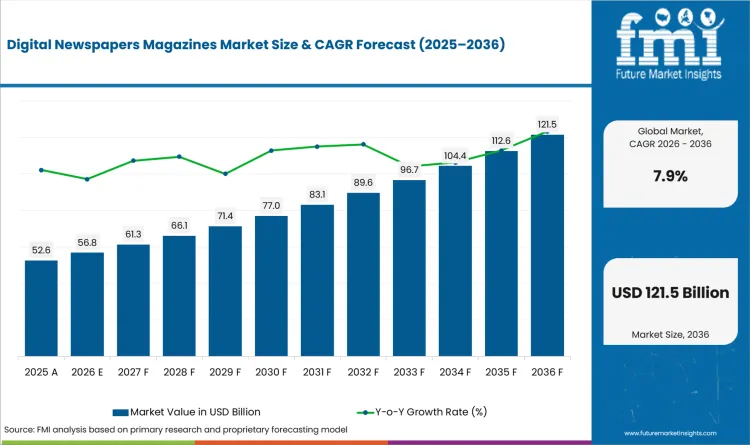
USD 56.8 billion in 2026 and USD 121.5 billion by 2036 at a 7.9% CAGR.
Demand for digital newspapers and magazines is projected to expand at 7.9% CAGR between 2026 and 2036, increasing valuation from USD 56.8 billion in 2026 to USD 121.5 billion by 2036. Recurring revenue depends on turning frequent reading into paid habits that remain useful beyond a single news event. The report noted in June 2026 that online news payment remained at 17% across its surveyed country basket. The modest payment level requires publishers to combine distinctive reporting with transparent pricing and products that support repeated personal or professional decisions. Investment in digital publishing platforms helps publishers manage accounts and deliver several formats across one direct relationship. Renewal evidence therefore carries more commercial weight than traffic volume during newsroom expansion or subscriber acquisition decisions.
Discovery patterns are creating a second commercial test because publishers need external reach without surrendering the direct relationship required for renewal. As per a report, in June 2026, social and video platforms reached 54% of respondents versus 51% for publisher websites and applications. The same report recorded a 33% decline in Google organic traffic across more than 2,500 sites between November 2024 and November 2025. Publishers use audience intelligence systems to identify cohorts that return through owned channels rather than isolated referral spikes. Content delivery networks protect access during sudden traffic surges and reduce the risk that technical failure interrupts paid use. Direct discovery creates durable value as registered readers continue using the publication beyond major news cycles or temporary external interest.
Key Takeaways of Digital Newspapers Magazines Market
- Reader revenue expands through distinctive reporting and repeat-use products that create a direct relationship beyond anonymous traffic volume.
- Digital newspapers are expected to account for 38.0% of product type revenue in 2026 through continuous updates and direct mobile access.
- News and current affairs is projected to represent 36.0% of application revenue in 2026 through frequent information needs and established newsroom trust.
- Individual consumers are anticipated to capture 54.0% of end user revenue in 2026 through personal subscriptions and advertising-supported reading sessions.
- Free alternatives and platform dependence constrain paid conversion across publications that lack distinctive local or professional utility.
- Competition combines scaled subscription groups with regional publishers and specialist titles that defend narrow audience needs through editorial depth.
Analyst Perspective
“Digital newspaper and magazine economics improve as a publication becomes part of a reader’s routine rather than another interchangeable source. News brands should compare renewal by cohort across newsletters and audio products before expanding acquisition spending. A broad bundle creates value if every included product gives subscribers a clear reason to return after introductory pricing ends.”
- Rahul Pandita, Principal Analyst, Future Market Insights
How is the Digital Newspapers Magazines Market segmented?
The digital newspapers magazines market is segmented by Product Type, Application, End User, Distribution Channel, Revenue Model, and Region.
The segmentation framework separates the purchased publication from its editorial purpose, paying audience, distribution route, and revenue model. Product type includes digital newspapers, digital magazines, business and financial publications, academic and professional publications, and special-interest titles. Application groups news and current affairs, business and finance, lifestyle and entertainment, education and research, and sports and recreation. End user covers individual consumers, corporate organizations, educational institutions, government organizations, and media and advertising agencies. Distribution channel includes publisher websites, mobile applications, digital news aggregators, third-party subscription platforms, and enterprise licensing arrangements. Revenue model distinguishes subscription-based, advertising-supported, freemium, pay-per-article, and institutional licensing structures across countries with different payment habits and publisher ecosystems.
Why do digital newspapers hold the primary position within product type?
Digital newspapers offer continuous reporting and searchable archives through products that readers access across devices throughout the day. Professional readers gain recurring value from dependable daily updates rather than a fixed publication schedule. News Corporation reported in May 2026 that The Wall Street Journal reached approximately 4.3 million digital-only subscriptions during its fiscal third quarter, up 11% year over year. The scale shows how specialist journalism can support recurring payment without proving equivalent demand for every newspaper. Comparable publishing portfolios extend the relationship through newsletters and archives used between major reporting events.
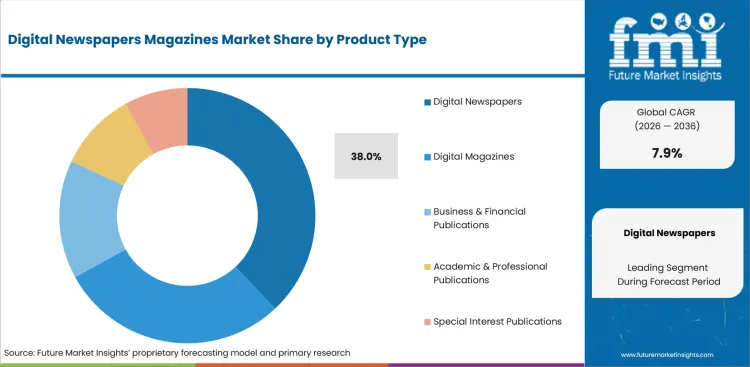
- Digital newspapers are set to lead the product type category with 38.0% share in 2026 due to continuous updates and direct subscription access. Frequent reporting creates more return occasions than fixed-edition products across breaking news and specialist coverage. Publisher-owned accounts also support newsletters and alerts that strengthen routine use across the complete renewal period.
- Newsrooms broaden adoption by combining core reporting with audio summaries and newsletters that fit commuting or workday reading routines. Mobile alerts can bring readers back to owned channels without requiring another search or social referral. Adoption weakens across general news if similar coverage remains free and the publication cannot demonstrate distinct local or professional utility.
What supports news and current affairs within the application category?
News and current affairs products support repeated decisions about politics, regulation and business conditions across professional and general audiences. Specialist readers value timely interpretation because broad headlines rarely explain how a policy change affects their work. Axel Springer announced in February 2026 that POLITICO would add a weekday German Pro newsletter covering artificial intelligence and digital policy. The launch shows how paid current-affairs products can address a recurring information task through focused editorial depth. Content intelligence tools organize related coverage without replacing the editorial judgment that defines a trusted publication.
- News and current affairs is projected to hold 36.0% share in 2026 owing to frequent information needs during political and commercial events. Trusted brands can convert repeated attention into subscription revenue or higher-value advertising across general and specialist products. The position depends on interpretation that remains useful beyond headlines already available through free channels.
- Publishers expand adoption through local reporting and specialist policy coverage that readers cannot replace with a broad national summary. Consistent newsletters create predictable reading habits across workdays and major policy events that require continuing interpretation. Subscription conversion weakens if general headlines attract temporary traffic but provide little reason for readers to maintain payment beyond the immediate event or introductory offer.
Why do individual consumers account for the largest end user share?
Individual consumers control subscriptions and generate advertising impressions through repeated sessions across smartphones and computers. Bundled portfolios can deepen household relationships by combining journalism with games, cooking and product guidance. The New York Times Company reported in May 2026 that it added 310,000 net digital-only subscribers and reached 13.08 million total subscribers. The result shows how several useful products can support one direct account without proving equal engagement across every bundle component. Digital content tools support newsletters and creator-led formats across distinct reader routines and publishing schedules.
- The end user category is forecast to be led by individual consumers at 54.0% share in 2026 due to personal subscriptions and frequent advertising exposure. Households can evaluate visible benefits across one account without waiting for an institutional licensing decision. Publishers gain direct renewal data but must explain pricing and cancellation terms across every paid component.
- Consumer adoption improves through introductory trials that lead into newsletters and mobile alerts built around repeated reading needs. Bundles perform better when each product supports a distinct routine instead of adding unused content to the account. Churn rises as promotional prices end if readers cannot identify continued value across the publications included in their subscription.
How do publisher websites shape the distribution channel category?
Publisher websites preserve direct registration data and give news brands control over subscription presentation across desktop and mobile sessions. Owned destinations gain value as publishers add several formats that make routine visits more useful. The Guardian introduced a redesigned application and global homepage in May 2025 with article audio, personalized feeds and daily puzzles. The release shows how one publisher-controlled destination can create several reasons for registered readers to return. Digital rights management supports consistent paid access across articles and archives without weakening the reader’s account experience.
- By distribution channel, publisher websites are estimated to hold 37.0% in 2026 owing to direct checkout and first-party audience measurement. Owned access gives publishers greater control over pricing and account communication across the subscription journey. The channel also connects reading behavior with renewal analysis without depending entirely on external referral data for each subscriber cohort.
- Website adoption improves through fast pages and personalized homepages that reward repeat visits across several editorial formats. Reliable account systems should preserve access across devices and make cancellation or renewal terms easy to understand. Interrupted access damages confidence in a paid product and can erase the advantage created by direct audience ownership during routine reading.
What keeps subscription-based offers ahead within revenue model?
Subscription revenue gives publishers a recurring payment stream that supports editorial planning and specialist newsroom investment. Portfolio economics improve as subscriber volume and renewal value increase across several publication brands and paid products. Condé Nast reported in February 2026 that subscription revenue grew 10% during 2025 while digital subscription revenue increased 29%. The results show how reader payments can expand beside advertising and commerce across a diversified magazine portfolio. Related ebook formats support portable access across longer reading sessions but follow different production and pricing economics.
- Subscription-based offers are likely to capture 42.0% share in 2026 attributable to predictable payments and direct customer accounts. Recurring billing supports longer editorial investment cycles than one-time article purchases across news and specialist titles. The model also gives product teams cohort-level renewal evidence that can guide pricing and bundle decisions over time.
- Publishers improve subscription adoption through bundles and specialist coverage that readers use across repeated personal or professional tasks. Transparent renewal prices reduce surprise during later billing cycles and make competing offers easier to compare. Adoption weakens if cancellation is difficult or a bundle contains several products that subscribers rarely use during normal routines.
What are the drivers, restraints, and opportunities in the Digital Newspapers Magazines Market?
Mobile news access and direct subscriptions support recurring revenue, while free alternatives and platform dependence restrict conversion. Specialist products and adjacent formats create practical routes for deeper engagement across owned and partner channels.
- Driver: Frequent online news use gives publishers repeated reader contact and supports direct registration across mobile devices.
- Restraint: Free alternatives and difficult paywall conversion limit recurring revenue across publications without distinctive editorial value.
- Opportunity: Specialist products and adjacent formats can deepen engagement through repeated professional or personal use across several publication categories.
Frequent online access creates a direct demand engine because readers can return several times each day through mobile devices. Publishers gain commercial value by converting repeated access into registered use rather than relying on anonymous visits. Ofcom reported in July 2025 that online news reached 70% of United Kingdom adults versus 68% for television and on-demand services. Registered accounts reveal which articles and formats support repeat reading across the same audience cohort. Editorial teams can use that evidence to design subscriptions around recurring needs rather than temporary traffic spikes.
Paywall resistance creates a material restraint for digital publications that offer broad coverage with limited differentiation. Readers often find similar headlines elsewhere without completing registration or accepting another recurring payment commitment. Pew Research Center reported in June 2025 that 53% of Americans encountering a paywall searched elsewhere while 32% stopped seeking the information. A restricted article creates a credible subscription route through continuing local or professional value that readers cannot replace easily. Publications without continuing utility face repeated abandonment throughout registration and introductory pricing before later renewal decisions.
Adjacent formats create an opportunity to deepen engagement without relying on one publication product or discovery channel. Short-form video can introduce editorial brands to audiences that do not begin on a publisher website. Condé Nast announced in July 2026 that thirteen brands would distribute videos to Netflix members across six English-speaking markets. Native advertising formats preserve brand context across partner distribution if sponsorship remains clear to readers. Programmatic display channels monetize registered audiences through measurable placements linked to known interests and reading patterns.
Which country CAGRs are profiled in the Digital Newspapers Magazines Market?
| Country | CAGR |
|---|---|
| Canada | 10.2% |
| Brazil | 9.1% |
| Germany | 8.6% |
| Australia | 8.2% |
| Japan | 7.6% |
| UK | 7.1% |
| USA | 5.7% |
How do country-level CAGRs compare in the Digital Newspapers Magazines Market?
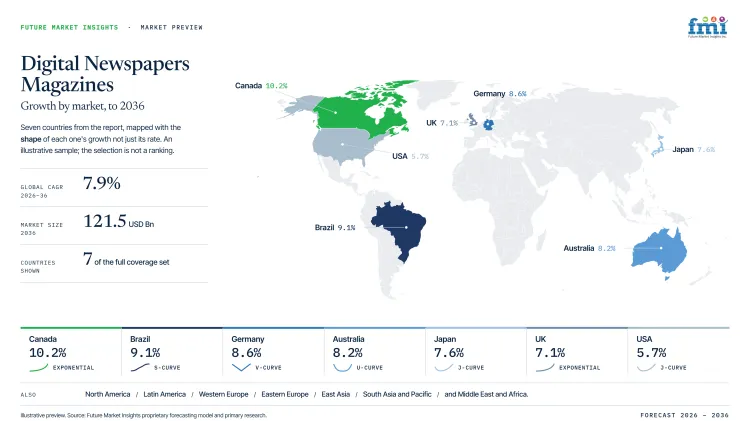
The profiled country rates span 4.5 percentage points between Canada and the USA across seven selected geographies. Canada and Brazil form a closely spaced growth band shaped by broad digital access and direct subscription potential. Germany and Australia create another narrow pairing while Japan and the UK remain separated by half a percentage point. The USA sits farther from the preceding group because abundant free alternatives place greater pressure on recurring payment conversion across fragmented local publishing environments. Each rate reflects local payment habits and direct-audience conditions rather than national internet access alone.
- Canada combines bilingual national brands with province-level local coverage that can support direct subscriptions across established news organizations.
- Brazil offers broad mobile readership across national and regional publications while household budgets favor lower-priced advertising and subscription packages.
- Germany has an expanding e-paper base that supports print conversion although public media and low online payment restrict broader adoption.
- Australia maintains high news access through several platforms while social discovery weakens direct publisher control over reader relationships.
- Japan retains a large print base that supports bundled conversion yet limited digital revenue slows portfolio-wide subscription development.
- The UK combines established national brands with extensive online news use while intermediary platforms remain central to routine discovery.
- The USA supports specialist subscriptions through extensive digital reach yet abundant free sources limit conversion across fragmented local publishing economics.
Country selection should weigh reader payment behavior beside addressable audience size and publication delivery economics. Growth becomes commercially useful if publishers preserve direct access and renew subscriptions without excessive discounting. The full report provides country-level CAGR analysis across North America, Latin America, Europe, East Asia, South Asia, Oceania and the Middle East and Africa.
Country-wise Analysis
- Canadian publishers serve English and French audiences through national brands and province-level outlets across a geographically dispersed readership. Digital newspaper and magazine demand in Canada is forecast to rise at 10.2% CAGR over the forecast period, supported by trusted domestic brands and direct reader accounts. Recurring provincial coverage gives subscription products a practical advantage over social feeds that cannot reproduce consistent local reporting. Statistics Canada reported in May 2026 that 66% of Canadians usually obtained information from news organizations versus 54% from social media. The established habit creates an acquisition route for domestic titles without proving that broad general news converts into payment. Misinformation concern remains a material friction because 61% of Canadians expressed strong concern about false online information during 2025.
- Brazilian publishers serve a mobile-first audience across wide income differences and diverse metropolitan or regional media environments. By 2036, Brazil’s digital newspaper and magazine market is projected to grow at 9.1% CAGR, reinforced by national publisher reach and frequent mobile news use. Mobile distribution gives national and regional publications a practical route to large audiences without relying on physical delivery networks. In June 2026, social media maintained a nine-point weekly news-source lead over television in Brazil. The same report found that 15% paid for online news and that the paying share had declined five points since 2023. Broad digital reach therefore supports audience acquisition, but lower-priced tiers and specialist utility remain necessary for recurring payment conversion.
- German publishers balance strong regional newspaper brands with public broadcasting and demanding consumer expectations for digital subscription services. Digital newspaper and magazine sales in Germany are forecast to expand at 8.6% CAGR by 2036, underpinned by established e-paper subscriptions across regional and national brands. Existing account relationships give publishers a practical route to introduce bundles without rebuilding payment trust from the beginning. A report published in June 2026 found that German digital newspaper subscriptions increased 8.5% to 2.77 million during late 2025. Wider conversion remains difficult because the same study found that 11% of respondents paid for online news.
- Australian publishers reach a concentrated urban population and smaller regional audiences spread across long service distances. The Australian digital newspaper and magazine sector is projected to record 8.2% CAGR during the assessment period, supported by widespread news access and established national brands. Regional publications need membership and advertising products that remain viable across smaller audience pools and higher reporting costs. ACMA reported in May 2026 that 92% of Australian adults accessed news while social media reached 43% and news websites reached 39%. The broad audience gives national publishers a direct subscription enabler across applications and owned websites. Platform dependence remains a material friction because social discovery reaches more adults than publisher websites during routine access.
- Japanese publishers retain significant print bundles and long-standing distribution relationships across national and regional newspapers. Adoption of digital newspaper and magazine products in Japan is estimated to expand at 7.6% CAGR through 2036, influenced by gradual conversion of print relationships into paid digital accounts. Large publishers can expand offerings with mobile access and specialist tools while preserving familiar subscription relationships across households and workplaces. A survey reported in June 2026 that daily newspaper circulation fell to 24 million during October 2025 while Nikkei reached 1.21 million digital subscribers. Portfolio investment remains constrained among smaller publishers because seventy-four of seventy-nine newspapers received less than 5% of revenue from digital sales.
- United Kingdom publishers compete through strong national brands as social platforms influence routine discovery and audience access. The UK’s digital newspaper and magazine outlook is anticipated to advance at 7.1% CAGR over the assessment period, aided by established subscription products and membership models. In June 2026, it was reported that 73% of Britons distrusted news on social media and 77% expressed concern about misinformation. The trust gap gives owned publisher channels a clearer reason for direct registration and repeated use. National brands can convert that concern into paid relationships through distinctive reporting and transparent account terms. Platform exposure remains a friction because extensive digital reach does not guarantee direct account ownership or renewal.
- United States publishers operate across national brands and thousands of local outlets with sharply different audience economics. The United States digital newspaper and magazine market is estimated to post 5.7% CAGR over the forecast period, shaped by widespread digital news access and extensive free competition. Specialist products can convert recurring professional needs more effectively than broad headlines available across numerous free sources. Pew Research Center reported in September 2025 that 86% of American adults obtained news from digital devices at least sometimes. The broad reach enables direct subscriptions across national and local products with clear editorial utility. Payment conversion remains difficult as readers compare free alternatives and reserve recurring charges for coverage they cannot replace easily.
Who are the notable companies in the Digital Newspapers Magazines Market?
The New York Times Company, News Corp, Axel Springer SE, The Washington Post, Gannett Co., Inc., The Economist Group, Financial Times Group, Hearst Communications, Condé Nast, and Bonnier Group are notable companies in this market.
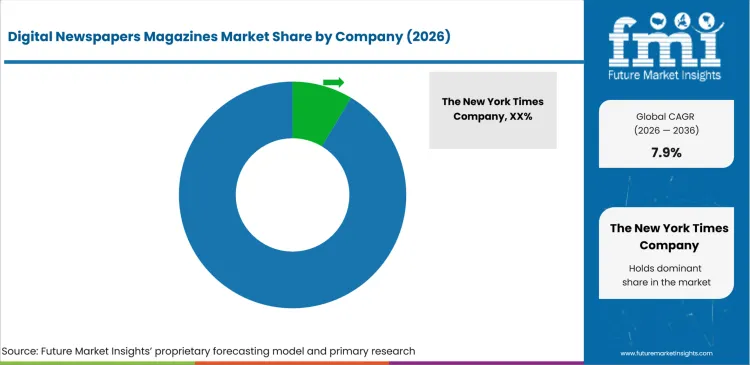
The competitive landscape combines a small group of scaled subscription publishers with a much wider field of local and specialist titles. Large groups compete through direct accounts and bundles that connect journalism with games and cooking alongside financial information or professional policy products. Regional publishers defend local reporting depth and advertiser relationships that global portfolios cannot reproduce consistently across every community. Specialist entrants can reach professional audiences through narrow coverage with clear decision value and recurring information needs. Credible entry requires sustained editorial investment before subscription habits develop across a new title and audience. Competitive advantage therefore rests on distinctive coverage, direct audience ownership and disciplined renewal pricing rather than publication volume alone.
- The New York Times Company and News Corp compete through scaled subscription portfolios that combine core journalism with professional or lifestyle products. Their breadth supports bundle testing and direct account management across several recurring reader needs without relying on one publication title or one discovery channel.
- Axel Springer SE and The Washington Post pursue professional audiences through policy intelligence and specialized digital news products. Their entry routes depend on expert coverage that supports recurring business decisions rather than broad consumer traffic across short news cycles or temporary political events.
- Gannett and Hearst Communications use local publication networks while Condé Nast and Bonnier Group combine specialist brands with subscription or advertising operations. Their portfolios defend audience depth through regional relevance and focused editorial communities without matching the largest global subscriber bases across every publication category.
Competitive Benchmarking: Digital Newspapers Magazines Market
| Company | Digital Subscription Capability | Advertising and Audience Products | Specialist Editorial Breadth | Geographic Reach |
|---|---|---|---|---|
| The New York Times Company | High | High | High | Global |
| News Corp | High | High | High | Global |
| Axel Springer SE | High | High | High | Multi-country |
| The Washington Post | Medium | High | Medium | North America |
| Gannett Co., Inc. | Medium | High | Medium | United States and UK |
| Financial Times Group | High | Medium | High | Global |
| Condé Nast | High | High | High | Global |
| Bonnier Group | High | Medium | High | Multi-country |
Key Developments in the Digital Newspapers Magazines Market
- In April 2025, The Washington Post partnered with OpenAI to place attributed summaries and links to original journalism inside ChatGPT search responses. The arrangement extends discovery beyond the publisher website while preserving a route to source articles. The commercial value depends on referral measurement because external distribution can increase audience reach without creating a direct registration or subscription relationship for the publication itself.
- In July 2025, Condé Nast moved WIRED Middle East from a licensed arrangement into its owned and operated regional portfolio. The transition placed the digital-first technology publication beside four established Middle East titles under direct company control. Ownership gives Condé Nast greater authority over audience products and commercial execution while requiring sustained local editorial investment across the regional digital publication.
- In February 2026, Axel Springer SE announced that POLITICO had acquired the German policy-monitoring platform Policylead. The completed transaction added regulatory tracking across European Union and German government levels to POLITICO’s journalism portfolio. The acquisition strengthens professional subscription utility by combining reporting with structured monitoring for companies and institutions that need daily policy updates and searchable archived regulatory alerts across Europe.
- In February 2026, Bonnier Group reported that Bonnier News had launched the +Pro professional product during 2025 and expanded its +Allt bundle beyond 1.15 million subscribers. The company stated that digital subscription revenue grew 14% during the year as portfolio access and specialist business coverage supported subscriber volume and average pricing. The development shows how a multi-title bundle can strengthen recurring reader value across several publication brands.
Key Players in the Digital Newspapers Magazines Market
Global News and Information Groups
- News Corp
- Axel Springer SE
- Hearst Communications
- Condé Nast
Direct Subscription Publishers
- The New York Times Company
- The Washington Post
- The Economist Group
- Financial Times Group
Regional and Portfolio Publishers
- Gannett Co., Inc.
- Bonnier Group
Digital Newspapers Magazines Market - Report Scope
| Coverage field | Report scope |
|---|---|
| Market breakdown | Product type, application, end user, distribution channel, revenue model, and region. |
| Market Definition | Paid and advertising-supported digital newspapers and magazines distributed through publisher websites, mobile applications, aggregators, newsletters, and digital subscription services. |
| Regions Covered | North America, Latin America, Western Europe, Eastern Europe, East Asia, South Asia and Pacific, and Middle East and Africa. |
| Countries Covered | Canada, Brazil, Germany, Australia, Japan, UK, and USA. |
| Key Companies Profiled | The New York Times Company, News Corp, Axel Springer SE, The Washington Post, Gannett Co., Inc., The Economist Group, Financial Times Group, Hearst Communications, Condé Nast, and Bonnier Group. |
| Forecast Period | 2026 to 2036. |
| Approach | Hybrid bottom-up and top-down market sizing supported by primary interviews and official desk research. |
Digital Newspapers Magazines Market - Research Methodology
| Method | Approach |
|---|---|
| Primary Research | FMI analysts gathered input from manufacturers, service providers, technology developers, distributors, end users, procurement teams, and subject-matter experts. Interviews examined purchasing decisions, product or service evaluation, adoption barriers, approval requirements, pricing considerations, and expectations for technical or commercial support. Respondents were also asked what evidence is required before a trial, pilot, or initial order develops into regular purchasing. |
| Desk Research | Desk research covered government statistics, regulatory publications, trade data, industry associations, technical literature, standards, company filings, product information, and official corporate announcements. Sources were reviewed for relevance, publication date, geographic coverage, and consistency with the defined market scope. Claims relating to performance, applications, approvals, capacity, investment, and commercial activity were retained only when supported by credible public evidence. |
| Market Sizing and Forecasting | The market model combined the baseline value with historical performance, segment structure, pricing and volume indicators, adoption levels, company participation, and country-level demand conditions. Forecast assumptions considered economic activity, investment trends, regulatory developments, technology adoption, purchasing cycles, supply availability, and barriers to wider market use. Segment and regional estimates were reconciled before the final market total was calculated. |
| Data Validation | Estimates were checked against multiple independent indicators, including public data, company activity, trade patterns, industry developments, and findings from primary interviews. Validation also tested whether products, services, applications, and company revenues fell within the defined market boundaries. Adjacent categories, unsupported claims, overlapping revenues, and activities without direct market relevance were excluded to reduce double counting and maintain consistency across segments and countries. |
Digital Newspapers Magazines Market by Segments
Digital Newspapers Magazines Market segmented by product type:
- Digital Newspapers
- Digital Magazines
- Business and Financial Publications
- Academic and Professional Publications
- Special Interest Publications
Digital Newspapers Magazines Market segmented by application:
- News and Current Affairs
- Business and Finance
- Lifestyle and Entertainment
- Education and Research
- Sports and Recreation
Digital Newspapers Magazines Market segmented by end user:
- Individual Consumers
- Corporate Organizations
- Educational Institutions
- Government Organizations
- Media and Advertising Agencies
Digital Newspapers Magazines Market segmented by distribution channel:
- Publisher Websites
- Mobile Applications
- Digital News Aggregators
- Third-Party Subscription Platforms
- Enterprise Licensing
Digital Newspapers Magazines Market segmented by revenue model:
- Subscription-Based
- Advertising-Supported
- Freemium Model
- Pay-Per-Article
- Institutional Licensing
Digital Newspapers Magazines Market by Region:
- North America
- United States
- Canada
- Latin America
- Brazil
- Mexico
- Argentina
- Chile
- Western Europe
- Germany
- France
- United Kingdom
- Italy
- Spain
- Benelux
- Nordics
- Eastern Europe
- Poland
- Czech Republic
- Romania
- Hungary
- East Asia
- China
- Japan
- South Korea
- South Asia and Pacific
- India
- ASEAN
- Australia and New Zealand
- Middle East and Africa
- GCC Countries
- South Africa
- Türkiye
- Israel
Research Sources and Bibliography
- Egan, J. (2026, June 16).
- Foran, H., & Bilodeau, H. (2026, May 13).
- Carro, R. (2026, June 16).
- Hölig, S., & Behre, J. (2026, June 16).
- Australian Communications and Media Authority. (2026, May 14).
- Sawa, Y., & Saisho, R. (2026, June 16).
- Egan, J. (2026, June 16).
- Pew Research Center. (2025, September 25).
- Tomasik, E., & Lipka, M. (2025, June 24).
- Ofcom. (2025, July 21)
- The New York Times Company. (2026, May 6).
- News Corporation. (2026, May 7).
- Gannett Co., Inc. (2025, August 1).
- The Economist Group. (2025, June 16).
- Condé Nast. (2026, February 27).
- The Guardian. (2025, May 7).
- Condé Nast. (2026, July 7).
- The Washington Post. (2025, April 22).
- The Washington Post. (2025, July 24)
- Condé Nast. (2025, July 6).
- Axel Springer SE. (2026, February 5).
- Axel Springer SE. (2026, February 10).
- Bonnier Group. (2026, February 19).
- Hearst Communications. (2025, February 18).
- Financial Times. (2025, March 6).
This bibliography is provided for reader reference and is not exhaustive. The full report contains the complete reference list and detailed citations
This Report Answers
- How large is the digital newspapers magazines market in 2026 and 2036?
- Which reader and publisher conditions support digital subscription revenue?
- Why do digital newspapers account for the primary product type share in 2026?
- How does news and current affairs shape application demand across digital publications?
- Why do individual consumers represent the largest end user share in 2026?
- How do country growth rates differ across Canada, Brazil, Europe, Japan, and the USA?
- Which companies operate digital newspaper and magazine subscription portfolios?
- What limits paywall conversion and direct audience access across publisher channels?
- How can bundles and specialist publications improve reader retention and recurring revenue?
Frequently Asked Questions
How big is the Digital Newspapers Magazines Market in 2026?
The digital newspapers magazines market is valued at USD 56.8 billion in 2026 and is forecast to reach USD 121.5 billion by 2036, reflecting growing demand for direct subscription products and recurring reader revenue across mobile-first news platforms and specialist digital publications.
What is the CAGR of the Digital Newspapers Magazines Market from 2026 to 2036?
The digital newspapers magazines market is projected to grow at a CAGR of 7.9% between 2026 and 2036, supported by frequent online news access that gives publishers repeated reader contact and direct registration opportunities across mobile devices and publisher-owned channels.
Which revenue model leads the Digital Newspapers Magazines Market?
Subscription-based offers account for 42.0% of the digital newspapers magazines market by revenue model in 2026, driven by predictable recurring payments that support longer editorial investment cycles and provide publishers with cohort-level renewal evidence to guide pricing and bundle decisions over time.
Which country is growing fastest in the Digital Newspapers Magazines Market?
The digital newspapers magazines market in Canada is projected to expand at a CAGR of 10.2% through 2036, ahead of Brazil at 9.1%, Germany at 8.6%, Australia at 8.2%, Japan at 7.6%, the UK at 7.1%, and the USA at 5.7%, reflecting trusted domestic news brands and established direct reader account relationships across English and French language publications.
Who are the leading companies in the Digital Newspapers Magazines Market?
Leading companies in the digital newspapers magazines market include The New York Times Company, News Corp, Axel Springer SE, The Washington Post, Gannett Co. Inc., The Economist Group, Financial Times Group, Hearst Communications, Condé Nast, and Bonnier Group, spanning global subscription portfolios, specialist professional publications, and regional multi-title publishing networks.
Preview the report firsthand - request a free sample
Get SampleGet the brochure for pricing and purchase details.
Get PDFTable of Content
- Key Takeaways
- Market Size and CAGR
- Top Growth Driver
- Fastest Growing Segment
- Leading Region
- Key Companies
- Emerging Opportunities
- Executive Summary
- Global Market Outlook
- Demand-side Trends
- Supply-side Trends
- Technology Roadmap Analysis
- Analysis and Recommendations
- Analyst Perspective (What is happening? Why now? What should investors know?)
- Key Questions Answered
- How large is the market?
- What is the CAGR?
- What are key trends?
- Which region dominates?
- Who are the leaders?
- Market Overview
- Market Coverage / Taxonomy
- Market Definition / Scope / Limitations
- Research Methodology
- Chapter Orientation
- Analytical Lens and Working Hypotheses
- Market Structure, Signals, and Trend Drivers
- Benchmarking and Cross-market Comparability
- Market Sizing, Forecasting, and Opportunity Mapping
- Research Design and Evidence Framework
- Desk Research Programme (Secondary Evidence)
- Expert Input and Fieldwork (Primary Evidence)
- Tooling, Models, and Reference Databases
- Data Engineering and Model Build
- Quality Assurance and Audit Trail
- Market Background
- Market Dynamics (Drivers, Restraints, Opportunity, Trends)
- Scenario Forecast (Optimistic, Likely, Conservative)
- Impact Analysis
- AI Impact
- Sustainability Impact
- Regulatory Impact
- Technology Impact
- Consumer / Buyer Analysis
- Purchase Drivers
- Adoption Barriers
- Buyer Journey
- Opportunity Map Analysis
- Product Life Cycle Analysis
- Supply Chain Analysis
- Investment Feasibility Matrix
- Value Chain Analysis
- PESTLE and Porter's Analysis
- Regulatory Landscape
- Regional Parent Market Outlook
- Production and Consumption Statistics
- Import and Export Statistics
- Global Market Analysis and Forecast, 2021 to 2036
- Historical Market Size Value (USD Billion) Analysis, 2021 to 2025
- Current and Future Market Size Value (USD Billion) Projections, 2026 to 2036
- Y-o-Y Growth Trend Analysis
- Absolute $ Opportunity Analysis
- Global Market Pricing Analysis, 2021 to 2036
- Global Market Analysis and Forecast, By Product Type, 2021 to 2036
- Introduction / Key Findings
- Historical Market Size Value (USD Billion) Analysis By Product Type, 2021 to 2025
- Current and Future Market Size Value (USD Billion) Analysis and Forecast By Product Type, 2026 to 2036
- Digital Newspapers
- General News Publications
- Business & Financial Newspapers
- Digital Magazines
- Lifestyle Magazines
- Fashion & Entertainment Magazines
- Business & Financial Publications
- Investment Publications
- Industry Journals
- Academic & Professional Publications
- Scientific Journals
- Professional Magazines
- Special Interest Publications
- Sports Publications
- Travel & Hobby Magazines
- Digital Newspapers
- Y-o-Y Growth Trend Analysis By Product Type, 2021 to 2025
- Absolute $ Opportunity Analysis By Product Type, 2026 to 2036
- Global Market Analysis and Forecast, By Application, 2021 to 2036
- Introduction / Key Findings
- Historical Market Size Value (USD Billion) Analysis By Application, 2021 to 2025
- Current and Future Market Size Value (USD Billion) Analysis and Forecast By Application, 2026 to 2036
- News & Current Affairs
- Politics
- Local & International News
- Business & Finance
- Market Analysis
- Investment News
- Lifestyle & Entertainment
- Fashion
- Celebrity & Entertainment
- Education & Research
- Academic Reading
- Professional Learning
- Sports & Recreation
- Sports News
- Travel & Leisure
- News & Current Affairs
- Y-o-Y Growth Trend Analysis By Application, 2021 to 2025
- Absolute $ Opportunity Analysis By Application, 2026 to 2036
- Global Market Analysis and Forecast, By End User, 2021 to 2036
- Introduction / Key Findings
- Historical Market Size Value (USD Billion) Analysis By End User, 2021 to 2025
- Current and Future Market Size Value (USD Billion) Analysis and Forecast By End User, 2026 to 2036
- Individual Consumers
- Personal Subscribers
- Premium Members
- Corporate Organizations
- Enterprise Subscribers
- Media Monitoring Firms
- Educational Institutions
- Universities
- Public Libraries
- Government Organizations
- Public Agencies
- Research Departments
- Media & Advertising Agencies
- Content Aggregators
- Digital Marketing Firms
- Individual Consumers
- Y-o-Y Growth Trend Analysis By End User, 2021 to 2025
- Absolute $ Opportunity Analysis By End User, 2026 to 2036
- Global Market Analysis and Forecast, By Distribution Channel, 2021 to 2036
- Introduction / Key Findings
- Historical Market Size Value (USD Billion) Analysis By Distribution Channel, 2021 to 2025
- Current and Future Market Size Value (USD Billion) Analysis and Forecast By Distribution Channel, 2026 to 2036
- Publisher Websites
- Direct Website Subscription
- Premium Digital Access
- Mobile Applications
- iOS Applications
- Android Applications
- Digital News Aggregators
- News Aggregation Platforms
- Content Discovery Apps
- Third-Party Subscription Platforms
- Bundle Subscription Services
- Digital Magazine Platforms
- Enterprise Licensing
- Corporate Access Programs
- Institutional Licenses
- Publisher Websites
- Y-o-Y Growth Trend Analysis By Distribution Channel, 2021 to 2025
- Absolute $ Opportunity Analysis By Distribution Channel, 2026 to 2036
- Global Market Analysis and Forecast, By Revenue Model, 2021 to 2036
- Introduction / Key Findings
- Historical Market Size Value (USD Billion) Analysis By Revenue Model, 2021 to 2025
- Current and Future Market Size Value (USD Billion) Analysis and Forecast By Revenue Model, 2026 to 2036
- Subscription-Based
- Monthly Subscription
- Annual Subscription
- Advertising-Supported
- Display Advertising
- Programmatic Advertising
- Freemium Model
- Limited Free Access
- Premium Content Upgrade
- Pay-Per-Article
- Single Article Purchase
- Day Pass Access
- Institutional Licensing
- Campus Licenses
- Corporate Licensing
- Subscription-Based
- Y-o-Y Growth Trend Analysis By Revenue Model, 2021 to 2025
- Absolute $ Opportunity Analysis By Revenue Model, 2026 to 2036
- Global Market Analysis and Forecast, By Region, 2021 to 2036
- Introduction
- Historical Market Size Value (USD Billion) Analysis By Region, 2021 to 2025
- Current Market Size Value (USD Billion) Analysis and Forecast By Region, 2026 to 2036
- North America
- Latin America
- Western Europe
- Eastern Europe
- East Asia
- South Asia and Pacific
- Middle East & Africa
- Market Attractiveness Analysis By Region
- North America Market Analysis and Forecast, By Country, 2021 to 2036
- Historical Market Size Value (USD Billion) Trend Analysis By Market Taxonomy, 2021 to 2025
- Market Size Value (USD Billion) Forecast By Market Taxonomy, 2026 to 2036
- By Country
- USA
- Canada
- By Product Type
- By Application
- By End User
- By Distribution Channel
- By Revenue Model
- By Country
- Market Attractiveness Analysis
- By Country
- By Product Type
- By Application
- By End User
- By Distribution Channel
- By Revenue Model
- Key Takeaways
- Latin America Market Analysis and Forecast, By Country
- Historical Market Size Value (USD Billion) Trend Analysis By Market Taxonomy, 2021 to 2025
- Market Size Value (USD Billion) Forecast By Market Taxonomy, 2026 to 2036
- By Country
- Brazil
- Mexico
- Chile
- Rest of Latin America
- By Product Type
- By Application
- By End User
- By Distribution Channel
- By Revenue Model
- By Country
- Market Attractiveness Analysis
- By Country
- By Product Type
- By Application
- By End User
- By Distribution Channel
- By Revenue Model
- Key Takeaways
- Western Europe Market Analysis and Forecast, By Country
- Historical Market Size Value (USD Billion) Trend Analysis By Market Taxonomy, 2021 to 2025
- Market Size Value (USD Billion) Forecast By Market Taxonomy, 2026 to 2036
- By Country
- Germany
- UK
- Italy
- Spain
- France
- Nordic
- BENELUX
- Rest of Western Europe
- By Product Type
- By Application
- By End User
- By Distribution Channel
- By Revenue Model
- By Country
- Market Attractiveness Analysis
- By Country
- By Product Type
- By Application
- By End User
- By Distribution Channel
- By Revenue Model
- Key Takeaways
- Eastern Europe Market Analysis and Forecast, By Country
- Historical Market Size Value (USD Billion) Trend Analysis By Market Taxonomy, 2021 to 2025
- Market Size Value (USD Billion) Forecast By Market Taxonomy, 2026 to 2036
- By Country
- Russia
- Poland
- Hungary
- Balkan & Baltic
- Rest of Eastern Europe
- By Product Type
- By Application
- By End User
- By Distribution Channel
- By Revenue Model
- By Country
- Market Attractiveness Analysis
- By Country
- By Product Type
- By Application
- By End User
- By Distribution Channel
- By Revenue Model
- Key Takeaways
- East Asia Market Analysis and Forecast, By Country
- Historical Market Size Value (USD Billion) Trend Analysis By Market Taxonomy, 2021 to 2025
- Market Size Value (USD Billion) Forecast By Market Taxonomy, 2026 to 2036
- By Country
- China
- Japan
- South Korea
- By Product Type
- By Application
- By End User
- By Distribution Channel
- By Revenue Model
- By Country
- Market Attractiveness Analysis
- By Country
- By Product Type
- By Application
- By End User
- By Distribution Channel
- By Revenue Model
- Key Takeaways
- South Asia and Pacific Market Analysis and Forecast, By Country
- Historical Market Size Value (USD Billion) Trend Analysis By Market Taxonomy, 2021 to 2025
- Market Size Value (USD Billion) Forecast By Market Taxonomy, 2026 to 2036
- By Country
- India
- ASEAN
- Australia & New Zealand
- Rest of South Asia and Pacific
- By Product Type
- By Application
- By End User
- By Distribution Channel
- By Revenue Model
- By Country
- Market Attractiveness Analysis
- By Country
- By Product Type
- By Application
- By End User
- By Distribution Channel
- By Revenue Model
- Key Takeaways
- Middle East & Africa Market Analysis and Forecast, By Country
- Historical Market Size Value (USD Billion) Trend Analysis By Market Taxonomy, 2021 to 2025
- Market Size Value (USD Billion) Forecast By Market Taxonomy, 2026 to 2036
- By Country
- Kingdom of Saudi Arabia
- Other GCC Countries
- Türkiye
- South Africa
- Other African Union
- Rest of Middle East & Africa
- By Product Type
- By Application
- By End User
- By Distribution Channel
- By Revenue Model
- By Country
- Market Attractiveness Analysis
- By Country
- By Product Type
- By Application
- By End User
- By Distribution Channel
- By Revenue Model
- Key Takeaways
- Key Countries Market Analysis
- USA
- Pricing Analysis
- Market Share Analysis, 2025
- By Product Type
- By Application
- By End User
- By Distribution Channel
- By Revenue Model
- Canada
- Pricing Analysis
- Market Share Analysis, 2025
- By Product Type
- By Application
- By End User
- By Distribution Channel
- By Revenue Model
- Mexico
- Pricing Analysis
- Market Share Analysis, 2025
- By Product Type
- By Application
- By End User
- By Distribution Channel
- By Revenue Model
- Brazil
- Pricing Analysis
- Market Share Analysis, 2025
- By Product Type
- By Application
- By End User
- By Distribution Channel
- By Revenue Model
- Chile
- Pricing Analysis
- Market Share Analysis, 2025
- By Product Type
- By Application
- By End User
- By Distribution Channel
- By Revenue Model
- Germany
- Pricing Analysis
- Market Share Analysis, 2025
- By Product Type
- By Application
- By End User
- By Distribution Channel
- By Revenue Model
- UK
- Pricing Analysis
- Market Share Analysis, 2025
- By Product Type
- By Application
- By End User
- By Distribution Channel
- By Revenue Model
- Italy
- Pricing Analysis
- Market Share Analysis, 2025
- By Product Type
- By Application
- By End User
- By Distribution Channel
- By Revenue Model
- Spain
- Pricing Analysis
- Market Share Analysis, 2025
- By Product Type
- By Application
- By End User
- By Distribution Channel
- By Revenue Model
- France
- Pricing Analysis
- Market Share Analysis, 2025
- By Product Type
- By Application
- By End User
- By Distribution Channel
- By Revenue Model
- India
- Pricing Analysis
- Market Share Analysis, 2025
- By Product Type
- By Application
- By End User
- By Distribution Channel
- By Revenue Model
- ASEAN
- Pricing Analysis
- Market Share Analysis, 2025
- By Product Type
- By Application
- By End User
- By Distribution Channel
- By Revenue Model
- Australia & New Zealand
- Pricing Analysis
- Market Share Analysis, 2025
- By Product Type
- By Application
- By End User
- By Distribution Channel
- By Revenue Model
- China
- Pricing Analysis
- Market Share Analysis, 2025
- By Product Type
- By Application
- By End User
- By Distribution Channel
- By Revenue Model
- Japan
- Pricing Analysis
- Market Share Analysis, 2025
- By Product Type
- By Application
- By End User
- By Distribution Channel
- By Revenue Model
- South Korea
- Pricing Analysis
- Market Share Analysis, 2025
- By Product Type
- By Application
- By End User
- By Distribution Channel
- By Revenue Model
- Russia
- Pricing Analysis
- Market Share Analysis, 2025
- By Product Type
- By Application
- By End User
- By Distribution Channel
- By Revenue Model
- Poland
- Pricing Analysis
- Market Share Analysis, 2025
- By Product Type
- By Application
- By End User
- By Distribution Channel
- By Revenue Model
- Hungary
- Pricing Analysis
- Market Share Analysis, 2025
- By Product Type
- By Application
- By End User
- By Distribution Channel
- By Revenue Model
- Kingdom of Saudi Arabia
- Pricing Analysis
- Market Share Analysis, 2025
- By Product Type
- By Application
- By End User
- By Distribution Channel
- By Revenue Model
- Türkiye
- Pricing Analysis
- Market Share Analysis, 2025
- By Product Type
- By Application
- By End User
- By Distribution Channel
- By Revenue Model
- South Africa
- Pricing Analysis
- Market Share Analysis, 2025
- By Product Type
- By Application
- By End User
- By Distribution Channel
- By Revenue Model
- USA
- Market Structure Analysis
- Competition Dashboard
- Competition Benchmarking
- Market Share Analysis of Top Players
- By Regional
- By Product Type
- By Application
- By End User
- By Distribution Channel
- By Revenue Model
- Emerging Startups
- Innovation Benchmarking
- Competition Analysis
- Competition Deep Dive
- The New York Times Company
- Overview
- Product Portfolio
- Profitability by Market Segments
- Sales Footprint
- Strategy Overview
- Marketing Strategy
- Product Strategy
- Channel Strategy
- News Corp
- Axel Springer SE
- The Washington Post
- Gannett Co., Inc.
- The Economist Group
- Financial Times Group
- Hearst Communications
- Condé Nast
- Bonnier Group
- The New York Times Company
- Case Studies
- Success Stories
- Recent Developments
- Competition Deep Dive
- Assumptions & Acronyms Used


