

- Market Size (2026)
- USD 624.5 Mn
- Forecast (2036)
- USD 1505.8 Mn
- CAGR (2026 to 2036)
- 9.2%
How big is Digital Orthodontics Workflow Solutions Market in 2026?
USD 624.5 million in 2026 and USD 1,505.8 million by 2036 at a 9.2% CAGR.
Sales of digital orthodontics workflow solutions stand at USD 624.5 million in 2026 and climb to USD 1505.8 million by 2036, growing at a 9.2% CAGR. Growth is driven by clinics moving away from fragmented case files split across scanners, treatment-planning software, and paper charts toward a single workflow that keeps scan records, treatment plans, and approval history connected from first visit through follow-up care. Orthodontic practices scaling clear-aligner and digital-impression caseloads need that continuity most, since rebuilding case history by hand every time a patient moves between the scanner and the planning tool slows staff down and creates room for records to fall out of sync.
Integration friction between scanner hardware, planning software, and lab or manufacturing partners works against faster adoption, and a workflow that forces staff to re-enter data at each handoff undermines the time savings it's meant to deliver. Clinics also weigh how much control the orthodontist retains over plan review when more of the process is automated, since oversight at the approval step remains central to clinical liability. The stronger opportunities lie in software that connects directly to multiple scanner brands rather than locking clinics into one hardware ecosystem, cloud-based case sharing between general dentists and orthodontists, and AI-assisted treatment planning that still routes final approval through the clinician. By software type, end user, and application, integration depth and adoption pace differ enough to warrant separate treatment later. Regionally, adoption concentrates where clear-aligner treatment volume is already high, since that caseload gives clinics the clearest return on standardizing their digital workflow.
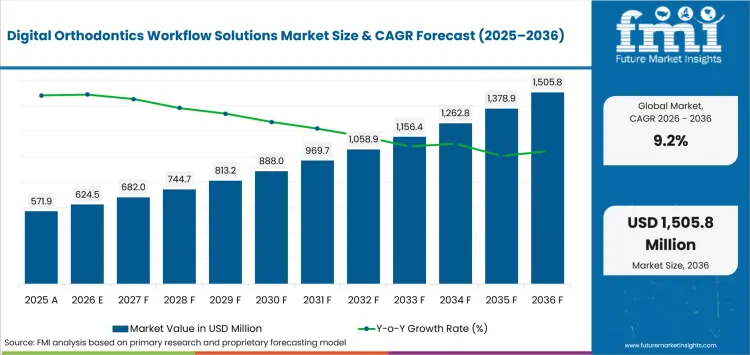
Key Takeaways of Digital Orthodontics Workflow Solutions Market
- Demand for digital orthodontics workflow solutions is driven by practices moving patient scans and treatment plans into one connected working record with clear clinical ownership.
- By component, software holds the leading share at 41.4% in 2026, reflecting its role as the main control layer for digital orthodontic cases.
- Treatment planning is the dominant application segment, holding 38.1% share in 2026, through its role converting scans into reviewed clinical plans.
- Dental clinics lead end-user demand at 41.7% share in 2026, as most adoption decisions are shaped by chairside scan capture and patient communication.
- Cloud-based deployment holds 63.0% share in 2026, due to shared access across doctors and clinic locations for multi-site practices.
- South Korea, the UK, and the USA record CAGRs of 11.4%, 10.4%, and 9.8% respectively through 2036, while Japan and Germany follow distinct paths shaped by compact workflow needs and governed-record privacy expectations.
- Competition centers on Align Technology, Dentsply Sirona, 3Shape, Carestream Dental, Planmeca, DentalMonitoring, and Ormco, with vendors differentiating through treatment-planning workflows, scan/imaging capability, practice-software integration, and remote monitoring depth.
Analyst Perspective
The real test for a digital orthodontics platform isn't whether it can plan a case but whether it removes a handoff without adding a new one somewhere else in the chairside routine, since software that shows the orthodontist's decision but still forces staff to re-enter data into a separate lab system hasn't actually solved the workflow problem it was bought to fix. Cloud deployment's appeal for multi-site practices is real, but the format only holds up commercially if vendors can back uptime and data-security claims with contract terms clinics can act on during an outage, not just marketing language about accessibility. Treatment planning's central role in the buying decision suggests clinics are evaluating software less on feature count and more on whether revisions and approvals stay traceable without someone hunting across separate files to reconstruct what changed and why.
-Anurag Sharma, Principal Analyst at Future Market Insights
Source: FMI's proprietary forecasting model and primary research
How is the Digital Orthodontics Workflow Solutions Market segmented?
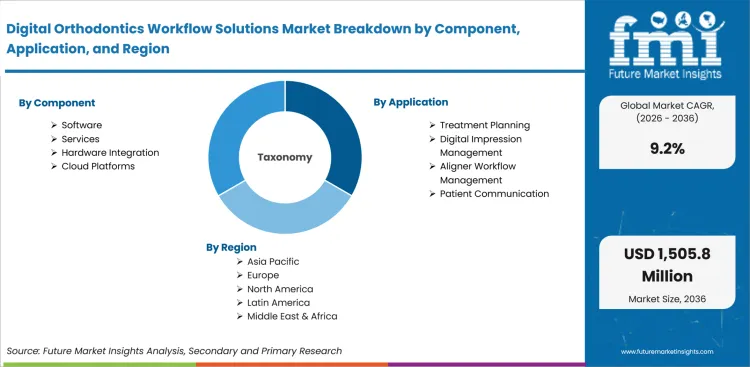
The digital orthodontics workflow solutions industry is segmented by component, application, end user, deployment, and region.
The segmentation framework separates software control from the work performed in daily orthodontic care. Component analysis covers software, services, and hardware used to manage digital cases. Application analysis follows treatment planning, patient communication, imaging workflow, remote monitoring, and case documentation. End-user categories cover dental clinics, orthodontic chains, hospitals, academic centers, and dental laboratories. Deployment compares cloud-based and on-premise systems. Regional analysis shows how clinic structure and digital-health policy affect adoption across countries.
What supports demand for software within the component category?
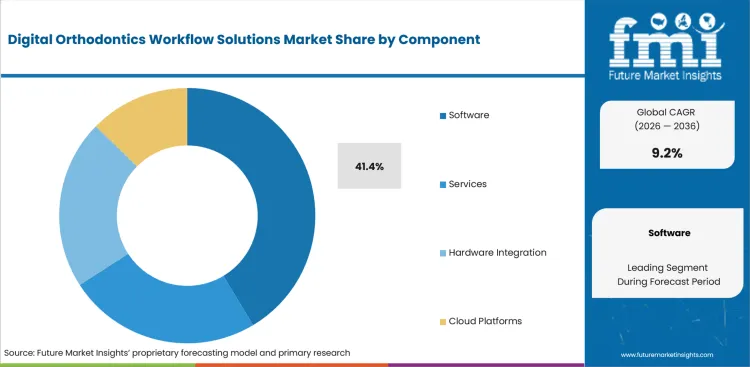
Software is expected to hold 41.4% of the Component category in 2026. Its lead reflects the role of planning tools and case dashboards inside one workflow. Clinics place value on software when it reduces repeated record work and makes each plan easier to review.
- Software demand is expected to rise where practices already use digital records and intraoral scans. These practices want fewer handoffs between records and treatment planning. Adoption improves when each case update shows the clinical decision and the next step.
- Staff confidence remains part of the purchase test. A software offer is easier to defend when it shows how the orthodontist reviews movement and how the lab receives case instructions.
How does treatment planning shape demand within the application category?
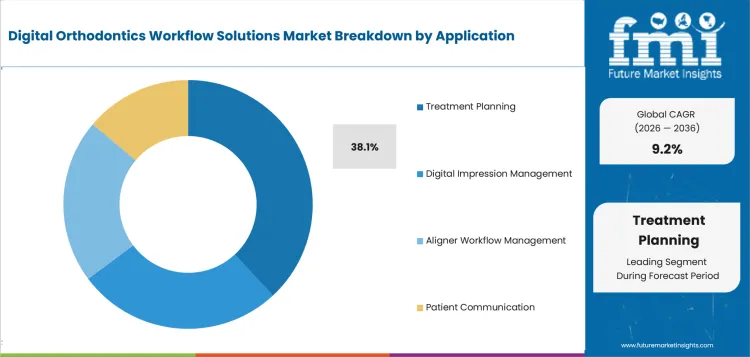
Treatment Planning is projected to represent 38.1% of the Application category in 2026. The share reflects the point where scans become a clinical plan and a patient-facing case discussion. This makes planning software central to the buying case.
- Treatment Planning gains preference when it makes plan review easier for the orthodontist. A clear workflow allows staff to follow revisions and approvals without searching across separate files.
- Clinics are expected to compare planning systems through accuracy and daily usability. The practical value comes from fewer repeated steps and clearer handoff between scanning and aligner ordering.
Why do dental clinics lead demand within the end user category?
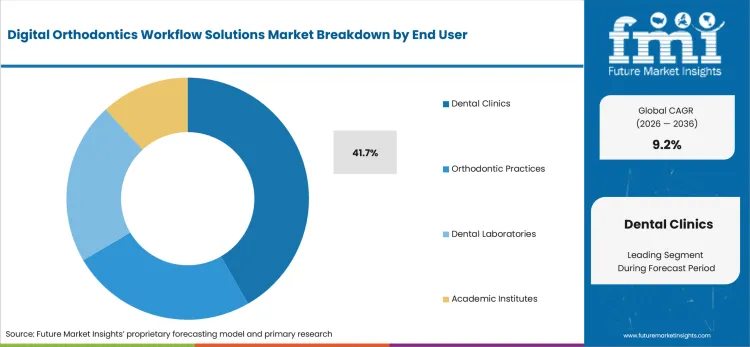
Dental Clinics are estimated to hold 41.7% of End User demand in 2026. Most adoption decisions are made close to the chairside workflow where scan capture and patient communication happen during routine care.
- Dental Clinics are expected to lead because they handle the first scan and explain the case to the patient. Workflow software helps them keep treatment choices and patient approvals in one place.
- Multi-chair clinics favor tools that reduce repeated entry between the scanner and the treatment plan. The same benefit is valuable for small practices when staff time is limited.
What makes cloud-based deployment the leading format?
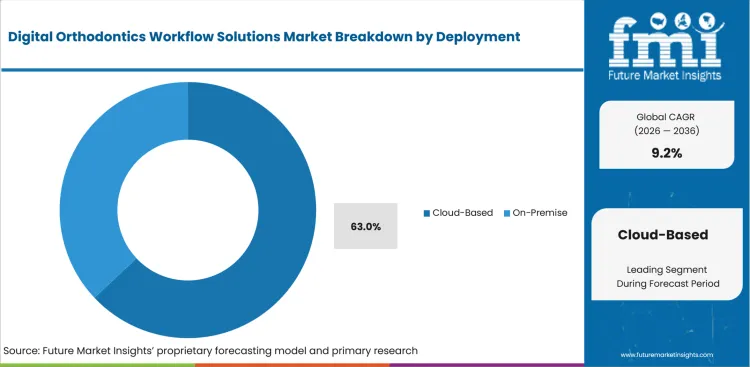
Cloud-Based deployment is forecast to account for 63.0% share in 2026. Its lead is tied to easier access across clinic locations and faster updates for planning tools. This format is useful where specialists review cases away from the scan room.
- Cloud deployment is expected to suit practices that manage several doctors or locations. Shared access supports review and follow-up without moving case files manually across devices.
- The format still has to meet privacy and uptime expectations. Vendors are expected to explain data controls and support response before clinics shift routine work to the cloud.
What are the drivers, restraints, and opportunities in the Digital Orthodontics Workflow Solutions Market?
Clinic demand is rising when workflow software reduces repeated entry and keeps clinical review visible. Adoption slows when data controls and staff training are unclear.
- Driver: Clinic operators are expected to invest when workflow software reduces repeated entry and protects clinical review.
- Restraint: Adoption slows when integration effort and training time remain unclear for ordinary practices.
- Opportunity: Cloud case records are expected to improve patient communication and make lab collaboration easier.
Workflow accountability is the main driver. Orthodontic cases pass through scanning and diagnosis before staging and patient approval. FDA listed Invisalign System 510(k) K252380 with an August 29 2025 decision date. The regulatory record keeps clear-aligner planning visible for USA software teams. Planning speed matters when clinics want faster review without losing clinical control.
Data governance remains the main restraint. Practices are cautious when a new tool adds screens without reducing error risk. HHS proposed HIPAA Security Rule changes in January 2025 that would require technology asset inventories at least once every 12 months. Vendors need to show how patient data stays controlled after installation.
The clearest opportunity is a connected case pathway. In February 2026, 3Shape released TRIOS and Unite 25.1 with collaboration workflows and scanning improvements. The update shows how case information is moving closer to chairside communication. Clinics gain value when one platform supports review and follow-up without adding record work.
Which country CAGRs are profiled in the Digital Orthodontics Workflow Solutions Market?
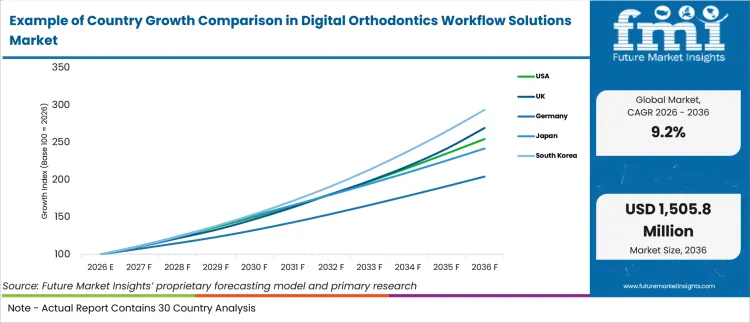
| Country | CAGR |
|---|---|
| USA | 9.8% |
| UK | 10.4% |
| Germany | 7.4% |
| Japan | 9.2% |
| South Korea | 11.4% |
How do country-level CAGRs compare in the digital orthodontics workflow solutions market?
The country comparison shows moderate spread across five markets. South Korea leads at 11.4% CAGR and Germany records the lowest disclosed rate at 7.4%. The spread reflects differences in clinic scale and digital-health readiness. It does not represent a claim about every national market.
- South Korea leads the profile and shows the fastest adoption path among the markets shown.
- The UK follows closely because clinic capacity and private orthodontic demand support workflow investment.
- USA and Japan form a middle band with different purchase reasons.
- Germany records the lowest disclosed rate yet remains a steady market for governed workflows.
- The pattern resembles a measured step-down and not a split between developed and immature markets.
Markets with similar CAGRs can still present different entry conditions due to local policy and clinic readiness. The full report provides country-level analysis across North America, Latin America, Europe, East Asia, South Asia, Oceania and the Middle East and Africa.
Country-wise Analysis
- The United States combines a large dental-care base with established clear-aligner workflows and growing use of practice-management software. Digital orthodontics workflow demand in the USA is projected to rise at 9.8% CAGR from 2026 to 2036, supported by regulated treatment-planning systems and broad dentist availability. Practice groups are expected to prefer platforms that retain scan files, treatment revisions and patient approvals within one case record. Software vendors should demonstrate that shorter planning cycles also improve review quality before broader implementation.
- UK dental practices face capacity pressure and require clearer communication across orthodontic treatment stages. Adoption in the UK is forecast to expand at 10.4% CAGR through 2036, supported by registered workforce growth and continued patient-flow pressure. NHS Business Services Authority reported that 18 million adult patients were seen during the 24 months ending March 31 2025. These figures support demand for workflow tools that reduce manual follow-up and improve case visibility across clinic teams. System selection should prioritize practical training and evidence that software improves daily clinic capacity without adding extra administrative work.
- Germany offers a regulated dental-care environment where software adoption depends on privacy compliance and formal control of clinical records. The German market is projected to record 7.4% CAGR during the forecast period, supported by dental-practice revenue and electronic patient-record implementation. Germany’s health ministry states that all service providers have been required to use the electronic patient record since October 1 2025. These conditions support demand for orthodontic workflow systems that document treatment decisions and data access clearly. Vendors should provide German-language training and dependable data controls because smaller practices may require longer approval cycles.
- Japanese clinics are expected to favor compact digital workflows that reduce repeated entry while preserving careful clinical review. Adoption in Japan is estimated to advance at 9.2% CAGR through 2036, supported by healthcare digitalization and disciplined practice operations. Japan’s Digital Agency updated its Healthcare DX Dashboard in July 2026, covering online eligibility checks, electronic records and personal health record activity. The digital-health policy environment supports better data continuity, while fewer clinic sites limit expansion through new locations. Software selection should favor simple interfaces and reliable local support that reduce workflow disruption.
- South Korea combines rapid adoption of patient-facing technology with demand from medical tourism and digitally active dental clinics. Digital orthodontics workflow sales in South Korea are predicted to advance at 11.4% CAGR by 2036, reinforced by fast clinic evaluation and overseas-patient demand. Korea.net reported in April 2026 that 2.01 million foreign patients visited Korea in 2025 and dental-clinic visits increased 128.9% from the previous year. Cloud case records are expected to gain value where clinics manage consultation, treatment planning and follow-up communication for domestic and overseas patients. Vendors should prioritize data protection and service responsiveness because patient information remains central to these workflows.
Who are the notable companies in the digital Orthodontics Workflow Solutions Market?
Align Technology, Dentsply Sirona, 3Shape, Carestream Dental, Planmeca, DentalMonitoring, Ormco, Angelalign Technology, Straumann are the notable companies shaping this market.
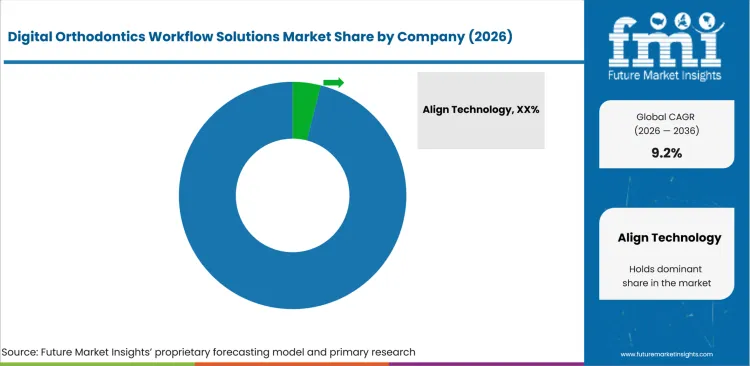
The competitive outlook combines clear-aligner planning platforms with scanner and imaging software providers. Companies compete through case planning quality and easier daily use inside clinics. Practice software groups strengthen the wider record environment that surrounds treatment planning. Commercial success depends on whether the platform improves case review without adding extra steps for the doctor.
- Align Technology and Dentsply Sirona compete through clear-aligner planning workflows that support doctor review and case setup.
- 3Shape and Carestream Dental support scan and imaging workflows used before treatment planning starts.
- Planmeca strengthens practice software and equipment ecosystems around digital dental workflows.
Competitive Benchmarking: Digital Orthodontics Workflow Solutions Market
| Company | Planning Workflow | Scan or Imaging Workflow | Practice Software Fit | Geographic Reach |
|---|---|---|---|---|
| Align Technology | High | High | Medium | Global |
| Dentsply Sirona | High | Medium | Medium | Global |
| 3Shape | Medium | High | Medium | Global |
| Carestream Dental | Medium | High | Medium | Global |
| Planmeca | Medium | High | Medium | Global |
| DentalMonitoring | Medium | Medium | High | Global |
| Ormco | High | Medium | Low | Global |
| Angelalign Technology | High | Medium | Low | East Asia and global expansion |
| Straumann | Medium | Medium | Medium | Global |
Key Developments in the Digital Orthodontics Workflow Solutions Market
- In October 2025, Align Technology announced ClinCheck Live Plan for Invisalign digital treatment planning. The company stated that eligible initial doctor-ready treatment plans could be generated within 15 minutes. The release gives orthodontic practices a faster route from case submission to doctor review.
- In October 2025, Carestream Dental launched CS 3D Imaging Premium, designed to improve case sharing and planning tasks. The launch strengthens the imaging side of digital dental workflows used before orthodontic or implant treatment decisions.
Key Players in the Digital Orthodontics Workflow Solutions Market
Clear-Aligner and Treatment Planning Providers
- Align Technology
- Dentsply Sirona
- Ormco
- Angelalign Technology
Scanner and Imaging Workflow Providers
- 3Shape
- Carestream Dental
- Planmeca
- Straumann
Practice Software and Monitoring Providers
- DentalMonitoring
Digital Orthodontics Workflow Solutions Market - Report Scope
| Coverage field | Report scope |
|---|---|
| Market breakdown | Component, application, end user, deployment, and region. |
| Quantitative Units | Revenue in USD Million, CAGR in %. |
| Market Definition | Products and services used to plan and manage orthodontic workflows. The scope includes digital scans and treatment plans. It covers aligner cases and patient follow-up. |
| Regions Covered | North America, Latin America, Europe, East Asia, South Asia, Oceania, and Middle East and Africa. |
| Countries Covered | USA, UK, Germany, Japan, and South Korea. |
| Key Companies Profiled | Align Technology, Dentsply Sirona, 3Shape, Carestream Dental, Planmeca, DentalMonitoring, Ormco, Angelalign Technology, and Straumann |
| Forecast Period | 2026 to 2036. |
| Approach | Hybrid bottom-up and top-down market sizing supported by primary interviews and official desk research. |
Digital Orthodontics Workflow Solutions Market - Research Methodology
| Method | Approach |
|---|---|
| Primary Research | FMI analysts gathered input from manufacturers, service providers, technology developers, distributors, end users, sourcing teams, and subject-matter experts. Interviews examined purchasing decisions, product or service evaluation, adoption barriers, approval requirements, pricing considerations, and expectations for technical or commercial support. Respondents were also asked what evidence is required before a trial, pilot, or initial order develops into regular purchasing. |
| Desk Research | Desk research covered government statistics, regulatory publications, trade data, industry associations, technical literature, standards, company filings, product information, and official corporate announcements. Sources were reviewed for relevance, publication date, geographic coverage, and consistency with the defined market scope. Claims relating to performance, applications, approvals, capacity, investment, and commercial activity were retained only when supported by credible public evidence. |
| Market Sizing and Forecasting | The market model combined the baseline value with historical performance, segment structure, pricing and volume indicators, adoption levels, company participation, and country-level demand conditions. Forecast assumptions considered economic activity, investment trends, regulatory developments, technology adoption, purchasing cycles, supply availability, and barriers to wider market use. Segment and regional estimates were reconciled before the final market total was calculated. |
| Data Validation | Estimates were checked against multiple independent indicators, including public data, company activity, trade patterns, industry developments, and findings from primary interviews. Validation also tested whether products, services, applications, and company revenues fell within the defined market boundaries. Adjacent categories, unsupported claims, overlapping revenues, and activities without direct market relevance were excluded to reduce double counting and maintain consistency across segments and countries. |
Digital Orthodontics Workflow Solutions Market by Segments
Digital Orthodontics Workflow Solutions Market segmented by Component:
- Software
- Services
- Hardware
Digital Orthodontics Workflow Solutions Market segmented by Application:
- Treatment Planning
- Patient Communication
- Imaging Workflow
- Remote Monitoring
- Case Documentation
Digital Orthodontics Workflow Solutions Market segmented by End User:
- Dental Clinics
- Orthodontic Chains
- Hospitals
- Academic and Research Centers
- Dental Laboratories
Digital Orthodontics Workflow Solutions Market segmented by Deployment:
- Cloud-Based
- On-Premise
Digital Orthodontics Workflow Solutions Market by Region:
- North America
- United States
- Canada
- Latin America
- Brazil
- Mexico
- Argentina
- Chile
- Western Europe
- Germany
- France
- United Kingdom
- Italy
- Spain
- Benelux
- Nordics
- Eastern Europe
- Poland
- Czech Republic
- Romania
- Hungary
- East Asia
- China
- Japan
- South Korea
- South Asia and Pacific
- India
- ASEAN
- Australia and New Zealand
- Middle East and Africa
- GCC Countries
- South Africa
- Türkiye
- Israel
Research Sources and Bibliography
- USA Department of Health and Human Services. (2025, January 6). Health Insurance Portability and Accountability Act Security Rule to strengthen the cybersecurity of electronic protected health information: Proposed rule.
- American Dental Association. (2026). Q1 2026 State of the USA Dental Economy.
- NHS Business Services Authority. (2025, August 28). Dental statistics-England 2024/25.
- Federal Ministry of Health. (2025, January 15). ePA für alle in Modellregionen gestartet.
- Align Technology, Inc. (2025, October 29). Align Technology announces ClinCheck Live Plan that automates doctor-ready initial Invisalign treatment plan in minutes.
- Carestream Dental. (2025, October 15). Carestream Dental launches AI-powered software that accelerates implant planning and streamlines case sharing.
This bibliography is provided for reader reference and is not exhaustive. The full report contains the complete reference list and detailed citations.
This Report Answers
- How large is the digital orthodontics workflow solutions market in 2026 and 2036?
- Which workflow pressures support investment in orthodontic planning software?
- Why does Software hold the leading Component share in 2026?
- How does Treatment Planning influence clinic software selection?
- Why do Dental Clinics account for leading End User share in 2026?
- How do country growth rates differ across the five profiled markets?
- Which companies provide treatment-planning software or supporting scan workflows?
- What limits adoption across small and mid-sized dental practices?
- How can cloud deployment align multi-site case review with patient communication?
Frequently Asked Questions
How big is the Digital Orthodontics Workflow Solutions Market in 2026?
The digital orthodontics workflow solutions market is valued at USD 624.5 million in 2026 and is forecast to reach USD 1505.8 million by 2036. Growth reflects software that keeps scan records and treatment plans inside one accountable orthodontic workflow across clinics and multi-site practices.
What is the CAGR of the Digital Orthodontics Workflow Solutions Market from 2026 to 2036?
The digital orthodontics workflow solutions market grows at a CAGR of 9.2% between 2026 and 2036, supported by clinic operators investing when workflow software reduces repeated entry and protects clinical review across scanning, diagnosis, and patient approval stages.
Which deployment model leads the Digital Orthodontics Workflow Solutions Market?
Cloud-based deployment accounts for 63.0% of the digital orthodontics workflow solutions market by deployment in 2026, tied to easier access across clinic locations and faster updates for planning tools used by specialists reviewing cases remotely.
How much will the Digital Orthodontics Workflow Solutions Market add between 2026 and 2036?
The digital orthodontics workflow solutions market is set to add USD 881.3 million between 2026 and 2036, growing from USD 624.5 million to USD 1505.8 million as cloud-based treatment planning platforms extend across a widening base of dental clinics and multi-site practices.
Who are the leading companies in the Digital Orthodontics Workflow Solutions Market?
Five companies lead the digital orthodontics workflow solutions market, including Align Technology, Dentsply Sirona, 3Shape, Carestream Dental, and Planmeca, competing through treatment-planning workflows, scan and imaging tools, and broader practice-software ecosystems.
Preview the report firsthand - request a free sample
Get SampleGet the brochure for pricing and purchase details.
Get PDFTable of Content
- Key Takeaways
- Market Size and CAGR
- Top Growth Driver
- Fastest Growing Segment
- Leading Region
- Key Companies
- Emerging Opportunities
- Executive Summary
- Global Market Outlook
- Demand-side Trends
- Supply-side Trends
- Technology Roadmap Analysis
- Analysis and Recommendations
- Analyst Perspective (What is happening? Why now? What should investors know?)
- Key Questions Answered
- How large is the market?
- What is the CAGR?
- What are key trends?
- Which region dominates?
- Who are the leaders?
- Market Overview
- Market Coverage / Taxonomy
- Market Definition / Scope / Limitations
- Research Methodology
- Chapter Orientation
- Analytical Lens and Working Hypotheses
- Market Structure, Signals, and Trend Drivers
- Benchmarking and Cross-market Comparability
- Market Sizing, Forecasting, and Opportunity Mapping
- Research Design and Evidence Framework
- Desk Research Programme (Secondary Evidence)
- Expert Input and Fieldwork (Primary Evidence)
- Tooling, Models, and Reference Databases
- Data Engineering and Model Build
- Quality Assurance and Audit Trail
- Market Background
- Market Dynamics (Drivers, Restraints, Opportunity, Trends)
- Scenario Forecast (Optimistic, Likely, Conservative)
- Impact Analysis
- AI Impact
- Sustainability Impact
- Regulatory Impact
- Technology Impact
- Consumer / Buyer Analysis
- Purchase Drivers
- Adoption Barriers
- Buyer Journey
- Opportunity Map Analysis
- Product Life Cycle Analysis
- Supply Chain Analysis
- Investment Feasibility Matrix
- Value Chain Analysis
- PESTLE and Porter's Analysis
- Regulatory Landscape
- Regional Parent Market Outlook
- Production and Consumption Statistics
- Import and Export Statistics
- Global Market Analysis and Forecast, 2021 to 2036
- Historical Market Size Value (USD Million) Analysis, 2021 to 2025
- Current and Future Market Size Value (USD Million) Projections, 2026 to 2036
- Y-o-Y Growth Trend Analysis
- Absolute $ Opportunity Analysis
- Global Market Pricing Analysis, 2021 to 2036
- Global Market Analysis and Forecast, By Component, 2021 to 2036
- Introduction / Key Findings
- Historical Market Size Value (USD Million) Analysis By Component, 2021 to 2025
- Current and Future Market Size Value (USD Million) Analysis and Forecast By Component, 2026 to 2036
- Software
- Services
- Hardware Integration
- Cloud Platforms
- Software
- Y-o-Y Growth Trend Analysis By Component, 2021 to 2025
- Absolute $ Opportunity Analysis By Component, 2026 to 2036
- Global Market Analysis and Forecast, By Application, 2021 to 2036
- Introduction / Key Findings
- Historical Market Size Value (USD Million) Analysis By Application, 2021 to 2025
- Current and Future Market Size Value (USD Million) Analysis and Forecast By Application, 2026 to 2036
- Treatment Planning
- Digital Impression Management
- Aligner Workflow Management
- Patient Communication
- Treatment Planning
- Y-o-Y Growth Trend Analysis By Application, 2021 to 2025
- Absolute $ Opportunity Analysis By Application, 2026 to 2036
- Global Market Analysis and Forecast, By End User, 2021 to 2036
- Introduction / Key Findings
- Historical Market Size Value (USD Million) Analysis By End User, 2021 to 2025
- Current and Future Market Size Value (USD Million) Analysis and Forecast By End User, 2026 to 2036
- Dental Clinics
- Orthodontic Practices
- Dental Laboratories
- Academic Institutes
- Dental Clinics
- Y-o-Y Growth Trend Analysis By End User, 2021 to 2025
- Absolute $ Opportunity Analysis By End User, 2026 to 2036
- Global Market Analysis and Forecast, By Deployment, 2021 to 2036
- Introduction / Key Findings
- Historical Market Size Value (USD Million) Analysis By Deployment, 2021 to 2025
- Current and Future Market Size Value (USD Million) Analysis and Forecast By Deployment, 2026 to 2036
- Cloud-Based
- On-Premise
- Cloud-Based
- Y-o-Y Growth Trend Analysis By Deployment, 2021 to 2025
- Absolute $ Opportunity Analysis By Deployment, 2026 to 2036
- Global Market Analysis and Forecast, By Region, 2021 to 2036
- Introduction
- Historical Market Size Value (USD Million) Analysis By Region, 2021 to 2025
- Current Market Size Value (USD Million) Analysis and Forecast By Region, 2026 to 2036
- North America
- Latin America
- Western Europe
- Eastern Europe
- East Asia
- South Asia and Pacific
- Middle East & Africa
- Market Attractiveness Analysis By Region
- North America Market Analysis and Forecast, By Country, 2021 to 2036
- Historical Market Size Value (USD Million) Trend Analysis By Market Taxonomy, 2021 to 2025
- Market Size Value (USD Million) Forecast By Market Taxonomy, 2026 to 2036
- By Country
- USA
- Canada
- By Component
- By Application
- By End User
- By Deployment
- By Country
- Market Attractiveness Analysis
- By Country
- By Component
- By Application
- By End User
- By Deployment
- Key Takeaways
- Latin America Market Analysis and Forecast, By Country
- Historical Market Size Value (USD Million) Trend Analysis By Market Taxonomy, 2021 to 2025
- Market Size Value (USD Million) Forecast By Market Taxonomy, 2026 to 2036
- By Country
- Brazil
- Mexico
- Chile
- Rest of Latin America
- By Component
- By Application
- By End User
- By Deployment
- By Country
- Market Attractiveness Analysis
- By Country
- By Component
- By Application
- By End User
- By Deployment
- Key Takeaways
- Western Europe Market Analysis and Forecast, By Country
- Historical Market Size Value (USD Million) Trend Analysis By Market Taxonomy, 2021 to 2025
- Market Size Value (USD Million) Forecast By Market Taxonomy, 2026 to 2036
- By Country
- Germany
- UK
- Italy
- Spain
- France
- Nordic
- BENELUX
- Rest of Western Europe
- By Component
- By Application
- By End User
- By Deployment
- By Country
- Market Attractiveness Analysis
- By Country
- By Component
- By Application
- By End User
- By Deployment
- Key Takeaways
- Eastern Europe Market Analysis and Forecast, By Country
- Historical Market Size Value (USD Million) Trend Analysis By Market Taxonomy, 2021 to 2025
- Market Size Value (USD Million) Forecast By Market Taxonomy, 2026 to 2036
- By Country
- Russia
- Poland
- Hungary
- Balkan & Baltic
- Rest of Eastern Europe
- By Component
- By Application
- By End User
- By Deployment
- By Country
- Market Attractiveness Analysis
- By Country
- By Component
- By Application
- By End User
- By Deployment
- Key Takeaways
- East Asia Market Analysis and Forecast, By Country
- Historical Market Size Value (USD Million) Trend Analysis By Market Taxonomy, 2021 to 2025
- Market Size Value (USD Million) Forecast By Market Taxonomy, 2026 to 2036
- By Country
- China
- Japan
- South Korea
- By Component
- By Application
- By End User
- By Deployment
- By Country
- Market Attractiveness Analysis
- By Country
- By Component
- By Application
- By End User
- By Deployment
- Key Takeaways
- South Asia and Pacific Market Analysis and Forecast, By Country
- Historical Market Size Value (USD Million) Trend Analysis By Market Taxonomy, 2021 to 2025
- Market Size Value (USD Million) Forecast By Market Taxonomy, 2026 to 2036
- By Country
- India
- ASEAN
- Australia & New Zealand
- Rest of South Asia and Pacific
- By Component
- By Application
- By End User
- By Deployment
- By Country
- Market Attractiveness Analysis
- By Country
- By Component
- By Application
- By End User
- By Deployment
- Key Takeaways
- Middle East & Africa Market Analysis and Forecast, By Country
- Historical Market Size Value (USD Million) Trend Analysis By Market Taxonomy, 2021 to 2025
- Market Size Value (USD Million) Forecast By Market Taxonomy, 2026 to 2036
- By Country
- Kingdom of Saudi Arabia
- Other GCC Countries
- Türkiye
- South Africa
- Other African Union
- Rest of Middle East & Africa
- By Component
- By Application
- By End User
- By Deployment
- By Country
- Market Attractiveness Analysis
- By Country
- By Component
- By Application
- By End User
- By Deployment
- Key Takeaways
- Key Countries Market Analysis
- USA
- Pricing Analysis
- Market Share Analysis, 2025
- By Component
- By Application
- By End User
- By Deployment
- Canada
- Pricing Analysis
- Market Share Analysis, 2025
- By Component
- By Application
- By End User
- By Deployment
- Mexico
- Pricing Analysis
- Market Share Analysis, 2025
- By Component
- By Application
- By End User
- By Deployment
- Brazil
- Pricing Analysis
- Market Share Analysis, 2025
- By Component
- By Application
- By End User
- By Deployment
- Chile
- Pricing Analysis
- Market Share Analysis, 2025
- By Component
- By Application
- By End User
- By Deployment
- Germany
- Pricing Analysis
- Market Share Analysis, 2025
- By Component
- By Application
- By End User
- By Deployment
- UK
- Pricing Analysis
- Market Share Analysis, 2025
- By Component
- By Application
- By End User
- By Deployment
- Italy
- Pricing Analysis
- Market Share Analysis, 2025
- By Component
- By Application
- By End User
- By Deployment
- Spain
- Pricing Analysis
- Market Share Analysis, 2025
- By Component
- By Application
- By End User
- By Deployment
- France
- Pricing Analysis
- Market Share Analysis, 2025
- By Component
- By Application
- By End User
- By Deployment
- India
- Pricing Analysis
- Market Share Analysis, 2025
- By Component
- By Application
- By End User
- By Deployment
- ASEAN
- Pricing Analysis
- Market Share Analysis, 2025
- By Component
- By Application
- By End User
- By Deployment
- Australia & New Zealand
- Pricing Analysis
- Market Share Analysis, 2025
- By Component
- By Application
- By End User
- By Deployment
- China
- Pricing Analysis
- Market Share Analysis, 2025
- By Component
- By Application
- By End User
- By Deployment
- Japan
- Pricing Analysis
- Market Share Analysis, 2025
- By Component
- By Application
- By End User
- By Deployment
- South Korea
- Pricing Analysis
- Market Share Analysis, 2025
- By Component
- By Application
- By End User
- By Deployment
- Russia
- Pricing Analysis
- Market Share Analysis, 2025
- By Component
- By Application
- By End User
- By Deployment
- Poland
- Pricing Analysis
- Market Share Analysis, 2025
- By Component
- By Application
- By End User
- By Deployment
- Hungary
- Pricing Analysis
- Market Share Analysis, 2025
- By Component
- By Application
- By End User
- By Deployment
- Kingdom of Saudi Arabia
- Pricing Analysis
- Market Share Analysis, 2025
- By Component
- By Application
- By End User
- By Deployment
- Türkiye
- Pricing Analysis
- Market Share Analysis, 2025
- By Component
- By Application
- By End User
- By Deployment
- South Africa
- Pricing Analysis
- Market Share Analysis, 2025
- By Component
- By Application
- By End User
- By Deployment
- USA
- Market Structure Analysis
- Competition Dashboard
- Competition Benchmarking
- Market Share Analysis of Top Players
- By Regional
- By Component
- By Application
- By End User
- By Deployment
- Emerging Startups
- Innovation Benchmarking
- Competition Analysis
- Competition Deep Dive
- Align Technology
- Overview
- Product Portfolio
- Profitability by Market Segments
- Sales Footprint
- Strategy Overview
- Marketing Strategy
- Product Strategy
- Channel Strategy
- Dentsply Sirona
- 3Shape
- Carestream Dental
- Henry Schein
- Planmeca
- Envista
- Straumann
- Ormco
- Angelalign
- Align Technology
- Case Studies
- Success Stories
- Recent Developments
- Competition Deep Dive
- Assumptions & Acronyms Used


