

- Market Size (2026)
- USD 1366.2 Mn
- Forecast (2036)
- USD 5672.9 Mn
- CAGR (2026 to 2036)
- 15.3%
How big is Digital Health Innovation Pathways Market in 2026?
USD 1366.2 million in 2026 and USD 5672.9 million by 2036 at a 15.3% CAGR.
Demand for digital health innovation pathways is projected to expand at a 15.3% CAGR from 2026 to 2036, supported by clearer regulatory and payment coordination. Industry valuation is expected to reach USD 1366.2 million in 2026 and cross USD 5672.9 million by 2036, reflecting broader governed clinical deployment across healthcare systems. The FDA introduced RAPID in April 2026 to align evidence planning for eligible breakthrough devices with Medicare national coverage decisions. The pathway allows manufacturers to coordinate FDA review and Medicare coverage planning earlier without guaranteeing authorization or payment for every applicant. Similar coordination matters across digital healthcare systems that otherwise separate technical review from purchasing and implementation responsibility. Developers gain a stronger investment case once product evidence and the funded operating route are defined during early planning.
Provider networks increasingly require digital products to exchange information with established clinical and administrative systems. ASTP reported in February 2026 that 71% of hospitals used standards-based APIs for patient access during 2024. Usage reached 77% among system-affiliated hospitals but 57% among independent hospitals, showing an integration gap between operating environments. Healthcare interoperability therefore influences deployment speed and the implementation burden carried by technology developers across provider settings. Large systems can fund integration teams while smaller facilities often require packaged interfaces and remote technical support. A viable pathway must connect regulatory evidence with purchasing authority and workflow ownership rather than treating authorization as the commercial endpoint.
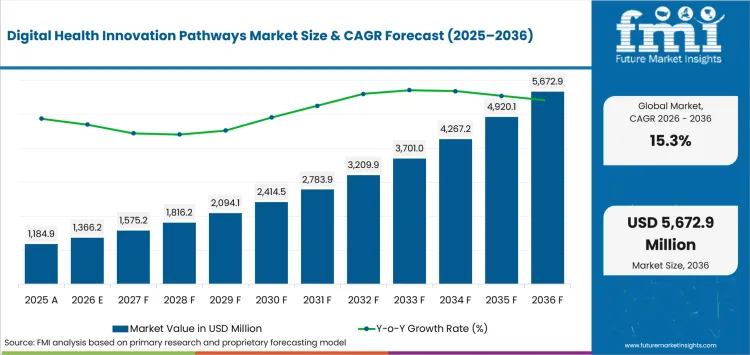
Key Takeaways of Digital Health Innovation Pathways Market
- Demand for digital health innovation pathways is driven by healthcare organizations connecting regulatory review with payment evidence and operating responsibility across one adoption route, with commercial purchasing slowing whenever reimbursement eligibility remains separated from integration responsibility and continuing service support.
- By pathway type, regulatory sandbox programs hold the leading share at 44.2% in 2026, attributable to structured testing and regulator engagement that reduces disconnected decisions between product development and routine clinical deployment.
- Digital therapeutics lead the technology category at 32.5% share in 2026, supported by outcome-based care programs that reward evidence linking digital activity with measurable clinical or capacity improvements across provider systems.
- Chronic disease management leads the application category at 37.9% share in 2026, driven by recurring patient monitoring needs and interoperable data exchange that reduces implementation effort across provider systems supporting established clinical workflows.
- Healthcare providers account for 39.1% end-user share in 2026, owing to their direct responsibility for integration, clinical oversight, and the operational accountability required to sustain digital health deployment at scale.
- Japan records a 19.0% CAGR through 2036, occupying the upper boundary of the five-country comparison, while the UK and Germany form a narrow second band, and South Korea and the USA complete the comparison with different payment structures and provider implementation constraints.
- Competition spans regulated digital products and provider platforms, with Roche and Philips differentiating through diagnostic and monitoring workflow integration, Oracle Health and Siemens Healthineers through data integration and clinical workflow platforms, and Veeva and IQVIA through evidence pathway support across provider environments.
Analyst Perspective
"The digital health innovation pathways market is shifting from technology validation to implementation readiness. Long-term success will depend on connecting clinical evidence with practical care workflows, regulatory alignment, and sustainable reimbursement strategies. Organizations that demonstrate repeatable deployment models, clear operational accountability, and measurable healthcare outcomes will be better positioned to accelerate adoption across health systems."
— - Anurag Sharma, Principal Analyst at Future Market Insights
Source: FMI's proprietary forecasting model and primary research
How is the Digital Health Innovation Pathways Market segmented?
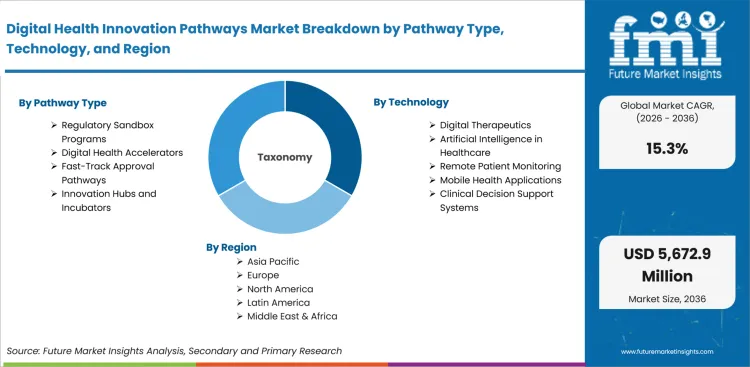
Digital Health Innovation Pathways Market is segmented by Pathway Type, Technology, Application, End User, and Region. Forecast Period from 2026 to 2036.
The framework separates institutional innovation routes from evaluated technologies and the clinical problems addressed during deployment. Pathway Type covers regulatory sandboxes and accelerators together with fast-track approval programs and innovation hubs. Technology distinguishes digital therapeutics from artificial intelligence and remote monitoring alongside mobile health applications within regulated care pathways. Application analysis follows chronic care and prevention across diagnosis and personalized treatment with healthcare administration. End User categories identify healthcare providers and digital health developers together with life sciences companies and regulatory agencies. Regional analysis compares legal entry and payment access with data infrastructure and implementation capacity across healthcare systems. The final taxonomy also places clinical decision support within technology choices used across these pathways.
How do regulatory sandbox programs shape demand within the pathway type category?
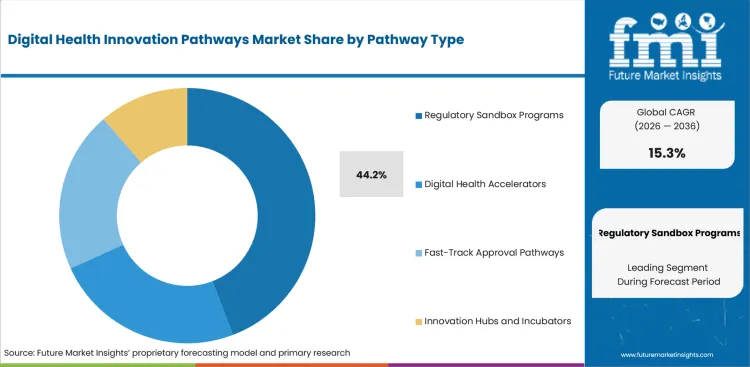
Digital health developers use regulatory sandboxes to test evidence plans and deployment controls before entering a full authorization process. The MHRA reported in June 2026 that its second AI Airlock phase examined seven case studies and documented regulatory lessons for medical-device artificial intelligence. Regulators and developers can clarify risk classifications and technical evidence within a controlled setting that supports later authorization planning. Commercial value depends on decisions that improve subsequent evidence work rather than visibility from program participation.
- The pathway type category is forecast to be led by regulatory sandbox programs at 44.2% share in 2026 due to direct regulatory feedback and clearer evidence planning. Early feedback helps developers identify study gaps and reserve capital for questions affecting safety or performance. The share reflects reduced planning uncertainty without implying automatic authorization or reimbursement across provider systems.
- Early-stage companies favor sandbox routes that combine technical review with practical guidance on governance and data controls. Program value rises through documented transition steps that connect supervised testing with formal review and provider evaluation. Adoption weakens if real-world evidence planning produces publicity without a usable submission package or accountable commercial decision.
What supports demand for digital therapeutics within the technology category?
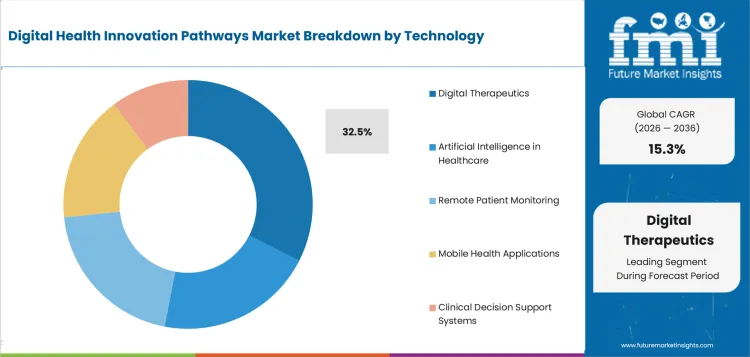
Digital therapeutics deliver treatment functions that require clinical evidence and defined supervision rather than general wellness positioning across consumer applications. Developers must connect software performance with patient eligibility and sustained engagement across the intended care program and prescribing workflow. Commercial adoption requires measurable outcomes and a service model that health plans and provider teams can evaluate together during continuing treatment delivery.
- By technology, digital therapeutics are forecast to represent 32.5% in 2026 driven by measurable treatment outcomes and defined clinical supervision. Commercial review examines evidence quality and prescribing workflow together with reimbursement and sustained patient participation. Unlike wellness applications, the segment carries a defined therapeutic claim and continuing clinical accountability requirements.
- Health plans and provider groups adopt treatment software within defined care programs rather than purchasing isolated application licenses. The FDA launched TEMPO in December 2025 for eligible devices addressing cardio-kidney-metabolic and musculoskeletal conditions alongside behavioral health needs. The pilot coordinates real-world performance reporting with technology-enabled care delivered under the CMS ACCESS model. Implementation therefore requires clear patient eligibility rules and clinician oversight with continuing adherence support services.
How does chronic disease management influence demand within the application category?
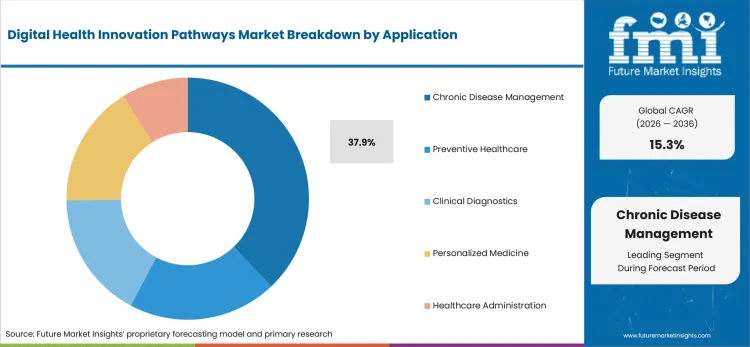
Chronic disease programs create repeated patient interactions that allow digital pathways to measure outcomes across extended care periods. The segment connects remote support with clinician supervision and defined escalation decisions during recurring episodes. Platforms must preserve patient engagement while generating evidence that links service activity with clinical and operating results. Consistent measurement helps care teams distinguish intervention effects from ordinary variation across longer treatment cycles. Commercial value therefore depends on continuing management rather than a single diagnostic or administrative interaction.
- Chronic disease management is set to lead the application category with 37.9% share in 2026 due to recurring measurements and defined escalation decisions. CMS reported in July 2026 that more than 150 healthcare organizations had been accepted for the ACCESS model launch. Outcome-aligned payments across four chronic condition groups create a practical setting for sustained service evaluation.
- Provider organizations use remote patient monitoring to extend chronic care beyond scheduled visits without removing clinical accountability. Adoption depends on reliable onboarding and threshold design with a documented response route for abnormal readings. Purchasers also test whether recurring service costs produce measurable capacity or quality gains across the covered population during routine operations.
How are healthcare providers positioned within the end user category?
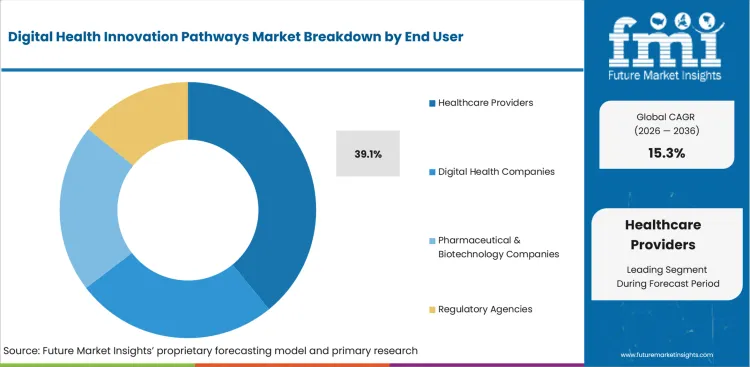
Healthcare providers control the workflow and patient data environment that determine whether a digital tool becomes routine care. Clinical teams must define governance and escalation responsibilities before automated recommendations influence treatment decisions during routine care delivery. ASTP reported in September 2025 that 71% of hospitals used predictive artificial intelligence integrated with electronic health records during 2024. The agency also found lower adoption among smaller and rural hospitals than other provider groups nationwide.
- Healthcare providers are likely to capture 39.1% share in 2026, attributable to direct responsibility for clinical safety and workflow adoption. Hospitals evaluate implementation effort and continuing support together with the technical performance claimed by developers. Their purchasing authority determines whether successful pilots become funded care services across participating provider organizations.
- Provider groups favor platforms that connect with healthcare cloud infrastructure while preserving local control over permissions and clinical decisions. Training must reach clinicians and operations teams so each group can manage routine use and exceptions. Smaller facilities may require managed integration services that reduce immediate staffing demands during implementation periods. Financing structures can also spread deployment costs without transferring clinical accountability away from the provider.
What are the drivers, restraints, and opportunities in the Digital Health Innovation Pathways Market?
Demand expands through coordinated evidence and payment routes while integration burdens and uneven implementation capacity continue to limit routine adoption.
- Driver: Outcome-based care programs create demand for digital pathways connecting patient data with measurable clinical and operating results.
- Restraint: Weak evidence and unclear pricing can prevent nationally listed products from gaining sustained use across routine provider workflows.
- Opportunity: Common data rules can support reusable integration and evidence models across countries that currently require separate implementation work.
Routine digital transactions create a practical demand base for pathways that connect patient requests with accountable clinical or administrative responses. NHS England reported in December 2025 that patients submitted 67.8 million repeat prescription requests through the NHS App during the preceding year. Developers of patient monitoring systems need comparable evidence that the workflow saves staff time or improves follow-up capacity rather than relying on transaction volume alone. Developers strengthen purchasing cases by showing measurable capacity gains within the specific workflow rather than relying on convenience claims.
National listing can fail to produce sustained adoption if evidence and pricing remain disputed during routine reimbursement. Health insurers then assess continuing benefit and budget impact rather than treating directory inclusion as sufficient proof of value. GKV-Spitzenverband argues that benefit should be demonstrated before listing and negotiated DiGA prices should apply from the first reimbursement day. Developers therefore need outcome collection that operates inside the prescriber and patient shared care workflow. Expansion slows further if continuing evidence work increases service costs without improving treatment decisions meaningfully.
The European Commission states that the EHDS entered force in March 2025 and will apply gradually through milestones beginning in 2027. Cross-border health data rules create an opening for platforms that reuse secure integration and governance controls across European healthcare systems. Reusable interfaces can lower duplicated technical work while national purchasing and care delivery decisions remain separate. Commercial value depends on data structures supporting local workflows and future exchange requirements without assuming uniform reimbursement across member states.
Which country CAGRs are profiled in the Digital Health Innovation Pathways Market?
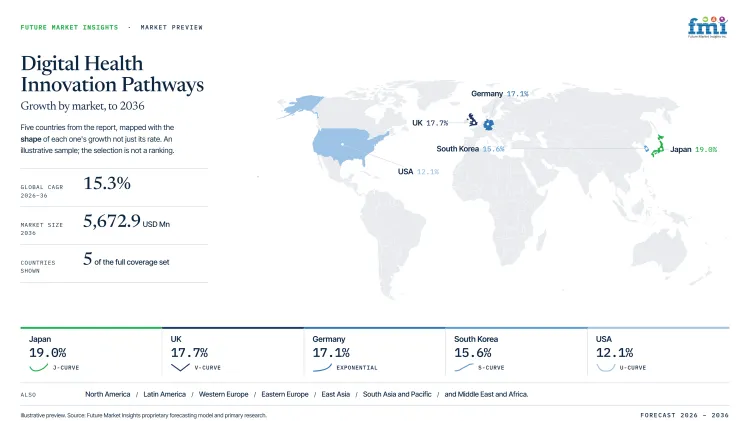
| Country | CAGR |
|---|---|
| USA | 12.1% |
| UK | 17.7% |
| Germany | 17.1% |
| Japan | 19.0% |
| South Korea | 15.6% |
How do country-level CAGRs compare in the Digital Health Innovation Pathways Market?
The country comparison shows a moderate spread in projected growth rates across the digital health innovation pathways market. Japan, the UK and Germany form a closely aligned upper group with only limited differences between their forecasts. South Korea follows as a nearby market and remains connected to this cluster through a modest gap in projected expansion. The USA sits apart from the other countries and is separated by a more pronounced difference. The overall gap between the first and last country is 6.9 percentage points which highlights varying levels of policy support and innovation pathway development across healthcare systems. These differences reflect the pace of digital health integration, regulatory modernization and the adoption of accelerated innovation frameworks.
- Japan shows a notable position within the comparison as healthcare providers and regulators continue to expand pathways that support the evaluation and deployment of digital health technologies.
- The UK remains close to Japan in CAGR terms but follows a different market path through structured innovation programs and regulatory initiatives designed to improve digital health adoption.
- Germany occupies a similar position to the UK as digital health growth is supported by reimbursement mechanisms and increasing integration of digital solutions into clinical practice.
- South Korea remains moderately separated from the upper group as national digital health initiatives and investments in healthcare technology continue to support market expansion.
- The USA holds a distinct position within the comparison as adoption is driven by a diverse healthcare ecosystem while implementation often varies across providers, payers and regulatory frameworks.
Comparable CAGRs do not create identical market conditions across countries. Differences in regulatory readiness, reimbursement structures, healthcare digitization levels and provider adoption can influence how quickly digital health innovations move from development to routine use. As a result, companies may encounter different commercialization pathways and market entry requirements despite broadly similar growth trends. The full report provides country-level CAGR analysis across North America, Latin America, Europe, East Asia, South Asia, Oceania and the Middle East and Africa.
Country-wise Analysis
- United States commercialization requires separate FDA authorization and payment decisions across Medicare and private health plans before providers fund routine use. The USA market is projected to expand at 12.1% CAGR from 2026 to 2036, shaped by extensive innovation activity and fragmented purchasing routes. CMS states that the ACCESS Model begins July 5, 2026 and tests outcome-aligned payments for technology-supported chronic care during a ten-year period. National cloud providers and specialist integrators can combine implementation training with remote technical support across large health systems and regional provider networks. Payer-specific coverage policies and local security reviews remain material frictions even if subscription contracts reduce initial deployment costs.
- The UK market is forecast to record 17.7% CAGR through 2036, supported by coordinated public infrastructure and formal digital health evaluation. MHRA guidance updated in February 2025 confirms that many software and artificial intelligence products are regulated as medical devices in the United Kingdom. NHS England reported in October 2025 that 92% of trusts had implemented electronic patient record systems by March 2025. NHS implementation teams and framework contractors provide training and integration support across provider sites with different technical environments. National purchasing frameworks can reduce account fragmentation through shared standards and established contracting routes across participating organizations. Workflow redesign and constrained local delivery capacity remain material frictions across trusts with different levels of digital maturity.
- Germany requires eligible digital health applications to complete BfArM review before physicians can prescribe them through statutory insurance. Germany's digital health innovation pathways demand is anticipated to advance at 17.1% CAGR during the forecast period, underpinned by an established reimbursement pathway and demanding evidence requirements. Manufacturers can work with German commercial teams and implementation partners for contracting and clinician onboarding. The Federal Ministry of Health stated in November 2025 that review covers safety and functionality alongside data protection and positive care effects. Providers of digital psychotherapeutics also need German-language onboarding and reliable patient engagement support during routine care delivery. National listing creates a defined entry route but does not automatically settle negotiated pricing or continuing evidence requirements. Evidence expectations and pricing negotiations remain material frictions following initial reimbursement access across statutory insurance programs.
- Japan's digital health innovation pathways demand is projected to expand at 19.0% CAGR between 2026 and 2036, influenced by specialist review pathways and demand for regulated software-based care. PMDA states that Japanese market entry requires approval or certification through a local authorization holder for regulated higher-risk devices. PMDA published draft review points for Digital Therapeutics in July 2026 and opened a six-month public comment period. Foreign developers commonly rely on local authorization holders and service partners for regulatory communication and continuing support across regional provider settings. Consultation capacity and reimbursement sequencing remain material frictions for companies lacking experienced local regulatory and commercial teams.
- The South Korea digital health innovation pathways market is estimated to expand at 15.6% CAGR through 2036, reflecting hospital technology capacity and a formal digital product framework. The Ministry of Food and Drug Safety issued implementation guidance in January 2025 as South Korea's Digital Medical Products Act entered operation. Large hospital groups and local technology partners can support implementation and clinician training across dense urban markets. Manufacturers also need product-specific local evidence and Korean-language support for hospital committee review during commercial deployment planning. Hospital committees therefore require Korean-language technical documentation and a named local service contact before routine deployment can proceed. New compliance requirements and institution-specific integration remain material frictions during routine purchasing and multi-hospital deployment.
Who are the notable companies in the Digital Health Innovation Pathways Market?
Roche, Philips, Siemens Healthineers, Oracle Health, Veeva Systems, IQVIA, Medtronic, and Teladoc Health are notable companies shaping this market.
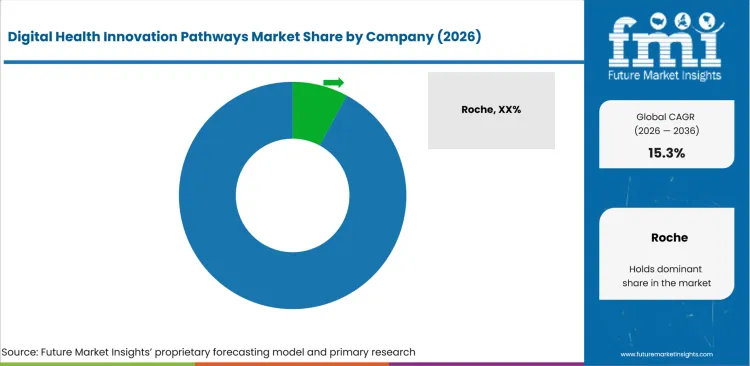
The competitive field combines diagnostic and provider platforms with life sciences systems and remote care networks across different innovation pathways. IQVIA Connected Intelligence and the Veeva Clinical Platform support research and commercial data workflows through integrated life sciences systems. Roche and Philips connect software with diagnostic or monitoring information inside provider environments that require governed clinical integration. Siemens Healthineers supports vendor-neutral interoperability and clinical workflow integration across provider systems with mixed equipment environments. Oracle Health adds conversational AI and standards-based exchange across electronic health record environments used by large provider organizations. Medtronic and Teladoc Health extend digital capabilities into monitored patient care through remote monitoring and virtual care services. Commercial selection depends on exact workflow ownership and verified operating support rather than broad corporate scale or reputation.
- Roche and Philips combine digital applications with diagnostic or monitoring systems operating inside provider environments. Roche navify connects Roche and non-Roche systems, while Philips HealthSuite connects data across clinical and operational workflows. Final selection depends on documented interoperability and continuing service support across each intended clinical workflow environment.
- Siemens Healthineers and Oracle Health provide enterprise platforms that connect data and workflows across provider facilities. Siemens teamplay supports vendor-neutral interoperability, while Oracle Health provides standards-based exchange across electronic health record environments. Purchasers should compare integration coverage and continuing technical support rather than broad platform breadth alone during selection.
- Veeva and IQVIA support life sciences data and evidence workflows, while Medtronic and Teladoc Health connect technology with monitored care. The distinct service roles create different purchasing routes and support expectations across research sponsors and provider organizations. Implementation plans must therefore distinguish evidence infrastructure from continuing patient services and clinical accountability across participating organizations.
Competitive Benchmarking: Digital Health Innovation Pathways Market
| Company | Evidence Pathway Support | Clinical Workflow Integration | Scaled Digital Delivery | Geographic Reach |
|---|---|---|---|---|
| Roche | Medium | High | Medium | Global |
| Philips | Medium | High | High | United States |
| Siemens Healthineers | Medium | High | High | Global |
| Oracle Health | Medium | High | High | United States |
| Veeva Systems | High | Medium | High | Global |
| IQVIA | High | Medium | High | Global |
| Medtronic | Medium | High | Medium | United States |
| Teladoc Health | Low | High | High | United States |
Key Developments in the Digital Health Innovation Pathways Market
- In March 2025, Oracle Health expanded its Clinical AI Agent across more than 30 medical specialties and reported nearly 30% lower daily documentation time. The system connects with Oracle Health electronic records and prepares draft notes for clinician review during routine care. The expansion adds an integrated documentation capability that can reduce clerical workload while preserving clinician review responsibility across participating provider organizations.
- In April 2025, Veeva Systems announced SiteVault CTMS for research sites with electronic investigator file and electronic consent integration. The planned system connects bidirectionally with sponsors through the Veeva Clinical Platform and coordinates document exchange across study operations. The announcement set an initial August 2025 release plan and described a unified operating model for evidence generation. Site adoption remained separate from the product announcement and required later evidence from active research operations.
- In January 2025, IQVIA announced a collaboration with NVIDIA to develop healthcare-grade artificial intelligence agents across life sciences workflows. The partnership combines IQVIA data and domain expertise with NVIDIA infrastructure for research and commercialization processes that require governed healthcare information and controlled clinical program execution. Commercial use requires validated controls and human review so automated outputs support regulated evidence work without replacing accountable scientific decisions across sponsor organizations.
- In March 2025, Teladoc Health expanded connected care partnerships through its Prism platform across specialty and family health categories. New integrations allow clinicians to view eligibility and refer members during routine virtual care interactions. Participating networks can connect internal care teams with external digital programs and community services during routine care delivery. The expansion changes referral capability while leaving payer eligibility and provider workflow design as continuing implementation requirements.
Key Players in the Digital Health Innovation Pathways Market
Clinical and Provider Platform Companies
- Roche
- Philips
- Siemens Healthineers
- Oracle Health
Evidence and Life Sciences Platform Companies
- Veeva Systems
- IQVIA
Connected Care and Monitoring Companies
- Medtronic
- Teladoc Health
Digital Health Innovation Pathways Market - Report Scope
| Coverage field | Report scope |
|---|---|
| Market breakdown | Pathway type, technology, application, end user, and region. |
| Market Definition | Programs and platforms plus technologies and services moving digital health products from evidence development through regulatory evaluation and funded clinical deployment. |
| Regions Covered | North America, Latin America, Western Europe, Eastern Europe, East Asia, South Asia and Pacific, and Middle East and Africa. |
| Countries Covered | USA, UK, Germany, Japan, and South Korea. |
| Key Companies Profiled | Roche, Philips, Siemens Healthineers, Oracle Health, Veeva Systems, IQVIA, Medtronic, and Teladoc Health. |
| Forecast Period | 2026 to 2036. |
| Approach | Hybrid bottom-up and top-down market sizing supported by primary research and current official desk research. |
Digital Health Innovation Pathways Market - Research Methodology
| Method | Approach |
|---|---|
| Primary Research | FMI analysts gathered input from manufacturers, service providers, technology developers, distributors, end users, procurement teams, and subject-matter experts. Interviews examined purchasing decisions, product or service evaluation, adoption barriers, approval requirements, pricing considerations, and expectations for technical or commercial support. Respondents were also asked what evidence is required before a trial, pilot, or initial order develops into regular purchasing. |
| Desk Research | Desk research covered government statistics, regulatory publications, trade data, industry associations, technical literature, standards, company filings, product information, and official corporate announcements. Sources were reviewed for relevance, publication date, geographic coverage, and consistency with the defined market scope. Claims relating to performance, applications, approvals, capacity, investment, and commercial activity were retained only when supported by credible public evidence. |
| Market Sizing and Forecasting | The market model combined the baseline value with historical performance, segment structure, pricing and volume indicators, adoption levels, company participation, and country-level demand conditions. Forecast assumptions considered economic activity, investment trends, regulatory developments, technology adoption, purchasing cycles, supply availability, and barriers to wider market use. Segment and regional estimates were reconciled before the final market total was calculated. |
| Data Validation | Estimates were checked against multiple independent indicators, including public data, company activity, trade patterns, industry developments, and findings from primary interviews. Validation also tested whether products, services, applications, and company revenues fell within the defined market boundaries. Adjacent categories, unsupported claims, overlapping revenues, and activities without direct market relevance were excluded to reduce double counting and maintain consistency across segments and countries. |
Digital Health Innovation Pathways Market by Segments
Digital Health Innovation Pathways Market segmented by Pathway Type:
- Regulatory Sandbox Programs
- Digital Health Accelerators
- Fast-Track Approval Pathways
- Innovation Hubs and Incubators
Digital Health Innovation Pathways Market segmented by Technology:
- Digital Therapeutics
- Artificial Intelligence in Healthcare
- Remote Patient Monitoring
- Mobile Health Applications
- Clinical Decision Support Systems
Digital Health Innovation Pathways Market segmented by Application:
- Chronic Disease Management
- Preventive Healthcare
- Clinical Diagnostics
- Personalized Medicine
- Healthcare Administration
Digital Health Innovation Pathways Market segmented by End User:
- Healthcare Providers
- Digital Health Companies
- Pharmaceutical & Biotechnology Companies
- Regulatory Agencies
Digital Health Innovation Pathways Market by Region:
- North America
- United States
- Canada
- Latin America
- Brazil
- Mexico
- Argentina
- Chile
- Western Europe
- Germany
- France
- United Kingdom
- Italy
- Spain
- Benelux
- Nordics
- Eastern Europe
- Poland
- Czech Republic
- Romania
- Hungary
- East Asia
- China
- Japan
- South Korea
- South Asia and Pacific
- India
- ASEAN
- Australia and New Zealand
- Middle East and Africa
- GCC Countries
- South Africa
- Türkiye
- Israel
Research Sources and Bibliography
- USA Food and Drug Administration. (2026, April 23).
- Assistant Secretary for Technology Policy/Office of the National Coordinator for Health Information Technology. (2026, February).
- Medicines and Healthcare products Regulatory Agency. (2026, June 9).
- USA Food and Drug Administration. (2025, December 5).
- Centers for Medicare & Medicaid Services. (2026, July 20).
- Assistant Secretary for Technology Policy/Office of the National Coordinator for Health Information Technology. (2025, September).
- NHS England. (2025, December 24).
- GKV-Spitzenverband. (n.d.).
- European Commission. (n.d.).
- Centers for Medicare & Medicaid Services. (n.d.).
- Medicines and Healthcare products Regulatory Agency. (2025, February 3).
- NHS England. (2025, October 31).
- Federal Ministry of Health. (2025, November 18).
- Pharmaceuticals and Medical Devices Agency. (n.d.).
- Pharmaceuticals and Medical Devices Agency. (2026, July 1).
- Ministry of Food and Drug Safety. (2025, January 24).
- Oracle. (2025, March 4).
- Veeva Systems. (2025, April 1).
- IQVIA. (2025, January 13).
- Teladoc Health. (2025, March 11).
- Roche. (n.d.).
- Teladoc Health. (2025, March 4).
This bibliography is provided for reader reference and is not exhaustive. The full report contains the complete reference list and detailed citations.
This Report Answers
- How large is the digital health innovation pathways market in 2026 and 2036?
- Which regulatory and payment conditions support investment across digital health innovation pathways?
- Why do Regulatory Sandbox Programs lead the Pathway Type category during 2026?
- How do Digital Therapeutics convert clinical evidence into funded care programs?
- Why does Chronic Disease Management hold the leading Application share during 2026?
- How do country growth rates differ across the USA, UK, Germany, Japan, and South Korea?
- Which companies support evidence generation and provider integration or connected care delivery?
- What limits adoption after regulatory authorization or national reimbursement listing?
- How should developers compare pathway speed with implementation cost and operating responsibility?
Frequently Asked Questions
How big is the Digital Health Innovation Pathways Market in 2026?
The digital health innovation pathways market is valued at USD 1366.2 million in 2026 and is forecast to reach USD 5672.9 million by 2036. Growth reflects increasing alignment between regulatory review, reimbursement planning, healthcare interoperability, and governed deployment of digital health technologies across provider systems.
What is the CAGR of the Digital Health Innovation Pathways Market from 2026 to 2036?
The digital health innovation pathways market is projected to grow at a CAGR of 15.3% between 2026 and 2036, supported by expanding regulatory innovation programs, wider adoption of digital therapeutics, improved interoperability standards, and increasing investment in outcome-based digital healthcare.
Which pathway type leads the Digital Health Innovation Pathways Market?
Regulatory sandbox programs account for 44.2% of the digital health innovation pathways market by pathway type in 2026, reflecting their role in helping developers refine clinical evidence, regulatory strategy, and governance before broader healthcare deployment.
How much will the Digital Health Innovation Pathways Market add between 2026 and 2036?
The digital health innovation pathways market is set to add USD 4306.7 million between 2026 and 2036, growing from USD 1366.2 million to USD 5672.9 million as healthcare systems accelerate adoption of regulated digital technologies, connected care platforms, and evidence-based implementation pathways.
Who are the leading companies in the Digital Health Innovation Pathways Market?
Leading companies in the digital health innovation pathways market include Roche, Philips, Siemens Healthineers, Oracle Health, Veeva Systems, IQVIA, Medtronic, and Teladoc Health, competing across clinical workflow integration, digital therapeutics, healthcare interoperability, evidence generation, remote patient monitoring, and connected care platforms.
Preview the report firsthand - request a free sample
Get SampleGet the brochure for pricing and purchase details.
Get PDFTable of Content
- Key Takeaways
- Market Size and CAGR
- Top Growth Driver
- Fastest Growing Segment
- Leading Region
- Key Companies
- Emerging Opportunities
- Executive Summary
- Global Market Outlook
- Demand-side Trends
- Supply-side Trends
- Technology Roadmap Analysis
- Analysis and Recommendations
- Analyst Perspective (What is happening? Why now? What should investors know?)
- Key Questions Answered
- How large is the market?
- What is the CAGR?
- What are key trends?
- Which region dominates?
- Who are the leaders?
- Market Overview
- Market Coverage / Taxonomy
- Market Definition / Scope / Limitations
- Research Methodology
- Chapter Orientation
- Analytical Lens and Working Hypotheses
- Market Structure, Signals, and Trend Drivers
- Benchmarking and Cross-market Comparability
- Market Sizing, Forecasting, and Opportunity Mapping
- Research Design and Evidence Framework
- Desk Research Programme (Secondary Evidence)
- Expert Input and Fieldwork (Primary Evidence)
- Tooling, Models, and Reference Databases
- Data Engineering and Model Build
- Quality Assurance and Audit Trail
- Market Background
- Market Dynamics (Drivers, Restraints, Opportunity, Trends)
- Scenario Forecast (Optimistic, Likely, Conservative)
- Impact Analysis
- AI Impact
- Sustainability Impact
- Regulatory Impact
- Technology Impact
- Consumer / Buyer Analysis
- Purchase Drivers
- Adoption Barriers
- Buyer Journey
- Opportunity Map Analysis
- Product Life Cycle Analysis
- Supply Chain Analysis
- Investment Feasibility Matrix
- Value Chain Analysis
- PESTLE and Porter's Analysis
- Regulatory Landscape
- Regional Parent Market Outlook
- Production and Consumption Statistics
- Import and Export Statistics
- Global Market Analysis and Forecast, 2021 to 2036
- Historical Market Size Value (USD Million) Analysis, 2021 to 2025
- Current and Future Market Size Value (USD Million) Projections, 2026 to 2036
- Y-o-Y Growth Trend Analysis
- Absolute $ Opportunity Analysis
- Global Market Pricing Analysis, 2021 to 2036
- Global Market Analysis and Forecast, By Pathway Type, 2021 to 2036
- Introduction / Key Findings
- Historical Market Size Value (USD Million) Analysis By Pathway Type, 2021 to 2025
- Current and Future Market Size Value (USD Million) Analysis and Forecast By Pathway Type, 2026 to 2036
- Regulatory Sandbox Programs
- Digital Health Accelerators
- Fast-Track Approval Pathways
- Innovation Hubs and Incubators
- Regulatory Sandbox Programs
- Y-o-Y Growth Trend Analysis By Pathway Type, 2021 to 2025
- Absolute $ Opportunity Analysis By Pathway Type, 2026 to 2036
- Global Market Analysis and Forecast, By Technology, 2021 to 2036
- Introduction / Key Findings
- Historical Market Size Value (USD Million) Analysis By Technology, 2021 to 2025
- Current and Future Market Size Value (USD Million) Analysis and Forecast By Technology, 2026 to 2036
- Digital Therapeutics
- Artificial Intelligence in Healthcare
- Remote Patient Monitoring
- Mobile Health Applications
- Clinical Decision Support Systems
- Digital Therapeutics
- Y-o-Y Growth Trend Analysis By Technology, 2021 to 2025
- Absolute $ Opportunity Analysis By Technology, 2026 to 2036
- Global Market Analysis and Forecast, By Application, 2021 to 2036
- Introduction / Key Findings
- Historical Market Size Value (USD Million) Analysis By Application, 2021 to 2025
- Current and Future Market Size Value (USD Million) Analysis and Forecast By Application, 2026 to 2036
- Chronic Disease Management
- Preventive Healthcare
- Clinical Diagnostics
- Personalized Medicine
- Healthcare Administration
- Chronic Disease Management
- Y-o-Y Growth Trend Analysis By Application, 2021 to 2025
- Absolute $ Opportunity Analysis By Application, 2026 to 2036
- Global Market Analysis and Forecast, By End User, 2021 to 2036
- Introduction / Key Findings
- Historical Market Size Value (USD Million) Analysis By End User, 2021 to 2025
- Current and Future Market Size Value (USD Million) Analysis and Forecast By End User, 2026 to 2036
- Healthcare Providers
- Digital Health Companies
- Pharmaceutical & Biotechnology Companies
- Regulatory Agencies
- Healthcare Providers
- Y-o-Y Growth Trend Analysis By End User, 2021 to 2025
- Absolute $ Opportunity Analysis By End User, 2026 to 2036
- Global Market Analysis and Forecast, By Region, 2021 to 2036
- Introduction
- Historical Market Size Value (USD Million) Analysis By Region, 2021 to 2025
- Current Market Size Value (USD Million) Analysis and Forecast By Region, 2026 to 2036
- North America
- Latin America
- Western Europe
- Eastern Europe
- East Asia
- South Asia and Pacific
- Middle East & Africa
- Market Attractiveness Analysis By Region
- North America Market Analysis and Forecast, By Country, 2021 to 2036
- Historical Market Size Value (USD Million) Trend Analysis By Market Taxonomy, 2021 to 2025
- Market Size Value (USD Million) Forecast By Market Taxonomy, 2026 to 2036
- By Country
- USA
- Canada
- By Pathway Type
- By Technology
- By Application
- By End User
- By Country
- Market Attractiveness Analysis
- By Country
- By Pathway Type
- By Technology
- By Application
- By End User
- Key Takeaways
- Latin America Market Analysis and Forecast, By Country
- Historical Market Size Value (USD Million) Trend Analysis By Market Taxonomy, 2021 to 2025
- Market Size Value (USD Million) Forecast By Market Taxonomy, 2026 to 2036
- By Country
- Brazil
- Mexico
- Chile
- Rest of Latin America
- By Pathway Type
- By Technology
- By Application
- By End User
- By Country
- Market Attractiveness Analysis
- By Country
- By Pathway Type
- By Technology
- By Application
- By End User
- Key Takeaways
- Western Europe Market Analysis and Forecast, By Country
- Historical Market Size Value (USD Million) Trend Analysis By Market Taxonomy, 2021 to 2025
- Market Size Value (USD Million) Forecast By Market Taxonomy, 2026 to 2036
- By Country
- Germany
- UK
- Italy
- Spain
- France
- Nordic
- BENELUX
- Rest of Western Europe
- By Pathway Type
- By Technology
- By Application
- By End User
- By Country
- Market Attractiveness Analysis
- By Country
- By Pathway Type
- By Technology
- By Application
- By End User
- Key Takeaways
- Eastern Europe Market Analysis and Forecast, By Country
- Historical Market Size Value (USD Million) Trend Analysis By Market Taxonomy, 2021 to 2025
- Market Size Value (USD Million) Forecast By Market Taxonomy, 2026 to 2036
- By Country
- Russia
- Poland
- Hungary
- Balkan & Baltic
- Rest of Eastern Europe
- By Pathway Type
- By Technology
- By Application
- By End User
- By Country
- Market Attractiveness Analysis
- By Country
- By Pathway Type
- By Technology
- By Application
- By End User
- Key Takeaways
- East Asia Market Analysis and Forecast, By Country
- Historical Market Size Value (USD Million) Trend Analysis By Market Taxonomy, 2021 to 2025
- Market Size Value (USD Million) Forecast By Market Taxonomy, 2026 to 2036
- By Country
- China
- Japan
- South Korea
- By Pathway Type
- By Technology
- By Application
- By End User
- By Country
- Market Attractiveness Analysis
- By Country
- By Pathway Type
- By Technology
- By Application
- By End User
- Key Takeaways
- South Asia and Pacific Market Analysis and Forecast, By Country
- Historical Market Size Value (USD Million) Trend Analysis By Market Taxonomy, 2021 to 2025
- Market Size Value (USD Million) Forecast By Market Taxonomy, 2026 to 2036
- By Country
- India
- ASEAN
- Australia & New Zealand
- Rest of South Asia and Pacific
- By Pathway Type
- By Technology
- By Application
- By End User
- By Country
- Market Attractiveness Analysis
- By Country
- By Pathway Type
- By Technology
- By Application
- By End User
- Key Takeaways
- Middle East & Africa Market Analysis and Forecast, By Country
- Historical Market Size Value (USD Million) Trend Analysis By Market Taxonomy, 2021 to 2025
- Market Size Value (USD Million) Forecast By Market Taxonomy, 2026 to 2036
- By Country
- Kingdom of Saudi Arabia
- Other GCC Countries
- Türkiye
- South Africa
- Other African Union
- Rest of Middle East & Africa
- By Pathway Type
- By Technology
- By Application
- By End User
- By Country
- Market Attractiveness Analysis
- By Country
- By Pathway Type
- By Technology
- By Application
- By End User
- Key Takeaways
- Key Countries Market Analysis
- USA
- Pricing Analysis
- Market Share Analysis, 2025
- By Pathway Type
- By Technology
- By Application
- By End User
- Canada
- Pricing Analysis
- Market Share Analysis, 2025
- By Pathway Type
- By Technology
- By Application
- By End User
- Mexico
- Pricing Analysis
- Market Share Analysis, 2025
- By Pathway Type
- By Technology
- By Application
- By End User
- Brazil
- Pricing Analysis
- Market Share Analysis, 2025
- By Pathway Type
- By Technology
- By Application
- By End User
- Chile
- Pricing Analysis
- Market Share Analysis, 2025
- By Pathway Type
- By Technology
- By Application
- By End User
- Germany
- Pricing Analysis
- Market Share Analysis, 2025
- By Pathway Type
- By Technology
- By Application
- By End User
- UK
- Pricing Analysis
- Market Share Analysis, 2025
- By Pathway Type
- By Technology
- By Application
- By End User
- Italy
- Pricing Analysis
- Market Share Analysis, 2025
- By Pathway Type
- By Technology
- By Application
- By End User
- Spain
- Pricing Analysis
- Market Share Analysis, 2025
- By Pathway Type
- By Technology
- By Application
- By End User
- France
- Pricing Analysis
- Market Share Analysis, 2025
- By Pathway Type
- By Technology
- By Application
- By End User
- India
- Pricing Analysis
- Market Share Analysis, 2025
- By Pathway Type
- By Technology
- By Application
- By End User
- ASEAN
- Pricing Analysis
- Market Share Analysis, 2025
- By Pathway Type
- By Technology
- By Application
- By End User
- Australia & New Zealand
- Pricing Analysis
- Market Share Analysis, 2025
- By Pathway Type
- By Technology
- By Application
- By End User
- China
- Pricing Analysis
- Market Share Analysis, 2025
- By Pathway Type
- By Technology
- By Application
- By End User
- Japan
- Pricing Analysis
- Market Share Analysis, 2025
- By Pathway Type
- By Technology
- By Application
- By End User
- South Korea
- Pricing Analysis
- Market Share Analysis, 2025
- By Pathway Type
- By Technology
- By Application
- By End User
- Russia
- Pricing Analysis
- Market Share Analysis, 2025
- By Pathway Type
- By Technology
- By Application
- By End User
- Poland
- Pricing Analysis
- Market Share Analysis, 2025
- By Pathway Type
- By Technology
- By Application
- By End User
- Hungary
- Pricing Analysis
- Market Share Analysis, 2025
- By Pathway Type
- By Technology
- By Application
- By End User
- Kingdom of Saudi Arabia
- Pricing Analysis
- Market Share Analysis, 2025
- By Pathway Type
- By Technology
- By Application
- By End User
- Türkiye
- Pricing Analysis
- Market Share Analysis, 2025
- By Pathway Type
- By Technology
- By Application
- By End User
- South Africa
- Pricing Analysis
- Market Share Analysis, 2025
- By Pathway Type
- By Technology
- By Application
- By End User
- USA
- Market Structure Analysis
- Competition Dashboard
- Competition Benchmarking
- Market Share Analysis of Top Players
- By Regional
- By Pathway Type
- By Technology
- By Application
- By End User
- Emerging Startups
- Innovation Benchmarking
- Competition Analysis
- Competition Deep Dive
- Roche
- Overview
- Product Portfolio
- Profitability by Market Segments
- Sales Footprint
- Strategy Overview
- Marketing Strategy
- Product Strategy
- Channel Strategy
- Philips
- Siemens Healthineers
- Oracle Health
- Veeva Systems
- IQVIA
- Medtronic
- Teladoc Health
- GE HealthCare
- Doximity
- Roche
- Case Studies
- Success Stories
- Recent Developments
- Competition Deep Dive
- Assumptions & Acronyms Used


