

- Industry Size (2026)
- USD 6.2 Bn
- Forecast (2036)
- USD 24.6 Bn
- CAGR (2026 to 2036)
- 14.80%
Real World Evidence Solutions Market Size, Market Forecast and Outlook By FMI
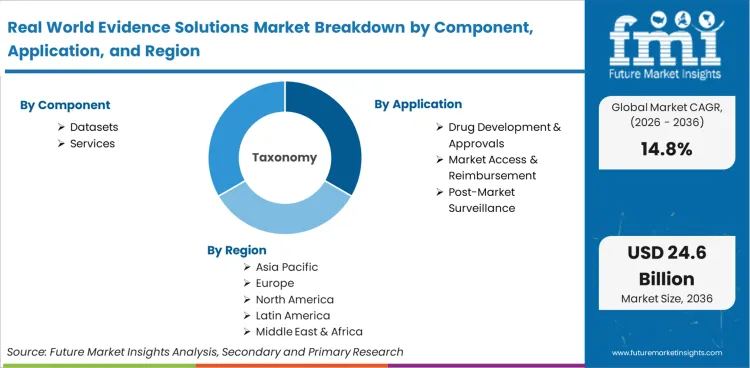
Regulatory agencies rejecting single-arm trials without synthetic control arms derived from longitudinal health records have driven the real-world evidence solutions market to USD 5.4 billion in 2025. Chief medical officers executing accelerated approval pathways now mandate multi-modal dataset integration to prove long-term safety profiles to scrutinizing health authorities. Compound expansion at 14.80% through 2036 carries the market to USD 24.6 billion as national health technology assessment bodies permanently transition from evaluating static clinical trial results to demanding continuous post-market surveillance streams.
The transition from episodic data gathering to continuous patient tracking forces pharmaceutical sponsors to abandon isolated trial databases and commit significant capital to federated networks. Health economics directors entering drug reimbursement negotiations without comprehensive observational registries face a massive evidentiary gap they cannot bridge with conventional trial data alone. Delaying this architectural pivot directly results in restricted payer coverage formulas and severely delayed regional market access.
Summary of Real World Evidence Solutions Market
- Real World Evidence Solutions Market Definition
- Real world evidence solutions encompass the integrated datasets and analytical services required to translate fragmented observational health data into validated clinical proof. This capability fundamentally relies on massive electronic health record networks to map long-term therapeutic safety and efficacy profiles.
- Demand Drivers in the Market
- Stringent post-market safety mandates force pharmacovigilance directors to specify analytical platforms capable of connecting initial trial participants with long-term insurance claims data.
- Value-based contracting models require health economics teams to deploy precise cohort matching mechanisms to prove real-world efficacy against competing therapeutic options.
- The intensification of specialized rare disease research compels clinical trial designers to construct synthetic control arms from existing registries to avoid ethical complications with placebo groups.
- Key Segments Analyzed in the FMI Report
- Datasets: 62.5% share in 2026, capturing the foundational baseline for all longitudinal patient mapping initiatives as raw clinical data remains the industry currency.
- Drug Development & Approvals: 35.0% share in 2026, reflecting the absolute operational requirement for supplementary observational evidence during accelerated regulatory reviews.
- China: 18.5% compound growth, sustained by extensive state-sponsored digital health infrastructure rollouts and centralised population health registries.
- Analyst Opinion at FMI
- Sabyasachi Ghosh, Principal Consultant for Healthcare & Pharmaceuticals, opines, "In my analysis, I have observed a distinct tension between the sheer volume of available health data and the actual interoperable utility of that information. Clinical informatics leads attempting to generate longitudinal evidence over standard unlinked datasets face unavoidable fragmentation that ruins the statistical power of rare disease cohorts. Pharmaceutical research directors who delay implementing sophisticated cryptographic tokenization standards will miss the upcoming European health data space certification window entirely, leaving their market access teams unable to defend premium drug pricing in key regional negotiations."
- Strategic Implications / Executive Takeaways
- Bioinformatic software suppliers must secure multi-regional privacy certifications to qualify for impending global pharmaceutical data aggregation contracts.
- Health economics directors should phase out unlinked standalone databases and mandate federated linkage capabilities in all new data procurement specifications.
- Trial designers must develop specialized synthetic control arm methodologies to prove definitive efficacy metrics during the regulatory submission phase.
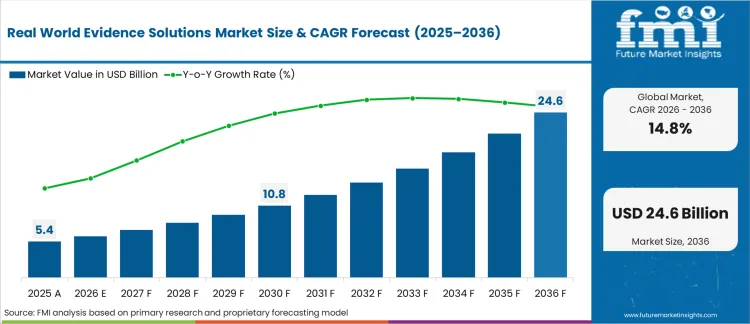
Key Takeaways, Market Size, and Forecast
| Metric | Value |
|---|---|
| Market Size (2025) | USD 5.4 Billion |
| Market Size (2026) | USD 6.2 Billion |
| Market Size (2036) | USD 24.6 Billion |
| Leading Component (2026) | Datasets |
| Datasets Share (2026) | 62.5% |
| Leading Application (2026) | Drug Development & Approvals |
Real World Evidence Solutions Market Key Takeaways
| Metric | Details |
|---|---|
| Industry Size (2026) | USD 6.2 billion |
| Industry Value (2036) | USD 24.6 billion |
| CAGR (2026-2036) | 14.80% |
Procurement leads who continue relying on fragmented claims data find their regulatory submissions rejected outright by compliance committees demanding fully tokenized patient journeys. Interoperability directors must deploy these cryptographic matching standards before the European cross-border safety mandates take effect to retain critical market access. Securing this native analytical layer allows life science researchers to continuously map rare disease progressions without ever triggering devastating data residency violations.
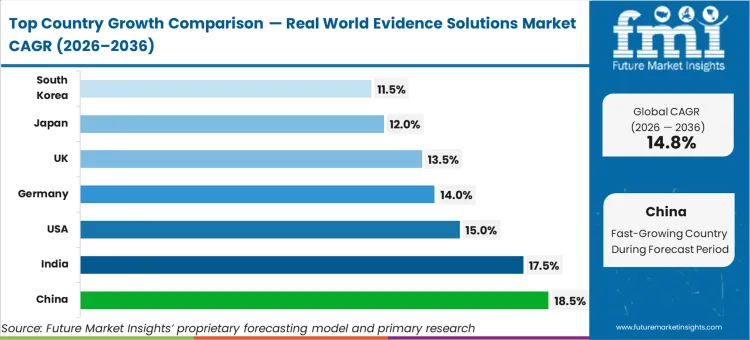
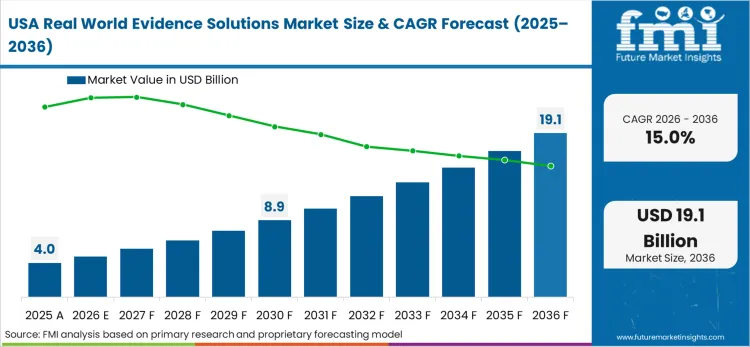
As regional healthcare systems transition toward federated data models, China sets the pace with an 18.5% CAGR, followed closely by India at 17.5% as both nations leverage greenfield digital health construction to bypass legacy retrofit hurdles. The United States advances at a 15.0% rate, supported by infrastructure modernization mandates from federal health agencies. Germany registers a 14.0% expansion while the UK tracks at 13.5%, both driven by precision engineering and genomic registry standards. Japan expands at a 12.0% trajectory anchored by its robust geriatric research sector. South Korea grows at 11.5% as localized bioinformatics funding matures, confirming that national privacy policies permanently dictate geographic adoption velocities.
Real World Evidence Solutions Market Definition
Real world evidence solutions represent the integrated datasets, analytical platforms, and consulting frameworks designed specifically to generate actionable clinical insights from observational patient data. The ecosystem includes de-identified electronic health records, medical claims databases, disease registries, and the epidemiological methodologies required to transform raw information into regulatory-grade evidence, enabling continuous therapeutic tracking outside controlled settings.
Real World Evidence Solutions Market Inclusions
The market scope includes commercialized clinical datasets, federated data networks, tokenization software, and specialized analytical services tailored for life science research. Retrospective cohort study platforms, synthetic control arm generation algorithms, and applications supporting electronic health records interoperability fall entirely within the boundaries. Products utilizing privacy-preserving record linkage mechanisms for critical post-market safety tracking are fully incorporated into the valuation.
Real World Evidence Solutions Market Exclusions
Standard commercial data warehousing solutions lacking healthcare-specific cryptographic tokenization are excluded. Pure hospital billing software without external epidemiological analysis capabilities falls outside the defined parameters. Legacy localized clinical trial management systems without multi-modal real-world interoperability features are explicitly omitted from the scope.
Real World Evidence Solutions Market Research Methodology
- Primary Research: Analysts engaged with chief data officers, health economics directors, and principal bioinformaticians to map the specific decision gates triggering observational research upgrades.
- Desk Research: The data collection phase aggregated compliance roadmaps from global health authorities, privacy framework ratification schedules, and major pharmaceutical data procurement guidelines.
- Market-Sizing and Forecasting: The baseline value derives from a bottom-up aggregation of commercial tokenization software deployments and dataset subscription contracts, applying region-specific digitalization curves to project the future adoption velocity.
- Data Validation and Update Cycle: Projections are rigorously tested against publicly reported capital expenditure guidance from the leading health data aggregators and life science conglomerates.
Segmental Analysis
Real World Evidence Solutions Market Analysis by Component
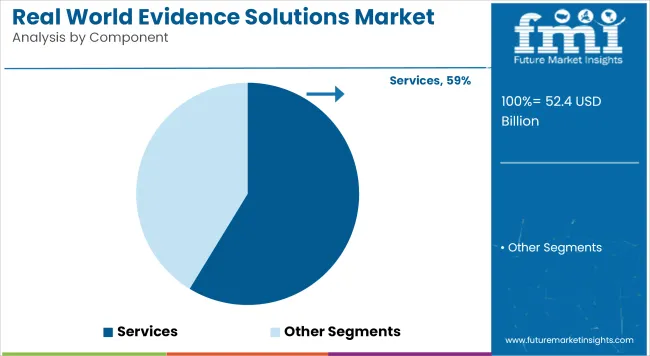
With dominant databases providing the absolute foundation for health outcomes research, procurement teams execute massive acquisition strategies to capture longitudinal value. Datasets command a striking 62.5% share in 2026, fusing raw clinical notes with comprehensive billing histories to track definitive patient journeys. Health economics directors deploying these combined data streams directly into their analytical engines establish the core evidence required for value-based pricing negotiations.
Based on FMI's assessment, this integration eliminates the fatal blind spots inherent in single-source observational studies. Procurement leads specifying these dual-source linkages streamline their entire evidentiary pipeline and significantly reduce the time required to answer regulatory inquiries. Health authorities facing complex safety signals now mandate comprehensive record alignment to authorize continued market access.
- Clinical depth fusion: Combining granular physician notes with absolute billing event timestamps allows clinical researchers to build highly accurate disease progression models.
- Longitudinal tracking: Unifying fragmented care episodes prevents patients from artificially dropping out of the observational cohort when they change insurance providers.
- Reimbursement validation: Linking diagnosis codes directly to specific pharmacy automation systems gives market access teams incontrovertible proof of real-world therapeutic adherence.
Real World Evidence Solutions Market Analysis by Application
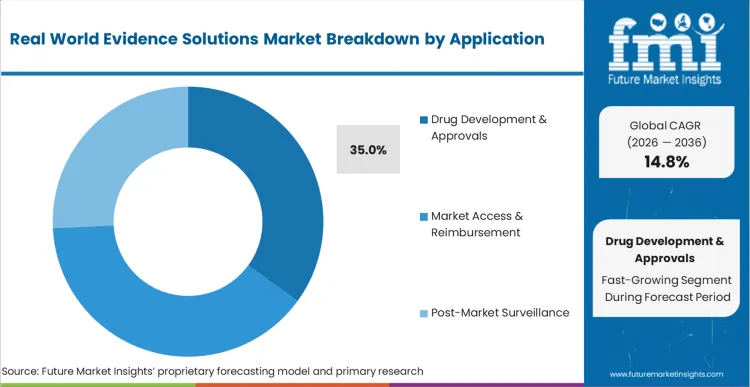
Traditional clinical pipelines face severe bottlenecks when evaluating therapeutics designed for exceptionally small patient populations. Drug Development & Approvals secures a 35.0% share in 2026 as late-stage development teams scramble to enrich their traditional trial dossiers with extended real-world observations.
FMI analysts opine that incorporating precise clinical trial management augmentation techniques allows sponsors to confidently present combined safety profiles to health authorities. Trial designers specifying these workflows bypass the immense costs of launching entirely new observational registries from scratch. Transforming static trial results into dynamic living datasets enables medical affairs teams to rapidly secure accelerated approval pathways. Value-based contracting directors utilizing robust observational evidence bypass standard reimbursement delays.
- Label expansion: Mapping early trial participants to their long-term electronic health records uncovers hidden secondary indications that drastically extend a commercial lifecycle.
- Comparator profiling: Analyzing linked real-world datasets allows clinical strategists to construct highly accurate synthetic control arms without deploying massive placebo groups.
- Protocol optimization: Evaluating historical patient journeys before launching a prospective trial ensures inclusion criteria perfectly match the actual real-world disease presentation.
Real World Evidence Solutions Market Analysis by End Use
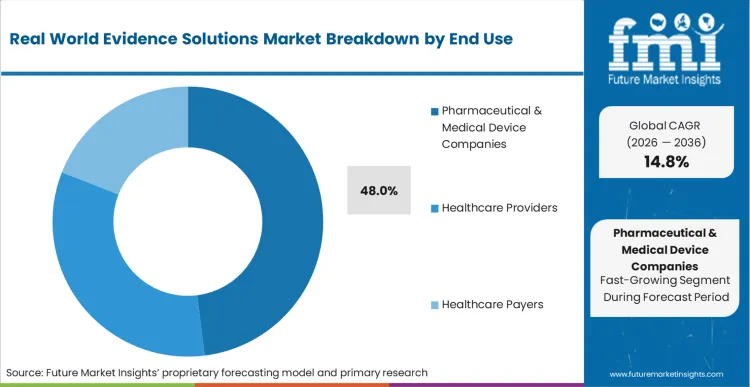
Sponsor organizations face mounting pressure to demonstrate therapeutic value across highly diverse patient populations over extended timelines. Pharmaceutical & Medical Device Companies represent a 48.0% share in 2026, driven directly by regulatory bodies imposing strict decade-long tracking requirements on advanced biologics.
In FMI's view, the convergence of comprehensive pharmaceutical contract research paradigms with massive claims databases amplifies the demand for continuous safety signal detection. Safety officers monitoring newly launched formulations reject delayed manual reporting workflows that introduce dangerous blind spots into the risk management plan. Automating the linkage between pharmacy dispensing records and subsequent hospital admissions provides immediate visibility into rare adverse events. Pharmacovigilance directors failing to deploy continuous automated linkage workflows face catastrophic regulatory warnings and potential product withdrawals.
- Signal detection: Algorithmic scanning of linked longitudinal records identifies extremely rare adverse events long before traditional spontaneous reporting systems register a pattern.
- Compliance automation: Integrating automated registry updates with mandatory regulatory submission portals slashes the administrative burden on dedicated pharmacovigilance teams.
- Risk mitigation: Real-time visibility into real-world dispensing errors allows risk management directors to instantly update physician prescribing guidelines and avert wide-scale patient harm.
Real World Evidence Solutions Market Drivers, Restraints, and Opportunities
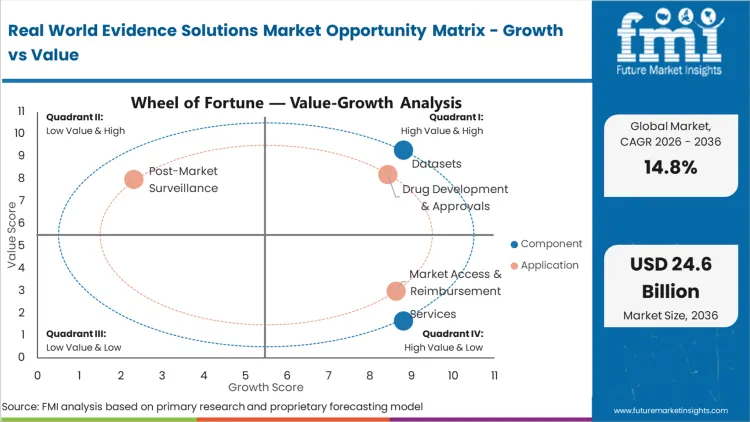
The convergence of value-based healthcare models and sophisticated precision medicine therapeutics forces health economics directors to extract actionable longitudinal data directly from fragmented provider networks. This commercial requirement renders siloed, single-source clinical registries virtually obsolete. Life sciences companies upgrading their evidentiary pipelines face a strict binary choice between abandoning complex post-market studies or deploying advanced observational networks. Transitioning to a unified federated matching backbone simplifies the entire regulatory submission process and enables instant cohort validation. Data aggregators that fail to modernize their core cryptographic linkage layers risk permanent exclusion from lucrative top-tier pharmaceutical procurement cycles.
The intricate legal parameters required to optimize cross-border data linkage create steep compliance learning curves for traditional clinical informaticians. Designing conflict-free data sharing schemas across multi-national registries demands specialized privacy legislation expertise that most biotechnology firms simply lack internally. To mitigate this skill gap, clinical operations directors increasingly rely on managed integration services that completely automate the token generation process and validate compliance frameworks before any physical data matching occurs.
Opportunities in the Real World Evidence Solutions Market
- Synthetic Control Generation: Advanced linkage algorithms enable trial designers to construct robust external control arms from existing electronic health records to eliminate placebo groups.
- Digital Biomarker Integration: Upgraded federated networks permit data scientists to seamlessly link continuous wearable medical devices outputs with traditional hospital diagnostic codes.
- Decentralized Trial Augmentation: Secure tokenization provides the exact cryptographic framework necessary to match mobile health application telemetry with standard clinical databases for global enrolment.
Regional Analysis
Based on the regional analysis, the Real World Evidence Solutions market is segmented into North America, Latin America, Europe, Asia Pacific, and Middle East & Africa across 40 plus countries.
.webp "Top Country Growth Comparison Real World Evidence Solutions Market Cagr (2026 2036)")
| Country | CAGR (2026 to 2036) |
| China | 18.5% |
| India | 17.5% |
| USA | 15.0% |
| Germany | 14.0% |
| UK | 13.5% |
| Japan | 12.0% |
| South Korea | 11.5% |
Source: Future Market Insights (FMI) analysis, based on proprietary forecasting model and primary research
Asia Pacific Real World Evidence Solutions Market Analysis
Rapid greenfield digital health adoption across the Asia Pacific region accelerates the bypass of archaic paper-based clinical trial constraints. Principal bioinformaticians constructing massive new genomic sequencing repositories specify unified tokenized networking in their initial architectural blueprints. FMI's analysis indicates that this clean-slate approach eliminates the costly and time-consuming data remediation phase that plagues older Western healthcare systems. By building native cryptographic linkage capabilities into the foundation, regional health authorities establish highly flexible data environments capable of rapid epidemiological analysis. The integration of robust network architecture forms the critical prerequisite for deploying advanced diagnostic machine learning applications across the region.
- China: Centralized population tracking anchors China's 18.5% compound expansion to 2036. The sheer volume of digitized citizen health records establishes a massive installed base of interoperable data architecture across the eastern coastal technology hubs. China's state-sponsored digital health initiatives deploy highly centralized regional health information exchanges requiring seamless data flow between provincial hospitals and central disease registries. Greenfield infrastructure architects bypass legacy deterministic matching entirely, specifying advanced neural network-based linkage algorithms for all new population health procurement contracts. Informatics vendors unable to demonstrate verified high-bandwidth analytical capabilities lose access to the most lucrative regional population health projects.
- India: India's expanding private hospital networks operate under new digital health mission frameworks requiring immutable electronic records for all patient encounters. Data integration engineers must deploy secure networks capable of guaranteeing critical sensor data delivery to centralized national registries without any packet loss. The national push toward universal health coverage triggers a wave of facility upgrades prioritizing unified, secure communication backbones. This mechanism drives a 17.5% CAGR for India as these digital health modernization mandates fundamentally transform regional clinical trial infrastructure. Suppliers failing to provide platforms with built-in data integrity mechanisms face disqualification from major life sciences facility tenders.
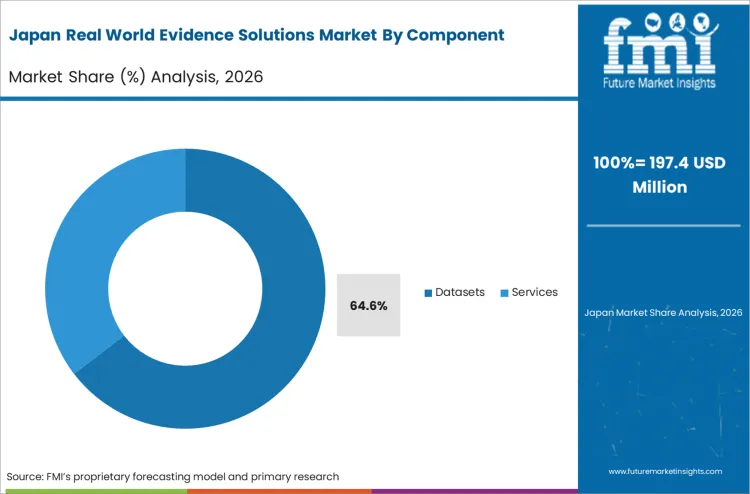
- Japan: Japan's robust regulatory demand is rising at a CAGR of 12.0% as this continuous safety qualification constraint sustains massive investment. The rapidly ageing demographic profile enforces strict post-market tracking requirements through the Pharmaceuticals and Medical Devices Agency for long-term geriatric safety evaluation. Every new rare disease research architecture must validate longitudinal linkage capacity before receiving authorisation for commercial reimbursement negotiations. The domestic pharmaceutical sector embeds precision observational tools directly into its clinical trial management systems to maintain global competitive advantage in advanced biologics development. Linkage service providers lacking verified compliance with local privacy acts forfeit access to the next generation of advanced therapy tracking contracts.
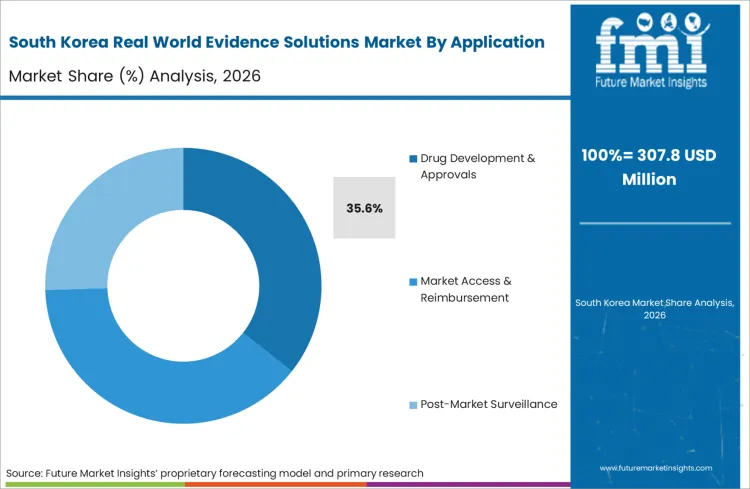
- South Korea: South Korea's advanced bio-manufacturing complex operates under rigorous real-world data mandates that exceed standard observational requirements by demanding direct linkage to national health insurance service claims. South Korea advances at an 11.5% compound rate as the zero-tolerance precision standard becomes the universal procurement baseline. Medical affairs leads mandate zero-loss tokenization architectures to ensure highly complex cell therapy outcomes are tracked flawlessly over full patient lifetimes. The concentration of advanced genomic research foundries necessitates continuous investment in highly secure linkage backbones to maximize evidentiary yield rates. Software suppliers targeting the next wave of government health data grants must prove massive parallel processing capabilities before entering the approved national vendor list.
FMI's report encompasses a holistic evaluation of the broader Asia Pacific digital health sector. The analysis investigates the emerging data linkage frameworks across Taiwan and the broader ASEAN region. A defining dynamic involves the integration of cross-border clinical trial datasets, which requires highly standardized tokenization protocols to coordinate multi-national regulatory submissions and maintain synchronized safety tracking schedules across completely different regional healthcare systems.
North America Real World Evidence Solutions Market Analysis
Sophisticated commercial claims ecosystems across North America target the systematic eradication of isolated health data domains. Health economics leaders executing critical value-based pricing strategies face strict mandates to unify diverse payer datasets under a single secure tokenization architecture. Implementing a standardized, privacy-preserving backbone enables pharmaceutical sponsors to deploy advanced predictive modelling algorithms without compromising patient anonymity.
FMI's research confirms that this strategic shift requires immense capital allocation toward robust cryptographic software capable of processing millions of records simultaneously. The success of these modernization initiatives depends entirely on the availability of certified interoperable networking components.
- USA: Robust federal policy architecture sustains a 15.0% compound rate for observational datasets in the USA. The United States commercial insurance sector enforces incredibly complex data usage frameworks across its entire fragmented provider ecosystem. Health informatics directors replacing basic deterministic matching must deploy advanced probabilistic tokenization algorithms capable of reconciling billing discrepancies across multiple state-level exchanges. Federal interoperability initiatives actively fund the replacement of archaic data silos with standardized application programming interfaces. Data brokers lacking documented compliance with rigorous HIPAA de-identification standards face immediate exclusion from massive commercial pharmaceutical data acquisitions.
FMI's report includes extensive coverage of the North American real world evidence market situation. It incorporates a detailed analysis of Canadian provincial data repositories and their specific integration challenges. A primary trend shaping these additional markets involves the rapid localization of data residency laws, forcing regional service providers to deploy entirely localized analytical engines to satisfy stringent federal health data sovereignty requirements.
Europe Real World Evidence Solutions Market Analysis
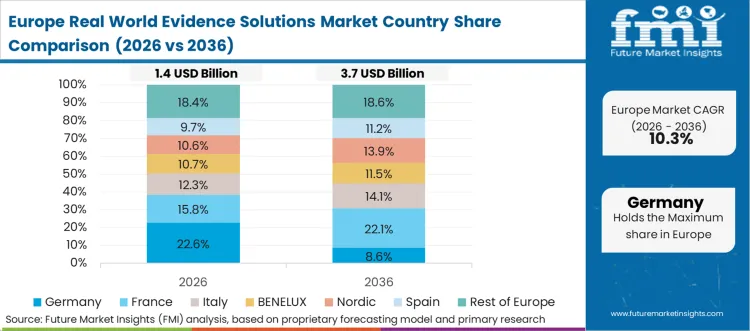
Strict European data protection policies actively penalize the commercialization of unsecured or poorly anonymized patient information. Chief privacy officers redesigning legacy clinical trial databases must integrate continuous compliance monitoring mechanisms alongside core cohort matching engines. This intense regulatory pressure forces the rapid adoption of zero-knowledge proof protocols to guarantee absolute patient anonymity while extracting highly valuable diagnostic trends. Upgrading the core linkage software provides the necessary mathematical certainty to support advanced cross-border epidemiological studies. As per FMI's projection, facility directors recognize that maintaining outdated network standards severely limits their ability to compete in highly regulated European markets.
- Germany: Germany's real-world evidence solutions market demand expands at a 14.0% CAGR as the federated standard proliferates across all major university hospital networks. The German digital health infrastructure operates under incredibly rigorous federal data protection laws that mandate localized tokenization layers for all commercial observational studies. System integrators must demonstrate flawless execution of federated queries before receiving authorization to connect specialized disease registries to the national telematics infrastructure. The national academic research sector operates under strict ethical certifications that force unified privacy compliance, creating a recurring architectural upgrade cycle that massively accelerates analytical software adoption. Bioinformatic providers targeting domestic payer reimbursement projects must guarantee absolute cryptographic irreversibility before the finalization of any commercial pharmaceutical data licensing agreements.
- UK: The United Kingdom's national health service modernization programs require incredibly precise patient matching data to evaluate the true cost-effectiveness of expensive advanced drug formulation rollouts. Clinical network planners deploying advanced population health management systems mandate tokenization architectures capable of securely bridging primary care records with highly specialized secondary care databases. The shift toward holistic care pathway analysis forces data scientists to abandon primitive probabilistic matching in favor of highly resilient, cryptographically secure linkage algorithms. Population health analytics deployment positions the UK at a 13.5% compound growth rate to 2036. Integration specialists unable to demonstrate absolute privacy preservation under severe audit scrutiny forfeit qualification for massive national research data expansion projects.
FMI's report includes thorough investigation of the broader European health informatics framework. The analysis encompasses Italy, France, Spain, the Nordics, and the Benelux region. A prevailing structural condition across these nations is the mandatory compliance with the impending European Health Data Space directives, forcing pharmaceutical sponsors to specify federated tokenization networks that can reliably transport anonymized safety signals without ever moving the underlying raw clinical data across sovereign borders.
Competitive Aligners for Market Players
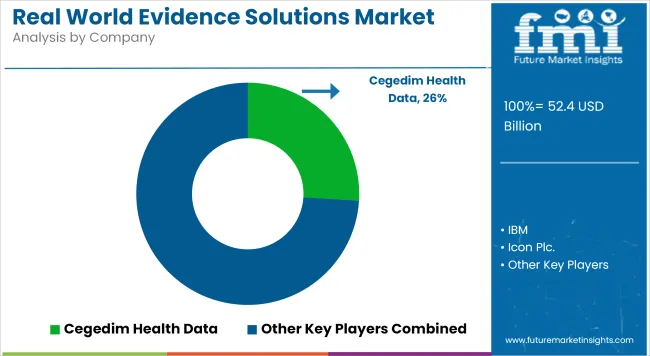
The rapid enforcement of stringent global data privacy frameworks is entirely reshaping how pharmaceutical buyers evaluate clinical data integration vendors. Instead of accepting vulnerable deterministic matching tools, procurement teams now demand certified, cryptographically secure analytical platforms in all new enterprise software tenders. This absolute shift has raised the privacy threshold across the entire ecosystem, meaning data brokers that continue to rely on centralized, unencrypted data pooling models risk being completely excluded from massive real-world evidence modernization programs. Industry leaders utilizing sophisticated artificial intelligence have already begun adapting rapidly to these structural mandates.
Prominent aggregators such as IQVIA, ICON plc, and Optum have strategically aligned their platform capabilities with highly advanced federated learning protocols, setting an entirely new competitive baseline for mid-tier challengers to follow. As a direct result, data integration vendors are severely pushed to integrate native zero-knowledge proof capabilities and advanced hashing algorithms directly into their core service offerings instead of utilizing vulnerable third-party bridging applications. Embedding robust healthcare analytical testing capabilities specifically for token matching grants a massive architectural advantage that streamlines procurement for large life science sponsors.
Growth of open, interoperable tokenization standards is permanently disrupting long-established proprietary data strongholds. With more health information exchanges mandating open application programming interfaces, system integrators designing converged data architectures can now select de-identification engines from multiple competing suppliers without worrying about incompatible hashing formats or massive data loss. This expanded operational flexibility empowers clinical trial sponsors to fully optimize their observational networks for raw evidentiary yield instead of being permanently constrained by legacy, closed-loop analytics platforms, structurally shifting pricing leverage back to the pharmaceutical buyers.
Key Players in Real World Evidence Solutions Market
- IQVIA
- ICON plc
- Thermo Fisher Scientific (PPD)
- Syneos Health
- Optum
- IBM (Merative)
- Oracle (Cerner)
- Cognizant
Scope of the Report
| Metric | Value |
| Quantitative Units | USD 6.2 billion to USD 24.6 billion, at a CAGR of 14.80% |
| Market Definition | Real world evidence solutions encompass the integrated datasets and analytical services required to translate fragmented observational health data into validated clinical proof. |
| Component Segmentation | Datasets, Services |
| Application Segmentation | Drug Development & Approvals, Market Access & Reimbursement, Post-Market Surveillance, Clinical Trial Design |
| End Use Segmentation | Pharmaceutical & Medical Device Companies, Healthcare Providers, Healthcare Payers, Regulatory Agencies |
| Regions Covered | North America, Latin America, Europe, Asia Pacific, Middle East & Africa |
| Countries Covered | China, India, USA, Germany, UK, Japan, South Korea, and 40+ other countries |
| Key Companies Profiled | IQVIA, ICON plc, Thermo Fisher Scientific (PPD), Syneos Health, Optum, IBM (Merative), Oracle (Cerner), Cognizant |
| Forecast Period | 2026 to 2036 |
| Approach | The baseline value derives from a bottom-up aggregation of commercial tokenization software deployments and dataset subscription contracts, applying region-specific digitalization curves to project future adoption velocity. Forecasts are validated against capital expenditure guidance from major health data aggregators. |
Source: Future Market Insights (FMI) analysis, based on proprietary forecasting model and primary research
Real World Evidence Solutions Market Analysis by Segments
Component:
- Datasets
- Services
Application:
- Drug Development & Approvals
- Market Access & Reimbursement
- Post-Market Surveillance
- Clinical Trial Design
End Use:
- Pharmaceutical & Medical Device Companies
- Healthcare Providers
- Healthcare Payers
- Regulatory Agencies
- Region:
- North America
- Latin America
- Europe
- Asia Pacific
- Middle East & Africa
Bibliography
- USA Food and Drug Administration. (2026, January 23). Real-world evidence.
- European Medicines Agency. (2025). Real-world evidence framework to support EU regulatory decision-making: 3rd report on experience gained with regulator-led studies (February 2024 to February 2025).
- Pharmaceuticals and Medical Devices Agency. (2024, October 4). Real World Data (RWD).
- Health Canada. (2024). 2024-2025 departmental plan: Health Canada.
- Canada’s Drug Agency. (2025, April 11). Real-world evidence for decision-making.
- Medicines and Healthcare products Regulatory Agency. (2025, July 17). MHRA guidance on the use of real-world data in clinical studies to support regulatory decisions.
- International Council for Harmonisation of Technical Requirements for Pharmaceuticals for Human Use. (2024, June 4). ICH reflection paper: Pursuing opportunities for harmonisation in using real-world data to generate real-world evidence, with a focus on effectiveness of medicines.
- Jansen, M. S., et al. (2024). Real-world evidence to inform regulatory decision making: A scoping review. Clinical Pharmacology & Therapeutics, 115(6), 1269-1276. doi:10.1002/cpt.3218
This bibliography is provided for reader reference. The full FMI report contains the complete reference list with primary source documentation.
This Report Addresses
- Market intelligence to support strategic decision‑making across organized real‑world evidence ecosystems and federated analytical infrastructure
- Market size estimation and 10‑year revenue forecasts from 2026 to 2036, supported by validated tokenization deployments, dataset subscription tracking, and structured primary interviews with health informatics and regulatory stakeholders
- Growth opportunity mapping across datasets, services, and multi‑modal real‑world evidence architectures, with emphasis on privacy‑preserving linkage, interoperability engineering, and regulatory‑grade analytical capabilities
- Segment and regional demand forecasts covering components, applications, and end‑use categories across major healthcare systems, regulatory jurisdictions, and high‑growth digital health economies
- Competitive strategy assessment including cryptographic tokenization differentiation, federated learning enablement, regulatory‑aligned data integration frameworks, and platform‑level interoperability innovation
- Technology and methodology tracking including synthetic control arm algorithms, longitudinal patient‑journey mapping, probabilistic and neural‑network tokenization engines, and continuous post‑market surveillance automation
- Market access analysis covering payer‑aligned evidence generation models, cross‑border compliance mandates, healthcare provider network integration, and adoption pathways shaped by global privacy laws
- Delivery of the full market intelligence suite in PDF, Excel, PPT, and interactive dashboard formats for executive planning, regulatory strategy, investment evaluation, and evidence‑generation workflow optimization
Frequently Asked Questions
How large is the Real World Evidence Solutions Market in 2026?
The market is estimated to be valued at USD 6.2 billion in 2026. This absolute necessity for regulatory-grade post-market safety validation drives continuous analytical investments.
What will the Real World Evidence Solutions Market be valued at by 2036?
The industry value is projected to reach USD 24.6 billion by 2036. The architectural pivot to federated data networks forces pharmaceutical sponsors to commit significant capital to observational registries.
What CAGR is projected for the Real World Evidence Solutions Market from 2026 to 2036?
Demand is expected to grow at a CAGR of 14.80% from 2026 to 2036. This compound expansion is sustained by health technology assessment bodies demanding continuous longitudinal tracking streams.
Which Component is poised to lead global sales by 2026?
Datasets accounts for 62.5% share in 2026. Health economics directors deploying these combined data streams directly into their analytical engines establish the core evidence required for value-based pricing.
How significant is the role of Drug Development & Approvals in driving market adoption in 2026?
Drug Development & Approvals represents 35.0% share in 2026. Trial designers specifying these observational workflows bypass the immense costs of launching entirely new clinical registries from scratch.
What specific requirement forces health economics directors to abandon traditional clinical trial data?
Standard trial data represents only a brief snapshot of highly controlled patient interactions. Health economics teams require decade-long real-world adherence records to justify premium formulary positioning to aggressive national payers.
Why do Pharmaceutical & Medical Device Companies dominate the end use segments?
This segment captures 48.0% share in 2026, driven directly by regulatory bodies imposing strict decade-long tracking requirements on advanced biologics. Incorporating precise observational techniques allows sponsors to confidently present combined safety dossiers.
What is the core tension driving the rapid adoption of tokenization engines?
The sheer volume of available health data clashes directly with strict global privacy laws. Clinical informatics leads attempting to generate longitudinal evidence must use cryptographic hashing to match patients without exposing protected health information.
What compliance standard fundamentally alters how clinical linkage is performed?
The impending European Health Data Space directives and massive HIPAA enforcement actions force the abandonment of centralized data pooling. Sponsors must deploy federated networks that process matches securely at the local hospital source.
What structural limitation plagues single-source observational studies?
Unifying fragmented care episodes prevents patients from artificially dropping out of the observational cohort when they change insurance providers. This eliminates the fatal flaws inherent in single-source claims analysis.
What is driving the massive real world evidence demand in the United States?
The United States commercial insurance sector enforces incredibly complex data usage frameworks across its fragmented provider ecosystem. Health informatics directors must deploy probabilistic algorithms capable of reconciling billing discrepancies across multiple state exchanges.
What is the growth outlook for the United States in this report?
The USA advances at a 15.0% compound rate from 2026 to 2036.
Why is China's digital health strategy unique regarding observational data?
China's state-sponsored initiatives deploy highly centralized regional health exchanges that bypass legacy deterministic matching entirely. Greenfield infrastructure architects specify advanced neural network linkage algorithms for all new population health contracts.
What is the China growth outlook in this report?
China is projected to expand at a CAGR of 18.5% during the forecast period.
How do German privacy regulations impact the local adoption of analytical services?
German regulations mandate completely localized tokenization layers for all commercial observational studies. System integrators must demonstrate flawless federated query execution before connecting disease registries to the national telematics infrastructure.
What is Germany's growth outlook in this report?
Germany tracks a 14.0% CAGR as the federated standard proliferates across all major university hospital networks.
Why does South Korea heavily invest in advanced data linkage?
South Korea's advanced bio-manufacturing complex operates under mandates demanding direct linkage to national health insurance claims. Medical affairs leads mandate zero-loss architectures to ensure complex advanced therapy outcomes are tracked flawlessly.
What sustains Japan's continuous investment in interoperable data registries?
Japan's rapidly aging demographic profile enforces strict post-market tracking requirements for long-term geriatric safety. Every new observational architecture must validate longitudinal capability to satisfy the Pharmaceuticals and Medical Devices Agency.
What specific application captures massive value in the regulatory pipeline?
Synthetic control generation enables trial designers to construct robust external control arms from existing electronic health records. This eliminates the need for massive placebo groups in specialized rare disease trials.
What is Real World Evidence Solutions and what is it mainly used for?
It represents the integrated datasets, analytical platforms, and consulting frameworks designed to generate actionable clinical insights from observational patient data. It is primarily used to map long-term therapeutic safety and efficacy profiles outside of controlled clinical trials.
What does the Real World Evidence Solutions market encompass in this report?
The scope includes commercialized clinical datasets, federated data networks, tokenization software, and specialized analytical services tailored for life science research.
What is explicitly excluded from the scope of this report?
Standard commercial data warehousing solutions lacking healthcare-specific cryptographic tokenization are excluded. Pure hospital billing software without external epidemiological analysis capabilities is also omitted.
What does the market forecast mean in the context of this report?
The forecast represents a model-based projection built on bottom-up tokenization software deployments and dataset subscription contracts for strategic planning purposes.
How does FMI build and validate this real world evidence solutions forecast?
The model applies regional digitalization curves to commercial tokenization deployments. Segment forecasts are cross-validated against quarterly software subscription revenues from major life science technology providers.
Preview the report firsthand - request a free sample
Get SampleGet the brochure for pricing and purchase details.
Get PDFTable of Content
- Executive Summary
- Global Market Outlook
- Demand-side Trends
- Supply-side Trends
- Technology Roadmap Analysis
- Analysis and Recommendations
- Market Overview
- Market Coverage / Taxonomy
- Market Definition / Scope / Limitations
- Research Methodology
- Chapter Orientation
- Analytical Lens and Working Hypotheses
- Market Structure, Signals, and Trend Drivers
- Benchmarking and Cross-market Comparability
- Market Sizing, Forecasting, and Opportunity Mapping
- Research Design and Evidence Framework
- Desk Research Programme (Secondary Evidence)
- Company Annual and Sustainability Reports
- Peer-reviewed Journals and Academic Literature
- Corporate Websites, Product Literature, and Technical Notes
- Earnings Decks and Investor Briefings
- Statutory Filings and Regulatory Disclosures
- Technical White Papers and Standards Notes
- Trade Journals, Industry Magazines, and Analyst Briefs
- Conference Proceedings, Webinars, and Seminar Materials
- Government Statistics Portals and Public Data Releases
- Press Releases and Reputable Media Coverage
- Specialist Newsletters and Curated Briefings
- Sector Databases and Reference Repositories
- FMI Internal Proprietary Databases and Historical Market Datasets
- Subscription Datasets and Paid Sources
- Social Channels, Communities, and Digital Listening Inputs
- Additional Desk Sources
- Expert Input and Fieldwork (Primary Evidence)
- Primary Modes
- Qualitative Interviews and Expert Elicitation
- Quantitative Surveys and Structured Data Capture
- Blended Approach
- Why Primary Evidence is Used
- Field Techniques
- Interviews
- Surveys
- Focus Groups
- Observational and In-context Research
- Social and Community Interactions
- Stakeholder Universe Engaged
- C-suite Leaders
- Board Members
- Presidents and Vice Presidents
- R&D and Innovation Heads
- Technical Specialists
- Domain Subject-matter Experts
- Scientists
- Physicians and Other Healthcare Professionals
- Governance, Ethics, and Data Stewardship
- Research Ethics
- Data Integrity and Handling
- Primary Modes
- Tooling, Models, and Reference Databases
- Desk Research Programme (Secondary Evidence)
- Data Engineering and Model Build
- Data Acquisition and Ingestion
- Cleaning, Normalisation, and Verification
- Synthesis, Triangulation, and Analysis
- Quality Assurance and Audit Trail
- Market Background
- Market Dynamics
- Drivers
- Restraints
- Opportunity
- Trends
- Scenario Forecast
- Demand in Optimistic Scenario
- Demand in Likely Scenario
- Demand in Conservative Scenario
- Opportunity Map Analysis
- Product Life Cycle Analysis
- Supply Chain Analysis
- Investment Feasibility Matrix
- Value Chain Analysis
- PESTLE and Porter’s Analysis
- Regulatory Landscape
- Regional Parent Market Outlook
- Production and Consumption Statistics
- Import and Export Statistics
- Market Dynamics
- Global Market Analysis 2021 to 2025 and Forecast, 2026 to 2036
- Historical Market Size Value (USD Million) Analysis, 2021 to 2025
- Current and Future Market Size Value (USD Million) Projections, 2026 to 2036
- Y-o-Y Growth Trend Analysis
- Absolute $ Opportunity Analysis
- Global Market Pricing Analysis 2021 to 2025 and Forecast 2026 to 2036
- Global Market Analysis 2021 to 2025 and Forecast 2026 to 2036, By Product Type
- Introduction / Key Findings
- Historical Market Size Value (USD Million) Analysis By Product Type , 2021 to 2025
- Current and Future Market Size Value (USD Million) Analysis and Forecast By Product Type , 2026 to 2036
- Type A
- Type B
- Type C
- Type A
- Y-o-Y Growth Trend Analysis By Product Type , 2021 to 2025
- Absolute $ Opportunity Analysis By Product Type , 2026 to 2036
- Global Market Analysis 2021 to 2025 and Forecast 2026 to 2036, By Design Type
- Introduction / Key Findings
- Historical Market Size Value (USD Million) Analysis By Design Type, 2021 to 2025
- Current and Future Market Size Value (USD Million) Analysis and Forecast By Design Type, 2026 to 2036
- U-Panel Bags
- Baffle/Q-Bags
- Circular/Tubular Bags
- U-Panel Bags
- Y-o-Y Growth Trend Analysis By Design Type, 2021 to 2025
- Absolute $ Opportunity Analysis By Design Type, 2026 to 2036
- Global Market Analysis 2021 to 2025 and Forecast 2026 to 2036, By Capacity
- Introduction / Key Findings
- Historical Market Size Value (USD Million) Analysis By Capacity, 2021 to 2025
- Current and Future Market Size Value (USD Million) Analysis and Forecast By Capacity, 2026 to 2036
- 500 to 1000 kg
- Up to 500 kg
- Above 1000 kg
- 500 to 1000 kg
- Y-o-Y Growth Trend Analysis By Capacity, 2021 to 2025
- Absolute $ Opportunity Analysis By Capacity, 2026 to 2036
- Global Market Analysis 2021 to 2025 and Forecast 2026 to 2036, By End Use
- Introduction / Key Findings
- Historical Market Size Value (USD Million) Analysis By End Use, 2021 to 2025
- Current and Future Market Size Value (USD Million) Analysis and Forecast By End Use, 2026 to 2036
- Chemicals & Fertilizers
- Food & Agriculture
- Construction
- Chemicals & Fertilizers
- Y-o-Y Growth Trend Analysis By End Use, 2021 to 2025
- Absolute $ Opportunity Analysis By End Use, 2026 to 2036
- Global Market Analysis 2021 to 2025 and Forecast 2026 to 2036, By Region
- Introduction
- Historical Market Size Value (USD Million) Analysis By Region, 2021 to 2025
- Current Market Size Value (USD Million) Analysis and Forecast By Region, 2026 to 2036
- North America
- Latin America
- Western Europe
- Eastern Europe
- East Asia
- South Asia and Pacific
- Middle East & Africa
- Market Attractiveness Analysis By Region
- North America Market Analysis 2021 to 2025 and Forecast 2026 to 2036, By Country
- Historical Market Size Value (USD Million) Trend Analysis By Market Taxonomy, 2021 to 2025
- Market Size Value (USD Million) Forecast By Market Taxonomy, 2026 to 2036
- By Country
- USA
- Canada
- Mexico
- By Product Type
- By Design Type
- By Capacity
- By End Use
- By Country
- Market Attractiveness Analysis
- By Country
- By Product Type
- By Design Type
- By Capacity
- By End Use
- Key Takeaways
- Latin America Market Analysis 2021 to 2025 and Forecast 2026 to 2036, By Country
- Historical Market Size Value (USD Million) Trend Analysis By Market Taxonomy, 2021 to 2025
- Market Size Value (USD Million) Forecast By Market Taxonomy, 2026 to 2036
- By Country
- Brazil
- Chile
- Rest of Latin America
- By Product Type
- By Design Type
- By Capacity
- By End Use
- By Country
- Market Attractiveness Analysis
- By Country
- By Product Type
- By Design Type
- By Capacity
- By End Use
- Key Takeaways
- Western Europe Market Analysis 2021 to 2025 and Forecast 2026 to 2036, By Country
- Historical Market Size Value (USD Million) Trend Analysis By Market Taxonomy, 2021 to 2025
- Market Size Value (USD Million) Forecast By Market Taxonomy, 2026 to 2036
- By Country
- Germany
- UK
- Italy
- Spain
- France
- Nordic
- BENELUX
- Rest of Western Europe
- By Product Type
- By Design Type
- By Capacity
- By End Use
- By Country
- Market Attractiveness Analysis
- By Country
- By Product Type
- By Design Type
- By Capacity
- By End Use
- Key Takeaways
- Eastern Europe Market Analysis 2021 to 2025 and Forecast 2026 to 2036, By Country
- Historical Market Size Value (USD Million) Trend Analysis By Market Taxonomy, 2021 to 2025
- Market Size Value (USD Million) Forecast By Market Taxonomy, 2026 to 2036
- By Country
- Russia
- Poland
- Hungary
- Balkan & Baltic
- Rest of Eastern Europe
- By Product Type
- By Design Type
- By Capacity
- By End Use
- By Country
- Market Attractiveness Analysis
- By Country
- By Product Type
- By Design Type
- By Capacity
- By End Use
- Key Takeaways
- East Asia Market Analysis 2021 to 2025 and Forecast 2026 to 2036, By Country
- Historical Market Size Value (USD Million) Trend Analysis By Market Taxonomy, 2021 to 2025
- Market Size Value (USD Million) Forecast By Market Taxonomy, 2026 to 2036
- By Country
- China
- Japan
- South Korea
- By Product Type
- By Design Type
- By Capacity
- By End Use
- By Country
- Market Attractiveness Analysis
- By Country
- By Product Type
- By Design Type
- By Capacity
- By End Use
- Key Takeaways
- South Asia and Pacific Market Analysis 2021 to 2025 and Forecast 2026 to 2036, By Country
- Historical Market Size Value (USD Million) Trend Analysis By Market Taxonomy, 2021 to 2025
- Market Size Value (USD Million) Forecast By Market Taxonomy, 2026 to 2036
- By Country
- India
- ASEAN
- Australia & New Zealand
- Rest of South Asia and Pacific
- By Product Type
- By Design Type
- By Capacity
- By End Use
- By Country
- Market Attractiveness Analysis
- By Country
- By Product Type
- By Design Type
- By Capacity
- By End Use
- Key Takeaways
- Middle East & Africa Market Analysis 2021 to 2025 and Forecast 2026 to 2036, By Country
- Historical Market Size Value (USD Million) Trend Analysis By Market Taxonomy, 2021 to 2025
- Market Size Value (USD Million) Forecast By Market Taxonomy, 2026 to 2036
- By Country
- Kingdom of Saudi Arabia
- Other GCC Countries
- Turkiye
- South Africa
- Other African Union
- Rest of Middle East & Africa
- By Product Type
- By Design Type
- By Capacity
- By End Use
- By Country
- Market Attractiveness Analysis
- By Country
- By Product Type
- By Design Type
- By Capacity
- By End Use
- Key Takeaways
- Key Countries Market Analysis
- USA
- Pricing Analysis
- Market Share Analysis, 2025
- By Product Type
- By Design Type
- By Capacity
- By End Use
- Canada
- Pricing Analysis
- Market Share Analysis, 2025
- By Product Type
- By Design Type
- By Capacity
- By End Use
- Mexico
- Pricing Analysis
- Market Share Analysis, 2025
- By Product Type
- By Design Type
- By Capacity
- By End Use
- Brazil
- Pricing Analysis
- Market Share Analysis, 2025
- By Product Type
- By Design Type
- By Capacity
- By End Use
- Chile
- Pricing Analysis
- Market Share Analysis, 2025
- By Product Type
- By Design Type
- By Capacity
- By End Use
- Germany
- Pricing Analysis
- Market Share Analysis, 2025
- By Product Type
- By Design Type
- By Capacity
- By End Use
- UK
- Pricing Analysis
- Market Share Analysis, 2025
- By Product Type
- By Design Type
- By Capacity
- By End Use
- Italy
- Pricing Analysis
- Market Share Analysis, 2025
- By Product Type
- By Design Type
- By Capacity
- By End Use
- Spain
- Pricing Analysis
- Market Share Analysis, 2025
- By Product Type
- By Design Type
- By Capacity
- By End Use
- France
- Pricing Analysis
- Market Share Analysis, 2025
- By Product Type
- By Design Type
- By Capacity
- By End Use
- India
- Pricing Analysis
- Market Share Analysis, 2025
- By Product Type
- By Design Type
- By Capacity
- By End Use
- ASEAN
- Pricing Analysis
- Market Share Analysis, 2025
- By Product Type
- By Design Type
- By Capacity
- By End Use
- Australia & New Zealand
- Pricing Analysis
- Market Share Analysis, 2025
- By Product Type
- By Design Type
- By Capacity
- By End Use
- China
- Pricing Analysis
- Market Share Analysis, 2025
- By Product Type
- By Design Type
- By Capacity
- By End Use
- Japan
- Pricing Analysis
- Market Share Analysis, 2025
- By Product Type
- By Design Type
- By Capacity
- By End Use
- South Korea
- Pricing Analysis
- Market Share Analysis, 2025
- By Product Type
- By Design Type
- By Capacity
- By End Use
- Russia
- Pricing Analysis
- Market Share Analysis, 2025
- By Product Type
- By Design Type
- By Capacity
- By End Use
- Poland
- Pricing Analysis
- Market Share Analysis, 2025
- By Product Type
- By Design Type
- By Capacity
- By End Use
- Hungary
- Pricing Analysis
- Market Share Analysis, 2025
- By Product Type
- By Design Type
- By Capacity
- By End Use
- Kingdom of Saudi Arabia
- Pricing Analysis
- Market Share Analysis, 2025
- By Product Type
- By Design Type
- By Capacity
- By End Use
- Turkiye
- Pricing Analysis
- Market Share Analysis, 2025
- By Product Type
- By Design Type
- By Capacity
- By End Use
- South Africa
- Pricing Analysis
- Market Share Analysis, 2025
- By Product Type
- By Design Type
- By Capacity
- By End Use
- USA
- Market Structure Analysis
- Competition Dashboard
- Competition Benchmarking
- Market Share Analysis of Top Players
- By Regional
- By Product Type
- By Design Type
- By Capacity
- By End Use
- Competition Analysis
- Competition Deep Dive
- Rishi FIBC
- Overview
- Product Portfolio
- Profitability by Market Segments (Product/Age /Sales Channel/Region)
- Sales Footprint
- Strategy Overview
- Marketing Strategy
- Product Strategy
- Channel Strategy
- Packem Umasree
- Bulk Corp International
- Global-Pak
- Berry Global
- Greif Inc.
- LC Packaging
- Rishi FIBC
- Competition Deep Dive
- Assumptions & Acronyms Used


