

- Industry Size (2026)
- USD 5.2 Bn
- Forecast (2036)
- USD 21.4 Bn
- CAGR (2026 to 2036)
- 15.2%
Digital Health for Obesity Market Forecast and Outlook 2026 to 2036
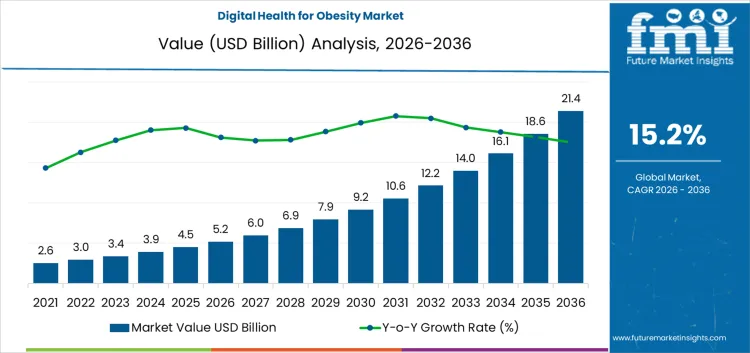
The digital health for obesity market is projected to reach USD 21.4 billion by 2036 from an expected USD 5.2 billion in 2026, implying a CAGR of 15.2%. Demand is heavily concentrated in North America and parts of Western Europe, where reimbursement pathways, employer health programs, and large private payer systems support scaled deployment. Adoption remains uneven because many countries rely on clinic based care and have limited coverage for digital interventions. Cost advantages cluster in regions with strong software development labor pools and established telehealth infrastructure, which shapes where platforms are built and operated.
Over the period, growth patterns continue to differ by health system structure rather than by population size alone. The United States and a few high income markets drive most spending, while large emerging economies expand usage at a slower, price sensitive pace. Localization costs, regulatory clearance, and data hosting rules influence rollout speed and product scope. Provider networks and insurer partnerships matter more than direct to consumer reach in most regions. The market expands through institutional adoption and coverage decisions, not through uniform global uptake of consumer health applications.
Quick Stats of the Digital Health for Obesity Market
- Digital Health for Obesity Market Value (2026): USD 5.2 billion
- Digital Health for Obesity Forecast Value (2036): USD 21.4 billion
- Digital Health for Obesity Forecast CAGR 2026 to 2036: 15.2%
- Leading Component in Digital Health for Obesity Market: Services (38 % share)
- Leading Application in Digital Health for Obesity Market: Weight Management and Tracking (42 % share)
- Key Growth Regions in Digital Health for Obesity Market: India, China, Brazil, USA, UK
- Top Players in Digital Health for Obesity Market: Noom, WW International (WeightWatchers), MyFitnessPal, Fitbit (Google), Teladoc Health, Lark Health, HealthifyMe
What is the Growth Forecast for Digital Health for Obesity Market through 2036?
Between 2026 and 2031, the digital health for obesity market is projected to expand from USD 5.2 billion along a rapid growth path consistent with a 15.2% CAGR, driven by a change in how weight management is delivered rather than by a simple rise in app downloads. This period is shaped by the migration of behavior change programs, coaching, and monitoring from episodic clinic visits to continuous, data-driven engagement models. Services and software gain prominence because they fit subscription-based care pathways and employer or insurer-supported wellness programs. Demand is reinforced by rising clinical recognition of obesity as a chronic condition requiring long-term management.
From 2031 to 2036, the market is expected to reach USD 21.4 billion, with growth driven by deeper integration of digital platforms into formal treatment pathways and chronic disease management programs. Digital obesity tools begin to operate alongside pharmacological and clinical interventions, serving as adherence, monitoring, and behavior reinforcement layers. Remote consultations and data-sharing with clinicians become routine in many care models, increasing the value per user rather than just the user count. Competitive positioning depends on clinical credibility, engagement retention, and outcomes data, not only user interface design. This environment favors established platforms such as Noom, WW International (WeightWatchers), MyFitnessPal, Fitbit (Google), Teladoc Health, Lark Health, and HealthifyMe.
Digital Health for Obesity Market Key Takeaways
| Metric | Value |
|---|---|
| Market Value (2026) | USD 5.2 billion |
| Forecast Value (2036) | USD 21.4 billion |
| Forecast CAGR 2026 to 2036 | 15.2% |
How Is Digital Health Transforming Obesity Management?
Digital health solutions for obesity are increasingly adopted to support weight management, lifestyle modification, and long-term patient monitoring. Historically, obesity interventions relied on in-person consultations, diet plans, and periodic check-ups, which often faced adherence challenges and limited scalability. Modern digital health tools integrate mobile apps, wearable devices, telehealth platforms, and AI-driven coaching to track physical activity, dietary intake, and biometric indicators, providing personalized guidance and real-time feedback. Healthcare providers, wellness companies, and insurers prioritize data accuracy, user engagement, and interoperability with electronic health records. Early adoption focused on high-risk patient populations, while current demand spans general healthcare, corporate wellness programs, and remote patient monitoring, driven by rising obesity prevalence, digital accessibility, and preventive health initiatives.
Increasing prevalence of obesity, demand for remote monitoring, and emphasis on preventive healthcare are shaping market growth. Compared with traditional interventions, digital health solutions emphasize continuous monitoring, personalized recommendations, and behavior modification through AI analytics. Cost structures depend on software development, device integration, and data security measures, concentrating margins among providers delivering reliable, user-friendly, and clinically validated solutions. Healthcare providers and insurers adopt these platforms to improve patient outcomes, reduce comorbidity risks, and enhance engagement. By 2036, digital health solutions for obesity are expected to become standard in preventive care and chronic disease management, supporting personalized interventions, scalable monitoring, and improved population health outcomes.
What Factors Are Shaping the Demand for Digital Health for Obesity by Solution Component and Care Application in 2026?
The digital health for obesity market in 2026 is segmented by component and by application focus. By solution component, demand is divided into services, software, hardware, and telehealth or coaching platforms, each playing a different role in delivery, monitoring, and patient engagement. By application, demand is organized around weight management and tracking, behavioral therapy and coaching, remote clinical consultations, and nutrition and diet planning. These segments reflect how care models are structured, how responsibility is shared between providers and patients, and how outcomes are managed across long treatment timelines where adherence, continuity, and data reliability shape both clinical results and commercial viability.
Why Do Services Represent the Largest Component Share in Digital Obesity Care?
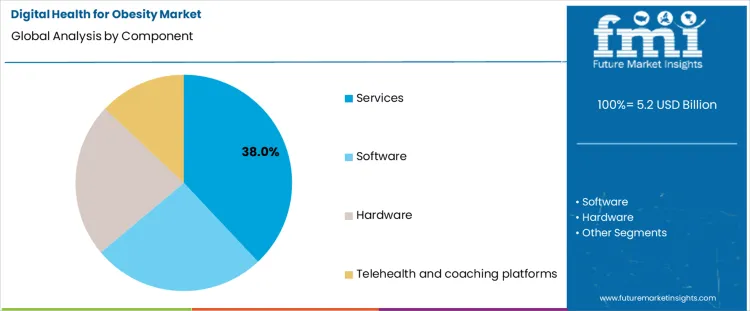
Services account for about 38% of demand in 2026, reflecting the central role of ongoing human interaction in obesity management. Long term weight control depends less on short term data collection and more on sustained guidance, accountability, and adjustment of plans as patient behavior and health status change. Many programs therefore allocate spending toward coaching, clinical oversight, and structured follow up rather than toward tools alone. Service models also allow providers to bundle multiple digital elements into a single care pathway, which simplifies procurement for employers, insurers, and health systems. This recurring, labor based delivery structure produces steady revenue streams and keeps services as the anchor of most digital obesity management offerings.
Software, hardware, and platform tools support these services rather than replacing them. Software applications handle tracking, reminders, and reporting, yet their effectiveness depends on how consistently patients engage with them. Hardware such as connected scales or wearables provides data, but data alone rarely changes outcomes without interpretation and guidance. Telehealth platforms make interaction easier, though they still rely on staffed programs to deliver value. These components are often included as part of broader service contracts rather than sold independently. This packaging logic limits their standalone share while reinforcing the dominance of service led business models across most payer and provider adoption scenarios.
Why Does Weight Management and Tracking Dominate Application Focus?
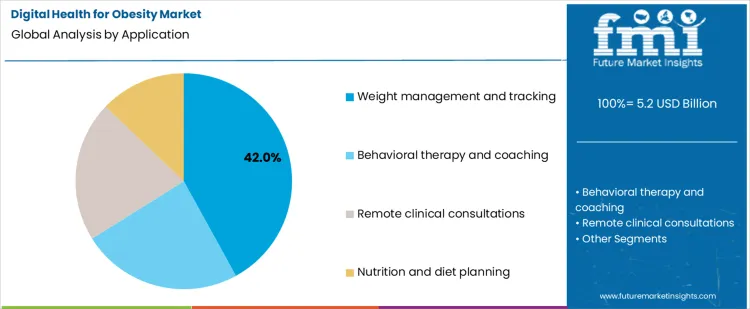
Weight management and tracking represent about 42% of demand in 2026 because they form the measurable core of most obesity care programs. Regular tracking creates feedback loops that support both patient motivation and clinical decision making. It also provides objective evidence for employers, insurers, and providers who need to assess program effectiveness over time. Compared with therapy or consultation, tracking functions can be deployed at scale across large populations with relatively low marginal cost. This makes them attractive as the first layer of engagement in many programs. Their central role in monitoring progress and structuring interventions explains why this application area absorbs the largest share of spending.
Behavioral therapy, remote consultations, and nutrition planning address more specific aspects of treatment. Behavioral programs require trained staff and sustained patient commitment, which limits throughput and raises cost per participant. Clinical consultations focus on medical oversight and comorbidity management rather than on daily behavior. Nutrition planning must be adapted to individual preferences and cultural contexts, which reduces standardization. These functions are essential, yet they are usually layered onto a tracking centered framework rather than replacing it. This structure keeps tracking and management at the center of most deployments, with other applications added selectively based on patient risk profile and program design.
Why Are Payer Scrutiny, Long Term Condition Management, and Access Gaps Driving Digital Health for Obesity through 2036?
Demand is being pulled by how obesity is financed and managed rather than by novelty in apps. Health systems face recurring costs from diabetes, cardiovascular disease, and orthopedic complications, which makes continuous weight management economically attractive. Waiting lists for specialist care and limited clinician time push payers toward tools that extend monitoring beyond clinics. Employers and insurers also want scalable programs that document adherence and outcomes. Digital platforms offer longitudinal tracking, coaching, and integration with prescriptions or devices without expanding physical capacity. Once programs are embedded in benefit designs, they become part of chronic care pathways, anchoring usage to population management strategies instead of episodic treatment cycles.
What Engagement Fragility, Reimbursement Uncertainty, and Clinical Validation Burden Are Limiting Impact?
The main constraint is human behavior, not software capability. Many users disengage after initial enthusiasm, which weakens outcome data and complicates payer justification. Reimbursement rules differ widely and often lag behind service models, forcing vendors into pilot projects rather than scaled contracts. Clinicians remain cautious because weight outcomes are influenced by many variables outside the app, making attribution difficult. Regulatory expectations around claims and data handling raise development and compliance costs. Integration with existing care workflows is also uneven. These factors stretch sales cycles, reduce predictable revenue, and keep many programs in trial or adjunct roles rather than core treatment pathways.
How Are Drug Therapies, Data Integration, and Care Pathway Redesign Changing the Role of Digital Tools?
The category is being redefined by its neighbors. As pharmacological treatments become more common, digital platforms are repositioned to manage adherence, side effects, and lifestyle coordination rather than acting alone. Health systems want tools that connect devices, labs, prescriptions, and coaching into one record, shifting value toward interoperability. Care pathways are also being standardized, with digital steps specified alongside clinic visits. Procurement is moving from consumer subscriptions to contracts with payers and providers. Over time, digital health for obesity becomes an infrastructure layer within chronic disease management, judged on continuity and outcomes support rather than on user interface novelty.
What is the Demand for Digital Health for Obesity by Country?
| Country | CAGR (%) |
|---|---|
| USA | 14.0 |
| UK | 13.5 |
| China | 16.5 |
| India | 17.8 |
| Brazil | 14.2 |
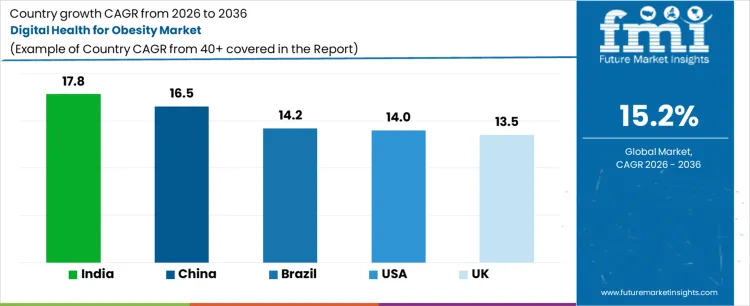
Demand for digital health solutions for obesity is rising as healthcare providers, technology companies, and consumers adopt digital tools for weight management, lifestyle tracking, and personalized interventions. India leads with a 17.8% CAGR, driven by increasing obesity prevalence, smartphone penetration, and adoption of AI-powered health platforms. China follows at 16.5%, supported by growing digital health infrastructure, government health initiatives, and rising awareness of lifestyle diseases. Brazil records 14.2% growth, shaped by urbanization, rising obesity rates, and demand for digital wellness programs. The USA grows at 14.0%, influenced by widespread telehealth adoption and integration of AI and wearable devices. The UK shows 13.5% CAGR, reflecting steady adoption of digital obesity management tools and remote healthcare solutions.
How is the United States experiencing growth in the digital health for obesity market?
United States is experiencing growth at a CAGR of 14%, supported by increasing adoption of digital health platforms for weight management, remote monitoring, and personalized lifestyle interventions. Healthcare providers and tech companies are deploying mobile apps, wearable devices, and telehealth programs optimized for patient engagement, real-time tracking, and integration with electronic health records. Demand is concentrated in metropolitan healthcare hubs such as Boston, San Francisco, and New York, where obesity prevalence and digital adoption rates are high. Investments focus on platform reliability, data security, and compliance with HIPAA and medical device regulations. Growth reflects rising obesity rates, telemedicine adoption, and focus on preventive healthcare solutions.
- Telehealth and digital platforms drive adoption.
- Solutions optimize real-time tracking and patient engagement.
- Metropolitan healthcare hubs concentrate demand.
- Platform reliability and regulatory compliance guide investment.
How is the United Kingdom witnessing growth in the digital health for obesity market?
United Kingdom is witnessing growth at a CAGR of 13.5%, fueled by the NHS push for preventive care and adoption of digital health tools for weight management and obesity monitoring. Digital interventions include mobile apps, wearable trackers, and online coaching platforms optimized for integration with national health services and chronic disease management programs. Demand is concentrated in London, Manchester, and Birmingham, where obesity prevalence is significant and technology adoption is high. Investments prioritize data security, usability, and compliance with NHS and GDPR standards. Growth reflects public health initiatives, increasing awareness of obesity risks, and integration of digital solutions in preventive healthcare programs.
- Preventive healthcare initiatives drive adoption.
- Platforms enhance patient monitoring and lifestyle management.
- Major cities concentrate demand.
- Data security and regulatory compliance guide investment.
How is China experiencing growth in the digital health for obesity market?
China is experiencing growth at a CAGR of 16.5%, driven by rising obesity prevalence, increasing smartphone penetration, and government-backed health technology initiatives. Digital health solutions include mobile apps, wearable devices, and AI-powered platforms optimized for personalized nutrition, exercise tracking, and teleconsultations. Demand is concentrated in urban centers such as Beijing, Shanghai, and Guangzhou, where digital literacy and lifestyle-related health challenges are high. Investments focus on AI integration, user engagement, and compliance with national health regulations. Growth reflects urban lifestyle shifts, government health programs, and expanding adoption of remote healthcare platforms.
- Urban lifestyle challenges drive adoption.
- Solutions optimize personalized nutrition and exercise tracking.
- Major metropolitan centers concentrate demand.
- AI integration and regulatory compliance guide investment.
How is India witnessing growth in the digital health for obesity market?
India is witnessing growth at a CAGR of 17.8%, fueled by rising obesity rates in urban areas, increasing smartphone penetration, and expansion of telemedicine and digital health platforms. Digital interventions include mobile apps, wearable fitness trackers, and AI-assisted coaching programs optimized for local dietary habits and lifestyle patterns. Demand is concentrated in metro cities such as Mumbai, Delhi, and Bengaluru, where urban lifestyle and sedentary behavior contribute to obesity prevalence. Investments focus on user engagement, platform reliability, and compliance with national health regulations. Growth reflects increasing health awareness, digital adoption, and the push for preventive healthcare solutions.
- Urban lifestyle and rising obesity drive adoption.
- Platforms enhance tracking, coaching, and behavioral interventions.
- Metro cities concentrate demand.
- User engagement and regulatory compliance guide investment.
How is Brazil experiencing growth in the digital health for obesity market?
Brazil is experiencing growth at a CAGR of 14.2%, supported by government health programs, rising obesity prevalence, and expanding digital health adoption. Solutions include mobile apps, wearable devices, and remote coaching platforms optimized for regional dietary habits, physical activity tracking, and personalized interventions. Demand is concentrated in urban areas such as São Paulo, Rio de Janeiro, and Brasília, where obesity rates are high and technology adoption is increasing. Investments prioritize platform reliability, patient engagement, and compliance with Brazilian health and data protection regulations. Growth reflects public health initiatives, growing digital literacy, and demand for scalable preventive healthcare solutions.
- Government health programs drive adoption.
- Platforms optimize tracking and personalized interventions.
- Urban centers concentrate demand.
- Platform reliability and regulatory compliance guide investment.
Who Competes in the Digital Health for Obesity Market and What Defines Their Capabilities?
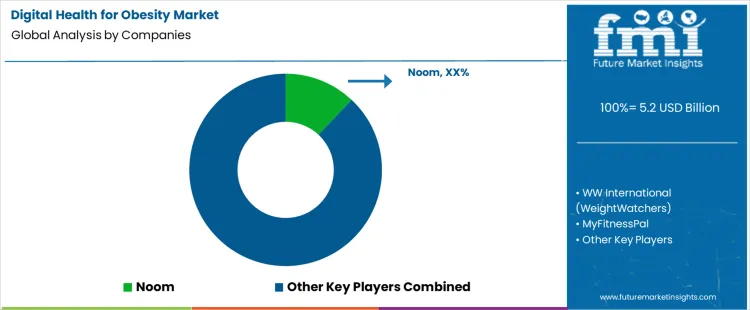
Competition in the digital health for obesity market is defined by platforms that combine behavior tracking, personalized guidance, and integration with health data. Noom offers a mobile app centered on behavior change, calorie tracking, and psychology based coaching to support weight management. WW International (WeightWatchers) provides subscription based digital coaching, meal planning, and community support anchored in evidence based dietary frameworks. MyFitnessPal, known for a comprehensive food database and tracking tools, supports calorie and macronutrient monitoring across devices and integrates with multiple health apps. Fitbit (Google) supplies wearable activity tracking and health metrics, enabling users to correlate physical activity with weight trends. Teladoc Health includes telehealth services with clinicians and nutrition professionals accessible through digital channels. Lark Health delivers AI driven coaching focused on lifestyle behaviors. HealthifyMe provides a combination of tracking tools and personalized coaching tailored to regional dietary patterns.
Market differentiation arises from how platforms combine technology, content, and human or automated support to influence lifestyle behaviors linked to weight outcomes. Noom emphasizes cognitive behavioral strategies paired with personalized coaching. WW International focuses on structured programs and community engagement backed by decades of weight management practice. MyFitnessPal and Fitbit extend the market by embedding diet and activity tracking into broader health ecosystems, supporting interoperability with ecosystem partners and wearables. Teladoc Health integrates clinical oversight with digital monitoring, positioning its offerings for users who require professional guidance beyond self monitoring. Lark Health’s AI coaching adapts advice based on ongoing user data, and HealthifyMe’s regional focus includes culturally relevant diet plans and local language support. Other competitors operate in segments that emphasize gamification, social support, or integration with weight related medical programs.
Key Players in the Digital Health for Obesity Market
- Noom
- WW International (WeightWatchers)
- MyFitnessPal
- Fitbit (Google)
- Teladoc Health
- Lark Health
- HealthifyMe
Scope of the Report
| Items | Values |
|---|---|
| Quantitative Units (2026) | USD billion |
| Component | Services, Software, Hardware, Telehealth and Coaching Platforms |
| Application | Weight Management and Tracking, Behavioral Therapy and Coaching, Remote Clinical Consultations, Nutrition and Diet Planning |
| Regions Covered | Asia Pacific, Europe, North America, Latin America, Middle East & Africa |
| Countries Covered | China, Japan, South Korea, India, Australia & New Zealand, ASEAN, Germany, United Kingdom, France, Italy, Spain, Nordic, BENELUX, United States, Canada, Mexico, Brazil, Chile, Saudi Arabia, Turkey, South Africa, and other regional markets |
| Key Companies Profiled | Noom, WW International (WeightWatchers), MyFitnessPal, Fitbit (Google), Teladoc Health, Lark Health, HealthifyMe |
| Additional Attributes | Dollar sales by component and application, services forming the largest share due to the need for continuous coaching and clinical oversight, weight management and tracking representing the core engagement layer in most programs, demand concentrated in high-income health systems with reimbursement and employer coverage, market expansion driven by institutional adoption and payer decisions rather than consumer app downloads, procurement shifting toward contracts with insurers and provider networks, platforms increasingly integrated into chronic disease and pharmacological treatment pathways, and competitive positioning based on clinical credibility, engagement retention, outcomes data, and interoperability rather than user interface design. |
Digital Health for Obesity Market Segmentation
Component:
- Services
- Software
- Hardware
- Telehealth and coaching platforms
Application:
- Weight management and tracking
- Behavioral therapy and coaching
- Remote clinical consultations
- Nutrition and diet planning
Region:
- Asia Pacific
- China
- Japan
- South Korea
- India
- Australia & New Zealand
- ASEAN
- Rest of Asia Pacific
- Europe
- Germany
- United Kingdom
- France
- Italy
- Spain
- Nordic
- BENELUX
- Rest of Europe
- North America
- United States
- Canada
- Mexico
- Latin America
- Brazil
- Chile
- Rest of Latin America
- Middle East & Africa
- Kingdom of Saudi Arabia
- Other GCC Countries
- Turkey
- South Africa
- Other African Union
- Rest of Middle East & Africa
Bibliography
- World Health Organization. (2024). Obesity and overweight fact sheet.
- World Health Organization. (2023). Global strategy on digital health 2020-2025: Implementation update.
- National Institutes of Health. (2024). Obesity: Overview and management approaches.
- Centers for Disease Control and Prevention. (2024). Adult obesity facts and prevention strategies.
- National Health Service England. (2023). Digital weight management programme: Policy framework.
Frequently Asked Questions
How big is the digital health for obesity market in 2026?
The global digital health for obesity market is estimated to be valued at USD 5.2 billion in 2026.
What will be the size of digital health for obesity market in 2036?
The market size for the digital health for obesity market is projected to reach USD 21.4 billion by 2036.
How much will be the digital health for obesity market growth between 2026 and 2036?
The digital health for obesity market is expected to grow at a 15.2% CAGR between 2026 and 2036.
What are the key product types in the digital health for obesity market?
The key product types in digital health for obesity market are services, software, hardware and telehealth and coaching platforms.
Which application segment to contribute significant share in the digital health for obesity market in 2026?
In terms of application, weight management and tracking segment to command 42.0% share in the digital health for obesity market in 2026.
Preview the report firsthand - request a free sample
Get SampleGet the brochure for pricing and purchase details.
Get PDFTable of Content
- Executive Summary
- Global Market Outlook
- Demand-side Trends
- Supply-side Trends
- Technology Roadmap Analysis
- Analysis and Recommendations
- Market Overview
- Market Coverage / Taxonomy
- Market Definition / Scope / Limitations
- Market Background
- Market Dynamics
- Drivers
- Restraints
- Opportunity
- Trends
- Scenario Forecast
- Demand in Optimistic Scenario
- Demand in Likely Scenario
- Demand in Conservative Scenario
- Opportunity Map Analysis
- Product Life Cycle Analysis
- Supply Chain Analysis
- Investment Feasibility Matrix
- Value Chain Analysis
- PESTLE and Porter’s Analysis
- Regulatory Landscape
- Regional Parent Market Outlook
- Production and Consumption Statistics
- Import and Export Statistics
- Market Dynamics
- Global Market Analysis 2021 to 2025 and Forecast, 2026 to 2036
- Historical Market Size Value (USD Million) Analysis, 2021 to 2025
- Current and Future Market Size Value (USD Million) Projections, 2026 to 2036
- Y-o-Y Growth Trend Analysis
- Absolute $ Opportunity Analysis
- Global Market Pricing Analysis 2021 to 2025 and Forecast 2026 to 2036
- Global Market Analysis 2021 to 2025 and Forecast 2026 to 2036, By Component
- Introduction / Key Findings
- Historical Market Size Value (USD Million) Analysis By Component, 2021 to 2025
- Current and Future Market Size Value (USD Million) Analysis and Forecast By Component, 2026 to 2036
- Services
- Software
- Hardware
- Telehealth and coaching platforms
- Services
- Y-o-Y Growth Trend Analysis By Component, 2021 to 2025
- Absolute $ Opportunity Analysis By Component, 2026 to 2036
- Global Market Analysis 2021 to 2025 and Forecast 2026 to 2036, By Application
- Introduction / Key Findings
- Historical Market Size Value (USD Million) Analysis By Application, 2021 to 2025
- Current and Future Market Size Value (USD Million) Analysis and Forecast By Application, 2026 to 2036
- Weight management and tracking
- Behavioral therapy and coaching
- Remote clinical consultations
- Nutrition and diet planning
- Weight management and tracking
- Y-o-Y Growth Trend Analysis By Application, 2021 to 2025
- Absolute $ Opportunity Analysis By Application, 2026 to 2036
- Global Market Analysis 2021 to 2025 and Forecast 2026 to 2036, By Region
- Introduction
- Historical Market Size Value (USD Million) Analysis By Region, 2021 to 2025
- Current Market Size Value (USD Million) Analysis and Forecast By Region, 2026 to 2036
- North America
- Latin America
- Western Europe
- Eastern Europe
- East Asia
- South Asia and Pacific
- Middle East & Africa
- Market Attractiveness Analysis By Region
- North America Market Analysis 2021 to 2025 and Forecast 2026 to 2036, By Country
- Historical Market Size Value (USD Million) Trend Analysis By Market Taxonomy, 2021 to 2025
- Market Size Value (USD Million) Forecast By Market Taxonomy, 2026 to 2036
- By Country
- USA
- Canada
- Mexico
- By Component
- By Application
- By Country
- Market Attractiveness Analysis
- By Country
- By Component
- By Application
- Key Takeaways
- Latin America Market Analysis 2021 to 2025 and Forecast 2026 to 2036, By Country
- Historical Market Size Value (USD Million) Trend Analysis By Market Taxonomy, 2021 to 2025
- Market Size Value (USD Million) Forecast By Market Taxonomy, 2026 to 2036
- By Country
- Brazil
- Chile
- Rest of Latin America
- By Component
- By Application
- By Country
- Market Attractiveness Analysis
- By Country
- By Component
- By Application
- Key Takeaways
- Western Europe Market Analysis 2021 to 2025 and Forecast 2026 to 2036, By Country
- Historical Market Size Value (USD Million) Trend Analysis By Market Taxonomy, 2021 to 2025
- Market Size Value (USD Million) Forecast By Market Taxonomy, 2026 to 2036
- By Country
- Germany
- UK
- Italy
- Spain
- France
- Nordic
- BENELUX
- Rest of Western Europe
- By Component
- By Application
- By Country
- Market Attractiveness Analysis
- By Country
- By Component
- By Application
- Key Takeaways
- Eastern Europe Market Analysis 2021 to 2025 and Forecast 2026 to 2036, By Country
- Historical Market Size Value (USD Million) Trend Analysis By Market Taxonomy, 2021 to 2025
- Market Size Value (USD Million) Forecast By Market Taxonomy, 2026 to 2036
- By Country
- Russia
- Poland
- Hungary
- Balkan & Baltic
- Rest of Eastern Europe
- By Component
- By Application
- By Country
- Market Attractiveness Analysis
- By Country
- By Component
- By Application
- Key Takeaways
- East Asia Market Analysis 2021 to 2025 and Forecast 2026 to 2036, By Country
- Historical Market Size Value (USD Million) Trend Analysis By Market Taxonomy, 2021 to 2025
- Market Size Value (USD Million) Forecast By Market Taxonomy, 2026 to 2036
- By Country
- China
- Japan
- South Korea
- By Component
- By Application
- By Country
- Market Attractiveness Analysis
- By Country
- By Component
- By Application
- Key Takeaways
- South Asia and Pacific Market Analysis 2021 to 2025 and Forecast 2026 to 2036, By Country
- Historical Market Size Value (USD Million) Trend Analysis By Market Taxonomy, 2021 to 2025
- Market Size Value (USD Million) Forecast By Market Taxonomy, 2026 to 2036
- By Country
- India
- ASEAN
- Australia & New Zealand
- Rest of South Asia and Pacific
- By Component
- By Application
- By Country
- Market Attractiveness Analysis
- By Country
- By Component
- By Application
- Key Takeaways
- Middle East & Africa Market Analysis 2021 to 2025 and Forecast 2026 to 2036, By Country
- Historical Market Size Value (USD Million) Trend Analysis By Market Taxonomy, 2021 to 2025
- Market Size Value (USD Million) Forecast By Market Taxonomy, 2026 to 2036
- By Country
- Kingdom of Saudi Arabia
- Other GCC Countries
- Turkiye
- South Africa
- Other African Union
- Rest of Middle East & Africa
- By Component
- By Application
- By Country
- Market Attractiveness Analysis
- By Country
- By Component
- By Application
- Key Takeaways
- Key Countries Market Analysis
- USA
- Pricing Analysis
- Market Share Analysis, 2025
- By Component
- By Application
- Canada
- Pricing Analysis
- Market Share Analysis, 2025
- By Component
- By Application
- Mexico
- Pricing Analysis
- Market Share Analysis, 2025
- By Component
- By Application
- Brazil
- Pricing Analysis
- Market Share Analysis, 2025
- By Component
- By Application
- Chile
- Pricing Analysis
- Market Share Analysis, 2025
- By Component
- By Application
- Germany
- Pricing Analysis
- Market Share Analysis, 2025
- By Component
- By Application
- UK
- Pricing Analysis
- Market Share Analysis, 2025
- By Component
- By Application
- Italy
- Pricing Analysis
- Market Share Analysis, 2025
- By Component
- By Application
- Spain
- Pricing Analysis
- Market Share Analysis, 2025
- By Component
- By Application
- France
- Pricing Analysis
- Market Share Analysis, 2025
- By Component
- By Application
- India
- Pricing Analysis
- Market Share Analysis, 2025
- By Component
- By Application
- ASEAN
- Pricing Analysis
- Market Share Analysis, 2025
- By Component
- By Application
- Australia & New Zealand
- Pricing Analysis
- Market Share Analysis, 2025
- By Component
- By Application
- China
- Pricing Analysis
- Market Share Analysis, 2025
- By Component
- By Application
- Japan
- Pricing Analysis
- Market Share Analysis, 2025
- By Component
- By Application
- South Korea
- Pricing Analysis
- Market Share Analysis, 2025
- By Component
- By Application
- Russia
- Pricing Analysis
- Market Share Analysis, 2025
- By Component
- By Application
- Poland
- Pricing Analysis
- Market Share Analysis, 2025
- By Component
- By Application
- Hungary
- Pricing Analysis
- Market Share Analysis, 2025
- By Component
- By Application
- Kingdom of Saudi Arabia
- Pricing Analysis
- Market Share Analysis, 2025
- By Component
- By Application
- Turkiye
- Pricing Analysis
- Market Share Analysis, 2025
- By Component
- By Application
- South Africa
- Pricing Analysis
- Market Share Analysis, 2025
- By Component
- By Application
- USA
- Market Structure Analysis
- Competition Dashboard
- Competition Benchmarking
- Market Share Analysis of Top Players
- By Regional
- By Component
- By Application
- Competition Analysis
- Competition Deep Dive
- Noom
- Overview
- Product Portfolio
- Profitability by Market Segments (Product/Age /Sales Channel/Region)
- Sales Footprint
- Strategy Overview
- Marketing Strategy
- Product Strategy
- Channel Strategy
- WW International (WeightWatchers)
- MyFitnessPal
- Fitbit (Google)
- Teladoc Health
- Lark Health
- HealthifyMe
- Noom
- Competition Deep Dive
- Assumptions & Acronyms Used
- Research Methodology


