

- Industry Size (2025)
- USD 3.3 Bn
- Forecast (2035)
- USD 10.8 Bn
- CAGR (2025 to 2035)
- 12.6%
Women Digital Health Solutions Market Size and Share Forecast Outlook 2025 to 2035
The Women Digital Health Solutions Market is witnessing consistent growth driven by rising awareness regarding female health management, reproductive wellness, and preventive healthcare adoption. The increasing integration of digital platforms such as mobile applications and wearable devices has enhanced the accessibility and personalization of women’s health services. The growing emphasis on self-monitoring and early diagnosis of health conditions through digital interfaces has significantly improved engagement and adherence to treatment plans.
The expanding use of artificial intelligence and data analytics in mobile health platforms is enabling precise health tracking, empowering women to make informed health decisions. Moreover, the increasing focus of healthcare providers on virtual consultation, fertility management, and menstrual health monitoring has accelerated the market expansion.
Government initiatives promoting digital health ecosystems and the rising penetration of smartphones in emerging markets are further fueling the adoption of women-focused digital health technologies As digital transformation continues to redefine healthcare delivery, the market is expected to sustain strong growth across all regions.
Quick Stats for Women Digital Health Solutions Market
- Women Digital Health Solutions Market Industry Value (2025): USD 3.3 billion
- Women Digital Health Solutions Market Forecast Value (2035): USD 10.8 billion
- Women Digital Health Solutions Market Forecast CAGR: 12.6%
- Leading Segment in Women Digital Health Solutions Market in 2025: Mobile apps (45.3%)
- Key Growth Region in Women Digital Health Solutions Market: North America, Asia-Pacific, Europe
- Top Key Players in Women Digital Health Solutions Market: Flo Health Inc., HeraMED Ltd, iSono Health Inc., Biowink GmbH, Chiaro Technology Ltd., Natural Cycles USA Corp., NURX, Inc., Athena Feminine Technologies, Inc., MobileODT Ltd., Lucina Health, Thirty Madison, Nurx Inc., UE LifeSciences Inc., Maven Clinic Co.
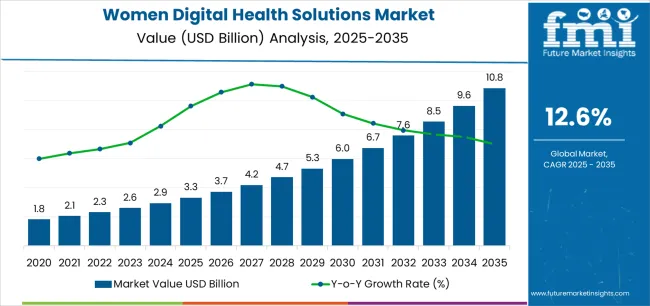
| Metric | Value |
|---|---|
| Women Digital Health Solutions Market Estimated Value in (2025E) | USD 3.3 billion |
| Women Digital Health Solutions Market Forecast Value in (2035F) | USD 10.8 billion |
| Forecast CAGR (2025 to 2035) | 12.6% |
Segmental Analysis
The market is segmented by Type and Application and region. By Type, the market is divided into Mobile apps, Wearable devices, Diagnostic tools, and Other types. In terms of Application, the market is classified into Reproductive health, Pregnancy & nursing care, Pelvic care, and General healthcare & wellness. Regionally, the market is classified into North America, Latin America, Western Europe, Eastern Europe, Balkan & Baltic Countries, Russia & Belarus, Central Asia, East Asia, South Asia & Pacific, and the Middle East & Africa.
Insights into the Mobile Apps Type Segment
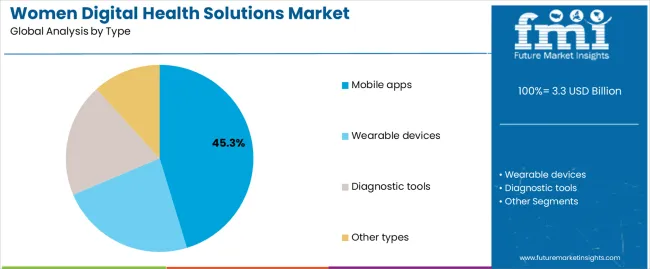
The mobile apps segment is projected to hold 45.30% of the Women Digital Health Solutions Market revenue share in 2025, making it the leading type segment. This dominance is driven by the increasing preference for mobile-based platforms that provide convenient, real-time access to healthcare guidance, tracking, and support services. The segment’s growth is being influenced by the rising availability of specialized applications focused on menstrual health, fertility, pregnancy monitoring, and wellness management.
The proliferation of smartphones and the growing awareness of digital health literacy among women have supported wider adoption. Enhanced features such as AI-driven insights, personalized health recommendations, and integration with wearable devices have strengthened user engagement and reliability.
The segment’s expansion is also fueled by continuous innovation from app developers focusing on user experience and data security, ensuring compliance with privacy standards As the shift toward digital-first healthcare continues, mobile apps are expected to remain the cornerstone of women’s digital health engagement.
Insights into the Reproductive Health Application Segment
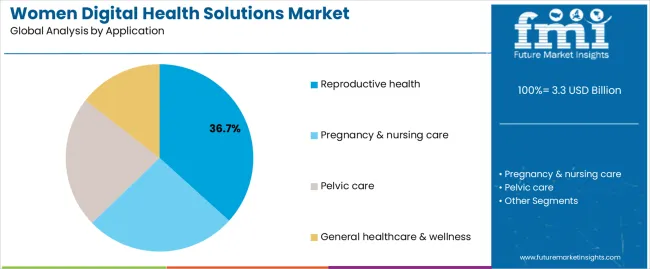
The reproductive health segment is expected to capture 36.70% of the Women Digital Health Solutions Market revenue share in 2025, positioning it as the leading application segment. This segment’s growth is primarily attributed to the rising focus on fertility management, menstrual cycle tracking, and pregnancy care through digital platforms. Increasing awareness regarding reproductive wellness and the availability of affordable digital solutions have expanded access to personalized health management for women.
The growing prevalence of reproductive health disorders and the rising demand for timely medical interventions are driving the adoption of technology-enabled monitoring tools. Integration of advanced analytics, predictive algorithms, and teleconsultation features is enhancing diagnosis accuracy and treatment outcomes.
Additionally, lifestyle changes and delayed pregnancies have heightened the need for continuous reproductive monitoring and support The combination of convenience, accessibility, and real-time insights is expected to maintain reproductive health as a dominant application segment in the evolving digital health ecosystem.
Semi-annual Market Update for Women Digital Health Solutions Market
The global women digital health solutions market's compound annual growth rate (CAGR) for the first half of 2025 and 2025 is compared in the table below. This analysis provides important insights into the performance of the industry by highlighting significant shifts and trends in revenue generation.
The first half (H1) is the period from January to June, and the second half (H2) is July to December. In the first half (H1) of the decade from 2025 to 2035, the business is predicted to grow at a CAGR of 13.4%, followed by a slightly lower growth rate of 13.0% in the second half (H2) of the same decade.
| Particular | Value CAGR |
|---|---|
| H1 | 13.4% (2025 to 2035) |
| H2 | 13.0% (2025 to 2035) |
| H1 | 12.6% (2025 to 2035) |
| H2 | 12.1% (2025 to 2035) |
Moving into the subsequent period, from H1 2025 to H2 2035, the CAGR is projected to decrease slightly to 12.6% in the first half and remain relatively moderate at 12.1% in the second half. In the first half (H1) the industry witnessed a decrease of 80 BPS while in the second half (H2), the industry witnessed a decrease of 90 BPS
Top Women Digital Health Solutions Market Dynamics and Industry Trends
Growing Awareness of Women's Health Drive Women Digital Health Solutions Market
The awareness of women's health acts as a driver in the women's digital health solution market. Greater educational campaigns, larger media exposure, and efforts by nonprofits organizations to underline problems related to women's health, including those about reproductive health, maternal care, and chronic diseases like breast cancer and osteoporosis, are some of the major factors contributing to fuel awareness.
Probably the most relevant example is the international drive for awareness of breast cancer, which is widely observed through events such as Breast Cancer Awareness Month, held in October month every year.
This increased awareness has translated into more funding of research, early detection programs, and the development of digital tools such as mammography tracking apps and artificial intelligence-based diagnostic platforms.
Companies like iBreastExam have developed portable, radiation-free devices that can be utilized in resource-poor settings to identify abnormalities of the breast and expand care to those women who may not have access to traditional healthcare facilities.
This growing awareness not only empowers women to take control of their health but also drives demand for innovative digital health solutions that cater specifically to their needs, propelling the market forward.
Rapid smartphone penetration drives the market’s growth
The increasing smartphone penetration acts as a strong driver in the market for women digital health solutions, granting unparalleled access to healthcare resources in parts where conventional healthcare infrastructure may not be so well-developed.
This wide diffusion of smartphones will be particularly impactful regarding women's health, where digital health solutions can be accessed via mobile applications that provide them with vital information, monitoring, and services right at their fingertips.
Another positive aspect of the diffusion of smartphones is the accessibility of mobile health (mHealth) applications specifically designed for women. For example, menstruation-tracking apps like Clue and Flo reached huge popularity; by 2025, Clue already had more than 12 million users worldwide.
These applications track menstrual health but also provide information on fertility, pregnancy, and general well-being, thus allowing for self-management of health. Telemedicine services are also facilitated by smartphone penetration. The trend is much on the rise in emerging markets, too.
For instance, in the case of India, smartphone penetration attained 54%, with a considerable segment of active users accessing health services through mobile applications. According to estimates by Practo, an Indian health technology firm, 40% of its total users were females who sought teleconsultations and digital prescriptions via their smartphones.
Growth of FemTech startups is a major trend in the market
FemTech, a word that combines female and technology, refers to software, diagnostics, products, and services that deploy technology for the care of women's health. This growth depicts an increasing awareness of women's health and the potential the market holds.
FemTech startups are leading the way with innovative solutions in reproductive health, pregnancy and nursing care, menstrual health, menopause, and sexual wellness. German-based start name Clue, for example, provides one of the best-known menstrual health apps, enabling users to view personalized cycle predictions, among other health insights.
Another well-known startup is Maven Clinic, which provides a virtual care platform with women's and family health considerations, from fertility support to post-natal care. Maven Clinic has raised over USD 300 million in funding, showing very clearly the demand for such focused platforms.
These products are designed with a deep understanding of specific health challenges that women face, offering convenience and improved outcomes. Another factor driving the growth of FemTech has been the increasing focus on gender-specific health research and the resultant pressure for more inclusive healthcare solutions.
Even as half of the population of the world, healthcare has often neglected women's specific needs throughout history. These startups in FemTech bridge that gap by providing much focused solutions that enhance the quality of life for women.
Limited access to digital health solutions in rural areas can hinder market growth
The major restraint in the women digital health solution market is limited access to digital health solutions in rural regions. Most rural areas face inappropriate digital infrastructure, a lack of high-speed internet facilities, and a shortage of healthcare centers.
These problems diminish the potential adoption of digital health technologies or their effective application in giving women substantial benefits. But most importantly, this limited connectivity system diminishes access to digital health platforms, apps, and telemedicine crucial for women's health.
Besides, the unavailability of health facilities in the rural areas further aggravates the situation. For instance, WHO reports that one physician serves 10,000 people in the rural regions in Africa, while in urban areas, this number is 30 physicians per 10,000.
This, in turn, means that even when the digital health solutions are available, probably there would not be enough healthcare professionals to guide and support women toward using the technology effectively. The discrepancy may be partly explained by limited access to digital health tools, which allow for virtual consultations, continuous health monitoring, and early diagnosis.
Many of these can be addressed by focused efforts at various levels to improve digital infrastructure in rural areas, enhance the much-needed training for healthcare workers, and develop low-bandwidth digital health solutions that can be accessed despite weak internet connectivity.
Comparison of Historical vs Future Outlook on Changing Consumer Trends for Women Digital Health Solutions Industry
The Women Digital Health Solutions industry recorded a CAGR of 6.9% between 2020 and 2025. According to the industry, Women Digital Health Solutions generated USD 2,607.4 million in 2025, up from USD 1,823.7 million in 2020.
Historically, women's health was often neglected in medical research and treatment as very limited attention was paid to them, and access to suitable solutions was restricted. The trend now has changed to more personalized care, with more digital solutions for specific needs, applying technology to improve health outcomes.
The growth of the women's digital health solutions market is driven by increasing health awareness, growing demand for personalized care, and advancement in the field of technology. This growth evidences an increasing trend of integrating digital tools into health service delivery.
Other causes of growth include increased awareness of specialized health needs. This makes people to seek digital means of getting personalized care and support for reproductive health, mental well-being, and other ongoing health issues. The greater the awareness among women regarding the benefits of focused digital tools, the greater the demand.
Improvement in technology, including wearable devices and mobile apps, actually empowers women with continuous real-time data about their physiological parameters, with specific recommendations based on this data, and greatly helps them manage their health more proactively, thus contributing to improved access and quality of healthcare overall.
Key Women Digital Health Solutions Market Players and Concentration
Companies in the Tier 1 sector account for 25.6% of the global market, ranking them as the dominant players in the industry. Tier 1 player offer a wide range of products, have an established industry presence, offer continuous innovation, and have a significant influence in the field.
Having financial resources that enables them to enhance their research and development efforts and expand into new markets. A strong brand recognition and a loyal customer base provide them with a competitive advantage. Prominent companies within Tier 1 include HeraMED Ltd, iSono Health Inc. and Biowink GmbH.
Tier 2 players dominate the industry with a 28.7% market share. Tier 2 firms have a strong focus on a specific technology and a substantial presence in the industry, but they have less influence than Tier 1 firms. The players are more competitive when it comes to pricing and target niche markets.
New products and services will also be introduced into the industry by Tier 2 companies. Tier 2 companies include Chiaro Technology Ltd., Natural Cycles USA Corp., Ava AG, and NURX, Inc.
Compared to Tiers 1 and 2, Tier 3 companies have smaller revenue spouts and less influence. Those in Tier 3 have smaller work force and limited presence across the globe. Prominent players in the tier 3 category are Athena Feminine Technologies, Inc., MobileODT Ltd., Lucina Health and others
Analysis of Top Countries Developing, Adopting, Distributing, and Utilizing Women Digital Health Solutions
The section below covers the industry analysis for the women digital health solutions market for different countries. Market demand analysis on key countries in several regions of the globe, including North America, Latin America, East Asia, South Asia & Pacific, Western Europe, Eastern Europe, and Middle East and Africa (MEA), is provided.
The USA is anticipated to remain at the forefront in North America through 2035. China is projected to witness a CAGR of 12.6% from 2025 to 2035.
| Countries | Value CAGR (2025 to 2035) |
|---|---|
| USA | 3.9% |
| Germany | 3.9% |
| France | 6.4% |
| China | 12.6% |
| India | 14.3% |
| South Korea | 9.9% |
Focus on precision medicine and a strong regulatory framework that supports digital health innovations is boosting sales in Germany
Germany’s women digital health solutions market is poised to exhibit a CAGR of 3.9% between 2025 and 2035. The Germany holds highest market share in the European market.
The strong emphasis on precision medicine and a healthy regulatory environment that encourages digital health innovation is a major growth factor in Germany. The Digital Health Care Act, known as DVG, plays a very important role has allowed doctors to prescribe digital health applications, with reimbursement provided by health insurance.
The law supports the integration of cutting-edge digital tools into mainstream healthcare care to make innovations accessible and economically viable for patients.
In addition, Germany has a very high and increasing share of elderly citizens, and such a high standard of healthcare has been increasing the demand for more personalized digital health solutions, according to specific needs resulting from gender.
Areas like reproductive health management, menopause management, and general wellness are increasingly dealt with on digital platforms, signaling an ever-better appreciation of a need for technology-driven interventions. The market, therefore, moves in conjunction with the encouraging regulations and changing needs for health care.
Rising prevalence of female health issues boosts the demand in the USA
The USA market is anticipated to grow at a CAGR of 3.9% throughout the forecast period.
Several factors contribute to the growth of the USA market, major among them being the increase in the prevalence of women's health disorders, such as endometriosis and polycystic ovary syndrome.
This has driven the adoption of the use of digital health solutions due to the high prevalence of females with health problems. In light of these health conditions, the demand for digital toolsets that can provide management and support on a personalized basis becomes so necessary.
It has been estimated that, in the USA, PCOS affects 6-12% of women of reproductive age, or approximately 5 million women. Since the diagnostic criteria and population studied often vary, prevalence estimates do differ. Indeed, PCOS is a primary cause of infertility but also frequently co-occurs with other health conditions, such as diabetes, cardiovascular problems, and mental health disorders.
Innovative solutions like mobile health applications help with symptom and menstrual cycle tracking and access to telehealth consultations. These digital platforms offer convenience, real-time monitoring, and tailored recommendation features that are valuable as more various health challenges arise. The upsurge in demand due to an increased requirement for advanced digital health solutions, therefore, propels market growth in the USA
Rising smartphone and internet penetration in China push the market’s growth
China is expected to show a CAGR of 12.6% over the forecast period and the country dominated the East Asia market in 2025
The rapid penetration of smartphones and high-speed internet across the country is driving the expansion of digital health platforms. With more people accessing smartphones and high-speed internet, they are readily able to use health applications and access health services online. This will make it easy to access health information, schedule appointments, and receive medical advice even from home.
Smartphones come with many health apps, ranging from menstrual cycle tracking applications to chronic condition management and health tips. High-speed internet ensures this works without glitches, since it operates at efficient speeds. Some of the other key benefits are telemedicine, allowing patients to consult with a doctor over video calls or messaging, hence needing to physically visit clinics or hospitals less.
The convenience accorded to citizens facilitates access to specific health support for women, ease in healthcare service delivery, and therefore more convenience. Overall, the pervasiveness of these technologies contributes to increased effectiveness and penetration of digital health solutions across China.
Women Digital Health Solutions Industry Analysis by Top Investment Segments
A description of the leading segments in the industry is provided in this section. The mobile apps segment is expected to hold 46.5% of the value share in 2025.
Mobile apps segment will dominate the market in terms of value
| Type | Mobile Apps |
|---|---|
| Value Share (2025) | 46.5% |
The mobile apps segment is expected to dominate the market in terms of revenue, accounting for almost 46.5% of the market share in 2025.
Conveniences and access have been some of the major reasons that have LED to mobile apps' leading positions in the market: making it easier for women to track different health aspects, menstrual cycles, pregnancy, and overall wellness.
Another advantage of using mobile apps is that it offers a level of privacy. This empowers women to manage their health in a comfortable environment. Mobile apps variety of features such as user-friendly interfaces, educational resources, reminders, etc. which increase adherence to the health goal.
Apart from the above demand side factor various supply side factors boost the adoption of mobile apps. Mobile apps have lower initial investment and operational costs compared to hardware development. The company can seamlessly update and get feedback directly from the end user. The covid-19 pandemic has highlighted the importance of at-home healthcare which have pushed the adoption of digital solutions.
Reproductive health will dominate the market in terms of value
| Application | Reproductive health |
|---|---|
| Value Share (2025) | 28.5% |
The reproductive health segment is expected to dominate the market in terms of revenue, accounting for almost 28.5% of the market share in 2025.
The reproductive health segment is likely to hold the major share of the women's digital health market, due to increasing awareness and high disease burden related to reproductive health. A considerable percentage of women are affected by diseases like PCOS, endometriosis, and infertility, which, in turn, creates demand for specific digital solutions addressing their needs.
Fertility tracking apps, ovulation monitors, and telehealth consultations are innovative solutions that have been introduced, offering them much-needed support and personalized care. Further, the focus of society on family planning and maternal health is an added cog in increasing demand for accessible, technology-driven solutions. These factors make reproductive health a central and rapidly growing segment within the market.
Leading Suppliers of Women Digital Health Solutions
The market for joint women digital health solutions is extremely dispersed. Companies are constantly focusing on means to increase their revenue. Key players in the women digital health solutions market are leveraging several growth strategies. They focus on expanding product portfolios with innovative solutions such as AI-driven diagnostics and personalized health management tools.
Companies are also pursuing global market expansion by targeting emerging economies with tailored solutions. Additionally, they are implementing aggressive marketing campaigns and utilizing data analytics to better understand and address women’s unique health needs.
Recent Industry Developments in the Women Digital Health Solutions Market
- In June 2025, HeraMED launched HeraCARE within Smart Connected Care ecosystem of Telstra Health through targeted GP clinics. The partnership deal between HeraMED and Telstra Health’s MedicalDirector platform was signed in November 2025.
- In May 2025, HeraMED signed a three year partnership agreement with Joondalup Obstetrics and Gynaecology Group (JOGG) intending to deploy HeraCare for 120 pregnancies annually.
- In September 2025, Thirty Madison and Nurx announced their plan to merge into single business. Together the company will be able to serve around 750,000 patients. The company is expected to reach USD 300 million in revenue in its first year.
Leading Women Digital Health Solutions Producers by Market Share
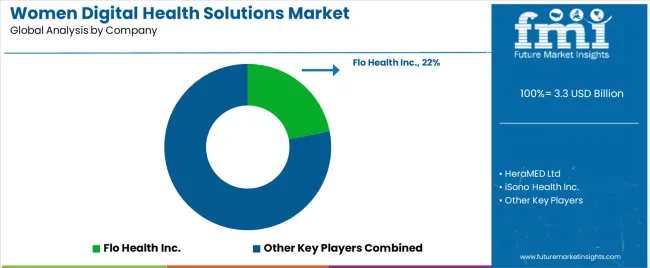
- HeraMED Ltd
- iSono Health Inc.
- Biowink GmbH
- Chiaro Technology Ltd.
- Natural Cycles USA Corp.
- NURX, Inc.
- Athena Feminine Technologies, Inc.
- MobileODT Ltd.
- Lucina Health
- Thirty Madison
- Nurx Inc.
- UE LifeSciences Inc.
- Biowink GmbH
- Flo Health Inc.
- Maven Clinic Co.
Top Segments Studied in the Women Digital Health Solutions Market Research Report
By Type:
In terms of type, the industry is segregated into mobile apps, wearable devices, diagnostic tools, and other types.
By Application:
In terms of application, the industry is segmented into reproductive health, pregnancy & nursing care, pelvic care, and general healthcare & wellness.
By Region:
Key countries of North America, Latin America, Western Europe, Eastern Europe, South Asia & Pacific, East Asia, the Middle East, and Africa have been covered in the report.
Frequently Asked Questions
How big is the women digital health solutions market in 2025?
The global women digital health solutions market is estimated to be valued at USD 3.3 billion in 2025.
What will be the size of women digital health solutions market in 2035?
The market size for the women digital health solutions market is projected to reach USD 10.8 billion by 2035.
How much will be the women digital health solutions market growth between 2025 and 2035?
The women digital health solutions market is expected to grow at a 12.6% CAGR between 2025 and 2035.
What are the key product types in the women digital health solutions market?
The key product types in women digital health solutions market are mobile apps, wearable devices, diagnostic tools and other types.
Which application segment to contribute significant share in the women digital health solutions market in 2025?
In terms of application, reproductive health segment to command 36.7% share in the women digital health solutions market in 2025.
Preview the report firsthand - request a free sample
Get SampleGet the brochure for pricing and purchase details.
Get PDFTable of Content
- Executive Summary
- Global Market Outlook
- Demand-side Trends
- Supply-side Trends
- Technology Roadmap Analysis
- Analysis and Recommendations
- Market Overview
- Market Coverage / Taxonomy
- Market Definition / Scope / Limitations
- Market Background
- Market Dynamics
- Drivers
- Restraints
- Opportunity
- Trends
- Scenario Forecast
- Demand in Optimistic Scenario
- Demand in Likely Scenario
- Demand in Conservative Scenario
- Opportunity Map Analysis
- Product Life Cycle Analysis
- Supply Chain Analysis
- Investment Feasibility Matrix
- Value Chain Analysis
- PESTLE and Porter’s Analysis
- Regulatory Landscape
- Regional Parent Market Outlook
- Production and Consumption Statistics
- Import and Export Statistics
- Market Dynamics
- Global Market Analysis 2020 to 2025 and Forecast, 2025 to 2035
- Historical Market Size Value (USD Million) Analysis, 2020 to 2025
- Current and Future Market Size Value (USD Million) Projections, 2025 to 2035
- Y-o-Y Growth Trend Analysis
- Absolute $ Opportunity Analysis
- Global Market Pricing Analysis 2020 to 2025 and Forecast 2025 to 2035
- Global Market Analysis 2020 to 2025 and Forecast 2025 to 2035, By Type
- Introduction / Key Findings
- Historical Market Size Value (USD Million) Analysis By Type , 2020 to 2025
- Current and Future Market Size Value (USD Million) Analysis and Forecast By Type , 2025 to 2035
- Mobile apps
- Wearable devices
- Diagnostic tools
- Other types
- Y-o-Y Growth Trend Analysis By Type , 2020 to 2025
- Absolute $ Opportunity Analysis By Type , 2025 to 2035
- Global Market Analysis 2020 to 2025 and Forecast 2025 to 2035, By Application
- Introduction / Key Findings
- Historical Market Size Value (USD Million) Analysis By Application, 2020 to 2025
- Current and Future Market Size Value (USD Million) Analysis and Forecast By Application, 2025 to 2035
- Reproductive health
- Pregnancy & nursing care
- Pelvic care
- General healthcare & wellness
- Y-o-Y Growth Trend Analysis By Application, 2020 to 2025
- Absolute $ Opportunity Analysis By Application, 2025 to 2035
- Global Market Analysis 2020 to 2025 and Forecast 2025 to 2035, By Region
- Introduction
- Historical Market Size Value (USD Million) Analysis By Region, 2020 to 2025
- Current Market Size Value (USD Million) Analysis and Forecast By Region, 2025 to 2035
- North America
- Latin America
- Western Europe
- Eastern Europe
- East Asia
- South Asia and Pacific
- Middle East & Africa
- Market Attractiveness Analysis By Region
- North America Market Analysis 2020 to 2025 and Forecast 2025 to 2035, By Country
- Historical Market Size Value (USD Million) Trend Analysis By Market Taxonomy, 2020 to 2025
- Market Size Value (USD Million) Forecast By Market Taxonomy, 2025 to 2035
- By Country
- USA
- Canada
- Mexico
- By Type
- By Application
- By Country
- Market Attractiveness Analysis
- By Country
- By Type
- By Application
- Key Takeaways
- Latin America Market Analysis 2020 to 2025 and Forecast 2025 to 2035, By Country
- Historical Market Size Value (USD Million) Trend Analysis By Market Taxonomy, 2020 to 2025
- Market Size Value (USD Million) Forecast By Market Taxonomy, 2025 to 2035
- By Country
- Brazil
- Chile
- Rest of Latin America
- By Type
- By Application
- By Country
- Market Attractiveness Analysis
- By Country
- By Type
- By Application
- Key Takeaways
- Western Europe Market Analysis 2020 to 2025 and Forecast 2025 to 2035, By Country
- Historical Market Size Value (USD Million) Trend Analysis By Market Taxonomy, 2020 to 2025
- Market Size Value (USD Million) Forecast By Market Taxonomy, 2025 to 2035
- By Country
- Germany
- UK
- Italy
- Spain
- France
- Nordic
- BENELUX
- Rest of Western Europe
- By Type
- By Application
- By Country
- Market Attractiveness Analysis
- By Country
- By Type
- By Application
- Key Takeaways
- Eastern Europe Market Analysis 2020 to 2025 and Forecast 2025 to 2035, By Country
- Historical Market Size Value (USD Million) Trend Analysis By Market Taxonomy, 2020 to 2025
- Market Size Value (USD Million) Forecast By Market Taxonomy, 2025 to 2035
- By Country
- Russia
- Poland
- Hungary
- Balkan & Baltic
- Rest of Eastern Europe
- By Type
- By Application
- By Country
- Market Attractiveness Analysis
- By Country
- By Type
- By Application
- Key Takeaways
- East Asia Market Analysis 2020 to 2025 and Forecast 2025 to 2035, By Country
- Historical Market Size Value (USD Million) Trend Analysis By Market Taxonomy, 2020 to 2025
- Market Size Value (USD Million) Forecast By Market Taxonomy, 2025 to 2035
- By Country
- China
- Japan
- South Korea
- By Type
- By Application
- By Country
- Market Attractiveness Analysis
- By Country
- By Type
- By Application
- Key Takeaways
- South Asia and Pacific Market Analysis 2020 to 2025 and Forecast 2025 to 2035, By Country
- Historical Market Size Value (USD Million) Trend Analysis By Market Taxonomy, 2020 to 2025
- Market Size Value (USD Million) Forecast By Market Taxonomy, 2025 to 2035
- By Country
- India
- ASEAN
- Australia & New Zealand
- Rest of South Asia and Pacific
- By Type
- By Application
- By Country
- Market Attractiveness Analysis
- By Country
- By Type
- By Application
- Key Takeaways
- Middle East & Africa Market Analysis 2020 to 2025 and Forecast 2025 to 2035, By Country
- Historical Market Size Value (USD Million) Trend Analysis By Market Taxonomy, 2020 to 2025
- Market Size Value (USD Million) Forecast By Market Taxonomy, 2025 to 2035
- By Country
- Kingdom of Saudi Arabia
- Other GCC Countries
- Turkiye
- South Africa
- Other African Union
- Rest of Middle East & Africa
- By Type
- By Application
- By Country
- Market Attractiveness Analysis
- By Country
- By Type
- By Application
- Key Takeaways
- Key Countries Market Analysis
- USA
- Pricing Analysis
- Market Share Analysis, 2025
- By Type
- By Application
- Canada
- Pricing Analysis
- Market Share Analysis, 2025
- By Type
- By Application
- Mexico
- Pricing Analysis
- Market Share Analysis, 2025
- By Type
- By Application
- Brazil
- Pricing Analysis
- Market Share Analysis, 2025
- By Type
- By Application
- Chile
- Pricing Analysis
- Market Share Analysis, 2025
- By Type
- By Application
- Germany
- Pricing Analysis
- Market Share Analysis, 2025
- By Type
- By Application
- UK
- Pricing Analysis
- Market Share Analysis, 2025
- By Type
- By Application
- Italy
- Pricing Analysis
- Market Share Analysis, 2025
- By Type
- By Application
- Spain
- Pricing Analysis
- Market Share Analysis, 2025
- By Type
- By Application
- France
- Pricing Analysis
- Market Share Analysis, 2025
- By Type
- By Application
- India
- Pricing Analysis
- Market Share Analysis, 2025
- By Type
- By Application
- ASEAN
- Pricing Analysis
- Market Share Analysis, 2025
- By Type
- By Application
- Australia & New Zealand
- Pricing Analysis
- Market Share Analysis, 2025
- By Type
- By Application
- China
- Pricing Analysis
- Market Share Analysis, 2025
- By Type
- By Application
- Japan
- Pricing Analysis
- Market Share Analysis, 2025
- By Type
- By Application
- South Korea
- Pricing Analysis
- Market Share Analysis, 2025
- By Type
- By Application
- Russia
- Pricing Analysis
- Market Share Analysis, 2025
- By Type
- By Application
- Poland
- Pricing Analysis
- Market Share Analysis, 2025
- By Type
- By Application
- Hungary
- Pricing Analysis
- Market Share Analysis, 2025
- By Type
- By Application
- Kingdom of Saudi Arabia
- Pricing Analysis
- Market Share Analysis, 2025
- By Type
- By Application
- Turkiye
- Pricing Analysis
- Market Share Analysis, 2025
- By Type
- By Application
- South Africa
- Pricing Analysis
- Market Share Analysis, 2025
- By Type
- By Application
- USA
- Market Structure Analysis
- Competition Dashboard
- Competition Benchmarking
- Market Share Analysis of Top Players
- By Regional
- By Type
- By Application
- Competition Analysis
- Competition Deep Dive
- Flo Health Inc.
- Overview
- Product Portfolio
- Profitability by Market Segments (Product/Age /Sales Channel/Region)
- Sales Footprint
- Strategy Overview
- Marketing Strategy
- Product Strategy
- Channel Strategy
- HeraMED Ltd
- iSono Health Inc.
- Biowink GmbH
- Chiaro Technology Ltd.
- Natural Cycles USA Corp.
- NURX, Inc.
- Athena Feminine Technologies, Inc.
- MobileODT Ltd.
- Lucina Health
- Thirty Madison
- Nurx Inc.
- UE LifeSciences Inc.
- Maven Clinic Co.
- Flo Health Inc.
- Competition Deep Dive
- Assumptions & Acronyms Used
- Research Methodology


