

- Industry Size (2025)
- USD 62.6 Mn
- Forecast (2035)
- USD 169.9 Mn
- CAGR (2025 to 2035)
- 10.5%
Patient Monitoring System Market Forecast and Outlook By FMI
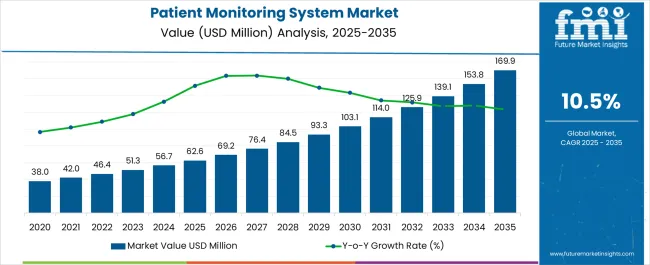
In 2025, the patient monitoring system market was valued at USD 62.6 million. Based on Future Market Insights' analysis, demand for patient monitoring systems is estimated to grow to USD 69.2 million in 2026 and USD 169.9 million by 2036. FMI projects a CAGR of 9.4% during the forecast period.
Absolute dollar growth of USD 107.3 million over the decade signals structural transformation rather than cyclical recovery. Despite hospital budget constraints and reimbursement complexities, major patient monitoring system manufacturers sustain margin expansion through software-enabled service models and integration with electronic health record ecosystems.
Summary of Patient Monitoring System Market
- Patient Monitoring System Market Definition:
- The industry covers medical devices and software platforms enabling continuous or intermittent monitoring of patient physiological parameters in hospital and home settings.
- Demand Drivers in the Market:
- Aging population increases chronic disease prevalence requiring monitoring.
- ICU capacity expansion drives bedside monitor procurement.
- Remote patient monitoring adoption expands home care applications.
- Key Segments Analyzed in the FMI Report:
- Type of System: Cardiac monitoring leads with 35.0% share.
- End Use: Hospital dominates at 60.0% share.
- Geography: High-growth Asia-Pacific versus replacement-driven mature markets.
- Analyst Opinion at FMI:
- Sabyasachi Ghosh, Principal Consultant for Healthcare at Future Market Insights, opines, "In the updated version of the Patient Monitoring System Market Report for 2026 to 2036, hospital administrators will find insights into how AI-enabled predictive analytics are reshaping monitoring system ROI calculations and clinical workflow integration. Besides this, my findings point at semiconductor supply chain constraints directly impacting device delivery timelines and the consolidation of monitoring platforms into single-vendor ecosystems creating both integration benefits and vendor lock-in risks."
- Strategic Implications/Executive Takeaways:
- Shift focus from hardware sales to software-enabled care pathway solutions.
- Treat interoperability as market access requirement rather than differentiator.
- Prioritize AI-driven predictive analytics to solve alarm fatigue challenges.
- Methodology:
- Validated through hospital procurement records and manufacturer shipment data.
- Zero reliance on speculative third-party market research reports.
- Based on verifiable bed capacity statistics and device registration records.
China (13.2% CAGR) and India (12.1% CAGR) drive new opportunities through hospital infrastructure expansion and increasing chronic disease burden. Brazil (10.2% CAGR) contributes via healthcare system modernization and private hospital investment. Mature healthcare markets such as Germany (11.2%), the United States (9.2%), the United Kingdom (8.0%), and Japan (7.2%) generate replacement demand through technology upgrades, with volume expansion constrained by bed capacity limits and value-based care reimbursement pressures.
Patient Monitoring System Market Definition
Patient monitoring systems comprise medical devices and software platforms that continuously or intermittently measure, record, and display patients' physiological parameters including cardiac activity, respiratory function, blood pressure, oxygen saturation, and temperature. These systems enable healthcare providers to track vital signs in real-time, detect clinical deterioration early, and support data-driven treatment decisions across hospital and home care settings.
Patient Monitoring System Market Inclusions
The report includes a comprehensive analysis of market dynamics, featuring Global and Regional Market Sizes (Volume and Value) and a 10-year Forecast (2026-2036). It covers segmental breakdowns by system type (Cardiac Monitoring, Respiratory Monitoring, Peak Flow Meter, Anesthesia Monitoring, Hematological Monitoring), end use (Hospital, Home), and geographic regions.
Patient Monitoring System Market Exclusions
The scope excludes standalone diagnostic devices not integrated with monitoring platforms, disposable sensors without reusable components, and consumer wellness wearables not meeting medical device classification standards. It also omits imaging systems and laboratory analyzers, focusing strictly on devices designed for continuous or intermittent patient monitoring in clinical and home settings.
Patient Monitoring System Market Research Methodology
- Primary Research: Interviews were conducted with patient monitoring system manufacturers, hospital procurement directors, clinical engineering heads, and telemedicine program managers across major regions. Health informaticists clarified EHR integration requirements.
- Desk Research: Hospital bed capacity data from WHO, medical device registration records, and corporate financial filings supported volume benchmarking.
- Market-Sizing and Forecasting: A hybrid top-down and bottom-up model was developed. Demand was reconstructed from hospital bed counts, ICU capacity expansion, monitoring device penetration rates, and replacement cycles, then validated against manufacturer shipment data.
- Data Validation and Update Cycle: Outputs undergo anomaly screening, variance checks across production and trade datasets, and structured peer review prior to release.
Segmental Analysis
Patient Monitoring System Market Analysis by Type of System
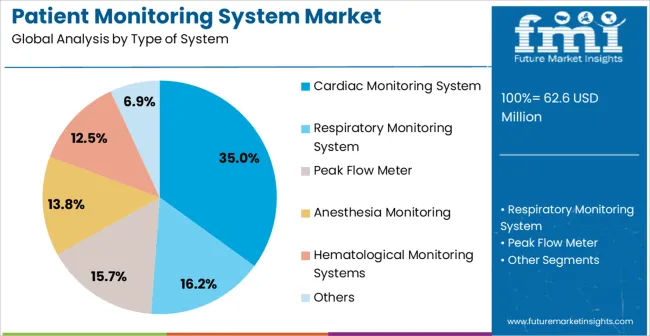
Based on FMI’s patient monitoring system market report, consumption of cardiac monitoring systems is estimated to hold 35.0% share in 2026. Growth in demand for cardiac monitoring comes from cardiovascular diseases remaining the leading cause of death globally, requiring continuous ECG tracking in ICUs, step-down units, and increasingly in home settings for post-discharge management.
- Wearable Cardiac Innovation: Philips introduced in September 2025 an “innovative telemetry platform” featuring the “next-generation Telemetry Monitor 5500,” designed as a compact, wearable monitor with easy-to-use touchscreen and lightweight design to keep patients ambulating while under continuous surveillance. [1]
- Hospital Integration: GE HealthCare states “CARESCAPE Central Station transforms an ordinary central station into a clinician-centric workstation” by integrating monitoring and historical data from multiple sources to help clinicians make fast, confident decisions, with alarm configurability intended to limit nuisance alarms and reduce alarm fatigue. [2]
- Home Monitoring Expansion: Medtronic’s HealthCast award release notes “HealthCast™ wearables: Extend patient monitoring in hospital and home settings” using insights and automated, personalized trending notifications to support proactive decision-making and patient discharge decisions. [3]
Patient Monitoring System Market Analysis by End Use
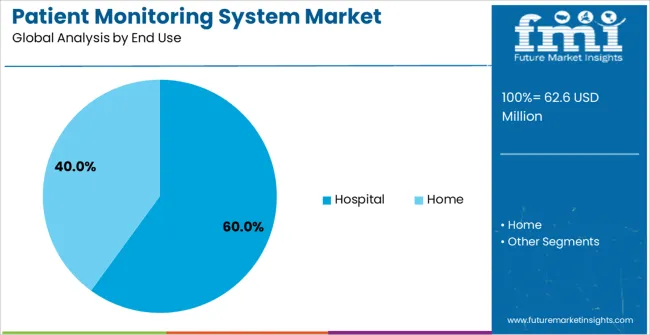
Based on FMI’s patient monitoring system market report, consumption in hospital settings is estimated to hold 60.0% share in 2026. Growth in hospital demand comes from ICU capacity expansion, increasing acuity of hospitalized patients, and the shift toward centralized monitoring models that improve clinical efficiency.
- ICU Capacity Investment: Mindray notes it is “aligning with Saudi Arabia’s Vision 2030 for Healthcare Digitalization” and strengthening partnerships with Saudi medical institutions, including SEHA Virtual Hospital, to expand access to high-quality medical services through intelligent solutions. [4]
- Centralized Monitoring Adoption: Nihon Kohden’s NIHON KOHDEN REPORT 2025 describes a monitoring system where staff can centrally monitor EEG, ECG, blood pressure, heart rate, respiration rate, and body temperature of up to 8 patients, and notes “This monitoring system consists of a central monitor at the nurse station and bedside monitors in patient rooms.” [5]
- Workflow Standardization: Central station deployments reduce watch burden by consolidating multi-bed visibility and trending, which supports faster escalation when alarms and trajectory changes indicate deterioration, reinforcing hospital preference for integrated central monitoring over bedside-only setups.
Patient Monitoring System Market Drivers, Restraints, and Opportunities
Future Market Insights analysis indicates a structurally expanding clinical technology category where adoption is shifting from episodic vitals capture to continuous risk detection across ICUs, step-down units, and post-discharge care. The 2026 baseline reflects hospitals upgrading centralized monitoring to improve response time and staffing efficiency, while provider networks expand remote monitoring to keep higher-risk patients under observation between visits and reduce preventable deterioration events.
While demand is broadening, growth is constrained by alarm burden, integration complexity, and cybersecurity requirements. Hospitals are pushing for smarter alarm governance, better signal quality, and workflow-aligned notifications because higher device density can increase nuisance alarms and clinical fatigue. At the same time, interoperability with EHRs, device fleet standardization across multi-site systems, and lifecycle security management raise total implementation cost and elongate procurement cycles, favoring suppliers that can deliver end-to-end deployment, training, and long-term service coverage.
- Clinical Acuity and Chronic Disease Burden: Rising cardiovascular and respiratory disease loads are increasing continuous ECG and multi-parameter monitoring needs in acute settings, while aging populations expand demand for longer-duration observation in lower-acuity units and home environments.
- Care Model Virtualization: Hospitals and payers are shifting more recovery and chronic management into home-based pathways, driving demand for wearables, remote telemetry, and centralized command-center style monitoring to support earlier discharge and proactive intervention.
- Integration, Alarm Fatigue, and Security Barriers: Growth is limited when systems cannot integrate cleanly with hospital IT, when alarm noise overwhelms staff, or when cybersecurity and privacy requirements add operational burden, creating a higher bar for scalable deployment.
Regional Analysis
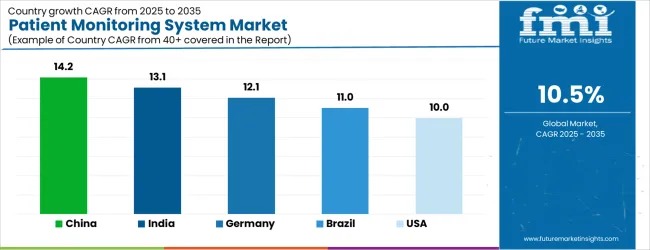
Based on the regional analysis, the patient monitoring system market is segmented into North America, Latin America, Europe, East Asia, South Asia, Oceania and Middle East & Africa across 40-plus countries. The full report also offers market attractiveness analysis based on regional trends.
| Country | CAGR (2026 to 2036) |
|---|---|
| China | 14.2% |
| India | 13.1% |
| Germany | 12.1% |
| Brazil | 11.0% |
| United States | 10.0% |
| United Kingdom | 8.9% |
| Japan | 7.9% |
Source: Future Market Insights (FMI) analysis, based on proprietary forecasting model and primary research
North America Patient Monitoring System Market Analysis
North America is shaped by reimbursement-led remote monitoring growth and hospital demand for enterprise monitoring platforms that reduce response time, improve unit visibility, and support discharge-to-home pathways. Large health systems favor vendors that can integrate monitoring data into clinical workflows and scale service across multi-site networks.
- United States: Demand for patient monitoring systems in the United States is projected to rise at a 10.0% CAGR through 2036, supported by CMS updates in the CY 2026 Physician Fee Schedule Final Rule that expand Remote Physiologic Monitoring (RPM) coding flexibility, including a new device supply code for shorter monitoring durations. [6]
FMI’s report includes a detailed analysis of the growth in the North American region, along with a country-wise assessment that includes the USA and Canada. Readers can also find regional trends, regulations, and market growth based on different segments and countries in the North America region.
Asia Pacific Patient Monitoring System Market Analysis
Asia Pacific is the primary growth engine, driven by rapid hospital capacity buildout, stronger digital health infrastructure, and policy-backed moves that raise quality requirements for devices and software. Buyers prioritize scalable monitoring, centralized surveillance, and connected care that can extend beyond tertiary hospitals.
- China: Leading with a 14.2% CAGR, the market is shifting toward stronger domestic manufacturing discipline under tighter quality controls, with NMPA publishing a revised Good Manufacturing Practice for Medical Devices that takes effect on 1 November 2026 and replaces the 2014 version to strengthen device quality management systems. [7]
- India: Domestic demand is accelerating at a 13.1% CAGR, supported by digital health scale-up, with the government reporting 8.79 crore ABHA cards created under ABDM in FY 2025 to 26 (as on 28 January 2026), expanding the base for connected, identity-linked care pathways. [8]
- Japan: Expanding at a 7.9% CAGR, the market is moving toward home-based connected care, supported by MHLW’s FY2026 budget planning that rises to about 35 trillion yen, reflecting a larger pool of funding tied to health system priorities that include regulatory and digital health capacity. [9]
The full report analyze the patient monitoring system market across East and South Asia from 2021-2036, covering trends, adoption drivers, and growth factors in China, Japan, South Korea, India, Indonesia, Malaysia, and Thailand. The assessment highlights trends that dictate platform selection and procurement strategies.
Latin America Patient Monitoring System Market Analysis
Latin America is moving toward more connected public-sector care models, where national digital health programs and procurement frameworks increase demand for interoperable monitoring and remote care enablement. Suppliers that can meet public procurement, training, and service requirements gain an advantage.
- Brazil: A projected 11.0% CAGR through 2036 is supported by SUS Digital, with Brazil’s Ministry of Health publishing Chamamento Público nº 01/2026 to identify partners and innovative digital health solutions aligned with the national digital health program. [10]
The report consists of a detailed analysis for the market in Brazil, Mexico, Chile, Argentina, Colombia and Rest of Latin America. Readers can find detailed information about several factors, such as the pricing analysis and regional trends, which are impacting growth in the Latin America region.
Europe Patient Monitoring System Market Analysis
Europe is driven by hospital modernization funding, tighter operating models, and a strong focus on safer monitoring workflows that reduce alarm burden while improving centralized visibility. Replacement demand is strong where hospitals upgrade systems to improve care efficiency and meet longer-term digital infrastructure targets.
- Germany: Demand for patient monitoring systems in Germany is rising at a 12.1% CAGR through 2036, driven by the Hospital Transformation Fund, with the Federal Ministry of Health stating funding will be available from 1 January 2026 and that up to 50 billion euros will be provided up until 2035 for modernization of hospital structures. [11]
- United Kingdom: Expanding at an 8.9% CAGR, growth is supported by virtual care expansion, with NHS England positioning virtual wards as hospital-at-home services and NHS Digital publishing recurring capacity and occupancy statistics that track scale and utilization. [12]
FMI’s analysis of patient monitoring system market in Europe consists of country-wise assessment that includes Germany, France, UK, Italy, Spain, Nordics, Benelux and Rest of Europe. Readers can know various regulations and latest trends in the regional market.
Competitive Aligners for Market Players
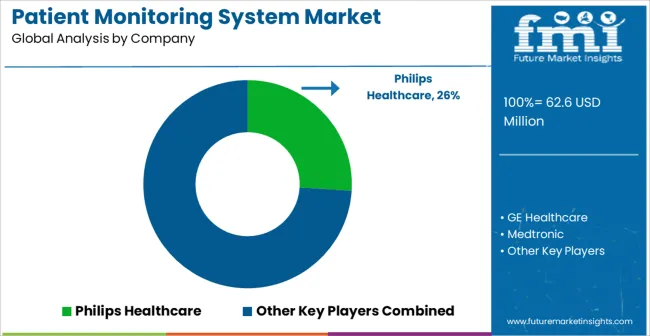
Market structure remains fragmented across bedside monitors, central stations, wearables, and software layers, yet practical competition concentrates among a limited set of suppliers that can meet hospital-scale volume, cybersecurity, interoperability, and long-term service expectations. Roughly a core tier of global OEMs competes for enterprise platform awards, while many smaller players operate in niche categories or regional tenders with limited pricing leverage and heavy dependence on installation backlog and utilization. The primary competitive variable is lifecycle survivability in mid-cycle pricing, not peak hardware margin capture.
Suppliers with integrated portfolios, long service networks, and multi-year contracting absorb component volatility and staffing costs more effectively, sustaining uptime commitments and rapid parts availability. Vendors without scale rely on distributor-led fulfillment and shorter contracts, increasing exposure to margin compression and loss of share when hospitals consolidate vendors. Compliance further narrows the field. Hospitals expect validated alarm performance, consistent software updates, and documentation discipline across fleets, which creates attrition among underinvested platforms that cannot keep pace with security patching and system integrations.
Customer concentration reinforces buyer leverage. Large IDNs and public systems multi-source devices and accessories to avoid dependency, limiting price pass-through and using SLA scorecards to shift volume quickly when downtime, alarm burden, or integration issues appear.
Recent Developments
The report includes full coverage of key trends from competitive benchmarking. Some of the recent developments covered in the reports:
- In October 2025, Philips highlighted how advanced algorithms and cloud-based monitoring platforms are transforming patient care, improving cardiac diagnostics, enabling real-time data integration, and supporting clinicians with predictive insights while maintaining a strong focus on responsible deployment [13].
- In July 2023 – Mindray agreed to acquire a 75% stake in Germany-based DiaSys Diagnostic Systems for approximately €115 million, strengthening its global in vitro diagnostics portfolio and expanding its overseas supply chain capabilities [14].
Key Players in Patient Monitoring System Market
- Koninklijke Philips N.V. (Philips Healthcare)
- GE HealthCare Technologies Inc.
- Medtronic plc
- Abbott Laboratories
- Nihon Kohden Corporation
- Mindray Medical International Limited
- Masimo Corporation
- Drägerwerk AG & Co. KGaA
- Baxter International Inc. (Hillrom)
- Boston Scientific Corporation
- Siemens Healthineers AG
- Fukuda Denshi Co., Ltd.
- Spacelabs Healthcare (OSI Systems, Inc.)
- Schiller AG
- Shenzhen Comen Medical Instruments Co., Ltd.
- EDAN Instruments, Inc.
- Welch Allyn (Hillrom)
- BioTelemetry, Inc. (Philips)
Scope of the Report
| Metric | Value |
|---|---|
| Quantitative Units | USD 69.2 million (2026) to USD 169.9 million (2036), at a CAGR of 9.4% |
| Market Definition | The patient monitoring system market comprises the global development, manufacturing, and deployment of medical devices and software platforms that continuously or intermittently measure, record, and display physiological parameters such as ECG, respiration, blood pressure, oxygen saturation, and temperature to support real-time clinical decision-making in hospital and home care settings. |
| Type of System Segmentation | Cardiac Monitoring System, Respiratory Monitoring System, Peak Flow Meter, Anesthesia Monitoring, Hematological Monitoring Systems, Others |
| End Use Segmentation | Hospital, Home |
| Application Coverage | ICU and critical care monitoring, operating room and anesthesia monitoring, step-down and general ward monitoring, emergency and transport monitoring, post-discharge and chronic disease remote monitoring, home-based vital sign surveillance |
| Regions Covered | North America, Latin America, Europe, East Asia, South Asia, Oceania, Middle East and Africa |
| Countries Covered | United States, Canada, Mexico, Brazil, Argentina, Germany, France, United Kingdom, Italy, Spain, China, India, Japan, South Korea, Indonesia, Malaysia, Thailand, Vietnam, Philippines, Australia, New Zealand, Saudi Arabia, United Arab Emirates, Turkey, South Africa, Israel and 40 plus countries |
| Key Companies Profiled | Koninklijke Philips N.V., GE HealthCare Technologies Inc., Medtronic plc, Abbott Laboratories, Nihon Kohden Corporation, Shenzhen Mindray Bio-Medical Electronics Co., Ltd., Masimo Corporation, Drägerwerk AG & Co. KGaA, Baxter International Inc. (Hillrom), Siemens Healthineers AG |
| Forecast Period | 2026 to 2036 |
| Approach | Hybrid top down and bottom up market modeling validated through primary interviews with patient monitoring OEMs, hospital procurement leaders, clinical engineering heads, and telemedicine program managers, supported by hospital bed and ICU capacity benchmarking, device penetration and replacement cycle mapping, installed-base triangulation, and shipment validation across key regions. |
Patient Monitoring System Market by Segments
Type of System
- Cardiac Monitoring System
- ECG Monitors
- Holter Monitors
- Event Monitors
- Implantable Cardiac Monitors
- Respiratory Monitoring System
- Spirometers
- Capnographs
- Pulse Oximeters
- Peak Flow Meter
- Anesthesia Monitoring
- Hematological Monitoring Systems
- Others (Neurological, Fetal, Multi-parameter)
End Use
- Hospital
- Intensive Care Units (ICU)
- Operating Rooms
- Emergency Departments
- General Wards
- Home
- Chronic Disease Management
- Post-Acute Care
- Elderly Monitoring
Region
- North America
- United States
- Canada
- Mexico
- Latin America
- Brazil
- Argentina
- Chile
- Colombia
- Rest of Latin America
- Europe
- Germany
- France
- United Kingdom
- Italy
- Spain
- Russia
- Nordic
- Benelux
- Rest of Europe
- East Asia
- China
- Japan
- South Korea
- South Asia & Pacific
- India
- ASEAN (Indonesia, Malaysia, Thailand, Vietnam, Philippines)
- Australia & New Zealand
- Rest of South Asia & Pacific
- Middle East & Africa
- Kingdom of Saudi Arabia
- United Arab Emirates
- Turkey
- South Africa
- Israel
- Rest of Middle East & Africa
Bibliography
- [1] Philips. (2025). Philips launches smart telemetry platform for cardiac monitoring that provides continuous enterprise-wide connectivity beyond the bedside. Philips Newsroom.
- [2] GE HealthCare. (2025). CARESCAPE central station patient monitoring system. GE HealthCare.
- [3] Medtronic. (2025). Medtronic wins 2025 MedTech Breakthrough Award for Best Overall Medical Device Solution for HealthCast™ intelligent patient monitoring. Medtronic Newsroom.
- [4] Mindray. (2025). MICO+ breakthrough at Saudi Arabia virtual hospital. Mindray Customer Stories.
- [5] Nihon Kohden Corporation. (2025). Annual report 2025. Nihon Kohden.
- [6] Rimidi. (2026). 2026 RPM code expansion. Rimidi News.
- [7] National Medical Products Administration (NMPA). (2025, November 7). Regulatory news release. NMPA.
- [8] Press Information Bureau, Government of India. (2026). Press release. PIB.
- [9] Pacific Bridge Medical. (2026). Japan’s MHLW announces increased FY2026 budget. Pacific Bridge Medical News Brief.
- [10] Ministério da Saúde (Brazil). (2026). Chamamento público no 01/2026 – SEIDIGI. Government of Brazil.
- [11] Federal Ministry of Health (Germany). (2026). Changes in the areas of health and long-term care in 2026. Bundesgesundheitsministerium.
- [12] NHS England. (2026). MI-NHSE virtual ward capacity and occupancy statistics. NHS Digital.
- [13] Philips. (2025). AI in patient monitoring. Philips Healthcare.
- [14] Mindray. (2025). Mindray acquires majority stake in DiaSys Diagnostic Systems GmbH. Mindray Press Release.
This Report Addresses
- Market intelligence to enable structured strategic decision-making across mature and emerging patient monitoring economies
- Market size estimation and 10-year revenue forecasts from 2026 to 2036, supported by validated hospital bed data and device shipment statistics
- Growth opportunity mapping across system types, end-use settings, and geographic regions with emphasis on AI-enabled and remote monitoring solutions
- Segment and regional revenue forecasts covering cardiac, respiratory, anesthesia, and hematological monitoring applications
- Competition strategy assessment including integrated solution positioning, regulatory compliance capability, and installed base leverage benchmarking
- Technology roadmap tracking including AI algorithm integration, wireless connectivity advances, and miniaturization trends
- Regulatory impact analysis covering FDA/EASA clearances, MDR compliance, and reimbursement policy developments
- Market report delivery in PDF, Excel, PPT, and interactive dashboard formats for executive and operational use
Frequently Asked Questions
How large is the demand for patient monitoring systems in the global market in 2026?
Demand for patient monitoring systems in the global market is estimated to be valued at USD 69.2 million in 2026.
What will be the market size of patient monitoring systems in the global market by 2036?
Market size for patient monitoring systems is projected to reach USD 169.9 million by 2036.
What is the expected demand growth for patient monitoring systems in the global market between 2026 and 2036?
Demand for patient monitoring systems in the global market is expected to grow at a CAGR of 9.4% between 2026 and 2036.
Which system type is poised to lead global sales by 2026?
Cardiac monitoring systems are expected to be the dominant type, capturing approximately 35.0% of global market share in 2026 due to cardiovascular disease prevalence and continuous ECG monitoring requirements.
Which end-use segment is projected to contribute significant share in the patient monitoring system market in 2026?
In terms of end use, the hospital segment is projected to command 60.0% share in the patient monitoring system market in 2026, driven by ICU capacity expansion and centralized monitoring adoption.
What is driving patient monitoring system demand in China?
China's 13.2% CAGR is driven by hospital infrastructure expansion under the 14th Five-Year Plan, with hospital bed capacity reaching 10 million beds in 2025 and ICU bed expansion targets driving monitoring device procurement.
What compliance standards are referenced for China?
China's NMPA medical device registration requirements and GB standards for patient monitoring equipment are referenced as key compliance benchmarks.
What is the United States growth outlook in this report?
The United States is projected to grow at a CAGR of 9.2% during 2026 to 2036, supported by CMS remote monitoring reimbursement expansion and value-based care adoption.
Why is Germany's growth rate significant in this report?
Germany's 11.2% CAGR reflects hospital digitization funding (Krankenhauszukunftsgesetz) allocating EUR 4.3 billion for digital infrastructure, including networked monitoring systems.
What type of demand dominates in mature markets?
Technology upgrade demand through AI-enabled monitoring platforms and replacement cycles dominates mature markets, with volume expansion constrained by bed capacity limits.
What is Japan's growth outlook in this report?
Japan is projected to grow at a CAGR of 7.2% during 2026 to 2036, characterized by aging population (29% over 65) and healthcare reform emphasizing home-based care.
Does the report cover South Korea in its regional analysis?
South Korea is included within East Asia under the regional coverage framework.
What is the main Korea-related demand theme in East Asia coverage?
Korea's demand centers on advanced technology adoption in its highly digitalized healthcare system, with government telemedicine initiatives following regulatory changes in 2023.
Which system type is strategically important for ICU applications?
Multi-parameter monitoring systems integrating cardiac, respiratory, and hemodynamic parameters are prioritized for ICU applications, with higher content value per bed than general ward monitors.
What are patient monitoring systems and what are they mainly used for?
Patient monitoring systems are medical devices and software platforms that continuously or intermittently measure, record, and display patients' physiological parameters, primarily used in hospitals for critical care and increasingly in homes for chronic disease management.
What does the patient monitoring system market mean in this report?
The patient monitoring system market refers to global production and supply of medical devices and software platforms designed for continuous or intermittent patient monitoring in clinical and home settings.
What is included in the scope of this patient monitoring system market report?
Scope covers patient monitoring systems by type (cardiac, respiratory, anesthesia, hematological), end use (hospital, home), and geographic regions.
What is excluded from the scope of this report?
Standalone diagnostic devices not integrated with monitoring platforms, disposable sensors without reusable components, and consumer wellness wearables not meeting medical device classification standards are excluded.
What does market forecast mean on this page?
Market forecast represents a model-based projection built on defined assumptions for strategic planning purposes.
How does FMI build and validate the patient monitoring system market forecast?
Forecast is developed using hybrid top-down and bottom-up modeling validated through hospital bed data, device shipment statistics, and manufacturer capacity benchmarks.
What does zero reliance on speculative third-party market research mean here?
Primary interviews and verifiable public datasets including WHO hospital statistics, medical device registration records, and corporate financial filings are used instead of unverified syndicated market estimates.
Preview the report firsthand - request a free sample
Get SampleGet the brochure for pricing and purchase details.
Get PDFTable of Content
- Executive Summary
- Global Market Outlook
- Demand-side Trends
- Supply-side Trends
- Technology Roadmap Analysis
- Analysis and Recommendations
- Market Overview
- Market Coverage / Taxonomy
- Market Definition / Scope / Limitations
- Research Methodology
- Chapter Orientation
- Analytical Lens and Working Hypotheses
- Market Structure, Signals, and Trend Drivers
- Benchmarking and Cross-market Comparability
- Market Sizing, Forecasting, and Opportunity Mapping
- Research Design and Evidence Framework
- Desk Research Programme (Secondary Evidence)
- Company Annual and Sustainability Reports
- Peer-reviewed Journals and Academic Literature
- Corporate Websites, Product Literature, and Technical Notes
- Earnings Decks and Investor Briefings
- Statutory Filings and Regulatory Disclosures
- Technical White Papers and Standards Notes
- Trade Journals, Industry Magazines, and Analyst Briefs
- Conference Proceedings, Webinars, and Seminar Materials
- Government Statistics Portals and Public Data Releases
- Press Releases and Reputable Media Coverage
- Specialist Newsletters and Curated Briefings
- Sector Databases and Reference Repositories
- FMI Internal Proprietary Databases and Historical Market Datasets
- Subscription Datasets and Paid Sources
- Social Channels, Communities, and Digital Listening Inputs
- Additional Desk Sources
- Expert Input and Fieldwork (Primary Evidence)
- Primary Modes
- Qualitative Interviews and Expert Elicitation
- Quantitative Surveys and Structured Data Capture
- Blended Approach
- Why Primary Evidence is Used
- Field Techniques
- Interviews
- Surveys
- Focus Groups
- Observational and In-context Research
- Social and Community Interactions
- Stakeholder Universe Engaged
- C-suite Leaders
- Board Members
- Presidents and Vice Presidents
- R&D and Innovation Heads
- Technical Specialists
- Domain Subject-matter Experts
- Scientists
- Physicians and Other Healthcare Professionals
- Governance, Ethics, and Data Stewardship
- Research Ethics
- Data Integrity and Handling
- Primary Modes
- Tooling, Models, and Reference Databases
- Desk Research Programme (Secondary Evidence)
- Data Engineering and Model Build
- Data Acquisition and Ingestion
- Cleaning, Normalisation, and Verification
- Synthesis, Triangulation, and Analysis
- Quality Assurance and Audit Trail
- Market Background
- Market Dynamics
- Drivers
- Restraints
- Opportunity
- Trends
- Scenario Forecast
- Demand in Optimistic Scenario
- Demand in Likely Scenario
- Demand in Conservative Scenario
- Opportunity Map Analysis
- Product Life Cycle Analysis
- Supply Chain Analysis
- Investment Feasibility Matrix
- Value Chain Analysis
- PESTLE and Porter’s Analysis
- Regulatory Landscape
- Regional Parent Market Outlook
- Production and Consumption Statistics
- Import and Export Statistics
- Market Dynamics
- Global Market Analysis 2021 to 2025 and Forecast, 2026 to 2036
- Historical Market Size Value (USD Million) Analysis, 2021 to 2025
- Current and Future Market Size Value (USD Million) Projections, 2026 to 2036
- Y-o-Y Growth Trend Analysis
- Absolute $ Opportunity Analysis
- Global Market Pricing Analysis 2021 to 2025 and Forecast 2026 to 2036
- Global Market Analysis 2021 to 2025 and Forecast 2026 to 2036, By Type of System
- Introduction / Key Findings
- Historical Market Size Value (USD Million) Analysis By Type of System , 2021 to 2025
- Current and Future Market Size Value (USD Million) Analysis and Forecast By Type of System , 2026 to 2036
- Cardiac Monitoring System
- Respiratory Monitoring System
- Peak Flow Meter
- Anesthesia Monitoring
- Cardiac Monitoring System
- Y-o-Y Growth Trend Analysis By Type of System , 2021 to 2025
- Absolute $ Opportunity Analysis By Type of System , 2026 to 2036
- Global Market Analysis 2021 to 2025 and Forecast 2026 to 2036, By End Use
- Introduction / Key Findings
- Historical Market Size Value (USD Million) Analysis By End Use, 2021 to 2025
- Current and Future Market Size Value (USD Million) Analysis and Forecast By End Use, 2026 to 2036
- Hospitals
- Home
- Hospitals
- Y-o-Y Growth Trend Analysis By End Use, 2021 to 2025
- Absolute $ Opportunity Analysis By End Use, 2026 to 2036
- Global Market Analysis 2021 to 2025 and Forecast 2026 to 2036, By Region
- Introduction
- Historical Market Size Value (USD Million) Analysis By Region, 2021 to 2025
- Current Market Size Value (USD Million) Analysis and Forecast By Region, 2026 to 2036
- North America
- Latin America
- Western Europe
- Eastern Europe
- East Asia
- South Asia and Pacific
- Middle East & Africa
- Market Attractiveness Analysis By Region
- North America Market Analysis 2021 to 2025 and Forecast 2026 to 2036, By Country
- Historical Market Size Value (USD Million) Trend Analysis By Market Taxonomy, 2021 to 2025
- Market Size Value (USD Million) Forecast By Market Taxonomy, 2026 to 2036
- By Country
- USA
- Canada
- Mexico
- By Type of System
- By End Use
- By Country
- Market Attractiveness Analysis
- By Country
- By Type of System
- By End Use
- Key Takeaways
- Latin America Market Analysis 2021 to 2025 and Forecast 2026 to 2036, By Country
- Historical Market Size Value (USD Million) Trend Analysis By Market Taxonomy, 2021 to 2025
- Market Size Value (USD Million) Forecast By Market Taxonomy, 2026 to 2036
- By Country
- Brazil
- Chile
- Rest of Latin America
- By Type of System
- By End Use
- By Country
- Market Attractiveness Analysis
- By Country
- By Type of System
- By End Use
- Key Takeaways
- Western Europe Market Analysis 2021 to 2025 and Forecast 2026 to 2036, By Country
- Historical Market Size Value (USD Million) Trend Analysis By Market Taxonomy, 2021 to 2025
- Market Size Value (USD Million) Forecast By Market Taxonomy, 2026 to 2036
- By Country
- Germany
- UK
- Italy
- Spain
- France
- Nordic
- BENELUX
- Rest of Western Europe
- By Type of System
- By End Use
- By Country
- Market Attractiveness Analysis
- By Country
- By Type of System
- By End Use
- Key Takeaways
- Eastern Europe Market Analysis 2021 to 2025 and Forecast 2026 to 2036, By Country
- Historical Market Size Value (USD Million) Trend Analysis By Market Taxonomy, 2021 to 2025
- Market Size Value (USD Million) Forecast By Market Taxonomy, 2026 to 2036
- By Country
- Russia
- Poland
- Hungary
- Balkan & Baltic
- Rest of Eastern Europe
- By Type of System
- By End Use
- By Country
- Market Attractiveness Analysis
- By Country
- By Type of System
- By End Use
- Key Takeaways
- East Asia Market Analysis 2021 to 2025 and Forecast 2026 to 2036, By Country
- Historical Market Size Value (USD Million) Trend Analysis By Market Taxonomy, 2021 to 2025
- Market Size Value (USD Million) Forecast By Market Taxonomy, 2026 to 2036
- By Country
- China
- Japan
- South Korea
- By Type of System
- By End Use
- By Country
- Market Attractiveness Analysis
- By Country
- By Type of System
- By End Use
- Key Takeaways
- South Asia and Pacific Market Analysis 2021 to 2025 and Forecast 2026 to 2036, By Country
- Historical Market Size Value (USD Million) Trend Analysis By Market Taxonomy, 2021 to 2025
- Market Size Value (USD Million) Forecast By Market Taxonomy, 2026 to 2036
- By Country
- India
- ASEAN
- Australia & New Zealand
- Rest of South Asia and Pacific
- By Type of System
- By End Use
- By Country
- Market Attractiveness Analysis
- By Country
- By Type of System
- By End Use
- Key Takeaways
- Middle East & Africa Market Analysis 2021 to 2025 and Forecast 2026 to 2036, By Country
- Historical Market Size Value (USD Million) Trend Analysis By Market Taxonomy, 2021 to 2025
- Market Size Value (USD Million) Forecast By Market Taxonomy, 2026 to 2036
- By Country
- Kingdom of Saudi Arabia
- Other GCC Countries
- Turkiye
- South Africa
- Other African Union
- Rest of Middle East & Africa
- By Type of System
- By End Use
- By Country
- Market Attractiveness Analysis
- By Country
- By Type of System
- By End Use
- Key Takeaways
- Key Countries Market Analysis
- USA
- Pricing Analysis
- Market Share Analysis, 2025
- By Type of System
- By End Use
- Canada
- Pricing Analysis
- Market Share Analysis, 2025
- By Type of System
- By End Use
- Mexico
- Pricing Analysis
- Market Share Analysis, 2025
- By Type of System
- By End Use
- Brazil
- Pricing Analysis
- Market Share Analysis, 2025
- By Type of System
- By End Use
- Chile
- Pricing Analysis
- Market Share Analysis, 2025
- By Type of System
- By End Use
- Germany
- Pricing Analysis
- Market Share Analysis, 2025
- By Type of System
- By End Use
- UK
- Pricing Analysis
- Market Share Analysis, 2025
- By Type of System
- By End Use
- Italy
- Pricing Analysis
- Market Share Analysis, 2025
- By Type of System
- By End Use
- Spain
- Pricing Analysis
- Market Share Analysis, 2025
- By Type of System
- By End Use
- France
- Pricing Analysis
- Market Share Analysis, 2025
- By Type of System
- By End Use
- India
- Pricing Analysis
- Market Share Analysis, 2025
- By Type of System
- By End Use
- ASEAN
- Pricing Analysis
- Market Share Analysis, 2025
- By Type of System
- By End Use
- Australia & New Zealand
- Pricing Analysis
- Market Share Analysis, 2025
- By Type of System
- By End Use
- China
- Pricing Analysis
- Market Share Analysis, 2025
- By Type of System
- By End Use
- Japan
- Pricing Analysis
- Market Share Analysis, 2025
- By Type of System
- By End Use
- South Korea
- Pricing Analysis
- Market Share Analysis, 2025
- By Type of System
- By End Use
- Russia
- Pricing Analysis
- Market Share Analysis, 2025
- By Type of System
- By End Use
- Poland
- Pricing Analysis
- Market Share Analysis, 2025
- By Type of System
- By End Use
- Hungary
- Pricing Analysis
- Market Share Analysis, 2025
- By Type of System
- By End Use
- Kingdom of Saudi Arabia
- Pricing Analysis
- Market Share Analysis, 2025
- By Type of System
- By End Use
- Turkiye
- Pricing Analysis
- Market Share Analysis, 2025
- By Type of System
- By End Use
- South Africa
- Pricing Analysis
- Market Share Analysis, 2025
- By Type of System
- By End Use
- USA
- Market Structure Analysis
- Competition Dashboard
- Competition Benchmarking
- Market Share Analysis of Top Players
- By Regional
- By Type of System
- By End Use
- Competition Analysis
- Competition Deep Dive
- Koninklijke Philips N.V. (Philips Healthcare)
- Overview
- Product Portfolio
- Profitability by Market Segments (Product/Age /Sales Channel/Region)
- Sales Footprint
- Strategy Overview
- Marketing Strategy
- Product Strategy
- Channel Strategy
- GE HealthCare Technologies Inc.
- Medtronic plc
- Abbott Laboratories
- Nihon Kohden Corporation
- Mindray Medical International Limited
- Masimo Corporation
- Koninklijke Philips N.V. (Philips Healthcare)
- Competition Deep Dive
- Assumptions & Acronyms Used


