

- Market Size (2026)
- USD 1.8 Bn
- Forecast (2036)
- USD 7.3 Bn
- CAGR (2026 to 2036)
- 14.7%
How big is Paralysis Treatment Innovation Market in 2026?
USD 1.8 billion in 2026 and USD 7.3 billion by 2036 at a 14.7% CAGR.
Demand in the paralysis treatment innovation market is anticipated to push valuation from USD 1.8 billion in 2026 to USD 7.3 billion by 2036, expanding at a 14.7.0% CAGR over the forecast period. Clinical spending depends on indication-specific evidence and a service pathway that supports treatment selection across neurological teams. The United States Food and Drug Administration granted De Novo classification in December 2024 to the ARC-EX System for transcutaneous spinal stimulation that improves skeletal muscle strength and sensation. The classification created a regulated pathway for a paralysis treatment system through a defined clinical function and documented device controls. Investigational regenerative medicine programs face longer validation cycles because cell delivery and safety monitoring require controlled specialist infrastructure. Commercial neurostimulation systems follow a different purchasing route through approved devices that require implantation capacity and continuing technical support. Hospital groups therefore compare clinical benefit with training and service responsibility before committing capital across a neurological care program.
United States providers work through separate regulatory and insurer decisions while United Kingdom services rely on commissioned neurological rehabilitation pathways. American clinical centers can study implanted brain-computer interfaces inside qualified protocols without treating investigational systems as routine therapeutic inventory. British providers must connect technology selection with public service capacity and a documented rehabilitation plan across hospital and community settings. Japanese facilities use national reimbursement listings that narrow product choice and define training expectations for approved rehabilitation systems. South Korean hospitals benefit from domestic medical rehabilitation robotics engineering although advanced programs remain concentrated within specialist institutions. Manufacturers need country-specific access plans that combine legal availability with payment responsibility and dependable maintenance across every intended care setting.
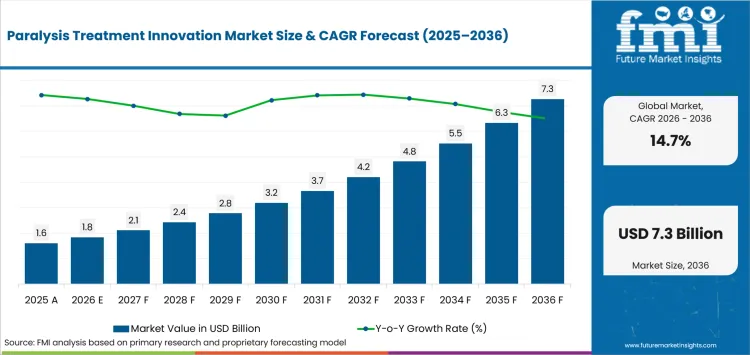
Key Takeaways of Paralysis Treatment Innovation Market
- Demand for paralysis treatment innovation is driven by therapies and assistive systems addressing measurable losses in movement or communication, with stroke and spinal cord injury pathways requiring repeated assessment tied to defined interventions.
- By technology, brain-computer interfaces are expected to lead with 42.5% share in 2026, owing to coordinated implant and decoding software development.
- Spinal cord injury is the dominant application segment, projected to hold 37.0% share in 2026, driven by concentrated functional deficits and structured rehabilitation programs.
- Regenerative therapies are estimated to hold 35.0% share in 2026, due to complex development and specialist delivery requirements.
- Reimbursement support and long-term technical service remain critical to adoption, as insurers evaluate medical necessity while hospitals balance clinician training against continuing programming needs.
- Germany and the United States are expected to lead growth at 16.1% and 15.0% CAGR respectively through 2036, while the UK relies on public commissioning and Japan/South Korea require local regulatory documentation and maintenance coverage.
- Competition centers on Neuralink, Synchron, Blackrock Neurotech, ONWARD Medical, Lifeward, Wandercraft, CUREXO, and Myomo, with vendors differentiating through investigational neural interfaces, approved spinal stimulation, robotic gait rehabilitation, and powered orthoses.
Analyst Perspective
"The neurorehabilitation technology market is increasingly evaluated on its ability to deliver measurable functional outcomes within routine clinical practice. Healthcare providers are prioritizing solutions that fit existing rehabilitation workflows, align with reimbursement pathways, and support long-term patient care without adding operational complexity. Companies that combine strong clinical evidence with practical implementation and sustained service support are expected to strengthen their market position."
- Anurag Sharma, Principal Analyst at Future Market Insights
Source: FMI's proprietary forecasting model and primary research
How is the Paralysis Treatment Innovation Market segmented?
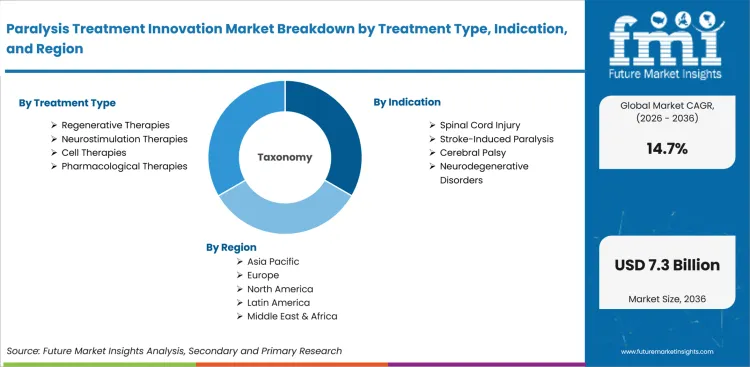
The paralysis treatment innovation industry is segmented by treatment type, indication, end user, technology, and region.
Treatment type separates biological repair approaches from neurostimulation and pharmacological therapies according to the intervention delivered. The indication category classifies demand through spinal cord injury and other neurological conditions that create different functional deficits and care pathways. End user distinguishes hospitals from rehabilitation centers and research institutions according to procedural capacity and continuing therapy responsibility. The technology category separates brain-computer interfaces and neural implants from robotics and regenerative medicine platforms with different approval and service requirements. Regional analysis compares how national regulation and reimbursement interact with specialist availability and local maintenance access across the defined geographic coverage.
What supports the commercial position of regenerative therapies within treatment type?
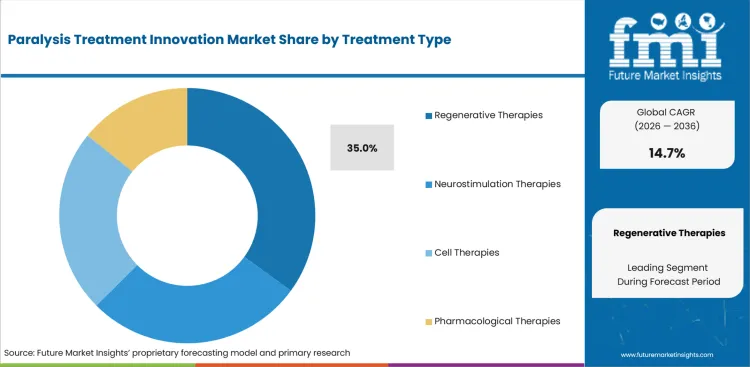
Regenerative therapies seek biological repair rather than compensating for lost function through external devices or continuing assistance. Clinical development requires controlled cell delivery and extended safety monitoring across narrowly selected participants and qualified manufacturing controls. ClinicalTrials.gov reported in February 2026 that the United States DOSED study remained a recruiting Phase 1 program with ten estimated participants. The trial status explains why stem cell therapies require specialist research sites and remain outside routine hospital purchasing without stronger clinical evidence.
- By treatment type, regenerative therapies account for 35.0% share in 2026 owing to complex development and specialist administration. Their position reflects manufacturing controls and long follow-up obligations rather than routine purchasing volume across ordinary neurological care settings.
- Academic medical centers evaluate regenerative therapies through protocol readiness and long-term safety monitoring across qualified research programs. Commercial adoption depends on validated delivery methods and reproducible outcomes that can support regulatory review beyond a small investigational population across repeatable clinical programs.
How does spinal cord injury influence treatment selection within the indication category?
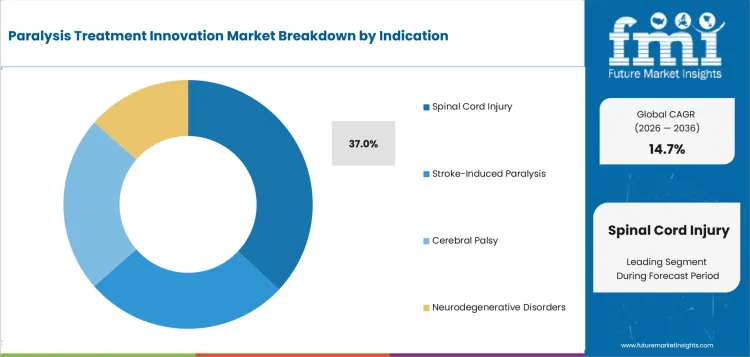
Spinal cord injury creates measurable losses in movement and sensation that vary by injury level and remaining neural function. Clinical teams match each intervention with a defined functional objective while specialist centers set criteria for injury level and treatment timing across multidisciplinary programs. Treatment selection remains difficult because early biological improvement can differ from durable recovery across a broader patient group.
- Spinal cord injury represents 37.0% of the indication category in 2026 due to concentrated functional deficits and structured specialist care. A January 2025 phase 2b trial across thirteen European hospitals found no significant primary-endpoint difference for NG101 across the complete analysis population.
- Spinal injury centers combine treatment with repeated assessments and nerve monitoring devices that distinguish neurological change from ordinary therapy variation. Purchasing decisions gain support through systems that fit a defined injury level and measurable rehabilitation objective with continuing outcome review.
What makes hospitals central to the end user category?
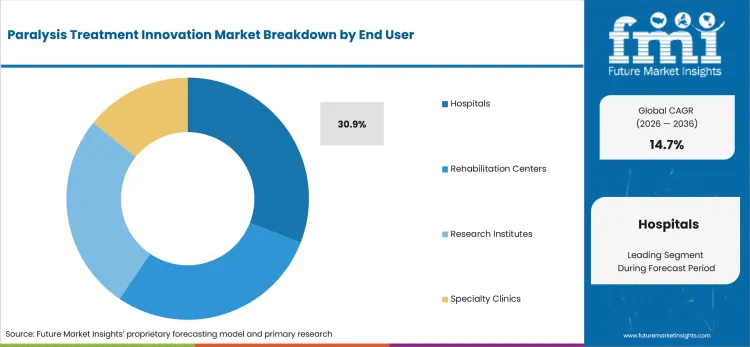
Hospitals coordinate surgery and device programming together with complication management across complex neurological cases and multidisciplinary rehabilitation schedules. Their capital decisions must account for clinical governance and rehabilitation scheduling rather than hardware price alone. Multidisciplinary teams also determine whether a technology belongs inside inpatient treatment or a continuing outpatient pathway. Hospital procurement also depends on technical service that can support several departments without disrupting scheduled neurological care.
- In 2026, hospitals hold 30.9% share, driven by their control over invasive procedures and specialist assessment. Their position also reflects the governance and capital required for complex neurological technologies across multidisciplinary care pathways with continuing service oversight.
- Hospital rehabilitation departments evaluate utilization alongside setup time and therapist workload for robotic rehabilitation tools. Wandercraft reported in May 2025 that an Italian rehabilitation institute integrated Atalante X with single-therapist sessions and rapid setup during its first year of use.
How do brain-computer interfaces shape the technology category?
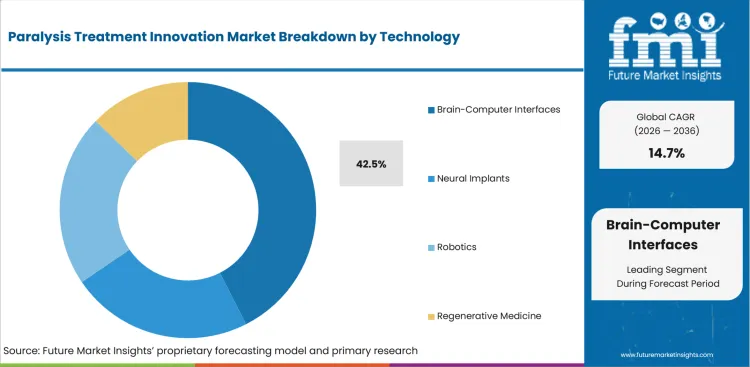
Brain-computer interfaces translate recorded neural activity into digital commands for people whose motor pathways cannot carry ordinary movement signals. Implant programs require specialized surgery and continuing software support across carefully selected participants and long-term device monitoring. Each program also needs a practical command target that links decoded signals with a meaningful daily function. Neuralink reported in January 2026 that twenty-one participants were enrolled in trials worldwide and demonstrated computer or robotic-arm control. The current pathway positions neurotechnology devices around clinical validation rather than routine therapeutic sales across specialist research centers.
- Brain-computer interfaces represent 42.5% of the technology category in 2026, propelled by concentrated implant and decoding software development. Their position reflects coordinated investment across hardware and software that must operate under continuing clinical supervision and long-term clinical support.
- Neurosurgery centers consider implanted interfaces when digital independence provides a measurable functional objective for carefully selected participants. Adoption remains constrained by trial eligibility and long-term implant support because technical performance cannot establish a commercial treatment pathway alone across qualified implant centers.
What are the drivers, restraints, and opportunities in the Paralysis Treatment Innovation Market?
Defined neurological need supports demand, investigational status limits routine purchasing, and connected care tools create a practical service opportunity.
- Driver: Neurological teams require measurable treatment pathways for patients whose movement or communication remains limited by paralysis.
- Restraint: Investigational implants and regenerative therapies cannot enter routine purchasing without regulatory approval and durable clinical evidence.
- Opportunity: Connected rehabilitation systems can link device configuration with usage information and more structured clinical follow-up.
Stroke-related paralysis creates sustained assessment and rehabilitation workloads across hospitals and community neurological services throughout continuing care. Treatment spending develops through teams that connect a therapy or device with a defined functional target. The American Heart Association reported in January 2026 that more than 600,000 people experience a first ischemic stroke annually in the United States and about 200,000 experience a recurrent stroke. Neurological providers need repeatable pathways that document movement or communication outcomes across continuing care and long-term rehabilitation.
Investigational status prevents implanted interfaces from entering ordinary hospital purchasing and reimbursement channels across routine paralysis care. Implant programs require implant safety testing and continuing support beyond the initial procedure across clinical systems. Hospital committees need clear responsibility for software updates and long-term implant monitoring across complex care pathways. ClinicalTrials.gov reported in April 2025 that the United States COMMAND study had enrolled six participants and listed Synchron’s motor neuroprosthesis as unapproved or uncleared. Commercial access therefore depends on durable safety evidence and a regulator-authorized indication for routine clinical use.
Connected clinical tools create an opening for rehabilitation companies that can improve device setup and continuing patient support. Remote configuration and usage visibility can reduce avoidable visits without replacing professional assessment across customized assistive systems. Myomo announced in April 2026 that its United States mobile application supports remote MyoPro settings and gives clinicians visibility into patient usage. Manufacturers can capture the opening through secure data workflows and clearly assigned responsibility for clinical adjustments.
Which country CAGRs are profiled in the Paralysis Treatment Innovation Market?
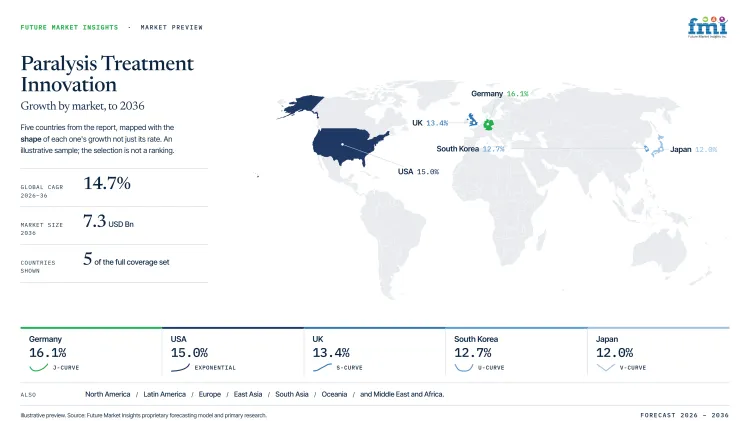
| Country | CAGR |
|---|---|
| USA | 15.0% |
| UK | 13.4% |
| Germany | 16.1% |
| Japan | 12.0% |
| South Korea | 12.7% |
How do country-level CAGRs compare in the Paralysis Treatment Innovation Market?
The country comparison spans 4.1 percentage points between Germany and Japan. Germany and the USA form a compressed upper group with a separation of 1.1 points. The UK sits 1.6 points below the USA and 0.7 points above South Korea. South Korea and Japan form another close pair with a 0.7-point separation. The spacing reflects different commercialization routes rather than current market size or installed-base strength across the five approved profiles.
- Germany combines its upper position with reimbursement arrangements and an established rehabilitation service base across several provider types.
- The USA remains near Germany although regulatory clearance and individual payer authorization create separate transaction gates for many products.
- The UK occupies the central position through public commissioning that ties equipment access to available neurological rehabilitation capacity.
- South Korea sits below the UK and benefits from domestic rehabilitation robotics expertise concentrated within specialist hospital programs.
- Japan remains close to South Korea through national reimbursement listings that define commercial access for specific approved robotic systems.
Similar CAGRs can produce different entry economics because legal availability does not guarantee local training or dependable maintenance. Payment responsibility also changes how quickly a hospital or individual can progress from evaluation to purchase. The full report provides country-level CAGR analysis across North America, Latin America, Europe, East Asia, South Asia, Oceania and the Middle East and Africa.
Country-wise Analysis
- United States commercialization depends on separate FDA and payer decisions across implanted systems and personal mobility devices. Demand for paralysis treatment innovation in the USA is forecast to rise at 15.0% CAGR through 2036 through regulated products and insurer authorization. Lifeward reported in June 2025 that an administrative law judge found the ReWalk Personal Exoskeleton reasonable and necessary for one Medicare beneficiary with spinal cord injury. The ruling provides a documented payment route but each beneficiary requires medical-necessity review and suitable training. Manufacturers need reimbursement support and qualified rehabilitation providers before regulatory access becomes a completed purchase.
- United Kingdom neurological rehabilitation operates through commissioned public services that require coordinated assessment and a documented rehabilitation plan. Local implementation depends on whether each service can fund suitable equipment and trained neurological staff. The UK paralysis treatment innovation market is projected to record 13.4% CAGR from 2026 to 2036 through structured care pathways and selective technology access. NICE published guideline NG252 in October 2025 for chronic neurological disorders including acquired spinal cord injury across England. The guideline includes robotics and exoskeletons among targeted mobility options but does not guarantee capacity at every provider. Market entry depends on commissioner funding and a service plan that supports continuing rehabilitation across local provider networks.
- Germany combines specialist rehabilitation services with insurer agreements that can define access for personal mobility systems. Germany’s paralysis treatment innovation outlook is anticipated to advance at 16.1% CAGR through 2036 through established care infrastructure and reimbursement routes. A February 2025 Lifeward agreement with BARMER added 8.5 million covered lives for personal exoskeleton reimbursement in Germany. Product delivery still depends on clinical qualification and local training across separate rehabilitation providers with continuing maintenance support. Companies need dependable German service coverage beyond major university centers and regional rehabilitation clinics throughout regional care networks.
- Japan uses national reimbursement notices to identify medical devices that can enter insured clinical pathways across approved indications. Each listed system must fit the specified classification and a facility must maintain trained clinical operators. Adoption of paralysis treatment innovation in Japan is estimated to expand at 12.0% CAGR through 2036 through defined classifications and specialist rehabilitation delivery. A December 2025 notice from Japan’s health ministry listed the Medical HAL Lower Limb Type C for insurance coverage from January 2026. The listing creates a direct access route but retains indication limits and facility training requirements. Companies need Japanese regulatory documentation and local maintenance for safe operation within approved clinical use.
- South Korea combines domestic rehabilitation robotics engineering with tertiary hospitals that maintain advanced therapy departments. Paralysis treatment innovation demand in South Korea is predicted to advance at 12.7% CAGR through 2036 through local equipment familiarity and concentrated clinical expertise. CUREXO confirmed in July 2025 that approximately 100 therapists and professors using MorningWalk attended its national user meeting in South Korea. Domestic training supports adoption but access remains narrower outside major hospitals and urban rehabilitation centers. Product expansion depends on broader service coverage and evidence that new programs improve therapist workflow across regional hospitals.
Who are the notable companies in the Paralysis Treatment Innovation Market?
Neuralink, Synchron, Blackrock Neurotech, ONWARD Medical, Lifeward, Wandercraft, Myomo, and CUREXO are the notable companies shaping this market.
The competitive field separates investigational neural interfaces from commercial spinal stimulation and rehabilitation platforms across different clinical pathways. Neuralink and Synchron depend on implant trials while Blackrock Neurotech supplies established neural recording and stimulation infrastructure for research programs. ONWARD Medical combines commercial spinal stimulation with investigational implanted systems that require specialist implementation across spinal injury programs. CUREXO reported in March 2026 that MorningWalk received European Medical Device Regulation certification and created a route toward European rehabilitation sales. Lifeward and Wandercraft provide lower-limb systems while Myomo addresses upper-limb paralysis through customized orthoses and continuing home use. neurointerventional devices shape catheter-based access requirements for Synchron’s implant pathway without becoming direct paralysis treatment products.
- Neuralink and Synchron develop investigational interfaces for severe motor impairment through qualified implant studies and controlled clinical programs worldwide. Blackrock Neurotech supplies neural recording and stimulation tools that support human research and developing clinical interfaces.
- ONWARD Medical provides commercial transcutaneous spinal stimulation alongside investigational implant platforms for spinal cord injury and rehabilitation. Lifeward supports personal exoskeleton use through regulatory clearance and reimbursement-dependent access routes for eligible people with spinal cord injury.
- Wandercraft and CUREXO provide institutional gait rehabilitation robots with different balancing and setup designs across specialist rehabilitation centers. Myomo supplies customized powered upper-limb orthoses through clinical fitting and insurance-supported delivery channels for eligible patients at home.
Competitive Benchmarking: Paralysis Treatment Innovation Market
| Company | Neural Control Interface | Spinal Neuromodulation | Rehabilitation Delivery Systems | Geographic Reach |
|---|---|---|---|---|
| Neuralink | High | Low | Low | Selected trial markets |
| Synchron | High | Low | Low | USA and Australia |
| Blackrock Neurotech | High | Low | Low | North America and selected global research markets |
| ONWARD Medical | Medium | High | High | USA and Europe |
| Lifeward | Low | Low | High | North America and Europe |
| Wandercraft | Low | Low | High | USA, Europe, and Australia |
| Myomo | Low | Low | High | North America and Europe |
| CUREXO | Low | Low | High | East Asia and selected export markets |
Source basis: Official corporate product pages and regulatory records supported every capability threshold and geographic designation.
Key Developments in the Paralysis Treatment Innovation Market
- In May 2025, Neuralink received United States Food and Drug Administration Breakthrough Device designation for a speech-restoration program covering severe speech impairment from several neurological conditions. The designation supports expedited regulatory interaction without commercial approval and broadens the development pathway beyond cursor control toward communication restoration for people with paralysis inside qualified clinical programs.
- In January 2025, ONWARD Medical announced first United States commercial sales of the ARC-EX System to UW Medicine and NextSteps Chicago. The institutional orders gave two rehabilitation providers access to programmed transcutaneous spinal cord stimulation for people with chronic incomplete spinal cord injury. The transactions established a direct purchasing route across academic and community rehabilitation settings for planned neurological care programs.
- In November 2025, Wandercraft announced expanded United States Food and Drug Administration indications for Atalante X covering spinal cord injury levels C4 through L5 and multiple sclerosis. The clearance added joint-specific assistance controls and updated clinical reporting so trained rehabilitation teams can apply the system across more complex mobility profiles under supervised institutional programs.
- In September 2025, Lifeward received European CE mark approval for the ReWalk 7 Personal Exoskeleton and cleared the system for commercial launch across the European Union. The seventh-generation device added cloud connectivity and new control features for personal mobility and clinician support. European access remains tied to country reimbursement processes and qualified clinical training for individuals with spinal cord injury.
Key Players in the Paralysis Treatment Innovation Market
Investigational Neural Interface Developers
- Neuralink
- Synchron
- Blackrock Neurotech
Spinal Stimulation and Personal Mobility Providers
- ONWARD Medical
- Lifeward
Rehabilitation Robotics and Orthotics Providers
- Wandercraft
- Myomo
- CUREXO
Paralysis Treatment Innovation Market - Report Scope
| Coverage field | Report scope |
|---|---|
| Market breakdown | Treatment type, indication, end user, technology, and region. |
| Quantitative Units | Revenue in USD Million, CAGR in %. |
| Market Definition | Products and associated services used to restore or compensate for neurological function in people living with paralysis through regenerative treatment, stimulation, implanted interfaces, and rehabilitation systems. |
| Regions Covered | North America, Latin America, Europe, East Asia, South Asia, Oceania, and Middle East and Africa. |
| Countries Covered | USA, UK, Germany, Japan, and South Korea. |
| Key Companies Profiled | Neuralink, Synchron, Blackrock Neurotech, ONWARD Medical, Lifeward, Wandercraft, Myomo, and CUREXO |
| Forecast Period | 2026 to 2036. |
| Approach | Hybrid bottom-up and top-down market sizing supported by primary interviews and official desk research. |
Paralysis Treatment Innovation Market - Research Methodology
| Method | Approach |
|---|---|
| Primary Research | FMI analysts gathered input from manufacturers, service providers, technology developers, distributors, end users, procurement teams, and subject-matter experts. Interviews examined purchasing decisions, product or service evaluation, adoption barriers, approval requirements, pricing considerations, and expectations for technical or commercial support. Respondents were also asked what evidence is required before a trial, pilot, or initial order develops into regular purchasing. |
| Desk Research | Desk research covered government statistics, regulatory publications, trade data, industry associations, technical literature, standards, company filings, product information, and official corporate announcements. Sources were reviewed for relevance, publication date, geographic coverage, and consistency with the defined market scope. Claims relating to performance, applications, approvals, capacity, investment, and commercial activity were retained only when supported by credible public evidence. |
| Market Sizing and Forecasting | The market model combined the baseline value with historical performance, segment structure, pricing and volume indicators, adoption levels, company participation, and country-level demand conditions. Forecast assumptions considered economic activity, investment trends, regulatory developments, technology adoption, purchasing cycles, supply availability, and barriers to wider market use. Segment and regional estimates were reconciled before the final market total was calculated. |
| Data Validation | Estimates were checked against multiple independent indicators, including public data, company activity, trade patterns, industry developments, and findings from primary interviews. Validation also tested whether products, services, applications, and company revenues fell within the defined market boundaries. Adjacent categories, unsupported claims, overlapping revenues, and activities without direct market relevance were excluded to reduce double counting and maintain consistency across segments and countries. |
Paralysis Treatment Innovation Market by Segments
Paralysis Treatment Innovation Market segmented by Treatment Type:
- Regenerative Therapies
- Neurostimulation Therapies
- Cell Therapies
- Pharmacological Therapies
Paralysis Treatment Innovation Market segmented by Indication:
- Spinal Cord Injury
- Stroke-Induced Paralysis
- Cerebral Palsy
- Neurodegenerative Disorders
Paralysis Treatment Innovation Market segmented by End User:
- Hospitals
- Rehabilitation Centers
- Research Institutes
- Specialty Clinics
Paralysis Treatment Innovation Market segmented by Technology:
- Brain-Computer Interfaces
- Neural Implants
- Robotics
- Regenerative Medicine
Paralysis Treatment Innovation Market by Region
- North America
- United States
- Canada
- Latin America
- Brazil
- Mexico
- Argentina
- Chile
- Western Europe
- Germany
- France
- United Kingdom
- Italy
- Spain
- Benelux
- Nordics
- Eastern Europe
- Poland
- Czech Republic
- Romania
- Hungary
- East Asia
- China
- Japan
- South Korea
- South Asia and Pacific
- India
- ASEAN
- Australia and New Zealand
- Middle East and Africa
- GCC Countries
- South Africa
- Türkiye
- Israel
Research Sources and Bibliography
- USA Food and Drug Administration. (2024, December 19). Device Classification Under Section 513(f)(2)(De Novo).
- ClinicalTrials.gov. (2026, February 12). Delivery of Oligodendrocyte Progenitor Cells for Spinal Cord Injury: Evaluation of a Novel Device (DOSED).
- Weidner, N., Abel, R., Maier, D., Röhl, K., Röhrich, F., Baumberger, M., Hund-Georgiadis, M., Saur, M., Benito, J., Rehahn, K., Aach, M., Badke, A., Kriz, J., Barkovits, K., Killeen, T., Farner, L., Seif, M., Hubli, M., Marcus, K., . . . Nogo Inhibition in Spinal Cord Injury Study Group. (2025). Safety and efficacy of intrathecal antibodies to Nogo-A in patients with acute cervical spinal cord injury: A randomised, double-blind, multicentre, placebo-controlled, phase 2b trial. The Lancet Neurology, 24(1), 42-53.
- Wandercraft. (2025, May 15). New study shows how Atalante X fits seamlessly into rehabilitation workflows.
- Neuralink. (2026, January 28). Two Years of Telepathy.
- American Heart Association. (2026, January 26). 2026 Guideline for the Early Management of Patients With Acute Ischemic Stroke.
- ClinicalTrials.gov. (2025, April 29). COMMAND Early Feasibility Study: Implantable BCI to Control a Digital Device for People With Paralysis.
- Myomo, Inc. (2026, April 20). Myomo Introduces Myomo Mobile App to Enhance Clinical Workflow and Patient Engagement.
- Lifeward Ltd. (2025, June 24). Administrative Law Judge Determines ReWalk Personal Exoskeleton is “Reasonable and Necessary” for Medicare Beneficiary.
- National Institute for Health and Care Excellence. (2025, October 15). Rehabilitation for chronic neurological disorders including acquired brain injury (NICE Guideline NG252).
- Lifeward Ltd. (2025, February 5). Lifeward Finalizes Personal Exoskeleton Reimbursement Agreement with BARMER, Adding 8.5 Million Covered Lives in Germany.
- Ministry of Health, Labour and Welfare. (2025, December 26). 医療機器の保険適用について [Insurance coverage of medical devices].
- CUREXO. (2025, July 8). Morning Walk User Meeting 2025.
- CUREXO. (2026, March 9). MorningWalk has successfully achieved CE Marking under the European Medical Device Regulation.
- Neuralink. (2025, May 1). Neuralink Receives Breakthrough Device Designation for Speech.
- ONWARD Medical N.V. (2025, January 9). ONWARD Medical Announces First Commercial Sales of ARC-EX System.
- Wandercraft. (2025, November 3). Wandercraft Gains Second FDA Indication Extension for Atalante X in Less Than Two Years, Extending Advanced Robotic Rehabilitation for More Patients with Severe Mobility Loss.
- Lifeward Ltd. (2025, September 8). Lifeward Achieves CE Mark Approval for the ReWalk 7 Personal Exoskeleton.
- Neuralink. (n.d.). Neuralink for device control. Retrieved July 20, 2026.
- Synchron. (n.d.). Technology. Retrieved July 20, 2026.
- Blackrock Neurotech. (n.d.). NeuroPort. Retrieved July 20, 2026.
- Tether Operations, S.A. de C.V. (2024, April 29). Tether Takes Strategic Stake in Leading Brain-Computer-Interface Company Blackrock Neurotech.
- ONWARD Medical N.V. (n.d.). ARC-EX. Retrieved July 20, 2026.
- ONWARD Medical N.V. (n.d.). Brain-Computer Interface. Retrieved July 20, 2026.
- Lifeward. (n.d.). ReWalk 7 Personal Exoskeleton for Spinal Cord Injury. Retrieved July 20, 2026.
- Wandercraft. (n.d.). Atalante X: A new kind of rehabilitation. Retrieved July 20, 2026.
- Wandercraft. (2026, February 24). Wandercraft Announces Availability of Atalante X in Australia Following Therapeutic Goods Administration (TGA) Approval.
- Myomo, Inc. (2026, March 9). Annual Report on Form 10-K for the year ended December 31, 2025.
- CUREXO. (n.d.). MorningWalk. Retrieved July 20, 2026.
This bibliography is provided for reader reference and is not exhaustive. The full report contains the complete reference list and detailed citations.
This Report Answers
- How large is the paralysis treatment innovation market in 2026 and 2036?
- Which neurological care pressures support spending across paralysis treatment pathways?
- Why do regenerative therapies hold a major treatment type share in 2026?
- How does spinal cord injury influence treatment and rehabilitation purchasing decisions?
- Why do brain-computer interfaces represent a major technology share in 2026?
- How do country growth conditions differ across the USA, UK, Germany, Japan, and South Korea?
- Which companies provide commercial systems or investigational platforms for paralysis treatment innovation?
- What limits routine adoption across implanted interfaces and regenerative therapies?
- How should hospitals compare clinical evidence with training and service requirements?
Frequently Asked Questions
How big is the Paralysis Treatment Innovation Market in 2026?
The paralysis treatment innovation market is valued at USD 1.8 billion in 2026 and is forecast to reach USD 7.3 billion by 2036. Growth reflects hospital groups comparing clinical benefit with training and service responsibility before committing capital across neurological care programs worldwide.
What is the CAGR of the Paralysis Treatment Innovation Market from 2026 to 2036?
The paralysis treatment innovation market grows at a CAGR of 14.7% between 2026 and 2036, supported by neurological teams requiring measurable treatment pathways for patients whose movement or communication remains limited by paralysis across hospital and specialist care settings.
Which technology leads the Paralysis Treatment Innovation Market?
Brain-computer interfaces account for 42.5% of the paralysis treatment innovation market by technology in 2026, propelled by concentrated implant and decoding software development requiring continuing clinical supervision and long-term specialist support.
How much will the Paralysis Treatment Innovation Market add between 2026 and 2036?
The paralysis treatment innovation market is set to add USD 5.5 billion between 2026 and 2036, growing from USD 1.8 billion to USD 7.3 billion as regulated stimulation, robotic rehabilitation, and neural interface systems extend across a widening base of specialist care programs.
Who are the leading companies in the Paralysis Treatment Innovation Market?
Five companies lead the paralysis treatment innovation market, including Neuralink, Synchron, Blackrock Neurotech, ONWARD Medical, and Lifeward, competing through investigational neural interfaces, approved spinal stimulation, robotic gait rehabilitation, and powered orthoses.
Preview the report firsthand - request a free sample
Get SampleGet the brochure for pricing and purchase details.
Get PDFTable of Content
- Key Takeaways
- Market Size and CAGR
- Top Growth Driver
- Fastest Growing Segment
- Leading Region
- Key Companies
- Emerging Opportunities
- Executive Summary
- Global Market Outlook
- Demand-side Trends
- Supply-side Trends
- Technology Roadmap Analysis
- Analysis and Recommendations
- Analyst Perspective (What is happening? Why now? What should investors know?)
- Key Questions Answered
- How large is the market?
- What is the CAGR?
- What are key trends?
- Which region dominates?
- Who are the leaders?
- Market Overview
- Market Coverage / Taxonomy
- Market Definition / Scope / Limitations
- Research Methodology
- Chapter Orientation
- Analytical Lens and Working Hypotheses
- Market Structure, Signals, and Trend Drivers
- Benchmarking and Cross-market Comparability
- Market Sizing, Forecasting, and Opportunity Mapping
- Research Design and Evidence Framework
- Desk Research Programme (Secondary Evidence)
- Expert Input and Fieldwork (Primary Evidence)
- Tooling, Models, and Reference Databases
- Data Engineering and Model Build
- Quality Assurance and Audit Trail
- Market Background
- Market Dynamics (Drivers, Restraints, Opportunity, Trends)
- Scenario Forecast (Optimistic, Likely, Conservative)
- Impact Analysis
- AI Impact
- Sustainability Impact
- Regulatory Impact
- Technology Impact
- Consumer / Buyer Analysis
- Purchase Drivers
- Adoption Barriers
- Buyer Journey
- Opportunity Map Analysis
- Product Life Cycle Analysis
- Supply Chain Analysis
- Investment Feasibility Matrix
- Value Chain Analysis
- PESTLE and Porter's Analysis
- Regulatory Landscape
- Regional Parent Market Outlook
- Production and Consumption Statistics
- Import and Export Statistics
- Global Market Analysis and Forecast, 2021 to 2036
- Historical Market Size Value (USD Billion) Analysis, 2021 to 2025
- Current and Future Market Size Value (USD Billion) Projections, 2026 to 2036
- Y-o-Y Growth Trend Analysis
- Absolute $ Opportunity Analysis
- Global Market Pricing Analysis, 2021 to 2036
- Global Market Analysis and Forecast, By Treatment Type, 2021 to 2036
- Introduction / Key Findings
- Historical Market Size Value (USD Billion) Analysis By Treatment Type, 2021 to 2025
- Current and Future Market Size Value (USD Billion) Analysis and Forecast By Treatment Type, 2026 to 2036
- Regenerative Therapies
- Neurostimulation Therapies
- Cell Therapies
- Pharmacological Therapies
- Regenerative Therapies
- Y-o-Y Growth Trend Analysis By Treatment Type, 2021 to 2025
- Absolute $ Opportunity Analysis By Treatment Type, 2026 to 2036
- Global Market Analysis and Forecast, By Indication, 2021 to 2036
- Introduction / Key Findings
- Historical Market Size Value (USD Billion) Analysis By Indication, 2021 to 2025
- Current and Future Market Size Value (USD Billion) Analysis and Forecast By Indication, 2026 to 2036
- Spinal Cord Injury
- Stroke-Induced Paralysis
- Cerebral Palsy
- Neurodegenerative Disorders
- Spinal Cord Injury
- Y-o-Y Growth Trend Analysis By Indication, 2021 to 2025
- Absolute $ Opportunity Analysis By Indication, 2026 to 2036
- Global Market Analysis and Forecast, By End User, 2021 to 2036
- Introduction / Key Findings
- Historical Market Size Value (USD Billion) Analysis By End User, 2021 to 2025
- Current and Future Market Size Value (USD Billion) Analysis and Forecast By End User, 2026 to 2036
- Hospitals
- Rehabilitation Centers
- Research Institutes
- Specialty Clinics
- Hospitals
- Y-o-Y Growth Trend Analysis By End User, 2021 to 2025
- Absolute $ Opportunity Analysis By End User, 2026 to 2036
- Global Market Analysis and Forecast, By Technology, 2021 to 2036
- Introduction / Key Findings
- Historical Market Size Value (USD Billion) Analysis By Technology, 2021 to 2025
- Current and Future Market Size Value (USD Billion) Analysis and Forecast By Technology, 2026 to 2036
- Brain-Computer Interfaces
- Neural Implants
- Robotics
- Regenerative Medicine
- Brain-Computer Interfaces
- Y-o-Y Growth Trend Analysis By Technology, 2021 to 2025
- Absolute $ Opportunity Analysis By Technology, 2026 to 2036
- Global Market Analysis and Forecast, By Region, 2021 to 2036
- Introduction
- Historical Market Size Value (USD Billion) Analysis By Region, 2021 to 2025
- Current Market Size Value (USD Billion) Analysis and Forecast By Region, 2026 to 2036
- North America
- Latin America
- Western Europe
- Eastern Europe
- East Asia
- South Asia and Pacific
- Middle East & Africa
- Market Attractiveness Analysis By Region
- North America Market Analysis and Forecast, By Country, 2021 to 2036
- Historical Market Size Value (USD Billion) Trend Analysis By Market Taxonomy, 2021 to 2025
- Market Size Value (USD Billion) Forecast By Market Taxonomy, 2026 to 2036
- By Country
- USA
- Canada
- By Treatment Type
- By Indication
- By End User
- By Technology
- By Country
- Market Attractiveness Analysis
- By Country
- By Treatment Type
- By Indication
- By End User
- By Technology
- Key Takeaways
- Latin America Market Analysis and Forecast, By Country
- Historical Market Size Value (USD Billion) Trend Analysis By Market Taxonomy, 2021 to 2025
- Market Size Value (USD Billion) Forecast By Market Taxonomy, 2026 to 2036
- By Country
- Brazil
- Mexico
- Chile
- Rest of Latin America
- By Treatment Type
- By Indication
- By End User
- By Technology
- By Country
- Market Attractiveness Analysis
- By Country
- By Treatment Type
- By Indication
- By End User
- By Technology
- Key Takeaways
- Western Europe Market Analysis and Forecast, By Country
- Historical Market Size Value (USD Billion) Trend Analysis By Market Taxonomy, 2021 to 2025
- Market Size Value (USD Billion) Forecast By Market Taxonomy, 2026 to 2036
- By Country
- Germany
- UK
- Italy
- Spain
- France
- Nordic
- BENELUX
- Rest of Western Europe
- By Treatment Type
- By Indication
- By End User
- By Technology
- By Country
- Market Attractiveness Analysis
- By Country
- By Treatment Type
- By Indication
- By End User
- By Technology
- Key Takeaways
- Eastern Europe Market Analysis and Forecast, By Country
- Historical Market Size Value (USD Billion) Trend Analysis By Market Taxonomy, 2021 to 2025
- Market Size Value (USD Billion) Forecast By Market Taxonomy, 2026 to 2036
- By Country
- Russia
- Poland
- Hungary
- Balkan & Baltic
- Rest of Eastern Europe
- By Treatment Type
- By Indication
- By End User
- By Technology
- By Country
- Market Attractiveness Analysis
- By Country
- By Treatment Type
- By Indication
- By End User
- By Technology
- Key Takeaways
- East Asia Market Analysis and Forecast, By Country
- Historical Market Size Value (USD Billion) Trend Analysis By Market Taxonomy, 2021 to 2025
- Market Size Value (USD Billion) Forecast By Market Taxonomy, 2026 to 2036
- By Country
- China
- Japan
- South Korea
- By Treatment Type
- By Indication
- By End User
- By Technology
- By Country
- Market Attractiveness Analysis
- By Country
- By Treatment Type
- By Indication
- By End User
- By Technology
- Key Takeaways
- South Asia and Pacific Market Analysis and Forecast, By Country
- Historical Market Size Value (USD Billion) Trend Analysis By Market Taxonomy, 2021 to 2025
- Market Size Value (USD Billion) Forecast By Market Taxonomy, 2026 to 2036
- By Country
- India
- ASEAN
- Australia & New Zealand
- Rest of South Asia and Pacific
- By Treatment Type
- By Indication
- By End User
- By Technology
- By Country
- Market Attractiveness Analysis
- By Country
- By Treatment Type
- By Indication
- By End User
- By Technology
- Key Takeaways
- Middle East & Africa Market Analysis and Forecast, By Country
- Historical Market Size Value (USD Billion) Trend Analysis By Market Taxonomy, 2021 to 2025
- Market Size Value (USD Billion) Forecast By Market Taxonomy, 2026 to 2036
- By Country
- Kingdom of Saudi Arabia
- Other GCC Countries
- Türkiye
- South Africa
- Other African Union
- Rest of Middle East & Africa
- By Treatment Type
- By Indication
- By End User
- By Technology
- By Country
- Market Attractiveness Analysis
- By Country
- By Treatment Type
- By Indication
- By End User
- By Technology
- Key Takeaways
- Key Countries Market Analysis
- USA
- Pricing Analysis
- Market Share Analysis, 2025
- By Treatment Type
- By Indication
- By End User
- By Technology
- Canada
- Pricing Analysis
- Market Share Analysis, 2025
- By Treatment Type
- By Indication
- By End User
- By Technology
- Mexico
- Pricing Analysis
- Market Share Analysis, 2025
- By Treatment Type
- By Indication
- By End User
- By Technology
- Brazil
- Pricing Analysis
- Market Share Analysis, 2025
- By Treatment Type
- By Indication
- By End User
- By Technology
- Chile
- Pricing Analysis
- Market Share Analysis, 2025
- By Treatment Type
- By Indication
- By End User
- By Technology
- Germany
- Pricing Analysis
- Market Share Analysis, 2025
- By Treatment Type
- By Indication
- By End User
- By Technology
- UK
- Pricing Analysis
- Market Share Analysis, 2025
- By Treatment Type
- By Indication
- By End User
- By Technology
- Italy
- Pricing Analysis
- Market Share Analysis, 2025
- By Treatment Type
- By Indication
- By End User
- By Technology
- Spain
- Pricing Analysis
- Market Share Analysis, 2025
- By Treatment Type
- By Indication
- By End User
- By Technology
- France
- Pricing Analysis
- Market Share Analysis, 2025
- By Treatment Type
- By Indication
- By End User
- By Technology
- India
- Pricing Analysis
- Market Share Analysis, 2025
- By Treatment Type
- By Indication
- By End User
- By Technology
- ASEAN
- Pricing Analysis
- Market Share Analysis, 2025
- By Treatment Type
- By Indication
- By End User
- By Technology
- Australia & New Zealand
- Pricing Analysis
- Market Share Analysis, 2025
- By Treatment Type
- By Indication
- By End User
- By Technology
- China
- Pricing Analysis
- Market Share Analysis, 2025
- By Treatment Type
- By Indication
- By End User
- By Technology
- Japan
- Pricing Analysis
- Market Share Analysis, 2025
- By Treatment Type
- By Indication
- By End User
- By Technology
- South Korea
- Pricing Analysis
- Market Share Analysis, 2025
- By Treatment Type
- By Indication
- By End User
- By Technology
- Russia
- Pricing Analysis
- Market Share Analysis, 2025
- By Treatment Type
- By Indication
- By End User
- By Technology
- Poland
- Pricing Analysis
- Market Share Analysis, 2025
- By Treatment Type
- By Indication
- By End User
- By Technology
- Hungary
- Pricing Analysis
- Market Share Analysis, 2025
- By Treatment Type
- By Indication
- By End User
- By Technology
- Kingdom of Saudi Arabia
- Pricing Analysis
- Market Share Analysis, 2025
- By Treatment Type
- By Indication
- By End User
- By Technology
- Türkiye
- Pricing Analysis
- Market Share Analysis, 2025
- By Treatment Type
- By Indication
- By End User
- By Technology
- South Africa
- Pricing Analysis
- Market Share Analysis, 2025
- By Treatment Type
- By Indication
- By End User
- By Technology
- USA
- Market Structure Analysis
- Competition Dashboard
- Competition Benchmarking
- Market Share Analysis of Top Players
- By Regional
- By Treatment Type
- By Indication
- By End User
- By Technology
- Emerging Startups
- Innovation Benchmarking
- Competition Analysis
- Competition Deep Dive
- Abbott
- Overview
- Product Portfolio
- Profitability by Market Segments
- Sales Footprint
- Strategy Overview
- Marketing Strategy
- Product Strategy
- Channel Strategy
- Medtronic
- Neuralink
- Synchron
- Onward Medical
- Blackrock Neurotech
- ReWalk Robotics
- Ekso Bionics
- NeuroPace
- SpineX
- Abbott
- Case Studies
- Success Stories
- Recent Developments
- Competition Deep Dive
- Assumptions & Acronyms Used


