

- Market Size (2026)
- USD 15.6 Bn
- Forecast (2036)
- USD 145.3 Bn
- CAGR (2026 to 2036)
- 25.0%
How big is Industrial Digital Twins & Sim-to-Real Market size?
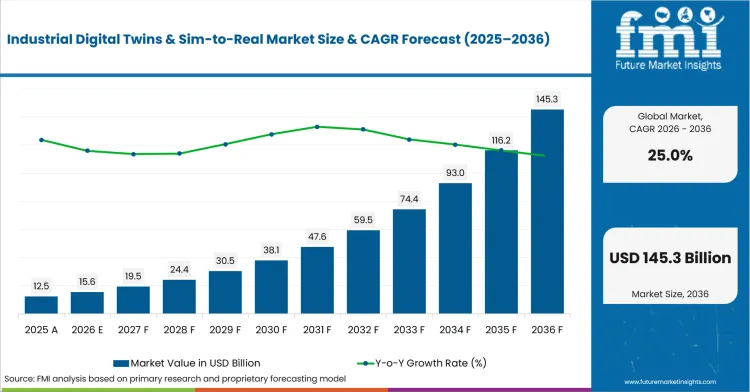
USD 15.6 billion in 2026 and USD 145.3 billion by 2036 at a 25.0% CAGR.
Demand for Industrial Digital Twins & Sim-to-Real is projected to expand at 25.0% CAGR between 2026 and 2036, increasing valuation from USD 15.6 billion in 2026 to USD 145.3 billion by 2036. Testing new robot movements directly on an active assembly line is risky and expensive. To avoid costly shutdowns, factory engineers build virtual replicas to experiment with equipment settings safely. National Institute of Standards and Technology reported in October 2024 an estimated manufacturing impact of USD 37.9 billion. This substantial financial benefit demonstrates how computer models help companies prevent expensive physical errors before touching real hardware.
Different regions approach factory simulation with distinct priorities. Purchase teams in the United States and the European Union emphasize long-term project tracking and secure software integration. At the same time, manufacturers in China and South Korea focus on increasing robot-cell testing and quick assembly line replication. Industrial automation helping verify machine behavior through software has now become essential. International Federation of Robotics reported in September 2025 global installations of 542,000 industrial robots during 2024. Setting up this extensive volume of new equipment requires thorough virtual checks so engineers can ensure physical precision on the shop floor.
Key Takeaways of Industrial Digital Twins & Sim-to-Real Market
- Demand for industrial digital twins and sim-to-real solutions is driven by engineering teams testing production changes without stopping active equipment, connecting simulation with operating data for commissioning and daily improvement.
- By deployment, cloud is expected to lead with 44.0% share in 2026, guided by distributed engineering access and scalable simulation resources.
- Platforms are the dominant offering segment, projected to hold 42.0% share in 2026, aided by model governance and controlled user access.
- Process twins are estimated to lead the twin type category with 30.0% share in 2026, led by flow analysis and operating-rule testing.
- Integration with maintenance systems and control feeds remains critical, as robot teams and maintenance groups use simulated scenes and condition monitoring to prepare software before physical trials.
- China, the United States, and South Korea are expected to form the higher-growth country tier, advancing at 28.0%, 26.0%, and 25.0% CAGR respectively through 2036, supported by factory automation, robot investment, and electronics/automotive production complexity.
- Competition centers on Siemens, Dassault Systèmes, PTC, AVEVA, NVIDIA, and Synopsys, with vendors differentiating through lifecycle and production modeling depth, connected asset/operations use cases, and accelerated simulation with physical AI capability.
Analyst Perspective
"The value of industrial digital twins is determined by how effectively virtual models remain synchronized with physical assets throughout their operational life. Organizations are shifting their focus from one-time simulation projects to digital environments that continuously support commissioning, process optimization, maintenance, and operational decision-making. Long-term market leadership will favor providers that simplify model lifecycle management, establish clear governance for engineering data, and deliver reliable sim-to-real validation that manufacturers can apply with confidence across production facilities."
- Nikhil Kaitwade, Managing Consultant for Information Technology at Future Market Insights
Source: Future Market Insights analysis, 2026.
How is Industrial Digital Twins & Sim-to-Real Market segmented?
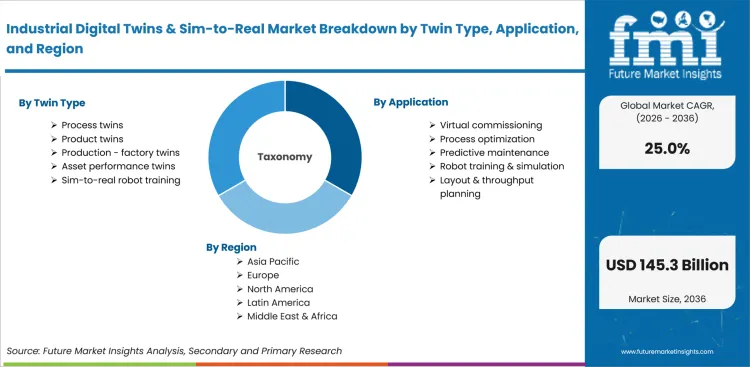
The industrial digital twins & sim-to-real industry is segmented by twin type, application, deployment, end-use industry, offering, and region.
The industrial digital twins & sim-to-real industry is segmented by twin type, application, deployment, end-use industry, offering, and region. Twin type coverage includes process twins alongside product twins, production - factory twins, asset performance twins, and sim-to-real robot training. Application coverage includes virtual commissioning, process optimization, predictive maintenance, robot training & simulation, and layout & throughput planning.
Deployment coverage includes cloud, on-premise, and hybrid. End-use industry coverage includes automotive, electronics & semiconductors, aerospace & defense, machinery, and energy & others. Offering coverage includes platforms, simulation software, integration services, and consulting. Regional coverage includes North America, Europe, East Asia, South Asia and Pacific, Latin America, Middle East and Africa.
How do Process twins shape twin type demand?
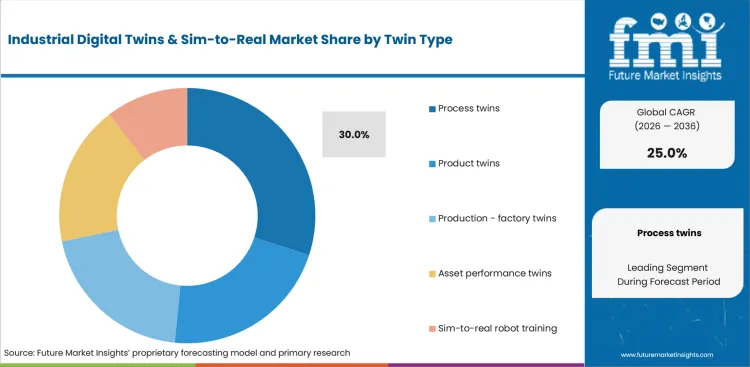
Process twins guide twin type selection driven by plants needing virtual tests for flow changes and operating rules. Models connect station timing with material movement, helping teams examine a production change without disturbing an active shift. Hexagon reported in April 2025 for the findings being drawn from more than 600 C-suite executives, integrating engineering analytics through measured operating outcomes and model maturity reviews.
- Process twins are projected to hold 30.0% share in 2026, driven by cycle analysis and production-flow testing. Engineering teams compare model depth with available plant data prior to supporting repeated use.
- Product twins and production-factory twins address design and plant-wide movement questions. Asset performance twins and sim-to-real robot training support equipment condition work and robot-policy preparation.
How does Virtual commissioning shape application demand?
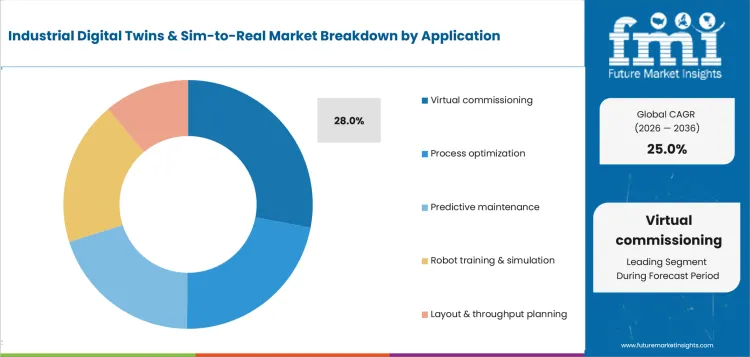
Siemens reported in January 2026 announcing an initial PepsiCo deployment achieved nearly 100% design validation, showing how factory automation and industrial controls reviews are expected to improve line performance prior to physical rework. Virtual commissioning lead application selection as controls engineers need sequence validation prior to installed equipment entering production. Simulated machines expose timing errors and collision risks during software testing.
- In 2026, virtual commissioning is estimated to capture 28.0% share owing to earlier control testing and reduced startup correction. Project teams review physics fidelity and controller connection prior to approving model use.
- Process optimization and predictive maintenance support live operations following startup. Robot training & simulation and layout & throughput planning address motion learning and factory-space decisions.
How does Cloud support deployment demand?
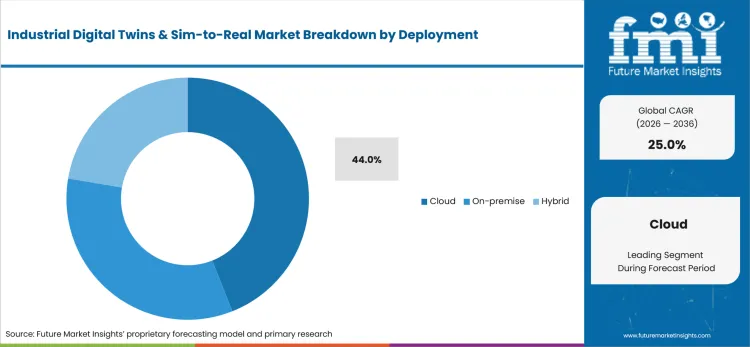
Cloud deployment retain deployment strength since distributed teams require shared model access and computing capacity. Central access reduces duplicate model copies across engineering sites and supports larger simulation workloads. Eurostat reported in February 2026 to have paid cloud platform use for application development or deployment among 26.1% of EU enterprises during 2025, indicating a practical enterprise base for shared simulation environments.
- Cloud is predicted to represent 44.0% share of deployment in 2026, aided by distributed access and scalable computing. Industrial teams evaluate data residency and model permissions prior to expanding shared environments.
- On-premise deployment promotes sensitive engineering information and tightly controlled plant networks. Hybrid models combine local data control with external computing for selected simulation tasks.
Why does Automotive lead end-use demand?
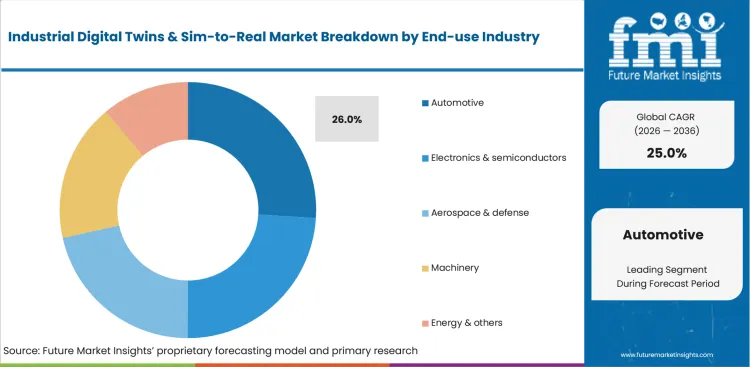
Automotive dominate end-use activity due to vehicle plants coordinate robots and fixtures across closely timed production stages. Battery lines and body shops benefit from collision checks and material-flow tests prior to equipment changes. International Organization of Motor Vehicle Manufacturers reported in April 2026 about the global vehicle production of 96.4 million units during 2025, sustaining extensive robot controller and software planning workloads.
- By end-use, automotive is expected to secure 26.0% share in 2026 since it is led by synchronized assembly and frequent model changes. Vehicle producers examine line balance and robot reach prior to releasing revised production layouts.
- Electronics & semiconductors and aerospace & defense use twins for dense equipment settings and controlled engineering work. Machinery and energy users connect models with equipment behavior and operating scenarios.
How do Platforms retain offering strength?
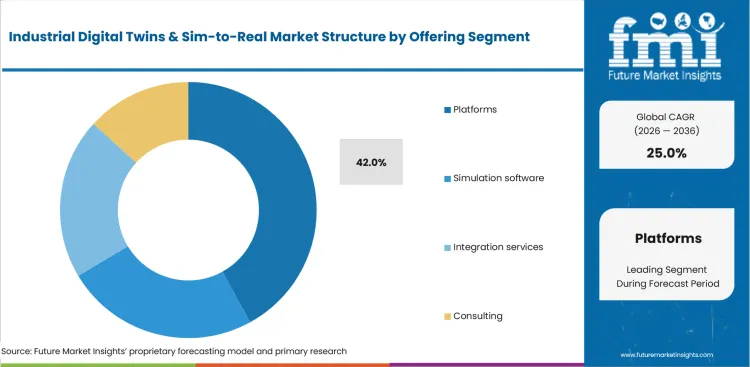
Platforms reflect the prominent share within offering strength led by engineering groups need controlled access to models and operating context. Model permissions and version control help production teams work from a shared representation. Dassault Systèmes and nasscom reported in June 2024 for the best-of-breed software or large managed-service partner interest being among 67% of surveyed enterprises, influencing process automation and instrumentation integration choices.
- Based on offering, platforms are anticipated to capture 42.0% share in 2026 as it is driven by model organization and connected user access. Buyers assess lifecycle continuity and plant-data links prior to selecting a provider.
- Simulation software supplies physics and motion calculations. Integration services and consulting connect models with plant systems and define operating questions suited to simulation.
What are drivers, restraints, and opportunities in Industrial Digital Twins & Sim-to-Real Market?
Industrial twin spending gains support from earlier production testing and connected operating insight. Data quality gaps and cybersecurity exposure are expected to delay wider deployment.
- Driver: Factory teams use virtual models to reduce physical rework during line changes and commissioning.
- Restraint: Disconnected plant data and unclear model ownership may weaken decision confidence.
- Opportunity: Physical AI programs create room for synthetic scenes and controlled sim-to-real transfer.
Measurable production improvements and fewer manual investigations contribute as drivers for the sector. Dassault Systèmes reported in January 2025 about a global electronics manufacturer achieving a 33% reduction in component attrition through AI-assisted virtual twin analysis, demonstrating value for predictive quality assurance equipment programs.
Restraints center on secure data exchange and model integrity across connected factories. European Union Agency for Cybersecurity reported in October 2025 about an assessment of 4,875 incidents spanning July 2024 through June 2025, reinforcing security review for IoT enabled equipment maintenance solutions.
Industry expansion is driven by synthetic data and robot-learning environments. NVIDIA reported in August 2025 updated Omniverse software development kits supporting more than 250,000 MJCF robot-learning developers, indicating a substantial base for predictive analytics and physical AI preparation.
What country CAGRs are profiled in Industrial Digital Twins & Sim-to-Real Market?
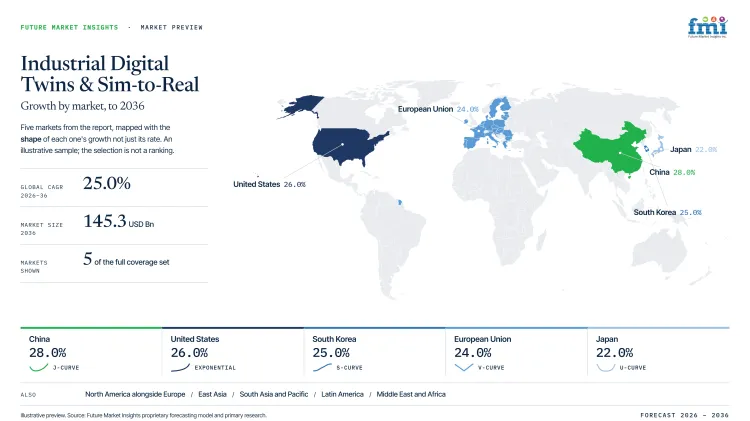
| Country / Market | CAGR |
|---|---|
| China | 28.0% |
| United States | 26.0% |
| South Korea | 25.0% |
| European Union | 24.0% |
| Japan | 22.0% |
Source: Future Market Insights analysis, 2026.
How do country-level CAGRs compare in the Industrial Digital Twins & Sim-to-Real Market?
The country comparison spans 6.0 percentage points and highlights three distinct growth tiers across the industrial digital twins & sim-to-real market. China and the United States form the leading group with a 2.0-point gap. South Korea and the European Union create a tightly clustered middle tier separated by just 1.0 percentage point, while Japan completes the comparison 2.0 percentage points below the European Union. The variation reflects differences in industrial AI adoption, digital engineering capabilities and investment in virtual production environments.
- China leads the comparison with a CAGR of 28.0%. Manufacturers are expanding the use of industrial digital twins and sim-to-real workflows to validate production processes, optimize factory operations and shorten the deployment cycle for AI-enabled robotics before physical implementation.
- The United States follows at 26.0%, remaining 2.0 percentage points behind China. Industrial companies are increasing investment in simulation-driven manufacturing platforms that enable virtual testing, predictive optimization and faster commissioning of automated production systems across complex facilities.
- South Korea records a CAGR of 25.0%, only 1.0 percentage point below the United States. The country's advanced electronics and automotive sectors continue incorporating digital twin technologies to improve production planning, refine robotic automation and reduce operational interruptions through virtual process validation.
- The European Union posts a CAGR of 24.0%, standing 1.0 percentage point behind South Korea. Market activity reflects broader adoption of digital engineering tools that support factory modernization, equipment optimization and lifecycle management. Uptake varies across member states because manufacturing specialization and digital transformation priorities differ across the region.
- Japan reaches a CAGR of 22.0%, trailing the European Union by 2.0 percentage points. Demand is linked to precision manufacturing environments where sim-to-real technologies help verify robotic behavior, improve production accuracy and reduce implementation risk before deployment on the factory floor.
Comparable CAGRs can still produce different market entry conditions. Differences in industrial digitalization, software integration, manufacturing complexity and investment priorities influence technology adoption, deployment timelines and long-term commercial opportunities. The full report provides country-level CAGR analysis across North America, Latin America, Europe, East Asia, South Asia, Oceania and the Middle East and Africa.
Country-wise Analysis
- Sector in China is projected to expand at 28.0% CAGR between 2026 and 2036, led by factory scale and local engineering capability. Production breadth encourages manufacturers to test robot cells and line movement through reusable virtual models. National Bureau of Statistics of China reported in January 2025 for industrial robot output of 556,369 units during 2024, expanding equipment capacity suited to virtual validation and production-flow modeling.
- Automation investment encourages manufacturers to test controls and line sequences prior to equipment deployment. Industry in the United States in expected to scale at 26.0% CAGR during the assessment period, guided by industrial software depth and reshoring-led automation. International Federation of Robotics reported in June 2026 United States installations of 38,000 industrial robots during 2025, increasing automated cells needing controller tests and line simulations.
- Electronics and vehicle plants require detailed simulation across dense production layouts and frequent equipment changes. Ministry of Trade, Industry and Energy reported in January 2025 a 43.9% increase in semiconductor exports during 2024, reinforcing advanced production investment and model-based process review. Sales in South Korea are forecast to advance at 25.0% CAGR through 2036, driven by complex assembly and semiconductor manufacturing programs.
- Adoption in the European Union is projected to rise at 24.0% CAGR during the forecast period, backed by secure data exchange and cross-site engineering programs. Shared model environments help distributed teams compare design and maintenance decisions across facilities. Eurostat reported in December 2025 claiming 37.8% of enterprises in Finland used AI technologies during 2025, illustrating advanced regional uptake suited to model-linked analytics and simulation.
- Factory retrofit programs encourage collision checks and control validation across installed automation systems. The market in Japan is likely to rise at 22.0% CAGR between 2026 and 2036, aided by established engineering practices and careful production changes. International Federation of Robotics reported in July 2025 for Japanese automotive highlighting installations of about 13,000 industrial robots during 2024, creating active need for virtual commissioning and motion review.
Who are notable companies in Industrial Digital Twins & Sim-to-Real Market?
Siemens AG and Dassault Systèmes SE are expected to shape market direction through lifecycle and production modeling. PTC Inc. and AVEVA (a Schneider Electric company) add connected asset and operations capability. NVIDIA Corporation and Synopsys, Inc. support physics simulation and physical AI development. Hexagon AB and Bentley Systems, Incorporated contribute engineering and asset-context depth. Microsoft Corporation and Amazon Web Services, Inc. support cloud infrastructure and industrial data services.
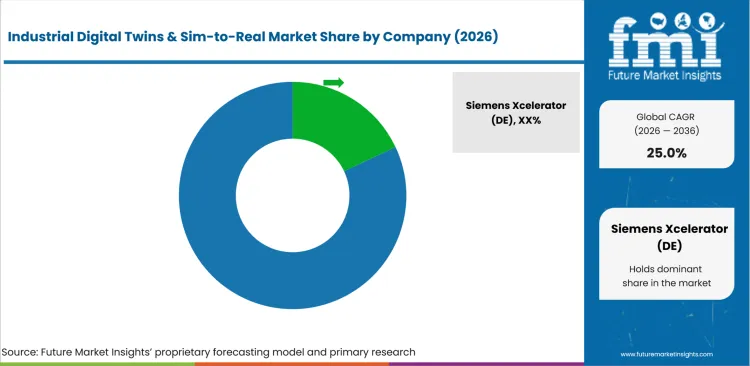
Competition in Industrial Digital Twins & Sim-to-Real is anticipated to center on model accuracy and data connection. Account teams are likely to compare providers through engineering coverage and integration effort. Siemens is expected to gain review attention through Xcelerator and production software depth. Dassault Systèmes is forecast to compete led by 3DEXPERIENCE and DELMIA. PTC is projected to support connected-product and asset use cases. AVEVA is likely to add operations and process-industry coverage. NVIDIA is anticipated to strengthen sim-to-real programs driven by Omniverse and Isaac. Synopsys is expected to expand multiphysics access based on integrated physics capabilities.
- Siemens AG and Dassault Systèmes SE receive attention from manufacturers seeking lifecycle continuity. Production engineering depth supports programs spanning design and commissioning.
- PTC Inc. and AVEVA Group Limited compete depending on connected asset context and plant operations software. Integration work influences final vendor selection.
- NVIDIA Corporation and Synopsys, Inc. support physics simulation and robot-learning workloads. Accelerated computing and multiphysics depth strengthen complex model review.
- Hexagon AB and Bentley Systems, Incorporated add engineering data and asset representation capability. Cloud access and industrial data foundations are supported by Microsoft Corporation and Amazon Web Services, Inc.
Competitive Benchmarking: Industrial Digital Twins & Sim-to-Real Market
| Company | Portfolio Depth | Industrial Twin Match | Service Support | Service Reach |
|---|---|---|---|---|
| Siemens AG | High | High | High | Germany and global |
| Dassault Systèmes SE | High | High | High | France and global |
| PTC Inc. | High | High | High | United States and global |
| AVEVA (a Schneider Electric company) | High | High | High | United Kingdom and global |
| NVIDIA Corporation | High | High | Medium | United States and global |
| Rockwell Automation, Inc. | High | High | High | North America and global |
| Hexagon AB | High | High | High | Sweden and global |
| Bentley Systems, Incorporated | High | Medium | High | United States and global |
| Microsoft Corporation | High | Medium | High | Global |
| Amazon Web Services, Inc. | High | Medium | High | Global |
Source: Future Market Insights competitive analysis, 2026.
Key Developments in Industrial Digital Twins & Sim-to-Real Market
- In February 2025, Dassault Systèmes announced a partnership with KUKA and joined KUKA mosaixx industrial software access. Easier access to 3DEXPERIENCE applications is expected to support robot-cell simulation and adaptable automation engineering.
- In April 2025, Rockwell Automation launched Emulate3D Factory Test for factory-scale virtual controls testing. Integration with NVIDIA Omniverse interfaces and OpenUSD is anticipated to improve automation validation prior to equipment deployment.
- In April 2026, OMRON and Dassault Systèmes announced integration between Sysmac automation and virtual production twins. Continuous feedback from sensors and controllers is expected to support model refinement during plant operation.
Key Players in Industrial Digital Twins & Sim-to-Real Market
Lifecycle and production modeling providers
- Siemens AG
- Dassault Systèmes SE
- PTC Inc.
- AVEVA (a Schneider Electric company)
Simulation and physical AI providers
- NVIDIA Corporation
- Synopsys, Inc.
- Hexagon AB
- Bentley Systems, Incorporated
Cloud and industrial data providers
- Microsoft Corporation
- Amazon Web Services, Inc.
Industrial Digital Twins & Sim-to-Real Market - Report Scope
| Coverage field | Report scope |
|---|---|
| Market breakdown | Industrial Digital Twins & Sim-to-Real Market breakdown by twin type alongside application, deployment, end-use industry, offering, and region |
| Quantitative Units | USD billion in 2026 to USD billion by 2036 at a CAGR |
| Market Definition | Industrial twins include connected virtual representations of products, processes, factories, or assets used for engineering tests, commissioning, operational comparison, and sim-to-real preparation. |
| Regions Covered | North America alongside Europe, East Asia, South Asia and Pacific, Latin America, Middle East and Africa |
| Countries Covered | United States and China alongside Japan, South Korea, Germany, France, United Kingdom, Italy, Spain, India, ASEAN, Australia, New Zealand, Brazil, Mexico, GCC countries, South Africa and Türkiye |
| Key Companies Profiled | Siemens AG and Dassault Systèmes SE alongside PTC Inc., AVEVA (a Schneider Electric company), NVIDIA Corporation, Synopsys, Inc., Hexagon AB, Bentley Systems, Incorporated, Microsoft Corporation and Amazon Web Services, Inc. |
| Forecast Period | 2026 to 2036 |
| Approach | Hybrid bottom-up and top-down methodology using segment share, country CAGR, industrial automation exposure, simulation depth, company portfolio coverage, and integration activity |
Source: Future Market Insights analysis, 2026.
Industrial Digital Twins & Sim-to-Real Market - Research Methodology
| Method | Approach |
|---|---|
| Primary Research | FMI analysts gathered input from manufacturers, service providers, technology developers, distributors, end users, procurement teams, and subject-matter experts. Interviews examined purchasing decisions, product or service evaluation, adoption barriers, approval requirements, pricing considerations, and expectations for technical or commercial support. Respondents were also asked what evidence is required before a trial, pilot, or initial order develops into regular purchasing. |
| Desk Research | Desk research covered government statistics, regulatory publications, trade data, industry associations, technical literature, standards, company filings, product information, and official corporate announcements. Sources were reviewed for relevance, publication date, geographic coverage, and consistency with the defined market scope. Claims relating to performance, applications, approvals, capacity, investment, and commercial activity were retained only when supported by credible public evidence. |
| Market Sizing and Forecasting | The market model combined the baseline value with historical performance, segment structure, pricing and volume indicators, adoption levels, company participation, and country-level demand conditions. Forecast assumptions considered economic activity, investment trends, regulatory developments, technology adoption, purchasing cycles, supply availability, and barriers to wider market use. Segment and regional estimates were reconciled before the final market total was calculated. |
| Data Validation | Estimates were checked against multiple independent indicators, including public data, company activity, trade patterns, industry developments, and findings from primary interviews. Validation also tested whether products, services, applications, and company revenues fell within the defined market boundaries. Adjacent categories, unsupported claims, overlapping revenues, and activities without direct market relevance were excluded to reduce double counting and maintain consistency across segments and countries. |
Source: Future Market Insights analysis, 2026.
Industrial Digital Twins & Sim-to-Real Market by Segments
Industrial Digital Twins & Sim-to-Real Market segmented by Twin Type:
- Process twins
- Product twins
- Production - factory twins
- Asset performance twins
- Sim-to-real robot training
Industrial Digital Twins & Sim-to-Real Market segmented by Application:
- Virtual commissioning
- Process optimization
- Predictive maintenance
- Robot training & simulation
- Layout & throughput planning
Industrial Digital Twins & Sim-to-Real Market segmented by Deployment:
- Cloud
- On-premise
- Hybrid
Industrial Digital Twins & Sim-to-Real Market segmented by End-use Industry:
- Automotive
- Electronics & semiconductors
- Aerospace & defense
- Machinery
- Energy & others
Industrial Digital Twins & Sim-to-Real Market segmented by Offering:
- Platforms
- Simulation software
- Integration services
- Consulting
Industrial Digital Twins & Sim-to-Real Market by Region:
- North America
- United States
- Canada
- Europe
- Germany
- United Kingdom
- France
- Italy
- Spain
- East Asia
- China
- Japan
- South Korea
- South Asia and Pacific
- India
- ASEAN
- Australia and New Zealand
- Latin America
- Brazil
- Mexico
- Middle East and Africa
- GCC countries
- South Africa
- Türkiye
Research Sources and Bibliography
- Dassault Systèmes. (2024, June 17). Virtual twin technology impact report from Dassault Systèmes and nasscom highlights 2x growth in virtual twin adoption in India.
- Thomas, D. (2024, October 30). Economics of digital twins: Costs, benefits, and economic decision making. National Institute of Standards and Technology.
- Ministry of Trade, Industry and Energy. (2025, January 2). Korea’s annual exports reach new highs in 2024.
- Wood, A. (2025, January 15). How to accelerate efficiency with virtual twins and AI in manufacturing. Dassault Systèmes.
- National Bureau of Statistics of China. (2025, January 24). Industrial production operation in December 2024.
- Dassault Systèmes. (2025, February 24). Dassault Systèmes and KUKA partner to boost robotics and automation efficiency for manufacturers.
- Rockwell Automation. (2025, April 1). Rockwell Automation to launch Emulate3D Factory Test at Hannover Messe 2025.
- Goldfarb, A. (2025, April 9). Digital twin trends report findings: Key benefits exceed expectations. Hexagon.
- International Federation of Robotics. (2025, July 15). Japan’s car industry has highest robot installations in five years.
- McKenna, J. (2025, August 20). Into the Omniverse: How OpenUSD and digital twins are powering industrial and physical AI. NVIDIA.
- International Federation of Robotics. (2025, September 25). Global robot demand in factories doubles over 10 years.
- European Union Agency for Cybersecurity. (2025, October 1). ENISA Threat Landscape 2025.
- Eurostat. (2025, December 11). 20% of EU enterprises use AI technologies.
- Gallagher, K. (2026, January 7). Igniting the industrial AI future: Roland Busch at CES 2026 introducing Digital Twin Composer. Siemens Digital Industries Software.
- Eurostat. (2026, February 3). 53% EU enterprises used paid cloud services in 2025.
- Dassault Systèmes. (2026, April 21). OMRON and Dassault Systèmes partner to revolutionize manufacturing with virtual and real integration.
- International Organization of Motor Vehicle Manufacturers. (2026, April 23). Auto industry growth shifted east in 2025 amid global repositioning.
- International Federation of Robotics. (2026, June 18). US robot industry returns to double digit growth.
This bibliography is provided for reader reference and is not exhaustive. The full report contains the complete reference list and detailed citations.
This Report Answers
- What segments shape industrial digital twins & sim-to-real activity across twin type, application, deployment, end-use industry, and offering?
- How do process twins support production-flow and operating-rule analysis?
- How does virtual commissioning reduce physical startup correction?
- What makes cloud deployment suitable for distributed engineering teams?
- How do automotive plants evaluate virtual models for line changes?
- How do country CAGRs differ across profiled areas?
- What companies compete through lifecycle modeling and simulation depth?
- How are forecasts validated using a hybrid bottom-up and top-down approach?
- What limits return on investment for industrial twin programs?
- How do sim-to-real teams build confidence prior to physical release?
Frequently Asked Questions
What supports demand in industrial digital twins & sim-to-real market?
Demand is likely to be supported by manufacturers seeking earlier production tests and fewer physical corrections. Engineering teams are expected to favor providers combining simulation accuracy with plant-data connection.
Who are key players in industrial digital twins & sim-to-real market?
Key companies are anticipated to include Siemens AG and Dassault Systèmes SE alongside PTC Inc. and NVIDIA Corporation. Competition is likely to reflect lifecycle coverage and physics simulation depth.
What restraint affects industrial digital twins & sim-to-real market?
A major restraint arises from disconnected data and unclear responsibility for model updates across industrial teams. Spending slows if operating changes are not reflected in the virtual representation.
Why do executives track industrial digital twins & sim-to-real market?
Executives are expected to track industrial twins as virtual testing influences commissioning time and production-change risk. Model reuse and integration effort shape investment reviews.
What business problem does industrial digital twins & sim-to-real market address?
Industrial twins address operating gaps created by testing complex production changes directly on active equipment. Virtual scenarios help teams review motion and sequence behavior prior to physical implementation.
What do account teams evaluate prior to selecting vendors?
Account teams are likely to evaluate model accuracy and industrial data connection ahead of vendor selection. Version control and integration support are expected to guide final review.
What limits return on investment for industrial teams?
Return on investment weakens if models lose alignment with current equipment and control settings. Duplicate model work and unsupported interfaces reduce expected efficiency gains.
How do vendors build long-term account confidence?
Vendors build account confidence through dependable model governance and evidence from industrial deployments. Responsive integration support and clear transfer limits are expected to influence repeat investment.
Preview the report firsthand - request a free sample
Get SampleGet the brochure for pricing and purchase details.
Get PDFTable of Content
- Key Takeaways
- Market Size and CAGR
- Top Growth Driver
- Fastest Growing Segment
- Leading Region
- Key Companies
- Emerging Opportunities
- Executive Summary
- Global Market Outlook
- Demand-side Trends
- Supply-side Trends
- Technology Roadmap Analysis
- Analysis and Recommendations
- Analyst Perspective (What is happening? Why now? What should investors know?)
- Key Questions Answered
- How large is the market?
- What is the CAGR?
- What are key trends?
- Which region dominates?
- Who are the leaders?
- Market Overview
- Market Coverage / Taxonomy
- Market Definition / Scope / Limitations
- Research Methodology
- Chapter Orientation
- Analytical Lens and Working Hypotheses
- Market Structure, Signals, and Trend Drivers
- Benchmarking and Cross-market Comparability
- Market Sizing, Forecasting, and Opportunity Mapping
- Research Design and Evidence Framework
- Desk Research Programme (Secondary Evidence)
- Expert Input and Fieldwork (Primary Evidence)
- Tooling, Models, and Reference Databases
- Data Engineering and Model Build
- Quality Assurance and Audit Trail
- Market Background
- Market Dynamics (Drivers, Restraints, Opportunity, Trends)
- Scenario Forecast (Optimistic, Likely, Conservative)
- Impact Analysis
- AI Impact
- Sustainability Impact
- Regulatory Impact
- Technology Impact
- Consumer / Buyer Analysis
- Purchase Drivers
- Adoption Barriers
- Buyer Journey
- Opportunity Map Analysis
- Product Life Cycle Analysis
- Supply Chain Analysis
- Investment Feasibility Matrix
- Value Chain Analysis
- PESTLE and Porter's Analysis
- Regulatory Landscape
- Regional Parent Market Outlook
- Production and Consumption Statistics
- Import and Export Statistics
- Global Market Analysis and Forecast, 2021 to 2036
- Historical Market Size Value (USD Bn) Analysis, 2021 to 2025
- Current and Future Market Size Value (USD Bn) Projections, 2026 to 2036
- Y-o-Y Growth Trend Analysis
- Absolute $ Opportunity Analysis
- Global Market Pricing Analysis, 2021 to 2036
- Global Market Analysis and Forecast, By Twin Type, 2021 to 2036
- Introduction / Key Findings
- Historical Market Size Value (USD Bn) Analysis By Twin Type, 2021 to 2025
- Current and Future Market Size Value (USD Bn) Analysis and Forecast By Twin Type, 2026 to 2036
- Process twins
- Product twins
- Production - factory twins
- Asset performance twins
- Sim-to-real robot training
- Process twins
- Y-o-Y Growth Trend Analysis By Twin Type, 2021 to 2025
- Absolute $ Opportunity Analysis By Twin Type, 2026 to 2036
- Global Market Analysis and Forecast, By Application, 2021 to 2036
- Introduction / Key Findings
- Historical Market Size Value (USD Bn) Analysis By Application, 2021 to 2025
- Current and Future Market Size Value (USD Bn) Analysis and Forecast By Application, 2026 to 2036
- Virtual commissioning
- Process optimization
- Predictive maintenance
- Robot training & simulation
- Layout & throughput planning
- Virtual commissioning
- Y-o-Y Growth Trend Analysis By Application, 2021 to 2025
- Absolute $ Opportunity Analysis By Application, 2026 to 2036
- Global Market Analysis and Forecast, By Deployment, 2021 to 2036
- Introduction / Key Findings
- Historical Market Size Value (USD Bn) Analysis By Deployment, 2021 to 2025
- Current and Future Market Size Value (USD Bn) Analysis and Forecast By Deployment, 2026 to 2036
- Cloud
- On-premise
- Hybrid
- Cloud
- Y-o-Y Growth Trend Analysis By Deployment, 2021 to 2025
- Absolute $ Opportunity Analysis By Deployment, 2026 to 2036
- Global Market Analysis and Forecast, By End-use Industry, 2021 to 2036
- Introduction / Key Findings
- Historical Market Size Value (USD Bn) Analysis By End-use Industry, 2021 to 2025
- Current and Future Market Size Value (USD Bn) Analysis and Forecast By End-use Industry, 2026 to 2036
- Automotive
- Electronics & semiconductors
- Aerospace & defense
- Machinery
- Energy & others
- Automotive
- Y-o-Y Growth Trend Analysis By End-use Industry, 2021 to 2025
- Absolute $ Opportunity Analysis By End-use Industry, 2026 to 2036
- Global Market Analysis and Forecast, By Offering, 2021 to 2036
- Introduction / Key Findings
- Historical Market Size Value (USD Bn) Analysis By Offering, 2021 to 2025
- Current and Future Market Size Value (USD Bn) Analysis and Forecast By Offering, 2026 to 2036
- Platforms
- Simulation software
- Integration services
- Consulting
- Platforms
- Y-o-Y Growth Trend Analysis By Offering, 2021 to 2025
- Absolute $ Opportunity Analysis By Offering, 2026 to 2036
- Global Market Analysis and Forecast, By Region, 2021 to 2036
- Introduction
- Historical Market Size Value (USD Bn) Analysis By Region, 2021 to 2025
- Current Market Size Value (USD Bn) Analysis and Forecast By Region, 2026 to 2036
- North America
- Latin America
- Western Europe
- Eastern Europe
- East Asia
- South Asia and Pacific
- Middle East & Africa
- Market Attractiveness Analysis By Region
- North America Market Analysis and Forecast, By Country, 2021 to 2036
- Historical Market Size Value (USD Bn) Trend Analysis By Market Taxonomy, 2021 to 2025
- Market Size Value (USD Bn) Forecast By Market Taxonomy, 2026 to 2036
- By Country
- USA
- Canada
- By Twin Type
- By Application
- By Deployment
- By End-use Industry
- By Offering
- By Country
- Market Attractiveness Analysis
- By Country
- By Twin Type
- By Application
- By Deployment
- By End-use Industry
- By Offering
- Key Takeaways
- Latin America Market Analysis and Forecast, By Country
- Historical Market Size Value (USD Bn) Trend Analysis By Market Taxonomy, 2021 to 2025
- Market Size Value (USD Bn) Forecast By Market Taxonomy, 2026 to 2036
- By Country
- Brazil
- Mexico
- Chile
- Rest of Latin America
- By Twin Type
- By Application
- By Deployment
- By End-use Industry
- By Offering
- By Country
- Market Attractiveness Analysis
- By Country
- By Twin Type
- By Application
- By Deployment
- By End-use Industry
- By Offering
- Key Takeaways
- Western Europe Market Analysis and Forecast, By Country
- Historical Market Size Value (USD Bn) Trend Analysis By Market Taxonomy, 2021 to 2025
- Market Size Value (USD Bn) Forecast By Market Taxonomy, 2026 to 2036
- By Country
- Germany
- UK
- Italy
- Spain
- France
- Nordic
- BENELUX
- Rest of Western Europe
- By Twin Type
- By Application
- By Deployment
- By End-use Industry
- By Offering
- By Country
- Market Attractiveness Analysis
- By Country
- By Twin Type
- By Application
- By Deployment
- By End-use Industry
- By Offering
- Key Takeaways
- Eastern Europe Market Analysis and Forecast, By Country
- Historical Market Size Value (USD Bn) Trend Analysis By Market Taxonomy, 2021 to 2025
- Market Size Value (USD Bn) Forecast By Market Taxonomy, 2026 to 2036
- By Country
- Russia
- Poland
- Hungary
- Balkan & Baltic
- Rest of Eastern Europe
- By Twin Type
- By Application
- By Deployment
- By End-use Industry
- By Offering
- By Country
- Market Attractiveness Analysis
- By Country
- By Twin Type
- By Application
- By Deployment
- By End-use Industry
- By Offering
- Key Takeaways
- East Asia Market Analysis and Forecast, By Country
- Historical Market Size Value (USD Bn) Trend Analysis By Market Taxonomy, 2021 to 2025
- Market Size Value (USD Bn) Forecast By Market Taxonomy, 2026 to 2036
- By Country
- China
- Japan
- South Korea
- By Twin Type
- By Application
- By Deployment
- By End-use Industry
- By Offering
- By Country
- Market Attractiveness Analysis
- By Country
- By Twin Type
- By Application
- By Deployment
- By End-use Industry
- By Offering
- Key Takeaways
- South Asia and Pacific Market Analysis and Forecast, By Country
- Historical Market Size Value (USD Bn) Trend Analysis By Market Taxonomy, 2021 to 2025
- Market Size Value (USD Bn) Forecast By Market Taxonomy, 2026 to 2036
- By Country
- India
- ASEAN
- Australia & New Zealand
- Rest of South Asia and Pacific
- By Twin Type
- By Application
- By Deployment
- By End-use Industry
- By Offering
- By Country
- Market Attractiveness Analysis
- By Country
- By Twin Type
- By Application
- By Deployment
- By End-use Industry
- By Offering
- Key Takeaways
- Middle East & Africa Market Analysis and Forecast, By Country
- Historical Market Size Value (USD Bn) Trend Analysis By Market Taxonomy, 2021 to 2025
- Market Size Value (USD Bn) Forecast By Market Taxonomy, 2026 to 2036
- By Country
- Kingdom of Saudi Arabia
- Other GCC Countries
- Türkiye
- South Africa
- Other African Union
- Rest of Middle East & Africa
- By Twin Type
- By Application
- By Deployment
- By End-use Industry
- By Offering
- By Country
- Market Attractiveness Analysis
- By Country
- By Twin Type
- By Application
- By Deployment
- By End-use Industry
- By Offering
- Key Takeaways
- Key Countries Market Analysis
- USA
- Pricing Analysis
- Market Share Analysis, 2025
- By Twin Type
- By Application
- By Deployment
- By End-use Industry
- By Offering
- Canada
- Pricing Analysis
- Market Share Analysis, 2025
- By Twin Type
- By Application
- By Deployment
- By End-use Industry
- By Offering
- Mexico
- Pricing Analysis
- Market Share Analysis, 2025
- By Twin Type
- By Application
- By Deployment
- By End-use Industry
- By Offering
- Brazil
- Pricing Analysis
- Market Share Analysis, 2025
- By Twin Type
- By Application
- By Deployment
- By End-use Industry
- By Offering
- Chile
- Pricing Analysis
- Market Share Analysis, 2025
- By Twin Type
- By Application
- By Deployment
- By End-use Industry
- By Offering
- Germany
- Pricing Analysis
- Market Share Analysis, 2025
- By Twin Type
- By Application
- By Deployment
- By End-use Industry
- By Offering
- UK
- Pricing Analysis
- Market Share Analysis, 2025
- By Twin Type
- By Application
- By Deployment
- By End-use Industry
- By Offering
- Italy
- Pricing Analysis
- Market Share Analysis, 2025
- By Twin Type
- By Application
- By Deployment
- By End-use Industry
- By Offering
- Spain
- Pricing Analysis
- Market Share Analysis, 2025
- By Twin Type
- By Application
- By Deployment
- By End-use Industry
- By Offering
- France
- Pricing Analysis
- Market Share Analysis, 2025
- By Twin Type
- By Application
- By Deployment
- By End-use Industry
- By Offering
- India
- Pricing Analysis
- Market Share Analysis, 2025
- By Twin Type
- By Application
- By Deployment
- By End-use Industry
- By Offering
- ASEAN
- Pricing Analysis
- Market Share Analysis, 2025
- By Twin Type
- By Application
- By Deployment
- By End-use Industry
- By Offering
- Australia & New Zealand
- Pricing Analysis
- Market Share Analysis, 2025
- By Twin Type
- By Application
- By Deployment
- By End-use Industry
- By Offering
- China
- Pricing Analysis
- Market Share Analysis, 2025
- By Twin Type
- By Application
- By Deployment
- By End-use Industry
- By Offering
- Japan
- Pricing Analysis
- Market Share Analysis, 2025
- By Twin Type
- By Application
- By Deployment
- By End-use Industry
- By Offering
- South Korea
- Pricing Analysis
- Market Share Analysis, 2025
- By Twin Type
- By Application
- By Deployment
- By End-use Industry
- By Offering
- Russia
- Pricing Analysis
- Market Share Analysis, 2025
- By Twin Type
- By Application
- By Deployment
- By End-use Industry
- By Offering
- Poland
- Pricing Analysis
- Market Share Analysis, 2025
- By Twin Type
- By Application
- By Deployment
- By End-use Industry
- By Offering
- Hungary
- Pricing Analysis
- Market Share Analysis, 2025
- By Twin Type
- By Application
- By Deployment
- By End-use Industry
- By Offering
- Kingdom of Saudi Arabia
- Pricing Analysis
- Market Share Analysis, 2025
- By Twin Type
- By Application
- By Deployment
- By End-use Industry
- By Offering
- Türkiye
- Pricing Analysis
- Market Share Analysis, 2025
- By Twin Type
- By Application
- By Deployment
- By End-use Industry
- By Offering
- South Africa
- Pricing Analysis
- Market Share Analysis, 2025
- By Twin Type
- By Application
- By Deployment
- By End-use Industry
- By Offering
- USA
- Market Structure Analysis
- Competition Dashboard
- Competition Benchmarking
- Market Share Analysis of Top Players
- By Regional
- By Twin Type
- By Application
- By Deployment
- By End-use Industry
- By Offering
- Emerging Startups
- Innovation Benchmarking
- Competition Analysis
- Competition Deep Dive
- Siemens Xcelerator (DE)
- Overview
- Product Portfolio
- Profitability by Market Segments
- Sales Footprint
- Strategy Overview
- Marketing Strategy
- Product Strategy
- Channel Strategy
- Dassault Systemes (FR)
- PTC (US)
- NVIDIA Omniverse (US)
- Siemens Xcelerator (DE)
- Case Studies
- Success Stories
- Recent Developments
- Competition Deep Dive
- Assumptions & Acronyms Used


