

- Market Size (2026)
- USD 175.0 Mn
- Forecast (2036)
- USD 437.7 Mn
- CAGR (2026 to 2036)
- 9.6%
How big is the industrial gripper finger sensors market in 2026?
USD 175.0 million in 2026 and USD 437.7 million by 2036 at a 9.6% CAGR.
The industrial gripper finger sensors market is predicted to rise from USD 159.7 million in 2025 to USD 437.7 million by 2036 at 9.6% CAGR. Factory buyers are moving from simple pick-and-place hardware toward sensed gripping that confirms contact and part stability. Collaborative Robots are forecast to represent 34.0% share in 2026 because human-adjacent cells need safer fingertip feedback.
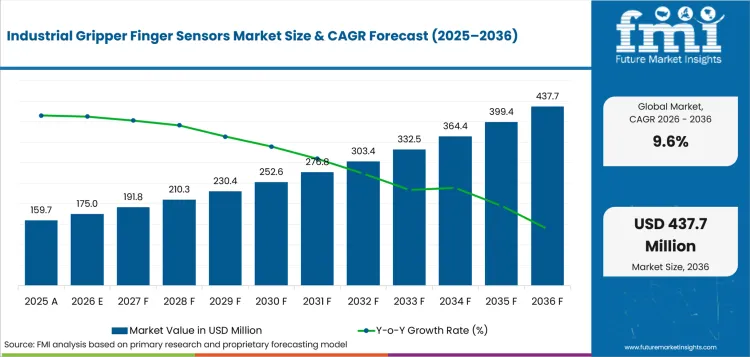
Industrial Gripper Finger Sensors Market Overview: Size and Forecast
- 2025 Market Size: USD 159.7 million
- 2026 Market Size: USD 175.0 million
- 2036 Market Size: USD 437.7 million
- Forecast CAGR: 9.6% from 2026 to 2036
- Leading Robot Type: Collaborative Robots
- Collaborative Robots Share in 2026: 34.0%
- Leading Payload Range: 5-20 kg
- 5-20 kg Payload Share in 2026: 42.5%
- Fastest-growing Country: India
- India CAGR: 11.4% by 2036
Summary of the Industrial Gripper Finger Sensors Market
- Demand and Growth Drivers
- Collaborative robot cells are shifting buyers toward fingertip feedback that can support safer human-adjacent handling.
- Electronics assembly creates premium demand because small parts require controlled contact and placement checks.
- Machine tending users prefer sensed fingers that verify parts before machining cycles begin.
- Product and Segment View
- Collaborative Robots are forecast to represent 34.0% share in 2026, led by safer contact-rich automation cells.
- The 5-20 kg payload range is projected to hold 42.5% share in 2026 because most sensed fingers serve mid-sized workpieces.
- Material Handling is expected to secure 31.0% share in 2026, supported by repetitive pick and transfer cycles.
- Geography and Competitive Outlook
- East Asia is projected to account for 37.0% share in 2026 as China, Japan, and South Korea hold dense automation clusters.
- India is forecast to record 11.4% CAGR by 2036 as automotive and electronics factories widen automation programs.
- Robotiq, SCHUNK, Festo, OnRobot, Zimmer Group, Weiss Robotics, and SMC compete through gripper portfolios and automation channels.
- Smaller tactile specialists compete by supplying fingertip modules and software tools for retrofitted gripper systems.
- Analyst Opinion
- Nikhil Kaitwade, Principal Consultant at Future Market Insights for industrial domain, says, “Industrial gripper finger sensors are moving from accessory buying to process assurance buying. Buyers should evaluate whether the sensor confirms the part, protects the part, and sends useful data to the controller.”
Robot installations create the broadest demand base for sensorized fingers. The International Federation of Robotics reported 542,000 industrial robots installed in 2024. This scale matters because each flexible robot cell needs better feedback at the contact point. Suppliers gain pricing power when their fingers reduce scrap and feed usable grip data back to the controller.
Which factors support expansion in the industrial gripper finger sensors market?
Sensorized gripper revenue is supported by factory cells that need verified contact before the next robot motion begins.
- Revenue is supported by sensorized fingers sold with grippers and retrofit kits for existing robot cells.
- Supplier pricing reflects contact accuracy, controller compatibility, ruggedness, and field replacement support.
- Repeat revenue improves when sensorized fingers reduce dropped parts and shorten recovery after false picks.
- Service access becomes a buying filter because fingertip calibration affects uptime in production cells.
Why is the industrial gripper finger sensors market growing?
Robot buyers are moving toward sensed fingertips because gripper feedback protects parts, cycle time, and downstream inspection quality.
Demand for robotic grippers is anticipated to rise because end-of-arm tooling is the purchase route for many sensorized fingers. Collaborative robots add demand where human-adjacent cells need contact control. tactile sensors support premium feedback where pressure and slip detection matter.
Material handling is creating the first broad demand layer for sensorized fingers. Factories are moving toward flexible cells that handle parts with different shapes during the same shift. Robotiq’s TSF-85 tactile fingertips use a 28-taxel capacitive array and sample vibration at 1000 Hz for slip detection. This shows why simple open-close confirmation is not enough for premium cells.
How is the industrial gripper finger sensors market segmented?
The industrial gripper finger sensors industry is segmented by robot type, payload, application, end-use industry, and region.
- Collaborative Robots are projected to secure 34.0% share in 2026, led by safe-speed cells that need fingertip feedback.
- The 5-20 kg payload range is anticipated to hold 42.5% share in 2026 because it covers trays, cartons, fixtures, and machined parts.
- Material Handling is expected to capture 31.0% share in 2026 through repetitive pick, place, and transfer tasks.
- Electronics is forecast to represent 28.5% share in 2026 because small workpieces need controlled contact.
- East Asia is projected to account for 37.0% share in 2026 as robot density and electronics automation remain high.
Why do Collaborative Robots lead the industrial gripper finger sensors market?
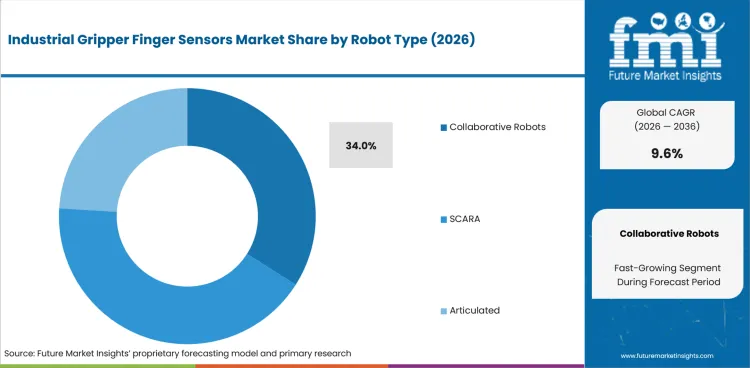
- Collaborative Robots are projected to account for 34.0% share in 2026, influenced by safe-speed operation near workers.
- Cobot buyers compare gripper mass and wiring because excess finger weight can reduce useful payload.
Which payload range leads the industrial gripper finger sensors market?
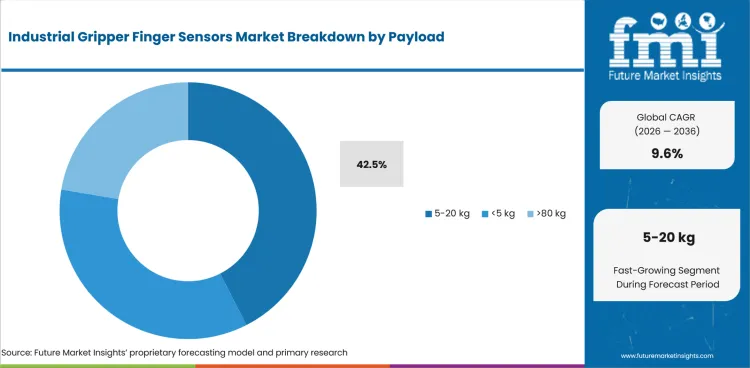
- The 5-20 kg range is expected to represent 42.5% share in 2026 through common trays, cartons, and machined parts.
- Mid-payload buyers favor rugged sensing because these fingers face repeated impacts and higher jaw forces.
Which application leads the industrial gripper finger sensors market?
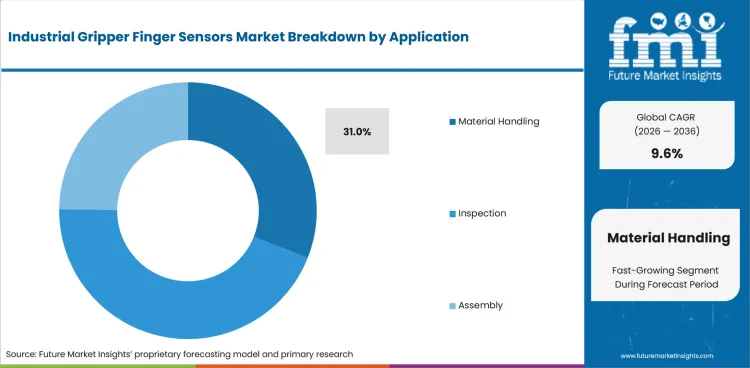
- Material Handling is anticipated to hold 31.0% share in 2026 as gripper fingers confirm pick success before transfer.
- Buyers value slip signals and part-present checks because a dropped item can halt conveyors.
Which end-use industry leads the industrial gripper finger sensors market?
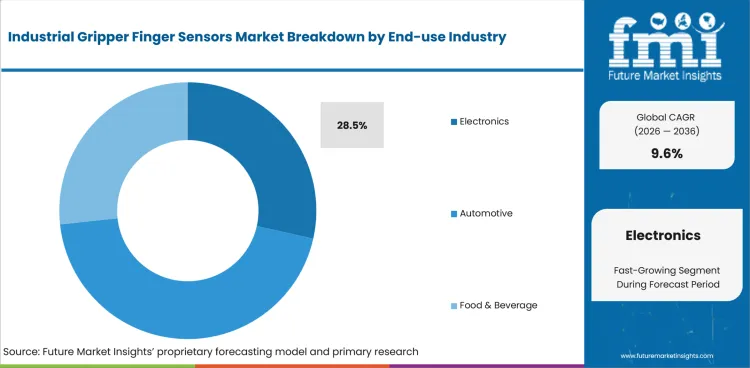
- Electronics is estimated to represent 28.5% share in 2026 because small workpieces require verified placement.
- Plant engineers ask for clean sensor data export because board handling faults must be traced by robot cycle.
Which region leads the industrial gripper finger sensors market?
- East Asia is projected to account for 37.0% share in 2026 as China, Japan, and South Korea hold deep factory robot use.
- Regional suppliers must support short lead times because electronics and battery buyers change gripper tooling often.
What are the driver, restraints, and opportunities in the industrial gripper finger sensors market?
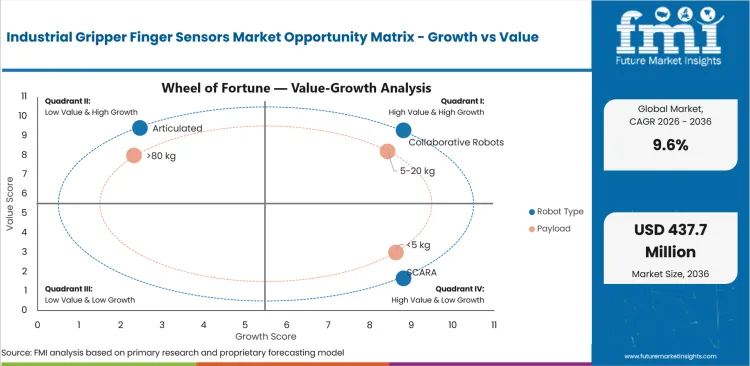
Grip assurance and tactile data support growth while integration complexity limits faster adoption.
- Driver: Grip verification is moving sensed fingers into standard robot cell design because buyers want proof before motion continues.
- Restraint: Integration complexity can slow adoption when sensors must match controllers, cables, and fieldbus protocols.
- Opportunity: Tactile digital twins can help train gripping software before production hardware trials begin.
Industrial Gripper Finger Sensors Market Demand Outlook
Demand outlook is moving toward sensorized fingers that can prove contact quality before robots transfer parts. Robotiq released a TSF-85 tactile sensor digital twin in June 2026 for NVIDIA Isaac Sim. The launch shows how suppliers are pairing hardware readings with simulation planning for robot learning workflows.
Application Adoption and Purchase Behavior Analysis
Current buyers include robot integrators, electronics manufacturers, machine-tool users, and logistics operators. Repeat purchases depend on simple controller links, replaceable fingertips, and calibration support. Buyers are less likely to approve premium tactile modules when integration time is unclear.
Voice of Customer and Decision-driver Analysis
Purchase decisions are shaped by feedback accuracy, service access, and controller compatibility. Plant engineers prefer sensors that confirm part presence without adding false stops. Procurement teams compare sensor kits against full gripper replacement when retrofit budgets are tight.
Which countries are growing fastest in the industrial gripper finger sensors market?
India 11.4% CAGR, China 10.7% CAGR, South Korea 10.2% CAGR, Germany 9.1% CAGR, Japan 8.9% CAGR, United States 8.8% CAGR, France 8.5% CAGR, and United Kingdom 8.2% CAGR through 2036.
.webp "Top Country Growth Comparison Industrial Gripper Finger Sensors Market Cagr (2026 2036)")
| Country | CAGR |
|---|---|
| United States | 8.8% |
| United Kingdom | 8.2% |
| Germany | 9.1% |
| France | 8.5% |
| Japan | 8.9% |
| China | 10.7% |
| South Korea | 10.2% |
| India | 11.4% |
Source: Future Market Insights, 2026.
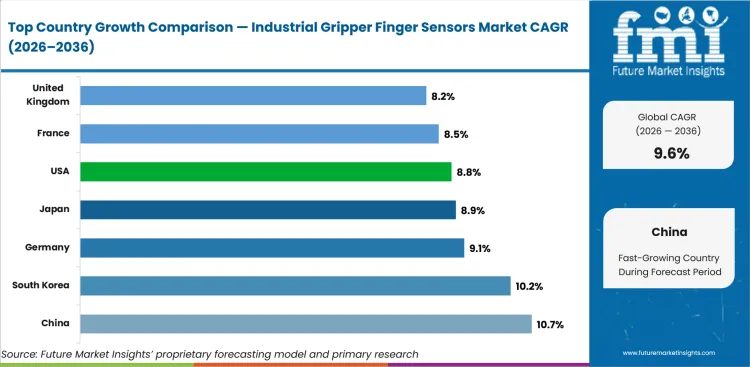
How do country-level CAGRs compare in the industrial gripper finger sensors market?
India leads country growth while the United Kingdom records the most selective expansion outlook among profiled markets.
- India is forecast to record 11.4% CAGR by 2036 based on automation depth and sector-specific gripper demand.
- China is forecast to record 10.7% CAGR by 2036 based on automation depth and sector-specific gripper demand.
- South Korea is forecast to record 10.2% CAGR by 2036 based on automation depth and sector-specific gripper demand.
- Germany is forecast to record 9.1% CAGR by 2036 based on automation depth and sector-specific gripper demand.
- Japan is forecast to record 8.9% CAGR by 2036 based on automation depth and sector-specific gripper demand.
- United States is forecast to record 8.8% CAGR by 2036 based on automation depth and sector-specific gripper demand.
- France is forecast to record 8.5% CAGR by 2036 based on automation depth and sector-specific gripper demand.
- United Kingdom is forecast to record 8.2% CAGR by 2036 based on automation depth and sector-specific gripper demand.
What is the industrial gripper finger sensors market outlook in the United States?
An 8.8% CAGR through 2036 is supported by durable goods automation and integrator-led retrofit work.
Country Market Snapshot Table
| Parameter | Value |
|---|---|
| Market Size in 2025 (Value) | USD 29.0 million |
| Market Size in 2026 (Value) | USD 31.5 million |
| Market Forecast in 2036 (Value) | USD 73.2 million |
| CAGR (2026 to 2036) | 8.8% |
| Years Considered | 2021 to 2036 |
| Base Year | 2025 |
| Forecast Period | 2026 to 2036 |
| Units Considered | Value (USD million) |
| Leading Sub-Region | Midwest and Southern automotive corridors |
United States Industrial Gripper Finger Sensors Market Outlook
United States demand is shaped by factory buyers that want proof of grip before a robot moves the part. Integrators influence the sale because they connect fingertip sensors to robot controllers and plant safety logic.
Machine tending, logistics, electronics, and medical device plants create repeat demand for sensed fingers. Suppliers with local service and controller documentation should gain stronger approval in retrofit projects.
Key Growth Drivers
- Durable goods orders support automation cell planning. The U.S. Census Bureau reported new orders rising 7.9% in April 2026.
- Factory output timing supports retrofit work. The Federal Reserve reported manufacturing production rose 0.7% in April 2026.
- Automotive battery and powertrain plants need sensed fingers to confirm part seating before welding or machining begins.
- Medical device and electronics factories value tactile feedback because small parts need verified contact before regulated records close.
Key Restraints
- Capital approval remains selective. BEA reported private goods-producing industries decreased 1.8% in fourth-quarter 2025.
- Imported robot platforms can raise integration cost when sensors must support different gripper bodies and controller settings.
- Smaller factories often lack tactile-data skills, so integrators must handle calibration before sensorized fingers can scale.
What makes United States unique
United States demand is unique because a large integrator ecosystem converts robot platforms into customized end-of-arm tooling systems.
Key Companies
- Robotiq
- SCHUNK USA
- Festo USA
- OnRobot USA
- SMC Corporation of America
- GelSight
- ATI Industrial Automation
Sales & Marketing Channels
- Robot system integrators qualify gripper sensor packages for machine tending and packaging cells.
- Automation distributors bundle gripper fingers with cables, controllers, and replacement parts.
- OEM tooling partners specify sensorized fingers during full cell design.
- Trade shows and demo centers support proof-of-concept selling for risk-sensitive buyers.
Country Segment Breakdown Table
| Segment | Sub-Segments |
|---|---|
| By Robot Type | Collaborative Robots · SCARA · Articulated · AMR/AGV · Delta Robots |
| By Payload | <5 kg · 5-20 kg · 20-80 kg · >80 kg |
| By Application | Material Handling · Inspection · Assembly · Welding · Packaging · Machine Tending |
| By End-use Industry | Automotive · Electronics · Food & Beverage · Logistics · Pharmaceuticals · Metals |
| By Region | North America · Latin America · Europe · East Asia · South Asia and Pacific · Middle East and Africa |
| Key Sub-Regions Covered, Manufacturing and automation corridors | Midwest · Southeast · Texas · California · New England · Pacific Northwest |
Frequently Asked Questions
How fast is United States industrial gripper finger sensors market growing?
Demand in the United States is forecast to rise at 8.8% CAGR from 2026 to 2036 due to integrator-led automation upgrades.
Who leads United States industrial gripper finger sensors market?
Robotiq, SCHUNK USA, Festo USA, OnRobot USA, and SMC Corporation of America compete through integrator channels.
What is driving adoption in United States industrial gripper finger sensors market?
Durable goods automation and medical device handling needs are moving buyers toward verified contact feedback.
How is the industrial gripper finger sensors market performing in the United Kingdom?
An 8.2% CAGR through 2036 reflects selective robotics funding and pilot-led use in high-value plants.
Country Market Snapshot Table
| Parameter | Value |
|---|---|
| Market Size in 2025 (Value) | USD 6.7 million |
| Market Size in 2026 (Value) | USD 7.2 million |
| Market Forecast in 2036 (Value) | USD 15.8 million |
| CAGR (2026 to 2036) | 8.2% |
| Years Considered | 2021 to 2036 |
| Base Year | 2025 |
| Forecast Period | 2026 to 2036 |
| Units Considered | Value (USD million) |
| Leading Sub-Region | Midlands and national integrator corridors |
United Kingdom Industrial Gripper Finger Sensors Market Outlook
United Kingdom demand is concentrated in plants that need clear payback and safer handling. Food, aerospace, and precision manufacturing buyers test sensorized fingers through pilots before wider deployment.
The sales route depends on integrators because many end users want an application-ready cell rather than a loose sensor module. Documentation and training are therefore central to supplier selection.
Key Growth Drivers
- Robotics skills funding should improve adoption readiness. Innovate UK opened up to GBP 2.5 million for robotics skills projects in February 2026.
- Manufacturing plants have a near-term automation case. ONS reported manufacturing output grew 0.8% in the three months to March 2026.
- Aerospace suppliers need controlled gripping for small assemblies and traceable part transfer.
- Food factories use gentle contact sensors when variable packs and irregular products make jaw position checks unreliable.
Key Restraints
- Output weakness can slow new project approvals. ONS reported production output decreased 0.1% in the three months to April 2026.
- Pilot-led buying can slow supplier revenue because each plant wants uptime proof before approving premium fingertip modules.
- Capital spending varies by incentive cycle, so buyers may postpone tactile upgrades after a funded automation project closes.
What makes United Kingdom unique
The United Kingdom is unique because sensorized gripping adoption is selective and concentrated in high-value manufacturing plants.
Key Companies
- Applied Automation
- CKF Systems
- Mills CNC Automation
- RMGroup
- FANUC UK
- KUKA Robotics UK
- Festo UK
Sales & Marketing Channels
- Integrator consulting supports buyers that need a full robot cell before approving gripper sensors.
- Pilot cell demonstrations help food and aerospace users test contact feedback before plant rollout.
- Distributor-led component supply supports replacement fingers and spare sensor modules.
- University and industry testbeds validate handling recipes for SMEs with limited automation staff.
Country Segment Breakdown Table
| Segment | Sub-Segments |
|---|---|
| By Robot Type | Collaborative Robots · SCARA · Articulated · AMR/AGV · Delta Robots |
| By Payload | <5 kg · 5-20 kg · 20-80 kg · >80 kg |
| By Application | Material Handling · Inspection · Assembly · Welding · Packaging · Machine Tending |
| By End-use Industry | Automotive · Electronics · Food & Beverage · Logistics · Pharmaceuticals · Metals |
| By Region | North America · Latin America · Europe · East Asia · South Asia and Pacific · Middle East and Africa |
| Key Sub-Regions Covered, Manufacturing and automation corridors | Midlands · North West England · London · Scotland · Wales · Northern Ireland |
Frequently Asked Questions
How fast is United Kingdom industrial gripper finger sensors market growing?
Demand in the United Kingdom is projected to increase at 8.2% CAGR from 2026 to 2036 through selective robotics adoption.
Who leads United Kingdom industrial gripper finger sensors market?
Applied Automation, CKF Systems, FANUC UK, KUKA Robotics UK, SCHUNK Intec UK, and Festo UK shape local access.
What is driving adoption in United Kingdom industrial gripper finger sensors market?
Robotics skills funding and manufacturing output recovery are supporting pilot demand for sensed gripper fingers.
What is driving industrial gripper finger sensors growth in Germany?
A 9.1% CAGR through 2036 is supported by machine-builder demand and automation-heavy industrial clusters.
Country Market Snapshot Table
| Parameter | Value |
|---|---|
| Market Size in 2025 (Value) | USD 16.9 million |
| Market Size in 2026 (Value) | USD 18.4 million |
| Market Forecast in 2036 (Value) | USD 44.0 million |
| CAGR (2026 to 2036) | 9.1% |
| Years Considered | 2021 to 2036 |
| Base Year | 2025 |
| Forecast Period | 2026 to 2036 |
| Units Considered | Value (USD million) |
| Leading Sub-Region | Bavaria, Baden-Württemberg, and North Rhine-Westphalia |
Germany Industrial Gripper Finger Sensors Market Outlook
Germany demand is led by machine builders and Tier 1 suppliers that need structured automation systems. Buyers ask for repeatable force readings, IO-Link readiness, and clear documentation.
Automotive, machinery, and electronics plants create the strongest pull because these buyers already operate disciplined qualification routines. Suppliers must prove integration fit before volume orders scale.
Key Growth Drivers
- Factory activity supports sensor qualification. Destatis reported industrial production increased 0.4% in April 2026.
- Order backlogs support automation planning. Destatis reported manufacturing order stock rose 0.4% in April 2026.
- Machine builders specify IO-Link and deterministic feedback because gripper data must connect cleanly with factory controls.
- Automotive and machinery suppliers need sensorized fingers to reduce scrap during repeat handling of machined parts and fixtures.
Key Restraints
- Qualification timing remains a brake. Destatis reported manufacturing orders fell 3.8% in April 2026.
- High engineering standards lengthen approval cycles when a new tactile module changes cable routing or jaw geometry.
- Retrofit projects face price pressure when buyers compare sensor kits against full gripper replacement.
What makes Germany unique
Germany is unique because machine-builder influence turns gripper sensors into engineered modules inside complete automation systems.
Key Companies
- SCHUNK
- Festo
- Zimmer Group
- Weiss Robotics
- SMC Deutschland
- Hahn Automation
- KUKA integrator partners
Sales & Marketing Channels
- Machine builders specify sensor-ready grippers during cell engineering.
- Direct industrial sales support automotive and machinery accounts with documented performance needs.
- Automation distributor networks provide replacement parts and IO-Link support.
- Trade fair demonstration cells help suppliers prove non-positioned object handling.
Country Segment Breakdown Table
| Segment | Sub-Segments |
|---|---|
| By Robot Type | Collaborative Robots · SCARA · Articulated · AMR/AGV · Delta Robots |
| By Payload | <5 kg · 5-20 kg · 20-80 kg · >80 kg |
| By Application | Material Handling · Inspection · Assembly · Welding · Packaging · Machine Tending |
| By End-use Industry | Automotive · Electronics · Food & Beverage · Logistics · Pharmaceuticals · Metals |
| By Region | North America · Latin America · Europe · East Asia · South Asia and Pacific · Middle East and Africa |
| Key Sub-Regions Covered, Manufacturing and automation corridors | Bavaria · Baden-Württemberg · North Rhine-Westphalia · Saxony · Lower Saxony · Hesse |
Frequently Asked Questions
How fast is Germany industrial gripper finger sensors market growing?
Demand in Germany is estimated to rise at 9.1% CAGR from 2026 to 2036 through machine-builder integration.
Who leads Germany industrial gripper finger sensors market?
SCHUNK, Festo, Zimmer Group, Weiss Robotics, SMC Deutschland, and KUKA partners compete through automation channels.
What is driving adoption in Germany industrial gripper finger sensors market?
Machine-builder specifications and factory automation discipline are moving gripper sensors into engineered tooling packages.
How is the industrial gripper finger sensors market developing in France?
An 8.5% CAGR through 2036 reflects project-based adoption in aerospace, food, and pharmaceutical automation.
Country Market Snapshot Table
| Parameter | Value |
|---|---|
| Market Size in 2025 (Value) | USD 7.5 million |
| Market Size in 2026 (Value) | USD 8.1 million |
| Market Forecast in 2036 (Value) | USD 18.3 million |
| CAGR (2026 to 2036) | 8.5% |
| Years Considered | 2021 to 2036 |
| Base Year | 2025 |
| Forecast Period | 2026 to 2036 |
| Units Considered | Value (USD million) |
| Leading Sub-Region | Île-de-France, Auvergne-Rhône-Alpes, and Occitanie |
France Industrial Gripper Finger Sensors Market Outlook
France demand is project-led and application-specific. Aerospace parts, food trays, and pharmaceutical packs require controlled handling when manual checks are costly.
System integrators remain important because end users often buy gripper sensors as part of a validated cell. Local service and proof-of-concept work influence supplier selection.
Key Growth Drivers
- Factory activity supports selective automation. INSEE reported manufacturing output increased 0.4% in April 2026.
- Innovation policy feeds automation channels. French Tech 2030 selected 80 companies in the 2025 class.
- Aerospace suppliers need controlled gripper feedback for shaped components and fixtures with documentation requirements.
- Pharmaceutical packaging lines use sensed fingers to confirm pack transfer before downstream coding or inspection.
Key Restraints
- Capacity pressure can delay sensor trials. INSEE reported 43% of manufacturers at a production capacity limit in April 2026.
- SME buyers may delay sensor upgrades when proof-of-concept projects require extra safety validation before purchase.
- Country-specific gripper sensor manufacturing is limited, so many projects depend on imported hardware and local integration.
What makes France unique
France is unique because project-based automation creates demand around validated handling cells rather than loose sensor modules.
Key Companies
- Staubli Robotics
- Sepro Group
- Siléane
- Exotec
- SCHUNK France
- Festo France
- SMC France
Sales & Marketing Channels
- Integrator-led project sales fit buyers that need a documented handling cell.
- Machine builder partnerships connect gripper sensors to packaging and aerospace equipment.
- Distributor technical support helps factories maintain spare fingertips and cables.
- Food and pharmaceutical demonstrations show whether tactile feedback can handle variable packs.
Country Segment Breakdown Table
| Segment | Sub-Segments |
|---|---|
| By Robot Type | Collaborative Robots · SCARA · Articulated · AMR/AGV · Delta Robots |
| By Payload | <5 kg · 5-20 kg · 20-80 kg · >80 kg |
| By Application | Material Handling · Inspection · Assembly · Welding · Packaging · Machine Tending |
| By End-use Industry | Automotive · Electronics · Food & Beverage · Logistics · Pharmaceuticals · Metals |
| By Region | North America · Latin America · Europe · East Asia · South Asia and Pacific · Middle East and Africa |
| Key Sub-Regions Covered, Manufacturing and automation corridors | Île-de-France · Auvergne-Rhône-Alpes · Occitanie · Hauts-de-France · Grand Est · Pays de la Loire |
Frequently Asked Questions
How fast is France industrial gripper finger sensors market growing?
Demand in France is set to increase at 8.5% CAGR from 2026 to 2036 through project-based automation.
Who leads France industrial gripper finger sensors market?
Staubli Robotics, Sepro Group, Siléane, Exotec, SCHUNK France, Festo France, and SMC France influence local access.
What is driving adoption in France industrial gripper finger sensors market?
Aerospace handling and pharmaceutical packaging projects are moving buyers toward verified contact feedback.
What is the industrial gripper finger sensors market forecast for Japan?
An 8.9% CAGR through 2036 reflects precision automation upgrades in electronics and machine-tool cells.
Country Market Snapshot Table
| Parameter | Value |
|---|---|
| Market Size in 2025 (Value) | USD 17.4 million |
| Market Size in 2026 (Value) | USD 19.0 million |
| Market Forecast in 2036 (Value) | USD 44.6 million |
| CAGR (2026 to 2036) | 8.9% |
| Years Considered | 2021 to 2036 |
| Base Year | 2025 |
| Forecast Period | 2026 to 2036 |
| Units Considered | Value (USD million) |
| Leading Sub-Region | Kanto, Chubu, and Kansai manufacturing clusters |
Japan Industrial Gripper Finger Sensors Market Outlook
Japan demand is shaped by precision, compact design, and reliability. The sensor must not reduce jaw stroke or disrupt cycle speed.
Electronics, automotive components, and machine tools form the strongest demand pockets because each process needs repeatable contact confirmation. Domestic platform fit remains a major buying filter.
Key Growth Drivers
- Factory recovery supports upgrade timing. METI reported industrial production rose 0.5% in April 2026.
- Capital equipment demand supports automation planning. The Cabinet Office reported private-sector machinery orders increased 6.4% in January to March 2026.
- Domestic robot platforms create demand for certified gripper compatibility across precision assembly cells.
- Electronics factories need contact control for small components that require verified placement without surface damage.
Key Restraints
- Capital planning can shift quickly. The Cabinet Office reported private-sector machinery orders fell 9.4% in March 2026.
- Installed robot cells can postpone sensor upgrades until full line renewal or tooling replacement cycles occur.
- Buyers may prefer domestic support channels for production-critical equipment, which can slow entry for foreign tactile modules.
What makes Japan unique
Japan is unique because gripper sensor value is judged by precision, compact design, and long-term reliability.
Key Companies
- SMC
- CKD
- IAI
- THK
- FANUC
- Yaskawa
- Kawasaki Robotics
Sales & Marketing Channels
- Direct OEM supply supports robot makers and machine tool builders with qualified components.
- Robot platform partnerships shape which gripper sensors reach electronics lines.
- Precision automation distributors support replacement fingers and spare sensor kits.
- Machine tool integrators specify grip confirmation before machining cycles begin.
Country Segment Breakdown Table
| Segment | Sub-Segments |
|---|---|
| By Robot Type | Collaborative Robots · SCARA · Articulated · AMR/AGV · Delta Robots |
| By Payload | <5 kg · 5-20 kg · 20-80 kg · >80 kg |
| By Application | Material Handling · Inspection · Assembly · Welding · Packaging · Machine Tending |
| By End-use Industry | Automotive · Electronics · Food & Beverage · Logistics · Pharmaceuticals · Metals |
| By Region | North America · Latin America · Europe · East Asia · South Asia and Pacific · Middle East and Africa |
| Key Sub-Regions Covered, Manufacturing and automation corridors | Kanto · Chubu · Kansai · Kyushu · Tohoku · Chugoku |
Frequently Asked Questions
How fast is Japan industrial gripper finger sensors market growing?
Demand in Japan is projected at 8.9% CAGR from 2026 to 2036 through precision automation upgrades.
Who leads Japan industrial gripper finger sensors market?
SMC, CKD, IAI, THK, FANUC, Yaskawa, and Kawasaki Robotics influence local platform requirements.
What is driving adoption in Japan industrial gripper finger sensors market?
Precision assembly and machine-tool automation are supporting demand for compact sensed gripper fingers.
What is the industrial gripper finger sensors market outlook in China?
A 10.7% CAGR through 2036 is supported by robot output growth and EV manufacturing scale.
Country Market Snapshot Table
| Parameter | Value |
|---|---|
| Market Size in 2025 (Value) | USD 37.9 million |
| Market Size in 2026 (Value) | USD 42.0 million |
| Market Forecast in 2036 (Value) | USD 116.1 million |
| CAGR (2026 to 2036) | 10.7% |
| Years Considered | 2021 to 2036 |
| Base Year | 2025 |
| Forecast Period | 2026 to 2036 |
| Units Considered | Value (USD million) |
| Leading Sub-Region | Yangtze River Delta and Pearl River Delta automation corridors |
China Industrial Gripper Finger Sensors Market Outlook
China is the largest addressable field for gripper finger sensors because robot installations, domestic robot brands, and electronics lines are expanding together. Premium demand is concentrated in electronics and EV cells.
Mainstream handling is more price-sensitive and relies on short delivery, local service, and simple controller links. Suppliers must localize support before sensorized fingers reach wider adoption.
Key Growth Drivers
- Robot production supports local sensor demand. NBS reported industrial robot output grew 27.9% year over year in May 2026.
- EV automation widens demand. SCIO reported 16.626 million new energy vehicles were produced in 2025.
- Domestic robot suppliers widen channels through controller-linked gripper packages and short delivery for local automation projects.
- Electronics and EV factories need sensed fingers for modules and coated components that cannot tolerate missed contact.
Key Restraints
- Foreign supplier caution can delay premium localization. MOFCOM reported FDI inflow fell 10.8% in the first three months of 2025.
- Local pricing pressure can compress margins for imported tactile modules in mainstream material-handling cells.
- Buyer specifications vary across robot brands, so suppliers must localize cabling and controller support for each channel.
What makes China unique
China is unique because unmatched robot volume and domestic supplier influence make localization a core market requirement.
Key Companies
- Siasun
- Estun
- Inovance
- JAKA
- Elite Robots
- DH-Robotics
- OnRobot China
Sales & Marketing Channels
- Local robot OEM partnerships route sensors into domestic controller ecosystems.
- Regional system integrators fit sensorized fingers into electronics and EV cells.
- Distributor stocking programs support short lead times for replacement fingers.
- Direct factory automation sales target high-volume buyers with repeat cell builds.
Country Segment Breakdown Table
| Segment | Sub-Segments |
|---|---|
| By Robot Type | Collaborative Robots · SCARA · Articulated · AMR/AGV · Delta Robots |
| By Payload | <5 kg · 5-20 kg · 20-80 kg · >80 kg |
| By Application | Material Handling · Inspection · Assembly · Welding · Packaging · Machine Tending |
| By End-use Industry | Automotive · Electronics · Food & Beverage · Logistics · Pharmaceuticals · Metals |
| By Region | North America · Latin America · Europe · East Asia · South Asia and Pacific · Middle East and Africa |
| Key Sub-Regions Covered, Manufacturing and automation corridors | Yangtze River Delta · Pearl River Delta · Beijing-Tianjin-Hebei · Chengdu-Chongqing · Shandong · Hubei |
Frequently Asked Questions
How fast is China industrial gripper finger sensors market growing?
Demand in China is forecast to expand at 10.7% CAGR from 2026 to 2036 through robot production and EV automation.
Who leads China industrial gripper finger sensors market?
Siasun, Estun, Inovance, JAKA, Elite Robots, DH-Robotics, SCHUNK China, and OnRobot China support local channels.
What is driving adoption in China industrial gripper finger sensors market?
Industrial robot output and EV manufacturing scale are moving factories toward localized sensed gripper fingers.
How fast is South Korea industrial gripper finger sensors market growing?
A 10.2% CAGR through 2036 is supported by high robot density and semiconductor-linked automation demand.
Country Market Snapshot Table
| Parameter | Value |
|---|---|
| Market Size in 2025 (Value) | USD 11.6 million |
| Market Size in 2026 (Value) | USD 12.8 million |
| Market Forecast in 2036 (Value) | USD 33.8 million |
| CAGR (2026 to 2036) | 10.2% |
| Years Considered | 2021 to 2036 |
| Base Year | 2025 |
| Forecast Period | 2026 to 2036 |
| Units Considered | Value (USD million) |
| Leading Sub-Region | Gyeonggi, Chungcheong, and Ulsan industrial corridors |
South Korea Industrial Gripper Finger Sensors Market Outlook
South Korean demand is tied to high-speed electronics, semiconductor, battery, and automotive lines. Buyers require clean data, rapid replacement, and strong documentation.
Supplier qualification is demanding because downtime costs are high and production processes are tightly controlled. Premium contact feedback gains value when it protects yield and handling repeatability.
Key Growth Drivers
- Export scale supports precision automation. MOTIR reported exports reached USD 709.7 billion in 2025.
- Semiconductor demand supports sensed handling. MOTIR reported semiconductor exports reached USD 173.4 billion in 2025.
- Battery lines use sensed gripping for thin cells and coated modules that require verified contact before transfer.
- Automotive suppliers demand repeatable gripper feedback across fast production cycles and frequent model changes.
Key Restraints
- Labor tightness can raise automation service costs. MODS reported labor force participation at 65.2% in May 2026.
- Semiconductor qualification raises testing costs when a fingertip sensor affects clean data capture or maintenance routines.
- High local performance expectations can limit low-cost sensor entry in battery and chip production lines.
What makes South Korea unique
South Korea is unique because high robot density and electronics concentration favor premium contact feedback.
Key Companies
- Hyundai Robotics
- Doosan Robotics
- Rainbow Robotics
- Neuromeka
- Hanwha Robotics
- Robostar
- SMC Korea
Sales & Marketing Channels
- Semiconductor automation suppliers qualify sensors through documented process tests.
- Battery equipment integrators specify contact feedback for thin cell handling.
- Automotive line builders route gripper sensors into high-speed body and component cells.
- Technical distributors provide replacement modules and local service support.
Country Segment Breakdown Table
| Segment | Sub-Segments |
|---|---|
| By Robot Type | Collaborative Robots · SCARA · Articulated · AMR/AGV · Delta Robots |
| By Payload | <5 kg · 5-20 kg · 20-80 kg · >80 kg |
| By Application | Material Handling · Inspection · Assembly · Welding · Packaging · Machine Tending |
| By End-use Industry | Automotive · Electronics · Food & Beverage · Logistics · Pharmaceuticals · Metals |
| By Region | North America · Latin America · Europe · East Asia · South Asia and Pacific · Middle East and Africa |
| Key Sub-Regions Covered, Manufacturing and automation corridors | Gyeonggi · Chungcheong · Ulsan · Busan · Daegu · Incheon |
Frequently Asked Questions
How fast is South Korea industrial gripper finger sensors market growing?
Demand in South Korea is forecast to record 10.2% CAGR from 2026 to 2036 through high-density automation.
Who leads South Korea industrial gripper finger sensors market?
Hyundai Robotics, Doosan Robotics, Rainbow Robotics, Neuromeka, Hanwha Robotics, Robostar, and SMC Korea influence local demand.
What is driving adoption in South Korea industrial gripper finger sensors market?
Semiconductor exports and battery automation needs are moving buyers toward premium tactile feedback.
What is the industrial gripper finger sensors market outlook in India?
An 11.4% CAGR through 2036 reflects fast growth from basic automation into sensor-backed robot handling.
Country Market Snapshot Table
| Parameter | Value |
|---|---|
| Market Size in 2025 (Value) | USD 5.6 million |
| Market Size in 2026 (Value) | USD 6.2 million |
| Market Forecast in 2036 (Value) | USD 18.2 million |
| CAGR (2026 to 2036) | 11.4% |
| Years Considered | 2021 to 2036 |
| Base Year | 2025 |
| Forecast Period | 2026 to 2036 |
| Units Considered | Value (USD million) |
| Leading Sub-Region | Pune, Bengaluru, Chennai, and NCR automation corridors |
India Industrial Gripper Finger Sensors Market Outlook
India demand starts from a lower automation base and grows through automotive, electronics, metals, and pharmaceutical projects. Buyers compare sensor cost against downtime reduction and scrap prevention.
Local integrators are critical because they prove payback and handle installation in specific plant lines. Sensorized fingers are expected to scale first in plants with repeat machine tending and electronics transfer needs.
Key Growth Drivers
- Factory output supports automation trials. MoSPI reported IIP growth of 4.9% in April 2026.
- Manufacturing led the new IIP series. PIB reported manufacturing sector growth of 6.2% in April 2026.
- Automotive component makers need stable gripper feedback for machining, assembly, and inspection lines.
- Electronics manufacturing programs widen demand for small-part handling where missed contact creates rework.
Key Restraints
- Premium sensor uptake faces price pressure. SIAM reported total vehicle production at 31,034,174 units in April 2024 to March 2025.
- Smaller factories may reject tactile modules unless integrators show payback through lower rejects and fewer manual recoveries.
- Integration skill gaps can slow use of high-sensitivity feedback when plants lack staff to tune tactile data.
What makes India unique
India is unique because buyers are moving quickly from basic automation to sensor-backed handling.
Key Companies
- DiFACTO Robotics
- Systemantics
- Addverb
- Peppermint Robotics
- Gridbots
- TAL Manufacturing
- SCHUNK India
Sales & Marketing Channels
- Automation distributors supply grippers, sensors, cables, and spares to regional projects.
- Local system integrators prove uptime before buyers approve sensor upgrades.
- Automotive supplier programs create repeat demand for machine tending and component handling.
- Electronics and pharmaceutical OEMs specify sensed fingers for clean transfer and pack handling.
Country Segment Breakdown Table
| Segment | Sub-Segments |
|---|---|
| By Robot Type | Collaborative Robots · SCARA · Articulated · AMR/AGV · Delta Robots |
| By Payload | <5 kg · 5-20 kg · 20-80 kg · >80 kg |
| By Application | Material Handling · Inspection · Assembly · Welding · Packaging · Machine Tending |
| By End-use Industry | Automotive · Electronics · Food & Beverage · Logistics · Pharmaceuticals · Metals |
| By Region | North America · Latin America · Europe · East Asia · South Asia and Pacific · Middle East and Africa |
| Key Sub-Regions Covered, Manufacturing and automation corridors | Pune · Bengaluru · Chennai · NCR · Gujarat · Hyderabad |
Frequently Asked Questions
How fast is India industrial gripper finger sensors market growing?
Demand in India is projected to record 11.4% CAGR from 2026 to 2036 as factories scale robot-assisted handling.
Who leads India industrial gripper finger sensors market?
DiFACTO Robotics, Systemantics, Addverb, Gridbots, TAL Manufacturing, SCHUNK India, Festo India, and SMC India support project routes.
What is driving adoption in India industrial gripper finger sensors market?
IIP growth and electronics manufacturing programs are moving buyers toward sensor-backed robot handling.
Who are the leading companies in the industrial gripper finger sensors market?
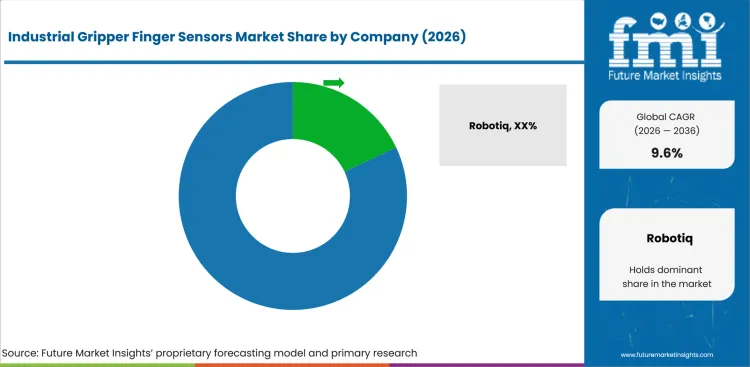
Robotiq, SCHUNK, Festo, OnRobot, Zimmer Group, Weiss Robotics, and SMC are listed among verified suppliers.
- Integrated gripper suppliers hold an advantage when tactile sensing is sold with jaws, fingers, and controller documentation.
- Tactile specialists gain shelf space when they prove pressure mapping and slip detection in delicate handling cells.
- Automation distributors matter because buyers need spare fingers, cables, and setup support after installation.
- Field support separates suppliers when plants run high-mix robot cells across multiple gripper brands.
Suppliers in this market compete by combining gripper hardware with readable sensor signals. SCHUNK, Festo, Zimmer Group, and SMC benefit from established industrial channels. Robotiq and OnRobot gain relevance through cobot-ready tooling and practical setup material. Tactile specialists such as Weiss Robotics and GelSight compete where pressure mapping and slip detection matter more than simple part-present checks.
Companies with tested robot compatibility are best placed to win repeat orders. Buyers prefer suppliers that can support cables, controller files, replacement fingers, and field calibration. Scale alone is not enough when false stops or poor sensor tuning can interrupt a production cell.
Regional suppliers can compete when they localize controller support and serve retrofit projects quickly. China and India create room for local integrators because price sensitivity remains high. Germany, Japan, and South Korea reward suppliers that pass strict qualification checks in electronics, machine tools, and automotive lines.
How do top industrial gripper finger sensors companies compare?
SCHUNK and Festo score strongest on industrial channel depth while Robotiq leads tactile-feedback visibility in cobot applications.
| Company | Relevance to Market Title | Sensor Portfolio Depth | Robot Integration Breadth | Field Service Readiness | Geographic Footprint |
|---|---|---|---|---|---|
| Robotiq | Very High | Very Strong | Strong | Strong | North America, Europe, Asia |
| SCHUNK | Very High | Strong | Very Strong | Very Strong | Global |
| Festo | High | Moderate to Strong | Very Strong | Very Strong | Global |
| OnRobot | High | Moderate | Very Strong | Strong | Global |
| Zimmer Group | High | Moderate | Strong | Strong | Europe, North America, Asia |
| Weiss Robotics | High | Very Strong | Moderate | Moderate | Europe, North America, Asia |
| SMC | Moderate to High | Moderate | Strong | Very Strong | Global |
| GelSight | High | Very Strong | Moderate | Moderate | North America, Europe, Asia |
Source: Future Market Insights competitive analysis, 2026.
Who are the key players in the industrial gripper finger sensors market?
Robotiq, SCHUNK, Festo, OnRobot, Zimmer Group, Weiss Robotics, SMC, and GelSight are listed with regional automation suppliers.
Key global companies leading the industrial gripper finger sensors market include:
- Robotiq
- SCHUNK
- Festo
- OnRobot
- Zimmer Group
- Weiss Robotics
- SMC
- GelSight
- ATI Industrial Automation
- DH-Robotics
Key Developments in Industrial Gripper Finger Sensors Market
- In June 2026, Bosch presented automation and robotics technologies at Bosch Connected World 2026. It emphasized MEMS sensors as tactile elements that help robots adjust grip for different objects. This matters because gripper sensor buyers are moving from simple force feedback toward component-level sensing that supports safer handling in factories.
- In May 2026, XELA Robotics said it would show tactile sensing innovations across Robotics Summit & Expo and ICRA plus Automate 2026. The company said the updates included new sensor hardware plus software improvements and broader robotic platform integrations. This matters because buyers need tactile sensing that works with existing robot platforms and not only with lab prototypes.
- In March 2026, GelSight received a U.S. Air Force Phase II SBIR contract for compact tactile fingertip sensors. The project targets real-time 3D touch and force data for robotic grippers. This matters because industrial buyers are asking for smaller and more rugged tactile sensing that can support dexterous handling outside controlled demonstrations.
Key Players in the Industrial Gripper Finger Sensors Market
Integrated Gripper Suppliers
- SCHUNK
- Festo
- SMC
- Zimmer Group
- OnRobot
Tactile and Cobot Tooling Specialists
- Robotiq
- Weiss Robotics
- GelSight
- ATI Industrial Automation
- DH-Robotics
Regional Automation Integrators
- DiFACTO Robotics
- Applied Automation
- Siléane
- Hahn Automation
- Siasun
- Hyundai Robotics
Industrial Gripper Finger Sensors Market - Report Scope
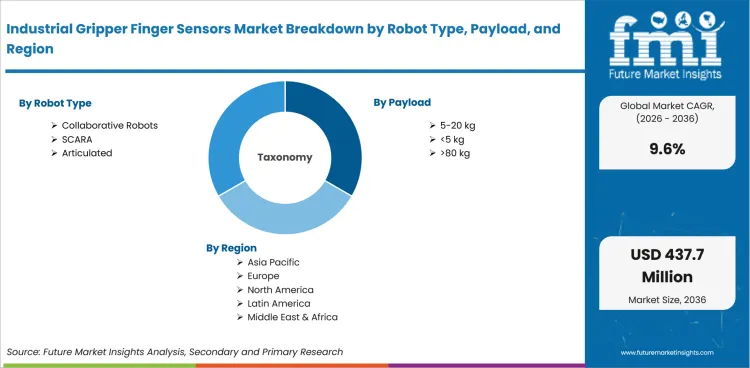
| Parameter | Details |
|---|---|
| Forecast period | 2026 to 2036 |
| Historical period | 2021 to 2025 |
| Quantitative unit | Revenue in USD million |
| By robot type | Collaborative Robots, SCARA, Articulated, AMR/AGV, Delta Robots |
| By payload | <5 kg, 5-20 kg, 20-80 kg, >80 kg |
| By application | Material Handling, Inspection, Assembly, Welding, Packaging, Machine Tending |
| By end-use industry | Automotive, Electronics, Food & Beverage, Logistics, Pharmaceuticals, Metals |
| Regions covered | North America, Latin America, Europe, East Asia, South Asia and Pacific, Middle East and Africa |
| Countries covered | United States, United Kingdom, Germany, France, Japan, China, South Korea, India |
| Key companies profiled | Robotiq, SCHUNK, Festo, OnRobot, Zimmer Group, Weiss Robotics, SMC, GelSight |
| Approach | Hybrid bottom-up and top-down approach using robot cell volume, sensor attachment rates, sensor pricing, and regional automation intensity |
Industrial Gripper Finger Sensors Market - Scope & Definition
| Attribute | Detail |
|---|---|
| Market Definition | Contact, force, position, tactile, pressure, vibration, and proximity sensors fitted inside or on industrial robot gripper fingers. |
| Functions Covered | Contact confirmation, slip detection, force measurement, part-present detection, grip stability checks, and controller feedback. |
| Applications Covered | Material handling, inspection, assembly, welding, packaging, machine tending, and other industrial robot handling tasks. |
| End-Use Industries | Automotive, electronics, food and beverage, logistics, pharmaceuticals, metals, and industrial machinery. |
| Grades Covered | Payload classes below 5 kg, 5-20 kg, 20-80 kg, and above 80 kg. |
| Inclusions | Sensorized robot fingers, tactile fingertip kits, force-feedback jaws, position sensors, pressure pads, and controller-linked gripper sensor modules. |
| Exclusions | Standalone robot arms, external safety curtains, machine vision cameras, wrist-only force torque sensors, manual clamps, prosthetic hands, and consumer robot toys. |
Industrial Gripper Finger Sensors Market - Research Methodology
| Method | Description |
|---|---|
| Primary Research | FMI analyst interviews with robot integrators, gripper suppliers, automation distributors, electronics manufacturers, and plant engineering teams across key markets. |
| Desk Research | Review of industrial robot statistics, automation product documents, company releases, standards references, and country manufacturing data. |
| Market Sizing & Forecasting | Hybrid model using gripper volume, sensor attachment rates, average selling prices, robot type mix, payload class, and country automation intensity. |
| Data Validation | Cross-verification using robot installation trends, cobot accessory portfolios, tactile sensor launches, regional automation channels, and supplier portfolio screening. |
Industrial Gripper Finger Sensors Market Breakdown by Robot Type, Payload, Application, End-use Industry, and Region
Industrial Gripper Finger Sensors Market Segmented by Robot Type
- Collaborative Robots
- SCARA
- Articulated
- AMR/AGV
- Delta Robots
Industrial Gripper Finger Sensors Market Segmented by Payload
- <5 kg
- 5-20 kg
- 20-80 kg
- >80 kg
Industrial Gripper Finger Sensors Market Segmented by Application
- Material Handling
- Inspection
- Assembly
- Welding
- Packaging
- Machine Tending
Industrial Gripper Finger Sensors Market Segmented by End-use Industry
- Automotive
- Electronics
- Food & Beverage
- Logistics
- Pharmaceuticals
- Metals
Industrial Gripper Finger Sensors Market Segmented by Region
- North America
- Latin America
- Europe
- East Asia
- South Asia and Pacific
- Middle East and Africa
Research Sources and Bibliography
- Cabinet Office of Japan. (2026, February 18). Machinery orders in December 2025 and forecast for January-March 2026.
- Cabinet Office of Japan. (2026, May 21). Machinery orders in March 2026 and forecast for April-June 2026.
- Destatis. (2026, June 8). New orders in manufacturing in April 2026.
- Destatis. (2026, June 18). Stock of orders in manufacturing in April 2026.
- Federal Reserve Board. (2026, June 15). Industrial production and capacity utilization.
- French Tech Mission. (2025, November 6). French Tech 2030 new cohort: 80 trailblazing startups shaping France’s future.
- INSEE. (2026, April 23). In April 2026, manufacturers expect demand to weaken slightly.
- INSEE. (2026, June 5). In April 2026, manufacturing output increased by 0.4%.
- International Federation of Robotics. (2025, September 25). World Robotics 2025 report: Industrial robots.
- International Federation of Robotics. (2026, April 8). Robot density surges in Europe, Asia, and Americas.
- Ministry of Economy, Trade and Industry. (2026, June 12). Revised report for April 2026: Indices of Industrial Production.
- Ministry of Statistics and Programme Implementation. (2026, June 1). First press release of All India Index of Industrial Production of new series with base year 2022-23.
- Ministry of Trade, Industry and Resources. (2026, January 2). Korea’s annual exports reach new highs in 2025.
- National Bureau of Statistics of China. (2026, June 16). National economy showed steady momentum with high-quality development steadily advancing in May 2026.
- Ministry of Data and Statistics. (2026, June 11). Economically Active Population Survey in May 2026.
- Office for National Statistics. (2026, May 14). GDP monthly estimate, UK: March 2026.
- Office for National Statistics. (2026, June 12). Index of Production, UK: April 2026.
- Robotiq. (2026, January 27). Robotiq brings the sense of touch to Physical AI.
- Robotiq. (2026, March 5). Tactile Sensors TSF-85: User Guide.
- Robotiq. (2026, June 2). Robotiq releases TSF-85 Tactile Sensor Digital Twin on NVIDIA Isaac Sim.
- Society of Indian Automobile Manufacturers. (2025, April 15). Auto industry sales performance of March 2025 and April 2024 to March 2025.
- State Council Information Office of the People’s Republic of China. (2025, April 18). China’s FDI inflow rises 13.2 percent in March.
- State Council Information Office of the People’s Republic of China. (2026, January 15). China’s auto output, sales reach new highs in 2025.
- U.S. Bureau of Economic Analysis. (2026, April 9). GDP by industry and corporate profits: Fourth quarter and year 2025.
- U.S. Census Bureau. (2026, June 3). Monthly advance report on durable goods manufacturers’ shipments, inventories, and orders: April 2026.
This Report Answers
- Market size estimates for 2026 and forecasts through 2036 for the industrial gripper finger sensors market.
- Insights across more than 30 regional and country-level automation markets.
- Analysis of demand drivers, application adoption patterns, usage trends, and purchasing behavior.
- Evaluation of robot type, payload, application, and end-use industry segmentation.
- Assessment of controller integration, sensor calibration, and field service impacts on market development.
- Identification of growth opportunities across collaborative robots, material handling, electronics, and machine tending.
- Evaluation of supply chain dynamics, product development trends, and distribution channel structures.
- Country-level growth analysis covering the United States, United Kingdom, Germany, France, Japan, China, South Korea, and India.
- Assessment of the competitive landscape, including integrated gripper suppliers and tactile sensor specialists.
- Regional outlooks across North America, Europe, East Asia, and South Asia and Pacific.
- Delivery of market data, forecasts, and supporting analysis in PDF and Excel formats.
Frequently Asked Questions
What is the growth prospect for industrial gripper finger sensors?
Demand for industrial gripper finger sensors is expected to rise as factories add contact feedback to robot handling cells.
Which companies are expected to shape the industrial gripper finger sensors market?
Robotiq, SCHUNK, Festo, OnRobot, Zimmer Group, Weiss Robotics, SMC, and GelSight are expected to shape competition through sensorized tooling.
Why are industrial companies investing in gripper finger sensors?
Industrial companies are investing in gripper finger sensors to reduce false picks, protect parts, and verify handling cycles.
Why is controller compatibility important in this market?
Controller compatibility is important because fingertip data must trigger clear robot actions without adding complex programming work.
Which applications are gaining attention in industrial gripper finger sensors?
Material handling and electronics assembly are gaining attention because both applications require verified contact and repeatable part transfer.
How do regulations influence industrial gripper finger sensor launches?
Regulations influence launches through machine safety, control-system documentation, and validation needs in regulated factories.
Why is service support important for industrial gripper finger sensors?
Service support is important because fingertip calibration and replacement speed affect uptime in production robot cells.
What role do tactile digital twins play in this market?
Tactile digital twins support adoption by helping teams train grip logic before hardware trials begin.
Preview the report firsthand - request a free sample
Get SampleGet the brochure for pricing and purchase details.
Get PDFTable of Content
- Executive Summary
- Global Market Outlook
- Demand-side Trends
- Supply-side Trends
- Technology Roadmap Analysis
- Analysis and Recommendations
- Market Overview
- Market Coverage / Taxonomy
- Market Definition / Scope / Limitations
- Research Methodology
- Research Design
- Primary Research
- Desk Research
- Market Sizing and Forecasting
- Data Validation
- Global Market Analysis 2021 to 2025 and Forecast, 2026 to 2036
- Historical Market Size Value (USD Million) Analysis, 2021 to 2025
- Current and Future Market Size Value (USD Million) Projections, 2026 to 2036
- Y-o-Y Growth Trend Analysis
- Absolute $ Opportunity Analysis
- Global Market Pricing Analysis 2021 to 2025 and Forecast 2026 to 2036
- Global Market Analysis 2021 to 2025 and Forecast 2026 to 2036, By Robot Type
- Introduction / Key Findings
- Historical Market Size Value (USD Million) Analysis By Robot Type, 2021 to 2025
- Current and Future Market Size Value (USD Million) Analysis By Robot Type, 2026 to 2036
- Global Market Analysis 2021 to 2025 and Forecast 2026 to 2036, By Payload
- Introduction / Key Findings
- Historical Market Size Value (USD Million) Analysis By Payload, 2021 to 2025
- Current and Future Market Size Value (USD Million) Analysis By Payload, 2026 to 2036
- Global Market Analysis 2021 to 2025 and Forecast 2026 to 2036, By Application
- Introduction / Key Findings
- Historical Market Size Value (USD Million) Analysis By Application, 2021 to 2025
- Current and Future Market Size Value (USD Million) Analysis By Application, 2026 to 2036
- Global Market Analysis 2021 to 2025 and Forecast 2026 to 2036, By End-use Industry
- Introduction / Key Findings
- Historical Market Size Value (USD Million) Analysis By End-use Industry, 2021 to 2025
- Current and Future Market Size Value (USD Million) Analysis By End-use Industry, 2026 to 2036
- Global Market Analysis 2021 to 2025 and Forecast 2026 to 2036, By Region
- Introduction / Key Findings
- Historical Market Size Value (USD Million) Analysis By Region, 2021 to 2025
- Current and Future Market Size Value (USD Million) Analysis By Region, 2026 to 2036
- North America Market Analysis 2021 to 2025 and Forecast 2026 to 2036
- Pricing Analysis
- Market Share Analysis, 2025
- By Country
- By Robot Type
- By Payload
- By Application
- By End-use Industry
- Country-level Analysis
- United States
- Canada
- Latin America Market Analysis 2021 to 2025 and Forecast 2026 to 2036
- Pricing Analysis
- Market Share Analysis, 2025
- By Country
- By Robot Type
- By Payload
- By Application
- By End-use Industry
- Country-level Analysis
- Brazil
- Mexico
- Rest of Latin America
- Western Europe Market Analysis 2021 to 2025 and Forecast 2026 to 2036
- Pricing Analysis
- Market Share Analysis, 2025
- By Country
- By Robot Type
- By Payload
- By Application
- By End-use Industry
- Country-level Analysis
- Germany
- France
- United Kingdom
- Italy
- Spain
- BENELUX
- Nordics
- Rest of Western Europe
- Eastern Europe Market Analysis 2021 to 2025 and Forecast 2026 to 2036
- Pricing Analysis
- Market Share Analysis, 2025
- By Country
- By Robot Type
- By Payload
- By Application
- By End-use Industry
- Country-level Analysis
- Russia
- Poland
- Rest of Eastern Europe
- East Asia Market Analysis 2021 to 2025 and Forecast 2026 to 2036
- Pricing Analysis
- Market Share Analysis, 2025
- By Country
- By Robot Type
- By Payload
- By Application
- By End-use Industry
- Country-level Analysis
- China
- Japan
- South Korea
- South Asia and Pacific Market Analysis 2021 to 2025 and Forecast 2026 to 2036
- Pricing Analysis
- Market Share Analysis, 2025
- By Country
- By Robot Type
- By Payload
- By Application
- By End-use Industry
- Country-level Analysis
- India
- ASEAN
- Australia & New Zealand
- Rest of South Asia and Pacific
- Middle East & Africa Market Analysis 2021 to 2025 and Forecast 2026 to 2036
- Pricing Analysis
- Market Share Analysis, 2025
- By Country
- By Robot Type
- By Payload
- By Application
- By End-use Industry
- Country-level Analysis
- GCC Countries
- South Africa
- Turkey
- Rest of Middle East & Africa
- Market Structure Analysis
- Competition Dashboard
- Competition Benchmarking
- Market Share Analysis of Top Players
- By Region
- By Robot Type
- By Payload
- By Application
- By End-use Industry
- Emerging Startups
- Innovation Benchmarking
- Competition Analysis
- Competition Deep Dive
- Company Profiles
- Case Studies
- Success Stories
- Recent Developments
- Assumptions & Acronyms Used
- List of Tables: Industrial Gripper Finger Sensors Market
- List of Figures: Industrial Gripper Finger Sensors Market


