

- Market Size (2026)
- USD 2.5 Bn
- Forecast (2036)
- USD 4.6 Bn
- CAGR (2026 to 2036)
- 6.4%
How big is Industrial Code-Reading Systems Market in 2026?
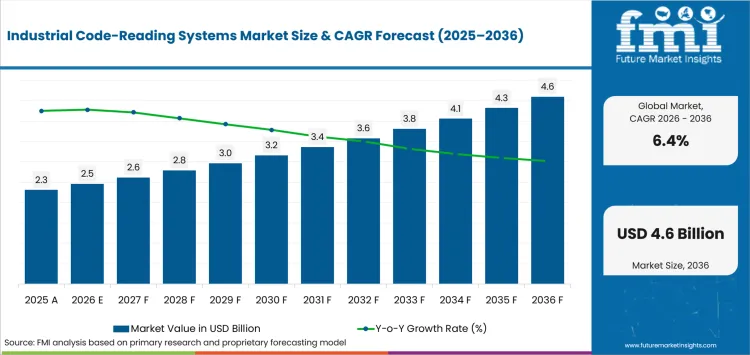
USD 2.5 billion in 2026 and USD 4.6 billion by 2036 at a 6.4% CAGR.
Sales of industrial code-reading systems are estimated to rise at 6.4% CAGR through 2036, increasing valuation from USD 2.5 billion in 2026 to USD 4.6 billion by 2036. Growth is attributable to the replacement of manual checks with machine-readable traceability and the need to process older linear labels beside newer 2D symbols. GS1 documented in January 2025 that companies were testing next-generation barcodes in more than 45 countries. The mixed-format transition keeps industrial barcode scanners relevant because plants rarely replace every label convention and reader at the same time.
industrial automation intensity also differs by region, which changes the pace of reader installation and replacement. The International Federation of Robotics recorded 542,000 industrial robot installations in 2024 and reported that Asia accounted for 74% of new deployments in its September 2025 release. Countries with dense automated production can justify more fixed inspection points, while plants with older controls face longer commissioning work. The spending case therefore depends on line speed, mark quality, network compatibility, and the cost of manual exception handling.
Key Takeaways
- Mixed 1D and 2D identification requirements are increasing demand for readers that fit automated traceability without forcing immediate label-system replacement.
- Based on system type, 1D barcode readers are projected to account for 19.0% in 2026 due to installed linear-label workflows requiring backward-compatible decoding.
- In 2026, image-based technology is expected to lead technology with 38.0% share because full-frame imaging handles varied code orientations and damaged marks.
- By mounting, fixed mount systems are forecast to represent 42.0% in 2026 driven by repeatable geometry at automated inspection points.
- Difficult direct part marks and legacy controls slow wider adoption by increasing lighting, setup, verification, and integration work before a reader can be released for production.
- Some of the key players in this market include Cognex, KEYENCE, Datalogic, Zebra Technologies, SICK, Omron, Leuze, and Brady Corporation.
Analyst Perspective
"A code reader earns its place after the line proves stable reads on the actual mark under production speed and lighting. Plants gain more from fewer manual recoveries than from a higher decoder specification that fails at the station."
- Nikhil Kaitwade, Principal Consultant, Future Market Insights
How is the industrial code-reading systems market segmented?
The industrial code-reading systems market is segmented by system type, technology, mounting, end use, sales channel, and region.
The market is segmented by system type, technology, mounting, end use, sales channel, and region. System type covers 1D, 2D, DPM, handheld, and fixed vision readers. Technology covers image, laser, machine vision, AI-assisted, and RFID-hybrid methods. Mounting separates fixed, handheld, robot, and conveyor configurations, while end use and sales channel capture operating environment and route to deployment. These dimensions locate automatic data capture within the operating workflow.
What supports automotive leadership in the end use category?
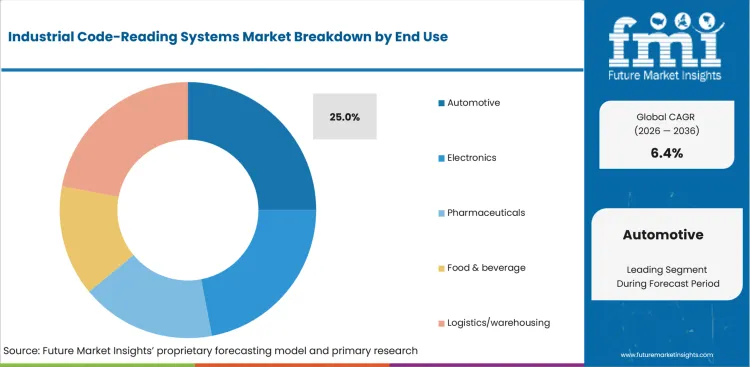
Automotive plants require component identity to survive machining and assembly, which keeps direct part marks important on durable parts. In February 2025, Datalogic launched Matrix 220 XAI for DPM reading and named automotive among its target industries, showing how machine vision cameras address scratched or low-contrast marks at speed.
- Based on end use, automotive is projected to account for 25.0% in 2026 due to component-level DPM and work-in-process identification embedded in quality workflows.
- Factories still need application trials because metal finish, marking method, cycle time, and reader angle can change decode performance from one station to another.
What makes 1D barcode readers important within the system type category?
Linear codes remain embedded in cartons and older production records, so plants often replace readers before redesigning every label. In December 2025, Leuze introduced the DCR 100i for 1D, 2D, and DPM reading, and mixed-format fixed 2D scanners preserve legacy identifiers during 2D preparation without disrupting existing records.
- By system type, 1D barcode readers are estimated to hold 19.0% in 2026 owing to installed linear-label workflows that still require backward-compatible decoding.
- Plants adopt dual-format readers to reduce parallel hardware and keep existing identifiers usable as new 2D formats enter the same production or logistics flow.
Why does image-based technology lead the technology category?
Image capture gives decoding software a full view of rotated or low-contrast codes, and Cognex launched its SLX logistics portfolio in October 2025 with barcode reading plus AI-based item detection. The release places machine vision systems and software decoding in the same device family during label and package changeovers.
- The image-based technology segment is likely to capture 38.0% share in 2026 attributable to full-frame imaging that handles several code geometries and difficult presentation conditions.
- Plants favor one camera platform where software changes can address new labels and package orientation without replacing the complete read station.
How does fixed mount shape the mounting category?
Fixed readers give engineers repeatable trigger timing and working distance at automated stations with controlled lighting and a known target position. Omron launched the VHV5 in June 2025 for difficult direct part marks and high-speed packaging, placing industrial machine vision at the read point without a separate inspection computer.
- Fixed mount systems are set to lead the mounting category with 42.0% share in 2026 due to repeatable geometry and hands-free triggering on automated lines.
- Plants scale fixed readers where every unit needs an automatic identity check before the PLC releases the next machine or conveyor step automatically.
What are the drivers, restraints and opportunities in the Industrial Code-Reading Systems Market?
Mixed-format migration and automated traceability expand reader demand, DPM verification and brownfield integration raise qualification work, and digital product records extend the use of reliable machine-readable identifiers.
- Driver: Mixed linear and 2D barcode use pushes plants toward readers that can process both formats during a multi-year transition.
- Restraint: Direct part marks require controlled lighting, image quality, and verification, which raises setup work on difficult surfaces.
- Opportunity: Digital product records increase the value of reliable identifiers that link physical items to structured data.
Mixed-Code Migration Extends Reader Replacement Demand
Plants replacing readers during 2D migration still need linear-code coverage because older labels remain in receiving and packaging flows. GS1's December 2025 retail guideline retains a linear barcode beside a 2D symbol until 90% of point-of-sale scanning solutions can process compliant 2D codes. Industrial sites therefore favor dual-format readers that share triggers with adjacent vision sensors, reducing parallel hardware during the transition.
DPM Quality Requirements Raise Application-Engineering Work
Direct part marks lose contrast through surface texture, lighting angle, and machining residue. ISO published ISO/IEC 29158:2025 in March 2025 as the current DPM quality-test specification. The standard grades the mark itself, so reader optics and factory automation controls still need station-level tuning before engineers can remove manual recovery.
Digital Product Records Extend the Identification Use Case
Product identification is taking on a data role beyond a local pass-or-fail scan. The European Commission launched the Digital Product Passport Registry and testing environment in July 2026 ahead of the first battery implementation deadline in February 2027. industrial robotics can pass durable identifiers into plant records, giving reader makers a route into data integration as well as hardware replacement.
Which country CAGRs are profiled in the Industrial Code-Reading Systems Market?
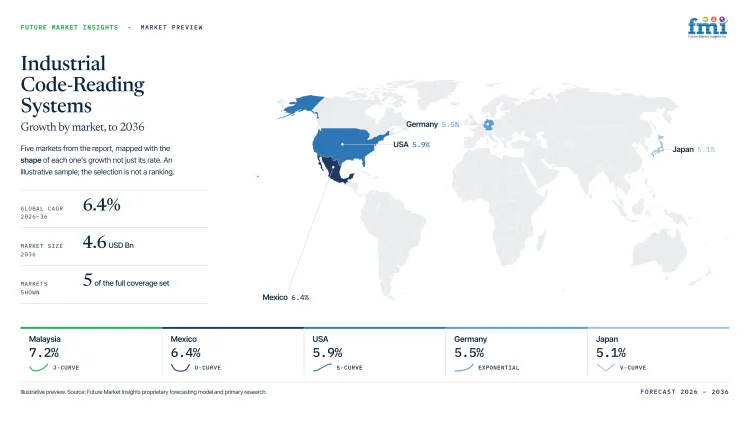
| Country | CAGR |
|---|---|
| Malaysia | 7.2% |
| Mexico | 6.4% |
| South Korea | 6.3% |
| USA | 5.9% |
| Netherlands | 5.8% |
| Germany | 5.5% |
| Japan | 5.1% |
How do country-level CAGRs compare in the Industrial Code-Reading Systems Market?
The country spread is narrow but commercially relevant: Malaysia leads at 7.2%, while Japan closes the group at 5.1%. Mexico and South Korea form the next tier near the market average, followed by a mature-market cluster in the USA, Netherlands, and Germany. Similar CAGRs therefore mask different replacement cycles, factory densities, and integration burdens.
- Malaysia's electronics capacity broadens greenfield specifications.
- Mexico's cross-border component flows raise data-handoff needs.
- South Korea's dense electronics production adds read points.
- USA installed fleets sustain replacement demand.
- Netherlands's compact logistics sites favor small fixed readers.
- Germany's machine builders set protocol expectations.
- Japan's long equipment life slows replacement.
Similar rates therefore require different product and service choices. The full report provides country-level CAGR analysis across North America, Latin America, Europe, East Asia, South Asia, Oceania and the Middle East and Africa.
Country-wise Analysis
- Malaysian electronics and advanced-manufacturing plants are adding new lines where code readers can be specified before controls and conveyor layouts are frozen. Industrial code-reading system demand in Malaysia is forecast to rise at 7.2% CAGR through 2036 given greenfield line additions, and MIDA recorded 1,354 approved manufacturing projects for 2025 in its March 2026 release. Local automation firms shorten commissioning, but mixed labels and small electronics marks still require application tuning, so reader makers with local engineering support have a clearer route into new plants than brands selling hardware without station-level setup or local commissioning knowledge during initial deployment.
- Mexican vehicle and component plants run tightly sequenced assembly lines where an unread identifier can divert a part into manual recovery or interrupt downstream traceability before final shipment. INEGI documented 3,953,494 light vehicles produced during 2025 in its January 2026 release, giving reader makers a large installed base that already depends on work-in-process identification at OEM and tier plants. Mexico is estimated to post 6.4% CAGR over the forecast period because automated checks keep spreading, yet uneven controls at smaller tier plants limit standard rollouts and make local protocol support more important than a single global scanner specification.
- Korean electronics and battery factories place many identification points beside automated inspection and material-handling equipment, which favors compact fixed readers with fast network response and centralized production records on fast cycle lines. The Ministry of Trade, Industry and Resources stated in October 2025 that the M.AX program had more than 100 AI-factory pilot projects, showing how quickly machine-level data capture is entering production. In South Korea, industrial code-reading system demand is predicted to advance at 6.3% CAGR through 2036, aided by those investments, though smaller sites face software-integration costs that give locally supported interoperable readers an advantage during line upgrades.
- United States factories operate large installed fleets of scanners, PLCs, robots, and warehouse devices, so many code-reader purchases extend existing stations instead of starting with a clean controls design or new line layout. The International Federation of Robotics counted 38,000 industrial robot installations in 2025 in its June 2026 release, indicating how many automated handoff points can require dependable identity capture during production and logistics. Industrial code-reading demand in the USA is predicted to advance at 5.9% CAGR through 2036, attributable to upgrades and tighter traceability, although plant network rules and legacy interfaces keep integration effort high at critical read points.
- Dutch warehouses and manufacturing sites face persistent labor shortages, so unattended scanning is often evaluated where manual receiving, picking, or packing restricts throughput and forces staff into repetitive exception handling. Adoption of industrial code-reading systems in the Netherlands is estimated to expand at 5.8% CAGR through 2036, tied to labor-saving automation, and Statistics Netherlands found in June 2026 that 29.1% of manufacturers were using more automation because of staff shortages. Compact sites and mixed equipment limit installation freedom, so models that preserve existing control interfaces can move from trial to rollout faster than readers requiring major mechanical or software changes.
- German machine builders usually treat code reading as part of a wider control and quality design, which raises expectations for diagnostics, industrial networking, and repeatable validation before series deployment on customer lines and exported machinery. Destatis data published in November 2025 show that 57% of enterprises with at least 250 employees used AI technologies, indicating a digitally mature base for software-assisted industrial reading and machine-vision integration. Germany is projected to grow at 5.5% CAGR over the forecast period, helped by automation upgrades, while demanding qualification standards make protocol coverage and application proof more decisive than price during reader selection cycles.
- Japanese automotive and battery supply chains place strong emphasis on trusted data exchange between companies, so identifiers increasingly need to stay usable beyond a single production cell and through intercompany traceability records during long product programs. In May 2025, METI selected two Ouranos Ecosystem projects, including one for secure carbon-footprint and due-diligence data sharing in automotive and battery supply chains. Industrial code-reading system sales in Japan are forecast to expand at 5.1% CAGR by 2036, driven by interoperable traceability, but long equipment qualification cycles mean vendors win more reliably by fitting existing controls and documenting stable read performance in production.
Who are the notable companies in the Industrial Code-Reading Systems Market?
Cognex, KEYENCE, Datalogic, Zebra Technologies, SICK, Omron, Leuze, and Brady Corporation serve the industrial code-reading systems market.
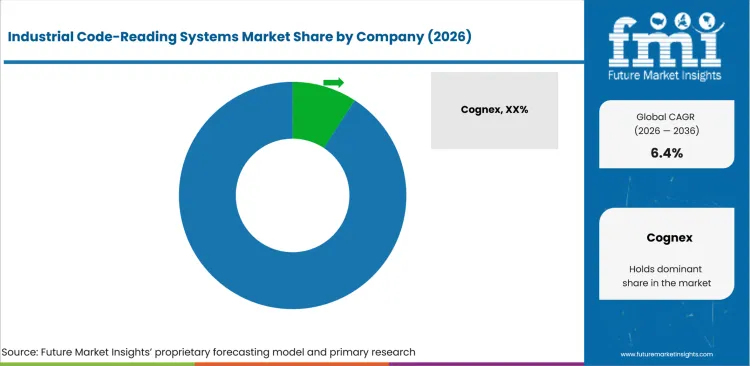
Competition centers on machine-vision specialists, automatic-identification companies, sensor manufacturers, and rugged-scanning providers. Entry is difficult because a reader must hold decode performance under real marks and lighting while fitting PLC, network, and maintenance practices. Station proof carries more weight than portfolio breadth once plants compare cycle time and manual exception rates.
- Cognex and KEYENCE concentrate on fixed industrial code reading and machine-vision integration for automated inspection points.
- Datalogic and Zebra Technologies cover fixed industrial scanning plus rugged mobile routes for exceptions and warehouse workflows.
- SICK, Omron, Leuze, and Brady Corporation extend the field through industrial sensors, fixed readers, handheld scanning, and automatic-identification portfolios.
Competitive Benchmarking: Industrial Code-Reading Systems Market
| Company | Difficult-Code & DPM Reading | Fixed-Mount Integration | Mobile / Exception Scanning | Geographic Reach |
|---|---|---|---|---|
| Cognex | High | High | Medium | Americas, Europe, Asia-Pacific |
| KEYENCE | High | High | Medium | Americas, Europe, Asia-Pacific |
| Datalogic | High | High | High | Global |
| Zebra Technologies | High | High | High | Global |
| SICK | High | High | Medium | Americas, Europe, Asia-Pacific |
| Omron | High | High | Medium | Americas, Europe, Asia-Pacific |
| Leuze | High | High | High | Americas, Europe, Asia-Pacific |
| Brady Corporation | Medium | Medium | High | Global |
Scoring basis: High requires documented current products or releases for demanding codes plus a clear industrial deployment route. Medium requires a verified adjacent or narrower capability. Low requires an explicit product or scope limitation. Geographic reach reflects documented selling and support presence, not market share.
Key Developments in the Industrial Code-Reading Systems Market
- In August 2026, Brady Corporation completed its acquisition of Honeywell Productivity Solutions and Services, bringing barcode scanning, mobile computing, RFID, and workflow software into the Brady portfolio.
- In March 2025, Datalogic launched the AV7000 12K linear camera barcode reader for high-throughput transport and logistics identification.
- In March 2025, Zebra Technologies completed its acquisition of Photoneo, adding 3D machine-vision technology for applications including automotive and logistics.
Key Players in the Industrial Code-Reading Systems Market
Machine-Vision and Fixed Code Reading
- Cognex
- KEYENCE
Industrial Scanning and Mobile Data Capture
- Datalogic
- Zebra Technologies
Sensor and Identification Platforms
- SICK
- Omron
- Leuze
Extended Automatic Data Capture Portfolio
- Brady Corporation
Industrial Code-Reading Systems Market - Report Scope
| Coverage field | Report scope |
|---|---|
| Market breakdown | system type, technology, mounting, end use, sales channel, and region |
| Quantitative Units | USD billion. |
| Market Definition | Industrial code-reading systems include fixed and handheld devices that decode 1D, 2D, and direct part marks for industrial identification, traceability, inspection, and material-flow workflows. |
| Regions Covered | North America, Latin America, Western Europe, Eastern Europe, East Asia, South Asia and Pacific, and Middle East and Africa. |
| Countries Covered | Malaysia, Mexico, South Korea, USA, Netherlands, Germany, Japan, and 20+ countries included in the full report. |
| Key Companies Profiled | Cognex, KEYENCE, Datalogic, Zebra Technologies, SICK, Omron, Leuze, and Brady Corporation |
| Forecast Period | 2026 to 2036. |
| Approach | Primary and secondary research with market triangulation. |
Industrial Code-Reading Systems Market - Research Methodology
| Method | Approach |
|---|---|
| Primary Research | FMI analysts gathered input from manufacturers, service providers, technology developers, distributors, end users, procurement teams, and subject-matter experts. Interviews examined purchasing decisions, product or service evaluation, adoption barriers, approval requirements, pricing considerations, and expectations for technical or commercial support. Respondents were also asked what evidence is required before a trial, pilot, or initial order develops into regular purchasing. |
| Desk Research | Desk research covered government statistics, regulatory publications, trade data, industry associations, technical literature, standards, company filings, product information, and official corporate announcements. Sources were reviewed for relevance, publication date, geographic coverage, and consistency with the defined market scope. Claims relating to performance, applications, approvals, capacity, investment, and commercial activity were retained only when supported by credible public evidence. |
| Market Sizing and Forecasting | The market model combined the baseline value with historical performance, segment structure, pricing and volume indicators, adoption levels, company participation, and country-level demand conditions. Forecast assumptions considered economic activity, investment trends, regulatory developments, technology adoption, purchasing cycles, supply availability, and barriers to wider market use. Segment and regional estimates were reconciled before the final market total was calculated. |
| Data Validation | Estimates were checked against multiple independent indicators, including public data, company activity, trade patterns, industry developments, and findings from primary interviews. Validation also tested whether products, services, applications, and company revenues fell within the defined market boundaries. Adjacent categories, unsupported claims, overlapping revenues, and activities without direct market relevance were excluded to reduce double counting and maintain consistency across segments and countries. |
Industrial Code-Reading Systems Market by Segments
System Type
- 1D barcode readers
- 2D code readers
- DPM code readers
- Handheld industrial readers
- Fixed-mount vision readers
Technology
- Image-based
- Laser scanning
- Machine vision
- AI-assisted decoding
- RFID hybrid systems
Mounting
- Fixed mount
- Handheld rugged
- Robot-mounted
- Conveyor-mounted
End Use
- Automotive
- Electronics
- Pharmaceuticals
- Food & beverage
- Logistics/warehousing
Sales Channel
- Automation distributors
- Direct OEM supply
- System integrators
- E-commerce/catalog
Industrial Code-Reading Systems Market by Region:
- North America
- USA
- Canada
- Mexico
- Latin America
- Brazil
- Chile
- Rest of Latin America
- Western Europe
- Germany
- United Kingdom
- Italy
- Spain
- France
- Nordics
- Benelux
- Rest of Western Europe
- Eastern Europe
- Russia
- Poland
- Hungary
- Balkan and Baltic States
- Rest of Eastern Europe
- East Asia
- Japan
- South Korea
- South Asia and Pacific
- ASEAN
- Australia and New Zealand
- Rest of South Asia and Pacific
- Middle East and Africa
- Kingdom of Saudi Arabia
- Other GCC Countries
- Türkiye
- South Africa
- Other African Union Countries
- Rest of Middle East and Africa
Research Sources and Bibliography
- GS1. (2025, January 8). How long will the transition to 2D barcodes take?.
- International Federation of Robotics. (2025, September 25). Global Robot Demand in Factories Doubles Over 10 Years.
- Leuze electronic. (2025, December 5). Code reading without compromise.
- Cognex Corporation. (2025, October 28). Cognex Introduces the Solutions Experience (SLX) Logistics Portfolio.
- Omron Automation. (2025, June 2). Omron Launches VHV5 Ultra-High Performance Barcode Reader.
- Datalogic S.p.A. (2025, February 27). Matrix 220 XAI: Ultimate DPM with the fastest auto-setup ever, AI-Powered.
- GS1. (2025, December). 2D Barcodes at Retail Point-of-Sale Implementation Guideline.
- International Organization for Standardization. (2025, March 25). ISO/IEC 29158:2025 Automatic identification and data capture techniques - Bar code symbol quality test specification - Direct part mark (DPM).
- European Commission. (2026, July 20). The Digital Product Passport Registry is now live.
- Malaysian Investment Development Authority. (2026, March 6). Malaysia Breaks Investment Record with RM426.7 Billion in 2025, Up 11% Year-On-Year; Creating Over 240,000 New Jobs.
- Instituto Nacional de Estadística y Geografía. (2026, January 9). Registro Administrativo de la Industria Automotriz de Vehículos Ligeros.
- Ministry of Trade, Industry and Resources. (2025, October 1). Korea Ramps Up AI Factories to Lead Global Manufacturing by 2030.
- International Federation of Robotics. (2026, June 18). US Robot Industry Returns to Double Digit Growth.
- Statistics Netherlands. (2026, June 3). Staff shortages mean business is turning to automation.
- Federal Statistical Office of Germany. (2025, November 24). Enterprises using artificial intelligence (AI) technologies, by employment size class.
- Ministry of Economy, Trade and Industry. (2025, May 9). Certification of Projects under the Ouranos Ecosystem Initiative.
- Brady Corporation. (2026, August 3). Brady Corporation Completes Transformational Acquisition.
- Datalogic S.p.A. (2025, March 25). AV7000 12K: Redefining Logistics Leadership in Ultra-High Definition.
- Zebra Technologies. (2025, March 3). Zebra Technologies Completes Acquisition of Photoneo.
- Datalogic S.p.A. (2025, October 15). Datalogic Accelerates Enterprise Digital Transformation by Expanding Its Software Solutions Portfolio with the Launch of Datalogic Connect.
- Leuze electronic. (2026, February 13). LogiMAT 2026: Intelligently networked with Leuze.
- Zebra Technologies. (2025, March 17). Zebra Technologies Unveils Solutions Advancing Intelligent Automation at ProMat 2025.
- Omron Automation. (2026, June 8). Omron Launches VHV5-SRV Barcode Verification System.
- DENSO WAVE. (2025, September 11). Update SC1 series Firmware, SC1-QB User’s Manual and Scanner Setting 2D.
- Cognex Corporation. (2026, May 5). Cognex Launches Highest Performance Embedded AI Vision System Powered by Qualcomm.
- KEYENCE Corporation of America. (2026, June 20). Certified Models : CSA Certified.
- Datalogic S.p.A. (2025, May 7). PowerScan 9600 RFID Series - Revolutionizing Industrial Scanning.
- Zebra Technologies. (2025, July 1). Zebra Technologies and Clearview Launch Industrial Automation Centre of Excellence.
- SICK AG. (2025, January 27). SICK acquires tech startup Accerion and expands Autonomous Mobile Robots portfolio - AI and software-based localization solutions for industrial automation.
- Omron Automation. (2026, April 21). OMRON and Dassault Systèmes Partner to Bridge the Virtual and the Real Worlds for Flexible, High-Performance Manufacturing.
- Leuze electronic. (2025, September 5). Full power in seconds.
- Brady Corporation. (2025, August 4). Brady Corporation Acquires Mecco.
- SICK AG. (n.d.). Certificates.
This bibliography is provided for reader reference and is not exhaustive. The full report contains the complete reference list and detailed citations.
This Report Answers
- How large is the industrial code-reading systems market in 2026 and what value is projected for 2036?
- Which operating changes are increasing demand for mixed 1D and 2D code-reading capability?
- Why does image-based technology hold a large share of code-reading demand?
- What keeps fixed-mount readers important on automated production and logistics lines?
- How do direct part marks change reader selection in automotive applications?
- Which factors slow deployment in brownfield plants with legacy controls?
- How do the profiled country CAGRs differ and what explains the spread?
- Which companies are active in fixed industrial reading, mobile scanning, and machine vision?
- What evidence separates high and medium Competitive Benchmarking ratings?
Frequently Asked Questions
How big is the industrial code-reading systems market in 2026?
The industrial code-reading systems market is valued at USD 2.5 billion in 2026 and is projected to reach USD 4.6 billion by 2036. Growth follows automated traceability and mixed-format barcode migration.
What is the CAGR of the industrial code-reading systems market from 2026 to 2036?
The industrial code-reading systems market is projected to grow at a CAGR of 6.4% between 2026 and 2036. Expansion follows automated identification, reader replacement, and software-assisted decoding of difficult marks.
Which technology leads the industrial code-reading systems market?
The image-based segment is expected to hold 38.0% of the industrial code-reading systems market technology category in 2026, driven by flexible decoding of varied code orientations and damaged marks. Software tuning also extends one imaging platform to more applications.
Which mounting type leads the industrial code-reading systems market?
The fixed mount segment is expected to hold 42.0% of the industrial code-reading systems market mounting category in 2026, attributable to repeatable trigger geometry on automated lines. Fixed stations also pass decode results directly into machine-control workflows.
Which companies are active in the industrial code-reading systems market?
Key companies operating in the market include Cognex, KEYENCE, Datalogic, Zebra Technologies, SICK, Omron, Leuze, and Brady Corporation. Their positions span fixed industrial reading, machine vision, rugged mobile scanning, and application support.
Preview the report firsthand - request a free sample
Get SampleGet the brochure for pricing and purchase details.
Get PDFTable of Content
- Key Takeaways
- Market Size and CAGR
- Top Growth Driver
- Fastest Growing Segment
- Leading Region
- Key Companies
- Emerging Opportunities
- Executive Summary
- Global Market Outlook
- Demand-side Trends
- Supply-side Trends
- Technology Roadmap Analysis
- Analysis and Recommendations
- Analyst Perspective (What is happening? Why now? What should investors know?)
- Key Questions Answered
- How large is the market?
- What is the CAGR?
- What are key trends?
- Which region dominates?
- Who are the leaders?
- Market Overview
- Market Coverage / Taxonomy
- Market Definition / Scope / Limitations
- Research Methodology
- Chapter Orientation
- Analytical Lens and Working Hypotheses
- Market Structure, Signals, and Trend Drivers
- Benchmarking and Cross-market Comparability
- Market Sizing, Forecasting, and Opportunity Mapping
- Research Design and Evidence Framework
- Desk Research Programme (Secondary Evidence)
- Expert Input and Fieldwork (Primary Evidence)
- Tooling, Models, and Reference Databases
- Data Engineering and Model Build
- Quality Assurance and Audit Trail
- Market Background
- Market Dynamics (Drivers, Restraints, Opportunity, Trends)
- Scenario Forecast (Optimistic, Likely, Conservative)
- Impact Analysis
- AI Impact
- Sustainability Impact
- Regulatory Impact
- Technology Impact
- Consumer / Buyer Analysis
- Purchase Drivers
- Adoption Barriers
- Buyer Journey
- Opportunity Map Analysis
- Product Life Cycle Analysis
- Supply Chain Analysis
- Investment Feasibility Matrix
- Value Chain Analysis
- PESTLE and Porter's Analysis
- Regulatory Landscape
- Regional Parent Market Outlook
- Production and Consumption Statistics
- Import and Export Statistics
- Global Market Analysis and Forecast, 2021 to 2036
- Historical Market Size Value (USD Billion) Analysis, 2021 to 2025
- Current and Future Market Size Value (USD Billion) Projections, 2026 to 2036
- Y-o-Y Growth Trend Analysis
- Absolute $ Opportunity Analysis
- Global Market Pricing Analysis, 2021 to 2036
- Global Market Analysis and Forecast, By System Type, 2021 to 2036
- Introduction / Key Findings
- Historical Market Size Value (USD Billion) Analysis By System Type, 2021 to 2025
- Current and Future Market Size Value (USD Billion) Analysis and Forecast By System Type, 2026 to 2036
- 1D barcode readers
- 2D code readers
- DPM code readers
- Handheld industrial readers
- Fixed-mount vision readers
- 1D barcode readers
- Y-o-Y Growth Trend Analysis By System Type, 2021 to 2025
- Absolute $ Opportunity Analysis By System Type, 2026 to 2036
- Global Market Analysis and Forecast, By Technology, 2021 to 2036
- Introduction / Key Findings
- Historical Market Size Value (USD Billion) Analysis By Technology, 2021 to 2025
- Current and Future Market Size Value (USD Billion) Analysis and Forecast By Technology, 2026 to 2036
- Image-based
- Laser scanning
- Machine vision
- AI-assisted decoding
- RFID hybrid systems
- Image-based
- Y-o-Y Growth Trend Analysis By Technology, 2021 to 2025
- Absolute $ Opportunity Analysis By Technology, 2026 to 2036
- Global Market Analysis and Forecast, By Mounting, 2021 to 2036
- Introduction / Key Findings
- Historical Market Size Value (USD Billion) Analysis By Mounting, 2021 to 2025
- Current and Future Market Size Value (USD Billion) Analysis and Forecast By Mounting, 2026 to 2036
- Fixed mount
- Handheld rugged
- Robot-mounted
- Conveyor-mounted
- Fixed mount
- Y-o-Y Growth Trend Analysis By Mounting, 2021 to 2025
- Absolute $ Opportunity Analysis By Mounting, 2026 to 2036
- Global Market Analysis and Forecast, By End Use, 2021 to 2036
- Introduction / Key Findings
- Historical Market Size Value (USD Billion) Analysis By End Use, 2021 to 2025
- Current and Future Market Size Value (USD Billion) Analysis and Forecast By End Use, 2026 to 2036
- Automotive
- Electronics
- Pharmaceuticals
- Food & beverage
- Logistics/warehousing
- Automotive
- Y-o-Y Growth Trend Analysis By End Use, 2021 to 2025
- Absolute $ Opportunity Analysis By End Use, 2026 to 2036
- Global Market Analysis and Forecast, By Sales Channel, 2021 to 2036
- Introduction / Key Findings
- Historical Market Size Value (USD Billion) Analysis By Sales Channel, 2021 to 2025
- Current and Future Market Size Value (USD Billion) Analysis and Forecast By Sales Channel, 2026 to 2036
- Automation distributors
- Direct OEM supply
- System integrators
- E-commerce/catalog
- Automation distributors
- Y-o-Y Growth Trend Analysis By Sales Channel, 2021 to 2025
- Absolute $ Opportunity Analysis By Sales Channel, 2026 to 2036
- Global Market Analysis and Forecast, By Region, 2021 to 2036
- Introduction
- Historical Market Size Value (USD Billion) Analysis By Region, 2021 to 2025
- Current Market Size Value (USD Billion) Analysis and Forecast By Region, 2026 to 2036
- North America
- Latin America
- Western Europe
- Eastern Europe
- East Asia
- South Asia and Pacific
- Middle East & Africa
- Market Attractiveness Analysis By Region
- North America Market Analysis and Forecast, By Country, 2021 to 2036
- Historical Market Size Value (USD Billion) Trend Analysis By Market Taxonomy, 2021 to 2025
- Market Size Value (USD Billion) Forecast By Market Taxonomy, 2026 to 2036
- By Country
- USA
- Canada
- By System Type
- By Technology
- By Mounting
- By End Use
- By Sales Channel
- By Country
- Market Attractiveness Analysis
- By Country
- By System Type
- By Technology
- By Mounting
- By End Use
- By Sales Channel
- Key Takeaways
- Latin America Market Analysis and Forecast, By Country
- Historical Market Size Value (USD Billion) Trend Analysis By Market Taxonomy, 2021 to 2025
- Market Size Value (USD Billion) Forecast By Market Taxonomy, 2026 to 2036
- By Country
- Brazil
- Mexico
- Chile
- Rest of Latin America
- By System Type
- By Technology
- By Mounting
- By End Use
- By Sales Channel
- By Country
- Market Attractiveness Analysis
- By Country
- By System Type
- By Technology
- By Mounting
- By End Use
- By Sales Channel
- Key Takeaways
- Western Europe Market Analysis and Forecast, By Country
- Historical Market Size Value (USD Billion) Trend Analysis By Market Taxonomy, 2021 to 2025
- Market Size Value (USD Billion) Forecast By Market Taxonomy, 2026 to 2036
- By Country
- Germany
- UK
- Italy
- Spain
- France
- Nordic
- BENELUX
- Rest of Western Europe
- By System Type
- By Technology
- By Mounting
- By End Use
- By Sales Channel
- By Country
- Market Attractiveness Analysis
- By Country
- By System Type
- By Technology
- By Mounting
- By End Use
- By Sales Channel
- Key Takeaways
- Eastern Europe Market Analysis and Forecast, By Country
- Historical Market Size Value (USD Billion) Trend Analysis By Market Taxonomy, 2021 to 2025
- Market Size Value (USD Billion) Forecast By Market Taxonomy, 2026 to 2036
- By Country
- Russia
- Poland
- Hungary
- Balkan & Baltic
- Rest of Eastern Europe
- By System Type
- By Technology
- By Mounting
- By End Use
- By Sales Channel
- By Country
- Market Attractiveness Analysis
- By Country
- By System Type
- By Technology
- By Mounting
- By End Use
- By Sales Channel
- Key Takeaways
- East Asia Market Analysis and Forecast, By Country
- Historical Market Size Value (USD Billion) Trend Analysis By Market Taxonomy, 2021 to 2025
- Market Size Value (USD Billion) Forecast By Market Taxonomy, 2026 to 2036
- By Country
- China
- Japan
- South Korea
- By System Type
- By Technology
- By Mounting
- By End Use
- By Sales Channel
- By Country
- Market Attractiveness Analysis
- By Country
- By System Type
- By Technology
- By Mounting
- By End Use
- By Sales Channel
- Key Takeaways
- South Asia and Pacific Market Analysis and Forecast, By Country
- Historical Market Size Value (USD Billion) Trend Analysis By Market Taxonomy, 2021 to 2025
- Market Size Value (USD Billion) Forecast By Market Taxonomy, 2026 to 2036
- By Country
- India
- ASEAN
- Australia & New Zealand
- Rest of South Asia and Pacific
- By System Type
- By Technology
- By Mounting
- By End Use
- By Sales Channel
- By Country
- Market Attractiveness Analysis
- By Country
- By System Type
- By Technology
- By Mounting
- By End Use
- By Sales Channel
- Key Takeaways
- Middle East & Africa Market Analysis and Forecast, By Country
- Historical Market Size Value (USD Billion) Trend Analysis By Market Taxonomy, 2021 to 2025
- Market Size Value (USD Billion) Forecast By Market Taxonomy, 2026 to 2036
- By Country
- Kingdom of Saudi Arabia
- Other GCC Countries
- Türkiye
- South Africa
- Other African Union
- Rest of Middle East & Africa
- By System Type
- By Technology
- By Mounting
- By End Use
- By Sales Channel
- By Country
- Market Attractiveness Analysis
- By Country
- By System Type
- By Technology
- By Mounting
- By End Use
- By Sales Channel
- Key Takeaways
- Key Countries Market Analysis
- USA
- Pricing Analysis
- Market Share Analysis, 2025
- By System Type
- By Technology
- By Mounting
- By End Use
- By Sales Channel
- Canada
- Pricing Analysis
- Market Share Analysis, 2025
- By System Type
- By Technology
- By Mounting
- By End Use
- By Sales Channel
- Mexico
- Pricing Analysis
- Market Share Analysis, 2025
- By System Type
- By Technology
- By Mounting
- By End Use
- By Sales Channel
- Brazil
- Pricing Analysis
- Market Share Analysis, 2025
- By System Type
- By Technology
- By Mounting
- By End Use
- By Sales Channel
- Chile
- Pricing Analysis
- Market Share Analysis, 2025
- By System Type
- By Technology
- By Mounting
- By End Use
- By Sales Channel
- Germany
- Pricing Analysis
- Market Share Analysis, 2025
- By System Type
- By Technology
- By Mounting
- By End Use
- By Sales Channel
- UK
- Pricing Analysis
- Market Share Analysis, 2025
- By System Type
- By Technology
- By Mounting
- By End Use
- By Sales Channel
- Italy
- Pricing Analysis
- Market Share Analysis, 2025
- By System Type
- By Technology
- By Mounting
- By End Use
- By Sales Channel
- Spain
- Pricing Analysis
- Market Share Analysis, 2025
- By System Type
- By Technology
- By Mounting
- By End Use
- By Sales Channel
- France
- Pricing Analysis
- Market Share Analysis, 2025
- By System Type
- By Technology
- By Mounting
- By End Use
- By Sales Channel
- India
- Pricing Analysis
- Market Share Analysis, 2025
- By System Type
- By Technology
- By Mounting
- By End Use
- By Sales Channel
- ASEAN
- Pricing Analysis
- Market Share Analysis, 2025
- By System Type
- By Technology
- By Mounting
- By End Use
- By Sales Channel
- Australia & New Zealand
- Pricing Analysis
- Market Share Analysis, 2025
- By System Type
- By Technology
- By Mounting
- By End Use
- By Sales Channel
- China
- Pricing Analysis
- Market Share Analysis, 2025
- By System Type
- By Technology
- By Mounting
- By End Use
- By Sales Channel
- Japan
- Pricing Analysis
- Market Share Analysis, 2025
- By System Type
- By Technology
- By Mounting
- By End Use
- By Sales Channel
- South Korea
- Pricing Analysis
- Market Share Analysis, 2025
- By System Type
- By Technology
- By Mounting
- By End Use
- By Sales Channel
- Russia
- Pricing Analysis
- Market Share Analysis, 2025
- By System Type
- By Technology
- By Mounting
- By End Use
- By Sales Channel
- Poland
- Pricing Analysis
- Market Share Analysis, 2025
- By System Type
- By Technology
- By Mounting
- By End Use
- By Sales Channel
- Hungary
- Pricing Analysis
- Market Share Analysis, 2025
- By System Type
- By Technology
- By Mounting
- By End Use
- By Sales Channel
- Kingdom of Saudi Arabia
- Pricing Analysis
- Market Share Analysis, 2025
- By System Type
- By Technology
- By Mounting
- By End Use
- By Sales Channel
- Türkiye
- Pricing Analysis
- Market Share Analysis, 2025
- By System Type
- By Technology
- By Mounting
- By End Use
- By Sales Channel
- South Africa
- Pricing Analysis
- Market Share Analysis, 2025
- By System Type
- By Technology
- By Mounting
- By End Use
- By Sales Channel
- USA
- Market Structure Analysis
- Competition Dashboard
- Competition Benchmarking
- Market Share Analysis of Top Players
- By Regional
- By System Type
- By Technology
- By Mounting
- By End Use
- By Sales Channel
- Emerging Startups
- Innovation Benchmarking
- Competition Analysis
- Competition Deep Dive
- Cognex
- Overview
- Product Portfolio
- Profitability by Market Segments
- Sales Footprint
- Strategy Overview
- Marketing Strategy
- Product Strategy
- Channel Strategy
- Keyence
- Datalogic
- Zebra Technologies
- SICK
- Omron
- Honeywell
- Balluff
- Pepperl+Fuchs
- Leuze
- Cognex
- Case Studies
- Success Stories
- Recent Developments
- Competition Deep Dive
- Assumptions & Acronyms Used


