

- Market Size (2026)
- USD 450.0 Mn
- Forecast (2036)
- USD 25949.0 Mn
- CAGR (2026 to 2036)
- 50.0%
How big is the AI PLC Code Generation & Industrial Copilots Market in 2026?
USD 450.0 million in 2026 and USD 25,949.0 million by 2036 at a 50.0% CAGR.
Demand for AI PLC code generation and industrial copilots is projected to expand at 50.0% CAGR through 2036, increasing valuation from USD 450.0 million in 2026 to USD 25,949 million. Factory automation and industrial controls are expected to create a broad installed base for tools that draft code inside established engineering work. The International Federation of Robotics reported in September 2025 that 542,000 industrial robots were installed during 2024. That volume is expected to increase recurring work across controller logic and device setup. Commercial value is therefore anticipated to shift toward tools that combine generation with project context and human approval.
The United States is expected to favor copilots that connect with mixed controller estates and protected plant networks. China is projected to move faster through dense automation programs and repeated equipment builds. The September 2025 release from the International Federation of Robotics reported 67,800 industrial robot installations across the European Union during 2024. That installed base is expected to support AI trials beyond isolated technology teams across the region. Plant engineering leaders are expected to compare role controls and model hosting before accepting cloud access to source code. Procurement reviews are likely to test library reuse and support terms alongside cybersecurity responsibilities. Industrial AI agents are anticipated to widen the addressable budget once assistants coordinate code and tests inside one approved project. Regional growth is therefore expected to differ according to installed software and governance maturity across industrial organizations.
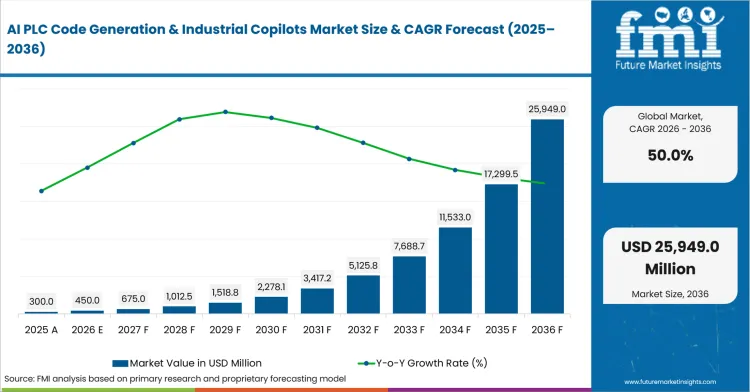
Summary of the AI PLC Code Generation & Industrial Copilots Market
| Market Signal | Commercial Impact |
|---|---|
| Demand and Growth Drivers | Engineering capacity is expected to become the central spending trigger as plants face more control changes without matching growth in specialist staffing across production sites.
|
| Product and Segment View | LLM code generation is anticipated to anchor early purchases because engineers can inspect each proposed block against familiar controller rules and approved project libraries.
|
| Geography and Growth Outlook | Country growth is expected to reflect automation intensity and the maturity of engineering software across each industrial base and its local support network.
|
| Competitive Landscape | Competition is expected to center on the depth of project context available during code generation and the evidence retained through engineering review.
|
| Analyst Perspective | Commercial success is expected to depend on whether a copilot reduces review effort rather than moving that effort into another engineering step.
|
How is the AI PLC Code Generation & Industrial Copilots Market segmented?
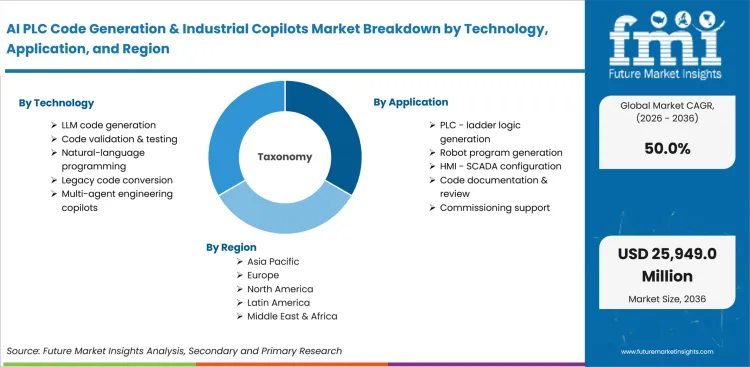
technology, application, deployment, end-use industry, and user type
The market is segmented by technology and application before deployment choices define how project data reaches each model. End-use industry shows where controller work occurs and user type identifies the role that approves generated behavior. Technology covers LLM code generation and validation tools alongside natural-language programming. Application covers ladder logic and robot programs together with HMI configuration and documentation. Deployment compares cloud and on-premise use with hybrid arrangements. End-use analysis spans automotive and machine building plus process industries and electronics. User analysis covers control engineers and system integrators with maintenance teams. These views are expected to link software capability to daily engineering ownership across industrial automation software.
Why is LLM code generation expected to account for 36.0% of the technology segment in 2026?
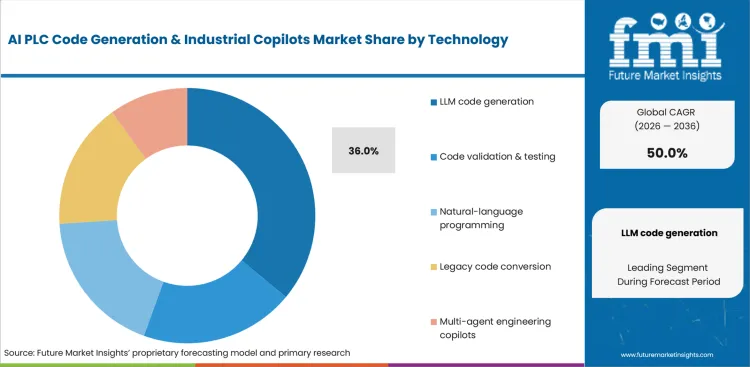
LLM code generation enters projects through routine blocks that already follow established naming and sequencing patterns. Value becomes clearer when a first draft can be compared with approved examples inside the same engineering environment. Adoption slows when the tool cannot read project tags or hardware limits. The commercial test therefore focuses on usable code and review time rather than raw text output.
- By technology, LLM code generation is expected to account for 36.0% share in 2026 since editable output can be compared with established PLC libraries and controller rules across routine control projects.
- Control engineers are increasingly purchasing LLM generation tools led by pressure to finish more routine blocks within existing review windows. Links with operational technology systems are projected to matter because project context must remain aligned with access rights. The purchase case is expected to improve once one assistant can explain its draft and preserve human approval.
How is PLC - ladder logic generation positioned within the application segment?
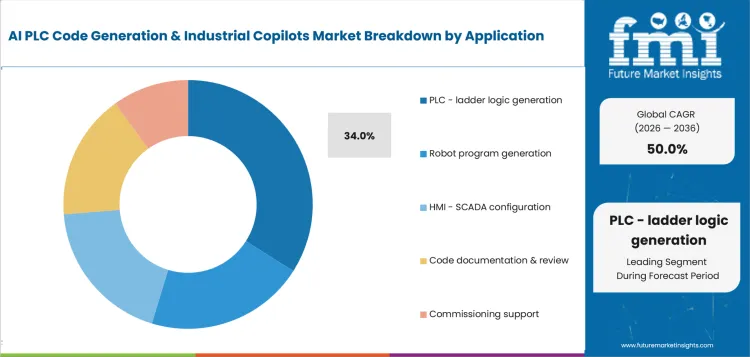
Ladder logic retains a central role because its visual structure remains familiar to plant engineering teams and maintenance staff. Proposed rungs can be reviewed against expected sensor states before code reaches a controller. The format supports repeat work across conveyors and pumps with standard interlocks. Value falls when generated rungs omit abnormal states or device timing that exists outside the prompt.
- Familiar visual review means PLC - ladder logic generation is forecast to hold 34.0% of application spending in 2026 across repetitive machine sequences and standard interlock work during routine machine reviews.
- Demand for ladder logic generation is expected to grow among filling-line technicians and machine controls specialists attributable to repeat programs across compact controllers. Micro and nano PLC platforms are anticipated to extend the need for fast code creation across smaller machines. Review discipline is expected to remain central because each accepted rung can change real equipment behavior during commissioning and routine operation.
Why is cloud deployment expected to represent 46.0% of spending in 2026?
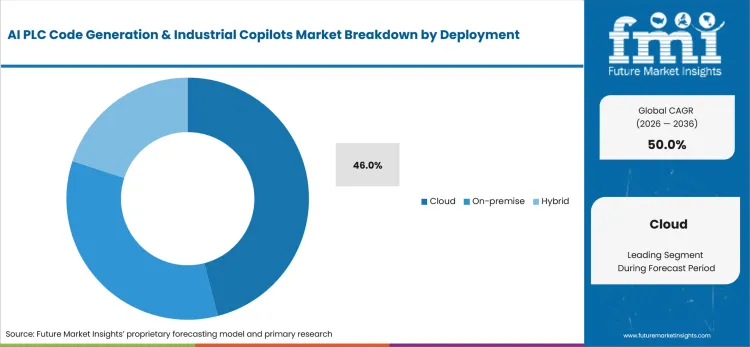
Cloud delivery supports early trials through access to capable models and centrally managed updates. This delivery model reduces local computing needs during limited industrial engineering pilots across multiple sites. Industrial code and equipment settings face restrictions that prevent external processing at protected sites. The segment therefore grows through controlled services that separate general model work from protected project context. Clear data handling terms shape contract approval across restricted manufacturing sites and shared engineering teams.
- Central model access is projected to push cloud deployment to a 46.0% share in 2026 through easier updates and lower local computing needs across shared engineering teams during early trials.
- Purchase activity for cloud copilots is anticipated to rise driven by multi-site engineering teams that need common model access. Cloud PLC services are expected to support shared work without removing the need for role controls and project boundaries. Hybrid options are likely to gain attention when plant code must remain inside a protected network.
What supports automotive demand within the end-use industry segment?
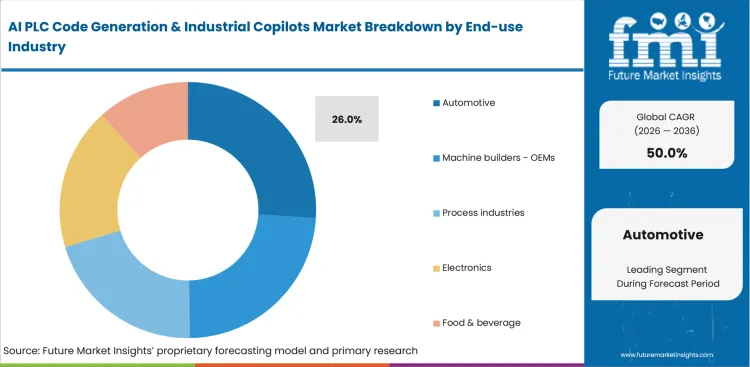
Automotive plants generate repeated control work across assembly and material handling systems. New vehicle programs require code changes across many similar stations with local device differences. Copilots help reuse approved patterns and explain inherited logic during line changes. The segment rewards products that connect requirements with code and test evidence. Tools that ignore safety layers remain outside approved production workflows across automotive plants and machinery programs.
- Automotive is estimated to lead end-use spending with 26.0% in 2026 while machine builders hold a smaller share given repeated control changes across vehicle plants during vehicle platform transitions.
- Automotive controls teams are expected to favor project-aware copilots over alternatives due to repeated station designs and strict release reviews. The assistant is anticipated to reduce setup work across related lines without changing final engineering responsibility. Commercial value is expected to rise when generated code arrives with tests and clear links to approved requirements.
Why are control engineers expected to hold 44.0% of user spending in 2026?
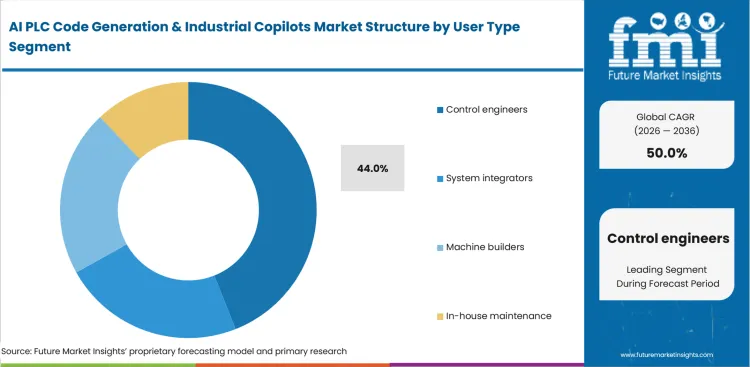
Control engineers remain the daily owners of generated PLC code because they understand the machine and approve final behavior. Their work combines programming knowledge with device timing and fault response across live production systems. Copilots support routine drafting and code explanation without replacing that judgment. Adoption depends on whether each output can be traced to a clear request and tested inside the normal project process.
- A 44.0% share of user spending is anticipated for control engineers in 2026 since they review generated code and remain accountable for final controller behavior across regulated production programs.
- Engineering copilots are expected to draw demand from system integrators owing to customer-specific hardware and project standards. They need reusable assistance that can adapt approved patterns without exposing one customer project to another. The product is expected to gain value when explanations and test records travel with the generated block through commissioning.
What are the drivers, restraints, and opportunities in the AI PLC Code Generation & Industrial Copilots Market?
Driver: engineering workload is expected to support routine code assistance. Restraint: project context and safety review are anticipated to slow approval. Opportunity: connected code and test generation is projected to widen paid use.
- Driver - engineering capacity gap: Copilots are expected to prepare routine code and explanations so experienced controls staff can focus on machine behavior and abnormal states.
- Restraint - validation burden: Generated logic is anticipated to require simulation and controlled commissioning because a plausible output can still miss project rules or equipment limits.
- Opportunity - connected engineering workflow: Products are projected to gain value when one requirement can produce code and tests with a visible review record.
Engineering workload supports adoption as AI use spreads across larger organizations. Eurostat reported in June 2026 that 55.03% of large EU enterprises used AI technologies during 2025. Large industrial groups therefore have more internal experience with model access and governance than smaller plants. That experience shortens pilot design for engineering copilots across larger industrial organizations. Paid use expands when routine code creation reduces backlog without weakening the authority of the controls specialist.
The main restraint remains the cost of an incorrect answer inside a physical process. NIST released its Generative AI Profile in July 2024 with 12 identified risk areas and just over 200 suggested actions. Industrial engineering teams therefore demand repeatable evaluation and clear human review before generated logic enters commissioning. Suppliers that cannot show project boundaries or test evidence may face longer approval cycles across regulated plants and critical production assets.
Connected generation and testing create the clearest expansion path beyond simple code suggestions. Siemens announced industrial AI agents in May 2025 and described an Engineering Copilot for TIA Portal with natural-language SCL generation. That development shows how assistance is moving toward engineering tasks inside established software. Digital thread for automation reinforces this opportunity by tying requirements and code to the same project record. Revenue improves when one approved request supports drafting and test preparation inside the same project.
Which country CAGRs are profiled in the AI PLC Code Generation & Industrial Copilots Market?
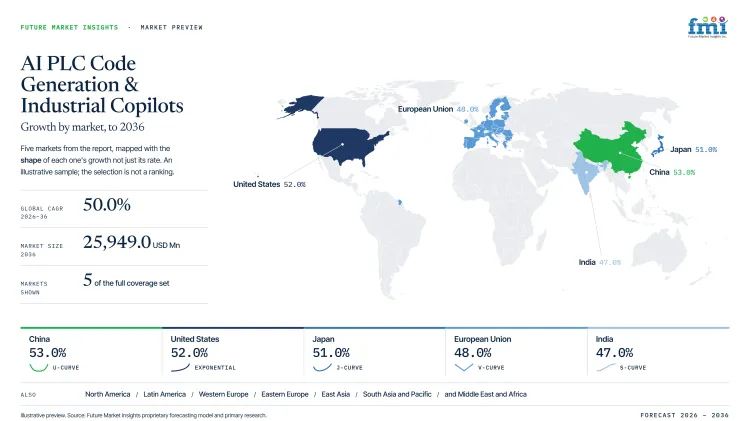
| Country or Market | CAGR |
|---|---|
| European Union | 48.0% |
| United States | 52.0% |
| China | 53.0% |
| India | 47.0% |
| Japan | 51.0% |
Source: FMI's proprietary forecasting model and primary research
How do country-level CAGRs compare in the AI PLC code generation & industrial copilots market?
The country comparison spans 6.0 percentage points and reveals three distinct growth groups across the AI PLC code generation & industrial copilots market. China, the United States and Japan form the leading tier with only 2.0 percentage points separating the three markets. India and the European Union make up the second tier within a narrow 1.0-point band. Markets with more advanced industrial automation ecosystems and wider adoption of digital engineering tools are generally moving faster toward AI-assisted PLC programming and industrial copilot platforms.
-
China leads the comparison with a CAGR of 53.0%. Manufacturers and automation suppliers are increasingly incorporating AI into PLC programming, commissioning and production engineering workflows to shorten development cycles and improve consistency across industrial automation projects.
-
Just 1.0 percentage point below China, the United States records a CAGR of 52.0%. Adoption reflects growing interest in industrial copilots that assist engineers with PLC code generation, debugging, documentation and system optimization while helping manufacturers accelerate automation projects.
-
Japan stands 1.0 percentage point behind the United States at 51.0%. Demand is linked to advanced manufacturing operations where AI-assisted programming tools complement established factory automation practices and help improve engineering productivity.
-
The European Union posts a CAGR of 48.0%, placing it 3.0 percentage points below Japan. Continued investment in smart manufacturing and industrial digitalization encourages evaluation of AI-enabled engineering software, although implementation timelines differ across member states because of variations in industrial structure and technology adoption.
-
India records a CAGR of 47.0%, remaining 1.0 percentage point below the European Union. Expanding factory automation, increasing deployment of PLC-controlled production lines and broader adoption of digital engineering platforms are creating opportunities for AI-powered code generation and industrial copilot solutions.
Comparable CAGRs can still produce different market entry conditions. Differences in industrial automation maturity, software integration, engineering practices and investment priorities influence deployment timelines and long-term commercial opportunities. The full report provides country-level CAGR analysis across North America, Latin America, Europe, East Asia, South Asia, Oceania and the Middle East and Africa.
Country-wise Analysis
Country growth reflects the scale of automation work and the maturity of engineering software in each industrial base. China and the United States move faster through installed systems and repeated equipment programs. Japan values code quality and support across machine lifecycles that extend through several software generations. European Union organizations balance AI use with governance requirements across engineering and operations teams. India gains through factory investment and engineering service activity across domestic and export projects. These differences shape product design around hosting options and local support rather than one global rollout model.
-
United States: United States automation leaders evaluate mixed-controller support before approving a new engineering copilot platform. The United States outlook is anticipated to advance at 52.0% CAGR over the assessment period, supported by a large installed equipment base and active software adoption. The June 2026 release from the International Federation of Robotics reported 38,000 industrial robot installations in the United States during 2025. That recovery is expected to increase recurring code and maintenance work across automotive and food plants. Products that support edge use and air-gapped sites are therefore likely to address a wider group of industrial programs across regional production networks.
- China: China's automation mix is shifting toward project-wide AI assistance at a rate that is anticipated to affect engineering cycle time. AI PLC code generation demand in China is forecast to rise at 53.0% CAGR over the forecast period, driven by dense equipment production and repeated control projects. Data from the International Federation of Robotics showed 2024 installations in China at 295,000 industrial robots in September 2025. That scale is expected to create large volumes of controller configuration and code maintenance. Local model hosting and Chinese-language project support are likely to influence supplier selection across domestic machinery programs and export-oriented equipment plants.
- India: India's role as an engineering services base means industrial copilot use is expected to support local factories and international automation projects. Adoption of AI PLC code generation in India is estimated to expand at 47.0% CAGR through 2036, reflecting new factory capacity and a wider controls workforce. The International Federation of Robotics recorded 9,100 industrial robot installations in India during 2024 in its September 2025 release. That record is expected to expand demand for code support and technician training across new automation projects. Affordable licensing around robotics systems is likely to matter across system integrators and smaller machine builders.
- Japan: The service base in Japan is anticipated to grow as long-life machines need code explanation and careful migration support. Japan is estimated to post 51.0% CAGR over the forecast period, attributable to disciplined engineering practices and high automation density. Official data from the International Federation of Robotics placed 2024 installations in Japan at 44,500 industrial robots in September 2025. The installed base is expected to support demand for documentation and legacy program analysis across long equipment lifecycles. Products that preserve established review steps are likely to gain more trust than assistants designed around unrestricted code generation across industrial plant networks.
- European Union: The EU AI Act is projected to reshape the European Union sourcing base through formal governance and human oversight expectations. The European Union sector is projected to record 48.0% CAGR during the assessment period, linked to industrial software investment and controlled AI adoption. Eurostat reported in December 2025 that 20.0% of EU enterprises used AI technologies during 2025. The result is expected to widen the pool of organizations ready to test industrial copilots. Contracts are likely to place greater weight on data handling and audit records across cross-border engineering programs and shared industrial production systems worldwide.
Who are the notable companies in the AI PLC Code Generation & Industrial Copilots Market?
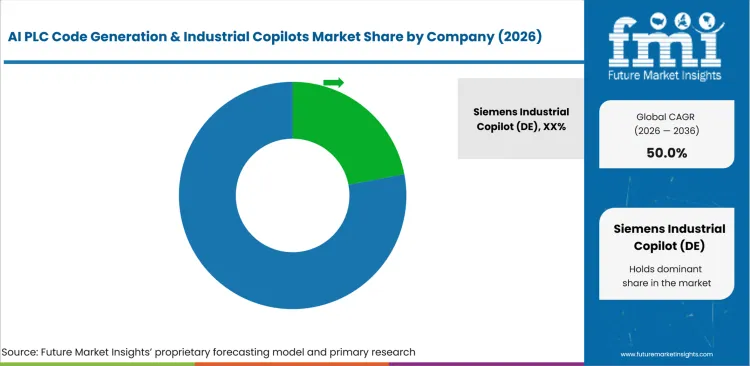
| Company | Market Position |
|---|---|
| Siemens (Germany) | TIA Portal integration gives the company direct access to PLC code and HMI engineering workflows. |
| Rockwell Automation (United States) | FactoryTalk Design Studio connects generative assistance with Logix control design and edge deployment choices. |
| Schneider Electric (France) | EcoStruxure Automation Expert combines PLC code generation with software-defined automation and simulation across collaborative engineering workflows and mixed control hardware. |
| PTC (United States) | Codebeamer links AI assistance with requirements reuse and test traceability before control implementation across complex product variants and regulated engineering programs. |
Competition turns on how much verified project context each assistant can use during generation. Automation suite providers benefit from direct links with controller projects and device settings. Lifecycle platforms compete through requirements reuse and test traceability across complex industrial product programs. Edge model options widen access at plants that restrict external processing of protected project data. Industrial cybersecurity controls influence access design across cloud and local services. Smart factory programs raise expectations for one engineering record across design and operations. Commercial separation therefore depends on usable output and governance rather than general model fluency.
- Integrated automation suites: Siemens and Rockwell Automation are expected to compete through direct links with controller projects and established industrial software workflows. Their products are likely to gain preference when generated code can be reviewed inside the same environment used for testing and release.
- Software-defined control platforms: Schneider Electric is projected to differentiate through code generation and simulation inside an open automation environment. The position is expected to appeal to engineering groups that want one workflow for control logic and HMI work across mixed hardware.
- Requirements and lifecycle platforms: PTC is anticipated to support industrial copilot work through reusable requirements and test records across complex industrial product programs. Its commercial role is likely to center on work before detailed PLC implementation and during evidence-based change control.
Competitive Benchmarking: AI PLC Code Generation & Industrial Copilots Market
| Benchmark Area | Siemens (Germany) | Rockwell Automation (United States) | Schneider Electric (France) | PTC (United States) |
|---|---|---|---|---|
| PLC code generation depth | High | High | High | Low |
| Project-context integration | High | High | High | Medium |
| Requirements and test traceability | Medium | Medium | High | High |
| Edge or on-premise flexibility | Medium | High | Medium | Medium |
Source: Future Market Insights competitive assessment based on official corporate announcements published from March 2025 through April 2026
Key Developments in the AI PLC Code Generation & Industrial Copilots Market
- In April 2026, Siemens launched the Eigen Engineering Agent for automation engineering inside TIA Portal. The company reported pilots with more than 100 customers across 19 countries and described PLC coding with HMI visualization and device configuration.
- In November 2025, Rockwell Automation announced an edge-based generative AI model optimized for FactoryTalk Design Studio workflows. The model was designed for HMI panels and desktop engineering environments with support for edge and air-gapped use.
- In March 2025, Schneider Electric introduced Automation Copilot within the EcoStruxure Automation Expert Platform. The assistant was designed to help engineers create validated code and applications inside a unified automation environment.
- In March 2025, PTC launched Codebeamer 3.0 for application lifecycle management across complex product programs. The release added scaled working sets and requirements reuse that can strengthen traceability before generated control code reaches implementation.
Key Players in the AI PLC Code Generation & Industrial Copilots Market
Automation engineering platform providers
- Siemens
- Rockwell Automation
- Schneider Electric
Requirements and lifecycle platform providers
- PTC
AI PLC Code Generation & Industrial Copilots Market - Report Scope
| Report Attribute | Coverage |
|---|---|
| Market Breakdown | Technology, Application, Deployment, End-use Industry, User Type, and Region |
| Segments Covered | Code generation, validation and testing, ladder logic, robot programs, cloud, on-premise, hybrid, end uses, and users |
| Regions Covered | North America, Latin America, Western Europe, Eastern Europe, East Asia, South Asia and Pacific, and Middle East and Africa |
| Countries or Markets Covered | European Union, United States, China, India, Japan, and other economies within the regional model |
| Key Companies Profiled | Siemens, Rockwell Automation, Schneider Electric, and PTC |
Source: Future Market Insights - proprietary forecasting model and primary research
AI PLC Code Generation & Industrial Copilots Market - Research Methodology
| Method | Application |
|---|---|
| Primary Research | FMI analysts gathered input from manufacturers, service providers, technology developers, distributors, end users, procurement teams, and subject-matter experts. Interviews examined purchasing decisions, product or service evaluation, adoption barriers, approval requirements, pricing considerations, and expectations for technical or commercial support. Respondents were also asked what evidence is required before a trial, pilot, or initial order develops into regular purchasing. |
| Desk Research | Desk research covered government statistics, regulatory publications, trade data, industry associations, technical literature, standards, company filings, product information, and official corporate announcements. Sources were reviewed for relevance, publication date, geographic coverage, and consistency with the defined market scope. Claims relating to performance, applications, approvals, capacity, investment, and commercial activity were retained only when supported by credible public evidence. |
| Market Sizing and Forecasting | The market model combined the baseline value with historical performance, segment structure, pricing and volume indicators, adoption levels, company participation, and country-level demand conditions. Forecast assumptions considered economic activity, investment trends, regulatory developments, technology adoption, purchasing cycles, supply availability, and barriers to wider market use. Segment and regional estimates were reconciled before the final market total was calculated. |
| Data Validation | Estimates were checked against multiple independent indicators, including public data, company activity, trade patterns, industry developments, and findings from primary interviews. Validation also tested whether products, services, applications, and company revenues fell within the defined market boundaries. Adjacent categories, unsupported claims, overlapping revenues, and activities without direct market relevance were excluded to reduce double counting and maintain consistency across segments and countries. |
AI PLC Code Generation & Industrial Copilots Market by Segments
AI PLC Code Generation & Industrial Copilots Market segmented by Technology:
- LLM Code Generation
- Code Validation and Testing
- Natural-language Programming
- Legacy Code Conversion
- Multi-agent Engineering Copilots
AI PLC Code Generation & Industrial Copilots Market segmented by Application:
- PLC - Ladder Logic Generation
- Robot Program Generation
- HMI - SCADA Configuration
- Code Documentation and Review
- Commissioning Support
AI PLC Code Generation & Industrial Copilots Market segmented by Deployment:
- Cloud
- On-premise
- Hybrid
AI PLC Code Generation & Industrial Copilots Market segmented by End-use Industry:
- Automotive
- Machine Builders and OEMs
- Process Industries
- Electronics
- Food and Beverage
AI PLC Code Generation & Industrial Copilots Market segmented by User Type:
- Control Engineers
- System Integrators
- Machine Builders
- In-house Maintenance Teams
AI PLC Code Generation & Industrial Copilots Market by Region:
- North America
- United States
- Canada
- Latin America
- Brazil
- Mexico
- Other Latin American Countries
- Western Europe
- Germany
- France
- United Kingdom
- Italy
- Spain
- Other Western European Countries
- Eastern Europe
- Poland
- Czech Republic
- Romania
- Other Eastern European Countries
- East Asia
- China
- Japan
- South Korea
- South Asia and Pacific
- India
- ASEAN Countries
- Australia
- New Zealand
- Other South Asian and Pacific Countries
- Middle East and Africa
- Gulf Cooperation Council Countries
- South Africa
- Other Middle Eastern and African Countries
Research Sources and Bibliography
- European Commission. (2024, August 1). European Artificial Intelligence Act comes into force.123
- Eurostat. (2025, December 11). 20% of EU enterprises use AI technologies.
- Eurostat. (2026, June 2). Use of artificial intelligence in enterprises.
- International Federation of Robotics. (2025, September 25). Global robot demand in factories doubles over 10 years.
- International Federation of Robotics. (2025, September 25). India rises to sixth in global factory robot installations.
- International Federation of Robotics. (2026, June 18). US robot industry returns to double digit growth.
- National Institute of Standards and Technology. (2024, July 26). Department of Commerce announces new guidance, tools 270 days following President Biden’s executive order on AI.
- PTC Inc. (2025, March 27). PTC launches Codebeamer 3.0.
- Rockwell Automation. (2025, November 13). Rockwell Automation to advance industrial intelligence through edge-based generative AI with NVIDIA Nemotron.
- Schneider Electric. (2025, March 31). Schneider Electric demonstrates technologies shaping the future of industry at Hannover Messe 2025.
- Siemens AG. (2025, May 12). Siemens introduces AI agents for industrial automation.
- Siemens AG. (2026, April 20). Siemens launches the Eigen Engineering Agent.
This Report Answers
- How large is the AI PLC code generation and industrial copilots market in 2026 and 2036?
- Which CAGR is projected for the market from 2026 to 2036?
- Which technology and application segments hold the disclosed 2026 shares?
- Why does cloud deployment account for 46.0% of spending in 2026?
- How do validation needs affect adoption inside physical production systems?
- Why do country growth rates differ across the profiled industrial economies?
- Which competitive dimensions separate automation suites from lifecycle platforms?
- What should plant engineering leaders test before approving a copilot?
- How does the research approach reconcile segment and country forecasts?
Frequently Asked Questions
What is driving growth in the AI PLC Code Generation & Industrial Copilots Market?
Engineering backlogs support demand for tools that draft routine PLC code and explain inherited programs. Growth depends on preserved human review across every controller change and commissioning decision.
Who are the key players in the AI PLC Code Generation & Industrial Copilots Market?
Siemens and Rockwell Automation connect generative assistance with established control engineering environments across major industrial projects. Schneider Electric and PTC support code creation or traceability across broader software workflows and complex product programs.
What is a notable restraint in the AI PLC Code Generation & Industrial Copilots Market?
Generated code can alter physical equipment after engineering approval and controlled download to the controller. Plants therefore need simulation and controlled commissioning before accepting any proposed logic for production use.
Why should executives track the AI PLC Code Generation & Industrial Copilots Market?
These tools change engineering capacity and software spending across automated plants and machine-building operations. Executives should track whether productivity gains arrive without weaker safety controls or less secure project data handling.
What business problem does the AI PLC Code Generation & Industrial Copilots Market address?
The market addresses repetitive code creation and the difficulty of understanding older controller programs. Faster preparation is possible while engineers retain final authority over machine behavior and commissioning approval.
What should procurement leaders evaluate before selecting suppliers?
Procurement leaders should test project-context access and supported controller languages before signing a contract. They should confirm hosting terms and audit records for generated outputs across each supported engineering environment.
What limits return on investment for purchasers?
Return is limited if engineers must rebuild every test or rewrite generated blocks ahead of commissioning. Poor integration moves engineering effort between tasks rather than reducing total project work.
How do suppliers build long-term account confidence?
Long-term confidence grows through stable project integration and clear boundaries around protected code. Consistent support during validation matters more than broad prompt features across long-term industrial accounts.
Preview the report firsthand - request a free sample
Get SampleGet the brochure for pricing and purchase details.
Get PDFTable of Content
- Key Takeaways
- Market Size and CAGR
- Top Growth Driver
- Fastest Growing Segment
- Leading Region
- Key Companies
- Emerging Opportunities
- Executive Summary
- Global Market Outlook
- Demand-side Trends
- Supply-side Trends
- Technology Roadmap Analysis
- Analysis and Recommendations
- Analyst Perspective (What is happening? Why now? What should investors know?)
- Key Questions Answered
- How large is the market?
- What is the CAGR?
- What are key trends?
- Which region dominates?
- Who are the leaders?
- Market Overview
- Market Coverage / Taxonomy
- Market Definition / Scope / Limitations
- Research Methodology
- Chapter Orientation
- Analytical Lens and Working Hypotheses
- Market Structure, Signals, and Trend Drivers
- Benchmarking and Cross-market Comparability
- Market Sizing, Forecasting, and Opportunity Mapping
- Research Design and Evidence Framework
- Desk Research Programme (Secondary Evidence)
- Expert Input and Fieldwork (Primary Evidence)
- Tooling, Models, and Reference Databases
- Data Engineering and Model Build
- Quality Assurance and Audit Trail
- Market Background
- Market Dynamics (Drivers, Restraints, Opportunity, Trends)
- Scenario Forecast (Optimistic, Likely, Conservative)
- Impact Analysis
- AI Impact
- Sustainability Impact
- Regulatory Impact
- Technology Impact
- Consumer / Buyer Analysis
- Purchase Drivers
- Adoption Barriers
- Buyer Journey
- Opportunity Map Analysis
- Product Life Cycle Analysis
- Supply Chain Analysis
- Investment Feasibility Matrix
- Value Chain Analysis
- PESTLE and Porter's Analysis
- Regulatory Landscape
- Regional Parent Market Outlook
- Production and Consumption Statistics
- Import and Export Statistics
- Global Market Analysis and Forecast, 2021 to 2036
- Historical Market Size Value (USD Mn) Analysis, 2021 to 2025
- Current and Future Market Size Value (USD Mn) Projections, 2026 to 2036
- Y-o-Y Growth Trend Analysis
- Absolute $ Opportunity Analysis
- Global Market Pricing Analysis, 2021 to 2036
- Global Market Analysis and Forecast, By Technology, 2021 to 2036
- Introduction / Key Findings
- Historical Market Size Value (USD Mn) Analysis By Technology, 2021 to 2025
- Current and Future Market Size Value (USD Mn) Analysis and Forecast By Technology, 2026 to 2036
- LLM code generation
- Code validation & testing
- Natural-language programming
- Legacy code conversion
- Multi-agent engineering copilots
- LLM code generation
- Y-o-Y Growth Trend Analysis By Technology, 2021 to 2025
- Absolute $ Opportunity Analysis By Technology, 2026 to 2036
- Global Market Analysis and Forecast, By Application, 2021 to 2036
- Introduction / Key Findings
- Historical Market Size Value (USD Mn) Analysis By Application, 2021 to 2025
- Current and Future Market Size Value (USD Mn) Analysis and Forecast By Application, 2026 to 2036
- PLC - ladder logic generation
- Robot program generation
- HMI - SCADA configuration
- Code documentation & review
- Commissioning support
- PLC - ladder logic generation
- Y-o-Y Growth Trend Analysis By Application, 2021 to 2025
- Absolute $ Opportunity Analysis By Application, 2026 to 2036
- Global Market Analysis and Forecast, By Deployment, 2021 to 2036
- Introduction / Key Findings
- Historical Market Size Value (USD Mn) Analysis By Deployment, 2021 to 2025
- Current and Future Market Size Value (USD Mn) Analysis and Forecast By Deployment, 2026 to 2036
- Cloud
- On-premise
- Hybrid
- Cloud
- Y-o-Y Growth Trend Analysis By Deployment, 2021 to 2025
- Absolute $ Opportunity Analysis By Deployment, 2026 to 2036
- Global Market Analysis and Forecast, By End-use Industry, 2021 to 2036
- Introduction / Key Findings
- Historical Market Size Value (USD Mn) Analysis By End-use Industry, 2021 to 2025
- Current and Future Market Size Value (USD Mn) Analysis and Forecast By End-use Industry, 2026 to 2036
- Automotive
- Machine builders - OEMs
- Process industries
- Electronics
- Food & beverage
- Automotive
- Y-o-Y Growth Trend Analysis By End-use Industry, 2021 to 2025
- Absolute $ Opportunity Analysis By End-use Industry, 2026 to 2036
- Global Market Analysis and Forecast, By User Type, 2021 to 2036
- Introduction / Key Findings
- Historical Market Size Value (USD Mn) Analysis By User Type, 2021 to 2025
- Current and Future Market Size Value (USD Mn) Analysis and Forecast By User Type, 2026 to 2036
- Control engineers
- System integrators
- Machine builders
- In-house maintenance
- Control engineers
- Y-o-Y Growth Trend Analysis By User Type, 2021 to 2025
- Absolute $ Opportunity Analysis By User Type, 2026 to 2036
- Global Market Analysis and Forecast, By Region, 2021 to 2036
- Introduction
- Historical Market Size Value (USD Mn) Analysis By Region, 2021 to 2025
- Current Market Size Value (USD Mn) Analysis and Forecast By Region, 2026 to 2036
- North America
- Latin America
- Western Europe
- Eastern Europe
- East Asia
- South Asia and Pacific
- Middle East & Africa
- Market Attractiveness Analysis By Region
- North America Market Analysis and Forecast, By Country, 2021 to 2036
- Historical Market Size Value (USD Mn) Trend Analysis By Market Taxonomy, 2021 to 2025
- Market Size Value (USD Mn) Forecast By Market Taxonomy, 2026 to 2036
- By Country
- USA
- Canada
- By Technology
- By Application
- By Deployment
- By End-use Industry
- By User Type
- By Country
- Market Attractiveness Analysis
- By Country
- By Technology
- By Application
- By Deployment
- By End-use Industry
- By User Type
- Key Takeaways
- Latin America Market Analysis and Forecast, By Country
- Historical Market Size Value (USD Mn) Trend Analysis By Market Taxonomy, 2021 to 2025
- Market Size Value (USD Mn) Forecast By Market Taxonomy, 2026 to 2036
- By Country
- Brazil
- Mexico
- Chile
- Rest of Latin America
- By Technology
- By Application
- By Deployment
- By End-use Industry
- By User Type
- By Country
- Market Attractiveness Analysis
- By Country
- By Technology
- By Application
- By Deployment
- By End-use Industry
- By User Type
- Key Takeaways
- Western Europe Market Analysis and Forecast, By Country
- Historical Market Size Value (USD Mn) Trend Analysis By Market Taxonomy, 2021 to 2025
- Market Size Value (USD Mn) Forecast By Market Taxonomy, 2026 to 2036
- By Country
- Germany
- UK
- Italy
- Spain
- France
- Nordic
- BENELUX
- Rest of Western Europe
- By Technology
- By Application
- By Deployment
- By End-use Industry
- By User Type
- By Country
- Market Attractiveness Analysis
- By Country
- By Technology
- By Application
- By Deployment
- By End-use Industry
- By User Type
- Key Takeaways
- Eastern Europe Market Analysis and Forecast, By Country
- Historical Market Size Value (USD Mn) Trend Analysis By Market Taxonomy, 2021 to 2025
- Market Size Value (USD Mn) Forecast By Market Taxonomy, 2026 to 2036
- By Country
- Russia
- Poland
- Hungary
- Balkan & Baltic
- Rest of Eastern Europe
- By Technology
- By Application
- By Deployment
- By End-use Industry
- By User Type
- By Country
- Market Attractiveness Analysis
- By Country
- By Technology
- By Application
- By Deployment
- By End-use Industry
- By User Type
- Key Takeaways
- East Asia Market Analysis and Forecast, By Country
- Historical Market Size Value (USD Mn) Trend Analysis By Market Taxonomy, 2021 to 2025
- Market Size Value (USD Mn) Forecast By Market Taxonomy, 2026 to 2036
- By Country
- China
- Japan
- South Korea
- By Technology
- By Application
- By Deployment
- By End-use Industry
- By User Type
- By Country
- Market Attractiveness Analysis
- By Country
- By Technology
- By Application
- By Deployment
- By End-use Industry
- By User Type
- Key Takeaways
- South Asia and Pacific Market Analysis and Forecast, By Country
- Historical Market Size Value (USD Mn) Trend Analysis By Market Taxonomy, 2021 to 2025
- Market Size Value (USD Mn) Forecast By Market Taxonomy, 2026 to 2036
- By Country
- India
- ASEAN
- Australia & New Zealand
- Rest of South Asia and Pacific
- By Technology
- By Application
- By Deployment
- By End-use Industry
- By User Type
- By Country
- Market Attractiveness Analysis
- By Country
- By Technology
- By Application
- By Deployment
- By End-use Industry
- By User Type
- Key Takeaways
- Middle East & Africa Market Analysis and Forecast, By Country
- Historical Market Size Value (USD Mn) Trend Analysis By Market Taxonomy, 2021 to 2025
- Market Size Value (USD Mn) Forecast By Market Taxonomy, 2026 to 2036
- By Country
- Kingdom of Saudi Arabia
- Other GCC Countries
- Türkiye
- South Africa
- Other African Union
- Rest of Middle East & Africa
- By Technology
- By Application
- By Deployment
- By End-use Industry
- By User Type
- By Country
- Market Attractiveness Analysis
- By Country
- By Technology
- By Application
- By Deployment
- By End-use Industry
- By User Type
- Key Takeaways
- Key Countries Market Analysis
- USA
- Pricing Analysis
- Market Share Analysis, 2025
- By Technology
- By Application
- By Deployment
- By End-use Industry
- By User Type
- Canada
- Pricing Analysis
- Market Share Analysis, 2025
- By Technology
- By Application
- By Deployment
- By End-use Industry
- By User Type
- Mexico
- Pricing Analysis
- Market Share Analysis, 2025
- By Technology
- By Application
- By Deployment
- By End-use Industry
- By User Type
- Brazil
- Pricing Analysis
- Market Share Analysis, 2025
- By Technology
- By Application
- By Deployment
- By End-use Industry
- By User Type
- Chile
- Pricing Analysis
- Market Share Analysis, 2025
- By Technology
- By Application
- By Deployment
- By End-use Industry
- By User Type
- Germany
- Pricing Analysis
- Market Share Analysis, 2025
- By Technology
- By Application
- By Deployment
- By End-use Industry
- By User Type
- UK
- Pricing Analysis
- Market Share Analysis, 2025
- By Technology
- By Application
- By Deployment
- By End-use Industry
- By User Type
- Italy
- Pricing Analysis
- Market Share Analysis, 2025
- By Technology
- By Application
- By Deployment
- By End-use Industry
- By User Type
- Spain
- Pricing Analysis
- Market Share Analysis, 2025
- By Technology
- By Application
- By Deployment
- By End-use Industry
- By User Type
- France
- Pricing Analysis
- Market Share Analysis, 2025
- By Technology
- By Application
- By Deployment
- By End-use Industry
- By User Type
- India
- Pricing Analysis
- Market Share Analysis, 2025
- By Technology
- By Application
- By Deployment
- By End-use Industry
- By User Type
- ASEAN
- Pricing Analysis
- Market Share Analysis, 2025
- By Technology
- By Application
- By Deployment
- By End-use Industry
- By User Type
- Australia & New Zealand
- Pricing Analysis
- Market Share Analysis, 2025
- By Technology
- By Application
- By Deployment
- By End-use Industry
- By User Type
- China
- Pricing Analysis
- Market Share Analysis, 2025
- By Technology
- By Application
- By Deployment
- By End-use Industry
- By User Type
- Japan
- Pricing Analysis
- Market Share Analysis, 2025
- By Technology
- By Application
- By Deployment
- By End-use Industry
- By User Type
- South Korea
- Pricing Analysis
- Market Share Analysis, 2025
- By Technology
- By Application
- By Deployment
- By End-use Industry
- By User Type
- Russia
- Pricing Analysis
- Market Share Analysis, 2025
- By Technology
- By Application
- By Deployment
- By End-use Industry
- By User Type
- Poland
- Pricing Analysis
- Market Share Analysis, 2025
- By Technology
- By Application
- By Deployment
- By End-use Industry
- By User Type
- Hungary
- Pricing Analysis
- Market Share Analysis, 2025
- By Technology
- By Application
- By Deployment
- By End-use Industry
- By User Type
- Kingdom of Saudi Arabia
- Pricing Analysis
- Market Share Analysis, 2025
- By Technology
- By Application
- By Deployment
- By End-use Industry
- By User Type
- Türkiye
- Pricing Analysis
- Market Share Analysis, 2025
- By Technology
- By Application
- By Deployment
- By End-use Industry
- By User Type
- South Africa
- Pricing Analysis
- Market Share Analysis, 2025
- By Technology
- By Application
- By Deployment
- By End-use Industry
- By User Type
- USA
- Market Structure Analysis
- Competition Dashboard
- Competition Benchmarking
- Market Share Analysis of Top Players
- By Regional
- By Technology
- By Application
- By Deployment
- By End-use Industry
- By User Type
- Emerging Startups
- Innovation Benchmarking
- Competition Analysis
- Competition Deep Dive
- Siemens Industrial Copilot (DE)
- Overview
- Product Portfolio
- Profitability by Market Segments
- Sales Footprint
- Strategy Overview
- Marketing Strategy
- Product Strategy
- Channel Strategy
- Beckhoff (DE)
- PTC - CodeBeamer (US)
- Datch (US)
- Siemens Industrial Copilot (DE)
- Case Studies
- Success Stories
- Recent Developments
- Competition Deep Dive
- Assumptions & Acronyms Used


