

- Market Size (2026)
- USD 3.2 Bn
- Forecast (2036)
- USD 6.5 Bn
- CAGR (2026 to 2036)
- 7.2%
Industrial Sludge Dryer Market Size, Market Forecast and Outlook By FMI
USD 3.2 billion in 2026 and USD 6.5 billion by 2036 at a 7.2% CAGR.
The industrial sludge dryer market is projected to rise from USD 3.0 billion in 2025 to USD 6.5 billion by 2036. This expansion is expected to be driven by plants that need lower disposal weight and steadier sludge outlets. Dryer buyers now compare hauling cost against heat availability before they approve a thermal system Market expansion is expected to be supported by public wastewater infrastructure renewal and growing efforts to reduce the risks and costs associated with sludge transportation. The scale of upcoming investment is significant, with the USA Environmental Protection Agency reporting in May 2026 that clean water infrastructure needs totaled USD 630.1 billion.
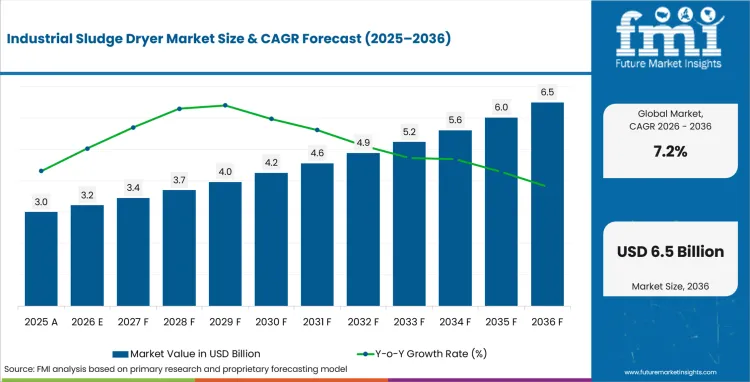
| Metric | Value |
|---|---|
| 2026 Market Size | USD 3.2 billion |
| 2036 Market Size | USD 6.5 billion |
| Forecast CAGR | 7.2% CAGR from 2026 to 2036 |
| Leading Dryer Type | Belt Dryers |
| Belt Dryers Share in 2026 | 34.0% |
| Leading Heat Source | Steam / Thermal Oil |
| Steam / Thermal Oil Share in 2026 | 40.0% |
| Fastest-growing Country | India |
| India CAGR | 8.6% by 2036 |
Summary of the Industrial Sludge Dryer Market
| Market Signal | Commercial Impact |
|---|---|
| Demand and Growth Drivers | Demand for industrial sludge dryers is being driven by wastewater treatment facilities seeking lower disposal costs and improved sludge management efficiency.
|
| Product and Segment View | Belt dryers, steam and thermal oil systems, municipal sludge applications, and EPC integrators are expected to lead their respective segments.
|
| Geography and Growth Outlook | India, China, and the United States are expected to remain key growth markets, supported by wastewater infrastructure investment and increasingly stringent sludge management requirements.
|
| Competitive Landscape | Competition is increasingly focused on integrated sludge treatment capabilities, thermal efficiency, and comprehensive wastewater management solutions.
|
| Analyst Perspective | Industrial sludge dryers are increasingly becoming part of broader wastewater investment decisions rather than standalone equipment purchases.
- Nikhil Kaitwade, Principal Consultant at Future Market Insights |
Mature wastewater networks continue to generate steady demand for sludge treatment solutions, as highlighted by Germany's environment ministry, which noted in February 2026 that about 97% of the population is connected to public sewage systems. Project activity further reflects ongoing modernization efforts, with SUEZ securing the Sha Tin cavern contract in Hong Kong in January 2026. These developments indicate that wastewater system upgrades are creating opportunities for sludge dryers to be incorporated into broader water treatment systems modernization and efficiency improvement programs.
Which factors support expansion in the industrial sludge dryer market?
Dryer demand is shaped by treatment-asset renewal and practical sludge handling economics.
- Market value reflects thermal equipment spending due to added project scope from odor systems and conveyors.
- Supplier pricing is driven by evaporation duty and metallurgy before controls change installed project value.
- Revenue improves due to lifecycle proof that compares dryer energy cost against wet cake hauling and landfill fees.
- Project confidence rises after OEMs provide pilot testing and heat-balance evidence before final tendering.
Why is the industrial sludge dryer market growing?
Sludge drying demand is rising because plants need lower disposal weight and safer final sludge outlets.
Dryer selection begins before the thermal unit is specified because upstream cake quality decides energy load. According to EPA in September 2025, reports submitted in 2024 covered about four million dry metric tons of sewage sludge. That volume explains why utilities evaluate dewatering and sludge treatment chemicals before dryer sizing decisions. Higher cake solids reduce heat demand and make the final equipment case easier to defend.
How is the industrial sludge dryer market segmented?
The industrial sludge dryer industry is segmented by dryer type, heat source, sludge type, capacity, and sales channel.
- Belt dryers are projected to secure 34.0% share in 2026 supported by waste heat fit and lower-temperature operation.
- Steam / thermal oil systems are anticipated to hold 40.0% share in 2026 owing to stable heat transfer for indirect dryers.
- Municipal sludge is expected to capture 52.0% share in 2026 due to repeat sludge volumes from public treatment plants.
- The 10-50 TPD capacity range is forecast to represent 44.0% share in 2026 attributable to mid-sized utility demand.
- EPC / integrators are projected to direct 43.0% share in 2026 driven by bundled design and emission-treatment scope.
Which dryer type category holds a notable share in the industrial sludge dryer market?
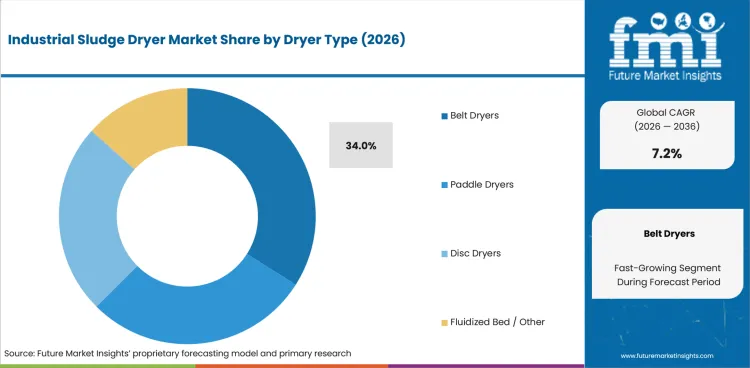
- Belt dryers are projected to account for 34.0% share in 2026 due to low-temperature operation and steady municipal sludge drying needs.
- Paddle dryers serve enclosed indirect drying needs owing to lower exhaust volume and reduced operator exposure.
How does the heat source segment perform in the industrial sludge dryer market?
- Steam / thermal oil systems are expected to hold 40.0% share in 2026 supported by stable heat transfer for paddle and disc dryers.
- Waste heat recovery gains relevance at plants with boilers or process exhaust lines due to better payback before new fuel purchases.
What drives demand across the sludge type segment in the industrial sludge dryer market?
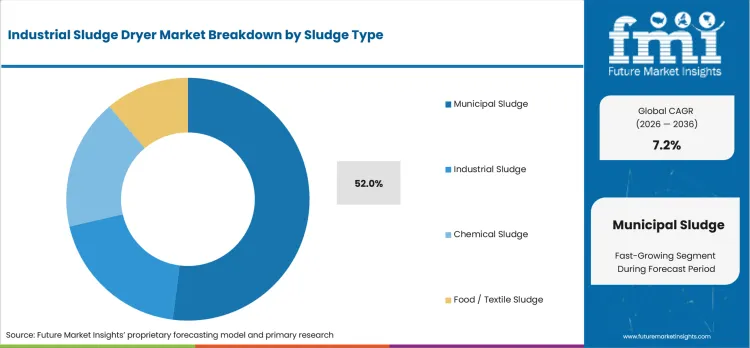
- Municipal sludge is forecast to represent 52.0% share in 2026 driven by repeat cake volumes from public utilities.
- Industrial sludge demand is supported by chemical and textile processors plus food plants due to predictable disposal-route needs.
Which capacity band shows a prominent position in the industrial sludge dryer market?
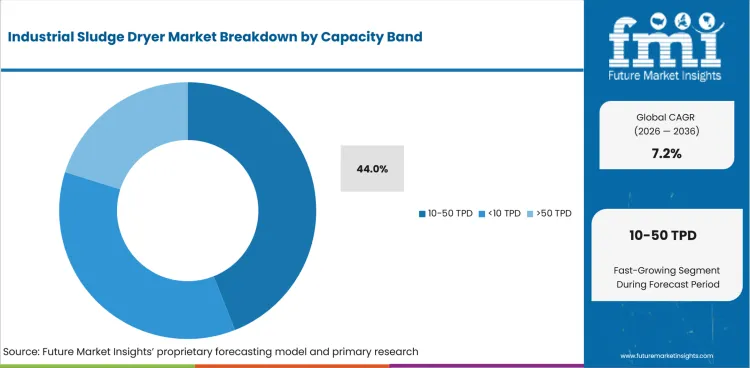
- The 10-50 TPD band is projected to hold 44.0% share in 2026 attributable to mid-sized plant replacement cycles.
- Plants below 10 TPD often favor compact units due to landfill distance and odor complaints at smaller sites.
How are buyers selecting across sales channel options in the industrial sludge dryer market?
- EPC / integrators are estimated to hold 43.0% share in 2026 owing to engineering coordination needs in thermal drying.
- Direct OEM routes remain important for plants that can integrate dryers into existing dewatering lines.
What drivers and restraints shape opportunities in the industrial sludge dryer market?
Disposal pressure and heat integration support equipment demand. High energy cost limits projects that lack usable heat.
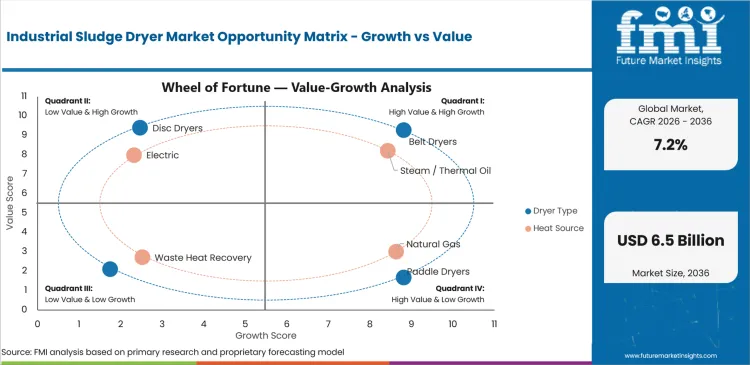
- Driver: Disposal-route tightening is likely to raise demand for drying before landfill or recovery use.
- Restraint: High thermal energy cost can slow adoption in plants that lack usable steam or waste heat.
- Opportunity: Heat pump and cold-air dryers can serve smaller plants lacking conventional thermal sources.
Industrial Sludge Drying Demand Outlook
Landfill exposure gives drying a clear disposal-cost role because utilities can compare wet hauling against thermal treatment. EPA stated in September 2025 that reports submitted in 2024 showed about 982000 dry metric tons of sewage sludge was landfilled. The figure matters because landfill use keeps utilities exposed to hauling cost and outlet restrictions. Drying can reduce transport weight before sludge is sent for disposal or recovery in planned outlet routes.
Heat Source Economics and Payback Analysis
Heat-source fit is reviewed before buyers compare dryer formats because energy source decides operating value. HUBER introduced the Cold Air Dryer HPS in August 2025 for smaller sewage sludge applications. The system serves plants up to 50 thousand PE and can handle annual sludge production up to 3000 t. This gives industrial water treatment systems buyers a heat-pump route at sites without useful waste heat.
Odor and Dust Control Decision Analysis
Outlet control is becoming part of the dryer business case because disposal routes require stronger documentation. The Environment Agency said in December 2025 that PR24 enabled GBP 0.5 billion of investment for sludge supply-chain resilience. The same program expects water companies to reach 100% satisfactory sludge use and disposal under the strategy. These targets make stable dried output more valuable during permit and storage reviews for utilities.
Which countries are growing fastest in the industrial sludge dryer market?
India 8.6% CAGR, China 8.2% CAGR, South Korea 6.9% CAGR, United States 6.8% CAGR, France 6.6% CAGR, United Kingdom 6.5% CAGR, Germany 6.1% CAGR, and Japan 5.9% CAGR by 2036.
.webp "Top Country Growth Comparison Industrial Sludge Dryer Market Cagr (2026 2036)")
| Country | CAGR |
|---|---|
| India | 8.6% |
| China | 8.2% |
| South Korea | 6.9% |
| United States | 6.8% |
| France | 6.6% |
| United Kingdom | 6.5% |
| Germany | 6.1% |
| Japan | 5.9% |
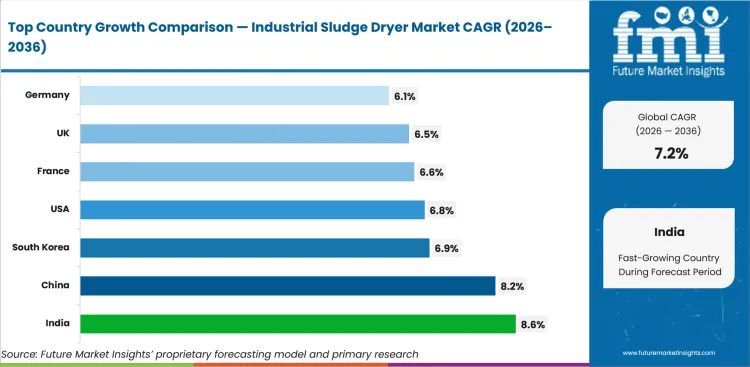
Source: Future Market Insights, 2026.
How do country-level CAGRs compare in the industrial sludge dryer market?
India shows the most prominent CAGR outlook. Japan records the most cautious expansion among profiled countries.
- India is forecast to post 8.6% CAGR by 2036 due to sewage treatment additions and industrial effluent compliance.
- China is projected to advance at 8.2% CAGR by 2036 supported by sludge capacity targets and large city wastewater clusters.
- South Korea is estimated to grow at 6.9% CAGR by 2036 attributable to high-spec industrial wastewater requirements.
- United States demand is set to rise at 6.8% CAGR by 2036 driven by public utility replacement and landfill exposure.
- France is likely to reach 6.6% CAGR by 2036 owing to operator-led wastewater modernization.
- United Kingdom growth is pegged at 6.5% CAGR by 2036 supported by sludge regulatory transition and AMP-cycle planning.
- Germany is expected to record 6.1% CAGR by 2036 due to retrofit demand across municipal treatment assets.
- Japan is anticipated to post 5.9% CAGR by 2036 attributable to resource recovery policy and compact equipment needs.
How fast is the industrial sludge dryer market growing in India?
An 8.6% CAGR by 2036 reflects sewage treatment additions and stricter industrial effluent management.
Industrial Sludge Dryer Market
| Parameter | Value |
|---|---|
| Market Size in 2025 (Value) | USD 147.3 million |
| Market Size in 2026 (Value) | USD 160.0 million |
| Market Forecast in 2036 (Value) | USD 365.1 million |
| CAGR (2026 to 2036) | 8.6% |
| Years Considered | 2021 to 2036 |
| Base Year | 2025 |
| Forecast Period | 2026 to 2036 |
| Units Considered | Value (USD million) |
| Leading Sub-Region | Delhi NCR, Maharashtra, Gujarat, Tamil Nadu, and industrial wastewater corridors |
India Industrial Sludge Dryer Market Outlook
India sludge dryer demand is propelled by sewage capacity additions and industrial cluster compliance. Municipal bodies need equipment that reduces wet cake transport before disposal planning becomes difficult.
Local fabrication and EPC partnerships shape buying decisions. State pollution consent requirements also push suppliers to prove service access and operating reliability.
Key Growth Drivers
- Urban sewage treatment additions are expected to create downstream sludge handling demand across larger municipal projects. National Green Tribunal material recorded planned Delhi sewage treatment capacity at 922 MGD for the city. This figure supports dryer demand because added treatment capacity usually creates more dewatered cake that must be moved or stabilized.
- River-cleaning and sanitation programs make bundled wastewater equipment procurement more likely across city utility packages and EPC tenders. NMCG reported Delhi STP capacity planning at 964.5 MGD for the next phase of works. That planning base gives EPC bidders a clearer route to include drying and handling equipment in larger treatment packages.
- Textile and chemical clusters keep mid-capacity dryers relevant due to sludge stabilization needs before off-site disposal.
- Domestic EPC and fabrication channels improve bid access owing to local service coverage that lowers municipal tender risk.
Key Restraints
- Municipal budgets keep lifecycle savings under close review due to cheaper hauling options in some tender comparisons.
- Feed variability can limit uptime in smaller industrial plants owing to pretreatment discipline needed before thermal drying.
- Project execution delays can hold back downstream dryer awards after wastewater capacity is still being approved. CPCB filings show Delhi STP capacity planning is still moving in stages across treatment additions. This is important for dryer suppliers because thermal equipment is usually ordered after civil scope and treatment capacity are approved.
What makes India unique
India is unique for its mix of sewage capacity additions and industrial consent pressure across municipal and private-sector demand.
Key Companies
- Kilburn Engineering
- VA Tech WABAG
- Thermax Limited
- Ion Exchange India
- Triveni Engineering
- ANDRITZ Separation India
Sales & Marketing Channels
- Municipal corporation tenders
- EPC contractor bids
- Industrial park wastewater projects
- Direct OEM sales
- Local fabricator partnerships
- State pollution compliance upgrades
Country Segment Breakdown Table
| Segment | Sub-Segments |
|---|---|
| By Dryer Type | Belt Dryers · Paddle Dryers · Disc Dryers · Fluidized Bed / Other |
| By Heat Source | Steam / Thermal Oil · Natural Gas · Electric · Waste Heat Recovery |
| By Sludge Type | Municipal Sludge · Industrial Sludge · Chemical Sludge · Food / Textile Sludge |
| By Capacity | <10 TPD · 10-50 TPD · >50 TPD |
| By Sales Channel | Direct OEM · EPC / Integrators · Service Retrofit |
| Key Sub-Regions Covered, Manufacturing and wastewater corridors | Delhi NCR, Maharashtra, Gujarat, Tamil Nadu, and industrial wastewater corridors |
Frequently Asked Questions
How fast is India industrial sludge dryer market growing?
India is forecast to expand at 8.6% CAGR from 2026 to 2036.
Who competes in India industrial sludge dryer market?
Kilburn Engineering, VA Tech WABAG, Thermax Limited, and Ion Exchange India compete through dryer equipment and wastewater project access.
What drives adoption in India industrial sludge dryer market?
Sewage treatment additions and industrial estate compliance keep dryer trials active. Utilities want lower hauling weight and clearer disposal routes.
What supports industrial sludge dryer growth in China?
An 8.2% CAGR by 2036 reflects large sludge volumes and city-level treatment capacity targets.
Industrial Sludge Dryer Market
| Parameter | Value |
|---|---|
| Market Size in 2025 (Value) | USD 647.0 million |
| Market Size in 2026 (Value) | USD 700.0 million |
| Market Forecast in 2036 (Value) | USD 1539.5 million |
| CAGR (2026 to 2036) | 8.2% |
| Years Considered | 2021 to 2036 |
| Base Year | 2025 |
| Forecast Period | 2026 to 2036 |
| Units Considered | Value (USD million) |
| Leading Sub-Region | Yangtze River Delta, Pearl River Delta, Beijing-Tianjin-Hebei, Chengdu, and Tianjin |
China Industrial Sludge Dryer Market Outlook
China sludge dryer demand is anchored in large urban treatment projects. High-capacity belt and disc systems fit city plants that need repeat sludge handling at scale.
Suppliers need local testing and automation proof before public tenders. Service depth and provincial EPC relationships often decide whether foreign dryer technology converts into orders.
Key Growth Drivers
- City sludge treatment targets are expected to lift dryer procurement in larger municipal projects and provincial tenders. The USA International Trade Administration reported added capacity targets of 20 thousand tons per day. That target makes high-throughput dryers more relevant for municipal clusters that must move sludge continuously.
- Large sludge generation creates a scale-based case for high-capacity drying systems in urban wastewater projects. The USA International Trade Administration reported annual sludge production above 70 million tons for China. This scale supports demand for dryers that can handle variable feed while keeping output stable for disposal routes.
- Industrial water reuse policy reinforces stronger wastewater treatment lines due to rising attention on sludge stabilization in industrial parks.
- Local EPC partnerships improve access to provincial tenders owing to reference and aftermarket coverage requirements for foreign OEMs.
Key Restraints
- Variable sludge composition can raise wear and energy risk before equipment selection is finalized during public tenders. The USA International Trade Administration noted high silt and heavy metal content in China sludge. That observation explains why buyers ask for pilot testing before choosing a dryer configuration for procurement.
- Public tenders often reward price and references due to domestic delivery capacity remaining a selection factor.
- Approval cycles can be lengthy in city-scale projects owing to civil coordination before dryer equipment orders move.
What makes China unique
China is unique for large sludge volumes and city-level capacity targets that favor high-throughput dryer packages.
Key Companies
- SUEZ NWS
- ANDRITZ China
- HUBER Technology China
- Haarslev China
- Beijing Enterprises Water Group
- Poten Environment
Sales & Marketing Channels
- Public project tenders
- Local EPC partnerships
- Provincial utility procurement
- Industrial park wastewater projects
- Joint bids with local contractors
- Service and spare parts networks
Country Segment Breakdown Table
| Segment | Sub-Segments |
|---|---|
| By Dryer Type | Belt Dryers · Paddle Dryers · Disc Dryers · Fluidized Bed / Other |
| By Heat Source | Steam / Thermal Oil · Natural Gas · Electric · Waste Heat Recovery |
| By Sludge Type | Municipal Sludge · Industrial Sludge · Chemical Sludge · Food / Textile Sludge |
| By Capacity | <10 TPD · 10-50 TPD · >50 TPD |
| By Sales Channel | Direct OEM · EPC / Integrators · Service Retrofit |
| Key Sub-Regions Covered, Manufacturing and wastewater corridors | Yangtze River Delta, Pearl River Delta, Beijing-Tianjin-Hebei, Chengdu, and Tianjin |
Frequently Asked Questions
How fast is China industrial sludge dryer market growing?
China is forecast to expand at 8.2% CAGR from 2026 to 2036.
Who competes in China industrial sludge dryer market?
SUEZ NWS, ANDRITZ China, HUBER Technology China, and Haarslev China compete through dryer equipment and wastewater project access.
What drives adoption in China industrial sludge dryer market?
City sludge treatment capacity targets raise dryer relevance in larger municipal packages. Industrial parks also need reliable cake stabilization before off-site movement.
How is South Korea performing in the industrial sludge dryer market?
A 6.9% CAGR by 2036 reflects industrial wastewater quality needs and compact project requirements.
Industrial Sludge Dryer Market
| Parameter | Value |
|---|---|
| Market Size in 2025 (Value) | USD 102.9 million |
| Market Size in 2026 (Value) | USD 110.0 million |
| Market Forecast in 2036 (Value) | USD 214.4 million |
| CAGR (2026 to 2036) | 6.9% |
| Years Considered | 2021 to 2036 |
| Base Year | 2025 |
| Forecast Period | 2026 to 2036 |
| Units Considered | Value (USD million) |
| Leading Sub-Region | Seoul metropolitan area, Gyeonggi, Ulsan, Busan, Daegu, and semiconductor corridors |
South Korea Industrial Sludge Dryer Market Outlook
South Korea demand is tied to electronics and chemical manufacturing sites that manage complex wastewater streams. Municipal water quality expectations also influence dryer specification.
Market access depends on local engineering partners and fast service response. Domestic EPC firms influence plant specifications, so foreign suppliers need channel support before shortlisting.
Key Growth Drivers
- Environmental technology exports show that South Korea has an active base for water-infrastructure delivery and EPC execution. The Ministry of Environment reported KRW 20 trillion in green industry contracts and exports in its policy plan. This supports dryer demand because domestic engineering capability can move wastewater projects from policy intent to equipment delivery.
- Sewage reuse experience reinforces the case for treatment-line upgrades across public wastewater assets and utility systems. Korea reported 1136.75 million tons of treated sewage reuse in official sewer statistics for public wastewater systems. Reuse at that scale makes sludge handling quality more important because treatment plants must keep by-products controlled.
- Electronics and chemical plants need predictable sludge handling due to enclosed drying requirements and service-backed retrofit needs.
- Space-constrained sites favor compact automated systems because smaller footprints improve supplier relevance in retrofit tenders.
Key Restraints
- Smaller domestic project counts can limit scale for foreign OEMs due to the need for local partners to convert approvals into awards.
- Industrial buyers may prefer established domestic engineering channels owing to performance references required before shortlisting.
- Public evidence on dryer projects remains limited compared with larger equipment markets in East Asia. Korea's official sewer statistics still focus on treated sewage reuse rather than dryer awards and installed dryer references. This makes benchmarking harder for smaller suppliers that need project references before shortlisting decisions and service negotiations.
What makes South Korea unique
South Korea is unique for high-spec industrial wastewater needs that can outweigh lowest purchase price in dryer selection.
Key Companies
- Samsung Engineering
- Hyundai Engineering
- GS Engineering & Construction
- Kolon Global
- Doosan Enerbility
- SUEZ Korea
Sales & Marketing Channels
- Industrial plant engineering contractors
- Public utility tenders
- Local distributor partnerships
- Direct OEM technical proposals
- Retrofit service agreements
- Compliance consulting channels
Country Segment Breakdown Table
| Segment | Sub-Segments |
|---|---|
| By Dryer Type | Belt Dryers · Paddle Dryers · Disc Dryers · Fluidized Bed / Other |
| By Heat Source | Steam / Thermal Oil · Natural Gas · Electric · Waste Heat Recovery |
| By Sludge Type | Municipal Sludge · Industrial Sludge · Chemical Sludge · Food / Textile Sludge |
| By Capacity | <10 TPD · 10-50 TPD · >50 TPD |
| By Sales Channel | Direct OEM · EPC / Integrators · Service Retrofit |
| Key Sub-Regions Covered, Manufacturing and wastewater corridors | Seoul metropolitan area, Gyeonggi, Ulsan, Busan, Daegu, and semiconductor corridors |
Frequently Asked Questions
How fast is South Korea industrial sludge dryer market growing?
South Korea is forecast to expand at 6.9% CAGR from 2026 to 2036.
Who competes in South Korea industrial sludge dryer market?
Samsung Engineering, Hyundai Engineering, GS Engineering & Construction, and Kolon Global compete through dryer equipment and wastewater project access.
What drives adoption in South Korea industrial sludge dryer market?
Electronics and chemical wastewater sites favor predictable sludge handling. Local EPC channels make enclosed drying easier to specify.
What is the industrial sludge dryer outlook in the United States?
A 6.8% CAGR by 2036 reflects utility renewal and landfill pressure. Industrial sludge handling demand adds a second channel.
Industrial Sludge Dryer Market
| Parameter | Value |
|---|---|
| Market Size in 2025 (Value) | USD 674.2 million |
| Market Size in 2026 (Value) | USD 720.0 million |
| Market Forecast in 2036 (Value) | USD 1390.1 million |
| CAGR (2026 to 2036) | 6.8% |
| Years Considered | 2021 to 2036 |
| Base Year | 2025 |
| Forecast Period | 2026 to 2036 |
| Units Considered | Value (USD million) |
| Leading Sub-Region | California, Texas, Midwest utilities, Southeast wastewater corridors, and Northeast industrial clusters |
United States Industrial Sludge Dryer Market Outlook
USA dryer projects compete for capital against nutrient removal and collection-system repair. Stormwater work also pressures utility budgets.
Municipal buyers usually require pilot testing and service access before award. Industrial buyers can move faster if landfill acceptance or hauling cost becomes a direct operating risk.
Key Growth Drivers
- Public wastewater infrastructure needs create a long runway for upgrade opportunities inside treatment plants and utility networks. EPA reported clean water infrastructure needs of USD 630.1 billion in May 2026 for reported projects. This figure supports dryer demand because sludge handling upgrades often appear inside broader treatment-plant renewal budgets.
- Large treatment networks create repeat sludge volumes for equipment suppliers across many utility sites and regions. EPA recorded 17544 publicly owned treatment works in the Clean Watersheds Needs Survey for the United States. A network of that size gives dryer vendors many retrofit targets beyond single large metropolitan plants.
- Biogas and combined heat and power systems improve dryer economics because existing thermal assets can reduce fresh fuel purchases.
- Engineering consultant specifications support proven suppliers since test data and local service teams reduce project risk.
Key Restraints
- Landfill reliance remains a risk rather than a direct conversion path for dryer adoption decisions. EPA estimated that 982000 dry metric tons of sewage sludge was landfilled in reported submissions. This number shows why utilities compare dryer energy cost against future landfill exposure before approving projects.
- Capital budgets can delay dryers behind urgent sewer repairs because consent-order work often receives earlier utility funding.
- Odor concerns can slow permitting since community review often examines exhaust treatment and enclosed system performance before approval.
What makes United States unique
The United States is unique for public utility tenders and private industrial sludge projects that both support dryer demand.
Key Companies
- HUBER Technology Inc.
- Komline-Sanderson
- LCI Corporation
- ANDRITZ Inc.
- Haarslev Inc.
- Veolia Water Technologies North America
Sales & Marketing Channels
- Public utility tenders
- Engineering consultant specifications
- EPC contractor partnerships
- Direct OEM sales
- Service retrofit programs
- State and municipal procurement frameworks
Country Segment Breakdown Table
| Segment | Sub-Segments |
|---|---|
| By Dryer Type | Belt Dryers · Paddle Dryers · Disc Dryers · Fluidized Bed / Other |
| By Heat Source | Steam / Thermal Oil · Natural Gas · Electric · Waste Heat Recovery |
| By Sludge Type | Municipal Sludge · Industrial Sludge · Chemical Sludge · Food / Textile Sludge |
| By Capacity | <10 TPD · 10-50 TPD · >50 TPD |
| By Sales Channel | Direct OEM · EPC / Integrators · Service Retrofit |
| Key Sub-Regions Covered, Manufacturing and wastewater corridors | California, Texas, Midwest utilities, Southeast wastewater corridors, and Northeast industrial clusters |
Frequently Asked Questions
How fast is United States industrial sludge dryer market growing?
United States is forecast to expand at 6.8% CAGR from 2026 to 2036.
Who competes in United States industrial sludge dryer market?
HUBER Technology Inc., Komline-Sanderson, LCI Corporation, and ANDRITZ Inc. compete through dryer equipment and wastewater project access.
What drives adoption in United States industrial sludge dryer market?
Landfill exposure and utility renewal keep dryer projects under review. Buyers need clear lifecycle evidence before choosing thermal drying.
What is shaping industrial sludge dryer demand in France?
A 6.6% CAGR by 2036 reflects operator-led wastewater modernization and sludge resource recovery planning.
Industrial Sludge Dryer Market
| Parameter | Value |
|---|---|
| Market Size in 2025 (Value) | USD 187.6 million |
| Market Size in 2026 (Value) | USD 200.0 million |
| Market Forecast in 2036 (Value) | USD 379.0 million |
| CAGR (2026 to 2036) | 6.6% |
| Years Considered | 2021 to 2036 |
| Base Year | 2025 |
| Forecast Period | 2026 to 2036 |
| Units Considered | Value (USD million) |
| Leading Sub-Region | Greater Paris, Lyon, Marseille, Lille, Toulouse, and industrial wastewater corridors |
France Industrial Sludge Dryer Market Outlook
France demand is shaped by large operators that manage wastewater assets under public-service contracts. Dryer selection often becomes part of wider plant modernization rather than a standalone purchase.
Municipal buyers examine lifecycle cost and final outlet options before awarding equipment work. Environmental performance remains part of the tender case.
Key Growth Drivers
- Large wastewater modernization programs strengthen integrated sludge lines inside operator-led utility projects and long-term service contracts. Veolia reported a EUR 100 million Saint Fons wastewater contract in August 2024 for plant modernization. The contract supports dryer relevance because plant modernization can combine treatment upgrades with sludge reuse and energy planning.
- Sludge-to-energy planning can improve the case for dryers in French wastewater modernization projects and operator programs. Veolia's Saint Fons work includes sludge reuse for energy inside the plant program and service scope. That development gives suppliers a practical route to position dried output as part of resource recovery rather than simple disposal.
- Operator-led procurement can speed equipment choices because long-term service contracts connect dryers to broader plant goals.
- Industrial wastewater tenders create selective demand where disposal cost pressure is visible near production sites.
Key Restraints
- Public concern over sludge outlets can restrict project assumptions during municipal wastewater planning and agricultural-use review. European wastewater policy places closer scrutiny on treatment quality and traceability in outlet decisions for operators. This makes drying more useful when operators need a stable output that can pass review.
- Large operator influence can restrict access for smaller equipment suppliers because partnership evidence is needed before direct bids.
- Modernization contracts can bundle dryer scope under wider plant priorities and reduce standalone equipment selling.
What makes France unique
France is unique for service operators that can shape dryer selection inside long-term municipal wastewater contracts.
Key Companies
- Veolia Water Technologies
- SUEZ
- Saur
- ANDRITZ SAS
- HUBER Technology France
- SEDE Environnement
Sales & Marketing Channels
- Municipal concession contracts
- Operator-led procurement
- EPC integration routes
- Direct OEM sales
- Retrofit service packages
- Industrial wastewater tenders
Country Segment Breakdown Table
| Segment | Sub-Segments |
|---|---|
| By Dryer Type | Belt Dryers · Paddle Dryers · Disc Dryers · Fluidized Bed / Other |
| By Heat Source | Steam / Thermal Oil · Natural Gas · Electric · Waste Heat Recovery |
| By Sludge Type | Municipal Sludge · Industrial Sludge · Chemical Sludge · Food / Textile Sludge |
| By Capacity | <10 TPD · 10-50 TPD · >50 TPD |
| By Sales Channel | Direct OEM · EPC / Integrators · Service Retrofit |
| Key Sub-Regions Covered, Manufacturing and wastewater corridors | Greater Paris, Lyon, Marseille, Lille, Toulouse, and industrial wastewater corridors |
Frequently Asked Questions
How fast is France industrial sludge dryer market growing?
France is forecast to expand at 6.6% CAGR from 2026 to 2036.
Who competes in France industrial sludge dryer market?
Veolia Water Technologies, SUEZ, Saur, and ANDRITZ SAS compete through dryer equipment and wastewater project access.
What drives adoption in France industrial sludge dryer market?
Operator-led wastewater contracts create room for bundled sludge lines. Resource recovery planning also raises interest in stable dried output.
How is the industrial sludge dryer forecast developing in the United Kingdom?
A 6.5% CAGR by 2036 reflects sludge regulation reform and planned water utility investment cycles.
Industrial Sludge Dryer Market
| Parameter | Value |
|---|---|
| Market Size in 2025 (Value) | USD 178.4 million |
| Market Size in 2026 (Value) | USD 190.0 million |
| Market Forecast in 2036 (Value) | USD 356.7 million |
| CAGR (2026 to 2036) | 6.5% |
| Years Considered | 2021 to 2036 |
| Base Year | 2025 |
| Forecast Period | 2026 to 2036 |
| Units Considered | Value (USD million) |
| Leading Sub-Region | London, Thames Valley, Manchester, Birmingham, Yorkshire, and Scottish utility regions |
United Kingdom Industrial Sludge Dryer Market Outlook
United Kingdom demand is shaped by sludge regulation moving toward clearer permitting. Utilities need stable dried outputs that reduce uncertainty around land use and storage.
Suppliers need consultant alignment and a clear carbon case before winning utility frameworks. Retrofit references also improve tender quality.
Key Growth Drivers
- Environmental permitting reform increases the value of controlled sludge treatment for utility planning and land-use review. The Environment Agency selected a route to move sludge spreading into EPR under the reform process. That policy direction supports dryer review because utilities need clearer evidence before land-use and storage decisions.
- Regulated utility cycles create planned investment windows for sludge assets during AMP planning and framework discussions. The Environment Agency said PR24 enabled GBP 0.5 billion of investment for sludge supply-chain resilience. This funding signal gives dryer suppliers a clearer window for utility framework discussions and project screening.
- Contaminant review raises interest in drying before thermal or recovery routes because operators need predictable sludge outputs.
- Framework contractors help translate compliance needs into equipment packages and reinforce EPC-led dryer procurement.
Key Restraints
- Transition timing can defer final investment decisions while utilities wait for clearer permit duties and delivery guidance. Utilities may delay capital approval before committing to new sludge treatment assets and equipment scope. The EPR route therefore creates demand potential and timing risk at the same time for dryer suppliers.
- Energy prices raise scrutiny of dryer operating cost because heat-balance evidence is needed before tenders move.
- Agricultural spreading routes face stronger review because dried output value can change after equipment selection.
What makes United Kingdom unique
The United Kingdom is unique for regulation transition that can unlock delayed sludge treatment upgrades during utility planning cycles.
Key Companies
- HUBER Technology UK
- Veolia Water Technologies UK
- SUEZ Recycling and Recovery UK
- Anglian Water
- Thames Water
- Wessex Water
Sales & Marketing Channels
- Water utility framework contracts
- Engineering consultant specifications
- EPC contractor bids
- Direct OEM proposals
- Service retrofit routes
- Compliance-led asset planning cycles
Country Segment Breakdown Table
| Segment | Sub-Segments |
|---|---|
| By Dryer Type | Belt Dryers · Paddle Dryers · Disc Dryers · Fluidized Bed / Other |
| By Heat Source | Steam / Thermal Oil · Natural Gas · Electric · Waste Heat Recovery |
| By Sludge Type | Municipal Sludge · Industrial Sludge · Chemical Sludge · Food / Textile Sludge |
| By Capacity | <10 TPD · 10-50 TPD · >50 TPD |
| By Sales Channel | Direct OEM · EPC / Integrators · Service Retrofit |
| Key Sub-Regions Covered, Manufacturing and wastewater corridors | London, Thames Valley, Manchester, Birmingham, Yorkshire, and Scottish utility regions |
Frequently Asked Questions
How fast is United Kingdom industrial sludge dryer market growing?
United Kingdom is forecast to expand at 6.5% CAGR from 2026 to 2036.
Who competes in United Kingdom industrial sludge dryer market?
HUBER Technology UK, Veolia Water Technologies UK, SUEZ Recycling and Recovery UK, and Anglian Water compete through dryer equipment and wastewater project access.
What drives adoption in United Kingdom industrial sludge dryer market?
Regulation reform and PR24 investment planning are shaping dryer review. Utilities want better storage and outlet control.
How does Germany compare in the industrial sludge dryer market?
A 6.1% CAGR by 2036 reflects selective retrofit demand in an established wastewater treatment base.
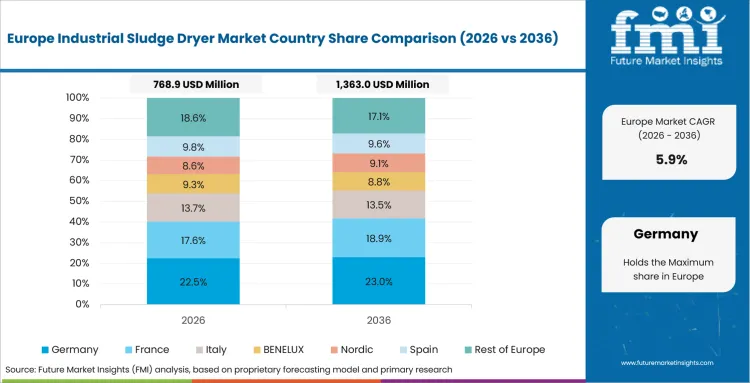
Industrial Sludge Dryer Market
| Parameter | Value |
|---|---|
| Market Size in 2025 (Value) | USD 245.1 million |
| Market Size in 2026 (Value) | USD 260.0 million |
| Market Forecast in 2036 (Value) | USD 470.0 million |
| CAGR (2026 to 2036) | 6.1% |
| Years Considered | 2021 to 2036 |
| Base Year | 2025 |
| Forecast Period | 2026 to 2036 |
| Units Considered | Value (USD million) |
| Leading Sub-Region | North Rhine-Westphalia, Bavaria, Baden-Wuerttemberg, Lower Saxony, Saxony, and Rhine industrial corridors |
Germany Industrial Sludge Dryer Market Outlook
Germany projects often focus on retrofit value and energy integration. Thermal treatment fit also shapes supplier selection before purchase approval.
German utilities and industrial plants examine references and maintenance access before equipment selection. Performance guarantees can decide awards in retrofit-heavy tenders.
Key Growth Drivers
- A large public treatment base backs replacement and retrofit demand across German municipalities and industrial sites. Germany's environment ministry said wastewater is treated in around 9000 treatment plants across the country. That installed base gives dryer suppliers a steady retrofit audience rather than only new-build opportunities.
- High sewer connection creates a steady sludge base for municipal treatment assets and downstream handling systems. Germany's environment ministry reported that around 97% of people are connected to public sewer systems. This supports demand for dryers that help utilities control sludge before thermal disposal or recovery.
- Domestic OEM presence shortens service access for buyers and improves confidence in retrofit project execution. HUBER reported more than 400 solar sewage sludge drying lines worldwide across municipal and industrial sites. The installed reference base helps German buyers compare drying formats before they approve retrofit spending.
- Mono-incineration routes increase the need for controlled dry solids because drying is often required before thermal disposal.
Key Restraints
- Established assets can upgrade slowly because retrofit timing depends on cost pressure and regulatory urgency.
- Strict engineering review raises bid costs for smaller suppliers because detailed documentation is needed before tender approval.
- Energy integration requirements can narrow supplier options because systems without proven heat-balance data face longer review.
What makes Germany unique
Germany is unique for domestic OEM depth and thermal treatment discipline that shape dryer specifications.
Key Companies
- HUBER SE
- ANDRITZ Separation GmbH
- Veolia Water Technologies Deutschland
- SUEZ Deutschland
- Haarslev GmbH
- EnviroChemie GmbH
Sales & Marketing Channels
- Municipal authority tenders
- Engineering consultant-led specifications
- OEM direct sales
- EPC contractor packages
- Service retrofit programs
- Trade fair and reference-site selling
Country Segment Breakdown Table
| Segment | Sub-Segments |
|---|---|
| By Dryer Type | Belt Dryers · Paddle Dryers · Disc Dryers · Fluidized Bed / Other |
| By Heat Source | Steam / Thermal Oil · Natural Gas · Electric · Waste Heat Recovery |
| By Sludge Type | Municipal Sludge · Industrial Sludge · Chemical Sludge · Food / Textile Sludge |
| By Capacity | <10 TPD · 10-50 TPD · >50 TPD |
| By Sales Channel | Direct OEM · EPC / Integrators · Service Retrofit |
| Key Sub-Regions Covered, Manufacturing and wastewater corridors | North Rhine-Westphalia, Bavaria, Baden-Wuerttemberg, Lower Saxony, Saxony, and Rhine industrial corridors |
Frequently Asked Questions
How fast is Germany industrial sludge dryer market growing?
Germany is forecast to expand at 6.1% CAGR from 2026 to 2036.
Who competes in Germany industrial sludge dryer market?
HUBER SE, ANDRITZ Separation GmbH, Veolia Water Technologies Deutschland, and SUEZ Deutschland compete through dryer equipment and wastewater project access.
What drives adoption in Germany industrial sludge dryer market?
Retrofit projects and sewer connection density create steady sludge handling needs. Suppliers gain from reference sites and heat-balance proof.
What is the industrial sludge dryer outlook in Japan?
A 5.9% CAGR by 2036 reflects resource recovery goals and compact municipal equipment needs.
Industrial Sludge Dryer Market
| Parameter | Value |
|---|---|
| Market Size in 2025 (Value) | USD 141.6 million |
| Market Size in 2026 (Value) | USD 150.0 million |
| Market Forecast in 2036 (Value) | USD 266.1 million |
| CAGR (2026 to 2036) | 5.9% |
| Years Considered | 2021 to 2036 |
| Base Year | 2025 |
| Forecast Period | 2026 to 2036 |
| Units Considered | Value (USD million) |
| Leading Sub-Region | Tokyo, Osaka, Yokohama, Nagoya, Fukuoka, Sapporo, and compact municipal sites |
Japan Industrial Sludge Dryer Market Outlook
Japan dryer demand is connected to resource recovery planning. Drying can improve storage and handling before sludge moves into fuel or fertilizer routes.
Smaller municipal sites and industrial plants need low-temperature or compact dryers. Local suppliers matter because service access and sludge testing reduce adoption risk.
Key Growth Drivers
- Resource recovery policy encourages drying before fertilizer and fuel routes in Japanese sludge planning and municipal programs. NILIM reported that only about 10% of sewage sludge is used in fertilizer across Japan. The low share shows why drying must prove storage and distribution value before wider recovery use.
- Nutrient recovery gives sludge a measurable resource case for fertilizer and recovery routes in Japan. NILIM estimated that sewage sludge contains about 50000 tons of phosphorus in the national resource base. That resource base supports drying where stable handling can help move sludge into fertilizer or recovery channels.
- Compact equipment is relevant in smaller sites that cannot absorb large drying systems or complex installation work. AMCON states that its SP Series can dry waste activated sludge and chemical sludge in compact applications. This application fit matters for Japan because smaller plants need equipment that can manage variable feed without large footprints.
- Low-temperature drying fits sticky sludge applications that need gentler handling and better cleaning control during operation. Kenki Dryer positions its system for high-moisture adhesive organic sludge and difficult sludge streams in thermal processing. That company focus supports niche demand where conventional dryers struggle with sticky feed and frequent cleaning needs.
Key Restraints
- Fertilizer distribution barriers can reduce dried sludge output value after treatment is complete and storage begins. NILIM identified distribution and technical issues around sludge fertilizer use in its resource-recovery discussion for sewage sludge. This restraint matters because dryers create more value when the final product has a dependable outlet.
- Established wastewater coverage limits new-build volume compared with faster-growing Asian markets and leaves replacement demand carrying more weight.
- Energy cost scrutiny affects compact plant projects because heat pump or low-temperature systems must prove operating value.
What makes Japan unique
Japan is unique for phosphorus recovery interest and compact site constraints that shape dryer adoption.
Key Companies
- AMCON Inc.
- Kenki Corporation
- Nara Machinery Co.
- Tsukishima Holdings
- Kobelco Eco-Solutions
- ANDRITZ K.K.
Sales & Marketing Channels
- Municipal sewerage agencies
- Technology demonstration programs
- Direct OEM sales
- Local distributor networks
- Industrial wastewater plant sales
- EPC and plant engineering channels
Country Segment Breakdown Table
| Segment | Sub-Segments |
|---|---|
| By Dryer Type | Belt Dryers · Paddle Dryers · Disc Dryers · Fluidized Bed / Other |
| By Heat Source | Steam / Thermal Oil · Natural Gas · Electric · Waste Heat Recovery |
| By Sludge Type | Municipal Sludge · Industrial Sludge · Chemical Sludge · Food / Textile Sludge |
| By Capacity | <10 TPD · 10-50 TPD · >50 TPD |
| By Sales Channel | Direct OEM · EPC / Integrators · Service Retrofit |
| Key Sub-Regions Covered, Manufacturing and wastewater corridors | Tokyo, Osaka, Yokohama, Nagoya, Fukuoka, Sapporo, and compact municipal sites |
Frequently Asked Questions
How fast is Japan industrial sludge dryer market growing?
Japan is forecast to expand at 5.9% CAGR from 2026 to 2036.
Who competes in Japan industrial sludge dryer market?
AMCON Inc., Kenki Corporation, Nara Machinery Co., and Tsukishima Holdings compete through dryer equipment and wastewater project access.
What drives adoption in Japan industrial sludge dryer market?
Resource recovery goals and compact site constraints shape dryer interest. Local specialists compete on small-footprint and sticky-sludge designs.
Who are the leading companies in the industrial sludge dryer market?
ANDRITZ, HUBER SE, Komline-Sanderson, Haarslev, Veolia Water Technologies, SUEZ, LCI Corporation, Kenki Dryer, AMCON, and Kilburn Engineering are profiled in the market.
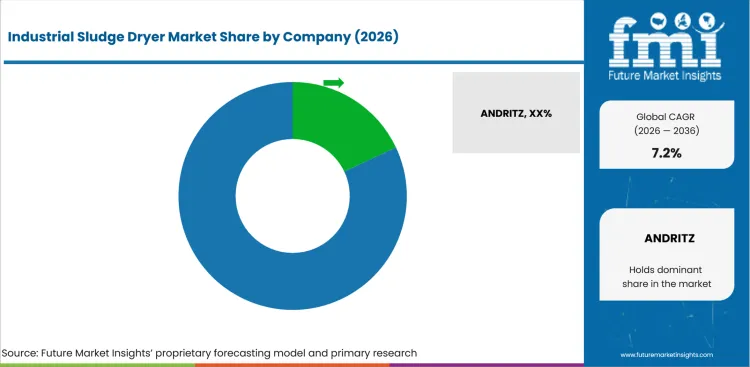
- Competition is based on sludge testing and dryer type breadth while heat-source fit and service access also affect selection.
- Large OEMs gain an advantage if municipal buyers require references and performance guarantees before tender award.
- Specialist suppliers gain space in sticky sludge or compact applications because pilot results can outweigh portfolio breadth.
- Operator-led projects often favor companies that can combine dryer technology with treatment-plant delivery and service support.
Thermal dryer OEMs are focusing on evaporation duty and heat-source matching because buyers need proof before tender award. ANDRITZ provides belt drying and Gouda paddle technologies for sludge applications across thermal projects and wastewater sites. HUBER adds solar and belt drying formats while its disc and cold-air equipment broaden the portfolio. These portfolios overlap with contact and convective dryers used in wider moisture-removal and process projects.
Project delivery depends on filings and pilot testing because suppliers must prove fit before final selection. Komline-Sanderson uses steam or thermal fluid in its paddle sludge dryer for indirect drying projects. LCI offers thin-film sludge dryers for municipal and industrial wastewater plants that need controlled heat transfer. Dryer demand also connects with water and wastewater treatment equipment because upstream separation affects dryer sizing.
Companies backed by local service teams are better positioned in larger tenders because commissioning support affects buyer risk. Veolia and SUEZ shape specifications in operator-led projects through wastewater operating and service relationships across plants. AMCON and Kenki Dryer fit compact or sticky-sludge applications that need specialized handling in smaller systems. Adjacent municipal sludge dewatering equipment demand also influences dryer feed preparation and thermal sizing decisions.
How do top industrial sludge dryer market companies compare?
Companies differ by sludge test capability and heat-source breadth. Account access and service reach also affect tender positioning.
| Company | Portfolio/Focus | Account Access | Footprint/Service Reach |
|---|---|---|---|
| ANDRITZ | Belt and Gouda paddle dryers | Utility and industrial EPC accounts | Global |
| HUBER SE | Belt, solar, disc, and cold-air dryers | Municipal utility channels | Global |
| Komline-Sanderson | Paddle sludge dryers | North American utility and industrial accounts | North America and export projects |
| Haarslev | Rotary drum and disc drying | Municipal sludge and biosolids projects | Global |
| Veolia Water Technologies | Integrated wastewater and sludge systems | Operator-led contracts | Global |
| SUEZ | Sludge dewatering and treatment packages | Public wastewater concessions | Global |
| LCI Corporation | Thin-film sludge dryers | Industrial and municipal accounts | North America |
| Kenki Dryer | Low-temperature sticky sludge drying | Specialist industrial applications | Japan and export channels |
| AMCON | Compact sludge dryer SP Series | Japanese municipal and industrial accounts | Japan and distributor channels |
| Kilburn Engineering | Industrial and municipal sludge dryers | Indian EPC and industrial channels | India and export projects |
Source: Future Market Insights competitive analysis, 2026.
Who are the key players in the industrial sludge dryer market?
The profiled company set includes global dryer OEMs and integrated water operators. Regional specialist suppliers also appear in compact and sticky-sludge applications.
Key global companies leading the industrial sludge dryer market include:
- ANDRITZ
- HUBER SE
- Komline-Sanderson
- Haarslev
- Veolia Water Technologies
- SUEZ
- LCI Corporation
- Kenki Dryer
- AMCON
- Kilburn Engineering
Key Developments in Industrial Sludge Dryer Market
- In August 2025, HUBER introduced its Cold Air Dryer HPS for sewage sludge drying using heat pump technology.
- In January 2026, SUEZ secured a sludge dewatering equipment contract for the Sha Tin Cavern Sewage Treatment Works.
- In August 2024, Veolia won a EUR 100 million contract to modernize and manage the Saint Fons wastewater treatment plant.
Key Players in the Industrial Sludge Dryer Market
Thermal Dryer OEMs
- ANDRITZ
- HUBER SE
- Komline-Sanderson
- Haarslev
- LCI Corporation
Integrated Water Operators
- Veolia Water Technologies
- SUEZ
- VA Tech WABAG
- Saur
Specialist and Regional Suppliers
- Kenki Dryer
- AMCON
- Kilburn Engineering
- Nara Machinery Co.
Report Scope and Coverage
| Parameter | Details |
|---|---|
| Forecast period | 2026 to 2036 |
| Historical period | 2021 to 2025 |
| Quantitative unit | Revenue in USD million |
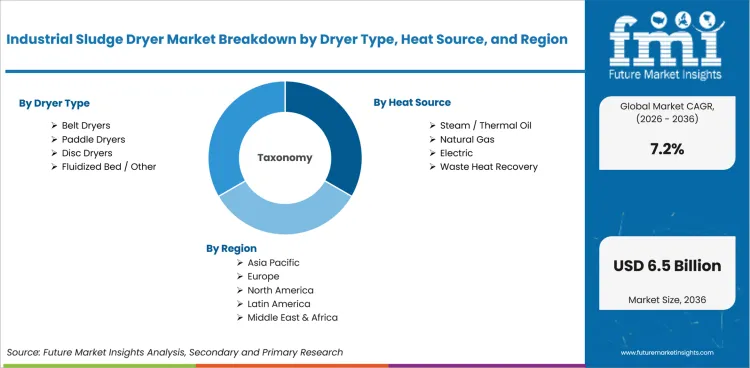
| By dryer type | Belt dryers, paddle dryers, disc dryers, fluidized bed / other |
| By heat source | Steam / thermal oil, natural gas, electric, waste heat recovery |
| By sludge type | Municipal sludge, industrial sludge, chemical sludge, food / textile sludge |
| By capacity | <10 TPD, 10-50 TPD, >50 TPD |
| By sales channel | Direct OEM, EPC / integrators, service retrofit |
| Regions covered | North America, Latin America, Europe, East Asia, South Asia and Pacific, Middle East and Africa |
| Countries covered | India, China, South Korea, United States, France, United Kingdom, Germany, Japan |
| Key companies profiled | ANDRITZ, HUBER SE, Komline-Sanderson, Haarslev, Veolia Water Technologies, SUEZ, LCI Corporation, Kenki Dryer, AMCON, Kilburn Engineering |
| Approach | Bottom-up project-boundary approach using sludge generation proxies, wastewater infrastructure signals, dryer portfolios, and country-level adoption assumptions |
Source: Future Market Insights, 2026.
Industrial Sludge Dryer Market - Scope & Definition
| Attribute | Detail |
|---|---|
| Market Definition | Equipment and integrated systems used to thermally dry dewatered municipal and industrial sludge across utility and industrial treatment plants |
| Functions Covered | Moisture reduction, volume reduction, sludge stabilization, odor-controlled handling, dried solids preparation |
| Applications Covered | Municipal wastewater plants, industrial effluent treatment plants, chemical facilities, food processors, textile units, and sludge-to-fuel projects |
| End-Use Industries | Municipal utilities, industrial wastewater operators, chemical processing, food processing, textiles, and environmental services |
| Grades Covered | Belt, paddle, disc, fluidized bed, steam / thermal oil, natural gas, electric, and waste heat configurations |
| Inclusions | Commercially traded sludge dryer systems, integrated thermal drying lines, controls, conveyors, and retrofit packages tied directly to sludge drying |
| Exclusions | Standalone dewatering presses, chemical conditioners, digesters, incinerators without dryer scope, and general-purpose dryers not sold for sludge use |
Industrial Sludge Dryer Market - Research Methodology
| Method | Description |
|---|---|
| Primary Research | FMI analyst interviews with wastewater utilities, industrial effluent operators, EPC contractors, dryer OEMs, and sludge hauling service providers across key markets |
| Desk Research | Review of wastewater infrastructure data, biosolids reporting, sludge policy documents, company product literature, official project references, and public utility materials |
| Market Sizing & Forecasting | Bottom-up project-boundary model using installed wastewater treatment capacity, sludge generation proxies, average system pricing, dryer replacement cycles, and heat-source availability |
| Forecast Basis | Market assumptions reflect official statistics, regulator sources, company product evidence, country regulation, and supplier portfolio checks |
Industrial Sludge Dryer Market Breakdown by Dryer Type, Heat Source, Sludge Type, Capacity, Sales Channel, and Region
Industrial Sludge Dryer Market Segmented by Dryer Type
- Belt Dryers
- Paddle Dryers
- Disc Dryers
- Fluidized Bed / Other
Industrial Sludge Dryer Market Segmented by Heat Source
- Steam / Thermal Oil
- Natural Gas
- Electric
- Waste Heat Recovery
Industrial Sludge Dryer Market Segmented by Sludge Type
- Municipal Sludge
- Industrial Sludge
- Chemical Sludge
- Food / Textile Sludge
Industrial Sludge Dryer Market Segmented by Capacity
- <10 TPD
- 10-50 TPD
- >50 TPD
Industrial Sludge Dryer Market Segmented by Sales Channel
- Direct OEM
- EPC / Integrators
- Service Retrofit
Industrial Sludge Dryer Market by Region
- North America
- Latin America
- Europe
- East Asia
- South Asia and Pacific
- Middle East and Africa
Research Sources and Bibliography
- United States Environmental Protection Agency. (2026, May 21). Clean Watersheds Needs Survey. United States Environmental Protection Agency.
- United States Environmental Protection Agency. (2025, September 26). Basic information about sewage sludge and biosolids. United States Environmental Protection Agency.
- Environment Agency. (2026, January 28). Environment Agency strategy for safe and sustainable sludge use. GOV.UK.
- Federal Ministry for the Environment, Climate Action, Nature Conservation and Nuclear Safety. (2026, February 11). General information on waste water treatment plants. Bundesregierung.
- European Environment Agency. (2026). Country profiles on urban waste water treatment: France. WISE Freshwater.
- National Institute for Land and Infrastructure Management. (2024). Expanded use of sewage sludge resources as fertilizer. NILIM Annual Report 2024.
- USA International Trade Administration. (2025, September 25). China environmental technology. USA Department of Commerce.
- Ministry of Environment of South Korea. (2024, January 25). 2024 Ministry of Environment major policy implementation plan.
- Korea Ministry of Environment. (2024). 2022 sewer statistics released. Korea.net Government Briefing Room.
- National Green Tribunal. (2024). CPCB report on sewage treatment capacity in Delhi.
- National Mission for Clean Ganga. (2024, July 8). Monthly progress report of Government of NCT of Delhi for May 2024.
- ANDRITZ. (2025, October). Thermal systems for sludge drying and recycling.
- ANDRITZ. (2026). Wastewater treatment Ambarli reference.
- HUBER SE. (2026, February 26). HUBER at IFAT Munich 2026.
- HUBER SE. (2025, August 22). New product: HUBER Cold Air Dryer HPS. HUBER SE.
- HUBER Technology Inc. (2024, June). HUBER Technology Inc. wins largest belt dryer project in the USA to date.
- Komline-Sanderson. (2026). Biosolids/sludge dryer.
- Haarslev. (2026). Rotary drum dryer.
- SUEZ. (2026, January 29). SUEZ awarded a sludge dewatering contract in Hong Kong, setting a new benchmark for Asia's largest sewage treatment plant in caverns. SUEZ.
- Veolia. (2024, August 1). Veolia wins a major contract for the Saint Fons wastewater treatment plant.
- AMCON. (2026). Sludge dryer SP Series.
- Kilburn Engineering. (2026). Sludge dryer.
- Kenki Dryer. (2025, December 11). The ultimate solution for drying sticky, adhesive, and high-moisture materials.
- LCI Corporation. (2026). Thin film sludge dryer.
- Thermax Limited. (2026). Water and waste solutions.
- VA Tech WABAG. (2026). Sludge treatment plant solutions.
- Environment Agency. (2025, December 12). Sludge. Engage Environment Agency.
- Ion Exchange India. (2025, March 7). The importance of sewage sludge treatment plants in India.
This bibliography is provided for reader reference and is not exhaustive. The full report contains detailed source notes and validation records.
This Report Answers
- Market size estimates for 2026 and forecasts by 2036 for the industrial sludge dryer market.
- Analysis of demand drivers across municipal and industrial sludge drying applications.
- The report evaluates dryer type and heat source segments alongside sludge type, capacity, and sales channel segments.
- Country-level growth analysis covers India, China, South Korea, the United States, France, the United Kingdom, Germany, and Japan.
- The report assesses disposal pressure and heat-source economics alongside odor control and dust safety in buyer decisions.
- The report identifies regional companies and operators supported by OEMs and EPC channels that influence procurement.
- Competitive positioning is compared across sludge testing and portfolio breadth with account access and service reach also reviewed.
- The report explains Scope & Definition and inclusions alongside exclusions and the methodology used in the forecast.
- Official sources and company evidence are reviewed, supported by project developments used in market analysis.
- The report delivers market data and forecasts with supporting analysis in a Word-ready report format.
Frequently Asked Questions
What is the growth prospect for industrial sludge dryers?
Demand for industrial sludge dryers is expected to rise as plants need lower transport weight and safer sludge outlets.
Why are utilities investing in industrial sludge dryers?
Utilities invest in dryers to reduce wet cake movement and improve control over disposal or recovery routes.
Why is heat-source fit important in sludge drying?
Heat-source fit is important because energy cost can decide whether drying improves sludge handling economics.
Which dryer formats are gaining attention?
Belt and paddle dryers are gaining attention across municipal and industrial plants. Disc and cold-air formats fit selected projects that need tighter heat control.
How do regulations influence sludge dryer adoption?
Regulations increase scrutiny around land application and odor control. Final sludge stability also receives closer review before project approval.
Why are EPC channels important for sludge dryers?
EPC channels are important because feed handling and air treatment needs affect project delivery. Civil integration also influences dryer awards.
What role do regional companies play in this market?
Regional companies improve tender access by offering local service and fabrication support. Operator relationships also matter.
How does industrial sludge differ from municipal sludge?
Industrial sludge varies more by process chemistry. Buyers often need pilot testing before choosing a dryer.
Preview the report firsthand - request a free sample
Get SampleGet the brochure for pricing and purchase details.
Get PDFTable of Content
- Key Takeaways
- Market Size and CAGR
- Top Growth Driver
- Fastest Growing Segment
- Leading Region
- Key Companies
- Emerging Opportunities
- Executive Summary
- Global Market Outlook
- Demand-side Trends
- Supply-side Trends
- Technology Roadmap Analysis
- Analysis and Recommendations
- Analyst Perspective (What is happening? Why now? What should investors know?)
- Key Questions Answered
- How large is the market?
- What is the CAGR?
- What are key trends?
- Which region dominates?
- Who are the leaders?
- Market Overview
- Market Coverage / Taxonomy
- Market Definition / Scope / Limitations
- Research Methodology
- Chapter Orientation
- Analytical Lens and Working Hypotheses
- Market Structure, Signals, and Trend Drivers
- Benchmarking and Cross-market Comparability
- Market Sizing, Forecasting, and Opportunity Mapping
- Research Design and Evidence Framework
- Desk Research Programme (Secondary Evidence)
- Expert Input and Fieldwork (Primary Evidence)
- Tooling, Models, and Reference Databases
- Data Engineering and Model Build
- Quality Assurance and Audit Trail
- Market Background
- Market Dynamics (Drivers, Restraints, Opportunity, Trends)
- Scenario Forecast (Optimistic, Likely, Conservative)
- Impact Analysis
- AI Impact
- Sustainability Impact
- Regulatory Impact
- Technology Impact
- Consumer / Buyer Analysis
- Purchase Drivers
- Adoption Barriers
- Buyer Journey
- Opportunity Map Analysis
- Product Life Cycle Analysis
- Supply Chain Analysis
- Investment Feasibility Matrix
- Value Chain Analysis
- PESTLE and Porter's Analysis
- Regulatory Landscape
- Regional Parent Market Outlook
- Production and Consumption Statistics
- Import and Export Statistics
- Global Market Analysis and Forecast, 2021 to 2036
- Historical Market Size Value (USD Billion) & Volume (Unit) Analysis, 2021 to 2025
- Current and Future Market Size Value (USD Billion) & Volume (Unit) Projections, 2026 to 2036
- Y-o-Y Growth Trend Analysis
- Absolute $ Opportunity Analysis
- Global Market Pricing Analysis, 2021 to 2036
- Global Market Analysis and Forecast, By Dryer Type, 2021 to 2036
- Introduction / Key Findings
- Historical Market Size Value (USD Billion) & Volume (Unit) Analysis By Dryer Type, 2021 to 2025
- Current and Future Market Size Value (USD Billion) & Volume (Unit) Analysis and Forecast By Dryer Type, 2026 to 2036
- Belt Dryers
- Paddle Dryers
- Disc Dryers
- Fluidized Bed / Other
- Belt Dryers
- Y-o-Y Growth Trend Analysis By Dryer Type, 2021 to 2025
- Absolute $ Opportunity Analysis By Dryer Type, 2026 to 2036
- Global Market Analysis and Forecast, By Heat Source, 2021 to 2036
- Introduction / Key Findings
- Historical Market Size Value (USD Billion) & Volume (Unit) Analysis By Heat Source, 2021 to 2025
- Current and Future Market Size Value (USD Billion) & Volume (Unit) Analysis and Forecast By Heat Source, 2026 to 2036
- Steam / Thermal Oil
- Natural Gas
- Electric
- Waste Heat Recovery
- Steam / Thermal Oil
- Y-o-Y Growth Trend Analysis By Heat Source, 2021 to 2025
- Absolute $ Opportunity Analysis By Heat Source, 2026 to 2036
- Global Market Analysis and Forecast, By Sludge Type, 2021 to 2036
- Introduction / Key Findings
- Historical Market Size Value (USD Billion) & Volume (Unit) Analysis By Sludge Type, 2021 to 2025
- Current and Future Market Size Value (USD Billion) & Volume (Unit) Analysis and Forecast By Sludge Type, 2026 to 2036
- Municipal Sludge
- Industrial Sludge
- Chemical Sludge
- Food / Textile Sludge
- Municipal Sludge
- Y-o-Y Growth Trend Analysis By Sludge Type, 2021 to 2025
- Absolute $ Opportunity Analysis By Sludge Type, 2026 to 2036
- Global Market Analysis and Forecast, By Capacity, 2021 to 2036
- Introduction / Key Findings
- Historical Market Size Value (USD Billion) & Volume (Unit) Analysis By Capacity, 2021 to 2025
- Current and Future Market Size Value (USD Billion) & Volume (Unit) Analysis and Forecast By Capacity, 2026 to 2036
- 10-50 TPD
- <10 TPD
- >50 TPD
- 10-50 TPD
- Y-o-Y Growth Trend Analysis By Capacity, 2021 to 2025
- Absolute $ Opportunity Analysis By Capacity, 2026 to 2036
- Global Market Analysis and Forecast, By Region, 2021 to 2036
- Introduction
- Historical Market Size Value (USD Billion) & Volume (Unit) Analysis By Region, 2021 to 2025
- Current Market Size Value (USD Billion) & Volume (Unit) Analysis and Forecast By Region, 2026 to 2036
- North America
- Latin America
- Western Europe
- Eastern Europe
- East Asia
- South Asia and Pacific
- Middle East & Africa
- Market Attractiveness Analysis By Region
- North America Market Analysis and Forecast, By Country, 2021 to 2036
- Historical Market Size Value (USD Billion) & Volume (Unit) Trend Analysis By Market Taxonomy, 2021 to 2025
- Market Size Value (USD Billion) & Volume (Unit) Forecast By Market Taxonomy, 2026 to 2036
- By Country
- USA
- Canada
- Mexico
- By Dryer Type
- By Heat Source
- By Sludge Type
- By Capacity
- By Country
- Market Attractiveness Analysis
- By Country
- By Dryer Type
- By Heat Source
- By Sludge Type
- By Capacity
- Key Takeaways
- Latin America Market Analysis and Forecast, By Country
- Historical Market Size Value (USD Billion) & Volume (Unit) Trend Analysis By Market Taxonomy, 2021 to 2025
- Market Size Value (USD Billion) & Volume (Unit) Forecast By Market Taxonomy, 2026 to 2036
- By Country
- Brazil
- Chile
- Rest of Latin America
- By Dryer Type
- By Heat Source
- By Sludge Type
- By Capacity
- By Country
- Market Attractiveness Analysis
- By Country
- By Dryer Type
- By Heat Source
- By Sludge Type
- By Capacity
- Key Takeaways
- Western Europe Market Analysis and Forecast, By Country
- Historical Market Size Value (USD Billion) & Volume (Unit) Trend Analysis By Market Taxonomy, 2021 to 2025
- Market Size Value (USD Billion) & Volume (Unit) Forecast By Market Taxonomy, 2026 to 2036
- By Country
- Germany
- UK
- Italy
- Spain
- France
- Nordic
- BENELUX
- Rest of Western Europe
- By Dryer Type
- By Heat Source
- By Sludge Type
- By Capacity
- By Country
- Market Attractiveness Analysis
- By Country
- By Dryer Type
- By Heat Source
- By Sludge Type
- By Capacity
- Key Takeaways
- Eastern Europe Market Analysis and Forecast, By Country
- Historical Market Size Value (USD Billion) & Volume (Unit) Trend Analysis By Market Taxonomy, 2021 to 2025
- Market Size Value (USD Billion) & Volume (Unit) Forecast By Market Taxonomy, 2026 to 2036
- By Country
- Russia
- Poland
- Hungary
- Balkan & Baltic
- Rest of Eastern Europe
- By Dryer Type
- By Heat Source
- By Sludge Type
- By Capacity
- By Country
- Market Attractiveness Analysis
- By Country
- By Dryer Type
- By Heat Source
- By Sludge Type
- By Capacity
- Key Takeaways
- East Asia Market Analysis and Forecast, By Country
- Historical Market Size Value (USD Billion) & Volume (Unit) Trend Analysis By Market Taxonomy, 2021 to 2025
- Market Size Value (USD Billion) & Volume (Unit) Forecast By Market Taxonomy, 2026 to 2036
- By Country
- China
- Japan
- South Korea
- By Dryer Type
- By Heat Source
- By Sludge Type
- By Capacity
- By Country
- Market Attractiveness Analysis
- By Country
- By Dryer Type
- By Heat Source
- By Sludge Type
- By Capacity
- Key Takeaways
- South Asia and Pacific Market Analysis and Forecast, By Country
- Historical Market Size Value (USD Billion) & Volume (Unit) Trend Analysis By Market Taxonomy, 2021 to 2025
- Market Size Value (USD Billion) & Volume (Unit) Forecast By Market Taxonomy, 2026 to 2036
- By Country
- India
- ASEAN
- Australia & New Zealand
- Rest of South Asia and Pacific
- By Dryer Type
- By Heat Source
- By Sludge Type
- By Capacity
- By Country
- Market Attractiveness Analysis
- By Country
- By Dryer Type
- By Heat Source
- By Sludge Type
- By Capacity
- Key Takeaways
- Middle East & Africa Market Analysis and Forecast, By Country
- Historical Market Size Value (USD Billion) & Volume (Unit) Trend Analysis By Market Taxonomy, 2021 to 2025
- Market Size Value (USD Billion) & Volume (Unit) Forecast By Market Taxonomy, 2026 to 2036
- By Country
- Kingdom of Saudi Arabia
- Other GCC Countries
- Türkiye
- South Africa
- Other African Union
- Rest of Middle East & Africa
- By Dryer Type
- By Heat Source
- By Sludge Type
- By Capacity
- By Country
- Market Attractiveness Analysis
- By Country
- By Dryer Type
- By Heat Source
- By Sludge Type
- By Capacity
- Key Takeaways
- Key Countries Market Analysis
- USA
- Pricing Analysis
- Market Share Analysis, 2025
- By Dryer Type
- By Heat Source
- By Sludge Type
- By Capacity
- Canada
- Pricing Analysis
- Market Share Analysis, 2025
- By Dryer Type
- By Heat Source
- By Sludge Type
- By Capacity
- Mexico
- Pricing Analysis
- Market Share Analysis, 2025
- By Dryer Type
- By Heat Source
- By Sludge Type
- By Capacity
- Brazil
- Pricing Analysis
- Market Share Analysis, 2025
- By Dryer Type
- By Heat Source
- By Sludge Type
- By Capacity
- Chile
- Pricing Analysis
- Market Share Analysis, 2025
- By Dryer Type
- By Heat Source
- By Sludge Type
- By Capacity
- Germany
- Pricing Analysis
- Market Share Analysis, 2025
- By Dryer Type
- By Heat Source
- By Sludge Type
- By Capacity
- UK
- Pricing Analysis
- Market Share Analysis, 2025
- By Dryer Type
- By Heat Source
- By Sludge Type
- By Capacity
- Italy
- Pricing Analysis
- Market Share Analysis, 2025
- By Dryer Type
- By Heat Source
- By Sludge Type
- By Capacity
- Spain
- Pricing Analysis
- Market Share Analysis, 2025
- By Dryer Type
- By Heat Source
- By Sludge Type
- By Capacity
- France
- Pricing Analysis
- Market Share Analysis, 2025
- By Dryer Type
- By Heat Source
- By Sludge Type
- By Capacity
- India
- Pricing Analysis
- Market Share Analysis, 2025
- By Dryer Type
- By Heat Source
- By Sludge Type
- By Capacity
- ASEAN
- Pricing Analysis
- Market Share Analysis, 2025
- By Dryer Type
- By Heat Source
- By Sludge Type
- By Capacity
- Australia & New Zealand
- Pricing Analysis
- Market Share Analysis, 2025
- By Dryer Type
- By Heat Source
- By Sludge Type
- By Capacity
- China
- Pricing Analysis
- Market Share Analysis, 2025
- By Dryer Type
- By Heat Source
- By Sludge Type
- By Capacity
- Japan
- Pricing Analysis
- Market Share Analysis, 2025
- By Dryer Type
- By Heat Source
- By Sludge Type
- By Capacity
- South Korea
- Pricing Analysis
- Market Share Analysis, 2025
- By Dryer Type
- By Heat Source
- By Sludge Type
- By Capacity
- Russia
- Pricing Analysis
- Market Share Analysis, 2025
- By Dryer Type
- By Heat Source
- By Sludge Type
- By Capacity
- Poland
- Pricing Analysis
- Market Share Analysis, 2025
- By Dryer Type
- By Heat Source
- By Sludge Type
- By Capacity
- Hungary
- Pricing Analysis
- Market Share Analysis, 2025
- By Dryer Type
- By Heat Source
- By Sludge Type
- By Capacity
- Kingdom of Saudi Arabia
- Pricing Analysis
- Market Share Analysis, 2025
- By Dryer Type
- By Heat Source
- By Sludge Type
- By Capacity
- Türkiye
- Pricing Analysis
- Market Share Analysis, 2025
- By Dryer Type
- By Heat Source
- By Sludge Type
- By Capacity
- South Africa
- Pricing Analysis
- Market Share Analysis, 2025
- By Dryer Type
- By Heat Source
- By Sludge Type
- By Capacity
- USA
- Market Structure Analysis
- Competition Dashboard
- Competition Benchmarking
- Market Share Analysis of Top Players
- By Regional
- By Dryer Type
- By Heat Source
- By Sludge Type
- By Capacity
- Emerging Startups
- Innovation Benchmarking
- Competition Analysis
- Competition Deep Dive
- ANDRITZ
- Overview
- Product Portfolio
- Profitability by Market Segments (Product/Region/Sales Channel)
- Sales Footprint
- Strategy Overview
- Marketing Strategy
- Product Strategy
- Channel Strategy
- HUBER SE
- Komline-Sanderson
- Haarslev
- Veolia Water Technologies
- SUEZ
- ANDRITZ
- Case Studies
- Success Stories
- Recent Developments
- Competition Deep Dive
- Assumptions & Acronyms Used


