

- Market Size (2026)
- USD 245.0 Mn
- Forecast (2036)
- USD 574.7 Mn
- CAGR (2026 to 2036)
- 8.9%
How big is the Enzyme Compost Accelerators Market in 2026?
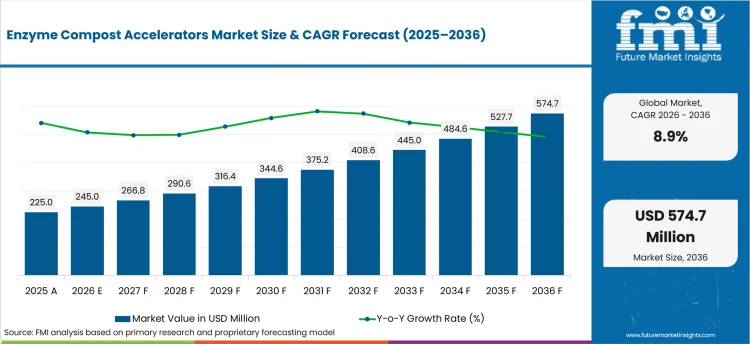
USD 245.0 million in 2026 to USD 574.7 million by 2036, at 8.9% CAGR
Demand for enzyme compost accelerators is projected to expand at 8.9% CAGR between 2026 and 2036, increasing valuation from USD 245.0 million in 2026 to USD 574.7 million by 2036. Organics processors need shorter cycles without sacrificing aeration control or the maturity of finished compost. That operating need brings agricultural enzymes into composting trials that use microbial or enzymatic additives. In October 2025, Eurostat reported that EU food waste reached 58.2 million tonnes in 2023. The feedstock volume gives processors a broad operating base where faster breakdown is valuable only when finished compost remains stable.
India and China are expected to emphasize residue and manure treatment at scale because farms and local waste systems handle large organic feedstock volumes. USA and German operators are anticipated to stress contamination control and operating records before changing an established biological additive. Technical teams compare feedstock mix and moisture before consulting the related fertilizer outlook to judge the likely value of finished compost. In November 2025, China’s Ministry of Ecology and Environment reported manure utilization at 79.4% during 2024. The recovery base is expected to increase scrutiny of accelerator fit across manure-rich compost lines. Procurement teams compare dosing guidance and odor response before an initial trial expands across additional sites. Repeatable maturity under changing feedstocks is expected to remain the decisive approval test for routine purchasing.
| Metric | Value |
|---|---|
| 2025 Market Size | USD 225.0 million |
| 2026 Market Size | USD 245.0 million |
| 2036 Market Size | USD 574.7 million |
| Forecast CAGR (2026-2036) | 8.9% |
| Leading Product Type | Powder |
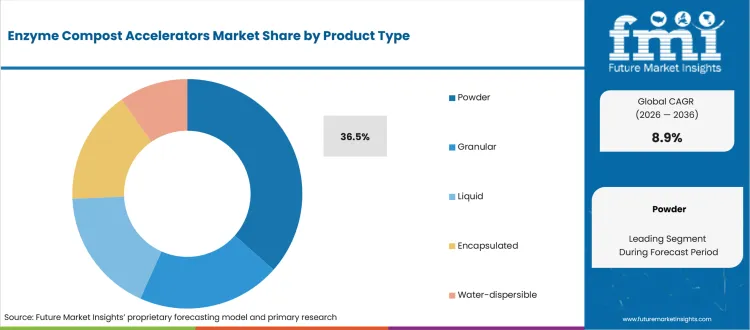
| Powder Share (2026) | 36.5% |
| Leading Source | Microbial |
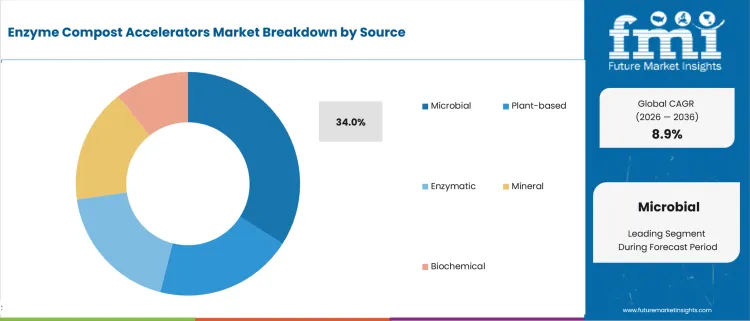
| Microbial Share (2026) | 34.0% |
| Leading Feedstock Type | Crop Residues |
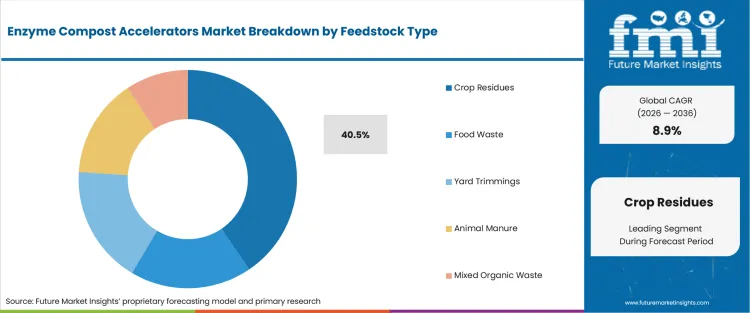
| Crop Residues Share (2026) | 40.5% |
Summary of the Enzyme Compost Accelerators Market
| Market Signal | Commercial Impact |
|---|---|
| Demand and Growth Drivers | Organics processors are expected to test accelerators when cycle-time pressure is paired with a clear compost quality target. Repeat orders are projected to depend on dosing guidance that fits real feedstock changes.
|
| Product and Segment View | Powder and microbial formats are expected to remain central because storage stability and dosing control shape day-to-day use. Feedstock and setting are expected to guide product selection. Functional benefit is projected to shape comparisons between formulations.
|
| Geography and Growth Outlook | Country growth is projected to differ according to feedstock availability and local compost practice. India and China are expected to emphasize throughput, while European and Japanese operators are anticipated to stress process records.
|
| Competitive Landscape | Competition is expected to depend on proof under mixed feedstocks and responsive technical support after a weak trial. Operators need practical recovery guidance when moisture or odor changes after aeration conditions shift.
|
| Analyst Perspective | Variable feedstock is the defining commercial test because an accelerator must perform across changing moisture and carbon balance. Commercial value is projected to come from products that help operators correct those changes without restarting the trial.
|
Source: FMI's proprietary forecasting model and primary research
How is the enzyme compost accelerators market segmented?
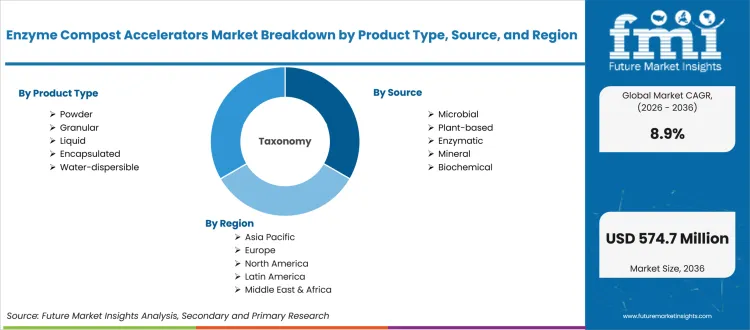
The enzyme compost accelerators industry is segmented by product type, source, feedstock type, composting setting, functional benefit, and region.
The enzyme compost accelerators market is segmented by product type and source before feedstock type, composting setting and functional benefit are assessed. Product type covers liquid and granular formats alongside powder, encapsulated and water-dispersible products. Source includes microbial and plant-based inputs alongside enzymatic, mineral and biochemical options. Feedstock type covers crop residues and food waste alongside yard trimmings, animal manure and mixed organic waste. Composting setting separates municipal and commercial facilities from farm and institutional operations alongside household and industrial operations. Functional benefit covers faster organic breakdown and odor reduction alongside heat build-up support, maturity support and nutrient retention. Regional coverage extends across treatment routes discussed in related research on systems for managing food waste.
How does powder shape demand within the product type category?
Powder products fit channels that store small packs and dose material into repeated compost batches. In July 2026, Earth Care Equipments’ official product page stated that Kwik Composter systems reduce incoming organic waste volume by about 70% to 80%. The operating sequence shows why accelerator products are reviewed beside processing time and finished compost maturity. Distributors need clear dose instructions because the product must fit the site rhythm without creating another measuring step.
- Based on product type, powder is projected to account for 36.5% in 2026 due to storage simplicity and measured dosing across farm and community compost sites. In March 2026, Queensland Government guidance recommended two parts brown material for one part green material. Powder products fit that practical mixing routine because operators portion a dry additive without adding extra liquid during feedstock adjustment.
- Powder is drawing demand from distributors and site operators because dry formats are easier to portion across small or repeated batches. In November 2025, Oregon Metro guidance advised turning compost every few weeks to introduce air. Product teams are expected to link dosing instructions with the same maintenance rhythm when positioning biofertilizer adoption alongside compost accelerator use.
What supports demand for microbial sources within the source category?
Microbial sources fit sites where operators want an active biological inoculant that complements aeration and feedstock management. In April 2025, a USDA Agricultural Marketing Service technical report described the initial composting phase as raising pile temperature to about 45°C. The temperature response shows why product teams need to separate normal biological heat from a credible additive effect. Trial guidance should define the feedstock condition and operating baseline before a microbial product is introduced.
- By source, microbial inputs are estimated to hold 34.0% in 2026 due to operator familiarity with bacteria and fungi in aerobic decomposition. In May 2026, EPA reported that only 5% of USA wasted food generated in 2019 was composted. The treatment share is expected to keep formulation trials aligned with clear aeration and maturity checks.
- Demand for microbial sources is expected to grow among compost operators because odor and slow breakdown often trigger a search for biological help. In January 2026, EPA’s Food: Material-Specific Data page reported 66 million tons of wasted food from retail and food service sectors alongside residences in 2019. Technical teams compare organism claims with site records before linking a product to wider programs using fertilizer inputs based on bioenzymes.
How does crop residue shape demand within the feedstock type category?
Crop residues arrive in seasonal bursts and often contain fibrous material that needs shredding or moisture adjustment before biological treatment. India’s Press Information Bureau reported in February 2026 that more than 3.24 lakh crop residue management machines had been supplied through government programs. The equipment base shows why accelerator trials must fit organized residue handling and processing routines. Product teams need to explain dose changes after residue moisture or particle size shifts during seasonal processing.
- In 2026, crop residues are expected to lead feedstock type demand with 40.5% share because harvest periods create recurring volumes for farm composting. In February 2026, India’s Press Information Bureau estimated annual agricultural waste generation at 350 million tonnes. The feedstock scale makes preparation and moisture control central to product evaluation before an accelerator moves into routine operation.
- Farm composting operations are anticipated to purchase residue-focused products led by the need to process fibrous material without excessive turning work. The Press Information Bureau reported in February 2026 that more than 42,000 custom hiring centers supported crop residue management during 2018-19 to 2025-26. The operating network gives residue handling a practical context beside recycled coffee grounds and other structured organic streams.
What drives municipal and commercial composting within the composting setting category?
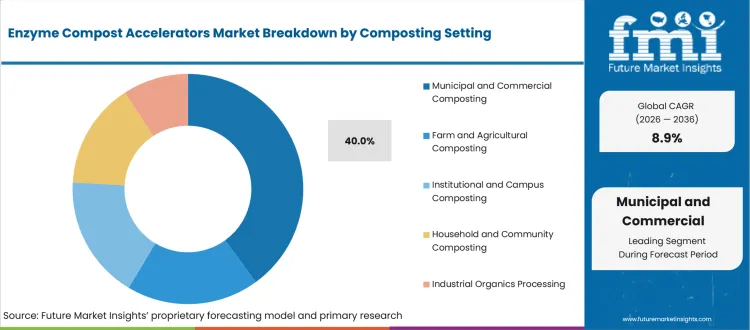
Municipal and commercial composting puts the accelerator inside an organics treatment process where odor and unfinished material are immediately visible. In March 2026, EPA reported that food represented 24% of USA landfilled municipal solid waste. The share keeps food scraps central to diversion plans that direct organic material toward managed biological treatment. Operators are expected to test accelerators only when faster breakdown is paired with a clear test of compost maturity.
- By composting setting, municipal and commercial facilities are forecast to represent 40.0% in 2026 due to direct exposure to mixed food and yard feedstocks. In August 2025, EPA estimated that wasted food was responsible for 58% of landfill methane emissions. Diversion pressure gives commercial compost operators a reason to test faster aerobic processing without relaxing contamination checks.
- Purchase activity for municipal and commercial composting is anticipated to rise because processors need a route for wet food scraps and dry structural materials. In October 2025, Eurostat reported that households generated 53% of EU food waste during 2023. The feedstock mix increases the value of simple carbon and moisture guidance beside specialized fertility blends made from food waste.
What are the drivers, restraints, and opportunities in the enzyme compost accelerators market?
Near-term purchases are projected to reflect food-waste diversion pressure and variable feedstock performance. Formulation support tailored to each site is expected to shape the opportunity outlined below.
- Driver: Food-waste diversion targets are expected to increase trials of additives that shorten biological breakdown under controlled aerobic conditions.
- Restraint: Adoption is anticipated to slow where mixed feedstocks or poor moisture control make trial results difficult to repeat.
- Opportunity: Compost operators are projected to favor products backed by feedstock guidance and local troubleshooting for odor or maturity failures.
Organics processors are expected to test tools that shorten processing time when collection programs send more material toward biological treatment. Eurostat reported in March 2026 that 111 million tonnes of EU municipal waste were recycled during 2024. The treatment scale creates room for accelerators where operators already control turning routines and moisture conditions across incoming batches. A product still needs to prove that shorter processing does not leave unstable material at screening. Facility managers still need verified maturity evidence before expanding accelerator use across additional feedstock batches or treatment lines.
Mixed feedstocks are anticipated to limit repeatability when operators change food scraps or woody material without adjusting the process. EPA reported in January 2025 that hot composting commonly operates at about 54°C to 71°C under active pile management. The temperature range shows why accelerator claims need controlled operating records instead of visual breakdown alone. Quality teams are expected to reject trials where faster processing is not followed by a stable compost endpoint.
The commercial opening is projected to be concentrated in application support that turns a failed batch into a clear correction plan. In March 2025, Eionet mapped 332 food-waste actions across all EU-27 member countries for its prevention review. The policy activity is expected to increase demand for local guidance when treatment programs test additives. Similar operating discipline shapes decisions about equipment for composting food waste because additives and process controls are evaluated together. Local technical support is expected to decide which recovery trials continue after the first operating batch.
Which country CAGRs are profiled in the enzyme compost accelerators market?
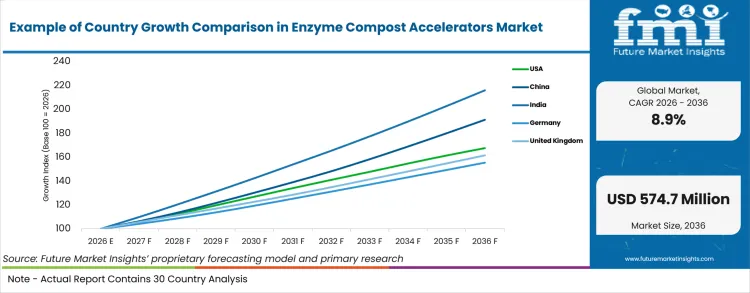
| Country | Growth Profile |
|---|---|
| United States | 5.3% |
| China | 6.7% |
| India | 8.0% |
| Germany | 4.5% |
| United Kingdom | 4.9% |
| Japan | 3.8% |
| South Korea | 5.2% |
Source: FMI's proprietary forecasting model and primary research
How do country-level CAGRs compare in the enzyme compost accelerators market?
Country growth is projected to differ according to organic feedstock collection and the discipline of local compost operations. OECD reported in November 2025 that composting handled 11% of municipal waste across its member-country indicator set. India and China are expected to expand around residue and manure recovery programs that bring more material into organized treatment routes. The United States is anticipated to emphasize diversion and methane reduction across municipal systems. Germany and the United Kingdom are projected to prioritize contamination control. Japan is estimated to focus on business food loss while South Korea is forecast to build on city systems that already convert collected food waste into usable resources.
- Local diversion programs and federal landfill pressure guide USA compost purchasing across treatment and product trials. United States demand is projected to advance at 5.3% CAGR through 2036 because organics processors need methods that fit established aerobic practices. EPA reported in September 2025 that municipal solid waste landfills accounted for approximately 14.4% of USA human-related methane emissions during 2022. State agencies and local compost operators translate that pressure into trials with defined operating and maturity checks. Midwest and West Coast facilities are expected to screen additives on odor response and finished compost stability. USA vendors with clear application records are anticipated to receive closer consideration during repeat orders.
- China entered 2026 with a large manure and crop-residue recovery base that gives biological treatment products a clear operating context. In November 2025, the Ministry of Ecology and Environment reported that crop straw utilization exceeded 88% during 2024. Enzyme compost accelerator demand in China is forecast to rise at 6.7% CAGR over the assessment period because local systems need faster treatment without losing batch control. Municipal agriculture bureaus and rural waste service companies are expected to shape trial access across residue programs. Provincial accounts are anticipated to compare service speed and cost per treated tonne before expanding purchases. Domestic formulators are expected to compete through feedstock-specific instructions and nearby technical response during site trials.
- India is organizing manure and crop-residue recovery through local programs that bring more organic feedstock into managed treatment routes. Adoption of enzyme compost accelerators in India is estimated to expand at 8.0% CAGR through 2036 because decentralized projects need repeatable biological processing. In February 2026, the Press Information Bureau reported 979 operational biogas plants under GOBARdhan as of January 2026. Composting routes beside those projects are expected to create room for additives where aerobic treatment is preferred. Panchayats and farm cooperatives are anticipated to influence local product trials through feedstock access and operator participation. Product providers are projected to earn repeat business by pairing dosing guidance with fertilizer programs based on manure.
- Germany’s compost sector operates inside a recycling system where landfill disposal is already uncommon for municipal waste streams. In April 2025, the European Environment Agency reported that only around 1% of German municipal waste was landfilled. The German enzyme compost accelerators sector is projected to record 4.5% CAGR during the assessment period because processors focus on quality and contamination control before adding process aids. Municipal biowaste operators and certification-oriented compost producers are expected to demand clear composition records during procurement. Technical teams are anticipated to compare dose response against established turning and aeration schedules before accepting an additive.
- United Kingdom composting programs are expected to place more weight on household organics collection and the quality of separated feedstocks. Local authorities are anticipated to influence product demand through collection design and facility contracts with regional treatment operators. In June 2026, the Office for National Statistics reported that 44.6% of UK household waste was recycled during 2023. Enzyme compost accelerator demand in the United Kingdom is forecast to rise at 4.9% CAGR over the forecast period because processors need better control of wet and variable material. UK composters are projected to favor products with direct application guidance and accessible technical support.
- Enzyme compost accelerator sales in Japan are forecast to expand at 3.8% CAGR by 2036 because treatment teams need evidence under defined food residues. The Ministry of Agriculture, Forestry and Fisheries reported in June 2026 that business food loss reached 2.37 million tonnes for fiscal 2024. Japan has tightened attention on business food loss while compost and feed recovery remain part of the wider recycling framework. Food manufacturers and service operators are expected to separate prevention decisions from treatment decisions before choosing an additive. Local compost companies are anticipated to screen product claims against controlled operating records before adopting additives across repeated food-residue batches.
- In South Korea, demand is anticipated to advance at 5.2% CAGR through 2036 because additives must show value inside an established recovery system. Seoul has turned food-waste collection into a resource-recovery system that gives compost additives a demanding reference point. In July 2025, Seoul Metropolitan Government reported that 100% of collected food waste was converted into animal feed and compost or biogas. City processors are expected to compare any accelerator against established sorting and conversion steps before expanding use inside current recovery systems. Local equipment operators and district waste teams are anticipated to influence product trials through access to sorted food-waste streams.
Who are the notable companies in the enzyme compost accelerators market?
Roebic Laboratories, Inc., Juwel H. Wüster GmbH, Kemper S.r.l., EMNZ, BioNutri International (Pvt) Ltd., Earth Care Equipments Pvt. Ltd., SoilFixer, Envii, and HD Chemicals LTD are the notable companies shaping this market.
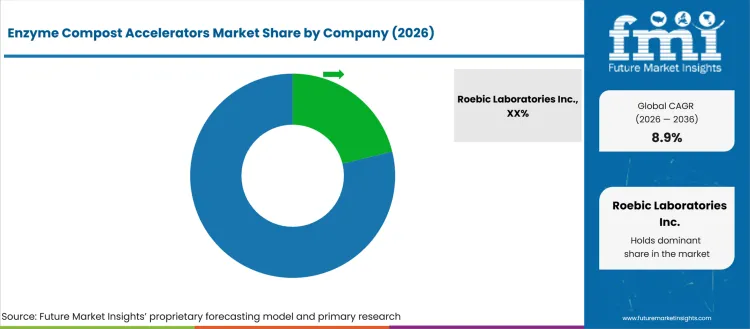
Competitive outlook in the industry includes microbial formulation specialists and home-compost brands alongside providers that pair additives with equipment used to process organic waste. Competition is expected to center on feedstock guidance and odor response during practical trials across mixed organic streams. Operators are projected to compare dose clarity and technical support before a trial expands across more sites. In March 2026, Eurostat reported that the EU recycled 248 kg of municipal waste per person during 2024. The recycling volume gives biological treatment a broad operating context where accelerator products need practical proof under changing feedstocks. Competitive positioning is expected to overlap with waste services because collection quality and contamination directly affect accelerator performance.
- Roebic Laboratories and Juwel H. Wüster GmbH compete through microbial products aimed at garden and plant-based compost feedstocks. Account access is expected to depend on dose guidance and fit across changing moisture conditions.
- Kemper and EMNZ approach the category through multi-organism formulations for varied organic feedstocks. Their competitive basis is expected to center on formulation breadth and support during trials across changing feedstocks.
- BioNutri and Earth Care Equipments connect accelerator demand with farm and decentralized organics treatment needs. Their routes are expected to differ between standalone products and equipment-linked service.
- Envii serves household and small-site users through a natural accelerator positioned for garden composting. The company is expected to compete through simple instructions and online availability where users need a low-complexity route into accelerator products without site engineering support.
Competitive Benchmarking: Enzyme Compost Accelerators Market
| Company | Biological Blend Breadth | Feedstock Guidance | Odor-Control Positioning | Specification Support | Service Reach |
|---|---|---|---|---|---|
| Roebic Laboratories, Inc. | Medium | High | Medium | High | Regional; North America |
| Juwel H. Wüster GmbH | Medium | Medium | Medium | High | Regional; Europe |
| Kemper S.r.l. | High | High | Medium | High | Regional; Europe |
| EMNZ | High | High | High | High | Country-specific |
| BioNutri International (Pvt) Ltd. | Medium | Medium | High | Medium | Country-specific |
| Earth Care Equipments Pvt. Ltd. | Medium | High | High | High | Regional; South Asia |
| SoilFixer | Medium | High | Medium | High | Country-specific |
| Envii | Medium | High | Medium | High | Country-specific |
| HD Chemicals LTD | Medium | High | Medium | High | Country-specific |
Source: Future Market Insights competitive analysis, 2026. Ratings reflect relative portfolio relevance and workflow fit. Service capability and geographic reach shape the remaining comparison.
Key Developments in the Enzyme Compost Accelerators Market
- In July 2025, Waste4Good Technologies won the inaugural Mindanao TECH PLANTER Demo Day with its enhanced Compost Activator Solution for transforming agricultural waste.
- In September 2025, Loveland Products launched EXTRACT XC with microbial-derived biochemistry designed to accelerate crop-residue breakdown and nutrient release.
- In December 2025, Ginkgo Bioworks and Agricen completed an optimized fermentation process for complex bacterial strains used in an Agricen soil amendment product.
Key Players in the Enzyme Compost Accelerators Market
Microbial and Enzyme Formulation Providers
- Roebic Laboratories, Inc.
- Juwel H. Wüster GmbH
- Kemper S.r.l.
- EMNZ
- BioNutri International (Pvt) Ltd.
Compost Process and Application Providers
- Earth Care Equipments Pvt. Ltd.
- SoilFixer
- Envii
- HD Chemicals LTD
Enzyme Compost Accelerators Market - Report Scope
| Coverage field | Report scope |
|---|---|
| Market breakdown | By product type, source, feedstock type, composting setting, functional benefit, and region |
| Quantitative Units | Revenue measures, physical volume measures, and percentage-based growth indicators |
| Market Definition | Formulations containing enzymes or microbial cultures and related biological activators that are added to organic feedstocks to speed aerobic breakdown or improve compost process consistency. |
| Regions Covered | North America, Latin America, Western Europe, Eastern Europe, East Asia, South Asia and Pacific, Middle East and Africa |
| Countries Covered | United States, China, India, Germany, United Kingdom, Japan, South Korea, and additional markets across the covered regions |
| Key Companies Profiled | Roebic Laboratories, Juwel H. Wüster GmbH, Kemper, EMNZ, BioNutri International, Earth Care Equipments, SoilFixer, Envii, and HD Chemicals |
| Forecast Period | Long-term assessment from the base estimate through the end of the forecast horizon |
| Approach | Hybrid methodology combining bottom-up supplier mapping with top-down demand reconciliation and primary research |
Source: Future Market Insights - analysis driven by proprietary forecasting models and primary research
Enzyme Compost Accelerators Market - Research Methodology
| Method | Approach |
|---|---|
| Primary Research | FMI interviews compost facility managers and farm teams that use biological process aids under practical operating conditions. Researchers also speak with distributors and technical service staff who support trials and troubleshoot weak batches. Discussions cover feedstock mix and dose adjustment before teams compare moisture control with odor events. Cycle-time targets are reviewed against the operating routine. Findings from municipal and commercial accounts are compared before agricultural evidence is reviewed separately. |
| Desk Research | Desk research reviews official waste policy and organics collection frameworks before analysts examine composting guidance. Company product documentation is then checked for direct relevance to adoption. Analysts examine treatment routes and application limits before connecting policy direction with market demand. Official company pages authenticate accelerator portfolios and service models. Regulatory material is compared with primary research to identify practical purchasing triggers and operating constraints. |
| Market Sizing and Forecasting | Market sizing combines bottom-up supplier mapping with top-down estimates of addressable composting activity across treatment routes. Supplier presence is compared with organic feedstock flows and composting settings before analysts calibrate the base estimate. Product type and source are reconciled with feedstock type and composting setting. Functional benefit is reviewed separately before country outlooks are tested against the global model path and primary research. |
| Data Validation | FMI validates results through primary interviews and official evidence before completing the market forecast and country outlook. Company relevance is checked against exact product fit while segment assumptions are reviewed against channel feedback. Country assumptions are compared with local organics programs and operating practice. Final checks reconcile the historical baseline with the base estimate before segment relationships and long-term forecast direction are reviewed. |
Source: Future Market Insights (FMI) analysis, based on proprietary forecasting model and primary research
Enzyme Compost Accelerators Market by Segments
Enzyme Compost Accelerators Market segmented by Product Type:
- Liquid
- Granular
- Powder
- Encapsulated
- Water-dispersible
Enzyme Compost Accelerators Market segmented by Source:
- Microbial
- Plant-based
- Enzymatic
- Mineral
- Biochemical
Enzyme Compost Accelerators Market segmented by Feedstock Type:
- Crop Residues
- Food Waste
- Yard Trimmings
- Animal Manure
- Mixed Organic Waste
Enzyme Compost Accelerators Market segmented by Composting Setting:
- Municipal and Commercial Composting
- Farm and Agricultural Composting
- Institutional and Campus Composting
- Household and Community Composting
- Industrial Organics Processing
Enzyme Compost Accelerators Market segmented by Functional Benefit:
- Faster Organic Breakdown
- Odor Reduction
- Heat Build-up Support
- Compost Maturity Support
- Nutrient Retention
Enzyme Compost Accelerators Market by Region:
- North America
- United States
- Canada
- Latin America
- Brazil
- Mexico
- Argentina
- Western Europe
- Germany
- United Kingdom
- France
- Italy
- Spain
- Eastern Europe
- Poland
- Russia
- Czech Republic
- East Asia
- China
- Japan
- South Korea
- South Asia and Pacific
- India
- Australia
- ASEAN countries
- Middle East and Africa
- GCC countries
- South Africa
- Türkiye
Research Sources and Bibliography
- Eurostat. (2026, March). Municipal waste statistics. Eurostat.
- Eurostat. (2025, October). 130 kg of food wasted per person annually in the EU. Eurostat.
- Eurostat. (2026, March). 517 kg municipal waste per capita in 2024. Eurostat.
- USA Environmental Protection Agency and USA Department of Agriculture. (2025, February). National Strategy for Reducing Food Loss and Waste and Recycling Organics. USA Environmental Protection Agency.
- USA Environmental Protection Agency. (2026, May). Composting. USA Environmental Protection Agency.
- USA Environmental Protection Agency. (2025, August). Sustainable Management of Food Basics. USA Environmental Protection Agency.
- USA Environmental Protection Agency. (2025, December). Composting At Home. USA Environmental Protection Agency.
- Ministry of Ecology and Environment of the People’s Republic of China. (2025, November). China’s Policies and Actions Addressing Climate Change 2025 Annual Report. Ministry of Ecology and Environment.
- Press Information Bureau. (2026, February). Circular Economy in Agriculture: Waste to Wealth. Government of India.
- European Environment Agency. (2025, April). Germany profile on municipal and packaging waste management - 2025. European Environment Agency.
- Office for National Statistics. (2026, June). Beyond GDP insights, UK measures of National Well-being. Office for National Statistics.
- Seoul Metropolitan Government. (2025, July). Seoul Featured on BBC StoryWorks for Innovative Food Waste Solutions. Seoul Metropolitan Government.
- Department of the Environment, Tourism, Science and Innovation. (2026, March). How to compost effectively: step-by-step guide. Queensland Government.
- Eurostat. (2025, February). Municipal waste down by second consecutive year. Eurostat.
- European Environment Information and Observation Network. (2025, March). Ambitions towards food waste prevention in the EU-27 Member States. Eionet.
- BioNutri International (Pvt) Ltd. (2025, April). Bio Composter - Compost Accelerator. BioNutri International (Pvt) Ltd.
- Earth Care Equipments Pvt. Ltd. (2025, March). Compost Machine For Society And Large Buildings. Earth Care Equipments Pvt. Ltd.
- Earth Care Equipments Pvt. Ltd. (2026, July). Organic Waste Composter - KCE Series [Current official product page accessed July 2026]. Earth Care Equipments Pvt. Ltd.
- SoilFixer. (2025, October). What are compost activators. SoilFixer.
- HD Chemicals LTD. (2026, June). How to Make Compost Faster: The Complete Guide to Using a Compost Activator. HD Chemicals LTD.
- Leave a Nest Co., Ltd. (2025, July 25). Mindanao’s innovation takes center stage: Waste4Good Technologies crowned champion at inaugural Mindanao TECH PLANTER 2025 Demo Day.
- Agricen. (2025, September 2). Loveland Products launches EXTRACT XC to advance residue and nutrient management efficiency.
- Agricen. (2025, December 17). Ginkgo Bioworks and Agricen enter collaboration to optimize manufacturing processes for a key agricultural soil amendment.
- Roebic Laboratories, Inc. (2026, July). Compost Accelerator [Current official product page accessed July 2026]. Roebic Laboratories, Inc.
- Juwel H. Wüster GmbH. (2026, July). BIO AKTIV 1000 - compost accelerator [Current official product page accessed July 2026]. Juwel H. Wüster GmbH.
- Kemper S.r.l. (2026, July). MBL COMPOST 300 - Biological activator [Current official product page accessed July 2026]. Kemper S.r.l.
- EMNZ. (2026, July). Compost Boost+ [Current official product page accessed July 2026]. EMNZ.
- Envii. (2026, July). Organic Compost Accelerator [Current official product page accessed July 2026]. Envii.
- USA Composting Council. (2025, May). Compost producers participated in USCC’s second triennial survey. USA Composting Council.
- Australian Department of Climate Change, Energy, the Environment and Water. (2025, September). Recovering organic waste. Australian Government.
- Department for Environment, Food & Rural Affairs. (2026, March). Local authority collected waste management: annual results 2024/25. UK Government.
- Compost Research & Education Foundation. (2026, June). Compostable Packaging Acceptance Up 9% Since 2023. Compost Research & Education Foundation.
- OECD. (2025, November). Environment at a Glance Indicators: Circular economy - waste and materials. OECD.
- Metro. (2025, November). Make your own compost. Metro.
- USA Department of Agriculture, Agricultural Marketing Service. (2025, April). 2025 Limited Scope Technical Report - Compostable Materials - Crops. USA Department of Agriculture.
- USA Environmental Protection Agency. (2025, January). Environmental Value of Applying Compost: Improving Soil Health for Stormwater Management, Contaminated Site Remediation, Ecosystem Restoration, Landscaping and Agriculture. USA Environmental Protection Agency.
- USA Environmental Protection Agency. (2026, January). Food: Material-Specific Data. USA Environmental Protection Agency.
- USA Environmental Protection Agency. (2026, March). From Farm to Kitchen: The Environmental Impacts of USA Food Waste. USA Environmental Protection Agency.
- USA Environmental Protection Agency. (2025, September). Basic Information about Landfill Gas. USA Environmental Protection Agency.
- Washington State Department of Ecology. (2025, September). Compost Market Study. Washington State Department of Ecology.
- BioNutri International (Pvt) Ltd. (2026, July). Bio Composter Compost Accelerator [Current official product page accessed July 2026]. BioNutri International (Pvt) Ltd.
- Earth Care Equipments Pvt. Ltd. (2026, July). Kwik KC 250 Organic Waste Composter [Current official product page accessed July 2026]. Earth Care Equipments Pvt. Ltd.
This bibliography is provided for reader reference and uses primary government, standards-body, official trade body, and company sources.
This Report Answers
- What value is the enzyme compost accelerators market estimated to reach in 2026 and 2036?
- What CAGR is projected for the enzyme compost accelerators market across the full 2026 to 2036 forecast period?
- Which segments are expected to shape demand across product type and source alongside feedstock type, composting setting and functional benefit?
- Which waste-diversion and process-control pressures are expected to support accelerator purchase activity across operating compost treatment sites?
- How are country CAGRs estimated to differ across the seven national markets profiled in this research report?
- Which companies compete across feedstock guidance and odor response alongside specification support and service reach?
- How does FMI validate forecasts by reconciling supplier mapping and demand estimates with findings from primary research?
- Which operating factors should compost facility managers address before expanding accounts or committing to a new formulation?
- How do claims review and application guidance work with waste-management rules to affect vendor selection?
Frequently Asked Questions
What is driving demand in the Enzyme Compost Accelerators Market?
Demand is projected to rise because organics processors need shorter composting cycles and more consistent breakdown. Food-waste diversion programs are expected to widen structured product trials.
Who are the key players in the Enzyme Compost Accelerators Market?
Notable companies include Roebic Laboratories and Juwel H. Wüster GmbH alongside Kemper, EMNZ and BioNutri. Competition is projected to center on dosing guidance and feedstock fit alongside responsive technical support.
What is a significant restraint in the Enzyme Compost Accelerators Market?
Variable feedstocks and weak moisture control are expected to limit repeatable results. Adoption is anticipated to slow when site guidance and clear operating conditions remain incomplete.
Why should compost facility managers evaluate enzyme compost accelerators?
Facility managers are expected to evaluate accelerators when feedstock breakdown is too slow or inconsistent. Product trials should test cycle time and odor response before teams compare final compost quality.
Which feedstocks are suited to accelerator trials?
Crop residues and food scraps are common trial routes for accelerator testing. Manure-rich blends and mixed green waste are expected to suit controlled trials with suitable moisture and aeration practice.
What should operators evaluate before selecting a supplier?
Operators should review dose guidance and storage requirements before comparing feedstock compatibility with troubleshooting support. Supplier selection is expected to favor clear instructions that fit the site’s existing composting routine.
How do moisture and aeration affect accelerator performance?
Moisture and aeration shape microbial activity throughout aerobic breakdown. Accelerators are expected to perform more consistently when turning schedules and moisture correction remain aligned with the feedstock mix.
What supports repeat purchasing in this market?
Repeat purchasing is projected to depend on consistent results across changing feedstocks and operating seasons. Suppliers are expected to retain accounts through practical dosing advice and responsive troubleshooting.
Preview the report firsthand - request a free sample
Get SampleGet the brochure for pricing and purchase details.
Get PDFTable of Content
- Key Takeaways
- Market Size and CAGR
- Top Growth Driver
- Fastest Growing Segment
- Leading Region
- Key Companies
- Emerging Opportunities
- Executive Summary
- Global Market Outlook
- Demand-side Trends
- Supply-side Trends
- Technology Roadmap Analysis
- Analysis and Recommendations
- Analyst Perspective (What is happening? Why now? What should investors know?)
- Key Questions Answered
- How large is the market?
- What is the CAGR?
- What are key trends?
- Which region dominates?
- Who are the leaders?
- Market Overview
- Market Coverage / Taxonomy
- Market Definition / Scope / Limitations
- Research Methodology
- Chapter Orientation
- Analytical Lens and Working Hypotheses
- Market Structure, Signals, and Trend Drivers
- Benchmarking and Cross-market Comparability
- Market Sizing, Forecasting, and Opportunity Mapping
- Research Design and Evidence Framework
- Desk Research Programme (Secondary Evidence)
- Expert Input and Fieldwork (Primary Evidence)
- Tooling, Models, and Reference Databases
- Data Engineering and Model Build
- Quality Assurance and Audit Trail
- Market Background
- Market Dynamics (Drivers, Restraints, Opportunity, Trends)
- Scenario Forecast (Optimistic, Likely, Conservative)
- Impact Analysis
- AI Impact
- Sustainability Impact
- Regulatory Impact
- Technology Impact
- Consumer / Buyer Analysis
- Purchase Drivers
- Adoption Barriers
- Buyer Journey
- Opportunity Map Analysis
- Product Life Cycle Analysis
- Supply Chain Analysis
- Investment Feasibility Matrix
- Value Chain Analysis
- PESTLE and Porter's Analysis
- Regulatory Landscape
- Regional Parent Market Outlook
- Production and Consumption Statistics
- Import and Export Statistics
- Global Market Analysis and Forecast, 2021 to 2036
- Historical Market Size Value (USD Million) Analysis, 2021 to 2025
- Current and Future Market Size Value (USD Million) Projections, 2026 to 2036
- Y-o-Y Growth Trend Analysis
- Absolute $ Opportunity Analysis
- Global Market Pricing Analysis, 2021 to 2036
- Global Market Analysis and Forecast, By Product Type, 2021 to 2036
- Introduction / Key Findings
- Historical Market Size Value (USD Million) Analysis By Product Type, 2021 to 2025
- Current and Future Market Size Value (USD Million) Analysis and Forecast By Product Type, 2026 to 2036
- Powder
- Granular
- Liquid
- Encapsulated
- Water-dispersible
- Powder
- Y-o-Y Growth Trend Analysis By Product Type, 2021 to 2025
- Absolute $ Opportunity Analysis By Product Type, 2026 to 2036
- Global Market Analysis and Forecast, By Source, 2021 to 2036
- Introduction / Key Findings
- Historical Market Size Value (USD Million) Analysis By Source, 2021 to 2025
- Current and Future Market Size Value (USD Million) Analysis and Forecast By Source, 2026 to 2036
- Microbial
- Plant-based
- Enzymatic
- Mineral
- Biochemical
- Microbial
- Y-o-Y Growth Trend Analysis By Source, 2021 to 2025
- Absolute $ Opportunity Analysis By Source, 2026 to 2036
- Global Market Analysis and Forecast, By Feedstock Type, 2021 to 2036
- Introduction / Key Findings
- Historical Market Size Value (USD Million) Analysis By Feedstock Type, 2021 to 2025
- Current and Future Market Size Value (USD Million) Analysis and Forecast By Feedstock Type, 2026 to 2036
- Crop Residues
- Food Waste
- Yard Trimmings
- Animal Manure
- Mixed Organic Waste
- Crop Residues
- Y-o-Y Growth Trend Analysis By Feedstock Type, 2021 to 2025
- Absolute $ Opportunity Analysis By Feedstock Type, 2026 to 2036
- Global Market Analysis and Forecast, By Composting Setting, 2021 to 2036
- Introduction / Key Findings
- Historical Market Size Value (USD Million) Analysis By Composting Setting, 2021 to 2025
- Current and Future Market Size Value (USD Million) Analysis and Forecast By Composting Setting, 2026 to 2036
- Municipal and Commercial Composting
- Farm and Agricultural Composting
- Institutional and Campus Composting
- Household and Community Composting
- Industrial Organics Processing
- Municipal and Commercial Composting
- Y-o-Y Growth Trend Analysis By Composting Setting, 2021 to 2025
- Absolute $ Opportunity Analysis By Composting Setting, 2026 to 2036
- Global Market Analysis and Forecast, By Functional Benefit, 2021 to 2036
- Introduction / Key Findings
- Historical Market Size Value (USD Million) Analysis By Functional Benefit, 2021 to 2025
- Current and Future Market Size Value (USD Million) Analysis and Forecast By Functional Benefit, 2026 to 2036
- Faster Organic Breakdown
- Odor Reduction
- Heat Build-up Support
- Compost Maturity Support
- Nutrient Retention
- Faster Organic Breakdown
- Y-o-Y Growth Trend Analysis By Functional Benefit, 2021 to 2025
- Absolute $ Opportunity Analysis By Functional Benefit, 2026 to 2036
- Global Market Analysis and Forecast, By Region, 2021 to 2036
- Introduction
- Historical Market Size Value (USD Million) Analysis By Region, 2021 to 2025
- Current Market Size Value (USD Million) Analysis and Forecast By Region, 2026 to 2036
- North America
- Latin America
- Western Europe
- Eastern Europe
- East Asia
- South Asia and Pacific
- Middle East & Africa
- Market Attractiveness Analysis By Region
- North America Market Analysis and Forecast, By Country, 2021 to 2036
- Historical Market Size Value (USD Million) Trend Analysis By Market Taxonomy, 2021 to 2025
- Market Size Value (USD Million) Forecast By Market Taxonomy, 2026 to 2036
- By Country
- USA
- Canada
- By Product Type
- By Source
- By Feedstock Type
- By Composting Setting
- By Functional Benefit
- By Country
- Market Attractiveness Analysis
- By Country
- By Product Type
- By Source
- By Feedstock Type
- By Composting Setting
- By Functional Benefit
- Key Takeaways
- Latin America Market Analysis and Forecast, By Country
- Historical Market Size Value (USD Million) Trend Analysis By Market Taxonomy, 2021 to 2025
- Market Size Value (USD Million) Forecast By Market Taxonomy, 2026 to 2036
- By Country
- Brazil
- Mexico
- Chile
- Rest of Latin America
- By Product Type
- By Source
- By Feedstock Type
- By Composting Setting
- By Functional Benefit
- By Country
- Market Attractiveness Analysis
- By Country
- By Product Type
- By Source
- By Feedstock Type
- By Composting Setting
- By Functional Benefit
- Key Takeaways
- Western Europe Market Analysis and Forecast, By Country
- Historical Market Size Value (USD Million) Trend Analysis By Market Taxonomy, 2021 to 2025
- Market Size Value (USD Million) Forecast By Market Taxonomy, 2026 to 2036
- By Country
- Germany
- UK
- Italy
- Spain
- France
- Nordic
- BENELUX
- Rest of Western Europe
- By Product Type
- By Source
- By Feedstock Type
- By Composting Setting
- By Functional Benefit
- By Country
- Market Attractiveness Analysis
- By Country
- By Product Type
- By Source
- By Feedstock Type
- By Composting Setting
- By Functional Benefit
- Key Takeaways
- Eastern Europe Market Analysis and Forecast, By Country
- Historical Market Size Value (USD Million) Trend Analysis By Market Taxonomy, 2021 to 2025
- Market Size Value (USD Million) Forecast By Market Taxonomy, 2026 to 2036
- By Country
- Russia
- Poland
- Hungary
- Balkan & Baltic
- Rest of Eastern Europe
- By Product Type
- By Source
- By Feedstock Type
- By Composting Setting
- By Functional Benefit
- By Country
- Market Attractiveness Analysis
- By Country
- By Product Type
- By Source
- By Feedstock Type
- By Composting Setting
- By Functional Benefit
- Key Takeaways
- East Asia Market Analysis and Forecast, By Country
- Historical Market Size Value (USD Million) Trend Analysis By Market Taxonomy, 2021 to 2025
- Market Size Value (USD Million) Forecast By Market Taxonomy, 2026 to 2036
- By Country
- China
- Japan
- South Korea
- By Product Type
- By Source
- By Feedstock Type
- By Composting Setting
- By Functional Benefit
- By Country
- Market Attractiveness Analysis
- By Country
- By Product Type
- By Source
- By Feedstock Type
- By Composting Setting
- By Functional Benefit
- Key Takeaways
- South Asia and Pacific Market Analysis and Forecast, By Country
- Historical Market Size Value (USD Million) Trend Analysis By Market Taxonomy, 2021 to 2025
- Market Size Value (USD Million) Forecast By Market Taxonomy, 2026 to 2036
- By Country
- India
- ASEAN
- Australia & New Zealand
- Rest of South Asia and Pacific
- By Product Type
- By Source
- By Feedstock Type
- By Composting Setting
- By Functional Benefit
- By Country
- Market Attractiveness Analysis
- By Country
- By Product Type
- By Source
- By Feedstock Type
- By Composting Setting
- By Functional Benefit
- Key Takeaways
- Middle East & Africa Market Analysis and Forecast, By Country
- Historical Market Size Value (USD Million) Trend Analysis By Market Taxonomy, 2021 to 2025
- Market Size Value (USD Million) Forecast By Market Taxonomy, 2026 to 2036
- By Country
- Kingdom of Saudi Arabia
- Other GCC Countries
- Türkiye
- South Africa
- Other African Union
- Rest of Middle East & Africa
- By Product Type
- By Source
- By Feedstock Type
- By Composting Setting
- By Functional Benefit
- By Country
- Market Attractiveness Analysis
- By Country
- By Product Type
- By Source
- By Feedstock Type
- By Composting Setting
- By Functional Benefit
- Key Takeaways
- Key Countries Market Analysis
- USA
- Pricing Analysis
- Market Share Analysis, 2025
- By Product Type
- By Source
- By Feedstock Type
- By Composting Setting
- By Functional Benefit
- Canada
- Pricing Analysis
- Market Share Analysis, 2025
- By Product Type
- By Source
- By Feedstock Type
- By Composting Setting
- By Functional Benefit
- Mexico
- Pricing Analysis
- Market Share Analysis, 2025
- By Product Type
- By Source
- By Feedstock Type
- By Composting Setting
- By Functional Benefit
- Brazil
- Pricing Analysis
- Market Share Analysis, 2025
- By Product Type
- By Source
- By Feedstock Type
- By Composting Setting
- By Functional Benefit
- Chile
- Pricing Analysis
- Market Share Analysis, 2025
- By Product Type
- By Source
- By Feedstock Type
- By Composting Setting
- By Functional Benefit
- Germany
- Pricing Analysis
- Market Share Analysis, 2025
- By Product Type
- By Source
- By Feedstock Type
- By Composting Setting
- By Functional Benefit
- UK
- Pricing Analysis
- Market Share Analysis, 2025
- By Product Type
- By Source
- By Feedstock Type
- By Composting Setting
- By Functional Benefit
- Italy
- Pricing Analysis
- Market Share Analysis, 2025
- By Product Type
- By Source
- By Feedstock Type
- By Composting Setting
- By Functional Benefit
- Spain
- Pricing Analysis
- Market Share Analysis, 2025
- By Product Type
- By Source
- By Feedstock Type
- By Composting Setting
- By Functional Benefit
- France
- Pricing Analysis
- Market Share Analysis, 2025
- By Product Type
- By Source
- By Feedstock Type
- By Composting Setting
- By Functional Benefit
- India
- Pricing Analysis
- Market Share Analysis, 2025
- By Product Type
- By Source
- By Feedstock Type
- By Composting Setting
- By Functional Benefit
- ASEAN
- Pricing Analysis
- Market Share Analysis, 2025
- By Product Type
- By Source
- By Feedstock Type
- By Composting Setting
- By Functional Benefit
- Australia & New Zealand
- Pricing Analysis
- Market Share Analysis, 2025
- By Product Type
- By Source
- By Feedstock Type
- By Composting Setting
- By Functional Benefit
- China
- Pricing Analysis
- Market Share Analysis, 2025
- By Product Type
- By Source
- By Feedstock Type
- By Composting Setting
- By Functional Benefit
- Japan
- Pricing Analysis
- Market Share Analysis, 2025
- By Product Type
- By Source
- By Feedstock Type
- By Composting Setting
- By Functional Benefit
- South Korea
- Pricing Analysis
- Market Share Analysis, 2025
- By Product Type
- By Source
- By Feedstock Type
- By Composting Setting
- By Functional Benefit
- Russia
- Pricing Analysis
- Market Share Analysis, 2025
- By Product Type
- By Source
- By Feedstock Type
- By Composting Setting
- By Functional Benefit
- Poland
- Pricing Analysis
- Market Share Analysis, 2025
- By Product Type
- By Source
- By Feedstock Type
- By Composting Setting
- By Functional Benefit
- Hungary
- Pricing Analysis
- Market Share Analysis, 2025
- By Product Type
- By Source
- By Feedstock Type
- By Composting Setting
- By Functional Benefit
- Kingdom of Saudi Arabia
- Pricing Analysis
- Market Share Analysis, 2025
- By Product Type
- By Source
- By Feedstock Type
- By Composting Setting
- By Functional Benefit
- Türkiye
- Pricing Analysis
- Market Share Analysis, 2025
- By Product Type
- By Source
- By Feedstock Type
- By Composting Setting
- By Functional Benefit
- South Africa
- Pricing Analysis
- Market Share Analysis, 2025
- By Product Type
- By Source
- By Feedstock Type
- By Composting Setting
- By Functional Benefit
- USA
- Market Structure Analysis
- Competition Dashboard
- Competition Benchmarking
- Market Share Analysis of Top Players
- By Regional
- By Product Type
- By Source
- By Feedstock Type
- By Composting Setting
- By Functional Benefit
- Emerging Startups
- Innovation Benchmarking
- Competition Analysis
- Competition Deep Dive
- Roebic Laboratories Inc.
- Overview
- Product Portfolio
- Profitability by Market Segments
- Sales Footprint
- Strategy Overview
- Marketing Strategy
- Product Strategy
- Channel Strategy
- Juwel H. Wüster GmbH
- Kemper S.r.l.
- EMillionZ
- BioNutri International (Pvt) Ltd.
- Earth Care Equipments Pvt. Ltd.
- SoilFixer
- Envii
- HD Chemicals LTD
- Roebic Laboratories Inc.
- Case Studies
- Success Stories
- Recent Developments
- Competition Deep Dive
- Assumptions & Acronyms Used


