

- Market Size (2026)
- USD 2.0 Bn
- Forecast (2036)
- USD 27.6 Bn
- CAGR (2026 to 2036)
- 30.0%
How big is the AI Robotic Piece Picking Market in 2026?
USD 2.0 billion in 2026 and USD 27.6 billion by 2036 at a 30.0% CAGR.
Demand for AI robotic piece picking is projected to expand at 30.0% CAGR between 2026 and 2036. The market value is estimated to rise from USD 2.0 billion in 2026 to USD 27.6 billion by 2036. A failed grip forces staff to clear the item and restart work around the robot. The USA Census Bureau reported in May 2026 that first-quarter online retail sales reached USD 326.7 billion. Order volumes at this scale make reliable exception handling more valuable than a high-test speed, while warehouse robotics investment supports more flexible automation across storage and order flow.
New fulfillment centers in the United States and Eastern Europe often include robot cells during the original building design. Japan and the European Union face harder retrofit work around established conveyors and control software. The USA International Trade Administration reported in April 2026 that Poland's online retail market is projected to reach USD 52 billion in 2028. Projected sales growth points to more regional order volume and a stronger case for item-level automation. Expansion depends on cycle time and the speed of recovery from a missed grip. Local engineering teams must keep the cell running during normal shifts and respond quickly to faults. Broader logistics automation spending places these choices within storage, order handling, and warehouse redesign decisions. Commercial success comes from matching the robot to the order flow without forcing a complete warehouse redesign.
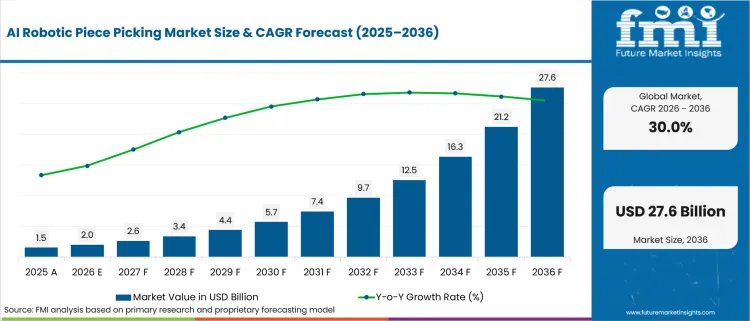
| Metric | Value |
|---|---|
| 2025 Market Size | USD 1.5 billion |
| 2026 Market Size | USD 2.0 billion |
| 2036 Market Size | USD 27.6 billion |
| Forecast CAGR (2026-2036) | 30.0% |
| Technology Focus | Foundation-model Grasping AI |
| Foundation-model Grasping AI Share (2026) | 30.0% |
| Application Focus | Each Picking for E-commerce |
| Each Picking for E-commerce Share (2026) | 36.0% |
| Component Focus | Hardware |
| Hardware Share (2026) | 48.0% |
Summary of the AI Robotic Piece Picking Market
| Market Signal | Commercial Impact |
|---|---|
| Demand and Growth Drivers | Mixed products create the central operating problem in robotic picking. Fixed routines struggle with soft packs and unfamiliar shapes, so staff must clear exceptions during busy shifts. Each manual recovery lowers effective throughput and makes labor planning less predictable during peak demand.
|
| Product and Segment View | Software expands the product range handled by one robot without repeated programming for every new item. The arm and gripper set the physical limits for reach, weight and surface control.
|
| Geography and Growth Outlook | Warehouse age explains much of the regional difference in project risk. New buildings often include robot cells in the original layout. Mature sites need careful retrofit work around established equipment. Retrofit cost therefore becomes a major part of the investment decision.
|
| Competitive Landscape | Competition turns on dependable output across changing products and daily order conditions in active fulfillment centers. Robot arms are widely available, but fewer companies connect recognition and grasp control with reliable software links and field support during daily operations.
|
| Analyst Perspective | Pick rate alone does not prove commercial value in a working fulfillment center. The better test is how quickly a cell recovers from difficult products without returning work to staff.
|
Source: FMI's proprietary forecasting model and primary research
How is the AI robotic piece picking market segmented?
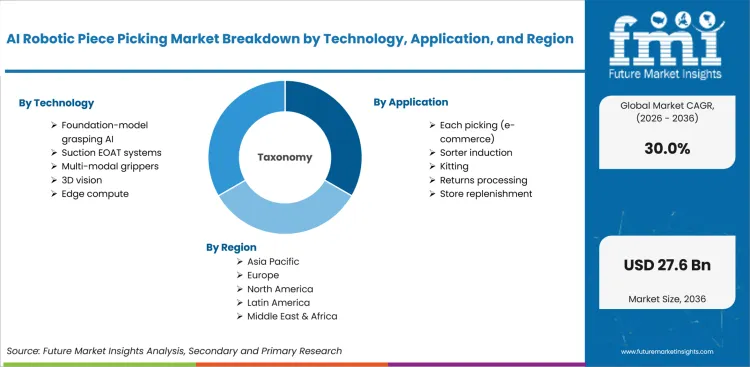
The AI robotic piece picking industry is segmented by technology, application, component, end-use industry, business model, and region.
The report uses five business views to explain how robotic picking creates value. Technology describes how robots see and grip items through foundation models, suction tools, multi-modal grippers, 3D vision, and edge computing. Application identifies the work performed across e-commerce picking, sorter induction, kitting, returns, and store replenishment. Component analysis separates spending on physical equipment from revenue earned through AI software and support services. End-use analysis compares demand across e-commerce, third-party logistics, grocery, apparel, and pharmaceutical facilities. Business models show how companies pay through robots-as-a-service, direct purchase, leasing, and pilot programs.
What supports demand for foundation-model grasping AI within the technology category?
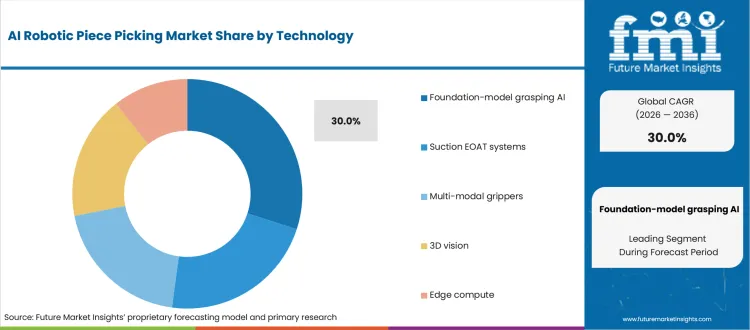
Warehouses cannot write a new grasp rule every time the product range changes. Foundation models reduce that work by learning from broad visual and contact data. In January 2026 the International Federation of Robotics valued annual industrial robot installations at USD 16.7 billion. The figure covers the wider industrial robot market and shows the investment base supporting better sensing for difficult handling tasks.
- In 2026, foundation-model grasping AI is estimated to hold 30.0% share due to its wider product coverage. Nomagic announced a USD 10 million funding extension in January 2026 for commercial growth and new AI models. The investment shows that better grasp planning requires sustained software work and support across active warehouse fleets.
- Online retail and third-party logistics are expected to create more demand for foundation models as product ranges change more often. The robotic gripper must be tested with the software because broad training improves product coverage but site trials remain necessary for soft packs and reflective surfaces.
How does each picking for e-commerce shape demand within the application category?
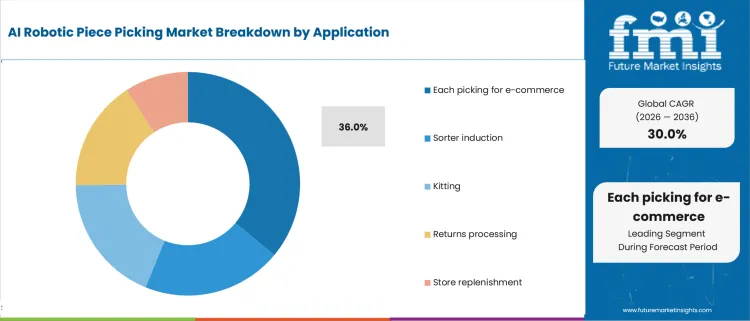
Parcel fulfillment depends on short handling cycles across orders containing individual products from mixed storage positions. Flexible bags and reflective packs make secure contact and stable lifting much harder for robotic grippers. The USA Census Bureau reported in May 2026 that second-quarter 2025 online retail sales reached USD 304.5 billion. Order volume at this level raises the value of robots that clear exceptions without delaying daily dispatch.
- Each picking (e-commerce) is expected to represent 36.0% share among applications in 2026 due to repeated single-item handling. The International Trade Administration reported in August 2025 that Amazon.de generated USD 15.76 billion in 2024 net sales. That scale supports investment in dependable picking across large European fulfillment networks with heavy regional order flows.
- Online retailers are projected to expand item-level automation as orders contain more low-quantity lines from changing product ranges. A sortation system depends on accurate upstream picking because one weak pick affects the next handling stage.
How do warehouse operators evaluate hardware within the component category?
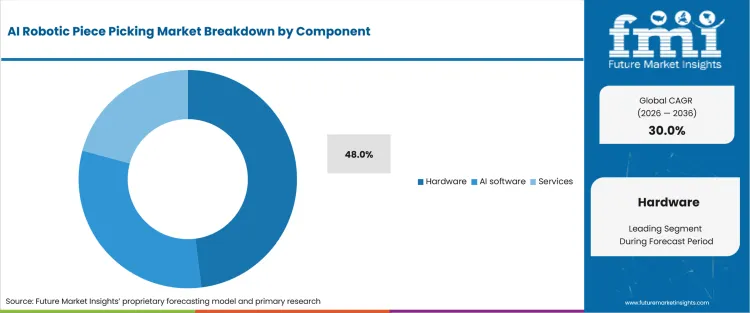
A robot arm must reach every storage position without slowing the planned cycle. One gripper rarely controls rigid cartons and soft packs equally well, which creates a separate design limit. OSARO combines machine perception with item-handling equipment for warehouse tasks involving variable products and packaging. Its approach shows why the arm and gripper must be tested with the camera and controls as one working cell.
- By component, hardware is forecast to account for 48.0% share of component spending in 2026 due to the cost of robot arms and grippers. RightHand Robotics presents RightPick as matched hardware and picking software supported by service. The offer reflects a practical need for the robot hand and control software to perform as one system during daily production.
- Long daily operating schedules increase the value of quick tool service and dependable spare parts. A robotics-as-a-service contract can spread cell costs across agreed production periods when it protects uptime and defines a clear response to damaged tools or failed components.
What are the drivers, restraints, and opportunities in the AI robotic piece picking market?
Adaptive handling is projected to support demand. Integration and safety work are anticipated to slow adoption. Service contracts are estimated to widen access.
- Driver: Variable packaging is projected to raise demand for robots that adjust grasp plans without repeated programming.
- Restraint: Integration work and safety checks are anticipated to extend approval and delay routine production.
- Opportunity: Service contracts are estimated to widen access for warehouses that need operating proof ahead of a capital purchase.
A missed grip often stops nearby equipment and returns manual work to the busy picking station. Nomagic reported in June 2026 that its Shoebox Picker handled up to 98% of shoebox stock-keeping units in a live customer setting. Loose lids make two-piece boxes difficult for suction tools to control during lifting. Better perception and a purpose-built gripper protect order flow more effectively than faster arm motion alone.
A rushed installation often hides the safety work required around a complete robot cell during installation. The International Organization for Standardization published revised requirements in February 2025 under ISO 10218-1 and ISO 10218-2. The standards cover both the robot and its surrounding application near people and equipment. Projects need a clear budget for guarding and risk assessment alongside output tests. Late safety changes force costly layout work and weaken the financial case for the cell.
One of the key opportunity lies in scaling proven pilot results across multiple facilities through strong local engineering support. Brightpick’s March 2026 introduction of Gridpicker reflects the growing opportunity for integrated automation systems that connect storage and picking operations. By aligning robot performance with upstream ASRSinfrastructure, such solutions can improve throughput and operational efficiency. Continued market expansion will depend on responsive service networks and reliable support throughout routine operations.
Which country CAGRs are profiled in the AI robotic piece picking market?
| Country | CAGR |
|---|---|
| United States | 31.0% |
| Eastern Europe | 32.0% |
| Japan | 27.0% |
| European Union | 29.0% |
Source: FMI's proprietary forecasting model and primary research
How do country-level CAGRs compare in the AI robotic piece picking market?
Warehouse age and local engineering depth explain much of the difference between the profiled growth rates. The United States combines large order flows with an established service base for complex fulfillment programs. Eastern Europe benefits from newer logistics buildings that often include robot cells in the original design. Japan places greater weight on repeatable performance inside dense facilities with mature automation. European Union projects must improve online fulfillment without weakening safety or compatibility with older equipment. Local integration skill therefore decides whether one successful pilot becomes a wider program.
- Large fulfillment networks in the United States handle broad product ranges under strict order cut-offs. The USA Census Bureau reported in May 2026 that fourth-quarter 2025 online retail sales reached USD 318.0 billion. Demand is forecast to rise at 31.0% CAGR from 2026 to 2036 as large order flows support item-level automation. Amazon Robotics develops systems inside its own network and uses live operating data to guide design. RightHand Robotics offers dedicated picking cells for companies seeking a focused piece-picking system. Both models face the same live trial, which requires recovery from missed grips without delaying nearby packing and dispatch work.
- Poland connects domestic online demand with cross-border distribution through a growing network of logistics facilities. The International Trade Administration valued Poland's online retail market at USD 25 billion in its April 2026 guide. Eastern Europe is estimated to record 32.0% CAGR by 2036 as newer logistics buildings reduce integration work. Open layouts make it easier to add robot cells near storage and sorting equipment. Nomagic brings regional engineering experience to fashion and e-commerce fulfillment programs across Eastern Europe. The regional advantage comes from easier installation and closer technical support instead of demand growth alone, which lowers project risk during expansion.
- Japanese distribution centers favor controlled motion and repeatable handling inside dense layouts. Mujin provides a local example of robot control for random picking in complex automation cells. Adoption in Japan is projected to expand at a CAGR of 27.0% between 2026 and 2036, supported by a large base of mature industrial facilities that are increasingly investing in robotic solutions to optimize and enhance established operational systems. The International Trade Administration reported in November 2025 that Rakuten's 2024 domestic gross merchandise sales reached about USD 42 billion. Such order volume supports high-throughput handling across strict delivery windows in dense urban distribution networks. New systems must raise output without disrupting proven warehouse routines or existing safety controls during peak demand.
- European Union projects must raise fulfillment output without weakening safety or compatibility with established equipment. The International Trade Administration reported in August 2025 that Germany generated USD 100.6 billion in 2024 online retail revenue. Regional demand is anticipated to advance at 29.0% CAGR over the forecast period as warehouses renew older systems. ABB Robotics brings controls experience to complex cells that coordinate several machines around one workflow. Nomagic focuses on item-picking software that adapts to changing product ranges in online fulfillment. Both approaches need clear safety records and dependable local service during routine warehouse operations. Integration quality determines whether a pilot becomes a repeat installation across several sites.
Who are the notable companies in the AI robotic piece picking market?
Amazon Robotics, RightHand Robotics, Nomagic, OSARO, Mujin, Brightpick, and ABB Robotics are the notable companies shaping this market.
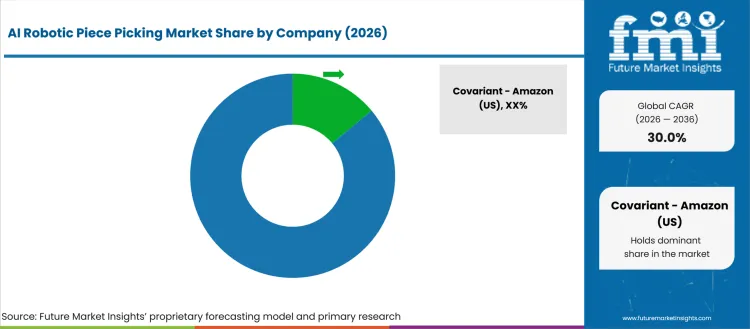
Competition separates dedicated picking specialists from larger industrial robot groups. The full operating result carries more weight than the robot arm by itself. A capable cell must recognize difficult products and recover from a missed grip without slowing nearby work. Reliable links with storage and order software are equally necessary for routine operation across busy shifts. Collaborative robots provide a useful comparison with systems designed for closer human interaction. Commercial advantage comes from stable output across changing products and practical support during system faults.
- Amazon Robotics develops picking systems inside a large fulfillment network and tests them under daily order pressure. Direct access to operating data improves sensing and motion across crowded storage positions. Its significance comes from keeping robot design tied to the full fulfillment process instead of a separate machine task.
- RightHand Robotics and OSARO focus on dedicated piece-picking stations with matched perception software and handling equipment. Their value comes from repeatable output across mixed products and common warehouse interfaces. This focused approach shortens the path from a technical trial to routine use.
- Nomagic focuses on fashion and e-commerce operations with soft packaging and frequent product changes. Its software is designed to reduce manual tuning across active product ranges. The company represents a specialist model built around difficult item handling instead of a broad industrial robot portfolio.
- Brightpick combines mobile robots with storage and picking workflows that rely less on fixed conveyor routes. The model suits warehouses seeking flexible movement and denser storage without a fixed conveyor route. Its commercial value depends on local engineering and dependable software support during regional expansion.
- Mujin and ABB Robotics bring control experience from wider industrial automation programs. Their role becomes relevant in complex cells containing several machines and strict safety needs. Both companies compete on coordinated motion and formal engineering support instead of a narrow picking product.
Competitive Benchmarking: AI Robotic Piece Picking Market
| Company | AI Grasping Capability | End-Effector Flexibility | Workflow Integration | Documented Operating Reach |
|---|---|---|---|---|
| Amazon Robotics | High | High | High | United States and Europe / Regional |
| RightHand Robotics | High | High | High | North America and Europe / Regional |
| Nomagic | High | Medium | High | Europe and North America / Regional |
| OSARO | High | Medium | Medium | North America and Europe / Regional |
| Mujin | High | Medium | High | Asia-Pacific and North America / Regional |
| Brightpick | Medium | High | High | North America and Europe / Regional |
| ABB Robotics | Medium | Medium | High | Global |
Scoring basis: High indicates substantial direct capability, Medium reflects partial or indirect capability and Low indicates limited direct evidence for the stated dimension.
Source: Future Market Insights competitive analysis, 2026. Ratings reflect relative portfolio relevance and workflow fit. Operating evidence and geographic reach shape the remaining comparison.
Key Developments in the AI Robotic Piece Picking Market
- In May 2025, Amazon Robotics, introduced Vulcan as its first touch-sensing robot for picking and stowing products inside crowded storage pods. Amazon reported coverage of about 75% of stored item types and more than 500,000 processed orders at early sites.
- In October 2025, Nomagic, was selected by Zalando to expand item picking and sorter induction across more fulfillment centers. The earlier pilot averaged 10,000 picks per day and supported nine robots during 2025. Zalando's repeat order connects investment with measured output across live fashion products.
- In April 2026, Brightpick, partnered with MotionTech to expand Gridpicker installation and service coverage across Europe. The agreement combines a complete robotic fulfillment system with regional engineering and maintenance for complex warehouse programs.
- In October 2025, ABB, agreed to sell its Robotics division to SoftBank Group for an enterprise value of USD 5.375 billion. The transaction replaced ABB's earlier separation plan and linked an established robot portfolio with SoftBank's investment in AI and computing.
Key Players in the AI Robotic Piece Picking Market
Internal fulfillment robot systems
- Amazon Robotics
Dedicated robotic piece-picking specialists
- RightHand Robotics
- Nomagic
- OSARO
Warehouse system and industrial robot companies
- Brightpick
- Mujin
- ABB Robotics
AI Robotic Piece Picking Market - Report Scope
| Coverage field | Report scope |
|---|---|
| Market breakdown | Technology, application, component, end-use industry, business model, and region |
| Quantitative Units | Revenue in USD Million, Volume in Units, CAGR in % |
| Market Definition | AI robotic piece picking covers robot cells that use machine perception and grasp planning to select individual items from bins or storage positions. |
| Regions Covered | North America, Latin America, Europe, East Asia, South Asia, Oceania, and Middle East and Africa |
| Countries Covered | United States, Poland and other Eastern European countries, Japan, European Union members, and 30+ countries |
| Key Companies Profiled | Amazon Robotics, RightHand Robotics, Nomagic, OSARO, Mujin, Brightpick, and ABB Robotics |
| Forecast Period | 2026 to 2036 |
| Approach | Hybrid bottom-up and top-down sizing supported by company evidence and primary interviews |
Source: Future Market Insights - analysis driven by proprietary forecasting models and primary research
AI Robotic Piece Picking Market - Research Methodology
| Method | Approach |
|---|---|
| Primary Research | Primary interviews cover fulfillment directors and warehouse engineering teams across major logistics regions. Discussions examine product range and missed grips together with staffing patterns and order cut-off needs. System integrators describe installation work and service response during routine operations. Robot companies explain product coverage and support terms alongside gripper specialists who describe payload limits and difficult surfaces. The interviews show which results decide whether a pilot enters routine use. |
| Desk Research | Desk research reviews official online retail statistics and dated company releases. Product pages and technical material support the assessment of grasping capability and software fit. Robot safety standards explain the work required around complete cells. Official trade guides describe local logistics conditions and online retail scale. |
| Market Sizing and Forecasting | Market sizing combines company product evidence and installation data with spending on robot arms and gripping tools. Software and service revenue are assessed separately and then combined with the total market. Segment shares reflect technology and application spending during the base year. Country forecasts compare fulfillment investment and warehouse age with local integration capacity, service coverage, and replacement timing plans. |
| Data Validation | Data validation compares company evidence with interviews from integrators and fulfillment teams. Pick rates and recovery from missed grips are reviewed with service coverage and common cell designs. Segment shares are tested against component costs and contract structures. Country forecasts are checked against official online retail conditions and documented warehouse investment. |
Source: Future Market Insights (FMI) analysis, based on proprietary forecasting model and primary research
AI Robotic Piece Picking Market by Segments
AI Robotic Piece Picking Market segmented by Technology:
- Foundation-model grasping AI
- Suction EOAT systems
- Multi-modal grippers
- 3D vision
- Edge compute
AI Robotic Piece Picking Market segmented by Application:
- Each picking (e-commerce)
- Sorter induction
- Kitting
- Returns processing
- Store replenishment
AI Robotic Piece Picking Market segmented by Component:
- Hardware
- AI software
- Services
AI Robotic Piece Picking Market segmented by End-use Industry:
- E-commerce
- 3PL
- Grocery
- Apparel
- Pharma
AI Robotic Piece Picking Market segmented by Business Model:
- Robots-as-a-Service
- Direct purchase
- Lease
- Pilot programs
AI Robotic Piece Picking Market by Region:
- North America
- United States
- Canada
- Latin America
- Brazil
- Mexico
- Argentina
- Europe
- Germany
- United Kingdom
- France
- Italy
- Spain
- Poland
- Other European Countries
- East Asia
- China
- Japan
- South Korea
- South Asia
- India
- Thailand
- Indonesia
- Other South Asian Countries
- Oceania
- Australia
- New Zealand
- Middle East and Africa
- Gulf Cooperation Council Countries
- South Africa
- Turkey
- Other Middle Eastern and African Countries
Research Sources and Bibliography
- Amazon. (2025, May). Introducing Vulcan: Amazon's first robot with a sense of touch. Amazon.
- ABB. (2025, October). ABB to divest Robotics division to SoftBank Group. ABB.
- ABB Robotics. (n.d.). Robotics for logistics and warehouse automation. ABB.
- Brightpick. (2026, March). Brightpick Launches Gridpicker; Highest-Throughput Robotic Fulfillment System Ever Developed. Brightpick.
- Brightpick. (2026, April). Brightpick and MotionTech Partner to Scale Gridpicker Deployment Across Europe. Brightpick.
- Brightpick. (2026, June). Trew Partners with Brightpick to Expand Robotic Fulfillment Portfolio. Brightpick.
- International Federation of Robotics. (2026, January). Top 5 Global Robotics Trends 2026. International Federation of Robotics.
- International Organization for Standardization. (2025, February). ISO 10218-1:2025 Robotics - Safety requirements - Part 1: Industrial robots. ISO.
- International Organization for Standardization. (2025, February). ISO 10218-2:2025 Robotics - Safety requirements - Part 2: Industrial robot applications and robot cells. ISO.
- International Trade Administration. (2025, August). Germany - eCommerce. USA Department of Commerce.
- International Trade Administration. (2025, November). Japan - eCommerce. USA Department of Commerce.
- International Trade Administration. (2026, April). Poland - eCommerce. USA Department of Commerce.
- Mujin. (n.d.). Intelligent robot control and random picking. Mujin.
- Nomagic. (2025, February). Nomagic Secures $44 Million Investment to Drive AI Innovation in Robotics. Nomagic.
- Nomagic. (2025, October). Nomagic selected by Zalando to Expand Robotic Warehouse Capabilities. Nomagic.
- Nomagic. (2026, January). Nomagic secures an additional $10M to accelerate commercial growth and advance its technology roadmap. Nomagic.
- Nomagic. (2026, June). Nomagic Wins 2026 IFOY Award for Shoebox Picker, Marking Breakthrough in Warehouse Automation for Fashion and Footwear Fulfillment. Nomagic.
- OSARO. (n.d.). Robotic Piece Picking. OSARO.
- RightHand Robotics. (n.d.). RightPick system. RightHand Robotics.
- USA Census Bureau. (2026, May). Quarterly Retail E-Commerce Sales: 1st Quarter 2026. USA Department of Commerce.
This bibliography is provided for reader reference and uses primary government, standards-body, official trade body, and company sources.
This Report Answers
- What is the AI robotic piece picking market value in 2026 and 2036?
- What CAGR is projected for the market from 2026 to 2036?
- Which technology and application segments are estimated to shape demand?
- Which operating pressures are projected to support adoption in major fulfillment centers?
- How do growth rates differ across the profiled markets?
- Which companies compete on grasping performance and workflow integration?
- How does FMI validate market size and country forecasts?
- What should companies address during expansion across several fulfillment sites?
- How do safety and integration needs affect company selection?
Frequently Asked Questions
What is driving growth in the AI Robotic Piece Picking Market?
Growth is driven by the need to handle mixed packaging and frequently changing product ranges in fulfillment operations. Adaptive vision systems improve picking accuracy and reduce manual intervention during peak demand periods.
Who are the key players in the AI Robotic Piece Picking Market?
Amazon Robotics and RightHand Robotics are prominent players competing through advanced sensing and handling capabilities. Nomagic and OSARO differentiate themselves by providing AI-driven software designed for diverse and changing product assortments.
What is a notable restraint in the AI Robotic Piece Picking Market?
Integration requirements can delay deployment and approval processes, particularly in older warehouse environments. Additional safety reviews increase implementation costs and can reveal weaknesses in pilot planning and system design.
Why should executives track the AI Robotic Piece Picking Market?
AI-powered robotic picking is reshaping workforce planning, order processing strategies, and fulfillment operations. Executives must ensure that productivity gains outweigh potential losses from missed picks and system downtime.
What business problem does the AI Robotic Piece Picking Market address?
The market addresses the challenge of consistently handling products that vary in size, shape, and packaging. AI-guided robots reduce the need for repeated programming while improving recovery from unsuccessful pick attempts.
What should procurement leaders evaluate before selecting suppliers?
Procurement leaders should validate robot performance using representative products in real operating conditions. They should also assess software accessibility, integration capabilities and the availability of local service support for multi-site deployments.
What limits return on investment for purchasers?
Return on investment is reduced when robots process insufficient product volumes or operate below capacity. Unplanned downtime and late-stage facility modifications can further decrease productive utilization and financial returns.
How do suppliers build long-term account confidence?
Suppliers build confidence by consistently demonstrating reliable performance across challenging product and packaging conditions. Strong service support, transparent reporting and documented operational results encourage broader deployment over time.
Preview the report firsthand - request a free sample
Get SampleGet the brochure for pricing and purchase details.
Get PDFTable of Content
- Key Takeaways
- Market Size and CAGR
- Top Growth Driver
- Fastest Growing Segment
- Leading Region
- Key Companies
- Emerging Opportunities
- Executive Summary
- Global Market Outlook
- Demand-side Trends
- Supply-side Trends
- Technology Roadmap Analysis
- Analysis and Recommendations
- Analyst Perspective (What is happening? Why now? What should investors know?)
- Key Questions Answered
- How large is the market?
- What is the CAGR?
- What are key trends?
- Which region dominates?
- Who are the leaders?
- Market Overview
- Market Coverage / Taxonomy
- Market Definition / Scope / Limitations
- Research Methodology
- Chapter Orientation
- Analytical Lens and Working Hypotheses
- Market Structure, Signals, and Trend Drivers
- Benchmarking and Cross-market Comparability
- Market Sizing, Forecasting, and Opportunity Mapping
- Research Design and Evidence Framework
- Desk Research Programme (Secondary Evidence)
- Expert Input and Fieldwork (Primary Evidence)
- Tooling, Models, and Reference Databases
- Data Engineering and Model Build
- Quality Assurance and Audit Trail
- Market Background
- Market Dynamics (Drivers, Restraints, Opportunity, Trends)
- Scenario Forecast (Optimistic, Likely, Conservative)
- Impact Analysis
- AI Impact
- Sustainability Impact
- Regulatory Impact
- Technology Impact
- Consumer / Buyer Analysis
- Purchase Drivers
- Adoption Barriers
- Buyer Journey
- Opportunity Map Analysis
- Product Life Cycle Analysis
- Supply Chain Analysis
- Investment Feasibility Matrix
- Value Chain Analysis
- PESTLE and Porter's Analysis
- Regulatory Landscape
- Regional Parent Market Outlook
- Production and Consumption Statistics
- Import and Export Statistics
- Global Market Analysis and Forecast, 2021 to 2036
- Historical Market Size Value (USD Billion) Analysis, 2021 to 2025
- Current and Future Market Size Value (USD Billion) Projections, 2026 to 2036
- Y-o-Y Growth Trend Analysis
- Absolute $ Opportunity Analysis
- Global Market Pricing Analysis, 2021 to 2036
- Global Market Analysis and Forecast, By Technology, 2021 to 2036
- Introduction / Key Findings
- Historical Market Size Value (USD Billion) Analysis By Technology, 2021 to 2025
- Current and Future Market Size Value (USD Billion) Analysis and Forecast By Technology, 2026 to 2036
- Foundation-model grasping AI
- Suction EOAT systems
- Multi-modal grippers
- 3D vision
- Edge compute
- Foundation-model grasping AI
- Y-o-Y Growth Trend Analysis By Technology, 2021 to 2025
- Absolute $ Opportunity Analysis By Technology, 2026 to 2036
- Global Market Analysis and Forecast, By Application, 2021 to 2036
- Introduction / Key Findings
- Historical Market Size Value (USD Billion) Analysis By Application, 2021 to 2025
- Current and Future Market Size Value (USD Billion) Analysis and Forecast By Application, 2026 to 2036
- Each picking for e-commerce
- Sorter induction
- Kitting
- Returns processing
- Store replenishment
- Each picking for e-commerce
- Y-o-Y Growth Trend Analysis By Application, 2021 to 2025
- Absolute $ Opportunity Analysis By Application, 2026 to 2036
- Global Market Analysis and Forecast, By Component, 2021 to 2036
- Introduction / Key Findings
- Historical Market Size Value (USD Billion) Analysis By Component, 2021 to 2025
- Current and Future Market Size Value (USD Billion) Analysis and Forecast By Component, 2026 to 2036
- Hardware
- AI software
- Services
- Hardware
- Y-o-Y Growth Trend Analysis By Component, 2021 to 2025
- Absolute $ Opportunity Analysis By Component, 2026 to 2036
- Global Market Analysis and Forecast, By End-use Industry, 2021 to 2036
- Introduction / Key Findings
- Historical Market Size Value (USD Billion) Analysis By End-use Industry, 2021 to 2025
- Current and Future Market Size Value (USD Billion) Analysis and Forecast By End-use Industry, 2026 to 2036
- E-commerce
- 3PL
- Grocery
- Apparel
- Pharma
- E-commerce
- Y-o-Y Growth Trend Analysis By End-use Industry, 2021 to 2025
- Absolute $ Opportunity Analysis By End-use Industry, 2026 to 2036
- Global Market Analysis and Forecast, By Business Model, 2021 to 2036
- Introduction / Key Findings
- Historical Market Size Value (USD Billion) Analysis By Business Model, 2021 to 2025
- Current and Future Market Size Value (USD Billion) Analysis and Forecast By Business Model, 2026 to 2036
- Robots-as-a-Service
- Direct purchase
- Lease
- Pilot programs
- Robots-as-a-Service
- Y-o-Y Growth Trend Analysis By Business Model, 2021 to 2025
- Absolute $ Opportunity Analysis By Business Model, 2026 to 2036
- Global Market Analysis and Forecast, By Region, 2021 to 2036
- Introduction
- Historical Market Size Value (USD Billion) Analysis By Region, 2021 to 2025
- Current Market Size Value (USD Billion) Analysis and Forecast By Region, 2026 to 2036
- North America
- Latin America
- Western Europe
- Eastern Europe
- East Asia
- South Asia and Pacific
- Middle East & Africa
- Market Attractiveness Analysis By Region
- North America Market Analysis and Forecast, By Country, 2021 to 2036
- Historical Market Size Value (USD Billion) Trend Analysis By Market Taxonomy, 2021 to 2025
- Market Size Value (USD Billion) Forecast By Market Taxonomy, 2026 to 2036
- By Country
- USA
- Canada
- By Technology
- By Application
- By Component
- By End-use Industry
- By Business Model
- By Country
- Market Attractiveness Analysis
- By Country
- By Technology
- By Application
- By Component
- By End-use Industry
- By Business Model
- Key Takeaways
- Latin America Market Analysis and Forecast, By Country
- Historical Market Size Value (USD Billion) Trend Analysis By Market Taxonomy, 2021 to 2025
- Market Size Value (USD Billion) Forecast By Market Taxonomy, 2026 to 2036
- By Country
- Brazil
- Mexico
- Chile
- Rest of Latin America
- By Technology
- By Application
- By Component
- By End-use Industry
- By Business Model
- By Country
- Market Attractiveness Analysis
- By Country
- By Technology
- By Application
- By Component
- By End-use Industry
- By Business Model
- Key Takeaways
- Western Europe Market Analysis and Forecast, By Country
- Historical Market Size Value (USD Billion) Trend Analysis By Market Taxonomy, 2021 to 2025
- Market Size Value (USD Billion) Forecast By Market Taxonomy, 2026 to 2036
- By Country
- Germany
- UK
- Italy
- Spain
- France
- Nordic
- BENELUX
- Rest of Western Europe
- By Technology
- By Application
- By Component
- By End-use Industry
- By Business Model
- By Country
- Market Attractiveness Analysis
- By Country
- By Technology
- By Application
- By Component
- By End-use Industry
- By Business Model
- Key Takeaways
- Eastern Europe Market Analysis and Forecast, By Country
- Historical Market Size Value (USD Billion) Trend Analysis By Market Taxonomy, 2021 to 2025
- Market Size Value (USD Billion) Forecast By Market Taxonomy, 2026 to 2036
- By Country
- Russia
- Poland
- Hungary
- Balkan & Baltic
- Rest of Eastern Europe
- By Technology
- By Application
- By Component
- By End-use Industry
- By Business Model
- By Country
- Market Attractiveness Analysis
- By Country
- By Technology
- By Application
- By Component
- By End-use Industry
- By Business Model
- Key Takeaways
- East Asia Market Analysis and Forecast, By Country
- Historical Market Size Value (USD Billion) Trend Analysis By Market Taxonomy, 2021 to 2025
- Market Size Value (USD Billion) Forecast By Market Taxonomy, 2026 to 2036
- By Country
- China
- Japan
- South Korea
- By Technology
- By Application
- By Component
- By End-use Industry
- By Business Model
- By Country
- Market Attractiveness Analysis
- By Country
- By Technology
- By Application
- By Component
- By End-use Industry
- By Business Model
- Key Takeaways
- South Asia and Pacific Market Analysis and Forecast, By Country
- Historical Market Size Value (USD Billion) Trend Analysis By Market Taxonomy, 2021 to 2025
- Market Size Value (USD Billion) Forecast By Market Taxonomy, 2026 to 2036
- By Country
- India
- ASEAN
- Australia & New Zealand
- Rest of South Asia and Pacific
- By Technology
- By Application
- By Component
- By End-use Industry
- By Business Model
- By Country
- Market Attractiveness Analysis
- By Country
- By Technology
- By Application
- By Component
- By End-use Industry
- By Business Model
- Key Takeaways
- Middle East & Africa Market Analysis and Forecast, By Country
- Historical Market Size Value (USD Billion) Trend Analysis By Market Taxonomy, 2021 to 2025
- Market Size Value (USD Billion) Forecast By Market Taxonomy, 2026 to 2036
- By Country
- Kingdom of Saudi Arabia
- Other GCC Countries
- Türkiye
- South Africa
- Other African Union
- Rest of Middle East & Africa
- By Technology
- By Application
- By Component
- By End-use Industry
- By Business Model
- By Country
- Market Attractiveness Analysis
- By Country
- By Technology
- By Application
- By Component
- By End-use Industry
- By Business Model
- Key Takeaways
- Key Countries Market Analysis
- USA
- Pricing Analysis
- Market Share Analysis, 2025
- By Technology
- By Application
- By Component
- By End-use Industry
- By Business Model
- Canada
- Pricing Analysis
- Market Share Analysis, 2025
- By Technology
- By Application
- By Component
- By End-use Industry
- By Business Model
- Mexico
- Pricing Analysis
- Market Share Analysis, 2025
- By Technology
- By Application
- By Component
- By End-use Industry
- By Business Model
- Brazil
- Pricing Analysis
- Market Share Analysis, 2025
- By Technology
- By Application
- By Component
- By End-use Industry
- By Business Model
- Chile
- Pricing Analysis
- Market Share Analysis, 2025
- By Technology
- By Application
- By Component
- By End-use Industry
- By Business Model
- Germany
- Pricing Analysis
- Market Share Analysis, 2025
- By Technology
- By Application
- By Component
- By End-use Industry
- By Business Model
- UK
- Pricing Analysis
- Market Share Analysis, 2025
- By Technology
- By Application
- By Component
- By End-use Industry
- By Business Model
- Italy
- Pricing Analysis
- Market Share Analysis, 2025
- By Technology
- By Application
- By Component
- By End-use Industry
- By Business Model
- Spain
- Pricing Analysis
- Market Share Analysis, 2025
- By Technology
- By Application
- By Component
- By End-use Industry
- By Business Model
- France
- Pricing Analysis
- Market Share Analysis, 2025
- By Technology
- By Application
- By Component
- By End-use Industry
- By Business Model
- India
- Pricing Analysis
- Market Share Analysis, 2025
- By Technology
- By Application
- By Component
- By End-use Industry
- By Business Model
- ASEAN
- Pricing Analysis
- Market Share Analysis, 2025
- By Technology
- By Application
- By Component
- By End-use Industry
- By Business Model
- Australia & New Zealand
- Pricing Analysis
- Market Share Analysis, 2025
- By Technology
- By Application
- By Component
- By End-use Industry
- By Business Model
- China
- Pricing Analysis
- Market Share Analysis, 2025
- By Technology
- By Application
- By Component
- By End-use Industry
- By Business Model
- Japan
- Pricing Analysis
- Market Share Analysis, 2025
- By Technology
- By Application
- By Component
- By End-use Industry
- By Business Model
- South Korea
- Pricing Analysis
- Market Share Analysis, 2025
- By Technology
- By Application
- By Component
- By End-use Industry
- By Business Model
- Russia
- Pricing Analysis
- Market Share Analysis, 2025
- By Technology
- By Application
- By Component
- By End-use Industry
- By Business Model
- Poland
- Pricing Analysis
- Market Share Analysis, 2025
- By Technology
- By Application
- By Component
- By End-use Industry
- By Business Model
- Hungary
- Pricing Analysis
- Market Share Analysis, 2025
- By Technology
- By Application
- By Component
- By End-use Industry
- By Business Model
- Kingdom of Saudi Arabia
- Pricing Analysis
- Market Share Analysis, 2025
- By Technology
- By Application
- By Component
- By End-use Industry
- By Business Model
- Türkiye
- Pricing Analysis
- Market Share Analysis, 2025
- By Technology
- By Application
- By Component
- By End-use Industry
- By Business Model
- South Africa
- Pricing Analysis
- Market Share Analysis, 2025
- By Technology
- By Application
- By Component
- By End-use Industry
- By Business Model
- USA
- Market Structure Analysis
- Competition Dashboard
- Competition Benchmarking
- Market Share Analysis of Top Players
- By Regional
- By Technology
- By Application
- By Component
- By End-use Industry
- By Business Model
- Emerging Startups
- Innovation Benchmarking
- Competition Analysis
- Competition Deep Dive
- Covariant - Amazon (US)
- Overview
- Product Portfolio
- Profitability by Market Segments
- Sales Footprint
- Strategy Overview
- Marketing Strategy
- Product Strategy
- Channel Strategy
- RightHand Robotics (US)
- Nomagic (PL)
- Osaro (US)
- Mujin (JP)
- Covariant - Amazon (US)
- Case Studies
- Success Stories
- Recent Developments
- Competition Deep Dive
- Assumptions & Acronyms Used


