

- Market Size (2026)
- USD 860.6 Mn
- Forecast (2036)
- USD 1470.0 Mn
- CAGR (2026 to 2036)
- 5.5%
How big is Air Slide Fabrics Market in 2026?
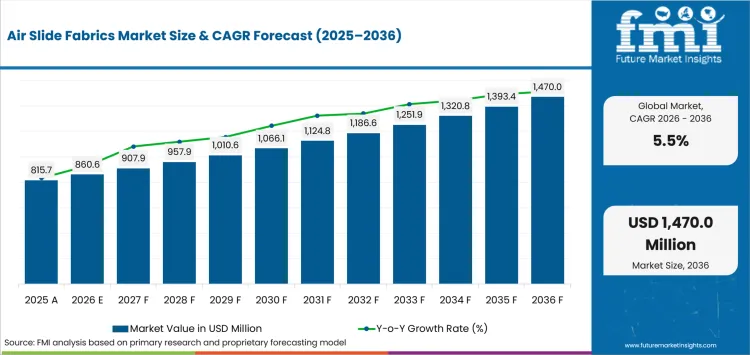
USD 860.6 million in 2026 and USD 1470.0 million by 2036 at a 5.5% CAGR.
Demand for air slide fabrics is projected to expand at a 5.5% CAGR between 2026 and 2036, increasing valuation from USD 860.6 million in 2026 to USD 1470.0 million by 2036. Installed bulk material handling equipment requires replacement fabric as textile media loses stable airflow well ahead of conveyor housing end-of-life. Press Information Bureau reported in June 2026 that Indian cement production rose 8.4% year over year during May, adding duty cycles that increase inspection exposure for installed air-slide media.
Replacement demand differs between mature and expansion-led cement markets as plant utilization and new construction place different loads on installed air-slide equipment. The American Cement Association projected United States cement consumption to decline 2.5% during 2026, increasing the relative weight of maintenance-led orders in a mature plant base. Indonesia and Türkiye combine higher profiled CAGRs with active production systems that expose powder-transfer fabrics to more regular operating wear.
Key Takeaways of Air Slide Fabrics Market
- Recurring maintenance across cement and dry-powder plants sustains demand as fabric condition affects airflow stability during transfer operations.
- By fabric material, polyester is estimated to hold 39.0% in 2026 owing to practical temperature coverage across routine powder-transfer duties.
- In 2026, plain weave is expected to lead weave / construction with 28.0% share because regular yarn geometry supports predictable airflow and dimensional stability.
- The air permeability category is forecast to be led by low permeability at 24.0% share in 2026 due to controlled airflow requirements for fine powders.
- Specification mismatch can delay supplier switching as replacement media must reproduce proven airflow behavior inside existing equipment.
- Testori S.p.A., BWF Group, Filmedia®, Dollfus & Muller, Albarrie Canada Limited, Calcutta Conveyors and Filters Pvt. Ltd., India Canvas & Tarpaulin Co. and China Sunrise Machinery serve air-slide fabric and related technical-textile supply.
Analyst Perspective
"Blower pressure and trough geometry set the acceptable permeability range for each powder duty during air-slide fabric qualification. Recurring replacement revenue favors manufacturers that reproduce this range across each roll and convert stock to the installed width inside planned outage windows."
- Nikhil Kaitwade, Principal Consultant, Future Market Insights
How is the Air Slide Fabrics Market segmented?
The air slide fabrics market is segmented by fabric material, weave / construction, air permeability, application, sales model and region.
Fabric material includes polyester, aramid, cotton, glass fiber and blended technical fabrics. Weave / construction covers plain weave, needle felt, multi-layer woven and fluidizing membrane. Air permeability includes low, medium and high. Application covers cement air slides, silo fluidization, fly ash conveying and powder handling systems. Sales model covers replacement rolls, cut-to-size pads and OEM supply. Region follows taxonomy.
What supports demand for cement air slides within the application category?
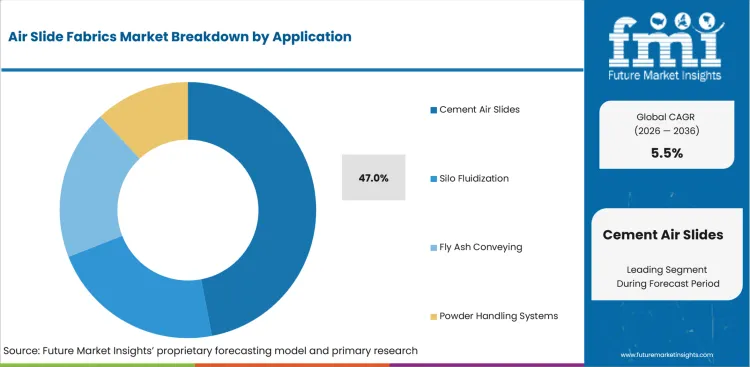
Cement air slides transfer fine powder between grinding and storage without mechanical carrying surfaces. Press Information Bureau reported in July 2026 that Indian cement production rose 9.8% year over year during June. Higher output extends operating hours across conveyor systems and increases fabric-wear exposure without establishing the modeled application share.
- By application, cement air slides are forecast to represent 47.0% in 2026 driven by repeated transfer duties across high-throughput cement plants.
- Unlike conveyor belts, scheduled maintenance links fabric condition to outage planning as uneven airflow can interrupt transfer well ahead of conveyor housing replacement.
What makes polyester central to the fabric material category?
Polyester balances mechanical strength with replacement cost across cement and mineral lines. China Sunrise Machinery published a January 2026 note describing air-slide fabric made from synthetic polyester fibers. It identifies uniform air permeability as necessary for sealed powder transport across cement and power applications, reinforcing the need for industrial fabric that holds its dimensions under abrasive airflow.
- By fabric material, polyester is estimated to hold 39.0% in 2026 owing to practical temperature coverage across routine powder-transfer duties.
- Fabricators can tune polyester construction for permeability and roll dimensions while preserving manageable replacement economics across standard air-slide positions.
How does low permeability shape demand within the air permeability category?
Low-permeability grades meter airflow into fine powder and limit penetration into the textile structure. Albarrie presented AlSlide fluidizing fabric at the Powder & Bulk Show in April 2025 for air-gravity conveying. Its dense nonwoven fabrics use small consistent openings for even fluidization, leaving plant engineers to match fabric resistance with available blower capacity during qualification.
- In 2026, low permeability is expected to lead air permeability with 24.0% share because fine powders require controlled airflow distribution.
- Maintenance teams compare pressure drop and pore consistency as excessive resistance can starve fluidization across existing blower and trough configurations.
What drives replacement rolls within the sales model category?
Replacement rolls fit maintenance programs as air-slide media wears earlier than steel conveyor housings. China Sunrise Machinery published a July 2025 installation note requiring aligned tension during air-slide canvas replacement. The guidance also requires tight chute sealing for uniform airflow, while roll stock gives technical textile fabricators flexibility to match installed lengths during planned outages.
- Based on sales model, replacement rolls are projected to account for 43.0% in 2026 due to recurring inspection and fabric-renewal cycles.
- Maintenance teams can cut qualified roll stock across several conveyor sections without ordering separate pads for every standard geometry.
What are the drivers, restraints and opportunities in the Air Slide Fabrics Market?
Recurring wear supports replacement demand, qualification risk limits switching and local engineered service can shorten outage-related purchase cycles.
- Driver: Installed cement and mineral-processing equipment generates recurring fabric replacement as airflow drift can interrupt powder transfer earlier than conveyor structure failure.
- Restraint: Permeability or dimensional mismatch can delay supplier switching by forcing plants to reproduce proven airflow behavior under existing pressure conditions.
- Opportunity: Regional conversion and documented pressure-drop testing can shorten qualification work while local stock protects maintenance schedules during planned or unexpected fabric replacement.
Installed Equipment Converts Operating Hours into Replacement Demand
Installed cement equipment turns operating hours into recurring air-slide fabric replacement as abrasive powder gradually changes permeability across the conveying surface. Press Information Bureau reported in May 2026 that Indian cement production rose 9.4% year over year during April, extending airflow exposure across installed slides. More operating hours also increase inspections that identify pneumatic conveying fabric drift well ahead of conveyor housing replacement.
Qualification Risk Protects Proven Specifications
Qualification risk rises if replacement fabric cannot reproduce the resistance and dimensions of an approved installed specification. China Sunrise Machinery stated in November 2025 that practical air-slide fabric requires flat construction and uniform thickness to maintain sealing performance. Small differences in textile geometry can change airflow at the existing blower setting, so maintenance teams often retain proven specifications during short outage windows.
Regional Conversion Can Shorten Replacement Lead Times
Regional conversion reduces replacement lead time once a plant establishes its required fabric specification and pressure-drop range. Testori S.p.A. opened Testori Australia in November 2025 to provide local products and technical counselling for industrial filtration customers. A nearer service point can shorten specification review and delivery time as regional technical textile production networks provide qualified fabrication for recurring replacement programs.
Which country CAGRs are profiled in the Air Slide Fabrics Market?
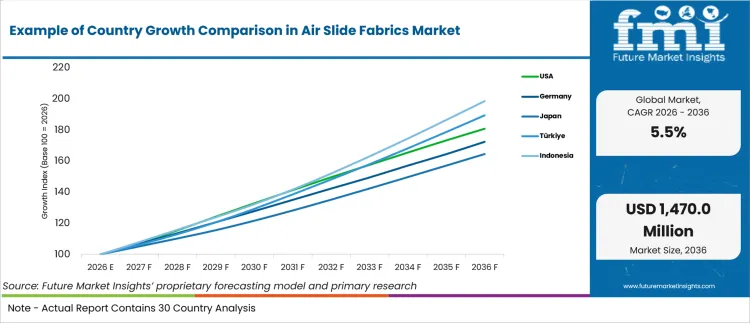
| Country | CAGR |
|---|---|
| Indonesia | 5.5% |
| Türkiye | 5.2% |
| United States | 4.6% |
| Germany | 4.2% |
| Japan | 3.9% |
How do country-level CAGRs compare in the Air Slide Fabrics Market?
The profiled markets span 1.6 percentage points and form distinct operating groups across national cement production systems. Indonesia and Türkiye form the upper cluster around active production and export exposure that maintains transfer-equipment utilization. The United States bridges that pattern as Germany and Japan depend more on qualification discipline.
- Indonesia combines variable project demand with replacement needs across dispersed cement production clusters.
- Türkiye links export-oriented cement output with maintenance pressure across high-utilization powder-transfer equipment.
- United States plants pair mature service channels with substantial imported cement requirements.
- Germany concentrates replacement access around established plants with demanding technical qualification routines.
- Japan emphasizes proven specifications across a compact plant base with costly downtime.
Different growth rates produce different order timing as service access and plant utilization vary. The full report provides country-level CAGR analysis across North America, Latin America, Europe, East Asia, South Asia, Oceania and the Middle East and Africa.
Country-wise Analysis
- Indonesian cement plants operate across dispersed production clusters with uneven project demand, making local fabric conversion and replacement stock important during maintenance outages at plants far from Java's main industrial service centers and ports. Asperssi reported in February 2026 that national cement production fell 4.5% to 64.7 million tonnes during 2025, as weaker construction spending reduced domestic sales and shifted more routine maintenance attention toward installed plant equipment. Air slide fabric demand in Indonesia is forecast to rise at 5.5% CAGR over the forecast period, supported by installed capacity although flexible order quantities remain important outside Java's main regional industrial corridors.
- Türkiye operates a high-volume cement base with export exposure, so powder-transfer efficiency and maintenance cost remain visible across coastal terminals and inland plants serving domestic and overseas customers during frequent scheduled production campaigns. Türkiye's air slide fabrics outlook is anticipated to advance at 5.2% CAGR over the assessment period, owing to recurring fabric inspection across heavily utilized production systems and established cement export flows during maintenance. TÜRKÇİMENTO reported in June 2026 that 2025 cement production reached 97.8 million tonnes and exports reached 15.6 million tonnes, yet energy costs and trade rules increase the value of airflow consistency and service life.
- United States cement plants rely on mature regional maintenance channels across a dispersed national construction market, so scheduled shutdowns create recurring replacement windows for legacy air-slide assemblies and other installed dry-powder handling equipment. The American Cement Association reported in March 2026 that imports meet 20% of annual cement demand, which makes domestic stock and responsive regional conversion more valuable during outages with limited replacement lead time. The United States air slide fabrics sector is projected to record 4.6% CAGR during the assessment period, supported by installed equipment although legacy dimensions and costly downtime leave qualification requirements high across service networks.
- German cement producers operate a mature plant network that relies on planned maintenance and strict technical qualification for recurring air-slide fabric replacement across established regional production sites and long-serving powder-handling equipment during outages nationwide. Germany is estimated to post 4.2% CAGR over the forecast period, owing to recurring maintenance across mature powder-handling equipment and disciplined specification control within established cement plants and local service networks nationwide. VDZ reported in May 2026 that German cement sales had fallen by one-third over five years, which leaves new-volume growth weak and raises the importance of dimensional consistency plus technical service in replacement programs.
- Japanese cement producers manage a compact national plant base that rewards dependable maintenance and stable specifications during planned outages across regional production networks with little tolerance for extended downtime or delayed replacement media. Adoption of air slide fabrics in Japan is estimated to expand at 3.9% CAGR through 2036, reinforced by recurring maintenance across concentrated production sites and established technical service networks during planned outage cycles. The Japan Cement Association reported in July 2025 that 15 companies owned 26 plants with 47 million tons of clinker capacity, so proven quality records and local representation carry more weight during replacement work.
Who are the notable companies in the Air Slide Fabrics Market?
Testori S.p.A., BWF Group, Filmedia®, Clear Edge Filtration, Albarrie Canada Limited, Calcutta Conveyors and Filters Pvt. Ltd., India Canvas & Tarpaulin Co. and China Sunrise Machinery serve this market.
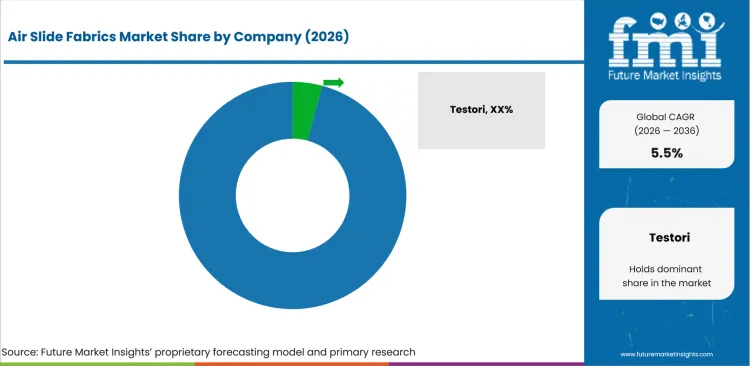
The field is fragmented across dedicated fluidization-fabric makers and wider technical-textile companies serving cement and bulk-handling plants through industrial filtration networks. Broader industrial air filtration platforms add engineering and service depth, but air-slide entry depends on repeatable permeability and compatible roll construction.
- Testori S.p.A., BWF Group, Filmedia® and Clear Edge Filtration combine technical textile manufacturing with regional industrial service networks.
- Albarrie Canada Limited, Calcutta Conveyors and Filters Pvt. Ltd., India Canvas & Tarpaulin Co. and China Sunrise Machinery focus on fluidization fabric or equipment-linked conversion.
Competitive Benchmarking: Air Slide Fabrics Market
| Company | Fluidization Breadth | Fabric Engineering | Conversion Support | Geographic Reach |
|---|---|---|---|---|
| Testori S.p.A. | High | High | High | Europe, Asia-Pacific and Americas |
| BWF Group | High | High | High | Europe, Asia-Pacific and Americas |
| Filmedia® | Medium | High | High | Global |
| Clear Edge Filtration | Medium | High | High | Global |
| Albarrie Canada Limited | High | High | Medium | North America and exports |
| Calcutta Conveyors and Filters Pvt. Ltd. | High | High | Medium | India and exports |
| India Canvas & Tarpaulin Co. | High | High | Medium | International exports |
| China Sunrise Machinery | High | High | Medium | China and exports |
Key Developments in the Air Slide Fabrics Market
- In April 2026, Testori S.p.A. announced its acquisition of Tessitura Fratelli Fontana, broadening its manufacturing base in technical textiles and industrial filtration. The Italian producer adds complementary fabric engineering and conversion resources for industrial customers.
- In March 2026, BWF Group's Envirotec division inaugurated its Rayong production facility for Southeast Asian operations. Regional production and local service reduce support distance for industrial filtration customers across Southeast Asian markets.
- In November 2025, Filmedia® reported using fully automatic sewing equipment for filter-bag production within its textile operations. The equipment improves fabrication consistency, although the development remains adjacent to direct air-slide fabric manufacturing.
Key Players in the Air Slide Fabrics Market
Integrated Technical-Textile Platforms
- Testori S.p.A.
- BWF Group
- Filmedia®
- Clear Edge Filtration
Fluidization Fabric Specialists
- Albarrie Canada Limited
- Calcutta Conveyors and Filters Pvt. Ltd.
- India Canvas & Tarpaulin Co.
Powder-Handling Equipment and Textile Supplier
- China Sunrise Machinery
Air Slide Fabrics Market - Report Scope
| Coverage field | Report scope |
|---|---|
| Market breakdown | By fabric material, weave / construction, air permeability, application, sales model and region. |
| Quantitative Units | Revenue in USD million and CAGR in %. |
| Market Definition | Commercial air-permeable technical fabrics and fabricated fluidizing media sold for air-gravity conveying, silo aeration, fly ash movement and other dry-powder fluidization uses. |
| Regions Covered | North America, Latin America, Europe, East Asia, South Asia and Pacific, and Middle East and Africa. |
| Countries Covered | Indonesia, Türkiye, United States, Germany, Japan, and 20+ countries included in the full report. |
| Key Companies Profiled | Testori S.p.A., BWF Group, Filmedia®, Clear Edge Filtration, Albarrie Canada Limited, Calcutta Conveyors and Filters Pvt. Ltd., India Canvas & Tarpaulin Co., China Sunrise Machinery. |
| Forecast Period | 2026 to 2036. |
| Approach | Primary and secondary research with market triangulation. |
Air Slide Fabrics Market - Research Methodology
| Method | Approach |
|---|---|
| Primary Research | FMI analysts gathered input from manufacturers, service providers, technology developers, distributors, end users, procurement teams, and subject-matter experts. Interviews examined purchasing decisions, product or service evaluation, adoption barriers, approval requirements, pricing considerations, and expectations for technical or commercial support. Respondents were also asked what evidence is required before a trial, pilot, or initial order develops into regular purchasing. |
| Desk Research | Desk research covered government statistics, regulatory publications, trade data, industry associations, technical literature, standards, company filings, product information, and official corporate announcements. Sources were reviewed for relevance, publication date, geographic coverage, and consistency with the defined market scope. Claims relating to performance, applications, approvals, capacity, investment, and commercial activity were retained only when supported by credible public evidence. |
| Market Sizing and Forecasting | The market model combined the baseline value with historical performance, segment structure, pricing and volume indicators, adoption levels, company participation, and country-level demand conditions. Forecast assumptions considered economic activity, investment trends, regulatory developments, technology adoption, purchasing cycles, supply availability, and barriers to wider market use. Segment and regional estimates were reconciled before the final market total was calculated. |
| Data Validation | Estimates were checked against multiple independent indicators, including public data, company activity, trade patterns, industry developments, and findings from primary interviews. Validation also tested whether products, services, applications, and company revenues fell within the defined market boundaries. Adjacent categories, unsupported claims, overlapping revenues, and activities without direct market relevance were excluded to reduce double counting and maintain consistency across segments and countries. |
Air Slide Fabrics Market by Segments
Air Slide Fabrics Market segmented by Fabric Material:
- Polyester
- Aramid
- Cotton
- Glass Fiber
- Blended Technical Fabrics
Air Slide Fabrics Market segmented by Weave / Construction:
- Plain Weave
- Needle Felt
- Multi-layer Woven
- Fluidizing Membrane
Air Slide Fabrics Market segmented by Air Permeability:
- Low Permeability
- Medium Permeability
- High Permeability
Air Slide Fabrics Market segmented by Application:
- Cement Air Slides
- Silo Fluidization
- Fly Ash Conveying
- Powder Handling Systems
Air Slide Fabrics Market segmented by Sales Model:
- Replacement Rolls
- Cut-to-size Pads
- OEM Supply
Air Slide Fabrics Market by Region:
- North America
- United States
- Canada
- Latin America
- Brazil
- Mexico
- Chile
- Rest of Latin America
- Western Europe
- Germany
- United Kingdom
- Italy
- Spain
- France
- Nordics
- Benelux
- Rest of Western Europe
- Eastern Europe
- Russia
- Poland
- Hungary
- Balkan and Baltic States
- Rest of Eastern Europe
- East Asia
- China
- Japan
- South Korea
- South Asia and Pacific
- India
- ASEAN
- Australia and New Zealand
- Rest of South Asia and Pacific
- Middle East and Africa
- Kingdom of Saudi Arabia
- Other GCC Countries
- Türkiye
- South Africa
- Other African Union Countries
- Rest of Middle East and Africa
Research Sources and Bibliography
- Press Information Bureau, Government of India. (2026, June 22). INDEX OF EIGHT CORE INDUSTRIES (BASE YEAR: 2011-12=100) FOR MAY 2026.
- American Cement Association. (2026, April 30). USA Cement Industry’s Economic Forecast Reflects Uncertainty of War’s Future; Recession Still Unlikely.
- China Sunrise Machinery. (2026, January 27). Air slide fabric for pneumatic conveying systems.
- Albarrie Canada Limited. (2025, April 29). Innovative Filtration & Powder Handling Solutions by Albarrie.
- Press Information Bureau, Government of India. (2026, July 20). FIRST PRESS RELEASE OF INDEX OF CORE INDUSTRIES OF NEW SERIES WITH BASE YEAR 2022-23.
- China Sunrise Machinery. (2025, July 30). How to properly install air slide canvas in a chute.
- Press Information Bureau, Government of India. (2026, May 20). INDEX OF EIGHT CORE INDUSTRIES (BASE YEAR: 2011-12=100) FOR APRIL, 2026.
- China Sunrise Machinery. (2025, November 24). Air slide fabric requirements in practical application.
- Testori S.p.A. (2025, November 3). Foundation of Testori Australia PTY LTD.
- Association of Indonesian Cement Companies. (2026, February 1). Asperssi Reveals Cement Production & Sales Volume in 2025 and Projections for 2026.
- TÜRKÇİMENTO. (2026, June 5). ADİL SANİ KONUKOĞLU ELECTED CHAIRMAN OF TOBB CEMENT AND CEMENT PRODUCTS COUNCIL.
- American Cement Association. (2026, March 13). What’s better than today’s 577,000 USA cement industry jobs?
- Verein Deutscher Zementwerke. (2026, May 5). Dr Dirk Spenner elected as new VDZ president.
- Japan Cement Association. (2025, July). Statistics.
- Testori S.p.A. (Retrieved August 11, 2026). Production Process.
- BWF Group. (Retrieved August 11, 2026). Technical Needle Felts from BWF Protec in action.
- Filmedia®. (Retrieved August 11, 2026). About Us.
- Clear Edge Filtration. (Retrieved August 11, 2026). Clear Edge Facility - Johannesburg, South Africa.
- Albarrie Canada Limited. (Retrieved August 11, 2026). Albarrie’s Nonwoven Technical Fabric Manufacturing Capabilities.
- Calcutta Conveyors and Filters Pvt. Ltd. (Retrieved August 11, 2026). About Us | Airslide Fabric Manufacturer and Exporter.
- India Canvas & Tarpaulin Co. (Retrieved August 11, 2026). Air Slide Fabric.
- China Sunrise Machinery. (Retrieved August 11, 2026). About Air slide belt Fabric Suppliers.
- Testori S.p.A. (2026, April 9). Acqusizione di Tessitura Fratelli Fontana.
- BWF Group. (2026, April 22). A proud milestone for BWF Envirotec in Thailand.
- Filmedia®. (2025, November 6). Filmedia® Fully Automatic Sewing Machines Produce Filter Bags.
- Clear Edge Filtration. (2026, May 13). Clear Edge Develops Fully FDA-Certified Antistatic Textile Belt in Collaboration with stela.
- Testori S.p.A. (2026, April 8). Xtes: Next Generation Felt.
- China Sunrise Machinery. (2026, March 16). Maintenance cycle and standards for air slide canvas.
This bibliography is provided for reader reference and is not exhaustive. The full report contains the complete reference list and detailed citations
This Report Answers
- What size is the air slide fabrics market in 2026 and 2036?
- Which operating conditions turn installed powder-handling equipment into recurring fabric replacement?
- Why does polyester account for 39.0% of fabric material demand in 2026?
- How does low permeability affect fine-powder airflow and fabric qualification?
- Why do cement air slides represent 47.0% of application demand in 2026?
Frequently Asked Questions
How big is the Air Slide Fabrics Market in 2026?
The air slide fabrics market is expected to be valued at USD 860.6 million in 2026 and reach USD 1,470.0 million by 2036. Recurring replacement underpins the forecast as installed powder-handling fabrics lose stable airflow or dimensional integrity.
What is the CAGR of the Air Slide Fabrics Market from 2026 to 2036?
The air slide fabrics market is projected to expand at a 5.5% CAGR between 2026 and 2036. Recurring maintenance across cement and other dry-powder systems supports growth as installed equipment requires qualified replacement media.
Which fabric material segment is projected to dominate the Air Slide Fabrics Market?
The air slide fabrics market is expected to record a 39.0% share for polyester within fabric material demand in 2026. Practical cost and mechanical strength support its position across routine powder-transfer temperatures during recurring replacement service.
Which application segment holds the dominance in the Air Slide Fabrics Market?
The air slide fabrics market is forecast to record a 47.0% application share for cement air slides in 2026. Repeated powder transfer between grinding and storage gives installed equipment a recurring fabric replacement requirement.
Which companies are active in the Air Slide Fabrics Market?
The air slide fabrics market includes Testori S.p.A., BWF Group, Filmedia®, Clear Edge Filtration, Albarrie Canada Limited, Calcutta Conveyors and Filters Pvt. Ltd., India Canvas & Tarpaulin Co. and China Sunrise Machinery. Those companies compete across fabric manufacturing, fluidization media and technical service for powder-handling applications.
Preview the report firsthand - request a free sample
Get SampleGet the brochure for pricing and purchase details.
Get PDFTable of Content
- Key Takeaways
- Market Size and CAGR
- Top Growth Driver
- Fastest Growing Segment
- Leading Region
- Key Companies
- Emerging Opportunities
- Executive Summary
- Global Market Outlook
- Demand-side Trends
- Supply-side Trends
- Technology Roadmap Analysis
- Analysis and Recommendations
- Analyst Perspective (What is happening? Why now? What should investors know?)
- Key Questions Answered
- How large is the market?
- What is the CAGR?
- What are key trends?
- Which region dominates?
- Who are the leaders?
- Market Overview
- Market Coverage / Taxonomy
- Market Definition / Scope / Limitations
- Research Methodology
- Chapter Orientation
- Analytical Lens and Working Hypotheses
- Market Structure, Signals, and Trend Drivers
- Benchmarking and Cross-market Comparability
- Market Sizing, Forecasting, and Opportunity Mapping
- Research Design and Evidence Framework
- Desk Research Programme (Secondary Evidence)
- Expert Input and Fieldwork (Primary Evidence)
- Tooling, Models, and Reference Databases
- Data Engineering and Model Build
- Quality Assurance and Audit Trail
- Market Background
- Market Dynamics (Drivers, Restraints, Opportunity, Trends)
- Scenario Forecast (Optimistic, Likely, Conservative)
- Impact Analysis
- AI Impact
- Sustainability Impact
- Regulatory Impact
- Technology Impact
- Consumer / Buyer Analysis
- Purchase Drivers
- Adoption Barriers
- Buyer Journey
- Opportunity Map Analysis
- Product Life Cycle Analysis
- Supply Chain Analysis
- Investment Feasibility Matrix
- Value Chain Analysis
- PESTLE and Porter's Analysis
- Regulatory Landscape
- Regional Parent Market Outlook
- Production and Consumption Statistics
- Import and Export Statistics
- Global Market Analysis and Forecast, 2021 to 2036
- Historical Market Size Value (USD Million) Analysis, 2021 to 2025
- Current and Future Market Size Value (USD Million) Projections, 2026 to 2036
- Y-o-Y Growth Trend Analysis
- Absolute $ Opportunity Analysis
- Global Market Pricing Analysis, 2021 to 2036
- Global Market Analysis and Forecast, By Fabric Material, 2021 to 2036
- Introduction / Key Findings
- Historical Market Size Value (USD Million) Analysis By Fabric Material, 2021 to 2025
- Current and Future Market Size Value (USD Million) Analysis and Forecast By Fabric Material, 2026 to 2036
- Polyester
- Aramid
- Cotton
- Glass Fiber
- Blended Technical Fabrics
- Polyester
- Y-o-Y Growth Trend Analysis By Fabric Material, 2021 to 2025
- Absolute $ Opportunity Analysis By Fabric Material, 2026 to 2036
- Global Market Analysis and Forecast, By Weave / Construction, 2021 to 2036
- Introduction / Key Findings
- Historical Market Size Value (USD Million) Analysis By Weave / Construction, 2021 to 2025
- Current and Future Market Size Value (USD Million) Analysis and Forecast By Weave / Construction, 2026 to 2036
- Needle Felt
- Plain Weave
- Multi-layer Woven
- Fluidizing Membrane
- Needle Felt
- Y-o-Y Growth Trend Analysis By Weave / Construction, 2021 to 2025
- Absolute $ Opportunity Analysis By Weave / Construction, 2026 to 2036
- Global Market Analysis and Forecast, By Air Permeability, 2021 to 2036
- Introduction / Key Findings
- Historical Market Size Value (USD Million) Analysis By Air Permeability, 2021 to 2025
- Current and Future Market Size Value (USD Million) Analysis and Forecast By Air Permeability, 2026 to 2036
- Medium Permeability
- Low Permeability
- High Permeability
- Medium Permeability
- Y-o-Y Growth Trend Analysis By Air Permeability, 2021 to 2025
- Absolute $ Opportunity Analysis By Air Permeability, 2026 to 2036
- Global Market Analysis and Forecast, By Application, 2021 to 2036
- Introduction / Key Findings
- Historical Market Size Value (USD Million) Analysis By Application, 2021 to 2025
- Current and Future Market Size Value (USD Million) Analysis and Forecast By Application, 2026 to 2036
- Cement Air Slides
- Silo Fluidization
- Fly Ash Conveying
- Powder Handling Systems
- Cement Air Slides
- Y-o-Y Growth Trend Analysis By Application, 2021 to 2025
- Absolute $ Opportunity Analysis By Application, 2026 to 2036
- Global Market Analysis and Forecast, By Sales Model, 2021 to 2036
- Introduction / Key Findings
- Historical Market Size Value (USD Million) Analysis By Sales Model, 2021 to 2025
- Current and Future Market Size Value (USD Million) Analysis and Forecast By Sales Model, 2026 to 2036
- Replacement Rolls
- Cut-to-size Pads
- OEM Supply
- Replacement Rolls
- Y-o-Y Growth Trend Analysis By Sales Model, 2021 to 2025
- Absolute $ Opportunity Analysis By Sales Model, 2026 to 2036
- Global Market Analysis and Forecast, By Region, 2021 to 2036
- Introduction
- Historical Market Size Value (USD Million) Analysis By Region, 2021 to 2025
- Current Market Size Value (USD Million) Analysis and Forecast By Region, 2026 to 2036
- North America
- Latin America
- Western Europe
- Eastern Europe
- East Asia
- South Asia and Pacific
- Middle East & Africa
- Market Attractiveness Analysis By Region
- North America Market Analysis and Forecast, By Country, 2021 to 2036
- Historical Market Size Value (USD Million) Trend Analysis By Market Taxonomy, 2021 to 2025
- Market Size Value (USD Million) Forecast By Market Taxonomy, 2026 to 2036
- By Country
- USA
- Canada
- By Fabric Material
- By Weave / Construction
- By Air Permeability
- By Application
- By Sales Model
- By Country
- Market Attractiveness Analysis
- By Country
- By Fabric Material
- By Weave / Construction
- By Air Permeability
- By Application
- By Sales Model
- Key Takeaways
- Latin America Market Analysis and Forecast, By Country
- Historical Market Size Value (USD Million) Trend Analysis By Market Taxonomy, 2021 to 2025
- Market Size Value (USD Million) Forecast By Market Taxonomy, 2026 to 2036
- By Country
- Brazil
- Mexico
- Chile
- Rest of Latin America
- By Fabric Material
- By Weave / Construction
- By Air Permeability
- By Application
- By Sales Model
- By Country
- Market Attractiveness Analysis
- By Country
- By Fabric Material
- By Weave / Construction
- By Air Permeability
- By Application
- By Sales Model
- Key Takeaways
- Western Europe Market Analysis and Forecast, By Country
- Historical Market Size Value (USD Million) Trend Analysis By Market Taxonomy, 2021 to 2025
- Market Size Value (USD Million) Forecast By Market Taxonomy, 2026 to 2036
- By Country
- Germany
- UK
- Italy
- Spain
- France
- Nordic
- BENELUX
- Rest of Western Europe
- By Fabric Material
- By Weave / Construction
- By Air Permeability
- By Application
- By Sales Model
- By Country
- Market Attractiveness Analysis
- By Country
- By Fabric Material
- By Weave / Construction
- By Air Permeability
- By Application
- By Sales Model
- Key Takeaways
- Eastern Europe Market Analysis and Forecast, By Country
- Historical Market Size Value (USD Million) Trend Analysis By Market Taxonomy, 2021 to 2025
- Market Size Value (USD Million) Forecast By Market Taxonomy, 2026 to 2036
- By Country
- Russia
- Poland
- Hungary
- Balkan & Baltic
- Rest of Eastern Europe
- By Fabric Material
- By Weave / Construction
- By Air Permeability
- By Application
- By Sales Model
- By Country
- Market Attractiveness Analysis
- By Country
- By Fabric Material
- By Weave / Construction
- By Air Permeability
- By Application
- By Sales Model
- Key Takeaways
- East Asia Market Analysis and Forecast, By Country
- Historical Market Size Value (USD Million) Trend Analysis By Market Taxonomy, 2021 to 2025
- Market Size Value (USD Million) Forecast By Market Taxonomy, 2026 to 2036
- By Country
- China
- Japan
- South Korea
- By Fabric Material
- By Weave / Construction
- By Air Permeability
- By Application
- By Sales Model
- By Country
- Market Attractiveness Analysis
- By Country
- By Fabric Material
- By Weave / Construction
- By Air Permeability
- By Application
- By Sales Model
- Key Takeaways
- South Asia and Pacific Market Analysis and Forecast, By Country
- Historical Market Size Value (USD Million) Trend Analysis By Market Taxonomy, 2021 to 2025
- Market Size Value (USD Million) Forecast By Market Taxonomy, 2026 to 2036
- By Country
- India
- ASEAN
- Australia & New Zealand
- Rest of South Asia and Pacific
- By Fabric Material
- By Weave / Construction
- By Air Permeability
- By Application
- By Sales Model
- By Country
- Market Attractiveness Analysis
- By Country
- By Fabric Material
- By Weave / Construction
- By Air Permeability
- By Application
- By Sales Model
- Key Takeaways
- Middle East & Africa Market Analysis and Forecast, By Country
- Historical Market Size Value (USD Million) Trend Analysis By Market Taxonomy, 2021 to 2025
- Market Size Value (USD Million) Forecast By Market Taxonomy, 2026 to 2036
- By Country
- Kingdom of Saudi Arabia
- Other GCC Countries
- Türkiye
- South Africa
- Other African Union
- Rest of Middle East & Africa
- By Fabric Material
- By Weave / Construction
- By Air Permeability
- By Application
- By Sales Model
- By Country
- Market Attractiveness Analysis
- By Country
- By Fabric Material
- By Weave / Construction
- By Air Permeability
- By Application
- By Sales Model
- Key Takeaways
- Key Countries Market Analysis
- USA
- Pricing Analysis
- Market Share Analysis, 2025
- By Fabric Material
- By Weave / Construction
- By Air Permeability
- By Application
- By Sales Model
- Canada
- Pricing Analysis
- Market Share Analysis, 2025
- By Fabric Material
- By Weave / Construction
- By Air Permeability
- By Application
- By Sales Model
- Mexico
- Pricing Analysis
- Market Share Analysis, 2025
- By Fabric Material
- By Weave / Construction
- By Air Permeability
- By Application
- By Sales Model
- Brazil
- Pricing Analysis
- Market Share Analysis, 2025
- By Fabric Material
- By Weave / Construction
- By Air Permeability
- By Application
- By Sales Model
- Chile
- Pricing Analysis
- Market Share Analysis, 2025
- By Fabric Material
- By Weave / Construction
- By Air Permeability
- By Application
- By Sales Model
- Germany
- Pricing Analysis
- Market Share Analysis, 2025
- By Fabric Material
- By Weave / Construction
- By Air Permeability
- By Application
- By Sales Model
- UK
- Pricing Analysis
- Market Share Analysis, 2025
- By Fabric Material
- By Weave / Construction
- By Air Permeability
- By Application
- By Sales Model
- Italy
- Pricing Analysis
- Market Share Analysis, 2025
- By Fabric Material
- By Weave / Construction
- By Air Permeability
- By Application
- By Sales Model
- Spain
- Pricing Analysis
- Market Share Analysis, 2025
- By Fabric Material
- By Weave / Construction
- By Air Permeability
- By Application
- By Sales Model
- France
- Pricing Analysis
- Market Share Analysis, 2025
- By Fabric Material
- By Weave / Construction
- By Air Permeability
- By Application
- By Sales Model
- India
- Pricing Analysis
- Market Share Analysis, 2025
- By Fabric Material
- By Weave / Construction
- By Air Permeability
- By Application
- By Sales Model
- ASEAN
- Pricing Analysis
- Market Share Analysis, 2025
- By Fabric Material
- By Weave / Construction
- By Air Permeability
- By Application
- By Sales Model
- Australia & New Zealand
- Pricing Analysis
- Market Share Analysis, 2025
- By Fabric Material
- By Weave / Construction
- By Air Permeability
- By Application
- By Sales Model
- China
- Pricing Analysis
- Market Share Analysis, 2025
- By Fabric Material
- By Weave / Construction
- By Air Permeability
- By Application
- By Sales Model
- Japan
- Pricing Analysis
- Market Share Analysis, 2025
- By Fabric Material
- By Weave / Construction
- By Air Permeability
- By Application
- By Sales Model
- South Korea
- Pricing Analysis
- Market Share Analysis, 2025
- By Fabric Material
- By Weave / Construction
- By Air Permeability
- By Application
- By Sales Model
- Russia
- Pricing Analysis
- Market Share Analysis, 2025
- By Fabric Material
- By Weave / Construction
- By Air Permeability
- By Application
- By Sales Model
- Poland
- Pricing Analysis
- Market Share Analysis, 2025
- By Fabric Material
- By Weave / Construction
- By Air Permeability
- By Application
- By Sales Model
- Hungary
- Pricing Analysis
- Market Share Analysis, 2025
- By Fabric Material
- By Weave / Construction
- By Air Permeability
- By Application
- By Sales Model
- Kingdom of Saudi Arabia
- Pricing Analysis
- Market Share Analysis, 2025
- By Fabric Material
- By Weave / Construction
- By Air Permeability
- By Application
- By Sales Model
- Türkiye
- Pricing Analysis
- Market Share Analysis, 2025
- By Fabric Material
- By Weave / Construction
- By Air Permeability
- By Application
- By Sales Model
- South Africa
- Pricing Analysis
- Market Share Analysis, 2025
- By Fabric Material
- By Weave / Construction
- By Air Permeability
- By Application
- By Sales Model
- USA
- Market Structure Analysis
- Competition Dashboard
- Competition Benchmarking
- Market Share Analysis of Top Players
- By Regional
- By Fabric Material
- By Weave / Construction
- By Air Permeability
- By Application
- By Sales Model
- Emerging Startups
- Innovation Benchmarking
- Competition Analysis
- Competition Deep Dive
- Testori
- Overview
- Product Portfolio
- Profitability by Market Segments
- Sales Footprint
- Strategy Overview
- Marketing Strategy
- Product Strategy
- Channel Strategy
- BWF Envirotec
- Filmedia
- Bonfilt
- Hebei Defeng
- Clear Edge Filtration
- Kayser Filtertech
- Hien Powertech
- Albarrie
- SEFAR
- Testori
- Case Studies
- Success Stories
- Recent Developments
- Competition Deep Dive
- Assumptions & Acronyms Used


