

- Market Size (2026)
- USD 88.0 Mn
- Forecast (2036)
- USD 179.7 Mn
- CAGR (2026 to 2036)
- 7.4%
How big is the air-gapped factory transfer station market in 2026?
USD 88.0 million in 2026 and USD 179.7 million by 2036 at a 7.4% CAGR.
The air-gapped factory transfer station industry value is forecast to grow from USD 81.9 million in 2025 to USD 179.7 million by 2036 at 7.4% CAGR as factories formalize controlled file movement between engineering systems, removable media, historians, and isolated production zones. On-premise deployment is estimated to represent 64.0% share in 2026 because air-gapped plants keep transfer policy and audit logs inside the facility. Removable Media Transfer is projected to account for 47.0% share in 2026, supported by frequent use of portable files for maintenance, recipe changes, and staged patch delivery.
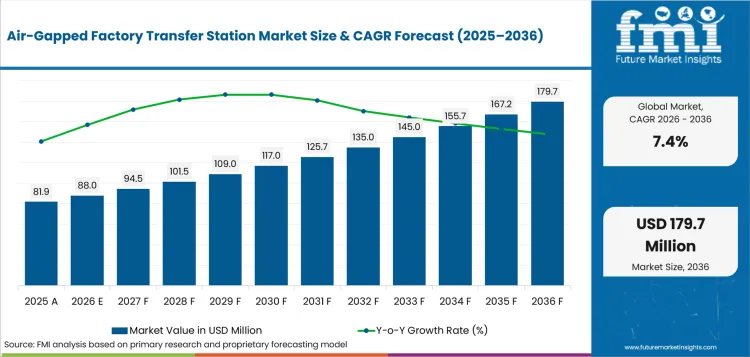
Air-Gapped Factory Transfer Station Market Overview: Size and Forecast
- 2026 Market Size: USD 88.0 million
- 2036 Market Size: USD 179.7 million
- Forecast CAGR: 7.4% from 2026 to 2036
- Leading Deployment: On-premise
- On-premise Share in 2026: 64.0%
- Leading Transfer Mode: Removable Media Transfer
- Removable Media Transfer Share in 2026: 47.0%
- Fastest-growing Country: India
- India CAGR: 8.7% by 2036
Summary of the Air-Gapped Factory Transfer Station Market
- Demand and Growth Drivers
- Factories are replacing informal USB handling with approved scan-and-release steps before production files enter isolated assets.
- OT security buyers are giving more attention to transfer logs as audit teams demand proof for every file movement event.
- Critical infrastructure operators are adopting one-way transfer patterns when outbound plant data must move without inbound exposure.
- System integrators are shaping demand by bundling transfer stations with OT assessment, commissioning, and operator training work.
- Product and Segment View
- On-premise deployment is estimated to hold 64.0% share in 2026, led by plant-owned policy stores and locally retained transfer records.
- Removable Media Transfer is projected to secure 47.0% share in 2026, supported by frequent use of portable files for maintenance and recipe changes.
- Hardware Appliances are expected to account for 42.0% share in 2026, influenced by demand for visible checkpoints and tamper-resistant transfer control.
- Geography and Competitive Outlook
- India is projected to record 8.7% CAGR by 2036 as expanding manufacturing corridors require repeatable offline transfer procedures.
- South Korea is expected to rise at 8.4% CAGR by 2036 as semiconductor and battery plants tighten file movement around high-value process assets.
- OPSWAT, Owl Cyber Defense, and Waterfall Security compete through kiosk, media scanning, diode, and industrial transfer products.
- TXOne Networks and Claroty influence adjacent purchasing through offline inspection, OT visibility, and plant security workflow support.
- Analyst Opinion
- Nikhil Kaitwade, Principal Consultant at Future Market Insights for the industrial domain, says, “I see this market as a control-point purchase rather than a conventional cybersecurity software purchase. Factory leaders are buying transfer stations to stop one unsafe file from reaching a line controller, historian, or engineering workstation. The best suppliers will prove scan depth, uptime protection, and audit clarity during selection. Buyers should watch operator workflow closely because the station touches maintenance teams, system integrators, and plant cyber staff at the same time. Supplier advantage will come from certified hardware, clear operator steps, and support for legacy OT file formats.”
Quality control is the main pressure point for air-gapped factory transfer stations as plant security teams review how files enter isolated production assets. CISA released ten Industrial Control Systems advisories on August 7, 2025, showing recurring vulnerability pressure across OT environments. CISA also released twenty-two Industrial Control Systems advisories on May 15, 2025, reinforcing how clustered disclosure activity can create urgent review work for plant teams. CISA’s April 2026 Siemens SICAM advisory covered eight products, showing why factories need auditable patch intake, controlled file staging, and release records before updates reach high-consequence systems.
Which factors support expansion in the air-gapped factory transfer station market?
Controlled file transfer revenue and appliance-led inspection workflows support market value across regulated industrial sites.
- Market value is supported by dedicated transfer appliances before policy software and services add follow-on revenue.
- Supplier pricing reflects scan engines, data diode hardware, audit storage, and plant-grade support requirements.
- Revenue improves as multi-site manufacturers standardize approved transfer points across isolated production areas.
- Buyer trust improves when transfer logs capture file source, operator identity, approval reason, scan verdict, and release action.
Why is the air-gapped factory transfer station market growing?
Factories are adding transfer checkpoints as maintenance files can carry malware into isolated production assets.
Factory buyers are treating file transfer as an operational risk point rather than a minor IT task. NIST stated in April 2026 that it enriched nearly 42,000 CVEs in 2025, which was 45% more than any prior year. This record workload gives plant teams a stronger reason to control how patches, configuration files, and vendor updates move toward isolated assets. Transfer stations support that need by scanning files, recording approvals, and limiting informal removable media handling before files reach controllers, historians, engineering workstations, and production tools. Buyers increasingly want proof that every transfer has a source, owner, verdict, and release trail.
How is the air-gapped factory transfer station market segmented?
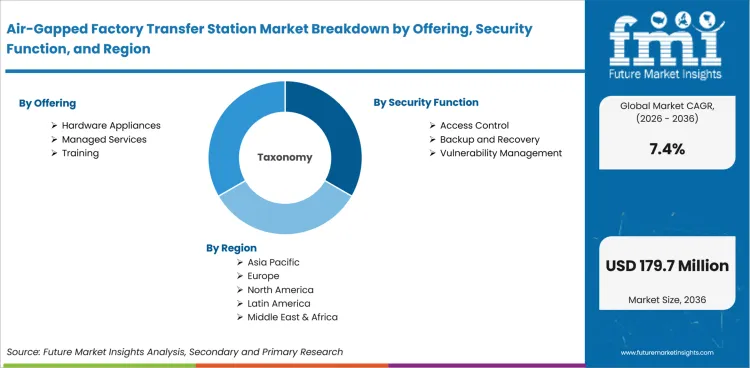
The air-gapped factory transfer station industry is segmented by offering, security function, deployment, end-use industry, and transfer mode.
- Hardware Appliances are projected to secure 42.0% share in 2026, led by plant teams requiring fixed inspection points with scan engines, controlled release paths, and hardened local operation.
- Access Control is expected to capture 31.5% share in 2026 as transfer approvals increasingly connect user identity, file purpose, and production asset ownership before release.
- On-premise deployment is anticipated to represent 64.0% share in 2026 since air-gapped plants prefer local logs, plant-owned policy stores, and limited remote administration.
- Manufacturing is estimated to account for 38.0% share in 2026 due to routine movement of engineering files, vendor patches, recipes, and machine diagnostics across isolated zones.
- Removable Media Transfer is forecast to hold 47.0% share in 2026 because many production sites rely on portable media when legacy assets cannot accept normal remote updates.
Why do hardware appliances dominate the air-gapped factory transfer station market?
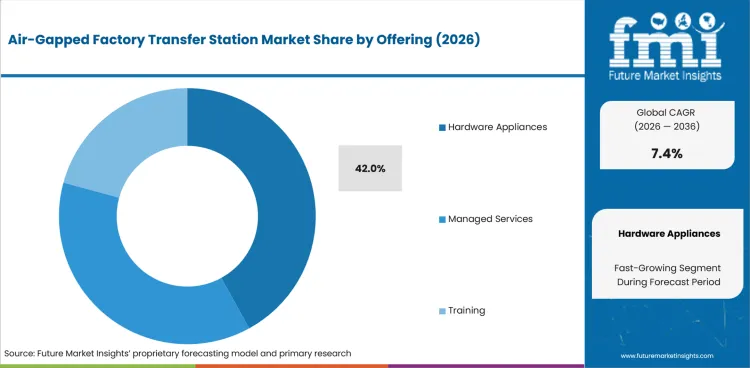
- Hardware Appliances are projected to account for 42.0% share in 2026, influenced by buyer preference for locked physical checkpoints before file release.
- Software remains important in larger installations as multi-site owners need policy coordination, but appliance proof usually starts the purchase discussion.
Which security function leads the air-gapped factory transfer station market?
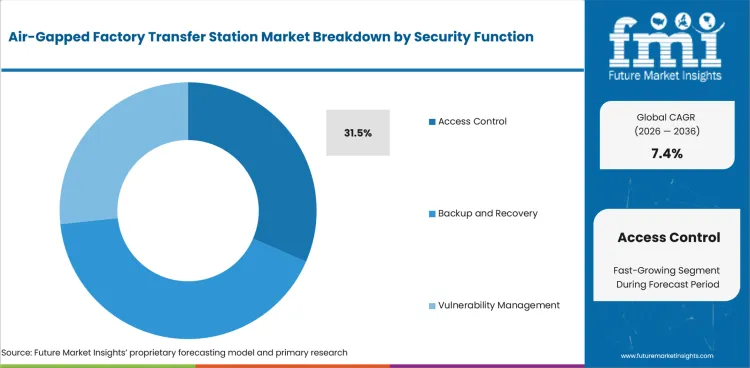
- Access Control is expected to hold 31.5% share in 2026 through user approvals that connect file movement to operator identity and plant responsibility.
- Asset discovery gains importance as plants want transfer decisions to reflect which controller, workstation, or historian will receive the file.
Which deployment model leads the air-gapped factory transfer station market?
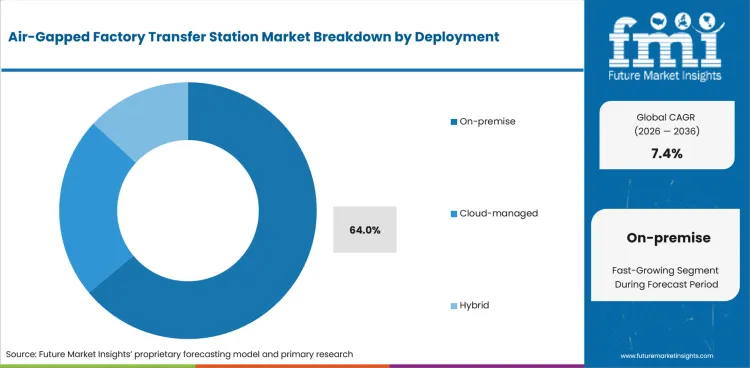
- On-premise deployment is anticipated to represent 64.0% share in 2026, supported by local policy control and restricted remote visibility into isolated operations.
- Hybrid setups gain attention in multi-site groups when corporate security needs common policy language without opening plant networks to direct management.
Which end-use industry leads the air-gapped factory transfer station market?
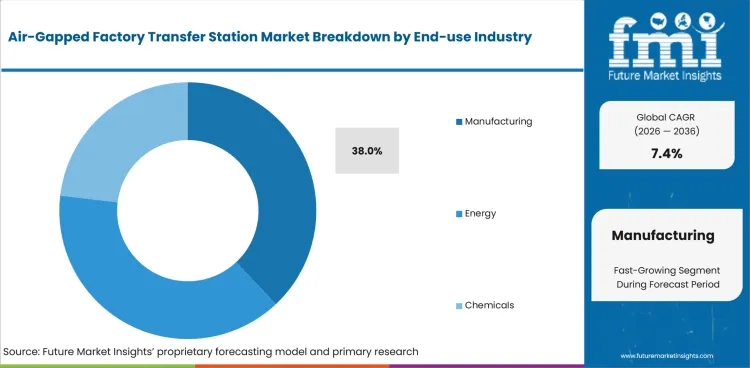
- Manufacturing is estimated to account for 38.0% share in 2026, led by frequent vendor patching and engineering file exchange across production assets.
- Energy and water utilities show higher assurance needs because transfer records must support safety, service continuity, and critical infrastructure review.
Which transfer mode leads the air-gapped factory transfer station market?
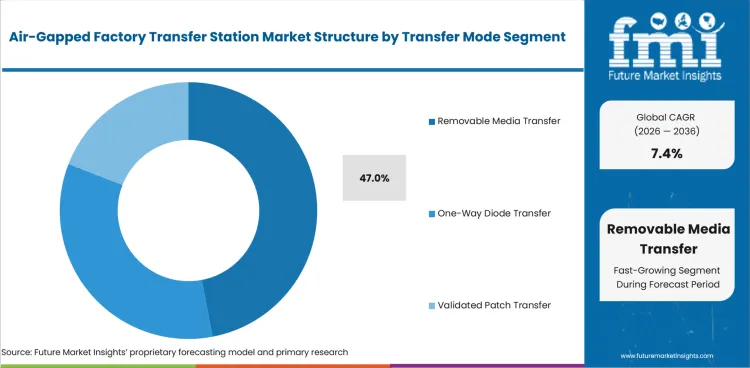
- Removable Media Transfer is forecast to hold 47.0% share in 2026, reflected by recurring use of USB media, portable diagnostics, and staged patch files in isolated plants.
- One-way diode transfer gains premium value where operators need outbound operational data movement without creating an inbound route into sensitive networks.
What are the driver, restraints, and opportunities in the air-gapped factory transfer station market?
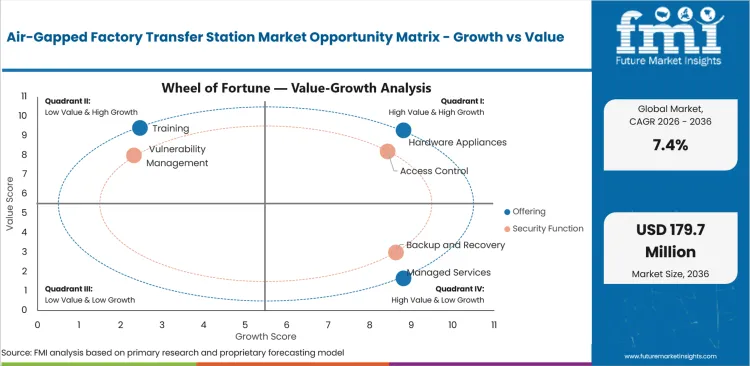
Offline patch workflows support growth while slow inspection steps can create operator workarounds in urgent maintenance situations.
- Driver: Offline patch transfer is becoming formal as many factory assets cannot accept normal remote updates safely.
- Restraint: Scan delay can create frustration when operators face urgent maintenance work and short shutdown windows.
- Opportunity: Hardware-enforced one-way transfer can expand where buyers need safe data movement from high-consequence networks.
Air-Gapped Factory Transfer Station Market Demand Outlook
Demand outlook is moving toward formal transfer checkpoints that can prove file source, scan result, approval trail, and destination before any update reaches production assets. CISA’s 2025 Cybersecurity Performance Goals Adoption Report analyzed vulnerability exposure across 7,791 critical infrastructure organizations enrolled in its Vulnerability Scanning service, showing how large the monitored asset base has become for structured cyber controls. This supports transfer station demand because factories need approved workflows before patches, configuration files, and vendor updates move toward isolated controllers. Appliances that scan media, preserve logs, and guide operators through release steps can reduce informal USB movement during planned maintenance windows.
Operator Workflow and Restraint Analysis
Operator behavior remains the main restraint when transfer steps feel slower than urgent maintenance work. CISA’s 2026 BOD 26-04 implementation guidance states that agencies must determine in fewer than three days whether a vulnerability meets the remediation threshold and requires forensic triage, showing how compressed vulnerability-response timelines have become. Plant teams must then handle file verification, testing, and approval without delaying line recovery. If a transfer station is slow or unclear, operators may return to informal media handling. Vendors must reduce friction through familiar screens, simple verdicts, and station records that maintenance teams can defend during audits.
One-Way Transfer and Opportunity Analysis
Opportunity is expanding in one-way transfer and diode-assisted workflows as plants share operational data with enterprise tools without adding inbound exposure. The U.S. Census Bureau reported that manufactured goods new orders increased 4.8% to USD 662.7 billion in April 2026, pointing to active production environments where file volume and transfer accountability can rise together. Suppliers able to prove hardware separation, content inspection, and plant-friendly deployment can win premium projects in energy, water, chemicals, and high-value manufacturing.
Which countries are growing fastest in the air-gapped factory transfer station market?
India 8.7% CAGR, South Korea 8.4% CAGR, China 8.1% CAGR, United States 7.2% CAGR, Germany 7.1% CAGR, Japan 7.0% CAGR, France 6.9% CAGR, and United Kingdom 6.8% CAGR through 2036.
.webp "Top Country Growth Comparison Air Gapped Factory Transfer Station Market Cagr (2026 2036)")
| Country | CAGR |
|---|---|
| India | 8.7% |
| South Korea | 8.4% |
| China | 8.1% |
| United States | 7.2% |
| Germany | 7.1% |
| Japan | 7.0% |
| France | 6.9% |
| United Kingdom | 6.8% |
Source: Future Market Insights, 2026.
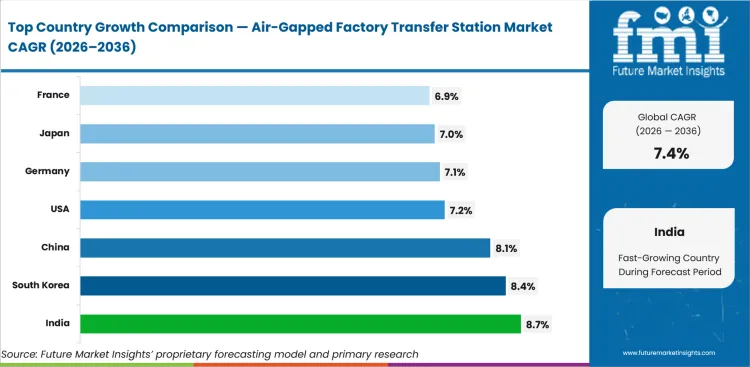
How do country-level CAGRs compare in the air-gapped factory transfer station market?
India leads country growth while the United Kingdom records the most cautious expansion outlook among profiled markets.
- India is projected to record 8.7% CAGR by 2036 as new industrial corridors require controlled file movement across modern plants.
- South Korea is expected to expand at 8.4% CAGR through 2036 as semiconductor and battery facilities value auditable media handling.
- China is forecast to rise at 8.1% CAGR by 2036 as large factory networks require repeatable OT data boundaries.
- The United States is estimated to grow at 7.2% CAGR through 2036 as federal OT advisories influence security reviews.
- Germany is projected to advance at 7.1% CAGR by 2036 as automation-heavy plants formalize secure engineering file transfer.
- Japan is expected to grow at 7.0% CAGR through 2036 as uptime-focused plants test transfer stations cautiously.
- France is projected to increase at 6.9% CAGR by 2036 as regulated industrial sectors emphasize audit evidence.
- The United Kingdom is forecast to post 6.8% CAGR by 2036 as service-led channels support plant cybersecurity upgrades.
How fast is the air-gapped factory transfer station market growing in United States?
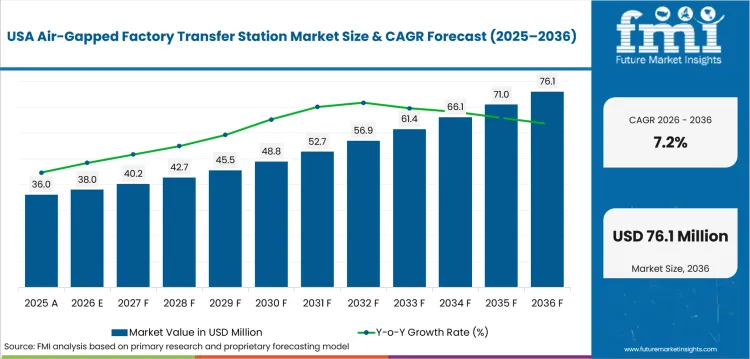
A 7.2% CAGR through 2036 reflects federal OT guidance, cyber insurance pressure, and deep supplier presence across industrial buyers.
Country Market Snapshot Table
| Parameter | Value |
|---|---|
| Market Size in 2025 (Value) | USD 26.6 million |
| Market Size in 2026 (Value) | USD 28.5 million |
| Market Forecast in 2036 (Value) | USD 57.1 million |
| CAGR (2026 to 2036) | 7.2% |
| Years Considered | 2021 to 2036 |
| Base Year | 2025 |
| Forecast Period | 2026 to 2036 |
| Units Considered | Value (USD million) |
| Leading Sub-Region | Midwest and Gulf Coast manufacturing corridors |
United States Air-Gapped Factory Transfer Station Market Outlook
United States demand is shaped by OT advisory activity and large manufacturing networks that require controlled maintenance file movement. Buyers increasingly want station logs that connect file sources, operators, scan verdicts, and release decisions.
Factory leaders usually evaluate transfer stations through risk teams and plant engineering groups together. Vendors with federal-grade references and local integrator support can gain trust faster than firms selling only software licenses.
Key Growth Drivers
- Federal Reserve data showed manufacturing output increased 0.7% in April 2026, supporting more controlled file-transfer demand across active production sites.
- BLS reported manufacturing employment at 12.605 million in May 2026, reflecting a large industrial workforce that needs repeatable transfer procedures.
- Critical infrastructure plants require transfer stations that move maintenance files without opening broad remote routes into controllers.
- Integrator-heavy procurement helps buyers connect transfer appliances with historians, PLC tools, and operator procedures.
Key Restraints
- Budget scrutiny remains high as the FBI said cyber-enabled crimes defrauded Americans of nearly USD 21 billion in 2025.
- Legacy controls can slow station integration when older engineering tools need careful workflow mapping before approval.
- Budget ownership can split between IT security and plant engineering teams, which may delay final purchase decisions.
What makes United States unique
United States is unique due to federal OT guidance, cyber insurance pressure, and deep supplier presence.
Key Companies
- OPSWAT
- Owl Cyber Defense
- Waterfall Security Solutions
- TXOne Networks
- Claroty
- Dragos
- Fortinet
Sales & Marketing Channels
- Direct enterprise sales
- OT system integrators
- Critical infrastructure procurement teams
- Channel partners
- Automation service firms
- Cyber insurance advisory networks
Country Segment Breakdown Table
| Segment | Sub-Segments |
|---|---|
| By Offering | Software · Hardware Appliances · Managed Services · Consulting · Training |
| By Security Function | Asset Discovery · Network Monitoring · Access Control · Backup and Recovery · Vulnerability Management |
| By Deployment | On-premise · Cloud-managed · Hybrid |
| By End-use Industry | Manufacturing · Energy · Water Utilities · Chemicals · Pharmaceuticals · Transportation |
| By Transfer Mode | Removable Media Transfer · One-Way Diode Transfer · Cross-Domain Transfer · Validated Patch Transfer · Engineering File Transfer |
| Key Sub-Regions Covered, Industrial and Critical Infrastructure Clusters | Midwest · Gulf Coast · Southeast · California · Texas · Pacific Northwest |
Frequently Asked Questions
How fast is United States air-gapped factory transfer station market growing?
Demand in United States is ready to rise at 7.2% CAGR from 2026 to 2036 through controlled OT file movement.
Who leads United States air-gapped factory transfer station market?
OPSWAT, Owl Cyber Defense, Waterfall Security Solutions, TXOne Networks compete based on OT security services, integration support, and controlled transfer workflows.
What is driving adoption in United States air-gapped factory transfer station market?
Adoption in United States is supported by federal OT guidance, cyber insurance pressure, and deep supplier presence and the need for safer maintenance file movement.
How fast is the air-gapped factory transfer station market growing in United Kingdom?
A 6.8% CAGR through 2036 reflects managed security partners and specialist OT consultancies across industrial buyers.
Country Market Snapshot Table
| Parameter | Value |
|---|---|
| Market Size in 2025 (Value) | USD 5.4 million |
| Market Size in 2026 (Value) | USD 5.8 million |
| Market Forecast in 2036 (Value) | USD 11.2 million |
| CAGR (2026 to 2036) | 6.8% |
| Years Considered | 2021 to 2036 |
| Base Year | 2025 |
| Forecast Period | 2026 to 2036 |
| Units Considered | Value (USD million) |
| Leading Sub-Region | Midlands and North West industrial corridors |
United Kingdom Air-Gapped Factory Transfer Station Market Outlook
United Kingdom demand is shaped by service-led cyber buying and plant operators that need stronger proof for external file handling. Automotive, pharmaceutical, food, and water utility sites form the main evaluation base.
Buyers often seek assessment, setup, training, and managed review before scaling hardware across several sites. Transfer stations gain support when they reduce cyber exposure without adding long maintenance steps.
Key Growth Drivers
- ONS reported manufacturing output rose 0.4% in April 2026, supporting transfer demand in plants with active production routines.
- NCSC handled 204 nationally significant cyber attacks in the year to August 2025, strengthening the case for controlled industrial file movement.
- Managed security providers create a channel for multi-site cyber controls that include station setup and log review.
- Water and pharmaceutical buyers need documented approval records when files move into regulated production areas.
Key Restraints
- The UK Cyber Security Breaches Survey 2025/2026 found 65% of medium businesses experienced a breach or attack in the last twelve months.
- Cost pressure can slow replacement of informal removable media scanning routines in smaller factories.
- Some plants lack staff to own station policy, log review, and operator retraining after installation.
What makes United Kingdom unique
United Kingdom is unique due to managed security partners and specialist OT consultancies.
Key Companies
- BAE Systems Digital Intelligence
- Darktrace
- Capula
- Mandiant UK
- Waterfall Security Solutions
- OPSWAT
- TXOne Networks
Sales & Marketing Channels
- Managed security providers
- OT cybersecurity consultants
- Direct enterprise sales
- Water utility procurement teams
- Pharmaceutical compliance teams
- Automation integrator networks
Country Segment Breakdown Table
| Segment | Sub-Segments |
|---|---|
| By Offering | Software · Hardware Appliances · Managed Services · Consulting · Training |
| By Security Function | Asset Discovery · Network Monitoring · Access Control · Backup and Recovery · Vulnerability Management |
| By Deployment | On-premise · Cloud-managed · Hybrid |
| By End-use Industry | Manufacturing · Energy · Water Utilities · Chemicals · Pharmaceuticals · Transportation |
| By Transfer Mode | Removable Media Transfer · One-Way Diode Transfer · Cross-Domain Transfer · Validated Patch Transfer · Engineering File Transfer |
| Key Sub-Regions Covered, Industrial and Critical Infrastructure Clusters | Midlands · North West · London · Scotland · Wales · Yorkshire |
Frequently Asked Questions
How fast is United Kingdom air-gapped factory transfer station market growing?
Demand in United Kingdom is ready to rise at 6.8% CAGR from 2026 to 2036 through controlled OT file movement.
Who leads United Kingdom air-gapped factory transfer station market?
BAE Systems Digital Intelligence, Darktrace, Capula, Mandiant UK compete based on OT security services, integration support, and controlled transfer workflows.
What is driving adoption in United Kingdom air-gapped factory transfer station market?
Adoption in United Kingdom is supported by managed security partners and specialist OT consultancies and the need for safer maintenance file movement.
How fast is the air-gapped factory transfer station market growing in Germany?
A 7.1% CAGR through 2036 reflects automation density, engineering discipline, and partner validation across industrial buyers.
Country Market Snapshot Table
| Parameter | Value |
|---|---|
| Market Size in 2025 (Value) | USD 6.4 million |
| Market Size in 2026 (Value) | USD 6.9 million |
| Market Forecast in 2036 (Value) | USD 13.7 million |
| CAGR (2026 to 2036) | 7.1% |
| Years Considered | 2021 to 2036 |
| Base Year | 2025 |
| Forecast Period | 2026 to 2036 |
| Units Considered | Value (USD million) |
| Leading Sub-Region | Bavaria, Baden-Württemberg, and North Rhine-Westphalia industrial clusters |
Germany Air-Gapped Factory Transfer Station Market Outlook
Germany demand is shaped by automation density and frequent exchange of engineering files across complex plants. Buyers tend to require strong documentation before approving transfer stations for production use.
Local service support carries weight because plants expect long equipment lifecycles and controlled maintenance routines. Vendors with German partners can address installation, language, and support expectations more credibly.
Key Growth Drivers
- Destatis reported manufacturing order stocks rose 8.4% year on year in April 2026, keeping engineering file flow active across industrial sites.
- Bitkom stated that 87% of companies were affected by data theft, espionage, or sabotage in the past twelve months, raising transfer-control attention.
- Automotive and machinery facilities need controlled vendor file movement during maintenance, calibration, and commissioning work.
- Local partnership models improve trust when buyers test appliances inside highly documented plant security environments.
Key Restraints
- BSI reported an average of 309,000 new malware variants per day in its 2024 security situation report, increasing caution around connected plant tools.
- Buyers can extend pilot phases before committing to full rollout across complex production environments.
- Legacy automation diversity raises integration effort when transfer workflows must support several vendor toolchains.
What makes Germany unique
Germany is unique due to automation density, engineering discipline, and partner validation.
Key Companies
- Waterfall Security Solutions
- HOPF Elektronik GmbH
- Siemens
- Rohde & Schwarz Cybersecurity
- OPSWAT
- TXOne Networks
- Claroty
Sales & Marketing Channels
- Automation integrators
- Local OT security partners
- Direct enterprise sales
- Machinery OEM service teams
- Chemical plant procurement
- Energy infrastructure buyers
Country Segment Breakdown Table
| Segment | Sub-Segments |
|---|---|
| By Offering | Software · Hardware Appliances · Managed Services · Consulting · Training |
| By Security Function | Asset Discovery · Network Monitoring · Access Control · Backup and Recovery · Vulnerability Management |
| By Deployment | On-premise · Cloud-managed · Hybrid |
| By End-use Industry | Manufacturing · Energy · Water Utilities · Chemicals · Pharmaceuticals · Transportation |
| By Transfer Mode | Removable Media Transfer · One-Way Diode Transfer · Cross-Domain Transfer · Validated Patch Transfer · Engineering File Transfer |
| Key Sub-Regions Covered, Industrial and Critical Infrastructure Clusters | Bavaria · Baden-Württemberg · North Rhine-Westphalia · Saxony · Hesse · Lower Saxony |
Frequently Asked Questions
How fast is Germany air-gapped factory transfer station market growing?
Demand in Germany is ready to rise at 7.1% CAGR from 2026 to 2036 through controlled OT file movement.
Who leads Germany air-gapped factory transfer station market?
Waterfall Security Solutions, HOPF Elektronik GmbH, Siemens, Rohde & Schwarz Cybersecurity compete based on OT security services, integration support, and controlled transfer workflows.
What is driving adoption in Germany air-gapped factory transfer station market?
Adoption in Germany is supported by automation density, engineering discipline, and partner validation and the need for safer maintenance file movement.
How fast is the air-gapped factory transfer station market growing in France?
A 6.9% CAGR through 2036 reflects critical infrastructure protection and strict evidence needs across industrial buyers.
Country Market Snapshot Table
| Parameter | Value |
|---|---|
| Market Size in 2025 (Value) | USD 5.1 million |
| Market Size in 2026 (Value) | USD 5.4 million |
| Market Forecast in 2036 (Value) | USD 10.5 million |
| CAGR (2026 to 2036) | 6.9% |
| Years Considered | 2021 to 2036 |
| Base Year | 2025 |
| Forecast Period | 2026 to 2036 |
| Units Considered | Value (USD million) |
| Leading Sub-Region | Île-de-France, Auvergne-Rhône-Alpes, and aerospace corridors |
France Air-Gapped Factory Transfer Station Market Outlook
France demand is guided by high-assurance cyber expectations in aerospace, energy, pharmaceuticals, and water utilities. Transfer stations are evaluated for traceability when files cross isolated production areas.
Buyers focus on safety, compliance, and evidence quality before selecting hardware. Suppliers must show how transfer records support audit teams without creating extra operator burden.
Key Growth Drivers
- INSEE reported manufacturing output increased 0.4% month on month in April 2026, supporting steady demand from active production sites.
- France 2030 represents EUR 54.0 billion of investment, strengthening digital and industrial modernization programs tied to secure operations.
- Aerospace and energy sites require stronger air-gap control when external engineering files enter production workflows.
- Integrator-led validation supports buyer confidence in high-assurance settings where transfer logs must satisfy audit teams.
Key Restraints
- ANSSI recorded 196 data exfiltration incidents in 2025, increasing caution around supplier access and external file handling.
- Approval cycles can slow near-term hardware purchases in public-linked or highly regulated industrial projects.
- Local documentation expectations can raise setup effort for global vendors entering French plant environments.
What makes France unique
France is unique due to critical infrastructure protection and strict evidence needs.
Key Companies
- Airbus Protect
- Orange Cyberdefense
- Thales
- Sekoia.io
- OPSWAT
- Waterfall Security Solutions
- TXOne Networks
Sales & Marketing Channels
- Direct enterprise sales
- Certified security integrators
- Aerospace supplier networks
- Energy infrastructure procurement
- Pharmaceutical validation teams
- Public-sector tender channels
Country Segment Breakdown Table
| Segment | Sub-Segments |
|---|---|
| By Offering | Software · Hardware Appliances · Managed Services · Consulting · Training |
| By Security Function | Asset Discovery · Network Monitoring · Access Control · Backup and Recovery · Vulnerability Management |
| By Deployment | On-premise · Cloud-managed · Hybrid |
| By End-use Industry | Manufacturing · Energy · Water Utilities · Chemicals · Pharmaceuticals · Transportation |
| By Transfer Mode | Removable Media Transfer · One-Way Diode Transfer · Cross-Domain Transfer · Validated Patch Transfer · Engineering File Transfer |
| Key Sub-Regions Covered, Industrial and Critical Infrastructure Clusters | Île-de-France · Auvergne-Rhône-Alpes · Occitanie · Nouvelle-Aquitaine · Provence-Alpes-Côte d’Azur · Hauts-de-France |
Frequently Asked Questions
How fast is France air-gapped factory transfer station market growing?
Demand in France is ready to rise at 6.9% CAGR from 2026 to 2036 through controlled OT file movement.
Who leads France air-gapped factory transfer station market?
Airbus Protect, Orange Cyberdefense, Thales, Sekoia.io compete based on OT security services, integration support, and controlled transfer workflows.
What is driving adoption in France air-gapped factory transfer station market?
Adoption in France is supported by critical infrastructure protection and strict evidence needs and the need for safer maintenance file movement.
How fast is the air-gapped factory transfer station market growing in Japan?
A 7.0% CAGR through 2036 reflects uptime-first buying culture and operator workflow discipline across industrial buyers.
Country Market Snapshot Table
| Parameter | Value |
|---|---|
| Market Size in 2025 (Value) | USD 6.5 million |
| Market Size in 2026 (Value) | USD 7.0 million |
| Market Forecast in 2036 (Value) | USD 13.8 million |
| CAGR (2026 to 2036) | 7.0% |
| Years Considered | 2021 to 2036 |
| Base Year | 2025 |
| Forecast Period | 2026 to 2036 |
| Units Considered | Value (USD million) |
| Leading Sub-Region | Tokyo-Osaka-Nagoya manufacturing corridors |
Japan Air-Gapped Factory Transfer Station Market Outlook
Japan demand is expected to build from advanced manufacturing sites that improve transfer control without disrupting production discipline. Operators value reliable station behavior during maintenance and quality review.
The sales cycle can be slower because buyers test workflow impact carefully before scaling. Stable hardware, local support, and clear operator screens matter strongly during selection.
Key Growth Drivers
- METI reported the April 2026 production index at 102.5 with a 0.5% monthly increase, supporting active factory conditions for controlled transfer demand.
- JPCERT/CC received 10,102 incident reports from January to March 2025, underscoring continued attention to cyber response discipline.
- Automotive and electronics plants handle frequent engineering file updates that require traceable release decisions.
- Quality culture supports repeatable transfer procedures that protect uptime while giving audit teams clearer records.
Key Restraints
- IPA reported that 15.7% of vulnerabilities registered in JVN iPedia in early 2026 were classified as Critical, increasing patch review pressure.
- Slow change approval can delay new station placement when production teams prioritize stable operations.
- Older factory assets require careful workflow mapping before transfer stations can become standard plant procedure.
What makes Japan unique
Japan is unique due to uptime-first buying culture and operator workflow discipline.
Key Companies
- NEC Corporation
- Hitachi Systems
- Toshiba Digital Solutions
- Mitsubishi Electric
- OPSWAT
- Waterfall Security Solutions
- TXOne Networks
Sales & Marketing Channels
- Local automation partners
- Direct enterprise sales
- Factory engineering teams
- Quality and compliance groups
- Distributor networks
- OEM maintenance channels
Country Segment Breakdown Table
| Segment | Sub-Segments |
|---|---|
| By Offering | Software · Hardware Appliances · Managed Services · Consulting · Training |
| By Security Function | Asset Discovery · Network Monitoring · Access Control · Backup and Recovery · Vulnerability Management |
| By Deployment | On-premise · Cloud-managed · Hybrid |
| By End-use Industry | Manufacturing · Energy · Water Utilities · Chemicals · Pharmaceuticals · Transportation |
| By Transfer Mode | Removable Media Transfer · One-Way Diode Transfer · Cross-Domain Transfer · Validated Patch Transfer · Engineering File Transfer |
| Key Sub-Regions Covered, Industrial and Critical Infrastructure Clusters | Tokyo · Osaka · Nagoya · Yokohama · Fukuoka · Sapporo |
Frequently Asked Questions
How fast is Japan air-gapped factory transfer station market growing?
Demand in Japan is ready to rise at 7.0% CAGR from 2026 to 2036 through controlled OT file movement.
Who leads Japan air-gapped factory transfer station market?
NEC Corporation, Hitachi Systems, Toshiba Digital Solutions, Mitsubishi Electric compete based on OT security services, integration support, and controlled transfer workflows.
What is driving adoption in Japan air-gapped factory transfer station market?
Adoption in Japan is supported by uptime-first buying culture and operator workflow discipline and the need for safer maintenance file movement.
How fast is the air-gapped factory transfer station market growing in China?
A 8.1% CAGR through 2036 reflects large factory scale and repeatable multi-site transfer rules across industrial buyers.
Country Market Snapshot Table
| Parameter | Value |
|---|---|
| Market Size in 2025 (Value) | USD 11.3 million |
| Market Size in 2026 (Value) | USD 12.2 million |
| Market Forecast in 2036 (Value) | USD 26.6 million |
| CAGR (2026 to 2036) | 8.1% |
| Years Considered | 2021 to 2036 |
| Base Year | 2025 |
| Forecast Period | 2026 to 2036 |
| Units Considered | Value (USD million) |
| Leading Sub-Region | Yangtze River Delta and Greater Bay Area factory clusters |
China Air-Gapped Factory Transfer Station Market Outlook
China demand is shaped by large factory networks that create repeated file transfer and patching requirements. Multi-site manufacturers need station workflows that can support many facilities without creating bottlenecks.
Demand is shaped by scale, localization, and domestic service capacity. Vendors need local partners and clear product fit for industrial control environments.
Key Growth Drivers
- NBS reported industrial value added above designated size increased 5.6% year on year from January to April 2026, supporting transfer volume across large factory bases.
- China’s State Council said connected industrial devices on key platforms are expected to surpass 120 million units by 2028, raising secure OT data-transfer needs.
- Electronics manufacturing scale raises file transfer volume across production sites and increases the value of standardized logs.
- Industrial digitization increases the need to move OT data safely between production assets and enterprise review tools.
Key Restraints
- CNCERT handled 387 network security incidents in a 2026 weekly report, reinforcing caution around ungoverned transfer channels.
- Local sourcing expectations can limit access for foreign-only suppliers without domestic support capability.
- Complex site networks make policy consistency difficult when plants operate different generations of automation assets.
What makes China unique
China is unique due to large factory scale and repeatable multi-site transfer rules.
Key Companies
- Venustech
- Qi An Xin
- NSFOCUS
- Sangfor Technologies
- OPSWAT
- Waterfall Security Solutions
- TXOne Networks
Sales & Marketing Channels
- Local system integrators
- Direct enterprise sales
- Industrial park procurement teams
- Automation distributors
- OEM service channels
- Critical infrastructure buyers
Country Segment Breakdown Table
| Segment | Sub-Segments |
|---|---|
| By Offering | Software · Hardware Appliances · Managed Services · Consulting · Training |
| By Security Function | Asset Discovery · Network Monitoring · Access Control · Backup and Recovery · Vulnerability Management |
| By Deployment | On-premise · Cloud-managed · Hybrid |
| By End-use Industry | Manufacturing · Energy · Water Utilities · Chemicals · Pharmaceuticals · Transportation |
| By Transfer Mode | Removable Media Transfer · One-Way Diode Transfer · Cross-Domain Transfer · Validated Patch Transfer · Engineering File Transfer |
| Key Sub-Regions Covered, Industrial and Critical Infrastructure Clusters | Yangtze River Delta · Greater Bay Area · Beijing-Tianjin-Hebei · Chengdu-Chongqing · Shandong · Liaoning |
Frequently Asked Questions
How fast is China air-gapped factory transfer station market growing?
Demand in China is ready to rise at 8.1% CAGR from 2026 to 2036 through controlled OT file movement.
Who leads China air-gapped factory transfer station market?
Venustech, Qi An Xin, NSFOCUS, Sangfor Technologies compete based on OT security services, integration support, and controlled transfer workflows.
What is driving adoption in China air-gapped factory transfer station market?
Adoption in China is supported by large factory scale and repeatable multi-site transfer rules and the need for safer maintenance file movement.
How fast is the air-gapped factory transfer station market growing in South Korea?
A 8.4% CAGR through 2036 reflects semiconductor density and centralized industrial security buying across industrial buyers.
Country Market Snapshot Table
| Parameter | Value |
|---|---|
| Market Size in 2025 (Value) | USD 5.8 million |
| Market Size in 2026 (Value) | USD 6.3 million |
| Market Forecast in 2036 (Value) | USD 14.1 million |
| CAGR (2026 to 2036) | 8.4% |
| Years Considered | 2021 to 2036 |
| Base Year | 2025 |
| Forecast Period | 2026 to 2036 |
| Units Considered | Value (USD million) |
| Leading Sub-Region | Gyeonggi, Incheon, Ulsan, and semiconductor clusters |
South Korea Air-Gapped Factory Transfer Station Market Outlook
South Korea demand is led by high-value electronics, semiconductor, battery, and automotive facilities. These plants require disciplined file transfer during equipment service and process updates.
Large industrial groups often evaluate suppliers at group level before scaling across facilities. The decision weighs appliance reliability, logging, Korean-language support, and fit with existing OT security tools.
Key Growth Drivers
- Korea’s Ministry of Data and Statistics reported manufacturing production increased 1.6% year on year in April 2026, keeping transfer oversight relevant in active plants.
- MOTIR reported semiconductor exports reached USD 32.8 billion in March 2026, giving fabs a stronger reason to formalize transfer approvals around high-value production systems.
- Semiconductor fabs need disciplined file transfer during equipment service because downtime risk is high.
- Centralized group security policies support repeat transfer station purchases once a hardware workflow is approved.
Key Restraints
- MOEF reported mining and manufacturing production decreased 0.7% month on month in April 2026, making installation timing sensitive for plant teams.
- Maintenance windows can limit installation timing when fabs and battery plants protect production schedules.
- Vendor approval processes can be demanding for smaller suppliers without local service depth.
What makes South Korea unique
South Korea is unique due to semiconductor density and centralized industrial security buying.
Key Companies
- Samsung SDS
- AhnLab
- SK Shieldus
- LG CNS
- OPSWAT
- Waterfall Security Solutions
- TXOne Networks
Sales & Marketing Channels
- Korean OT security partners
- Direct enterprise sales
- Semiconductor procurement teams
- Battery plant engineering teams
- Automation integrators
- Group-level security teams
Country Segment Breakdown Table
| Segment | Sub-Segments |
|---|---|
| By Offering | Software · Hardware Appliances · Managed Services · Consulting · Training |
| By Security Function | Asset Discovery · Network Monitoring · Access Control · Backup and Recovery · Vulnerability Management |
| By Deployment | On-premise · Cloud-managed · Hybrid |
| By End-use Industry | Manufacturing · Energy · Water Utilities · Chemicals · Pharmaceuticals · Transportation |
| By Transfer Mode | Removable Media Transfer · One-Way Diode Transfer · Cross-Domain Transfer · Validated Patch Transfer · Engineering File Transfer |
| Key Sub-Regions Covered, Industrial and Critical Infrastructure Clusters | Gyeonggi · Incheon · Ulsan · Daegu · Busan · Daejeon |
Frequently Asked Questions
How fast is South Korea air-gapped factory transfer station market growing?
Demand in South Korea is ready to rise at 8.4% CAGR from 2026 to 2036 through controlled OT file movement.
Who leads South Korea air-gapped factory transfer station market?
Samsung SDS, AhnLab, SK Shieldus, LG CNS compete based on OT security services, integration support, and controlled transfer workflows.
What is driving adoption in South Korea air-gapped factory transfer station market?
Adoption in South Korea is supported by semiconductor density and centralized industrial security buying and the need for safer maintenance file movement.
How fast is the air-gapped factory transfer station market growing in India?
A 8.7% CAGR through 2036 reflects fast industrial expansion and expanding cyber response awareness across industrial buyers.
Country Market Snapshot Table
| Parameter | Value |
|---|---|
| Market Size in 2025 (Value) | USD 3.9 million |
| Market Size in 2026 (Value) | USD 4.2 million |
| Market Forecast in 2036 (Value) | USD 9.7 million |
| CAGR (2026 to 2036) | 8.7% |
| Years Considered | 2021 to 2036 |
| Base Year | 2025 |
| Forecast Period | 2026 to 2036 |
| Units Considered | Value (USD million) |
| Leading Sub-Region | Maharashtra, Gujarat, Tamil Nadu, and Karnataka industrial corridors |
India Air-Gapped Factory Transfer Station Market Outlook
India demand is supported by manufacturing expansion, new industrial corridors, and stronger cyber risk awareness among plant operators. Transfer stations are attractive when factories need controlled movement of vendor patches and engineering files.
Adoption is likely to start in large plants, energy sites, and regulated manufacturing before wider uptake among mid-sized factories. Local service partners will play a major role in installation and operator training.
Key Growth Drivers
- PIB reported IIP growth of 4.9% in April 2026, while manufacturing output grew 6.2% under the new series.
- India’s Economic Survey stated the industrial sector is projected to grow 6.2% in FY26, supporting wider need for secure factory file movement.
- New electronics, automotive, and process plants need transfer controls before maintenance media reaches isolated controllers.
- System integrators can package transfer stations with OT audits, commissioning, and operator training for large projects.
Key Restraints
- CERT-In handled 2,041,360 incidents in 2024, increasing caution around plant connectivity and removable media practices.
- Smaller plants may delay appliance purchases when basic antivirus routines look cheaper in the near term.
- Operator training gaps can create informal file movement if transfer steps are not simple enough for maintenance teams.
What makes India unique
India is unique due to fast industrial expansion and expanding cyber response awareness.
Key Companies
- Tata Advanced Systems
- Tata Consultancy Services
- Larsen & Toubro Technology Services
- Tech Mahindra
- OPSWAT
- Waterfall Security Solutions
- TXOne Networks
Sales & Marketing Channels
- Industrial system integrators
- Direct enterprise sales
- Manufacturing park procurement teams
- Energy and utility buyers
- Automation service partners
- Managed security providers
Country Segment Breakdown Table
| Segment | Sub-Segments |
|---|---|
| By Offering | Software · Hardware Appliances · Managed Services · Consulting · Training |
| By Security Function | Asset Discovery · Network Monitoring · Access Control · Backup and Recovery · Vulnerability Management |
| By Deployment | On-premise · Cloud-managed · Hybrid |
| By End-use Industry | Manufacturing · Energy · Water Utilities · Chemicals · Pharmaceuticals · Transportation |
| By Transfer Mode | Removable Media Transfer · One-Way Diode Transfer · Cross-Domain Transfer · Validated Patch Transfer · Engineering File Transfer |
| Key Sub-Regions Covered, Industrial and Critical Infrastructure Clusters | Maharashtra · Gujarat · Tamil Nadu · Karnataka · Telangana · Delhi NCR |
Frequently Asked Questions
How fast is India air-gapped factory transfer station market growing?
Demand in India is ready to rise at 8.7% CAGR from 2026 to 2036 through controlled OT file movement.
Who leads India air-gapped factory transfer station market?
Tata Advanced Systems, Tata Consultancy Services, Larsen & Toubro Technology Services, Tech Mahindra compete based on OT security services, integration support, and controlled transfer workflows.
What is driving adoption in India air-gapped factory transfer station market?
Adoption in India is supported by fast industrial expansion and expanding cyber response awareness and the need for safer maintenance file movement.
Who are the leading companies in the air-gapped factory transfer station market?
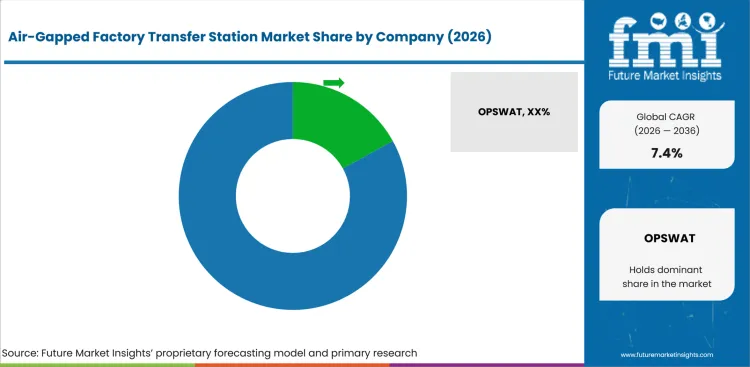
OPSWAT, Owl Cyber Defense, Waterfall Security Solutions, TXOne Networks, and Claroty.
- Established OT security vendors hold an advantage through plant-ready appliances, industrial protocol familiarity, and transfer workflow proof.
- Data diode specialists gain value in critical infrastructure settings that need one-way data movement without inbound exposure.
- Portable inspection suppliers support air-gapped maintenance teams that need malware checks on standalone systems.
- OT visibility firms influence buying decisions by helping plants identify which assets need controlled transfer routes.
Companies in the market compete by combining hardware assurance with plant-friendly operation. OPSWAT, Owl Cyber Defense, and Waterfall Security Solutions show strong relevance through kiosk, media scanning, data diode, and controlled transfer products. Buyers assess whether the product can handle maintenance files, engineering formats, removable media, and log retention without slowing plant routines. Supplier credibility improves when products can support both isolated operations and formal audit evidence.
Manufacturing and critical infrastructure customers usually require proof before scaling transfer stations across multiple sites. TXOne Networks supports adjacent demand through offline inspection tools for standalone and air-gapped systems. Claroty, Dragos, and Fortinet shape nearby buying through OT visibility, asset context, and risk prioritization. The strongest suppliers are expected to show a clear link between file inspection, operator approval, and production uptime protection.
Regional suppliers and system integrators can win by improving deployment support around local plants. Germany, Japan, South Korea, India, and China need strong local service because transfer stations touch maintenance teams, engineering teams, and plant cyber teams together. Vendors that provide easy operator screens, clear audit exports, and support for older factory environments should gain stronger repeat placement. Suppliers relying only on broad cybersecurity branding will face weaker acceptance when buyers test station behavior during maintenance windows.
How do top air-gapped factory transfer station companies compare?
OPSWAT and Owl Cyber Defense score strongest on appliance fit while Waterfall Security leads one-way transfer relevance.
| Company | Relevance to Market Title | Appliance Depth | Transfer Workflow Fit | OT Security Strength | Channel Reach | Geographic Footprint |
|---|---|---|---|---|---|---|
| OPSWAT | Very High | Very Strong | Very Strong | Strong | Very Strong | Global |
| Owl Cyber Defense | Very High | Very Strong | Very Strong | Very Strong | Strong | North America and Global |
| Waterfall Security Solutions | Very High | Strong | Very Strong | Very Strong | Strong | Global |
| TXOne Networks | High | Strong | Strong | Very Strong | Strong | Global |
| Claroty | Moderate to High | Moderate | Moderate | Very Strong | Very Strong | Global |
| Dragos | Moderate to High | Moderate | Moderate | Very Strong | Strong | North America and Global |
| Fortinet | Moderate | Moderate | Moderate | Strong | Very Strong | Global |
| Siemens | Moderate | Moderate | Moderate | Strong | Very Strong | Global |
| Rohde & Schwarz Cybersecurity | Moderate | Moderate | Moderate | Strong | Moderate | Europe |
| Samsung SDS | Moderate | Moderate | Moderate | Strong | Strong | South Korea and Global |
Source: Future Market Insights competitive analysis, 2026.
Who are the key players in the air-gapped factory transfer station market?
OPSWAT, Owl Cyber Defense, Waterfall Security Solutions, TXOne Networks, Claroty, and Dragos are listed with Fortinet and Siemens among other suppliers.
Key global companies leading the air-gapped factory transfer station market include:
- OPSWAT
- Owl Cyber Defense
- Waterfall Security Solutions
- TXOne Networks
- Claroty
- Dragos
- Fortinet
- Siemens
- Rohde & Schwarz Cybersecurity
- Samsung SDS
Key Developments in Air-Gapped Factory Transfer Station Market
- In May 2025, Owl Cyber Defense launched Owl Talon Torrent, a protocol filtering data diode designed for secure one-way transfer at up to 100 Gbps.
- In June 2025, Waterfall Security Solutions and HOPF announced a Germany-focused partnership to strengthen operational technology cybersecurity networks.
- In August 2025, TXOne Networks released Portable Inspector material describing malware scanning and removal for standalone computers and air-gapped systems.
Key Players in the Air-Gapped Factory Transfer Station Market
Transfer Appliance and Kiosk Specialists
- OPSWAT
- Owl Cyber Defense
- Waterfall Security Solutions
- TXOne Networks
OT Security and Visibility Providers
- Claroty
- Dragos
- Fortinet
- Siemens
Regional Industrial Cybersecurity Companies
- Rohde & Schwarz Cybersecurity
- Samsung SDS
- AhnLab
- Airbus Protect
- Tata Consultancy Services
Air-Gapped Factory Transfer Station Market - Report Scope
| Parameter | Details |
|---|---|
| Forecast period | 2026 to 2036 |
| Historical period | 2021 to 2025 |
| Quantitative unit | Revenue in USD million |
| By offering | Software, hardware appliances, managed services, consulting, training |
| By security function | Asset discovery, network monitoring, access control, backup and recovery, vulnerability management |
| By deployment | On-premise, cloud-managed, hybrid |
| By end-use industry | Manufacturing, energy, water utilities, chemicals, pharmaceuticals, transportation |
| By transfer mode | Removable media transfer, one-way diode transfer, cross-domain transfer, validated patch transfer, engineering file transfer |
| Regions covered | North America, Latin America, Europe, East Asia, South Asia and Pacific, Middle East and Africa |
| Countries covered | United States, United Kingdom, Germany, France, Japan, China, South Korea, India |
| Key companies profiled | OPSWAT, Owl Cyber Defense, Waterfall Security Solutions, TXOne Networks, Claroty, Dragos, Fortinet, Siemens |
| Approach | Bottom-up workflow-boundary approach using appliance pricing, site deployment patterns, factory intensity, transfer frequency, and OT security spending indicators |
Source: Future Market Insights, 2026.
Air-Gapped Factory Transfer Station Market Breakdown by Offering, Security Function, Deployment, End-use Industry, Transfer Mode, and Region
Air-Gapped Factory Transfer Station Market Segmented by Offering:
- Software
- Hardware Appliances
- Managed Services
- Consulting
- Training
Air-Gapped Factory Transfer Station Market Segmented by Security Function:
- Asset Discovery
- Network Monitoring
- Access Control
- Backup and Recovery
- Vulnerability Management
Air-Gapped Factory Transfer Station Market Segmented by Deployment:
- On-premise
- Cloud-managed
- Hybrid
Air-Gapped Factory Transfer Station Market Segmented by End-use Industry:
- Manufacturing
- Energy
- Water Utilities
- Chemicals
- Pharmaceuticals
- Transportation
Air-Gapped Factory Transfer Station Market Segmented by Transfer Mode:
- Removable Media Transfer
- One-Way Diode Transfer
- Cross-Domain Transfer
- Validated Patch Transfer
- Engineering File Transfer
Air-Gapped Factory Transfer Station Market by Region:
- North America
- Latin America
- Europe
- East Asia
- South Asia and Pacific
- Middle East and Africa
Research Sources and Bibliography
- Agence nationale de la sécurité des systèmes d’information. (2026, May 19). Cyber threat overview 2025.
- Board of Governors of the Federal Reserve System. (2026, June 15). Industrial production and capacity utilization: May 2026.
- Bitkom. (2025, September). Economic Security 2025.
- Cybersecurity and Infrastructure Security Agency. (2025, May 15). CISA releases twenty-two Industrial Control Systems advisories.
- Cybersecurity and Infrastructure Security Agency. (2025, August 7). CISA releases ten Industrial Control Systems advisories.
- Cybersecurity and Infrastructure Security Agency. (2026, April 2). Siemens SICAM 8 products advisory.
- Department for Science, Innovation and Technology. (2026, April 30). Cyber Security Breaches Survey 2025/2026.
- Federal Bureau of Investigation. (2026, April 6). FBI releases the 2025 Internet Crime Report.
- Federal Office for Information Security. (2024, November). The state of IT security in Germany in 2024.
- Federal Statistical Office of Germany. (2026, June 18). Stock of orders in manufacturing in April 2026.
- Government of France. (2025, March). France 2030 investment plan progress and priorities.
- Government of India. (2026, January). Economic Survey 2025–26.
- Indian Computer Emergency Response Team. (2024, November 29). Annual Report 2024.
- Information-technology Promotion Agency, Japan. (2026, May 20). Vulnerability countermeasure information database JVN iPedia: 2026 Q1.
- Institut national de la statistique et des études économiques. (2026, June). Industrial production index: April 2026.
- Japan Computer Emergency Response Team Coordination Center. (2025, June 23). Incident handling report: January 1, 2025 to March 31, 2025.
- Ministry of Data and Statistics. (2026, May 29). Monthly Industrial Statistics, April 2026.
- Ministry of Economy and Finance. (2026, May). Monthly economic trends: April 2026.
- Ministry of Economy, Trade and Industry. (2026, June 12). Indices of industrial production: Revised report for April 2026.
- Ministry of Trade, Industry and Resources. (2026, April 1). March 2026 exports reach record USD 86.1 billion, surpassing USD 80 billion for the first time.
- National Bureau of Statistics of China. (2026, May 19). Industrial production operation in April 2026.
- National Computer Network Emergency Response Technical Team/Coordination Center of China. (2026, January). Weekly report of CNCERT, Issue 2, 2026.
- National Cyber Security Centre. (2025, October 14). UK experiencing four nationally significant cyber attacks every week.
- National Institute of Standards and Technology. (2026, April 15). NIST updates NVD operations to address record CVE growth.
- Office for National Statistics. (2026, June 12). Index of production, UK: April 2026.
- Owl Cyber Defense. (2025, May 20). Owl Cyber Defense launches Owl Talon Torrent to deliver unprecedented speed and security for mission-critical one-way data transfers.
- Press Information Bureau. (2026, June 1). Quick estimates of Index of Industrial Production for April 2026.
- State Council of the People’s Republic of China. (2026, January 13). China issues action plan to boost high-quality development of industrial internet platforms.
- TXOne Networks. (2025, August 7). Portable Inspector datasheet.
- U.S. Bureau of Labor Statistics. (2026, June). Manufacturing: NAICS 31-33.
- U.S. Census Bureau. (2026, June 4). Manufacturers’ shipments, inventories, and orders: April 2026.
- Waterfall Security Solutions. (2025, June 16). Waterfall Security and HOPF join forces to strengthen industrial cybersecurity in Germany.
- Cybersecurity and Infrastructure Security Agency. (2025, January 10). CISA releases the Cybersecurity Performance Goals Adoption Report.
- Cybersecurity and Infrastructure Security Agency. (2026, June 10). BOD 26-04: Prioritizing Security Updates Based on Risk.
This bibliography is provided for reader reference and is not exhaustive. The full report contains the complete reference list and detailed citations.
Air-Gapped Factory Transfer Station Market - Scope & Definition
| Attribute | Detail |
|---|---|
| Market Definition | Hardware appliances, software, and services used to scan, approve, sanitize, log, and transfer files across separated factory networks without a direct open network path. |
| Functions Covered | Media inspection, malware scanning, content sanitization, approval workflow, audit logging, one-way transfer, patch staging, and file release control. |
| Applications Covered | Engineering file transfer, removable media inspection, validated patch transfer, cross-domain movement, historian export, and vendor maintenance file release. |
| End-Use Industries | Manufacturing, energy, water utilities, chemicals, pharmaceuticals, transportation, and other industrial operations with isolated production networks. |
| Grades Covered | Software-only systems, hardened transfer appliances, diode-enabled systems, managed transfer services, and consulting-led deployment models. |
| Inclusions | All commercially sold air-gapped factory transfer stations, kiosks, secure media appliances, transfer workflow software, diode-linked transfer tools, and related deployment services. |
| Exclusions | Generic enterprise file sharing, consumer USB scanning tools, ordinary endpoint antivirus, standard firewalls, cloud storage, and backup platforms without factory transfer workflow control. |
Air-Gapped Factory Transfer Station Market - Research Methodology
| Method | Description |
|---|---|
| Primary Research | FMI analyst interviews with OT security vendors, automation engineers, plant cyber teams, system integrators, and industrial buyers across key markets. |
| Desk Research | Review of regulator advisories, national statistics, OT security guidance, company product releases, and official industrial cybersecurity references. |
| Market Sizing & Forecasting | Bottom-up workflow-boundary approach using site-level installation patterns, appliance pricing, replacement cycles, transfer frequency, country factory intensity, and segment use rates. |
| Data Validation | Cross-verification using supplier portfolios, industrial cybersecurity demand patterns, advisory activity, country manufacturing indicators, and buyer workflow evidence. |
This Report Answers
- Market size estimates for 2026 and forecasts through 2036 for the air-gapped factory transfer station market.
- Insights across regional and country-level markets where manufacturing, energy, utilities, and process industries require controlled file movement.
- Analysis of demand drivers, offline patching routines, removable media inspection patterns, and one-way transfer requirements.
- Evaluation of key deployment models and transfer modes including on-premise systems, hardware appliances, and diode-assisted file movement.
- Assessment of regional manufacturing indicators, cyber advisory activity, and industrial security requirements that shape market development.
- Identification of growth opportunities across hardware appliances, managed services, transfer workflow software, and secure media inspection.
- Evaluation of supplier positioning across kiosk products, data diode systems, OT visibility tools, and local integration channels.
- Country-level growth analysis covering the United States, United Kingdom, Germany, France, Japan, China, South Korea, and India.
- Assessment of the competitive landscape, including leading transfer appliance vendors and adjacent OT cybersecurity suppliers.
- Analysis of plant-level purchasing behavior, workflow friction, and maintenance team requirements.
- Regional outlooks across North America, Europe, East Asia, South Asia and Pacific, Latin America, and Middle East and Africa.
- Delivery of market data, forecasts, and supporting analysis in PDF and Excel formats.
Frequently Asked Questions
What is the growth prospect for air-gapped factory transfer stations?
Demand for air-gapped factory transfer stations is expected to rise at a steady pace as factories formalize controlled file movement across isolated production networks.
Which companies are expected to shape the air-gapped factory transfer station market?
OPSWAT, Owl Cyber Defense, Waterfall Security Solutions, TXOne Networks, Claroty, Dragos, Fortinet, and Siemens are expected to shape market competition through transfer appliances, diode systems, and OT security workflows.
Why are industrial buyers investing in air-gapped factory transfer stations?
Industrial buyers are investing in air-gapped factory transfer stations to reduce unsafe file movement and create audit records before files reach controllers, historians, and engineering workstations.
Why is on-premise deployment important in the air-gapped factory transfer station market?
On-premise deployment is important because many air-gapped plants want local policy control, local logs, and limited remote administration across sensitive production systems.
Which transfer formats are gaining attention in the air-gapped factory transfer station market?
Removable media transfer and one-way diode transfer are gaining attention as buyers control patch files, engineering updates, and outbound operational data.
How do regulations and advisories influence air-gapped factory transfer station adoption?
Regulations and advisories influence adoption by increasing the need for traceable transfer records, controlled update workflows, and evidence-based OT security procedures.
Why are hardware appliances important for air-gapped factory transfer stations?
Hardware appliances are important because buyers prefer visible inspection points that combine scan engines, controlled release, tamper resistance, and plant-ready operator workflows.
What role do system integrators play in the air-gapped factory transfer station market?
System integrators help specify, install, and validate transfer stations inside complex factory environments where maintenance teams, automation engineers, and cyber staff share ownership.
How do managed services support air-gapped factory transfer station adoption?
Managed services support adoption by helping multi-site industrial groups review transfer logs, maintain policies, train operators, and standardize workflows across plants.
Preview the report firsthand - request a free sample
Get SampleGet the brochure for pricing and purchase details.
Get PDFTable of Content
- Executive Summary
- Global Market Outlook
- Demand to side Trends
- Supply to side Trends
- Technology Roadmap Analysis
- Analysis and Recommendations
- Market Overview
- Market Coverage / Taxonomy
- Market Definition / Scope / Limitations
- Research Methodology
- Chapter Orientation
- Analytical Lens and Working Hypotheses
- Market Structure, Signals, and Trend Drivers
- Benchmarking and Cross-market Comparability
- Market Sizing, Forecasting, and Opportunity Mapping
- Research Design and Evidence Framework
- Desk Research Programme (Secondary Evidence)
- Company Annual and Sustainability Reports
- Peer-reviewed Journals and Academic Literature
- Corporate Websites, Product Literature, and Technical Notes
- Earnings Decks and Investor Briefings
- Statutory Filings and Regulatory Disclosures
- Technical White Papers and Standards Notes
- Trade Journals, Industry Magazines, and Analyst Briefs
- Conference Proceedings, Webinars, and Seminar Materials
- Government Statistics Portals and Public Data Releases
- Press Releases and Reputable Media Coverage
- Specialist Newsletters and Curated Briefings
- Sector Databases and Reference Repositories
- FMI Internal Proprietary Databases and Historical Market Datasets
- Subscription Datasets and Paid Sources
- Social Channels, Communities, and Digital Listening Inputs
- Additional Desk Sources
- Expert Input and Fieldwork (Primary Evidence)
- Primary Modes
- Qualitative Interviews and Expert Elicitation
- Quantitative Surveys and Structured Data Capture
- Blended Approach
- Why Primary Evidence is Used
- Field Techniques
- Interviews
- Surveys
- Focus Groups
- Observational and In-context Research
- Social and Community Interactions
- Stakeholder Universe Engaged
- C-suite Leaders
- Board Members
- Presidents and Vice Presidents
- R&D and Innovation Heads
- Technical Specialists
- Domain Subject-matter Experts
- Scientists
- Physicians and Other Healthcare Professionals
- Governance, Ethics, and Data Stewardship
- Research Ethics
- Data Integrity and Handling
- Primary Modes
- Tooling, Models, and Reference Databases
- Desk Research Programme (Secondary Evidence)
- Data Engineering and Model Build
- Data Acquisition and Ingestion
- Cleaning, Normalisation, and Verification
- Synthesis, Triangulation, and Analysis
- Quality Assurance and Audit Trail
- Market Background
- Market Dynamics
- Drivers
- Restraints
- Opportunity
- Trends
- Scenario Forecast
- Demand in Optimistic Scenario
- Demand in Likely Scenario
- Demand in Conservative Scenario
- Opportunity Map Analysis
- Product Life Cycle Analysis
- Supply Chain Analysis
- Investment Feasibility Matrix
- Value Chain Analysis
- PESTLE and Porter’s Analysis
- Regulatory Landscape
- Regional Parent Market Outlook
- Production and Consumption Statistics
- Import and Export Statistics
- Market Dynamics
- Global Market Analysis 2021 to 2025 and Forecast, 2026 to 2036
- Historical Market Size Value (USD Million) Analysis, 2021 to 2025
- Current and Future Market Size Value (USD Million) Projections, 2026 to 2036
- Y to o to Y Growth Trend Analysis
- Absolute $ Opportunity Analysis
- Global Market Pricing Analysis 2021 to 2025 and Forecast 2026 to 2036
- Global Market Analysis 2021 to 2025 and Forecast 2026 to 2036, By Offering
- Introduction / Key Findings
- Historical Market Size Value (USD Million) Analysis By Offering , 2021 to 2025
- Current and Future Market Size Value (USD Million) Analysis and Forecast By Offering , 2026 to 2036
- Hardware Appliances
- Managed Services
- Training
- Hardware Appliances
- Y to o to Y Growth Trend Analysis By Offering , 2021 to 2025
- Absolute $ Opportunity Analysis By Offering , 2026 to 2036
- Global Market Analysis 2021 to 2025 and Forecast 2026 to 2036, By Security Function
- Introduction / Key Findings
- Historical Market Size Value (USD Million) Analysis By Security Function, 2021 to 2025
- Current and Future Market Size Value (USD Million) Analysis and Forecast By Security Function, 2026 to 2036
- Access Control
- Backup and Recovery
- Vulnerability Management
- Access Control
- Y to o to Y Growth Trend Analysis By Security Function, 2021 to 2025
- Absolute $ Opportunity Analysis By Security Function, 2026 to 2036
- Global Market Analysis 2021 to 2025 and Forecast 2026 to 2036, By Deployment
- Introduction / Key Findings
- Historical Market Size Value (USD Million) Analysis By Deployment, 2021 to 2025
- Current and Future Market Size Value (USD Million) Analysis and Forecast By Deployment, 2026 to 2036
- On-premise
- Cloud-managed
- Hybrid
- On-premise
- Y to o to Y Growth Trend Analysis By Deployment, 2021 to 2025
- Absolute $ Opportunity Analysis By Deployment, 2026 to 2036
- Global Market Analysis 2021 to 2025 and Forecast 2026 to 2036, By End-use Industry
- Introduction / Key Findings
- Historical Market Size Value (USD Million) Analysis By End-use Industry, 2021 to 2025
- Current and Future Market Size Value (USD Million) Analysis and Forecast By End-use Industry, 2026 to 2036
- Manufacturing
- Energy
- Chemicals
- Manufacturing
- Y to o to Y Growth Trend Analysis By End-use Industry, 2021 to 2025
- Absolute $ Opportunity Analysis By End-use Industry, 2026 to 2036
- Global Market Analysis 2021 to 2025 and Forecast 2026 to 2036, By Transfer Mode
- Introduction / Key Findings
- Historical Market Size Value (USD Million) Analysis By Transfer Mode, 2021 to 2025
- Current and Future Market Size Value (USD Million) Analysis and Forecast By Transfer Mode, 2026 to 2036
- Removable Media Transfer
- One-Way Diode Transfer
- Validated Patch Transfer
- Removable Media Transfer
- Y to o to Y Growth Trend Analysis By Transfer Mode, 2021 to 2025
- Absolute $ Opportunity Analysis By Transfer Mode, 2026 to 2036
- Global Market Analysis 2021 to 2025 and Forecast 2026 to 2036, By Region
- Introduction
- Historical Market Size Value (USD Million) Analysis By Region, 2021 to 2025
- Current Market Size Value (USD Million) Analysis and Forecast By Region, 2026 to 2036
- North America
- Latin America
- Western Europe
- Eastern Europe
- East Asia
- South Asia and Pacific
- Middle East & Africa
- Market Attractiveness Analysis By Region
- North America Market Analysis 2021 to 2025 and Forecast 2026 to 2036, By Country
- Historical Market Size Value (USD Million) Trend Analysis By Market Taxonomy, 2021 to 2025
- Market Size Value (USD Million) Forecast By Market Taxonomy, 2026 to 2036
- By Country
- USA
- Canada
- Mexico
- By Offering
- By Security Function
- By Deployment
- By End-use Industry
- By Transfer Mode
- By Country
- Market Attractiveness Analysis
- By Country
- By Offering
- By Security Function
- By Deployment
- By End-use Industry
- By Transfer Mode
- Key Takeaways
- Latin America Market Analysis 2021 to 2025 and Forecast 2026 to 2036, By Country
- Historical Market Size Value (USD Million) Trend Analysis By Market Taxonomy, 2021 to 2025
- Market Size Value (USD Million) Forecast By Market Taxonomy, 2026 to 2036
- By Country
- Brazil
- Chile
- Rest of Latin America
- By Offering
- By Security Function
- By Deployment
- By End-use Industry
- By Transfer Mode
- By Country
- Market Attractiveness Analysis
- By Country
- By Offering
- By Security Function
- By Deployment
- By End-use Industry
- By Transfer Mode
- Key Takeaways
- Western Europe Market Analysis 2021 to 2025 and Forecast 2026 to 2036, By Country
- Historical Market Size Value (USD Million) Trend Analysis By Market Taxonomy, 2021 to 2025
- Market Size Value (USD Million) Forecast By Market Taxonomy, 2026 to 2036
- By Country
- Germany
- UK
- Italy
- Spain
- France
- Nordic
- BENELUX
- Rest of Western Europe
- By Offering
- By Security Function
- By Deployment
- By End-use Industry
- By Transfer Mode
- By Country
- Market Attractiveness Analysis
- By Country
- By Offering
- By Security Function
- By Deployment
- By End-use Industry
- By Transfer Mode
- Key Takeaways
- Eastern Europe Market Analysis 2021 to 2025 and Forecast 2026 to 2036, By Country
- Historical Market Size Value (USD Million) Trend Analysis By Market Taxonomy, 2021 to 2025
- Market Size Value (USD Million) Forecast By Market Taxonomy, 2026 to 2036
- By Country
- Russia
- Poland
- Hungary
- Balkan & Baltic
- Rest of Eastern Europe
- By Offering
- By Security Function
- By Deployment
- By End-use Industry
- By Transfer Mode
- By Country
- Market Attractiveness Analysis
- By Country
- By Offering
- By Security Function
- By Deployment
- By End-use Industry
- By Transfer Mode
- Key Takeaways
- East Asia Market Analysis 2021 to 2025 and Forecast 2026 to 2036, By Country
- Historical Market Size Value (USD Million) Trend Analysis By Market Taxonomy, 2021 to 2025
- Market Size Value (USD Million) Forecast By Market Taxonomy, 2026 to 2036
- By Country
- China
- Japan
- South Korea
- By Offering
- By Security Function
- By Deployment
- By End-use Industry
- By Transfer Mode
- By Country
- Market Attractiveness Analysis
- By Country
- By Offering
- By Security Function
- By Deployment
- By End-use Industry
- By Transfer Mode
- Key Takeaways
- South Asia and Pacific Market Analysis 2021 to 2025 and Forecast 2026 to 2036, By Country
- Historical Market Size Value (USD Million) Trend Analysis By Market Taxonomy, 2021 to 2025
- Market Size Value (USD Million) Forecast By Market Taxonomy, 2026 to 2036
- By Country
- India
- ASEAN
- Australia & New Zealand
- Rest of South Asia and Pacific
- By Offering
- By Security Function
- By Deployment
- By End-use Industry
- By Transfer Mode
- By Country
- Market Attractiveness Analysis
- By Country
- By Offering
- By Security Function
- By Deployment
- By End-use Industry
- By Transfer Mode
- Key Takeaways
- Middle East & Africa Market Analysis 2021 to 2025 and Forecast 2026 to 2036, By Country
- Historical Market Size Value (USD Million) Trend Analysis By Market Taxonomy, 2021 to 2025
- Market Size Value (USD Million) Forecast By Market Taxonomy, 2026 to 2036
- By Country
- Kingdom of Saudi Arabia
- Other GCC Countries
- Turkiye
- South Africa
- Other African Union
- Rest of Middle East & Africa
- By Offering
- By Security Function
- By Deployment
- By End-use Industry
- By Transfer Mode
- By Country
- Market Attractiveness Analysis
- By Country
- By Offering
- By Security Function
- By Deployment
- By End-use Industry
- By Transfer Mode
- Key Takeaways
- Key Countries Market Analysis
- USA
- Pricing Analysis
- Market Share Analysis, 2025
- By Offering
- By Security Function
- By Deployment
- By End-use Industry
- By Transfer Mode
- Canada
- Pricing Analysis
- Market Share Analysis, 2025
- By Offering
- By Security Function
- By Deployment
- By End-use Industry
- By Transfer Mode
- Mexico
- Pricing Analysis
- Market Share Analysis, 2025
- By Offering
- By Security Function
- By Deployment
- By End-use Industry
- By Transfer Mode
- Brazil
- Pricing Analysis
- Market Share Analysis, 2025
- By Offering
- By Security Function
- By Deployment
- By End-use Industry
- By Transfer Mode
- Chile
- Pricing Analysis
- Market Share Analysis, 2025
- By Offering
- By Security Function
- By Deployment
- By End-use Industry
- By Transfer Mode
- Germany
- Pricing Analysis
- Market Share Analysis, 2025
- By Offering
- By Security Function
- By Deployment
- By End-use Industry
- By Transfer Mode
- UK
- Pricing Analysis
- Market Share Analysis, 2025
- By Offering
- By Security Function
- By Deployment
- By End-use Industry
- By Transfer Mode
- Italy
- Pricing Analysis
- Market Share Analysis, 2025
- By Offering
- By Security Function
- By Deployment
- By End-use Industry
- By Transfer Mode
- Spain
- Pricing Analysis
- Market Share Analysis, 2025
- By Offering
- By Security Function
- By Deployment
- By End-use Industry
- By Transfer Mode
- France
- Pricing Analysis
- Market Share Analysis, 2025
- By Offering
- By Security Function
- By Deployment
- By End-use Industry
- By Transfer Mode
- India
- Pricing Analysis
- Market Share Analysis, 2025
- By Offering
- By Security Function
- By Deployment
- By End-use Industry
- By Transfer Mode
- ASEAN
- Pricing Analysis
- Market Share Analysis, 2025
- By Offering
- By Security Function
- By Deployment
- By End-use Industry
- By Transfer Mode
- Australia & New Zealand
- Pricing Analysis
- Market Share Analysis, 2025
- By Offering
- By Security Function
- By Deployment
- By End-use Industry
- By Transfer Mode
- China
- Pricing Analysis
- Market Share Analysis, 2025
- By Offering
- By Security Function
- By Deployment
- By End-use Industry
- By Transfer Mode
- Japan
- Pricing Analysis
- Market Share Analysis, 2025
- By Offering
- By Security Function
- By Deployment
- By End-use Industry
- By Transfer Mode
- South Korea
- Pricing Analysis
- Market Share Analysis, 2025
- By Offering
- By Security Function
- By Deployment
- By End-use Industry
- By Transfer Mode
- Russia
- Pricing Analysis
- Market Share Analysis, 2025
- By Offering
- By Security Function
- By Deployment
- By End-use Industry
- By Transfer Mode
- Poland
- Pricing Analysis
- Market Share Analysis, 2025
- By Offering
- By Security Function
- By Deployment
- By End-use Industry
- By Transfer Mode
- Hungary
- Pricing Analysis
- Market Share Analysis, 2025
- By Offering
- By Security Function
- By Deployment
- By End-use Industry
- By Transfer Mode
- Kingdom of Saudi Arabia
- Pricing Analysis
- Market Share Analysis, 2025
- By Offering
- By Security Function
- By Deployment
- By End-use Industry
- By Transfer Mode
- Turkiye
- Pricing Analysis
- Market Share Analysis, 2025
- By Offering
- By Security Function
- By Deployment
- By End-use Industry
- By Transfer Mode
- South Africa
- Pricing Analysis
- Market Share Analysis, 2025
- By Offering
- By Security Function
- By Deployment
- By End-use Industry
- By Transfer Mode
- USA
- Market Structure Analysis
- Competition Dashboard
- Competition Benchmarking
- Market Share Analysis of Top Players
- By Regional
- By Offering
- By Security Function
- By Deployment
- By End-use Industry
- By Transfer Mode
- Competition Analysis
- Competition Deep Dive
- OPSWAT
- Overview
- Product Portfolio
- Profitability by Market Segments (Product/Age /Sales Channel/Region)
- Sales Footprint
- Strategy Overview
- Marketing Strategy
- Product Strategy
- Channel Strategy
- Owl Cyber Defense
- Waterfall Security Solutions
- TXOne Networks
- Claroty
- Dragos
- OPSWAT
- Competition Deep Dive
- Assumptions & Acronyms Used


