

- Market Size (2026)
- USD 680.0 Mn
- Forecast (2036)
- USD 2543.1 Mn
- CAGR (2026 to 2036)
- 14.1%
How big is the AMR docking and charging stations market in 2026?
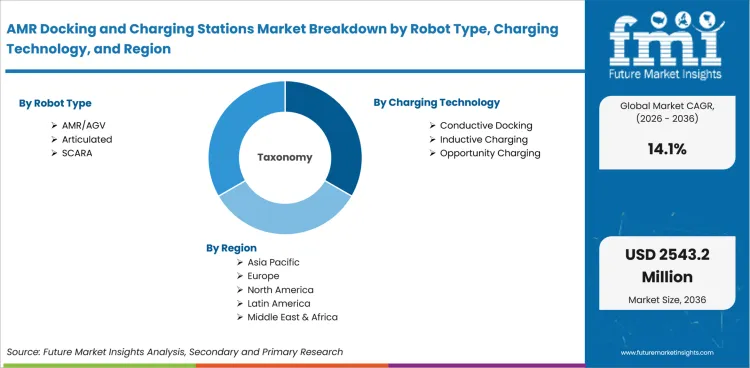
USD 680.0 million in 2026 and USD 2,543.1 million by 2036 at a 14.1% CAGR.
The AMR docking and charging stations industry value is forecast to grow from USD 596.0 million in 2025 to USD 2,543.1 million by 2036 at 14.1% CAGR as the robot market moves toward larger mobile fleets and planned charging capacity. AMR/AGV is projected to account for 57.5% share in 2026 because mobile platforms need automatic charge recovery after every transport cycle. Conductive docking is expected to secure 52.5% share in 2026, led by predictable energy transfer and simpler maintenance checks.
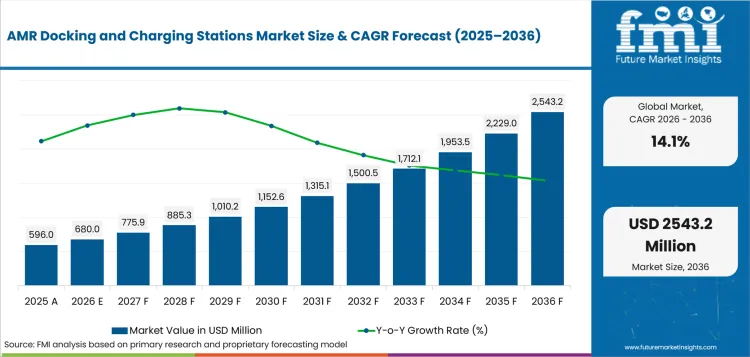
AMR Docking and Charging Stations Market Overview: Size and Forecast
- 2026 Market Size: USD 680.0 million
- 2036 Market Size: USD 2,543.1 million
- Forecast CAGR: 14.1% from 2026 to 2036
- Leading Robot Type: AMR/AGV
- AMR/AGV Share in 2026: 57.5%
- Leading Charging Technology: Conductive Docking
- Conductive Docking Share in 2026: 52.5%
- Fastest-growing Country: China
- China CAGR: 15.8% by 2036
Summary of the AMR Docking and Charging Stations Market
- Demand and Growth Drivers
- Fleet uptime is the main driver as operators need robots to charge between jobs without manual handling.
- Material handling workflows create repeated travel cycles that support predictable charging station use.
- Warehouse and factory buyers are using charger density to protect robot availability during peak shifts.
- Product and Segment View
- AMR/AGV is projected to lead By Robot Type with 57.5% share in 2026 as docking is built into mobile workflows.
- Conductive Docking is expected to lead By Charging Technology with 52.5% share in 2026 due to reliable contact charging and easier retrofit planning.
- Material Handling is anticipated to lead By Application with 48.0% share in 2026 as repeated task cycles increase use of warehouse robotics charging stations.
- Geography and Competitive Outlook
- China is projected to record 15.8% CAGR through 2036 with the fastest buildout of charging-ready AMR fleets.
- India is expected to expand at 15.4% CAGR through 2036 as warehouses adopt flexible automation in phases.
- ABB Robotics and KUKA compete with integrated AMR platforms and charging concepts for industrial sites.
- Mobile Industrial Robots, Omron Automation, OTTO by Rockwell Automation, Geekplus, and Locus Robotics strengthen competition through warehouse AMR systems.
- Analyst Opinion
- Nikhil Kaitwade, Principal Consultant at Future Market Insights for industrial domain, says, “This market is an uptime market first and a charger market second. Buyers are not only buying a dock. They are buying confidence that robots will return to work without a supervisor walking the floor. Suppliers that prove charge scheduling, safe docking, service response, and fleet software fit in one package will gain stronger buyer confidence.”
Fleet charging planning is being shaped by measurable robotics deployment and factory automation density. The International Federation of Robotics reported almost 200,000 professional service robots sold in 2024, with transportation and logistics remaining the largest application class. It also reported global operational industrial robot stock of 4,664,000 units in 2024, up 9.0% from the prior year. KUKA added a highly relevant equipment signal in August 2025 by introducing the KMP 250P mobile platform with 250 kg payload capacity and conductive charging, with an inductive version available for charging while production continues.
Which factors support expansion in the AMR docking and charging stations market?
Fleet charging revenue and software-linked docking systems support market value across automated warehouses and factories.
- Market value is supported by charging stations sold with automated guided vehicles and AMR platforms before service contracts add incremental revenue.
- Supplier pricing reflects charger power class, docking controls, safety sensors, and commissioning support before fleet software affects premium placement.
- Revenue improves as buyers move from isolated AMR pilots to multi-robot networks that need scheduled energy cycles.
- Retail and logistics sites value compact charging stations that reduce manual battery handling and support predictable shift uptime.
Why is the AMR docking and charging stations market growing?
Multi-robot fleets need scheduled charging points as operators shift from isolated transport tasks to full-site material flow.
Warehouse and factory operators are buying charging stations as part of uptime planning instead of treating them as accessories. IFR forecast industrial robot installations to rise 6.0% to 575,000 units in 2025 and exceed 700,000 units by 2028, which widens the future installed base needing charging infrastructure. This creates a stronger link between fleet design, energy infrastructure, and the industrial robotics market. Chargers must therefore be placed near natural wait zones and return paths so robots can recharge without weakening task flow.
How is the AMR docking and charging stations market segmented?
The AMR docking and charging stations industry is segmented by robot type, charging technology, application, payload, and end-use industry.
- AMR/AGV is projected to lead By Robot Type with 57.5% share in 2026 as mobile platforms require automatic charge recovery after transport cycles and connect directly with fleet scheduling tools.
- Conductive Docking is projected to lead By Charging Technology with 52.5% share in 2026 as physical contact charging offers predictable energy transfer, simpler retrofit planning, and easier service checks for multi-shift warehouses.
- Material Handling is projected to lead By Application with 48.0% share in 2026 as repeated tote, cart, and pallet movement creates recurring charging cycles across predictable traffic lanes.
- 20-80 kg is projected to lead By Payload with 41.0% share in 2026 as tote and parts transport sits within compact AMR duty bands that need small docks near work cells.
- Logistics is projected to lead By End-use Industry with 36.0% share in 2026 as fulfillment sites need fleets ready for peak order waves and therefore plan charger density early.
AMR Docking and Charging Stations Market Analysis By Robot Type
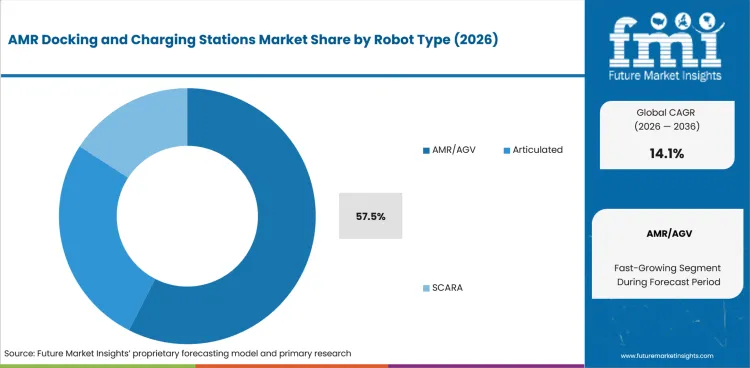
- AMR/AGV is projected to account for 57.5% share in 2026 as mobile platforms need automated charge recovery after each transport cycle and connect directly with mobile robots fleet scheduling tools.
- Automatic docking becomes more valuable as AMR fleets operate across wider plant routes and must return to work without manual battery handling.
AMR Docking and Charging Stations Market Analysis By Charging Technology
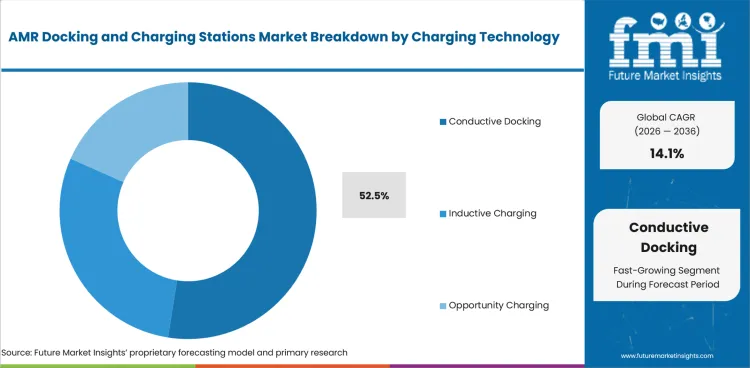
- Conductive Docking is expected to secure 52.5% share in 2026 as physical contact charging provides dependable power transfer and simpler maintenance checks.
- Inductive charging gains use in high-throughput plants that need sealed docks, fewer exposed contacts, and charging opportunities during brief production pauses.
AMR Docking and Charging Stations Market Analysis By Application
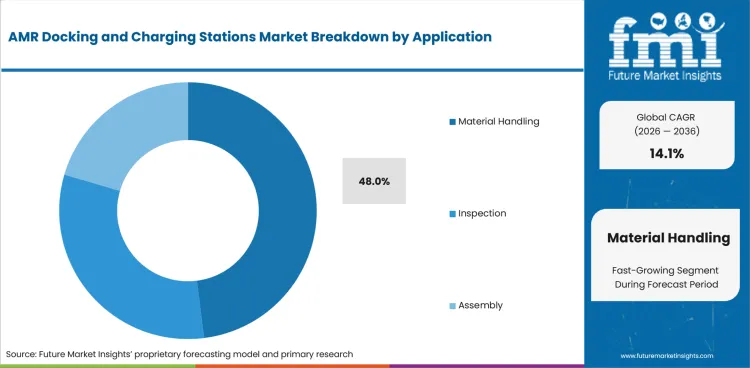
- Material Handling is anticipated to account for 48.0% share in 2026 as repeated parts movement creates clear charger utilization cycles across automated material handling equipment programs.
- Inspection and assembly applications gain charging value when robots must return to fixed routes without disrupting worker movement or takt timing.
AMR Docking and Charging Stations Market Analysis By Payload
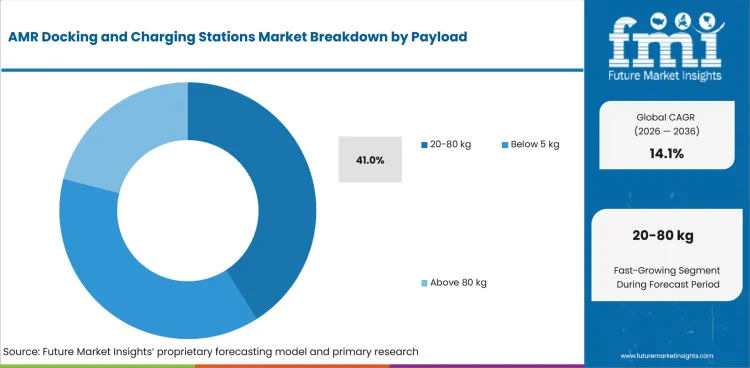
- The 20-80 kg payload class is estimated to hold 41.0% share in 2026 as tote movement and light kitting fit compact charging layouts.
- Heavier payload classes need stronger dock alignment and higher service support because charging stations must tolerate repeated positioning loads.
AMR Docking and Charging Stations Market Analysis By End-use Industry
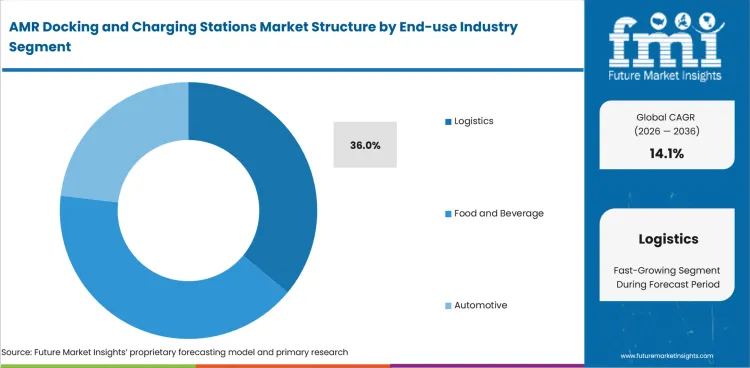
- Logistics is expected to represent 36.0% share in 2026 as fulfillment sites need logistics robots ready for peak order windows and short idle charging cycles.
- Automotive and electronics sites add demand as AMRs support line-side delivery, parts staging, and cleaner internal movement planning.
What are the drivers, restraints, and opportunities in the AMR docking and charging stations market?
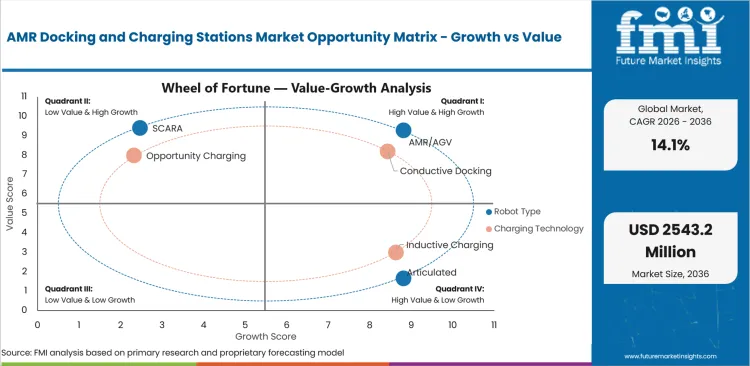
Fleet uptime and software-linked charging support demand while brownfield electrical limits and safety review slow wider rollout.
- Driver: Fleet operators need automatic charging points that protect robot availability during busy shifts.
- Restraint: Brownfield electrical limits can delay charger placement when facilities lack power access near robot waiting zones.
- Opportunity: Safety-certified and software-integrated docking can improve approval speed in factories using mobile robots near workers.
Fleet Uptime Charging
Fleet operators now judge charging systems by how well they protect robot availability during active work. The U.S. Census Bureau reported retail e-commerce sales of USD 326.7 billion in the first quarter of 2026, up 9.7% from the same quarter of 2025. That order flow signal supports larger warehouse automation programs, where chargers must fit live task queues and short dwell windows. Buyers should size charging networks from trip data and queue pressure rather than robot count alone.
Brownfield Dock Placement
Existing warehouses often have limited power access and narrow travel paths, which makes charger placement a project risk. The U.S. Bureau of Labor Statistics reported 2.5 million nonfatal workplace injuries and illnesses in private industry during 2024, keeping facility safety and work-zone review central to automation approval. Compact docks and standard power options can reduce installation disruption, especially in older sites that cannot rebuild the whole floor plan. Suppliers with layout support can shorten payback timing for first-time AMR buyers.
Safety-Certified Docking
Safety expectations shape buying behavior as AMRs charge near people and working equipment. IFR stated in April 2026 that robot density reached 267 robots per 10,000 employees in Western Europe, 204 in North America, and 131 in Asia during 2024. Higher automation density makes documented docking behavior, risk assessment, and smart factory integration more important. Vendors that align charging stations with recognized driverless truck safety practice can reduce approval friction in regulated factories.
Which countries are growing fastest in the AMR docking and charging stations market?
China 15.8% CAGR, India 15.4% CAGR, South Korea 14.7% CAGR, United States 14.3% CAGR, Japan 13.8% CAGR, Germany 13.6% CAGR, France 12.9% CAGR, and United Kingdom 12.7% CAGR through 2036.
.webp "Top Country Growth Comparison Amr Docking And Charging Stations Market Cagr (2026 2036)")
| Country | CAGR |
|---|---|
| China | 15.8% |
| India | 15.4% |
| South Korea | 14.7% |
| United States | 14.3% |
| Japan | 13.8% |
| Germany | 13.6% |
| France | 12.9% |
| United Kingdom | 12.7% |
Source: Future Market Insights, 2026.
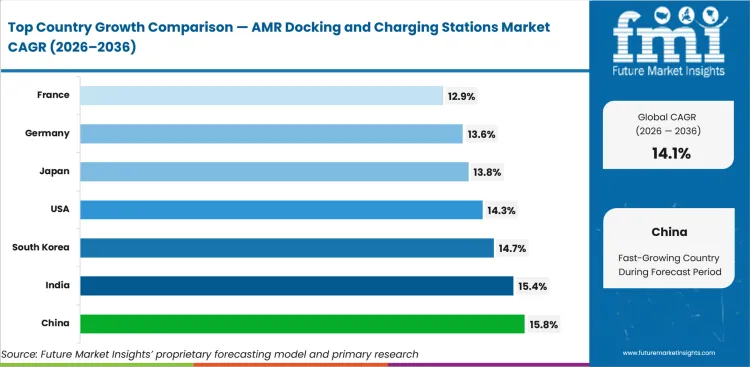
How do country-level CAGRs compare in the AMR docking and charging stations market?
China leads country growth while the United Kingdom records the most selective expansion outlook among profiled markets.
- China is projected to record 15.8% CAGR by 2036 as local warehouse automation and manufacturing demand shape charging station adoption.
- India is projected to record 15.4% CAGR by 2036 as local warehouse automation and manufacturing demand shape charging station adoption.
- South Korea is projected to record 14.7% CAGR by 2036 as local warehouse automation and manufacturing demand shape charging station adoption.
- United States is projected to record 14.3% CAGR by 2036 as local warehouse automation and manufacturing demand shape charging station adoption.
- Japan is projected to record 13.8% CAGR by 2036 as local warehouse automation and manufacturing demand shape charging station adoption.
- Germany is projected to record 13.6% CAGR by 2036 as local warehouse automation and manufacturing demand shape charging station adoption.
- France is projected to record 12.9% CAGR by 2036 as local warehouse automation and manufacturing demand shape charging station adoption.
- United Kingdom is projected to record 12.7% CAGR by 2036 as local warehouse automation and manufacturing demand shape charging station adoption.
What is the AMR docking and charging stations market outlook in China?
A 15.8% CAGR through 2036 is supported by large robot deployment scale and fast warehouse automation programs.
Country Market Snapshot Table
| Parameter | Value |
|---|---|
| Market Size in 2025 (Value) | USD 139.9 million |
| Market Size in 2026 (Value) | USD 162.0 million |
| Market Forecast in 2036 (Value) | USD 702.4 million |
| CAGR (2026 to 2036) | 15.8% |
| Years Considered | 2021 to 2036 |
| Base Year | 2025 |
| Forecast Period | 2026 to 2036 |
| Units Considered | Value (USD million) |
| Leading Sub-Region | Yangtze River Delta and Greater Bay Area automation corridors |
China AMR Docking and Charging Stations Market Outlook
China demand is shaped by automation intensity, warehouse modernization, and the need to protect AMR uptime during daily operations. Charging stations are increasingly reviewed with fleet software, dock placement, and commissioning support before project approval.
Retailers, manufacturers, and logistics operators are expected to favor suppliers that can package chargers with site layout guidance and service response. Brands with compact stations, clear safety documentation, and upgrade paths for opportunity charging should gain stronger acceptance.
Key Growth Drivers
- Robot deployment scale creates a large charging base, as IFR reported China installed 295,000 industrial robots in 2024 and represented 54.0% of global deployments.
- E-commerce warehouse flow supports higher charger density, as China’s National Bureau of Statistics reported online retail sales of 15,972.2 billion yuan in 2025.
- Domestic AMR suppliers can package docks with fleet software and service programs for factories seeking faster commissioning.
- Electronics and automotive plants increasingly plan charging positions during layout design rather than after robot purchase.
Key Restraints
- Price pressure can narrow margins for standalone charging suppliers, especially when large buyers bundle chargers into robot tenders.
- Regional warehouse operators may delay premium charging upgrades when lower-cost manual plug-in options meet early fleet needs.
- Safety review remains important, as China’s State Council Information Office reported workplace accidents declined 11.0% in 2024 and kept prevention programs under close scrutiny.
What makes China unique
China is unique due to very large robot deployment scale, domestic AMR suppliers, and high-density e-commerce warehouse programs.
Key Companies
- Geekplus
- Quicktron Robotics
- Hikrobot
- SEER Robotics
- Siasun Robot & Automation
- KUKA China
- Omron Automation China
Sales & Marketing Channels
- Direct AMR OEM sales
- E-commerce warehouse tenders
- Factory automation integrators
- Local robotics distributors
- Systems integrator networks
- Aftermarket service contracts
Country Segment Breakdown Table
| Segment | Sub-Segments |
|---|---|
| By Robot Type | Collaborative Robots · SCARA · Articulated · AMR/AGV · Delta Robots |
| By Charging Technology | Conductive Docking · Inductive Charging · Opportunity Charging · Smart Charging Controllers · Manual Plug-in Backup |
| By Payload | Below 5 kg · 5-20 kg · 20-80 kg · Above 80 kg |
| By Application | Material Handling · Inspection · Assembly · Welding · Packaging · Machine Tending |
| By End-use Industry | Automotive · Electronics · Food & Beverage · Logistics · Pharmaceuticals · Metals |
| Key Sub-Regions Covered, Automation and Logistics Corridors | Shanghai · Shenzhen · Guangzhou · Suzhou · Beijing · Chengdu |
Frequently Asked Questions
How fast is China AMR docking and charging stations market growing?
Sales in China are ready to scale at 15.8% CAGR from 2026 to 2036, guided by AMR fleet charging demand.
Who leads China AMR docking and charging stations market?
Geekplus, Quicktron Robotics, Hikrobot, SEER Robotics compete through AMR systems, local integrator links, and service support.
What is driving adoption in China AMR docking and charging stations market?
Automation programs, warehouse modernization, and safer docking placement are moving buyers toward automatic AMR charging stations.
How is the AMR docking and charging stations market growing in India?
A 15.4% CAGR through 2036 reflects logistics modernization and phased warehouse automation adoption.
Country Market Snapshot Table
| Parameter | Value |
|---|---|
| Market Size in 2025 (Value) | USD 39.0 million |
| Market Size in 2026 (Value) | USD 45.0 million |
| Market Forecast in 2036 (Value) | USD 188.5 million |
| CAGR (2026 to 2036) | 15.4% |
| Years Considered | 2021 to 2036 |
| Base Year | 2025 |
| Forecast Period | 2026 to 2036 |
| Units Considered | Value (USD million) |
| Leading Sub-Region | Western industrial corridors and national logistics clusters |
India AMR Docking and Charging Stations Market Outlook
India demand is shaped by automation intensity, warehouse modernization, and the need to protect AMR uptime during daily operations. Charging stations are increasingly reviewed with fleet software, dock placement, and commissioning support before project approval.
Retailers, manufacturers, and logistics operators are expected to favor suppliers that can package chargers with site layout guidance and service response. Brands with compact stations, clear safety documentation, and upgrade paths for opportunity charging should gain stronger acceptance.
Key Growth Drivers
- Large logistics activity expands the charging addressable base, as India’s Press Information Bureau stated the logistics sector employs over 22 million people.
- Multimodal movement is improving automation relevance, with inland waterways cargo reaching 145.5 million tonnes in 2024-25 according to the Press Information Bureau.
- Warehouse operators are using AMRs to reduce repetitive internal movement before committing to fixed conveyor systems.
- Local integrators can support staged charging networks for brownfield warehouses that need limited electrical disruption.
Key Restraints
- Small and medium warehouses often delay charger networks until robot utilization is proven during peak operations.
- Integrator capacity can vary by region, making installation support and service response important buying filters.
- India’s industrial robot base remains smaller than leading markets, as IFR reported the operational stock reached 52,570 units in 2024.
What makes India unique
India is unique because logistics modernization, new warehouses, and flexible automation programs are growing from a smaller robot base.
Key Companies
- Addverb Technologies
- GreyOrange
- Daifuku India
- Omron Automation India
- KUKA India
- ABB Robotics India
- Systemantics India
Sales & Marketing Channels
- Direct enterprise robotics sales
- Warehouse automation integrators
- 3PL automation tenders
- Industrial park channels
- Robotics distributor networks
- Service and maintenance partners
Country Segment Breakdown Table
| Segment | Sub-Segments |
|---|---|
| By Robot Type | Collaborative Robots · SCARA · Articulated · AMR/AGV · Delta Robots |
| By Charging Technology | Conductive Docking · Inductive Charging · Opportunity Charging · Smart Charging Controllers · Manual Plug-in Backup |
| By Payload | Below 5 kg · 5-20 kg · 20-80 kg · Above 80 kg |
| By Application | Material Handling · Inspection · Assembly · Welding · Packaging · Machine Tending |
| By End-use Industry | Automotive · Electronics · Food & Beverage · Logistics · Pharmaceuticals · Metals |
| Key Sub-Regions Covered, Automation and Logistics Corridors | Maharashtra · Gujarat · Karnataka · Tamil Nadu · Delhi NCR · Telangana |
Frequently Asked Questions
How fast is India AMR docking and charging stations market growing?
Sales in India are ready to scale at 15.4% CAGR from 2026 to 2036, guided by AMR fleet charging demand.
Who leads India AMR docking and charging stations market?
Addverb Technologies, GreyOrange, Daifuku India, Omron Automation India compete through AMR systems, local integrator links, and service support.
What is driving adoption in India AMR docking and charging stations market?
Automation programs, warehouse modernization, and safer docking placement are moving buyers toward automatic AMR charging stations.
What is the AMR docking and charging stations market forecast for South Korea?
A 14.7% CAGR through 2036 reflects high robot density and advanced electronics manufacturing demand.
Country Market Snapshot Table
| Parameter | Value |
|---|---|
| Market Size in 2025 (Value) | USD 48.0 million |
| Market Size in 2026 (Value) | USD 55.0 million |
| Market Forecast in 2036 (Value) | USD 216.8 million |
| CAGR (2026 to 2036) | 14.7% |
| Years Considered | 2021 to 2036 |
| Base Year | 2025 |
| Forecast Period | 2026 to 2036 |
| Units Considered | Value (USD million) |
| Leading Sub-Region | Seoul Capital Area and advanced manufacturing clusters |
South Korea AMR Docking and Charging Stations Market Outlook
South Korea demand is shaped by automation intensity, warehouse modernization, and the need to protect AMR uptime during daily operations. Charging stations are increasingly reviewed with fleet software, dock placement, and commissioning support before project approval.
Retailers, manufacturers, and logistics operators are expected to favor suppliers that can package chargers with site layout guidance and service response. Brands with compact stations, clear safety documentation, and upgrade paths for opportunity charging should gain stronger acceptance.
Key Growth Drivers
- Automation density supports charger demand, as IFR placed South Korea at 1,220 robots per 10,000 manufacturing employees in 2024.
- Factory robot additions keep charging infrastructure relevant, with IFR reporting 30,600 industrial robot installations in South Korea during 2024.
- Electronics and battery plants favor compact charging stations that support precise routing and controlled floor movement.
- Domestic robotics suppliers help buyers connect chargers with fleet tools and local service response.
Key Restraints
- High automation maturity raises buyer expectations for documented uptime, safety testing, and software compatibility before approval.
- Dense production floors can limit charger placement near the most productive waiting zones.
- Workplace safety scrutiny remains active, as the labor ministry reported 589 fatal accident subjects in 2024 across industrial accident statistics.
What makes South Korea unique
South Korea is unique for very high robot density and electronics-led automation that rewards compact, reliable charging stations.
Key Companies
- Hyundai Robotics
- Doosan Robotics
- Hanwha Robotics
- Twinny
- LG CNS Robotics
- Omron Korea
- ABB Korea
Sales & Marketing Channels
- Direct factory automation sales
- Electronics plant procurement
- Robotics integrators
- Domestic AMR suppliers
- Service contracts
- Distributor demonstrations
Country Segment Breakdown Table
| Segment | Sub-Segments |
|---|---|
| By Robot Type | Collaborative Robots · SCARA · Articulated · AMR/AGV · Delta Robots |
| By Charging Technology | Conductive Docking · Inductive Charging · Opportunity Charging · Smart Charging Controllers · Manual Plug-in Backup |
| By Payload | Below 5 kg · 5-20 kg · 20-80 kg · Above 80 kg |
| By Application | Material Handling · Inspection · Assembly · Welding · Packaging · Machine Tending |
| By End-use Industry | Automotive · Electronics · Food & Beverage · Logistics · Pharmaceuticals · Metals |
| Key Sub-Regions Covered, Automation and Logistics Corridors | Seoul · Incheon · Gyeonggi · Busan · Ulsan · Daegu |
Frequently Asked Questions
How fast is South Korea AMR docking and charging stations market growing?
Sales in South Korea are ready to scale at 14.7% CAGR from 2026 to 2036, guided by AMR fleet charging demand.
Who leads South Korea AMR docking and charging stations market?
Hyundai Robotics, Doosan Robotics, Hanwha Robotics, Twinny compete through AMR systems, local integrator links, and service support.
What is driving adoption in South Korea AMR docking and charging stations market?
Automation programs, warehouse modernization, and safer docking placement are moving buyers toward automatic AMR charging stations.
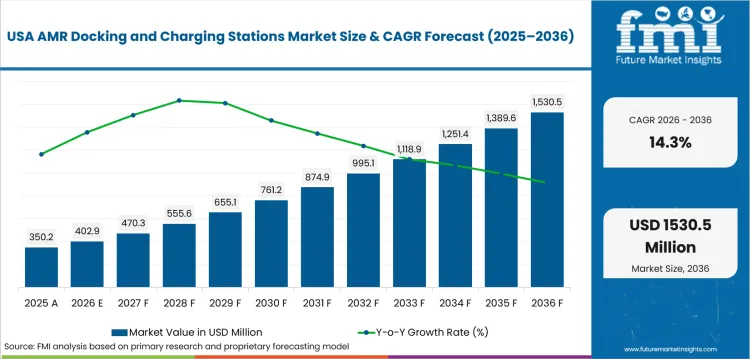
How fast is the AMR docking and charging stations market growing in the United States?
A 14.3% CAGR through 2036 reflects warehouse automation expansion and strong AMR integrator coverage.
Country Market Snapshot Table
| Parameter | Value |
|---|---|
| Market Size in 2025 (Value) | USD 115.5 million |
| Market Size in 2026 (Value) | USD 132.0 million |
| Market Forecast in 2036 (Value) | USD 502.4 million |
| CAGR (2026 to 2036) | 14.3% |
| Years Considered | 2021 to 2036 |
| Base Year | 2025 |
| Forecast Period | 2026 to 2036 |
| Units Considered | Value (USD million) |
| Leading Sub-Region | South Atlantic logistics corridors and Midwest manufacturing hubs |
United States AMR Docking and Charging Stations Market Outlook
United States demand is shaped by automation intensity, warehouse modernization, and the need to protect AMR uptime during daily operations. Charging stations are increasingly reviewed with fleet software, dock placement, and commissioning support before project approval.
Retailers, manufacturers, and logistics operators are expected to favor suppliers that can package chargers with site layout guidance and service response. Brands with compact stations, clear safety documentation, and upgrade paths for opportunity charging should gain stronger acceptance.
Key Growth Drivers
- Industrial robot demand supports charger planning, as IFR reported United States installations rose 11.0% to 38,000 units in 2025.
- Transport and warehousing scale keeps automation buyers active, as BTS reported sector employment at 6,550,500 in March 2026.
- Large 3PL networks need flexible robot fleets that recharge without stopping peak shift workflows.
- Automotive and electronics plants use AMRs for line-side material movement with predictable charging windows.
Key Restraints
- Older facilities may lack convenient electrical points near the best robot waiting zones.
- Buyer scrutiny is high when AMRs share routes with forklifts, pallets, and pedestrian traffic.
- Workplace safety review remains central, as BLS reported 5,070 fatal work injuries in the United States during 2024.
What makes United States unique
The United States is unique due to deep AMR OEM channels, enterprise warehouse buyers, and large-scale integrator networks.
Key Companies
- Seegrid
- OTTO by Rockwell Automation
- Locus Robotics
- Zebra Technologies
- Mobile Industrial Robots
- Omron Automation Americas
- Fetch Robotics by Zebra
Sales & Marketing Channels
- Direct enterprise AMR sales
- Warehouse automation integrators
- Robotics distributor networks
- OEM fleet software channels
- Safety consulting partners
- Aftermarket service contracts
Country Segment Breakdown Table
| Segment | Sub-Segments |
|---|---|
| By Robot Type | Collaborative Robots · SCARA · Articulated · AMR/AGV · Delta Robots |
| By Charging Technology | Conductive Docking · Inductive Charging · Opportunity Charging · Smart Charging Controllers · Manual Plug-in Backup |
| By Payload | Below 5 kg · 5-20 kg · 20-80 kg · Above 80 kg |
| By Application | Material Handling · Inspection · Assembly · Welding · Packaging · Machine Tending |
| By End-use Industry | Automotive · Electronics · Food & Beverage · Logistics · Pharmaceuticals · Metals |
| Key Sub-Regions Covered, Automation and Logistics Corridors | Southeast · Midwest · Texas · California · New York · Pacific Northwest |
Frequently Asked Questions
How fast is United States AMR docking and charging stations market growing?
Sales in United States are ready to scale at 14.3% CAGR from 2026 to 2036, guided by AMR fleet charging demand.
Who leads United States AMR docking and charging stations market?
Seegrid, OTTO by Rockwell Automation, Locus Robotics, Zebra Technologies compete through AMR systems, local integrator links, and service support.
What is driving adoption in United States AMR docking and charging stations market?
Automation programs, warehouse modernization, and safer docking placement are moving buyers toward automatic AMR charging stations.
What is the AMR docking and charging stations market forecast for Japan?
A 13.8% CAGR through 2036 is supported by compact factory automation and disciplined service expectations.
Country Market Snapshot Table
| Parameter | Value |
|---|---|
| Market Size in 2025 (Value) | USD 63.3 million |
| Market Size in 2026 (Value) | USD 72.0 million |
| Market Forecast in 2036 (Value) | USD 262.3 million |
| CAGR (2026 to 2036) | 13.8% |
| Years Considered | 2021 to 2036 |
| Base Year | 2025 |
| Forecast Period | 2026 to 2036 |
| Units Considered | Value (USD million) |
| Leading Sub-Region | Tokyo-Osaka manufacturing and distribution corridors |
Japan AMR Docking and Charging Stations Market Outlook
Japan demand is shaped by automation intensity, warehouse modernization, and the need to protect AMR uptime during daily operations. Charging stations are increasingly reviewed with fleet software, dock placement, and commissioning support before project approval.
Retailers, manufacturers, and logistics operators are expected to favor suppliers that can package chargers with site layout guidance and service response. Brands with compact stations, clear safety documentation, and upgrade paths for opportunity charging should gain stronger acceptance.
Key Growth Drivers
- Factory automation depth supports charging demand, as IFR reported Japan installed 44,500 industrial robots in 2024.
- Digital retail flow adds warehouse pressure, as METI reported Japan’s B2C e-commerce market reached 26.1 trillion yen in 2024.
- Electronics and pharmaceutical facilities favor predictable docking behavior that protects worker movement and process reliability.
- Local automation service networks support buyers that require documented commissioning and fast maintenance response.
Key Restraints
- Legacy plant layouts can limit charger placement near the highest-value AMR routes.
- Buyers often require long proof cycles before expanding from pilots to full fleet charging networks.
- Competitive convenience-channel pressure is selective, as the International Trade Administration placed Japan’s C2C e-commerce market at USD 18.0 billion in 2024.
What makes Japan unique
Japan combines automation maturity with space discipline, which favors compact docks and reliable fleet control.
Key Companies
- Omron Corporation
- Mujin
- ZMP Inc.
- Kawasaki Robotics
- Denso Wave
- KUKA Japan
- ABB Robotics Japan
Sales & Marketing Channels
- Direct factory automation sales
- Local integrator networks
- Electronics plant procurement
- Pharmaceutical facility channels
- OEM service programs
- Distributor-led demonstrations
Country Segment Breakdown Table
| Segment | Sub-Segments |
|---|---|
| By Robot Type | Collaborative Robots · SCARA · Articulated · AMR/AGV · Delta Robots |
| By Charging Technology | Conductive Docking · Inductive Charging · Opportunity Charging · Smart Charging Controllers · Manual Plug-in Backup |
| By Payload | Below 5 kg · 5-20 kg · 20-80 kg · Above 80 kg |
| By Application | Material Handling · Inspection · Assembly · Welding · Packaging · Machine Tending |
| By End-use Industry | Automotive · Electronics · Food & Beverage · Logistics · Pharmaceuticals · Metals |
| Key Sub-Regions Covered, Automation and Logistics Corridors | Tokyo · Osaka · Yokohama · Nagoya · Fukuoka · Sapporo |
Frequently Asked Questions
How fast is Japan AMR docking and charging stations market growing?
Sales in Japan are ready to scale at 13.8% CAGR from 2026 to 2036, guided by AMR fleet charging demand.
Who leads Japan AMR docking and charging stations market?
Omron Corporation, Mujin, ZMP Inc., Kawasaki Robotics compete through AMR systems, local integrator links, and service support.
What is driving adoption in Japan AMR docking and charging stations market?
Automation programs, warehouse modernization, and safer docking placement are moving buyers toward automatic AMR charging stations.
How is the AMR docking and charging stations market performing in Germany?
A 13.6% CAGR through 2036 reflects automotive line supply, machinery production, and engineering-led automation.
Country Market Snapshot Table
| Parameter | Value |
|---|---|
| Market Size in 2025 (Value) | USD 54.6 million |
| Market Size in 2026 (Value) | USD 62.0 million |
| Market Forecast in 2036 (Value) | USD 221.9 million |
| CAGR (2026 to 2036) | 13.6% |
| Years Considered | 2021 to 2036 |
| Base Year | 2025 |
| Forecast Period | 2026 to 2036 |
| Units Considered | Value (USD million) |
| Leading Sub-Region | Bavaria, Baden-Württemberg, and Rhine-Ruhr industrial corridors |
Germany AMR Docking and Charging Stations Market Outlook
Germany demand is shaped by automation intensity, warehouse modernization, and the need to protect AMR uptime during daily operations. Charging stations are increasingly reviewed with fleet software, dock placement, and commissioning support before project approval.
Retailers, manufacturers, and logistics operators are expected to favor suppliers that can package chargers with site layout guidance and service response. Brands with compact stations, clear safety documentation, and upgrade paths for opportunity charging should gain stronger acceptance.
Key Growth Drivers
- Industrial robot scale supports charger upgrades, as IFR reported Germany installed 26,982 industrial robots in 2024.
- High automation density creates structured charger demand, with IFR placing Germany at 449 robots per 10,000 manufacturing employees in 2024.
- Automotive line supply creates repeated AMR missions that need planned charging cycles and validated dock behavior.
- Machinery plants favor mobile transport that avoids fixed conveyor changes and preserves line flexibility.
Key Restraints
- Detailed factory validation can extend order cycles for charger networks when docks affect safety layouts.
- Premium system pricing limits smaller buyer adoption outside large industrial sites.
- Physical workload concerns keep safety planning important, as BAuA stated around one quarter of days of incapacity relate to musculoskeletal disorders.
What makes Germany unique
Germany is a proving ground for charging stations tied to high-duty manufacturing workflows and safety-heavy approval processes.
Key Companies
- KUKA
- ABB Robotics Germany
- Magazino
- DS AUTOMOTION
- Omron Germany
- Mobile Industrial Robots Germany
- SICK AG
Sales & Marketing Channels
- Direct OEM engagement
- Factory automation integrators
- Automotive supplier tenders
- Robotics distributor networks
- Plant engineering consultants
- Maintenance service partners
Country Segment Breakdown Table
| Segment | Sub-Segments |
|---|---|
| By Robot Type | Collaborative Robots · SCARA · Articulated · AMR/AGV · Delta Robots |
| By Charging Technology | Conductive Docking · Inductive Charging · Opportunity Charging · Smart Charging Controllers · Manual Plug-in Backup |
| By Payload | Below 5 kg · 5-20 kg · 20-80 kg · Above 80 kg |
| By Application | Material Handling · Inspection · Assembly · Welding · Packaging · Machine Tending |
| By End-use Industry | Automotive · Electronics · Food & Beverage · Logistics · Pharmaceuticals · Metals |
| Key Sub-Regions Covered, Automation and Logistics Corridors | Bavaria · Baden-Württemberg · North Rhine-Westphalia · Saxony · Hesse · Lower Saxony |
Frequently Asked Questions
How fast is Germany AMR docking and charging stations market growing?
Sales in Germany are ready to scale at 13.6% CAGR from 2026 to 2036, guided by AMR fleet charging demand.
Who leads Germany AMR docking and charging stations market?
KUKA, ABB Robotics Germany, Magazino, DS AUTOMOTION compete through AMR systems, local integrator links, and service support.
What is driving adoption in Germany AMR docking and charging stations market?
Automation programs, warehouse modernization, and safer docking placement are moving buyers toward automatic AMR charging stations.
What is driving AMR docking and charging stations growth in France?
A 12.9% CAGR through 2036 is supported by retail logistics modernization and phased industrial automation.
Country Market Snapshot Table
| Parameter | Value |
|---|---|
| Market Size in 2025 (Value) | USD 34.5 million |
| Market Size in 2026 (Value) | USD 39.0 million |
| Market Forecast in 2036 (Value) | USD 131.2 million |
| CAGR (2026 to 2036) | 12.9% |
| Years Considered | 2021 to 2036 |
| Base Year | 2025 |
| Forecast Period | 2026 to 2036 |
| Units Considered | Value (USD million) |
| Leading Sub-Region | Paris basin and national retail logistics corridors |
France AMR Docking and Charging Stations Market Outlook
France demand is shaped by automation intensity, warehouse modernization, and the need to protect AMR uptime during daily operations. Charging stations are increasingly reviewed with fleet software, dock placement, and commissioning support before project approval.
Retailers, manufacturers, and logistics operators are expected to favor suppliers that can package chargers with site layout guidance and service response. Brands with compact stations, clear safety documentation, and upgrade paths for opportunity charging should gain stronger acceptance.
Key Growth Drivers
- Retail logistics activity supports charger placement, as FEVAD reported French e-commerce turnover of EUR 175.0 billion in 2024.
- Order frequency strengthens AMR charging needs, with FEVAD reporting 2.6 billion e-commerce transactions in France during 2024.
- Food and beverage plants prefer low-disruption automation that avoids fixed conveyor changes across existing halls.
- Pharmaceutical handling supports AMRs where traceable movement and controlled access are important.
Key Restraints
- Regional warehouse operators may delay automation until labor and volume pressure is clearly measured.
- Charger installation can slow when site safety review and electrical access limits require extra engineering work.
- European robot investment remained selective, as IFR reported robot installations in Europe declined 8.0% to 85,000 units in 2024.
What makes France unique
France stands out for phased AMR adoption in logistics sites where integrator support can decide charger acceptance.
Key Companies
- Exotec
- Balyo
- Scallog
- Effidence
- ABB France
- KUKA France
- Omron France
Sales & Marketing Channels
- Logistics integrator sales
- Robotics distributor networks
- Retail warehouse tenders
- Food plant engineering teams
- Maintenance and service partners
- Direct OEM demonstrations
Country Segment Breakdown Table
| Segment | Sub-Segments |
|---|---|
| By Robot Type | Collaborative Robots · SCARA · Articulated · AMR/AGV · Delta Robots |
| By Charging Technology | Conductive Docking · Inductive Charging · Opportunity Charging · Smart Charging Controllers · Manual Plug-in Backup |
| By Payload | Below 5 kg · 5-20 kg · 20-80 kg · Above 80 kg |
| By Application | Material Handling · Inspection · Assembly · Welding · Packaging · Machine Tending |
| By End-use Industry | Automotive · Electronics · Food & Beverage · Logistics · Pharmaceuticals · Metals |
| Key Sub-Regions Covered, Automation and Logistics Corridors | Île-de-France · Auvergne-Rhône-Alpes · Hauts-de-France · Grand Est · Occitanie · Nouvelle-Aquitaine |
Frequently Asked Questions
How fast is France AMR docking and charging stations market growing?
Sales in France are ready to scale at 12.9% CAGR from 2026 to 2036, guided by AMR fleet charging demand.
Who leads France AMR docking and charging stations market?
Exotec, Balyo, Scallog, Effidence compete through AMR systems, local integrator links, and service support.
What is driving adoption in France AMR docking and charging stations market?
Automation programs, warehouse modernization, and safer docking placement are moving buyers toward automatic AMR charging stations.
What is the AMR docking and charging stations market outlook in the United Kingdom?
A 12.7% CAGR through 2036 reflects selective automation in space-constrained logistics and healthcare distribution sites.
Country Market Snapshot Table
| Parameter | Value |
|---|---|
| Market Size in 2025 (Value) | USD 33.7 million |
| Market Size in 2026 (Value) | USD 38.0 million |
| Market Forecast in 2036 (Value) | USD 125.6 million |
| CAGR (2026 to 2036) | 12.7% |
| Years Considered | 2021 to 2036 |
| Base Year | 2025 |
| Forecast Period | 2026 to 2036 |
| Units Considered | Value (USD million) |
| Leading Sub-Region | Greater London, Midlands, and national fulfillment networks |
United Kingdom AMR Docking and Charging Stations Market Outlook
United Kingdom demand is shaped by automation intensity, warehouse modernization, and the need to protect AMR uptime during daily operations. Charging stations are increasingly reviewed with fleet software, dock placement, and commissioning support before project approval.
Retailers, manufacturers, and logistics operators are expected to favor suppliers that can package chargers with site layout guidance and service response. Brands with compact stations, clear safety documentation, and upgrade paths for opportunity charging should gain stronger acceptance.
Key Growth Drivers
- Online retail keeps warehouse automation relevant, as ONS placed internet sales at 28.0% of total retail sales in September 2025.
- Digital customer reach supports fulfillment automation, as the International Trade Administration reported 66.3 million UK internet users in 2026.
- Pharmaceutical distribution needs controlled movement and reliable uptime during order waves.
- Retail fulfillment sites prefer modular charging stations that can follow seasonal layout changes.
Key Restraints
- Limited floor space raises charger congestion risk during peak shifts in older urban warehouses.
- Conservative capital approval can delay larger charger networks until payback is proven.
- Safety compliance remains a project gate, as HSE reported 138 workers killed in work-related accidents in Great Britain during 2023-24.
What makes United Kingdom unique
The United Kingdom is distinctive for space-constrained automation projects that reward compact chargers and simple installation.
Key Companies
- Locus Robotics UK
- Geekplus UK
- Mobile Industrial Robots UK
- Omron UK
- KUKA UK
- ABB Robotics UK
- OPEX Corporation UK
Sales & Marketing Channels
- Systems integrator sales
- European robotics distributors
- 3PL automation tenders
- Retail fulfillment technology teams
- Pharmaceutical logistics channels
- Service and maintenance partners
Country Segment Breakdown Table
| Segment | Sub-Segments |
|---|---|
| By Robot Type | Collaborative Robots · SCARA · Articulated · AMR/AGV · Delta Robots |
| By Charging Technology | Conductive Docking · Inductive Charging · Opportunity Charging · Smart Charging Controllers · Manual Plug-in Backup |
| By Payload | Below 5 kg · 5-20 kg · 20-80 kg · Above 80 kg |
| By Application | Material Handling · Inspection · Assembly · Welding · Packaging · Machine Tending |
| By End-use Industry | Automotive · Electronics · Food & Beverage · Logistics · Pharmaceuticals · Metals |
| Key Sub-Regions Covered, Automation and Logistics Corridors | London · Manchester · Birmingham · Leeds · Glasgow · Bristol |
Frequently Asked Questions
How fast is United Kingdom AMR docking and charging stations market growing?
Sales in United Kingdom are ready to scale at 12.7% CAGR from 2026 to 2036, guided by AMR fleet charging demand.
Who leads United Kingdom AMR docking and charging stations market?
Locus Robotics UK, Geekplus UK, Mobile Industrial Robots UK, Omron UK compete through AMR systems, local integrator links, and service support.
What is driving adoption in United Kingdom AMR docking and charging stations market?
Automation programs, warehouse modernization, and safer docking placement are moving buyers toward automatic AMR charging stations.
Who are the leading companies in the AMR docking and charging stations market?
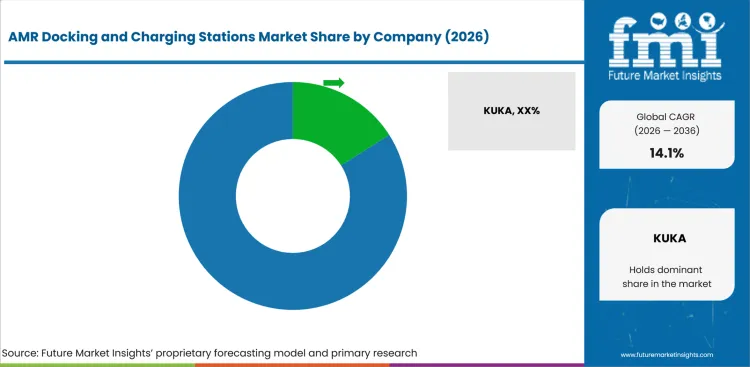
KUKA, Omron Automation, Mobile Industrial Robots, Locus Robotics and Geekplus.
- Integrated robotics suppliers hold an advantage through AMR platforms, automatic docking hardware, and service support that buyers can evaluate together.
- Warehouse AMR specialists gain acceptance by linking charging stations with fleet software and route planning across fulfillment networks.
- Charging-focused platform vendors gain better acceptance in sites treating energy infrastructure as part of robot uptime planning.
- Retail-ready service packages support trial through clear charger placement, power requirements, and preventive maintenance information.
Robotics groups in the market compete by combining mobile robot portfolios with automatic docking execution. KUKA and Omron hold strong relevance where charging stations must fit factory approval processes and payload-specific workflows. Mobile Industrial Robots gains attention through compact charging stations and return-to-charge behavior. Buyers assess charger density, safe docking zones, and software visibility before adding more robots to the floor.
Manufacturing scale has become a competitive separator as AMR fleets move beyond small proof-of-concept installations. KUKA introduced the KMP 250P platform in August 2025 with 250 kg payload capacity, conductive charging, and an optional inductive charging version. Locus Robotics added Locus Array in May 2025 to support robots-to-goods automation under the LocusONE platform. Suppliers with documented uptime results and field service depth can secure stronger project confidence.
Smaller and regional players can win through local integrator relationships and faster deployment support. Addverb Technologies, GreyOrange, Exotec, Balyo, and Hikrobot serve buyers that need phased automation programs and site-specific charging layouts. China and India create faster conditions, while Germany and Japan require stronger validation before wider rollout. Companies relying only on standalone dock sales are expected to face weaker acceptance in scaled AMR programs.
How do top AMR docking and charging stations companies compare?
KUKA and Omron score strongest on industrial platform depth while Locus Robotics and Geekplus lead warehouse fleet integration.
| Company | Relevance to Market Title | AMR Platform Depth | Docking & Charging Portfolio | Fleet Software Control | Channel Reach | Geographic Footprint |
|---|---|---|---|---|---|---|
| KUKA | Very High | Very Strong | Very Strong | Strong | Very Strong | Global |
| Omron Automation | Very High | Very Strong | Strong | Strong | Very Strong | Global |
| Mobile Industrial Robots | Very High | Strong | Very Strong | Strong | Strong | Europe and Americas |
| Locus Robotics | Very High | Strong | Strong | Very Strong | Very Strong | Global |
| Geekplus | Very High | Strong | Strong | Very Strong | Very Strong | Global |
| OTTO by Rockwell Automation | High | Strong | Strong | Very Strong | Strong | North America and Europe |
| Seegrid | High | Strong | Moderate | Strong | Strong | United States |
| ABB Robotics | High | Strong | Moderate | Strong | Very Strong | Global |
| Addverb Technologies | High | Strong | Moderate | Strong | Strong | India and Global |
| Exotec | Moderate to High | Strong | Moderate | Strong | Strong | Europe and Americas |
Source: Future Market Insights competitive analysis, 2026.
Who are the key players in the AMR docking and charging stations market?
KUKA, Omron Automation, Mobile Industrial Robots and Locus Robotics are listed with Geekplus and OTTO by Rockwell Automation among other suppliers.
Key global companies leading the AMR docking and charging stations market include:
- KUKA
- Omron Automation
- Mobile Industrial Robots
- Locus Robotics
- Geekplus
- OTTO by Rockwell Automation
- Seegrid
- ABB Robotics
- Addverb Technologies
- Exotec
Key Developments in AMR Docking and Charging Stations Market
- In August 2025, KUKA introduced the KMP 250P mobile platform with 250 kg payload capacity, conductive charging, and an optional inductive charging version for continuous production environments.
- In May 2025, Locus Robotics introduced Locus Array as a robots-to-goods automation approach under the LocusONE platform, supporting 24/7 operations for high-volume warehouses.
- In November 2025, Rockwell Automation reported that its OTTO autonomous mobile robot business grew at a double-digit rate during fiscal 2025, strengthening its AMR-linked charging and fleet automation position.
Key Players in the AMR Docking and Charging Stations Market
Global Robotics and Automation Groups
- KUKA
- ABB Robotics
- Omron Automation
- Rockwell Automation
- Yaskawa Electric
Mobile Robot and Warehouse AMR Specialists
- Mobile Industrial Robots
- Locus Robotics
- Geekplus
- Seegrid
- OTTO by Rockwell Automation
Regional and Integrator-led Companies
- Addverb Technologies
- GreyOrange
- Exotec
- Balyo
- Hikrobot
AMR Docking and Charging Stations Market - Report Scope
| Parameter | Details |
|---|---|
| Forecast period | 2026 to 2036 |
| Historical period | 2021 to 2025 |
| Quantitative unit | Revenue in USD million |
| By robot type | Collaborative robots, SCARA, articulated, AMR/AGV, delta robots |
| By charging technology | Conductive docking, inductive charging, opportunity charging, smart charging controllers, manual plug-in backup |
| By payload | Below 5 kg, 5-20 kg, 20-80 kg, above 80 kg |
| By application | Material handling, inspection, assembly, welding, packaging, machine tending |
| By end-use industry | Automotive, electronics, food and beverage, logistics, pharmaceuticals, metals |
| Regions covered | North America, Latin America, Europe, East Asia, South Asia and Pacific, Middle East and Africa |
| Countries covered | China, India, South Korea, United States, Japan, Germany, France, United Kingdom |
| Key companies profiled | KUKA, Omron Automation, Mobile Industrial Robots, Locus Robotics, Geekplus, OTTO by Rockwell Automation, Seegrid, ABB Robotics |
| Approach | Bottom-up product-boundary approach using eligible charger revenue, AMR fleet additions, charger-to-robot ratios, country automation maturity, and channel presence |
Source: Future Market Insights, 2026.
AMR Docking and Charging Stations Market Breakdown by Robot Type, Charging Technology, Payload, Application, End-use Industry, and Region
AMR Docking and Charging Stations Market Segmented by Robot Type:
- Collaborative Robots
- SCARA
- Articulated
- AMR/AGV
- Delta Robots
AMR Docking and Charging Stations Market Segmented by Charging Technology:
- Conductive Docking
- Inductive Charging
- Opportunity Charging
- Smart Charging Controllers
- Manual Plug-in Backup
AMR Docking and Charging Stations Market Segmented by Payload:
- Below 5 kg
- 5-20 kg
- 20-80 kg
- Above 80 kg
AMR Docking and Charging Stations Market Segmented by Application:
- Material Handling
- Inspection
- Assembly
- Welding
- Packaging
- Machine Tending
AMR Docking and Charging Stations Market Segmented by End-use Industry:
- Automotive
- Electronics
- Food and Beverage
- Logistics
- Pharmaceuticals
- Metals
AMR Docking and Charging Stations Market by Region:
- North America
- Latin America
- Europe
- East Asia
- South Asia and Pacific
- Middle East and Africa
Research Sources and Bibliography
- Bureau of Labor Statistics. (2026, January 22). Employer-reported workplace injuries and illnesses, 2023-2024.
- Bureau of Transportation Statistics. (2026, April 3). March 2026 U.S. transportation sector unemployment falls below March 2025 level.
- Federal Institute for Occupational Safety and Health. (2025). Health and physical workloads in Germany.
- FEVAD. (2025, September). France e-commerce key figures 2025.
- Germany Trade & Invest. (2025). Robotics industry in Germany.
- Health and Safety Executive. (2024, July). Work-related fatal injuries in Great Britain, 2023/24.
- International Federation of Robotics. (2025, September 25). World Robotics 2025 report: Global robot demand in factories doubles over 10 years.
- International Federation of Robotics. (2025, October 7). World Robotics 2025 report: Service robots see global growth boom.
- International Federation of Robotics. (2026, April 8). Robot density surges in Europe, Asia, and Americas.
- International Trade Administration. (2025, November 18). Japan - eCommerce.
- International Trade Administration. (2026, February 3). United Kingdom - eCommerce.
- KUKA. (2025, August 28). KMP 250P: Secure, flexible, compatible.
- Locus Robotics. (2025, May 2). Robots-to-goods and Locus Array: The next era of warehouse automation.
- Ministry of Economy, Trade and Industry. (2025, August 26). Results of FY2024 e-commerce market survey compiled.
- Ministry of Employment and Labor. (2025, March 11). 2024 industrial accident statistics supplementary report.
- National Bureau of Statistics of China. (2025, March 18). Industrial production operation from January to February 2025.
- National Bureau of Statistics of China. (2026, January 20). Total retail sales of consumer goods in December 2025.
- Office for National Statistics. (2026, June). Internet sales as a percentage of total retail sales.
- Occupational Safety and Health Administration. (2025). Lithium-ion battery safety.
- Press Information Bureau. (2025, August 16). Logistics: India’s growth engine.
- Rockwell Automation. (2025, November 6). Fourth quarter fiscal 2025 earnings conference call prepared remarks.
- State Council Information Office of the People’s Republic of China. (2025, January 16). China reports year-on-year decline in workplace accidents in 2024.
- U.S. Census Bureau. (2026, May 18). Quarterly retail e-commerce sales, 1st quarter 2026.
- This bibliography is provided for reader reference and is not exhaustive. The full report contains the complete reference list and detailed citations.
AMR Docking and Charging Stations Market - Scope & Definition
| Attribute | Detail |
|---|---|
| Market Definition | Automatic conductive docks, inductive charging pads, charger controllers, battery interface modules, mounting hardware, and charging software used with autonomous mobile robots in industrial and warehouse environments |
| Functions Covered | Automatic charging, opportunity charging, charge scheduling, dock alignment, battery interface control, fleet availability support, safety-zone charging |
| Applications Covered | Material handling, inspection, assembly support, welding support, packaging movement, machine tending, line-side transport, warehouse replenishment |
| End-Use Industries | Automotive, electronics, food and beverage, logistics, pharmaceuticals, metals, and industrial manufacturing facilities |
| Technologies Covered | Conductive docking, inductive charging, smart charging controllers, opportunity charging, and manual plug-in backup used as part of AMR deployment |
| Inclusions | Charging stations, docking hardware, controller modules, fleet charging interfaces, AMR charging software attachments, and installation-related revenue tied to eligible AMR docking systems |
| Exclusions | Public electric vehicle chargers, consumer robot charging docks, drone docking pads, fixed conveyor power systems, manual forklift battery rooms, and robot sales revenue without charging hardware or software |
AMR Docking and Charging Stations Market - Research Methodology
| Method | Description |
|---|---|
| Primary Research | FMI analyst interviews with AMR manufacturers, warehouse automation integrators, factory automation teams, robotics distributors, service partners, and fleet operations managers across key markets |
| Desk Research | Review of official robotics statistics, safety guidance, company product pages, product manuals, charging system documentation, and AMR fleet deployment information |
| Market Sizing & Forecasting | Bottom-up product-boundary approach using charger unit shipments, AMR fleet additions, charger-to-robot ratios, replacement cycles, average charger pricing, and software attachment rates |
| Data Validation | Cross-verification using robot installation signals, AMR use patterns, official safety guidance, product specifications, country automation maturity, and company portfolio checks |
This Report Answers
- Market size estimates for 2026 and forecasts through 2036 for the AMR docking and charging stations market.
- Insights across more than 30 regional and country-level markets.
- Analysis of demand drivers, fleet charging patterns, docking technology trends, and purchasing behavior.
- Evaluation of key robot types and charging technologies, including AMR/AGV platforms and conductive docking systems.
- Assessment of safety review, brownfield installation, charger density, and fleet software impacts on market development.
- Identification of opportunities across robot type, payload, application, charging technology, and end-use industry.
- Evaluation of supply chain dynamics, product innovation trends, service models, and distributor structures.
- Country-level growth analysis covering China, India, South Korea, the United States, Japan, Germany, France, and the United Kingdom.
- Assessment of the competitive landscape, including leading robotics manufacturers, AMR specialists, and charging system suppliers.
- Analysis of buyer preferences, fleet scale-up patterns, and emerging growth opportunities.
- Regional outlooks across North America, Europe, East Asia, South Asia and Pacific, Latin America, and Middle East and Africa.
- Delivery of market data, forecasts, and supporting analysis in PDF and Excel formats.
Frequently Asked Questions
What is the growth prospect for AMR docking and charging stations?
Demand for AMR docking and charging stations is expected to rise at a considerable pace as factories and warehouses expand mobile robot fleets.
Which companies are expected to shape the AMR docking and charging stations market?
KUKA, Omron Automation, Mobile Industrial Robots, Locus Robotics, Geekplus, OTTO by Rockwell Automation, Seegrid, and ABB Robotics are expected to shape market competition through AMR portfolios and charging-linked service support.
Why are leading robotics companies investing in AMR docking and charging stations?
Leading robotics companies are investing in AMR docking and charging stations to improve fleet uptime and support larger automated material handling programs.
Why is fleet software important in AMR docking and charging stations?
Fleet software is important because battery status, task priority, and charger availability must be coordinated before robots return to active work.
Which charging formats are gaining attention in AMR docking and charging stations?
Conductive docking and opportunity charging are gaining attention as operators seek predictable charging cycles and reduced manual battery handling.
How do safety requirements influence AMR charging station deployment?
Safety requirements influence deployment by shaping dock placement, pedestrian separation, risk assessment, and charging-zone approval.
Why are compact docks important for AMR docking and charging stations?
Compact docks are important since brownfield warehouses often have limited electrical access and narrow waiting areas.
How do logistics sites support AMR docking and charging station demand?
Logistics sites support demand by using AMRs across repeated picking, transport, replenishment, and returns movement.
Preview the report firsthand - request a free sample
Get SampleGet the brochure for pricing and purchase details.
Get PDFTable of Content
- Executive Summary
- Global Market Outlook
- Demand to side Trends
- Supply to side Trends
- Technology Roadmap Analysis
- Analysis and Recommendations
- Market Overview
- Market Coverage / Taxonomy
- Market Definition / Scope / Limitations
- Research Methodology
- Chapter Orientation
- Analytical Lens and Working Hypotheses
- Market Structure, Signals, and Trend Drivers
- Benchmarking and Cross-market Comparability
- Market Sizing, Forecasting, and Opportunity Mapping
- Research Design and Evidence Framework
- Desk Research Programme (Secondary Evidence)
- Company Annual and Sustainability Reports
- Peer-reviewed Journals and Academic Literature
- Corporate Websites, Product Literature, and Technical Notes
- Earnings Decks and Investor Briefings
- Statutory Filings and Regulatory Disclosures
- Technical White Papers and Standards Notes
- Trade Journals, Industry Magazines, and Analyst Briefs
- Conference Proceedings, Webinars, and Seminar Materials
- Government Statistics Portals and Public Data Releases
- Press Releases and Reputable Media Coverage
- Specialist Newsletters and Curated Briefings
- Sector Databases and Reference Repositories
- FMI Internal Proprietary Databases and Historical Market Datasets
- Subscription Datasets and Paid Sources
- Social Channels, Communities, and Digital Listening Inputs
- Additional Desk Sources
- Expert Input and Fieldwork (Primary Evidence)
- Primary Modes
- Qualitative Interviews and Expert Elicitation
- Quantitative Surveys and Structured Data Capture
- Blended Approach
- Why Primary Evidence is Used
- Field Techniques
- Interviews
- Surveys
- Focus Groups
- Observational and In-context Research
- Social and Community Interactions
- Stakeholder Universe Engaged
- C-suite Leaders
- Board Members
- Presidents and Vice Presidents
- R&D and Innovation Heads
- Technical Specialists
- Domain Subject-matter Experts
- Scientists
- Physicians and Other Healthcare Professionals
- Governance, Ethics, and Data Stewardship
- Research Ethics
- Data Integrity and Handling
- Primary Modes
- Tooling, Models, and Reference Databases
- Desk Research Programme (Secondary Evidence)
- Data Engineering and Model Build
- Data Acquisition and Ingestion
- Cleaning, Normalisation, and Verification
- Synthesis, Triangulation, and Analysis
- Quality Assurance and Audit Trail
- Market Background
- Market Dynamics
- Drivers
- Restraints
- Opportunity
- Trends
- Scenario Forecast
- Demand in Optimistic Scenario
- Demand in Likely Scenario
- Demand in Conservative Scenario
- Opportunity Map Analysis
- Product Life Cycle Analysis
- Supply Chain Analysis
- Investment Feasibility Matrix
- Value Chain Analysis
- PESTLE and Porter’s Analysis
- Regulatory Landscape
- Regional Parent Market Outlook
- Production and Consumption Statistics
- Import and Export Statistics
- Market Dynamics
- Global Market Analysis 2021 to 2025 and Forecast, 2026 to 2036
- Historical Market Size Value (USD Million) Analysis, 2021 to 2025
- Current and Future Market Size Value (USD Million) Projections, 2026 to 2036
- Y to o to Y Growth Trend Analysis
- Absolute $ Opportunity Analysis
- Global Market Pricing Analysis 2021 to 2025 and Forecast 2026 to 2036
- Global Market Analysis 2021 to 2025 and Forecast 2026 to 2036, By Robot Type
- Introduction / Key Findings
- Historical Market Size Value (USD Million) Analysis By Robot Type , 2021 to 2025
- Current and Future Market Size Value (USD Million) Analysis and Forecast By Robot Type , 2026 to 2036
- AMR/AGV
- Articulated
- SCARA
- AMR/AGV
- Y to o to Y Growth Trend Analysis By Robot Type , 2021 to 2025
- Absolute $ Opportunity Analysis By Robot Type , 2026 to 2036
- Global Market Analysis 2021 to 2025 and Forecast 2026 to 2036, By Charging Technology
- Introduction / Key Findings
- Historical Market Size Value (USD Million) Analysis By Charging Technology, 2021 to 2025
- Current and Future Market Size Value (USD Million) Analysis and Forecast By Charging Technology, 2026 to 2036
- Conductive Docking
- Inductive Charging
- Opportunity Charging
- Conductive Docking
- Y to o to Y Growth Trend Analysis By Charging Technology, 2021 to 2025
- Absolute $ Opportunity Analysis By Charging Technology, 2026 to 2036
- Global Market Analysis 2021 to 2025 and Forecast 2026 to 2036, By Application
- Introduction / Key Findings
- Historical Market Size Value (USD Million) Analysis By Application, 2021 to 2025
- Current and Future Market Size Value (USD Million) Analysis and Forecast By Application, 2026 to 2036
- Material Handling
- Inspection
- Assembly
- Material Handling
- Y to o to Y Growth Trend Analysis By Application, 2021 to 2025
- Absolute $ Opportunity Analysis By Application, 2026 to 2036
- Global Market Analysis 2021 to 2025 and Forecast 2026 to 2036, By Payload
- Introduction / Key Findings
- Historical Market Size Value (USD Million) Analysis By Payload, 2021 to 2025
- Current and Future Market Size Value (USD Million) Analysis and Forecast By Payload, 2026 to 2036
- 20-80 kg
- Below 5 kg
- Above 80 kg
- 20-80 kg
- Y to o to Y Growth Trend Analysis By Payload, 2021 to 2025
- Absolute $ Opportunity Analysis By Payload, 2026 to 2036
- Global Market Analysis 2021 to 2025 and Forecast 2026 to 2036, By End-use Industry
- Introduction / Key Findings
- Historical Market Size Value (USD Million) Analysis By End-use Industry, 2021 to 2025
- Current and Future Market Size Value (USD Million) Analysis and Forecast By End-use Industry, 2026 to 2036
- Logistics
- Food and Beverage
- Automotive
- Logistics
- Y to o to Y Growth Trend Analysis By End-use Industry, 2021 to 2025
- Absolute $ Opportunity Analysis By End-use Industry, 2026 to 2036
- Global Market Analysis 2021 to 2025 and Forecast 2026 to 2036, By Region
- Introduction
- Historical Market Size Value (USD Million) Analysis By Region, 2021 to 2025
- Current Market Size Value (USD Million) Analysis and Forecast By Region, 2026 to 2036
- North America
- Latin America
- Western Europe
- Eastern Europe
- East Asia
- South Asia and Pacific
- Middle East & Africa
- Market Attractiveness Analysis By Region
- North America Market Analysis 2021 to 2025 and Forecast 2026 to 2036, By Country
- Historical Market Size Value (USD Million) Trend Analysis By Market Taxonomy, 2021 to 2025
- Market Size Value (USD Million) Forecast By Market Taxonomy, 2026 to 2036
- By Country
- USA
- Canada
- Mexico
- By Robot Type
- By Charging Technology
- By Application
- By Payload
- By End-use Industry
- By Country
- Market Attractiveness Analysis
- By Country
- By Robot Type
- By Charging Technology
- By Application
- By Payload
- By End-use Industry
- Key Takeaways
- Latin America Market Analysis 2021 to 2025 and Forecast 2026 to 2036, By Country
- Historical Market Size Value (USD Million) Trend Analysis By Market Taxonomy, 2021 to 2025
- Market Size Value (USD Million) Forecast By Market Taxonomy, 2026 to 2036
- By Country
- Brazil
- Chile
- Rest of Latin America
- By Robot Type
- By Charging Technology
- By Application
- By Payload
- By End-use Industry
- By Country
- Market Attractiveness Analysis
- By Country
- By Robot Type
- By Charging Technology
- By Application
- By Payload
- By End-use Industry
- Key Takeaways
- Western Europe Market Analysis 2021 to 2025 and Forecast 2026 to 2036, By Country
- Historical Market Size Value (USD Million) Trend Analysis By Market Taxonomy, 2021 to 2025
- Market Size Value (USD Million) Forecast By Market Taxonomy, 2026 to 2036
- By Country
- Germany
- UK
- Italy
- Spain
- France
- Nordic
- BENELUX
- Rest of Western Europe
- By Robot Type
- By Charging Technology
- By Application
- By Payload
- By End-use Industry
- By Country
- Market Attractiveness Analysis
- By Country
- By Robot Type
- By Charging Technology
- By Application
- By Payload
- By End-use Industry
- Key Takeaways
- Eastern Europe Market Analysis 2021 to 2025 and Forecast 2026 to 2036, By Country
- Historical Market Size Value (USD Million) Trend Analysis By Market Taxonomy, 2021 to 2025
- Market Size Value (USD Million) Forecast By Market Taxonomy, 2026 to 2036
- By Country
- Russia
- Poland
- Hungary
- Balkan & Baltic
- Rest of Eastern Europe
- By Robot Type
- By Charging Technology
- By Application
- By Payload
- By End-use Industry
- By Country
- Market Attractiveness Analysis
- By Country
- By Robot Type
- By Charging Technology
- By Application
- By Payload
- By End-use Industry
- Key Takeaways
- East Asia Market Analysis 2021 to 2025 and Forecast 2026 to 2036, By Country
- Historical Market Size Value (USD Million) Trend Analysis By Market Taxonomy, 2021 to 2025
- Market Size Value (USD Million) Forecast By Market Taxonomy, 2026 to 2036
- By Country
- China
- Japan
- South Korea
- By Robot Type
- By Charging Technology
- By Application
- By Payload
- By End-use Industry
- By Country
- Market Attractiveness Analysis
- By Country
- By Robot Type
- By Charging Technology
- By Application
- By Payload
- By End-use Industry
- Key Takeaways
- South Asia and Pacific Market Analysis 2021 to 2025 and Forecast 2026 to 2036, By Country
- Historical Market Size Value (USD Million) Trend Analysis By Market Taxonomy, 2021 to 2025
- Market Size Value (USD Million) Forecast By Market Taxonomy, 2026 to 2036
- By Country
- India
- ASEAN
- Australia & New Zealand
- Rest of South Asia and Pacific
- By Robot Type
- By Charging Technology
- By Application
- By Payload
- By End-use Industry
- By Country
- Market Attractiveness Analysis
- By Country
- By Robot Type
- By Charging Technology
- By Application
- By Payload
- By End-use Industry
- Key Takeaways
- Middle East & Africa Market Analysis 2021 to 2025 and Forecast 2026 to 2036, By Country
- Historical Market Size Value (USD Million) Trend Analysis By Market Taxonomy, 2021 to 2025
- Market Size Value (USD Million) Forecast By Market Taxonomy, 2026 to 2036
- By Country
- Kingdom of Saudi Arabia
- Other GCC Countries
- Turkiye
- South Africa
- Other African Union
- Rest of Middle East & Africa
- By Robot Type
- By Charging Technology
- By Application
- By Payload
- By End-use Industry
- By Country
- Market Attractiveness Analysis
- By Country
- By Robot Type
- By Charging Technology
- By Application
- By Payload
- By End-use Industry
- Key Takeaways
- Key Countries Market Analysis
- USA
- Pricing Analysis
- Market Share Analysis, 2025
- By Robot Type
- By Charging Technology
- By Application
- By Payload
- By End-use Industry
- Canada
- Pricing Analysis
- Market Share Analysis, 2025
- By Robot Type
- By Charging Technology
- By Application
- By Payload
- By End-use Industry
- Mexico
- Pricing Analysis
- Market Share Analysis, 2025
- By Robot Type
- By Charging Technology
- By Application
- By Payload
- By End-use Industry
- Brazil
- Pricing Analysis
- Market Share Analysis, 2025
- By Robot Type
- By Charging Technology
- By Application
- By Payload
- By End-use Industry
- Chile
- Pricing Analysis
- Market Share Analysis, 2025
- By Robot Type
- By Charging Technology
- By Application
- By Payload
- By End-use Industry
- Germany
- Pricing Analysis
- Market Share Analysis, 2025
- By Robot Type
- By Charging Technology
- By Application
- By Payload
- By End-use Industry
- UK
- Pricing Analysis
- Market Share Analysis, 2025
- By Robot Type
- By Charging Technology
- By Application
- By Payload
- By End-use Industry
- Italy
- Pricing Analysis
- Market Share Analysis, 2025
- By Robot Type
- By Charging Technology
- By Application
- By Payload
- By End-use Industry
- Spain
- Pricing Analysis
- Market Share Analysis, 2025
- By Robot Type
- By Charging Technology
- By Application
- By Payload
- By End-use Industry
- France
- Pricing Analysis
- Market Share Analysis, 2025
- By Robot Type
- By Charging Technology
- By Application
- By Payload
- By End-use Industry
- India
- Pricing Analysis
- Market Share Analysis, 2025
- By Robot Type
- By Charging Technology
- By Application
- By Payload
- By End-use Industry
- ASEAN
- Pricing Analysis
- Market Share Analysis, 2025
- By Robot Type
- By Charging Technology
- By Application
- By Payload
- By End-use Industry
- Australia & New Zealand
- Pricing Analysis
- Market Share Analysis, 2025
- By Robot Type
- By Charging Technology
- By Application
- By Payload
- By End-use Industry
- China
- Pricing Analysis
- Market Share Analysis, 2025
- By Robot Type
- By Charging Technology
- By Application
- By Payload
- By End-use Industry
- Japan
- Pricing Analysis
- Market Share Analysis, 2025
- By Robot Type
- By Charging Technology
- By Application
- By Payload
- By End-use Industry
- South Korea
- Pricing Analysis
- Market Share Analysis, 2025
- By Robot Type
- By Charging Technology
- By Application
- By Payload
- By End-use Industry
- Russia
- Pricing Analysis
- Market Share Analysis, 2025
- By Robot Type
- By Charging Technology
- By Application
- By Payload
- By End-use Industry
- Poland
- Pricing Analysis
- Market Share Analysis, 2025
- By Robot Type
- By Charging Technology
- By Application
- By Payload
- By End-use Industry
- Hungary
- Pricing Analysis
- Market Share Analysis, 2025
- By Robot Type
- By Charging Technology
- By Application
- By Payload
- By End-use Industry
- Kingdom of Saudi Arabia
- Pricing Analysis
- Market Share Analysis, 2025
- By Robot Type
- By Charging Technology
- By Application
- By Payload
- By End-use Industry
- Turkiye
- Pricing Analysis
- Market Share Analysis, 2025
- By Robot Type
- By Charging Technology
- By Application
- By Payload
- By End-use Industry
- South Africa
- Pricing Analysis
- Market Share Analysis, 2025
- By Robot Type
- By Charging Technology
- By Application
- By Payload
- By End-use Industry
- USA
- Market Structure Analysis
- Competition Dashboard
- Competition Benchmarking
- Market Share Analysis of Top Players
- By Regional
- By Robot Type
- By Charging Technology
- By Application
- By Payload
- By End-use Industry
- Competition Analysis
- Competition Deep Dive
- KUKA
- Overview
- Product Portfolio
- Profitability by Market Segments (Product/Age /Sales Channel/Region)
- Sales Footprint
- Strategy Overview
- Marketing Strategy
- Product Strategy
- Channel Strategy
- Omron Automation
- Mobile Industrial Robots
- Locus Robotics
- Geekplus
- OTTO by Rockwell Automation
- KUKA
- Competition Deep Dive
- Assumptions & Acronyms Used


