

- Industry Size (2026)
- USD 4.3 Bn
- Forecast (2036)
- USD 8.3 Bn
- CAGR (2026 to 2036)
- 6.8%
Demand for Water Electrolysis Machine in USA 2026 to 2036
Demand for Water Electrolysis Machine in USA is valued at USD 4.3 billion in 2026 and is projected to reach USD 8.3 billion by 2036, reflecting a CAGR of 6.8%. Demand expands as hydrogen deployment advances across clean energy, industrial decarbonization, and grid-balancing initiatives. Federal incentives, clean hydrogen hubs, and corporate net-zero commitments accelerate adoption of electrolysis-based hydrogen production for mobility, refining, chemicals, and power-to-gas applications.
PEM electrolyzers lead electrolyzer-type usage because rapid load-following capability, high current density, and compact system design align with variable renewable energy integration. These systems support fast start-up, flexible operation, and high-purity hydrogen output suited for fuel cells and industrial processes. Ongoing improvements in membrane durability, catalyst loading reduction, and balance-of-plant efficiency strengthen lifecycle performance.
West USA, South USA, Northeast USA, and Midwest USA represent key growth regions supported by renewable capacity expansion, industrial hydrogen demand centers, and infrastructure investment. Nel Hydrogen, Cummins Inc., Plug Power, Bloom Energy, and Thyssenkrupp Nucera anchor competitive activity through scaled manufacturing, project execution expertise, and integrated electrolyzer platforms aligned with evolving hydrogen standards and deployment timelines across U.S. energy and industrial ecosystems.
Quick Stats for Demand for Water Electrolysis Machine in USA
- USA Water Electrolysis Machine Sales Value (2026): USD 4.3 billion
- USA Water Electrolysis Machine Forecast Value (2036): USD 8.3 billion
- USA Water Electrolysis Machine Forecast CAGR (2026-2036): 6.8%
- Leading Electrolyzer Type in USA Demand: PEM Electrolyzers
- Key Growth Regions in USA Demand: West USA, South USA, Northeast USA, Midwest USA
- Top Players in USA Demand: Nel Hydrogen, Cummins Inc., Plug Power, Bloom Energy, Thyssenkrupp Nucera
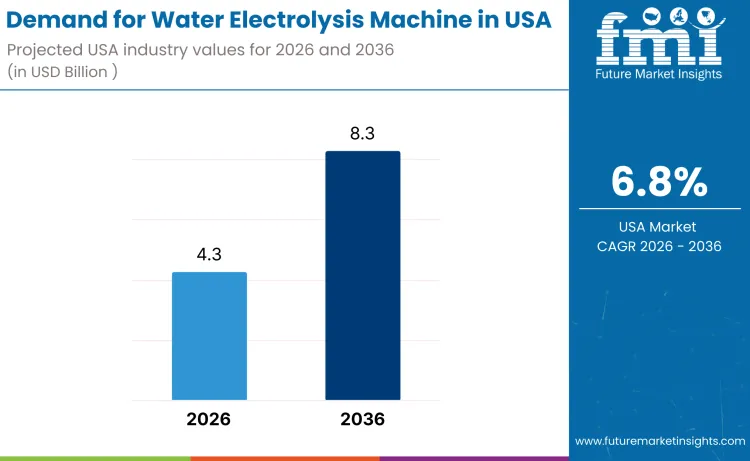
USA Water Electrolysis Machine Key Takeaways
| Metric | Value |
|---|---|
| USA Water Electrolysis Machine Sales Value (2026) | USD 4.3 billion |
| USA Water Electrolysis Machine Forecast Value (2036) | USD 8.3 billion |
| USA Water Electrolysis Machine Forecast CAGR (2026-2036) | 6.8% |
How Are the Segments Classified in the Demand for Water Electrolysis Machines in the USA?
Demand for water electrolysis machines in the USA is shaped by hydrogen decarbonization targets, industrial electrification, and expansion of domestic clean hydrogen infrastructure. Buyers evaluate electrolyzer efficiency, operating flexibility, electricity-source compatibility, and scalability for industrial deployment. Adoption patterns reflect early-stage hydrogen projects, pilot-scale energy storage systems, and increasing integration of electrolysis within chemical production and grid-linked energy systems across U.S. facilities.
Which Electrolyzer Type Accounts for the Largest Share of Demand in the USA?
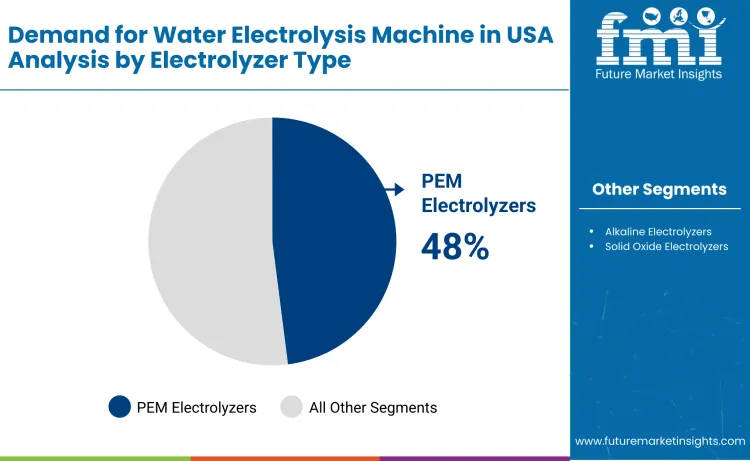
PEM electrolyzers hold 48.0%, making them the leading electrolyzer-type segment in the USA. PEM systems offer fast response times, high current density, and compatibility with variable renewable electricity sources. These characteristics support deployment alongside solar and wind generation for hydrogen production. Alkaline electrolyzers serve cost-sensitive installations with steady operating profiles and established industrial reliability. Solid oxide electrolyzers support high-temperature applications and integration with industrial heat sources. Electrolyzer-type distribution reflects preference for PEM systems due to operational flexibility and alignment with U.S. renewable-energy integration strategies.
Key Points:
- PEM electrolyzers dominate due to rapid response and flexibility.
- Compatibility with renewable electricity supports hydrogen projects.
- Alkaline and solid oxide systems serve specialized operating conditions.
Which Application Accounts for the Largest Share of Demand in the USA?
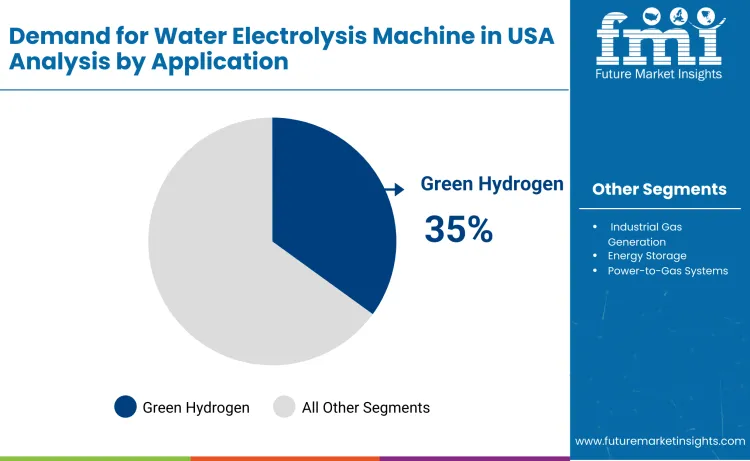
Green hydrogen production holds 35.0%, making it the leading application segment in the USA. Electrolysis systems are deployed to produce low-carbon hydrogen for industrial feedstock substitution and emissions reduction initiatives. Industrial gas generation uses electrolysis for on-site hydrogen supply and process integration. Energy storage applications apply hydrogen as a long-duration storage medium. Power-to-gas systems convert excess electricity into hydrogen for grid balancing. Application distribution reflects priority placed on green hydrogen production within U.S. energy transition frameworks.
Key Points:
- Green hydrogen production leads due to decarbonization targets.
- Industrial gas generation supports on-site hydrogen demand.
- Energy storage and power-to-gas enable grid flexibility.
Which End-User Segment Accounts for the Largest Share of Demand in the USA?
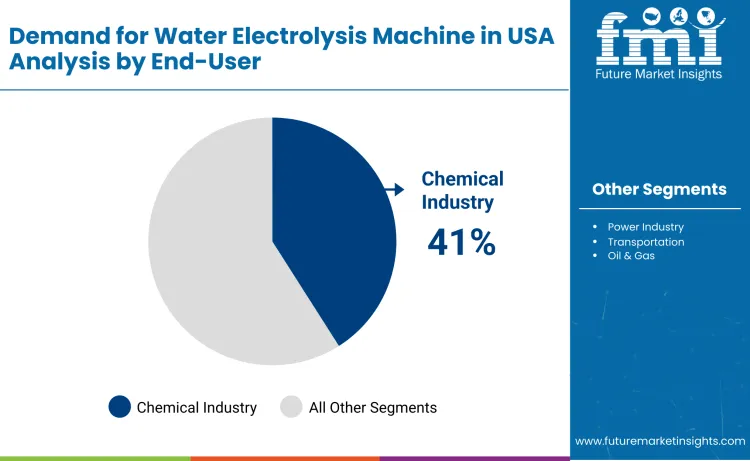
Chemical industry end users hold 41.0%, making them the leading end-user segment in the USA. Chemical manufacturers use hydrogen as a critical input for ammonia, methanol, and refining processes. Electrolysis enables partial replacement of fossil-derived hydrogen within existing plants. Power industry participants deploy electrolysis for grid services and renewable integration. Transportation applications focus on hydrogen fuel supply for heavy-duty and fleet use. Oil and gas entities apply electrolysis selectively for low-carbon initiatives. End-user distribution reflects strong industrial hydrogen demand within U.S. chemical manufacturing.
Key Points:
- Chemical industry drives demand due to hydrogen feedstock needs.
- Electrolysis supports low-carbon process transitions.
- Power and transport sectors represent emerging adoption segments.
What are the Key Dynamics in the Water Electrolysis Machine Industry in USA?
Demand increases as USA expands domestic hydrogen production for energy transition, industrial decarbonization, and grid-scale storage. Water electrolysis machines support green hydrogen generation aligned with federal incentives and state-level clean energy targets. Adoption concentrates in industrial hubs, renewable-rich regions, and pilot hydrogen hubs. Manufacturing localization, infrastructure funding, and corporate decarbonization commitments shape procurement activity across energy, chemicals, and transportation sectors.
How do federal incentives and industrial decarbonization goals drive demand in USA?
Federal tax credits and grant programs under recent energy legislation encourage deployment of electrolyzers for low-carbon hydrogen production. Industrial users in refining, ammonia, and steel evaluate electrolysis to reduce reliance on fossil-based hydrogen. Utility-scale renewable projects pair electrolyzers with excess solar and wind generation to manage curtailment. Hydrogen hubs supported by the Department of Energy stimulate regional demand for large-capacity systems. Defense and mobility pilots explore hydrogen for energy resilience and fuel diversification. Corporate emissions targets push manufacturers toward on-site hydrogen generation. Domestic equipment manufacturing gains support through localization and supply-chain resilience initiatives.
How do capital intensity, infrastructure readiness, and operational constraints affect scalability?
High upfront costs for electrolyzers, balance-of-plant equipment, and power connections influence project economics. Electricity pricing and grid interconnection timelines affect operating viability across regions. Water availability and permitting requirements vary by state, impacting site selection. Technical choices between alkaline, PEM, and solid oxide systems require specialized expertise. Supply-chain constraints for stacks and catalysts affect delivery schedules. Safety standards and hydrogen handling regulations add compliance overhead. Demand growth depends on sustained policy clarity, declining system costs, reliable renewable power access, and buildout of hydrogen transport and offtake infrastructure across USA.
How Is Demand for Water Electrolysis Machine in USA Evolving by Region?
Demand for water electrolysis machines in the USA is rising due to expansion of clean hydrogen initiatives, industrial decarbonization targets, and federal and state-level funding support. West USA leads with a 7.9% CAGR, supported by renewable energy integration, green hydrogen pilots, and technology-focused investment. South USA follows at 7.0%, driven by industrial hydrogen demand, ammonia production, and energy infrastructure projects. Northeast USA records a 6.3% CAGR, shaped by research-driven deployment, grid-support applications, and policy-led decarbonization programs. Midwest USA posts a 5.5% CAGR, reflecting adoption in industrial processing, fertilizer production, and manufacturing decarbonization. Regional variation reflects renewable capacity, industrial base, and policy alignment across the USA.
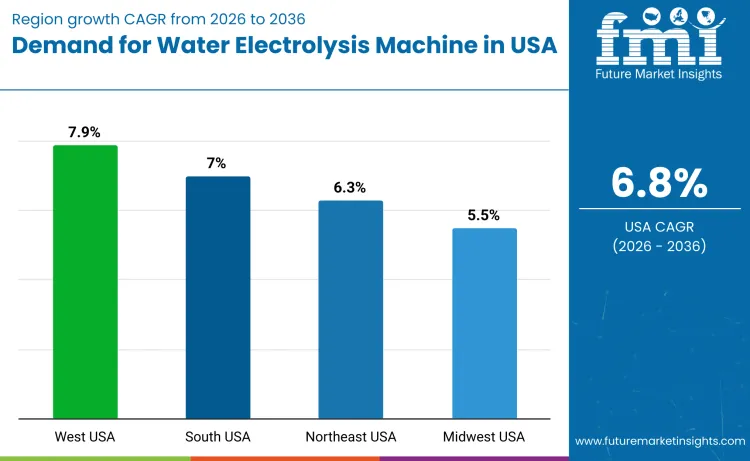
| Region | CAGR (2026-2036) |
|---|---|
| West USA | 7.9% |
| South USA | 7.0% |
| Northeast USA | 6.3% |
| Midwest USA | 5.5% |
How is West USA driving demand for Water Electrolysis Machines?
West USA demand is driven by strong renewable energy penetration, state decarbonization mandates, and early-stage hydrogen ecosystem development. The region’s CAGR of 7.9% reflects deployment of water electrolysis machines in green hydrogen pilot plants, utility-scale renewable projects, and transportation fuel demonstrations. Operators integrate electrolysis systems with solar and wind assets to manage curtailment and improve grid flexibility. Technology developers and research institutions support testing of PEM and alkaline electrolysis platforms at varying scales. Demand favors modular systems with digital controls, high efficiency, and compatibility with intermittent power sources. Growth is project-led, supported by public funding and innovation programs.
- Green hydrogen pilot and demonstration projects
- Integration with solar and wind generation assets
- Adoption of PEM and advanced alkaline systems
- Strong role of public funding and innovation programs
How is South USA driving demand for Water Electrolysis Machines?
South USA demand is shaped by industrial hydrogen consumption, energy infrastructure scale, and chemical production clusters. The region’s CAGR of 7.0% reflects adoption of electrolysis machines for low-carbon hydrogen supply in refining, ammonia production, and chemical processing. Industrial operators evaluate electrolysis to supplement or replace conventional hydrogen sources under decarbonization strategies. Access to industrial sites, ports, and pipeline infrastructure supports project feasibility. Demand emphasizes large-capacity systems, operational reliability, and integration with existing hydrogen handling assets. Growth remains commercially oriented, aligned with industrial decarbonization pathways.
- Industrial hydrogen production for refining and chemicals
- Ammonia and fertilizer-related applications
- Large-capacity electrolysis system deployment
- Integration with existing hydrogen infrastructure
How is Northeast USA driving demand for Water Electrolysis Machines?
Northeast USA demand reflects policy-driven adoption, research activity, and grid-support use cases. The region’s CAGR of 6.3% is supported by deployment of electrolysis machines in pilot-scale hydrogen hubs, research facilities, and utility-supported projects. State decarbonization targets encourage exploration of hydrogen for heating, power generation support, and energy storage. Universities and national laboratories contribute to testing and optimization of electrolysis efficiency and durability. Demand favors smaller-scale, flexible systems suitable for demonstration, backup, and grid-balancing roles. Growth aligns with policy milestones and infrastructure planning timelines.
- Policy-led hydrogen hub and pilot deployments
- Research and testing-focused electrolysis installations
- Grid-balancing and energy storage applications
- Preference for flexible, small-to-mid scale systems
How is Midwest USA driving demand for Water Electrolysis Machines?
Midwest USA demand is driven by industrial manufacturing, fertilizer production, and emerging interest in low-carbon process inputs. The region’s CAGR of 5.5% reflects use of water electrolysis machines in steel processing trials, chemical manufacturing, and sustainable ammonia initiatives. Industrial operators assess electrolysis as part of long-term decarbonization strategies rather than immediate large-scale replacement. Availability of industrial land and workforce supports pilot and early commercial projects. Demand emphasizes system durability, cost efficiency, and compatibility with continuous industrial operations. Growth remains steady and evaluation-driven.
- Industrial manufacturing and process decarbonization
- Fertilizer and sustainable ammonia initiatives
- Pilot-scale and early commercial deployments
- Focus on durability and operating cost control
What is the competitive landscape of demand for water electrolysis machines in the USA?
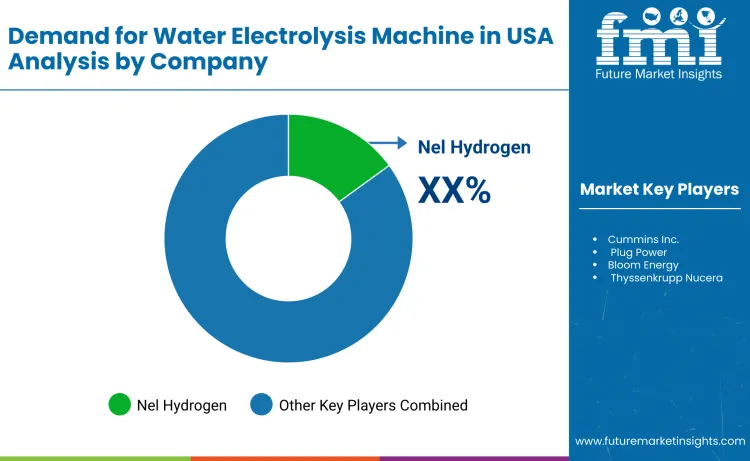
Demand for water electrolysis machines in the USA is driven by expansion of clean hydrogen projects, decarbonization of industrial processes, and federal incentives supporting low-carbon energy infrastructure. Applications include green hydrogen production for ammonia, refining, steelmaking, power-to-gas systems, and energy storage. Buyers evaluate electrolyzer efficiency, stack durability, operating pressure, scalability, and integration with renewable power sources. Procurement teams prioritize suppliers with U.S.-based manufacturing, compliance with domestic content requirements, and proven performance under continuous operation. Trend in the USA market reflects rising deployment of proton exchange membrane and alkaline electrolysis systems aligned with hydrogen hub development and industrial pilot projects.
Nel Hydrogen operates U.S. manufacturing and project deployments supplying alkaline and PEM electrolyzers for industrial and energy customers. Cummins Inc. supports demand through PEM electrolyzer technology integrated with large-scale hydrogen and power solutions. Plug Power maintains strong presence with electrolyzer manufacturing, hydrogen infrastructure projects, and integrated service capability across multiple U.S. states. Bloom Energy participates with solid oxide electrolysis systems used in industrial hydrogen and power applications. Thyssenkrupp Nucera supplies electrolysis technology through U.S. project partnerships serving large industrial decarbonization initiatives. Competitive positioning in the USA reflects technology maturity, domestic production capability, system efficiency, and ability to support large-scale hydrogen deployments.
Key Players in USA Water Electrolysis Machine Demand
- Nel Hydrogen
- Cummins Inc.
- Plug Power
- Bloom Energy
- Thyssenkrupp Nucera
Scope of the Report
| Items | Values |
|---|---|
| Quantitative Units | USD billion |
| Electrolyzer Type | PEM Electrolyzers; Alkaline Electrolyzers; Solid Oxide Electrolyzers |
| Application | Green Hydrogen Production; Industrial Gas Generation; Energy Storage; Power-to-Gas Systems |
| End-User | Chemical Industry; Power Industry; Transportation; Oil & Gas; Others |
| Regions Covered | West USA; South USA; Northeast USA; Midwest USA |
| Key Companies Profiled | Nel Hydrogen; Cummins Inc.; Plug Power; Bloom Energy; Thyssenkrupp Nucera |
| Additional Attributes | Dollar sales by electrolyzer type and application; deployment trends across industrial hydrogen, power, and transport sectors; adoption driven by decarbonization targets and federal incentives; capacity scaling patterns for PEM and alkaline systems; supplier competition shaped by efficiency, lifecycle cost, and domestic manufacturing focus. |
USA Water Electrolysis Machine Demand by Segments
Electrolyzer Type:
- PEM Electrolyzers
- Alkaline Electrolyzers
- Solid Oxide Electrolyzers
Application:
- Green Hydrogen Production
- Industrial Gas Generation
- Energy Storage
- Power-to-Gas Systems
End-User:
- Chemical Industry
- Power Industry
- Transportation
- Oil & Gas
- Others
Region:
- West USA
- South USA
- Northeast USA
- Midwest USA
Frequently Asked Questions
How big is the demand for water electrolysis machines in USA in 2026?
The demand for water electrolysis machines in USA is estimated to be valued at USD 4.3 billion in 2026.
What will be the size of water electrolysis machine demand in USA in 2036?
The demand size for water electrolysis machines in USA is projected to reach USD 8.3 billion by 2036.
How much will the demand for water electrolysis machines in USA grow between 2026 and 2036?
The demand for water electrolysis machines in USA is expected to grow at a 6.8% CAGR between 2026 and 2036.
What are the key electrolyzer types in the water electrolysis machine demand in USA?
The key electrolyzer types in water electrolysis machine demand in USA include PEM electrolyzers, alkaline electrolyzers, and solid oxide electrolyzers.
Which application segment is expected to contribute a significant share in the water electrolysis machine demand in USA in 2026?
In terms of application, green hydrogen production is expected to command 35.0% share in the water electrolysis machine demand in USA in 2026.
Preview the report firsthand - request a free sample
Get SampleGet the brochure for pricing and purchase details.
Get PDFTable of Content
- Executive Summary
- USA Market Outlook
- Demand Side Trends
- Supply Side Trends
- Hydrogen Policy and Incentive Landscape
- Analysis and Recommendations
- Market Overview
- Market Coverage and Taxonomy
- Market Definition Scope and Limitations
- Market Background
- Market Dynamics
- Drivers
- Restraints
- Opportunities
- Trends
- Scenario Forecast
- Demand in Optimistic Scenario
- Demand in Likely Scenario
- Demand in Conservative Scenario
- Opportunity Map Analysis
- Product Life Cycle Analysis
- Supply Chain Analysis
- Investment Feasibility Matrix
- Value Chain Analysis
- PESTLE and Porter Analysis
- Hydrogen and Energy Regulatory Framework
- Regional Parent Market Outlook
- Production and Consumption Statistics
- Import and Export Statistics
- USA Water Electrolysis Machine Demand Analysis 2020 to 2024 and Forecast 2025 to 2035
- Historical Demand Value USD Billion Analysis 2020 to 2024
- Current and Future Demand Value USD Billion Projections 2025 to 2035
- Year on Year Growth Trend Analysis
- Absolute Dollar Opportunity Analysis
- USA Water Electrolysis Machine Pricing Analysis 2020 to 2024 and Forecast 2025 to 2035
- USA Water Electrolysis Machine Demand Analysis 2020 to 2024 and Forecast 2025 to 2035 By Electrolyzer Type
- Introduction and Key Findings
- Historical Demand Value USD Billion Analysis by Electrolyzer Type 2020 to 2024
- Current and Future Demand Value USD Billion Analysis and Forecast by Electrolyzer Type 2025 to 2035
- PEM Electrolyzers
- Alkaline Electrolyzers
- Solid Oxide Electrolyzers
- Year on Year Growth Trend Analysis by Electrolyzer Type
- Absolute Dollar Opportunity Analysis by Electrolyzer Type
- USA Water Electrolysis Machine Demand Analysis 2020 to 2024 and Forecast 2025 to 2035 By Application
- Introduction and Key Findings
- Historical Demand Value USD Billion Analysis by Application 2020 to 2024
- Current and Future Demand Value USD Billion Analysis and Forecast by Application 2025 to 2035
- Green Hydrogen Production
- Industrial Gas Generation
- Energy Storage
- Power to Gas Systems
- Year on Year Growth Trend Analysis by Application
- Absolute Dollar Opportunity Analysis by Application
- USA Water Electrolysis Machine Demand Analysis 2020 to 2024 and Forecast 2025 to 2035 By End User
- Chemical Industry
- Power Industry
- Transportation
- Oil and Gas
- Others
- USA Water Electrolysis Machine Demand Analysis 2020 to 2024 and Forecast 2025 to 2035 By Region
- West USA
- South USA
- Northeast USA
- Midwest USA
- Market Structure Analysis
- Competition Dashboard
- Competition Benchmarking
- Market Share Analysis of Key Players
- By Electrolyzer Type
- By Application
- By End User
- By Region
- Competition Analysis
- Competition Deep Dive
- Nel Hydrogen
- Cummins Inc
- Plug Power
- Bloom Energy
- Thyssenkrupp Nucera
- Assumptions and Acronyms Used
- Research Methodology


