

- Industry Size (2026)
- USD 0.7 Bn
- Forecast (2036)
- USD 1.7 Bn
- CAGR (2026 to 2036)
- 9.4%
Demand for Aquarium Water Treatment in USA 2026 to 2036
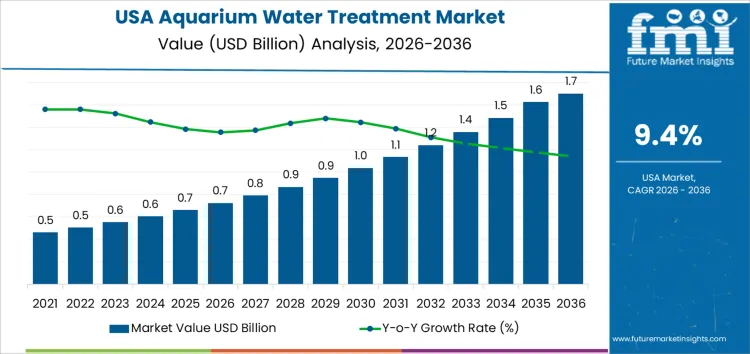
Demand for aquarium water treatment in USA is valued at USD 0.7 billion in 2026 and is forecasted to reach USD 1.7 billion by 2036, reflecting a CAGR of 9.4%. Demand rises due to increasing aquarium ownership, growth of marine and reef systems, and higher awareness of water quality management for aquatic health. Expansion of premium hobby segments and commercial aquarium installations supports sustained consumption.
Quick Stats for Demand for Aquarium Water Treatment in USA
- USA Aquarium Water Treatment Sales Value (2026): USD 0.7 billion
- USA Aquarium Water Treatment Forecast Value (2036): USD 1.7 billion
- USA Aquarium Water Treatment Forecast CAGR (2026 to 2036): 9.4%
- Leading Product Type in USA: Filters
- Key Growth Regions in USA: West USA, South USA, Northeast USA, Midwest USA
- Top Players in USA: Seachem Laboratories, API (Aquarium Pharmaceuticals, Inc.), Fluval, Tetra, Kordon LLC
Filters lead product-type usage because mechanical, biological, and chemical filtration ensures removal of waste, toxins, and harmful microorganisms. Aquarists rely on advanced filtration systems to maintain stable water parameters, reduce maintenance frequency, and support sensitive fish and coral species. Integration of multi-stage filtration and media compatibility strengthens performance across freshwater and saltwater setups.
West USA, South USA, Northeast USA, and Midwest USA represent key growth regions driven by dense hobbyist communities, specialty pet retail networks, and online distribution growth. Seachem Laboratories, API (Aquarium Pharmaceuticals, Inc.), Fluval, Tetra, and Kordon LLC anchor competitive activity through science-based formulations, trusted filtration technologies, and product portfolios aligned with evolving aquarium care standards across the United States.
USA Aquarium Water Treatment Key Takeaways
| Metric | Value |
|---|---|
| USA Aquarium Water Treatment Sales Value (2026) | USD 0.7 billion |
| USA Aquarium Water Treatment Forecast Value (2036) | USD 1.7 billion |
| USA Aquarium Water Treatment Forecast CAGR (2026-2036) | 9.4% |
Why is the Demand for Aquarium Water Treatment in USA Growing?
Demand for aquarium water treatment in the United States grows due to rising participation in home aquariums, aquascaping, and ornamental fish keeping across residential and commercial settings. Hobbyists maintain diverse freshwater and marine species that require stable water chemistry to support health, coloration, and longevity. Municipal tap water quality varies by region, which increases reliance on conditioners that neutralize chlorine, chloramine, and heavy metals. Growth in reef and planted aquariums strengthens use of treatments that regulate pH, hardness, nutrients, and trace elements. Increased awareness of fish disease prevention supports routine use of biological starters and detoxifying agents that stabilize nitrogen cycles.
Public aquariums, educational institutions, and research facilities maintain consistent demand for water treatment solutions to manage large volume systems and sensitive species. Expansion of aquaculture and breeding activities increases use of treatments that improve survival rates during early life stages. Product innovation introduces concentrated, species specific, and bacteria based formulations that improve effectiveness and ease of dosing. E commerce availability broadens access to specialized products for advanced hobbyists. Emphasis on animal welfare and tank sustainability reinforces regular adoption of water treatment solutions across the country.
How Are the Segments Classified in the Demand for Aquarium Water Treatment in USA?
Demand for aquarium water treatment in USA is shaped by aquatic health management standards, water quality stability requirements, and increasing participation in home aquarium ownership. Buyers evaluate treatment effectiveness, dosing simplicity, compatibility with freshwater and marine systems, and safety for aquatic species. Adoption patterns reflect strong residential usage, supported by professional installations in aquariums and pet retailers emphasizing consistent water conditions and livestock well-being.
Which Product Type Forms the Core of Aquarium Water Treatment Demand in USA?
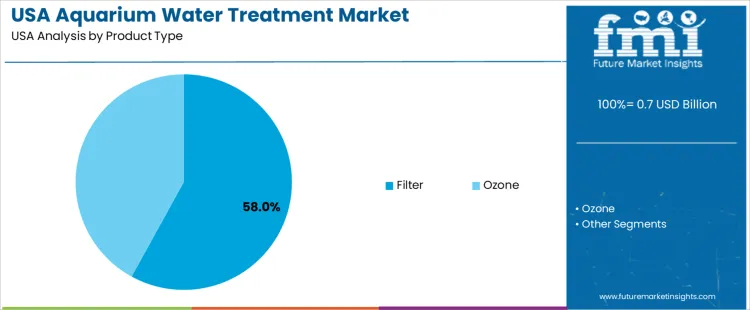
Filters hold 58.0%, forming the core product-type segment in USA demand. Filtration systems enable continuous mechanical, biological, and chemical treatment, supporting removal of debris, waste by-products, and dissolved contaminants. These systems are fundamental to maintaining stable aquarium environments across tank sizes. Ozone systems hold 42.0%, applied in advanced setups for oxidation of organic matter, odor control, and pathogen reduction. Product-type distribution reflects broader reliance on filtration as a baseline treatment solution, with ozone used selectively in higher-capacity or specialist aquariums.
Key Points
- Filters dominate due to continuous water quality management needs.
- Filtration supports mechanical, biological, and chemical balance.
- Ozone systems serve advanced and high-capacity applications.
Which Form Is Most Commonly Used for Aquarium Water Treatment in USA?
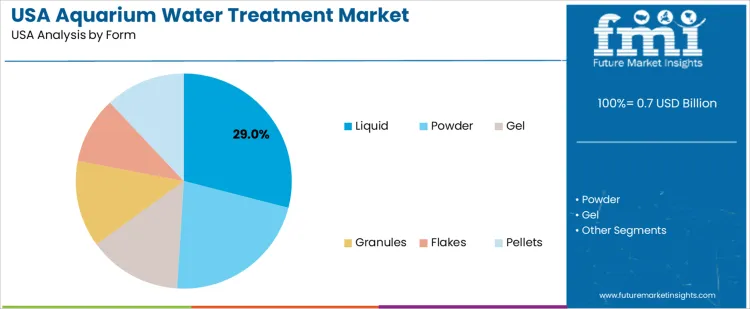
Liquid form holds 29.0%, making it the most commonly used form in USA demand. Liquid treatments allow rapid dispersion, precise dosing, and ease of application during routine maintenance or corrective interventions. Powder form holds 22.0%, supporting longer shelf life and cost-efficient storage. Gel holds 14.0%, enabling controlled release in targeted applications. Granules account for 13.0%, pellets hold 12.0%, and flakes hold 10.0%, mainly supporting filtration media and slow-acting treatment needs. Form distribution reflects preference for convenience and immediate effectiveness.
Key Points
- Liquid treatments lead due to ease of dosing and fast action.
- Powder and solid forms support extended storage and media use.
- Gels and granules enable controlled-release applications.
Which Treatment Purpose Drives the Largest Share of Aquarium Water Treatment Demand in USA?
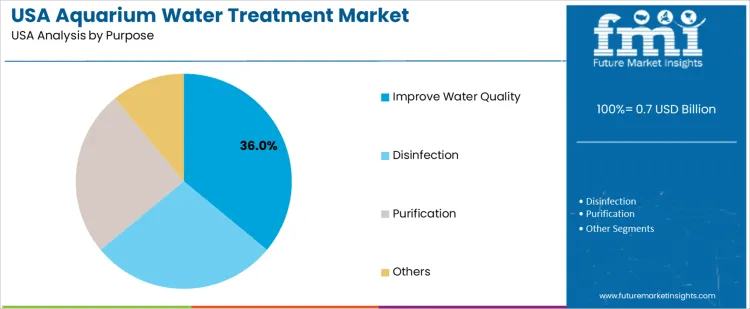
Improving water quality holds 36.0%, driving the largest purpose-based demand in USA. Treatments focus on stabilizing pH, reducing toxins, and maintaining clarity to support long-term aquatic health. Disinfection holds 28.0%, addressing bacterial and parasitic control within preventive care routines. Purification accounts for 25.0%, supporting removal of dissolved impurities and organic waste. Other purposes hold 11.0%, covering conditioning and specialty treatment functions. Purpose distribution reflects emphasis on routine water balance rather than reactive intervention.
Key Points
- Water quality improvement leads due to routine maintenance needs.
- Disinfection supports preventive aquatic health management.
- Purification addresses dissolved and organic contaminants.
What are the Key Dynamics in the Aquarium Water Treatment Industry?
Demand rises as aquarium hobbyists, specialty retailers, and public facilities in USA seek solutions to maintain water quality, biological balance, and species health. Water treatment products support ammonia, nitrite, and nitrate control, pH stabilization, pathogen management, and clarity enhancement across freshwater and marine systems. Adoption aligns with strong consumer spending on pet care, extensive aquarium enthusiast networks, and emphasis on animal welfare. Usage concentrates among households, public aquariums, and research facilities.
How do species care requirements and water quality expectations drive demand in USA?
Aquarium owners in USA prioritize stable water chemistry to support diverse fish, coral, and invertebrate species requiring specific temperature, salinity, and nutrient conditions. Biological filtration enhancers and beneficial bacteria supplements help establish and maintain the nitrogen cycle. Chemical conditioners adjust pH, bind chlorine, and detoxify heavy metals present in tap water. Marine systems use specialized media to control phosphate and organics to protect sensitive corals. Retailers and online channels offer test kits that guide treatment selection. Public aquariums and research facilities employ advanced filtration and UV sterilization to manage high stocking densities and prevent disease outbreaks. Regional hobbyist communities provide education on routine testing and targeted interventions.
How do product complexity, safety considerations, and seasonal management influence demand stability in USA?
Varied species needs require tailored treatment regimens, increasing product diversity and consumer decision complexity. Users must balance treatment efficacy with fish and coral safety, avoiding overuse of chemicals that disrupt biological equilibrium. Energy costs and operating expenses affect adoption of UV sterilizers and advanced media systems. Seasonal temperature fluctuations influence metabolic rates and water chemistry, driving periodic adjustment needs. Consumers exhibit price sensitivity for recurring purchases such as bacterial supplements and chemical additives. Regulatory guidance on safe use of treatment chemicals shapes product labeling and usage recommendations. Demand remains stable due to ongoing maintenance cycles, while expansion depends on continued education and advancement in treatment technologies within USA aquarium care practices.
How Is Demand for Aquarium Water Treatment in the USA Evolving by Region?
Demand for aquarium water treatment in the USA is rising due to ornamental fish ownership, reef aquarium growth, and focus on water quality stability. West USA leads with a 10.8% CAGR, supported by marine aquariums and advanced hobby practices. South USA follows at 9.7%, driven by warm climates and year-round tank operation. Northeast USA records an 8.7% CAGR, shaped by indoor aquariums and seasonal water chemistry control. Midwest USA posts 7.5%, reflecting maintenance-oriented usage and replacement demand. Regional variation reflects climate conditions, aquarium complexity, water source variability, and consumer emphasis on livestock health across residential and specialty aquarium settings in the USA.
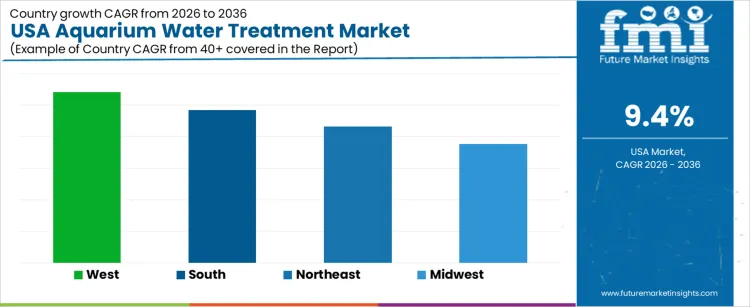
| Region | CAGR (2026 to 2036) |
|---|---|
| West USA | 10.8% |
| South USA | 9.7% |
| Northeast USA | 8.7% |
| Midwest USA | 7.5% |
What factors are accelerating aquarium water treatment adoption in West USA?
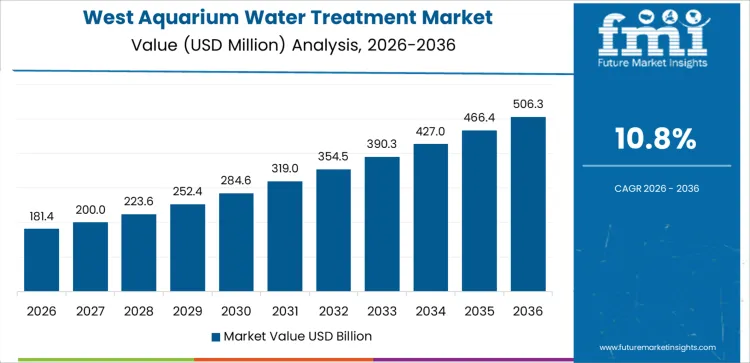
West USA drives demand through high penetration of reef aquariums, specialty aquarium retailers, and advanced hobbyist practices. Region’s CAGR of 10.8% reflects frequent use of conditioners, bacterial supplements, phosphate removers, and trace element solutions. Marine hobbyists manage sensitive coral species requiring precise water chemistry control. Variable municipal water quality increases reliance on dechlorinators and purification additives. Consumers prioritize premium formulations, dosing accuracy, and compatibility with automated dosing systems. Replacement cycles remain active due to continuous dosing requirements. Demand growth aligns with reef aquarium expansion, livestock health awareness, and preference for performance-driven treatment products.
- Strong reef and marine aquarium adoption
- High usage of advanced chemical treatments
- Sensitivity to municipal water variability
- Continuous dosing and replacement demand
Why is South USA showing strong growth in aquarium water treatment usage?
South USA demand is shaped by warm temperatures, high evaporation rates, and continuous aquarium operation. Region’s CAGR of 9.7% reflects extensive use of algae control agents, water clarifiers, and biological stabilizers. Elevated temperatures accelerate biological activity, increasing maintenance frequency. Freshwater and saltwater tanks operate year-round, raising additive consumption. Hobbyists prioritize treatments supporting ammonia control and oxygen balance. Retail availability supports steady access to mid-range and premium products. Demand growth remains climate-driven and maintenance-focused, aligned with prolonged operating conditions and consistent livestock care requirements.
- Warm climate increasing maintenance intensity
- Year-round aquarium operation
- High consumption of stabilizers and clarifiers
- Maintenance-led treatment replacement
How do indoor living patterns influence aquarium water treatment demand in Northeast USA?
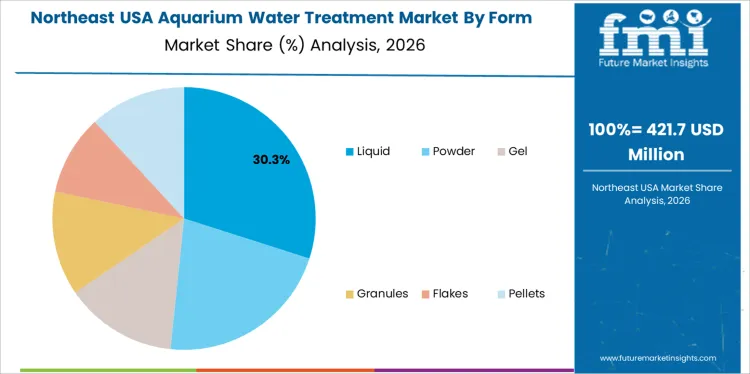
Northeast USA demand reflects indoor aquariums, apartment living, and seasonal changes in tap water composition. Region’s CAGR of 8.7% is supported by regular use of dechlorinators, pH buffers, and bacterial supplements. Hobbyists manage winter-related water chemistry shifts caused by heating systems. Limited tank sizes encourage precise dosing and stable parameters. Energy and water quality awareness influence purchasing decisions. Specialty retailers and online platforms support consistent replenishment. Demand growth remains steady, aligned with maintaining existing aquariums and preventing livestock stress rather than expanding tank capacity.
- Indoor aquarium and apartment prevalence
- Seasonal tap water chemistry variation
- Precision dosing for smaller tanks
- Preventive maintenance treatment demand
What explains maintenance-driven demand patterns in Midwest USA?
Midwest USA demand is anchored in household aquariums, value-conscious consumers, and stable freshwater tank ownership. Region’s CAGR of 7.5% reflects reliance on basic water conditioners, beneficial bacteria, and nitrate control products. Municipal water hardness and mineral content influence treatment selection. Hobbyists prioritize affordability, reliability, and ease of use. Purchases often follow routine water changes and seasonal maintenance schedules. Retail distribution supports predictable sales volumes. Growth remains necessity-driven and maintenance-focused, aligned with sustaining fish health and water clarity rather than adoption of advanced reef systems.
- Freshwater aquarium dominance
- Hardness and mineral management needs
- Value-oriented treatment selection
- Routine water change replacement cycles
What is the competitive landscape of demand for aquarium water treatment in the USA?
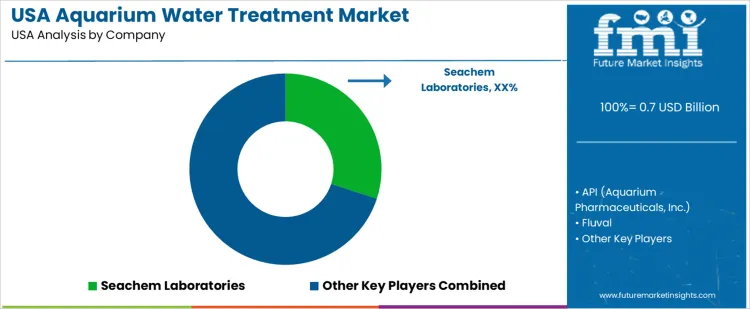
Demand for aquarium water treatment in the USA is driven by hobbyist maintenance needs, growth of home aquaria, and professional care standards in public aquariums and research facilities. Usage spans water conditioners, biological enhancers, pH stabilizers, ammonia and nitrate removers, and microbial additives supporting balanced aquatic environments. Buyers evaluate formulation safety for fish and invertebrates, ease of use, compatibility with freshwater and marine systems, and effectiveness under varied tank bioload conditions. Procurement teams prioritize suppliers with U.S. distribution, clear labeling compliant with EPA and state guidelines, and technical support for best-practice aquarium management. Trend in the USA market reflects interest in natural and non-toxic treatments, growth of reef tanks requiring specialized chemistries, and broader use of microbial solutions that promote water quality stability.
Seachem Laboratories operates a strong presence in the USA through extensive aquarium water treatment portfolios, including conditioners and biological support products tailored to hobbyist and advanced aquaria. API (Aquarium Pharmaceuticals, Inc.) participates with widely distributed water treatment solutions designed for freshwater and marine systems available in mass-market retail. Fluval USA supplies a range of water conditioners and treatment additives supported by brand recognition among hobbyists and specialty retailers. Tetra USA contributes with water care products integrated into broader aquatic accessory offerings supported by educational content for end users. Kordon LLC supports demand with specialized water treatment chemistries used in reef and high-performance marine setups sold through aquarium specialty channels. Competitive positioning in the USA reflects product safety, formulation effectiveness, retail and online availability, and community trust supporting diverse aquatic environments.
Key Players in USA Aquarium Water Treatment Demand
- Seachem Laboratories
- API (Aquarium Pharmaceuticals, Inc.)
- Fluval
- Tetra
- Kordon LLC
Scope of the Report
| Items | Details |
|---|---|
| Quantitative Units | USD billion |
| Product Type | Filter; Ozone |
| Form | Liquid; Powder; Gel; Granules; Flakes; Pellets |
| Purpose | Improve Water Quality; Disinfection; Purification; Others |
| Price Range | Mass Range; Economical Range; Premium Range |
| End User | Private; Commercial; Others |
| Regions Covered | West USA; South USA; Northeast USA; Midwest USA |
| Key Companies Profiled | Seachem Laboratories; API (Aquarium Pharmaceuticals, Inc.); Fluval; Tetra; Kordon LLC |
| Additional Attributes | Demand is supported by rising home aquarium ownership and expansion of commercial aquascaping services. Liquid formulations dominate routine water conditioning, while ozone-based systems remain limited to premium and commercial setups. Product efficacy, ease of dosing, brand trust, and specialty retail presence influence purchasing decisions. |
USA Aquarium Water Treatment Demand by Segments
Product Type:
- Filter
- Ozone
Form:
- Liquid
- Powder
- Gel
- Granules
- Flakes
- Pellets
Purpose:
- Improve Water Quality
- Disinfection
- Purification
- Others
Price Range:
- Mass Range
- Economical Range
- Premium Range
End User:
- Private
- Commercial
- Others
Region:
- West USA
- South USA
- Northeast USA
- Midwest USA
Frequently Asked Questions
How big is the demand for aquarium water treatment in USA in 2026?
The demand for aquarium water treatment in USA is estimated to be valued at USD 0.7 billion in 2026.
What will be the size of aquarium water treatment in USA in 2036?
The market size for the aquarium water treatment in USA is projected to reach USD 1.7 billion by 2036.
How much will be the demand for aquarium water treatment in USA growth between 2026 and 2036?
The demand for aquarium water treatment in USA is expected to grow at a 9.4% CAGR between 2026 and 2036.
What are the key product types in the aquarium water treatment in USA?
The key product types in aquarium water treatment in USA are filter and ozone.
Which form segment is expected to contribute significant share in the aquarium water treatment in USA in 2026?
In terms of form, liquid segment is expected to command 29.0% share in the aquarium water treatment in USA in 2026.
Preview the report firsthand - request a free sample
Get SampleGet the brochure for pricing and purchase details.
Get PDFTable of Content
- Executive Summary
- USA Market Outlook
- Demand-side Trends
- Supply-side Trends
- Technology Roadmap Analysis
- Analysis and Recommendations
- Market Overview
- Market Coverage / Taxonomy
- Market Definition / Scope / Limitations
- Market Background
- Market Dynamics
- Drivers
- Restraints
- Opportunity
- Trends
- Scenario Forecast
- Demand in Optimistic Scenario
- Demand in Likely Scenario
- Demand in Conservative Scenario
- Opportunity Map Analysis
- Product Life Cycle Analysis
- Supply Chain Analysis
- Investment Feasibility Matrix
- Value Chain Analysis
- PESTLE and Porter’s Analysis
- Regulatory Landscape
- Regional Parent Market Outlook
- Production and Consumption Statistics
- Import and Export Statistics
- Market Dynamics
- USA Market Analysis 2021 to 2025 and Forecast, 2026 to 2036
- Historical Market Size Value (USD Million) Analysis, 2021 to 2025
- Current and Future Market Size Value (USD Million) Projections, 2026 to 2036
- Y-o-Y Growth Trend Analysis
- Absolute $ Opportunity Analysis
- USA Market Pricing Analysis 2021 to 2025 and Forecast 2026 to 2036
- USA Market Analysis 2021 to 2025 and Forecast 2026 to 2036, By Product Type
- Introduction / Key Findings
- Historical Market Size Value (USD Million) Analysis By Product Type , 2021 to 2025
- Current and Future Market Size Value (USD Million) Analysis and Forecast By Product Type , 2026 to 2036
- Filter
- Ozone
- Filter
- Y-o-Y Growth Trend Analysis By Product Type , 2021 to 2025
- Absolute $ Opportunity Analysis By Product Type , 2026 to 2036
- USA Market Analysis 2021 to 2025 and Forecast 2026 to 2036, By Form
- Introduction / Key Findings
- Historical Market Size Value (USD Million) Analysis By Form, 2021 to 2025
- Current and Future Market Size Value (USD Million) Analysis and Forecast By Form, 2026 to 2036
- Liquid
- Powder
- Gel
- Granules
- Flakes
- Pellets
- Liquid
- Y-o-Y Growth Trend Analysis By Form, 2021 to 2025
- Absolute $ Opportunity Analysis By Form, 2026 to 2036
- USA Market Analysis 2021 to 2025 and Forecast 2026 to 2036, By Purpose
- Introduction / Key Findings
- Historical Market Size Value (USD Million) Analysis By Purpose, 2021 to 2025
- Current and Future Market Size Value (USD Million) Analysis and Forecast By Purpose, 2026 to 2036
- Improve Water Quality
- Disinfection
- Purification
- Others
- Improve Water Quality
- Y-o-Y Growth Trend Analysis By Purpose, 2021 to 2025
- Absolute $ Opportunity Analysis By Purpose, 2026 to 2036
- USA Market Analysis 2021 to 2025 and Forecast 2026 to 2036, By Price Range
- Introduction / Key Findings
- Historical Market Size Value (USD Million) Analysis By Price Range, 2021 to 2025
- Current and Future Market Size Value (USD Million) Analysis and Forecast By Price Range, 2026 to 2036
- Mass Range
- Economical Range
- Premium Range
- Mass Range
- Y-o-Y Growth Trend Analysis By Price Range, 2021 to 2025
- Absolute $ Opportunity Analysis By Price Range, 2026 to 2036
- USA Market Analysis 2021 to 2025 and Forecast 2026 to 2036, By End User
- Introduction / Key Findings
- Historical Market Size Value (USD Million) Analysis By End User, 2021 to 2025
- Current and Future Market Size Value (USD Million) Analysis and Forecast By End User, 2026 to 2036
- Private
- Commercial
- Others
- Private
- Y-o-Y Growth Trend Analysis By End User, 2021 to 2025
- Absolute $ Opportunity Analysis By End User, 2026 to 2036
- Market Structure Analysis
- Competition Dashboard
- Competition Benchmarking
- Market Share Analysis of Top Players
- By Regional
- By Product Type
- By Form
- By Purpose
- By Price Range
- By End User
- Competition Analysis
- Competition Deep Dive
- Seachem Laboratories
- Overview
- Product Portfolio
- Profitability by Market Segments (Product/Age /Sales Channel/Region)
- Sales Footprint
- Strategy Overview
- Marketing Strategy
- Product Strategy
- Channel Strategy
- API (Aquarium Pharmaceuticals, Inc.)
- Fluval
- Tetra
- Kordon LLC
- Seachem Laboratories
- Competition Deep Dive
- Assumptions & Acronyms Used
- Research Methodology


