

- Industry Size (2025)
- USD 42.4 Mn
- Forecast (2035)
- USD 67.4 Mn
- CAGR (2025 to 2035)
- 4.8%
Demand for Water Dissolvable Labels in USA 2025 to 2035
The demand for water dissolvable labels in the USA is valued at USD 42.4 million in 2025 and is forecasted to reach USD 67.4 million by 2035, recording a CAGR of 4.8%. Growth is linked to expanding hygiene compliance in food service operations, meal prep services, and institutional kitchens. These labels support safer inventory rotation, reduce adhesive residue on reusable containers, and help facilities comply with cleaning and allergen-control protocols. Demand is also shaped by a broader sustainability push replacing permanent synthetic labels with compost-friendly and easily removable alternatives.
Water-based ink labels represent the leading category due to their ability to dissolve fully under standard washing conditions while maintaining short-term visibility for date coding and product identification. Advancements in print durability, rapid ink dissolution, and compatibility with automated label dispensers further strengthen adoption. Customizable formats including colour-coding and barcode variants are regularly used to streamline food safety procedures.
Utilization is concentrated in the West, South, and Northeast regions, where restaurant chains, large catering operations, and commercial hospitality centers are prevalent. Key suppliers include Stranco, Brady Corporation, Avery Products Corporation, GA International, and Maco Tag & Label. Their portfolios focus on fast-dissolving adhesives, food-contact-safe materials, and SKU flexibility aligned with operational requirements in high-turnover kitchen environments.
Quick Stats for USA Water Dissolvable Labels Demand
- USA Water Dissolvable Labels Sales Value (2025): USD 42.4 million
- USA Water Dissolvable Labels Forecast Value (2035): USD 67.4 million
- USA Water Dissolvable Labels Forecast CAGR (2025–2035): 4.8%
- Leading Category in USA Water Dissolvable Labels Demand: Water-based Ink
- Key Growth Regions in USA Water Dissolvable Labels Demand: West USA, South USA, Northeast USA
- Top Players in USA Water Dissolvable Labels Demand: Stranco, Brady Corporation, Avery Products Corporation, GA International, Maco Tag & Label
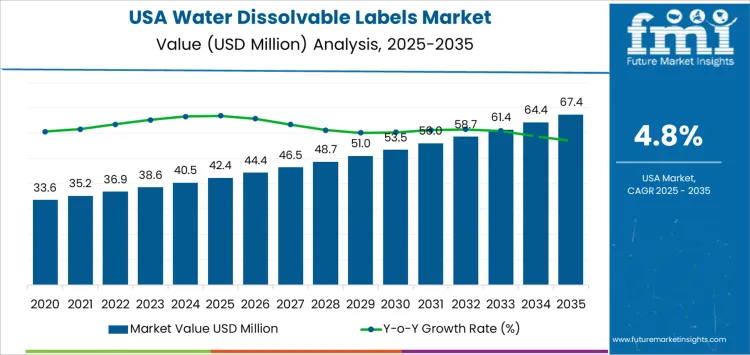
What is the Growth Forecast for Water Dissolvable Labels Industry in USA through 2035?
Peaks in demand for water dissolvable labels in the United States align with stronger adoption in foodservice and hospitality where temporary labeling supports safety compliance. Growth uplifts occur when institutions upgrade to labeling solutions that reduce adhesive residue and improve workflow efficiency during dishwashing. Regulatory attention to date tracking and cross-contamination prevention increases procurement activity, especially in the early forecast periods. E-commerce growth in reusable container systems also contributes to peak intervals.
Troughs tend to reflect budget constraints in foodservice operations or reduced dining activity during slower economic cycles. When organizations limit non-essential spending, upgrades to dissolvable formats may be delayed. Substitution from basic removable labels can create modest downward shifts if cost prioritization outweighs efficiency gains. These troughs remain shallow because dissolvable labels serve a clear compliance-supporting function. The peak-to-trough pattern indicates limited volatility, with peaks intensified by safety standard enforcement and operational modernization while troughs are constrained by consistent regulatory requirements. Long-term direction remains positive as sustainability initiatives favor reusable containers paired with dissolvable identification systems.
USA Water Dissolvable Labels Key Takeaways
| Metric | Value |
|---|---|
| USA Water Dissolvable Labels Sales Value (2025) | USD 42.4 million |
| USA Water Dissolvable Labels Forecast Value (2035) | USD 67.4 million |
| USA Water Dissolvable Labels Forecast CAGR (2025-2035) | 4.8% |
Why is the Demand for Water Dissolvable Labels in the USA Growing?
Demand for water dissolvable labels in the USA is increasing because foodservice operators, hospitality businesses and commercial kitchens need labeling solutions that improve hygiene and reduce sticky residue on reusable containers. Water dissolvable labels break down during standard washing cycles, which saves time in busy kitchens and supports safety standards for date marking and allergen identification. Meal prep services and institutional food operations adopt these labels to maintain clear rotation practices while simplifying cleanup.
Growth in reusable packaging programs and sustainability goals encourages companies to reduce single use plastics and adhesives that leave waste on containers. Craft breweries, specialty coffee shops and home brewers also use water dissolvable labels for batch identification on glass bottles and equipment. Online retail makes small quantity purchasing convenient for households that store leftovers and pantry items in reusable containers. Constraints include higher price compared with conventional labels and performance limitations in high humidity storage before washing. Some businesses delay switching until equipment and workflow reviews confirm compatibility. Awareness among general consumers is still developing, which influences retail adoption outside professional settings.
Which Ink Types and Printing Technologies Lead Demand for Water-Dissolvable Labels in the USA?
Demand for water-dissolvable labels in the United States grows due to increasing hygiene standards, single-use packaging regulations, and the need for temporary labeling in foodservice and home organization. Adoption is concentrated in commercial kitchens, institutional food operations, and consumer packaged goods where residue-free removal is essential. Ease of application, safety compliance, and alignment with biodegradable or compostable packaging materials strengthen usage across retail and industrial environments.
By Ink Type, Water-Based Ink Holds the Largest Share
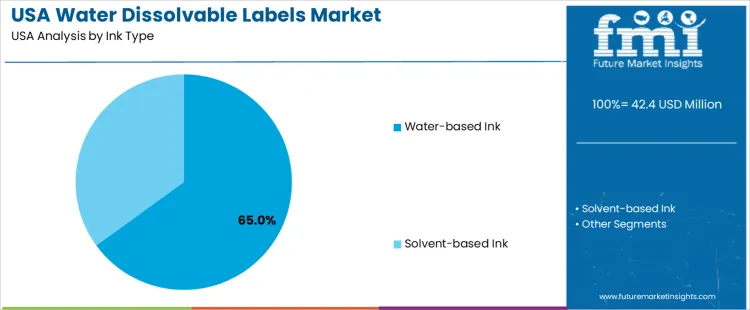
Water-based ink represents 65.0%, driven by strong regulatory support for low-VOC printing consumables and compatibility with dissolvable paper substrates used in food labeling. It offers fast drying, cost efficiency, and reduced allergen concerns for food contact surfaces. Solvent-based ink maintains remaining demand among industrial users requiring higher abrasion resistance, chemical durability, and print retention under cold-chain distribution. Ink selection aligns with sustainability goals, non-toxic formulation requirements, and state-level environmental restrictions affecting foodservice packaging. Product labeling laws also reinforce the need for clean removal without harmful residues or micro-plastic shedding during wash-off. USA procurement trends emphasize lifecycle safety, wastewater compliance, and controlled material tracking.
Key Points:
- Water-based inks dominate for food-safe and eco-preferred labeling
- Solvent-based inks remain relevant where durability outweighs sustainability
- Ink choice supports compliance with wash-off performance standards
By Printing Technology, Direct Thermal Printing Leads Adoption
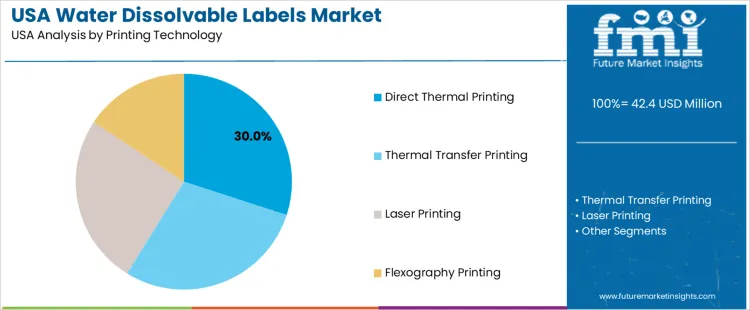
Direct thermal printing holds 30.0%, driven by simplicity, compact hardware options, and low operational cost in food preparation environments. This method supports quick time-stamping and expiration labeling in restaurants, grocery delis, and meal-kit distribution centers. Thermal transfer, laser, and flexography remain important for higher-volume operations requiring long-lasting codes, enhanced barcode clarity, or pre-printed brand messaging. Technology adoption maps to throughput needs, print permanence, and compatibility with dissolvable substrates that degrade under moisture exposure. Digital tracking features, FDA compliance, and efficient label removal during warewashing further support USA demand. Multi-format printers are gaining usage in institutional kitchens that balance durability and sustainability targets.
Key Points:
- Direct thermal supports high-speed, on-demand food labeling workflows
- Other printing modes serve durable or visually refined retail applications
- Technology choice reflects print survival needs vs. dissolvability compliance
What are the Drivers, Restraints, and Key Trends of the Demand for Water Dissolvable Labels in the USA?
Growth of food safety compliance in commercial kitchens, increased home-organization trends and rising demand for clean removal in reusable containers are driving demand.
In the United States, water dissolvable labels gain adoption in restaurants, cafeterias and catering operations that follow date-labeling rules under food safety management programs. Kitchens remove expired labels easily from storage bins without adhesive residue, supporting hygiene and reducing labor time spent on scrubbing. Meal prep and home-organization routines encourage consumers to use dissolvable labels on glass jars and food containers to track leftovers. Reusable packaging pilots in grocery and campus dining facilities require labels that dissolve completely during wash cycles to maintain container quality. Commercial dishwashers in healthcare and institutional foodservice benefit from labels designed to break down quickly under warm water, sustaining ongoing procurement.
Higher pricing than permanent labels, variable durability in wet environments during use and limited awareness outside foodservice restrain demand.
Water dissolvable labels cost more per unit than standard adhesive products, which may reduce adoption in cost-sensitive independent restaurants. Some labels can degrade prematurely if containers are repeatedly exposed to steam or condensation, creating operational inconsistency unless users choose the correct grade. Household buyers may rely on markers or regular stickers due to limited familiarity with dissolvable options. These price and awareness barriers slow faster expansion into general retail categories.
Shift toward biodegradable materials, increased compatibility with industrial dishwashers and rising use in reusable-packaging supply chains define key trends.
Label producers are expanding biodegradable paper and adhesive formulations that align with sustainability goals of national restaurant groups and retailers. Systems designed to dissolve fully in cooler water settings reduce clogging risk and maintenance requirements for high-throughput dishwashers. Grocery and food delivery programs testing reusable containers rely on dissolvable tracking labels that support cleaning workflows and reduce plastic waste. E-commerce platforms promote dissolvable labeling kits for home kitchens and small catering businesses, boosting trial adoption. These developments indicate steady, compliance-driven demand for water dissolvable labels across the United States foodservice and reusable-packaging environment.
Analysis of the Demand for Water-Dissolvable Labels in the USA by Region
Demand for water-dissolvable labels in the United States is increasing as foodservice providers, laboratories, hospitality operators, and consumer-goods suppliers transition to labeling solutions that eliminate adhesive residue and simplify container reuse. Sterile-processing environments, commercial kitchens, and meal-preparation services benefit from labels that disintegrate during normal wash cycles, improving hygiene and labor efficiency. Compliance with safety and allergen-tracking protocols also influences procurement trends. West USA leads demand at 5.5% CAGR, followed by South USA at 4.9%, Northeast USA at 4.4%, and Midwest USA at 3.8%. Growth aligns with sustainability programs, waste-reduction policies, and improvements in water-soluble adhesive formulations.
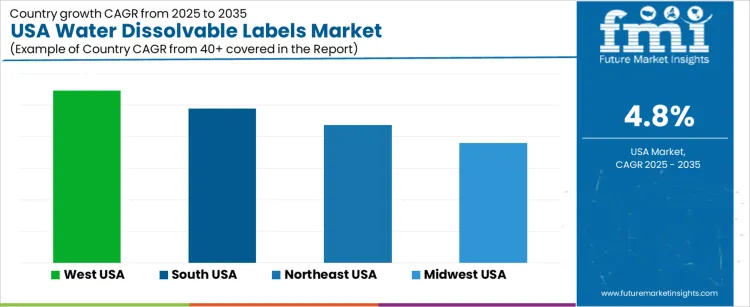
| Region | CAGR (2025-2035) |
|---|---|
| West USA | 5.5% |
| South USA | 4.9% |
| Northeast USA | 4.4% |
| Midwest USA | 3.8% |
How is the West USA advancing demand for water-dissolvable labels?
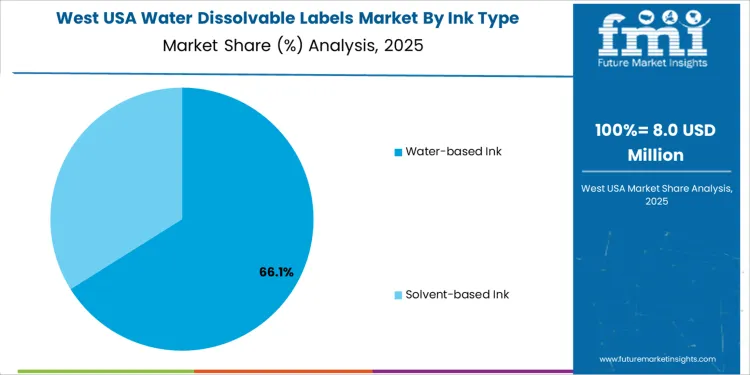
West USA shows 5.5% CAGR, supported by strong adoption in California, Washington, and Oregon where sustainability standards shape restaurant and institutional purchasing. Food delivery services and commissaries use dissolvable date-coding labels to streamline container turnover and avoid adhesive contamination in automated dishwashing lines. Healthcare and biotech labs evaluate water-dissolvable formats for temporary container identification within controlled washing workflows. Retail brands offer dissolvable labels to consumers for reusable pantry storage systems popular in urban households. Distribution partners prioritize stock availability for foodservice chains located near coast-driven tourism centers.
- Circular-economy initiatives influencing product transition
- Foodservice compliance improving label hygiene practices
- Lab-grade usage supporting efficient washing workflows
- Consumer organization trends boosting retail adoption
How is the South USA shaping demand for water-dissolvable labels?
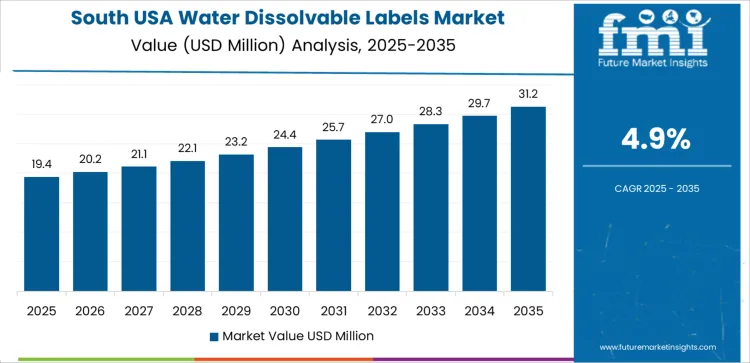
South USA grows at 4.9% CAGR, linked to extensive restaurant franchises and hospitality operations in Texas, Florida, and Georgia. Ventilation-intensive food prep settings require labels that can withstand condensation until washing begins. High turnover in takeaway services increases demand for single-use containers with dissolvable tracking labels that do not obstruct recycling or reuse. Regional procurement emphasizes product safety with FDA-compliant adhesives suitable for direct-contact risks. Local distributors supply bulk rolls to cruise, resort, and institutional markets experiencing seasonal activity.
- Hospitality sector driving continuous procurement
- Recycling-friendly properties improving material recovery
- Food safety compliance influencing adhesive standards
- Large franchise networks ensuring recurring orders
How is the Northeast USA reinforcing adoption?
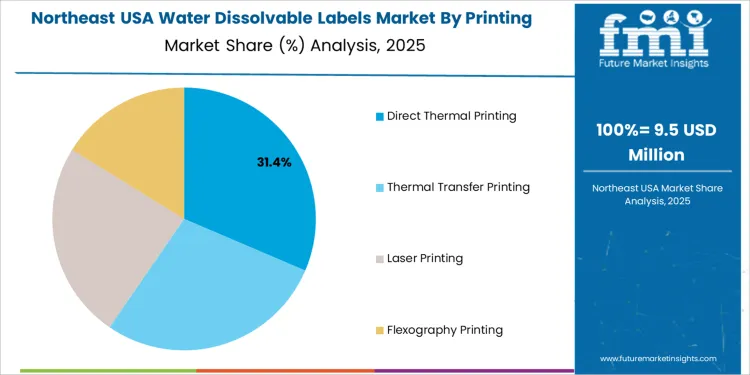
Northeast USA records 4.4% CAGR, influenced by dense foodservice operations in New York, New Jersey, and Massachusetts. Small commercial kitchens with limited storage favor dissolvable labels to simplify inventory handling. Healthcare systems deploy them in sterile processing units where complete label removal is required before autoclave cycles. Universities and research labs adopt water-soluble identification for temporary sample routing. Distributors target locations with sustainability mandates requiring residue-free packaging components.
- High-density foodservice operations driving convenience needs
- Sterile requirements supporting label disintegration
- Research-linked adoption expanding laboratory usage
- Regulatory attention strengthening non-residue products
How is the Midwest USA contributing to steady demand?
Midwest USA posts 3.8% CAGR, supported by food processing, catering operations, and assisted-living facilities across Illinois, Ohio, and Minnesota. Facility managers focus on reducing cleaning labor and eliminating adhesive scraping that damages reusable containers. Adoption is gradual and cost-managed, with emphasis on high-value use cases such as perishable-item rotation and storage-safety labeling. Procurement teams assess label durability under refrigerated conditions before wash cycles to avoid premature breakdown. Distribution emphasizes standardized roll sizes compatible with existing dispensers.
- Labor-saving priorities supporting usage
- Food-processing storage requiring clean label removal
- Value-focused adoption guiding purchasing decisions
- Compatibility with legacy dispensers influences SKUs
What does the competitive landscape for water-dissolvable label demand in the United States look like?
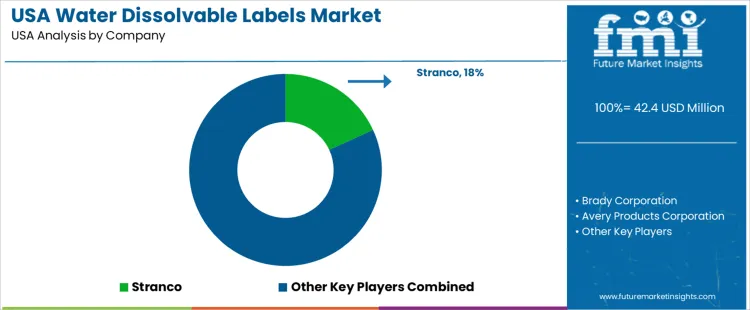
Water-dissolvable labels in the United States support food-rotation systems in commercial kitchens, laboratory sample tracking, and temporary asset marking across industrial and healthcare environments. Users require labels that fully dissolve in standard washing processes to prevent residue on containers and equipment. Procurement decisions focus on adhesive performance during use, complete dissolution under water, and compatibility with food-contact regulations. Demand continues to expand in restaurant chains, hospital nutrition services, and research facilities implementing strict hygiene practices and reducing manual label removal. Stranco holds an estimated 18.2% share. Its dissolvable food-safety labels are adopted in multi-unit foodservice organizations seeking uniform rotation compliance. Brady Corporation supports industrial and laboratory settings with printable materials that dissolve cleanly while maintaining barcode readability during use.
Avery Products Corporation participates in direct-to-consumer and small-business channels with dissolvable label formats compatible with common desktop printers. GA International provides dissolvable lab-identification solutions that meet traceability standards in clinical and research environments. Maco Tag & Label contributes options for hospitality and healthcare customers that require clear identification with dependable wash-off behavior in automated cleaning equipment. Competitive positioning in the United States depends on adhesive safety, print durability prior to dissolution, ease of workflow integration, and rapid fulfillment capability for high-volume users in regulated environments. Growth benefits from sustainability initiatives that reduce disposable containers and support efficient sterilization routines.
Key Players in USA Water Dissolvable Labels Demand
- Stranco
- Brady Corporation
- Avery Products Corporation
- GA International
- Maco Tag & Label
Scope of the Report
| Items | Values |
|---|---|
| Quantitative Units | USD million |
| Ink Type | Water-based Ink, Solvent-based Ink |
| Printing Technology | Direct Thermal Printing, Thermal Transfer Printing, Laser Printing, Flexography Printing |
| Regions Covered | West USA, South USA, Northeast USA, Midwest USA |
| Key Companies Profiled | Stranco, Brady Corporation, Avery Products Corporation, GA International, Maco Tag & Label |
| Additional Attributes | Dollar sales by ink type and printing technology; rising demand across food rotation labeling, laboratory sample tracking, and temporary product identification; focus on fast-dissolving adhesive technologies that reduce sticky residue and wastewater contamination; adoption driven by HACCP compliance in restaurants and hygiene regulations in healthcare; regional growth linked to high-density food service and healthcare clusters; product differentiation in print durability vs. solubility balance and environmental certifications. |
USA Water Dissolvable Labels Demand by Segments
Ink Type:
- Water-based Ink
- Solvent-based Ink
Printing Technology:
- Direct Thermal Printing
- Thermal Transfer Printing
- Laser Printing
- Flexography Printing
Region:
- West USA
- South USA
- Northeast USA
- Midwest USA
Frequently Asked Questions
How big is the demand for water dissolvable labels in USA in 2025?
The demand for water dissolvable labels in USA is estimated to be valued at USD 42.4 million in 2025.
What will be the size of water dissolvable labels in USA in 2035?
The market size for the water dissolvable labels in USA is projected to reach USD 67.4 million by 2035.
How much will be the demand for water dissolvable labels in USA growth between 2025 and 2035?
The demand for water dissolvable labels in USA is expected to grow at a 4.8% CAGR between 2025 and 2035.
What are the key product types in the water dissolvable labels in USA?
The key product types in water dissolvable labels in USA are water-based ink and solvent-based ink.
Which printing technology segment is expected to contribute significant share in the water dissolvable labels in USA in 2025?
In terms of printing technology, direct thermal printing segment is expected to command 30.0% share in the water dissolvable labels in USA in 2025.
Preview the report firsthand - request a free sample
Get SampleGet the brochure for pricing and purchase details.
Get PDFTable of Content
- Executive Summary
- USA Market Outlook
- Demand-side Trends
- Supply-side Trends
- Technology Roadmap Analysis
- Analysis and Recommendations
- Market Overview
- Market Coverage / Taxonomy
- Market Definition / Scope / Limitations
- Market Background
- Market Dynamics
- Drivers
- Restraints
- Opportunity
- Trends
- Scenario Forecast
- Demand in Optimistic Scenario
- Demand in Likely Scenario
- Demand in Conservative Scenario
- Opportunity Map Analysis
- Product Life Cycle Analysis
- Supply Chain Analysis
- Investment Feasibility Matrix
- Value Chain Analysis
- PESTLE and Porter’s Analysis
- Regulatory Landscape
- Regional Parent Market Outlook
- Production and Consumption Statistics
- Import and Export Statistics
- Market Dynamics
- USA Market Analysis 2020 to 2024 and Forecast, 2025 to 2035
- Historical Market Size Value (USD Million) Analysis, 2020 to 2024
- Current and Future Market Size Value (USD Million) Projections, 2025 to 2035
- Y-o-Y Growth Trend Analysis
- Absolute $ Opportunity Analysis
- USA Market Pricing Analysis 2020 to 2024 and Forecast 2025 to 2035
- USA Market Analysis 2020 to 2024 and Forecast 2025 to 2035, By Ink Type
- Introduction / Key Findings
- Historical Market Size Value (USD Million) Analysis By Ink Type , 2020 to 2024
- Current and Future Market Size Value (USD Million) Analysis and Forecast By Ink Type , 2025 to 2035
- Water-based Ink
- Solvent-based Ink
- Y-o-Y Growth Trend Analysis By Ink Type , 2020 to 2024
- Absolute $ Opportunity Analysis By Ink Type , 2025 to 2035
- USA Market Analysis 2020 to 2024 and Forecast 2025 to 2035, By Printing Technology
- Introduction / Key Findings
- Historical Market Size Value (USD Million) Analysis By Printing Technology, 2020 to 2024
- Current and Future Market Size Value (USD Million) Analysis and Forecast By Printing Technology, 2025 to 2035
- Direct Thermal Printing
- Thermal Transfer Printing
- Laser Printing
- Flexography Printing
- Y-o-Y Growth Trend Analysis By Printing Technology, 2020 to 2024
- Absolute $ Opportunity Analysis By Printing Technology, 2025 to 2035
- Market Structure Analysis
- Competition Dashboard
- Competition Benchmarking
- Market Share Analysis of Top Players
- By Regional
- By Ink Type
- By Printing Technology
- Competition Analysis
- Competition Deep Dive
- Stranco
- Overview
- Product Portfolio
- Profitability by Market Segments (Product/Age /Sales Channel/Region)
- Sales Footprint
- Strategy Overview
- Marketing Strategy
- Product Strategy
- Channel Strategy
- Brady Corporation
- Avery Products Corporation
- GA International
- Stranco
- Competition Deep Dive
- Assumptions & Acronyms Used
- Research Methodology


