

- Industry Size (2025)
- USD 6.3 Mn
- Forecast (2035)
- USD 9.1 Mn
- CAGR (2025 to 2035)
- 3.8%
Demand for Water Dissolvable Labels in Japan Forecast and Outlook 2025 to 2035
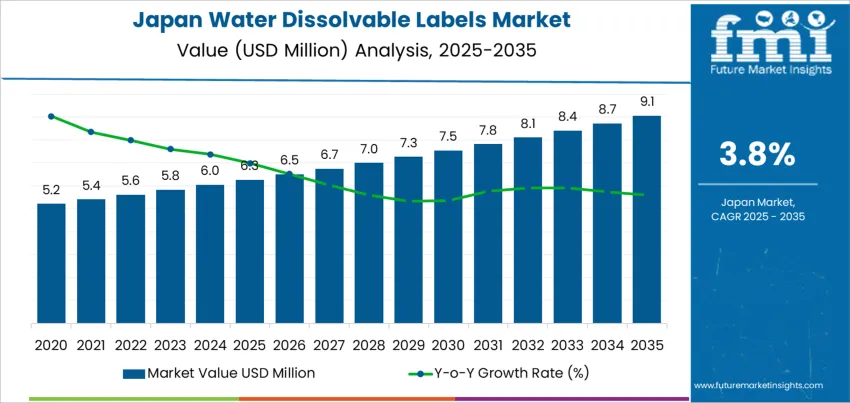
In 2025, demand for water dissolvable labels in Japan is valued at USD 6.3 million and is projected to reach USD 9.1 million by 2035 at a CAGR of 3.8%. The absolute dollar opportunity created during the first half of the forecast from 2025 to 2030 amounts to about USD 1.2 million, with demand rising from USD 6.3 million to nearly USD 7.5 million. This early value creation is concentrated in returnable glass bottles, reusable food containers, and pharmaceutical packaging where residue-free label removal is required for hygiene control. Breweries, dairy processors, and condiment bottlers form the core buyer group in this phase. Performance reliability in hot wash cycles and consistent dissolution timing drive repeat procurement.
From 2030 to 2035, the second phase generates a larger absolute opportunity of roughly USD 1.6 million as demand increases from about USD 7.5 million to USD 9.1 million. This later block accounts for the greater share of total value addition. Growth in this period is supported by wider rollout of closed-loop packaging systems in institutional catering, bottled beverage logistics, and industrial food preparation units. Centralized washing hubs raise consumption of dissolvable labels as container reuse programs scale. Higher-value label grades with improved tensile strength during handling and full solubility during washing contribute to pricing uplift. The later opportunity reflects operational expansion of reuse infrastructure rather than packaging volume growth alone.
Quick Stats of the Demand for Water Dissolvable Labels in Japan
- Demand for Water Dissolvable Labels in Japan Value (2025): USD 6.3 million
- Demand for Water Dissolvable Labels in Japan Forecast Value (2035): USD 9.1 million
- Demand for Water Dissolvable Labels in Japan Forecast CAGR (2025 to 2035): 3.8%
- Demand for Water Dissolvable Labels in Japan Leading Ink Type: Water-based Ink (65%)
- Demand for Water Dissolvable Labels in Japan Key Growth Regions: Kyushu & Okinawa, Kanto, Kansai, Chubu, Tohoku, Rest of Japan
- Demand for Water Dissolvable Labels in Japan Top Players: Stranco, Brady Worldwide Inc., Avantar, Shenzhen Mibils Precision Co., GA International Labtag
What is the Demand Forecast for Water Dissolvable Labels in Japan through 2035?
Water dissolvable labels in Japan serve highly controlled operational environments where residue-free identification is required rather than mass retail decoration, giving the category a process-driven demand profile. Demand increases from USD 6.3 million in 2025 to USD 6.5 million by 2026 and USD 6.7 million by 2027, reaching USD 7.3 million by 2030 and adding USD 1.0 million from the 2025 base. This phase reflects steady adoption across food processing lines, reusable container logistics, hospitals, and laboratory sample tracking where labels must disappear without manual removal. Growth is supported by automation in washing systems, contamination control standards, and efficiency gains in returnable packaging loops rather than branding activity.
From 2030 to 2035, the market expands from USD 7.3 million to USD 9.1 million, adding USD 1.8 million in the second half of the decade. This back weighted acceleration reflects deeper integration into pharmaceutical manufacturing, central sterile services, and closed-loop industrial packaging where traceability and rapid turnaround are critical. Improved adhesive solubility control, higher print durability before wash-off, and compatibility with thermal and laser printing raise value per unit. As Japanese industries intensify circular packaging systems and hygienic automation, water dissolvable labels shift from niche process tools into standardized identification solutions, sustaining long-term demand growth through 2035.
Water Dissolvable Labels Industry in Japan Key Takeaways
| Metric | Value |
|---|---|
| Industry Value (2025) | USD 6.3 million |
| Forecast Value (2035) | USD 9.1 million |
| Forecast CAGR (2025 to 2035) | 3.8% |
What Is Driving the Demand for Water Dissolvable Labels in Japan?
The demand for water dissolvable labels in Japan has grown from practical recycling needs, hygiene standards, and precision packaging requirements in food, beverage, and industrial manufacturing. Traditional adhesive labels often leave residue during container washing and recycling, which complicates reuse and contaminates material recovery streams. Water dissolvable labels offer clean separation during washing, which aligns with Japans strict recycling discipline and container return systems. Early adoption was concentrated in ready to eat foods, beverage bottles, pharmaceutical containers, and industrial chemical packaging where traceability is required during use but complete label removal is needed afterward. Logistics firms and processors value these labels for simplifying reuse cycles without manual peeling or chemical stripping.
Future demand for water dissolvable labels in Japan will be shaped by circular economy goals, automation in recycling facilities, and clean label packaging strategies. As producers face tighter expectations on material recovery and packaging contamination control, labels that fully dissolve during standard wash cycles will gain broader relevance. Growth will expand into cosmetics, refill packaging, and industrial ingredient containers where multi use packaging formats are increasing. Barriers include higher unit cost compared with conventional paper labels, sensitivity to ambient humidity during storage, and limited compatibility with some high speed printing systems. Market expansion will depend on improving material stability during use while preserving complete dissolution during recycling and washing processes.
How Are Ink Type and Printing Technology Structuring the Demand for Water Dissolvable Labels in Japan?
The demand for water dissolvable labels in Japan is structured by ink type and printing technology. Water based inks account for 65% of total demand, followed by solvent based inks used in applications requiring higher adhesion strength and resistance prior to dissolution. By printing technology, direct thermal printing represents 30.0% of total usage, followed by thermal transfer, laser printing, and flexography. Demand behavior is shaped by residue free removal requirements, surface compatibility, print durability prior to washing, and compliance with food and pharmaceutical labeling regulations. These segments reflect how ink solubility characteristics and printing process reliability influence adoption across food processing, healthcare sterilization, logistics tracking, and industrial reuse systems in Japan.
Why Does Water Based Ink Lead the Water Dissolvable Label Ink Demand in Japan?
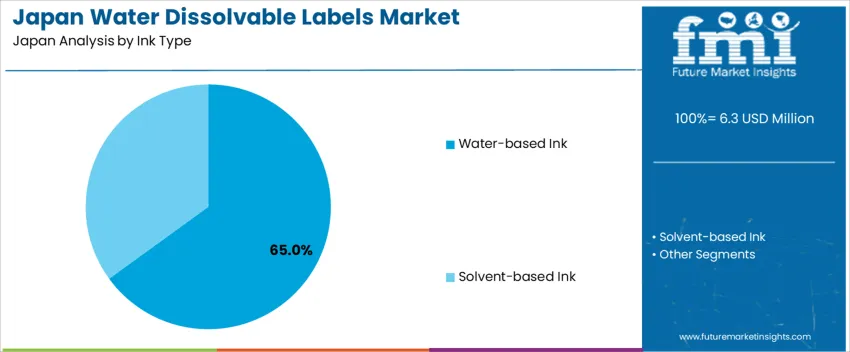
Water based ink accounts for 65% of total water dissolvable label demand in Japan due to its strong alignment with clean removal requirements and environmental compliance standards. These inks dissolve completely during standard washing cycles without leaving adhesive residue or pigment staining on containers and surfaces. Food processors, beverage bottlers, and pharmaceutical manufacturers rely on water based inks to support reusable container programs that require rapid label removal during sanitation operations. The ink chemistry allows stable print output during normal storage while enabling predictable dissolution under controlled water exposure.
Water based inks also provide low odor output and reduced volatile emissions inside production environments. Compatibility with paper and degradable facestock materials further supports compostable and recycling aligned packaging systems. Regulatory acceptance across food contact and packaging safety frameworks reinforces buyer confidence. These removal performance, environmental suitability, and regulatory alignment factors sustain water based ink as the dominant ink type in the Japan water dissolvable label demand structure.
Why Does Direct Thermal Printing Dominate the Water Dissolvable Label Printing Technology Demand in Japan?
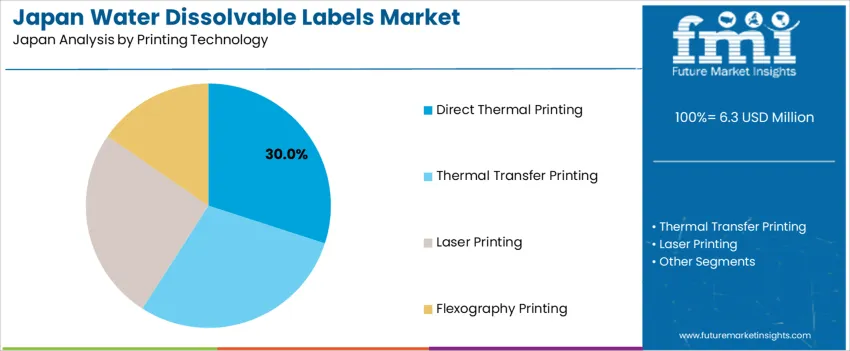
Direct thermal printing accounts for 30.0% of total water dissolvable label demand in Japan due to its simplicity, low operating cost, and compatibility with short duration labeling applications. Direct thermal systems eliminate the need for ribbons, inks, or toners, which reduces consumable complexity in food processing, sterilization tracking, and logistics identification operations. The print reacts directly with heat to create image contrast, which supports fast, on demand label production for batch traceability and container rotation workflows.
Direct thermal printing also supports compact equipment designs suited for space constrained production floors common in Japanese manufacturing facilities. Maintenance requirements remain lower than transfer or laser systems, which improves uptime reliability. These systems are particularly effective where labels are exposed to rapid wash cycles after short use periods. These operational efficiency, equipment simplicity, and cost control advantages position direct thermal printing as the leading technology in the Japan water dissolvable label demand landscape.
Why Are Water Dissolvable Labels in Japan Treated as Process Enablers Rather Than Sustainability Add-Ons?
Demand for water dissolvable labels in Japan is driven by their ability to simplify downstream cleaning and reuse rather than by environmental claims alone. Food processors, beverage bottlers, and pharmaceutical packagers rely on rapid container turnaround with minimal residue risk. Traditional adhesive labels slow washing lines and leave glue contamination on reusable glass and plastic containers. Dissolvable labels eliminate this bottleneck by disappearing completely during washing cycles. In high-throughput Japanese packaging plants where line efficiency and cleanliness are tightly controlled, these labels function as productivity tools embedded in operational discipline.
How Do Refillable Containers, Institutional Catering, and Medical Packaging Shape Demand?
Refillable bottle programs in Japan create steady structural demand for water dissolvable labels. Beverage, dairy, and condiment suppliers use them to enable repeated container reuse without secondary scraping steps. Institutional catering operations rely on dissolvable labels for traceability on temporary food storage containers that move through hot-water sanitation daily. In medical environments, dissolvable labels mark sterilized instruments and drug prep containers where permanent adhesives are not acceptable. These reuse-driven workflows create demand rooted in sanitation cycles rather than in retail branding needs.
What Material Stability and Ink Performance Constraints Limit Wider Adoption?
Water dissolvable labels in Japan face limits related to humidity exposure, condensation, and ink migration under cold storage conditions. Labels may dissolve prematurely in refrigerated or high-humidity environments if not precisely specified. Print clarity and barcode scannability must survive repeated handling before wash-off. Some inks bleed during dissolution and contaminate wash water, which creates filtration burdens. Cost also remains higher than pressure-sensitive paper labels. These technical and economic constraints restrict adoption to controlled-use environments rather than mass consumer goods retail packaging.
How Are Automation, Zero-Residue Standards, and Smart Traceability Reshaping Future Demand?
Future demand in Japan is shifting toward dissolvable labels engineered for robotic handling, laser-readable coding, and zero-residue contamination control. Automated vision systems require consistent label positioning and optical performance until dissolution. Food safety programs increasingly demand full wash-off with no micro-adhesive residue in sanitation baths. Temporary digital tracking codes printed on dissolvable films now support short-life traceability in closed production loops. These trends indicate that water dissolvable labels are evolving into precision-process interfaces rather than disposable identification materials.
What is the Demand for Water Dissolvable Labels in Japan by Region?
| Region | CAGR (%) |
|---|---|
| Kyushu & Okinawa | 4.7% |
| Kanto | 4.3% |
| Kansai | 3.8% |
| Chubu | 3.3% |
| Tohoku | 2.9% |
| Rest of Japan | 2.8% |
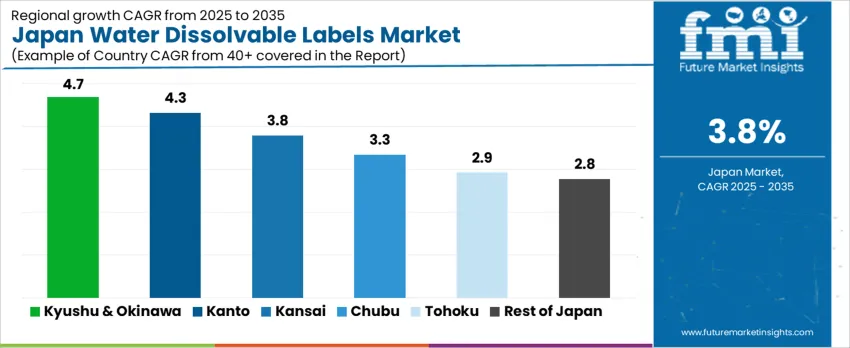
The demand for water dissolvable labels in Japan is increasing steadily across all regions, led by Kyushu & Okinawa at a 4.7% CAGR. Growth in this region is supported by rising adoption in food processing, beverage bottling, and reusable container systems where easy label removal is required. Kanto follows at 4.3%, driven by dense concentration of packaged food manufacturers, pharmaceutical companies, and logistics operators adopting clean labeling solutions. Kansai records 3.8% growth, supported by steady demand from regional manufacturing and industrial packaging users. Chubu at 3.3% reflects moderate uptake linked to automotive fluids, chemicals, and warehouse operations. Tohoku and Rest of Japan, at 2.9% and 2.8%, show slower growth shaped by smaller packaging volumes and lower industrial density.
How Is Packaging Automation Supporting Growth in Kyushu And Okinawa?
Operational adoption in Kyushu and Okinawa is advancing at a CAGR of 4.7% through 2035 for water dissolvable label demand, supported by seafood processing, ready meal production, and pharmaceutical logistics. Processors use dissolvable labels to streamline washing cycles and reduce residue during container reuse. Cold storage facilities rely on these labels for batch traceability without manual removal. Export food handling also supports limited secondary demand. Demand remains hygiene and efficiency driven, with procurement tied to sanitation compliance, container reuse programs, and steady growth in automated food and medical packaging operations.
- Seafood processing supports wash off label usage
- Cold storage traceability drives consistent adoption
- Container reuse programs sustain replacement demand
- Sanitization compliance guides material selection
What Is Sustaining Strong Uptake of Dissolvable Labels in Kanto?
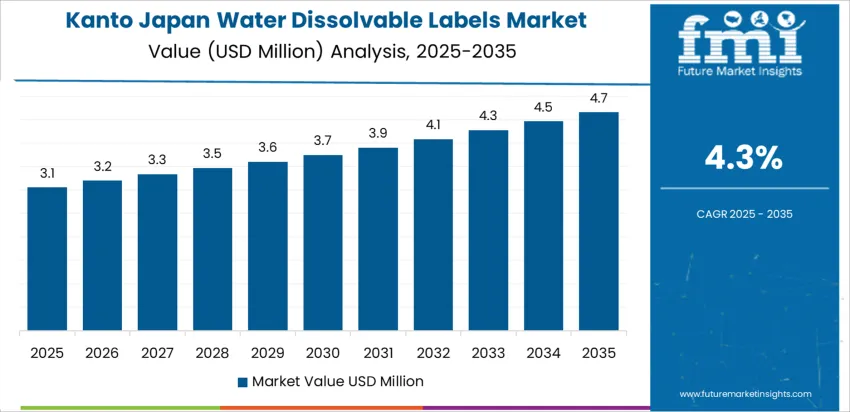
Metropolitan logistics intensity in Kanto supports a CAGR of 4.3% through 2035 for water dissolvable label demand, driven by central distribution centers, pharmaceutical packaging, and hospital supply chains. Automated labeling lines use dissolvable formats to support container recovery and cleaning efficiency. High throughput warehouses favor labels that eliminate manual peeling labor. Medical sample handling also benefits from residue free removal. Demand remains scale driven and operations focused, shaped by continuous material flow across urban logistics networks, regulated healthcare packaging, and high speed fulfillment centers.
- Central distribution hubs drive high volume label usage
- Pharmaceutical packaging supports hygiene driven adoption
- Automated lines reduce reliance on manual removal
- Hospital logistics add steady secondary volume
Why Is Kansai Showing Balanced Growth in Dissolvable Label Applications?
Regional manufacturing diversity in Kansai supports a CAGR of 3.8% through 2035 for water dissolvable label demand, shaped by food processing, beverage bottling, and institutional laundry operations. Crate pooling systems rely on dissolvable labels for repeated circulation. Beverage plants use washable labeling for returnable container management. Hospitals and hospitality laundries also apply the format for item tracking. Demand remains replacement driven and operations led, with steady procurement aligned to pool logistics turnover, container washing frequency, and stable regional manufacturing output.
- Crate pooling systems anchor steady label demand
- Beverage bottling supports returnable container tracking
- Institutional laundries add structured usage volume
- Container washing frequency drives reorder cycles
How Is Industrial Packaging Efficiency Shaping Demand in Chubu?
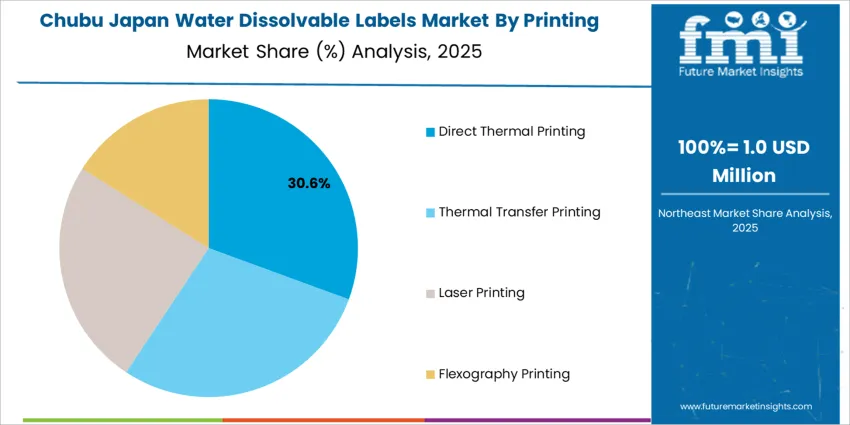
Manufacturing intensity in Chubu supports a CAGR of 3.3% through 2035 for water dissolvable label demand, driven by automotive parts logistics, machinery packaging, and industrial container reuse systems. Component totes and returnable bins use dissolvable labels for batch identification during cleaning cycles. Export oriented packaging lines also apply these labels for residue free removal before reuse. Demand remains contract driven and production aligned, with procurement tied to long term supply agreements, plant throughput stability, and standardized industrial packaging workflows.
- Returnable tote systems support recurring label usage
- Automotive logistics drive batch identification needs
- Export packaging requires clean surface recovery
- Long term contracts stabilize procurement volume
What Is Guiding Moderate Water Dissolvable Label Growth in Tohoku?
Regional food processing and logistics recovery in Tohoku supports a CAGR of 2.9% through 2035 for water dissolvable label demand, shaped by cooperative food production, cold storage expansion, and gradual packaging automation. Fish packing, frozen foods, and agricultural produce rely on washable labels for sanitation control. Limited high speed automation restrains rapid volume growth. Local consumption dominates distribution. Demand remains necessity driven and locally anchored, with steady usage aligned to cooperative logistics, hygiene compliance, and controlled development of regional cold chain infrastructure.
- Cooperative food processors sustain baseline usage
- Frozen and seafood packing supports washable labels
- Limited automation moderates rapid adoption
- Local circulation stabilizes replacement cycles
Why Does the Rest of Japan Show Slower Yet Stable Dissolvable Label Demand?
Municipal logistics and community scale food handling across the rest of Japan sustain a CAGR of 2.8% through 2035 for water dissolvable label demand, supported by school meal programs, hospital kitchens, and small distribution depots. Washable labels are used for tray identification, crate circulation, and short run food logistics. Manual packing remains common. Short logistics routes reduce demand for high performance materials. Demand stays stable and function driven, guided by routine public sector food service, healthcare operations, and essential community level packaging circulation.
- School meal logistics support predictable label usage
- Hospital kitchens rely on washable tracking formats
- Manual packing limits high speed material demand
- Community food circulation stabilizes long term volume
What Is Driving the Demand for Water Dissolvable Labels in Japan and Who Are the Key Suppliers Shaping the Market?
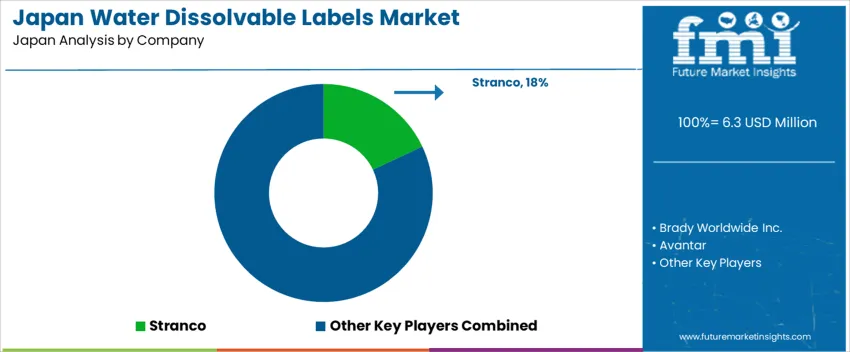
Demand for water dissolvable labels in Japan is increasing as brands and manufacturers respond to rising environmental awareness, stricter waste management expectations, and growing demand for sustainable packaging. Producers of food, beverage, pharmaceuticals, and cosmetics are seeking labeling solutions that dissolve cleanly during washing or disposal, thus reducing plastic and adhesive waste. The shift toward easier recycling, container reuse, and residue free disposal makes water soluble labels attractive in a market where consumer expectations and regulatory pressure support eco friendly practices. Expanding e commerce, ready to eat meal packaging, and single use product segments add volume to labeling needs, reinforcing demand for dissolvable-label systems that simplify packaging lifecycle and waste handling.
Major suppliers influencing the supply of water dissolvable label solutions include Stranco, Brady Worldwide, Avantar, Shenzhen Mibils Precision, and GA International Labtag. These firms offer labels made from water soluble substrates (such as PVA based or other biodegradable materials) that dissolve without residue when exposed to water. Their product ranges cater to food packaging, disposable containers, medical & labware labeling, and other temporary use applications. By supplying both film/adhesive technology and label printing/formatting capabilities, they enable manufacturers to adopt dissolvable labeling without overhauling packaging lines. Their presence supports broader market acceptance of environmentally friendly labeling solutions across Japanese packaging, distribution, and waste management systems.
Key Players in Water Dissolvable Labels Industry in Japan
- Stranco
- Brady Worldwide Inc.
- Avantar
- Shenzhen Mibils Precision Co.
- GA International Labtag
Scope of the Report
| Items | Values |
|---|---|
| Quantitative Units (2025) | USD million |
| Ink Type | Water-based Ink, Solvent-based Ink |
| Printing Technology | Direct Thermal Printing, Thermal Transfer Printing, Laser Printing, Flexography Printing |
| Region | Kyushu & Okinawa, Kanto, Kinki, Chubu, Tohoku, Rest of Japan |
| Key Companies Profiled | Stranco, Brady Worldwide Inc., Avantar, Shenzhen Mibils Precision Co., GA International Labtag |
| Additional Attributes | Dollar by sales by ink type, printing technology, and region. Includes solubility control during wash cycles, print durability before dissolution, compatibility with thermal, laser, and transfer printing systems, rapid dissolution timing, residue-free removal, hygiene compliance for food, pharmaceutical, and labware containers, automation-friendly label formats, traceability support, multi-use packaging loop integration, circular economy alignment, batch identification accuracy, and operational efficiency in closed-loop and institutional cleaning systems. |
Water Dissolvable Labels Industry in Japan Segmentation
Ink Type:
- Water-based Ink
- Solvent-based Ink
Printing Technology:
- Direct Thermal Printing
- Thermal Transfer Printing
- Laser Printing
- Flexography Printing
Region
- Kyushu & Okinawa
- Kanto
- Kansai
- Chubu
- Tohoku
- Rest of Japan
Frequently Asked Questions
How big is the demand for water dissolvable labels in Japan in 2025?
The demand for water dissolvable labels in Japan is estimated to be valued at USD 6.3 million in 2025.
What will be the size of water dissolvable labels in Japan in 2035?
The market size for the water dissolvable labels in Japan is projected to reach USD 9.1 million by 2035.
How much will be the demand for water dissolvable labels in Japan growth between 2025 and 2035?
The demand for water dissolvable labels in Japan is expected to grow at a 3.8% CAGR between 2025 and 2035.
What are the key product types in the water dissolvable labels in Japan?
The key product types in water dissolvable labels in Japan are water-based ink and solvent-based ink.
Which printing technology segment is expected to contribute significant share in the water dissolvable labels in Japan in 2025?
In terms of printing technology, direct thermal printing segment is expected to command 30.0% share in the water dissolvable labels in Japan in 2025.
Preview the report firsthand - request a free sample
Get SampleGet the brochure for pricing and purchase details.
Get PDFTable of Content
- Executive Summary
- Japan Market Outlook
- Demand-side Trends
- Supply-side Trends
- Technology Roadmap Analysis
- Analysis and Recommendations
- Market Overview
- Market Coverage / Taxonomy
- Market Definition / Scope / Limitations
- Market Background
- Market Dynamics
- Drivers
- Restraints
- Opportunity
- Trends
- Scenario Forecast
- Demand in Optimistic Scenario
- Demand in Likely Scenario
- Demand in Conservative Scenario
- Opportunity Map Analysis
- Product Life Cycle Analysis
- Supply Chain Analysis
- Investment Feasibility Matrix
- Value Chain Analysis
- PESTLE and Porter’s Analysis
- Regulatory Landscape
- Regional Parent Market Outlook
- Production and Consumption Statistics
- Import and Export Statistics
- Market Dynamics
- Japan Market Analysis 2020 to 2024 and Forecast, 2025 to 2035
- Historical Market Size Value (USD Million) Analysis, 2020 to 2024
- Current and Future Market Size Value (USD Million) Projections, 2025 to 2035
- Y-o-Y Growth Trend Analysis
- Absolute $ Opportunity Analysis
- Japan Market Pricing Analysis 2020 to 2024 and Forecast 2025 to 2035
- Japan Market Analysis 2020 to 2024 and Forecast 2025 to 2035, By Ink Type
- Introduction / Key Findings
- Historical Market Size Value (USD Million) Analysis By Ink Type , 2020 to 2024
- Current and Future Market Size Value (USD Million) Analysis and Forecast By Ink Type , 2025 to 2035
- Water-based Ink
- Solvent-based Ink
- Y-o-Y Growth Trend Analysis By Ink Type , 2020 to 2024
- Absolute $ Opportunity Analysis By Ink Type , 2025 to 2035
- Japan Market Analysis 2020 to 2024 and Forecast 2025 to 2035, By Printing Technology
- Introduction / Key Findings
- Historical Market Size Value (USD Million) Analysis By Printing Technology, 2020 to 2024
- Current and Future Market Size Value (USD Million) Analysis and Forecast By Printing Technology, 2025 to 2035
- Direct Thermal Printing
- Thermal Transfer Printing
- Laser Printing
- Flexography Printing
- Y-o-Y Growth Trend Analysis By Printing Technology, 2020 to 2024
- Absolute $ Opportunity Analysis By Printing Technology, 2025 to 2035
- Market Structure Analysis
- Competition Dashboard
- Competition Benchmarking
- Market Share Analysis of Top Players
- By Regional
- By Ink Type
- By Printing Technology
- Competition Analysis
- Competition Deep Dive
- Stranco
- Overview
- Product Portfolio
- Profitability by Market Segments (Product/Age /Sales Channel/Region)
- Sales Footprint
- Strategy Overview
- Marketing Strategy
- Product Strategy
- Channel Strategy
- Brady Worldwide Inc.
- Avantar
- Shenzhen Mibils Precision Co.
- GA International Labtag
- Stranco
- Competition Deep Dive
- Assumptions & Acronyms Used
- Research Methodology


