

- Industry Size (2026)
- USD 3.4 Bn
- Forecast (2036)
- USD 6.5 Bn
- CAGR (2026 to 2036)
- 6.7%
Water-Activated Reinforced Transit Tape Market Size, Market Forecast and Outlook By FMI
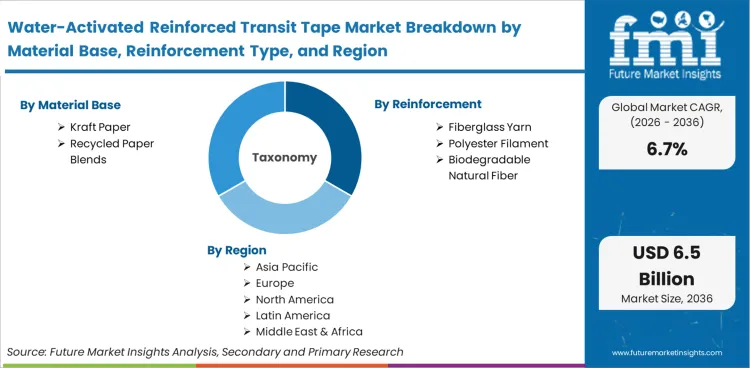
The water‑activated reinforced transit tape market was valued at USD 3.2 billion in 2025 and is projected to reach USD 3.4 billion in 2026, reflecting a 6.7% CAGR. Industry growth is expected to raise total revenues to USD 6.5 billion by 2036, driven primarily by plastic packaging taxes that are accelerating the shift toward repulpable, paper‑based sealing solutions.
The decisive shift in this sector stems from the eradication of biaxially oriented polypropylene (BOPP) plastic tapes in modern logistics networks. High-volume 3PLs and e-commerce giants face immediate material taxes and recycling penalties if they fail to eliminate plastic contaminants from their corrugated waste streams. Delaying this transition exposes facility operators to massive downstream waste fines and disrupts single-stream recycling compliance. Outsiders assume the shift to water-activated tape is purely an eco-friendly marketing play, but practitioners know the true driver is operational velocity.
Summary of Water-Activated Reinforced Transit Tape Market
- Water-Activated Reinforced Transit Tape Market Definition
- Water-Activated Reinforced Transit Tape encompasses structurally bonding paper seals embedded with tension-resistant filaments and starch adhesives, delivering permanent tamper evidence and single-stream recycling compatibility for heavy-duty industrial and e-commerce logistics.
- Demand Drivers in the Market
- The EU Packaging and Packaging Waste Regulation (PPWR) forces high-volume 3PLs to eliminate plastic tapes that contaminate single-stream corrugated recycling processes.
- Rising cross-border theft losses compel automotive parts shippers to deploy tamper-evident transit security seals on high-value components.
- Strict chain-of-custody requirements drive pharmaceutical distributors to adopt pilfer-proof packaging to maintain medical supply tender eligibility.
- Key Segments Analyzed in the FMI Report
- Kraft Paper: 65.5% share in 2026, dominating due to its superior tensile strength and immediate compatibility with established repulping infrastructure.
- Fiberglass Yarn: 72.0% share in 2026, driven by its unparalleled burst resistance required for heavy-duty automotive and industrial carton transit.
- Heavy-Duty Carton Sealing: 45.0% share in 2026, anchoring the market as heavy payloads physically break standard pressure-sensitive plastic seals during handling.
- Third-Party Logistics (3PL): 38.0% share in 2026, driven by massive centralized volume requirements and aggressive corporate mandates to eliminate non-recyclable consumables.
- China: 9.5% CAGR, propelled by strict green express packaging mandates penalizing non-degradable materials.
- Analyst Opinion at FMI
- Ismail Sutaria, Principal Consultant for Packaging, opines, "The true bottleneck in fulfillment operations is not the sorting machinery, but the manual rework required when pressure-sensitive plastic tapes fail on dusty corrugated cartons. Facilities attempting to scale throughput with legacy BOPP tapes face unavoidable carton pop-opens on automated conveyors. Logistics directors who continue delaying the switch to structurally bonding water-activated tapes will find themselves unable to meet the peak-season volume demands of modern e-commerce."
- Strategic Implications / Executive Takeaways
- Automated packaging machinery integrators must standardize water-activated tape heads on all new inline carton sealers before 2027 to capture the next wave of facility upgrades.
- High-volume 3PL operators should aggressively convert their remaining legacy taping lines to secure compliance with impending plastic waste taxation.
- Tape manufacturers must heavily invest in high-speed fiberglass co-extrusion capabilities or face immediate exclusion from Tier-1 e-commerce vendor lists.
- Methodology
- Primary Research: FMI conducted detailed technical interviews with packaging engineers, facility safety officers, and corporate sustainability directors across 40 countries to validate material transition timelines.
- Desk Research: Analysts aggregated public standards documentation from ISTA, ASTM compliance registries, corporate sustainability reports, and national packaging tax programs.
- Market-Sizing and Forecasting: The model applies a bottom-up methodology starting with global installed base metrics for fulfillment centers and projecting the conversion rate to paper-based standards.
- Data Validation and Update Cycle: Segment forecasts undergo rigorous cross-validation against quarterly production volumes of specialized natural starch adhesives.
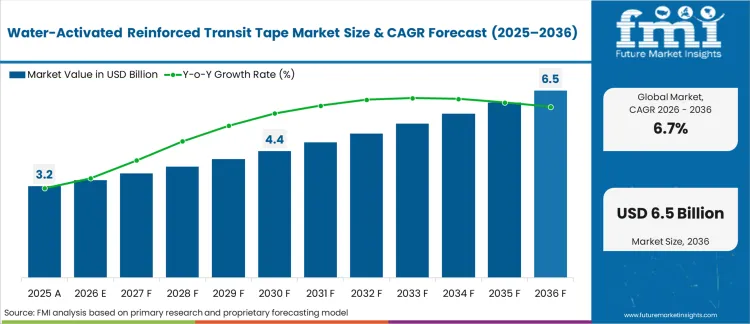
A single strip of reinforced tape structurally bonds to the carton, eliminating the inefficient six-strip plastic tape method and increasing throughput without requiring automated carton sealers to run slower. Growth becomes self-sustaining when automated packaging machinery integrators standardize water-activated tape heads as the default option on all new inline carton sealers by 2027. Procurement teams must abandon plastic tape infrastructure entirely before this integration window closes.
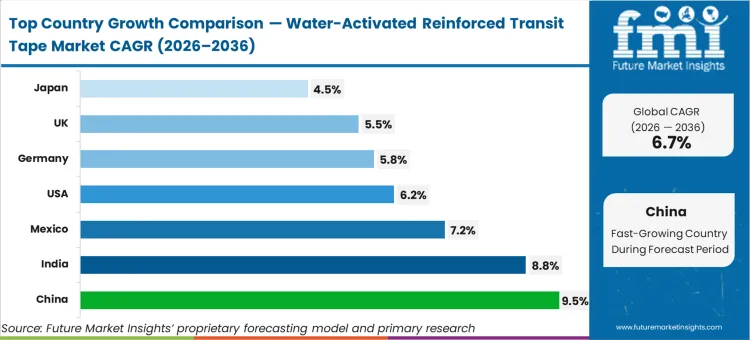
China advances at a 9.5% CAGR, driven by the State Post Bureau's strict green express packaging mandates. India records an 8.8% pace as organized retail consolidates its fulfillment logistics. Mexico tracks at 7.2% due to expanding cross-border automotive parts shipping networks. The United States follows at 6.2%, supported by domestic e-commerce infrastructure upgrades. Germany reaches a 5.8% rate, anchored by rigid extended producer responsibility taxes. The United Kingdom expands at 5.5% while Japan grows at 4.5%. This geographic spread exists because regions with aggressive plastic-reduction policies and booming export-oriented manufacturing enforce compliance much earlier than mature, slower-moving consumer markets.
Water-Activated Reinforced Transit Tape Market Definition
Water-Activated Reinforced Transit Tape represents high-strength carton sealing materials constructed from paper backings embedded with reinforcing filaments and coated with starch-based adhesives that require water for activation. Unlike pressure-sensitive plastic tapes that merely grip the surface, these products permanently bond with corrugated fibers to create a tamper-evident, structural seal.
Water-Activated Reinforced Transit Tape Market Inclusions
The market scope includes fiberglass-reinforced kraft tapes, polyester-reinforced recycled paper tapes, biodegradable natural fiber transit tapes, and specialized high-adhesion security variants requiring water activation. Standard rolls for manual desktop dispensers and jumbo continuous rolls designed specifically for automated carton sealing machinery fall completely within the boundaries.
Water-Activated Reinforced Transit Tape Market Exclusions
Standard pressure-sensitive plastic packaging tapes (BOPP, PVC), unreinforced plain gummed tapes utilized for lightweight craft applications, and hot melt adhesive formulations are explicitly excluded. Desktop dispensing machines and automated taping equipment hardware are omitted, as the valuation focuses solely on the consumable tape rolls.
Water-Activated Reinforced Transit Tape Market Research Methodology
- Primary Research: FMI analysts engaged with fulfillment center automation directors, sustainable packaging procurement leads, and 3PL operations managers to map exact tape replacement schedules.
- Desk Research: The data collection phase aggregated compliance roadmaps from the Fiber Box Association, EU Packaging and Packaging Waste Regulation dockets, and major courier vendor guidelines.
- Market-Sizing and Forecasting: The baseline value derives from a bottom-up aggregation of jumbo roll shipments to Tier-1 logistics providers, applying region-specific plastic phase-out curves to project future adoption velocity.
- Data Validation and Update Cycle: Projections undergo cross-validation against quarterly starch adhesive consumption metrics and publicly reported sustainability capital expenditure guidance from top e-commerce conglomerates.
Segmental Analysis
Water-Activated Reinforced Transit Tape Market Analysis by Material Base
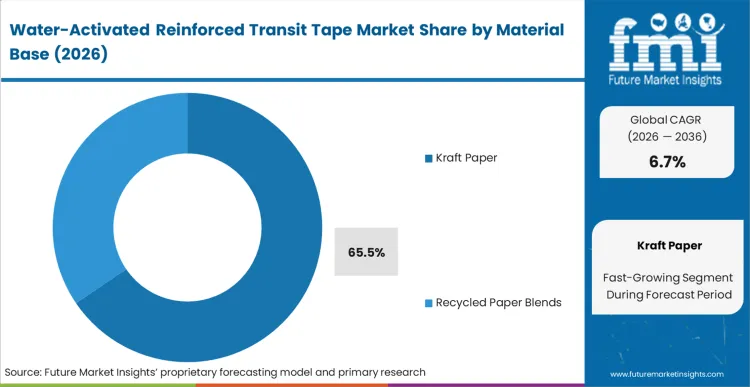
The displacement of unrecyclable plastic backings completely accelerates as facility waste managers refuse to manually strip tape off inbound boxes. Kraft Paper dominates with a 65.5% share in 2026, as its natural cellulose structure directly fuses with corrugated board when activated, ensuring zero disruption to existing recycling streams. Corporate sustainability directors specifying these backings completely eliminate the downstream EPR taxes previously associated with mixed-material packaging waste. According to FMI's estimates, switching to virgin or high-grade kraft enables seamless integration with standard repulpable paper packaging guidelines. Operations managers who fail to secure reliable supplies of high-grade kraft variants face immediate sorting penalties at municipal recycling centers.
- Sorting Compatibility: Single-stream recycling integration prevents massive inbound waste handling fees. Fulfillment directors securing verified repulpable formats completely bypass downstream plastic taxation.
- Surface Bonding: Deep fiber penetration creates a structural lock that pressure-sensitive adhesives physically cannot match. Logistics operators utilizing this bond eliminate in-transit carton failures.
- Tensile Optimization: High-grade unbleached kraft resists automated dispenser tearing better than cheaper recycled blends. Machine operators maintaining specific tension thresholds maximize daily carton throughput.
Water-Activated Reinforced Transit Tape Market Analysis by Reinforcement Type
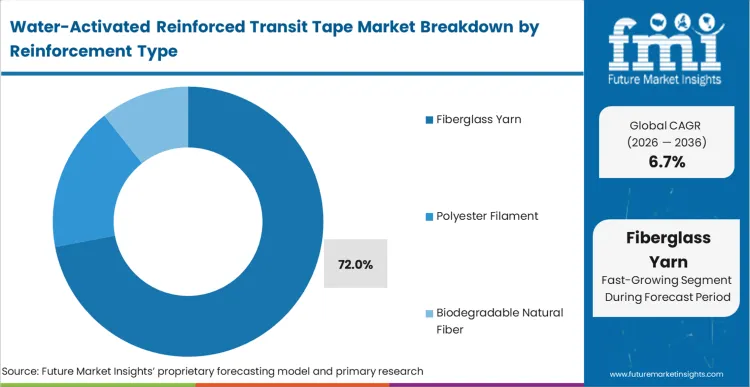
FMI analysts opine that standardizing on heavy-duty fiberglass matrices permanently resolves the chronic damage claims associated with weak packaging. Procurement leads deploying inferior polyester substitutes inevitably suffer catastrophic seal failures during peak shipping seasons. Heavy payloads actively destroy unreinforced seals during the rough handling of modern parcel networks, creating an absolute requirement for structural filaments. Fiberglass Yarn commands a dominant 72.0% share in 2026, providing the extreme cross-directional burst strength required for transporting dense industrial components. Packaging engineers integrating these specific industrial fiberglass yarns ensure that multi-kilogram boxes survive violent drops without the tape splitting along the center seam.
- Burst Prevention: Multidirectional filament weaving stops carton split-outs during high-velocity automated sorting. E-commerce logistics managers implementing these weaves drastically reduce damaged goods claims.
- Tamper Evidence: Intact fiberglass strands visually confirm that a seal has not been compromised or cut. Pharmaceutical shippers relying on this physical barrier guarantee strict chain-of-custody compliance.
- Dispenser Tracking: Precision-embedded yarns prevent the tape from snapping inside high-speed robotic heads. Plant engineers specifying these exact tolerances maintain maximum uptime on automated lines.
Water-Activated Reinforced Transit Tape Market Analysis by Application
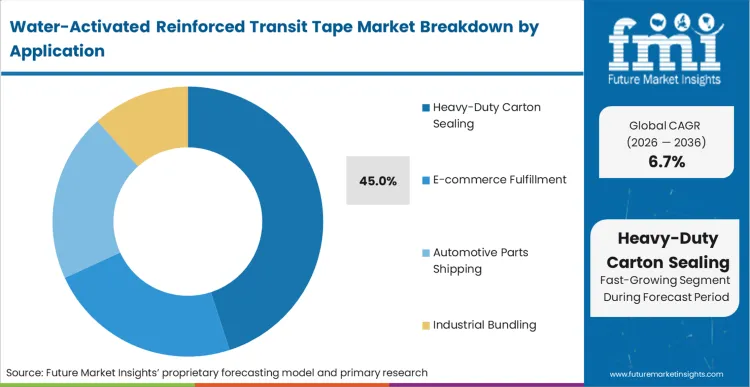
The chronic operational failure of standard hot melt tapes on dusty surfaces positions specific robust applications at the forefront of adoption. Heavy-Duty Carton Sealing captures a 45.0% segment share in 2026, as logistics operators process increasingly dense shipments that exceed standard weight capacities. Shippers transporting dense mechanical parts mandate these reinforced bonds to prevent heavy contents from literally punching through the bottom of heavy-duty corrugated cartons during transit. Based on FMI's assessment, replacing the common "six-strip" plastic taping method with a single structural H-seal of reinforced tape massively accelerates the pack-out process. Warehouse supervisors who ignore this capability limit their outbound volume strictly by manual taping speeds.
- Weight Tolerance: Structural bonding supports dense payloads that traditionally require expensive strapping. Parts distributors utilizing this application completely eliminate secondary plastic banding.
- Dust Mitigation: Starch-based adhesives penetrate through surface dust to bond directly with raw cellulose. Shipping managers leveraging this chemical interaction solve the most common cause of winter adhesive failure.
- Throughput Velocity: Single-strip sealing protocols slash the seconds required to finalize each outbound parcel. Fulfillment directors optimizing this sequence multiply their peak daily output capacity.
Water-Activated Reinforced Transit Tape Market Analysis by End Use
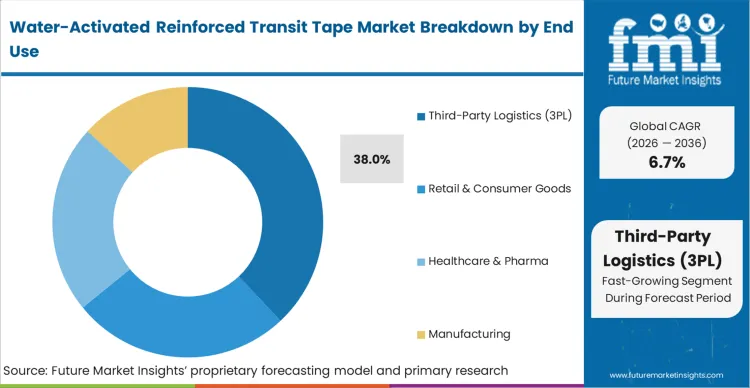
Global environmental compliance directly dictates the procurement strategies of massive third-party logistics organizations. In FMI's view, standardizing consumables across international networks forces 3PLs to adopt tape solutions that perform reliably in drastically different climate zones. Third-Party Logistics (3PL) accounts for a leading 38.0% share in 2026, as these operators execute massive corporate sustainability mandates across hundreds of distributed fulfillment centers. Incorporating fully repulpable sealing solutions allows these operators to market zero-waste-to-landfill third-party fulfillment services to eco-conscious retail brands. Facility operators failing to unify their tape procurement around temperature-stable water-activated adhesives face uncontrollable variations in outbound quality.
- Network Standardization: Uniform starch adhesives perform consistently regardless of warehouse humidity. Supply chain directors deploying this standard eradicate seasonal tape failure spikes.
- Client Acquisition: Verifiable plastic-free packaging attracts lucrative contracts from premium sustainable brands. Logistics providers offering this native capability win exclusive fulfillment tenders.
- Labor Efficiency: Automated dispensing machines preset exact tape lengths, eliminating operator guesswork. Floor supervisors implementing this control radically decrease raw material waste per shift.
Water-Activated Reinforced Transit Tape Market Drivers, Restraints, and Opportunities
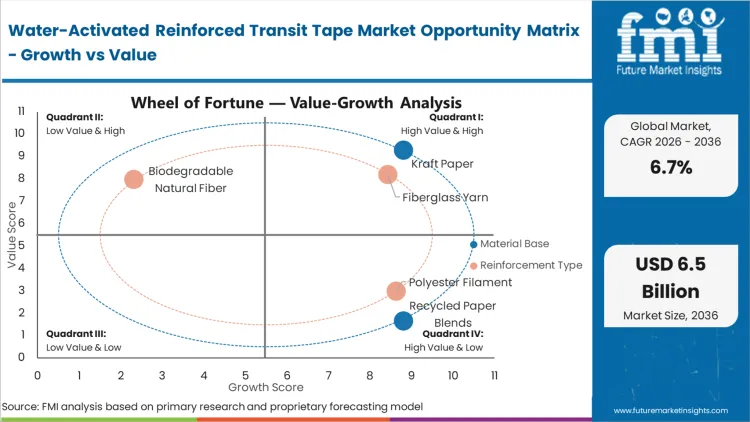
The European Union Packaging and Packaging Waste Regulation (PPWR) forces high-volume fulfillment centers to strip all non-repulpable plastics from their outbound carton streams. Global 3PL operators face a strict binary choice between absorbing massive extended producer responsibility taxes or overhauling their sealing infrastructure. Transitioning to reinforced water-activated tape eliminates plastic contamination entirely, ensuring seamless downstream recycling and immediate regulatory compliance. Facilities that fail to modernize their core packaging layers face severe financial penalties and risk losing major contracts from environmentally conscious retail giants.
The intricate tension control required to manufacture fiberglass-embedded tape creates significant production bottlenecks for smaller regional suppliers. Ensuring the fiberglass yarns do not snap during the co-extrusion process demands specialized web-handling expertise that many legacy tape converters lack. To mitigate this technical gap, major packaging distributors increasingly rely on exclusive toll-manufacturing agreements with advanced tier-1 material science companies to guarantee consistent roll quality.
Opportunities in the Water-Activated Reinforced Transit Tape Market
- Dynamic Automation Integration: Next-generation inline carton sealers utilize optical sensors to dynamically measure boxes and cut precise lengths of reinforced tape on the fly. Machinery integrators developing these inline scanning systems capture premium margins by offering entirely touchless taping lines.
- Cold Chain Adhesives: Specialized starch formulations are emerging that activate and bond perfectly in sub-zero refrigerated environments. Chemical engineers patenting these specific formulas secure exclusive vendor status within the rapidly expanding pharmaceutical distribution sector.
- Custom Security Printing: High-speed digital printing allows manufacturers to embed unique QR codes directly onto the paper backing before the adhesive coating phase. Brand owners deploying these custom rolls establish immutable anti-counterfeit tracking without adding a secondary labeling step.
Regional Analysis
Based on the regional analysis, the Water-Activated Reinforced Transit Tape market is segmented into North America, Latin America, Europe, Asia-Pacific, Oceania and Middle East & Africa across 40 plus countries.
.webp "Top Country Growth Comparison Water Activated Reinforced Transit Tape Market Cagr (2026 2036)")
| Country | CAGR (2026 to 2036) |
|---|---|
| China | 9.5% |
| India | 8.8% |
| Mexico | 7.2% |
| United States | 6.2% |
| Germany | 5.8% |
| United Kingdom | 5.5% |
| Japan | 4.5% |
Source: Future Market Insights (FMI) analysis, based on proprietary forecasting model and primary research
Asia-Pacific Water-Activated Reinforced Transit Tape Market Analysis
Aggressive green infrastructure policies and the rapid consolidation of disorganized retail logistics into massive hubs dictate the fast transition away from plastic consumables across the region. FMI analysts opine that this top-down regulatory environment and the pressing need for scalable, high-throughput packaging solutions entirely eliminate the slow phase-ins traditionally seen in Western markets. By building automated repulpable sealing capabilities directly into greenfield sites, regional 3PLs establish highly efficient cross-border ecommerce logistics hubs capable of bypassing international plastic tariffs and combating high in-transit damage rates.
- China: Boasting a 9.5% CAGR value through to 2036, China's market advances rapidly as the State Post Bureau's "Green Express" initiative heavily penalizes fulfillment centers utilizing non-degradable plastic shipping materials. Extensive auditing by provincial environmental regulators confirms the rapid phase-out of legacy BOPP rolls, forcing regional e-commerce giants to transition entirely to reinforced paper tapes for heavy parcel networks. Supply chain directors who ignore these state mandates face immediate operational suspensions and severe financial levies on their outbound freight.
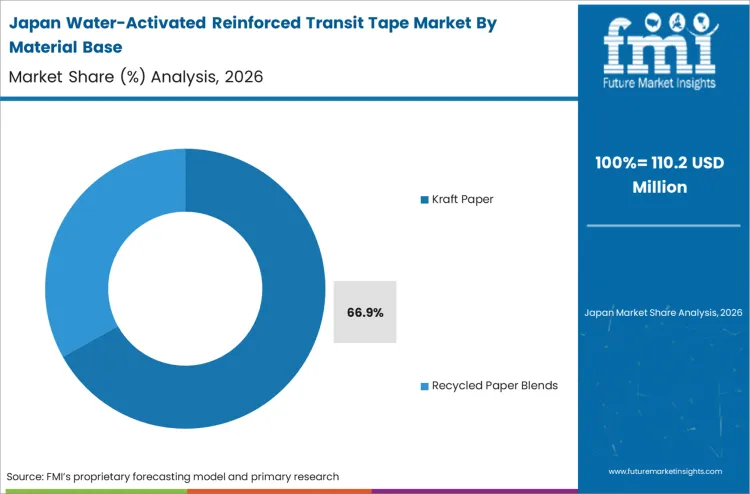
- Japan: Municipal sorting facilities actively reject commercial corrugated waste contaminated with plastic adhesive residues, expanding the market at a 4.5% trajectory anchored by highly organized domestic parcel courier networks. Logistics providers utilizing unapproved plastic seals lose access to vital commercial recycling contracts, as constrained urban waste management protocols in Japan mandate absolute compliance with single-stream paper recycling standards. The nation's advanced automated logistics sector standardizes on water-activated formulations to guarantee seamless end-of-life disposal.
- India: The massive shift toward organized e-commerce fulfillment directly triggers widespread adoption of tamper-evident carton sealing, as sourcing directors failing to upgrade their closure methods suffer catastrophic return rates on consumer electronics shipments. India's rapidly formalizing third-party logistics sector operates under extreme pressure to reduce transit damage across volatile, multi-modal supply chains, meaning fulfillment directors must deploy structurally bonding reinforced tapes to prevent dense packages from bursting during rough manual unloading, anchoring India's CAGR of 8.8% to 2036.
FMI's report includes detailed analysis of South Korea, Taiwan, and the broader ASEAN market. The rapid consolidation of semiconductor shipping hubs in these regions creates a parallel demand vector for pilfer-proof, anti-static paper sealing tapes, while a defining dynamic involves the localization of tape converting machinery, moving away from expensive jumbo-roll imports toward domestic coating and slitting operations.
North America Water-Activated Reinforced Transit Tape Market Analysis
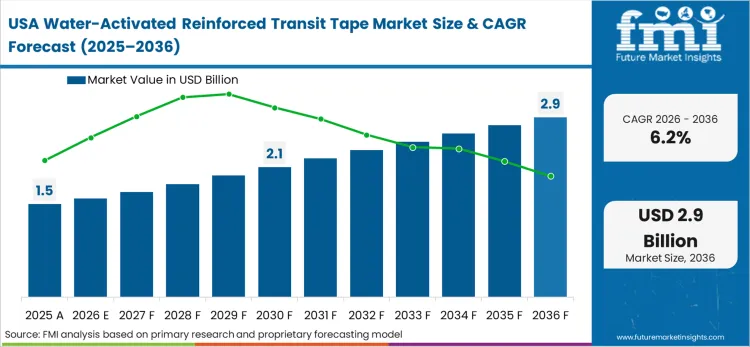
Industrial engineers leading warehouse optimization initiatives face strict directives to maximize daily carton throughput while simultaneously reducing repetitive strain injuries caused by manual hand-held tape guns. This operational shift depends entirely on a consistent supply of precision-slit fiberglass-reinforced rolls. Specific cost structure pressures and massive nationwide delivery volumes drive the North American transition from manual plastic taping to automated paper sealing. Based on FMI's assessment, replacing hand-applied plastic tape with electric water-activated dispensers instantly standardizes material usage per box, driving massive immediate cost savings.
- Mexico: Tracking an impressive 7.2% CAGR to 2036, Mexico's booming nearshored automotive parts export sector demands extreme transit security to prevent the theft of high-value components crossing international borders. The integration of high-strength structural sealing eliminates the need for expensive secondary plastic banding, as plant operations managers must deploy fiberglass-reinforced paper tapes that provide immediate, visible tamper evidence if a carton is compromised. Packaging engineers relying on weak plastic seals face uninsurable theft losses on critical cross-border freight routes.
- United States: Tier-1 e-commerce giants in the United States enforce strict material standardization across their massive automated fulfillment networks to eliminate operational variables, subsidizing a projected 6.2% CAGR over the forecast period to eliminate single-use plastics from fulfillment streams. Hardware suppliers lacking verified compatibility with high-speed carton sealing machinery face immediate exclusion from national vendor contracts, as procurement specification leads replace varying qualities of plastic tape with uniform, water-activated kraft rolls designed specifically for high-speed automated application.
FMI's report includes coverage of Canada and Latin America. Heavy reliance on cold-chain pharmaceutical distribution across these regions drives specific demand for moisture-resistant starch adhesive formulations.
Europe Water-Activated Reinforced Transit Tape Market Analysis
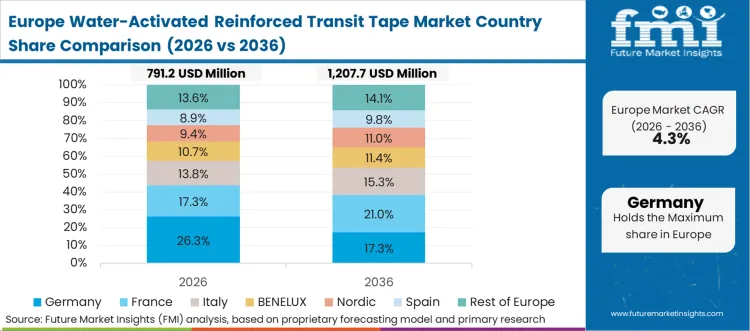
The transition requires a complete overhaul of procurement habits, shifting from low-cost hot melt tapes to engineered repulpable materials. This compliance requirement forces the rapid adoption of water-activated kraft tapes to guarantee that corrugated boxes enter the recycling stream without plastic contaminants. Stringent European circular economy directives actively penalize the continued operation of logistics networks that generate mixed-material packaging waste. Sustainability directors redesigning legacy fulfillment lines must integrate fully repulpable sealing solutions that pass strict municipal recycling audits.
- United Kingdom: Anchoring the UK's 5.5% CAGR trajectory to 2036, the post-Brexit plastic packaging tax requires massive retail logistics providers to utilize materials containing extreme levels of recycled or naturally derived content. Automated fulfillment centers deploying advanced carton sealers mandate completely repulpable tapes to align with zero-waste corporate pledges, forcing grid operators to abandon legacy plastic tapes. System integrators unable to demonstrate plastic-free compliance forfeit qualification for major logistics upgrade projects.
- Germany: Widespread auditing by the Central Agency Packaging Register confirms this aggressive structural shift away from plastic insulators, as Germany's updated Packaging Act (VerpackG) imposes punitive extended producer responsibility taxes strictly on mixed-material packaging. Facilities operators who ignore these material taxes face severe commercial disadvantages on high-volume distribution routes, and biopharma logistics managers operating within this environment must adopt certified cellulose alternatives to maintain competitive cost parity, sustaining a 5.8% CAGR to 2036.
FMI's report includes thorough investigation of Italy, France, and the Nordics. A prevailing structural condition across these nations is the mandatory compliance with strict retailer scorecards, forcing asset owners to specify verifiable eco-friendly packaging components.
Competitive Aligners for Market Players
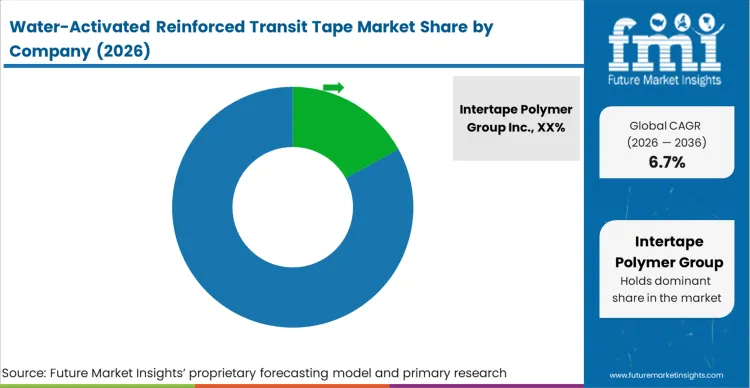
The global market for water-activated reinforced transit tape remains moderately consolidated, heavily controlled by legacy material science firms that possess massive, capital-intensive co-extrusion and fiberglass weaving infrastructure. This concentration exists because engineering high-tensile fiberglass matrices that do not snap under automated tension requires decades of proprietary web-handling experience. Industry giants such as Intertape Polymer Group Inc., 3M Company, and Shurtape Technologies LLC dominate the Tier-1 fulfillment sector by offering unmatched machine-roll consistency. Procurement teams use verifiable run-time consistency, specifically the prevention of automated dispenser jams, as the primary competitive variable to distinguish qualified vendors from low-cost importers.
Companies like Holland Manufacturing Co. and Papertec Inc. hold specific structural advantages by vertically integrating their kraft paper sourcing and starch adhesive formulation under one roof. This internal control allows them to rapidly iterate moisture-resistant adhesive blends that challengers relying on outsourced chemical suppliers simply cannot match. To replicate this position, an emerging player must specifically build advanced inline coating facilities capable of maintaining exact adhesive thickness tolerances at high speeds. Logistics operators integrating robotic dispensing heads actively seek out these vertically integrated suppliers to guarantee flawless machine operation during peak shipping seasons.
To prevent vendor lock-in, massive 3PL organizations increasingly enforce multi-vendor qualification programs, refusing to design their automated lines around a single manufacturer's proprietary core size. Buyers deliberately deploy standardized taping equipment that accepts generic jumbo rolls, constantly pitting dominant tape manufacturers against regional converters to suppress unit pricing. This structural tension limits the pricing power of the top players, despite the high barrier to entry. The competitive trajectory toward 2036 as a result indicates that the market is becoming slightly less concentrated as regional converting facilities scale up their capabilities to service localized e-commerce booms.
Key Players in Water-Activated Reinforced Transit Tape Market
- Intertape Polymer Group Inc.
- 3M Company
- Shurtape Technologies LLC
- Holland Manufacturing Co.
- Hollander Glass Texas (HGT)
- Papertec Inc.
- Windmill Tapes & Labels Ltd
- Neubronner GmbH & Co. KG
Scope of the Report
| Metric | Value |
|---|---|
| Quantitative Units | USD 3.4 billion to USD 6.5 billion, at a CAGR of 6.7% |
| Market Definition | Water-Activated Reinforced Transit Tape encompasses structurally bonding paper seals embedded with tension-resistant filaments and starch adhesives, delivering permanent tamper evidence and single-stream recycling compatibility for heavy-duty industrial and e-commerce logistics. |
| Material Base Segmentation | Kraft Paper, Recycled Paper Blends |
| Reinforcement Type Segmentation | Fiberglass Yarn, Polyester Filament, Biodegradable Natural Fiber |
| Application Segmentation | Heavy-Duty Carton Sealing, E-commerce Fulfillment, Automotive Parts Shipping, Industrial Bundling |
| End Use Segmentation | Third-Party Logistics (3PL), Retail & Consumer Goods, Healthcare & Pharma, Manufacturing |
| Regions Covered | North America, Latin America, Europe, Asia-Pacific, Oceania, Middle East & Africa |
| Countries Covered | China, India, Mexico, United States, Germany, United Kingdom, Japan, and 40 plus countries |
| Key Companies Profiled | Intertape Polymer Group Inc., 3M Company, Shurtape Technologies LLC, Holland Manufacturing Co., Hollander Glass Texas (HGT), Papertec Inc., Windmill Tapes & Labels Ltd, Neubronner GmbH & Co. KG |
| Forecast Period | 2026 to 2036 |
| Approach | The baseline value derives from a bottom-up aggregation of jumbo roll shipments to Tier-1 logistics providers, applying region-specific plastic phase-out curves to project future adoption velocity, validated against quarterly starch adhesive consumption metrics. |
Source: Future Market Insights (FMI) analysis, based on proprietary forecasting model and primary research
Key Segments in Water-Activated Reinforced Transit Tape Market
Material Base:
- Kraft Paper
- Recycled Paper Blends
Reinforcement Type:
- Fiberglass Yarn
- Polyester Filament
- Biodegradable Natural Fiber
Application:
- Heavy-Duty Carton Sealing
- E-commerce Fulfillment
- Automotive Parts Shipping
- Industrial Bundling
End Use:
- Third-Party Logistics (3PL)
- Retail & Consumer Goods
- Healthcare & Pharma
- Manufacturing
Regions:
- North America
- United States
- Canada
- Mexico
- Latin America
- Brazil
- Argentina
- Chile
- Rest of Latin America
- Europe
- Germany
- United Kingdom
- France
- Italy
- Spain
- Benelux
- Nordics
- Central & Eastern Europe
- Rest of Europe
- Asia-Pacific
- China
- Japan
- South Korea
- India
- ASEAN
- Rest of Asia-Pacific
- Oceania
- Australia
- New Zealand
- Middle East & Africa
- GCC
- South Africa
- Turkey
- Rest of Middle East & Africa
Bibliography
- International Safe Transit Association. (2024, February 15). ISTA 3A: Packaged-Products for Parcel Delivery System Shipment. ISTA Standard Guidelines.
- Intertape Polymer Group Inc. (2024, June 10). Advancements in Water-Activated Tape Adhesives for Automated Packaging. Technical White Papers.
- State Post Bureau of the PRC. (2024, August 12). Green Express Packaging Implementation Standards. SPB Directives.
- Packaging Machinery Manufacturers Institute. (2024, October). State of the Industry: Automated End-of-Line Systems. PMMI Intelligence.
- American Society for Testing and Materials. (2024, December). ASTM D5749 - 24 Standard Specification for Reinforced and Plain Gummed Tape for Sealing and Securing. ASTM International.
This bibliography is provided for reader reference. The full FMI report contains the complete reference list with primary source documentation.
This Report Addresses
- Market intelligence to support strategic decision making across high-strength reinforced carton sealing materials unique to this market
- Market size estimation and 10-year revenue forecasts from 2026 to 2036, supported by regulatory compliance tracking and automated dispenser installation metrics
- Growth opportunity mapping across fiberglass co-extrusion capabilities with emphasis on the standardization of tape heads on all new inline carton sealers by 2027
- Segment and regional revenue forecasts covering structural starch-based adhesives across high-volume automated e-commerce fulfillment operations
- Competition strategy assessment including machine-roll consistency, high-speed web tension control, and vertically integrated kraft sourcing
- Capability development tracking including biodegradable natural fiber filaments, moisture-resistant starch coatings, and compliance with the EU Packaging and Packaging Waste Regulation
- Market access analysis covering strict pharmaceutical chain-of-custody protocols and automotive cross-border security mandates
- Market report delivery in PDF, Excel, PPT, and interactive dashboard formats for executive strategy, fulfillment network planning, and operational benchmarking use
Frequently Asked Questions
How large is the Water-Activated Reinforced Transit Tape Market in 2026?
The market is estimated to be valued at USD 3.4 billion in 2026 as punitive plastic packaging taxes force high-volume fulfillment centers to standardize on repulpable solutions.
What will it be valued at by 2036?
The total opportunity is projected to reach USD 6.5 billion by 2036, driven by the complete elimination of biaxially oriented polypropylene (BOPP) plastic tapes in modern logistics.
What CAGR is projected?
Demand is expected to grow at a CAGR of 6.7%, structurally supported by massive corporate sustainability mandates pushing zero-waste-to-landfill fulfillment operations.
Which Material Base segment leads?
Kraft Paper holds a dominant 65.5% share in 2026, as its natural cellulose structure directly fuses with corrugated board to ensure zero disruption to existing recycling streams.
Which Reinforcement Type segment leads?
Fiberglass Yarn captures 72.0% of the market in 2026 due to the extreme cross-directional burst strength required for transporting dense industrial components without splitting.
Which Application segment leads?
Heavy-Duty Carton Sealing leads with a 45.0% share, driven by shippers transporting dense mechanical parts that easily punch through standard pressure-sensitive plastic seals.
What drives rapid growth?
The European Union PPWR forces 3PLs to eliminate plastic tape contamination, while rising theft losses compel automotive shippers to deploy tamper-evident transit security seals.
What is the primary restraint?
The intricate tension control required to weave fiberglass yarns into the tape without snapping during high-speed co-extrusion creates significant production bottlenecks for smaller regional converters.
Which country grows fastest?
China advances at a 9.5% CAGR, propelled by the State Post Bureau's strict green express packaging mandates penalizing non-degradable logistics materials.
What specific regulation impacts the European market?
The European Union Packaging and Packaging Waste Regulation (PPWR) classifies pressure-sensitive plastic tapes as contaminants, forcing a complete shift to single-stream repulpable paper sealing.
What technological capability is replacing legacy tapes?
Structurally bonding paper tapes utilizing starch-based water-activated adhesives are entirely replacing pressure-sensitive hot melt BOPP tapes on high-speed fulfillment lines.
How do the top vendors compete in this space?
Leading suppliers compete fiercely on machine-roll consistency and adhesive activation speed to prevent costly jams inside high-speed robotic dispensing heads.
How is the United States market performing?
The United States is projected to expand at a 6.2% CAGR as Tier-1 e-commerce giants enforce strict material standardization across their massive automated fulfillment networks.
What makes India a strategic growth market?
India's 8.8% growth rate is anchored by the rapid formalization of its third-party logistics sector, which desperately needs tamper-evident sealing to combat high transit damage.
Why is Mexico growing rapidly?
Mexico is tracking at 7.2% due to its booming nearshored automotive parts export sector, which demands extreme transit security to prevent theft crossing international borders.
What role does Germany play in the European tape sector?
Germany's updated Packaging Act (VerpackG) imposes punitive taxes strictly on mixed-material packaging, accelerating the adoption of certified cellulose alternatives.
What is the significance of the United Kingdom market?
The post-Brexit plastic packaging tax forces massive retail logistics providers in the UK to mandate completely repulpable tapes for all automated fulfillment operations.
Why do automotive shippers specify fiberglass reinforcement?
Fiberglass provides unparalleled multidirectional burst strength, stopping heavy mechanical components from breaking out of the carton bottom during rough multi-modal transit.
What advantage does water-activated tape offer over plastic?
Unlike plastic tape that merely grips the surface, water-activated starch adhesives penetrate raw cellulose fibers to create a permanent, tamper-evident structural lock.
How does inline automation change the market?
Dynamic carton sealers that measure boxes and cut precise lengths of reinforced tape on the fly are eliminating the inefficiencies of manual hand-held tape guns.
Does this report cover custom printed tapes?
Yes, the analysis includes custom security printing capabilities where unique anti-counterfeit QR codes are embedded directly onto the paper backing.
Are unreinforced gummed tapes included?
No, unreinforced plain gummed tapes utilized for lightweight craft and DIY applications are explicitly excluded from the valuation parameters.
Preview the report firsthand - request a free sample
Get SampleGet the brochure for pricing and purchase details.
Get PDFTable of Content
- Executive Summary
- Global Market Outlook
- Demand-side Trends
- Supply-side Trends
- Technology Roadmap Analysis
- Analysis and Recommendations
- Market Overview
- Market Coverage / Taxonomy
- Market Definition / Scope / Limitations
- Research Methodology
- Chapter Orientation
- Analytical Lens and Working Hypotheses
- Market Structure, Signals, and Trend Drivers
- Benchmarking and Cross-market Comparability
- Market Sizing, Forecasting, and Opportunity Mapping
- Research Design and Evidence Framework
- Desk Research Programme (Secondary Evidence)
- Company Annual and Sustainability Reports
- Peer-reviewed Journals and Academic Literature
- Corporate Websites, Product Literature, and Technical Notes
- Earnings Decks and Investor Briefings
- Statutory Filings and Regulatory Disclosures
- Technical White Papers and Standards Notes
- Trade Journals, Industry Magazines, and Analyst Briefs
- Conference Proceedings, Webinars, and Seminar Materials
- Government Statistics Portals and Public Data Releases
- Press Releases and Reputable Media Coverage
- Specialist Newsletters and Curated Briefings
- Sector Databases and Reference Repositories
- FMI Internal Proprietary Databases and Historical Market Datasets
- Subscription Datasets and Paid Sources
- Social Channels, Communities, and Digital Listening Inputs
- Additional Desk Sources
- Expert Input and Fieldwork (Primary Evidence)
- Primary Modes
- Qualitative Interviews and Expert Elicitation
- Quantitative Surveys and Structured Data Capture
- Blended Approach
- Why Primary Evidence is Used
- Field Techniques
- Interviews
- Surveys
- Focus Groups
- Observational and In-context Research
- Social and Community Interactions
- Stakeholder Universe Engaged
- C-suite Leaders
- Board Members
- Presidents and Vice Presidents
- R&D and Innovation Heads
- Technical Specialists
- Domain Subject-matter Experts
- Scientists
- Physicians and Other Healthcare Professionals
- Governance, Ethics, and Data Stewardship
- Research Ethics
- Data Integrity and Handling
- Primary Modes
- Tooling, Models, and Reference Databases
- Desk Research Programme (Secondary Evidence)
- Data Engineering and Model Build
- Data Acquisition and Ingestion
- Cleaning, Normalisation, and Verification
- Synthesis, Triangulation, and Analysis
- Quality Assurance and Audit Trail
- Market Background
- Market Dynamics
- Drivers
- Restraints
- Opportunity
- Trends
- Scenario Forecast
- Demand in Optimistic Scenario
- Demand in Likely Scenario
- Demand in Conservative Scenario
- Opportunity Map Analysis
- Product Life Cycle Analysis
- Supply Chain Analysis
- Investment Feasibility Matrix
- Value Chain Analysis
- PESTLE and Porter’s Analysis
- Regulatory Landscape
- Regional Parent Market Outlook
- Production and Consumption Statistics
- Import and Export Statistics
- Market Dynamics
- Global Market Analysis 2021 to 2025 and Forecast, 2026 to 2036
- Historical Market Size Value (USD Million) Analysis, 2021 to 2025
- Current and Future Market Size Value (USD Million) Projections, 2026 to 2036
- Y-o-Y Growth Trend Analysis
- Absolute $ Opportunity Analysis
- Global Market Pricing Analysis 2021 to 2025 and Forecast 2026 to 2036
- Global Market Analysis 2021 to 2025 and Forecast 2026 to 2036, By Material Base
- Introduction / Key Findings
- Historical Market Size Value (USD Million) Analysis By Material Base , 2021 to 2025
- Current and Future Market Size Value (USD Million) Analysis and Forecast By Material Base , 2026 to 2036
- Kraft Paper
- Recycled Paper Blends
- Kraft Paper
- Y-o-Y Growth Trend Analysis By Material Base , 2021 to 2025
- Absolute $ Opportunity Analysis By Material Base , 2026 to 2036
- Global Market Analysis 2021 to 2025 and Forecast 2026 to 2036, By Reinforcement Type
- Introduction / Key Findings
- Historical Market Size Value (USD Million) Analysis By Reinforcement Type, 2021 to 2025
- Current and Future Market Size Value (USD Million) Analysis and Forecast By Reinforcement Type, 2026 to 2036
- Fiberglass Yarn
- Polyester Filament
- Biodegradable Natural Fiber
- Fiberglass Yarn
- Y-o-Y Growth Trend Analysis By Reinforcement Type, 2021 to 2025
- Absolute $ Opportunity Analysis By Reinforcement Type, 2026 to 2036
- Global Market Analysis 2021 to 2025 and Forecast 2026 to 2036, By Application
- Introduction / Key Findings
- Historical Market Size Value (USD Million) Analysis By Application, 2021 to 2025
- Current and Future Market Size Value (USD Million) Analysis and Forecast By Application, 2026 to 2036
- Heavy-Duty Carton Sealing
- E-commerce Fulfillment
- Automotive Parts Shipping
- Industrial Bundling
- Heavy-Duty Carton Sealing
- Y-o-Y Growth Trend Analysis By Application, 2021 to 2025
- Absolute $ Opportunity Analysis By Application, 2026 to 2036
- Global Market Analysis 2021 to 2025 and Forecast 2026 to 2036, By End Use
- Introduction / Key Findings
- Historical Market Size Value (USD Million) Analysis By End Use, 2021 to 2025
- Current and Future Market Size Value (USD Million) Analysis and Forecast By End Use, 2026 to 2036
- Third-Party Logistics (3PL)
- Retail & Consumer Goods
- Healthcare & Pharma
- Manufacturing
- Third-Party Logistics (3PL)
- Y-o-Y Growth Trend Analysis By End Use, 2021 to 2025
- Absolute $ Opportunity Analysis By End Use, 2026 to 2036
- Global Market Analysis 2021 to 2025 and Forecast 2026 to 2036, By Region
- Introduction
- Historical Market Size Value (USD Million) Analysis By Region, 2021 to 2025
- Current Market Size Value (USD Million) Analysis and Forecast By Region, 2026 to 2036
- North America
- Latin America
- Western Europe
- Eastern Europe
- East Asia
- South Asia and Pacific
- Middle East & Africa
- Market Attractiveness Analysis By Region
- North America Market Analysis 2021 to 2025 and Forecast 2026 to 2036, By Country
- Historical Market Size Value (USD Million) Trend Analysis By Market Taxonomy, 2021 to 2025
- Market Size Value (USD Million) Forecast By Market Taxonomy, 2026 to 2036
- By Country
- USA
- Canada
- Mexico
- By Material Base
- By Reinforcement Type
- By Application
- By End Use
- By Country
- Market Attractiveness Analysis
- By Country
- By Material Base
- By Reinforcement Type
- By Application
- By End Use
- Key Takeaways
- Latin America Market Analysis 2021 to 2025 and Forecast 2026 to 2036, By Country
- Historical Market Size Value (USD Million) Trend Analysis By Market Taxonomy, 2021 to 2025
- Market Size Value (USD Million) Forecast By Market Taxonomy, 2026 to 2036
- By Country
- Brazil
- Chile
- Rest of Latin America
- By Material Base
- By Reinforcement Type
- By Application
- By End Use
- By Country
- Market Attractiveness Analysis
- By Country
- By Material Base
- By Reinforcement Type
- By Application
- By End Use
- Key Takeaways
- Western Europe Market Analysis 2021 to 2025 and Forecast 2026 to 2036, By Country
- Historical Market Size Value (USD Million) Trend Analysis By Market Taxonomy, 2021 to 2025
- Market Size Value (USD Million) Forecast By Market Taxonomy, 2026 to 2036
- By Country
- Germany
- UK
- Italy
- Spain
- France
- Nordic
- BENELUX
- Rest of Western Europe
- By Material Base
- By Reinforcement Type
- By Application
- By End Use
- By Country
- Market Attractiveness Analysis
- By Country
- By Material Base
- By Reinforcement Type
- By Application
- By End Use
- Key Takeaways
- Eastern Europe Market Analysis 2021 to 2025 and Forecast 2026 to 2036, By Country
- Historical Market Size Value (USD Million) Trend Analysis By Market Taxonomy, 2021 to 2025
- Market Size Value (USD Million) Forecast By Market Taxonomy, 2026 to 2036
- By Country
- Russia
- Poland
- Hungary
- Balkan & Baltic
- Rest of Eastern Europe
- By Material Base
- By Reinforcement Type
- By Application
- By End Use
- By Country
- Market Attractiveness Analysis
- By Country
- By Material Base
- By Reinforcement Type
- By Application
- By End Use
- Key Takeaways
- East Asia Market Analysis 2021 to 2025 and Forecast 2026 to 2036, By Country
- Historical Market Size Value (USD Million) Trend Analysis By Market Taxonomy, 2021 to 2025
- Market Size Value (USD Million) Forecast By Market Taxonomy, 2026 to 2036
- By Country
- China
- Japan
- South Korea
- By Material Base
- By Reinforcement Type
- By Application
- By End Use
- By Country
- Market Attractiveness Analysis
- By Country
- By Material Base
- By Reinforcement Type
- By Application
- By End Use
- Key Takeaways
- South Asia and Pacific Market Analysis 2021 to 2025 and Forecast 2026 to 2036, By Country
- Historical Market Size Value (USD Million) Trend Analysis By Market Taxonomy, 2021 to 2025
- Market Size Value (USD Million) Forecast By Market Taxonomy, 2026 to 2036
- By Country
- India
- ASEAN
- Australia & New Zealand
- Rest of South Asia and Pacific
- By Material Base
- By Reinforcement Type
- By Application
- By End Use
- By Country
- Market Attractiveness Analysis
- By Country
- By Material Base
- By Reinforcement Type
- By Application
- By End Use
- Key Takeaways
- Middle East & Africa Market Analysis 2021 to 2025 and Forecast 2026 to 2036, By Country
- Historical Market Size Value (USD Million) Trend Analysis By Market Taxonomy, 2021 to 2025
- Market Size Value (USD Million) Forecast By Market Taxonomy, 2026 to 2036
- By Country
- Kingdom of Saudi Arabia
- Other GCC Countries
- Turkiye
- South Africa
- Other African Union
- Rest of Middle East & Africa
- By Material Base
- By Reinforcement Type
- By Application
- By End Use
- By Country
- Market Attractiveness Analysis
- By Country
- By Material Base
- By Reinforcement Type
- By Application
- By End Use
- Key Takeaways
- Key Countries Market Analysis
- USA
- Pricing Analysis
- Market Share Analysis, 2025
- By Material Base
- By Reinforcement Type
- By Application
- By End Use
- Canada
- Pricing Analysis
- Market Share Analysis, 2025
- By Material Base
- By Reinforcement Type
- By Application
- By End Use
- Mexico
- Pricing Analysis
- Market Share Analysis, 2025
- By Material Base
- By Reinforcement Type
- By Application
- By End Use
- Brazil
- Pricing Analysis
- Market Share Analysis, 2025
- By Material Base
- By Reinforcement Type
- By Application
- By End Use
- Chile
- Pricing Analysis
- Market Share Analysis, 2025
- By Material Base
- By Reinforcement Type
- By Application
- By End Use
- Germany
- Pricing Analysis
- Market Share Analysis, 2025
- By Material Base
- By Reinforcement Type
- By Application
- By End Use
- UK
- Pricing Analysis
- Market Share Analysis, 2025
- By Material Base
- By Reinforcement Type
- By Application
- By End Use
- Italy
- Pricing Analysis
- Market Share Analysis, 2025
- By Material Base
- By Reinforcement Type
- By Application
- By End Use
- Spain
- Pricing Analysis
- Market Share Analysis, 2025
- By Material Base
- By Reinforcement Type
- By Application
- By End Use
- France
- Pricing Analysis
- Market Share Analysis, 2025
- By Material Base
- By Reinforcement Type
- By Application
- By End Use
- India
- Pricing Analysis
- Market Share Analysis, 2025
- By Material Base
- By Reinforcement Type
- By Application
- By End Use
- ASEAN
- Pricing Analysis
- Market Share Analysis, 2025
- By Material Base
- By Reinforcement Type
- By Application
- By End Use
- Australia & New Zealand
- Pricing Analysis
- Market Share Analysis, 2025
- By Material Base
- By Reinforcement Type
- By Application
- By End Use
- China
- Pricing Analysis
- Market Share Analysis, 2025
- By Material Base
- By Reinforcement Type
- By Application
- By End Use
- Japan
- Pricing Analysis
- Market Share Analysis, 2025
- By Material Base
- By Reinforcement Type
- By Application
- By End Use
- South Korea
- Pricing Analysis
- Market Share Analysis, 2025
- By Material Base
- By Reinforcement Type
- By Application
- By End Use
- Russia
- Pricing Analysis
- Market Share Analysis, 2025
- By Material Base
- By Reinforcement Type
- By Application
- By End Use
- Poland
- Pricing Analysis
- Market Share Analysis, 2025
- By Material Base
- By Reinforcement Type
- By Application
- By End Use
- Hungary
- Pricing Analysis
- Market Share Analysis, 2025
- By Material Base
- By Reinforcement Type
- By Application
- By End Use
- Kingdom of Saudi Arabia
- Pricing Analysis
- Market Share Analysis, 2025
- By Material Base
- By Reinforcement Type
- By Application
- By End Use
- Turkiye
- Pricing Analysis
- Market Share Analysis, 2025
- By Material Base
- By Reinforcement Type
- By Application
- By End Use
- South Africa
- Pricing Analysis
- Market Share Analysis, 2025
- By Material Base
- By Reinforcement Type
- By Application
- By End Use
- USA
- Market Structure Analysis
- Competition Dashboard
- Competition Benchmarking
- Market Share Analysis of Top Players
- By Regional
- By Material Base
- By Reinforcement Type
- By Application
- By End Use
- Competition Analysis
- Competition Deep Dive
- Intertape Polymer Group Inc.
- Overview
- Product Portfolio
- Profitability by Market Segments (Product/Age /Sales Channel/Region)
- Sales Footprint
- Strategy Overview
- Marketing Strategy
- Product Strategy
- Channel Strategy
- 3M Company
- Shurtape Technologies LLC
- Holland Manufacturing Co.
- Hollander Glass Texas (HGT)
- Papertec Inc.
- Windmill Tapes & Labels Ltd
- Neubronner GmbH & Co. KG
- Intertape Polymer Group Inc.
- Competition Deep Dive
- Assumptions & Acronyms Used


