

- Industry Size (2026)
- USD 13.2 Bn
- Forecast (2036)
- USD 23.9 Bn
- CAGR (2026 to 2036)
- 6.1%
Dissolvable PVOH Detergent Pods Market Forecast and Outlook By FMI
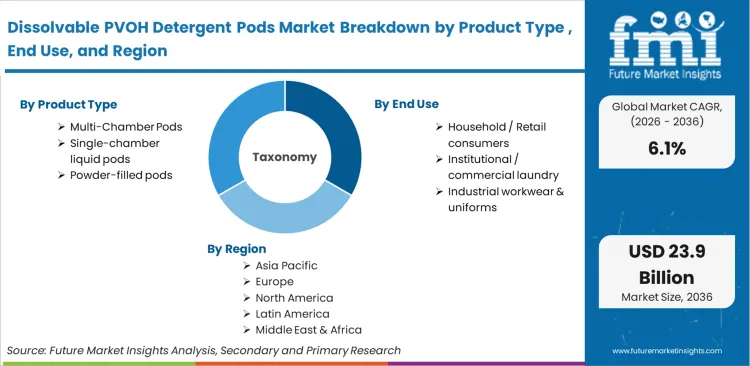
In 2025, the dissolvable PVOH detergent pods market was valued at USD 12.4 billion. Based on Future Market Insights’ analysis, demand for dissolvable PVOH detergent pods is estimated to grow to USD 13.2 billion in 2026 and USD 23.9 billion by 2036. FMI projects a CAGR of 6.1% during the forecast period.
Absolute dollar growth of USD 10.7 billion over 2026 to 2036 reflects steady expansion driven by unit-dose penetration in urban households and premiumization toward multi-benefit, multi-chamber formats. Growth is capped by film and surfactant cost volatility, compliance costs tied to packaging safety, and scrutiny on polymer fate in wastewater systems.
Dissolvable PVOH Detergent Pods Market Key Takeaways
- Market definition
- Single-dose laundry detergents wrapped in dissolvable PVOH film, sold mainly for household laundry with dosing precision and reduced handling.
- Demand drivers
- Growth in automatic washer penetration increases demand for pre-measured formats that reduce overdosing and residue risk.
- Cold-water washing positioning expands pod usage as brands tune enzymes and surfactants for short and cold cycles. [2]
- Retailers and brands push convenience-led premium packs, lifting category value even when volume growth is moderate.
- Key segments analyzed
- Product type: Multi-chamber pods lead with 54% share in 2026 due to multi-benefit delivery in one dose.
- End use: Household / retail consumers lead with 86% share in 2026 because pods are primarily a consumer convenience format.
- Channel: Supermarkets & hypermarkets lead with 51% share in 2026 through shelf visibility and bulk multipack promotion.
- Analyst opinion
- Ronak Shah, Principal Consultant for Consumer Goods at Future Market Insights, opines, ‘This report shows where cold-cycle performance and safer pack formats translate into share gains, by channel and by country.’
- Strategic implications
- Build multi-chamber portfolios with clear benefit ladders (stain, odour, hygiene, cold wash) to defend pricing.
- Reduce reliance on a single film and surfactant supply route to limit margin swings during input inflation.
- Treat safety-pack compliance as a growth enabler, not a cost line, because recalls reshape retailer listings. [5]
- Methodology
- Forecasts are built from penetration curves by channel and household washer mix, calibrated with public category signals.
- Segment shares are reconciled so leading shares align with the total market value for each year.
- Updates incorporate policy and stewardship changes affecting packaging, labelling, and consumer handling norms.
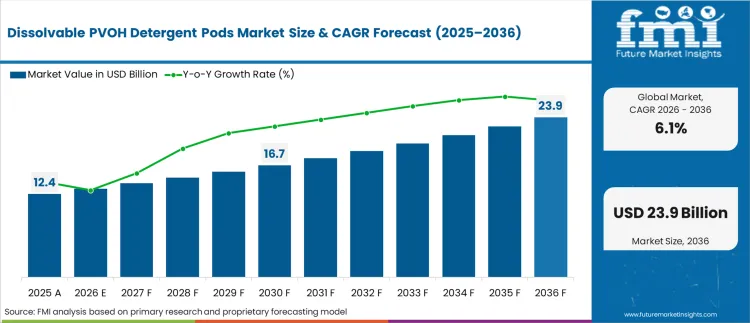
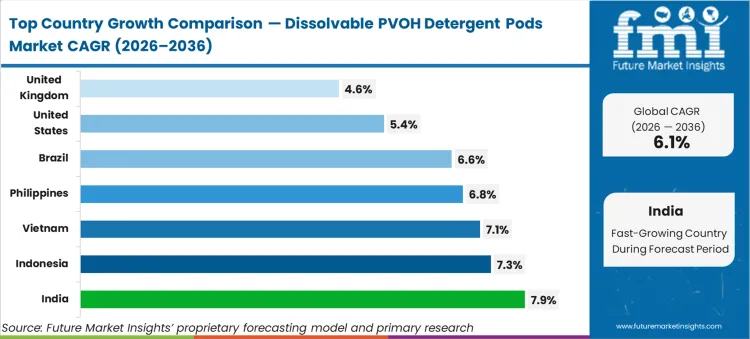
India (7.9% CAGR, modern retail and e-commerce scale-up), Indonesia (7.3% CAGR, rising automatic washer base), Vietnam (7.1% CAGR, urban convenience purchasing), Philippines (6.8% CAGR, online-led adoption) and Brazil (6.6% CAGR, premium detergent mix shift) lead growth. The United States (5.4% CAGR) and the United Kingdom (4.6% CAGR) sit in the mature cohort where replacement demand dominates, constrained by tighter safety-packaging requirements and higher compliance overhead.
| Metric | Value |
|---|---|
| Market Size (2026) | USD 13.2 Billion |
| Forecast Value (2036) | USD 23.9 Billion |
| CAGR (2026-2036) | 6.1% |
Dissolvable PVOH Detergent Pods Market Definition
The dissolvable PVOH detergent pods market covers single-dose laundry detergent packs wrapped in a water-soluble polyvinyl alcohol (PVOH) film. The pod dissolves in wash water, releasing concentrated detergent that can be liquid, powder, gel, or layered in multiple chambers. Buyers value pods for dosing accuracy, lower mess versus bottles, and convenience in small homes and busy retail settings.
Market Inclusions
This report covers global and regional market sizing for 2025 to 2036, with forecast estimates for 2026 to 2036. It provides segment breakdowns by product type (pod format), end use, and distribution channel, with regional demand commentary across major consuming economies. The analysis also tracks format shifts (multi-chamber vs single), cold-water performance positioning, and category stewardship practices tied to safe storage and packaging.
Market Exclusions
The scope excludes conventional liquid detergents, powders, and sheets sold without a dissolvable PVOH pod format. It also excludes automatic dishwashing capsules and hard-surface cleaning capsules not positioned for laundry use. Downstream appliances, dispensing hardware, and private-label retail programs are not sized as separate markets, unless directly tied to unit-dose detergent pod sales.
Research Methodology
- Primary Research: Interviews with detergent brand managers, contract packers, film suppliers, appliance partners, and retail category buyers across North America, Europe, and Asia.
- Desk Research: Review of public stewardship programmes, regulatory documentation, corporate press releases, and retailer announcements relevant to unit-dose detergents.
- Market-Sizing and Forecasting: Hybrid top-down and bottom-up modelling, triangulating household detergent spend, unit-dose penetration, and average selling price by channel.
- Data Validation and Update Cycle: Consistency checks across regional splits, segment shares, and adoption curves, with peer review and periodic refresh as new regulatory or packaging data emerges.
Segmental Analysis
Dissolvable PVOH Detergent Pods Market Analysis by product type (pod format)
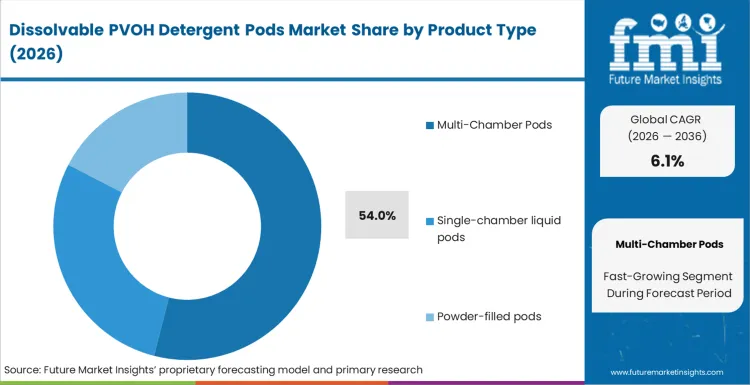
Based on FMI’s dissolvable PVOH detergent pods market report, consumption of Multi-chamber pods is estimated to account for 54% of the market in 2026. Multi-chamber designs let brands separate incompatible actives until use, enabling stronger stain systems, freshness boosters, and cold-wash enzymes in one dose, which supports premium price points.
- Appliance-linked validation: Samsung’s partnership cycle built around Tide POD cold washing links performance to appliance settings, reinforcing premium multi-benefit dosing logic. [2]
- Formulation for short cycles: Unilever’s Wonder Wash launch targets performance in fast cycles, reinforcing demand for concentrated, high-efficiency dose formats. [3]
- Cold-wash efficiency claims: Tide and Walmart’s campaign pushes cold washing adoption at scale, improving the value case for concentrated pods that clean in colder water. [4]
Dissolvable PVOH Detergent Pods Market Analysis by end use
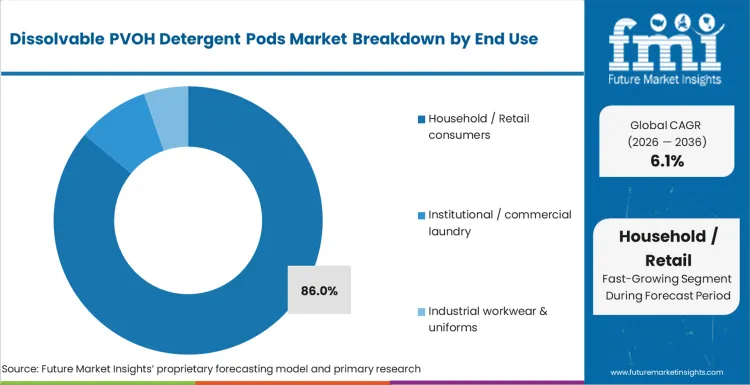
Based on FMI’s dissolvable PVOH detergent pods market report, consumption of Household / retail consumers is estimated to hold 86% share in 2026. Household buyers pay for dosing accuracy, portability, and reduced mess, while brand innovation cycles in consumer retail drive faster format turnover than in institutional procurement.
- Retail risk controls: The April 2024 recall tied to defective pod-bag packaging shows why consumer-facing safety controls shape listings and packaging specs. [5]
- Stewardship-driven messaging: A.I.S.E. stewardship programmes standardize safe-use icons and storage messages, strengthening consumer handling compliance across brands. [6]
- Brand refresh and shelf conversion: Henkel’s Persil brand refresh in North America targets fabric care and deep clean positioning, supporting premium household conversion. [9]
Dissolvable PVOH Detergent Pods Market Drivers, Restraints, Opportunities
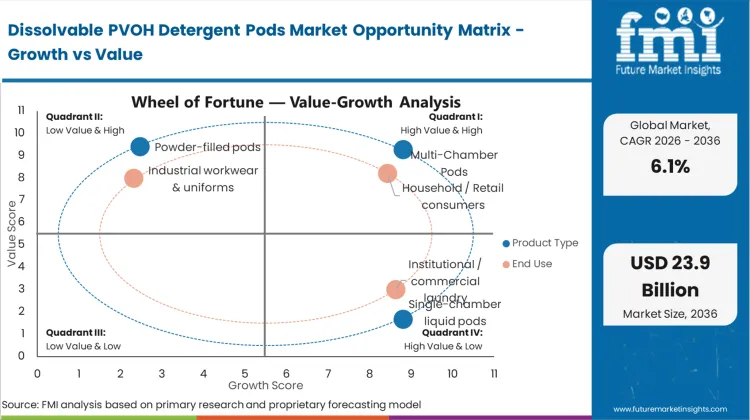
Future Market Insights analysis indicates that the category grew from a niche convenience format into a mainstream premium detergent option once brands proved consistent cleaning at smaller doses and retailers standardised multipack merchandising. The 2026 valuation reflects wide household adoption in urban markets, with the highest value concentration in formats that combine stain removal, freshness, and fabric care in a single pod.
The market is in a transition where performance claims are shifting toward cold and short cycles, while risk management is shifting toward safer packaging and clearer storage guidance. Pricing dynamics stay favourable for pods because value per wash remains higher than bottles, yet brands must offset higher packaging and film costs, plus compliance and recall exposure tied to concentrated chemistry handling.
- Cold-cycle performance: Appliance partnerships and “cold certified” cycle positioning support pod adoption in mature markets by improving wash results at lower temperatures. [2]
- Safety-pack compliance: Category stewardship programmes and enforcement pressure raise the bar for child-safe packaging, influencing retailer acceptance and private-label expansion pace. [6]
- Microplastics scrutiny: Policy attention on synthetic polymers and microplastics raises diligence on polymer fate, pushing brands to strengthen evidence and wastewater-aligned claims. [8]
Regional Analysis
Demand is assessed across North America, Latin America, Europe, East Asia, South Asia, and ASEAN markets, reflecting differences in retail structure, washer penetration, and stewardship enforcement. The full report also offers market attractiveness analysis based on regional trends.
.webp "Top Country Growth Comparison Dissolvable Pvoh Detergent Pods Market Cagr (2026 2036)")
| Country | CAGR (2026-2036) |
|---|---|
| India | 7.9% |
| Indonesia | 7.3% |
| Vietnam | 7.1% |
| Philippines | 6.8% |
| Brazil | 6.6% |
| United States | 5.4% |
| United Kingdom | 4.6% |
Source: Future Market Insights (FMI) analysis, based on proprietary forecasting model and primary research
North America Market Analysis
North America is a mature premium detergent market where pods are already mainstream, and growth is driven by performance upgrades, cold-cycle positioning, and tighter packaging compliance. Key players include Procter & Gamble, Henkel, and Church & Dwight, competing on stain efficacy, scent systems, and safer pack formats.
- United States: In the United States, dissolvable PVOH detergent pods are projected to expand at 5.4% CAGR through 2036. Category risk management is shaping retailer procurement, shown by the April 2024 recall of over 8.2 million pod bags tied to a packaging defect and child-access risk, which pushes retailers to tighten packaging acceptance criteria. [5] Adoption is also supported by appliance-led cold cycle positioning, where Samsung announced a multi-year partnership with P&G to introduce a Tide POD cold wash cycle on new laundry platforms in the USA and Canada, reinforcing wash performance at lower temperatures. [2] These signals support steady value growth as brands defend premium pricing through performance and compliance, while volume growth remains tied to replacement purchasing and pack-size optimization.
FMI’s analysis of dissolvable PVOH detergent pods market in North America consists of country-wise assessment that includes the United States and Canada. Readers can find pack-format trends, safety-pack practices, and channel dynamics across mass retail and online.
Europe Market Analysis
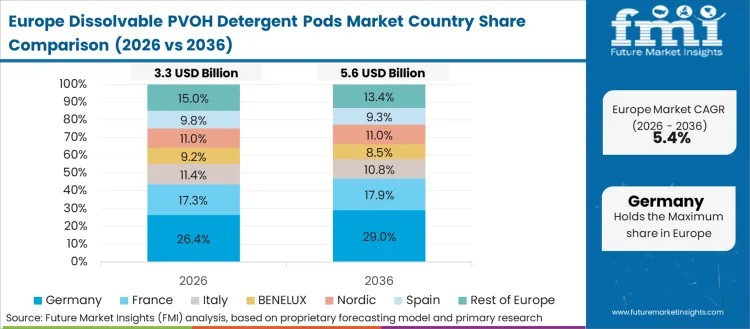
Europe functions as the regulatory and stewardship reference point for detergents, with strong pressure on labelling clarity, product information flows, and environmental compliance, while pods remain a premium, convenience-led format. Key players include Unilever, Henkel, and Reckitt, with competition anchored in cold wash efficacy and packaging sustainability.
- United Kingdom: Unit-dose laundry formats in the United Kingdom are forecast to rise at 4.6% CAGR through 2036, with growth shaped by product information compliance and cycle-behavior shifts. Product and information expectations are being reshaped by the ongoing revision process for the EU detergents framework, influencing how ingredient and product information is structured and shared across supply chains serving UK and EU retailers. [7] In parallel, Persil Wonder Wash availability across grocery and convenience channels from April 2024 positions performance for short cycles, supporting premium formats that deliver consistent results in faster washes. [10] The UK market still leans on replacement demand, so value expansion is tied to format trade-up, retailer promotion cadence, and higher short-cycle usage in urban households.
FMI’s analysis of dissolvable PVOH detergent pods market in Europe consists of country-wise assessment that includes the United Kingdom, Germany, France, Italy, Spain, and Benelux. Readers can find regulatory context, channel pricing patterns, and format mix by country.
East Asia Market Analysis
East Asia mixes high-performance laundry expectations with dense urban living and high washer penetration, supporting premium detergent formats that reduce dosing errors and storage footprint. Key players include Henkel (via partnerships), LG Household & Health Care, and global brands selling through modern retail and online channels.
- South Korea: Demand for dissolvable PVOH detergent pods in South Korea is projected to rise at 5.8% CAGR through 2036. Appliance integration is a visible growth lever, shown by Henkel and Samsung launching a Persil Deep Clean custom wash cycle aimed at reducing energy consumption while keeping wash performance, aligning pods and concentrated detergents with cold and efficient washing habits. [1] The same release references test-based energy reduction claims and dosing adjustments via auto-dispensing logic, which supports concentrated formats that work reliably at lower temperatures and controlled dosing. [1] Growth is also supported by fast e-commerce replenishment and premium brand preference, while competition focuses on stain performance, fragrance longevity, and compatibility with modern machine cycles.
FMI’s analysis of dissolvable PVOH detergent pods market in East Asia consists of country-wise assessment that includes South Korea, Japan, and China. Readers can find appliance-linked performance themes, channel shifts, and premiumization drivers.
South Asia and ASEAN Market Analysis
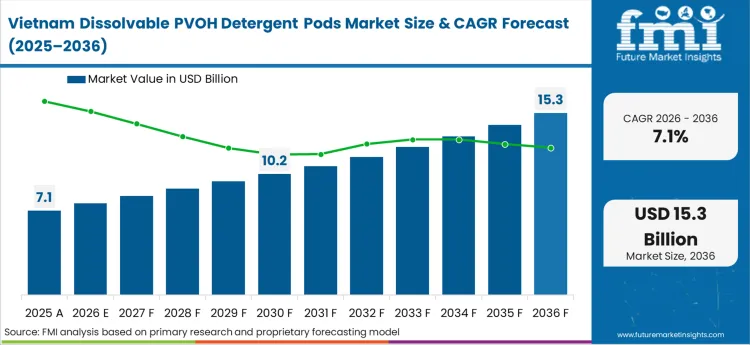
South Asia and ASEAN are the primary volume and growth engines, driven by rising automatic washer adoption, modern trade expansion, and e-commerce growth that supports premium convenience formats. Key players include P&G, Unilever, and regional brands competing on price-pack architecture and channel-led trial.
- India: India leads the growth cohort at 7.9% CAGR through 2036, driven by urban adoption of premium convenience formats and a widening modern retail footprint. Brand innovation around short and cold cycles supports trial in higher-income households that want time-efficient washing, mapped by Unilever’s Wonder Wash narrative built around short-cycle effectiveness. [3] In parallel, stewardship-driven safe storage messaging promoted through capsule safety programmes supports broader acceptance as adoption moves beyond early premium buyers. [6] Demand is strongest in metros and tier-1 cities first, then scales via e-commerce bundles and supermarket promotions that reduce entry price per wash. The fastest gains come where automatic washer ownership and online replenishment are rising together.
- Indonesia: Indonesia is projected to post 7.3% CAGR through 2036, with uptake centered on urban households shifting toward automatic machines and convenience-led purchasing. Global brands’ short-cycle performance messaging supports trial among consumers trading up from value liquids, again visible through Unilever’s short-cycle positioning that makes concentrated doses easier to use consistently. [3] Category stewardship programmes that standardize safe-use messaging help reduce perceived risk in family households, which matters as pods appear beyond premium aisles into broader retail distribution. [6] Growth is strongest where modern trade and online marketplaces accelerate sampling through multipacks and promotional pricing, while constraints include affordability ceilings and the need for clear usage education for first-time pod buyers.
- Vietnam: Vietnam is expected to grow at 7.1% CAGR through 2036, with adoption tied to urban convenience shopping, organized retail buildout, and consumer interest in efficient wash routines. Cold-wash positioning scaled through retailer education and brand messaging supports pods as a “correct dose” product for shorter, cooler washes, which helps premium formats gain repeat purchase. [4] Safety and handling guidance promoted through industry stewardship frameworks also reduces friction as pods become visible in mainstream retail and online channels. [6] Value growth is supported by premium multipacks and multi-benefit claims that reduce the need for add-on boosters, while penetration improves as e-commerce and supermarkets normalize unit-dose detergent buying.
- Philippines: In the Philippines, the market is forecast at 6.8% CAGR through 2036, with growth led by urban centers where e-commerce and supermarket promotions drive trial. Retail education around cold washing helps pods present as a simple, no-measure format that fits convenience-led purchasing, reinforced by large retailer-led messaging tied to cold-cycle adoption. [4] Industry stewardship guidance on safe storage and correct use supports wider household acceptance as pods expand through convenience and online channels. [6] The main constraint is price sensitivity, so brands lean on promotional pack architecture and repeat-purchase programs to keep the cost-per-wash acceptable for mainstream buyers.
FMI’s analysis of dissolvable PVOH detergent pods market in South Asia and ASEAN consists of country-wise assessment that includes India, Indonesia, Vietnam, Philippines, Thailand, and Malaysia. Readers can find channel adoption curves, price-pack shifts, and product format preferences by country.
Latin America Market Analysis
Latin America is a value-sensitive market where pods grow fastest in premium pockets, supported by modern retail and online, while liquids retain the mass base. Key players include P&G, Unilever, and regional retailers pushing multipacks and private-label tests.
- Brazil: Brazil is projected to rise at 6.6% CAGR through 2036, with pods gaining share mainly in premium pockets served by hypermarkets and online channels. Cold-wash adoption messaging scaled through large retailers supports pods as a concentrated option linked to energy-saving habits in urban households. [4] Safety-pack and safe-use messaging standardization helps pods sustain distribution as the category expands, reducing retailer risk concerns tied to concentrated chemistry handling. [6] Growth concentrates in large cities where multipacks and cash-and-carry formats can support higher unit values, while broader penetration remains constrained by affordability thresholds and promotion dependency.
FMI’s analysis of dissolvable PVOH detergent pods market in Latin America consists of country-wise assessment that includes Brazil, Mexico, Argentina, and Chile. Readers can find pricing and promotion patterns, channel contribution, and format mix by country.
Competitive Aligners for Market Players
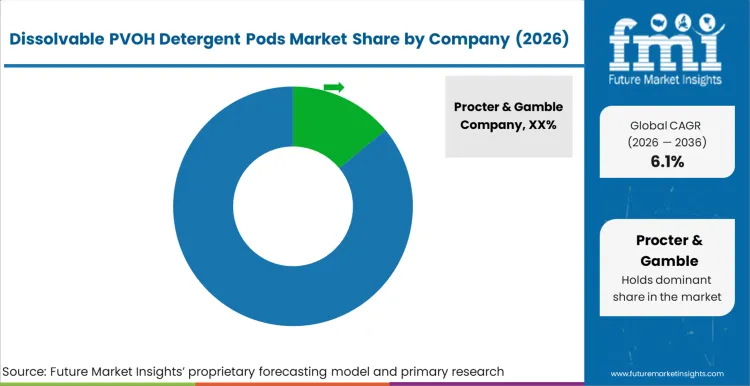
The market is moderately concentrated, led by multinational detergent groups with scale in formulation, film sourcing, and retail execution. Competitive advantage is anchored in performance credibility, pack safety compliance, and the ability to run multi-format portfolios that keep pods premium while defending volume in liquids and powders.
Companies with strong R&D and appliance or retailer partnerships can prove cold-cycle cleaning and short-cycle efficacy, which supports higher price per wash and repeat purchase. This matters in mature markets where household penetration is already high and share gains come from switching, not category expansion.
Buyer behaviour differs by channel. Large supermarkets push multi-buy promotions and demand stable supply and compliant packaging specs, while online marketplaces reward subscription packs and low-damage shipping formats. Across both, recalls and safety incidents shift leverage toward retailers, raising the cost of non-compliance for brands.
Key Players in Dissolvable PVOH Detergent Pods Market
- Procter & Gamble Company
- Henkel AG & Co. KGaA
- Unilever PLC
- Church & Dwight Co., Inc.
- Reckitt Benckiser Group plc
- Lion Corporation
- LG Household & Health Care Ltd.
- The Clorox Company
- Costco Wholesale Corporation
Scope of Report Table
| Item | Value |
| Quantitative Units | USD 13.2 billion (2026) to USD 23.9 billion (2036), at a CAGR of 6.1% |
| Market Definition | The dissolvable PVOH detergent pods market covers single-dose laundry detergent packs wrapped in a water-soluble polyvinyl alcohol (PVOH) film that dissolves in wash water, releasing concentrated detergent in liquid, powder, gel, or multi-chamber formats. |
| Product Type Segmentation | Single-chamber liquid pods, Multi-chamber pods, Powder-filled pods, Gel pods / concentrated gel capsules, Cold-water optimized quick-dissolve pods |
| End Use Segmentation | Household / retail consumers, Institutional / commercial laundry (hotels, hospitals, laundromats), Industrial workwear & uniforms (B2B contracts) |
| Distribution Channel Segmentation | Supermarkets & hypermarkets, Convenience stores, Drugstores / pharmacies, Online marketplaces, Direct-to-consumer (brand websites, subscriptions), Wholesale / club stores (bulk packs) |
| Regions Covered | North America, Latin America, Europe, East Asia, South Asia, ASEAN |
| Countries Covered | United States, Canada, United Kingdom, Germany, France, Italy, Spain, Benelux, South Korea, Japan, China, India, Indonesia, Vietnam, Philippines, Thailand, Malaysia, Brazil, Mexico, Argentina, Chile |
| Key Companies Profiled | Procter & Gamble Company, Henkel AG & Co. KGaA, Unilever PLC, Church & Dwight Co., Inc., Reckitt Benckiser Group plc, Lion Corporation, LG Household & Health Care Ltd., The Clorox Company, Costco Wholesale Corporation, Walmart Inc. |
| Forecast Period | 2026 to 2036 |
| Approach | Hybrid top-down and bottom-up modelling, triangulating household detergent spend, unit-dose penetration, and average selling price by channel. Primary research through interviews with detergent brand managers, contract packers, film suppliers, appliance partners, and retail category buyers across North America, Europe, and Asia. |
Dissolvable PVOH Detergent Pods Market Analysis by Segments
By Product Type (pod format)
- Single-chamber liquid pods
- Multi-chamber pods
- Powder-filled pods
- Gel pods / concentrated gel capsules
- Cold-water optimized quick-dissolve pods
By End Use
- Household / retail consumers
- Institutional / commercial laundry (hotels, hospitals, laundromats)
- Industrial workwear & uniforms (B2B contracts)
By Distribution Channel
- Supermarkets & hypermarkets
- Convenience stores
- Drugstores / pharmacies
- Online marketplaces
- Direct-to-consumer (brand websites, subscriptions)
- Wholesale / club stores (bulk packs)
Bibliography
- [1] Henkel AG & Co. KGaA, Henkel and Samsung introduce custom wash cycles that reduce energy consumption by 60 percent, Apr 2024.
- [2] Samsung Newsroom (US), Samsung and Procter & Gamble partnership creates Tide POD cold wash cycle, optimized for cold water laundry, Apr 2024.
- [3] Unilever, Evolving laundry habits and tech drive category innovation at Unilever, Apr 2024.
- [4] Business Wire, Tide and Walmart team up to expand adoption of washing in cold with consumers, Apr 2024.
- [5] AP News, P&G recalls 8.2 million bags of Tide, Gain and other laundry detergents over packaging defect, Apr 2024.
- [6] A.I.S.E., Liquid detergent capsules: safe and sustainable use, accessed Mar 2026.
- [7] European Parliament, Revision of the Detergents Regulation (REFIT) | Legislative train schedule, accessed Mar 2026.
- [8] European Commission, Commission Regulation (EU) 2023/2055: Restriction of intentionally added microplastics, accessed Mar 2026.
- [9] Henkel North America, Persil Laundry Detergent puts a new spin on category with reimagined brand identity, May 2024.
- [10] Unilever UK, Persil revolutionises laundry with new Wonder Wash for short cycles, Apr 2024.
This bibliography is provided for reader reference and is not exhaustive. The full report contains the complete reference list and detailed citations.
This Report Addresses
- Market intelligence to support pricing, pack-format, and channel strategy decisions for unit-dose laundry detergents.
- Market size estimation and 10-year revenue forecasts from 2026 to 2036, aligned to USD 13.2 billion (2026) and USD 23.9 billion (2036).
- Growth opportunity mapping across pod formats, end uses, and distribution channels, with focus on multi-chamber premiumization.
- Segment and regional revenue outlook covering North America, Europe, East Asia, South Asia, ASEAN, and Latin America.
- Competitive assessment of leading brands on performance claims, safety-pack compliance posture, and retailer partnership strength.
- Trend tracking on cold-cycle positioning, short-cycle performance, and category stewardship practices shaping buyer acceptance.
- Regulatory and compliance context affecting detergents information flow, packaging expectations, and polymer scrutiny.
- Report delivery in PDF, Excel, PPT, and dashboard-ready structures for executive and operational users.
Frequently Asked Questions
How large is the dissolvable PVOH detergent pods market in 2026?
The market is valued at USD 13.2 billion in 2026, reflecting broad household penetration and premium pricing versus liquids and powders.
What will the market size be by 2036?
The market is projected to reach USD 23.9 billion by 2036, supported by expanding adoption in Asia and premium multi-chamber format growth.
What is the expected CAGR during 2026 to 2036?
FMI projects a 6.1% CAGR from 2026 to 2036, driven by convenience-led purchasing and cold-cycle compatible concentrated formulations.
Which pod format is poised to lead in 2026?
Multi-chamber pods lead in 2026 with 54% share, supported by multi-benefit delivery and stronger premium positioning in retail shelves.
How significant is household demand in this market?
Household / retail consumers account for 86% share in 2026, since pods are primarily marketed as a convenience and dosing product.
Which distribution channel leads pod sales in 2026?
Supermarkets & hypermarkets lead with 51% share in 2026, driven by multipack merchandising, promotions, and high shopper visibility.
What are the main growth countries for this market?
India, Indonesia, Vietnam, Philippines, and Brazil post above-average growth, supported by modern trade expansion and rising automatic washer adoption.
How does the market grow in mature economies?
Mature markets grow through replacement demand and trading up to premium packs, with compliance and safety-pack requirements shaping listings.
What is the absolute dollar opportunity from 2026 to 2036?
The market expands by USD 10.7 billion from 2026 to 2036, reflecting sustained premiumization and rising penetration in growth economies.
Why do multi-chamber pods command higher pricing?
They separate active ingredients until use, enabling stain, odor, and cold-wash benefits in one dose, improving perceived value per load.
What drives adoption of cold-water optimized pods?
Cold-cycle positioning reduces energy use and shortens routines, so buyers prefer pods designed to dissolve fast and clean effectively in cold water.
What restraints affect category expansion?
Input cost volatility, packaging compliance costs, and scrutiny on polymer fate in wastewater systems can slow penetration in price-sensitive markets.
How do institutional laundries use pods differently?
Institutions value dosing accuracy and reduced waste, but adoption is slower due to procurement cycles and preference for bulk liquid systems.
What role do retailers play in category growth?
Retailers influence shelf space, promotion cadence, and packaging acceptance criteria, which affects brand access and the pace of private-label entry.
How important is product stewardship for pods?
Stewardship shapes consumer safety messaging and packaging expectations, reducing retailer risk and supporting category credibility as penetration widens.
Are online marketplaces important for pods?
Online channels scale trial through subscriptions and multipacks, especially in urban markets where convenience and repeat purchase drive premium detergent value.
How do brands defend margins in pods?
They use benefit tiering, format innovation, and supply diversification, then rely on premium price per wash to offset higher packaging and film costs.
What purchasing trend supports pod premiumization?
Consumers trade up for time savings and mess-free dosing, so multi-benefit pods gain share even when overall detergent volume growth is moderate.
Which companies are the main market leaders?
Leaders include Procter & Gamble, Henkel, and Unilever, with strong retail execution, ongoing innovation cycles, and broad multi-format portfolios.
What numbers should buyers use for planning?
Use USD 13.2 billion in 2026, USD 23.9 billion in 2036, and 6.1% CAGR for the 2026 to 2036 planning horizon.
Preview the report firsthand - request a free sample
Get SampleGet the brochure for pricing and purchase details.
Get PDFTable of Content
- Global Market Outlook
- Demand-side Trends
- Supply-side Trends
- Analysis and Recommendations
- Market Overview
- Market Coverage / Taxonomy
- Market Definition / Scope / Limitations
- Research Methodology
- Chapter Orientation
- Analytical Lens and Working Hypotheses
- Market Structure, Signals, and Trend Drivers
- Research Design and Evidence Framework
- Desk Research Programme (Secondary Evidence)
- Company Annual and Sustainability Reports
- Peer-reviewed Journals and Academic Literature
- Corporate Websites, Product Literature, and Technical Notes
- Earnings Decks and Investor Briefings
- Statutory Filings and Regulatory Disclosures
- Technical White Papers and Standards Notes
- Trade Journals, Industry Magazines, and Analyst Briefs
- Conference Proceedings, Webinars, and Seminar Materials
- Government Statistics Portals and Public Data Releases
- Press Releases and Reputable Media Coverage
- Specialist Newsletters and Curated Briefings
- Sector Databases and Reference Repositories
- FMI Internal Proprietary Databases and Historical Market Datasets
- Subscription Datasets and Paid Sources
- Social Channels, Communities, and Digital Listening Inputs
- Additional Desk Sources
- Expert Input and Fieldwork (Primary Evidence)
- Primary Modes
- Qualitative Interviews and Expert Elicitation
- Quantitative Surveys and Structured Data Capture
- Blended Approach
- Why Primary Evidence is Used
- Field Techniques
- Interviews
- Surveys
- Focus Groups
- Observational and In-context Research
- Social and Community Interactions
- Stakeholder Universe Engaged
- C-suite Leaders
- Board Members
- Presidents and Vice Presidents
- R&D and Innovation Heads
- Technical Specialists
- Domain Subject-matter Experts
- Scientists
- Physicians and Other Healthcare Professionals
- Governance, Ethics, and Data Stewardship
- Research Ethics
- Data Integrity and Handling
- Primary Modes
- Tooling, Models, and Reference Databases
- Desk Research Programme (Secondary Evidence)
- Data Engineering and Model Build
- Data Acquisition and Ingestion
- Cleaning, Normalisation, and Verification
- Synthesis, Triangulation, and Analysis
- Quality Assurance and Audit Trail
- Market Background
- Market Dynamics
- Drivers
- Restraints
- Opportunity
- Trends
- Scenario Forecast
- Demand in Optimistic Scenario
- Demand in Likely Scenario
- Demand in Conservative Scenario
- Opportunity Map Analysis
- Product Life Cycle Analysis
- Supply Chain Analysis
- Investment Feasibility Matrix
- Value Chain Analysis
- PESTLE and Porter’s Analysis
- Regulatory Landscape
- Regional Parent Market Outlook
- Production and Consumption Statistics
- Import and Export Statistics
- Market Dynamics
- Global Market Analysis 2021 to 2025 and Forecast, 2026 to 2036
- Historical Market Size Value (USD Million) Analysis, 2021 to 2025
- Current and Future Market Size Value (USD Million) Projections, 2026 to 2036
- Y-o-Y Growth Trend Analysis
- Absolute $ Opportunity Analysis
- Global Market Pricing Analysis 2021 to 2025 and Forecast 2026 to 2036
- Global Market Analysis 2021 to 2025 and Forecast 2026 to 2036, By Product Type
- Introduction / Key Findings
- Historical Market Size Value (USD Million) Analysis By Product Type , 2021 to 2025
- Current and Future Market Size Value (USD Million) Analysis and Forecast By Product Type , 2026 to 2036
- Multi-Chamber Pods
- Single-chamber liquid pods
- Powder-filled pods
- Multi-Chamber Pods
- Y-o-Y Growth Trend Analysis By Product Type , 2021 to 2025
- Absolute $ Opportunity Analysis By Product Type , 2026 to 2036
- Global Market Analysis 2021 to 2025 and Forecast 2026 to 2036, By End Use
- Introduction / Key Findings
- Historical Market Size Value (USD Million) Analysis By End Use, 2021 to 2025
- Current and Future Market Size Value (USD Million) Analysis and Forecast By End Use, 2026 to 2036
- Household / Retail consumers
- Institutional / commercial laundry
- Industrial workwear & uniforms
- Household / Retail consumers
- Y-o-Y Growth Trend Analysis By End Use, 2021 to 2025
- Absolute $ Opportunity Analysis By End Use, 2026 to 2036
- Global Market Analysis 2021 to 2025 and Forecast 2026 to 2036, By Region
- Introduction
- Historical Market Size Value (USD Million) Analysis By Region, 2021 to 2025
- Current Market Size Value (USD Million) Analysis and Forecast By Region, 2026 to 2036
- North America
- Latin America
- Western Europe
- Eastern Europe
- East Asia
- South Asia and Pacific
- Middle East & Africa
- Market Attractiveness Analysis By Region
- North America Market Analysis 2021 to 2025 and Forecast 2026 to 2036, By Country
- Historical Market Size Value (USD Million) Trend Analysis By Market Taxonomy, 2021 to 2025
- Market Size Value (USD Million) Forecast By Market Taxonomy, 2026 to 2036
- By Country
- USA
- Canada
- Mexico
- By Product Type
- By End Use
- By Country
- Market Attractiveness Analysis
- By Country
- By Product Type
- By End Use
- Key Takeaways
- Latin America Market Analysis 2021 to 2025 and Forecast 2026 to 2036, By Country
- Historical Market Size Value (USD Million) Trend Analysis By Market Taxonomy, 2021 to 2025
- Market Size Value (USD Million) Forecast By Market Taxonomy, 2026 to 2036
- By Country
- Brazil
- Chile
- Rest of Latin America
- By Product Type
- By End Use
- By Country
- Market Attractiveness Analysis
- By Country
- By Product Type
- By End Use
- Key Takeaways
- Western Europe Market Analysis 2021 to 2025 and Forecast 2026 to 2036, By Country
- Historical Market Size Value (USD Million) Trend Analysis By Market Taxonomy, 2021 to 2025
- Market Size Value (USD Million) Forecast By Market Taxonomy, 2026 to 2036
- By Country
- Germany
- UK
- Italy
- Spain
- France
- Nordic
- BENELUX
- Rest of Western Europe
- By Product Type
- By End Use
- By Country
- Market Attractiveness Analysis
- By Country
- By Product Type
- By End Use
- Key Takeaways
- Eastern Europe Market Analysis 2021 to 2025 and Forecast 2026 to 2036, By Country
- Historical Market Size Value (USD Million) Trend Analysis By Market Taxonomy, 2021 to 2025
- Market Size Value (USD Million) Forecast By Market Taxonomy, 2026 to 2036
- By Country
- Russia
- Poland
- Hungary
- Balkan & Baltic
- Rest of Eastern Europe
- By Product Type
- By End Use
- By Country
- Market Attractiveness Analysis
- By Country
- By Product Type
- By End Use
- Key Takeaways
- East Asia Market Analysis 2021 to 2025 and Forecast 2026 to 2036, By Country
- Historical Market Size Value (USD Million) Trend Analysis By Market Taxonomy, 2021 to 2025
- Market Size Value (USD Million) Forecast By Market Taxonomy, 2026 to 2036
- By Country
- China
- Japan
- South Korea
- By Product Type
- By End Use
- By Country
- Market Attractiveness Analysis
- By Country
- By Product Type
- By End Use
- Key Takeaways
- South Asia and Pacific Market Analysis 2021 to 2025 and Forecast 2026 to 2036, By Country
- Historical Market Size Value (USD Million) Trend Analysis By Market Taxonomy, 2021 to 2025
- Market Size Value (USD Million) Forecast By Market Taxonomy, 2026 to 2036
- By Country
- India
- ASEAN
- Australia & New Zealand
- Rest of South Asia and Pacific
- By Product Type
- By End Use
- By Country
- Market Attractiveness Analysis
- By Country
- By Product Type
- By End Use
- Key Takeaways
- Middle East & Africa Market Analysis 2021 to 2025 and Forecast 2026 to 2036, By Country
- Historical Market Size Value (USD Million) Trend Analysis By Market Taxonomy, 2021 to 2025
- Market Size Value (USD Million) Forecast By Market Taxonomy, 2026 to 2036
- By Country
- Kingdom of Saudi Arabia
- Other GCC Countries
- Turkiye
- South Africa
- Other African Union
- Rest of Middle East & Africa
- By Product Type
- By End Use
- By Country
- Market Attractiveness Analysis
- By Country
- By Product Type
- By End Use
- Key Takeaways
- Key Countries Market Analysis
- USA
- Pricing Analysis
- Market Share Analysis, 2025
- By Product Type
- By End Use
- Canada
- Pricing Analysis
- Market Share Analysis, 2025
- By Product Type
- By End Use
- Mexico
- Pricing Analysis
- Market Share Analysis, 2025
- By Product Type
- By End Use
- Brazil
- Pricing Analysis
- Market Share Analysis, 2025
- By Product Type
- By End Use
- Chile
- Pricing Analysis
- Market Share Analysis, 2025
- By Product Type
- By End Use
- Germany
- Pricing Analysis
- Market Share Analysis, 2025
- By Product Type
- By End Use
- UK
- Pricing Analysis
- Market Share Analysis, 2025
- By Product Type
- By End Use
- Italy
- Pricing Analysis
- Market Share Analysis, 2025
- By Product Type
- By End Use
- Spain
- Pricing Analysis
- Market Share Analysis, 2025
- By Product Type
- By End Use
- France
- Pricing Analysis
- Market Share Analysis, 2025
- By Product Type
- By End Use
- India
- Pricing Analysis
- Market Share Analysis, 2025
- By Product Type
- By End Use
- ASEAN
- Pricing Analysis
- Market Share Analysis, 2025
- By Product Type
- By End Use
- Australia & New Zealand
- Pricing Analysis
- Market Share Analysis, 2025
- By Product Type
- By End Use
- China
- Pricing Analysis
- Market Share Analysis, 2025
- By Product Type
- By End Use
- Japan
- Pricing Analysis
- Market Share Analysis, 2025
- By Product Type
- By End Use
- South Korea
- Pricing Analysis
- Market Share Analysis, 2025
- By Product Type
- By End Use
- Russia
- Pricing Analysis
- Market Share Analysis, 2025
- By Product Type
- By End Use
- Poland
- Pricing Analysis
- Market Share Analysis, 2025
- By Product Type
- By End Use
- Hungary
- Pricing Analysis
- Market Share Analysis, 2025
- By Product Type
- By End Use
- Kingdom of Saudi Arabia
- Pricing Analysis
- Market Share Analysis, 2025
- By Product Type
- By End Use
- Turkiye
- Pricing Analysis
- Market Share Analysis, 2025
- By Product Type
- By End Use
- South Africa
- Pricing Analysis
- Market Share Analysis, 2025
- By Product Type
- By End Use
- USA
- Market Structure Analysis
- Competition Dashboard
- Competition Benchmarking
- Market Share Analysis of Top Players
- By Regional
- By Product Type
- By End Use
- Competition Analysis
- Competition Deep Dive
- Procter & Gamble Company
- Overview
- Product Portfolio
- Profitability by Market Segments (Product/Age /Sales Channel/Region)
- Sales Footprint
- Strategy Overview
- Marketing Strategy
- Product Strategy
- Channel Strategy
- Henkel AG & Co. KGaA
- Unilever PLC
- Church & Dwight Co., Inc.
- Reckitt Benckiser Group plc
- Lion Corporation
- Procter & Gamble Company
- Competition Deep Dive
- Assumptions & Acronyms Used


