

- Industry Size (2026)
- USD 1.8 Bn
- Forecast (2036)
- USD 2.8 Bn
- CAGR (2026 to 2036)
- 4.3%
Automatic Dishwashing Products Market Forecast and Outlook 2026 to 2036
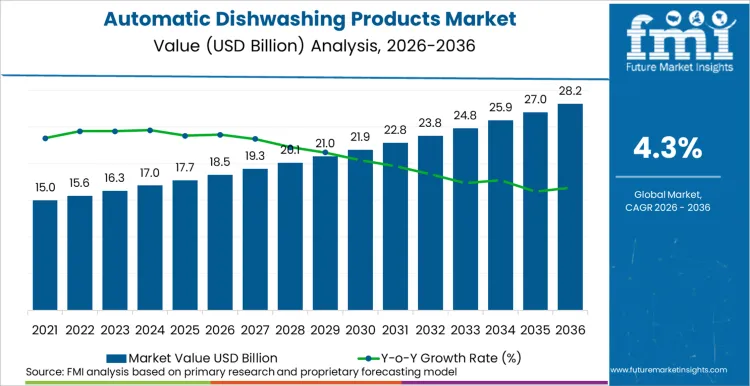
The global automatic dishwashing products sector is on track to achieve a valuation of USD 28.2 billion by 2036, expanding from USD 18.5 billion in 2026 at a CAGR of 4.3%. As per Future Market Insights, expansion is structurally underpinned by rising global dishwasher penetration rates, the premiumization of detergent formulations toward concentrated and multi-action formats, and the emergence of AI-powered dosing technology that links detergent consumption directly to appliance intelligence.
Euromonitor International data confirms that global dishwasher ownership continues to rise in Asia Pacific and Latin America, where penetration rates remain below 15%, creating a structural tailwind for automatic dishwashing product volumes. This expanding installed base compels detergent manufacturers to invest in formats optimized for machine efficiency rather than manual cleaning. Simultaneously, the regulatory landscape in Europe is tightening restrictions on phosphate content and surfactant biodegradability under REACH and the EU Ecolabel framework, forcing reformulation across the product portfolio.
Kris Licht, CEO of Reckitt, stated: 'The completion of the divestment of Essential Home is a major step forward in our strategy, moving Reckitt towards becoming a simpler, more effective world-class consumer health and hygiene company focused on a core portfolio of high-growth, high-margin Powerbrands.
This confirms that Reckitt's USD 2.2 billion divestiture of its Essential Home business to Advent International in December 2025 concentrates its automatic dishwashing portfolio around the Finish brand, signaling that major FMCG companies view premium dishwashing products as a strategic growth category rather than a commodity segment. FMI opines that this portfolio concentration will intensify competitive pressure in the premium automatic dishwashing segment as Reckitt, Henkel (Somat), and P&G (Cascade) each deploy differentiated technology platforms to capture share.
The product development landscape in 2025 and 2026 has been defined by technology integration and formulation upgrades. Henkel introduced Smartwash technology at CES 2025, an AI-powered cartridge-based dosing system for dishwashers under the Somat brand that uses autonomous sensing to dispense precise detergent amounts at optimal times during wash cycles.
P&G launched an upgraded Cascade Platinum Plus formulation in early 2025, featuring advanced enzyme technology and enhanced grease-fighting capabilities designed to eliminate the need for pre-washing. Reckitt completed the USD 2.2 billion divestiture of its Essential Home business to Advent International in December 2025, consolidating its dishwashing portfolio around the Finish Powerbrand. As per FMI, this convergence of smart dosing technology, formulation science, and portfolio rationalization confirms that the automatic dishwashing products market is transitioning from a volume-driven commodity category to a technology-enabled premium segment where innovation velocity determines market share.
Key Takeaways
The automatic dishwashing products market is controlled by a concentrated oligopoly where Reckitt (Finish), Henkel (Somat/Persil), and Procter & Gamble (Cascade) command the majority of global retail shelf space and brand recognition. FMI analysts observe that these three companies collectively invest more in dishwashing product R&D than the rest of the market combined, creating a technology barrier that private label and regional brands cannot match, particularly in AI-powered dosing and concentrated formulation chemistry.
Pricing asymmetry in the automatic dishwashing products market exists between premium multi-action tablets and pods (USD 0.30 to 0.50 per wash cycle) and economy powder formats (USD 0.05 to 0.10 per wash cycle). As per FMI, the premium segment is growing at 3 to 4 times the rate of economy formats, driven by consumer willingness to pay for convenience, superior cleaning performance, and machine protection claims. Smart dosing cartridge systems will further widen this gap by locking consumers into proprietary consumable formats.
Sourcing fragility is concentrated in the specialty enzyme and surfactant supply chain. Novozymes (now Novonesis) and IFF control the majority of global enzyme supply for automatic dishwashing formulations, creating a supplier concentration risk for detergent manufacturers. FMI is of the opinion that any disruption to enzyme production capacity would immediately impact premium detergent availability, as enzymes are the primary performance differentiator in modern formulations.
Brand and compliance risks center on environmental claims and the tightening of EU Ecolabel criteria for dishwashing products. Manufacturers making biodegradability, phosphate-free, or low-carbon claims face increasing scrutiny from both regulators and consumer advocacy groups. Henkel's research finding that 57% of consumers are unsure of correct dosing validates the environmental case for smart dosing technology as a waste reduction mechanism.
Geographic leverage is concentrated in Western Europe, which accounts for the highest dishwasher penetration and premium detergent adoption rates. North America follows with strong Cascade brand dominance. Asia Pacific is the fastest-growing region driven by rapid dishwasher adoption in China, South Korea, and urban India. Latin America and the Middle East are early-stage markets where dishwasher penetration growth directly drives first-time automatic detergent adoption.
The executive reframing for the automatic dishwashing products market is that the detergent-appliance interface is becoming the primary competitive battleground. FMI analysts emphasize that FMCG executives must invest in co-development partnerships with appliance manufacturers to ensure their detergent formats are optimized for, and potentially locked into, the next generation of connected dishwashers.
Summary of Automatic Dishwashing Products Market
What Is Growth Outlook for Automatic Dishwashing Products Market as per Future Market Insights Projection?
Future Market Insights projects the automatic dishwashing products market to expand at a CAGR of 4.3% from 2026 to 2036, increasing from USD 18.5 Billion in 2026 to USD 28.2 Billion by 2036.
FMI Research Approach: FMI proprietary forecasting model based on global dishwasher installed base growth and detergent format premiumization trends.
How Do FMI Analysts Perceive Automatic Dishwashing Products Market to Evolve?
FMI analysts perceive the market evolving toward AI-powered smart dosing platforms and concentrated multi-action formulations where detergent-appliance co-optimization replaces standalone product competition.
FMI Research Approach: Henkel CES 2025 Smartwash technology disclosure and P&G Cascade formulation upgrade tracking.
Which Country Holds Largest Share in Global Automatic Dishwashing Products Market?
The United States holds a significant share of the global automatic dishwashing products market by value which is supported by high dishwasher penetration rates and premium detergent format adoption.
FMI Research Approach: FMI country-level revenue modeling by dishwasher installed base and per-household detergent expenditure.
How Large Will Automatic Dishwashing Products Market Be by 2036?
The global automatic dishwashing products market is projected to reach USD 28.2 Billion by 2036.
FMI Research Approach: FMI long-term revenue forecast derived from dishwasher penetration growth projections and format mix shift modeling.
What Is Definition of Automatic Dishwashing Products Market?
The automatic dishwashing products market includes revenue from detergents, rinse aids, machine cleaners, and smart dosing consumables designed for use in residential and commercial dishwashing machines.
FMI Research Approach: FMI market taxonomy and inclusion-exclusion framework.
What Are Globally Unique Trends Shaping Automatic Dishwashing Products Market?
Globally unique trends include AI-powered cartridge-based dosing systems (Henkel Smartwash), portfolio concentration around premium Powerbrands (Reckitt-Finish), and enzyme technology advancements enabling pre-wash elimination (P&G Cascade Platinum Plus).
FMI Research Approach: CES 2025 product launches and Reckitt Essential Home divestiture filings.
Automatic Dishwashing Products Market Key Takeaways
| Metric | Details |
|---|---|
| Industry Size (2026) | USD 18.5 Billion |
| Industry Value (2036) | USD 28.2 Billion |
| CAGR (2026 to 2036) | 4.3% |
Source: Future Market Insights (FMI) analysis, based on proprietary forecasting model and primary research
Regional Performance and Growth Trends in the Automatic Dishwashing Products Market
North America
The Automatic Dishwashing Products Market of North America is expected to dominate the market due to the high adoption rate of dishwashers in homes, and an increasing demand for premium cleaning solutions opportunity offered by dishwasher detergent High focus on eco-friendly detergents is expected to further drive the North America Automatic Dishwashing Products Market growth. The USA and Canada top the region with growing household dishwasher penetration, increasing e-commerce distribution networks and growing consumer preference for time-saving cleaning products.
There is a growing realization among consumers that biodegradable, phosphate-free and plant-based detergents are the way of the future, and this shift is taking place at light speed across North America. The innovation of the product is further propelled by technological development in automatic dishwashing liquids, enzyme-based detergents, and multi-functional pods. This is contributing to the growth of the market as the region has a strong retail presence-from major supermarket chains and online marketplaces to subscription-based detergent services.
Europe
Automatic Dishwashing Products Market of Europe holds a significant share in the Automatic Dishwashing Products Market; leading countries for sustainable cleaning solutions and high-efficiency dishwashing products include Germany, the UK, France, and Italy. Strict European Union (EU) environmental regulations in the region forced manufacturers to remove phosphates, microplastics and harsh chemicals from automatic dishwashing detergents.
Such a scenario is driving demand for low-foam, fast-dissolving, and water-efficient detergents across households, especially in urban apartments using compact and energy-efficient dishwashers. Moreover, the July 2022 introduction of private-label green dishwashing lines across European supermarkets is providing cheaper alternatives to expensive brands, increasing availability of sustainable products for consumers.
Asia-Pacific
The Asia-Pacific region remains the top revenue contributor in the global Automatic Dishwashing Products Market with the highest CAGR, motivated by increase in disposable income, fast urbanization, and growing awareness toward hygiene and automation. Growing demand: China, Japan, South Korea and India are seeing the growth in demand for dishwashers and compatible detergents, primarily among urban centres where convenience and efficiency are in higher demand.
Automatic dishwashing gels, pods, and rinse aids are benefiting from China’s expanding middle-class population and rapid rate of adoption of smart home appliances. Japan and South Korea, both recognized as pioneers in the manufacturing of small household machines like dishwashers, are playing a role in the creation of super concentrated, water-saving, and fragrance-free dishwashing products. The growth of dual-income households and a growing awareness of hygiene standards in such emerging markets, like India’s emerging dishwasher market, is also driving the market growth in the region.
Demand for personalized and subscription-based dishwashing products is additionally growing in Asia-Pacific because of the increase in online retail and direct-to-consumer sales fashions as well as AI-enabled good dishwashing methods.
Shifts in the Automatic Dishwashing Products Market from 2021 to 2025 and Future Trends 2025 to 2035
From 2021 and 2025, the automatic dishwashing products market grew massively as more consumers wanted the convenience, hygiene and sustainability. Rising double income households, urbanization along with impetus towards smart kitchen devices pushed the segment for dishwashing detergents tablets, gels, powders, and rinse aids. Changing perceptions regarding water and energy efficiency had also an impact on product innovation, contributing to the creation of low-phosphate biodegradable and eco-friendly detergents.
The automatic dishwashing products market is projected to experience transformational advancements during 2025 to 2035, with AI-based smart dosing technology, waterless dishwashing solutions, and biodegradable nanocoatings reinventing the industry process. Moreover, AI-powered smart dishwashers will determine the precise amount of detergent needed per load according to its type and whether it is dirty or not, thus saving time and water. The rise of solid-state and encapsulated enzyme detergents will provide sustainable and extended performance.
Market Shifts: A Comparative Analysis (2021 to 2025 vs. 2026 to 2036)
| Market Shift | 2021 to 2025 |
|---|---|
| Regulatory Landscape | Stricter phosphate and microplastic bans, eco-label compliance, and low-VOC detergent regulations. |
| Technological Advancements | Growth in enzyme-based detergents, biodegradable surfactants, and concentrated gel formulas. |
| Industry Applications | Used in households, commercial kitchens, and industrial foodservice operations. |
| Adoption of Smart Equipment | Limited integration with smart dishwashers and automatic dosing systems. |
| Sustainability & Cost Efficiency | Adoption of eco-friendly detergents, compostable packaging, and reduced water consumption. |
| Data Analytics & Predictive Modeling | Basic usage tracking through smart dishwashers and detergent efficiency analysis. |
| Production & Supply Chain Dynamics | Supply chain affected by raw material fluctuations, rising costs of green ingredients, and logistical disruptions. |
| Market Growth Drivers | Growth driven by urbanization, time-saving consumer trends, and eco-conscious product demand. |
| Market Shift | 2026 to 2036 |
|---|---|
| Regulatory Landscape | Blockchain-enabled ingredient verification, AI-driven regulatory compliance tracking, and global green certification standards. |
| Technological Advancements | AI-powered smart dishwashing systems, probiotic-infused cleaning solutions, and self-cleaning nano-coatings. |
| Industry Applications | Expansion into waterless dishwashing appliances, zero-residue cleaning solutions, and AI-assisted dish care automation. |
| Adoption of Smart Equipment | AI-optimized detergent dispensing, IoT-connected dish care assistants, and load-specific auto-cleaning formulations. |
| Sustainability & Cost Efficiency | Ultra-low water dishwashing solutions, AI-driven detergent refilling systems, and carbon-neutral detergent production. |
| Data Analytics & Predictive Modeling | Real-time AI-powered dishwashing performance optimization, predictive detergent replenishment, and blockchain-based sustainability tracking. |
| Production & Supply Chain Dynamics | AI-enhanced supply chain automation, decentralized detergent production hubs, and on-demand detergent refill stations. |
| Market Growth Drivers | Future expansion fueled by smart kitchen automation, AI-assisted dish care, and zero-residue cleaning innovations. |
Market Definition
The automatic dishwashing products market represents revenue generated from the manufacture and sale of chemical consumables designed for use in residential and commercial dishwashing machines. The market measures the value of detergent tablets, pods, powders, gels, rinse aids, machine cleaners, and smart dosing cartridges sold through retail, e-commerce, and B2B channels.
Inclusions cover automatic dishwasher detergent tablets and pods, dishwasher powder and gel formulations, rinse aids and drying agents, machine descalers and cleaners, smart dosing cartridges and refill consumables, and commercial warewashing chemical systems. Eco-certified and phosphate-free formulations are also included.
Exclusions include manual hand dishwashing liquids and soaps, dishwasher appliance hardware, industrial plate heat exchanger cleaning chemicals, and food service sanitizers not designed for machine dishwashing cycles. General-purpose kitchen surface cleaners are outside the scope.
Country-wise Insights
United States
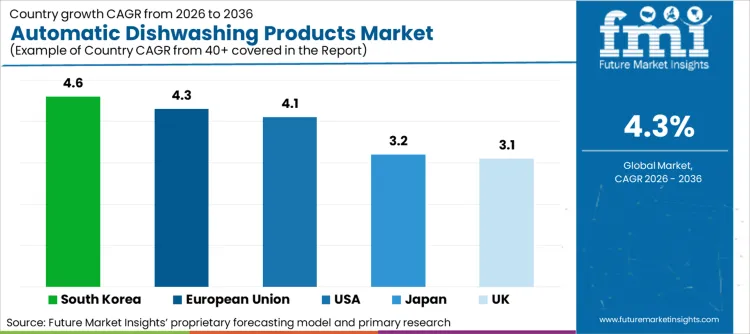
The USA automatic dishwashing products market is expected to grow because of the growing use of dishwashers, the growing need for eco-friendly detergents, and the use of new cleaning solutions in automatic dishwashing product formulations. Under its Safer Choice program, the USA Environmental Protection Agency is promoting phosphate-free and biodegradable dishwashing products. Good call for dishwasher tablets, pods, and gel-based solution sourced cleaning products see consumers moving to more convenience-driven cleaning solutions. Top brands like Finish, Cascade, and Seventh Generation are creating new formulas with a combination of enzymatic and plant-based cleaning agents to offer both power and sustainability.
Besides, the surging smart home trend and growing penetration of automatic dishwashers in the USA households are also paving the way for market growth.
| Country | CAGR (2026 to 2036) |
|---|---|
| USA | 4.1% |
United Kingdom
The UK Automatic Dishwashing Products Market is influenced by factors such as increasing adoption of dishwashers in households, growing awareness about sustainable cleaning products, regulations by the government regarding sustainable packaging. Due to the UK’s Plastic Packaging Tax and sustainability initiatives, makers are creating recyclable, plastic-free packaging solutions for dishwashing products. Moreover, preference for low-chemical, allergen-free detergents is providing potential avenues of growth for organic and non-toxic formulations.
Increasing penetration of e-commerce platforms and direct-to-consumer sales channels is further enabling the reach of premium automatic dishwashing powders, gels, and tablets in the UK market.
| Country | CAGR (2026 to 2036) |
|---|---|
| UK | 3.9% |
European Union
In the European Union, a fast-growing market for Automatic Dishwashing Products is driven by environmental regulations, high penetration of dishwashers and demand for sustainable and high-efficacy detergents. There are regulations by the European Chemicals Agency on phosphates and micro plastics in detergents, sparking innovation in sustainable, biodegradable dishwashing products.
It’s most important markets are Germany, France, and Italy, followed by rising trends for premium and organic dishwashing brands. Demand for low-temperature-activated detergents that boost cleaning while consuming less water and energy is also being driven by the move towards environmentally friendly and energy-efficient dishwasher solutions.
| Country | CAGR (2026 to 2036) |
|---|---|
| European Union (EU) | 4.3% |
Japan
Rising urbanization, increasing adoption of compact dishwashers, rising demand for high-efficiency detergents are some factors boosting the growth of Automatic Dishwashing Products Market in Japan. According to the Japanese Ministry of the Environment, the use of concentrated and biodegradable detergents is also an ecological cleaning practice.
With a taste in Japan for fragrance-free and skin-sensitive dishwashing formulations, there is demand for hypoallergenic, plant-based dishes. Dishwasher makers like Panasonic and Toshiba, on the other hand, are busy developing high-efficiency dishwashers that use low-foam, enzyme-based detergents which can leave behind food stains if you ignore the manufacturer's recommendations.
| Country | CAGR(2026 to 2036) |
|---|---|
| Japan | 3.2% |
South Korea
The market for automatic dishwashing products in South Korea has seen strong growth driven by a confluence of growing disposable incomes, increasing urbanization, and rising demand for high-performance cleaning solutions. Guided by these facts, the Korean Ministry of Environment recommends using green and non-phosphate dish-washing goods, to cut back on the pollution of the water.
The rising popularity of smart kitchen appliances is driving up demand for niche cleaning products for high-tech dishwashers. South Korea’s booming e-commerce market is also increasingly making access to convenient, subscription-based dishwashing products available to consumers.
| Country | CAGR (2026 to 2036) |
|---|---|
| South Korea | 4.6% |
Automatic Dishwashing Products Market - Segmentation Outlook
Detergent Tablets and Detergent Gel Drive Market Growth as Consumers Seek Efficiency and Convenience
The automatic dishwasher products market is experiencing robust growth as a result of the growing adoption of dishwashers in the household, commercial establishments, enhance the focus on convenience and developments in detergent formulations. Depending on product type, the market is categorized into detergent tablets and detergent gel, with the former accounting for a major share in the market owing to higher convenience associated with them, better cleaning performance, and increasing demand for environment-friendly formulations.
Detergent Tablets Lead Market Demand with Pre-Measured, High-Efficiency Cleaning Solutions
Automatic dishwasher detergent tablets are the most popular product as they contain a premeasured detergent concentration, which provides Herculean cleaning properties and reduces waste. These three-in-one tablets feature detergent, rinse aid, and grease-cutting agents, delivering better stain removal, grease-cutting and water softening all without needing extra products.
Globally, the rising preference for convenience and multi-purpose cleaning with detergents has been a strong driver for detergent tablets especially in households and commercial kitchens where quick, mess-free, and effective cleaning cycles are prioritized. Another rising category are eco-friendly, biodegradable, and phosphate-free detergent tablets, and sustainability concerns are increasingly affecting consumers' choice of what to buy.
Though, costs higher than traditional detergent powders and impacting packaging waste remains a challenge. These collectively render the product more sustainable and reduce costs to the customers, and hence manufacturers are working on water soluble film coatings, plastic-free packaging and concentrated tablet formulations.
Detergent Gel Gains Popularity for Its Customizable Dosage and Enhanced Solubility
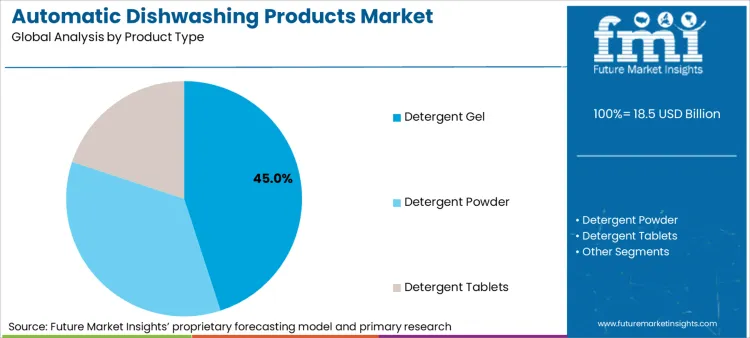
Detergent gel is another top product category, praised for its ability to dissolve rapidly, dose to personal preference and provide streak-free cleaning performance. Unlike the common tablets and powders, detergent gel can also be adapted as per the load size, soil level, and dishwasher settings making it a versatile choice for different washing requirements.
Growing use of compact and energy efficient dishwashers in urban households has driven the demand for low-residue, fast-acting detergent gels for dishwashing, especially among environmentally-aware consumers seeking together phosphate-free and plant-based formulations. Moreover, gel-based detergents with enzyme, fragrance boosters, and anti-hard-water agents are on the rise for their gentle yet strong cleaning abilities.
While detergent gel offers several benefits, it has its downsides as well, like higher packaging costs and a risk of overuse due to the absence of portion control. Innovations in biodegradable gel formulations, concentrated gel capsules and smart-dosing dispensers are likely to facilitate the wide adoption of this segment.
Commercial and Residential Applications Drive Market Expansion as Dishwasher Penetration Increases
Automatic dishwashing products are in high demand across commercial and residential applications, as consumers and businesses seek time-saving, water-saving, and hygienic dishwashing solutions.
Commercial Segment Leads Market as Foodservice Industry Prioritizes Hygiene and Efficiency
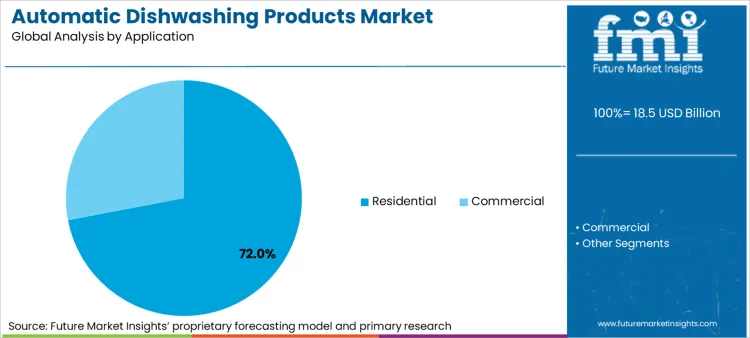
Automatic dishwashing products are mainly for commercial use, and the commercial end user segment accounts for a considerable share, owing to the necessity of high-volume dishwashing in restaurants, hotels, catering services, and institutional kitchens. In restaurants and commercial kitchens their use of industrial dishwashers has led to the development of high-performance detergent tabs and gels capable of achieving rapid, streak-free dish cleanliness without damaging glassware and utensils.
Stricter food safety guidelines and hygiene standards in the foodservice sector have also resulted in an increasing adoption of antibacterial, eco-friendly, and fragrance-free dishwashing detergents, which help make clean-ups safe and free of harmful chemicals. Moreover, the need for bulk pickings and low-cost detergent refills are also expected to increase with the commercial industries pursuing economical and waste-free cleaning solutions.
Although dishwasher tablets are highly sought after, they are not without their challenges, including water hardness issues, their compatibility with different models, and residue build up on glassware. From evolving industrial-strength detergent formulations through supplementation with water softening agents, to AI-directed dishwasher cycle optimization, the commercial dishwashing space is primed for further enhancement.
Residential Segment Expands as Dishwasher Ownership Rises in Urban Households
Residential Segment, Strong Growth with Increasing Adoption of Dishwashers in New Households, Specifically in Urban and Higher Income Regions. With combinations of these features, consumers are increasingly opting for dishwasher-friendly detergent tablets and gels, as they require minimal effort to use, save on water and grease-removing is generally superior to handwashing.
The increasing preference for convenient, single-dose detergent solutions has also fuelled the growth of all-in-one detergent tablets, which eliminate the requirement for separate rinse aids and water softeners. Moreover, the shift towards environments friendly and skin-safe detergent formulations is affecting the evolution of biodegradable, fragrance-free and plant-based dish washing products.
On a broader basis, price sensitivity, based on limited dishwasher penetration, has hindered the growth of the residential segment in developing markets. To appeal to a wider variety of consumers, manufacturers are responding to these concerns with affordably priced detergent packs, multipurpose cleaning formulas, and compact dishwasher-compatible solutions.
Competitive Outlook
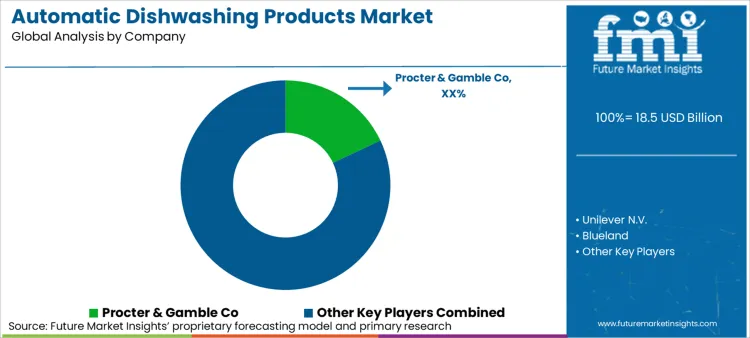
Rising environmental concerns worldwide are likely to increase the demand for commercial automatic dishwashing products while an increase in disposable income has also given rise to demand for household automatic dishwashing products, thus driving the growth of the automatic dishwashing products market. The market is powered by technical developments in enzyme-based organizations, water-efficient products, and smart dish-washing appliances. Companies are introducing sustainable packages, phosphate-free detergent, and multi-functional cleaning agents for both residential and commercial users. Global household cleaning product manufacturers, specialty chemical firms, and eco-friendly product innovators are all involved in this push, developing new dishwashing tablets, gels, and powders, and rinse aids as well.
Market Share Analysis by Company
| Company Name | Estimated Market Share (%) |
|---|---|
| Procter & Gamble Co. (Cascade, Fairy) | 18-22% |
| Reckitt Benckiser Group plc (Finish) | 15-19% |
| Unilever plc (Sun, Seventh Generation) | 10-14% |
| Henkel AG & Co. KGaA (Somat) | 8-12% |
| Church & Dwight Co., Inc. (OxiClean) | 6-10% |
| Other Companies (combined) | 30-40% |
Key Company Offerings and Activities
| Company Name | Key Offerings/Activities |
|---|---|
| Procter & Gamble Co. (Cascade, Fairy) | Produces enzyme-based automatic dishwashing pods, tablets, and liquid detergents with grease-fighting capabilities. |
| Reckitt Benckiser Group plc (Finish) | Specializes in multi-functional dishwasher tablets, rinse aids, and eco-friendly automatic dishwashing solutions. |
| Unilever plc (Sun, Seventh Generation) | Offers phosphate-free, plant-based dishwashing detergents focused on sustainability and biodegradable ingredients. |
| Henkel AG & Co. KGaA (Somat) | Develops high-performance dishwashing powders, gels, and water-saving detergent formulations. |
| Church & Dwight Co., Inc. (OxiClean) | Provides oxygen-powered dishwashing boosters and eco-friendly dishwashing formulas. |
Key Company Insights
Procter & Gamble Co. (18-22%)
As a leader in automatic dishwashing products, P&G makes Cascade and Fairy dishwashing detergents that use enzymatic grease-cutting power and water-efficient cleaning performance.
Reckitt Benckiser Group plc (15-19%)
Reckitt Benckiser is a global leader in manufacture of Finish-branded dishwashing products, emphasizing multi-action tablets as well as rinse aids and low temp cleaning solutions for hard water regions.
Unilever plc (10-14%)
Under brands such as Sun and Seventh Generation, Unilever offers eco-friendly dishwashing detergents and products that are plant-based, biodegradable, phosphate-free.
Henkel AG & Co. KGaA (8-12%)
Henkel provides premium dishwasher detergents under the Somat brand, integrating anti-stain and water-efficient cleaning technologies.
Church & Dwight Co., Inc. (6-10%)
Church & Dwight offers OxiClean dishwashing boosters and oxygen-powered detergents, catering to eco-conscious consumers and high-efficiency dishwashers.
Other Key Players (30-40% Combined)
Several household cleaning product manufacturers and eco-friendly brands contribute to innovations in sustainable packaging, enzyme-based detergents, and advanced dishwasher cleaning solutions. These include:
- Ecover (SC Johnson & Son, Inc.) - Develops plant-based automatic dishwashing detergents with biodegradable ingredients
- Colgate-Palmolive Company (Palmolive) - Provides phosphate-free dishwashing tablets and eco-friendly cleaning solutions
- Amway Corporation (Dish Drops) - Specializes in concentrated, water-efficient automatic dishwashing liquids
- Kao Corporation - Focuses on enzyme-activated dishwashing powders and gels for Asian markets
- Werner & Mertz GmbH (Frosch) - Offers environmentally friendly dishwashing detergents with recyclable packaging
Recent Developments
- In January 2025, Henkel introduced Smartwash technology at CES 2025, an AI-powered cartridge-based dosing system under the Somat brand that uses autonomous sensing to dispense precise detergent amounts during wash cycles.
- In early 2025, Procter & Gamble launched an upgraded Cascade Platinum Plus formulation featuring advanced enzyme technology and enhanced grease-fighting capabilities designed to eliminate pre-washing requirements.
- In December 2025, Reckitt completed the USD 2.2 billion divestiture of its Essential Home business to Advent International, consolidating its automatic dishwashing portfolio around the Finish Powerbrand.
Scope of Report
| Items | Values |
|---|---|
| Quantitative Units (2026) | USD 18.5 Billion |
| Product Type | Detergent Tablets and Pods, Powder Detergents, Gel Detergents, Rinse Aids, Machine Cleaners, Smart Dosing Cartridges |
| Material Type | Enzyme-Based Formulations, Surfactant-Based, Oxygen Bleach-Based, Phosphate-Free, Bio-Based and Eco-Certified |
| End-Use / Channel | Grocery and Mass Retail, E-Commerce, Warehouse Clubs, B2B Commercial Warewashing, Appliance-Bundled Consumables |
| Regions Covered | North America, Europe, Asia Pacific, Latin America, Middle East and Africa |
| Countries Covered | USA, Germany, UK, France, China, Japan, India, Brazil, and 40+ countries |
| Key Companies Profiled | Reckitt (Finish), Henkel (Somat), P&G (Cascade), Ecover, Seventh Generation (Unilever), Method (SC Johnson) |
| Additional Attributes | Revenue analysis by detergent format and distribution channel, smart dosing technology adoption tracking, enzyme supplier concentration analysis, EU Ecolabel compliance monitoring, and dishwasher penetration rate correlation |
Automatic Dishwashing Products Market Segmentation by Category
By Product Type, Automatic Dishwashing Products market is segmented as:
- Detergent Gel
- Detergent Powder
- Detergent Tablets
By Application, Automatic Dishwashing Products Market is segmented as:
- Commercial
- Residential
By Sales Channel, Automatic Dishwashing Products Market is segmented as:
- Hypermarkets/ Supermarkets
- Convenience Stores
- Modern Trade
- Wholesalers/ Distributors
- Online Retailers
- Other Sales Channel
By Region, Automatic Dishwashing Products Market is segmented as:
- North America
- Latin America
- Europe
- East Asia
- South Asia
- Oceania
- The Middle East and Africa (MEA)
Frequently Asked Questions
What is the current global market size for Automatic Dishwashing Products?
The global market is valued at USD 18.5 Billion in 2026, driven by premium detergent format adoption and AI-powered dosing technology integration.
What is the projected Compound Annual Growth Rate (CAGR) for the market over the next 10 years?
The market is projected to grow at a CAGR of 4.3% from 2026 to 2036.
Which regions are experiencing the fastest expansion?
Asia Pacific leads growth driven by rising dishwasher penetration in China and India, followed by Europe where premium format adoption and smart dosing technology are driving value growth.
What are the primary market drivers?
Rising global dishwasher penetration, premiumization toward concentrated multi-action formats, and AI-powered dosing technology integration are the primary drivers.
Who are the leading suppliers in the industry?
Reckitt (Finish), Henkel (Somat), and P&G (Cascade) are key players, differentiating through proprietary formulation technology, smart dosing platforms, and premium Powerbrand positioning.
Preview the report firsthand - request a free sample
Get SampleGet the brochure for pricing and purchase details.
Get PDFTable of Content
- Executive Summary
- Global Market Outlook
- Demand-side Trends
- Supply-side Trends
- Technology Roadmap Analysis
- Analysis and Recommendations
- Market Overview
- Market Coverage / Taxonomy
- Market Definition / Scope / Limitations
- Research Methodology
- Chapter Orientation
- Analytical Lens and Working Hypotheses
- Market Structure, Signals, and Trend Drivers
- Benchmarking and Cross-market Comparability
- Market Sizing, Forecasting, and Opportunity Mapping
- Research Design and Evidence Framework
- Desk Research Programme (Secondary Evidence)
- Company Annual and Sustainability Reports
- Peer-reviewed Journals and Academic Literature
- Corporate Websites, Product Literature, and Technical Notes
- Earnings Decks and Investor Briefings
- Statutory Filings and Regulatory Disclosures
- Technical White Papers and Standards Notes
- Trade Journals, Industry Magazines, and Analyst Briefs
- Conference Proceedings, Webinars, and Seminar Materials
- Government Statistics Portals and Public Data Releases
- Press Releases and Reputable Media Coverage
- Specialist Newsletters and Curated Briefings
- Sector Databases and Reference Repositories
- FMI Internal Proprietary Databases and Historical Market Datasets
- Subscription Datasets and Paid Sources
- Social Channels, Communities, and Digital Listening Inputs
- Additional Desk Sources
- Expert Input and Fieldwork (Primary Evidence)
- Primary Modes
- Qualitative Interviews and Expert Elicitation
- Quantitative Surveys and Structured Data Capture
- Blended Approach
- Why Primary Evidence is Used
- Field Techniques
- Interviews
- Surveys
- Focus Groups
- Observational and In-context Research
- Social and Community Interactions
- Stakeholder Universe Engaged
- C-suite Leaders
- Board Members
- Presidents and Vice Presidents
- R&D and Innovation Heads
- Technical Specialists
- Domain Subject-matter Experts
- Scientists
- Physicians and Other Healthcare Professionals
- Governance, Ethics, and Data Stewardship
- Research Ethics
- Data Integrity and Handling
- Primary Modes
- Tooling, Models, and Reference Databases
- Desk Research Programme (Secondary Evidence)
- Data Engineering and Model Build
- Data Acquisition and Ingestion
- Cleaning, Normalisation, and Verification
- Synthesis, Triangulation, and Analysis
- Quality Assurance and Audit Trail
- Market Background
- Market Dynamics
- Drivers
- Restraints
- Opportunity
- Trends
- Scenario Forecast
- Demand in Optimistic Scenario
- Demand in Likely Scenario
- Demand in Conservative Scenario
- Opportunity Map Analysis
- Product Life Cycle Analysis
- Supply Chain Analysis
- Investment Feasibility Matrix
- Value Chain Analysis
- PESTLE and Porter’s Analysis
- Regulatory Landscape
- Regional Parent Market Outlook
- Production and Consumption Statistics
- Import and Export Statistics
- Market Dynamics
- Global Market Analysis 2021 to 2025 and Forecast, 2026 to 2036
- Historical Market Size Value (USD Million) Analysis, 2021 to 2025
- Current and Future Market Size Value (USD Million) Projections, 2026 to 2036
- Y-o-Y Growth Trend Analysis
- Absolute $ Opportunity Analysis
- Global Market Pricing Analysis 2021 to 2025 and Forecast 2026 to 2036
- Global Market Analysis 2021 to 2025 and Forecast 2026 to 2036, By Product Type
- Introduction / Key Findings
- Historical Market Size Value (USD Million) Analysis By Product Type , 2021 to 2025
- Current and Future Market Size Value (USD Million) Analysis and Forecast By Product Type , 2026 to 2036
- Detergent Gel
- Detergent Powder
- Detergent Tablets
- Detergent Gel
- Y-o-Y Growth Trend Analysis By Product Type , 2021 to 2025
- Absolute $ Opportunity Analysis By Product Type , 2026 to 2036
- Global Market Analysis 2021 to 2025 and Forecast 2026 to 2036, By Application
- Introduction / Key Findings
- Historical Market Size Value (USD Million) Analysis By Application, 2021 to 2025
- Current and Future Market Size Value (USD Million) Analysis and Forecast By Application, 2026 to 2036
- Residential
- Commercial
- Residential
- Y-o-Y Growth Trend Analysis By Application, 2021 to 2025
- Absolute $ Opportunity Analysis By Application, 2026 to 2036
- Global Market Analysis 2021 to 2025 and Forecast 2026 to 2036, By Region
- Introduction
- Historical Market Size Value (USD Million) Analysis By Region, 2021 to 2025
- Current Market Size Value (USD Million) Analysis and Forecast By Region, 2026 to 2036
- North America
- Latin America
- Western Europe
- Eastern Europe
- East Asia
- South Asia and Pacific
- Middle East & Africa
- Market Attractiveness Analysis By Region
- North America Market Analysis 2021 to 2025 and Forecast 2026 to 2036, By Country
- Historical Market Size Value (USD Million) Trend Analysis By Market Taxonomy, 2021 to 2025
- Market Size Value (USD Million) Forecast By Market Taxonomy, 2026 to 2036
- By Country
- USA
- Canada
- Mexico
- By Product Type
- By Application
- By Country
- Market Attractiveness Analysis
- By Country
- By Product Type
- By Application
- Key Takeaways
- Latin America Market Analysis 2021 to 2025 and Forecast 2026 to 2036, By Country
- Historical Market Size Value (USD Million) Trend Analysis By Market Taxonomy, 2021 to 2025
- Market Size Value (USD Million) Forecast By Market Taxonomy, 2026 to 2036
- By Country
- Brazil
- Chile
- Rest of Latin America
- By Product Type
- By Application
- By Country
- Market Attractiveness Analysis
- By Country
- By Product Type
- By Application
- Key Takeaways
- Western Europe Market Analysis 2021 to 2025 and Forecast 2026 to 2036, By Country
- Historical Market Size Value (USD Million) Trend Analysis By Market Taxonomy, 2021 to 2025
- Market Size Value (USD Million) Forecast By Market Taxonomy, 2026 to 2036
- By Country
- Germany
- UK
- Italy
- Spain
- France
- Nordic
- BENELUX
- Rest of Western Europe
- By Product Type
- By Application
- By Country
- Market Attractiveness Analysis
- By Country
- By Product Type
- By Application
- Key Takeaways
- Eastern Europe Market Analysis 2021 to 2025 and Forecast 2026 to 2036, By Country
- Historical Market Size Value (USD Million) Trend Analysis By Market Taxonomy, 2021 to 2025
- Market Size Value (USD Million) Forecast By Market Taxonomy, 2026 to 2036
- By Country
- Russia
- Poland
- Hungary
- Balkan & Baltic
- Rest of Eastern Europe
- By Product Type
- By Application
- By Country
- Market Attractiveness Analysis
- By Country
- By Product Type
- By Application
- Key Takeaways
- East Asia Market Analysis 2021 to 2025 and Forecast 2026 to 2036, By Country
- Historical Market Size Value (USD Million) Trend Analysis By Market Taxonomy, 2021 to 2025
- Market Size Value (USD Million) Forecast By Market Taxonomy, 2026 to 2036
- By Country
- China
- Japan
- South Korea
- By Product Type
- By Application
- By Country
- Market Attractiveness Analysis
- By Country
- By Product Type
- By Application
- Key Takeaways
- South Asia and Pacific Market Analysis 2021 to 2025 and Forecast 2026 to 2036, By Country
- Historical Market Size Value (USD Million) Trend Analysis By Market Taxonomy, 2021 to 2025
- Market Size Value (USD Million) Forecast By Market Taxonomy, 2026 to 2036
- By Country
- India
- ASEAN
- Australia & New Zealand
- Rest of South Asia and Pacific
- By Product Type
- By Application
- By Country
- Market Attractiveness Analysis
- By Country
- By Product Type
- By Application
- Key Takeaways
- Middle East & Africa Market Analysis 2021 to 2025 and Forecast 2026 to 2036, By Country
- Historical Market Size Value (USD Million) Trend Analysis By Market Taxonomy, 2021 to 2025
- Market Size Value (USD Million) Forecast By Market Taxonomy, 2026 to 2036
- By Country
- Kingdom of Saudi Arabia
- Other GCC Countries
- Turkiye
- South Africa
- Other African Union
- Rest of Middle East & Africa
- By Product Type
- By Application
- By Country
- Market Attractiveness Analysis
- By Country
- By Product Type
- By Application
- Key Takeaways
- Key Countries Market Analysis
- USA
- Pricing Analysis
- Market Share Analysis, 2025
- By Product Type
- By Application
- Canada
- Pricing Analysis
- Market Share Analysis, 2025
- By Product Type
- By Application
- Mexico
- Pricing Analysis
- Market Share Analysis, 2025
- By Product Type
- By Application
- Brazil
- Pricing Analysis
- Market Share Analysis, 2025
- By Product Type
- By Application
- Chile
- Pricing Analysis
- Market Share Analysis, 2025
- By Product Type
- By Application
- Germany
- Pricing Analysis
- Market Share Analysis, 2025
- By Product Type
- By Application
- UK
- Pricing Analysis
- Market Share Analysis, 2025
- By Product Type
- By Application
- Italy
- Pricing Analysis
- Market Share Analysis, 2025
- By Product Type
- By Application
- Spain
- Pricing Analysis
- Market Share Analysis, 2025
- By Product Type
- By Application
- France
- Pricing Analysis
- Market Share Analysis, 2025
- By Product Type
- By Application
- India
- Pricing Analysis
- Market Share Analysis, 2025
- By Product Type
- By Application
- ASEAN
- Pricing Analysis
- Market Share Analysis, 2025
- By Product Type
- By Application
- Australia & New Zealand
- Pricing Analysis
- Market Share Analysis, 2025
- By Product Type
- By Application
- China
- Pricing Analysis
- Market Share Analysis, 2025
- By Product Type
- By Application
- Japan
- Pricing Analysis
- Market Share Analysis, 2025
- By Product Type
- By Application
- South Korea
- Pricing Analysis
- Market Share Analysis, 2025
- By Product Type
- By Application
- Russia
- Pricing Analysis
- Market Share Analysis, 2025
- By Product Type
- By Application
- Poland
- Pricing Analysis
- Market Share Analysis, 2025
- By Product Type
- By Application
- Hungary
- Pricing Analysis
- Market Share Analysis, 2025
- By Product Type
- By Application
- Kingdom of Saudi Arabia
- Pricing Analysis
- Market Share Analysis, 2025
- By Product Type
- By Application
- Turkiye
- Pricing Analysis
- Market Share Analysis, 2025
- By Product Type
- By Application
- South Africa
- Pricing Analysis
- Market Share Analysis, 2025
- By Product Type
- By Application
- USA
- Market Structure Analysis
- Competition Dashboard
- Competition Benchmarking
- Market Share Analysis of Top Players
- By Regional
- By Product Type
- By Application
- Competition Analysis
- Competition Deep Dive
- Procter & Gamble Co
- Overview
- Product Portfolio
- Profitability by Market Segments (Product/Age /Sales Channel/Region)
- Sales Footprint
- Strategy Overview
- Marketing Strategy
- Product Strategy
- Channel Strategy
- Unilever N.V.
- Blueland
- Bombril
- Reckitt Benckiser Group plc
- Church & Dwight Co. Inc.
- SC Johnson & Son Inc.
- Procter & Gamble Co
- Competition Deep Dive
- Assumptions & Acronyms Used


