

- Industry Size (2025)
- USD 1.8 Bn
- Forecast (2035)
- USD 2.7 Bn
- CAGR (2025 to 2035)
- 4%
Demand for Banding Machine in USA Forecast and Outlook 2025 to 2035
The demand for banding machines in the USA is expected to grow from USD 1.8 billion in 2025 to USD 2.7 billion by 2035, reflecting a compound annual growth rate (CAGR) of 4.0%. Banding machines, used primarily for packaging and bundling items, are essential in industries such as logistics, manufacturing, and retail. As businesses continue to seek more efficient and automated packaging solutions, the demand for these machines is expected to increase steadily, driven by technological advancements and the growing need for streamlined operations.
The market will see consistent growth, with demand rising from USD 1.8 billion in 2025 to USD 1.9 billion in 2026, USD 2.0 billion in 2027, and USD 2.1 billion in 2028. The market will continue to expand, reaching USD 2.2 billion in 2029 and maintaining steady growth through the early 2030s. By 2035, the demand for banding machines is expected to reach USD 2.7 billion, reflecting ongoing demand from various sectors seeking cost-effective and efficient packaging solutions.
Quick Stats of the Demand for Banding Machine in USA
- Demand for Banding Machine in USA Value (2025): USD 1.8 billion
- Demand for Banding Machine in USA Forecast Value (2035): USD 2.7 billion
- Demand for Banding Machine in USA Forecast CAGR (2025-2035): 4%
- Demand for Banding Machine in USA Operation: Automatic (63%)
- Demand for Banding Machine in USA Key Growth Regions: West USA, South USA, Northeast USA, Midwest USA
- Demand for Banding Machine in USA Key Players: Dynaric, Inc., StraPack, Inc., Transpak Equipment Corp., Signode Industrial Group LLC, Fromm Holding AG

What is the Growth Forecast for the Banding Machine Industry in USA through 2035?
The banding machine market in the USA is expected to experience steady, incremental growth through 2035. Starting at USD 1.8 billion in 2025, the market will grow to USD 1.9 billion in 2026, and USD 2.0 billion in 2027. The demand will continue to increase gradually, reaching USD 2.1 billion by 2028 and USD 2.2 billion by 2029. By 2035, the market for banding machines is projected to reach USD 2.7 billion, supported by the rising adoption of packaging automation and continued investments in operational efficiency.
The YoY growth analysis for the banding machine market shows consistent but moderate annual growth. From USD 1.8 billion in 2025, the market will increase by USD 0.1 billion each year until 2029, with annual growth rates of approximately 5.6%. This steady progression reflects gradual market expansion as the adoption of banding machines continues across industries. The growth rate slightly moderates in the later years, but the overall upward trend remains stable, with the market reaching USD 2.7 billion by 2035. This consistent annual increase indicates that the market for banding machines is on a predictable growth path, driven by the steady demand for automated packaging solutions in a variety of industries.
USA Banding Machine Industry Key Takeaways
| Metric | Value |
|---|---|
| Industry Sales Value (2025) | USD 1.8 billion |
| Industry Forecast Value (2035) | USD 2.7 billion |
| Industry Forecast CAGR (2025 to 2035) | 4% |
Why is the Demand for Banding Machines in USA Growing?
Demand for banding machines in the USA is rising as industries increasingly emphasize efficient, reliable, and automated packaging solutions. Banding machines streamline the process of bundling or securing products for shipment or storage. Packaging, logistics, and manufacturing sectors use banding machines to replace manual strapping or less efficient methods. As production volumes and distribution needs grow, especially in sectors such as food & beverage, pharmaceuticals, electronics, consumer goods, and e commerce, companies prefer banding machines because they ensure consistent bundling with reduced labor input and improved throughput. The rise of e commerce and the need for rapid order fulfillment and packaging further supports demand for banding machines across logistics and warehousing operations.
Increasing automation pressures and demand for labor efficient solutions also drive adoption of automatic banding machines. Many firms invest in semi automatic or fully automatic machines to handle high speed banding for large volumes. Automation reduces risk of manual error, improves consistency, and lowers long term labor costs. As manufacturers and packers in the USA modernize their production lines, demand for banding machines grows noticeably. Advances in machine design, speed, reliability, and adaptability to different banding materials (paper, plastic, textile straps) increase their attractiveness. Given ongoing growth in manufacturing output, e commerce, and logistics workflows, demand for banding machines in the USA is expected to rise steadily in coming years.
What Is the Current State of the Demand for Banding Machines in the USA in Terms of Operation and Strapping Speed?
The demand for banding machines in the USA is primarily driven by operation and strapping speed. The leading operation type is automatic, capturing 63% of the market share, while the most common strapping speed range is 1.0-1.5 sec/strap, accounting for 44% of the demand. Banding machines are crucial for packaging and securing items quickly and efficiently, and their use spans across various industries, including logistics, manufacturing, and retail. As the demand for faster and more efficient packaging solutions grows, the adoption of automatic banding machines with higher strapping speeds continues to rise.
How Is Automatic Operation Leading the Demand for Banding Machines in the USA?
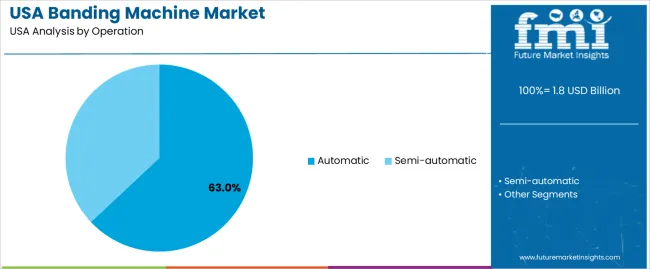
Automatic operation leads the demand for banding machines in the USA, holding 63% of the market share. Automatic banding machines are designed to increase efficiency and reduce the need for manual labor in the packaging process. These machines automatically feed the banding material, apply the strap around the product, and seal it without requiring constant human intervention. This level of automation is particularly valuable in high-volume packaging environments where speed and consistency are critical.
The demand for automatic banding machines is driven by the increasing need for faster and more efficient packaging processes. Industries such as logistics, warehousing, and e-commerce, where large volumes of goods need to be securely packaged and shipped, benefit greatly from the speed and reliability offered by automatic banding machines. With the growing emphasis on reducing labor costs, improving productivity, and streamlining operations, automatic banding machines are expected to continue leading the market in the USA.
How Is 1.0-1.5 sec/strap Leading the Strapping Speed Demand for Banding Machines in the USA?
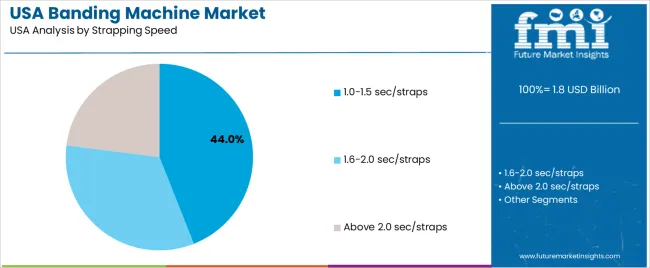
1.0-1.5 sec/strap is the leading strapping speed range for banding machines in the USA, capturing 44% of the market share. Machines operating within this speed range provide a balance between efficiency and quality, ensuring that products are securely strapped within a reasonable timeframe without compromising the integrity of the packaging. This strapping speed is ideal for high-volume operations where rapid packaging is essential, but the quality of the banding process still needs to be maintained.
The demand for banding machines with a strapping speed of 1.0-1.5 sec/strap is driven by the need for faster packaging solutions across industries. With the rise of e-commerce, retail, and logistics, businesses are increasingly looking for machines that can keep up with growing demands for quick turnarounds and efficient packaging. This speed range strikes a good balance between speed and quality, making it a preferred choice for many manufacturers and distributors. As packaging efficiency continues to be a key focus, the demand for banding machines with 1.0-1.5 sec/strap strapping speed is expected to remain strong.
What is the Summary of Demand for Banding Machines in the USA?
Demand for banding machines in the USA has been rising as manufacturers, logistics firms, and e commerce operators increasingly seek efficient, secure, and automated bundling solutions. Banding machines are used to wrap straps or bands around packages, cartons or bundles to stabilize them for storage and transport. As shipments — both domestic and cross border — grow in volume, the need for reliable packaging machinery like banding systems becomes stronger. This results in steady growth in the banding machine segment, reflecting broader expansion of the packaging and logistics sectors in the USA.
What are the Drivers of Demand for Banding Machines in the USA?
Several factors drive demand for banding machines across the USA. First, growth in e commerce and rapid increase in shipments and parcel volumes push companies to adopt automated packaging and bundling equipment to ensure speed, consistency, and safety of packages. Second, manufacturers in industries like food & beverage, pharmaceuticals, consumer goods, and logistics require efficient bundling and palletizing for boxes, cartons, and bundles — banding machines offer a cost effective, secure alternative to manual strapping or adhesive based packaging.
Third, labour cost pressures and shortage of manual workers encourage automation of repetitive packaging tasks; banding machines reduce reliance on manual labour and increase throughput. Fourth, the need for damage protection, load stability during transport, and compliance with handling and transport standards motivates companies to switch to mechanized banding systems rather than manual or less reliable methods. Fifth, demand for packaging solutions that are flexible and adapt to different package sizes, bundle types, or pallet configurations supports use of banding machines over single purpose packaging lines.
What are the Restraints on Demand for Banding Machines in the USA?
Despite growing demand, some factors restrain adoption of banding machines. One restraint is initial investment cost: high speed or fully automatic banding machines represent a significant capital expenditure, which small or low volume businesses may find difficult to justify. Another restraint is maintenance and operational complexity: mechanized banding requires maintenance, correct calibration, and sometimes specialized materials (bands, straps) — raising total cost of ownership and possibly deterring smaller operators.
Third, not all products or packaging formats benefit from banding; for light or low value shipments, manual strapping or simpler packaging may suffice, limiting demand for machine based banding. Fourth, competition from alternate packaging and bundling methods — such as shrink wrapping, stretch film wrapping, adhesive sealing or other automated packaging lines — may reduce the share of banding machines in some segments. Finally, fluctuations in demand (seasonal or cyclical) and variation in shipment volume can make it difficult for some companies to justify continuous operation of banding equipment, leading to under utilization and lower ROI.
What are the Key Trends Influencing Demand for Banding Machines in the USA?
Important trends shaping the demand for banding machines include increasing automation across the packaging, logistics, and manufacturing industries — companies are moving away from manual strapping to automated banding to boost efficiency and reduce labour dependence. Another trend is growth in e commerce and omnichannel retail, which drives high volumes of packaged goods requiring secure bundling for shipping.
There is also rising demand for flexible packaging lines capable of handling diverse products, bundle sizes, and pallet configurations — banding machines offering adjustable settings and easy integration are preferred. Adoption of more sustainable packaging practices and reduction of waste — as banding uses less material than some wrapping methods — supports banding solutions. Additionally, technological improvements including faster cycle times, semi automatic to fully automatic banders, and easier maintenance increase attractiveness of banding machines for newer and retrofit packaging lines.
What is the Regional Demand Outlook for Banding Machines in the USA?
The demand for banding machines in the USA is projected to grow steadily across all regions, with the West USA leading at a CAGR of 4.6%. The South USA follows with a CAGR of 4.1%, driven by industrial growth and manufacturing demand. The Northeast USA is expected to grow at 3.7%, while the Midwest USA shows slightly slower growth at 3.2%. These differences in demand are influenced by regional manufacturing activity, packaging needs, and the adoption of automation technology in various industries.

| Region | CAGR (%) |
|---|---|
| West USA | 4.6 |
| South USA | 4.1 |
| Northeast USA | 3.7 |
| Midwest USA | 3.2 |
What Factors Drive Demand for Banding Machines in the West USA?

In the West USA, the demand for banding machines is projected to grow at a CAGR of 4.6%. This growth is driven by the region's strong industrial base and its focus on packaging automation. States like California are major hubs for manufacturing, logistics, and distribution, creating significant demand for efficient packaging solutions like banding machines. These machines are used to secure products and materials for shipment, which is essential in industries such as agriculture, retail, and e-commerce. The West’s early adoption of automation technology and a growing focus on reducing operational costs support the steady demand for banding machines.
Why is Demand for Banding Machines Increasing in the South USA?
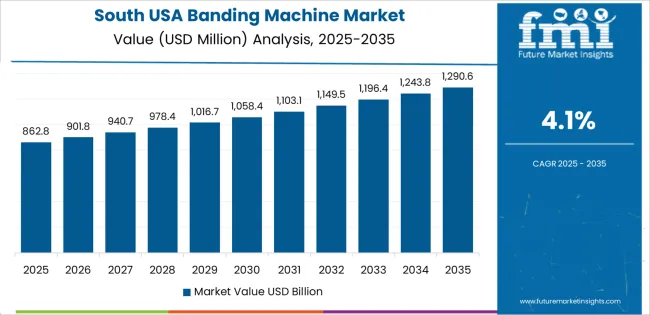
In the South USA, the demand for banding machines is expected to grow at a CAGR of 4.1%, reflecting the region's industrial expansion. The South has seen significant growth in sectors like automotive, food processing, and consumer goods manufacturing. These industries require reliable and cost-effective packaging solutions, which increases the demand for banding machines. Additionally, the growing e-commerce sector in the South, with its emphasis on streamlined logistics and packaging efficiency, further contributes to the uptake of banding machines. The region's manufacturing capacity and logistics infrastructure ensure that demand for banding machines will continue to rise as businesses seek to enhance their packaging processes.
What Supports Growth in the Northeast USA for Banding Machines?

In the Northeast USA, the demand for banding machines is projected to grow at a CAGR of 3.7%. The Northeast is home to a diverse range of industries, including pharmaceuticals, electronics, and food manufacturing, all of which require packaging solutions. Banding machines are increasingly being adopted in these sectors to improve packaging efficiency, reduce labor costs, and ensure product safety during transportation. The region's established manufacturing base, coupled with its focus on operational efficiency, supports the steady demand for banding machines. Although growth is slower than in more industrialized regions, the Northeast's emphasis on innovation and efficiency ensures that demand remains strong.
How is Demand for Banding Machines Evolving in the Midwest USA?
In the Midwest USA, the demand for banding machines is expected to grow at a CAGR of 3.2%. The Midwest has a strong presence in manufacturing, particularly in sectors like automotive, machinery, and consumer goods. However, compared to the West and South, the region has a lower growth rate in the adoption of packaging automation. As manufacturers in the Midwest seek ways to optimize their operations and reduce packaging costs, the demand for banding machines is expected to rise steadily. The growing interest in automation, combined with the need for cost-effective packaging solutions in the region’s diverse industries, ensures a stable market for banding machines over the forecast period.
What is the Competitive Landscape for the Banding Machine Market in the USA?

The banding machine market in the USA remains driven by demand for efficient packaging and bundling solutions across logistics, manufacturing, food & beverage, pharmaceuticals, and e commerce industries. Leading supplier Dynaric, Inc. holds approximately 28.2% of the market. Other key companies include StraPack, Inc., Transpak Equipment Corp., Signode Industrial Group LLC and Fromm Holding AG. These firms supply a range of banding and strapping machines — from semi automatic units suitable for small scale packaging to fully automatic high-throughput systems used in large warehouses and manufacturing lines. The US market benefits from growth in logistics and e commerce. Increased throughput demands and automated packaging requirements support sales of banding machines. The banding approach appeals because it can use paper or plastic bands, reducing waste and supporting sustainability goals. Its ease of removal and ability to integrate branding or labelling add value over traditional strapping or shrink wrap methods.
Suppliers differentiate through strategies such as product variety, customisation, automation level, and material options. Dynaric offers a broad portfolio covering food, newspaper, electronics and other sectors. StraPack and Transpak focus on semi-automatic and fully automatic strap/band machines with flexible material support. Signode and Fromm emphasise heavy duty and industrial scale banding systems for high load or pallet-level bundling. Some firms prioritise customization allowing various band widths and materials — plastic, paper, or metal — depending on application. Others highlight integration capabilities with conveyor lines, high-speed operations, and lower labour costs. Marketing materials and brochures stress reliability, packaging speed, sustainability, and lower environmental impact. The result is a competitive environment where companies compete on breadth of machine types, adaptability to different end uses, automation, and operational cost savings.
Key Players of the Banding Machine Industry in USA
- Dynaric, Inc
- StraPack, Inc.
- Transpak Equipment Corp.
- Signode Industrial Group LLC
- Fromm Holding AG
Scope of the Report
| Items | Details |
|---|---|
| Quantitative Units | USD Billion |
| Regions Covered | USA |
| Operation | Automatic, Semi-automatic |
| Strapping Speed | 1.0-1.5 sec/straps, 1.6-2.0 sec/straps, Above 2.0 sec/straps |
| End Use | E-commerce, Food & Beverage, Pharmaceuticals, Electrical & Electronics, Household |
| Key Companies Profiled | Dynaric, Inc., StraPack, Inc., Transpak Equipment Corp., Signode Industrial Group LLC, Fromm Holding AG |
| Additional Attributes | The demand for banding machines in the USA is driven by the increasing need for efficient and reliable packaging solutions across various industries, including e-commerce, food and beverage, pharmaceuticals, and electronics. Banding machines, both automatic and semi-automatic, are used to secure products for transport or storage, with the strapping speed playing a key role in determining the machine's efficiency. Faster machines (above 2.0 sec/straps) are commonly used in high-volume industries like e-commerce, while slower machines (1.0-1.5 sec/straps) may be used in lower-volume or specialty packaging applications. Companies such as Dynaric, StraPack, and Signode Industrial Group dominate the market, offering a range of banding machines tailored to different end uses. The market is expected to grow as demand for automation and faster packaging solutions increases across key sectors in the USA. |
Key Segments of the Demand for Banding Machine in USA
Operation:
- Automatic
- Semi-automatic
Strapping Speed:
- 1.0-1.5 sec/straps
- 1.6-2.0 sec/straps
- Above 2.0 sec/straps
End Use:
- E-commerce
- Food & Beverage
- Pharmaceuticals
- Electrical & Electronics
- Household
Region:
- Northeast USA
- West USA
- Midwest USA
- South USA
Frequently Asked Questions
How big is the demand for banding machine in USA in 2025?
The demand for banding machine in USA is estimated to be valued at USD 1.8 billion in 2025.
What will be the size of banding machine in USA in 2035?
The market size for the banding machine in USA is projected to reach USD 2.7 billion by 2035.
How much will be the demand for banding machine in USA growth between 2025 and 2035?
The demand for banding machine in USA is expected to grow at a 4.0% CAGR between 2025 and 2035.
What are the key product types in the banding machine in USA?
The key product types in banding machine in USA are automatic and semi-automatic.
Which strapping speed segment is expected to contribute significant share in the banding machine in USA in 2025?
In terms of strapping speed, 1.0-1.5 sec/straps segment is expected to command 44.0% share in the banding machine in USA in 2025.
Preview the report firsthand - request a free sample
Get SampleGet the brochure for pricing and purchase details.
Get PDFTable of Content
- Executive Summary
- USA Market Outlook
- Demand-side Trends
- Supply-side Trends
- Technology Roadmap Analysis
- Analysis and Recommendations
- Market Overview
- Market Coverage / Taxonomy
- Market Definition / Scope / Limitations
- Market Background
- Market Dynamics
- Drivers
- Restraints
- Opportunity
- Trends
- Scenario Forecast
- Demand in Optimistic Scenario
- Demand in Likely Scenario
- Demand in Conservative Scenario
- Opportunity Map Analysis
- Product Life Cycle Analysis
- Supply Chain Analysis
- Investment Feasibility Matrix
- Value Chain Analysis
- PESTLE and Porter’s Analysis
- Regulatory Landscape
- Regional Parent Market Outlook
- Production and Consumption Statistics
- Import and Export Statistics
- Market Dynamics
- USA Market Analysis 2020 to 2024 and Forecast, 2025 to 2035
- Historical Market Size Value (USD Million) Analysis, 2020 to 2024
- Current and Future Market Size Value (USD Million) Projections, 2025 to 2035
- Y-o-Y Growth Trend Analysis
- Absolute $ Opportunity Analysis
- USA Market Pricing Analysis 2020 to 2024 and Forecast 2025 to 2035
- USA Market Analysis 2020 to 2024 and Forecast 2025 to 2035, By Operation
- Introduction / Key Findings
- Historical Market Size Value (USD Million) Analysis By Operation , 2020 to 2024
- Current and Future Market Size Value (USD Million) Analysis and Forecast By Operation , 2025 to 2035
- Automatic
- Semi-automatic
- Y-o-Y Growth Trend Analysis By Operation , 2020 to 2024
- Absolute $ Opportunity Analysis By Operation , 2025 to 2035
- USA Market Analysis 2020 to 2024 and Forecast 2025 to 2035, By Strapping Speed
- Introduction / Key Findings
- Historical Market Size Value (USD Million) Analysis By Strapping Speed, 2020 to 2024
- Current and Future Market Size Value (USD Million) Analysis and Forecast By Strapping Speed, 2025 to 2035
- 1.0-1.5 sec/straps
- 1.6-2.0 sec/straps
- Above 2.0 sec/straps
- Y-o-Y Growth Trend Analysis By Strapping Speed, 2020 to 2024
- Absolute $ Opportunity Analysis By Strapping Speed, 2025 to 2035
- USA Market Analysis 2020 to 2024 and Forecast 2025 to 2035, By End Use
- Introduction / Key Findings
- Historical Market Size Value (USD Million) Analysis By End Use, 2020 to 2024
- Current and Future Market Size Value (USD Million) Analysis and Forecast By End Use, 2025 to 2035
- E-commerce
- Food & Beverage
- Pharmaceuticals
- Electrical & Electronics
- Household
- Y-o-Y Growth Trend Analysis By End Use, 2020 to 2024
- Absolute $ Opportunity Analysis By End Use, 2025 to 2035
- Market Structure Analysis
- Competition Dashboard
- Competition Benchmarking
- Market Share Analysis of Top Players
- By Regional
- By Operation
- By Strapping Speed
- By End Use
- Competition Analysis
- Competition Deep Dive
- Dynaric, Inc
- Overview
- Product Portfolio
- Profitability by Market Segments (Product/Age /Sales Channel/Region)
- Sales Footprint
- Strategy Overview
- Marketing Strategy
- Product Strategy
- Channel Strategy
- StraPack, Inc.
- Transpak Equipment Corp.
- Signode Industrial Group LLC
- Fromm Holding AG
- Dynaric, Inc
- Competition Deep Dive
- Assumptions & Acronyms Used
- Research Methodology


