

- Industry Size (2025)
- USD 36.2 Bn
- Forecast (2035)
- USD 53.0 Bn
- CAGR (2025 to 2035)
- 3.9%
Demand for Cotton Candy Machines in USA 2025 to 2035
The USA cotton candy machines demand is valued at USD 36.2 billion in 2025 and is projected to reach USD 53.0 billion by 2035, reflecting a CAGR of 3.9%. Growth is supported by strong participation in event-based food services, the expansion of family entertainment venues, and increasing home-use purchases driven by nostalgia and confectionery trends. Rental businesses, fairs, amusement parks, and mobile food vendors continue to reinforce steady equipment procurement.
Tabletop units lead usage due to their portability, lower upfront costs, and suitability for both residential and small commercial operations. Manufacturers integrate quicker heat-up times, improved safety features, and simplified cleaning to support frequent short-cycle usage. Wider color and flavor compatibility enhances product appeal and encourages impulse consumption in recreational settings.
The West, South, and Northeast regions show strong adoption based on dense entertainment infrastructure and high seasonal event activity. Online retail remains the leading distribution channel, supporting accessible product comparison and nationwide availability. Great Northern Popcorn Company, Nostalgia Products LLC, Paragon International, Inc., VIVO, and Olde Midway are key suppliers focused on performance durability, expanded accessories, and targeted offerings for both consumer and professional foodservice buyers.
Quick Stats for USA Cotton Candy Machines Demand
- USA Cotton Candy Machines Sales Value (2025): USD 36.2 billion
- USA Cotton Candy Machines Forecast Value (2035): USD 53.0 billion
- USA Cotton Candy Machines Forecast CAGR (2025-2035): 3.9%
- Leading Product Type in USA Cotton Candy Machines Demand: Tabletop Units
- Key Growth Regions in USA Cotton Candy Machines Demand: West USA, South USA, Northeast USA
- Top Players in USA Cotton Candy Machines Demand: Great Northern Popcorn Company, Nostalgia Products LLC, Paragon International, Inc., VIVO, Olde Midway
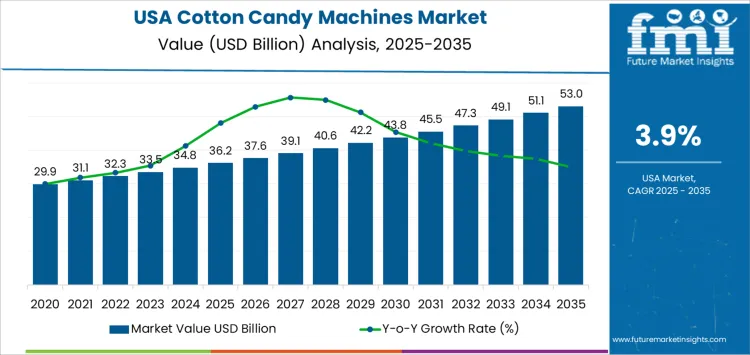
What is the Growth Forecast for Cotton Candy Machines Industry in USA through 2035?
Demand for cotton candy machines in the United States shows an initial acceleration phase supported by rising usage across amusement parks, stadiums, carnivals, and rental businesses. The category benefits from higher spending on recreational activities and event-based food services. Retail availability of compact countertop units expands the base toward small vendors and home users. These elements strengthen unit growth as new customer segments participate.
Deceleration becomes visible once penetration plateaus across primary commercial venues. Seasonal dependence limits consistent purchasing cycles. The installed base of equipment usually delivers long operational lifespans, reducing repeat buying frequency. Growth leans more toward replacement rather than new installations. Larger enterprises adopt maintenance programs that extend equipment longevity, softening expansion in peak years. The pattern presents a shift from rapid early adoption driven by fresh deployment opportunities to steadier demand linked with equipment upgrades and feature improvements. Product innovation centers on ease of cleaning, safety enhancements, and portability instead of expanding core usage environments.
USA Cotton Candy Machines Key Takeaways
| Metric | Value |
|---|---|
| USA Cotton Candy Machines Sales Value (2025) | USD 36.2 billion |
| USA Cotton Candy Machines Forecast Value (2035) | USD 53.0 billion |
| USA Cotton Candy Machines Forecast CAGR (2025-2035) | 3.9% |
Why is the Demand for Cotton Candy Machines in the USA Growing?
Demand for cotton candy machines in the USA is rising because entertainment venues, concession stands, fairs and small businesses see strong appeal in offering nostalgic and low-cost snacks. Event planners for carnivals, sports arenas, birthday parties and school fundraisers choose cotton candy machines to attract families and young customers with minimal investment. The machines allow operators to produce cotton candy on demand, providing high-margin treats with controlled portioning and low ingredient cost.
Growth in home-based event rentals and mobile concession services supports demand for portable units. Entrepreneurs offering pop-up stands, outdoor festivals and community events value machines that are easy to transport, simple to operate and suitable for temporary setups. Retailers featuring party supplies often include small countertop machines in their product lineup to meet demand from consumers hosting celebrations at home.
Suppliers offer models with varying sizes and power levels from small home-use units to heavy-duty commercial machines expanding accessibility across market segments. Constraints include seasonal and cyclical demand that depends heavily on events, school schedules and holidays. Some operators refrain from purchase due to limited storage space or cleaning requirements. Health concerns or dietary preferences for low sugar consumption may reduce repeat demand among health-conscious buyers.
Which Product Types and Distribution Channels Lead Demand for Cotton Candy Machines in the USA?
Demand for cotton candy machines in the United States is supported by entertainment venues, event catering, amusement parks, and home leisure usage. Product selection depends on power efficiency, portability, sugar-melting consistency, and continuous operation readiness. Growth links to expanding concession activity at sports venues, festivals, and seasonal fairs. Domestic usage trends also show interest in compact units designed for parties and gifting. Industry purchasing focuses on stainless steel bowls, clog-resistant heating systems, and quick disassembly for cleaning within compliance requirements across foodservice settings.
By Product Type, Tabletop Units Represent the Largest Share
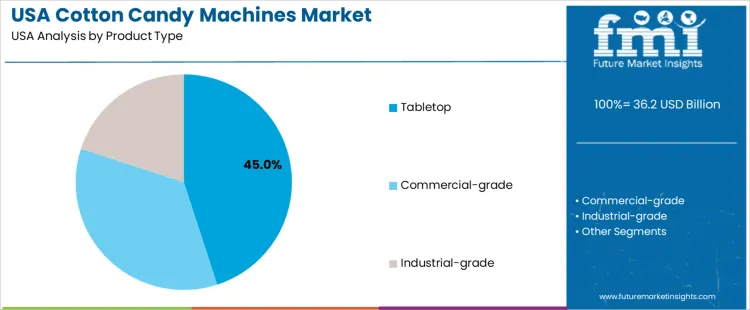
Tabletop cotton candy machines hold 45.0%. This reflects domestic entertainment and small concession functions that require low-maintenance equipment. Their presence spans school events, rental companies, and small snack counters. Commercial-grade units account for 35.0%, needed for continuous output across theme parks, cinemas, and franchise concession stands. These units maintain stable spinning speed and high-capacity sugar feed. Industrial-grade equipment holds 20.0%, supporting bulk manufacturing for pre-packaged cotton candy supplied to supermarkets and stadiums. Product type preferences reflect operational throughput, portability, and intended service environments across consumer and business purchases in the United States.
Key Points:
- Tabletop units dominate home leisure and low-volume concession usage
- Commercial-grade systems support continuous serving requirements
- Industrial-grade machines align with packaged cotton candy production
By Distribution, Online Retail Leads Sales
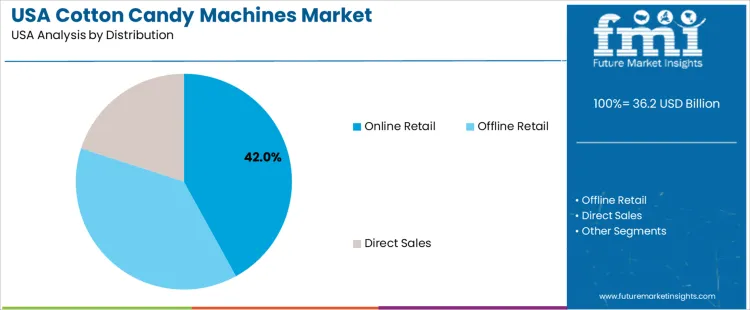
Online retail accounts for 42.0%. This channel benefits from direct-to-consumer ordering, broad model selection, and routine replenishment of accessories through e-commerce platforms in the United States. Offline retail holds 38.0%, sustained by kitchen appliance stores, party-supply outlets, and concession equipment distributors. Direct sales represent 20.0%, driven by institutional procurement and event service operators seeking technical installation support. Channel preferences correspond with cost visibility, bundled supply availability, and service assistance needed across a mix of consumer and professional buyers.
Key Points:
- Online retail supports wide accessibility for household buyers
- Offline stores maintain equipment testing and immediate purchase options
- Direct sales align with service-driven commercial procurement needs
What are the Key Dynamics in the Cotton Candy Machines Industry?
Growth of concession-based foodservice, steady presence of cotton candy in amusement settings and rising interest in nostalgic treats drive demand.
In the United States, cotton candy machines hold a consistent role in fairs, carnivals, theme parks, sports arenas and school fundraisers. Event organizers view cotton candy as a profitable item with low ingredient cost and fast preparation. Households adopt compact countertop units to support birthday parties and seasonal celebrations at home. Themed entertainment venues continue to promote cotton candy due to strong impulse buying from families and children. Rental businesses maintain regular inventories for community festivals and corporate events. Private-label foodservice suppliers distribute larger commercial machines to concession operators seeking durable equipment for high-traffic periods.
Budget limitations among small operators, storage and cleaning requirements and seasonal variation in demand restrain adoption.
Some small businesses postpone new equipment purchases when attendance uncertainty affects revenue planning. Proper machine cleaning and sugar-residue management require regular labor that some operators find inconvenient. Demand peaks during spring and summer when outdoor recreation is active and slows during colder months, creating uneven procurement cycles. Home users may delay replacement due to limited use frequency, reducing short-term repeat sales for manufacturers. These practical factors temper rapid growth across all distribution channels.
Shift toward compact home-use units, increased decorative product presentation and growing supply through online retail define key trends.
Manufacturers design smaller models with simplified controls aimed at households seeking affordable entertainment products for parties and holiday gatherings. LED lighting and clear bowl enclosures highlight spinning sugar colors that support visual appeal in social media content and themed events. Foodservice operators introduce flavored and naturally colored sugars aligned with consumer interest in variety and recognizable ingredients. E-commerce channels broaden access to both commercial and home-use machines through direct delivery, increasing availability beyond specialty stores. Rental services expand machine bundles that include pre-portioned sugar and cones to simplify operation for novice users. These developments indicate sustained demand for cotton candy machines across the United States supported by event-driven purchasing and ongoing interest in nostalgic concessions.
Analysis of the Demand for Cotton Candy Machines in the USA by Region
Demand for cotton candy machines in the United States rises as amusement venues, family entertainment centers, concession operators, and seasonal food vendors maintain reliance on nostalgic confectionery formats that generate impulse purchases. Growth reflects expansion of regional fairs, sports-arena concessions, and event-catering businesses using countertop or cart-based models to produce fresh servings on-site. West USA leads at 4.5% CAGR, followed by South USA at 4.0%, Northeast USA at 3.6%, and Midwest USA at 3.1%. Performance validation focuses on machine durability, heating-element stability, and simple cleaning requirements due to frequent transport and outdoor operation. Procurement aligns with event schedules, tourism cycles, retail-tainment venues, and recreational attractions generating steady demand for portable concession equipment.
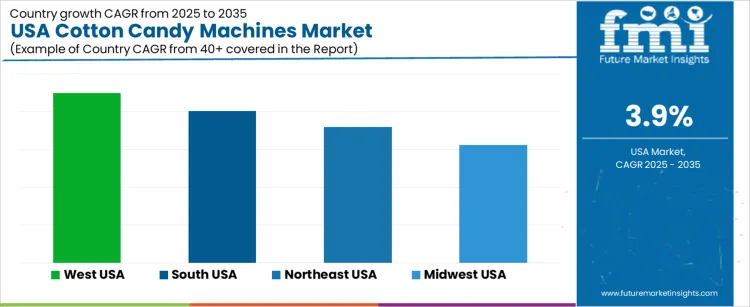
| Region | CAGR (2025-2035) |
|---|---|
| West USA | 4.5% |
| South USA | 4.0% |
| Northeast USA | 3.6% |
| Midwest USA | 3.1% |
How is the West USA driving demand for cotton candy machines?
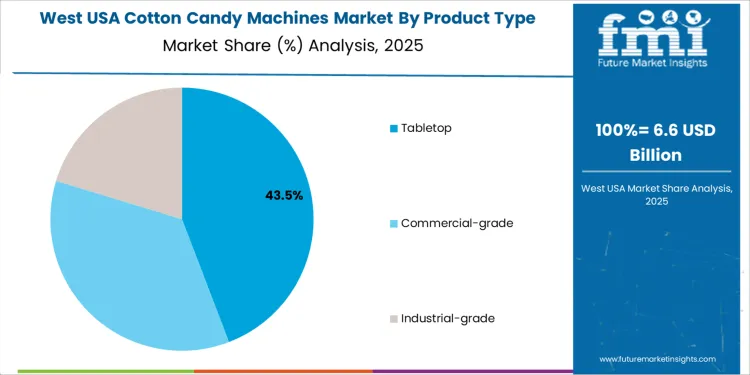
West USA grows at 4.5% CAGR, supported by extensive tourism and entertainment sectors across California, Nevada, and Arizona. Theme parks, beachfront attractions, and destination shopping centers maintain dedicated concession points where cotton candy machines contribute to high-margin snack sales. Mobile food vendors purchase lightweight models to operate at local festivals and weekend markets. Amusement-arcade operators choose machines designed for continuous spinning cycles during peak footfall hours. Buyers evaluate safety certifications and stainless-steel construction for hygiene compliance. Ports and major logistics hubs support consistent equipment distribution for national rental fleets. Outdoor events generate recurring demand for replaceable heating components and sugar-floss accessories that align with seasonal usage patterns.
- Theme-park and tourism exposure shaping deployment
- Rental fleets supporting seasonal activation across venues
- Durability and hygiene influencing procurement criteria
- Outdoor entertainment driving accessory and part turnover
How is the South USA shaping demand for cotton candy machines?
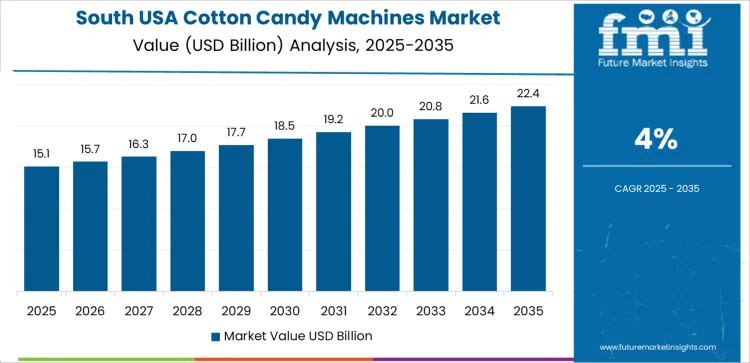
South USA posts 4.0% CAGR, influenced by strong carnival culture, high-traffic family attractions, and concession sales at collegiate sports events in Texas, Florida, and Georgia. Municipal fairs and boardwalk entertainment operate machines that produce consistent servings during extended service hours. Concessionaires prefer models with balanced grain distribution to reduce waste during rapid production cycles. Warm climates lengthen outdoor-event season, sustaining annual machine utilization levels. Event organizers purchase cart units compatible with branded signage used for visual merchandising. Distribution networks through Gulf Coast logistics corridors maintain fast replenishment for parts and consumables. Procurement emphasizes energy efficiency due to expanded operating hours in high-heat environments.
- Carnival and festival operations reinforcing baseline demand
- Game-day concessions shaping machine-flow requirements
- Tourism corridors supporting rental-fleet rotations
- Energy-efficiency attributes aiding long sessions
How is the Northeast USA contributing to regional demand?
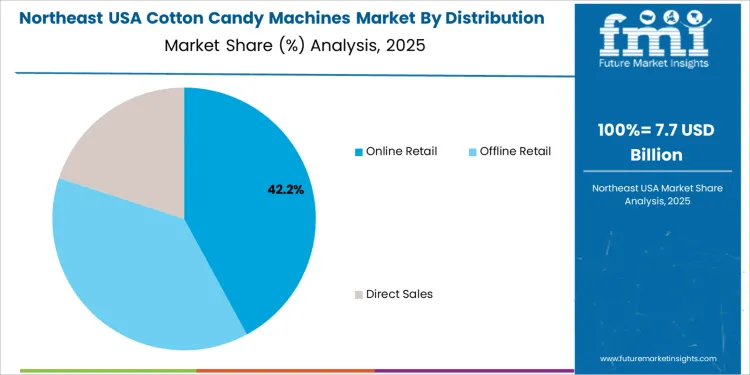
Northeast USA records 3.6% CAGR, driven by concentrated entertainment venues, zoos, aquariums, and family fun centers in New York, New Jersey, and Massachusetts. Seasonal tourism at waterfront destinations influences portable machine deployment from late spring into early fall. Operators prioritize clear-window domes and LED lighting features that improve product presentation in compact retail environments. Urban-based event planners rent commercial units for school fairs and corporate gatherings, supporting steady rotation across rental inventories. Buyers evaluate noise-reduction features to ensure comfortable usage in indoor attractions. Replacement-part availability remains important for continuous operation during peak attendance durations.
- Seasonal waterfront activity encouraging periodic scale-ups
- Indoor attractions requiring low-noise machine performance
- Compact layouts shaping product-visibility enhancements
- Rental demand sustaining repeat procurement cycles
How is the Midwest USA maintaining demand for cotton candy machines?
Midwest USA advances at 3.1% CAGR, supported by statewide fairs, minor-league sports parks, and community events across Illinois, Ohio, Michigan, and Missouri. Operators choose robust belt-drive and motor systems capable of maintaining heat consistency during fluctuating crowd demand patterns. Machines remain a standard concession item at local festivals and high-school events, boosting impulse snack revenue. Procurement teams prioritize serviceability due to long travel distances between equipment-repair providers. Cold-weather seasonality leads to storage downtime, prompting durable build requirements. Distribution routes via Chicago and Indianapolis ensure supply availability for private event-service companies rotating machines among venues.
- Community entertainment establishing enduring usage
- Service-friendly designs supporting upkeep during long cycles
- Balanced heat control preventing serving delays
- Logistics corridors providing reliable fulfillment
What is the competitive landscape of the demand for cotton candy machines in the United States?
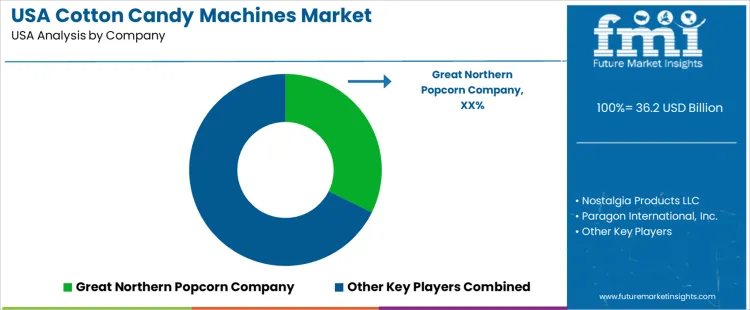
Demand for cotton candy machines in the United States reflects activity in concession services, school events, cinemas, amusement parks, catering companies, and home entertainment purchases. Buyers evaluate heating stability, production rate, cleaning effort, and durability of commercial components. Procurement preferences also consider size compatibility with mobile concession setups and retail environments.
Great Northern Popcorn Company holds an estimated 32.3% share through a wide range of commercial and consumer-grade spinning systems that align with common U.S. concession requirements. Their distribution strength in big-box retail and e-commerce channels fosters broad availability. Nostalgia Products LLC positions within home-use and light-commercial equipment with accessible pricing intended for seasonal or occasional operation. Paragon International, Inc. supports professional concessionaires through machines designed for continuous service, stainless-steel construction, and established supply of matching accessories.
VIVO contributes with models targeted at small businesses and event rental operators that need consistent heating and user-friendly setup. Olde Midway participates in both consumer and light-commercial channels with products designed for portability and simplified maintenance suited to youth recreation and fundraising uses. Competitive advantage depends on reliability during extended operation, transparent safety documentation, and service parts availability through U.S. distribution channels. Engineering that preserves texture and flavor consistency while reducing sugar residue accumulation supports stronger placement in purchasing decisions across commercial and consumer demand segments.
Key Players in USA Cotton Candy Machines Demand
- Great Northern Popcorn Company
- Nostalgia Products LLC
- Paragon International, Inc.
- VIVO
- Olde Midway
Scope of the Report
| Items | Values |
|---|---|
| Quantitative Units | USD billion |
| Product Type | Tabletop, Commercial-grade, Industrial-grade |
| Distribution | Online Retail, Offline Retail, Direct Sales |
| End-use Industry | Foodservice and Hospitality, Entertainment and Amusement Parks, Retail and Supermarkets, Events and Parties, Others |
| Regions Covered | West USA, South USA, Northeast USA, Midwest USA |
| Key Companies Profiled | Great Northern Popcorn Company, Nostalgia Products LLC, Paragon International, Inc., VIVO, Olde Midway |
| Additional Attributes | Dollar sales by product type, distribution model, and end-use sectors; demand driven by amusement parks, events, and foodservice operators; adoption trends in countertop and heavy-duty systems; competitive offerings integrating high-output heating coils and automatic sugar feeders; sales dynamics influenced by seasonal event peaks and rental services across U.S. regions. |
USA Cotton Candy Machines Demand by Segments
Product Type:
- Tabletop
- Commercial-grade
- Industrial-grade
Distribution:
- Online Retail
- Offline Retail
- Direct Sales
End-use Industry:
- Foodservice and Hospitality
- Entertainment and Amusement Parks
- Retail and Supermarkets
- Events and Parties
- Others
Region:
- West USA
- South USA
- Northeast USA
- Midwest USA
Frequently Asked Questions
How big is the demand for cotton candy machines in USA in 2025?
The demand for cotton candy machines in USA is estimated to be valued at USD 36.2 billion in 2025.
What will be the size of cotton candy machines in USA in 2035?
The market size for the cotton candy machines in USA is projected to reach USD 53.0 billion by 2035.
How much will be the demand for cotton candy machines in USA growth between 2025 and 2035?
The demand for cotton candy machines in USA is expected to grow at a 3.9% CAGR between 2025 and 2035.
What are the key product types in the cotton candy machines in USA?
The key product types in cotton candy machines in USA are tabletop, commercial-grade and industrial-grade.
Which distribution segment is expected to contribute significant share in the cotton candy machines in USA in 2025?
In terms of distribution, online retail segment is expected to command 42.0% share in the cotton candy machines in USA in 2025.
Preview the report firsthand - request a free sample
Get SampleGet the brochure for pricing and purchase details.
Get PDFTable of Content
- Executive Summary
- USA Market Outlook
- Demand-side Trends
- Supply-side Trends
- Technology Roadmap Analysis
- Analysis and Recommendations
- Market Overview
- Market Coverage / Taxonomy
- Market Definition / Scope / Limitations
- Market Background
- Market Dynamics
- Drivers
- Restraints
- Opportunity
- Trends
- Scenario Forecast
- Demand in Optimistic Scenario
- Demand in Likely Scenario
- Demand in Conservative Scenario
- Opportunity Map Analysis
- Product Life Cycle Analysis
- Supply Chain Analysis
- Investment Feasibility Matrix
- Value Chain Analysis
- PESTLE and Porter’s Analysis
- Regulatory Landscape
- Regional Parent Market Outlook
- Production and Consumption Statistics
- Import and Export Statistics
- Market Dynamics
- USA Market Analysis 2020 to 2024 and Forecast, 2025 to 2035
- Historical Market Size Value (USD Million) Analysis, 2020 to 2024
- Current and Future Market Size Value (USD Million) Projections, 2025 to 2035
- Y-o-Y Growth Trend Analysis
- Absolute $ Opportunity Analysis
- USA Market Pricing Analysis 2020 to 2024 and Forecast 2025 to 2035
- USA Market Analysis 2020 to 2024 and Forecast 2025 to 2035, By Product Type
- Introduction / Key Findings
- Historical Market Size Value (USD Million) Analysis By Product Type , 2020 to 2024
- Current and Future Market Size Value (USD Million) Analysis and Forecast By Product Type , 2025 to 2035
- Tabletop
- Commercial-grade
- Industrial-grade
- Y-o-Y Growth Trend Analysis By Product Type , 2020 to 2024
- Absolute $ Opportunity Analysis By Product Type , 2025 to 2035
- USA Market Analysis 2020 to 2024 and Forecast 2025 to 2035, By Distribution
- Introduction / Key Findings
- Historical Market Size Value (USD Million) Analysis By Distribution, 2020 to 2024
- Current and Future Market Size Value (USD Million) Analysis and Forecast By Distribution, 2025 to 2035
- Online Retail
- Offline Retail
- Direct Sales
- Y-o-Y Growth Trend Analysis By Distribution, 2020 to 2024
- Absolute $ Opportunity Analysis By Distribution, 2025 to 2035
- USA Market Analysis 2020 to 2024 and Forecast 2025 to 2035, By End-use Industry
- Introduction / Key Findings
- Historical Market Size Value (USD Million) Analysis By End-use Industry, 2020 to 2024
- Current and Future Market Size Value (USD Million) Analysis and Forecast By End-use Industry, 2025 to 2035
- Foodservice and Hospitality
- Entertainment and Amusement Parks
- Retail and Supermarkets
- Events and Parties
- Others
- Y-o-Y Growth Trend Analysis By End-use Industry, 2020 to 2024
- Absolute $ Opportunity Analysis By End-use Industry, 2025 to 2035
- Market Structure Analysis
- Competition Dashboard
- Competition Benchmarking
- Market Share Analysis of Top Players
- By Regional
- By Product Type
- By Distribution
- By End-use Industry
- Competition Analysis
- Competition Deep Dive
- Great Northern Popcorn Company
- Overview
- Product Portfolio
- Profitability by Market Segments (Product/Age /Sales Channel/Region)
- Sales Footprint
- Strategy Overview
- Marketing Strategy
- Product Strategy
- Channel Strategy
- Nostalgia Products LLC
- Paragon International, Inc.
- VIVO
- Olde Midway
- Great Northern Popcorn Company
- Competition Deep Dive
- Assumptions & Acronyms Used
- Research Methodology


