

- Industry Size (2025)
- USD 4861.0 Mn
- Forecast (2035)
- USD 6580.5 Mn
- CAGR (2025 to 2035)
- 3.1%
Demand for Cotton Candy Machines in Japan Forecast and Outlook 2025 to 2035
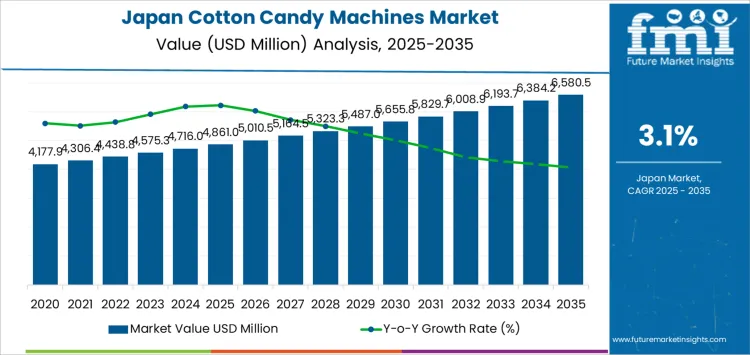
Demand for cotton candy machines in Japan is valued at USD 4,861.0 million in 2025 and is projected to reach USD 6,580.5 million by 2035, reflecting a CAGR of 3.1%. Historical series shows expansion from USD 4,177.9 million in 2021 to USD 4,861.0 million by 2025, indicating steady equipment placement across entertainment and retail venues. Tabletop models account for the largest share due to their suitability for temporary stalls and compact outlets. Commercial-grade units support foodservice and hospitality applications where daily output volumes remain stable. Distribution remains weighted toward online retail due to standardized specifications and regional availability. Offline retail continues to serve institutional buyers that require on site evaluation before procurement. Demand during this phase reflects routine event scheduling and regulated food preparation practices across indoor venues in Japan.
Foodservice and hospitality retain the largest end use share due to theme cafes, festivals, and seasonal promotions. Entertainment and amusement parks maintain stable procurement cycles tied to refurbishment planning. Retail and supermarkets account for a smaller but steady installation base for in-store demonstrations. Industrial grade systems remain limited to centralized production for packaged confectionery. Direct sales support large venue operators with service contracts and fixed replacement schedules. After 2030, replacement demand becomes the dominant volume driver as first-cycle machines reach renewal periods. Yearly increments remain narrow, indicating limited volatility in long-range demand pattern.
Quick Stats of the Demand for Cotton Candy Machines in Japan
- Demand for Cotton Candy Machines in Japan Value (2025): USD 4,861.0 million
- Demand for Cotton Candy Machines in Japan Forecast Value (2035): USD 6,580.5 million
- Demand for Cotton Candy Machines in Japan Forecast CAGR (2025–2035): 3.1%
- Demand for Cotton Candy Machines in Japan Leading Product Type: Tabletop (45%)
- Demand for Cotton Candy Machines in Japan Key Growth Regions: Kyushu & Okinawa, Kanto, Kansai
- Demand for Cotton Candy Machines in Japan Top Players: Great Northern Popcorn Company, Nostalgia Products LLC, Paragon International, VIVO, Olde Midway
What is the Growth Forecast for Cotton Candy Machines in Japan through 2035?
Between 2025 and 2030, demand for cotton candy machines in Japan is projected to rise from USD 4,861.0 million to USD 5,655.8 million, generating an absolute increase of USD 794.8 million and representing about 46.2% of total decade growth. This stage reflects steady expansion of amusement facilities, retail entertainment zones, and seasonal event services. Equipment upgrades across arcades and mobile vending formats support baseline demand. Historical growth was shaped by leisure footfall recovery, while near term performance is driven by compact machine formats, faster output cycles, and wider use in branded promotional retail activities.
From 2030 to 2035, demand is forecast to expand from USD 5,655.8 million to USD 6,580.5 million, adding USD 924.7 million and accounting for nearly 53.8% of the total ten-year expansion. Growth in this phase reflects deeper penetration across theme attractions, experiential retail, and automated snack vending installations. Integration with cashless payment systems and standardized safety controls supports wider institutional use. Earlier growth relied on venue density and event-driven sales, while higher utilization rates, controlled maintenance systems, and expansion of entertainment-led retail formats across regional and urban locations guide future expansion.
Cotton Candy Machines Industry in Japan Key Takeaways
| Metric | Value |
|---|---|
| Industry Value (2025) | USD 4,861.0 million |
| Forecast Value (2035) | USD 6,580.5 million |
| Forecast CAGR (2025-2035) | 3.1% |
What Is Driving the Demand for Cotton Candy Machines in Japan Across Historical and Future Growth Cycles?
Demand for cotton candy machines in Japan grew during the last two decades along with rising popularity of festivals, school events, small fairs, and community gatherings. Street vendors, local event organizers, school committees, and mobile-food vendors acquired machines due to affordability and ease of use. Domestic suppliers offered low-cost entry-level machines suitable for occasional use. Demand remained stable as events and seasonal festivals followed traditional calendars, and many buyers replaced machines slowly over time as usage remained occasional and wear rates were moderate.
Future demand for cotton candy machines in Japan is likely to increase through growth in experiential retail, themed cafés and pop-up food stalls, along with renewed interest in nostalgic snacks. Expansion of leisure tourism and social media-driven food trends encourage confectionery stalls at festivals, shopping malls, and amusement venues. Demand may rise for semi-professional and professional-grade machines as operators seek durability, safety, and higher output. Rising costs of imported equipment and stricter safety regulations could favour domestic manufacturers with certified machines. Urban redevelopment and mixed-use commercial zones offering diverse food experiences could broaden the base for cotton-candy equipment beyond traditional seasonal markets.
What Is the Demand for Cotton Candy Machines in Japan by Product Type and Distribution?
Demand for cotton candy machines in Japan is shaped by festival culture, compact retail formats, and rising interest in small scale event vending. Tabletop units lead by product type due to space efficiency and suitability for temporary setups. Distribution is led by online retail at 42.0% because small vendors and hobby users rely on digital platforms for equipment sourcing. Procurement is driven by event operators, amusement venues, and small food kiosks. Import reliance remains present for heating coils and motor assemblies. Substitution pressure exists from rental equipment services. Demand stability is supported by seasonal festivals, shopping arcade promotions, and pop up food stalls.
Why do tabletop machines account for 45% of the demand for cotton candy machines in Japan by product type?
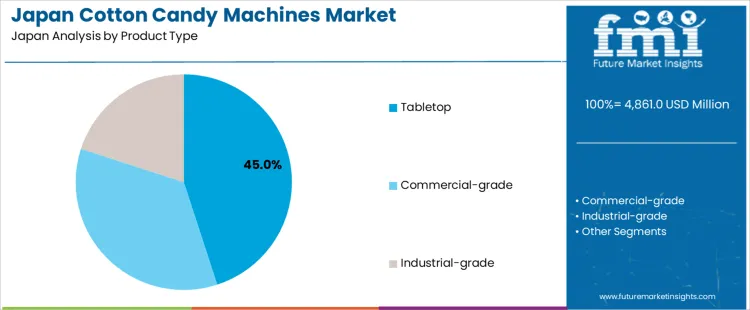
Tabletop machines account for 45% of the demand for cotton candy machines in Japan by product type, reflecting preference for compact equipment that fits limited retail and event spaces. Consumption intensity is driven by school festivals, shopping mall pop ups, and small food stalls that require portable setups. Usage remains stable because tabletop units allow quick assembly and storage between events. Procurement is led by small vendors, amusement operators, and hobby users purchasing through specialty appliance retailers and online platforms. Price sensitivity remains moderate because entry cost influences first time adoption. Specification control emphasizes heating stability, spin head balance, sugar feed rate consistency, and ease of cleaning after short production runs.
Tabletop machines also generate steady repeat demand through replacement of worn heating elements and drive motors. Repeat utilization remains predictable because many operators use these machines during recurring annual events. Buyers favor lightweight frames and detachable bowls to simplify transport and sanitation. Margin structure remains controlled under competition from low-cost imports and domestic appliance brands. Regulatory exposure centers on electrical safety certification and compliance with food contact surface requirements. Import reliance persists for motors and power control boards. Substitution pressure from commercial-grade units remains limited due to size and power supply constraints.
Why does online retail represent 38.0% of the demand for cotton candy machines in Japan by distribution?
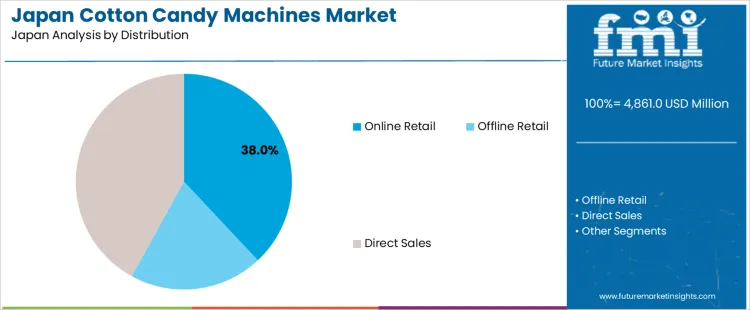
Online retail represents 38.0% of the demand for cotton candy machines in Japan by distribution, reflecting the role of digital platforms in reaching small scale buyers and temporary vendors. Consumption intensity is driven by direct to consumer sales, seasonal promotions, and rapid equipment sourcing ahead of events. Usage remains stable because online listings provide access to compact machines with nationwide delivery. Procurement is dominated by small business operators, hobby users, and festival vendors placing single unit orders. Price sensitivity remains high as buyers compare multiple listings before purchase. Specification control emphasizes product certification display, warranty clarity, and transparent power rating disclosure.
Online channels also generate consistent repeat demand through accessory purchases such as sugar floss, bowls, and heating heads. Repeat utilization remains predictable because many buyers expand their equipment set over time. Buyers favor platforms that offer bundled kits and spare parts availability. Margin structure remains controlled under marketplace commission models and seller competition. Regulatory exposure centers on consumer product labeling and electrical compliance documentation. Import reliance persists for finished machines sold through cross-border platforms. Substitution pressure from offline retail remains present for urgent same-day equipment needs.
What Is Driving the Demand for Cotton Candy Machines in Japan Festival Culture and Impulse Confection Sales?
Demand for cotton candy machines in Japan is tied to festival culture, compact entertainment venues, and impulse confection sales for children and tourists. Summer matsuri, temple fairs, and fireworks events create dense short duration peaks where visual cooking draws queues. Game centers, cinema lobbies, and family restaurants use tabletop units for after meal treats. Equipment choice favors fast spin up, stable heat control, and easy sugar change with minimal mess. Operators value low noise and simple cleaning between batches. Demand follows seasonal event calendars and venue foot traffic rather than permanent installation cycles in traditional dessert shops today across cities.
How Are Festivals and Seasonal Tourism Structuring Short Cycle Equipment Utilization?
Festival scheduling governs most cotton candy machine utilization in Japan. Operators store units for long inactive periods, then deploy them intensively during summer and autumn events. Mobile carts line shrine paths, riverbanks, and stadium approaches where families circulate slowly. Bright color floss acts as a visual signal that triggers spontaneous purchase decisions among children. Equipment endurance under continuous operation matters more than peak output speed. Sugar humidity control becomes critical during rainy festival days. This burst style usage pattern shapes replacement decisions around durability and transport weight rather than continuous commercial kitchen throughput targets for seasonal vendor operations nationwide yearly.
Why Do Game Centers and Family Dining Chains Sustain Baseline Demand?
Entertainment arcades and family dining chains provide steady baseline demand between festival peaks. Children redeem prizes and seek quick sweets after games or meals, which supports small format countertop machines near exits. Operators value compact size, plastic floss shields, and predictable portion output that suits fixed price menus. Maintenance staff prefer units with few exposed hot elements to limit downtime. Placement near vending aisles increases cross purchase with drinks. This environment ties machine demand to youth entertainment traffic patterns rather than to gourmet dessert positioning or high margin patisserie programs within urban leisure corridors across regional shopping districts today widely.
How Do Space Limits, Power Load, and Cleaning Rules Constrain Adoption?
Compact retail layouts in Japan constrain the adoption of cotton candy machines more than consumer interest. Counter width, ceiling clearance, and pedestrian flow rules restrict where spinning units can operate safely. Electrical load limits during summer place additional constraints when refrigeration and lighting already draw capacity. Health inspectors emphasize sugar ingress control, floss containment, and daily sanitation logs for shared food zones. Staff turnover raises the training burden for proper spinning and cleaning routines.
What is the Demand for Cotton Candy Machines in Japan by Region?
| Region | CAGR (%) |
|---|---|
| Kyushu & Okinawa | 3.8% |
| Kanto | 3.5% |
| Kansai | 3.1% |
| Chubu | 2.7% |
| Tohoku | 2.4% |
| Rest of Japan | 2.3% |
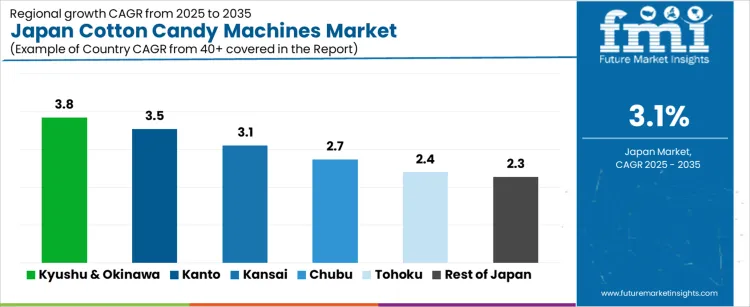
The demand for cotton candy machines in Japan is increasing gradually across entertainment and foodservice regions, led by Kyushu and Okinawa at a 3.8% CAGR. Growth in this region is supported by strong tourism activity, seasonal festivals, amusement facilities, and resort driven snack vending. Kanto follows at 3.5%, driven by dense urban event venues, high footfall in shopping malls, and steady replacement demand from arcades and family entertainment centers. Kansai records 3.1% growth, reflecting stable demand from street fairs, theme parks, and promotional events. Chubu at 2.7% shows moderate uptake linked to regional exhibitions and retail entertainment zones. Tohoku and the Rest of Japan, at 2.4% and 2.3%, reflect slower growth shaped by lower event density, fewer amusement operators, and longer equipment replacement cycles among small vendors.
How Is Seasonal Tourism and Event Retail Supporting Cotton Candy Machine Demand in Kyushu and Okinawa?
Demand for cotton candy machines in Kyushu and Okinawa is advancing at a CAGR of 3.8% through 2035, supported by strong seasonal tourism, frequent outdoor festivals, and steady snack sales at beachside entertainment zones. Amusement centers and mobile food vendors form the core customer base. Growth reflects steady equipment replacement from rental operators, rising use at resort theme zones, and continued popularity of visual snack preparation for children and family-focused venues.
- Tourism festivals sustain high seasonal equipment usage
- Mobile vendors support frequent machine relocation demand
- Amusement centers anchor stable base installations
- Rental operators drive recurring replacement purchases
Why Is Urban Entertainment Density Sustaining Cotton Candy Machine Growth in Kanto?
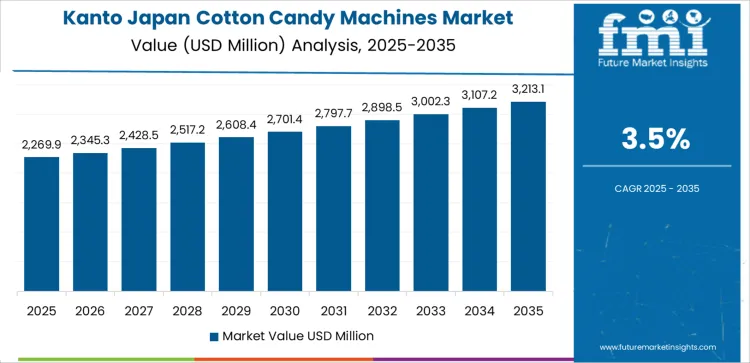
Demand for cotton candy machines in Kanto is rising at a CAGR of 3.5% through 2035, driven by dense concentration of amusement arcades, shopping mall entertainment zones, and family event venues across metropolitan areas. Kanto leads in permanent fixed installations within indoor recreation centers and children activity parks. Equipment demand remains tied to footfall driven impulse snack sales. Growth reflects regular outlet refurbishments, expansion of compact entertainment formats, and consistent demand from party rental operators serving urban residential communities.
- Indoor amusement centers support continuous machine operation
- Mall entertainment zones anchor fixed retail installations
- Party rental services drive short term deployment demand
- Outlet refurbishments support steady equipment turnover
What Is Supporting Controlled Cotton Candy Machine Adoption Across Kansai?
Demand for cotton candy machines in Kansai is progressing at a CAGR of 3.1% through 2035, supported by steady presence of family entertainment centers, moderate festival activity, and stable demand from local snack retailers. Kansai records balanced adoption across permanent and mobile installations. Equipment purchases remain focused on simple manual and semi automatic models. Growth remains linked to community event calendars, school festival usage, and routine equipment upgrades by small entertainment operators.
- Community festivals support periodic machine usage
- School events drive seasonal rental demand
- Semi automatic models dominate purchasing patterns
- Small operators guide controlled equipment investments
How Is Cost Conscious Food Entertainment Investment Shaping Demand in Chubu?
Demand for cotton candy machines in Chubu is advancing at a CAGR of 2.7% through 2035, supported by workforce driven family spending, steady amusement facility presence, and controlled capital investment by small retail operators. Chubu shows preference for entry level machines with basic functionality. Demand remains focused on durable units for long service life rather than feature rich display driven models. Growth reflects stable local entertainment budgets, consistent replacement needs, and sustained snack vending within factory adjacent family leisure zones.
- Entry level machines lead volume sales
- Factory adjacent leisure zones support steady usage
- Durability guides purchasing decisions
- Controlled investment shapes moderate growth pace
Why Is Limited Entertainment Infrastructure Moderating Cotton Candy Machine Growth in Tohoku?
Demand for cotton candy machines in Tohoku is advancing at a CAGR of 2.4% through 2035, supported by small scale local festivals, limited amusement facility density, and steady use by community event organizers. Miyagi anchors most regional entertainment equipment demand. Adoption remains focused on temporary setups during seasonal fairs and school celebrations. Growth remains moderate due to lower concentration of permanent entertainment venues and conservative spending on non essential snack equipment.
- Community events anchor most equipment usage
- Temporary installations dominate operating patterns
- Limited permanent venues restrict baseline demand
- Conservative budgets shape slow equipment expansion
How Is Small Town Event Culture Influencing Cotton Candy Machine Demand in Rest of Japan?
Demand for cotton candy machines in Rest of Japan is advancing at a CAGR of 2.3% through 2035, supported by neighborhood festivals, school functions, and gradual adoption by small snack vendors. These areas show stronger reliance on shared rental machines rather than permanent installations. Demand remains centered on basic tabletop and cart mounted units. Growth remains steady and guided by local event frequency, municipal fair schedules, and limited capital spending by small scale entertainment operators.
- Rental machines support shared community use
- School functions sustain recurring seasonal demand
- Cart mounted units dominate product preference
- Municipal fairs guide long term usage cycles
What Is Driving the Demand for Cotton Candy Machines in Japan and Which Companies Shape Festival and Retail Supply?
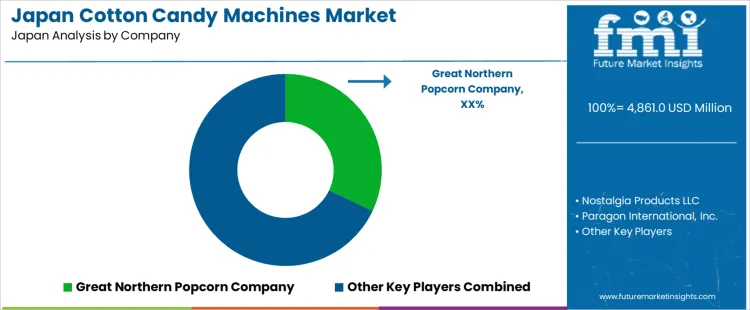
The demand for cotton candy machines in Japan is shaped by the strong matsuri festival calendar, steady traffic at amusement parks, and continued use in shopping mall events and school fairs. TOWA Kogyo and Nakamura Seisakusho hold central domestic positions through compact electric cotton candy machines designed for high humidity operation and limited booth space. These suppliers support widespread deployment through rental companies and event operators that serve regional festivals and seasonal markets. Great Northern Popcorn Company and Paragon International participate through imported machines supplied to theme parks, foreign brand food kiosks, and specialty concession operators. Nostalgia Products and Olde Midway reach consumers mainly through hobby retail and online channels focused on home entertainment use.
VIVO participates through entry level machines positioned for household and small party use through e commerce platforms. Equipment selection in Japan is governed by heat stability under continuous operation, sugar feed consistency, ease of cleaning between servings, and electrical safety compliance. Buyer preference favors compact footprint, splash control, and quiet motor performance suited to dense pedestrian areas. Demand visibility tracks summer festival schedules, school cultural events, tourism recovery in amusement districts, and steady growth in short term concession rentals for pop up food stalls across urban prefectures and regional towns.
Key Players in the Cotton Candy Machines Industry in Japan
- Great Northern Popcorn Company
- Nostalgia Products LLC
- Paragon International, Inc.
- VIVO
- Olde Midway
Scope of the Report
| Items | Values |
|---|---|
| Quantitative Units (2025) | USD million |
| Type | Tabletop, Commercial grade, Industrial grade |
| Application | Foodservice and Hospitality, Entertainment and Amusement Parks, Retail and Supermarkets, Events and Parties, Others |
| End User | Event Operators, Amusement Centers, Retail Snack Vendors, Family Dining Chains, Party Rental Services |
| Regions Covered | Kyushu and Okinawa, Kanto, Kansai, Chubu, Tohoku, Rest of Japan |
| Countries Covered | Japan |
| Key Companies Profiled | Great Northern Popcorn Company, Nostalgia Products LLC, Paragon International Inc., VIVO, Olde Midway, TOWA Kogyo, Nakamura Seisakusho |
| Additional Attributes | Dollar sales by product type and distribution channel, regional replacement driven demand patterns, festival and seasonal utilization cycles, rental versus ownership procurement structure, electrical safety compliance requirements, humidity resistant motor specifications, compact footprint and cleaning protocol requirements for dense retail environments |
Cotton Candy Machines Industry in Japan Segmentation
Product Type:
- Tabletop
- Commercial-grade
- Industrial-grade
Distribution:
- Online Retail
- Offline Retail
- Direct Sales
End-use Industry:
- Foodservice and Hospitality
- Entertainment and Amusement Parks
- Retail and Supermarkets
- Events and Parties
- Others
Region:
- Kyushu & Okinawa
- Kanto
- Kansai
- Chubu
- Tohoku
- Rest of Japan
Frequently Asked Questions
How big is the demand for cotton candy machines in Japan in 2025?
The demand for cotton candy machines in Japan is estimated to be valued at USD 4,861.0 million in 2025.
What will be the size of cotton candy machines in Japan in 2035?
The market size for the cotton candy machines in Japan is projected to reach USD 6,580.5 million by 2035.
How much will be the demand for cotton candy machines in Japan growth between 2025 and 2035?
The demand for cotton candy machines in Japan is expected to grow at a 3.1% CAGR between 2025 and 2035.
What are the key product types in the cotton candy machines in Japan?
The key product types in cotton candy machines in Japan are tabletop, commercial-grade and industrial-grade.
Which distribution segment is expected to contribute significant share in the cotton candy machines in Japan in 2025?
In terms of distribution, online retail segment is expected to command 38.0% share in the cotton candy machines in Japan in 2025.
Preview the report firsthand - request a free sample
Get SampleGet the brochure for pricing and purchase details.
Get PDFTable of Content
- Executive Summary
- Japan Market Outlook
- Demand-side Trends
- Supply-side Trends
- Technology Roadmap Analysis
- Analysis and Recommendations
- Market Overview
- Market Coverage / Taxonomy
- Market Definition / Scope / Limitations
- Market Background
- Market Dynamics
- Drivers
- Restraints
- Opportunity
- Trends
- Scenario Forecast
- Demand in Optimistic Scenario
- Demand in Likely Scenario
- Demand in Conservative Scenario
- Opportunity Map Analysis
- Product Life Cycle Analysis
- Supply Chain Analysis
- Investment Feasibility Matrix
- Value Chain Analysis
- PESTLE and Porter’s Analysis
- Regulatory Landscape
- Regional Parent Market Outlook
- Production and Consumption Statistics
- Import and Export Statistics
- Market Dynamics
- Japan Market Analysis 2020 to 2024 and Forecast, 2025 to 2035
- Historical Market Size Value (USD Million) Analysis, 2020 to 2024
- Current and Future Market Size Value (USD Million) Projections, 2025 to 2035
- Y-o-Y Growth Trend Analysis
- Absolute $ Opportunity Analysis
- Japan Market Pricing Analysis 2020 to 2024 and Forecast 2025 to 2035
- Japan Market Analysis 2020 to 2024 and Forecast 2025 to 2035, By Product Type
- Introduction / Key Findings
- Historical Market Size Value (USD Million) Analysis By Product Type , 2020 to 2024
- Current and Future Market Size Value (USD Million) Analysis and Forecast By Product Type , 2025 to 2035
- Tabletop
- Commercial-grade
- Industrial-grade
- Y-o-Y Growth Trend Analysis By Product Type , 2020 to 2024
- Absolute $ Opportunity Analysis By Product Type , 2025 to 2035
- Japan Market Analysis 2020 to 2024 and Forecast 2025 to 2035, By Distribution
- Introduction / Key Findings
- Historical Market Size Value (USD Million) Analysis By Distribution, 2020 to 2024
- Current and Future Market Size Value (USD Million) Analysis and Forecast By Distribution, 2025 to 2035
- Online Retail
- Offline Retail
- Direct Sales
- Y-o-Y Growth Trend Analysis By Distribution, 2020 to 2024
- Absolute $ Opportunity Analysis By Distribution, 2025 to 2035
- Japan Market Analysis 2020 to 2024 and Forecast 2025 to 2035, By End-use Industry
- Introduction / Key Findings
- Historical Market Size Value (USD Million) Analysis By End-use Industry, 2020 to 2024
- Current and Future Market Size Value (USD Million) Analysis and Forecast By End-use Industry, 2025 to 2035
- Foodservice and Hospitality
- Entertainment and Amusement Parks
- Retail and Supermarkets
- Events and Parties
- Others
- Y-o-Y Growth Trend Analysis By End-use Industry, 2020 to 2024
- Absolute $ Opportunity Analysis By End-use Industry, 2025 to 2035
- Market Structure Analysis
- Competition Dashboard
- Competition Benchmarking
- Market Share Analysis of Top Players
- By Regional
- By Product Type
- By Distribution
- By End-use Industry
- Competition Analysis
- Competition Deep Dive
- Great Northern Popcorn Company
- Overview
- Product Portfolio
- Profitability by Market Segments (Product/Age /Sales Channel/Region)
- Sales Footprint
- Strategy Overview
- Marketing Strategy
- Product Strategy
- Channel Strategy
- Nostalgia Products LLC
- Paragon International, Inc.
- VIVO
- Olde Midway
- Great Northern Popcorn Company
- Competition Deep Dive
- Assumptions & Acronyms Used
- Research Methodology


