

- Market Size (2026)
- USD 1.9 Bn
- Forecast (2036)
- USD 3.2 Bn
- CAGR (2026 to 2036)
- 5.4%
How big is Spiral Conveyors Market in 2026?
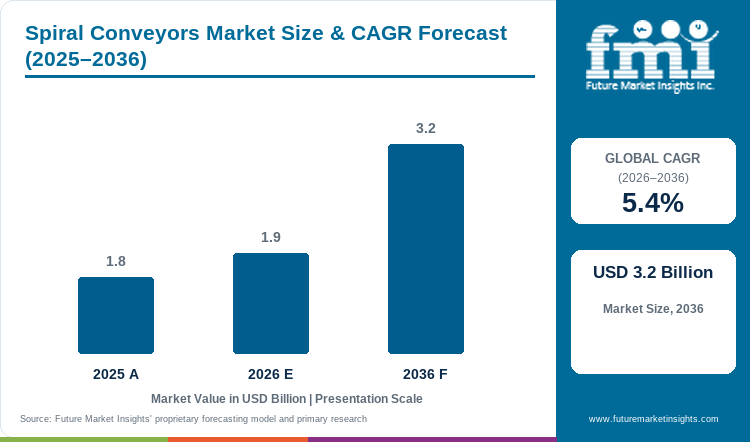
The spiral conveyors market is estimated at USD 1.9 billion in 2026 and projected to reach USD 3.2 billion by 2036 at 5.4% CAGR.
Demand in the spiral conveyors market is anticipated to expand at a 5.4% CAGR over the forecast period, building from USD 1.8 billion in 2025 to USD 1.9 billion in 2026, before pushing valuation to USD 3.2 billion by 2036. Facilities are selecting compact vertical routes to protect product flow and preserve storage or picking space. Ryson International documented ten Model 1900-600 spirals in a June 2025 Canadian direct-to-consumer warehouse project. Compact spiral sections reduce the horizontal run required within conveyor systems that move products between levels.
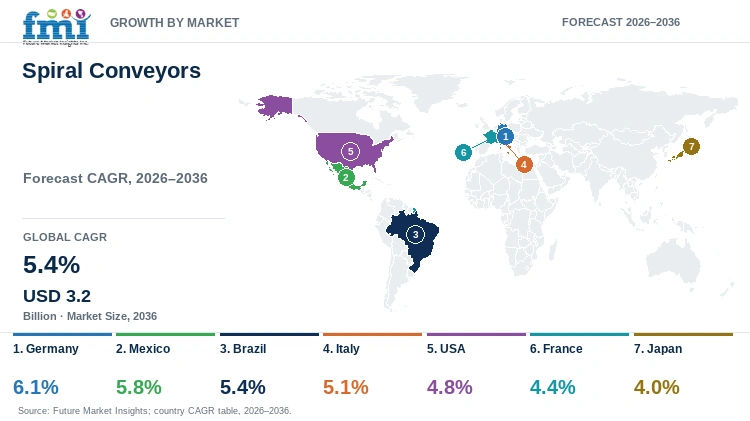
Equipment turnover and application engineering differ between mature automation bases and produce different country outlooks. Germany is projected to grow at 6.1% CAGR through 2036 and Japan is forecast at 4.0%. World Bank WITS records USD 1.079 billion of German HS 842839 continuous-action conveyor exports for 2024. Germany's export base provides the application-specific retrofit capacity needed for complex industrial conveyor projects. Japanese buyers are placing greater weight on service continuity during approval of another automated transfer point.
Key Takeaways
- Facilities are adding continuous vertical movement to preserve throughput in layouts that cannot accommodate long horizontal conveying routes.
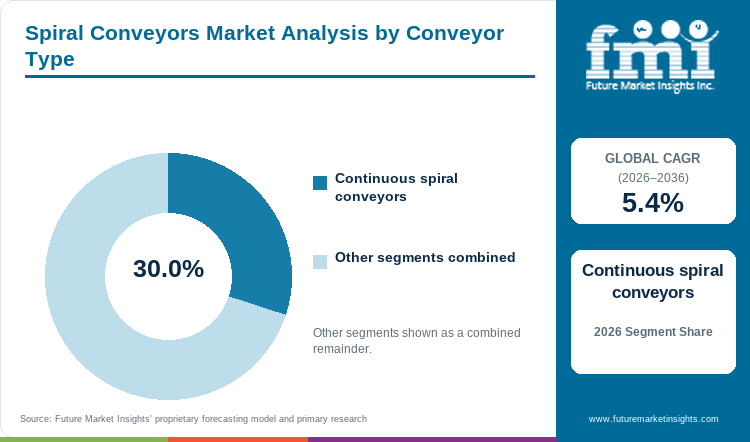
- Continuous spiral conveyors are estimated to hold 30.0% of conveyor type demand in 2026, attributable to uninterrupted powered vertical movement.
- Cartons are expected to lead load type with 28.0% share in 2026, driven by stable bases that simplify guided transfers.
- E-commerce and parcel is forecast to represent 30.0% of end use demand in 2026, supported by multilevel facilities that concentrate product flow.
- Unresolved transfer behavior or controls integration delays orders during application-specific commissioning and final equipment approval.
- Some of the key players in this market include AmbaFlex, Ryson International, Interroll, Intralox, FlexLink, Nercon, Apollo VTS, Dorner, Toyota Automated Logistics, and Habasit.
Analyst Perspective
“Engineers approve spiral conveyors based on proof that compact elevation preserves line rate under the actual load profile. Strong proposals also resolve controls integration and maintenance access during capital approval.”
- Nikhil Kaitwade, Principal Consultant, Future Market Insights
How is the spiral conveyors market segmented?
Spiral Conveyors Market is segmented by Conveyor Type, Load Type, End Use, Drive, Sales Channel and Region.
The spiral conveyors market is segmented by conveyor type, load type, end use, drive, sales channel and region. Conveyor type includes continuous spiral conveyors, mass flow spiral conveyors, alpine spiral conveyors, accumulation spiral conveyors and freezer - cooling spiral conveyors. Load type covers cartons, totes, parcels, food trays and bottles - cans within the verified handling categories. End use includes e-commerce and parcel, food and beverage, warehousing, pharmaceuticals and manufacturing lines. Drive covers chain-driven, belt-driven, drum motor-driven and modular plastic belt systems used within spiral configurations. Sales channel covers conveyor OEMs, system integrators, direct plant projects and aftermarket - service routes for installed equipment.
How do continuous spirals protect line rate during vertical transport?
Continuous spiral conveyors are protecting line rate on production lines that cannot tolerate stop-start elevation between operating levels. Nercon documented variable slopes and multiple lanes in an April 2026 update on automated material handling inside compact layouts. Engineers are validating entry spacing and load stability during production-rate approval for the vertical stage.
- Continuous spiral conveyors are projected to account for 30.0% of conveyor type demand in 2026, enabled by continuous powered vertical movement.
- Line-rate continuity and compact geometry make this configuration attractive for projects requiring controls synchronization and transfer tuning.
Why do cartons simplify spiral loading and discharge control?
Cartons are providing stable bases and repeatable geometry for guided elevation changes under continuous movement. Ryson documented ten spiral conveyors in a June 2025 direct-to-consumer project handling boxes up to 30 by 20 inches. Repeatable carton geometry is reducing transfer uncertainty at packaging machinery interfaces during guided entry and discharge. Engineers are testing weight distribution and surface friction to protect load stability during continuous elevation.
- Cartons are estimated to hold 28.0% of load type demand in 2026, influenced by stable surfaces that support repeatable guidance.
- Case dimensions and weight distribution require application testing to confirm stable carton flow during continuous vertical movement.
What makes multilevel parcel handling a strong spiral use case?
Limited horizontal expansion is pushing e-commerce and parcel facilities to concentrate sorting and packing work on multiple levels. AmbaFlex presented spiral solutions for warehousing and logistics at the June 2026 India Warehousing Show. E-commerce logistics operations are using compact vertical routes to stabilize parcel flow and protect sorter output.
- E-commerce and parcel is expected to lead end use with 30.0% share in 2026, reinforced by dense multilevel handling requirements.
- Integrators are proving parcel stability during design to confirm the spiral can operate as a fixed sorter interface under committed throughput.
How does chain drive change service planning for spiral systems?
Chain-driven spirals use positive engagement to move conveying surfaces through repeated turns under defined loads. Dorner explained in December 2025 that its FlexMove Helix uses side-roller chains to reduce corner friction during continuous elevation. Plants are comparing drive wear with the serviceability of conveyor belts during chain-driven spiral selection.
- Chain-driven systems are forecast to represent 29.0% of drive demand in 2026, aided by positive engagement that maintains controlled motion.
- Maintenance teams include service intervals in equipment selection because drive wear can alter motion quality through repeated spiral tiers.
Why do conveyor OEMs retain control of many spiral projects?
Spiral performance depends on geometry that matches elevation and load behavior during precommissioning design. FlexLink presented its X85 compact spiral at Fispal Tecnologia in June 2025 with a documented 40% smaller footprint than common alternatives. Integrated material handling equipment projects are keeping spiral OEMs involved to retain control over geometry and transfer interfaces. System integrators are connecting spiral controls with upstream and downstream automation inside the final project architecture.
- The sales channel category is forecast to be led by conveyor OEMs at 41.0% share in 2026, shaped by application-specific geometry controlled by the equipment designer.
- System integrators retain project influence by connecting spiral modules with larger material-flow controls and surrounding equipment.
What are the drivers, restraints and opportunities in the Spiral Conveyors Market?
Compact vertical throughput increases equipment demand while integration risk slows approval and retrofit-ready spiral technologies expand the installed-base opportunity.
- Driver: Facilities are adding spiral capacity to remove throughput bottlenecks without consuming equivalent horizontal production or storage space.
- Restraint: Belt condition and difficult service access can delay retrofit approval by increasing expected installation or maintenance downtime.
- Opportunity: New spiral belting and modular replacement options are extending upgrade activity into food lines that need cleaner operation and easier service.
Fixed floor area is turning vertical transport into a capacity decision for plants that cannot lengthen conveying paths. Nercon documented a March 2025 food-manufacturing installation that used a sanitary side-drive spiral ahead of an overhead conveyor and preserved floor access. Warehouse robotics layouts are intensifying floor-area pressure because storage and picking equipment share the same operating envelope.
Difficult-to-isolate wear components can turn compact vertical layouts into recurring downtime during planned maintenance work. Ryson explained in March 2025 that modular spiral construction can shorten repairs by isolating affected belts or motors. Food processing equipment lines face narrow sanitation windows that increase the value of accessible wear components and planned service.
Brownfield replacement is generating spiral orders without requiring a new warehouse or processing plant. Ryson documented in May 2025 that customers replaced case lifts and older vertical conveyors with spiral systems for higher throughput and smaller footprints. Packaging automation projects are using configured spiral replacements to preserve surrounding lines during commissioning.
Which country CAGRs are profiled in the Spiral Conveyors Market?
| Country | CAGR |
|---|---|
| Germany | 6.1% |
| Mexico | 5.8% |
| Brazil | 5.4% |
| Italy | 5.1% |
| USA | 4.8% |
| France | 4.4% |
| Japan | 4.0% |
How do country-level CAGRs compare in the Spiral Conveyors Market?
The seven profiled forecasts span 2.1 percentage points from Germany at 6.1% to Japan at 4.0% between 2026 and 2036. Germany and Mexico form the upper band with Brazil and Italy in the middle range. USA and France are both forecast below 5.0% and occupy the lower part of the profiled range. Japan is forecast at 4.0%, so the distribution describes forecast pace rather than current equipment scale.
- Germany combines export-oriented conveyor engineering with mature retrofit demand that places controls compatibility high in project screening.
- Mexico depends more heavily on imported continuous-conveyor equipment which raises the value of local commissioning and replacement-parts support.
- Brazilian projects face wider service territories which makes regional field coverage important for installation and ongoing parts availability.
- Italy pairs domestic conveyor manufacturing with food and packaging applications that require compact elevation and sanitation-compatible design choices.
- USA replacement work is commercially important for large installed material-flow systems requiring new vertical modules without line redesign.
- France emphasizes staged retrofit execution as established engineering capacity shifts competition toward installation planning and lifecycle service quality.
- Japan combines mature logistics-equipment spending with conservative reliability screening for facilities adding another automated vertical transfer point.
Installed equipment and local service capacity do not expand together, so comparable CAGRs can produce different entry conditions. The full report provides country-level CAGR analysis across North America, Latin America, Western Europe, Eastern Europe, East Asia, South Asia and Pacific, and the Middle East and Africa.
Country-wise Analysis
- German plants are operating within a dense conveyor engineering base that makes retrofit compatibility a routine equipment-screening issue. Spiral conveyor demand in Germany is forecast to rise at 6.1% CAGR through 2036, influenced by mature retrofit activity and national conveyor engineering capacity. World Bank WITS records USD 347.4 million of German HS 842839 continuous-action conveyor imports for 2024 which documents a substantial national equipment base. Suppliers are improving project conversion by documenting electrical integration and service responsibility during installation planning at operating plants.
- Mexican automation projects are relying heavily on imported conveyor equipment that requires local commissioning near production and distribution sites. Adoption of spiral conveyors in Mexico is estimated to expand at 5.8% CAGR through 2036, supported by imported equipment activity and local commissioning requirements. World Bank WITS records 115,262 imported HS 842839 continuous-action conveyor items for 2024 which documents a large national inflow of related equipment. Local engineering teams are reducing commissioning risk by connecting imported spiral modules with plant controls and established material-flow routes.
- Brazilian plants and logistics sites require equipment support over wide service territories with variable project lead times. The Brazil spiral conveyors sector is projected to record 5.4% CAGR during the assessment period, shaped by imported equipment activity and regional service requirements. World Bank WITS records 59,847 imported HS 842839 continuous-action conveyor items for 2024 which documents a national equipment stream for fixed material-flow systems. Regional parts access reduces downtime exposure for compact vertical equipment operating far from major service centers.
- Italian food and packaging plants combine domestic conveyor capability with compact processing layouts that require controlled elevation. Spiral conveyor sales in Italy are forecast to expand at 5.1% CAGR by 2036, reinforced by domestic manufacturing and food-processing applications. World Bank WITS records USD 547.5 million of Italian HS 842839 continuous-action conveyor exports for 2024 which documents substantial national manufacturing participation. Installation teams are resolving cleaning and belt-temperature requirements to keep food applications within the usable design set.
- United States facilities are purchasing spiral conveyors as modules inside larger material-handling systems that depend on controls compatibility and uptime. In the USA, spiral conveyor demand is predicted to advance at 4.8% CAGR through 2036. The forecast is driven by brownfield integration needs within a large continuous-conveyor equipment base. World Bank WITS records USD 1.846 billion of US HS 842839 continuous-action conveyor imports for 2024 which documents a large national equipment base. Engineering teams are documenting transfer geometry and commissioning steps to improve brownfield conversion without redesigning surrounding lines.
- French spiral projects are operating within an established conveyor engineering base that places heavy weight on retrofit sequencing. Spiral conveyor demand in France is forecast to rise at 4.4% CAGR over the forecast period, aided by established engineering capacity and staged retrofit requirements. World Bank WITS records USD 125.5 million of French HS 842839 continuous-action conveyor exports for 2024 which documents domestic participation in related fixed conveying equipment. Installation teams are protecting worker access and existing line output through staged commissioning plans for active facilities.
- Japanese logistics operations are using mature material-handling equipment and placing substantial weight on reliability during evaluation of another automated transfer point. The Japan spiral conveyors market is estimated to post 4.0% CAGR over the forecast period, attributable to active logistics-equipment spending within a mature installed base. The Japan Institute of Logistics Systems reported in September 2025 that logistics-system equipment sales increased 3.8% during fiscal 2024. Cold chain equipment projects require documented service access and operating reliability during expansion approval.
Who are the notable companies in the Spiral Conveyors Market?
AmbaFlex, Ryson International, Interroll, Intralox, FlexLink, Nercon, Apollo VTS, Dorner, Toyota Automated Logistics and Habasit serve the spiral conveyors market.
Competition includes dedicated spiral OEMs and broader conveyor platforms alongside belt specialists and systems integrators. Interroll completed its Royal Apollo Group acquisition in May 2026 and now owns Ryson International and Apollo VTS through that group. Toyota Automated Logistics became the successor brand to Bastian Solutions on April 1 2026. Application engineering is the main entry barrier since compact geometry alone cannot guarantee stable transfers or maintainable operation.
- AmbaFlex and Ryson International concentrate on dedicated spiral architectures for unit loads and distribution applications.
- Interroll and Apollo VTS pair spiral technology with expanded sales and lifecycle-service resources under the 2026 Royal Apollo Group acquisition.
- Intralox and Habasit specialize in spiral belting alongside FlexLink and Nercon plus Dorner and Toyota Automated Logistics in integrated automation roles.
Competitive Benchmarking: Spiral Conveyors Market
| Company | Spiral Configuration Breadth | Integration & Service | Hygienic / Low-Tension Engineering | Geographic Reach |
|---|---|---|---|---|
| AmbaFlex | High | High | Medium | Global |
| Ryson International | High | High | Medium | North America and international |
| Interroll | Medium | High | Medium | Global |
| Intralox | Medium | Medium | High | Global |
| FlexLink | Medium | High | Medium | Global |
| Nercon | Medium | High | High | North America |
| Apollo VTS | High | High | Medium | Global |
| Dorner | Medium | High | Medium | Global |
| Toyota Automated Logistics | Low | High | Low | Global |
| Habasit | Medium | High | High | Global |
Scoring basis: High configuration breadth requires several verified spiral architectures within the exact market scope. Medium configuration breadth covers a narrower exact-market range and Low reflects one direct spiral route. High integration and service requires documented engineering capability plus lifecycle support for installed spiral systems. Medium integration and service requires one verified service layer for installation or ongoing operating support. High hygienic or low-tension engineering requires direct sanitation or tension evidence for specialist spiral duties. Geographic reach records documented operating regions and is descriptive instead of functioning as a performance score.
Key Developments in the Spiral Conveyors Market
- In July 2026, Ryson International documented a brownfield return-lane modernization that replaced a gravity tote spiral with a powered Model 1700-600 spiral in a FORTNA-integrated project.
- In May 2026, Interroll completed the acquisition of Royal Apollo Group and added spiral conveyor technology together with installation and lifecycle-service capabilities to its global portfolio.
- In September 2025, Nercon documented a food-manufacturing installation using 36 washdown spirals rated for 220 products per minute with clean-in-place compatible belting.
Key Players in the Spiral Conveyors Market
Dedicated Spiral Conveyor OEMs
- AmbaFlex
- Ryson International
- Apollo VTS
Integrated Conveyor and Automation Platforms
- Interroll
- FlexLink
- Nercon
- Dorner
- Toyota Automated Logistics
Spiral Belt and Drive Specialists
- Intralox
- Habasit
Spiral Conveyors Market - Report Scope
| Coverage field | Report scope |
|---|---|
| Market breakdown | By conveyor type, load type, end use, drive, sales channel and region. |
| Quantitative Units | USD billion. |
| Market Definition | Engineered spiral conveyor systems and directly supporting spiral conveying technologies used for continuous vertical product movement. |
| Regions Covered | North America, Latin America, Western Europe, Eastern Europe, East Asia, South Asia and Pacific, and Middle East and Africa. |
| Countries Covered | Germany, Mexico, Brazil, Italy, USA, France, Japan, and 20+ countries included in the full report. |
| Key Companies Profiled | AmbaFlex, Ryson International, Interroll, Intralox, FlexLink, Nercon, Apollo VTS, Dorner, Toyota Automated Logistics and Habasit. |
| Forecast Period | 2026 to 2036. |
| Approach | Primary and secondary research with market triangulation. |
Spiral Conveyors Market - Research Methodology
| Method | Approach |
|---|---|
| Primary Research | FMI analysts gathered input from manufacturers, service providers, technology developers, distributors, end users, procurement teams, and subject-matter experts. Interviews examined purchasing decisions, product or service evaluation, adoption barriers, approval requirements, pricing considerations, and expectations for technical or commercial support. Respondents were also asked what evidence is required before a trial, pilot, or initial order develops into regular purchasing. |
| Desk Research | Desk research covered government statistics, regulatory publications, trade data, industry associations, technical literature, standards, company filings, product information, and official corporate announcements. Sources were reviewed for relevance, publication date, geographic coverage, and consistency with the defined market scope. Claims relating to performance, applications, approvals, capacity, investment, and commercial activity were retained only when supported by credible public evidence. |
| Market Sizing and Forecasting | The market model combined the baseline value with historical performance, segment structure, pricing and volume indicators, adoption levels, company participation, and country-level demand conditions. Forecast assumptions considered economic activity, investment trends, regulatory developments, technology adoption, purchasing cycles, supply availability, and barriers to wider market use. Segment and regional estimates were reconciled before the final market total was calculated. |
| Data Validation | Estimates were checked against multiple independent indicators, including public data, company activity, trade patterns, industry developments, and findings from primary interviews. Validation also tested whether products, services, applications, and company revenues fell within the defined market boundaries. Adjacent categories, unsupported claims, overlapping revenues, and activities without direct market relevance were excluded to reduce double counting and maintain consistency across segments and countries. |
Spiral Conveyors Market by Segments
Spiral Conveyors Market segmented by Conveyor Type:
- Continuous spiral conveyors
- Mass flow spiral conveyors
- Alpine spiral conveyors
- Accumulation spiral conveyors
- Freezer - cooling spiral conveyors
Spiral Conveyors Market segmented by Load Type:
- Cartons
- Totes
- Parcels
- Food trays
- Bottles - cans
Spiral Conveyors Market segmented by End Use:
- E-commerce and parcel
- Food and beverage
- Warehousing
- Pharmaceuticals
- Manufacturing lines
Spiral Conveyors Market segmented by Drive:
- Chain-driven
- Belt-driven
- Drum motor-driven
- Modular plastic belt
Spiral Conveyors Market segmented by Sales Channel:
- Conveyor OEMs
- System integrators
- Direct plant projects
- Aftermarket - service
Spiral Conveyors Market by Region:
- North America
- United States
- Canada
- Latin America
- Brazil
- Mexico
- Argentina
- Chile
- Western Europe
- Germany
- France
- United Kingdom
- Italy
- Spain
- Benelux
- Nordics
- Eastern Europe
- Poland
- Czech Republic
- Romania
- Hungary
- East Asia
- China
- Japan
- South Korea
- South Asia and Pacific
- India
- ASEAN
- Australia and New Zealand
- Middle East and Africa
- GCC Countries
- South Africa
- Türkiye
- Israel
Research Sources and Bibliography
- Ryson International. (2025, June 19). Spiral Conveyors Built for Direct to Consumer Warehouses.
- World Bank. (n.d.). Germany Cont-action elevators/conveyors for goods/mat n exports by country | 2024 | Data. Retrieved September 17, 2026.
- Nercon. (2026, April 15). The Flexibility and Versatility of Spiral Conveyor Systems.
- Ryson International. (n.d.). Vertical Spiral Conveyor: Big Throughput with a Small Footprint. Retrieved September 17, 2026.
- AmbaFlex. (2026, June 25). Meet us at the India Warehousing Show in New Delhi!
- Dorner. (n.d.). FlexMove Helix Conveyors. Retrieved September 17, 2026.
- AmbaFlex. (n.d.). Products | AmbaFlex leading spiral conveyor solutions. Retrieved September 17, 2026.
- Nercon. (2025, March 5). Floor Space is King: Conveyors That Maximize Every Square Inch.
- Ryson International. (2025, March 27). Reducing Downtime and Maintenance With Modular Conveyors.
- Ryson International. (2025, May 15). Ryson Spirals Replace Other Vertical Conveying Equipment.
- World Bank. (n.d.). Germany Cont-action elevators/conveyors for goods/mat n imports by country | 2024 | Data. Retrieved September 17, 2026.
- World Bank. (n.d.). Mexico Cont-action elevators/conveyors for goods/mat n imports by country | 2024 | Data. Retrieved September 17, 2026.
- World Bank. (n.d.). Brazil Cont-action elevators/conveyors for goods/mat n imports by country | 2024 | Data. Retrieved September 17, 2026.
- World Bank. (n.d.). Italy Cont-action elevators/conveyors for goods/mat n exports by country | 2024 | Data. Retrieved September 17, 2026.
- World Bank. (n.d.). United States Cont-action elevators/conveyors for goods/mat n imports by country | 2024 | Data. Retrieved September 17, 2026.
- World Bank. (n.d.). France Cont-action elevators/conveyors for goods/mat n exports by country | 2024 | Data. Retrieved September 17, 2026.
- Japan Institute of Logistics Systems. (2025, September 4). 2024
- Ryson International. (2026, July 15). Modernizing the Return Lane: Upgrading a Retail Giant’s Tote Flow.
- Interroll Holding AG. (2026, May 8). Interroll Holding AG announces the acquisition of Royal Apollo Group.
- Nercon. (2025, September 8). Fortune 500 CPG Manufacturer Elevates Efficiency with Nercon’s CIP Washdown Spiral.
- Toyota Automated Logistics. (n.d.). Conveyor Systems for Automated Material Transport. Retrieved September 17, 2026.
- Nercon. (2026, March 5). Beyond Specialty Equipment: Nercon Connects with Northeast Manufacturers at PACK EXPO East.
- FlexLink. (2025, June 24). Meet FlexLink at Fispal Tecnologia 2025: Packaging innovation with integrated solutions.
- AmbaFlex. (2026, June 10). ProPak Asia 2026 is live.
- Intralox. (2025, February 17). Endless Reliability: New Products to Enhance Your Line’s Performance.
- Ryson International. (2025, March 5). Scaling Up Distribution in Mexico with Ryson/Apollo Spirals.
- AmbaFlex. (n.d.). SpiralVeyor SVe-Series. Retrieved September 17, 2026.
- FlexLink. (n.d.). X85 Compact Spiral Conveyor. Retrieved September 17, 2026.
- Nercon. (n.d.). Spiral Conveyor. Retrieved September 17, 2026.
- Apollo Group. (n.d.). Spiral Conveyors. Retrieved September 17, 2026.
- Intralox. (n.d.). Major Global Wholesale Bakery Optimizes Product Transfers with S2900 Curved Top Belting. Retrieved September 17, 2026.
- Habasit. (n.d.). HabasitLINK Spiral Belts. Retrieved September 17, 2026.
- Dorner. (2025, December 23). What Are Space-Saving Conveyor Options for Crowded Production Floors?
- Interroll Holding AG. (2026, July 31). Executing the strategy and strengthening the market position.
This bibliography is provided for reader reference and is not exhaustive. The full report contains the complete reference list and detailed citations.
This Report Answers
- How large is the spiral conveyors market in 2026 and 2036?
- Which operating conditions support compact continuous vertical product movement in spiral systems?
- Which conveyor type holds 30.0% share during the 2026 base year?
- Why do cartons account for 28.0% of load type demand in 2026?
- How does e-commerce and parcel use change spiral specifications in multilevel facilities?
- Which countries show the widest spread in forecast spiral conveyor growth rates?
- How do drive choices alter maintenance and commissioning requirements for spiral systems?
- Which companies supply spiral equipment integration and specialist belting technologies globally?
- Which conditions determine whether brownfield spiral upgrades receive capital approval?
Frequently Asked Questions
How big is the Spiral Conveyors Market in 2026?
The spiral conveyors market is valued at USD 1.9 billion in 2026 and is projected to reach USD 3.2 billion by 2036. Facilities are buying spiral conveyors to protect throughput without using the horizontal space required by longer incline conveyors.
What is the CAGR of the Spiral Conveyors Market from 2026 to 2036?
The spiral conveyors market is projected to expand at 5.4% CAGR between 2026 and 2036. Facilities are selecting compact vertical transport to preserve line rate without extending horizontal conveyor runs.
Which conveyor type leads the Spiral Conveyors Market?
Continuous spiral conveyors are likely to capture 30.0% of conveyor type demand in 2026, enabled by uninterrupted powered vertical movement. Continuous movement keeps products moving between elevations without adding the batch cycle imposed by many lift-based alternatives.
Which load type leads the Spiral Conveyors Market?
Cartons are projected to hold 28.0% of load type demand in 2026, influenced by stable bases that simplify guided transfers. Repeatable outer geometry reduces transfer uncertainty and limits the handling controls required for irregular loads.
Which end use leads the Spiral Conveyors Market?
E-commerce and parcel is set to lead the end use category with 30.0% share in 2026, supported by multilevel fulfillment facilities that concentrate product flow. Compact elevation preserves sorter output and returns valuable floor area to storage or picking operations.
Which companies are active in the Spiral Conveyors Market?
Key companies operating in the spiral conveyors market include AmbaFlex, Ryson International, Interroll, Intralox, FlexLink, Nercon, Apollo VTS, Dorner, Toyota Automated Logistics and Habasit. Their roles span dedicated spiral equipment and integrated automation platforms together with directly supporting belt technologies for continuous vertical handling.
Preview the report firsthand - request a free sample
Get SampleGet the brochure for pricing and purchase details.
Get PDFTable of Content
- Key Takeaways
- Market Size and CAGR
- Top Growth Driver
- Fastest Growing Segment
- Leading Region
- Key Companies
- Emerging Opportunities
- Executive Summary
- Global Market Outlook
- Demand-side Trends
- Supply-side Trends
- Technology Roadmap Analysis
- Analysis and Recommendations
- Analyst Perspective (What is happening? Why now? What should investors know?)
- Key Questions Answered
- How large is the market?
- What is the CAGR?
- What are key trends?
- Which region dominates?
- Who are the leaders?
- Market Overview
- Market Coverage / Taxonomy
- Market Definition / Scope / Limitations
- Research Methodology
- Chapter Orientation
- Analytical Lens and Working Hypotheses
- Market Structure, Signals, and Trend Drivers
- Benchmarking and Cross-market Comparability
- Market Sizing, Forecasting, and Opportunity Mapping
- Research Design and Evidence Framework
- Desk Research Programme (Secondary Evidence)
- Expert Input and Fieldwork (Primary Evidence)
- Tooling, Models, and Reference Databases
- Data Engineering and Model Build
- Quality Assurance and Audit Trail
- Market Background
- Market Dynamics (Drivers, Restraints, Opportunity, Trends)
- Scenario Forecast (Optimistic, Likely, Conservative)
- Impact Analysis
- AI Impact
- Sustainability Impact
- Regulatory Impact
- Technology Impact
- Consumer / Buyer Analysis
- Purchase Drivers
- Adoption Barriers
- Buyer Journey
- Opportunity Map Analysis
- Product Life Cycle Analysis
- Supply Chain Analysis
- Investment Feasibility Matrix
- Value Chain Analysis
- PESTLE and Porter's Analysis
- Regulatory Landscape
- Regional Parent Market Outlook
- Production and Consumption Statistics
- Import and Export Statistics
- Global Market Analysis and Forecast, 2021 to 2036
- Historical Market Size Value (USD Billion) Analysis, 2021 to 2025
- Current and Future Market Size Value (USD Billion) Projections, 2026 to 2036
- Y-o-Y Growth Trend Analysis
- Absolute $ Opportunity Analysis
- Global Market Pricing Analysis, 2021 to 2036
- Global Market Analysis and Forecast, By Conveyor Type, 2021 to 2036
- Introduction / Key Findings
- Historical Market Size Value (USD Billion) Analysis By Conveyor Type, 2021 to 2025
- Current and Future Market Size Value (USD Billion) Analysis and Forecast By Conveyor Type, 2026 to 2036
- Continuous spiral conveyors
- Mass flow spiral conveyors
- Alpine spiral conveyors
- Accumulation spiral conveyors
- Freezer - cooling spiral conveyors
- Y-o-Y Growth Trend Analysis By Conveyor Type, 2021 to 2025
- Absolute $ Opportunity Analysis By Conveyor Type, 2026 to 2036
- Global Market Analysis and Forecast, By Load Type, 2021 to 2036
- Introduction / Key Findings
- Historical Market Size Value (USD Billion) Analysis By Load Type, 2021 to 2025
- Current and Future Market Size Value (USD Billion) Analysis and Forecast By Load Type, 2026 to 2036
- Cartons
- Totes
- Parcels
- Food trays
- Bottles - cans
- Y-o-Y Growth Trend Analysis By Load Type, 2021 to 2025
- Absolute $ Opportunity Analysis By Load Type, 2026 to 2036
- Global Market Analysis and Forecast, By End Use, 2021 to 2036
- Introduction / Key Findings
- Historical Market Size Value (USD Billion) Analysis By End Use, 2021 to 2025
- Current and Future Market Size Value (USD Billion) Analysis and Forecast By End Use, 2026 to 2036
- E-commerce and parcel
- Food and beverage
- Warehousing
- Pharmaceuticals
- Manufacturing lines
- Y-o-Y Growth Trend Analysis By End Use, 2021 to 2025
- Absolute $ Opportunity Analysis By End Use, 2026 to 2036
- Global Market Analysis and Forecast, By Drive, 2021 to 2036
- Introduction / Key Findings
- Historical Market Size Value (USD Billion) Analysis By Drive, 2021 to 2025
- Current and Future Market Size Value (USD Billion) Analysis and Forecast By Drive, 2026 to 2036
- Chain-driven
- Belt-driven
- Drum motor-driven
- Modular plastic belt
- Y-o-Y Growth Trend Analysis By Drive, 2021 to 2025
- Absolute $ Opportunity Analysis By Drive, 2026 to 2036
- Global Market Analysis and Forecast, By Sales Channel, 2021 to 2036
- Introduction / Key Findings
- Historical Market Size Value (USD Billion) Analysis By Sales Channel, 2021 to 2025
- Current and Future Market Size Value (USD Billion) Analysis and Forecast By Sales Channel, 2026 to 2036
- Conveyor OEMs
- System integrators
- Direct plant projects
- Aftermarket - service
- Y-o-Y Growth Trend Analysis By Sales Channel, 2021 to 2025
- Absolute $ Opportunity Analysis By Sales Channel, 2026 to 2036
- Global Market Analysis and Forecast, By Region, 2021 to 2036
- Introduction
- Historical Market Size Value (USD Billion) Analysis By Region, 2021 to 2025
- Current Market Size Value (USD Billion) Analysis and Forecast By Region, 2026 to 2036
- North America
- Latin America
- Western Europe
- Eastern Europe
- East Asia
- South Asia and Pacific
- Middle East and Africa
- Market Attractiveness Analysis By Region
- North America Market Analysis and Forecast, By Country, 2021 to 2036
- Historical Market Size Value (USD Billion) Trend Analysis By Market Taxonomy, 2021 to 2025
- Market Size Value (USD Billion) Forecast By Market Taxonomy, 2026 to 2036
- By Country
- United States
- Canada
- By Conveyor Type
- By Load Type
- By End Use
- By Drive
- By Sales Channel
- By Country
- Market Attractiveness Analysis
- By Country
- By Conveyor Type
- By Load Type
- By End Use
- By Drive
- By Sales Channel
- Key Takeaways
- Latin America Market Analysis and Forecast, By Country
- Historical Market Size Value (USD Billion) Trend Analysis By Market Taxonomy, 2021 to 2025
- Market Size Value (USD Billion) Forecast By Market Taxonomy, 2026 to 2036
- By Country
- Brazil
- Mexico
- Argentina
- Chile
- By Conveyor Type
- By Load Type
- By End Use
- By Drive
- By Sales Channel
- By Country
- Market Attractiveness Analysis
- By Country
- By Conveyor Type
- By Load Type
- By End Use
- By Drive
- By Sales Channel
- Key Takeaways
- Western Europe Market Analysis and Forecast, By Country
- Historical Market Size Value (USD Billion) Trend Analysis By Market Taxonomy, 2021 to 2025
- Market Size Value (USD Billion) Forecast By Market Taxonomy, 2026 to 2036
- By Country
- Germany
- France
- United Kingdom
- Italy
- Spain
- Benelux
- Nordics
- By Conveyor Type
- By Load Type
- By End Use
- By Drive
- By Sales Channel
- By Country
- Market Attractiveness Analysis
- By Country
- By Conveyor Type
- By Load Type
- By End Use
- By Drive
- By Sales Channel
- Key Takeaways
- Eastern Europe Market Analysis and Forecast, By Country
- Historical Market Size Value (USD Billion) Trend Analysis By Market Taxonomy, 2021 to 2025
- Market Size Value (USD Billion) Forecast By Market Taxonomy, 2026 to 2036
- By Country
- Poland
- Czech Republic
- Romania
- Hungary
- By Conveyor Type
- By Load Type
- By End Use
- By Drive
- By Sales Channel
- By Country
- Market Attractiveness Analysis
- By Country
- By Conveyor Type
- By Load Type
- By End Use
- By Drive
- By Sales Channel
- Key Takeaways
- East Asia Market Analysis and Forecast, By Country
- Historical Market Size Value (USD Billion) Trend Analysis By Market Taxonomy, 2021 to 2025
- Market Size Value (USD Billion) Forecast By Market Taxonomy, 2026 to 2036
- By Country
- China
- Japan
- South Korea
- By Conveyor Type
- By Load Type
- By End Use
- By Drive
- By Sales Channel
- By Country
- Market Attractiveness Analysis
- By Country
- By Conveyor Type
- By Load Type
- By End Use
- By Drive
- By Sales Channel
- Key Takeaways
- South Asia and Pacific Market Analysis and Forecast, By Country
- Historical Market Size Value (USD Billion) Trend Analysis By Market Taxonomy, 2021 to 2025
- Market Size Value (USD Billion) Forecast By Market Taxonomy, 2026 to 2036
- By Country
- India
- ASEAN
- Australia and New Zealand
- By Conveyor Type
- By Load Type
- By End Use
- By Drive
- By Sales Channel
- By Country
- Market Attractiveness Analysis
- By Country
- By Conveyor Type
- By Load Type
- By End Use
- By Drive
- By Sales Channel
- Key Takeaways
- Middle East and Africa Market Analysis and Forecast, By Country
- Historical Market Size Value (USD Billion) Trend Analysis By Market Taxonomy, 2021 to 2025
- Market Size Value (USD Billion) Forecast By Market Taxonomy, 2026 to 2036
- By Country
- GCC Countries
- South Africa
- Türkiye
- Israel
- By Conveyor Type
- By Load Type
- By End Use
- By Drive
- By Sales Channel
- By Country
- Market Attractiveness Analysis
- By Country
- By Conveyor Type
- By Load Type
- By End Use
- By Drive
- By Sales Channel
- Key Takeaways
- Key Countries Market Analysis
- United States
- Pricing Analysis
- Market Share Analysis, 2025
- By Conveyor Type
- By Load Type
- By End Use
- By Drive
- By Sales Channel
- Canada
- Pricing Analysis
- Market Share Analysis, 2025
- By Conveyor Type
- By Load Type
- By End Use
- By Drive
- By Sales Channel
- Mexico
- Pricing Analysis
- Market Share Analysis, 2025
- By Conveyor Type
- By Load Type
- By End Use
- By Drive
- By Sales Channel
- Brazil
- Pricing Analysis
- Market Share Analysis, 2025
- By Conveyor Type
- By Load Type
- By End Use
- By Drive
- By Sales Channel
- Chile
- Pricing Analysis
- Market Share Analysis, 2025
- By Conveyor Type
- By Load Type
- By End Use
- By Drive
- By Sales Channel
- Germany
- Pricing Analysis
- Market Share Analysis, 2025
- By Conveyor Type
- By Load Type
- By End Use
- By Drive
- By Sales Channel
- United Kingdom
- Pricing Analysis
- Market Share Analysis, 2025
- By Conveyor Type
- By Load Type
- By End Use
- By Drive
- By Sales Channel
- Italy
- Pricing Analysis
- Market Share Analysis, 2025
- By Conveyor Type
- By Load Type
- By End Use
- By Drive
- By Sales Channel
- Spain
- Pricing Analysis
- Market Share Analysis, 2025
- By Conveyor Type
- By Load Type
- By End Use
- By Drive
- By Sales Channel
- France
- Pricing Analysis
- Market Share Analysis, 2025
- By Conveyor Type
- By Load Type
- By End Use
- By Drive
- By Sales Channel
- India
- Pricing Analysis
- Market Share Analysis, 2025
- By Conveyor Type
- By Load Type
- By End Use
- By Drive
- By Sales Channel
- ASEAN
- Pricing Analysis
- Market Share Analysis, 2025
- By Conveyor Type
- By Load Type
- By End Use
- By Drive
- By Sales Channel
- Australia and New Zealand
- Pricing Analysis
- Market Share Analysis, 2025
- By Conveyor Type
- By Load Type
- By End Use
- By Drive
- By Sales Channel
- China
- Pricing Analysis
- Market Share Analysis, 2025
- By Conveyor Type
- By Load Type
- By End Use
- By Drive
- By Sales Channel
- Japan
- Pricing Analysis
- Market Share Analysis, 2025
- By Conveyor Type
- By Load Type
- By End Use
- By Drive
- By Sales Channel
- South Korea
- Pricing Analysis
- Market Share Analysis, 2025
- By Conveyor Type
- By Load Type
- By End Use
- By Drive
- By Sales Channel
- Poland
- Pricing Analysis
- Market Share Analysis, 2025
- By Conveyor Type
- By Load Type
- By End Use
- By Drive
- By Sales Channel
- Hungary
- Pricing Analysis
- Market Share Analysis, 2025
- By Conveyor Type
- By Load Type
- By End Use
- By Drive
- By Sales Channel
- Türkiye
- Pricing Analysis
- Market Share Analysis, 2025
- By Conveyor Type
- By Load Type
- By End Use
- By Drive
- By Sales Channel
- South Africa
- Pricing Analysis
- Market Share Analysis, 2025
- By Conveyor Type
- By Load Type
- By End Use
- By Drive
- By Sales Channel
- United States
- Market Structure Analysis
- Competition Dashboard
- Competition Benchmarking
- Market Share Analysis of Top Players
- By Regional
- By Conveyor Type
- By Load Type
- By End Use
- By Drive
- By Sales Channel
- Emerging Startups
- Innovation Benchmarking
- Competition Analysis
- Competition Deep Dive
- AmbaFlex
- Overview
- Product Portfolio
- Profitability by Market Segments
- Sales Footprint
- Strategy Overview
- Marketing Strategy
- Product Strategy
- Channel Strategy
- Ryson International
- Interroll
- Intralox
- FlexLink
- Nercon
- Apollo VTS
- Dorner
- Toyota Automated Logistics
- Habasit
- AmbaFlex
- Case Studies
- Success Stories
- Recent Developments
- Competition Deep Dive
- Assumptions & Acronyms Used


