

- Market Size (2026)
- USD 52.6 Bn
- Forecast (2036)
- USD 84.9 Bn
- CAGR (2026 to 2036)
- 4.9%
How big is Packaging Machinery & Converting Automation Market in 2026?
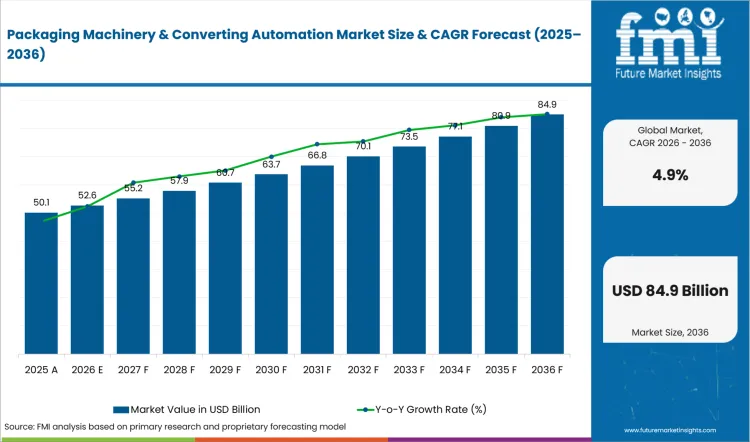
USD 52.6 billion in 2026 and USD 84.9 billion by 2036 at a 4.9% CAGR.
Demand for packaging machinery and converting automation is projected to expand at 4.9% CAGR between 2026 and 2036, increasing valuation from USD 52.6 billion in 2026 to USD 84.9 billion by 2036. Throughput pressure has made packaging machinery demand a capital planning issue for plants that must protect output during frequent product and format changes. PMMI reported in September 2025 that United States packaging machinery sales reached USD 11.3 billion during 2024. The sales base shows why uptime records and changeover proof carry more weight than broad automation claims during supplier review.
Manufacturers in India and China are projected to favor suppliers that install lines quickly and service equipment near expanding production clusters. German and Japanese manufacturers place greater weight on safety records and repeatable acceptance tests before plants replace established machinery. PMMI reported in September 2025 that Canadian packaging machinery sales reached USD 1.2 billion during 2024. The smaller installed base raises the value of local service coverage for plants purchasing imported machinery. North American processors therefore base food packaging equipment orders on sanitation controls and predictable changeovers across multiple package sizes. These buying patterns separate suppliers by application engineering and local response capacity instead of catalog breadth alone.
| Metric | Value |
|---|---|
| 2025 Market Size | USD 50.1 billion |
| 2026 Market Size | USD 52.6 billion |
| 2036 Market Size | USD 84.9 billion |
| Forecast CAGR (2026-2036) | 4.9% |
| Machine Type Focus | Filling & Sealing (34.0% share in 2026) |
| Automation Level Focus | Fully Automatic (63.0% share in 2026) |
| End Use Focus | Food (39.0% share in 2026) |
Summary of the Packaging Machinery & Converting Automation Market
| Market Signal | Commercial Impact |
|---|---|
| Demand and Growth Drivers | Plants purchase automation to protect throughput during format changes and sanitation stops across recurring production schedules. Supplier selection therefore depends on equipment proof and plant support instead of broad capability claims.
|
| Product and Segment View | The filling and sealing segment defines the machine focus while fully automatic equipment shapes the automation view across high-volume production lines. Food production remains the clearest setting for repeated changeovers and hygiene-sensitive validation during commercial operation.
|
| Geography and Growth Outlook | India and China support wider installation activity while Germany and Japan retain longer technical review cycles. Italy and Brazil add distinct opportunities through machinery exports and local investment in food or personal care packaging.
|
| Competitive Landscape | Competition spans integrated line suppliers and specialists in converting or end-of-line automation across different packaging workflows. No single portfolio covers every packaging format with the same technical depth or regional service capacity.
|
| Analyst Perspective | Installation accountability creates a commercial divide that extends beyond machine speed during supplier evaluation and contract review. A line that misses acceptance criteria disrupts production long after equipment arrival and delays the expected operating savings.
|
Source: FMI's proprietary forecasting model and primary research
How is the packaging machinery & converting automation market segmented?
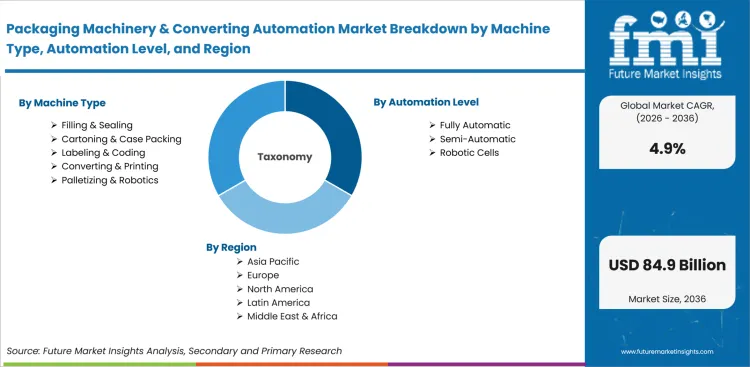
machine type, automation level, end use, technology, sales type, and region
Machine type covers filling and sealing systems alongside cartoning or case packing equipment and labeling or coding platforms. Converting and printing machinery joins palletizing or robotic equipment to complete the machine view across primary and end-of-line work. Automation levels separate fully automatic lines from semi-automatic systems and robotic cells used for selected handling steps. End uses cover food or beverages alongside pharmaceutical production and personal or home care manufacturing. Technology choices range from servo-driven controls to pneumatic or mechanical systems while vision-integrated equipment adds inspection during operation. Sales type distinguishes new equipment from retrofit and service work across the installed machinery base. Regional coverage includes North America and Latin America alongside Europe and Asia where flexible packaging machinery serves different production formats.
What supports demand for filling and sealing within the machine type category?
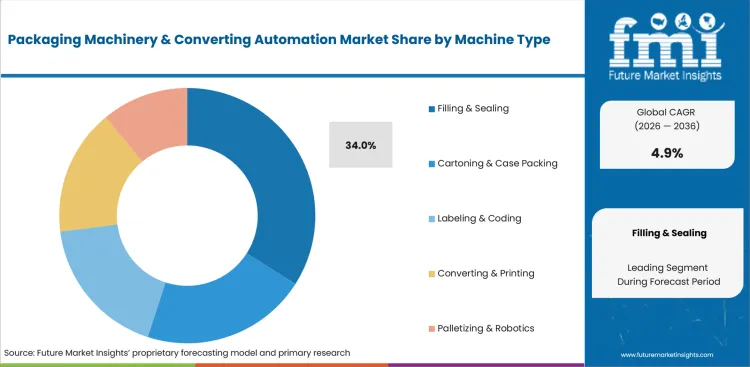
Filling and sealing equipment controls the point where product dosing meets package closure inside one production sequence. Krones reported in January 2026 that Wosana had expanded aseptic filling with a line inaugurated during March 2025. The project shows why processors examine hygiene design and downstream coordination before approving a platform for recurring output. Equipment ownership extends beyond initial dosing owing to continued plant checks for closure control and cleaning verification after commissioning.
- By machine type, filling and sealing is forecast to represent 34.0% share in 2026 driven by its direct effect on dosing accuracy and seal integrity. Plants use this equipment during every production run, so performance evidence shapes line acceptance and later capacity decisions.
- Engineering teams are expected to favor filling and sealing systems because shorter changeovers and repeatable sanitation routines reduce line disruption. Suppliers must connect dosing controls to industrial filling systems already installed downstream so commissioning does not disrupt established package flow. A coordinated control design reduces integration risk after handover and supports stable ramp-up across the first validated production batches.
How is fully automatic positioned within the automation level category?
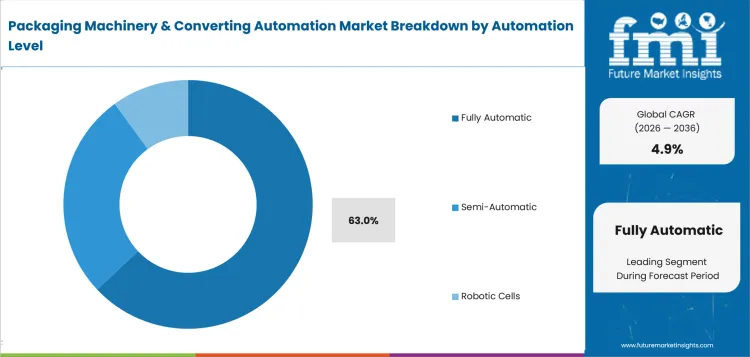
Fully automatic platforms coordinate feeding and inspection states without repeated operator handoffs across the packaging line. Tetra Pak launched Factory OS in November 2025 to connect real-time production information across food and beverage equipment. Factory OS shows that automation purchasing now includes data integration and alarm handling alongside the physical machinery.
- Fully automatic is projected to hold 63.0% share in 2026 owing to predictable cycle control across multi-shift production. Manufacturers select this automation level to reduce manual variation, although acceptance depends on controlled stops and safe restart procedures during format changes.
- Operators are expected to favor fully automatic equipment where labor gaps and stricter output records make manual handoffs harder to sustain. Procurement teams compare controller access and recovery procedures with robotic packaging machines before approving a line.
What drives food demand within the end use category?
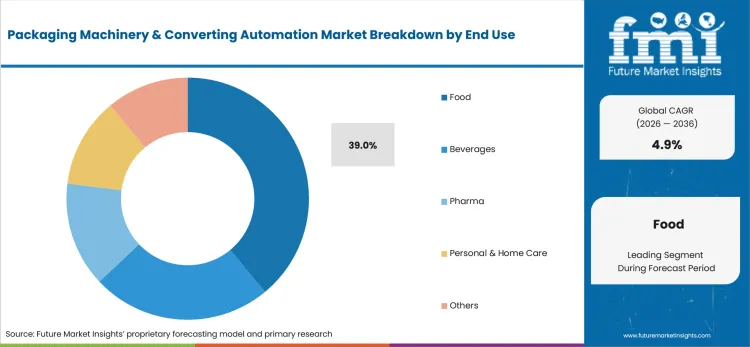
Food plants combine hygiene controls with frequent changes in product weight and package format during recurring commercial runs. In May 2025, Ishida introduced the QX-800 tray sealer for high-volume food lines that need quick tool changes and integrated line monitoring. Ishida's launch shows why processors review seal quality and cleaning access within one approval process before equipment enters a production area.
- In 2026, food is expected to lead the end use category with 39.0% share because packaged products require repeated filling and sealing activity. Food processors face short shelf-life windows, so downtime during changeovers creates an immediate production loss. Inspection records help prevent poorly sealed packs from reaching retailers or distribution centers during routine release checks.
- Managers at food facilities are expected to increase machinery purchases where frequent product switches make automated recipe control and documented cleaning steps valuable. Upstream speed determines final package flow, so engineering teams compare tray and pouch handling with beverage packaging equipment.
What are the drivers, restraints, and opportunities in the packaging machinery & converting automation market?
Throughput protection is expected to drive equipment purchases across plants managing frequent package changes and sanitation stops.
- Driver: automated feeding and inspection are expected to reduce manual variation during frequent changeovers and long production shifts.
- Restraint: capital approval and planned shutdown requirements are anticipated to delay machinery replacement inside operating plants.
- Opportunity: modular robotic cells are projected to expand retrofit options where complete line replacement is commercially impractical.
Packaging producers must maintain output while product sizes and materials change across the same equipment. Automatic recipe settings and inspection controls shorten the time required to restore a validated process after each changeover. Equipment purchases therefore depend on documented line performance instead of broad automation labels used during early supplier screening. Customer trials connect equipment spending to measurable production risk and help plants define operator actions before commissioning begins. Those operating details give finance teams a clearer basis for approving machinery that protects output during recurring package changes.
Replacement decisions become harder if installation requires a long shutdown or major changes to upstream conveyors. Plant managers compare lost production against expected labor savings and waste reduction before they release capital. Integration risk rises where controls from several machine generations remain connected across the operating line. These conditions extend technical review even after the equipment performs well during a supplier demonstration. A phased retrofit often receives earlier approval because it limits shutdown risk to a defined production area.
Modular automation gives plants more handling capacity without requiring a complete rebuild of the packaging hall. Robotic case packing and palletizing cells are usually added after upstream machines have reached stable commercial output. Palletizing robot demand is projected to rise where repetitive lifting creates labor pressure and safety exposure. Suppliers reduce commissioning risk by defining interface points and recovery steps before equipment enters an established production area. Those details shorten fault isolation after the new cell enters routine service within a brownfield plant.
Which country CAGRs are profiled in the packaging machinery & converting automation market?
.webp "Top Country Growth Comparison Packaging Machinery & Converting Automation Market Cagr (2026 2036)")
| Country | CAGR |
|---|---|
| United States | 4.3% |
| China | 6.2% |
| India | 6.9% |
| Germany | 3.9% |
| Italy | 4.1% |
| Japan | 3.6% |
| Brazil | 5.4% |
Source: FMI's proprietary forecasting model and primary research
How do country-level CAGRs compare in the packaging machinery & converting automation market?
Country growth reflects installed packaging capacity and the service model available after equipment commissioning and operator training. New production projects in India and China create wider expansion routes for suppliers serving manufacturing clusters. Plant engineering teams in Germany and Japan place greater weight on safety records and controlled acceptance testing before machinery replacement. Export-oriented machinery capacity comes from Italian suppliers, and United States plants combine a large installed base with replacement demand. Regional distributors carry more weight for Brazilian processors because imported equipment requires local installation support and parts planning after delivery. Supplier evaluation therefore changes by workflow and country, so cartoning machine investment follows checks from beverage filling projects.
- United States plants operate a broad installed base that keeps replacement and retrofit decisions under close financial review. Packaging machinery demand in the United States is forecast to rise at a 4.3% CAGR over the assessment period supported by automation upgrades and service-led purchasing. PMMI reported in May 2026 that United States food and beverage processing machinery shipments reached USD 6.2 billion during 2025. Food processors compare uptime history before replacing proven equipment because an extended stop often affects several production shifts. Service coverage near the plant influences approval alongside the ability to reuse accepted conveyors and package handling devices.
- Chinese equipment clusters allow manufacturers to repeat proven machinery designs across nearby production sites that share suppliers and technical labor. Data released by PMMI in April 2025 showed China imported USD 54.3 million of United States-made food processing and packaging machinery entered China during 2024. Adoption of packaging machinery and converting automation in China is estimated to expand at a 6.2% CAGR through 2036 led by new capacity and local equipment availability. Tariff exposure makes landed cost and lead-time planning part of supplier review alongside controller access.
- Indian manufacturers plan packaged food and consumer product capacity around urban demand centers and shorter delivery routes. Training centers help maintenance teams build controls skills before high-speed equipment enters commercial production at new plants. Official data cited by PMMI in February 2026 placed United States imports from India at USD 56 million for food processing and packaging machinery between November 2024 and October 2025. India is estimated to post a 6.9% CAGR over the forecast period attributable to new line installations and service localization. The trade value shows that Indian suppliers already serve overseas food and packaging machinery demand.
- German machinery suppliers work closely with beverage and industrial packaging plants that require detailed acceptance records. The German sector is projected to record a 3.9% CAGR during the assessment period shaped by replacement work and selective automation upgrades. According to Syntegon's December 2025 release, its new Remshalden assembly hall increased capacity for food packaging systems by 40%. Nearby engineering capacity shows why technical support improves complex line projects and later equipment additions. German plant engineering teams emphasize machinery safety and control documentation before changing a validated line that supports recurring production.
- Italian machinery makers retain technical experience in filling and converting systems designed for export-oriented production. IMA stated in October 2025 that its pharmaceutical end-of-line systems manage up to 500 cartons per minute with full aggregation into cases and pallets. Demand in Italy is forecast to grow at a 4.1% CAGR over the assessment period reinforced by established equipment clusters and replacement demand. Rated output shows how Italian suppliers compete in high-speed packaging systems used for regulated production. Pharmaceutical manufacturers in Italy test format flexibility and control access before approving equipment that must support detailed batch records across several package formats.
- Japanese plants favor controlled machinery changes that protect product quality and established maintenance routines during long equipment lifecycles. Equipment distributors in Japan support operator training and parts planning after handover to reduce delays during scheduled maintenance. A May 2026 review from the USA International Trade Administration placed Japan's food processing machinery market at USD 4.2 billion during 2024. Packaging machinery sales in Japan are forecast to expand at a 3.6% CAGR from 2026 to 2036 due to replacement demand and selective labor-saving investment. Japan's installed equipment base creates recurring demand for packaging upgrades that preserve accepted operating settings.
- Brazilian processors often depend on regional distributors to connect imported machinery with local installation support. PMMI's April 2025 report recorded packaging machinery imports of USD 327 million using trade data updated through September 2024. In Brazil, the market is predicted to advance at a 5.4% CAGR through 2036 supported by food and personal care packaging investment. Brazil's import base explains why distributor coverage and landed equipment cost influence project approval across major processing regions.
Who are the notable companies in the packaging machinery & converting automation market?
Krones, Tetra Pak, Syntegon, BOBST, IMA Group, Coesia, ProMach, Sidel, MULTIVAC, and Ishida are the notable companies shaping this market.
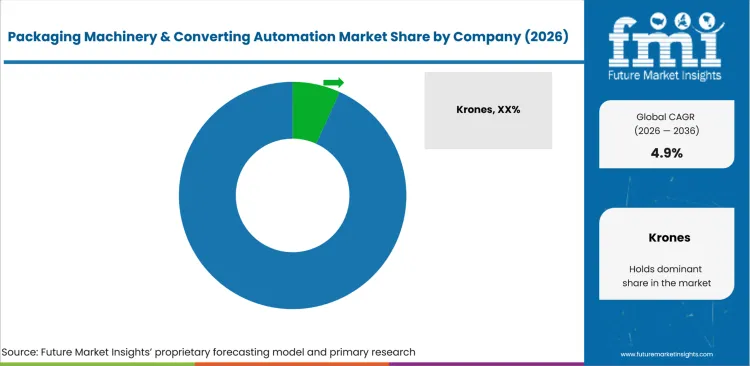
The competitive structure combines integrated line providers with specialists in converting and end-of-line equipment across different packaging workflows. Supplier advantage depends on proven application fit and the ability to coordinate controls across existing machinery. Regulated food or pharmaceutical plants require documented acceptance support before new machinery enters commercial production. Converters place greater weight on print quality and web handling than on filling capability during supplier review. Service reach remains commercially relevant because one equipment fault often interrupts several upstream processes after commissioning. Competition across labeling equipment portfolios therefore turns on technical depth and response capacity within the intended workflow.
- Krones and Tetra Pak combine processing knowledge with filling or downstream packaging equipment for beverage and food plants. Their position is reinforced by integrated line engineering and service teams that support commissioning across several production stages. Both groups coordinate controls across processing and packaging boundaries during multi-site installation or later line expansion.
- Syntegon and IMA Group address packaging workflows for food and pharmaceutical products where validation support influences equipment approval. Both groups compete across primary packaging and end-of-line automation, although their portfolio emphasis differs by product format. Their service teams help plants maintain acceptance records after installation and during later control changes.
- BOBST and Coesia serve different machinery workflows across converting and packaging automation projects for consumer goods producers. Print and converting platforms remain BOBST's focus while Coesia combines specialist equipment businesses across consumer and industrial packaging. Each company connects machine design with application engineering during project review and commissioning across complex production layouts.
- ProMach and Ishida compete in end-of-line handling or inspection-led projects where existing upstream equipment limits design freedom. MULTIVAC and Sidel add depth in food packaging and beverage lines that require stable package integrity during repeated changes. These suppliers support integration around installed conveyor and control systems that cannot be replaced during every project.
Competitive Benchmarking: Packaging Machinery & Converting Automation Market
| Company | Filling and Sealing | Converting and Printing | Robotic End-of-Line | Service Reach |
|---|---|---|---|---|
| Krones | High | Medium | High | Global |
| Tetra Pak | High | Low | Medium | Global |
| Syntegon | High | Low | High | Global |
| BOBST | Low | High | Medium | Global |
| IMA Group | High | Medium | High | Global |
| Coesia | High | Medium | Medium | Global |
| ProMach | High | Low | High | Regional; North America |
| Sidel | High | Low | Medium | Global |
| MULTIVAC | Medium | Medium | High | Global |
| Ishida | Medium | Low | High | Global |
Scoring basis: High indicates broad direct evidence in the named workflow; Medium identifies narrower relevance and Low indicates limited direct evidence.
Source: Future Market Insights competitive analysis, 2026. Ratings reflect relative portfolio relevance and workflow fit. Service capability and geographic reach shape the remaining comparison.
Key Developments in the Packaging Machinery & Converting Automation Market
- In September 2025, Krones presented integrated filling and packaging lines at drinktec 2025 for PET and glass containers. Krones demonstrated connected production equipment and line controls alongside resource management tools for beverage plants. Its drinktec presentation strengthened the company's position in projects that combine filling performance with line data coordination.
- In June 2025, Syntegon reported a customized case packing line for Snack Connection in the Netherlands. The Elematic 2001 WA reached up to 40 cases per minute and supported tool-free changes between packaging formats. Syntegon combined the case packer with the customer's existing SVE 2520 DZ vertical bagger on the production line.
- In March 2025, BOBST announced that Drorys Packlist had invested in an RS 6003 gravure press and a NOVALAM 800 laminator. The RS 6003 creates about 30% less material waste during startup than traditional machines due to its shorter web path. NOVALAM 800 handles film and paper substrates across solvent-based or water-based coating and fully solventless production processes. Together, the two machines expand Drorys Packlist's flexible packaging capacity and reduce waste during frequent job changes.
- In March 2025, MULTIVAC presented AI-supported vision systems for packaging lines ahead of IFFA 2025. The system classified pack contents and sent matching information to MULTIVAC labeling and printing equipment. Automated inspection covered labels and print alongside product completeness on high-speed food packaging lines during production.
Key Players in the Packaging Machinery & Converting Automation Market
Integrated line and filling specialists
- Krones
- Tetra Pak
- Syntegon
- IMA Group
- Sidel
Converting and multi-platform automation suppliers
- BOBST
- Coesia
- MULTIVAC
End-of-line and inspection specialists
- ProMach
- Ishida
Packaging Machinery & Converting Automation Market - Report Scope
| Parameter | Details |
|---|---|
| Market breakdown | Machine type, automation level, end use, technology, sales type, and region |
| Quantitative Units | USD billion |
| Market Definition | Machinery and automation used to fill, seal, label, convert, inspect, case pack, and palletize packaged products. |
| Regions Covered | North America, Latin America, Europe, East Asia, South Asia and Pacific, Oceania, Middle East and Africa |
| Countries Covered | United States, China, India, Germany, Italy, Japan, Brazil, and selected regional markets |
| Key Companies Profiled | Krones, Tetra Pak, Syntegon, BOBST, IMA Group, Coesia, ProMach, Sidel, MULTIVAC, and Ishida |
| Forecast Period | 2026 to 2036 |
| Approach | Hybrid bottom-up and top-down estimation supported by company evidence and primary interviews |
Source: Future Market Insights - analysis driven by proprietary forecasting models and primary research
Packaging Machinery & Converting Automation Market - Research Methodology
| Method | Application |
|---|---|
| Primary Research | Interviews with machinery producers and packaging engineers tested how plants select filling or converting equipment for specific production needs. Discussions covered commissioning time and service coverage alongside the controls knowledge available at each customer site. Inputs from food processors and converters separated new-line demand from retrofit activity driven by equipment failure or capacity limits. Supplier feedback was compared with purchaser priorities so the forecast reflects actual approval steps instead of catalog availability. |
| Desk Research | Official trade records and industry association releases were reviewed for machinery output and cross-border equipment activity after 2024. Company disclosures confirmed recent launches and installed projects across filling or converting workflows in several production regions. Research on pharmaceutical packaging equipment added workflow evidence for regulated plants that require documented validation before commercial use. Country manufacturing conditions and source dates were checked before primary interviews were reconciled with the market model. |
| Market Sizing and Forecasting | Bottom-up estimates were built from machinery categories and application demand across the profiled countries in the forecast model. Top-down checks used official trade values and company evidence only where category definitions matched the target market. Segment shares were tested against installed workflows and supplier portfolio coverage before slower capital-release scenarios were reviewed. |
| Data Validation | Market estimates were validated through a cross-comparison of trade statistics, company disclosures, and primary research findings. Industry participants were consulted to assess key implementation factors, including installation downtime, system integration complexity, and automation adoption challenges. Any anomalous estimates were reviewed against comparable segments and regional benchmarks to ensure consistency and accuracy, while avoiding double counting or the inclusion of values from unrelated markets. |
Source: Future Market Insights (FMI) analysis, based on proprietary forecasting model and primary research
Packaging Machinery & Converting Automation Market by Segments
Packaging Machinery & Converting Automation Market segmented by Machine Type:
- Filling & Sealing
- Cartoning & Case Packing
- Labeling & Coding
- Converting & Printing
- Palletizing & Robotics
Packaging Machinery & Converting Automation Market segmented by Automation Level:
- Fully Automatic
- Semi-Automatic
- Robotic Cells
Packaging Machinery & Converting Automation Market segmented by End Use:
- Food
- Beverages
- Pharma
- Personal & Home Care
- Others
Packaging Machinery & Converting Automation Market segmented by Technology:
- Servo-Driven
- Pneumatic or Mechanical
- AI-Vision Integrated
Packaging Machinery & Converting Automation Market segmented by Sales Type:
- New Equipment
- Retrofit & Services
Packaging Machinery & Converting Automation Market by Region:
- North America
- United States
- Canada
- Latin America
- Brazil
- Mexico
- Rest of Latin America
- Europe
- Germany
- Italy
- United Kingdom
- France
- Rest of Europe
- East Asia
- China
- Japan
- South Korea
- South Asia and Pacific
- India
- ASEAN
- Rest of South Asia and Pacific
- Oceania
- Australia
- New Zealand
- Middle East and Africa
- Gulf Cooperation Council
- South Africa
- Rest of Middle East and Africa
Research Sources and Bibliography
- PMMI. (2025, September). 2025 packaging state of the industry: USA expands and Canada maintains a strong base. https://www.pmmi.org/news/2025-packaging-state-of-the-industry-u-s-expands-canada-maintains-strong-base
- PMMI. (2026, May). PMMI and FPSA release inaugural 2026 processing state of the industry report and infographic. https://www.pmmi.org/news/pmmi-and-fpsa-release-inaugural-2026-processing-state-of-the-industry-report-and-infographic
- PMMI. (2025, June). 2025 India packaging machinery market. https://www.pmmi.org/report/2025-india-packaging-machinery-market
- PMMI. (2025, April). 2025 Brazil packaging machinery market. https://www.pmmi.org/report/2025-brazil-packaging-machinery-market
- PMMI. (2026, February). Cross-border trade updates: India. https://www.pmmi.org/blog/cross-border-trade-updates-54
- PMMI. (2025, April). China retaliatory tariffs. https://www.pmmi.org/blog/china-retaliatory-tariffs
- Krones AG. (2026, January). Wosana is expanding its aseptic filling with Krones. https://www.krones.com/en/company/press/magazine/reference/wosana-is-expanding-its-aseptic-filling-with-krones.php
- Krones AG. (2025, September). Krones at drinktec 2025: Smart solutions for the future of machinery and plant manufacture. https://www.krones.com/en/company/press/krones-at-drinktec-2025-smart-solutions-for-the-future-of-machinery-and-plant-manufacture.php
- Syntegon Technology GmbH. (2025, December). Syntegon opens new assembly hall in Remshalden to support future growth in its food business. https://www.syntegon.com/press/syntegon-new-assembly-hall-remschalen-2025/
- Syntegon Technology GmbH. (2025, June). Snack Connection enhances efficiency with a case packer from Syntegon. https://www.syntegon.com/news/snack-connection-enhances-efficiency-with-the-case-packer-from-syntegon/
- IMA Group. (2025, October). End-of-line packaging: A strategic pillar for the pharmaceutical industry. https://imagroup.com/news/end-of-line-packaging-a-strategic-pillar-for-the-pharmaceutical-industry/
- BOBST. (2025, March). Drorys Packlist invests in advanced BOBST technology for flexible packaging expansion. https://www.bobst.com/eu/en/news/1740586202-drorys-packlist-invests-in-advanced-bobst-technology-for-flexible-packaging-expansion
- Tetra Pak. (2025, November). Tetra Pak launches Factory OS to make factories AI-ready. https://www.tetrapak.com/about-tetra-pak/news-and-events/newsarchive/tetra-pak-launches-tetra-pak-factory-OS-to-make-factories-AI-ready
- Ishida Europe. (2025, May). Product launch: Introducing the QX-800 tray sealer. https://www.ishidaeurope.com/en/about-us/case-studies-and-events/news/product-launch-introducing-the-qx-800-the-future-of-tray-sealing/
- USA International Trade Administration. (2026, May). Japan food packaging equipment. https://www.trade.gov/market-intelligence/japan-food-packaging-equipment
- MULTIVAC. (2025, March). AI-supported vision systems for packaging processes. https://multivac.com/int/en/company/news/ai-supported-vision-systems
This bibliography is provided for reader reference and uses primary government, standards-body, official trade body, and company sources.
This Report Answers
- What value is forecast for the packaging machinery & converting automation market in 2026 and by 2036?
- What CAGR is forecast for the packaging machinery & converting automation market from 2026 to 2036?
- Which machine types and automation levels shape purchasing across the profiled applications?
- Which operational pressures support equipment replacement and retrofit activity?
- How do country CAGRs differ across the seven profiled national markets?
- Which competitive dimensions separate integrated line suppliers from specialist equipment companies?
- How does FMI validate market values using trade evidence and primary interviews?
- What should plant engineering teams evaluate before approving a machinery supplier?
- How do safety records and service coverage affect supplier selection after commissioning?
Frequently Asked Questions
What is driving growth in the Packaging Machinery & Converting Automation Market?
Plants are replacing manual handoffs where throughput and changeover pressure create recurring production losses across shifts. Automated inspection and coordinated controls support more repeatable output across package formats during extended production shifts.
Who are the key players in the Packaging Machinery & Converting Automation Market?
Krones and Tetra Pak compete across integrated processing and packaging lines for food or beverage plants. Syntegon and BOBST add depth in regulated packaging or converting workflows that require documented acceptance support.
What is a considerable restraint in the Packaging Machinery & Converting Automation Market?
Installation shutdowns often postpone orders even after machinery has passed the supplier trial and met the required output standard. Integration becomes harder where several controller generations and upstream machines remain connected within one operating line.
Why should executives track the Packaging Machinery & Converting Automation Market?
Equipment choices affect labor needs and production continuity across several packaged product categories and plant formats. Service access and acceptance planning shape the financial return long after machinery purchase and initial operator training.
What business problem does the Packaging Machinery & Converting Automation Market address?
The market addresses repeated filling and converting tasks that require controlled speed and package quality. Automation reduces manual variation across inspection and end-of-line handling steps during repeated commercial production runs.
What should procurement leaders evaluate before selecting suppliers?
Procurement leaders should compare application references and commissioning plans before choosing machinery suppliers for similar production requirements. They should confirm dependable spare-part access and controller support for the installed production environment before approval.
What limits return on investment for purchasers?
Return on investment is reduced by long shutdowns and poorly defined acceptance tests during equipment commissioning. Savings weaken if operators lack enough training to recover safely after alarms or format changes.
How do suppliers build long-term account confidence?
Suppliers build confidence by documenting output and responding quickly after commissioning or later production changes. Clear maintenance plans and local engineering support help plants protect scheduled production during later equipment changes.
Preview the report firsthand - request a free sample
Get SampleGet the brochure for pricing and purchase details.
Get PDFTable of Content
- Key Takeaways
- Market Size and CAGR
- Top Growth Driver
- Fastest Growing Segment
- Leading Region
- Key Companies
- Emerging Opportunities
- Executive Summary
- Global Market Outlook
- Demand-side Trends
- Supply-side Trends
- Technology Roadmap Analysis
- Analysis and Recommendations
- Analyst Perspective (What is happening? Why now? What should investors know?)
- Key Questions Answered
- How large is the market?
- What is the CAGR?
- What are key trends?
- Which region dominates?
- Who are the leaders?
- Market Overview
- Market Coverage / Taxonomy
- Market Definition / Scope / Limitations
- Research Methodology
- Chapter Orientation
- Analytical Lens and Working Hypotheses
- Market Structure, Signals, and Trend Drivers
- Benchmarking and Cross-market Comparability
- Market Sizing, Forecasting, and Opportunity Mapping
- Research Design and Evidence Framework
- Desk Research Programme (Secondary Evidence)
- Expert Input and Fieldwork (Primary Evidence)
- Tooling, Models, and Reference Databases
- Data Engineering and Model Build
- Quality Assurance and Audit Trail
- Market Background
- Market Dynamics (Drivers, Restraints, Opportunity, Trends)
- Scenario Forecast (Optimistic, Likely, Conservative)
- Impact Analysis
- AI Impact
- Sustainability Impact
- Regulatory Impact
- Technology Impact
- Consumer / Buyer Analysis
- Purchase Drivers
- Adoption Barriers
- Buyer Journey
- Opportunity Map Analysis
- Product Life Cycle Analysis
- Supply Chain Analysis
- Investment Feasibility Matrix
- Value Chain Analysis
- PESTLE and Porter's Analysis
- Regulatory Landscape
- Regional Parent Market Outlook
- Production and Consumption Statistics
- Import and Export Statistics
- Global Market Analysis and Forecast, 2021 to 2036
- Historical Market Size Value (USD Billion) Analysis, 2021 to 2025
- Current and Future Market Size Value (USD Billion) Projections, 2026 to 2036
- Y-o-Y Growth Trend Analysis
- Absolute $ Opportunity Analysis
- Global Market Pricing Analysis, 2021 to 2036
- Global Market Analysis and Forecast, By Machine Type, 2021 to 2036
- Introduction / Key Findings
- Historical Market Size Value (USD Billion) Analysis By Machine Type, 2021 to 2025
- Current and Future Market Size Value (USD Billion) Analysis and Forecast By Machine Type, 2026 to 2036
- Filling & Sealing
- Cartoning & Case Packing
- Labeling & Coding
- Converting & Printing
- Palletizing & Robotics
- Filling & Sealing
- Y-o-Y Growth Trend Analysis By Machine Type, 2021 to 2025
- Absolute $ Opportunity Analysis By Machine Type, 2026 to 2036
- Global Market Analysis and Forecast, By Automation Level, 2021 to 2036
- Introduction / Key Findings
- Historical Market Size Value (USD Billion) Analysis By Automation Level, 2021 to 2025
- Current and Future Market Size Value (USD Billion) Analysis and Forecast By Automation Level, 2026 to 2036
- Fully Automatic
- Semi-Automatic
- Robotic Cells
- Fully Automatic
- Y-o-Y Growth Trend Analysis By Automation Level, 2021 to 2025
- Absolute $ Opportunity Analysis By Automation Level, 2026 to 2036
- Global Market Analysis and Forecast, By End Use, 2021 to 2036
- Introduction / Key Findings
- Historical Market Size Value (USD Billion) Analysis By End Use, 2021 to 2025
- Current and Future Market Size Value (USD Billion) Analysis and Forecast By End Use, 2026 to 2036
- Food
- Beverages
- Pharma
- Personal & Home Care
- Others
- Food
- Y-o-Y Growth Trend Analysis By End Use, 2021 to 2025
- Absolute $ Opportunity Analysis By End Use, 2026 to 2036
- Global Market Analysis and Forecast, By Technology, 2021 to 2036
- Introduction / Key Findings
- Historical Market Size Value (USD Billion) Analysis By Technology, 2021 to 2025
- Current and Future Market Size Value (USD Billion) Analysis and Forecast By Technology, 2026 to 2036
- Servo-Driven
- Pneumatic / Mechanical
- AI-Vision Integrated
- Servo-Driven
- Y-o-Y Growth Trend Analysis By Technology, 2021 to 2025
- Absolute $ Opportunity Analysis By Technology, 2026 to 2036
- Global Market Analysis and Forecast, By Sales Type, 2021 to 2036
- Introduction / Key Findings
- Historical Market Size Value (USD Billion) Analysis By Sales Type, 2021 to 2025
- Current and Future Market Size Value (USD Billion) Analysis and Forecast By Sales Type, 2026 to 2036
- New Equipment
- Retrofit & Services
- New Equipment
- Y-o-Y Growth Trend Analysis By Sales Type, 2021 to 2025
- Absolute $ Opportunity Analysis By Sales Type, 2026 to 2036
- Global Market Analysis and Forecast, By Region, 2021 to 2036
- Introduction
- Historical Market Size Value (USD Billion) Analysis By Region, 2021 to 2025
- Current Market Size Value (USD Billion) Analysis and Forecast By Region, 2026 to 2036
- North America
- Latin America
- Western Europe
- Eastern Europe
- East Asia
- South Asia and Pacific
- Middle East & Africa
- Market Attractiveness Analysis By Region
- North America Market Analysis and Forecast, By Country, 2021 to 2036
- Historical Market Size Value (USD Billion) Trend Analysis By Market Taxonomy, 2021 to 2025
- Market Size Value (USD Billion) Forecast By Market Taxonomy, 2026 to 2036
- By Country
- USA
- Canada
- By Machine Type
- By Automation Level
- By End Use
- By Technology
- By Sales Type
- By Country
- Market Attractiveness Analysis
- By Country
- By Machine Type
- By Automation Level
- By End Use
- By Technology
- By Sales Type
- Key Takeaways
- Latin America Market Analysis and Forecast, By Country
- Historical Market Size Value (USD Billion) Trend Analysis By Market Taxonomy, 2021 to 2025
- Market Size Value (USD Billion) Forecast By Market Taxonomy, 2026 to 2036
- By Country
- Brazil
- Mexico
- Chile
- Rest of Latin America
- By Machine Type
- By Automation Level
- By End Use
- By Technology
- By Sales Type
- By Country
- Market Attractiveness Analysis
- By Country
- By Machine Type
- By Automation Level
- By End Use
- By Technology
- By Sales Type
- Key Takeaways
- Western Europe Market Analysis and Forecast, By Country
- Historical Market Size Value (USD Billion) Trend Analysis By Market Taxonomy, 2021 to 2025
- Market Size Value (USD Billion) Forecast By Market Taxonomy, 2026 to 2036
- By Country
- Germany
- UK
- Italy
- Spain
- France
- Nordic
- BENELUX
- Rest of Western Europe
- By Machine Type
- By Automation Level
- By End Use
- By Technology
- By Sales Type
- By Country
- Market Attractiveness Analysis
- By Country
- By Machine Type
- By Automation Level
- By End Use
- By Technology
- By Sales Type
- Key Takeaways
- Eastern Europe Market Analysis and Forecast, By Country
- Historical Market Size Value (USD Billion) Trend Analysis By Market Taxonomy, 2021 to 2025
- Market Size Value (USD Billion) Forecast By Market Taxonomy, 2026 to 2036
- By Country
- Russia
- Poland
- Hungary
- Balkan & Baltic
- Rest of Eastern Europe
- By Machine Type
- By Automation Level
- By End Use
- By Technology
- By Sales Type
- By Country
- Market Attractiveness Analysis
- By Country
- By Machine Type
- By Automation Level
- By End Use
- By Technology
- By Sales Type
- Key Takeaways
- East Asia Market Analysis and Forecast, By Country
- Historical Market Size Value (USD Billion) Trend Analysis By Market Taxonomy, 2021 to 2025
- Market Size Value (USD Billion) Forecast By Market Taxonomy, 2026 to 2036
- By Country
- China
- Japan
- South Korea
- By Machine Type
- By Automation Level
- By End Use
- By Technology
- By Sales Type
- By Country
- Market Attractiveness Analysis
- By Country
- By Machine Type
- By Automation Level
- By End Use
- By Technology
- By Sales Type
- Key Takeaways
- South Asia and Pacific Market Analysis and Forecast, By Country
- Historical Market Size Value (USD Billion) Trend Analysis By Market Taxonomy, 2021 to 2025
- Market Size Value (USD Billion) Forecast By Market Taxonomy, 2026 to 2036
- By Country
- India
- ASEAN
- Australia & New Zealand
- Rest of South Asia and Pacific
- By Machine Type
- By Automation Level
- By End Use
- By Technology
- By Sales Type
- By Country
- Market Attractiveness Analysis
- By Country
- By Machine Type
- By Automation Level
- By End Use
- By Technology
- By Sales Type
- Key Takeaways
- Middle East & Africa Market Analysis and Forecast, By Country
- Historical Market Size Value (USD Billion) Trend Analysis By Market Taxonomy, 2021 to 2025
- Market Size Value (USD Billion) Forecast By Market Taxonomy, 2026 to 2036
- By Country
- Kingdom of Saudi Arabia
- Other GCC Countries
- Türkiye
- South Africa
- Other African Union
- Rest of Middle East & Africa
- By Machine Type
- By Automation Level
- By End Use
- By Technology
- By Sales Type
- By Country
- Market Attractiveness Analysis
- By Country
- By Machine Type
- By Automation Level
- By End Use
- By Technology
- By Sales Type
- Key Takeaways
- Key Countries Market Analysis
- USA
- Pricing Analysis
- Market Share Analysis, 2025
- By Machine Type
- By Automation Level
- By End Use
- By Technology
- By Sales Type
- Canada
- Pricing Analysis
- Market Share Analysis, 2025
- By Machine Type
- By Automation Level
- By End Use
- By Technology
- By Sales Type
- Mexico
- Pricing Analysis
- Market Share Analysis, 2025
- By Machine Type
- By Automation Level
- By End Use
- By Technology
- By Sales Type
- Brazil
- Pricing Analysis
- Market Share Analysis, 2025
- By Machine Type
- By Automation Level
- By End Use
- By Technology
- By Sales Type
- Chile
- Pricing Analysis
- Market Share Analysis, 2025
- By Machine Type
- By Automation Level
- By End Use
- By Technology
- By Sales Type
- Germany
- Pricing Analysis
- Market Share Analysis, 2025
- By Machine Type
- By Automation Level
- By End Use
- By Technology
- By Sales Type
- UK
- Pricing Analysis
- Market Share Analysis, 2025
- By Machine Type
- By Automation Level
- By End Use
- By Technology
- By Sales Type
- Italy
- Pricing Analysis
- Market Share Analysis, 2025
- By Machine Type
- By Automation Level
- By End Use
- By Technology
- By Sales Type
- Spain
- Pricing Analysis
- Market Share Analysis, 2025
- By Machine Type
- By Automation Level
- By End Use
- By Technology
- By Sales Type
- France
- Pricing Analysis
- Market Share Analysis, 2025
- By Machine Type
- By Automation Level
- By End Use
- By Technology
- By Sales Type
- India
- Pricing Analysis
- Market Share Analysis, 2025
- By Machine Type
- By Automation Level
- By End Use
- By Technology
- By Sales Type
- ASEAN
- Pricing Analysis
- Market Share Analysis, 2025
- By Machine Type
- By Automation Level
- By End Use
- By Technology
- By Sales Type
- Australia & New Zealand
- Pricing Analysis
- Market Share Analysis, 2025
- By Machine Type
- By Automation Level
- By End Use
- By Technology
- By Sales Type
- China
- Pricing Analysis
- Market Share Analysis, 2025
- By Machine Type
- By Automation Level
- By End Use
- By Technology
- By Sales Type
- Japan
- Pricing Analysis
- Market Share Analysis, 2025
- By Machine Type
- By Automation Level
- By End Use
- By Technology
- By Sales Type
- South Korea
- Pricing Analysis
- Market Share Analysis, 2025
- By Machine Type
- By Automation Level
- By End Use
- By Technology
- By Sales Type
- Russia
- Pricing Analysis
- Market Share Analysis, 2025
- By Machine Type
- By Automation Level
- By End Use
- By Technology
- By Sales Type
- Poland
- Pricing Analysis
- Market Share Analysis, 2025
- By Machine Type
- By Automation Level
- By End Use
- By Technology
- By Sales Type
- Hungary
- Pricing Analysis
- Market Share Analysis, 2025
- By Machine Type
- By Automation Level
- By End Use
- By Technology
- By Sales Type
- Kingdom of Saudi Arabia
- Pricing Analysis
- Market Share Analysis, 2025
- By Machine Type
- By Automation Level
- By End Use
- By Technology
- By Sales Type
- Türkiye
- Pricing Analysis
- Market Share Analysis, 2025
- By Machine Type
- By Automation Level
- By End Use
- By Technology
- By Sales Type
- South Africa
- Pricing Analysis
- Market Share Analysis, 2025
- By Machine Type
- By Automation Level
- By End Use
- By Technology
- By Sales Type
- USA
- Market Structure Analysis
- Competition Dashboard
- Competition Benchmarking
- Market Share Analysis of Top Players
- By Regional
- By Machine Type
- By Automation Level
- By End Use
- By Technology
- By Sales Type
- Emerging Startups
- Innovation Benchmarking
- Competition Analysis
- Competition Deep Dive
- Krones
- Overview
- Product Portfolio
- Profitability by Market Segments
- Sales Footprint
- Strategy Overview
- Marketing Strategy
- Product Strategy
- Channel Strategy
- Tetra Pak
- Syntegon
- Bobst
- IMA Group
- Coesia
- ProMach
- Sidel
- Multivac
- Ishida
- Krones
- Case Studies
- Success Stories
- Recent Developments
- Competition Deep Dive
- Assumptions & Acronyms Used


