

- Market Size (2026)
- USD 980.7 Mn
- Forecast (2036)
- USD 1823.7 Mn
- CAGR (2026 to 2036)
- 6.4%
How big is the Air Stripping System Market in 2026?
USD 980.7 million in 2026 and USD 1,823.7 million by 2036 at a 6.4% CAGR.
The air stripping system market was valued at USD 921.7 million in 2025. It is expected to grow from USD 980.7 million in 2026 to USD 1,823.7 million in 2036 at a CAGR of 6.4% as groundwater remediation and landfill leachate projects move toward engineered on-site treatment. VOCs are projected to secure 52.6% share in 2026, backed by solvent and fuel-compound removal needs. Groundwater remediation is expected to hold 45.3% share in 2026, led by pump-and-treat use across VOC-impacted sites.
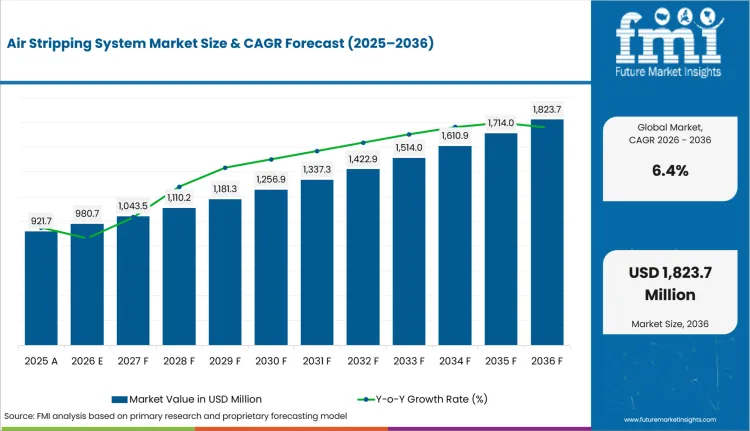
| Metric | Value |
|---|---|
| 2026 Market Size | USD 980.7 million |
| 2036 Market Size | USD 1,823.7 million |
| Forecast CAGR | 6.4% from 2026 to 2036 |
| Leading Contaminant Type | VOCs |
| VOCs Share in 2026 | 52.6% |
| Leading Application | Groundwater Remediation |
| Groundwater Remediation Share in 2026 | 45.3% |
| Leading CAGR Country | China |
| China CAGR | 7.2% by 2036 |
Summary of the Air Stripping System Market
| Market Signal | Commercial Impact |
|---|---|
| Demand and Growth Drivers | Air stripping system demand is increasing as environmental remediation and water treatment projects expand.
|
| Product and Segment View | VOC treatment, groundwater remediation, and environmental remediation applications dominate the market.
|
| Geography and Growth Outlook | China and India are expected to remain key growth markets for air stripping systems.
|
| Competitive Landscape | Competition is centered on treatment efficiency, engineered system design, and application expertise.
|
| Analyst Perspective | Air stripping systems are increasingly evaluated on remediation performance rather than equipment cost alone.
— Anurag Sharma, Principal Consultant, Industrial Automation, Future Market Insights |
Remediation investment is strengthening around site cleanup and reliable field treatment. EPA reported 72 remedial construction projects completed in fiscal year 2025, supporting equipment demand for water-phase treatment trains. Environment Agency reporting showed serious pollution incidents among water and sewerage companies increased by 60% from 47 in 2023 to 75 in 2024, lifting scrutiny on treatment reliability.
Xylem’s June 2026 Dow partnership states an advanced industrial water system is expected to operate by August 2028, reinforcing demand for integrated water treatment and reuse packages.Air stripping system demand is forecast to expand through 2036, supported by VOC groundwater treatment and engineered wastewater packages.
Which factors support expansion in the Air Stripping System Market?
Groundwater remediation and industrial wastewater compliance support market value across municipal and landfill settings.
- Market value rises as pump-and-treat systems need above-ground treatment for VOC-impacted groundwater.
- Packed tower units support adoption as large flows require stable air-water contact and simple operating routines.
- Tray and low-profile systems influence demand through compact layouts and rental suitability.
- Landfill leachate operators promote selective demand for ammonia stripping before discharge or surcharge review.
Why is the Air Stripping System Market growing?
Long-duration groundwater cleanup increases system demand as VOC plumes require reliable above-ground treatment.
Air stripping system buyers invest in packed towers and portable skids as extracted groundwater often needs treatment over extended periods. EPA reported in May 2026 that contaminated groundwater migration had been controlled at 1,191 Superfund sites by the end of fiscal year 2025, showing long remedy duration linked to water-phase treatment equipment. Contractor-led projects need systems that sustain removal targets across changing influent loads. Suppliers able to connect tower design, off-gas review, and maintenance support gain stronger acceptance in remediation and industrial wastewater investment decisions.
How is the Air Stripping System Market segmented?
Air Stripping System Market is segmented by system type, contaminant type, application, end use, and sales channel.
- Packed tower air strippers are projected to account for 39.8% share in 2026, influenced by high-flow groundwater projects needing durable mass transfer.
- VOCs are expected to represent 52.6% share in 2026, shaped by solvent and fuel-compound treatment across remediation sites.
- Groundwater remediation is anticipated to account for 45.3% share in 2026, led by pump-and-treat projects requiring above-ground water treatment.
- Environmental remediation is projected to hold 41.7% share in 2026, guided by contaminated-site cleanup and brownfield treatment needs.
- Environmental contractors are expected to represent 38.5% share in 2026, supported by specification influence and field service control.
Why do Packed Tower Air Strippers dominate the Air Stripping System Market by system type?
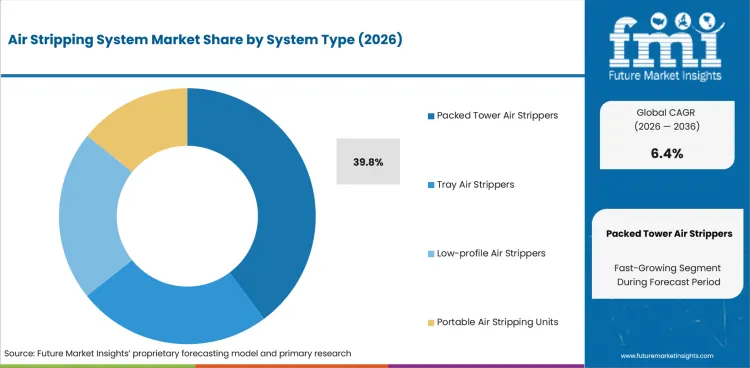
- Packed Tower Air Strippers are projected to account for 39.8% share in 2026, driven by high-flow groundwater treatment projects requiring stable contact between water and air.
- Tray Air Strippers gain demand as contractors prefer compact units for constrained sites and projects needing easier internal cleaning.
Which contaminant type leads the Air Stripping System Market?
- VOCs are expected to represent 52.6% share in 2026, led by MTBE and other volatile compounds suited to air-water transfer.
- Ammonia remains active in landfill leachate and industrial streams. pH adjustment and off-gas handling can influence project economics.
Which application leads the Air Stripping System Market?
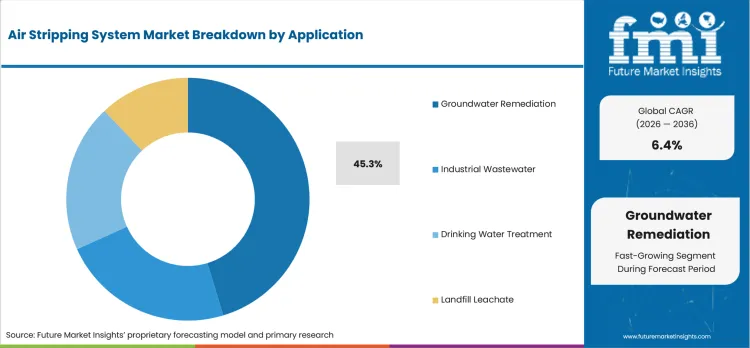
- Groundwater remediation is anticipated to account for 45.3% share in 2026, supported by pump-and-treat systems used after plume extraction.
- Industrial wastewater creates added demand as plants use stripping to reduce VOC or ammonia loads before biological treatment and discharge polishing.
Which end use leads the Air Stripping System Market?
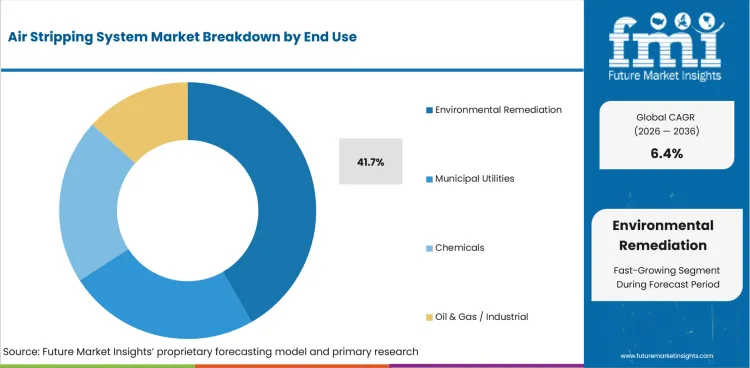
- Environmental remediation is projected to hold 41.7% share in 2026, guided by contaminated-site cleanup and groundwater remedy operation.
- Municipal utilities remain important as drinking water wells and wellhead treatment projects need reliable contaminant removal.
Which sales channel leads the Air Stripping System Market?
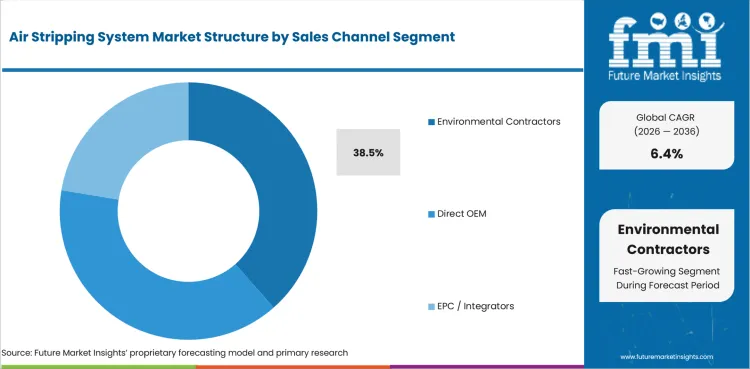
- Environmental Contractors are expected to represent 38.5% share in 2026, guided by contractor influence over pilot testing and site execution.
- Direct OEM sales remain active as utilities and industrial plants seek tower sizing and service support from equipment makers.
What are the drivers, restraints, and opportunities in the Air Stripping System Market?
Industrial remediation and pilot-led treatment planning are shaping air stripping system buying decisions.
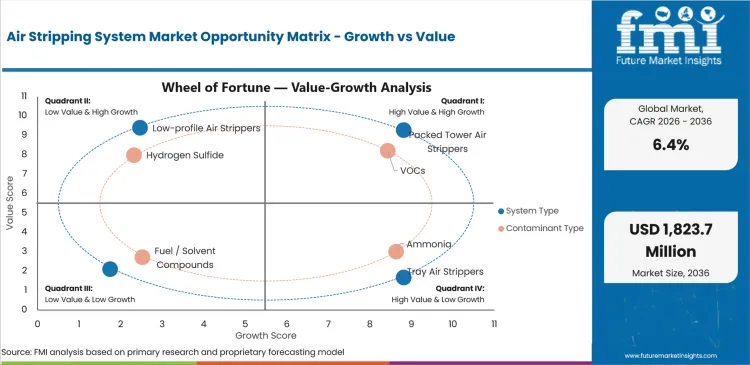
- Driver: VOC groundwater plumes require engineered stripping units before discharge targets can be achieved.
- Restraint: Off-gas treatment can raise total project cost if stripped contaminants require vapor-phase control.
- Opportunity: Rental and pilot skids can improve buyer confidence as landfill and industrial streams vary by site.
Pump-and-Treat Continuity Strengthens System Demand
Pump-and-treat continuity creates a notable reason for air stripping adoption. EPA completed 553 remedial site assessments in fiscal year 2025, supporting a continuing project funnel for investigation and above-ground treatment. Air stripping suppliers gain demand as contractors convert site data into treatment trains with pumps and vapor treatment. Long remedy schedules support replacement and service demand across established remediation markets.
Off-Gas Cost Pressure Limits High-Load VOC Projects
Off-gas cost pressure can slow adoption in projects containing concentrated VOC loads. GAO reported in 2025 that Superfund program appropriations declined from about USD 2.6 billion in fiscal year 1999 to about USD 537 million in fiscal year 2024, showing funding pressure around cleanup choices. Buyers must compare tower price with blower energy and monitoring. High-load sites can delay equipment orders until total treatment economics are clear.
Optimization Programs Create Service-Led Opportunity
Optimization programs create opportunity for suppliers able to improve long-running remedies. EPA reported 43 Superfund optimization evaluation and support projects in fiscal year 2025, showing continued attention to remedy effectiveness and cost efficiency. Air stripping suppliers can use pilot testing, upgraded packing and maintenance planning to improve legacy systems. Contractor partnerships can convert optimization work into replacement towers or portable treatment skids.
Which countries are growing in the Air Stripping System Market?
China 7.2% CAGR, India 7.0% CAGR, South Korea 6.6% CAGR, United States 6.3% CAGR, Germany 6.1% CAGR, France 6.0% CAGR, United Kingdom 5.8% CAGR, and Japan 5.7% CAGR through 2036.
.webp "Top Country Growth Comparison Air Stripping System Market Cagr (2026 2036)")
| Country | CAGR |
|---|---|
| China | 7.2% |
| India | 7.0% |
| South Korea | 6.6% |
| United States | 6.3% |
| Germany | 6.1% |
| France | 6.0% |
| United Kingdom | 5.8% |
| Japan | 5.7% |
Source: Future Market Insights, 2026.
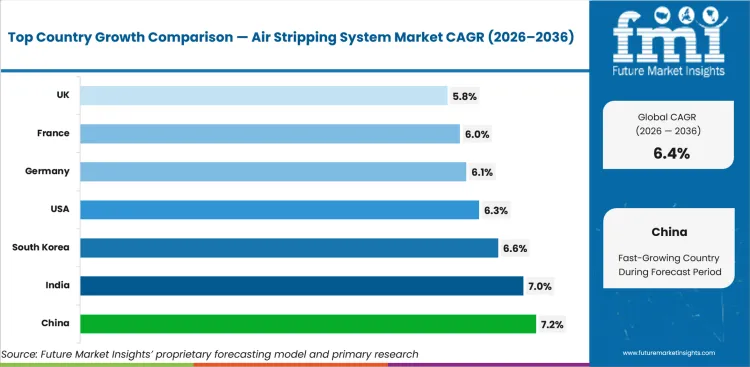
How do country-level CAGRs compare in the Air Stripping System Market?
China records the leading country pace while Japan records a more cautious pace among profiled markets.
- China is forecast to record 7.2% CAGR by 2036 through construction-land remediation and industrial groundwater control.
- India is expected to expand at 7.0% CAGR from 2026 to 2036, led by groundwater monitoring and contaminated-site management rules.
- South Korea is projected to grow at 6.6% CAGR through 2036 as industrial complex surveys and petroleum facility assessments support treatment planning.
- United States is estimated to rise at 6.3% CAGR by 2036, reflected by Superfund cleanup activity and established supplier presence.
- Germany is expected to advance at 6.1% CAGR over the forecast period as contaminated-site remediation and industrial groundwater protection support demand.
- France is expected to record 6.0% CAGR by 2036, driven by organochlorine and hydrocarbon contamination across selected sites.
- United Kingdom is projected to post 5.8% CAGR by 2036, guided by consultant-led remediation and water-sector performance scrutiny.
- Japan is forecast to grow at 5.7% CAGR by 2036, backed by compact-site engineering and VOC-related soil contamination controls.
How fast is the Air Stripping System Market growing in China?
A 7.2% CAGR through 2036 reflects construction-land remediation and industrial groundwater control.
Country Market Snapshot Table
| Parameter | Value |
|---|---|
| Market Size in 2025 (Value) | USD 116.2 million |
| Market Size in 2026 (Value) | USD 124.6 million |
| Market Forecast in 2036 (Value) | USD 249.7 million |
| CAGR (2026 to 2036) | 7.2% |
| Years Considered | 2021 to 2036 |
| Base Year | 2025 |
| Forecast Period | 2026 to 2036 |
| Units Considered | Value (USD million) |
| Leading Sub-Region | Yangtze River Delta, Pearl River Delta, Beijing-Tianjin-Hebei, Shandong, Jiangsu, Zhejiang |
China Air Stripping System Market Outlook
- China air stripping system industry is advancing through industrial redevelopment and groundwater quality management. Buyers need treatment packages that can support solvent removal and project delivery across industrial provinces.
- Equipment selection is expected to favor integrators combining field installation and local permit knowledge. Domestic environmental engineering firms are expected to remain influential as provincial tenders compare cost and treatment performance.
Key Growth Drivers
- Groundwater control supports treatment planning, as China’s 2024 freshwater review reported Grade I-IV groundwater at 77.9% and Grade V groundwater at 22.1%.
- River and lake restoration planning expands water-quality attention, reinforced by China’s 2025-2027 action plan covering more than 2,500 rivers and lakes.
- Industrial redevelopment creates demand for stripping units suited to chlorinated solvents and fuel compounds at selected sites.
- Local engineering partners support adoption as buyers need site construction and discharge coordination.
Key Restraints
- Provincial funding variation can slow system purchases if site owners lack clear remediation budgets.
- Mixed contamination can push projects toward combined treatment trains rather than stripping-only equipment.
- Beijing’s 2024 environment report monitored 105 rivers over 2,551.6 km, showing wide water-management scope that can spread funding across many priorities.
What makes China unique
China stands apart through provincial remediation programs and domestic engineering firms able to support large project packages.
Key Companies
- Beijing GeoEnviron Engineering & Technology
- Poten Environment Group
- Sound Environment Group
- Tus-EST
- CECEP Environmental Protection
- Yonker Environmental Protection
- Beijing OriginWater Technology
Sales & Marketing Channels
- Provincial remediation tenders
- EPC integrator partnerships
- Industrial park environmental upgrades
- Brownfield redevelopment projects
- Local distributor networks
- Direct sales to large industrial owners
Country Segment Breakdown Table
| Segment | Sub-Segments |
|---|---|
| By System Type | Packed Tower Air Strippers · Tray Air Strippers · Low-profile Air Strippers · Portable Air Stripping Units |
| By Contaminant Type | VOCs · Ammonia · Hydrogen Sulfide · Fuel / Solvent Compounds |
| By Application | Groundwater Remediation · Industrial Wastewater · Drinking Water Treatment · Landfill Leachate |
| By End Use | Environmental Remediation · Municipal Utilities · Chemicals · Oil & Gas / Industrial |
| By Sales Channel | Direct OEM · Environmental Contractors · EPC / Integrators |
| Key Sub-Regions Covered, Industrial Corridors | Yangtze River Delta · Pearl River Delta · Beijing-Tianjin-Hebei · Shandong · Jiangsu · Zhejiang |
Frequently Asked Questions
How fast is China Air Stripping System Market growing?
China records an estimated 7.2% CAGR as industrial redevelopment and groundwater-quality control lift demand for engineered treatment systems.
Who leads China Air Stripping System Market?
Beijing GeoEnviron Engineering & Technology leads China air stripping system market, followed by Poten Environment Group and Sound Environment Group across remediation and water projects.
What is driving adoption in China Air Stripping System Market?
Provincial remediation tenders and local EPC support are moving project owners toward packaged stripping systems.
What is the Air Stripping System Market outlook in India?
A 7.0% CAGR through 2036 reflects groundwater monitoring and contaminated-site management rule formation.
Country Market Snapshot Table
| Parameter | Value |
|---|---|
| Market Size in 2025 (Value) | USD 53.3 million |
| Market Size in 2026 (Value) | USD 57.0 million |
| Market Forecast in 2036 (Value) | USD 112.1 million |
| CAGR (2026 to 2036) | 7.0% |
| Years Considered | 2021 to 2036 |
| Base Year | 2025 |
| Forecast Period | 2026 to 2036 |
| Units Considered | Value (USD million) |
| Leading Sub-Region | Gujarat, Maharashtra, Tamil Nadu, Karnataka, Delhi-NCR, Telangana |
India Air Stripping System Market Outlook
- India air stripping system demand is gaining from groundwater quality scrutiny and contaminated-site management rules. Buyers need portable and packaged systems that can support pilot testing before full-scale investment.
- Adoption is expected to begin with industrial wastewater and landfill leachate projects before expanding into formal contaminated-site remediation. Local EPC and water-treatment firms will remain central to field service and compliance support.
Key Growth Drivers
- Groundwater monitoring scale supports stronger identification of localized contamination, as the Annual Groundwater Quality Report 2024 used 15,259 monitoring locations.
- Contaminated-site management now has a formal project pathway, and CPCB identified 103 contaminated sites while remediation had begun at 7 sites in 2025.
- Industrial estates and landfill leachate projects create selective demand for portable systems and pilot skids.
- Local EPC firms support adoption by combining treatment equipment with site works and compliance documentation.
Key Restraints
- Many groundwater contaminants are inorganic or non-volatile, reducing direct suitability for air stripping.
- Public tender cycles can slow adoption of imported components and premium air stripping packages.
- Annual groundwater quality reporting used 4,982 trend stations, showing wide monitoring depth that may identify many non-VOC issues before air stripping projects appear.
What makes India unique
India differs from peer markets through a large groundwater-monitoring base and a new contaminated-site rule structure that can convert selected sites into treatment projects.
Key Companies
- Thermax
- Ion Exchange India
- VA Tech Wabag India
- Paramount
- Netsol Water
- Kelvin Water Technologies
- Triveni Engineering & Industries
Sales & Marketing Channels
- State pollution-control tenders
- Industrial estate compliance projects
- EPC water-treatment firms
- Municipal landfill leachate projects
- Direct sales to large manufacturers
- Local service and spare-parts partners
Country Segment Breakdown Table
| Segment | Sub-Segments |
|---|---|
| By System Type | Packed Tower Air Strippers · Tray Air Strippers · Low-profile Air Strippers · Portable Air Stripping Units |
| By Contaminant Type | VOCs · Ammonia · Hydrogen Sulfide · Fuel / Solvent Compounds |
| By Application | Groundwater Remediation · Industrial Wastewater · Drinking Water Treatment · Landfill Leachate |
| By End Use | Environmental Remediation · Municipal Utilities · Chemicals · Oil & Gas / Industrial |
| By Sales Channel | Direct OEM · Environmental Contractors · EPC / Integrators |
| Key Sub-Regions Covered, Industrial Corridors | Gujarat · Maharashtra · Tamil Nadu · Karnataka · Delhi-NCR · Telangana |
Frequently Asked Questions
How fast is India Air Stripping System Market growing?
India records an estimated 7.0% CAGR as groundwater monitoring and new site-management rules improve treatment planning.
Who leads India Air Stripping System Market?
Thermax leads India Air Stripping System Market, supported by Ion Exchange India and VA Tech Wabag India across industrial water treatment and EPC channels.
What is driving adoption in India Air Stripping System Market?
Leachate treatment trials and groundwater investigation programs are moving buyers toward pilot-based stripping systems.
What is the Air Stripping System Market outlook in South Korea?
A 6.6% CAGR through 2036 reflects industrial complex surveys and petroleum facility assessment needs.
Country Market Snapshot Table
| Parameter | Value |
|---|---|
| Market Size in 2025 (Value) | USD 41.7 million |
| Market Size in 2026 (Value) | USD 44.5 million |
| Market Forecast in 2036 (Value) | USD 84.3 million |
| CAGR (2026 to 2036) | 6.6% |
| Years Considered | 2021 to 2036 |
| Base Year | 2025 |
| Forecast Period | 2026 to 2036 |
| Units Considered | Value (USD million) |
| Leading Sub-Region | Ulsan, Gyeonggi, Incheon, Busan, Daegu, Chungcheong industrial corridors |
South Korea Air Stripping System Market Outlook
- South Korea air stripping system demand is supported by regulated site surveys and industrial complex controls. Buyers need systems that can be integrated into remediation plans through certified contractors and engineering firms.
- Demand is expected to favor compact equipment and documented treatment performance. Local contractors are likely to influence whether stripping enters the treatment train after site investigations identify VOCs or fuel compounds.
Key Growth Drivers
- Soil and groundwater investigation supports treatment planning, reflected by Korea Environment Corporation’s 2023-2024 sustainability report covering 424 risk-area locations and 108,000 m³ of contaminated-soil purification.
- Future water-technology verification supports treatment-package uptake, driven by Korea Environment Corporation’s ESG Performance Summary Report noting digital and carbon-neutral water technology verification support for 24 companies.
- Petroleum and industrial facilities create treatment needs for fuel compounds and selected volatile contaminants.
- Certified environmental contractors support adoption through treatability testing and remediation plan submission.
Key Restraints
- Groundwater treatment may be bundled under wider soil remediation budgets, reducing direct equipment visibility.
- Foreign suppliers can face partner requirements and service-access expectations.
- Survey scope is wide, as Korea Environment Corporation lists 4 major assessment settings, involving petroleum-law facilities and abandoned mines among others.
What makes South Korea unique
South Korea has a survey-led project route that connects railway land and abandoned mines before treatment packages are selected.
Key Companies
- SK ecoplant
- Kolon Global
- Hansol EME
- Coway Engineering
- Samsung Engineering
- Doosan Enerbility
- Taeyoung Engineering & Construction
Sales & Marketing Channels
- Korea-based environmental contractors
- Public agency remediation programs
- Industrial complex site assessments
- Petroleum facility compliance projects
- EPC treatment packages
- Local service partner networks
Country Segment Breakdown Table
| Segment | Sub-Segments |
|---|---|
| By System Type | Packed Tower Air Strippers · Tray Air Strippers · Low-profile Air Strippers · Portable Air Stripping Units |
| By Contaminant Type | VOCs · Ammonia · Hydrogen Sulfide · Fuel / Solvent Compounds |
| By Application | Groundwater Remediation · Industrial Wastewater · Drinking Water Treatment · Landfill Leachate |
| By End Use | Environmental Remediation · Municipal Utilities · Chemicals · Oil & Gas / Industrial |
| By Sales Channel | Direct OEM · Environmental Contractors · EPC / Integrators |
| Key Sub-Regions Covered, Industrial Corridors | Ulsan · Gyeonggi · Incheon · Busan · Daegu · Chungcheong |
Frequently Asked Questions
How fast is South Korea Air Stripping System Market growing?
South Korea records an estimated 6.6% CAGR as industrial-site surveys and petroleum facility assessments create treatment-system opportunities.
Who leads South Korea Air Stripping System Market?
SK ecoplant leads South Korea air stripping system market, supported by Kolon Global and Hansol EME across environmental engineering and treatment projects.
What is driving adoption in South Korea Air Stripping System Market?
Petroleum-site assessments and contractor-led remediation planning are pushing demand toward compact stripping packages.
How fast is the Air Stripping System Market growing in the United States?
A 6.3% CAGR through 2036 reflects Superfund cleanup activity and established supplier networks.
Country Market Snapshot Table
| Parameter | Value |
|---|---|
| Market Size in 2025 (Value) | USD 244.4 million |
| Market Size in 2026 (Value) | USD 259.8 million |
| Market Forecast in 2036 (Value) | USD 478.6 million |
| CAGR (2026 to 2036) | 6.3% |
| Years Considered | 2021 to 2036 |
| Base Year | 2025 |
| Forecast Period | 2026 to 2036 |
| Units Considered | Value (USD million) |
| Leading Sub-Region | Midwest, Northeast, Gulf Coast, California, Great Lakes, Mid-Atlantic |
United States Air Stripping System Market Outlook
- United States air stripping system industry is supported by Superfund remedies, municipal wellhead treatment, and a deep supplier base. Buyers evaluate maintenance access and field service before finalizing equipment.
- Demand is expected to remain steady through remediation contractors and municipal utilities. Rental fleets and pilot skids remain important as landfill leachate and industrial wastewater chemistry can vary by site.
Key Growth Drivers
- Cleanup activity supports groundwater treatment demand, led by EPA having completed 195 removal actions in fiscal year 2025.
- Future remediation planning remains active, and EPA selected 10 cleanup remedies and updated 32 cleanup plans in fiscal year 2025.
- Municipal wellfield protection supports replacement demand as utilities compare well abandonment with on-site treatment.
- USA suppliers maintain strong rental and technical reference networks for contractor-led remediation projects.
Key Restraints
- Air permitting and vapor-phase carbon costs can change the economics of high-load VOC applications.
- Field service constraints can delay tower installation at remote remediation sites.
- Budget review remains central to remedy execution, shown by GAO reporting Superfund program appropriations at about USD 537 million in fiscal year 2024.
What makes the United States unique
United States stands out through a large remediation backlog and specialist suppliers active across tray and rental systems.
Key Companies
- QED Environmental Systems
- Monroe Environmental
- H2K Technologies
- Delta Cooling Towers
- KCH Engineered Systems
- Tri-Mer
- MXD Process / Branch Environmental
Sales & Marketing Channels
- Direct OEM sales to municipal utilities
- Environmental contractor specification
- EPC and remedial design routes
- Rental fleet channels for pilots
- Distributor support for parts and packing
- Public tender routes for wellhead treatment
Country Segment Breakdown Table
| Segment | Sub-Segments |
|---|---|
| By System Type | Packed Tower Air Strippers · Tray Air Strippers · Low-profile Air Strippers · Portable Air Stripping Units |
| By Contaminant Type | VOCs · Ammonia · Hydrogen Sulfide · Fuel / Solvent Compounds |
| By Application | Groundwater Remediation · Industrial Wastewater · Drinking Water Treatment · Landfill Leachate |
| By End Use | Environmental Remediation · Municipal Utilities · Chemicals · Oil & Gas / Industrial |
| By Sales Channel | Direct OEM · Environmental Contractors · EPC / Integrators |
| Key Sub-Regions Covered, Industrial Corridors | Midwest · Northeast · Gulf Coast · California · Great Lakes · Mid-Atlantic |
Frequently Asked Questions
How fast is United States Air Stripping System Market growing?
United States records an estimated 6.3% CAGR as Superfund remedies and municipal wellhead treatment sustain equipment use.
Who leads United States Air Stripping System Market?
QED Environmental Systems leads United States air stripping system market, supported by Monroe Environmental and H2K Technologies across remediation and industrial water treatment.
What is driving adoption in United States Air Stripping System Market?
Rental systems and municipal well treatment are keeping contractor-led purchases active.
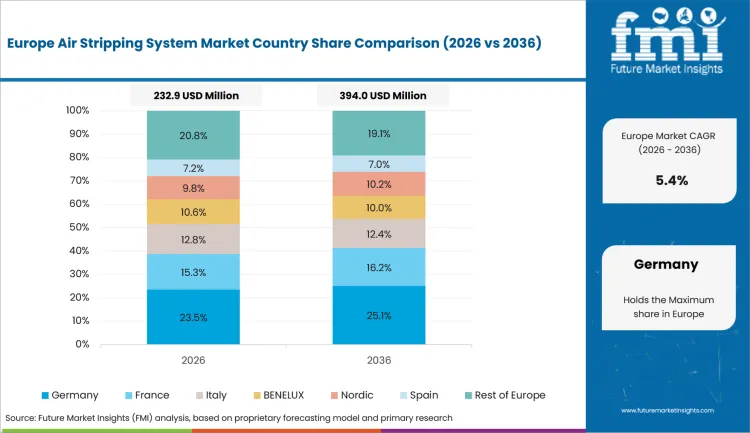
What is the Air Stripping System Market outlook in Germany?
A 6.1% CAGR through 2036 reflects contaminated-site remediation and industrial groundwater protection.
Country Market Snapshot Table
| Parameter | Value |
|---|---|
| Market Size in 2025 (Value) | USD 71.1 million |
| Market Size in 2026 (Value) | USD 75.4 million |
| Market Forecast in 2036 (Value) | USD 136.3 million |
| CAGR (2026 to 2036) | 6.1% |
| Years Considered | 2021 to 2036 |
| Base Year | 2025 |
| Forecast Period | 2026 to 2036 |
| Units Considered | Value (USD million) |
| Leading Sub-Region | North Rhine-Westphalia, Bavaria, Baden-Württemberg, Lower Saxony, Hesse, Saxony |
Germany Air Stripping System Market Outlook
- Germany air stripping system demand draws support from contaminated-site management and industrial groundwater protection. Buyers compare stripping with oxidation and combined treatment trains.
- Demand is expected to favor documented process reliability and service access. Packed towers remain suited to steady-flow sites, with tray and compact units supporting lower headroom and cleaning access.
Key Growth Drivers
- Federal remediation funding supports complex legacy-site cleanup, driven by German Environment Agency noting that about EUR 6 billion allocated to the Wismut remediation program scheduled for completion by 2028.
- Treatment choice remains technically detailed, since German Environment Agency’s 2026 remediation technology guidance lists 3 technique groups covering physical and chemical methods across in-situ and ex-situ use.
- Chemical and manufacturing regions create solvent and fuel-compound treatment needs at legacy sites.
- Public and private buyers value systems with operating records and reliable maintenance routines.
Key Restraints
- In-situ methods can displace air stripping if pumping creates high long-term cost.
- Design review can lengthen buying cycles for public and industrial projects.
- Industrial weakness can slow capital approvals, as Destatis reported production in industry declined 1.9% month on month in December 2025.
What makes Germany unique
Germany is distinct through formal remediation funding and engineering documentation that strongly influence treatment selection.
Key Companies
- EnviroChemie
- DAS Environmental Expert
- HUBER SE
- Remondis Aqua
- Bauer Resources
- Züblin Umwelttechnik
- HPC AG
Sales & Marketing Channels
- Environmental engineering consultancies
- Public contaminated-site tenders
- Chemical-site direct sales
- EPC remediation packages
- Specialist distributor networks
- Maintenance contracts for long-term systems
Country Segment Breakdown Table
| Segment | Sub-Segments |
|---|---|
| By System Type | Packed Tower Air Strippers · Tray Air Strippers · Low-profile Air Strippers · Portable Air Stripping Units |
| By Contaminant Type | VOCs · Ammonia · Hydrogen Sulfide · Fuel / Solvent Compounds |
| By Application | Groundwater Remediation · Industrial Wastewater · Drinking Water Treatment · Landfill Leachate |
| By End Use | Environmental Remediation · Municipal Utilities · Chemicals · Oil & Gas / Industrial |
| By Sales Channel | Direct OEM · Environmental Contractors · EPC / Integrators |
| Key Sub-Regions Covered, Industrial Corridors | North Rhine-Westphalia · Bavaria · Baden-Württemberg · Lower Saxony · Hesse · Saxony |
Frequently Asked Questions
How fast is Germany Air Stripping System Market growing?
Germany records an estimated 6.1% CAGR as legacy-site cleanup and industrial groundwater protection support selective equipment demand.
Who leads Germany Air Stripping System Market?
EnviroChemie leads Germany air stripping system market, supported by DAS Environmental Expert and HUBER SE across industrial water treatment and remediation projects.
What is driving adoption in Germany Air Stripping System Market?
Legacy remediation funding and documented method screening are guiding buyers toward engineered stripping systems.
What is the Air Stripping System Market outlook in France?
A 6.0% CAGR through 2036 reflects organochlorine and hydrocarbon contamination across selected sites.
Country Market Snapshot Table
| Parameter | Value |
|---|---|
| Market Size in 2025 (Value) | USD 59.4 million |
| Market Size in 2026 (Value) | USD 63.0 million |
| Market Forecast in 2036 (Value) | USD 112.8 million |
| CAGR (2026 to 2036) | 6.0% |
| Years Considered | 2021 to 2036 |
| Base Year | 2025 |
| Forecast Period | 2026 to 2036 |
| Units Considered | Value (USD million) |
| Leading Sub-Region | Île-de-France, Auvergne-Rhône-Alpes, Hauts-de-France, Grand Est, Normandy, Provence-Alpes-Côte d’Azur |
France Air Stripping System Market Outlook
- France air stripping system demand is linked to solvent-impacted groundwater and public technical support for decontamination. Buyers tend to evaluate stripping as part of a combined treatment train.
- Demand is expected to remain selective as pesticides and chlorinated solvents require different treatment methods. Pilot testing is anticipated to influence adoption as project owners compare stripping with adsorption and off-site disposal.
Key Growth Drivers
- Polluted-site treatment remains important, proven by BRGM stating France has more than 7,200 sites contaminated by heavy metals and organochlorine compounds.
- Pilot validation supports treatment selection, reflected by BRGM’s PRIME platform using 3 pilot measurement columns ranging from sub-metric to plurimetric scale.
- Industrial land reuse keeps remediation technology evaluation active near urban and industrial zones.
- Engineering consultants support adoption by matching contaminant volatility with treatment train design.
Key Restraints
- Heavy metal contamination does not suit air stripping and can narrow the direct project pool.
- Public funding and redevelopment timing can delay conversion into equipment orders.
- Mixed pollutant profiles across at least 9,000 polluted sites can shift spending toward combined systems rather than single-step stripping.
What makes France unique
France has a mixed polluted-site profile, making air stripping most useful in projects containing volatile solvents rather than metals-only contamination.
Key Companies
- SUEZ
- Veolia Water Technologies
- SAUR
- Stereau
- SERPOL
- Orège
- Séché Environnement
Sales & Marketing Channels
- Public remediation programs
- Engineering consultant specification
- Industrial land redevelopment projects
- EPC treatment packages
- Pilot testing through specialist contractors
- Municipal utility channels
Country Segment Breakdown Table
| Segment | Sub-Segments |
|---|---|
| By System Type | Packed Tower Air Strippers · Tray Air Strippers · Low-profile Air Strippers · Portable Air Stripping Units |
| By Contaminant Type | VOCs · Ammonia · Hydrogen Sulfide · Fuel / Solvent Compounds |
| By Application | Groundwater Remediation · Industrial Wastewater · Drinking Water Treatment · Landfill Leachate |
| By End Use | Environmental Remediation · Municipal Utilities · Chemicals · Oil & Gas / Industrial |
| By Sales Channel | Direct OEM · Environmental Contractors · EPC / Integrators |
| Key Sub-Regions Covered, Industrial Corridors | Île-de-France · Auvergne-Rhône-Alpes · Hauts-de-France · Grand Est · Normandy · Provence-Alpes-Côte d’Azur- |
Frequently Asked Questions
How fast is France Air Stripping System Market growing?
France records an estimated 6.0% CAGR as solvent-impacted sites and land reuse projects create selective treatment demand.
Who leads France Air Stripping System Market?
SUEZ leads France air stripping system market, supported by Veolia Water Technologies and SAUR across water treatment and remediation channels.
What is driving adoption in France Air Stripping System Market?
Solvent contamination and redevelopment-led cleanup are moving project owners toward air stripping inside combined treatment trains.
What is the Air Stripping System Market outlook in the United Kingdom?
A 5.8% CAGR through 2036 reflects consultant-led remediation and water-sector performance scrutiny.
Country Market Snapshot Table
| Parameter | Value |
|---|---|
| Market Size in 2025 (Value) | USD 63.1 million |
| Market Size in 2026 (Value) | USD 66.8 million |
| Market Forecast in 2036 (Value) | USD 117.4 million |
| CAGR (2026 to 2036) | 5.8% |
| Years Considered | 2021 to 2036 |
| Base Year | 2025 |
| Forecast Period | 2026 to 2036 |
| Units Considered | Value (USD million) |
| Leading Sub-Region | England water utility regions, Midlands, North West, South East, Scotland, Wales |
United Kingdom Air Stripping System Market Outlook
- United Kingdom air stripping system demand is linked to water utility scrutiny and consultant-led technology selection. Buyers rely on environmental consultants and contractors to compare stripping with carbon adsorption and off-site disposal.
- Demand is expected to remain project-specific as planning approval and land transaction schedules influence remediation timing. Contractor and integrator channels will matter more than direct municipal equipment purchases.
Key Growth Drivers
- Water-sector scrutiny supports treatment upgrades, led by Environment Agency reporting being rated 1 of 9 water and sewerage companies poor and 7 as requiring improvement in 2024.
- Ofwat reported drinking water quality compliance improved by 34% over the 2020-25 period, keeping treatment performance central to utility review.
- Brownfield redevelopment influences demand for groundwater treatment if solvent contamination affects site reuse.
- Industrial users evaluate stripping as VOCs or ammonia create discharge and odor concerns.
Key Restraints
- Planning-led remediation can delay equipment orders until land-use decisions are finalized.
- Smaller project sizes can limit appetite for custom tower fabrication.
- Environment Agency reporting showed serious pollution incidents increased by 60% in 2024, placing compliance budgets under competing pressure.
What makes the United Kingdom unique
United Kingdom demand is shaped by consultant-led remediation and project-specific brownfield cleanup.
Key Companies
- Siltbuster
- WCS Environmental Engineering
- WPL
- Jacopa
- Hydro International UK
- Arvia Technology
- Nijhuis Saur Industries UK
Sales & Marketing Channels
- Environmental consultant specification
- Water utility capital programs
- Brownfield redevelopment contractors
- EPC integrator packages
- Rental systems for pilot testing
- Industrial site compliance projects
Country Segment Breakdown Table
| Segment | Sub-Segments |
|---|---|
| By System Type | Packed Tower Air Strippers · Tray Air Strippers · Low-profile Air Strippers · Portable Air Stripping Units |
| By Contaminant Type | VOCs · Ammonia · Hydrogen Sulfide · Fuel / Solvent Compounds |
| By Application | Groundwater Remediation · Industrial Wastewater · Drinking Water Treatment · Landfill Leachate |
| By End Use | Environmental Remediation · Municipal Utilities · Chemicals · Oil & Gas / Industrial |
| By Sales Channel | Direct OEM · Environmental Contractors · EPC / Integrators |
| Key Sub-Regions Covered, Industrial Corridors | England water utility regions · Midlands · North West · South East · Scotland · Wales |
Frequently Asked Questions
How fast is United Kingdom Air Stripping System Market growing?
United Kingdom records an estimated 5.8% CAGR as water-sector performance scrutiny and brownfield remediation sustain project demand.
Who leads United Kingdom Air Stripping System Market?
Siltbuster leads United Kingdom air stripping system market, supported by WCS Environmental Engineering and WPL across water treatment and rental channels.
What is driving adoption in United Kingdom Air Stripping System Market?
Consultant-led design and utility performance programs are supporting contractor-led air stripping purchases.
What is the Air Stripping System Market outlook in Japan?
A 5.7% CAGR through 2036 reflects compact-site engineering and VOC-related soil contamination controls.
Country Market Snapshot Table
| Parameter | Value |
|---|---|
| Market Size in 2025 (Value) | USD 48.7 million |
| Market Size in 2026 (Value) | USD 51.5 million |
| Market Forecast in 2036 (Value) | USD 89.7 million |
| CAGR (2026 to 2036) | 5.7% |
| Years Considered | 2021 to 2036 |
| Base Year | 2025 |
| Forecast Period | 2026 to 2036 |
| Units Considered | Value (USD million) |
| Leading Sub-Region | Tokyo, Osaka, Aichi, Kanagawa, Chiba, Hyogo industrial corridors |
Japan Air Stripping System Market Outlook
- Japan air stripping system demand is guided by compact-site requirements and strict environmental documentation. Buyers value stable maintenance and local service support.
- Demand is expected to remain targeted rather than volume-led. Compact low-profile units and packaged systems are projected to suit sites constrained by building access and operating restrictions.
Key Growth Drivers
- PFAS and water-quality discussions sharpen treatment review, due to Japan’s 2025 environment report stating national agencies jointly conducted surveys from May to September 2024 after a June 2024 PFAS risk assessment.
- Chemical-substance control supports contaminant review, reflected by Japan’s 2025 national implementation plan stating PFOA-related substances saw Class I designations in September 2024 and January 2025, while PFHxS-related controls were designated in February 2024.
- Factory-site redevelopment keeps groundwater risk assessment active during land transactions.
- Compact low-profile units support adoption as site space and building integration remain important.
Key Restraints
- Established regulation links demand to site discovery and redevelopment timing rather than volume-led replacement.
- Buyers may prefer in-situ methods if pumping and above-ground equipment disrupt site reuse.
- Chemical monitoring breadth can steer budgets toward evaluation before equipment awards, as Japan’s 2025 action plan covers contamination tracking for 32 groups of persistent organic pollutants.
What makes Japan unique
Japan’s market is defined by careful environmental documentation and strong preference for service-backed packaged systems.
Key Companies
- Kurita Water Industries
- Swing Corporation
- Organo Corporation
- Metawater
- Mitsubishi Chemical Aqua Solutions
- Kankyo Kanri Center
- Ebara Environmental Plant
Sales & Marketing Channels
- Industrial owner direct sales
- Environmental engineering consultants
- Redevelopment contractor packages
- Local integrator channels
- Pilot and treatability testing routes
- Utility and public facility tenders
Country Segment Breakdown Table
| Segment | Sub-Segments |
|---|---|
| By System Type | Packed Tower Air Strippers · Tray Air Strippers · Low-profile Air Strippers · Portable Air Stripping Units |
| By Contaminant Type | VOCs · Ammonia · Hydrogen Sulfide · Fuel / Solvent Compounds |
| By Application | Groundwater Remediation · Industrial Wastewater · Drinking Water Treatment · Landfill Leachate |
| By End Use | Environmental Remediation · Municipal Utilities · Chemicals · Oil & Gas / Industrial |
| By Sales Channel | Direct OEM · Environmental Contractors · EPC / Integrators |
| Key Sub-Regions Covered, Industrial Corridors | Tokyo · Osaka · Aichi · Kanagawa · Chiba · Hyogo |
Frequently Asked Questions
How fast is Japan Air Stripping System Market growing?
Japan records an estimated 5.7% CAGR as compact industrial sites and water-quality reviews sustain targeted treatment demand.
Who leads Japan Air Stripping System Market?
Kurita Water Industries leads Japan air stripping system market, supported by Swing Corporation and Organo Corporation across water treatment and industrial site channels.
What is driving adoption in Japan Air Stripping System Market?
Factory redevelopment and PFAS-related water reviews are supporting demand for packaged treatment systems.
Who are the leading companies in the Air Stripping System Market?
Xylem, QED Environmental Systems, Monroe Environmental, H2K Technologies, and Delta Cooling Towers.
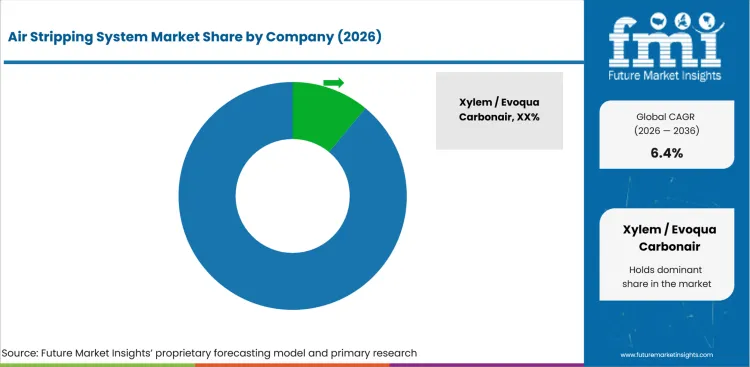
- Established water-treatment companies hold an advantage due to remediation references and field service networks.
- System specialists gain stronger acceptance by combining air stripping units and off-gas planning.
- Regional engineering companies win country projects led by site-specific design and maintenance support.
- Service-ready suppliers improve renewal chances based on treatability testing and troubleshooting on actual site water.
Air stripping system companies compete by combining low-profile designs and vapor-control planning. Xylem has a strong position through Evoqua and Carbonair water treatment assets. QED Environmental Systems competes through E-Z Tray air strippers and remediation-focused field use. Monroe Environmental holds value across custom tower and rental applications.
Field service and treatment-train knowledge have become stronger competitive separators as buyers move beyond simple tower comparison. H2K Technologies competes through non-fouling designs and high-solids water applications. Delta Cooling Towers and KCH Engineered Systems strengthen competition led by corrosion-resistant structures and municipal project experience. Buyers compare supplier performance through influent handling and vapor-treatment coordination.
Smaller and regional suppliers are expected to profit through local environmental engineering relationships and faster field support. United States and Europe create opportunities for suppliers operating rental units and contractor networks. China, India, and South Korea create opportunities for suppliers partnering with local EPC firms. Companies proving stable removal under changing water chemistry should gain more durable project relationships.
How do top Air Stripping System companies compare?
Xylem and QED score on remediation reach while Monroe Environmental and H2K Technologies lead through application-specific system design.
| Company | Relevance to Market Title | System Portfolio Depth | Remediation Service Strength | Off-Gas Support | Channel Reach | Geographic Footprint |
|---|---|---|---|---|---|---|
| Xylem / Evoqua Carbonair | Very High | Very Strong | Very Strong | Strong | Very Strong | Global |
| QED Environmental Systems | Very High | Strong | Very Strong | Strong | Strong | Global |
| Monroe Environmental | Very High | Strong | Strong | Strong | Strong | North America |
| H2K Technologies | High | Strong | Moderate | Moderate | Moderate | North America |
| Delta Cooling Towers | High | Moderate | Moderate | Moderate | Moderate | North America |
| KCH Engineered Systems | High | Moderate | Strong | Strong | Moderate | North America |
| Tri-Mer | Moderate to High | Moderate | Moderate | Very Strong | Moderate | North America |
| MXD Process / Branch Environmental | Moderate to High | Moderate | Moderate | Moderate | Moderate | North America |
| Envirogen | Moderate to High | Moderate | Strong | Strong | Strong | Global |
Source: Future Market Insights competitive analysis, 2026.
Who are the key players in the Air Stripping System Market?
Xylem, QED Environmental Systems, and Monroe Environmental are listed with H2K Technologies and Delta Cooling Towers among other suppliers.
Key global companies leading the Air Stripping System Market include:
- Xylem / Evoqua Carbonair
- QED Environmental Systems
- Monroe Environmental
- H2K Technologies
- Delta Cooling Towers
- KCH Engineered Systems
- Tri-Mer
- MXD Process / Branch Environmental
- Envirogen
- Veolia Water Technologies
Key Developments in Air Stripping System Market
- In February 2026, Monroe Environmental documented a rental air stripper used to test ammonia removal from landfill leachate.
- In October 2025, H2K Technologies presented its DTA non-fouling air stripper for high suspended solids and hardness among other factors.
- In June 2026, Xylem expanded its long-term water partnership with Dow for an advanced industrial water treatment and reuse system.
Key Players in the Air Stripping System Market
Air Stripping System Specialists
- QED Environmental Systems
- Monroe Environmental
- H2K Technologies
- Delta Cooling Towers
- KCH Engineered Systems
- Tri-Mer
- MXD Process / Branch Environmental
Integrated Water Treatment Companies
- Xylem / Evoqua Carbonair
- Envirogen
- Veolia Water Technologies
- SUEZ
- Kurita Water Industries
Regional Remediation and EPC Partners
- Environmental contractors
- EPC / Integrators
- Municipal utility engineering teams
- Industrial water treatment firms
- Brownfield redevelopment contractors
Air Stripping System Market - Scope & Definition
| Attribute | Detail |
|---|---|
| Market Definition | Equipment systems used to remove volatile contaminants from water by contacting contaminated water with air through packed towers, trays, low-profile units, or portable units |
| Functions Covered | Air-water transfer, VOC removal, ammonia stripping, hydrogen sulfide reduction, fuel-compound removal, influent handling, off-gas routing, and treatment-train integration |
| Applications Covered | Groundwater remediation, industrial wastewater treatment, drinking water treatment, landfill leachate treatment, pilot testing, and temporary treatment projects |
| End-Use Industries | Environmental remediation, municipal utilities, chemicals, oil and gas, industrial manufacturing, landfills, brownfield redevelopment, and water treatment contractors |
| Grades Covered | Standard packed towers, engineered tray systems, low-profile units, portable skids, rental systems, corrosion-resistant units, and custom integrated packages |
| Inclusions | All commercially traded air stripping systems across system type, contaminant type, application, end use, sales channel, and selected country-level remediation use |
| Exclusions | Standalone vapor treatment equipment, steam strippers, soil vapor extraction-only systems, air sparging wells, generic aerators, cooling towers sold only for heat rejection, and biological systems sold without air stripping |
Air StrippingSystem Market - Research Methodology
| Method | Description |
|---|---|
| Primary Research | FMI analyst interviews with remediation contractors, municipal water engineers, landfill leachate operators, industrial wastewater managers, equipment distributors, and EPC firms across selected markets |
| Desk Research | Review of official remediation technology references, Superfund metrics, country water and contaminated-site programs, company product pages, and technical references for air stripping applications |
| Market Sizing & Forecasting | Bottom-up equipment revenue approach using system volumes, average project pricing, contaminant mix, replacement demand, channel behavior, and country-level remediation intensity |
| Data Validation | Cross-verification using groundwater remediation use, municipal treatment needs, landfill leachate constraints, supplier activity, and field application references |
Air Stripping System Market - Report Scope
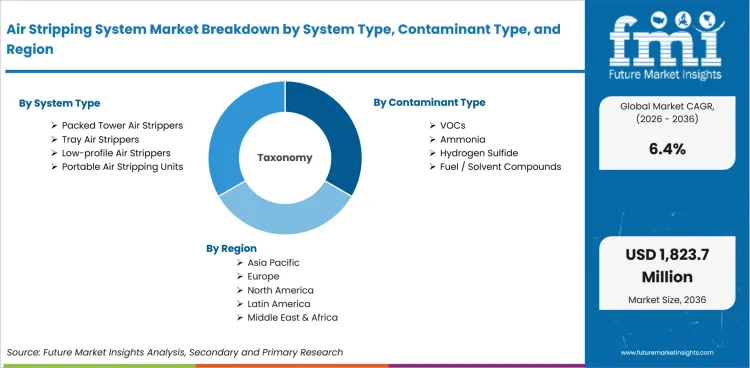
| Parameter | Details |
|---|---|
| Forecast period | 2026 to 2036 |
| Historical period | 2021 to 2025 |
| Quantitative unit | Revenue in USD million |
| By system type | Packed Tower Air Strippers, Tray Air Strippers, Low-profile Air Strippers, Portable Air Stripping Units |
| By contaminant type | VOCs, Ammonia, Hydrogen Sulfide, Fuel / Solvent Compounds |
| By application | Groundwater Remediation, Industrial Wastewater, Drinking Water Treatment, Landfill Leachate |
| By end use | Environmental Remediation, Municipal Utilities, Chemicals, Oil & Gas / Industrial |
| By sales channel | Direct OEM, Environmental Contractors, EPC / Integrators |
| Regions covered | North America, Latin America, Europe, East Asia, South Asia and Pacific, Middle East and Africa |
| Countries covered | China, India, South Korea, United States, Germany, France, United Kingdom, Japan |
| Key companies profiled | Xylem / Evoqua Carbonair, QED Environmental Systems, Monroe Environmental, H2K Technologies, Delta Cooling Towers, KCH Engineered Systems, Tri-Mer, MXD Process / Branch Environmental, Envirogen, Veolia Water Technologies |
| Approach | Bottom-up equipment revenue approach using system demand, average project pricing, contaminant suitability, service share, channel mix, and country-level remediation exposure |
Source: Future Market Insights competitive analysis, 2026.
Air Stripping System Market Breakdown by System Type, Contaminant Type, Application, End Use, Sales Channel, and Region
Air Stripping System Market Segmented by System Type
- Packed Tower Air Strippers
- Tray Air Strippers
- Low-profile Air Strippers
- Portable Air Stripping Units
Air Stripping System Market Segmented by Contaminant Type
- VOCs
- Ammonia
- Hydrogen Sulfide
- Fuel / Solvent Compounds
Air Stripping System Market Segmented by Application
- Groundwater Remediation
- Industrial Wastewater
- Drinking Water Treatment
- Landfill Leachate
Air Stripping System Market Segmented by End Use
- Environmental Remediation
- Municipal Utilities
- Chemicals
- Oil & Gas / Industrial
Air Stripping System Market Segmented by Sales Channel
- Direct OEM
- Environmental Contractors
- EPC / Integrators
Air Stripping System Market by Region
- North America
- Latin America
- Europe
- East Asia
- South Asia and Pacific
- Middle East and Africa
Research Sources and Bibliography
- Beijing Municipal Ecology and Environment Bureau. (2025). 2024 Report on the State of the Ecology and Environment in Beijing.
- BRGM. (2026). Depollution: New research and innovation platforms at the BRGM.
- China Water Risk. (2025, June 24). 2024 State of ecology and environment: Freshwater.
- Delta Cooling Towers. (2026). Vanguard air strippers and degassifiers.
- Destatis. (2026, February 6). Production in December 2025: -1.9% on the previous month.
- Environment Agency. (2025, November 21). Chief Regulator’s report 2024-25.
- Federal Remediation Technologies Roundtable. (2026). Air stripping ex situ.
- Federal Remediation Technologies Roundtable. (2026). Groundwater pump and treat.
- German Environment Agency. (2026, January 30). Research and funding.
- German Environment Agency. (2026, February 11). Contaminated sites.
- German Environment Agency. (2026, February 12). Remediation technology.
- H2K Technologies. (2025, October 14). Non-fouling air stripper.
- INSEE. (2026, May 22). In May 2026, the business climate in manufacturing industry has brightened again.
- Korea Environment Corporation. (2024). K-eco 2023-2024 Sustainability Report.
- Korea Environment Corporation. (2024). K-eco ESG Performance Summary Report.
- Korea Environment Corporation. (2026). Soil and groundwater management.
- Ministry of Ecology and Environment of the People’s Republic of China. (2025, September 30). Report on the State of the Ecology and Environment in China 2024.
- Ministry of Environment, Forest and Climate Change, Government of India. (2025, July 25). Environment Protection (Management of Contaminated Sites) Rules, 2025.
- Ministry of the Environment, Japan. (2024, May 21). The Basic Environment Plan.
- Ministry of the Environment, Japan. (2025). Annual Report on the Environment in Japan 2025.
- Ministry of the Environment, Japan. (2025, March 3). The National Implementation Plan of Japan under the Stockholm Convention on Persistent Organic Pollutants.
- Monroe Environmental. (2026, February 19). Rental air stripper removes ammonia from landfill leachate.
- Ofwat. (2025, October). Water company performance report 2024-25.
- Press Information Bureau, Government of India. (2024, December 31). Union Minister of Jal Shakti releases Annual Ground Water Quality Report 2024.
- Press Information Bureau, Government of India. (2025, August 18). New Rules under the Environment Protection Act.
- United States Environmental Protection Agency. (2025). Community guide to air stripping.
- United States Environmental Protection Agency. (2026, May 18). Superfund remedial annual accomplishments metrics fiscal year 2025.
- USA Government Accountability Office. (2025, April 9). Superfund: Many factors can affect cleanup of sites across the USA
- Xylem. (2026, June 8). Xylem expands long-term water partnership with Dow.
This bibliography is provided for reader reference and is not exhaustive. The full report contains the complete reference list and detailed citations.
This Report Answers
- Market size estimates for 2026 and forecasts through 2036 for the Air Stripping System Market.
- Insights across regional and country-level air stripping equipment demand.
- Analysis of demand drivers and purchasing behavior.
- Evaluation of system types, contaminant types, applications, end uses, and sales channels.
- Assessment of groundwater remediation and industrial wastewater treatment requirements.
- Identification of opportunities across packed towers and portable skids.
- Evaluation of environmental contractor channels and EPC-led treatment packages.
- Country-level analysis covering China, India, South Korea, United States, Germany, France, United Kingdom, and Japan.
- Assessment of competition, including air stripper specialists and integrated water treatment companies.
- Analysis of site-level decision drivers and service criteria.
- Regional outlooks across North America, Europe, East Asia, South Asia and Pacific, Latin America, and Middle East and Africa.
- Delivery of market data, forecasts, and supporting analysis in report-ready format.
Frequently Asked Questions
What is the growth prospect for air stripping systems?
Demand for air stripping systems is expected to rise at a considerable pace as remediation projects and industrial wastewater sites require on-site treatment for volatile contaminants.
Which companies are expected to shape the air stripping system market?
Xylem, QED Environmental Systems, Monroe Environmental, H2K Technologies, and Delta Cooling Towers are expected to shape market competition through system portfolios and contractor support.
Why are water treatment companies investing in air stripping systems?
Water treatment companies are investing in air stripping systems to support groundwater remediation and industrial wastewater projects involving volatile contaminants.
Why are environmental contractors important in the air stripping system market?
Environmental contractors support adoption by off-gas planning and long-term maintenance.
Which system formats are gaining attention in air stripping systems?
Packed tower air strippers and low-profile tray systems are gaining attention as buyers target high-flow groundwater treatment and compact-site operation.
How does groundwater remediation influence air stripping system demand?
Groundwater remediation influences demand through pump-and-treat systems requiring above-ground removal of VOCs and fuel compounds.
Why is contaminant type important for air stripping systems?
Contaminant type is important since VOCs and fuel compounds transfer efficiently to air, while non-volatile contaminants require other treatment methods.
What role does Direct OEM play in air stripping system adoption?
Direct OEM support helps adoption by combining equipment supply and service support.
Preview the report firsthand - request a free sample
Get SampleGet the brochure for pricing and purchase details.
Get PDFTable of Content
- Key Takeaways
- Market Size and CAGR
- Top Growth Driver
- Fastest Growing Segment
- Leading Region
- Key Companies
- Emerging Opportunities
- Executive Summary
- Global Market Outlook
- Demand-side Trends
- Supply-side Trends
- Technology Roadmap Analysis
- Analysis and Recommendations
- Analyst Perspective (What is happening? Why now? What should investors know?)
- Key Questions Answered
- How large is the market?
- What is the CAGR?
- What are key trends?
- Which region dominates?
- Who are the leaders?
- Market Overview
- Market Coverage / Taxonomy
- Market Definition / Scope / Limitations
- Research Methodology
- Chapter Orientation
- Analytical Lens and Working Hypotheses
- Market Structure, Signals, and Trend Drivers
- Benchmarking and Cross-market Comparability
- Market Sizing, Forecasting, and Opportunity Mapping
- Research Design and Evidence Framework
- Desk Research Programme (Secondary Evidence)
- Expert Input and Fieldwork (Primary Evidence)
- Tooling, Models, and Reference Databases
- Data Engineering and Model Build
- Quality Assurance and Audit Trail
- Market Background
- Market Dynamics (Drivers, Restraints, Opportunity, Trends)
- Scenario Forecast (Optimistic, Likely, Conservative)
- Impact Analysis
- AI Impact
- Sustainability Impact
- Regulatory Impact
- Technology Impact
- Consumer / Buyer Analysis
- Purchase Drivers
- Adoption Barriers
- Buyer Journey
- Opportunity Map Analysis
- Product Life Cycle Analysis
- Supply Chain Analysis
- Investment Feasibility Matrix
- Value Chain Analysis
- PESTLE and Porter's Analysis
- Regulatory Landscape
- Regional Parent Market Outlook
- Production and Consumption Statistics
- Import and Export Statistics
- Global Market Analysis and Forecast, 2021 to 2036
- Historical Market Size Value (USD Million) & Volume (Unit) Analysis, 2021 to 2025
- Current and Future Market Size Value (USD Million) & Volume (Unit) Projections, 2026 to 2036
- Y-o-Y Growth Trend Analysis
- Absolute $ Opportunity Analysis
- Global Market Pricing Analysis, 2021 to 2036
- Global Market Analysis and Forecast, By System Type, 2021 to 2036
- Introduction / Key Findings
- Historical Market Size Value (USD Million) & Volume (Unit) Analysis By System Type, 2021 to 2025
- Current and Future Market Size Value (USD Million) & Volume (Unit) Analysis and Forecast By System Type, 2026 to 2036
- Packed Tower Air Strippers
- Tray Air Strippers
- Low-profile Air Strippers
- Portable Air Stripping Value (USD Million) & Volume (Unit)s
- Packed Tower Air Strippers
- Y-o-Y Growth Trend Analysis By System Type, 2021 to 2025
- Absolute $ Opportunity Analysis By System Type, 2026 to 2036
- Global Market Analysis and Forecast, By Contaminant Type, 2021 to 2036
- Introduction / Key Findings
- Historical Market Size Value (USD Million) & Volume (Unit) Analysis By Contaminant Type, 2021 to 2025
- Current and Future Market Size Value (USD Million) & Volume (Unit) Analysis and Forecast By Contaminant Type, 2026 to 2036
- VOCs
- Ammonia
- Hydrogen Sulfide
- Fuel / Solvent Compounds
- VOCs
- Y-o-Y Growth Trend Analysis By Contaminant Type, 2021 to 2025
- Absolute $ Opportunity Analysis By Contaminant Type, 2026 to 2036
- Global Market Analysis and Forecast, By Application, 2021 to 2036
- Introduction / Key Findings
- Historical Market Size Value (USD Million) & Volume (Unit) Analysis By Application, 2021 to 2025
- Current and Future Market Size Value (USD Million) & Volume (Unit) Analysis and Forecast By Application, 2026 to 2036
- Groundwater Remediation
- Industrial Wastewater
- Drinking Water Treatment
- Landfill Leachate
- Groundwater Remediation
- Y-o-Y Growth Trend Analysis By Application, 2021 to 2025
- Absolute $ Opportunity Analysis By Application, 2026 to 2036
- Global Market Analysis and Forecast, By End Use, 2021 to 2036
- Introduction / Key Findings
- Historical Market Size Value (USD Million) & Volume (Unit) Analysis By End Use, 2021 to 2025
- Current and Future Market Size Value (USD Million) & Volume (Unit) Analysis and Forecast By End Use, 2026 to 2036
- Environmental Remediation
- Municipal Utilities
- Chemicals
- Oil & Gas / Industrial
- Environmental Remediation
- Y-o-Y Growth Trend Analysis By End Use, 2021 to 2025
- Absolute $ Opportunity Analysis By End Use, 2026 to 2036
- Global Market Analysis and Forecast, By Sales Channel, 2021 to 2036
- Introduction / Key Findings
- Historical Market Size Value (USD Million) & Volume (Unit) Analysis By Sales Channel, 2021 to 2025
- Current and Future Market Size Value (USD Million) & Volume (Unit) Analysis and Forecast By Sales Channel, 2026 to 2036
- Environmental Contractors
- Direct OEM
- EPC / Integrators
- Environmental Contractors
- Y-o-Y Growth Trend Analysis By Sales Channel, 2021 to 2025
- Absolute $ Opportunity Analysis By Sales Channel, 2026 to 2036
- Global Market Analysis and Forecast, By Region, 2021 to 2036
- Introduction
- Historical Market Size Value (USD Million) & Volume (Unit) Analysis By Region, 2021 to 2025
- Current Market Size Value (USD Million) & Volume (Unit) Analysis and Forecast By Region, 2026 to 2036
- North America
- Latin America
- Western Europe
- Eastern Europe
- East Asia
- South Asia and Pacific
- Middle East & Africa
- Market Attractiveness Analysis By Region
- North America Market Analysis and Forecast, By Country, 2021 to 2036
- Historical Market Size Value (USD Million) & Volume (Unit) Trend Analysis By Market Taxonomy, 2021 to 2025
- Market Size Value (USD Million) & Volume (Unit) Forecast By Market Taxonomy, 2026 to 2036
- By Country
- USA
- Canada
- Mexico
- By System Type
- By Contaminant Type
- By Application
- By End Use
- By Sales Channel
- By Country
- Market Attractiveness Analysis
- By Country
- By System Type
- By Contaminant Type
- By Application
- By End Use
- By Sales Channel
- Key Takeaways
- Latin America Market Analysis and Forecast, By Country
- Historical Market Size Value (USD Million) & Volume (Unit) Trend Analysis By Market Taxonomy, 2021 to 2025
- Market Size Value (USD Million) & Volume (Unit) Forecast By Market Taxonomy, 2026 to 2036
- By Country
- Brazil
- Chile
- Rest of Latin America
- By System Type
- By Contaminant Type
- By Application
- By End Use
- By Sales Channel
- By Country
- Market Attractiveness Analysis
- By Country
- By System Type
- By Contaminant Type
- By Application
- By End Use
- By Sales Channel
- Key Takeaways
- Western Europe Market Analysis and Forecast, By Country
- Historical Market Size Value (USD Million) & Volume (Unit) Trend Analysis By Market Taxonomy, 2021 to 2025
- Market Size Value (USD Million) & Volume (Unit) Forecast By Market Taxonomy, 2026 to 2036
- By Country
- Germany
- UK
- Italy
- Spain
- France
- Nordic
- BENELUX
- Rest of Western Europe
- By System Type
- By Contaminant Type
- By Application
- By End Use
- By Sales Channel
- By Country
- Market Attractiveness Analysis
- By Country
- By System Type
- By Contaminant Type
- By Application
- By End Use
- By Sales Channel
- Key Takeaways
- Eastern Europe Market Analysis and Forecast, By Country
- Historical Market Size Value (USD Million) & Volume (Unit) Trend Analysis By Market Taxonomy, 2021 to 2025
- Market Size Value (USD Million) & Volume (Unit) Forecast By Market Taxonomy, 2026 to 2036
- By Country
- Russia
- Poland
- Hungary
- Balkan & Baltic
- Rest of Eastern Europe
- By System Type
- By Contaminant Type
- By Application
- By End Use
- By Sales Channel
- By Country
- Market Attractiveness Analysis
- By Country
- By System Type
- By Contaminant Type
- By Application
- By End Use
- By Sales Channel
- Key Takeaways
- East Asia Market Analysis and Forecast, By Country
- Historical Market Size Value (USD Million) & Volume (Unit) Trend Analysis By Market Taxonomy, 2021 to 2025
- Market Size Value (USD Million) & Volume (Unit) Forecast By Market Taxonomy, 2026 to 2036
- By Country
- China
- Japan
- South Korea
- By System Type
- By Contaminant Type
- By Application
- By End Use
- By Sales Channel
- By Country
- Market Attractiveness Analysis
- By Country
- By System Type
- By Contaminant Type
- By Application
- By End Use
- By Sales Channel
- Key Takeaways
- South Asia and Pacific Market Analysis and Forecast, By Country
- Historical Market Size Value (USD Million) & Volume (Unit) Trend Analysis By Market Taxonomy, 2021 to 2025
- Market Size Value (USD Million) & Volume (Unit) Forecast By Market Taxonomy, 2026 to 2036
- By Country
- India
- ASEAN
- Australia & New Zealand
- Rest of South Asia and Pacific
- By System Type
- By Contaminant Type
- By Application
- By End Use
- By Sales Channel
- By Country
- Market Attractiveness Analysis
- By Country
- By System Type
- By Contaminant Type
- By Application
- By End Use
- By Sales Channel
- Key Takeaways
- Middle East & Africa Market Analysis and Forecast, By Country
- Historical Market Size Value (USD Million) & Volume (Unit) Trend Analysis By Market Taxonomy, 2021 to 2025
- Market Size Value (USD Million) & Volume (Unit) Forecast By Market Taxonomy, 2026 to 2036
- By Country
- Kingdom of Saudi Arabia
- Other GCC Countries
- Türkiye
- South Africa
- Other African Union
- Rest of Middle East & Africa
- By System Type
- By Contaminant Type
- By Application
- By End Use
- By Sales Channel
- By Country
- Market Attractiveness Analysis
- By Country
- By System Type
- By Contaminant Type
- By Application
- By End Use
- By Sales Channel
- Key Takeaways
- Key Countries Market Analysis
- USA
- Pricing Analysis
- Market Share Analysis, 2025
- By System Type
- By Contaminant Type
- By Application
- By End Use
- By Sales Channel
- Canada
- Pricing Analysis
- Market Share Analysis, 2025
- By System Type
- By Contaminant Type
- By Application
- By End Use
- By Sales Channel
- Mexico
- Pricing Analysis
- Market Share Analysis, 2025
- By System Type
- By Contaminant Type
- By Application
- By End Use
- By Sales Channel
- Brazil
- Pricing Analysis
- Market Share Analysis, 2025
- By System Type
- By Contaminant Type
- By Application
- By End Use
- By Sales Channel
- Chile
- Pricing Analysis
- Market Share Analysis, 2025
- By System Type
- By Contaminant Type
- By Application
- By End Use
- By Sales Channel
- Germany
- Pricing Analysis
- Market Share Analysis, 2025
- By System Type
- By Contaminant Type
- By Application
- By End Use
- By Sales Channel
- UK
- Pricing Analysis
- Market Share Analysis, 2025
- By System Type
- By Contaminant Type
- By Application
- By End Use
- By Sales Channel
- Italy
- Pricing Analysis
- Market Share Analysis, 2025
- By System Type
- By Contaminant Type
- By Application
- By End Use
- By Sales Channel
- Spain
- Pricing Analysis
- Market Share Analysis, 2025
- By System Type
- By Contaminant Type
- By Application
- By End Use
- By Sales Channel
- France
- Pricing Analysis
- Market Share Analysis, 2025
- By System Type
- By Contaminant Type
- By Application
- By End Use
- By Sales Channel
- India
- Pricing Analysis
- Market Share Analysis, 2025
- By System Type
- By Contaminant Type
- By Application
- By End Use
- By Sales Channel
- ASEAN
- Pricing Analysis
- Market Share Analysis, 2025
- By System Type
- By Contaminant Type
- By Application
- By End Use
- By Sales Channel
- Australia & New Zealand
- Pricing Analysis
- Market Share Analysis, 2025
- By System Type
- By Contaminant Type
- By Application
- By End Use
- By Sales Channel
- China
- Pricing Analysis
- Market Share Analysis, 2025
- By System Type
- By Contaminant Type
- By Application
- By End Use
- By Sales Channel
- Japan
- Pricing Analysis
- Market Share Analysis, 2025
- By System Type
- By Contaminant Type
- By Application
- By End Use
- By Sales Channel
- South Korea
- Pricing Analysis
- Market Share Analysis, 2025
- By System Type
- By Contaminant Type
- By Application
- By End Use
- By Sales Channel
- Russia
- Pricing Analysis
- Market Share Analysis, 2025
- By System Type
- By Contaminant Type
- By Application
- By End Use
- By Sales Channel
- Poland
- Pricing Analysis
- Market Share Analysis, 2025
- By System Type
- By Contaminant Type
- By Application
- By End Use
- By Sales Channel
- Hungary
- Pricing Analysis
- Market Share Analysis, 2025
- By System Type
- By Contaminant Type
- By Application
- By End Use
- By Sales Channel
- Kingdom of Saudi Arabia
- Pricing Analysis
- Market Share Analysis, 2025
- By System Type
- By Contaminant Type
- By Application
- By End Use
- By Sales Channel
- Türkiye
- Pricing Analysis
- Market Share Analysis, 2025
- By System Type
- By Contaminant Type
- By Application
- By End Use
- By Sales Channel
- South Africa
- Pricing Analysis
- Market Share Analysis, 2025
- By System Type
- By Contaminant Type
- By Application
- By End Use
- By Sales Channel
- USA
- Market Structure Analysis
- Competition Dashboard
- Competition Benchmarking
- Market Share Analysis of Top Players
- By Regional
- By System Type
- By Contaminant Type
- By Application
- By End Use
- By Sales Channel
- Emerging Startups
- Innovation Benchmarking
- Competition Analysis
- Competition Deep Dive
- Xylem / Evoqua Carbonair
- Overview
- Product Portfolio
- Profitability by Market Segments (Product/Region/Sales Channel)
- Sales Footprint
- Strategy Overview
- Marketing Strategy
- Product Strategy
- Channel Strategy
- QED Environmental Systems
- Monroe Environmental
- H2K Technologies
- Delta Cooling Towers
- KCH Engineered Systems
- Tri-Mer
- MXD Process / Branch Environmental
- Envirogen
- Xylem / Evoqua Carbonair
- Case Studies
- Success Stories
- Recent Developments
- Competition Deep Dive
- Assumptions & Acronyms Used


