

- Market Size (2026)
- USD 540.0 Mn
- Forecast (2036)
- USD 3,344.0 Mn
- CAGR (2026 to 2036)
- 20.0%
How big is the Robotic Parcel Induction & Singulation Market in 2026?
USD 540.0 million in 2026 and USD 3,344.0 million by 2036 at a 20.0% CAGR.
Sales in robotic parcel induction & singulation market are projected to increase from USD 540.0 million in 2026 to USD 3,344.0 million by 2036 at a 20.0% CAGR. The expansion reflects pressure to turn mixed parcel piles into a stable feed for scanners and sorters. Li and co-authors reported in June 2025 that a package-picking method was evaluated on more than 2 million induction picks and reduced pick failures by 20% against a heuristic baseline. That result shows why spending on automated material handling equipment depends on reliable grasp selection rather than robot speed alone.
Parcel networks in the USA and Japan create different operating tests for induction cells across established carrier systems. The United States Postal Service reported in November 2025 that Shipping and Packages revenue reached USD 32.580 billion during fiscal 2025. That revenue base supports investment in repeatable processing capacity across large American parcel hubs during future automation planning. Japan has a more concentrated carrier structure that supports comparison across repeatable home-delivery parcel streams. The Ministry of Land, Infrastructure, Transport and Tourism reported in August 2024 that three named services represented about 95.0% of truck-based home-delivery parcels during fiscal 2023. Integration with conveyor systems becomes an important procurement priority in both settings because the receiving line must accept each placement without double reads or accumulation.
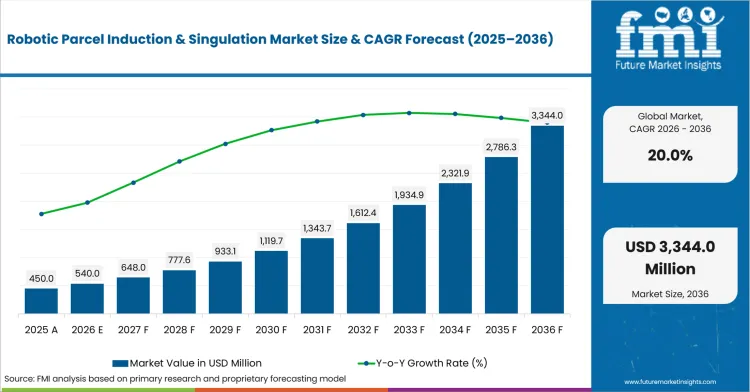
Key Takeaways of Robotic Parcel Induction & Singulation Market
- Demand for robotic parcel induction and singulation systems is driven by the need to protect operating hours that determine whether a hub meets its departure plan, converting irregular piles into measurable item flow.
- By technology, robotic induction arms are expected to lead with 40.0% share in 2026, driven by flexible motion across mixed parcel presentations.
- Parcel hub induction is the dominant application segment, projected to hold 44.0% share in 2026, as each successful placement supports scanning and destination routing.
- Hardware is estimated to lead the component category with 54.0% share in 2026, as robots and grippers carry much of the installed cell value.
- Vision systems and exception routes remain critical to performance, enabling secure grasps from unstable piles while removing parcels needing manual handling without stopping the receiving conveyor.
- The United States and European Union are expected to lead growth at 21.0% and 19.0% CAGR respectively, driven by repeatable cell designs across conveyor formats and expanding parcel network intake capacity.
- Competition centers on Plus One Robotics, AWL, Vanderlande, and Fizyr, with vendors differentiating through vision-guided induction cells with remote exception support, sorter integration with custom tooling, complete hub-level parcel transportation systems, and grasp-guidance vision software.
Analyst Perspective
"The robotic parcel induction & singulation market is moving beyond throughput benchmarks toward consistent handling of real-world parcel variation. Distribution centers are prioritizing systems that minimize manual intervention, maintain induction accuracy across mixed package types, and generate actionable performance data for continuous process improvement. Suppliers that simplify exception management and sustain reliable operation under changing workloads will strengthen their competitive position."
- Nikhil Kaitwade, Principal Analyst at Future Market Insights
Source: FMI's proprietary forecasting model and primary research.
How is the Robotic Parcel Induction & Singulation Market segmented?
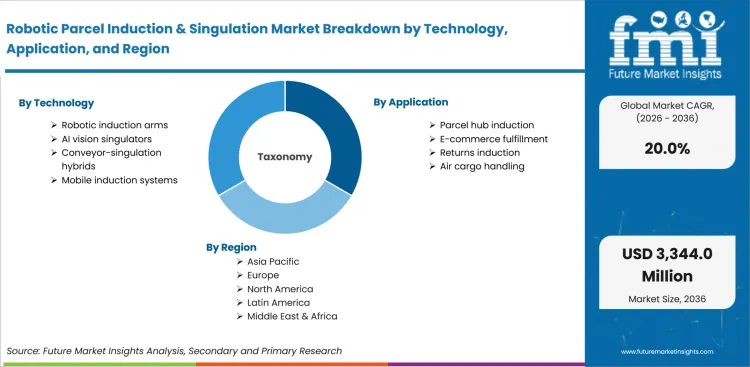
The industry is segmented by Technology, Application, Component, End-use Industry, Sales Channel, and Region.
The segmentation follows the decisions required to design and operate a parcel induction cell across varied hub environments. Technology separates robot arms from AI vision singulators and conveyor hybrids, with mobile layouts serving changing lane assignments. Application distinguishes parcel hub intake from fulfillment and returns work, while air cargo adds fixed departure windows. Component analysis divides installed hardware from software and support services that sustain the cell throughout its operating life. End-use Industry identifies the facilities that run the equipment, while Sales Channel shows which party carries delivery responsibility. Regional coverage links those choices with express and small parcel services across networks that differ in package mix, labor availability, and existing conveyor design.
What drives robotic induction arms within the Technology category?
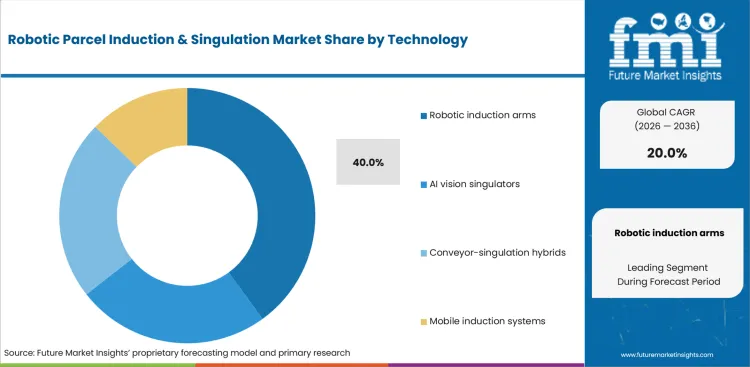
A parcel pile changes after every successful pick, so the robot must reassess visible surfaces. Wang and co-authors reported in June 2025 that their package-picking evaluation used three input modes: colour images, depth data, and semantic segmentation. The paper examined boxes and envelopes inside cluttered scenes where partial occlusion can hide secure grasp points. This evidence explains why the arm cannot be judged separately from perception software and multi-suction tooling. Robot motion begins with a grasp decision that reflects the parcel surface and the risk of lifting two items.
- By Technology, robotic induction arms are estimated to hold 40.0% share in 2026 owing to their flexible reach and controlled placement. Designs used in cobot palletizing end-effectors show how independent suction zones let one tool contact different package shapes without changing the complete cell layout. This flexibility supports a broader parcel library and reduces frequent tool changes during daily operation.
- Parcel operations invest in arm-based cells to reduce repetitive lifting and protect sorter feed during concentrated arrival periods. The comparison with goods-to-person robots is useful because both systems make object-level decisions during repeated handling cycles. Induction starts from a less stable bulk presentation and must create a clean conveyor gap, which adds a separate release-control requirement.
How does parcel hub induction shape demand within the Application category?
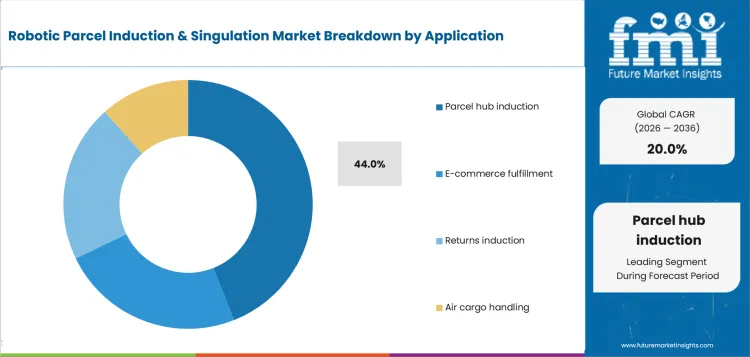
Parcel hubs combine several inbound routes before destination sorting, which makes the intake point sensitive to short interruptions. A missed pick reduces the stream reaching scanners and diverters during the same departure window. The application therefore rewards cells that recover quickly and keep parcel spacing stable across ordinary package variation. Hub operators can compare robotic lanes with neighbouring manual stations under similar flow conditions and the same departure schedule. That comparison reveals whether the cell adds usable capacity or merely shifts congestion to the next conveyor section.
- In 2026, parcel hub induction is forecast to represent 44.0% share due to its direct effect on sorter use. The cell converts loose inbound parcels into measured flow that downstream readers can identify without frequent double presentations. That direct effect on scanner availability explains why this application carries the stated share within the forecast view.
- Carrier networks favour this application across sites that share parcel profiles and similar departure patterns. Reliable infeed during concentrated departure periods supports outbound logistics operations by protecting route assignment near cut-off times. Standard cell interfaces can reduce repeated engineering work during a multi-site rollout and support comparable acceptance tests across facilities with different operating teams.
Why do Hardware hold dominance in 2026?
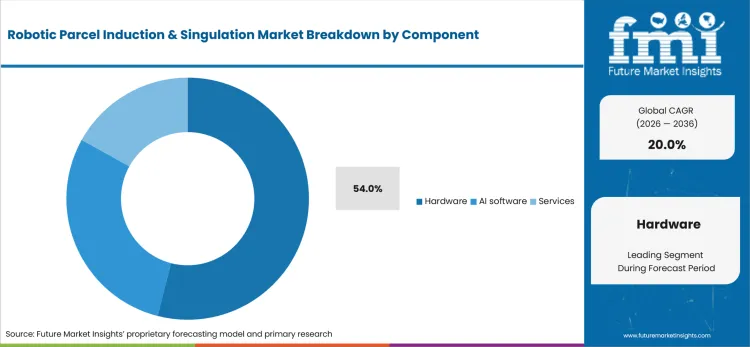
Hardware accounts for dominant share because every cell needs a robot and gripper. Cameras and guarding add further installed value and the receiving interface must match the conveyor.
- Hardware is projected to retain its 54.0% Component position in 2026 because physical equipment carries much of the installed value. AI software improves grasp choice as its commercial benefit depends on stable image capture across the complete operating shift. A mechanical platform must repeat each movement safely throughout the operating shift and remain accessible for maintenance.
- Direct procurement can simplify accountability, while logistics outsourcing contracts give an integrator responsibility for connecting the robot with existing conveyors and controls. This arrangement can reduce disputes during acceptance testing by assigning the complete infeed path to one accountable party.
What are the drivers, restraints, and opportunities in the Robotic Parcel Induction & Singulation Market?
Peak parcel flow supports demand. Difficult packaging limits autonomous output. Repeatable cell designs create a wider commercial opening.
- Driver: Concentrated arrival periods make stable induction capacity valuable because a missed departure window can affect the complete parcel route.
- Restraint: Flexible mailers and damaged cartons reduce grasp certainty, which raises retries and sends more exceptions to manual handling.
- Opportunity: Pre-engineered cells can reduce design work across hubs that share conveyor interfaces and similar parcel profiles.
Peak flow turns robotic induction into a capacity decision because departure performance depends on a concentrated operating window. AWL announced in February 2026 that its LogiMAT and MODEX demonstrations would include sorter induction with custom end-of-arm tooling for tote handling. The dated demonstration connects current development work with mixed inbound parcel flows at useful operating rates. A carrier gains little from isolated arm speed if receiving conveyors cannot support the same pace. Commercial performance therefore depends on stable throughput during dispatch hours and service response during exceptions.
Package variation remains the main technical restraint because flexible film can wrinkle and damaged cartons can lose predictable edges. These surfaces change the available contact area after neighbouring parcels move, so a grasp that looked secure in one frame may fail during lifting. More retries consume cycle time and send difficult items to manual handling, which reduces the usable capacity delivered to the sorter. Acceptance testing must therefore use the local parcel library instead of a clean demonstration set that hides the facility’s difficult items.
Repeatable cell designs create an opportunity beyond large flagship hubs that can support custom engineering teams. A standard mechanical frame and documented conveyor interface can shorten engineering work across facilities with similar layouts. E-commerce logistics adds another demand path as fulfillment and returns operations handle mixed outbound packages. Service packages can support this expansion through remote monitoring and planned maintenance across sites with limited robotics expertise. Commercial value concentrates in contracts that define performance responsibilities across the full infeed path instead of limiting guarantees to the robot arm.
Which country CAGRs are profiled in the Robotic Parcel Induction & Singulation Market?
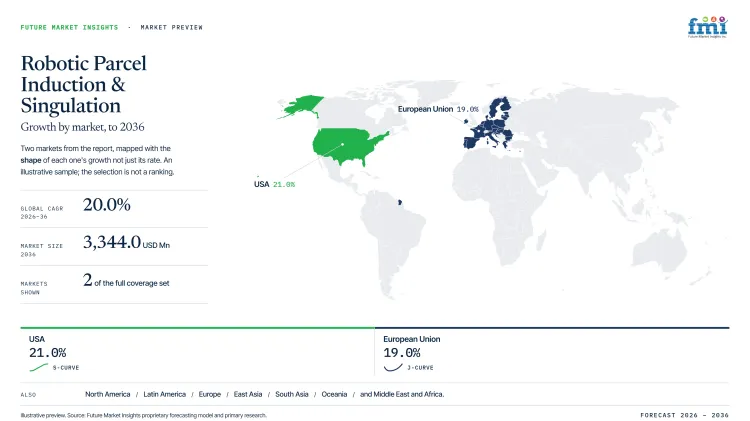
| Country | CAGR |
|---|---|
| USA | 21.0% |
| European Union | 19.0% |
Source: FMI's proprietary forecasting model and primary research.
How do country-level CAGRs compare in the Robotic Parcel Induction & Singulation Market?
National growth reflects parcel concentration and the ability to support robotic cells across several facilities. The USA offers broad carrier networks with several facility formats, while the European Union must process substantial cross-border e-commerce flow under varied local operating conditions. These differences shape the value of automated parcel delivery terminals and robotic intake systems across each country or regional network.
- Large carrier networks give the USA several settings for evaluating robotic parcel induction under real production conditions. Demand is expected to expand at a 21.0% CAGR through 2036, driven by operators seeking to standardize and replicate parcel induction and singulation cells across hubs operating on different generations of conveyor systems. The United States Postal Service reported in November 2025 that Shipping and Packages volume reached 6.837 billion pieces in fiscal 2025. The workload supports automation trials across large processing sites, although the 5.7% annual volume decline places greater scrutiny on capital returns.
- European parcel hubs must absorb large cross-border e-commerce flows without unlimited space for new intake lanes. The sector is projected to record 19.0% CAGR from 2026 to 2036 supported by operators seeking higher throughput and utilization from existing parcel‑handling facilities. The European Commission reported in February 2025 that 4.6 billion low-value parcels entered the European Union during 2024, equal to about 12 million items per day. The figure shows why package identification and controlled spacing matter at customs-linked sorting points with dense arrival patterns. Integration plans must account for established conveyor equipment and different site rules across national operations, which increases the value of multilingual service teams during rollout.
Who are the notable companies in the Robotic Parcel Induction & Singulation market?
Plus One Robotics, AWL, Vanderlande, and Fizyr are verified participants in robotic parcel induction, vision-guided picking, and parcel-line integration.
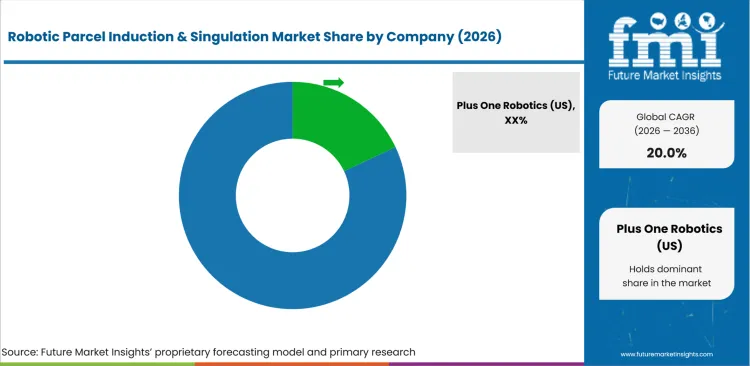
Competition divides between companies that deliver robotic cells and firms that connect them with the surrounding parcel line. Plus One Robotics combines vision guidance with remote exception support for difficult parcel picks during production shifts. AWL joins sorter induction with custom tooling, while Vanderlande connects parcel intake with transportation and sortation systems. Fizyr supplies vision software that selects grasp order across varied parcel surfaces during each picking cycle. These roles overlap across projects and make middle-mile delivery networks relevant to supplier selection decisions. A carrier needs clear responsibility for the handoff from the robot to the receiving conveyor. Scanner performance and exception routing must remain covered by one operating plan during acceptance testing.
- Plus One Robotics focus on complete parcel induction cells that combine robot motion with PickOne vision and Yonder remote support. This structure suits facilities that want one operating package for autonomous picks and difficult exceptions. The commercial question is whether remote intervention remains fast enough during the busiest intake period.
- AWL and Vanderlande share a practical basis in parcel-line integration, though their project roles can differ. AWL builds robotic handling cells and custom tooling, while Vanderlande connects parcel intake with transportation and sortation equipment. Their value depends on controlling congestion across the complete line instead of optimising one station.
- Fizyr supplies vision software used to rank grasp candidates across varied shapes and materials during production cycles. The company’s role becomes important in projects that combine robots and grippers from other vendors. Its commercial value rests on repeatable perception performance and clean integration with the cell controller.
Competitive Benchmarking: Robotic Parcel Induction & Singulation Market
| Company | Robotic Cell Delivery | Vision and Grasping | Parcel-Line Integration | Geographic Reach |
|---|---|---|---|---|
| Plus One Robotics | High | High | Medium | Medium |
| AWL | High | Medium | High | Medium |
| Vanderlande | Medium | Medium | High | High |
| Fizyr | Low | High | Medium | Medium |
Scoring basis: High indicates direct and well-documented capability in the stated dimension. Medium reflects relevant capability that depends partly on partners or project configuration. Low indicates limited direct evidence within the defined robotic parcel induction and singulation boundary.
Source: Future Market Insights competitive analysis, 2026.
Key Developments in the Robotic Parcel Induction & Singulation Market
- In April 2025, Fizyr announced that it had joined AWL and Vanderlande to automate DHL Express Madrid Hub's induction line. The system picks more than 1,500 parcels per hour with 99.99% accuracy and increased daily commercial-flight handling from 30 to 60 tonnes. The rollout shows how vision software and custom gripping can turn mixed small parcels into a controlled conveyor feed under production conditions.
- In March 2026, Plus One Robotics announced an expansion and acceleration of its parcel-handling robotics development on the company's official News page. The announcement concerns perception, grasping, and exception-control work that supports automated parcel induction across mixed package streams. Continued engineering activity in this area can improve repeatability across mixed package streams and reduce the redesign effort required when one cell is adapted for another parcel hub.
- In February 2026, Amazon stated on its official Operations news page that the multi-arm system was no longer used in operations. Amazon stated that the underlying technology would continue across the network after Blue Jay combined picking, stowing, and consolidation within one consolidated workspace. The decision provides a useful commercial warning: package-handling concepts must prove maintainability and production value before operators extend them across wider parcel-processing networks.
- In June 2026, Boston Dynamics announced an investment of USD 100 million in a Massachusetts facility covering 323 thousand square feet. The site supports robots including Stretch, which handles boxes upstream of parcel sorting systems and demonstrates continued capital commitment to robotic package handling. More consistent bulk parcel presentation can improve the flow received by induction and singulation equipment across high-volume logistics facilities.
Key Players in the Robotic Parcel Induction & Singulation Market
Complete robotic induction cell providers
- Plus One Robotics
- AWL
Parcel system integrators
- Vanderlande
Vision and grasping software providers
- Fizyr
Robotic Parcel Induction & Singulation Market - Report Scope
| Coverage Field | Report Scope |
|---|---|
| Market Breakdown | Technology, Application, Component, End-use Industry, Sales Channel, and Region. |
| Quantitative Units | Revenue in USD million and CAGR in percent. |
| Market Definition | Robotic systems that separate parcels from mixed flow and place individual items into downstream scanning or sortation. |
| Regions Covered | North America, Latin America, Europe, East Asia, South Asia, Oceania, and Middle East and Africa. |
| Countries Covered | China, Japan, USA, India, major European countries, and additional countries within the regional model. |
| Key Companies Profiled | Plus One Robotics, AWL, Vanderlande, and Fizyr. |
| Forecast Period | 2026 to 2036. |
| Approach | Bottom-up and top-down sizing supported by primary interviews and official desk research. |
Source: Future Market Insights analysis based on proprietary forecasting models and primary research.
Robotic Parcel Induction & Singulation Market - Research Methodology
| Method | Approach |
|---|---|
| Primary Research | FMI analysts gathered input from manufacturers, service providers, technology developers, distributors, end users, sourcing teams, and subject-matter experts. Interviews examined purchasing decisions, product or service evaluation, adoption barriers, approval requirements, pricing considerations, and expectations for technical or commercial support. Respondents were also asked what evidence is required before a trial, pilot, or initial order develops into regular purchasing. |
| Desk Research | Desk research covered government statistics, regulatory publications, trade data, industry associations, technical literature, standards, company filings, product information, and official corporate announcements. Sources were reviewed for relevance, publication date, geographic coverage, and consistency with the defined market scope. Claims relating to performance, applications, approvals, capacity, investment, and commercial activity were retained only when supported by credible public evidence. |
| Market Sizing and Forecasting | The market model combined the baseline value with historical performance, segment structure, pricing and volume indicators, adoption levels, company participation, and country-level demand conditions. Forecast assumptions considered economic activity, investment trends, regulatory developments, technology adoption, purchasing cycles, supply availability, and barriers to wider market use. Segment and regional estimates were reconciled before the final market total was calculated. |
| Data Validation | Estimates were checked against multiple independent indicators, including public data, company activity, trade patterns, industry developments, and findings from primary interviews. Validation also tested whether products, services, applications, and company revenues fell within the defined market boundaries. Adjacent categories, unsupported claims, overlapping revenues, and activities without direct market relevance were excluded to reduce double counting and maintain consistency across segments and countries. |
Source: Future Market Insights analysis based on proprietary forecasting models and primary research.
Robotic Parcel Induction & Singulation Market by Segments
Robotic Parcel Induction & Singulation Market segmented by Technology:
- Robotic Induction Arms
- AI Vision Singulators
- Conveyor-Singulation Hybrids
- Mobile Induction Systems
Robotic Parcel Induction & Singulation Market segmented by Application:
- Parcel Hub Induction
- E-commerce Fulfillment
- Returns Induction
- Air Cargo Handling
Robotic Parcel Induction & Singulation Market segmented by Component:
- Hardware
- AI Software
- Services
Robotic Parcel Induction & Singulation Market segmented by End-use Industry:
- Post & Parcel
- Third-Party Logistics
- E-commerce Facilities
- Air Cargo Handlers
Robotic Parcel Induction & Singulation Market segmented by Sales Channel:
- Direct
- System Integrators
- Robotics as a Service
- Aftermarket
Robotic Parcel Induction & Singulation Market by Region:
- North America
- United States
- Canada
- Latin America
- Brazil
- Mexico
- Argentina
- Europe
- Germany
- United Kingdom
- France
- Italy
- Spain
- East Asia
- China
- Japan
- South Korea
- South Asia
- India
- Thailand
- Indonesia
- Oceania
- Australia
- New Zealand
- Middle East and Africa
- GCC Countries
- South Africa
- Türkiye
Research Sources and Bibliography
- Li, Shuai, et al. (2025, June). Learning to Optimize Package Picking for Large-Scale, Real-World Robot Induction. arXiv.
- Wang, Che, et al. (2025, June). Demonstrating Multi-Suction Item Picking at Scale via Multi-Modal Learning of Pick Success. arXiv.
- USA Postal Service. (2025, November). USA Postal Service Reports Fiscal Year 2025 Results.
- Ministry of Land, Infrastructure, Transport and Tourism. (2024, August). FY2023 Home Delivery and Mail Service Handling Results. Government of Japan
- State Post Bureau. (2025, January). Postal Industry Operations in 2024. Government of China. https://www.spb.gov.cn/
- European Commission. (2025, February). Commission Tackles Risks Arising from Low-Value Imports Sold Through Online Retailers.
- Department of Posts. (2025, March). Annual Report 2024-25. Government of India.
- Fizyr. (2025, April). Case Study: AWL, Vanderlande and Fizyr Partner to Automate DHL Madrid Parcel Induction.
- AWL. (2026, February). Live AWL Demos at LogiMAT and MODEX: Turn Intralogistics Challenges into Scalable Robotic Automation.
- Plus One Robotics. (2026, March). Plus One Robotics: Expanding and Accelerating Parcel-Handling Robotics Development.
- Amazon. (2026, February). Introducing Blue Jay and Project Eluna, Amazon’s Latest Robotics and AI Technology for Its Operations.
- Boston Dynamics. (2026, June). Boston Dynamics Expands Massachusetts Footprint with New 323,000-Square-Foot Facility in Waltham.
This bibliography is provided for reader reference and uses primary government, standards-body, official trade body, and company sources.
This Report Answers
- What market value is estimated for 2026 and 2036?
- What CAGR is projected from 2026 to 2036?
- How do Technology and Application choices affect induction-cell design?
- Which operating pressures support robotic parcel induction and singulation?
- How do the two regional CAGRs compare?
- Which companies provide complete cells, integration, or vision software?
- What evidence should operators request during acceptance testing?
- How do package variation and conveyor integration affect autonomous output?
- What limits return on investment across multi-site parcel networks?
Frequently Asked Questions
What is driving growth in the Robotic Parcel Induction & Singulation Market?
Parcel hubs need stable infeed capacity during short arrival peaks that place pressure on manual stations. Robotic cells protect sorter use by separating mixed parcels and controlling the conveyor gap throughout concentrated operating periods.
Who are the key players in the Robotic Parcel Induction & Singulation Market?
Plus One Robotics and AWL provide robotic cells designed for parcel handling and sorter induction. Vanderlande adds parcel-line integration, while Fizyr supplies vision software that supports grasp selection across varied package surfaces.
What is a notable restraint in the Robotic Parcel Induction & Singulation Market?
Flexible mailers and damaged cartons can hide secure grasp points during normal parcel intake across mixed operating conditions. Higher retry rates reduce autonomous output and increase the manual work needed to resolve difficult parcel exceptions.
Why should executives track the Robotic Parcel Induction & Singulation Market?
The technology affects how much value a parcel hub receives from its existing sorter investment. Reliable induction can raise usable hub capacity without requiring another complete sorting line and its associated floor space.
What business problem does the Robotic Parcel Induction & Singulation Market address?
Mixed parcel piles cannot enter high-speed sortation as a controlled and identifiable item stream without prior separation. Robotic cells separate individual packages and create the spacing required for dependable scanning and route assignment.
What should procurement teams evaluate before selecting suppliers?
Procurement teams should test the normal parcel library across a complete production shift under realistic replenishment conditions. Contracts must define responsibility for robot faults, conveyor congestion, and parcels that need manual handling.
What limits return on investment for purchasers?
Low cell use and frequent manual recovery weaken the financial case for robotic induction across smaller facilities. Poor integration can transfer congestion downstream even if the robot reaches its stated cycle target.
What supports long-term commercial confidence in the market?
Measured placement quality across ordinary production shifts gives operators a credible performance baseline for wider network expansion. Clear service duties and repeatable interfaces support adoption across additional parcel hubs with similar operating requirements.
Preview the report firsthand - request a free sample
Get SampleGet the brochure for pricing and purchase details.
Get PDFTable of Content
- Key Takeaways
- Market Size and CAGR
- Top Growth Driver
- Fastest Growing Segment
- Leading Region
- Key Companies
- Emerging Opportunities
- Executive Summary
- Global Market Outlook
- Demand-side Trends
- Supply-side Trends
- Technology Roadmap Analysis
- Analysis and Recommendations
- Analyst Perspective (What is happening? Why now? What should investors know?)
- Key Questions Answered
- How large is the market?
- What is the CAGR?
- What are key trends?
- Which region dominates?
- Who are the leaders?
- Market Overview
- Market Coverage / Taxonomy
- Market Definition / Scope / Limitations
- Research Methodology
- Chapter Orientation
- Analytical Lens and Working Hypotheses
- Market Structure, Signals, and Trend Drivers
- Benchmarking and Cross-market Comparability
- Market Sizing, Forecasting, and Opportunity Mapping
- Research Design and Evidence Framework
- Desk Research Programme (Secondary Evidence)
- Expert Input and Fieldwork (Primary Evidence)
- Tooling, Models, and Reference Databases
- Data Engineering and Model Build
- Quality Assurance and Audit Trail
- Market Background
- Market Dynamics (Drivers, Restraints, Opportunity, Trends)
- Scenario Forecast (Optimistic, Likely, Conservative)
- Impact Analysis
- AI Impact
- Sustainability Impact
- Regulatory Impact
- Technology Impact
- Consumer / Buyer Analysis
- Purchase Drivers
- Adoption Barriers
- Buyer Journey
- Opportunity Map Analysis
- Product Life Cycle Analysis
- Supply Chain Analysis
- Investment Feasibility Matrix
- Value Chain Analysis
- PESTLE and Porter's Analysis
- Regulatory Landscape
- Regional Parent Market Outlook
- Production and Consumption Statistics
- Import and Export Statistics
- Global Market Analysis and Forecast, 2021 to 2036
- Historical Market Size Value (USD Mn) Analysis, 2021 to 2025
- Current and Future Market Size Value (USD Mn) Projections, 2026 to 2036
- Y-o-Y Growth Trend Analysis
- Absolute $ Opportunity Analysis
- Global Market Pricing Analysis, 2021 to 2036
- Global Market Analysis and Forecast, By Technology, 2021 to 2036
- Introduction / Key Findings
- Historical Market Size Value (USD Mn) Analysis By Technology, 2021 to 2025
- Current and Future Market Size Value (USD Mn) Analysis and Forecast By Technology, 2026 to 2036
- Robotic induction arms
- AI vision singulators
- Conveyor-singulation hybrids
- Mobile induction systems
- Robotic induction arms
- Y-o-Y Growth Trend Analysis By Technology, 2021 to 2025
- Absolute $ Opportunity Analysis By Technology, 2026 to 2036
- Global Market Analysis and Forecast, By Application, 2021 to 2036
- Introduction / Key Findings
- Historical Market Size Value (USD Mn) Analysis By Application, 2021 to 2025
- Current and Future Market Size Value (USD Mn) Analysis and Forecast By Application, 2026 to 2036
- Parcel hub induction
- E-commerce fulfillment
- Returns induction
- Air cargo handling
- Parcel hub induction
- Y-o-Y Growth Trend Analysis By Application, 2021 to 2025
- Absolute $ Opportunity Analysis By Application, 2026 to 2036
- Global Market Analysis and Forecast, By Component, 2021 to 2036
- Introduction / Key Findings
- Historical Market Size Value (USD Mn) Analysis By Component, 2021 to 2025
- Current and Future Market Size Value (USD Mn) Analysis and Forecast By Component, 2026 to 2036
- Hardware
- AI software
- Services
- Hardware
- Y-o-Y Growth Trend Analysis By Component, 2021 to 2025
- Absolute $ Opportunity Analysis By Component, 2026 to 2036
- Global Market Analysis and Forecast, By End-use Industry, 2021 to 2036
- Introduction / Key Findings
- Historical Market Size Value (USD Mn) Analysis By End-use Industry, 2021 to 2025
- Current and Future Market Size Value (USD Mn) Analysis and Forecast By End-use Industry, 2026 to 2036
- Post & parcel
- 3PL
- E-commerce
- Air cargo handlers
- Post & parcel
- Y-o-Y Growth Trend Analysis By End-use Industry, 2021 to 2025
- Absolute $ Opportunity Analysis By End-use Industry, 2026 to 2036
- Global Market Analysis and Forecast, By Sales Channel, 2021 to 2036
- Introduction / Key Findings
- Historical Market Size Value (USD Mn) Analysis By Sales Channel, 2021 to 2025
- Current and Future Market Size Value (USD Mn) Analysis and Forecast By Sales Channel, 2026 to 2036
- Direct
- System integrators
- RaaS
- Aftermarket
- Direct
- Y-o-Y Growth Trend Analysis By Sales Channel, 2021 to 2025
- Absolute $ Opportunity Analysis By Sales Channel, 2026 to 2036
- Global Market Analysis and Forecast, By Region, 2021 to 2036
- Introduction
- Historical Market Size Value (USD Mn) Analysis By Region, 2021 to 2025
- Current Market Size Value (USD Mn) Analysis and Forecast By Region, 2026 to 2036
- North America
- Latin America
- Western Europe
- Eastern Europe
- East Asia
- South Asia and Pacific
- Middle East & Africa
- Market Attractiveness Analysis By Region
- North America Market Analysis and Forecast, By Country, 2021 to 2036
- Historical Market Size Value (USD Mn) Trend Analysis By Market Taxonomy, 2021 to 2025
- Market Size Value (USD Mn) Forecast By Market Taxonomy, 2026 to 2036
- By Country
- USA
- Canada
- By Technology
- By Application
- By Component
- By End-use Industry
- By Sales Channel
- By Country
- Market Attractiveness Analysis
- By Country
- By Technology
- By Application
- By Component
- By End-use Industry
- By Sales Channel
- Key Takeaways
- Latin America Market Analysis and Forecast, By Country
- Historical Market Size Value (USD Mn) Trend Analysis By Market Taxonomy, 2021 to 2025
- Market Size Value (USD Mn) Forecast By Market Taxonomy, 2026 to 2036
- By Country
- Brazil
- Mexico
- Chile
- Rest of Latin America
- By Technology
- By Application
- By Component
- By End-use Industry
- By Sales Channel
- By Country
- Market Attractiveness Analysis
- By Country
- By Technology
- By Application
- By Component
- By End-use Industry
- By Sales Channel
- Key Takeaways
- Western Europe Market Analysis and Forecast, By Country
- Historical Market Size Value (USD Mn) Trend Analysis By Market Taxonomy, 2021 to 2025
- Market Size Value (USD Mn) Forecast By Market Taxonomy, 2026 to 2036
- By Country
- Germany
- UK
- Italy
- Spain
- France
- Nordic
- BENELUX
- Rest of Western Europe
- By Technology
- By Application
- By Component
- By End-use Industry
- By Sales Channel
- By Country
- Market Attractiveness Analysis
- By Country
- By Technology
- By Application
- By Component
- By End-use Industry
- By Sales Channel
- Key Takeaways
- Eastern Europe Market Analysis and Forecast, By Country
- Historical Market Size Value (USD Mn) Trend Analysis By Market Taxonomy, 2021 to 2025
- Market Size Value (USD Mn) Forecast By Market Taxonomy, 2026 to 2036
- By Country
- Russia
- Poland
- Hungary
- Balkan & Baltic
- Rest of Eastern Europe
- By Technology
- By Application
- By Component
- By End-use Industry
- By Sales Channel
- By Country
- Market Attractiveness Analysis
- By Country
- By Technology
- By Application
- By Component
- By End-use Industry
- By Sales Channel
- Key Takeaways
- East Asia Market Analysis and Forecast, By Country
- Historical Market Size Value (USD Mn) Trend Analysis By Market Taxonomy, 2021 to 2025
- Market Size Value (USD Mn) Forecast By Market Taxonomy, 2026 to 2036
- By Country
- China
- Japan
- South Korea
- By Technology
- By Application
- By Component
- By End-use Industry
- By Sales Channel
- By Country
- Market Attractiveness Analysis
- By Country
- By Technology
- By Application
- By Component
- By End-use Industry
- By Sales Channel
- Key Takeaways
- South Asia and Pacific Market Analysis and Forecast, By Country
- Historical Market Size Value (USD Mn) Trend Analysis By Market Taxonomy, 2021 to 2025
- Market Size Value (USD Mn) Forecast By Market Taxonomy, 2026 to 2036
- By Country
- India
- ASEAN
- Australia & New Zealand
- Rest of South Asia and Pacific
- By Technology
- By Application
- By Component
- By End-use Industry
- By Sales Channel
- By Country
- Market Attractiveness Analysis
- By Country
- By Technology
- By Application
- By Component
- By End-use Industry
- By Sales Channel
- Key Takeaways
- Middle East & Africa Market Analysis and Forecast, By Country
- Historical Market Size Value (USD Mn) Trend Analysis By Market Taxonomy, 2021 to 2025
- Market Size Value (USD Mn) Forecast By Market Taxonomy, 2026 to 2036
- By Country
- Kingdom of Saudi Arabia
- Other GCC Countries
- Türkiye
- South Africa
- Other African Union
- Rest of Middle East & Africa
- By Technology
- By Application
- By Component
- By End-use Industry
- By Sales Channel
- By Country
- Market Attractiveness Analysis
- By Country
- By Technology
- By Application
- By Component
- By End-use Industry
- By Sales Channel
- Key Takeaways
- Key Countries Market Analysis
- USA
- Pricing Analysis
- Market Share Analysis, 2025
- By Technology
- By Application
- By Component
- By End-use Industry
- By Sales Channel
- Canada
- Pricing Analysis
- Market Share Analysis, 2025
- By Technology
- By Application
- By Component
- By End-use Industry
- By Sales Channel
- Mexico
- Pricing Analysis
- Market Share Analysis, 2025
- By Technology
- By Application
- By Component
- By End-use Industry
- By Sales Channel
- Brazil
- Pricing Analysis
- Market Share Analysis, 2025
- By Technology
- By Application
- By Component
- By End-use Industry
- By Sales Channel
- Chile
- Pricing Analysis
- Market Share Analysis, 2025
- By Technology
- By Application
- By Component
- By End-use Industry
- By Sales Channel
- Germany
- Pricing Analysis
- Market Share Analysis, 2025
- By Technology
- By Application
- By Component
- By End-use Industry
- By Sales Channel
- UK
- Pricing Analysis
- Market Share Analysis, 2025
- By Technology
- By Application
- By Component
- By End-use Industry
- By Sales Channel
- Italy
- Pricing Analysis
- Market Share Analysis, 2025
- By Technology
- By Application
- By Component
- By End-use Industry
- By Sales Channel
- Spain
- Pricing Analysis
- Market Share Analysis, 2025
- By Technology
- By Application
- By Component
- By End-use Industry
- By Sales Channel
- France
- Pricing Analysis
- Market Share Analysis, 2025
- By Technology
- By Application
- By Component
- By End-use Industry
- By Sales Channel
- India
- Pricing Analysis
- Market Share Analysis, 2025
- By Technology
- By Application
- By Component
- By End-use Industry
- By Sales Channel
- ASEAN
- Pricing Analysis
- Market Share Analysis, 2025
- By Technology
- By Application
- By Component
- By End-use Industry
- By Sales Channel
- Australia & New Zealand
- Pricing Analysis
- Market Share Analysis, 2025
- By Technology
- By Application
- By Component
- By End-use Industry
- By Sales Channel
- China
- Pricing Analysis
- Market Share Analysis, 2025
- By Technology
- By Application
- By Component
- By End-use Industry
- By Sales Channel
- Japan
- Pricing Analysis
- Market Share Analysis, 2025
- By Technology
- By Application
- By Component
- By End-use Industry
- By Sales Channel
- South Korea
- Pricing Analysis
- Market Share Analysis, 2025
- By Technology
- By Application
- By Component
- By End-use Industry
- By Sales Channel
- Russia
- Pricing Analysis
- Market Share Analysis, 2025
- By Technology
- By Application
- By Component
- By End-use Industry
- By Sales Channel
- Poland
- Pricing Analysis
- Market Share Analysis, 2025
- By Technology
- By Application
- By Component
- By End-use Industry
- By Sales Channel
- Hungary
- Pricing Analysis
- Market Share Analysis, 2025
- By Technology
- By Application
- By Component
- By End-use Industry
- By Sales Channel
- Kingdom of Saudi Arabia
- Pricing Analysis
- Market Share Analysis, 2025
- By Technology
- By Application
- By Component
- By End-use Industry
- By Sales Channel
- Türkiye
- Pricing Analysis
- Market Share Analysis, 2025
- By Technology
- By Application
- By Component
- By End-use Industry
- By Sales Channel
- South Africa
- Pricing Analysis
- Market Share Analysis, 2025
- By Technology
- By Application
- By Component
- By End-use Industry
- By Sales Channel
- USA
- Market Structure Analysis
- Competition Dashboard
- Competition Benchmarking
- Market Share Analysis of Top Players
- By Regional
- By Technology
- By Application
- By Component
- By End-use Industry
- By Sales Channel
- Emerging Startups
- Innovation Benchmarking
- Competition Analysis
- Competition Deep Dive
- Plus One Robotics (US)
- Overview
- Product Portfolio
- Profitability by Market Segments
- Sales Footprint
- Strategy Overview
- Marketing Strategy
- Product Strategy
- Channel Strategy
- Vanderlande (NL)
- AWL (DE)
- Fizyr (NL)
- Plus One Robotics (US)
- Case Studies
- Success Stories
- Recent Developments
- Competition Deep Dive
- Assumptions & Acronyms Used


