

- Market Size (2026)
- USD 430.0 Mn
- Forecast (2036)
- USD 1359.6 Mn
- CAGR (2026 to 2036)
- 12.2%
How big is the cobot palletizing end-effector market in 2026?
USD 430.0 million in 2026 and USD 1,359.6 million by 2036 at a 12.2% CAGR.
The cobot palletizing end-effector industry value is forecast to grow from USD 383.2 million in 2025 to USD 1,359.6 million by 2036 at 12.2% CAGR as manufacturers automate end-of-line stacking with compact and flexible collaborative cells. Collaborative Robots are forecast to represent 64.0% share in 2026 because buyers prefer smaller palletizing systems that can work near operators. Vacuum and Foam Grippers are expected to secure 52.5% share in 2026, led by wider carton contact and better handling of porous secondary packaging.
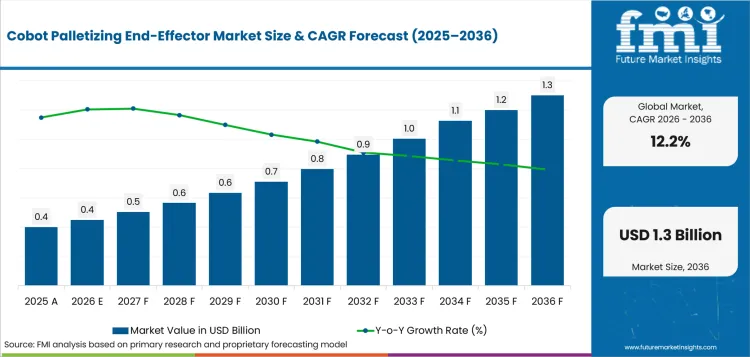
Cobot Palletizing End-Effector Market Overview: Size and Forecast
- 2026 Market Size: USD 430.0 million
- 2036 Market Size: USD 1,359.6 million
- Forecast CAGR: 12.2% from 2026 to 2036
- Leading Robot Type: Collaborative Robots
- Collaborative Robots Share in 2026: 64.0%
- Leading Gripper Technology: Vacuum and Foam Grippers
- Vacuum and Foam Grippers Share in 2026: 52.5%
- Fastest-growing Country: India
- India CAGR: 14.0% by 2036
Summary of the Cobot Palletizing End-Effector Market
- Demand and Growth Drivers
- Manufacturers are shifting from manual stacking toward compact palletizing cells that reduce repetitive lifting pressure.
- Integrators are giving more attention to end-effectors with clear lift testing and faster recipe change support.
- Packaging plants are extending automation budgets toward vacuum arrays, foam pads, and monitored gripper systems.
- Product and Segment View
- Collaborative Robots are forecast to represent 64.0% share in 2026, led by compact deployment and easier operator access.
- Vacuum and Foam Grippers are projected to hold 52.5% share in 2026, influenced by carton porosity and broad surface contact needs.
- The 5-20 kg payload band is expected to secure 48.0% share in 2026, supported by common secondary packaging weights.
- Geography and Competitive Outlook
- India is projected to record 14.0% CAGR by 2036, backed by expanding automation beyond automotive plants.
- China is expected to expand at 13.5% CAGR by 2036 through large robot installation pools and domestic integrator scale.
- OnRobot, Robotiq, Piab, and Schmalz compete through palletizing grippers and cobot-ready end-of-arm tools.
- Universal Robots and FANUC influence demand through cobot platform ecosystems and palletizing cell partnerships.
- Analyst Opinion
- Nikhil Kaitwade, Principal Consultant for Industrial Automation at FMI, observes, “Cobot palletizing end-effectors are becoming a core purchasing decision rather than a small accessory. Buyers can install a capable cobot and still lose throughput if the gripper cannot manage carton porosity, label placement, or mixed case dimensions. Suppliers treating lift proof, payload margin, safety documentation, and software integration as one package should gain stronger repeat orders.”
The cobot palletizing end-effector market is expected to witness strong growth through 2036, driven by demand from manufacturers seeking safer carton handling and flexible end-of-line automation. Market expansion is further supported by wider robot installations, integrator-led palletizing trials, and demand for grippers that can manage mixed packaging formats.
Automation demand is becoming more structured as factories compare end-effectors by lifting certainty, payload margin, and safety documentation. The International Federation of Robotics stated in September 2025 that 542,000 industrial robots were installed in factories during 2024, with Asia accounting for 74% of new deployments. The Bureau of Labor Statistics reported in March 2026 that private industry employers recorded 2.5 million nonfatal workplace injuries and illnesses in 2024, keeping repetitive lifting reduction important for plant managers. Universal Robots stated in September 2024 that UR20 and UR30 payload updates raise total payload including end-effector to 25 kg and 35 kg respectively in top-lift position. Suppliers with tested gripper packages and clear palletizing application support can secure stronger integrator trust.
Which factors support expansion in the cobot palletizing end-effector market?
End-of-line gripper revenue and palletizing cell integration support market value across packaging and manufacturing channels.
- Market value is supported by palletizing-specific end-of-arm tooling before robot platforms add wider automation revenue.
- Supplier pricing reflects vacuum zones, foam pad design, sensor support, and tool-change capability before installation services add cost.
- Revenue improves as manufacturers convert manual carton stacking points into compact collaborative palletizing cells.
- Integrator trust rises when grippers make payload, suction status, carton compatibility, and failure response easier to validate.
Why is the cobot palletizing end-effector market growing?
Manufacturers are moving toward compact palletizing tools with clearer lift control and safer end-of-line operation.
Growth outlook has become more structured as cobot palletizing moves from trial-led projects into repeatable automation programs. IFR stated in October 2025 that transportation and logistics service robots sold 102,900 units in 2024, rising 14% from the previous year. This shows stronger acceptance of automated goods movement across factories and warehouses. OnRobot states that its VGP20 electric vacuum gripper handles payloads up to 20 kg and is designed for heavy-duty packaging and palletizing. Robotiq stated in 2025 that PowerPick Multi uses a flexible multi-cup array and dual-zone picking for varied box sizes on the same line. These signals support wider demand for end-effectors that can prove carton handling performance before cell approval.
How is the cobot palletizing end-effector market segmented?
The cobot palletizing end-effector industry is segmented by robot type, payload, application, end-use industry, and gripper technology.
- Collaborative Robots are projected to secure 64.0% share in 2026, led by compact palletizing cells that can be deployed near workers with lower layout disruption.
- The 5-20 kg payload band is anticipated to hold 48.0% share in 2026 since most secondary packaging loads fit this range after tool mass is considered.
- Material Handling is expected to capture 42.0% share in 2026 due to repeatable carton transfer from conveyor to pallet across packaging lines.
- Food & Beverage is forecast to represent 31.5% share in 2026, guided by high carton throughput and frequent packaging-size changes.
- Vacuum and Foam Grippers are projected to account for 52.5% share in 2026, reflected by their ability to support porous board and mixed carton surfaces.
Why do collaborative robots dominate the cobot palletizing end-effector market?
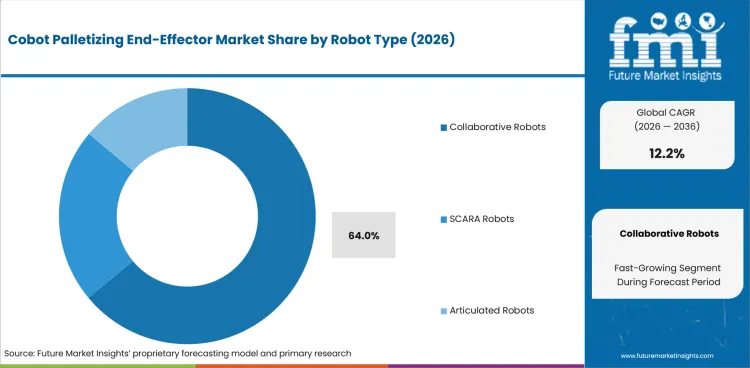
- Collaborative Robots are projected to account for 64.0% share in 2026, influenced by compact cells that fit secondary packaging lines without major floor redesign.
- Articulated robots gain use in heavier operations where higher speeds and larger payloads are needed beyond collaborative cell limits.
Which payload leads the cobot palletizing end-effector market?
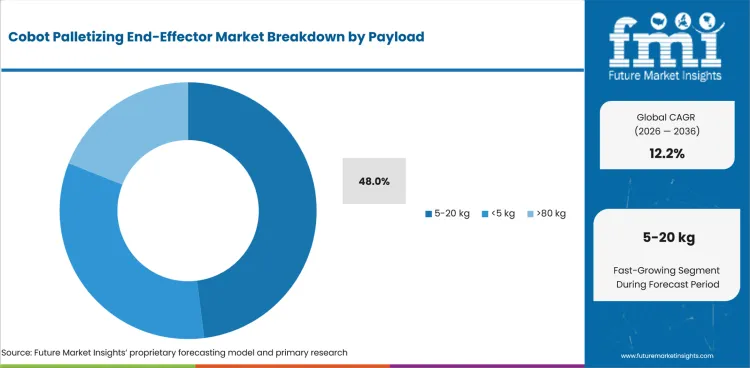
- The 5-20 kg payload band is anticipated to hold 48.0% share in 2026 through its fit with common carton loads and cobot wrist capacity.
- The 20-80 kg band gains importance where heavier cases need stronger grippers, although tool mass can reduce usable payload headroom.
Which application leads the cobot palletizing end-effector market?
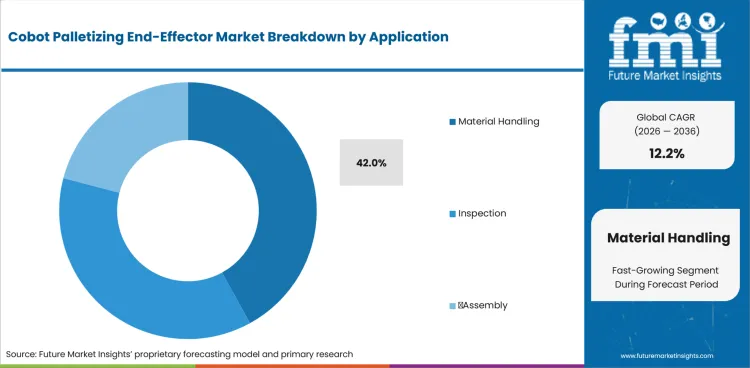
- Material Handling is forecast to secure 42.0% share in 2026, reflected by palletizing being a repetitive transfer task with clear automation payback.
- Packaging applications gain value when the same end-effector can manage trays, cartons, and wrapped bundles with lower changeover effort.
Which end-use industry leads the cobot palletizing end-effector market?
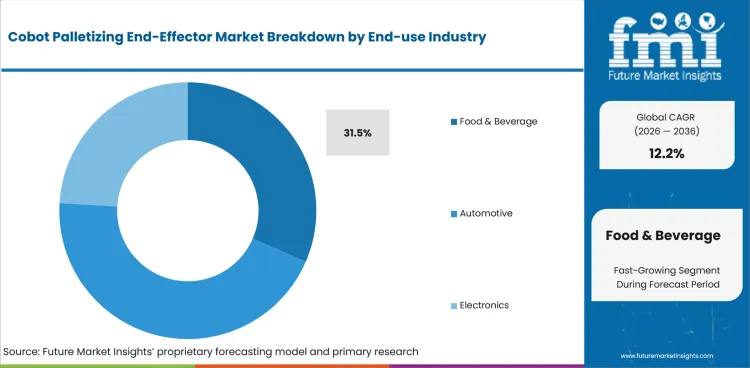
- Food & Beverage is projected to account for 31.5% share in 2026, led by carton variety, hygiene-aware packaging lines, and shift-based pallet patterns.
- Logistics facilities create additional demand as fulfillment operators test compact palletizing cells for safer carton movement.
Which gripper technology leads the cobot palletizing end-effector market?
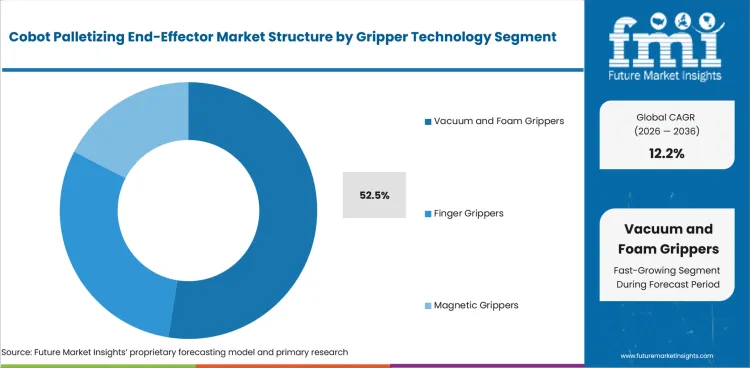
- Vacuum and Foam Grippers are expected to represent 52.5% share in 2026, attributable to broad surface contact and stronger handling of porous cardboard.
- Finger grippers gain use in rigid trays, open cases, and packs where mechanical holding can reduce suction-loss risk.
What are the driver, restraints, and opportunities in the cobot palletizing end-effector market?
Flexible palletizing cells support growth while payload limits and safety validation restrict faster rollout.
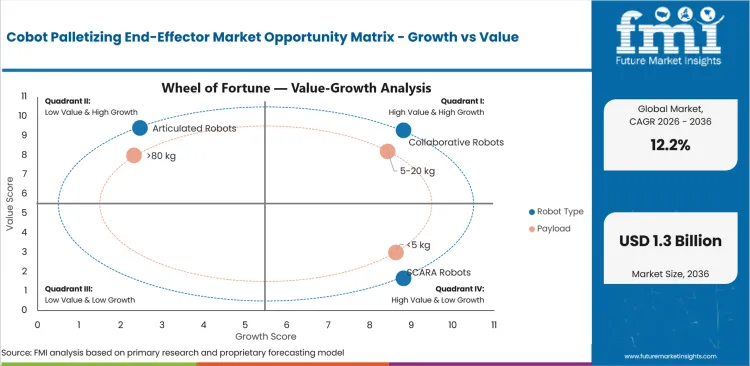
- Driver: Compact cobot palletizing cells are replacing manual stacking points in factories with limited floor space.
- Restraint: End-effector weight and carton porosity can reduce useful payload and delay cell approval.
- Opportunity: Connected grippers can improve buyer confidence through suction status, pick-failure reporting, and easier validation.
Cobot Palletizing End-Effector Market Demand Outlook
Demand outlook is moving toward gripper packages that combine lift proof, carton testing, and safe collaborative operation before wider deployment. The Bureau of Labor Statistics stated in 2026 that the private industry total recordable case rate was 2.3 cases per 100 full-time equivalent workers during 2024, the lowest rate in that data series. This supports the automation case for repetitive lifting tasks in packaging plants. Cobot palletizing end-effectors help buyers reduce manual handling exposure while keeping line layouts flexible. Suppliers with documented suction failure response and payload testing can support faster approval by safety and plant engineering teams.
Payload and Packaging Constraint Analysis
Payload headroom remains a major restraint because the gripper, carton, and safety margin must all fit within the cobot’s useful capacity. IFR stated in April 2026 that global robot density reached 162 units per 10,000 manufacturing employees in 2024, raising buyer expectations for performance benchmarking in automated cells. Mature automation buyers compare end-effector mass, carton weight, reach, and cycle time before approving new palletizing tools. This makes poorly documented grippers harder to justify during factory trials. Suppliers must prove realistic performance on porous board, uneven labels, and changing case sizes.
Connected Gripper and Validation Opportunity
The opportunity is moving toward sensor-enabled grippers that support integrator documentation and factory acceptance. OSHA published its FY 2025 top 10 cited standards in April 2026, keeping machine guarding and safety compliance visible to employers. Cobot palletizing cells require careful review of wrist tools because the end-effector can contact cartons, pallets, and nearby operators. Grippers with suction monitoring, tool status alerts, and clean integration records can reduce engineering hours for integrators. This creates a stronger value case for software-connected end-effectors.
Which countries are growing fastest in the cobot palletizing end-effector market?
India 14.0% CAGR, China 13.5% CAGR, United States 11.8% CAGR, South Korea 11.5% CAGR, Germany 10.9% CAGR, Japan 10.8% CAGR, France 10.7% CAGR, and United Kingdom 10.4% CAGR through 2036.
.webp "Top Country Growth Comparison Cobot Palletizing End Effector Market Cagr (2026 2036)")
| Country | CAGR |
|---|---|
| India | 14.0% |
| China | 13.5% |
| United States | 11.8% |
| South Korea | 11.5% |
| Germany | 10.9% |
| Japan | 10.8% |
| France | 10.7% |
| United Kingdom | 10.4% |
Source: Future Market Insights, 2026.
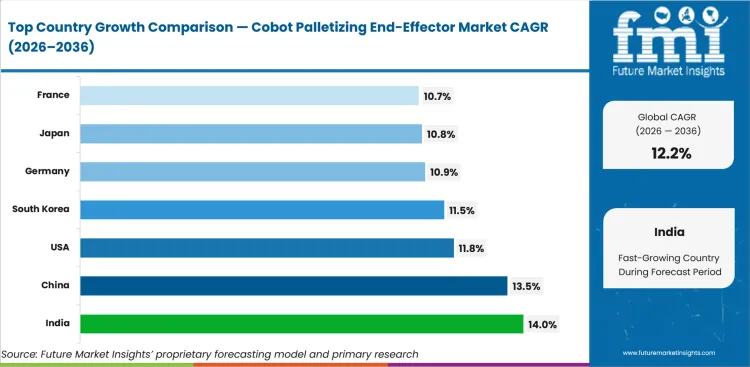
How do country-level CAGRs compare in the cobot palletizing end-effector market?
India leads country growth while the United Kingdom records the most cautious expansion outlook among profiled markets.
- India is forecast to record 14.0% CAGR by 2036 as packaging automation broadens beyond automotive manufacturing.
- China is expected to expand at 13.5% CAGR from 2026 to 2036 due to large robot deployment and domestic automation depth.
- The United States is projected to grow at 11.8% CAGR through 2036 as system integrators influence gripper trials.
- South Korea is estimated to rise at 11.5% CAGR by 2036 with electronics and logistics facilities supporting compact automation.
- Germany is expected to advance at 10.9% CAGR over the forecast period as mature automation users add flexible palletizing cells.
- Japan is forecast to grow at 10.8% CAGR through 2036 as robot OEM ecosystems support gripper compatibility.
- France is projected to post 10.7% CAGR by 2036 as packaging quality needs support gentle handling tools.
- The United Kingdom is anticipated to rise at 10.4% CAGR through 2036 as cautious buyers test one cell before wider rollout.
Why is India the fastest-growing cobot palletizing end-effector market?
A 14.0% CAGR through 2036 reflects faster automation adoption from a smaller base across packaging, logistics, and general manufacturing.
Country Market Snapshot Table
| Parameter | Value |
|---|---|
| Market Size in 2025 (Value) | USD 21.9 million |
| Market Size in 2026 (Value) | USD 25.0 million |
| Market Forecast in 2036 (Value) | USD 92.8 million |
| CAGR (2026 to 2036) | 14.0% |
| Years Considered | 2021 to 2036 |
| Base Year | 2025 |
| Forecast Period | 2026 to 2036 |
| Units Considered | Value (USD million) |
| Leading Sub-Region | Pune, Chennai, Bengaluru, Gujarat, and Delhi NCR corridors |
India Cobot Palletizing End-Effector Market Outlook
India cobot palletizing end-effector demand is influenced by factories moving from manual stacking to modular robotic cells. Packaging plants need tools that are easy to install, maintain, and train around.
Local integrators and robot distributors are expected to support adoption by offering carton trials before capital approval. Suppliers with rugged tools and accessible spare parts should gain early buyer confidence.
Key Growth Drivers
- Robot adoption gives palletizing gripper suppliers a clearer entry setting. IFR reported a record 9,120 industrial robot installations in India in 2024.
- Factory output supports new automation planning. PIB reported India’s Index of Industrial Production grew 7.8% in December 2025.
- Packaging and logistics plants can begin with compact cells before moving toward wider end-of-line automation programs.
- Integrator support helps mid-sized manufacturers test carton handling before approving multi-line deployment.
Key Restraints
- Utility readiness and compressed air quality can slow pneumatic gripper use in older manufacturing facilities.
- Buyer training needs can delay adoption when plants lack internal robot programming and maintenance experience.
- Factory safety scrutiny remains important. DGFASLI’s 2025 INDOSHNEWS review reported 25 fatal injuries and 142 non-fatal injuries in Rajasthan registered factories in 2023.
What makes India unique
India is unique due to automation expanding from automotive plants into packaging, logistics, and general manufacturing.
Key Companies
- Addverb Technologies
- DiFACTO Robotics and Automation
- Systemantics India
- Universal Robots India
- FANUC India
- Yaskawa India
- SMC India
Sales & Marketing Channels
- Direct automation audits
- System integrator partnerships
- Packaging machinery dealers
- Robot distributor networks
- Industrial exhibitions
- Aftermarket gripper upgrades
Country Segment Breakdown Table
| Segment | Sub-Segments |
|---|---|
| By Robot Type | Collaborative Robots, SCARA Robots, Articulated Robots, AMR/AGV Platforms, Delta Robots |
| By Payload | <5 kg, 5-20 kg, 20-80 kg, >80 kg |
| By Application | Material Handling, Inspection, Assembly, Welding, Packaging, Machine Tending |
| By End-use Industry | Automotive, Electronics, Food & Beverage, Logistics, Pharmaceuticals, Metals |
| By Gripper Technology | Vacuum and Foam Grippers, Finger Grippers, Magnetic Grippers, Tool Changers and Sensors |
| Key Sub-Regions Covered, Industrial Automation Corridors | Pune, Chennai, Bengaluru, Gujarat, Delhi NCR, Hyderabad |
Frequently Asked Questions
How fast is India cobot palletizing end-effector market growing?
Sales in India are ready to scale at 14.0% CAGR from 2026 to 2036, guided by wider factory automation.
Who leads India cobot palletizing end-effector market?
Addverb Technologies, DiFACTO Robotics and Automation, Systemantics India, and Universal Robots India compete through local integration and cobot automation support.
What is driving adoption in India cobot palletizing end-effector market?
Packaging automation and integrator-led carton trials are moving manufacturers toward validated end-of-arm tooling.
What is driving cobot palletizing end-effector demand in China?
A 13.5% CAGR through 2036 reflects the largest robot installation base and strong domestic automation supply.
Country Market Snapshot Table
| Parameter | Value |
|---|---|
| Market Size in 2025 (Value) | USD 88.1 million |
| Market Size in 2026 (Value) | USD 100.0 million |
| Market Forecast in 2036 (Value) | USD 355.3 million |
| CAGR (2026 to 2036) | 13.5% |
| Years Considered | 2021 to 2036 |
| Base Year | 2025 |
| Forecast Period | 2026 to 2036 |
| Units Considered | Value (USD million) |
| Leading Sub-Region | Guangdong, Jiangsu, Zhejiang, and Shanghai manufacturing clusters |
China Cobot Palletizing End-Effector Market Outlook
China cobot palletizing end-effector demand is influenced by high factory automation depth and strong domestic integrator networks. Buyers often compare price, delivery speed, and compatibility with domestic robot platforms.
Electronics, logistics, food packaging, and general manufacturing support broad palletizing use cases. Suppliers that localize service and provide multi-format carton testing should compete more effectively.
Key Growth Drivers
- Large robot deployment gives gripper suppliers a deep addressable base. IFR reported 295,000 industrial robot installations in China during 2024.
- Manufacturing activity supports automation demand. China’s National Bureau of Statistics reported manufacturing value added increased 6.4% in 2025.
- Domestic integrators influence end-effector selection by bundling robot arms, grippers, and cell commissioning.
- High-volume factories need grippers that balance carton variation, price pressure, and replacement part availability.
Key Restraints
- Intense domestic competition can compress gripper margins and pressure suppliers to prove reliability at lower system prices.
- Export and local demand swings can delay factory automation approvals when buyers protect cash flow.
- Demand visibility remains uneven. China’s National Bureau of Statistics reported a 98.2% industrial product sales ratio in December 2025, down 0.7 percentage points year over year.
What makes China unique
China is unique because domestic robot makers and integrators strongly influence end-effector choice on delivery speed and price.
Key Companies
- Siasun Robot & Automation
- EFORT Intelligent Equipment
- Estun Automation
- ABB Robotics China
- FANUC China
- JAKA Robotics
- SMC China
Sales & Marketing Channels
- Domestic system integrators
- Robot OEM bundles
- Direct factory automation sales
- Regional distributor networks
- Industrial procurement platforms
- Packaging machinery partnerships
Country Segment Breakdown Table
| Segment | Sub-Segments |
|---|---|
| By Robot Type | Collaborative Robots, SCARA Robots, Articulated Robots, AMR/AGV Platforms, Delta Robots |
| By Payload | <5 kg, 5-20 kg, 20-80 kg, >80 kg |
| By Application | Material Handling, Inspection, Assembly, Welding, Packaging, Machine Tending |
| By End-use Industry | Automotive, Electronics, Food & Beverage, Logistics, Pharmaceuticals, Metals |
| By Gripper Technology | Vacuum and Foam Grippers, Finger Grippers, Magnetic Grippers, Tool Changers and Sensors |
| Key Sub-Regions Covered, Industrial Automation Corridors | Guangdong, Jiangsu, Zhejiang, Shanghai, Shandong, Sichuan |
Frequently Asked Questions
How fast is China cobot palletizing end-effector market growing?
Sector in China is anticipated to grow at 13.5% CAGR from 2026 to 2036, reflecting dense robot adoption.
Who leads China cobot palletizing end-effector market?
Siasun Robot & Automation, EFORT Intelligent Equipment, Estun Automation, and ABB Robotics China compete through robot automation and integration channels.
What is driving adoption in China cobot palletizing end-effector market?
Large robot deployment and domestic integrator support are moving factories toward validated palletizing grippers.
What is the cobot palletizing end-effector market outlook in the United States?
An 11.8% CAGR through 2036 is supported by integrator-led projects and national packaging automation demand.
Country Market Snapshot Table
| Parameter | Value |
|---|---|
| Market Size in 2025 (Value) | USD 81.4 million |
| Market Size in 2026 (Value) | USD 91.0 million |
| Market Forecast in 2036 (Value) | USD 277.5 million |
| CAGR (2026 to 2036) | 11.8% |
| Years Considered | 2021 to 2036 |
| Base Year | 2025 |
| Forecast Period | 2026 to 2036 |
| Units Considered | Value (USD million) |
| Leading Sub-Region | Midwest and South Atlantic packaging corridors |
United States Cobot Palletizing End-Effector Market Outlook
United States cobot palletizing end-effector demand is shaped by system integrators and factory proof trials. Buyers often test carton porosity, box sizes, and line speeds before approving gripper purchases.
Local demo centers and cobot platform availability support adoption among mid-sized plants. Suppliers with clear documentation and fast spare-part support should gain stronger integrator recommendations.
Key Growth Drivers
- Automation scale gives suppliers a broad customer base. IFR reported the United States installed 34,200 industrial robots in 2024.
- Safety reporting increases attention on repetitive handling risk. OSHA’s 2024 injury data release included about 370,000 establishment-specific annual summaries.
- Food packaging, e-commerce fulfillment, and general manufacturing create compact palletizing demand where full fenced systems are difficult to place.
- Cobot platforms from FANUC and Universal Robots widen end-effector compatibility options for local system integrators.
Key Restraints
- Compressed air quality and line-level utilities can delay pneumatic gripper installation in older facilities.
- Budget approvals often depend on fast payback proof across several shifts before purchase teams accept the project.
- Workplace safety scrutiny remains high. BLS reported 2.5 million nonfatal workplace injuries and illnesses in private industry during 2024.
What makes the United States unique
United States is unique due to integrator-led proof culture and a large base of packaging automation buyers.
Key Companies
- FANUC America Corporation
- Universal Robots USA
- Robotiq Inc.
- OnRobot USA
- Schmalz Inc.
- SMC Corporation of America
- Piab USA Inc.
Sales & Marketing Channels
- Direct enterprise sales
- System integrator partnerships
- Distributor demo centers
- OEM palletizing cell bundles
- Trade show demonstrations
- Aftermarket gripper upgrades
Country Segment Breakdown Table
| Segment | Sub-Segments |
|---|---|
| By Robot Type | Collaborative Robots, SCARA Robots, Articulated Robots, AMR/AGV Platforms, Delta Robots |
| By Payload | <5 kg, 5-20 kg, 20-80 kg, >80 kg |
| By Application | Material Handling, Inspection, Assembly, Welding, Packaging, Machine Tending |
| By End-use Industry | Automotive, Electronics, Food & Beverage, Logistics, Pharmaceuticals, Metals |
| By Gripper Technology | Vacuum and Foam Grippers, Finger Grippers, Magnetic Grippers, Tool Changers and Sensors |
| Key Sub-Regions Covered, Industrial Automation Corridors | Midwest, Southeast, Texas, California, Pacific Northwest, Great Lakes |
Frequently Asked Questions
How fast is United States cobot palletizing end-effector market growing?
Demand in the United States is ready to rise at 11.8% CAGR from 2026 to 2036 with integrator-led palletizing projects.
Who leads United States cobot palletizing end-effector market?
FANUC America, Universal Robots USA, Robotiq, OnRobot, Schmalz, and SMC compete through platform access and gripper support.
What is driving adoption in United States cobot palletizing end-effector market?
Integrator trials and carton handling automation are moving factories toward validated cobot palletizing grippers.
How is South Korea shaping cobot palletizing end-effector demand?
An 11.5% CAGR through 2036 reflects dense automation use and strong electronics-led handling demand.
Country Market Snapshot Table
| Parameter | Value |
|---|---|
| Market Size in 2025 (Value) | USD 28.7 million |
| Market Size in 2026 (Value) | USD 32.0 million |
| Market Forecast in 2036 (Value) | USD 94.9 million |
| CAGR (2026 to 2036) | 11.5% |
| Years Considered | 2021 to 2036 |
| Base Year | 2025 |
| Forecast Period | 2026 to 2036 |
| Units Considered | Value (USD million) |
| Leading Sub-Region | Seoul Capital Area, Gyeonggi, and Ulsan industrial corridors |
South Korea Cobot Palletizing End-Effector Market Outlook
South Korea cobot palletizing end-effector demand is influenced by electronics, logistics, automotive, and advanced manufacturing facilities. Buyers compare gripper uptime and software fit because line interruptions can be costly.
Robot OEM channels and factory automation distributors shape how end-effectors reach end users. Suppliers with fast service response and proven mixed-case handling should gain better adoption.
Key Growth Drivers
- Robot density supports end-effector replacement demand. IFR reported 30,600 industrial robot installations in the Republic of Korea in 2024.
- Active factory use supports compact automation projects. Statistics Korea reported manufacturing average capacity utilization at 72.7% in December 2025.
- Electronics and logistics sites need accurate case handling where available floor space limits fixed palletizer layouts.
- Robot OEM partners and local automation distributors help validate grippers before wider production rollout.
Key Restraints
- High uptime expectations can extend pilot testing before suppliers win approval for broader plant deployment.
- Smaller packaging projects can be delayed if engineers must customize gripper arrays for each product family.
- Safety expectations are strengthening. KOSHA reported in June 2025 that supported workplaces saw a 66.7% reduction in fatal accidents after consultation programs.
What makes South Korea unique
South Korea is unique because electronics and advanced manufacturing buyers expect compact cells with high uptime evidence.
Key Companies
- Hyundai Robotics
- Doosan Robotics
- Rainbow Robotics
- Kawasaki Robotics Korea
- SMC Korea
- FANUC Korea
- Universal Robots Korea
Sales & Marketing Channels
- Robot OEM partners
- Electronics plant integrators
- Factory automation distributors
- Direct technical sales
- Packaging equipment builders
- Maintenance service providers
Country Segment Breakdown Table
| Segment | Sub-Segments |
|---|---|
| By Robot Type | Collaborative Robots, SCARA Robots, Articulated Robots, AMR/AGV Platforms, Delta Robots |
| By Payload | <5 kg, 5-20 kg, 20-80 kg, >80 kg |
| By Application | Material Handling, Inspection, Assembly, Welding, Packaging, Machine Tending |
| By End-use Industry | Automotive, Electronics, Food & Beverage, Logistics, Pharmaceuticals, Metals |
| By Gripper Technology | Vacuum and Foam Grippers, Finger Grippers, Magnetic Grippers, Tool Changers and Sensors |
| Key Sub-Regions Covered, Industrial Automation Corridors | Seoul Capital Area, Gyeonggi, Ulsan, Busan, Daegu, Daejeon |
Frequently Asked Questions
How fast is South Korea cobot palletizing end-effector market growing?
Industry in South Korea is projected to increase at 11.5% CAGR from 2026 to 2036 through compact automation.
Who leads South Korea cobot palletizing end-effector market?
Hyundai Robotics, Doosan Robotics, Rainbow Robotics, and Kawasaki Robotics Korea compete through robot platforms and automation support.
What is driving adoption in South Korea cobot palletizing end-effector market?
Electronics manufacturing, logistics handling, and local automation channels are supporting validated end-effector use.
What is driving the cobot palletizing end-effector market in Germany?
A 10.9% CAGR through 2036 reflects mature automation use and a strong local gripper supplier base.
Country Market Snapshot Table
| Parameter | Value |
|---|---|
| Market Size in 2025 (Value) | USD 46.9 million |
| Market Size in 2026 (Value) | USD 52.0 million |
| Market Forecast in 2036 (Value) | USD 146.4 million |
| CAGR (2026 to 2036) | 10.9% |
| Years Considered | 2021 to 2036 |
| Base Year | 2025 |
| Forecast Period | 2026 to 2036 |
| Units Considered | Value (USD million) |
| Leading Sub-Region | Bavaria, Baden-Wurttemberg, and North Rhine-Westphalia |
Germany Cobot Palletizing End-Effector Market Outlook
Germany cobot palletizing end-effector demand is influenced by mature automation users and disciplined validation culture. Buyers expect detailed documentation before approving new palletizing tools.
Local suppliers support trials and spare parts, helping buyers compare vacuum, foam, and mechanical gripping options. Documentation depth and service reliability usually affect purchasing decisions before price.
Key Growth Drivers
- Dense robot use creates a larger retrofit pool. IFR reported Germany installed 26,982 industrial robots in 2024.
- Manufacturing order recovery supports equipment review. Destatis reported new manufacturing orders rose 7.8% month on month in December 2025.
- Machine builders integrate palletizing tools into broader packaging and handling systems for factory buyers.
- Local automation suppliers support fast trials, spare-part access, and detailed safety documentation.
Key Restraints
- Documentation demands can extend approval timelines for new tool designs before plant teams accept them.
- High engineering standards raise support costs for foreign suppliers that lack local application engineers.
- Performance expectations are high in mature plants. Germany recorded 449 industrial robots per 10,000 manufacturing employees in 2024.
What makes Germany unique
Germany is distinct due to a strong local end-effector supplier base and disciplined validation culture.
Key Companies
- Schmalz GmbH
- Festo SE & Co. KG
- Zimmer Group
- KUKA AG
- Universal Robots Germany
- SMC Deutschland GmbH
- Piab Germany GmbH
Sales & Marketing Channels
- Machine builder partnerships
- Certified system integrators
- Direct technical sales
- Distributor engineering teams
- Factory acceptance testing
- Regional automation fairs
Country Segment Breakdown Table
| Segment | Sub-Segments |
|---|---|
| By Robot Type | Collaborative Robots, SCARA Robots, Articulated Robots, AMR/AGV Platforms, Delta Robots |
| By Payload | <5 kg, 5-20 kg, 20-80 kg, >80 kg |
| By Application | Material Handling, Inspection, Assembly, Welding, Packaging, Machine Tending |
| By End-use Industry | Automotive, Electronics, Food & Beverage, Logistics, Pharmaceuticals, Metals |
| By Gripper Technology | Vacuum and Foam Grippers, Finger Grippers, Magnetic Grippers, Tool Changers and Sensors |
| Key Sub-Regions Covered, Industrial Automation Corridors | Bavaria, Baden-Wurttemberg, North Rhine-Westphalia, Lower Saxony, Hesse, Saxony |
Frequently Asked Questions
How fast is Germany cobot palletizing end-effector market growing?
Sector in Germany is projected at 10.9% CAGR from 2026 to 2036 as mature automation users add compact cells.
Who leads Germany cobot palletizing end-effector market?
Schmalz, Festo, Zimmer Group, KUKA, Universal Robots Germany, and SMC Deutschland compete through local automation channels.
What is driving adoption in Germany cobot palletizing end-effector market?
Local supplier depth and disciplined validation are supporting wider use of palletizing end-effectors.
What is the cobot palletizing end-effector market forecast for Japan?
A 10.8% CAGR through 2036 reflects robot OEM depth and reliability-focused plant purchasing.
Country Market Snapshot Table
| Parameter | Value |
|---|---|
| Market Size in 2025 (Value) | USD 49.6 million |
| Market Size in 2026 (Value) | USD 55.0 million |
| Market Forecast in 2036 (Value) | USD 153.1 million |
| CAGR (2026 to 2036) | 10.8% |
| Years Considered | 2021 to 2036 |
| Base Year | 2025 |
| Forecast Period | 2026 to 2036 |
| Units Considered | Value (USD million) |
| Leading Sub-Region | Tokyo, Aichi, Osaka, and Kanagawa industrial corridors |
Japan Cobot Palletizing End-Effector Market Outlook
Japan cobot palletizing end-effector demand is influenced by mature robot users that prioritize reliability and documented interfaces. Palletizing tools are evaluated with robot platforms because maintenance risk and compatibility affect approval.
Food, electronics, automotive, and logistics facilities create demand for compact lifting cells near production lines. Suppliers with trusted ecosystem access and local engineering support should gain stronger adoption.
Key Growth Drivers
- Robot OEM depth supports end-effector demand. IFR reported Japan installed 44,500 industrial robots in 2024.
- Labor pressure supports safer lifting automation. JILPT reported about 4.6 million jobless workers who wished to work but were not seeking a job.
- Domestic robot OEMs support strong ecosystem compatibility for grippers and help buyers reduce interface risk.
- Electronics and food lines need reliable handling across compact workspaces where full palletizing equipment can be difficult to place.
Key Restraints
- Conservative plant approval can slow newer gripper technologies when proven pneumatic tools are already accepted.
- High reliability expectations increase qualification cost for suppliers that cannot provide local service.
- Machinery-interface risk remains under review. MHLW reported FY2024 pinched or caught-between-machine accidents increased to 6 cases in its monitored accident setting.
What makes Japan unique
Japan is unique due to robot OEM influence and component supplier depth shaping end-effector buying decisions.
Key Companies
- FANUC Corporation
- Yaskawa Electric Corporation
- Kawasaki Robotics
- SMC Corporation
- Omron Corporation
- Denso Wave
- Universal Robots Japan
Sales & Marketing Channels
- Robot OEM channels
- Factory automation distributors
- Direct engineering support
- Integrator partnerships
- Packaging equipment builders
- Maintenance service networks
Country Segment Breakdown Table
| Segment | Sub-Segments |
|---|---|
| By Robot Type | Collaborative Robots, SCARA Robots, Articulated Robots, AMR/AGV Platforms, Delta Robots |
| By Payload | <5 kg, 5-20 kg, 20-80 kg, >80 kg |
| By Application | Material Handling, Inspection, Assembly, Welding, Packaging, Machine Tending |
| By End-use Industry | Automotive, Electronics, Food & Beverage, Logistics, Pharmaceuticals, Metals |
| By Gripper Technology | Vacuum and Foam Grippers, Finger Grippers, Magnetic Grippers, Tool Changers and Sensors |
| Key Sub-Regions Covered, Industrial Automation Corridors | Tokyo, Aichi, Osaka, Kanagawa, Shizuoka, Fukuoka |
Frequently Asked Questions
How fast is Japan cobot palletizing end-effector market growing?
Sector in Japan is projected at 10.8% CAGR from 2026 to 2036 as mature robot users add compact palletizing cells.
Who leads Japan cobot palletizing end-effector market?
FANUC, Yaskawa Electric, Kawasaki Robotics, SMC, and Omron compete through robot platforms and local automation channels.
What is driving adoption in Japan cobot palletizing end-effector market?
Robot OEM ecosystems and reliability-focused purchasing are moving buyers toward documented palletizing grippers.
How fast is the cobot palletizing end-effector market growing in France?
A 10.7% CAGR through 2036 reflects packaging quality needs across food, cosmetics, and pharmaceutical plants.
Country Market Snapshot Table
| Parameter | Value |
|---|---|
| Market Size in 2025 (Value) | USD 28.9 million |
| Market Size in 2026 (Value) | USD 32.0 million |
| Market Forecast in 2036 (Value) | USD 88.6 million |
| CAGR (2026 to 2036) | 10.7% |
| Years Considered | 2021 to 2036 |
| Base Year | 2025 |
| Forecast Period | 2026 to 2036 |
| Units Considered | Value (USD million) |
| Leading Sub-Region | Paris region, Auvergne-Rhone-Alpes, and western packaging corridors |
France Cobot Palletizing End-Effector Market Outlook
France cobot palletizing end-effector demand is influenced by consumer goods plants needing compact cells without packaging damage. Gripper choice is closely reviewed because cartons, cosmetics cases, and pharmaceutical packs can be damaged by weak suction layouts.
Integrators and packaging equipment suppliers remain central to purchasing behavior. Suppliers with gentle handling evidence and quick local trials should gain stronger acceptance across mixed-format lines.
Key Growth Drivers
- Robot use gives suppliers a direct customer base. IFR reported France recorded 4,900 industrial robot installations in 2024.
- Manufacturing recovery supports practical automation review. INSEE reported manufacturing output bounced back 0.9% in September 2025.
- Food and cosmetics producers need compact end-of-line cells for mixed packaging and frequent presentation changes.
- European gripper suppliers provide easier access to trials and parts for first-time cobot palletizing projects.
Key Restraints
- Capital approvals can slow when plants lack internal robot programming skills and rely heavily on integrator availability.
- Packaging damage risk can delay acceptance of untested suction layouts in premium consumer goods plants.
- Output volatility can delay purchases. INSEE reported manufacturing output fell 0.8% in December 2025.
What makes France unique
France is unique due to its packaging quality focus across cosmetics, food, and pharmaceutical end users.
Key Companies
- Piab France SAS
- Schmalz France SARL
- Universal Robots France
- SMC France
- ABB Robotics France
- FANUC France
- Staubli Robotics
Sales & Marketing Channels
- Packaging line integrators
- Distributor-led trials
- Direct plant engineering sales
- OEM equipment partnerships
- Pharmaceutical equipment networks
- Food processing exhibitions
Country Segment Breakdown Table
| Segment | Sub-Segments |
|---|---|
| By Robot Type | Collaborative Robots, SCARA Robots, Articulated Robots, AMR/AGV Platforms, Delta Robots |
| By Payload | <5 kg, 5-20 kg, 20-80 kg, >80 kg |
| By Application | Material Handling, Inspection, Assembly, Welding, Packaging, Machine Tending |
| By End-use Industry | Automotive, Electronics, Food & Beverage, Logistics, Pharmaceuticals, Metals |
| By Gripper Technology | Vacuum and Foam Grippers, Finger Grippers, Magnetic Grippers, Tool Changers and Sensors |
| Key Sub-Regions Covered, Industrial Automation Corridors | Paris Region, Lyon, Nantes, Lille, Bordeaux, Toulouse |
Frequently Asked Questions
How fast is France cobot palletizing end-effector market growing?
Industry in France is expected to rise at 10.7% CAGR from 2026 to 2036 through packaging-focused automation.
Who leads France cobot palletizing end-effector market?
Piab France, Schmalz France, Universal Robots France, SMC France, and ABB Robotics France compete through gripping and automation support.
What is driving adoption in France cobot palletizing end-effector market?
Packaging quality needs and integrator-led trials are moving buyers toward validated cobot palletizing tools.
How is the cobot palletizing end-effector market performing in the United Kingdom?
A 10.4% CAGR through 2036 reflects careful automation spending and flexible packaging demand.
Country Market Snapshot Table
| Parameter | Value |
|---|---|
| Market Size in 2025 (Value) | USD 25.4 million |
| Market Size in 2026 (Value) | USD 28.0 million |
| Market Forecast in 2036 (Value) | USD 75.4 million |
| CAGR (2026 to 2036) | 10.4% |
| Years Considered | 2021 to 2036 |
| Base Year | 2025 |
| Forecast Period | 2026 to 2036 |
| Units Considered | Value (USD million) |
| Leading Sub-Region | London and Midlands contract packing corridors |
United Kingdom Cobot Palletizing End-Effector Market Outlook
United Kingdom cobot palletizing end-effector demand is supported by food plants, beverage producers, and contract packers seeking smaller end-of-line cells. Many buyers begin with one palletizing cell before expanding to other lines.
Flexible carton handling and easy recipe changes are important because contract packing sites handle frequent customer changes. Suppliers that reduce engineering visits and provide local parts should gain stronger distributor support.
Key Growth Drivers
- A selective automation base supports practical gripper trials. IFR reported UK industrial robot installations were 2,500 units in 2024.
- Food manufacturing supports end-of-line packaging demand. ONS reported UK manufacturers’ product sales of GBP 452.2 billion in 2024, with food representing 21% of total sales.
- Contract packing sites need flexible tools for frequent SKU and customer packaging changes.
- Food and beverage plants need safer handling for repetitive case stacking in tight spaces.
Key Restraints
- Lower robot installation volume limits the near-term pool of new cell purchases and raises payback scrutiny.
- Smaller factories can delay projects if gripper trials require long engineering visits or repeated carton testing.
- Ergonomic pressure remains high. HSE reported 511,000 workers suffered from work-related musculoskeletal disorders in 2024 to 2025.
What makes the United Kingdom unique
United Kingdom is unique due to cautious buyer behavior after incentive-led automation peaked and reset.
Key Companies
- Universal Robots UK
- RARUK Automation
- Piab UK Ltd.
- Schmalz UK Ltd.
- SMC Pneumatics UK Ltd.
- ABB Robotics UK
- FANUC UK Ltd.
Sales & Marketing Channels
- Regional robot integrators
- Packaging machinery dealers
- Distributor-led gripper trials
- Direct automation audits
- Food plant engineering networks
- Trade fair lead generation
Country Segment Breakdown Table
| Segment | Sub-Segments |
|---|---|
| By Robot Type | Collaborative Robots, SCARA Robots, Articulated Robots, AMR/AGV Platforms, Delta Robots |
| By Payload | <5 kg, 5-20 kg, 20-80 kg, >80 kg |
| By Application | Material Handling, Inspection, Assembly, Welding, Packaging, Machine Tending |
| By End-use Industry | Automotive, Electronics, Food & Beverage, Logistics, Pharmaceuticals, Metals |
| By Gripper Technology | Vacuum and Foam Grippers, Finger Grippers, Magnetic Grippers, Tool Changers and Sensors |
| Key Sub-Regions Covered, Industrial Automation Corridors | London, Midlands, Manchester, Birmingham, Leeds, Glasgow |
Frequently Asked Questions
How fast is United Kingdom cobot palletizing end-effector market growing?
Demand in the United Kingdom is expected to rise at 10.4% CAGR from 2026 to 2036 with flexible packaging automation.
Who leads United Kingdom cobot palletizing end-effector market?
Universal Robots UK, RARUK Automation, Piab UK, Schmalz UK, and SMC Pneumatics UK compete through partner channels.
What is driving adoption in United Kingdom cobot palletizing end-effector market?
Contract packing demand and food plant automation are supporting compact palletizing gripper adoption.
Who are the leading companies in the cobot palletizing end-effector market?
OnRobot, Robotiq, Piab, Schmalz, SMC, Zimmer Group, Festo, Universal Robots, FANUC, and ABB.
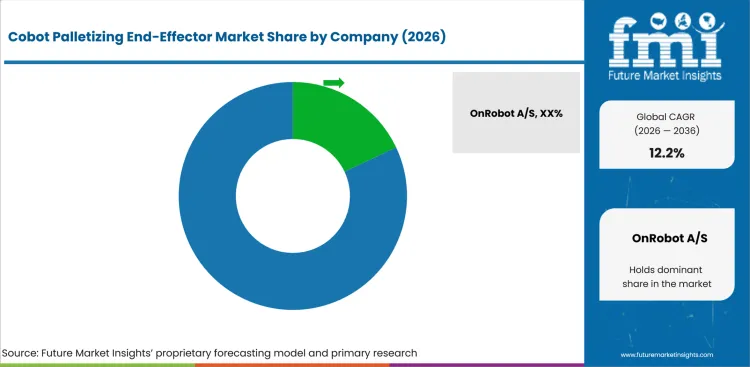
- Specialist gripper suppliers hold an advantage through palletizing-ready vacuum tools and software-connected end-of-arm systems.
- Cobot platform companies influence end-effector demand by shaping approved accessory ecosystems and palletizing cell design.
- Pneumatics and vacuum technology suppliers gain from foam grippers, suction cups, and vacuum monitoring used across packaging lines.
- Integrator-ready documentation supports faster trial approval through payload evidence, safety notes, and carton handling guidance.
Competition in the market is shaped by the ability to prove lift certainty across porous cardboard, printed labels, uneven flaps, and mixed carton dimensions. OnRobot and Robotiq compete strongly in cobot-oriented gripping systems that are easier for integrators to specify. Piab, Schmalz, SMC, Zimmer Group, and Festo compete through vacuum technology, suction systems, and automation components. Buyers assess tool weight, suction loss control, and software fit before final price comparison.
Platform influence remains important because many palletizing buyers select the robot and the end-effector together. Universal Robots supports demand through its cobot ecosystem and palletizing application focus. FANUC and ABB influence gripper selection through broader automation and robot-cell channels. Suppliers with local support and application engineers can reduce trial time and improve acceptance in packaging plants.
Smaller and regional suppliers can win through customization and faster service response. Local gripper providers may adapt foam pads, mounting plates, and suction layouts around plant-specific cartons. However, suppliers that cannot prove safety documentation or replace parts quickly may lose integrator trust. Companies best positioned to win are those combining gripping hardware, clear application proof, sensor feedback, and strong channel support.
How do top cobot palletizing end-effector companies compare?
OnRobot and Robotiq score strongest on cobot-specific grippers while Schmalz and Piab lead in vacuum expertise.
| Company | Relevance to Market Title | Palletizing Gripper Depth | Cobot Ecosystem Fit | Channel Control | Service Reach | Geographic Footprint |
|---|---|---|---|---|---|---|
| OnRobot A/S | Very High | Very Strong | Very Strong | Strong | Strong | Global |
| Robotiq Inc. | Very High | Very Strong | Very Strong | Strong | Strong | North America and Global |
| Piab AB | Very High | Very Strong | Strong | Strong | Strong | Global |
| J. Schmalz GmbH | Very High | Very Strong | Strong | Strong | Very Strong | Global |
| SMC Corporation | High | Strong | Strong | Very Strong | Very Strong | Global |
| Zimmer Group | High | Strong | Strong | Moderate | Strong | Europe and Global |
| Festo SE & Co. KG | High | Strong | Strong | Strong | Very Strong | Global |
| Universal Robots A/S | High | Moderate | Very Strong | Very Strong | Very Strong | Global |
| FANUC Corporation | High | Moderate | Strong | Very Strong | Very Strong | Global |
| ABB Robotics | High | Moderate | Strong | Very Strong | Very Strong | Global |
Source: Future Market Insights competitive analysis, 2026.
Who are the key players in the cobot palletizing end-effector market?
OnRobot, Robotiq and Piab are listed with Schmalz and SMC among other suppliers.
Key global companies leading the cobot palletizing end-effector market include:
- OnRobot A/S
- Robotiq Inc.
- Piab AB
- J. Schmalz GmbH
- SMC Corporation
- Zimmer Group
- Festo SE & Co. KG
- Universal Robots A/S
- FANUC Corporation
- ABB Robotics
Key Developments in Cobot Palletizing End-Effector Market
- In September 2024, Universal Robots updated UR20 and UR30 payload capacity so total payload including end-effector reached 25 kg and 35 kg respectively in top-lift position.
- In March 2025, Robotiq introduced PowerPick Multi for flexible palletizing with a multi-cup array and dual-zone picking for varied box sizes.
- In May 2025, Robotiq added PowerPick Multi to its Configurator workflow, making the vacuum gripper selectable for high-throughput multi-zone palletizing systems.
Key Players in the Cobot Palletizing End-Effector Market
Cobot Gripper Specialists
- OnRobot A/S
- Robotiq Inc.
- Piab AB
- J. Schmalz GmbH
- Zimmer Group
Automation Component Suppliers
- SMC Corporation
- Festo SE & Co. KG
- ATI Industrial Automation
- Destaco
Robot Platform and Cell Ecosystem Companies
- Universal Robots A/S
- FANUC Corporation
- ABB Robotics
- Yaskawa Electric Corporation
- KUKA AG
Cobot Palletizing End-Effector Market - Report Scope
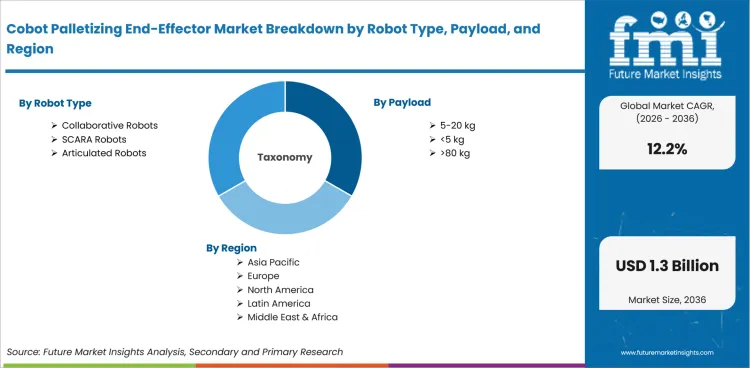
| Parameter | Details |
|---|---|
| Forecast period | 2026 to 2036 |
| Historical period | 2021 to 2025 |
| Quantitative unit | Revenue in USD million |
| By robot type | Collaborative robots, SCARA robots, articulated robots, AMR/AGV platforms, delta robots |
| By payload | <5 kg, 5-20 kg, 20-80 kg, >80 kg |
| By application | Material handling, inspection, assembly, welding, packaging, machine tending |
| By end-use industry | Automotive, electronics, food & beverage, logistics, pharmaceuticals, metals |
| By gripper technology | Vacuum and foam grippers, finger grippers, magnetic grippers, tool changers and sensors |
| Regions covered | North America, Latin America, Europe, East Asia, South Asia and Pacific, Middle East and Africa |
| Countries covered | India, China, United States, South Korea, Germany, Japan, France, United Kingdom |
| Key companies profiled | OnRobot, Robotiq, Piab, Schmalz, SMC, Zimmer Group, Festo, Universal Robots, FANUC, ABB |
| Approach | Bottom-up product-boundary approach using eligible end-effector revenue, palletizing cell adoption, robot compatibility, channel presence, and country-level automation patterns |
Source: Future Market Insights, 2026.
Cobot Palletizing End-Effector Market - Scope & Definition
| Attribute | Detail |
|---|---|
| Market Definition | End-of-arm tools used on collaborative robots and related compact robotic systems for palletizing cartons, trays, cases, bags, and secondary packaging onto pallets |
| Functions Covered | Carton lifting, pallet placement, vacuum gripping, foam contact handling, mechanical gripping, tool changing, sensing, suction monitoring, and safe end-of-line transfer |
| Applications Covered | Material handling, packaging, inspection support, assembly-linked transfer, machine tending support, and end-of-line palletizing operations |
| End-Use Industries | Automotive, electronics, food & beverage, logistics, pharmaceuticals, metals, and general manufacturing |
| Payload Bands Covered | <5 kg, 5-20 kg, 20-80 kg, and >80 kg payload categories for palletizing tools and lifted products |
| Inclusions | Vacuum grippers, foam grippers, suction cup arrays, finger grippers, magnetic grippers, tool changers, sensing modules, and control interfaces used for cobot palletizing |
| Exclusions | Complete robot arms sold without end-effector revenue, fixed gantry palletizers, conveyor-only systems, pallet wrappers, automated storage systems, manual lifting aids, and software-only pallet planning tools |
Cobot Palletizing End-Effector Market - Research Methodology
| Method | Description |
|---|---|
| Primary Research | FMI analyst interviews with packaging engineers, plant automation heads, system integrators, robot distributors, end-of-line equipment suppliers, and gripper manufacturers across key markets |
| Desk Research | Review of robot installation data, safety standards, company product pages, palletizing application guides, automation component catalogs, and public manufacturing statistics |
| Market Sizing & Forecasting | Bottom-up model using palletizing cell volume, average end-effector price, replacement cycles, payload mix, country-level robot adoption, and end-use industry distribution |
| Data Validation | Cross-verification using industrial robot installation patterns, gripper product evidence, integrator feedback, country automation signals, and company portfolio checks |
Cobot Palletizing End-Effector Market Breakdown by Robot Type, Payload, Application, End-use Industry, Gripper Technology, and Region
Cobot Palletizing End-Effector Market Segmented by Robot Type
- Collaborative Robots
- SCARA Robots
- Articulated Robots
- AMR/AGV Platforms
- Delta Robots
Cobot Palletizing End-Effector Market Segmented by Payload
- <5 kg
- 5-20 kg
- 20-80 kg
- >80 kg
Cobot Palletizing End-Effector Market Segmented by Application
- Material Handling
- Inspection
- Assembly
- Welding
- Packaging
- Machine Tending
Cobot Palletizing End-Effector Market Segmented by End-use Industry
- Automotive
- Electronics
- Food & Beverage
- Logistics
- Pharmaceuticals
- Metals
Cobot Palletizing End-Effector Market Segmented by Gripper Technology
- Vacuum and Foam Grippers
- Finger Grippers
- Magnetic Grippers
- Tool Changers and Sensors
Cobot Palletizing End-Effector Market by Region
- North America
- Latin America
- Europe
- East Asia
- South Asia and Pacific
- Middle East and Africa
Research Sources and Bibliography
- Bureau of Labor Statistics. (2026, March 23). 2.5 million workplace injuries and illnesses in private industry in 2024, down 3.1 percent from 2023. USA Department of Labor.
- Bureau of Labor Statistics. (2026, January 22). Employer-reported workplace injuries and illnesses, 2023-2024. USA Department of Labor.
- Directorate General Factory Advice Service & Labour Institutes. (2025, March 12). INDOSHNEWS July-September 2024. Ministry of Labour and Employment, Government of India.
- Federal Statistical Office. (2026, February 5). New orders in manufacturing in December 2025: +7.8% on the previous month. Destatis.
- Health and Safety Executive. (2025, November 20). Key figures for Great Britain 2024 to 2025.
- International Federation of Robotics. (2025, September 25). Global robot demand in factories doubles over 10 years.
- International Federation of Robotics. (2025, September 25). India rises to sixth in global factory robot installations.
- International Federation of Robotics. (2025, October 7). Service robots see global growth boom.
- International Federation of Robotics. (2026, April 8). Robot density surges in Europe, Asia, and Americas.
- Japan Institute for Labour Policy and Training. (2025). The “long-lasting and persistent” labor shortage.
- Korea Occupational Safety and Health Agency. (2025, June). Workplaces supported through risk assessments see 66.7% reduction in fatal accidents. KOSHA News.
- Ministry of Health, Labour and Welfare. (2025, April 24). Report on the occurrence of industrial accidents in FY2024.
- National Bureau of Statistics of China. (2026, January 20). Industrial production operation in December 2025.
- National Bureau of Statistics of China. (2026, February 28). Statistical communique of the People’s Republic of China on the 2025 national economic and social development.
- National Institute of Statistics and Economic Studies. (2025, November 5). In September 2025, manufacturing output bounced back.
- National Institute of Statistics and Economic Studies. (2026, February 5). In December 2025, manufacturing output fell back sharply.
- Occupational Safety and Health Administration. (2026, April 15). Top 10 most frequently cited standards.
- Office for National Statistics. (2025, July 22). UK manufacturers’ sales by product: 2024.
- OnRobot A/S. (2025). 20 kg payload vacuum gripper for collaborative robots.
- Press Information Bureau. (2026, January 28). India’s Index of Industrial Production records growth of 7.8% in December 2025. Government of India.
- Robotiq Inc. (2025, March 31). Meet PowerPick Multi: The gripper built for flexible palletizing.
- Robotiq Inc. (2025, May 5). Your Robotiq Configurator just got smarter: Meet PowerPick Multi.
- Statistics Korea. (2026, January 30). Monthly industrial statistics, December 2025.
- Universal Robots A/S. (2024, September 26). Universal Robots updates payload capacity for UR20 and UR30.
This bibliography is provided for reader reference and is not exhaustive. The full report contains the complete reference list and detailed citations.
This Report Answers
- Market size estimates for 2026 and forecasts through 2036 for the cobot palletizing end-effector market.
- Insights across major regional and country-level markets.
- Analysis of demand drivers, payload trends, gripper technology needs, and purchasing behavior.
- Evaluation of key robot types and payload bands including collaborative robots and 5-20 kg tools.
- Assessment of end-use industry demand across food & beverage, logistics, electronics, automotive, pharmaceuticals, and metals.
- Identification of growth opportunities across vacuum grippers, foam grippers, finger grippers, sensors, and tool changers.
- Evaluation of supply chain dynamics, integration channels, and system integrator influence.
- Country-level growth analysis covering India, China, United States, South Korea, Germany, Japan, France, and United Kingdom.
- Assessment of the competitive landscape, including leading gripper suppliers and robot platform companies.
- Analysis of validation requirements, safety documentation, carton handling trials, and payload-fit decisions.
- Regional outlooks across North America, Europe, East Asia, South Asia and Pacific, Latin America, and Middle East and Africa.
- Delivery of market data, forecasts, and supporting analysis in PDF and Excel formats.
Frequently Asked Questions
What is the growth prospect for cobot palletizing end-effectors?
Demand for cobot palletizing end-effectors is expected to rise at a considerable pace as factories automate carton stacking and end-of-line handling.
Which companies are expected to shape the cobot palletizing end-effector market?
OnRobot, Robotiq, Piab, Schmalz, SMC, Zimmer Group, Festo, Universal Robots, FANUC, and ABB are expected to shape competition.
Why are manufacturers investing in cobot palletizing end-effectors?
Manufacturers are investing in cobot palletizing end-effectors to reduce manual lifting, improve carton handling reliability, and support flexible pallet patterns.
Why are system integrators important in the cobot palletizing end-effector market?
System integrators support gripper selection by testing cartons, validating payload fit, and proving cell performance before buyer approval.
Which gripper formats are gaining attention in cobot palletizing?
Vacuum and foam grippers are gaining attention because they support broad surface contact across porous cartons and mixed secondary packaging.
How do payload limits influence cobot palletizing end-effector selection?
Payload limits influence selection because the robot must carry the gripper, carton, and safety margin without reducing useful cycle performance.
Why is safety documentation important for cobot palletizing end-effectors?
Safety documentation is important because collaborative cells must review tool mass, suction loss, operator access, and contact risks during validation.
What role does packaging variation play in end-effector adoption?
Packaging variation increases demand for adaptable grippers that can manage changing case sizes, board grades, labels, and pallet patterns.
How do connected grippers support cobot palletizing?
Connected grippers support cobot palletizing by reporting suction status, pick failures, and tool condition during production and validation.
Preview the report firsthand - request a free sample
Get SampleGet the brochure for pricing and purchase details.
Get PDFTable of Content
- Executive Summary
- Global Market Outlook
- Demand-side Trends
- Supply-side Trends
- Technology Roadmap Analysis
- Analysis and Recommendations
- Market Overview
- Market Coverage / Taxonomy
- Market Definition / Scope / Limitations
- Research Methodology
- Chapter Orientation
- Analytical Lens and Working Hypotheses
- Market Structure, Signals, and Trend Drivers
- Benchmarking and Cross-market Comparability
- Market Sizing, Forecasting, and Opportunity Mapping
- Research Design and Evidence Framework
- Desk Research Programme (Secondary Evidence)
- Company Annual and Sustainability Reports
- Peer-reviewed Journals and Academic Literature
- Corporate Websites, Product Literature, and Technical Notes
- Earnings Decks and Investor Briefings
- Statutory Filings and Regulatory Disclosures
- Technical White Papers and Standards Notes
- Trade Journals, Industry Magazines, and Analyst Briefs
- Conference Proceedings, Webinars, and Seminar Materials
- Government Statistics Portals and Public Data Releases
- Press Releases and Reputable Media Coverage
- Specialist Newsletters and Curated Briefings
- Sector Databases and Reference Repositories
- FMI Internal Proprietary Databases and Historical Market Datasets
- Subscription Datasets and Paid Sources
- Social Channels, Communities, and Digital Listening Inputs
- Additional Desk Sources
- Expert Input and Fieldwork (Primary Evidence)
- Primary Modes
- Qualitative Interviews and Expert Elicitation
- Quantitative Surveys and Structured Data Capture
- Blended Approach
- Why Primary Evidence is Used
- Field Techniques
- Interviews
- Surveys
- Focus Groups
- Observational and In-context Research
- Social and Community Interactions
- Stakeholder Universe Engaged
- C-suite Leaders
- Board Members
- Presidents and Vice Presidents
- R&D and Innovation Heads
- Technical Specialists
- Domain Subject-matter Experts
- Scientists
- Physicians and Other Healthcare Professionals
- Governance, Ethics, and Data Stewardship
- Research Ethics
- Data Integrity and Handling
- Primary Modes
- Tooling, Models, and Reference Databases
- Desk Research Programme (Secondary Evidence)
- Data Engineering and Model Build
- Data Acquisition and Ingestion
- Cleaning, Normalisation, and Verification
- Synthesis, Triangulation, and Analysis
- Quality Assurance and Audit Trail
- Market Background
- Market Dynamics
- Drivers
- Restraints
- Opportunity
- Trends
- Scenario Forecast
- Demand in Optimistic Scenario
- Demand in Likely Scenario
- Demand in Conservative Scenario
- Opportunity Map Analysis
- Product Life Cycle Analysis
- Supply Chain Analysis
- Investment Feasibility Matrix
- Value Chain Analysis
- PESTLE and Porter’s Analysis
- Regulatory Landscape
- Regional Parent Market Outlook
- Production and Consumption Statistics
- Import and Export Statistics
- Market Dynamics
- Global Market Analysis 2021 to 2025 and Forecast, 2026 to 2036
- Historical Market Size Value (USD Million) Analysis, 2021 to 2025
- Current and Future Market Size Value (USD Million) Projections, 2026 to 2036
- Y-o-Y Growth Trend Analysis
- Absolute $ Opportunity Analysis
- Global Market Pricing Analysis 2021 to 2025 and Forecast 2026 to 2036
- Global Market Analysis 2021 to 2025 and Forecast 2026 to 2036, By Robot Type
- Introduction / Key Findings
- Historical Market Size Value (USD Million) Analysis By Robot Type , 2021 to 2025
- Current and Future Market Size Value (USD Million) Analysis and Forecast By Robot Type , 2026 to 2036
- Collaborative Robots
- SCARA Robots
- Articulated Robots
- Collaborative Robots
- Y-o-Y Growth Trend Analysis By Robot Type , 2021 to 2025
- Absolute $ Opportunity Analysis By Robot Type , 2026 to 2036
- Global Market Analysis 2021 to 2025 and Forecast 2026 to 2036, By Payload
- Introduction / Key Findings
- Historical Market Size Value (USD Million) Analysis By Payload, 2021 to 2025
- Current and Future Market Size Value (USD Million) Analysis and Forecast By Payload, 2026 to 2036
- 5-20 kg
- <5 kg
- >80 kg
- 5-20 kg
- Y-o-Y Growth Trend Analysis By Payload, 2021 to 2025
- Absolute $ Opportunity Analysis By Payload, 2026 to 2036
- Global Market Analysis 2021 to 2025 and Forecast 2026 to 2036, By Application
- Introduction / Key Findings
- Historical Market Size Value (USD Million) Analysis By Application, 2021 to 2025
- Current and Future Market Size Value (USD Million) Analysis and Forecast By Application, 2026 to 2036
- Material Handling
- Inspection
- Assembly
- Material Handling
- Y-o-Y Growth Trend Analysis By Application, 2021 to 2025
- Absolute $ Opportunity Analysis By Application, 2026 to 2036
- Global Market Analysis 2021 to 2025 and Forecast 2026 to 2036, By End-use Industry
- Introduction / Key Findings
- Historical Market Size Value (USD Million) Analysis By End-use Industry, 2021 to 2025
- Current and Future Market Size Value (USD Million) Analysis and Forecast By End-use Industry, 2026 to 2036
- Food & Beverage
- Automotive
- Electronics
- Food & Beverage
- Y-o-Y Growth Trend Analysis By End-use Industry, 2021 to 2025
- Absolute $ Opportunity Analysis By End-use Industry, 2026 to 2036
- Global Market Analysis 2021 to 2025 and Forecast 2026 to 2036, By Gripper Technology
- Introduction / Key Findings
- Historical Market Size Value (USD Million) Analysis By Gripper Technology, 2021 to 2025
- Current and Future Market Size Value (USD Million) Analysis and Forecast By Gripper Technology, 2026 to 2036
- Vacuum and Foam Grippers
- Finger Grippers
- Magnetic Grippers
- Vacuum and Foam Grippers
- Y-o-Y Growth Trend Analysis By Gripper Technology, 2021 to 2025
- Absolute $ Opportunity Analysis By Gripper Technology, 2026 to 2036
- Global Market Analysis 2021 to 2025 and Forecast 2026 to 2036, By Region
- Introduction
- Historical Market Size Value (USD Million) Analysis By Region, 2021 to 2025
- Current Market Size Value (USD Million) Analysis and Forecast By Region, 2026 to 2036
- North America
- Latin America
- Western Europe
- Eastern Europe
- East Asia
- South Asia and Pacific
- Middle East & Africa
- Market Attractiveness Analysis By Region
- North America Market Analysis 2021 to 2025 and Forecast 2026 to 2036, By Country
- Historical Market Size Value (USD Million) Trend Analysis By Market Taxonomy, 2021 to 2025
- Market Size Value (USD Million) Forecast By Market Taxonomy, 2026 to 2036
- By Country
- USA
- Canada
- Mexico
- By Robot Type
- By Payload
- By Application
- By End-use Industry
- By Gripper Technology
- By Country
- Market Attractiveness Analysis
- By Country
- By Robot Type
- By Payload
- By Application
- By End-use Industry
- By Gripper Technology
- Key Takeaways
- Latin America Market Analysis 2021 to 2025 and Forecast 2026 to 2036, By Country
- Historical Market Size Value (USD Million) Trend Analysis By Market Taxonomy, 2021 to 2025
- Market Size Value (USD Million) Forecast By Market Taxonomy, 2026 to 2036
- By Country
- Brazil
- Chile
- Rest of Latin America
- By Robot Type
- By Payload
- By Application
- By End-use Industry
- By Gripper Technology
- By Country
- Market Attractiveness Analysis
- By Country
- By Robot Type
- By Payload
- By Application
- By End-use Industry
- By Gripper Technology
- Key Takeaways
- Western Europe Market Analysis 2021 to 2025 and Forecast 2026 to 2036, By Country
- Historical Market Size Value (USD Million) Trend Analysis By Market Taxonomy, 2021 to 2025
- Market Size Value (USD Million) Forecast By Market Taxonomy, 2026 to 2036
- By Country
- Germany
- UK
- Italy
- Spain
- France
- Nordic
- BENELUX
- Rest of Western Europe
- By Robot Type
- By Payload
- By Application
- By End-use Industry
- By Gripper Technology
- By Country
- Market Attractiveness Analysis
- By Country
- By Robot Type
- By Payload
- By Application
- By End-use Industry
- By Gripper Technology
- Key Takeaways
- Eastern Europe Market Analysis 2021 to 2025 and Forecast 2026 to 2036, By Country
- Historical Market Size Value (USD Million) Trend Analysis By Market Taxonomy, 2021 to 2025
- Market Size Value (USD Million) Forecast By Market Taxonomy, 2026 to 2036
- By Country
- Russia
- Poland
- Hungary
- Balkan & Baltic
- Rest of Eastern Europe
- By Robot Type
- By Payload
- By Application
- By End-use Industry
- By Gripper Technology
- By Country
- Market Attractiveness Analysis
- By Country
- By Robot Type
- By Payload
- By Application
- By End-use Industry
- By Gripper Technology
- Key Takeaways
- East Asia Market Analysis 2021 to 2025 and Forecast 2026 to 2036, By Country
- Historical Market Size Value (USD Million) Trend Analysis By Market Taxonomy, 2021 to 2025
- Market Size Value (USD Million) Forecast By Market Taxonomy, 2026 to 2036
- By Country
- China
- Japan
- South Korea
- By Robot Type
- By Payload
- By Application
- By End-use Industry
- By Gripper Technology
- By Country
- Market Attractiveness Analysis
- By Country
- By Robot Type
- By Payload
- By Application
- By End-use Industry
- By Gripper Technology
- Key Takeaways
- South Asia and Pacific Market Analysis 2021 to 2025 and Forecast 2026 to 2036, By Country
- Historical Market Size Value (USD Million) Trend Analysis By Market Taxonomy, 2021 to 2025
- Market Size Value (USD Million) Forecast By Market Taxonomy, 2026 to 2036
- By Country
- India
- ASEAN
- Australia & New Zealand
- Rest of South Asia and Pacific
- By Robot Type
- By Payload
- By Application
- By End-use Industry
- By Gripper Technology
- By Country
- Market Attractiveness Analysis
- By Country
- By Robot Type
- By Payload
- By Application
- By End-use Industry
- By Gripper Technology
- Key Takeaways
- Middle East & Africa Market Analysis 2021 to 2025 and Forecast 2026 to 2036, By Country
- Historical Market Size Value (USD Million) Trend Analysis By Market Taxonomy, 2021 to 2025
- Market Size Value (USD Million) Forecast By Market Taxonomy, 2026 to 2036
- By Country
- Kingdom of Saudi Arabia
- Other GCC Countries
- Turkiye
- South Africa
- Other African Union
- Rest of Middle East & Africa
- By Robot Type
- By Payload
- By Application
- By End-use Industry
- By Gripper Technology
- By Country
- Market Attractiveness Analysis
- By Country
- By Robot Type
- By Payload
- By Application
- By End-use Industry
- By Gripper Technology
- Key Takeaways
- Key Countries Market Analysis
- USA
- Pricing Analysis
- Market Share Analysis, 2025
- By Robot Type
- By Payload
- By Application
- By End-use Industry
- By Gripper Technology
- Canada
- Pricing Analysis
- Market Share Analysis, 2025
- By Robot Type
- By Payload
- By Application
- By End-use Industry
- By Gripper Technology
- Mexico
- Pricing Analysis
- Market Share Analysis, 2025
- By Robot Type
- By Payload
- By Application
- By End-use Industry
- By Gripper Technology
- Brazil
- Pricing Analysis
- Market Share Analysis, 2025
- By Robot Type
- By Payload
- By Application
- By End-use Industry
- By Gripper Technology
- Chile
- Pricing Analysis
- Market Share Analysis, 2025
- By Robot Type
- By Payload
- By Application
- By End-use Industry
- By Gripper Technology
- Germany
- Pricing Analysis
- Market Share Analysis, 2025
- By Robot Type
- By Payload
- By Application
- By End-use Industry
- By Gripper Technology
- UK
- Pricing Analysis
- Market Share Analysis, 2025
- By Robot Type
- By Payload
- By Application
- By End-use Industry
- By Gripper Technology
- Italy
- Pricing Analysis
- Market Share Analysis, 2025
- By Robot Type
- By Payload
- By Application
- By End-use Industry
- By Gripper Technology
- Spain
- Pricing Analysis
- Market Share Analysis, 2025
- By Robot Type
- By Payload
- By Application
- By End-use Industry
- By Gripper Technology
- France
- Pricing Analysis
- Market Share Analysis, 2025
- By Robot Type
- By Payload
- By Application
- By End-use Industry
- By Gripper Technology
- India
- Pricing Analysis
- Market Share Analysis, 2025
- By Robot Type
- By Payload
- By Application
- By End-use Industry
- By Gripper Technology
- ASEAN
- Pricing Analysis
- Market Share Analysis, 2025
- By Robot Type
- By Payload
- By Application
- By End-use Industry
- By Gripper Technology
- Australia & New Zealand
- Pricing Analysis
- Market Share Analysis, 2025
- By Robot Type
- By Payload
- By Application
- By End-use Industry
- By Gripper Technology
- China
- Pricing Analysis
- Market Share Analysis, 2025
- By Robot Type
- By Payload
- By Application
- By End-use Industry
- By Gripper Technology
- Japan
- Pricing Analysis
- Market Share Analysis, 2025
- By Robot Type
- By Payload
- By Application
- By End-use Industry
- By Gripper Technology
- South Korea
- Pricing Analysis
- Market Share Analysis, 2025
- By Robot Type
- By Payload
- By Application
- By End-use Industry
- By Gripper Technology
- Russia
- Pricing Analysis
- Market Share Analysis, 2025
- By Robot Type
- By Payload
- By Application
- By End-use Industry
- By Gripper Technology
- Poland
- Pricing Analysis
- Market Share Analysis, 2025
- By Robot Type
- By Payload
- By Application
- By End-use Industry
- By Gripper Technology
- Hungary
- Pricing Analysis
- Market Share Analysis, 2025
- By Robot Type
- By Payload
- By Application
- By End-use Industry
- By Gripper Technology
- Kingdom of Saudi Arabia
- Pricing Analysis
- Market Share Analysis, 2025
- By Robot Type
- By Payload
- By Application
- By End-use Industry
- By Gripper Technology
- Turkiye
- Pricing Analysis
- Market Share Analysis, 2025
- By Robot Type
- By Payload
- By Application
- By End-use Industry
- By Gripper Technology
- South Africa
- Pricing Analysis
- Market Share Analysis, 2025
- By Robot Type
- By Payload
- By Application
- By End-use Industry
- By Gripper Technology
- USA
- Market Structure Analysis
- Competition Dashboard
- Competition Benchmarking
- Market Share Analysis of Top Players
- By Regional
- By Robot Type
- By Payload
- By Application
- By End-use Industry
- By Gripper Technology
- Competition Analysis
- Competition Deep Dive
- OnRobot A/S
- Overview
- Product Portfolio
- Profitability by Market Segments (Product/Age /Sales Channel/Region)
- Sales Footprint
- Strategy Overview
- Marketing Strategy
- Product Strategy
- Channel Strategy
- Robotiq Inc.
- Piab AB
- J. Schmalz GmbH
- SMC Corporation
- Zimmer Group
- Festo SE & Co. KG
- OnRobot A/S
- Competition Deep Dive
- Assumptions & Acronyms Used


