

- Market Size (2026)
- USD 1.8 Bn
- Forecast (2036)
- USD 9.0 Bn
- CAGR (2026 to 2036)
- 17.5%
How big is AI Palletizing & Depalletizing Market size?
USD 1.8 billion in 2026 and USD 9.0 billion by 2036 at 17.5% CAGR.
Demand for AI palletizing & depalletizing is projected to expand at 17.5% CAGR between 2026 and 2036, increasing valuation from USD 1.8 billion in 2026 to USD 9.0 billion by 2036. Handling mixed box sizes makes smart software indispensable because cameras must constantly inspect damaged cartons and calculate stable gripping points on every cycle. Ongoing staffing shortages continuously motivate companies to invest in automated handling systems for their operational facilities. International Federation of Robotics reported in October 2025 stating professional service robot sales reached almost 200,000 units in 2024, marking a 9.0% increase.
Regional priorities steer how companies select their automation partners. Buyers in the United States and Germany closely scrutinize validation records alongside conveyor compatibility during project reviews. Warehouse operators in China and India prioritize local engineering support and fast software setup for new box sizes. Upgrading older facilities also forces engineers to prioritize compact robotic cells capable of recovering from handling errors without disrupting busy receiving areas. United States Bureau of Labor Statistics reported in January 2026 recording 4.8 cases per 100 full-time workers across warehousing and storage during 2024. These high injury rates encourage logistics providers to adopt equipment capable of eliminating repetitive heavy lifting and manual box recovery.
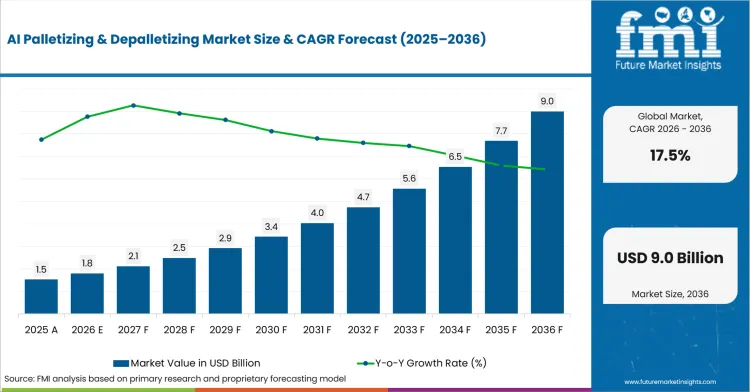
Key Takeaways of AI Palletizing & Depalletizing Market
- Demand for AI palletizing and depalletizing systems is driven by warehouses seeking safer case handling and steadier shift output, with project reviews emphasizing perception accuracy and dependable grip recovery.
- By component, hardware is expected to lead with 58.0% share in 2026, driven by robot arms and grippers forming substantial installed equipment content.
- System integrators are the dominant sales channel segment, projected to hold 40.0% share in 2026, aided by site-specific conveyor and safety connections.
- Articulated-arm cells are estimated to lead the robot type category with 36.0% share in 2026, led by reach flexibility across tall pallet patterns.
- Mixed-load handling and stable end-of-line flow remain critical to adoption, as cells must process changing carton dimensions without frequent recipe rebuilding.
- China, the United States, and the European Union are expected to form the higher-growth country tier, advancing at 20.5%, 18.5%, and 17.0% CAGR respectively through 2036, supported by robot production scale, distribution activity, and enterprise AI use.
- Competition centers on Premier Tech, Mujin, Fizyr, and AWL, with vendors differentiating through end-of-line packaging depth, robot control software, irregular-case perception, and system integration experience.
Analyst Perspective
"Warehouse automation no longer depends on robotic speed alone. The real benchmark is whether AI palletizing systems can manage continuous variation in case dimensions, stacking patterns, and product flow without reducing throughput or load stability. Facilities expanding mixed-SKU operations are looking for solutions that shorten changeover time, maintain dependable picking accuracy, and require minimal engineering intervention when packaging formats change. Providers that reduce operational complexity while supporting rapid commissioning and long-term system reliability will capture the strongest commercial opportunities."
- Nikhil Kaitwade, Principal Consultant for Industrial Automation at Future Market Insights
Source: Future Market Insights analysis, 2026.
How is AI Palletizing & Depalletizing Market segmented?
The AI palletizing & depalletizing industry is segmented by robot type, application, component, end-use industry, sales channel and region.
The AI palletizing & depalletizing market is segmented by robot type, application, component, end-use industry, sales channel and region. Robot type coverage includes articulated-arm cells alongside cobot palletizers, gantry systems, mobile palletizers and layer formers. Application coverage includes mixed-case depalletizing, uniform-case palletizing, bag and sack handling, layer picking and container unloading.
Component coverage includes hardware, vision and AI software and services. End-use coverage includes food and beverage, third-party logistics and e-commerce, consumer packaged goods, building materials and pharmaceutical operations. Sales channel coverage includes system integrators, direct sales, distributors and Robotics as a Service. Regional coverage includes North America and Latin America. Coverage also includes Western Europe, Eastern Europe, East Asia, South Asia and Pacific, Middle East and Africa.
How do articulated-arm cells shape robot type purchasing?
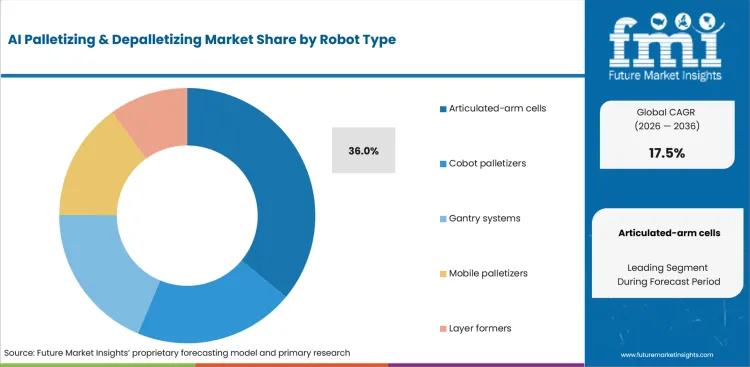
International Federation of Robotics reported in September 2025 recording 542,000 industrial robot installations during 2024, as established automation capacity supported articulated systems across manufacturing and handling operations. Long reach permits one cell to address tall pallets and multiple placement positions. Payload flexibility also supports cartons and bags through interchangeable robotic grippers.
- Articulated-arm cells are expected to secure 36.0% share of robot type in 2026, driven by extended reach and payload choice across full pallet patterns. Engineering teams assess base position and safety clearance prior to approval.
- Cobot palletizers and gantry systems address lower-speed or regular patterns. Articulated-arm cells retain purchasing attention as changing product formats require adaptable placement paths.
How does mixed-case depalletizing shape application demand?
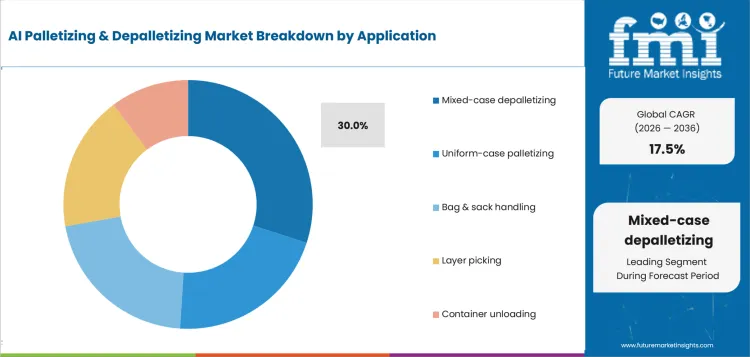
Mixed-case depalletizing guides application selection due to three-dimensional scene updates and automated pick sequencing. Camera quality and exception handling influence sustained throughput across irregular inbound stacks. United States Census Bureau reported in May 2026 stating e-commerce represented 16.9% of retail sales during first-quarter 2026, reflecting increase in parcel variation receiving complexity across distribution facilities.
- In 2026, mixed-case depalletizing is predicted to represent 30.0% share in 2026 since inbound cartons arrive in changing positions and conditions. Warehouse teams compare systems due to successful-pick rates and restart procedures.
- Uniform-case palletizing and layer picking serve controlled loads and accessible surfaces. Mixed-case depalletizing receives greater technical review as each removal changes remaining pallet geometry.
Why does hardware lead component demand?
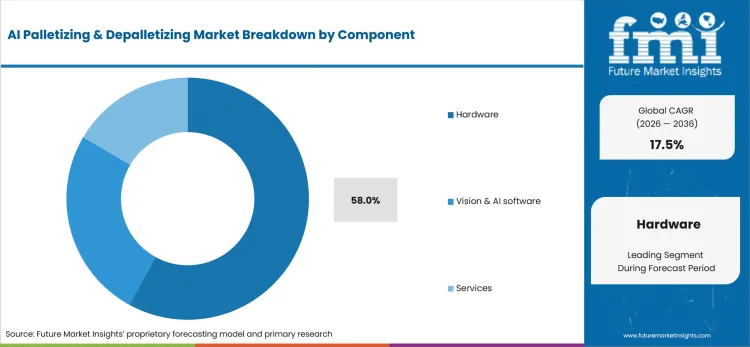
Association for Advancing Automation reported in February 2026 stating North American companies ordered 7,212 collaborative robots during 2025, reinforcing physical equipment investment across flexible handling projects. Hardware lead component selection since robot arms and grippers determine payload reach and contact quality. Guarding and pallet movement equipment add substantial installed content.
- By component, hardware is anticipated to garner 58.0% share in 2026 owing to robot structures and gripping equipment required for every handling cycle. Project teams inspect payload margin and end-effector durability during design review.
- Vision and AI software guides case selection, and services support commissioning. Hardware retains segment leadership as physical movement and load retention require dependable mechanical systems.
Why does food and beverage lead end-use demand?
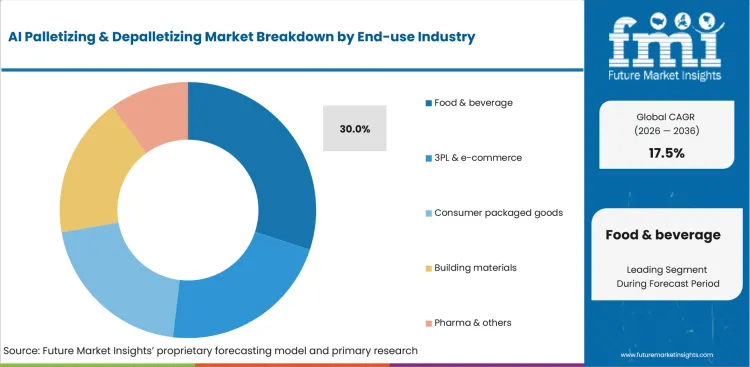
Food and beverage operations dominate end-use selection as repeated case flow supports high cell utilization. Vision guidance also helps manage changing labels and pallet patterns across product schedules. Fizyr reported in December 2025 noting high-speed cartoners operate at 600 packages or more per minute, creating inspection and downstream handling pressure across food packaging lines
- Food and beverage are estimated to hold 30.0% share in 2026, aided by sustained packaged case movement across production and distribution sites. Plant teams evaluate washdown needs and package integrity during cell review.
- Third-party logistics and consumer packaged goods operations create additional volume across mixed shipments. Food and beverage retains leadership as regular packing schedules support repeatable pallet cell workloads.
How do system integrators retain sales channel strength?
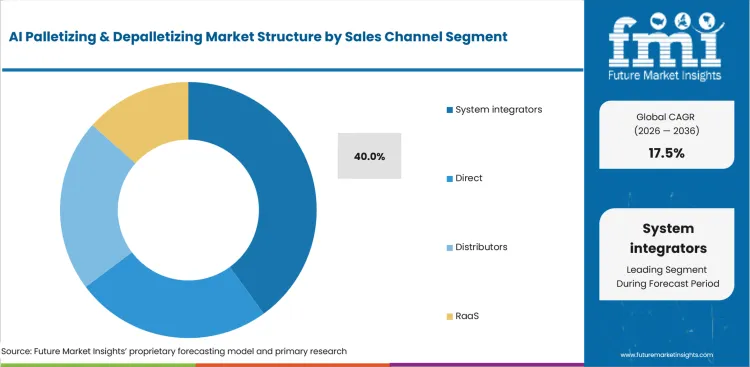
Association for Advancing Automation reported in May 2025 recording 1,052 collaborative robot orders during first-quarter 2025, as flexible systems increased engineering work across varied facilities. System integrators hold considerable share within channel strength due to conveyor links and machine-safety design. Site-specific software and controls also require coordinated commissioning.
- Based on sales channel, system integrators are likely to capture 40.0% share in 2026 as it is influenced by custom connections across conveyors and warehouse controls. Operating teams use integrator support to verify cycle timing and recovery procedures.
- Direct sales and distributors serve standardized projects and component replacement. System integrators retain channel strength as mixed-case cells require coordinated vision and mechanical design.
What are drivers, restraints, and opportunities in AI palletizing & depalletizing market?
AI palletizing and depalletizing selection is expected to be driven by labor relief and flexible case handling. Package damage and complex brownfield connections are likely to delay full-rate operation.
- Driver: Repetitive lifting and changing case flow encourage warehouses to evaluate perception-guided robotic cells.
- Restraint: Damaged cartons and reflective film may weaken grip security and camera confidence.
- Opportunity: Shared software and service-based deployment models may extend projects across smaller facilities.
Reduced strenuous handling and fewer repeated floor-level lifts strengthen market progress. United States Bureau of Labor Statistics reported in January 2026 recording 2.5 million workplace injury and illness cases during 2024, highlighting operational interest in cells transferring repetitive case movement from workers to controlled machinery.
Integration maturity and limited enterprise AI use across logistics may slow industry growth. Eurostat reported in June 2026 stating AI software used for logistics represented 6.08% of AI-using European Union enterprises during 2025, indicating constrained deployment experience for software-led material movement and increasing validation needs during complex warehouse projects.
Remote software access and recurring support models may help expand commercial potential. Eurostat reported in February 2026 stating 52.7% of European Union enterprises used paid cloud services during 2025, encouraging connected monitoring and software maintenance models able to support robotics as a service across distributed facilities.
What country CAGRs are profiled in AI Palletizing & Depalletizing
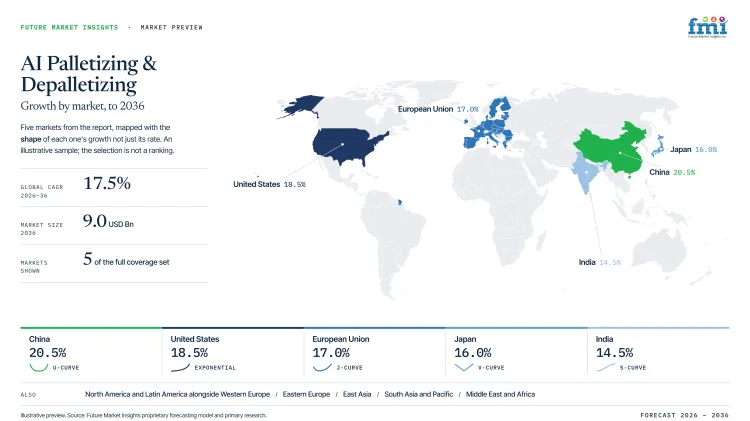
| Country or Market | CAGR |
|---|---|
| China | 20.5% |
| United States | 18.5% |
| European Union | 17.0% |
| Japan | 16.0% |
| India | 14.5% |
Source: Future Market Insights analysis, 2026.
How do country-level CAGRs compare in AI palletizing & depalletizing market?
The country comparison spans 6.0 percentage points and forms three distinct growth tiers across the AI palletizing & depalletizing market. China and the United States occupy the leading tier with a 2.0-point difference. The European Union and Japan create a closely aligned middle group separated by just 1.0 percentage point, while India stands 1.5 percentage points below Japan. The distribution reflects differences in warehouse automation maturity, AI integration across production facilities and labor optimization priorities.
- China leads the comparison with a CAGR of 20.5%. Manufacturers and logistics operators are increasingly adopting AI-enabled palletizing and depalletizing systems that improve handling accuracy, adapt to changing product configurations and increase throughput in high-volume distribution environments.
- The United States follows at 18.5%, remaining 2.0 percentage points behind China. Strong investment in warehouse automation and intelligent material handling continues to encourage deployment of AI-powered robotic cells that reduce manual pallet handling and improve operational efficiency.
- The European Union records a CAGR of 17.0%, standing 1.5 percentage points below the United States. Companies are modernizing production lines and distribution centers with AI-assisted robotic handling systems that accommodate mixed loads and variable packaging formats. Adoption differs across member states because manufacturing intensity and automation investment priorities vary across the region.
- Japan reaches a CAGR of 16.0%, only 1.0 percentage point behind the European Union. The market benefits from advanced industrial robotics capabilities and growing demand for flexible palletizing systems that improve productivity while addressing workforce constraints in manufacturing and logistics.
- India completes the comparison with a CAGR of 14.5%, trailing Japan by 1.5 percentage points. Expanding warehouse capacity, industrial automation initiatives and greater use of AI-enabled material handling equipment are creating opportunities for palletizing and depalletizing solutions across manufacturing and distribution operations.
Comparable CAGRs do not necessarily produce identical commercial opportunities. Differences in warehouse infrastructure, AI adoption, production volumes and capital investment strategies influence implementation timelines and long-term supplier positioning. The full report provides country-level CAGR analysis across North America, Latin America, Europe, East Asia, South Asia, Oceania and the Middle East and Africa.
Country-wise Analysis
National expansion patterns reflect robot manufacturing scale and warehouse investment conditions. China and the United States are projected to progress more considerably as factory automation and distribution requirements encourage wider cell evaluation.
- China is anticipated to expand at 20.5% CAGR between 2026 and 2036, driven by domestic robot manufacturing and large factory networks requiring repeatable pallet movement. Local engineering coverage is likely to shorten commissioning across manufacturing clusters using several pallet formats. National Bureau of Statistics of China reported in February 2026, stating industrial robot output reached 773,000 sets during 2025, strengthening local equipment availability for AI-enabled cells.
- International Federation of Robotics reported in June 2026, recording 38,000 industrial robot installations in United States during 2025, encouraging integrator capacity and food-handling project activity. Dense distribution networks also increase demand for recovery procedures compatible with established conveyor controls. AI palletizing & depalletizing activity in United States is projected to advance at 18.5% CAGR during the assessment period, guided by distribution scale and labor-intensive case movement.
- Enterprise AI use and established manufacturing systems are expected to support European Union activity at a projected 17.0% CAGR during forecast period. Food processing and consumer-goods facilities may favor compact cells designed around established safety layouts. Eurostat reported in December 2025, stating 20.0% of European Union enterprises used AI technologies during 2025, expanding organizational familiarity with software-guided operations.
- Ministry of Economy, Trade and Industry reported in June 2025 estimating AI and robotics use could deliver labor input equivalent to approximately 1.89 million workers by 2040, supporting handling automation across constrained operating teams. Compact production floors increase attention to precise reach planning and controlled case transfer. Sector in Japan is anticipated to progress at 16.0% CAGR from 2026 to 2036, aided by compact facility design and established robotics engineering.
- The market in India is predicted to record 14.5% CAGR through 2036 as modern logistics facilities expand and operators evaluate flexible pallet handling with controlled capital exposure. Local service access may improve confidence among operators introducing unfamiliar package sizes. Press Information Bureau reported in August 2025, recording 145.5 million tonnes of inland waterways cargo during 2024 to 2025, reinforcing goods movement scale and warehouse handling requirements across multimodal logistics networks.
Who are notable companies in AI Palletizing & Depalletizing Market?
Premier Tech and Mujin are expected to shape project direction driven by complete palletizing systems and robot control software. Fizyr and AWL add vision intelligence and robotic intralogistics integration. ABB Robotics, FANUC Corporation and KUKA AG contribute industrial robot platforms. Yaskawa Electric Corporation and Doosan Robotics support collaborative and palletizing applications across manufacturing sites.
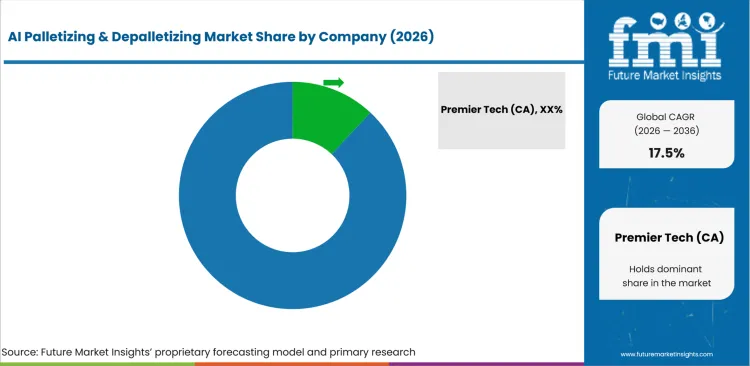
Competition in AI palletizing and depalletizing is anticipated to center on perception accuracy and implementation support. Operating teams are likely to compare providers led by irregular-case recognition and dependable restart procedures. Premier Tech is projected to receive review attention due to packaging and palletizing depth. Mujin is estimated to add orchestration strength across complex robot movement. Fizyr is expected to support vision-led depalletizing based on hardware-neutral software. AWL is likely to compete depending on integrated intralogistics engineering.
- Premier Tech and Mujin gain review attention due to complete palletizing systems and robot orchestration capabilities. Manufacturing and warehouse relationships support projects requiring configurable recipes and coordinated robot movement.
- Fizyr and AWL compete led by vision intelligence and integrated intralogistics engineering. Hardware-neutral perception software and material movement expertise strengthen irregular-case handling across depalletizing projects.
- ABB Robotics and KUKA AG support competition based on established industrial robot platforms. Their automation portfolios help operating teams compare payload options and implementation support across production sites.
- Yaskawa Electric Corporation and Doosan Robotics strengthen provider selection depending on collaborative and palletizing applications. Project attention improves as manufacturers assess flexible deployment and dependable handling across changing production requirements.
Competitive Benchmarking: AI Palletizing & Depalletizing Market
| Company | Portfolio Depth | AI Palletizing & Depalletizing Match | Service Support | Service Reach |
|---|---|---|---|---|
| Premier Tech | High | High | High | North America, Europe and global |
| Mujin | High | High | High | Japan, United States and global |
| Fizyr | Medium | High | Medium | Europe and global |
| AWL | High | High | High | Europe, North America and global |
| ABB Robotics | High | High | High | Global |
| FANUC Corporation | High | High | High | Japan and global |
| KUKA AG | High | High | High | Germany and global |
| Yaskawa Electric Corporation | High | High | High | Japan and global |
| Doosan Robotics Inc. | Medium | High | Medium | South Korea and global |
Source: Future Market Insights competitive analysis, 2026.
Key Developments in AI Palletizing & Depalletizing Market
- In June 2026, Premier Tech unveiled a new facility in Apodaca, Mexico. Premier Tech stated added regional capacity would strengthen Systems and Automation support across Latin American industries modernizing packaging and palletizing operations.
- In June 2026, Doosan Robotics introduced PalletizHD+ with integrated AI and PalletizOS. Doosan Robotics claimed processing capability of up to 11 boxes per minute, improving cycle planning for manufacturers seeking simpler palletizing deployment.
Key Players in AI Palletizing & Depalletizing Market
Complete palletizing and end-of-line system providers
- Premier Tech
- ABB Robotics
- FANUC Corporation
- KUKA AG
Robot control and vision software specialists
- Mujin
- Fizyr
Integration and collaborative automation providers
- AWL
- Yaskawa Electric Corporation
- Doosan Robotics Inc.
AI Palletizing & Depalletizing Market - Report Scope
| Coverage Field | Report Scope |
|---|---|
| Market Breakdown | AI palletizing & depalletizing market breakdown by robot type alongside application, component, end-use industry, sales channel and region |
| Quantitative Units | USD billion in 2026 to USD billion by 2036 at a CAGR |
| Market Definition | AI palletizing and depalletizing includes robotic cells using perception software and automated motion planning to stack or remove cases, bags and mixed loads from pallets. |
| Regions Covered | North America and Latin America alongside Western Europe, Eastern Europe, East Asia, South Asia and Pacific, Middle East and Africa |
| Countries Covered | United States and China alongside European Union, Japan, India, Canada, Brazil, Mexico, Germany, United Kingdom, France, Italy, Spain, South Korea, ASEAN, Australia, New Zealand, GCC countries, South Africa and Türkiye |
| Key Companies Profiled | Premier Tech and Mujin alongside Fizyr, AWL, ABB Robotics, FANUC Corporation, KUKA AG, Yaskawa Electric Corporation and Doosan Robotics Inc. |
| Forecast Period | 2026 to 2036 |
| Approach | Hybrid bottom-up and top-down methodology using segment share, country CAGR, warehouse activity, installed robot base, company portfolio depth and service exposure |
Source: Future Market Insights analysis, 2026.
AI Palletizing & Depalletizing Market - Research Methodology
| Method | Approach |
|---|---|
| Primary Research | FMI analysts gathered input from manufacturers, service providers, technology developers, distributors, end users, procurement teams, and subject-matter experts. Interviews examined purchasing decisions, product or service evaluation, adoption barriers, approval requirements, pricing considerations, and expectations for technical or commercial support. Respondents were also asked what evidence is required before a trial, pilot, or initial order develops into regular purchasing. |
| Desk Research | Desk research covered government statistics, regulatory publications, trade data, industry associations, technical literature, standards, company filings, product information, and official corporate announcements. Sources were reviewed for relevance, publication date, geographic coverage, and consistency with the defined market scope. Claims relating to performance, applications, approvals, capacity, investment, and commercial activity were retained only when supported by credible public evidence. |
| Market Sizing and Forecasting | The market model combined the baseline value with historical performance, segment structure, pricing and volume indicators, adoption levels, company participation, and country-level demand conditions. Forecast assumptions considered economic activity, investment trends, regulatory developments, technology adoption, purchasing cycles, supply availability, and barriers to wider market use. Segment and regional estimates were reconciled before the final market total was calculated. |
| Data Validation | Estimates were checked against multiple independent indicators, including public data, company activity, trade patterns, industry developments, and findings from primary interviews. Validation also tested whether products, services, applications, and company revenues fell within the defined market boundaries. Adjacent categories, unsupported claims, overlapping revenues, and activities without direct market relevance were excluded to reduce double counting and maintain consistency across segments and countries. |
Source: Future Market Insights analysis, 2026.
AI Palletizing & Depalletizing Market by Segments
AI Palletizing & Depalletizing Market segmented by Robot Type:
- Articulated-arm cells
- Cobot palletizers
- Gantry systems
- Mobile palletizers
- Layer formers
AI Palletizing & Depalletizing Market segmented by Application:
- Mixed-case depalletizing
- Uniform-case palletizing
- Bag and sack handling
- Layer picking
- Container unloading
AI Palletizing & Depalletizing Market segmented by Component:
- Hardware
- Vision and AI software
- Services
AI Palletizing & Depalletizing Market segmented by End-use Industry:
- Food and beverage
- Third-party logistics and e-commerce
- Consumer packaged goods
- Building materials
- Pharmaceutical and other industries
AI Palletizing & Depalletizing Market segmented by Sales Channel:
- System integrators
- Direct sales
- Distributors
- Robotics as a Service
AI Palletizing & Depalletizing Market by Region:
- North America
- United States
- Canada
- Latin America
- Brazil
- Mexico
- Argentina
- Western Europe
- Germany
- United Kingdom
- France
- Italy
- Spain
- Eastern Europe
- Russia
- Poland
- Czech Republic
- East Asia
- China
- Japan
- South Korea
- South Asia and Pacific
- India
- ASEAN
- Australia and New Zealand
- Middle East and Africa
- GCC countries
- South Africa
- Türkiye
Research Sources and Bibliography
- Association for Advancing Automation. (2025, May 22). North American robot orders hold steady in Q1 2025 as A3 launches first-ever collaborative robot tracking.
- Association for Advancing Automation. (2026, February 6). Robot orders grow 6.6% in 2025 as general industries drive broader automation adoption.
- FANUC Europe Corporation. (2025, June 3). Lift more, stack higher: FANUC’s new heavy-payload palletizing robot.
- AWL. (2025, October 20). KUKA and AWL join forces to advance global AMR integration.
- Doosan Robotics. (2026, June 22). Doosan Robotics unveils AI palletizing solution PalletizHD+ at Automate 2026.
- Eurostat. (2025, December 11). 20% of EU enterprises use AI technologies.
- Eurostat. (2026, February 3). 53% EU enterprises used paid cloud services in 2025.
- Eurostat. (2026, June 2). Use of artificial intelligence in enterprises.
- Fizyr. (2025, June 25). Fizyr and Yaskawa Europe announce new partnership with Bonetto Automation.
- Fizyr. (2025, December 15). Vision AI: Is food automation ready for the next wave?
- International Federation of Robotics. (2025, September 25). Global robot demand in factories doubles over 10 years.
- International Federation of Robotics. (2025, October 7). Service robots see global growth boom.
- International Federation of Robotics. (2026, June 18). US robot industry returns to double digit growth.
- Ministry of Economy, Trade and Industry. (2025, June). Reference materials for the fourth report of the Committee on New Direction of Economic and Industrial Policies: Industrial structure in 2040 led by growth investment.
- Mujin. (2025, August 14). Mujin partners with leading integrators to expand adoption of its robotics operating system.
- National Bureau of Statistics of China. (2026, February 28). Statistical communiqué of the People’s Republic of China on the 2025 national economic and social development.
- Press Information Bureau. (2025, August 16). Logistics: India’s growth engine.
- Premier Tech. (2025, September 2). Delivering automation for all.
- Premier Tech. (2026, June 10). Premier Tech expands facility in Mexico, fuelling growth in Latin America.
- USA Bureau of Labor Statistics. (2026, January 22). Employers report 2.5 million injury and illness cases in 2024, down 3.1% from 2023.
- USA Bureau of Labor Statistics. (2026, January 22). Incidence rates of nonfatal occupational injuries and illnesses by industry and case types, 2024.
- USA Census Bureau. (2026, May 18). Quarterly retail e-commerce sales, first quarter 2026.
This bibliography is provided for reader reference and is not exhaustive. The full report contains the complete reference list and detailed citations.
This Report Answers
- What segments shape activity across robot type, application, component, end-use industry and sales channel?
- How do warehouse operators evaluate AI palletizing and depalletizing prior to replacing manual case handling?
- How do country CAGRs differ across profiled markets?
- What companies compete through vision performance and implementation support?
- How are forecasts validated using a hybrid bottom-up and top-down approach?
- What factors do project teams assess prior to multi-site expansion?
- How do gripper design and case recognition affect cell selection?
- What limits return on investment for teams adding mixed-case automation?
- How do validation records and recovery procedures influence project approval?
- What provider capabilities improve long-term operating confidence?
Frequently Asked Questions
What supports demand in AI Palletizing & Depalletizing Market?
Activity is likely to be supported by warehouses needing stable case movement across changing package formats. Operating teams are expected to favor providers combining perception accuracy and responsive service.
Who are key players in AI Palletizing & Depalletizing Market?
Key companies are anticipated to include Premier Tech and Mujin alongside Fizyr and AWL. Competition is likely to focus on integrated controls and field engineering access.
What restraint affects AI Palletizing & Depalletizing Market?
A major restraint arises from damaged packaging and uncertain grip surfaces across inbound pallets. Project reviews slow if cells lack tested exception handling or package-support evidence.
Why do executives track AI Palletizing & Depalletizing Market?
Executives are expected to track AI palletizing and depalletizing as case handling affects labor planning and warehouse throughput. Factors such as software updates and service coverage shape investment review.
What business problem does AI Palletizing & Depalletizing Market address?
AI palletizing & depalletizing addresses repeated lifting and mixed-load decisions across receiving and shipping operations. Warehouses need equipment supporting safe picks and stable pallet construction across changing cartons.
What do project teams evaluate prior to selecting providers?
Project teams are likely to evaluate successful-pick performance and integration ownership prior to provider approval. Gripper durability and software support are expected to guide final review.
What limits return on investment for operating teams?
Return on investment weakens if package variation causes repeated stoppages during active shifts. Rework and extended commissioning reduce expected productivity gains.
How do providers build long-term operating confidence?
Providers build confidence through consistent cell performance and documented exception recovery. Training records and responsive troubleshooting are expected to influence repeat project decisions.
Preview the report firsthand - request a free sample
Get SampleGet the brochure for pricing and purchase details.
Get PDFTable of Content
- Key Takeaways
- Market Size and CAGR
- Top Growth Driver
- Fastest Growing Segment
- Leading Region
- Key Companies
- Emerging Opportunities
- Executive Summary
- Global Market Outlook
- Demand-side Trends
- Supply-side Trends
- Technology Roadmap Analysis
- Analysis and Recommendations
- Analyst Perspective (What is happening? Why now? What should investors know?)
- Key Questions Answered
- How large is the market?
- What is the CAGR?
- What are key trends?
- Which region dominates?
- Who are the leaders?
- Market Overview
- Market Coverage / Taxonomy
- Market Definition / Scope / Limitations
- Research Methodology
- Chapter Orientation
- Analytical Lens and Working Hypotheses
- Market Structure, Signals, and Trend Drivers
- Benchmarking and Cross-market Comparability
- Market Sizing, Forecasting, and Opportunity Mapping
- Research Design and Evidence Framework
- Desk Research Programme (Secondary Evidence)
- Expert Input and Fieldwork (Primary Evidence)
- Tooling, Models, and Reference Databases
- Data Engineering and Model Build
- Quality Assurance and Audit Trail
- Market Background
- Market Dynamics (Drivers, Restraints, Opportunity, Trends)
- Scenario Forecast (Optimistic, Likely, Conservative)
- Impact Analysis
- AI Impact
- Sustainability Impact
- Regulatory Impact
- Technology Impact
- Consumer / Buyer Analysis
- Purchase Drivers
- Adoption Barriers
- Buyer Journey
- Opportunity Map Analysis
- Product Life Cycle Analysis
- Supply Chain Analysis
- Investment Feasibility Matrix
- Value Chain Analysis
- PESTLE and Porter's Analysis
- Regulatory Landscape
- Regional Parent Market Outlook
- Production and Consumption Statistics
- Import and Export Statistics
- Global Market Analysis and Forecast, 2021 to 2036
- Historical Market Size Value (USD Bn) Analysis, 2021 to 2025
- Current and Future Market Size Value (USD Bn) Projections, 2026 to 2036
- Y-o-Y Growth Trend Analysis
- Absolute $ Opportunity Analysis
- Global Market Pricing Analysis, 2021 to 2036
- Global Market Analysis and Forecast, By Robot Type, 2021 to 2036
- Introduction / Key Findings
- Historical Market Size Value (USD Bn) Analysis By Robot Type, 2021 to 2025
- Current and Future Market Size Value (USD Bn) Analysis and Forecast By Robot Type, 2026 to 2036
- Articulated-arm cells
- Cobot palletizers
- Gantry systems
- Mobile palletizers
- Layer formers
- Articulated-arm cells
- Y-o-Y Growth Trend Analysis By Robot Type, 2021 to 2025
- Absolute $ Opportunity Analysis By Robot Type, 2026 to 2036
- Global Market Analysis and Forecast, By Application, 2021 to 2036
- Introduction / Key Findings
- Historical Market Size Value (USD Bn) Analysis By Application, 2021 to 2025
- Current and Future Market Size Value (USD Bn) Analysis and Forecast By Application, 2026 to 2036
- Mixed-case depalletizing
- Uniform-case palletizing
- Bag & sack handling
- Layer picking
- Container unloading
- Mixed-case depalletizing
- Y-o-Y Growth Trend Analysis By Application, 2021 to 2025
- Absolute $ Opportunity Analysis By Application, 2026 to 2036
- Global Market Analysis and Forecast, By Component, 2021 to 2036
- Introduction / Key Findings
- Historical Market Size Value (USD Bn) Analysis By Component, 2021 to 2025
- Current and Future Market Size Value (USD Bn) Analysis and Forecast By Component, 2026 to 2036
- Hardware
- Vision & AI software
- Services
- Hardware
- Y-o-Y Growth Trend Analysis By Component, 2021 to 2025
- Absolute $ Opportunity Analysis By Component, 2026 to 2036
- Global Market Analysis and Forecast, By End-use Industry, 2021 to 2036
- Introduction / Key Findings
- Historical Market Size Value (USD Bn) Analysis By End-use Industry, 2021 to 2025
- Current and Future Market Size Value (USD Bn) Analysis and Forecast By End-use Industry, 2026 to 2036
- Food & beverage
- 3PL & e-commerce
- Consumer packaged goods
- Building materials
- Pharma & others
- Food & beverage
- Y-o-Y Growth Trend Analysis By End-use Industry, 2021 to 2025
- Absolute $ Opportunity Analysis By End-use Industry, 2026 to 2036
- Global Market Analysis and Forecast, By Sales Channel, 2021 to 2036
- Introduction / Key Findings
- Historical Market Size Value (USD Bn) Analysis By Sales Channel, 2021 to 2025
- Current and Future Market Size Value (USD Bn) Analysis and Forecast By Sales Channel, 2026 to 2036
- System integrators
- Direct
- Distributors
- RaaS
- System integrators
- Y-o-Y Growth Trend Analysis By Sales Channel, 2021 to 2025
- Absolute $ Opportunity Analysis By Sales Channel, 2026 to 2036
- Global Market Analysis and Forecast, By Region, 2021 to 2036
- Introduction
- Historical Market Size Value (USD Bn) Analysis By Region, 2021 to 2025
- Current Market Size Value (USD Bn) Analysis and Forecast By Region, 2026 to 2036
- North America
- Latin America
- Western Europe
- Eastern Europe
- East Asia
- South Asia and Pacific
- Middle East & Africa
- Market Attractiveness Analysis By Region
- North America Market Analysis and Forecast, By Country, 2021 to 2036
- Historical Market Size Value (USD Bn) Trend Analysis By Market Taxonomy, 2021 to 2025
- Market Size Value (USD Bn) Forecast By Market Taxonomy, 2026 to 2036
- By Country
- USA
- Canada
- By Robot Type
- By Application
- By Component
- By End-use Industry
- By Sales Channel
- By Country
- Market Attractiveness Analysis
- By Country
- By Robot Type
- By Application
- By Component
- By End-use Industry
- By Sales Channel
- Key Takeaways
- Latin America Market Analysis and Forecast, By Country
- Historical Market Size Value (USD Bn) Trend Analysis By Market Taxonomy, 2021 to 2025
- Market Size Value (USD Bn) Forecast By Market Taxonomy, 2026 to 2036
- By Country
- Brazil
- Mexico
- Chile
- Rest of Latin America
- By Robot Type
- By Application
- By Component
- By End-use Industry
- By Sales Channel
- By Country
- Market Attractiveness Analysis
- By Country
- By Robot Type
- By Application
- By Component
- By End-use Industry
- By Sales Channel
- Key Takeaways
- Western Europe Market Analysis and Forecast, By Country
- Historical Market Size Value (USD Bn) Trend Analysis By Market Taxonomy, 2021 to 2025
- Market Size Value (USD Bn) Forecast By Market Taxonomy, 2026 to 2036
- By Country
- Germany
- UK
- Italy
- Spain
- France
- Nordic
- BENELUX
- Rest of Western Europe
- By Robot Type
- By Application
- By Component
- By End-use Industry
- By Sales Channel
- By Country
- Market Attractiveness Analysis
- By Country
- By Robot Type
- By Application
- By Component
- By End-use Industry
- By Sales Channel
- Key Takeaways
- Eastern Europe Market Analysis and Forecast, By Country
- Historical Market Size Value (USD Bn) Trend Analysis By Market Taxonomy, 2021 to 2025
- Market Size Value (USD Bn) Forecast By Market Taxonomy, 2026 to 2036
- By Country
- Russia
- Poland
- Hungary
- Balkan & Baltic
- Rest of Eastern Europe
- By Robot Type
- By Application
- By Component
- By End-use Industry
- By Sales Channel
- By Country
- Market Attractiveness Analysis
- By Country
- By Robot Type
- By Application
- By Component
- By End-use Industry
- By Sales Channel
- Key Takeaways
- East Asia Market Analysis and Forecast, By Country
- Historical Market Size Value (USD Bn) Trend Analysis By Market Taxonomy, 2021 to 2025
- Market Size Value (USD Bn) Forecast By Market Taxonomy, 2026 to 2036
- By Country
- China
- Japan
- South Korea
- By Robot Type
- By Application
- By Component
- By End-use Industry
- By Sales Channel
- By Country
- Market Attractiveness Analysis
- By Country
- By Robot Type
- By Application
- By Component
- By End-use Industry
- By Sales Channel
- Key Takeaways
- South Asia and Pacific Market Analysis and Forecast, By Country
- Historical Market Size Value (USD Bn) Trend Analysis By Market Taxonomy, 2021 to 2025
- Market Size Value (USD Bn) Forecast By Market Taxonomy, 2026 to 2036
- By Country
- India
- ASEAN
- Australia & New Zealand
- Rest of South Asia and Pacific
- By Robot Type
- By Application
- By Component
- By End-use Industry
- By Sales Channel
- By Country
- Market Attractiveness Analysis
- By Country
- By Robot Type
- By Application
- By Component
- By End-use Industry
- By Sales Channel
- Key Takeaways
- Middle East & Africa Market Analysis and Forecast, By Country
- Historical Market Size Value (USD Bn) Trend Analysis By Market Taxonomy, 2021 to 2025
- Market Size Value (USD Bn) Forecast By Market Taxonomy, 2026 to 2036
- By Country
- Kingdom of Saudi Arabia
- Other GCC Countries
- Türkiye
- South Africa
- Other African Union
- Rest of Middle East & Africa
- By Robot Type
- By Application
- By Component
- By End-use Industry
- By Sales Channel
- By Country
- Market Attractiveness Analysis
- By Country
- By Robot Type
- By Application
- By Component
- By End-use Industry
- By Sales Channel
- Key Takeaways
- Key Countries Market Analysis
- USA
- Pricing Analysis
- Market Share Analysis, 2025
- By Robot Type
- By Application
- By Component
- By End-use Industry
- By Sales Channel
- Canada
- Pricing Analysis
- Market Share Analysis, 2025
- By Robot Type
- By Application
- By Component
- By End-use Industry
- By Sales Channel
- Mexico
- Pricing Analysis
- Market Share Analysis, 2025
- By Robot Type
- By Application
- By Component
- By End-use Industry
- By Sales Channel
- Brazil
- Pricing Analysis
- Market Share Analysis, 2025
- By Robot Type
- By Application
- By Component
- By End-use Industry
- By Sales Channel
- Chile
- Pricing Analysis
- Market Share Analysis, 2025
- By Robot Type
- By Application
- By Component
- By End-use Industry
- By Sales Channel
- Germany
- Pricing Analysis
- Market Share Analysis, 2025
- By Robot Type
- By Application
- By Component
- By End-use Industry
- By Sales Channel
- UK
- Pricing Analysis
- Market Share Analysis, 2025
- By Robot Type
- By Application
- By Component
- By End-use Industry
- By Sales Channel
- Italy
- Pricing Analysis
- Market Share Analysis, 2025
- By Robot Type
- By Application
- By Component
- By End-use Industry
- By Sales Channel
- Spain
- Pricing Analysis
- Market Share Analysis, 2025
- By Robot Type
- By Application
- By Component
- By End-use Industry
- By Sales Channel
- France
- Pricing Analysis
- Market Share Analysis, 2025
- By Robot Type
- By Application
- By Component
- By End-use Industry
- By Sales Channel
- India
- Pricing Analysis
- Market Share Analysis, 2025
- By Robot Type
- By Application
- By Component
- By End-use Industry
- By Sales Channel
- ASEAN
- Pricing Analysis
- Market Share Analysis, 2025
- By Robot Type
- By Application
- By Component
- By End-use Industry
- By Sales Channel
- Australia & New Zealand
- Pricing Analysis
- Market Share Analysis, 2025
- By Robot Type
- By Application
- By Component
- By End-use Industry
- By Sales Channel
- China
- Pricing Analysis
- Market Share Analysis, 2025
- By Robot Type
- By Application
- By Component
- By End-use Industry
- By Sales Channel
- Japan
- Pricing Analysis
- Market Share Analysis, 2025
- By Robot Type
- By Application
- By Component
- By End-use Industry
- By Sales Channel
- South Korea
- Pricing Analysis
- Market Share Analysis, 2025
- By Robot Type
- By Application
- By Component
- By End-use Industry
- By Sales Channel
- Russia
- Pricing Analysis
- Market Share Analysis, 2025
- By Robot Type
- By Application
- By Component
- By End-use Industry
- By Sales Channel
- Poland
- Pricing Analysis
- Market Share Analysis, 2025
- By Robot Type
- By Application
- By Component
- By End-use Industry
- By Sales Channel
- Hungary
- Pricing Analysis
- Market Share Analysis, 2025
- By Robot Type
- By Application
- By Component
- By End-use Industry
- By Sales Channel
- Kingdom of Saudi Arabia
- Pricing Analysis
- Market Share Analysis, 2025
- By Robot Type
- By Application
- By Component
- By End-use Industry
- By Sales Channel
- Türkiye
- Pricing Analysis
- Market Share Analysis, 2025
- By Robot Type
- By Application
- By Component
- By End-use Industry
- By Sales Channel
- South Africa
- Pricing Analysis
- Market Share Analysis, 2025
- By Robot Type
- By Application
- By Component
- By End-use Industry
- By Sales Channel
- USA
- Market Structure Analysis
- Competition Dashboard
- Competition Benchmarking
- Market Share Analysis of Top Players
- By Regional
- By Robot Type
- By Application
- By Component
- By End-use Industry
- By Sales Channel
- Emerging Startups
- Innovation Benchmarking
- Competition Analysis
- Competition Deep Dive
- Premier Tech (CA)
- Overview
- Product Portfolio
- Profitability by Market Segments
- Sales Footprint
- Strategy Overview
- Marketing Strategy
- Product Strategy
- Channel Strategy
- Mujin (JP)
- Fizyr (NL)
- AWL (NL)
- Premier Tech (CA)
- Case Studies
- Success Stories
- Recent Developments
- Competition Deep Dive
- Assumptions & Acronyms Used


