

- Market Size (2026)
- USD 188.0 Mn
- Forecast (2036)
- USD 1751.0 Mn
- CAGR (2026 to 2036)
- 25.0%
How big is Robotic Food Kiosks & Vending Market in 2026?
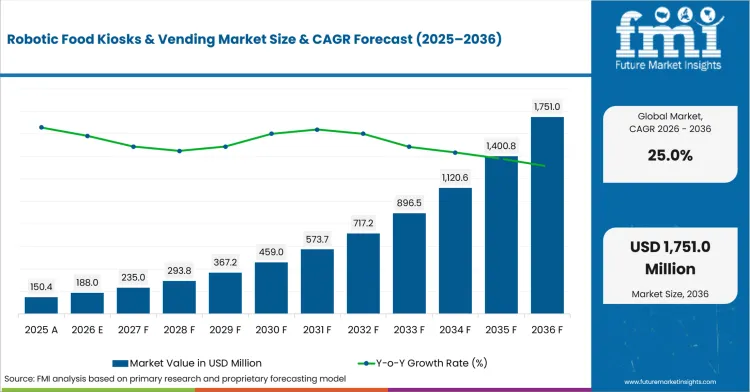
USD 188.0 million in 2026 and USD 1,751.0 million by 2036 at a 25.0% CAGR.
Demand for robotic food kiosks and vending is projected to expand from USD 188.0 million in 2026 to USD 1,751.0 million by 2036, reflecting a 25.0% CAGR during the forecast period. Foodservice operators continue evaluating robotic kiosks to improve service consistency and maintain continuous operations across locations with varying customer traffic. SoftBank Robotics announced that it would assume the distribution business for Yo-Kai Express' CHEFFY autonomous cooking robot in Japan beginning April 2024. The partnership aims to expand deployment, improve service quality, and support future expansion into European and Asian markets.
Regional demand patterns continue to vary according to automation adoption, labor availability, and investment in unattended retail infrastructure. South Korea and the United States continue encouraging commercial deployment through growing acceptance of automated foodservice concepts. Japan places greater emphasis on operational precision and equipment reliability before expanding commercial installations. Equipment manufacturers continue improving robotic preparation systems and remote equipment management to strengthen operational efficiency across unattended foodservice environments.
Key Takeaways of Robotic Food Kiosks & Vending Market
- Demand for robotic food kiosks and vending is driven by rising labor costs and increasing preference for automated foodservice operations across commercial and public locations.
- By component, hardware is expected to lead with 52.0% share in 2026, representing the largest investment during early deployment stages.
- Transit hubs are the dominant location segment, projected to hold 34.0% share in 2026, remaining the leading installation environment for automated kiosks.
- Hot-meal robot kiosks are estimated to lead the product category with 44.0% share in 2026, valued for their ability to prepare freshly cooked meals through automated workflows.
- Compact deployment formats, equipment reliability, and simplified maintenance remain important purchasing considerations, particularly for space-constrained commercial environments.
- South Korea is expected to record the highest country CAGR, with the United States and Japan also expanding adoption, shaped by automation readiness, labor conditions, and operational quality expectations.
- Competition centers on Yo-Kai Express, Blendid, Hyper Robotics, b;eat, RoboBurger, ABB Robotics, and KUKA AG, with vendors differentiating through robotic cooking technology, software integration for ordering and monitoring, and long-term maintenance support.
Analyst Perspective
"The robotic food kiosks and vending market is expanding as foodservice operators seek solutions that deliver consistent output while reducing dependence on manual labor. The commercial challenge extends beyond automation to maintaining reliable equipment availability, standardized food quality, and efficient operations across multiple locations. Suppliers that simplify deployment, support predictive maintenance, and help operators achieve stable day-to-day performance will be better placed to secure long-term contracts in quick-service restaurants, travel hubs, healthcare facilities, and institutional foodservice."
- Nandini Roy Choudhury, Principal Consultant at FMI
Source: FMI's proprietary forecasting model and primary research.
How is the Robotic Food Kiosks & Vending Market segmented?
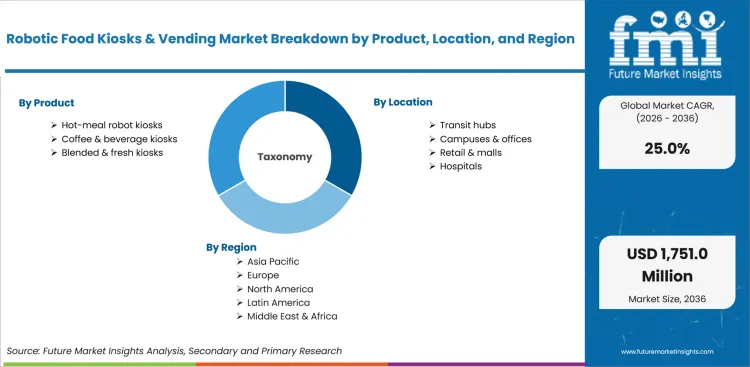
The robotic food kiosks & vending industry is segmented by product, location, component, end user, business model, and region.
The industry is categorized by product, location, component, end user, business model, and region. Product segmentation includes hot-meal robot kiosks, coffee & beverage kiosks, and blended & fresh kiosks based on food preparation capability and dispensing function. Location analysis covers transit hubs, campuses & offices, retail & malls, and hospitals according to deployment environment. Component segmentation comprises hardware, software & payments, and services & restocking. End-user analysis includes kiosk network operators, food brands, and facility owners. Business model assessment covers own-and-operate, franchise, and equipment sale. Regional analysis spans North America, Latin America, Europe, East Asia, South Asia and Pacific, Oceania, and the Middle East & Africa.
What supports demand for hot-meal robot kiosks within the product category?
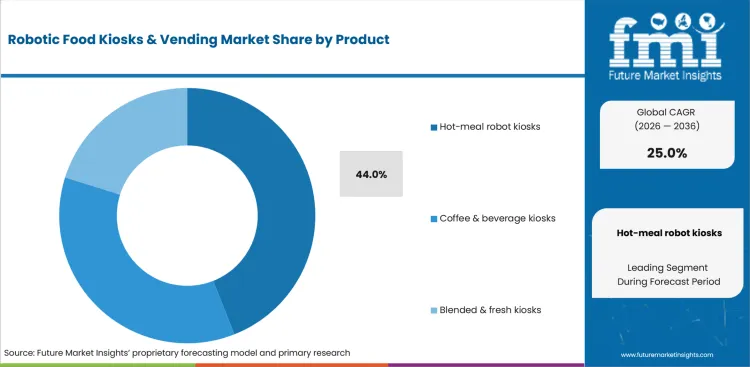
Hot-meal robot kiosks continue attracting commercial interest as foodservice operators seek automated preparation for freshly cooked meals within compact operating spaces. Automated cooking workflows improve preparation consistency and reduce manual intervention across locations serving standardized menus. Equipment developers continue enhancing cooking accuracy, ingredient handling, and production speed to improve operational efficiency.
- By product, hot-meal robot kiosks are projected to account for 44.0% share in 2026 attributable to growing adoption across transportation facilities, commercial buildings, and institutional environments. Standardized menu preparation supports consistent food quality across repeated operating cycles. Automated cooking capability also improves equipment utilization throughout extended operating hours.
- Commercial demand for hot-meal robot kiosks continues expanding across unattended foodservice programs owing to efficient space utilization and consistent meal preparation. Operators increasingly evaluate cooking capacity, equipment reliability, and maintenance requirements before selecting robotic foodservice platforms for commercial deployment. KUKA announced the opening of SELF, described as the world's first AI-powered robotic restaurant, at Josep Tarradellas Barcelona-El Prat Airport in collaboration with Areas and technology partners.
How do transit hubs influence demand within the location category?
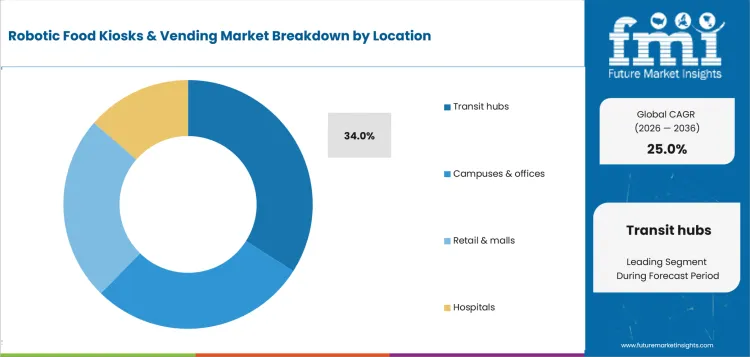
Transit hubs remain an important deployment environment owing to continuous passenger movement and demand for rapid foodservice throughout operating hours. Railway stations, airports, and bus terminals provide recurring customer traffic that supports automated retail concepts. Foodservice operators continue evaluating kiosk performance according to throughput, operating reliability, and service availability.
- Supported by sustained passenger traffic and growing preference for unattended foodservice solutions transit hubs are expected to hold 34.0% share in 2026. Transportation facilities continue adopting automated kiosks to improve customer convenience without increasing staffing requirements. High equipment utilization supports commercial deployment across major transit locations. ABB Robotics unveiled the BurgerBots automated restaurant concept in Los Gatos, California. The system combines ABB's IRB 360 FlexPicker and YuMi collaborative robot to prepare made-to-order burgers while automatically monitoring ingredient inventory and supporting restaurant staff.
- Installation activity across transit hubs continues encouraging manufacturers to improve equipment durability, payment integration, and operational monitoring. Transportation operators increasingly prioritize automated systems capable of maintaining reliable service across extended operating schedules.
Why does hardware account for the leading share within the component category?
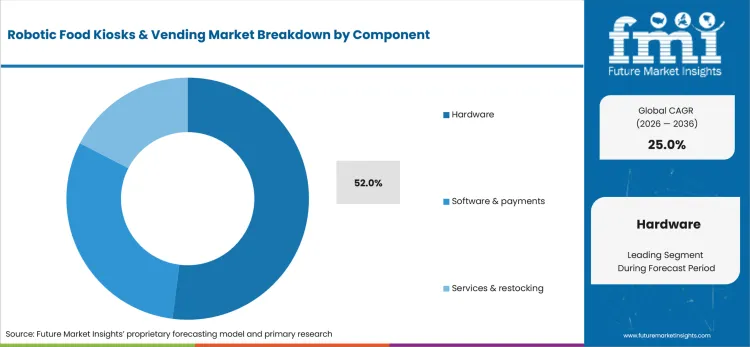
Hardware represents the largest investment during robotic kiosk deployment as automated cooking equipment, robotic handling systems, dispensing mechanisms, payment terminals, and structural assemblies form the foundation of each installation. Commercial operators continue prioritizing equipment durability and operational reliability before expanding deployment programs.
- Owing to continued investment in robotic equipment and automated food preparation systems hardware capture 52.0% share in 2026. Physical infrastructure represents the largest proportion of deployment expenditure during early market expansion. Software and service spending continues increasing as installed equipment expands. LG Electronics acquired a majority stake (51%) in Bear Robotics, integrating its commercial robot business with Bear Robotics to strengthen AI-powered service robotics for hospitality, foodservice, and commercial automation.
- Equipment manufacturers continue improving robotic mechanisms, food handling systems, and integrated control hardware to enhance operational performance across unattended foodservice environments. Commercial buyers increasingly compare equipment lifespan, maintenance requirements, and system reliability before finalizing purchasing decisions.
What are the drivers, restraints, and opportunities in the Robotic Food Kiosks & Vending Market?
Demand is projected to increase as foodservice operators seek automated meal preparation across high-traffic locations. Equipment investment and operational maintenance remain adoption constraints, whereas unattended retail expansion creates commercial opportunities.
- Driver: Foodservice operators are increasing investment in robotic kiosks to improve operational consistency and reduce dependence on manual staffing across repetitive food preparation tasks.
- Restraint: High equipment investment and ongoing maintenance requirements continue extending commercial evaluation before large-scale deployment.
- Opportunity: Expansion of unattended retail formats across transportation facilities, workplaces, and public venues is creating additional deployment opportunities for robotic food kiosks.
Foodservice businesses continue evaluating robotic kiosks as an approach to improve service consistency across standardized menu offerings. Automated preparation systems help maintain repeatable cooking processes and extend operating hours without proportional increases in staffing. Commercial interest remains strongest across locations handling predictable customer demand and requiring efficient use of limited floor space.
Initial investment continues influencing purchasing decisions as robotic kiosks combine food preparation equipment, robotic handling systems, payment technologies, refrigeration, and monitoring software within a single installation. Consumers frequently compare expected utilization and operating costs before approving commercial deployment programs.
Commercial opportunities continue expanding alongside increasing acceptance of unattended retail and automated foodservice concepts. Transportation facilities and retail environments continue assessing robotic kiosks as part of wider automation strategies. Equipment vendors providing flexible menu capability and remote operational monitoring, which strengthen their commercial position as deployment activity expands.
Which country CAGRs are profiled in the Robotic Food Kiosks & Vending Market?
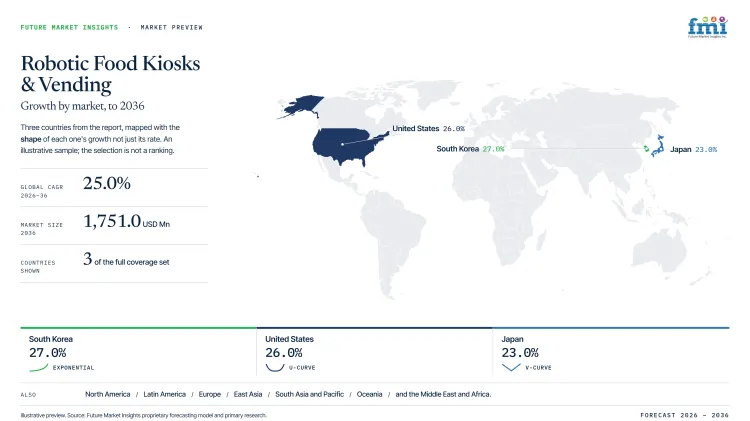
| Country | CAGR |
|---|---|
| South Korea | 27.0% |
| United States | 26.0% |
| Japan | 23.0% |
Source: FMI's proprietary forecasting model and primary research.
How do country-level CAGRs compare in the Robotic Food Kiosks & Vending Market?
The country comparison spans 4.0 percentage points and reveals two distinct growth groups across the robotic food kiosks & vending market. South Korea and the United States form the leading tier with only a 1.0-point difference between them, while Japan follows after a wider 3.0-point gap. The variation reflects differences in automated foodservice adoption, consumer acceptance of self-service technologies and investment in AI-enabled retail formats.
- South Korea leads the comparison with a CAGR of 27.0%. High consumer familiarity with automated retail, combined with widespread deployment of smart vending and unmanned foodservice concepts, is creating favorable conditions for robotic kiosks that prepare, dispense and customize food with minimal staff involvement.
- The United States follows at 26.0%, just 1.0 percentage point behind South Korea. Restaurants, convenience stores and transport hubs are increasingly evaluating robotic kiosks to improve order accuracy, reduce labor dependence and provide faster service during peak operating hours.
- Japan records a CAGR of 23.0%, placing it 3.0 percentage points below the United States. Strong acceptance of automation in retail and foodservice continues to encourage deployment of robotic vending systems that combine compact footprints with consistent food preparation and contactless customer interaction.
Comparable CAGRs do not necessarily translate into identical commercial opportunities. Differences in foodservice operating models, labor availability, consumer purchasing behavior and retail automation strategies influence deployment decisions and long-term market potential. The full report provides country-level CAGR analysis across North America, Latin America, Europe, East Asia, South Asia, Oceania and the Middle East and Africa.
Country-wise Analysis
Country performance reflects differences in automation adoption, foodservice operating models, labor availability, and consumer acceptance of unattended retail. South Korea and the United States continue expanding commercial deployments through automated foodservice investments and technology integration. Japan advances through measured equipment qualification and emphasis on operational reliability before commercial rollout.
- High consumer acceptance of unattended retail supports commercial deployment across South Korea. Robotic food kiosks & vending demand is projected to expand at 27.0% CAGR from 2026 to 2036 supported by continued investment in automated retail infrastructure and smart foodservice concepts. Automated ordering and self-service dining continue gaining acceptance across transportation facilities and commercial districts. Equipment vendors increasingly focus on operational reliability and compact kiosk designs to address space constraints across urban locations. Foodservice operators continue evaluating robotic systems capable of maintaining consistent meal quality throughout extended operating hours.
- Commercial foodservice operators continue accelerating automation investment across the United States. The market is anticipated to record 26.0% CAGR between 2026 and 2036 attributable to growing deployment across airports, office campuses, universities, and healthcare facilities. Labor availability continues encouraging operators to evaluate automated food preparation systems that improve operational consistency. Equipment manufacturers continue expanding software integration, cashless payment capability, and remote monitoring to strengthen commercial adoption. Long-term maintenance support remains an important purchasing consideration during manufacturer selection.
- Operational precision continues shaping robotic kiosk deployment across Japan. Market expansion is estimated at 23.0% CAGR through 2036 as commercial operators prioritize equipment reliability, food quality, and efficient space utilization. Compact foodservice formats remain well suited to dense metropolitan environments and transportation hubs. Buyers continue emphasizing proven equipment performance before approving larger deployment programs. Vendors demonstrating reliable operation and consistent after-sales service are expected to strengthen commercial opportunities across the Japanese market.
Who are the notable companies in the Robotic Food Kiosks & Vending Market?
Yo-Kai Express, Blendid, Hyper Robotics, b;eat, RoboBurger, ABB Robotics, and KUKA AG are among the companies participating in the robotic food kiosks & vending market.
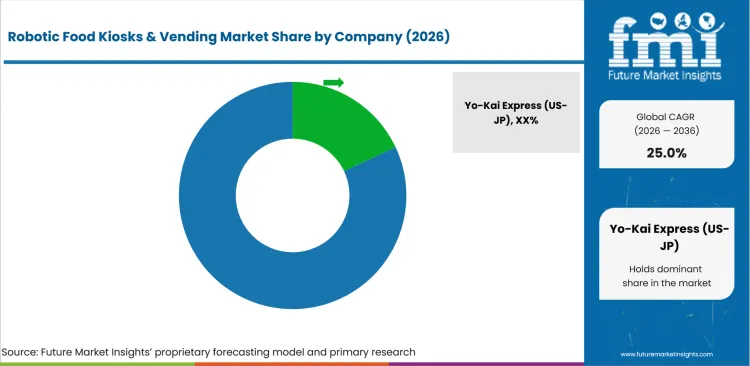
Competition continues extending beyond robotic equipment supply as foodservice operators increasingly compare automation capability, menu flexibility, software integration, operational reliability, and lifecycle service support before selecting a deployment partner. Companies combining robotic food preparation with intelligent inventory management, cashless payment systems, and remote operational monitoring continue strengthening their commercial position across transportation hubs, workplaces, educational campuses, and healthcare facilities.
- Yo-Kai Express and RoboBurger focus on automated meal preparation platforms designed for compact commercial environments. Product development emphasizes standardized food quality, rapid preparation cycles, and operational efficiency across unattended foodservice applications. Commercial differentiation increasingly depends on menu consistency, equipment reliability, and deployment flexibility across high-footfall locations.
- Blendid continue strengthening automated food preparation through robotic assembly technologies and software-driven workflow management. Their solutions support repeatable food preparation while improving order accuracy and operational efficiency. Flexible menu programming and intelligent system management continue supporting commercial deployment across institutional and workplace environments.
- Hyper Robotics, b;eat, ABB Robotics, and KUKA AG contribute through robotic automation, intelligent control systems, and industrial engineering expertise supporting unattended foodservice operations. Integration capability, technical service, and long-term operational support continue influencing vendor selection as commercial deployments expand across multiple application environments.
Competitive Benchmarking: Robotic Food Kiosks & Vending Market
| Company | Engineering Capability | Project Portfolio | Software Integration | Service Reach |
|---|---|---|---|---|
| Lödige Industries | High | High | High | Global |
| Yo-Kai Express | High | High | High | North America & Asia |
| Blendid | High | High | High | North America |
| Hyper Robotics | High | Medium | High | Global |
| b;eat | Medium | High | High | Asia-Pacific |
| RoboBurger | High | High | Medium | North America |
| ABB Robotics | High | Medium | High | Global |
| KUKA AG | High | Medium | High | Global |
Scoring basis: High indicates established commercial capability supported by automated foodservice solutions or robotic technologies. Medium reflects demonstrated capability across selected applications or regional deployments.
Source: Future Market Insights competitive analysis, 2026. Ratings reflect relative automation capability, application expertise, software integration, and commercial service coverage.
Key Developments in the Robotic Food Kiosks & Vending Market
- In March 2024, Yo-Kai Express entered a distribution agreement with SoftBank Robotics to expand the commercial reach of its autonomous cooking robot platform in Japan. SoftBank Robotics assumed distribution of the Yo-Kai Express autonomous cooking robot beginning April 2024, rebranding it as CHEFFY, and extended deployment into offices, lodging facilities, and commercial venues across Japan, building on an existing network of installations at train stations, airports, and expressway rest stops.
- In January 2025, Areas opened SELF, described as the first AI-powered robotic restaurant in an airport environment, at Terminal 1 of Josep Tarradellas Barcelona-El Prat Airport. The installation features a KUKA robotic arm supported by artificial intelligence and machine vision to manage and deliver orders, handling up to six orders simultaneously, and supports continuous automated food service across a high-traffic international transit hub.
- In July 2025, RoboBurger formed a strategic partnership with Sweet Robo to advance the next generation of its autonomous burger kiosk platform. Sweet Robo founder and CEO Piny Vind assumed the role of President at RoboBurger, with the combined entity targeting airports, arenas, and universities for commercial expansion and bringing Sweet Robo's multi-country deployment experience into the redesigned platform.
Key Players in the Robotic Food Kiosks & Vending Market
Robotic food kiosk platform providers
- Yo-Kai Express
- Blendid
- RoboBurger
- b;eat
Robotic automation and foodservice technology providers
- Hyper Robotics
- ABB Robotics
- KUKA AG
Robotic Food Kiosks & Vending Market - Report Scope
| Coverage field | Report scope |
|---|---|
| Market breakdown | Product, location, component, end user, business model, country, and regional analysis. |
| Quantitative Units | Revenue in USD Million, Volume in Units, CAGR in %. |
| Market Definition | Robotic food kiosks and vending systems combine automated food preparation, dispensing, payment, and monitoring technologies to deliver unattended foodservice across commercial and institutional locations. |
| Regions Covered | North America, Latin America, Europe, East Asia, South Asia and Pacific, Oceania, and the Middle East and Africa. |
| Countries Covered | United States, Japan, South Korea, and more than 30 additional countries. |
| Key Companies Profiled | Yo-Kai Express, Blendid, Hyper Robotics, b;eat, RoboBurger, ABB Robotics, and KUKA AG. |
| Forecast Period | 2026 to 2036, with 2025 used as the historical market-size reference. |
| Approach | Hybrid bottom-up and top-down sizing that combines vendor evidence with foodservice automation adoption patterns and country-level deployment conditions. |
Source: Future Market Insights - analysis driven by proprietary forecasting models and primary research.
Robotic Food Kiosks & Vending Market - Research Methodology
| Method | Approach |
|---|---|
| Primary Research | FMI analysts gathered input from manufacturers, service providers, technology developers, distributors, end users, sourcing teams, and subject-matter experts. Interviews examined purchasing decisions, product or service evaluation, adoption barriers, approval requirements, pricing considerations, and expectations for technical or commercial support. Respondents were also asked what evidence is required before a trial, pilot, or initial order develops into regular purchasing. |
| Desk Research | Desk research covered government statistics, regulatory publications, trade data, industry associations, technical literature, standards, company filings, product information, and official corporate announcements. Sources were reviewed for relevance, publication date, geographic coverage, and consistency with the defined market scope. Claims relating to performance, applications, approvals, capacity, investment, and commercial activity were retained only when supported by credible public evidence. |
| Market Sizing and Forecasting | The market model combined the baseline value with historical performance, segment structure, pricing and volume indicators, adoption levels, company participation, and country-level demand conditions. Forecast assumptions considered economic activity, investment trends, regulatory developments, technology adoption, purchasing cycles, supply availability, and barriers to wider market use. Segment and regional estimates were reconciled before the final market total was calculated. |
| Data Validation | Estimates were checked against multiple independent indicators, including public data, company activity, trade patterns, industry developments, and findings from primary interviews. Validation also tested whether products, services, applications, and company revenues fell within the defined market boundaries. Adjacent categories, unsupported claims, overlapping revenues, and activities without direct market relevance were excluded to reduce double counting and maintain consistency across segments and countries. |
Source: Future Market Insights (FMI) analysis, based on proprietary forecasting model and primary research.
Robotic Food Kiosks & Vending Market by Segments
Robotic Food Kiosks & Vending Market segmented by Product:
- Hot-meal Robot Kiosks
- Coffee & Beverage Kiosks
- Blended & Fresh Kiosks
Robotic Food Kiosks & Vending Market segmented by Location:
- Transit Hubs
- Campuses & Offices
- Retail & Malls
- Hospitals
Robotic Food Kiosks & Vending Market segmented by Component:
- Hardware
- Software & Payments
- Services & Restocking
Robotic Food Kiosks & Vending Market segmented by End User:
- Kiosk Network Operators
- Food Brands
- Facility Owners
Robotic Food Kiosks & Vending Market segmented by Business Model:
- Own-and-Operate
- Franchise
- Equipment Sale
Robotic Food Kiosks & Vending Market by Region:
- North America
- United States
- Canada
- Latin America
- Brazil
- Mexico
- Argentina
- Europe
- Germany
- United Kingdom
- France
- Italy
- Spain
- Rest of Europe
- East Asia
- China
- Japan
- South Korea
- South Asia and Pacific
- India
- ASEAN
- Australia and New Zealand
- Rest of South Asia and Pacific
- Oceania
- Australia
- New Zealand
- Pacific Island Markets
- Middle East and Africa
- Gulf Cooperation Council Countries
- South Africa
- Türkiye
- North Africa
- Rest of Middle East and Africa
Bibliography
- SoftBank Robotics. (2024, March 13). SoftBank Robotics to assume distribution of CHEFFY autonomous cooking robot in Japan.
- KUKA. (2025, March 6). KUKA and Areas open AI-powered robotic restaurant at Barcelona Airport.
- ABB. (2025, April 29). ABB and BurgerBots unveil robotic burger-making to revolutionize fast food preparation.
- LG Electronics (2025, January 24). LG acquires majority stake in Bear Robotics to bolster robotics capabilities.
- Bear Robotics. (2024, October 4). USEN-ALMEX and Bear Robotics announce strategic partnership.
- XRobotics. (2025). xPizza Cube automated pizza assembly system.
This bibliography is provided for reader reference and is not exhaustive. The full report contains the complete reference list and detailed citations.
This Report Answers
- What is the estimated value of the robotic food kiosks & vending market in 2026 and 2036?
- What CAGR is projected for the robotic food kiosks & vending market from 2026 to 2036?
- Which product, location, and component account for the disclosed 2026 segment shares?
- Which operating factors continue supporting adoption of robotic food kiosks and vending systems?
- How do country CAGRs differ across South Korea, the United States, and Japan?
- Which competitive factors differentiate robotic food kiosk vendors?
- How does Future Market Insights validate market estimates and company relevance?
- What should foodservice operators evaluate before selecting robotic food kiosk platforms?
- How do operational efficiency and deployment environment influence purchasing decisions?
Frequently Asked Questions
What is driving growth in the Robotic Food Kiosks & Vending Market?
Growing demand for automated food preparation, labor optimization, and consistent service quality continues supporting commercial adoption across transportation, workplace, healthcare, and educational environments.
Who are the key players in the Robotic Food Kiosks & Vending Market?
Leading participants include Yo-Kai Express, Blendid, Hyper Robotics, b;eat, RoboBurger, ABB Robotics, and KUKA AG.
What is a considerable restraint in the Robotic Food Kiosks & Vending Market?
High equipment investment and ongoing maintenance requirements continue extending commercial evaluation before large-scale deployment.
Why should executives track the Robotic Food Kiosks & Vending Market?
Commercial adoption of unattended foodservice technologies continues creating opportunities for automation providers, foodservice operators, and technology developers across multiple deployment environments.
What business problem does the Robotic Food Kiosks & Vending Market address?
Robotic food kiosks improve food preparation consistency, extend operating hours, and reduce dependence on manual staffing across standardized foodservice operations.
What should procurement leaders evaluate before selecting vendors?
Procurement teams should review automation capability, menu flexibility, equipment reliability, software integration, lifecycle service support, and operational performance before commercial deployment.
What limits return on investment for purchasers?
Lower equipment utilization, unsuitable deployment environments, and inadequate maintenance planning continue reducing long-term commercial returns.
How do vendors build long-term account confidence?
Vendors strengthen customer relationships through reliable system performance, responsive technical support, software updates, preventive maintenance, and documented commercial deployment experience.
Preview the report firsthand - request a free sample
Get SampleGet the brochure for pricing and purchase details.
Get PDFTable of Content
- Key Takeaways
- Market Size and CAGR
- Top Growth Driver
- Fastest Growing Segment
- Leading Region
- Key Companies
- Emerging Opportunities
- Executive Summary
- Global Market Outlook
- Demand-side Trends
- Supply-side Trends
- Technology Roadmap Analysis
- Analysis and Recommendations
- Analyst Perspective (What is happening? Why now? What should investors know?)
- Key Questions Answered
- How large is the market?
- What is the CAGR?
- What are key trends?
- Which region dominates?
- Who are the leaders?
- Market Overview
- Market Coverage / Taxonomy
- Market Definition / Scope / Limitations
- Research Methodology
- Chapter Orientation
- Analytical Lens and Working Hypotheses
- Market Structure, Signals, and Trend Drivers
- Benchmarking and Cross-market Comparability
- Market Sizing, Forecasting, and Opportunity Mapping
- Research Design and Evidence Framework
- Desk Research Programme (Secondary Evidence)
- Expert Input and Fieldwork (Primary Evidence)
- Tooling, Models, and Reference Databases
- Data Engineering and Model Build
- Quality Assurance and Audit Trail
- Market Background
- Market Dynamics (Drivers, Restraints, Opportunity, Trends)
- Scenario Forecast (Optimistic, Likely, Conservative)
- Impact Analysis
- AI Impact
- Sustainability Impact
- Regulatory Impact
- Technology Impact
- Consumer / Buyer Analysis
- Purchase Drivers
- Adoption Barriers
- Buyer Journey
- Opportunity Map Analysis
- Product Life Cycle Analysis
- Supply Chain Analysis
- Investment Feasibility Matrix
- Value Chain Analysis
- PESTLE and Porter's Analysis
- Regulatory Landscape
- Regional Parent Market Outlook
- Production and Consumption Statistics
- Import and Export Statistics
- Global Market Analysis and Forecast, 2021 to 2036
- Historical Market Size Value (USD Million) Analysis, 2021 to 2025
- Current and Future Market Size Value (USD Million) Projections, 2026 to 2036
- Y-o-Y Growth Trend Analysis
- Absolute $ Opportunity Analysis
- Global Market Pricing Analysis, 2021 to 2036
- Global Market Analysis and Forecast, By Product, 2021 to 2036
- Introduction / Key Findings
- Historical Market Size Value (USD Million) Analysis By Product, 2021 to 2025
- Current and Future Market Size Value (USD Million) Analysis and Forecast By Product, 2026 to 2036
- Hot-meal robot kiosks
- Coffee & beverage kiosks
- Blended & fresh kiosks
- Hot-meal robot kiosks
- Y-o-Y Growth Trend Analysis By Product, 2021 to 2025
- Absolute $ Opportunity Analysis By Product, 2026 to 2036
- Global Market Analysis and Forecast, By Location, 2021 to 2036
- Introduction / Key Findings
- Historical Market Size Value (USD Million) Analysis By Location, 2021 to 2025
- Current and Future Market Size Value (USD Million) Analysis and Forecast By Location, 2026 to 2036
- Transit hubs
- Campuses & offices
- Retail & malls
- Hospitals
- Transit hubs
- Y-o-Y Growth Trend Analysis By Location, 2021 to 2025
- Absolute $ Opportunity Analysis By Location, 2026 to 2036
- Global Market Analysis and Forecast, By Component, 2021 to 2036
- Introduction / Key Findings
- Historical Market Size Value (USD Million) Analysis By Component, 2021 to 2025
- Current and Future Market Size Value (USD Million) Analysis and Forecast By Component, 2026 to 2036
- Hardware
- Software & payments
- Services & restocking
- Hardware
- Y-o-Y Growth Trend Analysis By Component, 2021 to 2025
- Absolute $ Opportunity Analysis By Component, 2026 to 2036
- Global Market Analysis and Forecast, By End User, 2021 to 2036
- Introduction / Key Findings
- Historical Market Size Value (USD Million) Analysis By End User, 2021 to 2025
- Current and Future Market Size Value (USD Million) Analysis and Forecast By End User, 2026 to 2036
- Kiosk network operators
- Food brands
- Facility owners
- Kiosk network operators
- Y-o-Y Growth Trend Analysis By End User, 2021 to 2025
- Absolute $ Opportunity Analysis By End User, 2026 to 2036
- Global Market Analysis and Forecast, By Business Model, 2021 to 2036
- Introduction / Key Findings
- Historical Market Size Value (USD Million) Analysis By Business Model, 2021 to 2025
- Current and Future Market Size Value (USD Million) Analysis and Forecast By Business Model, 2026 to 2036
- Own-and-operate
- Franchise
- Equipment sale
- Own-and-operate
- Y-o-Y Growth Trend Analysis By Business Model, 2021 to 2025
- Absolute $ Opportunity Analysis By Business Model, 2026 to 2036
- Global Market Analysis and Forecast, By Region, 2021 to 2036
- Introduction
- Historical Market Size Value (USD Million) Analysis By Region, 2021 to 2025
- Current Market Size Value (USD Million) Analysis and Forecast By Region, 2026 to 2036
- North America
- Latin America
- Western Europe
- Eastern Europe
- East Asia
- South Asia and Pacific
- Middle East & Africa
- Market Attractiveness Analysis By Region
- North America Market Analysis and Forecast, By Country, 2021 to 2036
- Historical Market Size Value (USD Million) Trend Analysis By Market Taxonomy, 2021 to 2025
- Market Size Value (USD Million) Forecast By Market Taxonomy, 2026 to 2036
- By Country
- USA
- Canada
- By Product
- By Location
- By Component
- By End User
- By Business Model
- By Country
- Market Attractiveness Analysis
- By Country
- By Product
- By Location
- By Component
- By End User
- By Business Model
- Key Takeaways
- Latin America Market Analysis and Forecast, By Country
- Historical Market Size Value (USD Million) Trend Analysis By Market Taxonomy, 2021 to 2025
- Market Size Value (USD Million) Forecast By Market Taxonomy, 2026 to 2036
- By Country
- Brazil
- Mexico
- Chile
- Rest of Latin America
- By Product
- By Location
- By Component
- By End User
- By Business Model
- By Country
- Market Attractiveness Analysis
- By Country
- By Product
- By Location
- By Component
- By End User
- By Business Model
- Key Takeaways
- Western Europe Market Analysis and Forecast, By Country
- Historical Market Size Value (USD Million) Trend Analysis By Market Taxonomy, 2021 to 2025
- Market Size Value (USD Million) Forecast By Market Taxonomy, 2026 to 2036
- By Country
- Germany
- UK
- Italy
- Spain
- France
- Nordic
- BENELUX
- Rest of Western Europe
- By Product
- By Location
- By Component
- By End User
- By Business Model
- By Country
- Market Attractiveness Analysis
- By Country
- By Product
- By Location
- By Component
- By End User
- By Business Model
- Key Takeaways
- Eastern Europe Market Analysis and Forecast, By Country
- Historical Market Size Value (USD Million) Trend Analysis By Market Taxonomy, 2021 to 2025
- Market Size Value (USD Million) Forecast By Market Taxonomy, 2026 to 2036
- By Country
- Russia
- Poland
- Hungary
- Balkan & Baltic
- Rest of Eastern Europe
- By Product
- By Location
- By Component
- By End User
- By Business Model
- By Country
- Market Attractiveness Analysis
- By Country
- By Product
- By Location
- By Component
- By End User
- By Business Model
- Key Takeaways
- East Asia Market Analysis and Forecast, By Country
- Historical Market Size Value (USD Million) Trend Analysis By Market Taxonomy, 2021 to 2025
- Market Size Value (USD Million) Forecast By Market Taxonomy, 2026 to 2036
- By Country
- China
- Japan
- South Korea
- By Product
- By Location
- By Component
- By End User
- By Business Model
- By Country
- Market Attractiveness Analysis
- By Country
- By Product
- By Location
- By Component
- By End User
- By Business Model
- Key Takeaways
- South Asia and Pacific Market Analysis and Forecast, By Country
- Historical Market Size Value (USD Million) Trend Analysis By Market Taxonomy, 2021 to 2025
- Market Size Value (USD Million) Forecast By Market Taxonomy, 2026 to 2036
- By Country
- India
- ASEAN
- Australia & New Zealand
- Rest of South Asia and Pacific
- By Product
- By Location
- By Component
- By End User
- By Business Model
- By Country
- Market Attractiveness Analysis
- By Country
- By Product
- By Location
- By Component
- By End User
- By Business Model
- Key Takeaways
- Middle East & Africa Market Analysis and Forecast, By Country
- Historical Market Size Value (USD Million) Trend Analysis By Market Taxonomy, 2021 to 2025
- Market Size Value (USD Million) Forecast By Market Taxonomy, 2026 to 2036
- By Country
- Kingdom of Saudi Arabia
- Other GCC Countries
- Türkiye
- South Africa
- Other African Union
- Rest of Middle East & Africa
- By Product
- By Location
- By Component
- By End User
- By Business Model
- By Country
- Market Attractiveness Analysis
- By Country
- By Product
- By Location
- By Component
- By End User
- By Business Model
- Key Takeaways
- Key Countries Market Analysis
- USA
- Pricing Analysis
- Market Share Analysis, 2025
- By Product
- By Location
- By Component
- By End User
- By Business Model
- Canada
- Pricing Analysis
- Market Share Analysis, 2025
- By Product
- By Location
- By Component
- By End User
- By Business Model
- Mexico
- Pricing Analysis
- Market Share Analysis, 2025
- By Product
- By Location
- By Component
- By End User
- By Business Model
- Brazil
- Pricing Analysis
- Market Share Analysis, 2025
- By Product
- By Location
- By Component
- By End User
- By Business Model
- Chile
- Pricing Analysis
- Market Share Analysis, 2025
- By Product
- By Location
- By Component
- By End User
- By Business Model
- Germany
- Pricing Analysis
- Market Share Analysis, 2025
- By Product
- By Location
- By Component
- By End User
- By Business Model
- UK
- Pricing Analysis
- Market Share Analysis, 2025
- By Product
- By Location
- By Component
- By End User
- By Business Model
- Italy
- Pricing Analysis
- Market Share Analysis, 2025
- By Product
- By Location
- By Component
- By End User
- By Business Model
- Spain
- Pricing Analysis
- Market Share Analysis, 2025
- By Product
- By Location
- By Component
- By End User
- By Business Model
- France
- Pricing Analysis
- Market Share Analysis, 2025
- By Product
- By Location
- By Component
- By End User
- By Business Model
- India
- Pricing Analysis
- Market Share Analysis, 2025
- By Product
- By Location
- By Component
- By End User
- By Business Model
- ASEAN
- Pricing Analysis
- Market Share Analysis, 2025
- By Product
- By Location
- By Component
- By End User
- By Business Model
- Australia & New Zealand
- Pricing Analysis
- Market Share Analysis, 2025
- By Product
- By Location
- By Component
- By End User
- By Business Model
- China
- Pricing Analysis
- Market Share Analysis, 2025
- By Product
- By Location
- By Component
- By End User
- By Business Model
- Japan
- Pricing Analysis
- Market Share Analysis, 2025
- By Product
- By Location
- By Component
- By End User
- By Business Model
- South Korea
- Pricing Analysis
- Market Share Analysis, 2025
- By Product
- By Location
- By Component
- By End User
- By Business Model
- Russia
- Pricing Analysis
- Market Share Analysis, 2025
- By Product
- By Location
- By Component
- By End User
- By Business Model
- Poland
- Pricing Analysis
- Market Share Analysis, 2025
- By Product
- By Location
- By Component
- By End User
- By Business Model
- Hungary
- Pricing Analysis
- Market Share Analysis, 2025
- By Product
- By Location
- By Component
- By End User
- By Business Model
- Kingdom of Saudi Arabia
- Pricing Analysis
- Market Share Analysis, 2025
- By Product
- By Location
- By Component
- By End User
- By Business Model
- Türkiye
- Pricing Analysis
- Market Share Analysis, 2025
- By Product
- By Location
- By Component
- By End User
- By Business Model
- South Africa
- Pricing Analysis
- Market Share Analysis, 2025
- By Product
- By Location
- By Component
- By End User
- By Business Model
- USA
- Market Structure Analysis
- Competition Dashboard
- Competition Benchmarking
- Market Share Analysis of Top Players
- By Regional
- By Product
- By Location
- By Component
- By End User
- By Business Model
- Emerging Startups
- Innovation Benchmarking
- Competition Analysis
- Competition Deep Dive
- Yo-Kai Express (US-JP)
- Overview
- Product Portfolio
- Profitability by Market Segments
- Sales Footprint
- Strategy Overview
- Marketing Strategy
- Product Strategy
- Channel Strategy
- Blendid (US)
- Hyper Robotics (IL)
- b;eat (KR)
- Yo-Kai Express (US-JP)
- Case Studies
- Success Stories
- Recent Developments
- Competition Deep Dive
- Assumptions & Acronyms Used


