

- Industry Size (2026)
- USD 720.0 Mn
- Forecast (2036)
- USD 1206.7 Mn
- CAGR (2026 to 2036)
- 5.30%
Mill Rejects Handling System Market Forecast and Outlook 2026 to 2036
The mill rejects handling system market is likely to be valued at USD 720.0 million in 2026 and is projected to reach USD 1,206.7 million by 2036, expanding at a CAGR of 5.3% over the forecast period. Between 2026 and 2036, performance is shaped by project timing and plant-critical reliability rather than volume-led repeat purchasing. Cost structures are anchored in abrasion-resistant metallurgy, dust-tight enclosures, pneumatic or mechanical conveying hardware, and control integration, which raises qualification thresholds and favors vendors with proven reference installs.
Quick Stats for Mill Rejects Handling System Market
- Mill Rejects Handling System Market Value (2026): USD 720.0 Million
- Mill Rejects Handling System Market Forecast Value (2036): USD 1,206.7 Million
- Mill Rejects Handling System Market Forecast CAGR 2026 to 2036: 5.30%
- Leading Plant Type in Mill Rejects Handling System Market: Coal-Fired Power Plants
- Leading Sales Channel in Mill Rejects Handling System Market: EPC or Project Direct
- Key Growth Regions in Mill Rejects Handling System Market: Asia Pacific, Middle East & Africa, Latin America, North America
- Top Key Players in Mill Rejects Handling System Market: Babcock & Wilcox, Macawber Engineering, Aumund Group, FLSmidth, TAKRAF Group, Beumer Group, Andritz, Thermax, BHEL, Regional EPCs
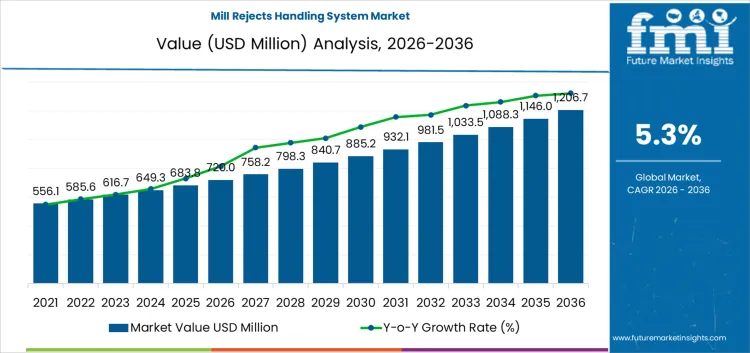
Procurement is typically routed through EPCs or plant modernization programs, so pricing leverage is defended through specifications, warranties, and commissioning accountability, not discounting. Buyer risk aversion remains high because failures can trigger mill trips, boiler instability, and safety incidents, pushing utilities and captive plants toward conservative supplier choices and standardized spares. Switching costs are reinforced by bespoke layouts, interface dependencies with mills and ash systems, and shutdown-constrained retrofit windows. Fragmentation persists in service and retrofit scopes where regional EPCs compete on execution speed, while integrated OEM-grade solutions retain margin concentration in large, complex installations.
Mill Rejects Handling System Market Key Takeaways
| Metric | Value |
|---|---|
| Industry Value (2026) | USD 720.0 Million |
| Forecast Value (2036) | USD 1,206.7 Million |
| Forecast CAGR 2026 to 2036 | 5.30% |
How is the Global Mill Rejects Handling System Market Advancing?
The global mill rejects handling system market is advancing steadily, driven by continued demand from coal-based thermal power plants and industrial boilers that require efficient management of rejected materials. Mill rejects handling systems are used to collect, transport, and dispose of oversized coal particles, foreign materials, and other rejects discharged from coal pulverizing mills, ensuring uninterrupted boiler operation and equipment protection.
A key driver supporting market growth is the increasing focus on improving plant efficiency and reducing unplanned shutdowns in power generation facilities. Inefficient handling of mill rejects can lead to blockages, excessive wear, and operational disruptions. As a result, plant operators are investing in automated and enclosed rejects handling systems that improve reliability, minimize manual intervention, and enhance workplace safety.
Advancements in system design and automation are further strengthening market adoption. Improvements in conveying mechanisms, abrasion-resistant materials, and dust suppression technologies are enhancing system durability and operational performance. In addition, integration with plant control systems allows real-time monitoring and better maintenance planning. As existing thermal power plants continue to undergo upgrades and operational optimization, the mill rejects handling system market is expected to maintain stable growth over the forecast period.
What Is the Segment-Wise Overview of the Mill Rejects Handling System Market?
The mill rejects handling system market is primarily driven by demand from coal-based power generation and project-driven procurement models. Coal-fired power plants dominate with a 66% share, as efficient handling of mill rejects is critical for maintaining boiler performance, reducing downtime, and ensuring safe disposal of unburnt coal and foreign materials. These systems are integral to continuous power plant operations. On the sales channel side, EPC or project-direct procurement accounts for 46% of demand, reflecting the capital-intensive and customized nature of mill reject handling installations. EPC-driven purchases ensure system integration with overall plant design and operational requirements.
Why Do Coal-Fired Power Plants Lead the Mill Rejects Handling System Market?
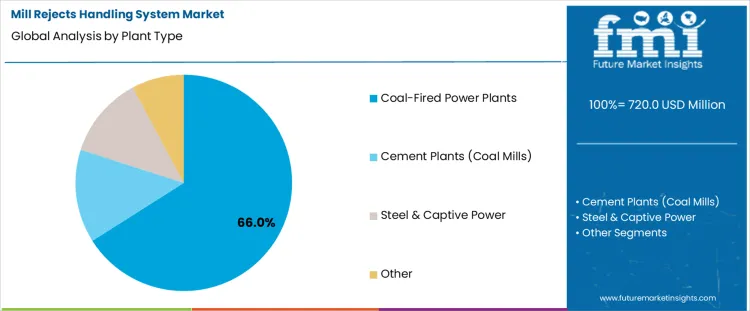
Coal-fired power plants account for 66% of demand in the mill rejects handling system market due to their continuous reliance on coal pulverization and the need for safe, efficient disposal of mill rejects. During coal milling, oversized coal particles, tramp metal, and other impurities must be removed to protect downstream equipment and maintain boiler efficiency. Mill rejects handling systems play a critical role in preventing blockages, reducing fire hazards, and ensuring uninterrupted plant operation. Given the large scale and continuous operation of coal-fired plants, these systems are designed for high reliability and heavy-duty performance. Aging coal power infrastructure in several regions further drives retrofit and replacement demand. Despite energy transition trends, coal-fired plants remain operational in many markets, sustaining strong demand for robust mill rejects handling solutions.
Why Does EPC or Project-Direct Procurement Dominate Sales in the Mill Rejects Handling System Market?
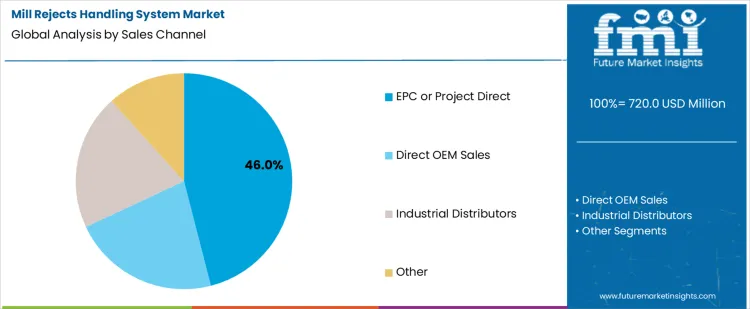
EPC or project-direct sales account for 46% of total sales channel demand, reflecting the engineered and site-specific nature of mill rejects handling systems. These systems must be precisely integrated with coal mills, boiler layouts, ash handling systems, and plant safety protocols, making turnkey project execution essential. EPC contractors manage design, equipment sourcing, installation, and commissioning as part of broader power plant construction or modernization projects. This approach reduces coordination risks and ensures system compatibility with overall plant operations. Project-direct procurement is also common in large retrofits and capacity expansion projects, where customization and compliance with plant standards are critical. As mill rejects handling systems are capital-intensive and engineered-to-order, EPC-led procurement continues to dominate market transactions.
What Are the Key Dynamics for the Mill Rejects Handling System Market?
Mill rejects materials that do not meet quality specifications can accumulate rapidly and require reliable handling systems to transport, segregate, recycle, or discard waste materials safely and efficiently. Key market dynamics include rising industrial production, stringent environmental regulations on waste management, and a growing emphasis on operational efficiency and workplace safety. Companies are increasingly investing in automated reject handling solutions to reduce manual labor, minimize spillage, and maintain consistent production throughput while ensuring compliance with environmental and safety standards in industrial facilities.
Why is the Mill Rejects Handling System Market Growing?
The mill rejects handling system market is growing as industries face increasing pressure to optimize production processes, reduce downtime, and comply with waste disposal regulations that impose stricter controls on industrial byproducts. Mill rejects handling systems such as conveyors, magnetic separators, screening units, crushers, and integrated handling lines help companies minimize material losses and improve resource utilization. Expansion of manufacturing and infrastructure sectors in emerging economies is accelerating demand for comprehensive material handling solutions, including reject management. Technological advancements in automation, sensor integration, and real-time monitoring enhance the performance and reliability of handling systems, supporting efficient material flow and process continuity.
How Are the Key Drivers Shaping the Mill Rejects Handling System Market?
Key drivers shaping the mill rejects handling system market include growing industrial output that generates higher volumes of mill rejects requiring systematic handling, storage, and processing. The trend toward automation and Industry 4.0 adoption is encouraging deployment of intelligent handling systems that integrate sensors, PLCs, and real-time monitoring to optimize reject removal and material flow. Environmental regulations related to waste disposal and recycling targets are motivating companies to adopt solutions that reduce landfill usage and improve material recovery. Rising focus on workplace safety and ergonomic design is also driving preference for automated reject handling over manual processes. Increasing plant capacity expansions and modernization projects across steel, cement, mining, and mineral processing sectors are stimulating investments in integrated handling systems that support sustainable and efficient operations.
What Is the Growth Outlook for the Mill Rejects Handling System Market by Country?
| Country | CAGR (%) |
|---|---|
| India | 6.4% |
| Indonesia | 6.0% |
| Vietnam | 5.6% |
| South Africa | 5.2% |
| Mexico | 4.9% |
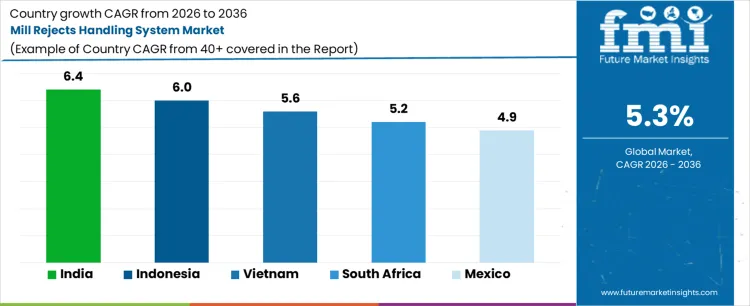
The mill rejects handling system market is growing steadily as coal-based power plants prioritize efficiency, safety, and reliability. India leads with a 6.4% CAGR, driven by large coal power capacity and modernization initiatives. Indonesia follows at 6.0%, supported by sustained coal-fired generation. Vietnam grows at 5.6%, backed by industrial power demand. South Africa (5.2%) shows maintenance-led growth due to aging infrastructure, while Mexico (4.9%) expands gradually through efficiency upgrades. As thermal power plants continue to optimize operations, demand for reliable mill rejects handling systems is expected to remain stable across these regions.
What Is Driving the Growth of the Mill Rejects Handling System Market in India?
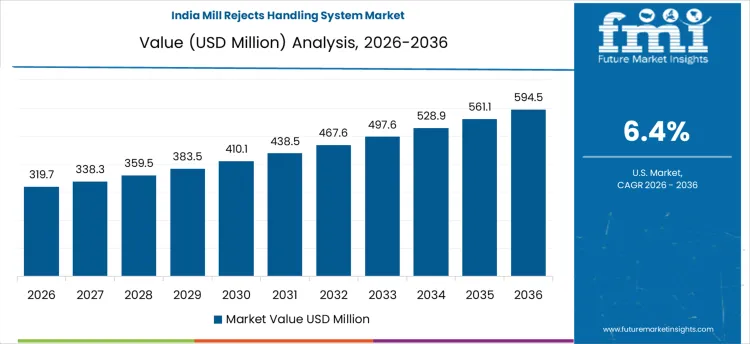
The mill rejects handling system market in India is growing at a CAGR of 6.4%, driven by expansion and modernization of coal-fired thermal power plants. India’s power generation mix still relies significantly on coal, creating sustained demand for efficient handling of mill rejects such as pyrites, stones, and unburnt coal. Utilities are increasingly focusing on automated and enclosed handling systems to improve plant efficiency, reduce dust emissions, and enhance workplace safety. Retrofit projects in aging power plants are also supporting demand, as operators replace manual or semi-automatic systems with mechanized solutions. Stricter environmental norms and emphasis on operational reliability are further influencing procurement decisions. Growth in captive power plants for cement, steel, and industrial facilities also contributes to demand. As India continues to optimize coal-based power assets, adoption of advanced mill rejects handling systems is expected to grow steadily.
How Is the Mill Rejects Handling System Market Expanding in Indonesia?
The mill rejects handling system market in Indonesia is expanding at a CAGR of 6.0%, supported by continued reliance on coal-fired power generation. Indonesia’s abundant coal resources and growing electricity demand are driving sustained operation of thermal power plants. Efficient mill rejects handling systems are increasingly adopted to manage abrasive and high-density rejects that can affect boiler performance if not handled properly. Power plant operators are prioritizing system reliability and reduced downtime, encouraging use of automated conveying and disposal systems. Expansion of industrial captive power plants is also supporting demand. In addition, increasing focus on plant safety and dust control is influencing upgrades to enclosed handling solutions. As Indonesia balances energy demand with operational efficiency, demand for mill rejects handling systems is expected to grow consistently.
What Is Supporting Growth of the Mill Rejects Handling System Market in Vietnam?
The mill rejects handling system market in Vietnam is growing at a CAGR of 5.6%, driven by steady expansion of coal-based power generation to support industrial growth. Vietnam’s manufacturing and export sectors require reliable electricity, increasing operational focus on thermal power plants. Mill rejects handling systems are essential for maintaining boiler efficiency and preventing equipment damage. Utilities are increasingly adopting automated and low-maintenance systems to improve operational continuity. Government investments in power infrastructure and grid stability further support demand. In addition, growing attention to environmental management within power plants is encouraging use of systems that minimize dust and spillage. As Vietnam continues to rely on coal power alongside renewables, demand for reliable mill rejects handling systems is expected to rise steadily.
How Is the Mill Rejects Handling System Market Developing in South Africa?
The Mill Rejects Handling System Market in South Africa is expanding at a CAGR of 5.2%, supported by the country’s dependence on coal-fired power plants for base-load electricity. Aging power infrastructure and frequent maintenance challenges are increasing focus on efficient material handling solutions. Mill rejects handling systems help reduce unplanned outages and improve boiler performance, making them critical for plant reliability. Utilities are investing in system upgrades and refurbishments to extend plant life and improve efficiency. Emphasis on worker safety and dust suppression is also driving adoption of enclosed handling solutions. Despite slower new capacity additions, maintenance-driven demand remains strong. As South Africa focuses on stabilizing its power sector, demand for mill rejects handling systems is expected to grow gradually.
How Is the Mill Rejects Handling System Market Expanding in Mexico?
The mill rejects handling system market in Mexico is growing at a CAGR of 4.9%, reflecting moderate demand driven by existing coal and industrial power generation facilities. While Mexico is gradually diversifying its energy mix, coal-based and captive power plants still require efficient handling of mill rejects. Plant operators are focusing on improving operational efficiency and reducing maintenance issues through mechanized handling systems. Growth in cement, steel, and manufacturing industries using captive power is also supporting demand. Environmental compliance and workplace safety considerations are encouraging replacement of manual handling methods. Slower expansion of coal-based power limits higher growth. As Mexico focuses on maintaining operational efficiency in existing plants, demand for mill rejects handling systems is expected to increase steadily.
How Are Companies Competing in the Mill Rejects Handling System Market?
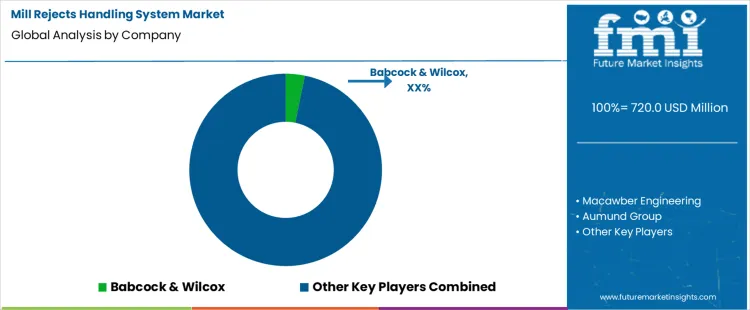
Competition in the mill rejects handling system market is driven by system reliability, handling efficiency, dust control performance, and the ability to operate continuously in harsh power plant and heavy industrial environments. Mill rejects systems are critical for safely conveying and disposing of unground materials such as pyrites, stones, and metal debris from coal pulverizers, helping protect boilers and maintain plant availability. Companies compete on conveying technology selection, wear resistance, automation, and integration with existing boiler and ash handling systems. Differentiation increasingly centers on minimizing spillage, reducing maintenance intervention, and ensuring stable operation under varying fuel quality and load conditions.
Babcock & Wilcox, FLSmidth, TAKRAF Group, Andritz, Aumund Group, Beumer Group, BHEL, and Thermax lead competition through deep power plant experience, engineered system design, and large EPC project capabilities. Babcock & Wilcox and FLSmidth leverage boiler and milling system expertise to deliver tightly integrated rejects handling solutions. TAKRAF, Aumund, and Beumer differentiate through heavy-duty conveying technologies designed for abrasive materials and long operating cycles. Andritz, BHEL, and Thermax compete by offering turnkey systems aligned with broader boiler, balance-of-plant, and retrofit projects, particularly in utility and industrial installations.
Macawber Engineering and regional EPCs compete through pneumatic conveying expertise, customization, and localized execution. Macawber differentiates with dense-phase pneumatic systems that reduce wear and dust emissions while enabling flexible routing. Regional EPCs compete on cost efficiency, faster project delivery, and adaptation to site-specific constraints. Across the market, competitive advantage is defined by system uptime, effective dust suppression, low maintenance requirements, and the ability to retrofit or upgrade existing plants while meeting increasingly stringent operational and environmental expectations.
Key Players in Mill Rejects Handling System Market
- Babcock & Wilcox
- Macawber Engineering
- Aumund Group
- FLSmidth
- TAKRAF Group
- Beumer Group
- Andritz
- Thermax
- BHEL
- Regional EPCs
Scope of Report
| Attributes | Description |
|---|---|
| Quantitative Unit (2026) | USD Million |
| Plant Type | Coal-Fired Power Plants, Cement Plants (Coal Mills), Steel & Captive Power, Other |
| Sales Channel | EPC or Project Direct, Direct OEM Sales, Industrial Distributors, Other |
| Regions Covered | Asia Pacific, Europe, North America, Latin America, Middle East & Africa |
| Countries Covered | China, Japan, South Korea, India, Australia & New Zealand, ASEAN, Rest of Asia Pacific, Germany, United Kingdom, France, Italy, Spain, Nordic, BENELUX, Rest of Europe, United States, Canada, Mexico, Brazil, Chile, Rest of Latin America, Kingdom of Saudi Arabia, Other GCC Countries, Turkey, South Africa, Other African Union, Rest of Middle East & Africa |
| Key Companies Profiled | Babcock & Wilcox, Macawber Engineering, Aumund Group, FLSmidth, TAKRAF Group, Beumer Group, Andritz, Thermax, BHEL, Regional EPCs |
| Additional Attributes | Dollar sales by plant type and sales channel; regional market size and forecast analysis; growth outlook across major regions; adoption trends for mill rejects handling and conveying systems; assessment of ash and reject management requirements, project-based procurement dynamics, and demand patterns across power, cement, steel, and captive industrial facilities. |
Mill Rejects Handling System Market by Key Segments
Plant Type
- Coal-Fired Power Plants
- Cement Plants (Coal Mills)
- Steel & Captive Power
- Other
Sales Channel
- EPC or Project Direct
- Direct OEM Sales
- Industrial Distributors
- Other
Region:
- Asia Pacific
- China
- Japan
- South Korea
- India
- Australia & New Zealand
- ASEAN
- Rest of Asia Pacific
- Europe
- Germany
- United Kingdom
- France
- Italy
- Spain
- Nordic
- BENELUX
- Rest of Europe
- North America
- United States
- Canada
- Mexico
- Latin America
- Brazil
- Chile
- Rest of Latin America
- Middle East & Africa
- Kingdom of Saudi Arabia
- Other GCC Countries
- Turkey
- South Africa
- Other African Union
- Rest of Middle East & Africa
Bibliography
- Aumund Group. (2024). Bulk material handling systems for power plants and heavy industry. AUMUND Fördertechnik GmbH.
- Babcock & Wilcox. (2025). Boiler systems, coal milling, and reject handling solutions. The Babcock & Wilcox Company.
- Beumer Group. (2024). Conveying and material handling solutions for abrasive bulk materials. BEUMER Group GmbH & Co. KG.
- Bharat Heavy Electricals Limited. (2024). Coal-fired power plant systems and auxiliary equipment. BHEL.
- FLSmidth. (2025). Material handling, conveying, and plant optimization solutions. FLSmidth A/S.
Frequently Asked Questions
How big is the mill rejects handling system market in 2026?
The global mill rejects handling system market is estimated to be valued at USD 720.0 million in 2026.
What will be the size of mill rejects handling system market in 2036?
The market size for the mill rejects handling system market is projected to reach USD 1,206.7 million by 2036.
How much will be the mill rejects handling system market growth between 2026 and 2036?
The mill rejects handling system market is expected to grow at a 5.3% CAGR between 2026 and 2036.
What are the key product types in the mill rejects handling system market?
The key product types in mill rejects handling system market are coal-fired power plants, cement plants (coal mills), steel & captive power and other.
Which sales channel segment to contribute significant share in the mill rejects handling system market in 2026?
In terms of sales channel, epc or project direct segment to command 46.0% share in the mill rejects handling system market in 2026.
Preview the report firsthand - request a free sample
Get SampleGet the brochure for pricing and purchase details.
Get PDFTable of Content
- Executive Summary
- Global Market Outlook
- Demand-side Trends
- Supply-side Trends
- Technology Roadmap Analysis
- Analysis and Recommendations
- Market Overview
- Market Coverage / Taxonomy
- Market Definition / Scope / Limitations
- Market Background
- Market Dynamics
- Drivers
- Restraints
- Opportunity
- Trends
- Scenario Forecast
- Demand in Optimistic Scenario
- Demand in Likely Scenario
- Demand in Conservative Scenario
- Opportunity Map Analysis
- Product Life Cycle Analysis
- Supply Chain Analysis
- Investment Feasibility Matrix
- Value Chain Analysis
- PESTLE and Porter’s Analysis
- Regulatory Landscape
- Regional Parent Market Outlook
- Production and Consumption Statistics
- Import and Export Statistics
- Market Dynamics
- Global Market Analysis 2021 to 2025 and Forecast, 2026 to 2036
- Historical Market Size Value (USD Million) Analysis, 2021 to 2025
- Current and Future Market Size Value (USD Million) Projections, 2026 to 2036
- Y-o-Y Growth Trend Analysis
- Absolute $ Opportunity Analysis
- Global Market Pricing Analysis 2021 to 2025 and Forecast 2026 to 2036
- Global Market Analysis 2021 to 2025 and Forecast 2026 to 2036, By Plant Type
- Introduction / Key Findings
- Historical Market Size Value (USD Million) Analysis By Plant Type , 2021 to 2025
- Current and Future Market Size Value (USD Million) Analysis and Forecast By Plant Type , 2026 to 2036
- Coal-Fired Power Plants
- Cement Plants (Coal Mills)
- Steel & Captive Power
- Other
- Coal-Fired Power Plants
- Y-o-Y Growth Trend Analysis By Plant Type , 2021 to 2025
- Absolute $ Opportunity Analysis By Plant Type , 2026 to 2036
- Global Market Analysis 2021 to 2025 and Forecast 2026 to 2036, By Sales Channel
- Introduction / Key Findings
- Historical Market Size Value (USD Million) Analysis By Sales Channel, 2021 to 2025
- Current and Future Market Size Value (USD Million) Analysis and Forecast By Sales Channel, 2026 to 2036
- EPC or Project Direct
- Direct OEM Sales
- Industrial Distributors
- Other
- EPC or Project Direct
- Y-o-Y Growth Trend Analysis By Sales Channel, 2021 to 2025
- Absolute $ Opportunity Analysis By Sales Channel, 2026 to 2036
- Global Market Analysis 2021 to 2025 and Forecast 2026 to 2036, By Region
- Introduction
- Historical Market Size Value (USD Million) Analysis By Region, 2021 to 2025
- Current Market Size Value (USD Million) Analysis and Forecast By Region, 2026 to 2036
- North America
- Latin America
- Western Europe
- Eastern Europe
- East Asia
- South Asia and Pacific
- Middle East & Africa
- Market Attractiveness Analysis By Region
- North America Market Analysis 2021 to 2025 and Forecast 2026 to 2036, By Country
- Historical Market Size Value (USD Million) Trend Analysis By Market Taxonomy, 2021 to 2025
- Market Size Value (USD Million) Forecast By Market Taxonomy, 2026 to 2036
- By Country
- USA
- Canada
- Mexico
- By Plant Type
- By Sales Channel
- By Country
- Market Attractiveness Analysis
- By Country
- By Plant Type
- By Sales Channel
- Key Takeaways
- Latin America Market Analysis 2021 to 2025 and Forecast 2026 to 2036, By Country
- Historical Market Size Value (USD Million) Trend Analysis By Market Taxonomy, 2021 to 2025
- Market Size Value (USD Million) Forecast By Market Taxonomy, 2026 to 2036
- By Country
- Brazil
- Chile
- Rest of Latin America
- By Plant Type
- By Sales Channel
- By Country
- Market Attractiveness Analysis
- By Country
- By Plant Type
- By Sales Channel
- Key Takeaways
- Western Europe Market Analysis 2021 to 2025 and Forecast 2026 to 2036, By Country
- Historical Market Size Value (USD Million) Trend Analysis By Market Taxonomy, 2021 to 2025
- Market Size Value (USD Million) Forecast By Market Taxonomy, 2026 to 2036
- By Country
- Germany
- UK
- Italy
- Spain
- France
- Nordic
- BENELUX
- Rest of Western Europe
- By Plant Type
- By Sales Channel
- By Country
- Market Attractiveness Analysis
- By Country
- By Plant Type
- By Sales Channel
- Key Takeaways
- Eastern Europe Market Analysis 2021 to 2025 and Forecast 2026 to 2036, By Country
- Historical Market Size Value (USD Million) Trend Analysis By Market Taxonomy, 2021 to 2025
- Market Size Value (USD Million) Forecast By Market Taxonomy, 2026 to 2036
- By Country
- Russia
- Poland
- Hungary
- Balkan & Baltic
- Rest of Eastern Europe
- By Plant Type
- By Sales Channel
- By Country
- Market Attractiveness Analysis
- By Country
- By Plant Type
- By Sales Channel
- Key Takeaways
- East Asia Market Analysis 2021 to 2025 and Forecast 2026 to 2036, By Country
- Historical Market Size Value (USD Million) Trend Analysis By Market Taxonomy, 2021 to 2025
- Market Size Value (USD Million) Forecast By Market Taxonomy, 2026 to 2036
- By Country
- China
- Japan
- South Korea
- By Plant Type
- By Sales Channel
- By Country
- Market Attractiveness Analysis
- By Country
- By Plant Type
- By Sales Channel
- Key Takeaways
- South Asia and Pacific Market Analysis 2021 to 2025 and Forecast 2026 to 2036, By Country
- Historical Market Size Value (USD Million) Trend Analysis By Market Taxonomy, 2021 to 2025
- Market Size Value (USD Million) Forecast By Market Taxonomy, 2026 to 2036
- By Country
- India
- ASEAN
- Australia & New Zealand
- Rest of South Asia and Pacific
- By Plant Type
- By Sales Channel
- By Country
- Market Attractiveness Analysis
- By Country
- By Plant Type
- By Sales Channel
- Key Takeaways
- Middle East & Africa Market Analysis 2021 to 2025 and Forecast 2026 to 2036, By Country
- Historical Market Size Value (USD Million) Trend Analysis By Market Taxonomy, 2021 to 2025
- Market Size Value (USD Million) Forecast By Market Taxonomy, 2026 to 2036
- By Country
- Kingdom of Saudi Arabia
- Other GCC Countries
- Turkiye
- South Africa
- Other African Union
- Rest of Middle East & Africa
- By Plant Type
- By Sales Channel
- By Country
- Market Attractiveness Analysis
- By Country
- By Plant Type
- By Sales Channel
- Key Takeaways
- Key Countries Market Analysis
- USA
- Pricing Analysis
- Market Share Analysis, 2025
- By Plant Type
- By Sales Channel
- Canada
- Pricing Analysis
- Market Share Analysis, 2025
- By Plant Type
- By Sales Channel
- Mexico
- Pricing Analysis
- Market Share Analysis, 2025
- By Plant Type
- By Sales Channel
- Brazil
- Pricing Analysis
- Market Share Analysis, 2025
- By Plant Type
- By Sales Channel
- Chile
- Pricing Analysis
- Market Share Analysis, 2025
- By Plant Type
- By Sales Channel
- Germany
- Pricing Analysis
- Market Share Analysis, 2025
- By Plant Type
- By Sales Channel
- UK
- Pricing Analysis
- Market Share Analysis, 2025
- By Plant Type
- By Sales Channel
- Italy
- Pricing Analysis
- Market Share Analysis, 2025
- By Plant Type
- By Sales Channel
- Spain
- Pricing Analysis
- Market Share Analysis, 2025
- By Plant Type
- By Sales Channel
- France
- Pricing Analysis
- Market Share Analysis, 2025
- By Plant Type
- By Sales Channel
- India
- Pricing Analysis
- Market Share Analysis, 2025
- By Plant Type
- By Sales Channel
- ASEAN
- Pricing Analysis
- Market Share Analysis, 2025
- By Plant Type
- By Sales Channel
- Australia & New Zealand
- Pricing Analysis
- Market Share Analysis, 2025
- By Plant Type
- By Sales Channel
- China
- Pricing Analysis
- Market Share Analysis, 2025
- By Plant Type
- By Sales Channel
- Japan
- Pricing Analysis
- Market Share Analysis, 2025
- By Plant Type
- By Sales Channel
- South Korea
- Pricing Analysis
- Market Share Analysis, 2025
- By Plant Type
- By Sales Channel
- Russia
- Pricing Analysis
- Market Share Analysis, 2025
- By Plant Type
- By Sales Channel
- Poland
- Pricing Analysis
- Market Share Analysis, 2025
- By Plant Type
- By Sales Channel
- Hungary
- Pricing Analysis
- Market Share Analysis, 2025
- By Plant Type
- By Sales Channel
- Kingdom of Saudi Arabia
- Pricing Analysis
- Market Share Analysis, 2025
- By Plant Type
- By Sales Channel
- Turkiye
- Pricing Analysis
- Market Share Analysis, 2025
- By Plant Type
- By Sales Channel
- South Africa
- Pricing Analysis
- Market Share Analysis, 2025
- By Plant Type
- By Sales Channel
- USA
- Market Structure Analysis
- Competition Dashboard
- Competition Benchmarking
- Market Share Analysis of Top Players
- By Regional
- By Plant Type
- By Sales Channel
- Competition Analysis
- Competition Deep Dive
- Babcock & Wilcox
- Overview
- Product Portfolio
- Profitability by Market Segments (Product/Age /Sales Channel/Region)
- Sales Footprint
- Strategy Overview
- Marketing Strategy
- Product Strategy
- Channel Strategy
- Macawber Engineering
- Aumund Group
- FLSmidth
- TAKRAF Group
- Beumer Group
- Andritz
- Thermax
- BHEL
- Regional EPCs
- Babcock & Wilcox
- Competition Deep Dive
- Assumptions & Acronyms Used
- Research Methodology


