

- Market Size (2026)
- USD 1.7 Bn
- Forecast (2036)
- USD 6.0 Bn
- CAGR (2026 to 2036)
- 13.4%
How big is Robotic CNC Machine Tending Market in 2026?
USD 1.7 billion in 2026 and USD 6.0 billion by 2036 at a 13.4% CAGR.
Demand for robotic CNC machine tending is projected to grow at 13.4% CAGR from 2026 to 2036. Market value is estimated to rise from USD 1.7 billion in 2026 to USD 6.0 billion by 2036. Growth reflects a fundamental production inefficiency, as high-cost CNC machines often sit idle while waiting for manual loading and unloading. In February 2026, the Association for Advancing Automation reported that North American robot orders reached USD 2.25 billion in 2025, with revenue growth outpacing unit volume, indicating increased spending on complete automation cells rather than standalone robots. This shift supports robotic CNC machine tending systems that increase spindle utilization, and the industrial robot outlook helps manufacturers weigh installation costs against the value of additional productive machine hours delivered by automated cells.
United States job shops and Japanese production networks approach robotic automation from different operating needs. Many American job shops want one cell that works across mixed CNC brands and existing controls. Japanese plants place greater value on repeatable recovery and dependable service across tightly managed lines. In February 2026, A3 reported North American robot orders worth USD 579 million during the fourth quarter of 2025. The spending confirms that manufacturers continued funding flexible automation across several industries. The CNC controller analysis explains why control access often determines whether one cell serves several machines. These differences shape commissioning plans and service expectations in each market.
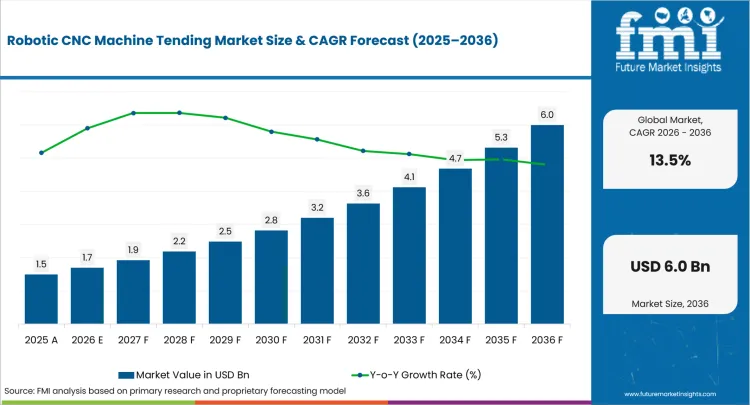
Key Takeaways of Robotic CNC Machine Tending Market
- Demand for robotic CNC machine tending is driven by machine shops seeking more output from installed equipment without assigning skilled machinists to repetitive loading, adding spindle hours while reducing routine operator coverage.
- By component, hardware is expected to lead with 60.0% share in 2026, as every project starts with an arm and dependable workholding.
- CNC milling is the dominant application segment, projected to hold 34.0% share in 2026, reflecting its longer cutting cycles.
- Cobot tending cells are estimated to lead the robot type category with 38.0% share in 2026, driven by smaller shops needing compact automation around mixed CNC fleets.
- Reusable, reconfigurable cells remain the preferred choice for precision job shops, as they protect returns better than dedicated systems when order mix and fixture needs change through the year.
- The United States, European Union, and Japan are expected to grow closely together at 14.0%, 13.0%, and 12.5% CAGR respectively through 2036, though approval priorities differ, with US shops valuing quick commissioning and European/Japanese plants focusing on documentation and repeatable recovery.
- Competition centers on HALTER CNC Automation, RoboJob, Fastems, Flexxbotics, Robotiq, and Universal Robots, with vendors differentiating through packaged tending systems, pallet automation, and cobot-based entry solutions for smaller manufacturers.
Analyst Perspective
"Manufacturers are assessing robotic loading systems by their ability to maintain stable production through routine part changes, operator interventions, and varying batch sizes. Commercial value is shaped by dependable cycle continuity, safe workcell integration, and the flexibility to support evolving manufacturing requirements without extensive re-engineering. Suppliers that combine validated automation performance with strong commissioning support, safety expertise, and responsive lifecycle service are likely to build enduring relationships across high-mix production environments."
- Nikhil Kaitwade, Principal Consultant for Industrial Automation at Future Market Insight
Source: FMI's proprietary forecasting model and primary research
How is the Robotic CNC Machine Tending Market Segmented?
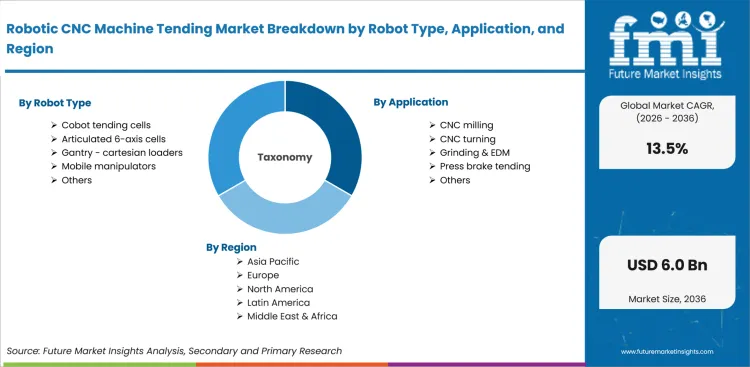
The robotic CNC machine tending industry is segmented by robot type, application, component, end-use industry, organization size, and region.
The report segments the market by robot type, application, component, end-use industry, organization size, and region. Robot type covers cobot cells, six-axis systems, gantry loaders, mobile manipulators, and other formats. Applications include milling, turning, grinding and EDM, press brake tending, and other tasks with different cycle and handling needs. Components include hardware, software, and services used across the cell's working life. End-use analysis compares precision job shops, automotive suppliers, aerospace manufacturers, medical-device producers, and general manufacturing. Organization size separates SME job shops, mid-market firms, large enterprises, and contract manufacturers. Regional analysis explains how labor costs and installed CNC fleets change the case for automation.
How does cobot tending shape demand within the robot type category?
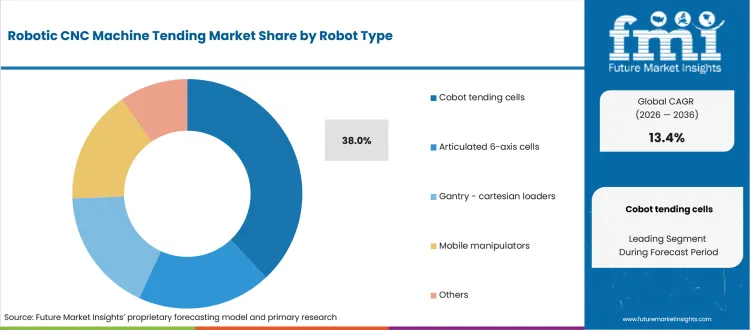
Small machine shops often have limited floor space and little time for custom robot engineering. Cobot tending cells are estimated to hold 38.0% of robot type demand in 2026. Movable systems suit mixed CNC fleets without requiring permanent automation layouts. In February 2026, A3 reported North American collaborative robot orders worth USD 241 million during 2025. The spending shows that cobots have moved beyond small trials into planned factory budgets. Commercial value depends on safe relocation and quick programming across daily production.
- In 2026, cobot tending cells are expected to lead robot type with 38.0% share. Compact layouts make them practical for crowded machining areas and mixed equipment fleets in smaller plants. One platform creates more value by serving several machines with limited fixture changes. The purchase review should measure relocation time and safe restart performance under a normal production schedule.
- High-mix production weakens the case for dedicated automation in smaller job shops with frequent part changes. These firms therefore favor cobot tending cells that support changing part families and customer schedules. The collaborative manufacturing robots study explains how simple programming helps teams with limited robot experience.
What supports demand for CNC milling within the application category?
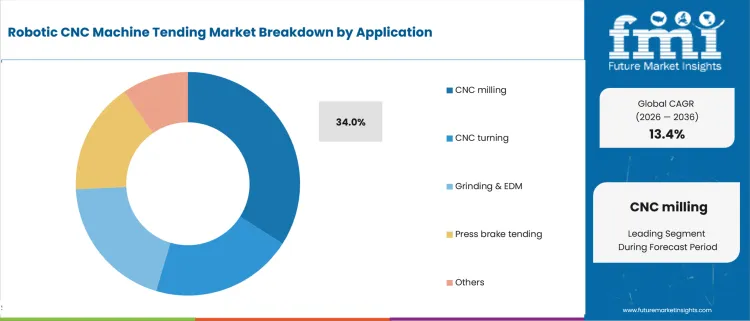
Longer cutting cycles make CNC milling a practical target for robotic loading due to predictable part positioning across repeat work. In February 2025, Fastems introduced a higher-payload Flexible Pallet System for four-axis and five-axis machining centers. Its modular design links several machines to one automation program and expands the usable equipment base.
- By application, CNC milling is forecast to dominate with 34.0% share in 2026. Longer cutting cycles give robotic cells enough time to load the next part without slowing production. Consistent workholding lets one system serve several part families during daily production. Higher spindle use then depends on reliable chip removal and accurate part seating during unattended operation.
- Shorter delivery schedules leave contract manufacturers less time for manual loading across active customer orders. These companies are expected to increase CNC milling tending across repeated machining work and changing batch sizes. The milling machine forecast places this demand within the wider equipment base used for precision work.
How do machine shops evaluate hardware within the component category?
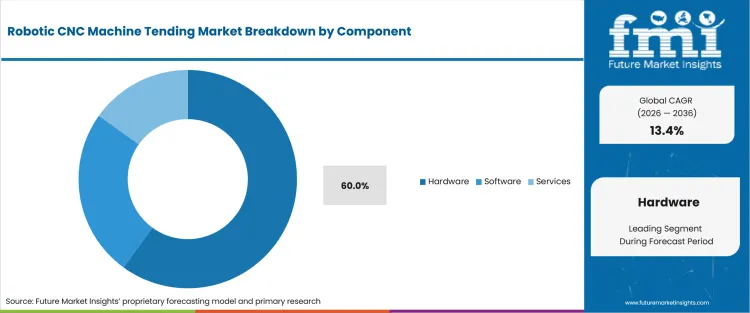
Every working cell needs a robot arm, dependable end-of-arm equipment and access to the machine. In February 2026, Flexxbotics updated its Beckhoff ADS TwinCAT connector for mixed-control production systems. The update reflects demand for equipment that shares operating data across different machines without a custom link for every connection.
- Hardware is forecast to lead component spending with 60.0% share in the market in 2026. Robot arms and workholding create the first major cost in most automated tending projects for manufacturers. Engineers should match payload and reach with every planned part family during system design and approval.
- New installations and replacements for manual fixtures are expected to support hardware demand during the forecast period. Automatic tool changes raise the value of one cell across several part families and shifting schedules.
What drives precision machining job shops within the end-use industry category?
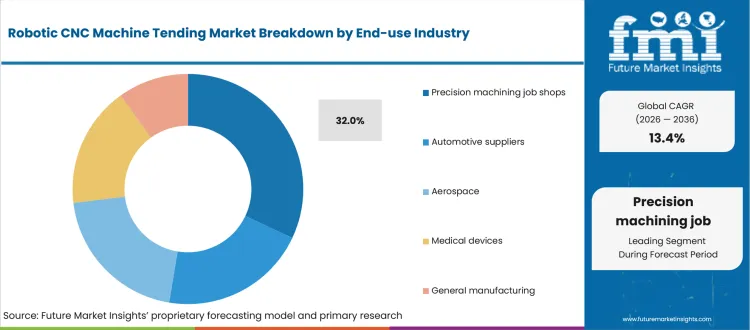
Precision machining job shops face uneven schedules and frequent part changes that weaken the case for fixed automation. In August 2025, A3 reported North American robot orders worth USD 1.094 billion during the first half of 2025. The spending shows that manufacturers continued funding automation during an uneven equipment cycle across North America.
- Precision machining job shops are projected to hold 32.0% share in 2026. Unattended hours protect margins on short runs that would otherwise need constant manual loading by skilled staff. Owners need cells that store several programs and recover safely from minor stops during production.
- Uncertain part mix weakens the case for dedicated equipment across many precision machining job shops. These firms are expected to favor reusable tending cells that support changing customer orders and recurring part families.
How does organization size influence purchasing within the SME job shop category?
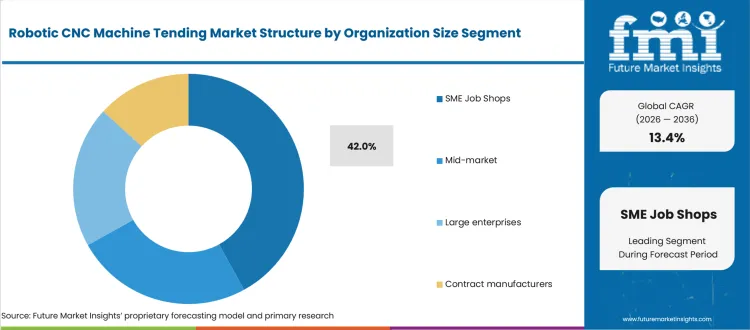
SME job shops need clear payback from every automation project. A failed installation places a large share of weekly capacity at risk in a smaller firm. In March 2026, HALTER CNC Automation joined the Gibas Group to combine product development with broader international reach. The transaction gives HALTER more engineering and service resources for packaged systems. Reliable support carries as much weight as robot speed during a smaller shop's production ramp.
- SME job shops are likely to capture 42.0% share of organization size in 2026. Limited staffing raises the cost of idle machines and makes unattended production more valuable for small firms. Many firms start with one cell and expand once several orders confirm the expected spindle gains. Training and local support often influence the final choice more than maximum speed or headline payload.
- Packaged cells are attracting smaller manufacturers that lack internal robot engineering across mixed CNC fleets. Camera guidance helps one system handle greater part variation across mixed production orders in daily work. Simpler setup reduces custom programming for each batch and shortens the learning curve for operators.
What are the drivers, restraints, and opportunities in the robotic CNC machine tending market?
Manual loading pressure is expected to support adoption across machine shops with limited staffing. Older CNC controls are anticipated to extend integration work and raise commissioning costs. Reusable cells are projected to widen automation across mixed CNC fleets and changing part schedules.
- Driver: Machine shops are expected to automate repetitive loading as idle spindle time reduces revenue during understaffed shifts.
- Restraint: Integration costs are anticipated to delay projects involving older CNC controls and custom safety circuits.
- Opportunity: Reusable tending cells are projected to widen automation across high-mix production and mixed-age CNC fleets.
Machine shops lose revenue whenever expensive CNC equipment waits for the next manual loading step. Labor shortages make that loss more costly during evening shifts and short runs that need regular loading. In March 2025, Teradyne Robotics demonstrated a Universal Robots cobot using plain-language instructions for CNC machine tending. The demonstration shows how simpler setup reduces engineering work across changing production tasks. Faster programming improves payback by keeping the same robot productive across frequent schedule changes.
Older CNC fleets create integration problems since door controls and safety circuits differ across machines. In February 2025, ISO published ISO 10218-1:2025 and ISO 10218-2:2025 for robot design and cell integration. The revisions raise expectations for risk assessment and clear responsibility during design and commissioning projects. Manufacturers need acceptance tests that reflect normal operation and safe recovery from routine production stops. Unplanned guarding work extends installation time and delays the first operating savings from each project.
Integration gaps create an opening for packaged cells and reusable control connectors across older machine fleets. In February 2026, Flexxbotics expanded Siemens S7Comm support for data exchange between robots and CNC controls. The update reduces custom engineering and supports repeatable installations across plants using related systems at several sites. The machine vision systems analysis shows another route for handling a wider part mix across changing tasks. Proven interfaces and local support help manufacturers automate older machines without replacing productive assets.
Which country CAGRs are profiled in the robotic CNC machine tending market?
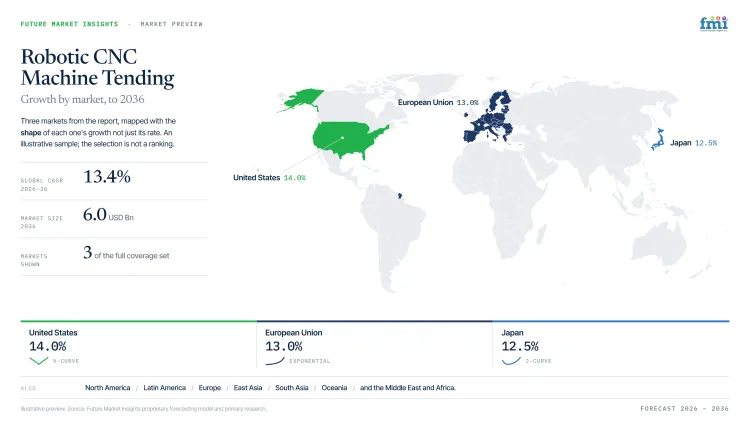
| Country | CAGR |
|---|---|
| United States | 14.0% |
| European Union | 13.0% |
| Japan | 12.5% |
Source: FMI's proprietary forecasting model and primary research
How do country-level CAGRs compare in the robotic CNC machine tending market?
The country comparison spans 1.5 percentage points, indicating a tightly clustered growth outlook across the Robotic CNC Machine Tending Market. The United States, the European Union and Japan all remain within a narrow range, suggesting that adoption is advancing across established manufacturing economies. Growth is influenced by labor availability, automation of precision machining operations and the need to improve machine utilization and production consistency.
- The United States records the highest CAGR at 14.0% as manufacturers increasingly deploy robotic machine tending to maximize CNC machine uptime, reduce dependence on manual loading and unloading, and support flexible production across aerospace, automotive and precision engineering applications.
- The European Union follows 1.0 percentage point behind the United States. Strong demand for industrial automation, high manufacturing quality standards and continued investment in smart factories encourage wider integration of robotic tending systems across metalworking and industrial production facilities.
- Japan stands 0.5 percentage points below the European Union, reflecting continued modernization of precision manufacturing operations and increasing use of collaborative and industrial robots to improve productivity, address workforce shortages and maintain consistent machining quality.
Comparable CAGRs can still produce different market entry conditions. Differences in manufacturing automation maturity, labor costs, CNC machine installed base and investment in digital production technologies influence deployment strategies and long-term commercial opportunities. The full report provides country-level CAGR analysis across North America, Latin America, Europe, East Asia, South Asia, Oceania and the Middle East and Africa.
Country-wise Analysis
Country growth reflects the age of installed CNC equipment and the local cost of skilled labor. United States job shops often prioritize quick installation across mixed machine brands and short contracts with limited engineering time. European projects give more weight to safety records and service coverage across national markets. Japanese plants usually demand stable recovery and long equipment life within tightly controlled production systems. The tool changer monitoring research explains why unattended cells need predictable accessory changes during long shifts. Forecast growth remains close across the three markets, but their approval tests create different service and commissioning needs.
- North American job shops are extending automation beyond automotive work into general metalworking and life-science production. Industry in the United States is forecast to rise at 14.0% CAGR from 2026 to 2036. In May 2026, A3 reported first-quarter robot orders worth USD 543 million across North America. Broad demand outside automotive programs confirms that manufacturers are maintaining automation budgets across several sectors. Robotiq and Universal Robots support this shift with packaged cobot options and local partner networks. Projects in the United States are likely to reward quick commissioning across mixed CNC controls and older equipment fleets.
- European manufacturers must manage different plant standards and service networks across national markets during automation projects. The European Union outlook is projected to advance at 13.0% CAGR from 2026 to 2036. In August 2025, the USA International Trade Administration forecast German machine tool production at USD 14.3 billion during 2025. The figure confirms a large production base that supports automation demand despite softer orders. Fastems and RoboJob compete through local application support across established machining regions and customer plants. Revised ISO 10218 requirements raise the value of clear safety records and realistic acceptance tests.
- Japanese machine builders operate in a production culture that rewards stable output and long equipment life. Demand is estimated to expand at 12.5% CAGR within the market from 2026 to 2036. In November 2025, the USA International Trade Administration valued Japan's industrial machine tool market at USD 4.771 billion during 2024. The figure shows an installed equipment base that gives robotic cell companies a clear service opportunity. FANUC and Yaskawa add local robot support beside established machine tool companies across Japan's industrial regions.
Who are the notable companies in the Robotic CNC Machine Tending Market?
HALTER CNC Automation, Fastems, RoboJob, Flexxbotics, Robotiq, Universal Robots, FANUC, ABB, KUKA, and Yaskawa are the notable companies shaping this market.
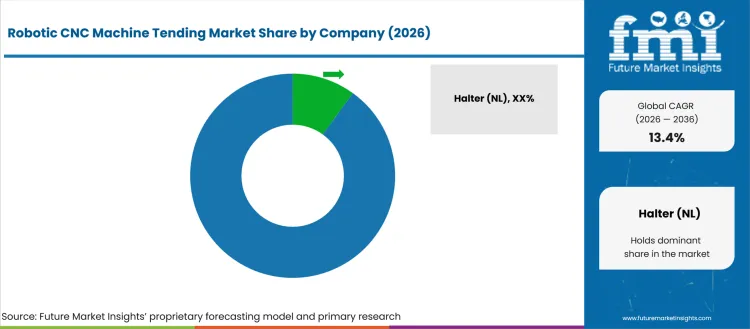
Competition divides between CNC automation specialists and broad robot manufacturers that solve different operating problems. Specialists focus on fast setup and reusable part presentation for machine shops with frequent production changes. Global robot companies add payload choice and service coverage across plants using several robot classes. Software companies link robots with CNC controls and inspection data across coordinated cells in production. Production teams compare application support and practical training with price and technical fit during selection reviews. The global robot market assessment adds context on the hardware and control systems used in tending cells. Commercial value comes from reaching stable unattended production with less engineering work for operators and managers.
- HALTER CNC Automation and RoboJob package CNC tending around simple setup and broad machine compatibility. Their systems suit smaller manufacturers that do not employ dedicated robotics engineers on their production staff. The competitive difference is the time required to turn a standard cell into dependable production equipment under normal shop conditions.
- Fastems serves multi-machine production through pallet handling and production planning software across coordinated machining operations. Its approach fits plants that need one system to manage scheduling and material flow across several machining centers. The value comes from coordinating the whole machining area instead of treating every cell as a separate project.
- Flexxbotics links robots with CNC controls and inspection systems across connected workcells in production plants. Its model reflects a wider shift from simple loading toward production that responds to inspection results. That capability is valuable in regulated or precision work that depends on part history and consistent process records.
- Robotiq and Universal Robots lower entry barriers through cobot packages and practical training resources for smaller manufacturers. Their role shows why simple programming and reusable accessories remain central for first-time automation users. The benefit fades if every part change requires specialist help during normal customer production orders.
- FANUC and ABB offer broad robot portfolios with service coverage across major manufacturing regions worldwide. KUKA and Yaskawa provide similar support for plants using several payload classes and industrial control systems. Scale helps manufacturers standardize service across several sites without forcing every task into one robot format.
Competitive Benchmarking: Robotic CNC Machine Tending Market
| Company | CNC Tending Cell Breadth | CNC and Robot Integration Depth | High-Mix Workflow Support | Service Reach | Geographic Coverage |
|---|---|---|---|---|---|
| HALTER CNC Automation | High | High | High | Medium | Europe and North America / Regional |
| Fastems | High | High | High | High | Global |
| RoboJob | High | High | High | Medium | Europe and North America / Regional |
| Flexxbotics | Low | High | High | Medium | North America and Europe / Regional |
| Robotiq | Medium | Medium | High | High | Global |
| Universal Robots | Medium | Medium | High | High | Global |
| FANUC | Medium | High | Medium | High | Global |
| ABB | Low | High | Medium | High | Global |
| KUKA | Medium | Medium | Medium | High | Global |
| Yaskawa | Medium | High | Low | High | Global |
Scoring basis: High indicates clear and substantial capability in the stated area for robotic CNC machine tending. Medium indicates relevant capability that remains partial or indirect within the same market comparison area. Low indicates limited official evidence of direct capability within the stated comparison area for this market.
Source: Future Market Insights competitive analysis, 2026. Ratings compare portfolio relevance with production fit across the companies included in this market assessment. Service capability and geographic reach complete the comparison across installation and operating needs for customers.
Key Developments in the Robotic CNC Machine Tending Market
- In July 2025, Fastems introduced the eLock concept for milling centers without built-in pallet changers. The bolt-on design uses electromagnetic power transfer and avoids new wiring on the machine table. The concept expands the installed equipment base suited to unattended production without major machine changes.
- In October 2025, Flexxbotics announced a partnership with Mach Medical for robotic production of orthopedic implants. The workcell links robots with five-axis milling and inspection equipment in one controlled production sequence. The project extends machine tending beyond loading by feeding inspection results into the production process.
- In November 2025, HALTER CNC Automation announced a collaboration with LNS Turbo UK that combines machine tending with chip and coolant management. The offer targets high-mix manufacturers seeking longer spindle hours with fewer operator visits. The collaboration shows that unattended machining depends on stable chip flow and reliable coolant control.
- In May 2025, Universal Robots introduced the UR15 collaborative robot and opened orders ahead of June shipments. The model supports faster handling and heavier work within compact tending layouts. Its motion control gives smaller cells more reach without requiring a larger industrial robot.
Key Players in the Robotic CNC Machine Tending Market
Packaged CNC tending specialists
- HALTER CNC Automation
- RoboJob
- Robotiq
Multi-machine automation and production control suppliers
- Fastems
- Flexxbotics
Global robot and cobot platform suppliers
- Universal Robots
- FANUC
- ABB
- KUKA
- Yaskawa
Robotic CNC Machine Tending Market - Report Scope
| Coverage field | Report scope |
|---|---|
| Market breakdown | Robot type, application, component, end-use industry, organization size, and region. |
| Quantitative Units | Revenue in USD Million, Volume in Units, CAGR in %. |
| Market Definition | The market covers robotic cells and related software or services used to load and unload CNC machine tools. |
| Regions Covered | North America, Latin America, Europe, East Asia, South Asia, Oceania, and the Middle East and Africa. |
| Countries Covered | United States, Canada, Germany, United Kingdom, France, China, Japan, India, and 20+ countries. |
| Key Companies Profiled | HALTER CNC Automation, Fastems, RoboJob, Flexxbotics, Robotiq, Universal Robots, FANUC, ABB, KUKA, and Yaskawa. |
| Forecast Period | 2026 to 2036. |
| Approach | Hybrid sizing combines bottom-up company analysis with top-down demand modeling. |
Source: Future Market Insights - analysis driven by proprietary forecasting models and primary research
Robotic CNC Machine Tending Market - Research Methodology
| Method | Approach |
|---|---|
| Primary Research | FMI analysts gathered input from manufacturers, service providers, technology developers, distributors, end users, procurement teams, and subject-matter experts. Interviews examined purchasing decisions, product or service evaluation, adoption barriers, approval requirements, pricing considerations, and expectations for technical or commercial support. Respondents were also asked what evidence is required before a trial, pilot, or initial order develops into regular purchasing. |
| Desk Research | Desk research covered government statistics, regulatory publications, trade data, industry associations, technical literature, standards, company filings, product information, and official corporate announcements. Sources were reviewed for relevance, publication date, geographic coverage, and consistency with the defined market scope. Claims relating to performance, applications, approvals, capacity, investment, and commercial activity were retained only when supported by credible public evidence. |
| Market Sizing and Forecasting | The market model combined the baseline value with historical performance, segment structure, pricing and volume indicators, adoption levels, company participation, and country-level demand conditions. Forecast assumptions considered economic activity, investment trends, regulatory developments, technology adoption, purchasing cycles, supply availability, and barriers to wider market use. Segment and regional estimates were reconciled before the final market total was calculated. |
| Data Validation | Estimates were checked against multiple independent indicators, including public data, company activity, trade patterns, industry developments, and findings from primary interviews. Validation also tested whether products, services, applications, and company revenues fell within the defined market boundaries. Adjacent categories, unsupported claims, overlapping revenues, and activities without direct market relevance were excluded to reduce double counting and maintain consistency across segments and countries. |
Source: Future Market Insights (FMI) analysis, based on proprietary forecasting model and primary research
Robotic CNC Machine Tending Market by Segments
Robotic CNC Machine Tending Market segmented by Robot Type:
- Cobot Tending Cells
- Articulated 6-Axis Cells
- Gantry Cartesian Loaders
- Mobile Manipulators
- Others
Robotic CNC Machine Tending Market segmented by Application:
- CNC Milling
- CNC Turning
- Grinding and EDM
- Press Brake Tending
- Others
Robotic CNC Machine Tending Market segmented by Component:
- Hardware
- Software
- Services
Robotic CNC Machine Tending Market segmented by End-use Industry:
- Precision Machining Job Shops
- Automotive Suppliers
- Aerospace
- Medical Devices
- General Manufacturing
Robotic CNC Machine Tending Market segmented by Organization Size:
- SME Job Shops
- Mid-market Firms
- Large Enterprises
- Contract Manufacturers
Robotic CNC Machine Tending Market by Region:
- North America
- United States
- Canada
- Latin America
- Brazil
- Mexico
- Argentina
- Europe
- Germany
- United Kingdom
- France
- Italy
- Spain
- Benelux
- Nordics
- East Asia
- China
- Japan
- South Korea
- South Asia
- India
- Thailand
- Indonesia
- Malaysia
- Oceania
- Australia
- New Zealand
- Middle East and Africa
- GCC Countries
- South Africa
- Turkey
- Israel
Research Sources and Bibliography
- Association for Advancing Automation. (2026, February). Robot orders grow 6.6% in 2025 as general industries drive broader automation adoption. Association for Advancing Automation.
- Association for Advancing Automation. (2026, May). Robot orders hold steady in Q1 2026 as demand broadens across non-automotive industries. Association for Advancing Automation.
- Association for Advancing Automation. (2025, August). New A3 report signals steady automation investment in first half of 2025. Association for Advancing Automation.
- Fastems. (2025, February). Fastems Flexible Pallet System integrates with hundreds of 4 and 5 axis machining centers - now also in 1,500 kg payloads. Fastems.
- Fastems. (2025, July). Fastems unveils revolutionary automation solutions at EMO Hanover 2025. Fastems.
- Flexxbotics. (2026, February). Flexxbotics updates Beckhoff ADS TwinCAT connector driver in open-source GitHub project. Flexxbotics.
- Flexxbotics. (2026, February). Flexxbotics extends Siemens S7Comm transformer in open-source GitHub project. Flexxbotics.
- Flexxbotics. (2025, October). Mach Medical partners with Flexxbotics to power robotic manufacturing of orthopedic implants. Flexxbotics.
- HALTER CNC Automation. (2026, March). Press release: Halter Group B.V. joins the Gibas Group. HALTER CNC Automation.
- HALTER CNC Automation. (2025, November). LNS Turbo UK and HALTER CNC Automation announce strategic collaboration. HALTER CNC Automation.
- International Organization for Standardization. (2025, February). ISO 10218-1:2025 Robotics - Safety requirements - Part 1: Industrial robots. International Organization for Standardization.
- International Organization for Standardization. (2025, February). ISO 10218-2:2025 Robotics - Safety requirements - Part 2: Industrial robot applications and robot cells. International Organization for Standardization.
- Universal Robots. (2025, March). Teradyne Robotics to debut AI Accelerator-powered solutions at NVIDIA GTC 2025, marking a first in AI-driven collaborative robotics. Universal Robots.
- Universal Robots. (2025, May). Universal Robots introduces its fastest ever cobot to enable unprecedented performance in collaborative automation. Universal Robots.
- USA International Trade Administration. (2025, August). Germany - Advanced manufacturing. USA Department of Commerce.
- USA International Trade Administration. (2025, November). Japan - Industrial machine tools. USA Department of Commerce.
- Future Market Insights. (2026). Robotic CNC Machine Tending Market forecast and segmentation analysis. Future Market Insights.
This bibliography gives readers direct access to primary government and standards-body materials used in the analysis. Official trade body and company sources provide the remaining evidence cited throughout the complete market report.
This Report Answers
- What value is the robotic CNC machine tending market projected to reach in 2026 and by 2036?
- What CAGR is forecast for robotic CNC machine tending between 2026 and 2036?
- Which robot type and application segments are estimated to shape demand during 2026?
- Which labor and machine-use pressures are expected to support robotic tending adoption?
- How do forecast growth rates differ across the European Union, United States, and Japan?
- Which companies compete through packaged cells, integration depth, and service reach?
- How does FMI validate market forecasts using company evidence and machine shop interviews?
- What operating issues should manufacturers resolve before committing to a wider automation rollout?
- How do safety records and machine interface requirements affect company selection?
Frequently Asked Questions
What is driving growth in the Robotic CNC Machine Tending Market?
Machine shops are expected to automate repetitive loading as skilled labor remains limited and CNC equipment remains costly. Longer unattended runs improve spindle use and support delivery performance across demanding schedules and staffing gaps.
Who are the key players in the Robotic CNC Machine Tending Market?
HALTER CNC Automation and Fastems compete through packaged CNC systems and coordinated production control platforms. Universal Robots and FANUC add broad robot platforms with established service coverage across manufacturing regions.
What is a significant restraint in the Robotic CNC Machine Tending Market?
Custom machine interfaces are expected to extend commissioning and raise project costs across older equipment fleets. Acceptance tests should cover doors and workholding together with safe restart behavior under normal production conditions.
Why should executives track the Robotic CNC Machine Tending Market?
Robotic tending changes the economics of installed CNC equipment by extending productive hours without another machine purchase. Better use of existing assets raises output and delays spending on added machining capacity.
What business problem does the Robotic CNC Machine Tending Market address?
The market addresses lost spindle time caused by manual loading and limited operator availability across machining operations. Automation redirects skilled machinists toward setup and quality work that needs human judgment and practical process knowledge.
What should procurement leaders evaluate before selecting suppliers?
A sound evaluation starts with machine compatibility and part changeover time instead of headline speed or payload. Local service and clear safety responsibility reduce installation risk throughout commissioning and the first production ramp.
What limits return on investment for purchasers?
Unstable part presentation is expected to reduce automation gains during normal production across unattended shifts. Poor chip control and weak fixtures create stops that require operator attention during unattended shifts.
How do suppliers build long-term account confidence?
A company builds long-term confidence by proving stable production across real part families under normal shifts. Clear training and reliable service support wider use once the first cell delivers measurable operating gains.
Preview the report firsthand - request a free sample
Get SampleGet the brochure for pricing and purchase details.
Get PDFTable of Content
- Key Takeaways
- Market Size and CAGR
- Top Growth Driver
- Fastest Growing Segment
- Leading Region
- Key Companies
- Emerging Opportunities
- Executive Summary
- Global Market Outlook
- Demand-side Trends
- Supply-side Trends
- Technology Roadmap Analysis
- Analysis and Recommendations
- Analyst Perspective (What is happening? Why now? What should investors know?)
- Key Questions Answered
- How large is the market?
- What is the CAGR?
- What are key trends?
- Which region dominates?
- Who are the leaders?
- Market Overview
- Market Coverage / Taxonomy
- Market Definition / Scope / Limitations
- Research Methodology
- Chapter Orientation
- Analytical Lens and Working Hypotheses
- Market Structure, Signals, and Trend Drivers
- Benchmarking and Cross-market Comparability
- Market Sizing, Forecasting, and Opportunity Mapping
- Research Design and Evidence Framework
- Desk Research Programme (Secondary Evidence)
- Expert Input and Fieldwork (Primary Evidence)
- Tooling, Models, and Reference Databases
- Data Engineering and Model Build
- Quality Assurance and Audit Trail
- Market Background
- Market Dynamics (Drivers, Restraints, Opportunity, Trends)
- Scenario Forecast (Optimistic, Likely, Conservative)
- Impact Analysis
- AI Impact
- Sustainability Impact
- Regulatory Impact
- Technology Impact
- Consumer / Buyer Analysis
- Purchase Drivers
- Adoption Barriers
- Buyer Journey
- Opportunity Map Analysis
- Product Life Cycle Analysis
- Supply Chain Analysis
- Investment Feasibility Matrix
- Value Chain Analysis
- PESTLE and Porter's Analysis
- Regulatory Landscape
- Regional Parent Market Outlook
- Production and Consumption Statistics
- Import and Export Statistics
- Global Market Analysis and Forecast, 2021 to 2036
- Historical Market Size Value (USD Million) Analysis, 2021 to 2025
- Current and Future Market Size Value (USD Million) Projections, 2026 to 2036
- Y-o-Y Growth Trend Analysis
- Absolute $ Opportunity Analysis
- Global Market Pricing Analysis, 2021 to 2036
- Global Market Analysis and Forecast, By Robot Type, 2021 to 2036
- Introduction / Key Findings
- Historical Market Size Value (USD Million) Analysis By Robot Type, 2021 to 2025
- Current and Future Market Size Value (USD Million) Analysis and Forecast By Robot Type, 2026 to 2036
- Cobot tending cells
- Articulated 6-axis cells
- Gantry - cartesian loaders
- Mobile manipulators
- Others
- Cobot tending cells
- Y-o-Y Growth Trend Analysis By Robot Type, 2021 to 2025
- Absolute $ Opportunity Analysis By Robot Type, 2026 to 2036
- Global Market Analysis and Forecast, By Application, 2021 to 2036
- Introduction / Key Findings
- Historical Market Size Value (USD Million) Analysis By Application, 2021 to 2025
- Current and Future Market Size Value (USD Million) Analysis and Forecast By Application, 2026 to 2036
- CNC milling
- CNC turning
- Grinding & EDM
- Press brake tending
- Others
- CNC milling
- Y-o-Y Growth Trend Analysis By Application, 2021 to 2025
- Absolute $ Opportunity Analysis By Application, 2026 to 2036
- Global Market Analysis and Forecast, By Component, 2021 to 2036
- Introduction / Key Findings
- Historical Market Size Value (USD Million) Analysis By Component, 2021 to 2025
- Current and Future Market Size Value (USD Million) Analysis and Forecast By Component, 2026 to 2036
- Hardware
- Software
- Services
- Hardware
- Y-o-Y Growth Trend Analysis By Component, 2021 to 2025
- Absolute $ Opportunity Analysis By Component, 2026 to 2036
- Global Market Analysis and Forecast, By End-use Industry, 2021 to 2036
- Introduction / Key Findings
- Historical Market Size Value (USD Million) Analysis By End-use Industry, 2021 to 2025
- Current and Future Market Size Value (USD Million) Analysis and Forecast By End-use Industry, 2026 to 2036
- Precision machining job shops
- Automotive suppliers
- Aerospace
- Medical devices
- General manufacturing
- Precision machining job shops
- Y-o-Y Growth Trend Analysis By End-use Industry, 2021 to 2025
- Absolute $ Opportunity Analysis By End-use Industry, 2026 to 2036
- Global Market Analysis and Forecast, By Organization Size, 2021 to 2036
- Introduction / Key Findings
- Historical Market Size Value (USD Million) Analysis By Organization Size, 2021 to 2025
- Current and Future Market Size Value (USD Million) Analysis and Forecast By Organization Size, 2026 to 2036
- SME Job Shops
- Mid-market
- Large enterprises
- Contract manufacturers
- SME Job Shops
- Y-o-Y Growth Trend Analysis By Organization Size, 2021 to 2025
- Absolute $ Opportunity Analysis By Organization Size, 2026 to 2036
- Global Market Analysis and Forecast, By Region, 2021 to 2036
- Introduction
- Historical Market Size Value (USD Million) Analysis By Region, 2021 to 2025
- Current Market Size Value (USD Million) Analysis and Forecast By Region, 2026 to 2036
- North America
- Latin America
- Western Europe
- Eastern Europe
- East Asia
- South Asia and Pacific
- Middle East & Africa
- Market Attractiveness Analysis By Region
- North America Market Analysis and Forecast, By Country, 2021 to 2036
- Historical Market Size Value (USD Million) Trend Analysis By Market Taxonomy, 2021 to 2025
- Market Size Value (USD Million) Forecast By Market Taxonomy, 2026 to 2036
- By Country
- USA
- Canada
- By Robot Type
- By Application
- By Component
- By End-use Industry
- By Organization Size
- By Country
- Market Attractiveness Analysis
- By Country
- By Robot Type
- By Application
- By Component
- By End-use Industry
- By Organization Size
- Key Takeaways
- Latin America Market Analysis and Forecast, By Country
- Historical Market Size Value (USD Million) Trend Analysis By Market Taxonomy, 2021 to 2025
- Market Size Value (USD Million) Forecast By Market Taxonomy, 2026 to 2036
- By Country
- Brazil
- Mexico
- Chile
- Rest of Latin America
- By Robot Type
- By Application
- By Component
- By End-use Industry
- By Organization Size
- By Country
- Market Attractiveness Analysis
- By Country
- By Robot Type
- By Application
- By Component
- By End-use Industry
- By Organization Size
- Key Takeaways
- Western Europe Market Analysis and Forecast, By Country
- Historical Market Size Value (USD Million) Trend Analysis By Market Taxonomy, 2021 to 2025
- Market Size Value (USD Million) Forecast By Market Taxonomy, 2026 to 2036
- By Country
- Germany
- UK
- Italy
- Spain
- France
- Nordic
- BENELUX
- Rest of Western Europe
- By Robot Type
- By Application
- By Component
- By End-use Industry
- By Organization Size
- By Country
- Market Attractiveness Analysis
- By Country
- By Robot Type
- By Application
- By Component
- By End-use Industry
- By Organization Size
- Key Takeaways
- Eastern Europe Market Analysis and Forecast, By Country
- Historical Market Size Value (USD Million) Trend Analysis By Market Taxonomy, 2021 to 2025
- Market Size Value (USD Million) Forecast By Market Taxonomy, 2026 to 2036
- By Country
- Russia
- Poland
- Hungary
- Balkan & Baltic
- Rest of Eastern Europe
- By Robot Type
- By Application
- By Component
- By End-use Industry
- By Organization Size
- By Country
- Market Attractiveness Analysis
- By Country
- By Robot Type
- By Application
- By Component
- By End-use Industry
- By Organization Size
- Key Takeaways
- East Asia Market Analysis and Forecast, By Country
- Historical Market Size Value (USD Million) Trend Analysis By Market Taxonomy, 2021 to 2025
- Market Size Value (USD Million) Forecast By Market Taxonomy, 2026 to 2036
- By Country
- China
- Japan
- South Korea
- By Robot Type
- By Application
- By Component
- By End-use Industry
- By Organization Size
- By Country
- Market Attractiveness Analysis
- By Country
- By Robot Type
- By Application
- By Component
- By End-use Industry
- By Organization Size
- Key Takeaways
- South Asia and Pacific Market Analysis and Forecast, By Country
- Historical Market Size Value (USD Million) Trend Analysis By Market Taxonomy, 2021 to 2025
- Market Size Value (USD Million) Forecast By Market Taxonomy, 2026 to 2036
- By Country
- India
- ASEAN
- Australia & New Zealand
- Rest of South Asia and Pacific
- By Robot Type
- By Application
- By Component
- By End-use Industry
- By Organization Size
- By Country
- Market Attractiveness Analysis
- By Country
- By Robot Type
- By Application
- By Component
- By End-use Industry
- By Organization Size
- Key Takeaways
- Middle East & Africa Market Analysis and Forecast, By Country
- Historical Market Size Value (USD Million) Trend Analysis By Market Taxonomy, 2021 to 2025
- Market Size Value (USD Million) Forecast By Market Taxonomy, 2026 to 2036
- By Country
- Kingdom of Saudi Arabia
- Other GCC Countries
- Türkiye
- South Africa
- Other African Union
- Rest of Middle East & Africa
- By Robot Type
- By Application
- By Component
- By End-use Industry
- By Organization Size
- By Country
- Market Attractiveness Analysis
- By Country
- By Robot Type
- By Application
- By Component
- By End-use Industry
- By Organization Size
- Key Takeaways
- Key Countries Market Analysis
- USA
- Pricing Analysis
- Market Share Analysis, 2025
- By Robot Type
- By Application
- By Component
- By End-use Industry
- By Organization Size
- Canada
- Pricing Analysis
- Market Share Analysis, 2025
- By Robot Type
- By Application
- By Component
- By End-use Industry
- By Organization Size
- Mexico
- Pricing Analysis
- Market Share Analysis, 2025
- By Robot Type
- By Application
- By Component
- By End-use Industry
- By Organization Size
- Brazil
- Pricing Analysis
- Market Share Analysis, 2025
- By Robot Type
- By Application
- By Component
- By End-use Industry
- By Organization Size
- Chile
- Pricing Analysis
- Market Share Analysis, 2025
- By Robot Type
- By Application
- By Component
- By End-use Industry
- By Organization Size
- Germany
- Pricing Analysis
- Market Share Analysis, 2025
- By Robot Type
- By Application
- By Component
- By End-use Industry
- By Organization Size
- UK
- Pricing Analysis
- Market Share Analysis, 2025
- By Robot Type
- By Application
- By Component
- By End-use Industry
- By Organization Size
- Italy
- Pricing Analysis
- Market Share Analysis, 2025
- By Robot Type
- By Application
- By Component
- By End-use Industry
- By Organization Size
- Spain
- Pricing Analysis
- Market Share Analysis, 2025
- By Robot Type
- By Application
- By Component
- By End-use Industry
- By Organization Size
- France
- Pricing Analysis
- Market Share Analysis, 2025
- By Robot Type
- By Application
- By Component
- By End-use Industry
- By Organization Size
- India
- Pricing Analysis
- Market Share Analysis, 2025
- By Robot Type
- By Application
- By Component
- By End-use Industry
- By Organization Size
- ASEAN
- Pricing Analysis
- Market Share Analysis, 2025
- By Robot Type
- By Application
- By Component
- By End-use Industry
- By Organization Size
- Australia & New Zealand
- Pricing Analysis
- Market Share Analysis, 2025
- By Robot Type
- By Application
- By Component
- By End-use Industry
- By Organization Size
- China
- Pricing Analysis
- Market Share Analysis, 2025
- By Robot Type
- By Application
- By Component
- By End-use Industry
- By Organization Size
- Japan
- Pricing Analysis
- Market Share Analysis, 2025
- By Robot Type
- By Application
- By Component
- By End-use Industry
- By Organization Size
- South Korea
- Pricing Analysis
- Market Share Analysis, 2025
- By Robot Type
- By Application
- By Component
- By End-use Industry
- By Organization Size
- Russia
- Pricing Analysis
- Market Share Analysis, 2025
- By Robot Type
- By Application
- By Component
- By End-use Industry
- By Organization Size
- Poland
- Pricing Analysis
- Market Share Analysis, 2025
- By Robot Type
- By Application
- By Component
- By End-use Industry
- By Organization Size
- Hungary
- Pricing Analysis
- Market Share Analysis, 2025
- By Robot Type
- By Application
- By Component
- By End-use Industry
- By Organization Size
- Kingdom of Saudi Arabia
- Pricing Analysis
- Market Share Analysis, 2025
- By Robot Type
- By Application
- By Component
- By End-use Industry
- By Organization Size
- Türkiye
- Pricing Analysis
- Market Share Analysis, 2025
- By Robot Type
- By Application
- By Component
- By End-use Industry
- By Organization Size
- South Africa
- Pricing Analysis
- Market Share Analysis, 2025
- By Robot Type
- By Application
- By Component
- By End-use Industry
- By Organization Size
- USA
- Market Structure Analysis
- Competition Dashboard
- Competition Benchmarking
- Market Share Analysis of Top Players
- By Regional
- By Robot Type
- By Application
- By Component
- By End-use Industry
- By Organization Size
- Emerging Startups
- Innovation Benchmarking
- Competition Analysis
- Competition Deep Dive
- Halter (NL)
- Overview
- Product Portfolio
- Profitability by Market Segments
- Sales Footprint
- Strategy Overview
- Marketing Strategy
- Product Strategy
- Channel Strategy
- Fastems (FI)
- RoboJob (BE)
- Flexxbotics (US)
- Halter (NL)
- Case Studies
- Success Stories
- Recent Developments
- Competition Deep Dive
- Assumptions & Acronyms Used


