

- Market Size (2026)
- USD 390.0 Mn
- Forecast (2036)
- USD 940.4 Mn
- CAGR (2026 to 2036)
- 9.2%
How big is the robotic screwdriving workcells market in 2026?
USD 390.0 million in 2026 and USD 940.4 million by 2036 at a 9.2% CAGR.
The robotic screwdriving workcells industry value is forecast to grow from USD 357.1 million in 2025 to USD 940.4 million by 2036 at 9.2% CAGR as manufacturers replace manual tightening benches with traceable cells. The <5 kg payload class is estimated to represent 52.0% share in 2026 as compact fastening tools dominate electronics and light assembly lines. Standalone workcells are projected to hold 49.5% share in 2026, led by validation-ready stations that can be tested before plant rollout.
Summary of the Robotic Screwdriving Workcells Market
- Demand and Growth Drivers
- Manufacturers are shifting from manual torque checks to workcells that connect tightening status with batch and serial production records.
- Integrators are giving more attention to feeder testing, fixture access and workcell safety documentation before customer acceptance.
- Robot OEMs and fastening specialists are extending application packages for screwdriving, assembly and small-part positioning tasks.
- Product and Segment View
- The <5 kg payload class is estimated to represent 52.0% share in 2026, led by lightweight screwdrivers, compact bit tools and vacuum pickup heads.
- Standalone workcells are projected to hold 49.5% share in 2026 as buyers prefer self-contained stations that can be validated before plant rollout.
- Assembly is anticipated to account for 46.5% share in 2026, supported by repeated fastening steps across electronics, automotive modules and industrial equipment.
- Geography and Competitive Outlook
- China is projected to record 10.8% CAGR by 2036, backed by electronics scale and domestic robot supply depth.
- India is expected to expand at 10.4% CAGR through 2036 as electronics, appliances and automotive components automate fastening.
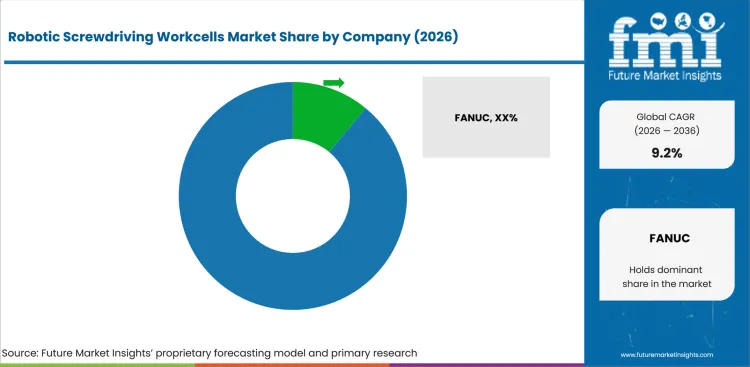
- FANUC, ABB Robotics and Universal Robots compete through robot platforms that support application-ready screwdriving cells.
- Atlas Copco, WEBER Schraubautomaten and DEPRAG influence tool selection through torque control, screw feeding and service depth.
- Analyst Opinion
- Nikhil Kaitwade, Principal Consultant at Future Market Insights for industrial domain, says, “Robotic screwdriving workcells are moving from labor-saving equipment to quality-data equipment. Buyers now ask whether every fastening cycle can be traced, whether stripped threads can be caught early, and whether the same cell can support the next product variant. A robot arm alone is not enough if the feeder jams or the torque file cannot pass customer audit. The stronger suppliers will combine motion control, screw presentation, part locating, torque records and service support into one accountable package.”
Factory automation planning is moving toward documented fastening because robot cell buyers now expect trace files, safety checks, feeder reliability and simpler commissioning. IFR reported 542,076 industrial robots installed in 2024 and stated that Asia accounted for 74% of new deployments, showing the scale of factory automation capacity that can absorb screwdriving cells.
ABB also launched OmniCore in June 2024 after a USD 170 million control platform investment, which signals stronger controller support for robot cells that need tool communication, motion stability and future software updates. Suppliers that combine robot arms, torque tools, feeders, fixtures and validation records should gain preference as buyers compare workcell accountability rather than arm price alone. For adjacent automation trends, FMI’s industrial robotics market analysis also indicates how broader robot investment supports specialized cell adoption.
The robotic screwdriving workcells market is expected to witness steady expansion through 2036, driven by demand from electronics, automotive components and precision assembly lines seeking repeatable screw fastening. Market expansion is further supported by the need for torque data, line flexibility and reduced rework in compact production environments.
Which factors support expansion in the robotic screwdriving workcells market?
Configured workcell revenue, torque data capture and integrated service support strengthen market value across factory assembly channels.
- Market value is supported by configured workcell revenue before service contracts and software add incremental sales.
- Supplier pricing reflects robot platform cost, screwdriver quality and screw feeding reliability before validation software affects project margin.
- Revenue improves as manufacturers move from manual torque tools to controlled robot cells with documented fastening records.
- Factory trust rises when workcell dashboards make torque, angle, cycle status and reject handling easier to compare.
Why is the robotic screwdriving workcells market growing?
Manufacturers are adopting robotic screwdriving workcells as fastening data becomes part of product release and customer audit.
Screwdriving automation is growing because electronics and automotive plants need repeatable fastening, compact layouts and traceable process records before products move downstream. IFR reported 128,899 industrial robot installations in electrical and electronics in 2024, making the sector the largest customer industry for robots. This matters for screwdriving cells because electronics assembly uses compact screws, tight spacing and high product volumes that need repeatable Z-axis force. Buyers also need defect flags before housings close or modules move downstream. Automotive component suppliers are adding similar requirements as sensors, lighting modules, EV power electronics and interiors need controlled fastening tied to production records. Suppliers able to combine force control, screw feeding and traceable tightening files can defend higher system prices while supporting related demand for the robot controller and integrator market outlook.
How is the robotic screwdriving workcells market segmented?
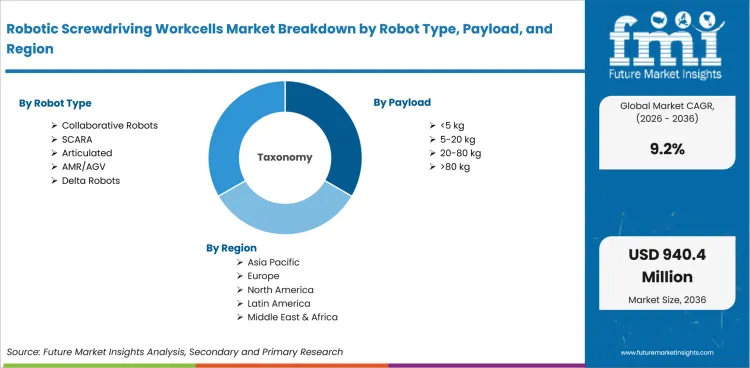
The robotic screwdriving workcells industry is segmented by robot type, payload, application, end-use industry, and workcell configuration.
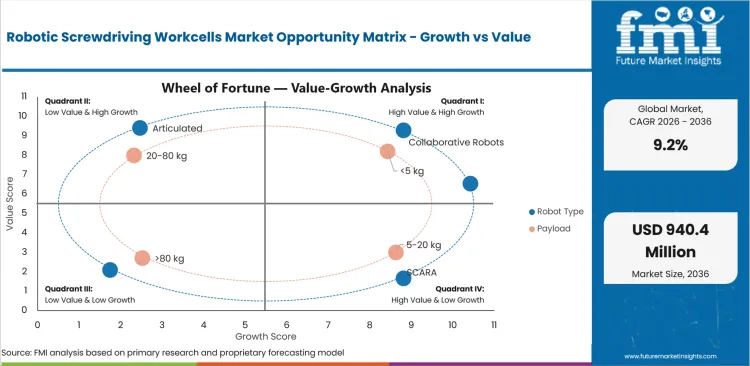
- Collaborative Robots are projected to secure 38.0% share in 2026, led by operator-accessible cells that support loading, inspection and rework in high-mix plants.
- The <5 kg payload class is expected to hold 52.0% share in 2026 since most screwdrivers, bits and vacuum pickup heads stay within compact payload limits.
- Assembly is anticipated to account for 46.5% share in 2026 because fastening is one of the most repeated operations in discrete production.
- Electronics is forecast to represent 39.0% share in 2026 due to miniature screw use, high line repeatability and strong demand for missing-screw detection.
- Standalone workcells are projected to account for 49.5% share in 2026 as self-contained stations simplify validation, operator loading and layout changes.
Why do collaborative robots dominate robotic screwdriving workcells?
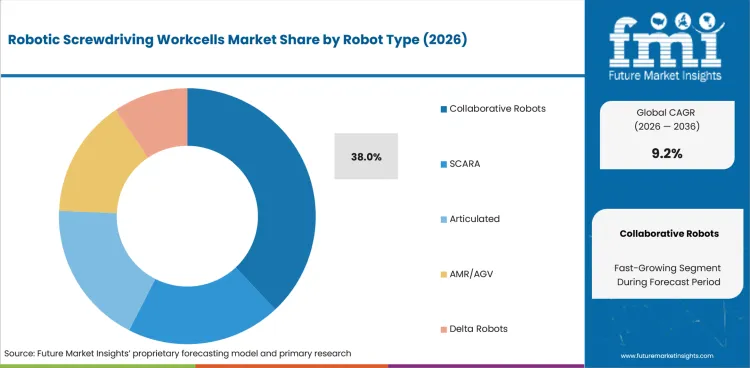
- Collaborative Robots are projected to account for 38.0% share in 2026, influenced by high-mix assembly lines that need safe operator access for loading, inspection and rework.
- SCARA robots gain use in fixed-position fastening where cycle speed and repeatability matter more than redeployable operator-side layouts.
Which payload class leads robotic screwdriving workcells?
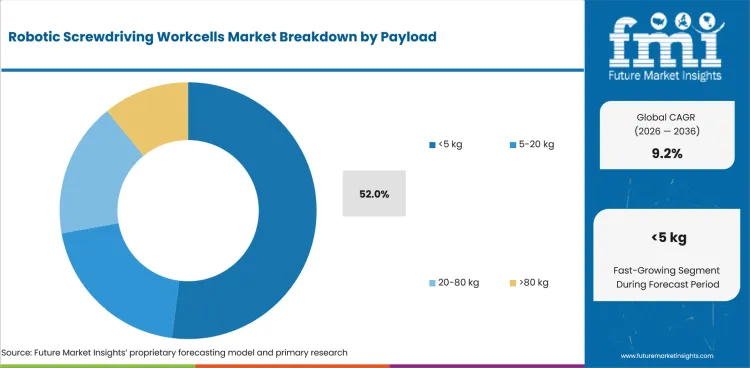
- The <5 kg class is estimated to hold 52.0% share in 2026 through lightweight screwdrivers, compact bits and low-mass pickup heads.
- Higher payload classes gain value when dual tools, heavy cable packages or part-positioning fixtures increase wrist load requirements.
Which application leads robotic screwdriving workcells?
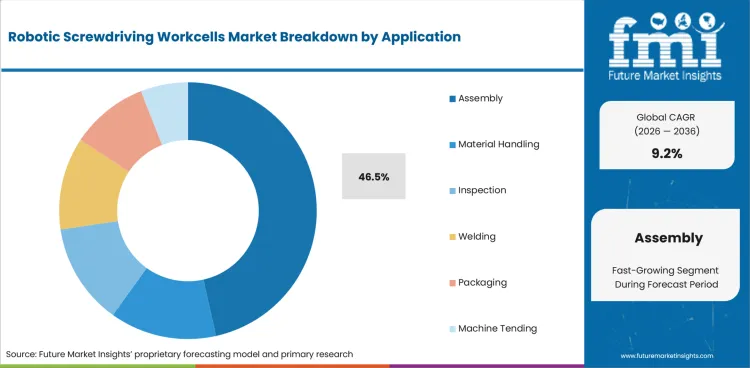
- Assembly is anticipated to hold 46.5% share in 2026, reflected by fastening remaining central to repeatable product build quality.
- Inspection-linked screwdriving gains importance as buyers combine vision checks with torque records to reduce hidden fastening defects.
Which end-use industry leads robotic screwdriving workcells?
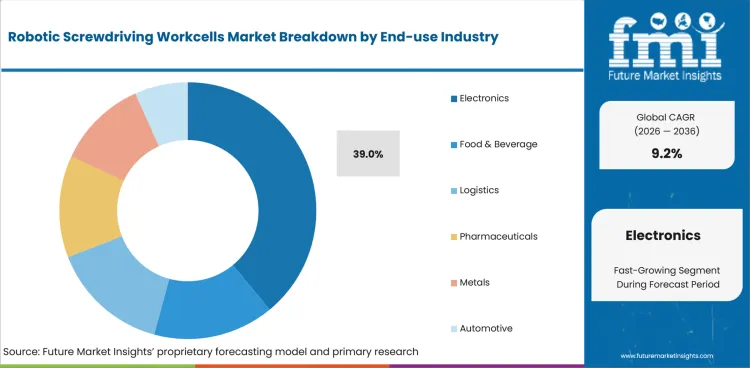
- Electronics is forecast to capture 39.0% share in 2026, supported by small screws, tight product spacing and high-volume assembly needs.
- Automotive gains value as EV modules, lighting assemblies and sensors require traceable tightening linked with warranty control.
Which workcell configuration leads robotic screwdriving workcells?
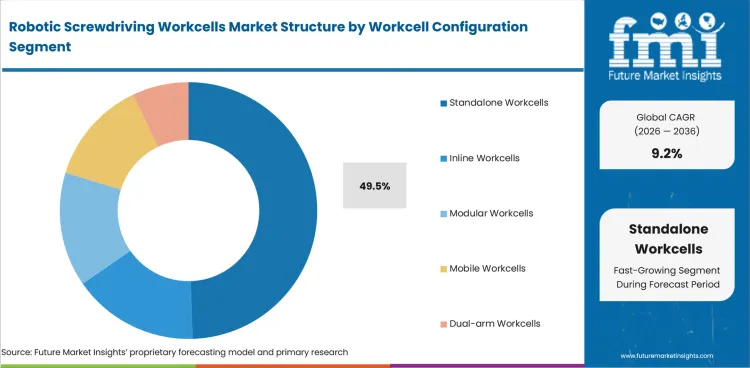
- Standalone workcells are projected to hold 49.5% share in 2026, shaped by easier factory acceptance testing and flexible line placement.
- Inline workcells gain use when high-volume assembly plants need screwdriving to match takt time without manual transfer steps.
What are the driver, restraints, and opportunities in the robotic screwdriving workcells market?
Torque traceability and compact automation support demand while feeder uptime and integration skill gaps limit wider deployment.
- Quality teams are replacing manual torque sampling with workcells that document every fastening cycle, giving production managers clearer evidence for audits and warranty claims.
- Feeder jams, bit wear, and fixture changeovers reduce uptime when screw geometry varies across product families, making application engineering central to adoption.
- Offline simulation and application-ready cobot packages can shorten validation for smaller manufacturers that need fastening automation without large internal robotics teams.
Torque Record Demand Outlook
Demand outlook is moving toward closed-loop fastening cells that can prove tool status, torque window and reject handling before wider line rollout. IFR reported 126,088 industrial robot installations in the automotive industry in 2024, confirming a large installed environment for validated fastening automation. Automotive modules, EV electronics and interior assemblies create many screwdriving points where a missing torque file can delay release. Suppliers that connect robot position, driver feedback and station audit records should gain stronger acceptance in plants serving warranty-sensitive customers.
Feeder Reliability and Integration Restraint
Feeding is often the weakest part of a screwdriving workcell because screws vary by length, head geometry, plating and magnetism. ISO 10218-2:2025 covers industrial robot applications and robot cells, including safeguarding during integration, commissioning, functional testing, operation, maintenance and repair. That broader safety and integration burden can extend project timelines when buyers lack trained automation teams. Vendors should prove feeder uptime with real screws and parts before final acceptance rather than relying on catalog cycle-time claims.
Simulation and Modular Workcell Opportunity
Simulation is becoming a practical sales tool because plants want fewer failed installations and faster approval. IFR forecast global robot installations to grow to 575,000 units in 2025 and to surpass 700,000 units by 2028, showing that buyers are still planning automation even when regional cycles vary. Screwdriving suppliers can use offline workcell planning to check reach, fixture clearance, tool approach and operator access before hardware spending. This helps smaller manufacturers evaluate the collaborative robots market outlook alongside full cell cost.
Which countries are growing fastest in the robotic screwdriving workcells market?
China 10.8% CAGR, India 10.4% CAGR, South Korea 9.8% CAGR, United States 9.4% CAGR, Japan 8.7% CAGR, France 8.6% CAGR, Germany 8.3% CAGR, and United Kingdom 8.1% CAGR through 2036.
.webp "Top Country Growth Comparison Robotic Screwdriving Workcells Market Cagr (2026 2036)")
| Country | CAGR |
| China | 10.8% |
| India | 10.4% |
| South Korea | 9.8% |
| United States | 9.4% |
| Japan | 8.7% |
| France | 8.6% |
| Germany | 8.3% |
| United Kingdom | 8.1% |
Source: Future Market Insights, 2026.
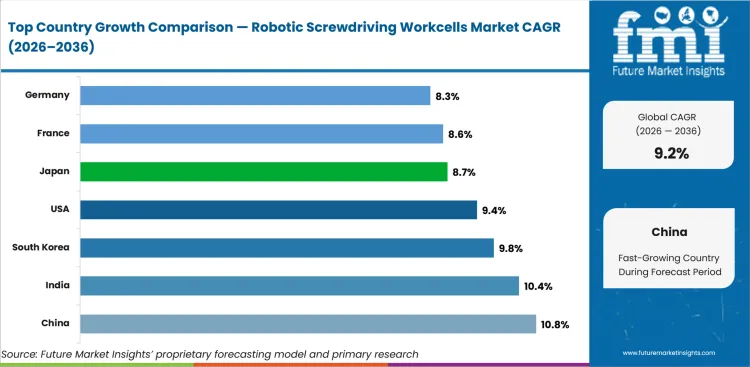
How do country-level CAGRs compare in the robotic screwdriving workcells market?
China leads country expansion while the United Kingdom records the most cautious profile among profiled markets.
- China is forecast to record 10.8% CAGR by 2036 as electronics scale and local robot supply reinforce demand.
- India is expected to expand at 10.4% CAGR through 2036 as automotive electronics and appliance lines automate fastening.
- South Korea is projected to grow at 9.8% CAGR by 2036 with electronics, batteries, and automotive components supporting compact cells.
- The United States is estimated to rise at 9.4% CAGR through 2036 as integrator-led purchasing supports traceable workcell adoption.
- Japan is expected to advance at 8.7% CAGR by 2036 as precision assembly lines refresh robot cells.
- France is forecast to expand at 8.6% CAGR through 2036 as aerospace and precision manufacturing drive selective projects.
- Germany is projected to post 8.3% CAGR by 2036 as mature buyers upgrade fastening systems under strict validation rules.
- The United Kingdom is expected to grow at 8.1% CAGR through 2036 as smaller manufacturers adopt low-complexity workcells.
What is driving robotic screwdriving workcells growth in China?
A 10.8% CAGR through 2036 is supported by electronics scale, EV assembly, and local robot supplier depth.
Country Market Snapshot Table
| Parameter | Value |
| Market Size in 2025 (Value) | USD 106.5 million |
| Market Size in 2026 (Value) | USD 118.0 million |
| Market Forecast in 2036 (Value) | USD 329.1 million |
| CAGR (2026 to 2036) | 10.8% |
| Years Considered | 2021 to 2036 |
| Base Year | 2025 |
| Forecast Period | 2026 to 2036 |
| Units Considered | Value (USD million) |
| Leading Sub-Region | Guangdong and Yangtze River Delta electronics clusters |
China Robotic Screwdriving Workcells Market Outlook
- China robotic screwdriving workcell demand is shaped by electronics scale, EV component production, and domestic robot supplier growth. Plants use these systems when high-speed tightening must be linked with station-level records.
- Industrial buyers compare local robot arms, imported torque tools, and integrator service coverage. Vendors with feeder reliability, rapid fixture adaptation, and local spare parts should gain stronger project conversion.
Key Growth Drivers
- Guangdong and Jiangsu electronics clusters need high-speed fastening cells for consumer and industrial devices. IFR reported China installed 295,045 industrial robots in 2024.
- Local robot production supports shorter lead times and lower-cost workcell configurations. IFR reported China accounted for 54.0% of global robot installations in 2024.
- EV component plants use screwdriving workcells for modules, housings, and power electronics assemblies.
- Regional integrators compete on fast fixture adaptation and local service coverage for high-volume assembly buyers.
Key Restraints
- Domestic price competition can compress margins for foreign robot and tool suppliers.
- Buyers may prioritize fast delivery over long validation, which can raise later uptime risk.
- Integration quality risk remains important because China’s National Bureau of Statistics reported a 95.5% product sales rate for large industrial enterprises in January-February 2025.
What makes China unique
China is unique for combining the world’s largest robot installation volume with a fast-growing domestic robot supplier base.
Key Companies
- ABB Robotics China
- FANUC China
- KUKA Robotics China
- Universal Robots China
- Estun Automation
- Siasun Robot & Automation
- Inovance Technology
Sales & Marketing Channels
- Local system integrators
- Direct enterprise sales
- Electronics OEM procurement
- EV supplier RFQs
- Regional distributor networks
- Application demo centers
Country Segment Breakdown Table
| Segment | Sub-Segments |
| By Robot Type | Collaborative Robots · SCARA · Articulated · AMR/AGV · Delta Robots |
| By Payload | <5 kg · 5-20 kg · 20-80 kg · >80 kg |
| By Application | Material Handling · Inspection · Assembly · Welding · Packaging · Machine Tending |
| By End-use Industry | Automotive · Electronics · Food & Beverage · Logistics · Pharmaceuticals · Metals |
| By Workcell Configuration | Standalone Workcells · Inline Workcells · Modular Workcells · Mobile Workcells · Dual-arm Workcells |
| Key Sub-Regions Covered, Industrial Assembly Clusters | Guangdong · Jiangsu · Shanghai · Zhejiang · Chongqing · Shandong |
Frequently Asked Questions
How fast is China robotic screwdriving workcells market growing?
Sales in China are ready to scale at 10.8% CAGR from 2026 to 2036, guided by electronics automation and domestic robot supply depth.
Who leads China robotic screwdriving workcells market?
ABB Robotics China, FANUC China, KUKA Robotics China, and Universal Robots China compete based on robot platforms, fastening tools, integration support, and local service reach.
What is driving adoption in China robotic screwdriving workcells market?
Electronics scale, EV component assembly, and local integrator capacity are moving China buyers toward robotic screwdriving workcells.
What is the robotic screwdriving workcells market outlook in India?
A 10.4% CAGR through 2036 reflects expanding electronics, automotive components, and appliance assembly capacity.
Country Market Snapshot Table
| Parameter | Value |
| Market Size in 2025 (Value) | USD 15.4 million |
| Market Size in 2026 (Value) | USD 17.0 million |
| Market Forecast in 2036 (Value) | USD 45.7 million |
| CAGR (2026 to 2036) | 10.4% |
| Years Considered | 2021 to 2036 |
| Base Year | 2025 |
| Forecast Period | 2026 to 2036 |
| Units Considered | Value (USD million) |
| Leading Sub-Region | Pune, Chennai, Noida, and southern electronics corridors |
India Robotic Screwdriving Workcells Market Outlook
- India robotic screwdriving workcell demand is shaped by electronics manufacturing, automotive components, appliance assembly, and phased factory automation. Plants use these systems when manual fastening becomes a bottleneck in repeatable high-volume tasks.
- Industrial sales rely on regional system integrators, direct plant-level sales, distributor demonstrations, and training-linked service packages. Brands that offer phased automation and accessible support should gain better conversion among first-time buyers.
Key Growth Drivers
- Automotive suppliers in Pune, Chennai, and Sanand need repeatable fastening for modules and electronics. IFR reported India reached a record 9,120 industrial robot installations in 2024.
- Mobile device assembly supports compact screwdriving cells in Noida and southern electronics clusters. PIB reported India had more than 300 mobile manufacturing units by December 2024.
- Appliance plants adopt workcells when manual fastening becomes a bottleneck in high-volume lines.
- Phased automation packages help buyers control risk before expanding traceable fastening across multiple lines.
Key Restraints
- Smaller manufacturers can delay purchases when the payback case depends only on labor savings.
- Imported components and service gaps can raise maintenance risk outside major industrial corridors.
- Cost pressure can limit premium tool adoption because PIB stated the PM E-DRIVE scheme requires minimum 50.0% domestic value addition for incentives.
What makes India unique
India is unique for combining high expansion potential with buyer demand for low-risk phased automation packages.
Key Companies
- FANUC India Pvt. Ltd.
- ABB India Robotics
- Universal Robots India
- Omron Automation India
- Atlas Copco India
- Yaskawa India
- Tata Automation Ltd.
Sales & Marketing Channels
- Regional system integrators
- Direct plant-level sales
- Automotive supplier RFQs
- Electronics EMS procurement
- Distributor-led demonstrations
- Training and service packages
Country Segment Breakdown Table
| Segment | Sub-Segments |
| By Robot Type | Collaborative Robots · SCARA · Articulated · AMR/AGV · Delta Robots |
| By Payload | <5 kg · 5-20 kg · 20-80 kg · >80 kg |
| By Application | Material Handling · Inspection · Assembly · Welding · Packaging · Machine Tending |
| By End-use Industry | Automotive · Electronics · Food & Beverage · Logistics · Pharmaceuticals · Metals |
| By Workcell Configuration | Standalone Workcells · Inline Workcells · Modular Workcells · Mobile Workcells · Dual-arm Workcells |
| Key Sub-Regions Covered, Industrial Assembly Clusters | Pune · Chennai · Sanand · Noida · Bengaluru · Hyderabad |
Frequently Asked Questions
How fast is India robotic screwdriving workcells market growing?
Sales in India are ready to scale at 10.4% CAGR from 2026 to 2036, guided by electronics, appliances, and automotive component automation.
Who leads India robotic screwdriving workcells market?
FANUC India Pvt. Ltd., ABB India Robotics, Universal Robots India, and Omron Automation India compete based on robot platforms, fastening tools, integration support, and local service reach.
What is driving adoption in India robotic screwdriving workcells market?
Traceable fastening, compact assembly work, and phased automation packages are moving India buyers toward robotic screwdriving workcells.
How fast is the robotic screwdriving workcells market growing in South Korea?
A 9.8% CAGR through 2036 reflects electronics, battery, and automotive component demand for compact traceable cells.
Country Market Snapshot Table
| Parameter | Value |
| Market Size in 2025 (Value) | USD 26.0 million |
| Market Size in 2026 (Value) | USD 28.5 million |
| Market Forecast in 2036 (Value) | USD 72.6 million |
| CAGR (2026 to 2036) | 9.8% |
| Years Considered | 2021 to 2036 |
| Base Year | 2025 |
| Forecast Period | 2026 to 2036 |
| Units Considered | Value (USD million) |
| Leading Sub-Region | Gyeonggi-do and battery manufacturing corridors |
South Korea Robotic Screwdriving Workcells Market Outlook
- South Korea robotic screwdriving workcell demand is shaped by electronics, batteries, displays, and automotive components with high supplier qualification standards. Plants use these systems when screw seating, feeder uptime, and traceable tightening must meet strict process requirements.
- Industrial buying depends on large-group procurement, certified integrators, and application validation labs. Brands with compact cell designs and robust feeder testing should gain stronger repeat order potential.
Key Growth Drivers
- Electronics and display plants around Gyeonggi-do need precise fastening for compact assemblies. IFR reported Korea recorded 1,220 robots per 10,000 employees in 2024.
- Semiconductor and battery manufacturing reinforce demand for compact assembly automation. The International Trade Administration reported South Korea semiconductor output rose 13.2% year on year in 2025.
- Automotive component plants require documented tightening for sensors and control modules.
- Large buyers encourage repeated installations when suppliers can prove feeder uptime and torque record integrity.
Key Restraints
- Large buyer qualification processes can slow entry for smaller foreign suppliers that lack proven local support.
- High uptime expectations make feeder failures a serious barrier to repeat orders in electronics and battery assembly lines.
- Equipment investment caution can slow workcell approvals because Korea’s Ministry of Data and Statistics reported the Equipment Investment Index decreased 14.1% month-on-month in October 2025.
What makes South Korea unique
South Korea is unique for demanding high-throughput compact cells in electronics and battery environments with strict supplier qualification.
Key Companies
- Hyundai Robotics
- Doosan Robotics
- ABB Robotics Korea
- Universal Robots Korea
- FANUC Korea
- Yaskawa Korea
- Atlas Copco Korea
Sales & Marketing Channels
- Electronics group procurement
- Battery supplier RFQs
- Certified integrator channels
- Direct technical sales
- Application validation labs
- Service-led upgrade programs
Country Segment Breakdown Table
| Segment | Sub-Segments |
| By Robot Type | Collaborative Robots · SCARA · Articulated · AMR/AGV · Delta Robots |
| By Payload | <5 kg · 5-20 kg · 20-80 kg · >80 kg |
| By Application | Material Handling · Inspection · Assembly · Welding · Packaging · Machine Tending |
| By End-use Industry | Automotive · Electronics · Food & Beverage · Logistics · Pharmaceuticals · Metals |
| By Workcell Configuration | Standalone Workcells · Inline Workcells · Modular Workcells · Mobile Workcells · Dual-arm Workcells |
| Key Sub-Regions Covered, Industrial Assembly Clusters | Gyeonggi-do · Seoul · Incheon · Ulsan · Busan · Chungcheong |
Frequently Asked Questions
How fast is South Korea robotic screwdriving workcells market growing?
Sales in South Korea are ready to scale at 9.8% CAGR from 2026 to 2036, guided by electronics, batteries, and compact automation.
Who leads South Korea robotic screwdriving workcells market?
Hyundai Robotics, Doosan Robotics, ABB Robotics Korea, and Universal Robots Korea compete based on robot platforms, fastening tools, integration support, and local service reach.
What is driving adoption in South Korea robotic screwdriving workcells market?
Electronics, battery production, and strict qualification requirements are moving South Korea buyers toward robotic screwdriving workcells.
What is the robotic screwdriving workcells market outlook in the United States?
A 9.4% CAGR through 2036 reflects integrator-led buying and traceable fastening demand across advanced assembly plants.
Country Market Snapshot Table
| Parameter | Value |
| Market Size in 2025 (Value) | USD 62.2 million |
| Market Size in 2026 (Value) | USD 68.0 million |
| Market Forecast in 2036 (Value) | USD 167.0 million |
| CAGR (2026 to 2036) | 9.4% |
| Years Considered | 2021 to 2036 |
| Base Year | 2025 |
| Forecast Period | 2026 to 2036 |
| Units Considered | Value (USD million) |
| Leading Sub-Region | South Atlantic and Midwest assembly corridors |
United States Robotic Screwdriving Workcells Market Outlook
- United States robotic screwdriving workcell demand is shaped by integrator-led procurement, automotive component manufacturing, and electronics assembly requirements. Plants use these systems when fastening records, reject handling, and station uptime must be documented before production release.
- Industrial buying depends on system integrators, OEM application labs, and plant-level procurement teams. Brands with local service response, training support, and feeder trials should gain stronger buyer confidence.
Key Growth Drivers
- Automotive component plants in Michigan and Ohio use fastening traceability to reduce warranty exposure. IFR reported the United States installed 34,164 industrial robots in 2024.
- Medical device and electronics assembly in Minnesota and California support compact cells with clean process records. The USA Census Bureau reported durable goods orders of USD 346.0 billion in April 2026.
- Domestic integrators in the Midwest reduce project risk by qualifying feeders before plant acceptance.
- Large plants prefer suppliers that can train operators and connect torque records with existing manufacturing execution systems.
Key Restraints
- Imported robot and fastening tool supply can lengthen lead times when tariff, freight, or controller availability risk increases.
- Small manufacturers can delay projects when in-house programming skill is limited and production engineers are already stretched.
- Automation staffing remains a restraint because BLS projects nearly 1.0 million production occupation openings each year from 2024 to 2034.
What makes the United States unique
The United States is unique for its integrator-heavy buying model, where workcell accountability often matters more than individual robot brand choice.
Key Companies
- FANUC America Corporation
- ABB Robotics USA
- Universal Robots USA
- Atlas Copco Tools and Assembly Systems LLC
- OnRobot US Inc.
- Southwestern PTS
- HA Industries Inc.
Sales & Marketing Channels
- Direct enterprise sales
- Robot system integrators
- Distributor-led tool packages
- Automotive supplier RFQs
- Trade show demonstrations
- Application lab trials
Country Segment Breakdown Table
| Segment | Sub-Segments |
| By Robot Type | Collaborative Robots · SCARA · Articulated · AMR/AGV · Delta Robots |
| By Payload | <5 kg · 5-20 kg · 20-80 kg · >80 kg |
| By Application | Material Handling · Inspection · Assembly · Welding · Packaging · Machine Tending |
| By End-use Industry | Automotive · Electronics · Food & Beverage · Logistics · Pharmaceuticals · Metals |
| By Workcell Configuration | Standalone Workcells · Inline Workcells · Modular Workcells · Mobile Workcells · Dual-arm Workcells |
| Key Sub-Regions Covered, Industrial Assembly Clusters | Southeast · Midwest · Texas · California · New York · Pacific Northwest |
Frequently Asked Questions
How fast is United States robotic screwdriving workcells market growing?
Sales in the United States are ready to scale at 9.4% CAGR from 2026 to 2036, guided by assembly automation and fastening traceability.
Who leads United States robotic screwdriving workcells market?
FANUC America Corporation, ABB Robotics USA, Universal Robots USA, and Atlas Copco Tools and Assembly Systems LLC compete based on robot platforms, fastening tools, integration support, and local service reach.
What is driving adoption in United States robotic screwdriving workcells market?
Traceable fastening, compact assembly work, and system integrator support are moving United States buyers toward robotic screwdriving workcells.
What is the robotic screwdriving workcells market forecast for Japan?
An 8.7% CAGR through 2036 reflects precision assembly culture and strong domestic robot platform availability.
Country Market Snapshot Table
| Parameter | Value |
| Market Size in 2025 (Value) | USD 43.2 million |
| Market Size in 2026 (Value) | USD 47.0 million |
| Market Forecast in 2036 (Value) | USD 108.2 million |
| CAGR (2026 to 2036) | 8.7% |
| Years Considered | 2021 to 2036 |
| Base Year | 2025 |
| Forecast Period | 2026 to 2036 |
| Units Considered | Value (USD million) |
| Leading Sub-Region | Tokyo and central precision manufacturing corridors |
Japan Robotic Screwdriving Workcells Market Outlook
- Japan robotic screwdriving workcell demand is shaped by local assembly depth, automation maturity, and buyer expectations for fastening documentation. Plants use these systems when screw torque, reject handling, and station uptime must be documented before production release.
- Industrial sales depend on integrators, OEM application labs, and plant-level procurement. Brands with clear service response, training support, and feeder trials should gain stronger buyer confidence.
Key Growth Drivers
- Electronics assembly in Nagano and Kyushu supports compact screwdriving cells for small product formats. IFR reported Japan installed 44,453 industrial robots in 2024.
- Electronics device and component producers support small fastening demand. JEITA reported July 2025 Japanese electronics production at 1,021,694 million yen, equal to 100.7% of the previous-year level.
- Domestic robot OEMs reduce buyer risk through local application engineering and spare part availability.
- Precision equipment plants favor compact cells that can match takt time while preserving clean operator access.
Key Restraints
- Mature factories often need a clear quality gain before replacing existing screwdriving automation with new robotic workcells.
- Space-constrained plants require compact cells with careful fixture planning, cable routing, and maintenance access.
- Production forecast uncertainty can slow new cell approvals because METI expected Japanese production to decrease 1.2% in November 2025 and 2.0% in December 2025.
What makes Japan unique
Japan is unique for the overlap of robot manufacturing strength and precision assembly culture in compact factory layouts.
Key Companies
- FANUC Corporation
- Epson Robots
- Kawasaki Robotics
- Yaskawa Electric Corporation
- Yamaha Robotics
- Atlas Copco Japan
- Universal Robots Japan
Sales & Marketing Channels
- Direct robot OEM sales
- Precision equipment integrators
- Automotive supplier RFQs
- Electronics factory trials
- Distributor technical support
- Service-based upgrade programs
Country Segment Breakdown Table
| Segment | Sub-Segments |
| By Robot Type | Collaborative Robots · SCARA · Articulated · AMR/AGV · Delta Robots |
| By Payload | <5 kg · 5-20 kg · 20-80 kg · >80 kg |
| By Application | Material Handling · Inspection · Assembly · Welding · Packaging · Machine Tending |
| By End-use Industry | Automotive · Electronics · Food & Beverage · Logistics · Pharmaceuticals · Metals |
| By Workcell Configuration | Standalone Workcells · Inline Workcells · Modular Workcells · Mobile Workcells · Dual-arm Workcells |
| Key Sub-Regions Covered, Industrial Assembly Clusters | Tokyo · Nagoya · Osaka · Kyushu · Nagano · Shizuoka |
Frequently Asked Questions
How fast is Japan robotic screwdriving workcells market growing?
Sales in Japan are ready to scale at 8.7% CAGR from 2026 to 2036, guided by precision assembly and domestic robot platform depth.
Who leads Japan robotic screwdriving workcells market?
FANUC Corporation, Epson Robots, Kawasaki Robotics, and Yaskawa Electric Corporation compete based on robot platforms, fastening tools, integration support, and local service reach.
What is driving adoption in Japan robotic screwdriving workcells market?
Traceable fastening, compact assembly work, and domestic robot engineering are moving Japan buyers toward robotic screwdriving workcells.
What is driving robotic screwdriving workcells growth in France?
An 8.6% CAGR through 2036 is supported by aerospace assembly, automotive components, and selective precision automation.
Country Market Snapshot Table
| Parameter | Value |
| Market Size in 2025 (Value) | USD 16.6 million |
| Market Size in 2026 (Value) | USD 18.0 million |
| Market Forecast in 2036 (Value) | USD 41.1 million |
| CAGR (2026 to 2036) | 8.6% |
| Years Considered | 2021 to 2036 |
| Base Year | 2025 |
| Forecast Period | 2026 to 2036 |
| Units Considered | Value (USD million) |
| Leading Sub-Region | Toulouse and northern automotive clusters |
France Robotic Screwdriving Workcells Market Outlook
- France robotic screwdriving workcell demand is anchored in aerospace, precision equipment, automotive components, and selective industrial modernization. Buyers use these cells when fastening quality and process evidence outweigh basic labor-saving arguments.
- Procurement often depends on integrators that can combine safety documentation, feeder qualification, and operator training. Suppliers with realistic payback cases and field support can win projects in smaller factories.
Key Growth Drivers
- Aerospace assembly around Toulouse supports validated fastening and documented process checks. GIFAS reported French aerospace and defence turnover reached EUR 73.2 billion in 2024.
- Automotive suppliers in northern and eastern France use automation to stabilize component assembly. France’s new vehicle market recorded 1,718,417 passenger car registrations in 2024.
- SME modernization programs encourage practical workcells with short training needs.
- Regional integrator networks help buyers test fixtures and torque records before equipment rollout.
Key Restraints
- Payback scrutiny can delay projects in smaller factories with low screwdriving volume.
- Integration talent shortages can extend lead times for custom fixtures and safety review.
- Robot demand volatility can slow cautious buyers because IFR reported France installed 4,900 industrial robots in 2024, down 24.0% from the previous year.
What makes France unique
France is unique for selective demand in aerospace and precision assembly, where documentation quality can outweigh pure cycle speed.
Key Companies
- ABB Robotics France
- FANUC France
- Universal Robots France
- KUKA France
- Atlas Copco France
- Staubli Robotics
- OnRobot France
Sales & Marketing Channels
- Aerospace supplier procurement
- Industrial automation distributors
- Regional integrator networks
- Training-led sales programs
- Factory trials with real parts
- Maintenance service contracts
Country Segment Breakdown Table
| Segment | Sub-Segments |
| By Robot Type | Collaborative Robots · SCARA · Articulated · AMR/AGV · Delta Robots |
| By Payload | <5 kg · 5-20 kg · 20-80 kg · >80 kg |
| By Application | Material Handling · Inspection · Assembly · Welding · Packaging · Machine Tending |
| By End-use Industry | Automotive · Electronics · Food & Beverage · Logistics · Pharmaceuticals · Metals |
| By Workcell Configuration | Standalone Workcells · Inline Workcells · Modular Workcells · Mobile Workcells · Dual-arm Workcells |
| Key Sub-Regions Covered, Industrial Assembly Clusters | Toulouse · Île-de-France · Hauts-de-France · Grand Est · Auvergne-Rhône-Alpes · Pays de la Loire |
Frequently Asked Questions
How fast is France robotic screwdriving workcells market growing?
Sales in France are ready to scale at 8.6% CAGR from 2026 to 2036, guided by aerospace and precision assembly automation.
Who leads France robotic screwdriving workcells market?
ABB Robotics France, FANUC France, Universal Robots France, and Staubli Robotics compete based on automation platforms and integrator support.
What is driving adoption in France robotic screwdriving workcells market?
Aerospace quality documentation and selective factory modernization are moving France buyers toward screwdriving workcells.
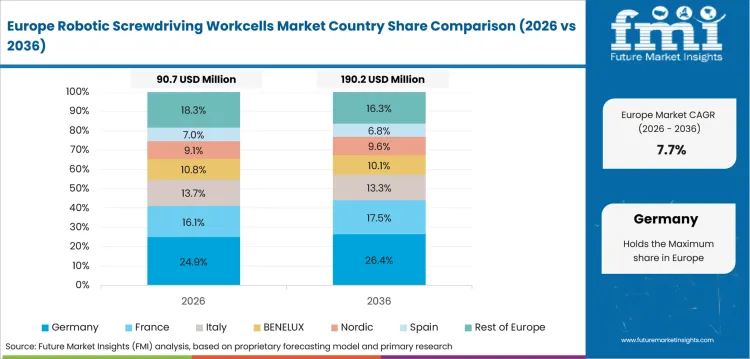
How is the robotic screwdriving workcells market performing in Germany?
An 8.3% CAGR through 2036 reflects mature automation depth and strict acceptance criteria in automotive and machinery assembly.
Country Market Snapshot Table
| Parameter | Value |
| Market Size in 2025 (Value) | USD 36.0 million |
| Market Size in 2026 (Value) | USD 39.0 million |
| Market Forecast in 2036 (Value) | USD 86.6 million |
| CAGR (2026 to 2036) | 8.3% |
| Years Considered | 2021 to 2036 |
| Base Year | 2025 |
| Forecast Period | 2026 to 2036 |
| Units Considered | Value (USD million) |
| Leading Sub-Region | Bavaria and Baden-Württemberg supplier networks |
Germany Robotic Screwdriving Workcells Market Outlook
- Germany robotic screwdriving workcell demand is shaped by automation maturity and strict production acceptance criteria. Plants use these systems where fastening repeatability, line safety, and torque records must meet customer audit requirements.
- Industrial buying is led by OEM procurement teams, Tier supplier RFQs, machinery builders, and certified integrators. Brands with documented performance tests and local service contracts should gain stronger project acceptance.
Key Growth Drivers
- Bavarian and Baden-Württemberg automotive suppliers need traceable screwdriving for modules and electronic assemblies. IFR reported Germany installed 26,982 industrial robots in 2024.
- Machinery builders use robotic fastening to stabilize output when skilled labor is tight. Germany Trade & Invest reported robotics and automation industry turnover at EUR 15.2 billion in 2024.
- Dense integrator capacity lets buyers combine robot arms, feeders, safety systems, and fixture engineering under one project scope.
- Formal factory acceptance testing favors vendors with documented torque records and validated operator safety procedures.
Key Restraints
- Automotive investment cycles can delay fastening workcell orders during platform uncertainty.
- Strict safety review raises upfront engineering time for collaborative and fenced screwdriving cells.
- Production uncertainty can slow capital release because Destatis reported industrial production down 4.3% month-on-month in August 2025.
What makes Germany unique
Germany is unique for its dense robot engineering ecosystem, which supports complex workcells but raises buyer expectations sharply.
Key Companies
- KUKA AG
- ABB Robotics Germany
- WEBER Schraubautomaten GmbH
- DEPRAG SCHULZ GmbH u. Co.
- Atlas Copco Tools Central Europe GmbH
- FANUC Deutschland GmbH
- Universal Robots Germany GmbH
Sales & Marketing Channels
- Direct OEM procurement
- Tier supplier RFQs
- Machinery builder partnerships
- Certified system integrators
- Factory acceptance testing
- Regional service contracts
Country Segment Breakdown Table
| Segment | Sub-Segments |
| By Robot Type | Collaborative Robots · SCARA · Articulated · AMR/AGV · Delta Robots |
| By Payload | <5 kg · 5-20 kg · 20-80 kg · >80 kg |
| By Application | Material Handling · Inspection · Assembly · Welding · Packaging · Machine Tending |
| By End-use Industry | Automotive · Electronics · Food & Beverage · Logistics · Pharmaceuticals · Metals |
| By Workcell Configuration | Standalone Workcells · Inline Workcells · Modular Workcells · Mobile Workcells · Dual-arm Workcells |
| Key Sub-Regions Covered, Industrial Assembly Clusters | Bavaria · Baden-Württemberg · North Rhine-Westphalia · Saxony · Lower Saxony · Hesse |
Frequently Asked Questions
How fast is Germany robotic screwdriving workcells market growing?
Sales in Germany are ready to scale at 8.3% CAGR from 2026 to 2036, guided by assembly automation and fastening traceability.
Who leads Germany robotic screwdriving workcells market?
KUKA, ABB Robotics Germany, WEBER Schraubautomaten, and DEPRAG compete based on robot platforms, fastening tools, integration support, and local service reach.
What is driving adoption in Germany robotic screwdriving workcells market?
Strict acceptance testing and mature machinery engineering are moving German buyers toward traceable robotic screwdriving cells.
How is the robotic screwdriving workcells market performing in the United Kingdom?
An 8.1% CAGR through 2036 reflects productivity pressure and demand for simple workcells among SME manufacturers.
Country Market Snapshot Table
| Parameter | Value |
| Market Size in 2025 (Value) | USD 12.5 million |
| Market Size in 2026 (Value) | USD 13.5 million |
| Market Forecast in 2036 (Value) | USD 29.4 million |
| CAGR (2026 to 2036) | 8.1% |
| Years Considered | 2021 to 2036 |
| Base Year | 2025 |
| Forecast Period | 2026 to 2036 |
| Units Considered | Value (USD million) |
| Leading Sub-Region | Midlands and aerospace manufacturing corridors |
United Kingdom Robotic Screwdriving Workcells Market Outlook
- United Kingdom robotic screwdriving workcell demand is shaped by local assembly depth, automation maturity, and buyer expectations for fastening documentation. Plants use these systems when screw torque, reject handling, and station uptime must be documented before production release.
- Industrial sales depend on integrators, OEM application labs, and plant-level procurement rather than open retail channels. Brands with clear service response, training support, and feeder trials should gain stronger buyer confidence.
Key Growth Drivers
- Aerospace suppliers around Bristol and Derby need traceable fastening in regulated component workflows. ADS reported that UK aerospace, defence, security, and space sectors contributed £42.2 billion in 2024.
- The Smart Machines 2035 Strategy gives robotics clearer national visibility, with the Department for Science, Innovation and Technology publishing the 10-year roadmap in February 2025.
- Food equipment makers and packaging machinery builders use compact screwdriving cells for repeatable subassembly without deep programming teams.
- Integrator-led sales help smaller factories compare payback, safety layouts, and operator training before hardware purchase.
Key Restraints
- Smaller buyers can defer workcell projects when payback is unclear or finance costs rise.
- Limited shop-floor robotics skill can slow acceptance testing and post-sale use across smaller manufacturing sites.
- Robot adoption volatility remains a restraint because IFR reported UK industrial robot installations down 35.0% to 2,500 units in 2024.
What makes United Kingdom unique
The United Kingdom is unique for a buyer base that needs low-complexity workcell packages to overcome a thinner automation skills pool.
Key Companies
- ABB Robotics UK
- Universal Robots UK
- Atlas Copco Tools UK
- OnRobot UK
- RNA Automation Ltd.
- FANUC UK Ltd.
- KUKA Robotics UK Ltd.
Sales & Marketing Channels
- Automation distributors
- Regional system integrators
- Aerospace supplier procurement
- SME productivity programs
- Trade association events
- Demonstration cells at automation shows
Country Segment Breakdown Table
| Segment | Sub-Segments |
| By Robot Type | Collaborative Robots · SCARA · Articulated · AMR/AGV · Delta Robots |
| By Payload | <5 kg · 5-20 kg · 20-80 kg · >80 kg |
| By Application | Material Handling · Inspection · Assembly · Welding · Packaging · Machine Tending |
| By End-use Industry | Automotive · Electronics · Food & Beverage · Logistics · Pharmaceuticals · Metals |
| By Workcell Configuration | Standalone Workcells · Inline Workcells · Modular Workcells · Mobile Workcells · Dual-arm Workcells |
| Key Sub-Regions Covered, Industrial Assembly Clusters | Midlands · Bristol · Derby · Manchester · London · Glasgow |
Frequently Asked Questions
How fast is United Kingdom robotic screwdriving workcells market growing?
Sales in the United Kingdom are ready to scale at 8.1% CAGR from 2026 to 2036, guided by assembly automation and fastening traceability.
Who leads United Kingdom robotic screwdriving workcells market?
ABB Robotics UK, Universal Robots UK, Atlas Copco Tools UK, and OnRobot UK compete based on robot platforms, fastening tools, integration support, and local service reach.
What is driving adoption in United Kingdom robotic screwdriving workcells market?
Traceable fastening, compact assembly work, and system integrator support are moving United Kingdom buyers toward robotic screwdriving workcells.
Who are the leading companies in the robotic screwdriving workcells market?
FANUC, ABB Robotics, Universal Robots, KUKA and Atlas Copco.
- Robot platform suppliers hold an advantage through installed controller ecosystems and plant standardization.
- Fastening tool specialists gain influence when buyers need torque records, screw feeding stability, and application trials.
- Integrators win projects by proving cycle time, fixture access, feeder reliability, and reject handling before plant rollout.
- Simulation-ready workcell packages support buyer confidence by reducing layout uncertainty and change orders.
Robot platform companies compete by making screwdriving easier to configure across collaborative, SCARA, and articulated robot formats. FANUC, ABB Robotics, KUKA, and Universal Robots support workcell adoption through controller ecosystems, application templates, service networks, and compatible peripherals. Their role is strongest when buyers already standardize robot brands across plants and want simpler training, spare parts, and safety documentation.
Fastening tool suppliers compete closer to the process problem. Atlas Copco, WEBER Schraubautomaten, DEPRAG, and ESTIC influence buying decisions through torque accuracy, driver control, screw feeding, and station audit records. Their position is critical because a robot arm cannot compensate for feeder jams, unstable screw presentation, or missing torque files. Buyers evaluating fastening-critical production lines often shortlist tool suppliers before finalizing the arm.
System integrators shape awards when factory layouts, fixtures, operator loading, and safety devices must work together. Smaller regional integrators can compete with global suppliers when they understand local parts, plant constraints, and maintenance expectations. Vendors that can package simulation, risk assessment, feeder trials, and staff training should gain more durable adoption than suppliers offering only catalog hardware.
How do top robotic screwdriving workcells companies compare?
FANUC and ABB Robotics lead on robot platform depth while Atlas Copco, WEBER, and DEPRAG lead on screwdriving process control.
| Company | Relevance to Market Title | Torque Data Integration | Screw Feeding Depth | Workcell Software Fit | Channel Reach | Geographic Footprint |
| FANUC | Very High | High | Medium | Very Strong | Very Strong | Global |
| ABB Robotics | Very High | Medium | Medium | Very Strong | Very Strong | Global |
| Universal Robots | Very High | Medium | Moderate | Very Strong | Strong | Global |
| KUKA | High | Medium | Medium | Strong | Strong | Global |
| Atlas Copco | Very High | Very Strong | Strong | Strong | Very Strong | Global |
| WEBER Schraubautomaten | High | Strong | Very Strong | Moderate | Strong | Europe and North America |
| DEPRAG | High | Very Strong | Very Strong | Moderate | Strong | Global |
| ESTIC | High | Very Strong | Strong | Moderate | Moderate | Asia and North America |
| OnRobot | Moderate to High | Moderate | Moderate | Strong | Strong | Global |
| Epson Robots | Moderate to High | Moderate | Moderate | Strong | Moderate | Asia and North America |
Source: Future Market Insights competitive analysis, 2026.
Who are the key players in the robotic screwdriving workcells market?
FANUC, ABB Robotics, Universal Robots, KUKA, Atlas Copco, WEBER Schraubautomaten, DEPRAG, OnRobot, ESTIC, Epson Robots, and specialist integrators are listed among major suppliers.
Key global companies leading the robotic screwdriving workcells market include:
- FANUC
- ABB Robotics
- Universal Robots
- KUKA
- Epson Robots
- Atlas Copco
- WEBER Schraubautomaten
- DEPRAG
- OnRobot
- ESTIC
- Southwestern PTS
- HA Industries
- MS Automation
Key Developments in Robotic Screwdriving Workcells Market
- In June 2025, Universal Robots launched UR Studio, an online simulation tool with pre-made templates for common applications including screwdriving, machine tending, palletizing, and pick-and-place.
- In April 2026, FANUC America debuted the CRX-3iA collaborative robot with 3 kg payload and 692 mm reach, positioning the model for small assembly, screwdriving, and inspection tasks.
- In April 2026, ABB Robotics launched the PoWa cobot family for compact industrial environments, with screwdriving and assembly included among targeted applications.
Key Players in the Robotic Screwdriving Workcells Market
Robot Platform Suppliers
- FANUC
- ABB Robotics
- Universal Robots
- KUKA
- Epson Robots
- Yaskawa
- Kawasaki Robotics
Fastening Tool and Screw Feeding Specialists
- Atlas Copco
- WEBER Schraubautomaten
- DEPRAG
- ESTIC
- OnRobot
- Design Tool Inc.
System Integrators and Regional Workcell Builders
- Southwestern PTS
- HA Industries
- MS Automation
- Acieta
- RNA Automation
- Local certified robot integrators
Robotic Screwdriving Workcells Market - Scope & Definition
| Attribute | Detail |
| Market Definition | Automated screw fastening workcells that combine robot motion, screw feeding, screwdriver control, fixturing, safety hardware, and validation software. |
| Functions Covered | Screw pickup, part positioning, controlled tightening, torque and angle recording, reject handling, operator interface, and production audit support. |
| Applications Covered | Electronics assembly, automotive modules, appliances, medical devices, precision machinery, and light industrial equipment. |
| End-use Industries | Automotive, electronics, food and beverage equipment, logistics equipment, pharmaceuticals, and metals. |
| Grades Covered | Collaborative cells, SCARA cells, articulated robot cells, inline stations, standalone stations, modular workcells, mobile workcells, and dual-arm workcells. |
| Inclusions | Configured cells, tool packages, feeders, robot integration, controls, fixtures, safety components, and validation software connected to physical workcells. |
| Exclusions | Handheld electric screwdrivers, pneumatic nutrunners without robot integration, manual bench stations, robot arms sold without screwdriving use, and standalone software without a physical workcell connection. |
Robotic Screwdriving Workcells Market - Research Methodology
| Method | Description |
| Primary Research | FMI analyst interviews with assembly engineers, automation managers, system integrators, fastening tool suppliers, and plant maintenance teams across key markets. |
| Desk Research | Review of robotics association data, safety standards, company product information, official manufacturing statistics, and supplier application evidence related to robotic screwdriving cells. |
| Market Sizing & Forecasting | Bottom-up configured workcell revenue approach using average system pricing, robot type mix, payload class mix, application demand, and country automation intensity. |
| Data Validation | Cross-verification using industrial robot installation trends, robot cell safety requirements, supplier portfolios, country-level automation signals, and end-use assembly demand. |
Robotic Screwdriving Workcells Market - Report Scope
| Parameter | Details |
| Forecast period | 2026 to 2036 |
| Historical period | 2021 to 2025 |
| Quantitative unit | Revenue in USD million |
| By robot type | Collaborative robots, SCARA, articulated, AMR/AGV, delta robots |
| By payload | <5 kg, 5-20 kg, 20-80 kg, >80 kg |
| By application | Material handling, inspection, assembly, welding, packaging, machine tending |
| By end-use industry | Automotive, electronics, food and beverage, logistics, pharmaceuticals, metals |
| By workcell configuration | Standalone workcells, inline workcells, modular workcells, mobile workcells, dual-arm workcells |
| Regions covered | North America, Latin America, Europe, East Asia, South Asia and Pacific, Middle East and Africa |
| Countries covered | China, India, South Korea, United States, Japan, France, Germany, United Kingdom |
| Key companies profiled | FANUC, ABB Robotics, Universal Robots, KUKA, Epson Robots, Atlas Copco, WEBER Schraubautomaten, DEPRAG, OnRobot, ESTIC |
| Approach | Bottom-up configured workcell revenue approach using robot type mix, payload class, application demand, end-use adoption, country automation intensity, and supplier portfolio validation |
Source: Future Market Insights, 2026.
Robotic Screwdriving Workcells Market Breakdown by Robot Type, Payload, Application, End-use Industry, Workcell Configuration, and Region
Robotic Screwdriving Workcells Market Segmented by Robot Type
- Collaborative Robots
- SCARA
- Articulated
- AMR/AGV
- Delta Robots
Robotic Screwdriving Workcells Market Segmented by Payload
- <5 kg
- 5-20 kg
- 20-80 kg
- >80 kg
Robotic Screwdriving Workcells Market Segmented by Application
- Material Handling
- Inspection
- Assembly
- Welding
- Packaging
- Machine Tending
Robotic Screwdriving Workcells Market Segmented by End-use Industry
- Automotive
- Electronics
- Food & Beverage
- Logistics
- Pharmaceuticals
- Metals
Robotic Screwdriving Workcells Market Segmented by Workcell Configuration
- Standalone Workcells
- Inline Workcells
- Modular Workcells
- Mobile Workcells
- Dual-arm Workcells
Robotic Screwdriving Workcells Market by Region
- North America
- Latin America
- Europe
- East Asia
- South Asia and Pacific
- Middle East and Africa
Research Sources and Bibliography
- ABB Robotics. (2024, June 5). ABB launches OmniCore robot control platform.
- ABB Robotics. (2026, April 22). ABB Robotics launches high-speed PoWa cobot family.
- ADS Group. (2025). Industry facts and figures 2025.
- Bureau of Labor Statistics. (2025, August 28). Employment projections - 2024-2034.
- Census Bureau. (2026, May 28). Monthly advance report on durable goods manufacturers’ shipments, inventories, and orders: April 2026.
- Department for Science, Innovation and Technology. (2025, February 11). Smart Machines Strategy 2035.
- Destatis. (2025, October 8). Production in August 2025: -4.3% on the previous month.
- FANUC America Corporation. (2026, April 20). FANUC America debuts ultra lightweight CRX-3iA collaborative robot and new capabilities across the CRX lineup.
- Germany Trade & Invest. (2025, September 29). Germany is Europe’s leading robotics nation.
- GIFAS. (2025, May 19). 2024 results: The French aerospace sector regains pre-Covid levels thanks to unprecedented industrial mobilisation.
- International Federation of Robotics. (2025, September 25). World Robotics 2025 report: Industrial robots.
- International Federation of Robotics. (2026, April 8). Robot density surges in Europe, Asia, and Americas.
- International Organization for Standardization. (2025). ISO 10218-2:2025 Robotics — Safety requirements — Part 2: Industrial robot applications and robot cells.
- International Trade Administration. (2026, June 8). South Korea AI semiconductor.
- Japan Electronics and Information Technology Industries Association. (2025, July). Production by the Japanese electronics industry.
- Ministry of Economy, Trade and Industry. (2025, November 28). Indices of Industrial Production Forecast: Preliminary report for October 2025.
- Ministry of Data and Statistics. (2025, November 28). Monthly industrial statistics, October 2025.
- National Bureau of Statistics of China. (2025, March 18). Industrial production operation from January to February 2025.
- Press Information Bureau. (2025, March 26). Make in India’s leap in electronics manufacturing and exports.
- Press Information Bureau. (2025, July 22). PM E-DRIVE and PLI schemes.
- Universal Robots. (2025, June 24). Universal Robots launches UR Studio.
- VDA. (2026, February 16). Automobile production.
This bibliography is provided for reader reference and is not exhaustive. The full report contains the complete reference list and detailed citations.
This Report Answers
- Market size estimates for 2026 and forecasts through 2036 for the robotic screwdriving workcells market.
- Insights across regional and country-level robotic screwdriving workcell adoption.
- Analysis of demand drivers, buyer adoption patterns, fastening quality requirements, and purchasing behavior.
- Evaluation of robot type, payload, application, end-use industry, and workcell configuration segments.
- Assessment of torque traceability, screw feeding reliability, and workcell safety documentation requirements.
- Identification of growth opportunities across standalone, inline, modular, mobile, and dual-arm workcell configurations.
- Evaluation of supply chain dynamics, robot platform choices, and fastening tool integration.
- Country-level analysis covering China, India, South Korea, the United States, Japan, France, Germany, and the United Kingdom.
- Assessment of the competitive landscape, including robot OEMs, fastening specialists, and integrators.
- Analysis of simulation, offline programming, and modular workcell development.
- Regional outlooks across North America, Europe, East Asia, and South Asia and Pacific.
- Delivery of market data, forecasts, and supporting analysis in PDF and Excel formats.
Frequently Asked Questions
What is the growth prospect for robotic screwdriving workcells?
Demand for robotic screwdriving workcells is expected to rise at a considerable pace as manufacturers shift toward traceable fastening and compact automated assembly.
Which companies are expected to shape the robotic screwdriving workcells market?
FANUC, ABB Robotics, Universal Robots, KUKA, Atlas Copco, WEBER Schraubautomaten, DEPRAG, and ESTIC are expected to shape market competition through robot platforms, fastening tools, and integration support.
Why are manufacturers investing in robotic screwdriving workcells?
Manufacturers are investing in robotic screwdriving workcells to reduce fastening errors, document torque records, improve repeatability, and support faster line changeovers.
Why is payload important in robotic screwdriving workcells?
Payload is important because screwdrivers, pickup heads, cables, and tool changers must stay within wrist limits while maintaining stable Z-axis force.
Which payload class is expected to lead the market?
The <5 kg payload class is expected to lead because compact screwdrivers and pickup tools dominate electronics and light assembly tasks.
Which application is gaining the most attention?
Assembly is gaining the most attention as repeated fastening remains central to electronics, automotive modules, appliances, and precision equipment.
How do regulations influence robotic screwdriving workcell launches?
Regulations influence workcell deployment through machine guarding, safety validation, risk assessment, and collaborative robot integration requirements.
Why is feeder reliability important for robotic screwdriving workcells?
Feeder reliability is important because screw jams can stop production and erase the labor-saving value of automated fastening.
How do simulation tools support robotic screwdriving workcells?
Simulation tools support workcell planning by helping buyers test reach, fixture access, cycle time, and operator clearance before hardware installation.
Which country is expected to grow fastest?
China is expected to grow fastest due to electronics manufacturing scale, EV component production, and domestic robot supplier depth.
Preview the report firsthand - request a free sample
Get SampleGet the brochure for pricing and purchase details.
Get PDFTable of Content
- Key Takeaways
- Market Size and CAGR
- Top Growth Driver
- Fastest Growing Segment
- Leading Region
- Key Companies
- Emerging Opportunities
- Executive Summary
- Global Market Outlook
- Demand-side Trends
- Supply-side Trends
- Technology Roadmap Analysis
- Analysis and Recommendations
- Analyst Perspective (What is happening? Why now? What should investors know?)
- Key Questions Answered
- How large is the market?
- What is the CAGR?
- What are key trends?
- Which region dominates?
- Who are the leaders?
- Market Overview
- Market Coverage / Taxonomy
- Market Definition / Scope / Limitations
- Research Methodology
- Chapter Orientation
- Analytical Lens and Working Hypotheses
- Market Structure, Signals, and Trend Drivers
- Benchmarking and Cross-market Comparability
- Market Sizing, Forecasting, and Opportunity Mapping
- Research Design and Evidence Framework
- Desk Research Programme (Secondary Evidence)
- Expert Input and Fieldwork (Primary Evidence)
- Tooling, Models, and Reference Databases
- Data Engineering and Model Build
- Quality Assurance and Audit Trail
- Market Background
- Market Dynamics (Drivers, Restraints, Opportunity, Trends)
- Scenario Forecast (Optimistic, Likely, Conservative)
- Impact Analysis
- AI Impact
- Sustainability Impact
- Regulatory Impact
- Technology Impact
- Consumer / Buyer Analysis
- Purchase Drivers
- Adoption Barriers
- Buyer Journey
- Opportunity Map Analysis
- Product Life Cycle Analysis
- Supply Chain Analysis
- Investment Feasibility Matrix
- Value Chain Analysis
- PESTLE and Porter's Analysis
- Regulatory Landscape
- Regional Parent Market Outlook
- Production and Consumption Statistics
- Import and Export Statistics
- Global Market Analysis and Forecast, 2021 to 2036
- Historical Market Size Value (USD Million) & Volume (Unit) Analysis, 2021 to 2025
- Current and Future Market Size Value (USD Million) & Volume (Unit) Projections, 2026 to 2036
- Y-o-Y Growth Trend Analysis
- Absolute $ Opportunity Analysis
- Global Market Pricing Analysis, 2021 to 2036
- Global Market Analysis and Forecast, By Robot Type, 2021 to 2036
- Introduction / Key Findings
- Historical Market Size Value (USD Million) & Volume (Unit) Analysis By Robot Type, 2021 to 2025
- Current and Future Market Size Value (USD Million) & Volume (Unit) Analysis and Forecast By Robot Type, 2026 to 2036
- Collaborative Robots
- SCARA
- Articulated
- AMR/AGV
- Delta Robots
- Collaborative Robots
- Y-o-Y Growth Trend Analysis By Robot Type, 2021 to 2025
- Absolute $ Opportunity Analysis By Robot Type, 2026 to 2036
- Global Market Analysis and Forecast, By Payload, 2021 to 2036
- Introduction / Key Findings
- Historical Market Size Value (USD Million) & Volume (Unit) Analysis By Payload, 2021 to 2025
- Current and Future Market Size Value (USD Million) & Volume (Unit) Analysis and Forecast By Payload, 2026 to 2036
- <5 kg
- 5-20 kg
- 20-80 kg
- >80 kg
- <5 kg
- Y-o-Y Growth Trend Analysis By Payload, 2021 to 2025
- Absolute $ Opportunity Analysis By Payload, 2026 to 2036
- Global Market Analysis and Forecast, By Application, 2021 to 2036
- Introduction / Key Findings
- Historical Market Size Value (USD Million) & Volume (Unit) Analysis By Application, 2021 to 2025
- Current and Future Market Size Value (USD Million) & Volume (Unit) Analysis and Forecast By Application, 2026 to 2036
- Assembly
- Welding
- Packaging
- Machine Tending
- Material Handling
- Inspection
- Assembly
- Y-o-Y Growth Trend Analysis By Application, 2021 to 2025
- Absolute $ Opportunity Analysis By Application, 2026 to 2036
- Global Market Analysis and Forecast, By End-use Industry, 2021 to 2036
- Introduction / Key Findings
- Historical Market Size Value (USD Million) & Volume (Unit) Analysis By End-use Industry, 2021 to 2025
- Current and Future Market Size Value (USD Million) & Volume (Unit) Analysis and Forecast By End-use Industry, 2026 to 2036
- Electronics
- Food & Beverage
- Logistics
- Pharmaceuticals
- Metals
- Automotive
- Electronics
- Y-o-Y Growth Trend Analysis By End-use Industry, 2021 to 2025
- Absolute $ Opportunity Analysis By End-use Industry, 2026 to 2036
- Global Market Analysis and Forecast, By Workcell Configuration, 2021 to 2036
- Introduction / Key Findings
- Historical Market Size Value (USD Million) & Volume (Unit) Analysis By Workcell Configuration, 2021 to 2025
- Current and Future Market Size Value (USD Million) & Volume (Unit) Analysis and Forecast By Workcell Configuration, 2026 to 2036
- Standalone Workcells
- Inline Workcells
- Modular Workcells
- Mobile Workcells
- Dual-arm Workcells
- Standalone Workcells
- Y-o-Y Growth Trend Analysis By Workcell Configuration, 2021 to 2025
- Absolute $ Opportunity Analysis By Workcell Configuration, 2026 to 2036
- Global Market Analysis and Forecast, By Region, 2021 to 2036
- Introduction
- Historical Market Size Value (USD Million) & Volume (Unit) Analysis By Region, 2021 to 2025
- Current Market Size Value (USD Million) & Volume (Unit) Analysis and Forecast By Region, 2026 to 2036
- North America
- Latin America
- Western Europe
- Eastern Europe
- East Asia
- South Asia and Pacific
- Middle East & Africa
- Market Attractiveness Analysis By Region
- North America Market Analysis and Forecast, By Country, 2021 to 2036
- Historical Market Size Value (USD Million) & Volume (Unit) Trend Analysis By Market Taxonomy, 2021 to 2025
- Market Size Value (USD Million) & Volume (Unit) Forecast By Market Taxonomy, 2026 to 2036
- By Country
- USA
- Canada
- Mexico
- By Robot Type
- By Payload
- By Application
- By End-use Industry
- By Workcell Configuration
- By Country
- Market Attractiveness Analysis
- By Country
- By Robot Type
- By Payload
- By Application
- By End-use Industry
- By Workcell Configuration
- Key Takeaways
- Latin America Market Analysis and Forecast, By Country
- Historical Market Size Value (USD Million) & Volume (Unit) Trend Analysis By Market Taxonomy, 2021 to 2025
- Market Size Value (USD Million) & Volume (Unit) Forecast By Market Taxonomy, 2026 to 2036
- By Country
- Brazil
- Chile
- Rest of Latin America
- By Robot Type
- By Payload
- By Application
- By End-use Industry
- By Workcell Configuration
- By Country
- Market Attractiveness Analysis
- By Country
- By Robot Type
- By Payload
- By Application
- By End-use Industry
- By Workcell Configuration
- Key Takeaways
- Western Europe Market Analysis and Forecast, By Country
- Historical Market Size Value (USD Million) & Volume (Unit) Trend Analysis By Market Taxonomy, 2021 to 2025
- Market Size Value (USD Million) & Volume (Unit) Forecast By Market Taxonomy, 2026 to 2036
- By Country
- Germany
- UK
- Italy
- Spain
- France
- Nordic
- BENELUX
- Rest of Western Europe
- By Robot Type
- By Payload
- By Application
- By End-use Industry
- By Workcell Configuration
- By Country
- Market Attractiveness Analysis
- By Country
- By Robot Type
- By Payload
- By Application
- By End-use Industry
- By Workcell Configuration
- Key Takeaways
- Eastern Europe Market Analysis and Forecast, By Country
- Historical Market Size Value (USD Million) & Volume (Unit) Trend Analysis By Market Taxonomy, 2021 to 2025
- Market Size Value (USD Million) & Volume (Unit) Forecast By Market Taxonomy, 2026 to 2036
- By Country
- Russia
- Poland
- Hungary
- Balkan & Baltic
- Rest of Eastern Europe
- By Robot Type
- By Payload
- By Application
- By End-use Industry
- By Workcell Configuration
- By Country
- Market Attractiveness Analysis
- By Country
- By Robot Type
- By Payload
- By Application
- By End-use Industry
- By Workcell Configuration
- Key Takeaways
- East Asia Market Analysis and Forecast, By Country
- Historical Market Size Value (USD Million) & Volume (Unit) Trend Analysis By Market Taxonomy, 2021 to 2025
- Market Size Value (USD Million) & Volume (Unit) Forecast By Market Taxonomy, 2026 to 2036
- By Country
- China
- Japan
- South Korea
- By Robot Type
- By Payload
- By Application
- By End-use Industry
- By Workcell Configuration
- By Country
- Market Attractiveness Analysis
- By Country
- By Robot Type
- By Payload
- By Application
- By End-use Industry
- By Workcell Configuration
- Key Takeaways
- South Asia and Pacific Market Analysis and Forecast, By Country
- Historical Market Size Value (USD Million) & Volume (Unit) Trend Analysis By Market Taxonomy, 2021 to 2025
- Market Size Value (USD Million) & Volume (Unit) Forecast By Market Taxonomy, 2026 to 2036
- By Country
- India
- ASEAN
- Australia & New Zealand
- Rest of South Asia and Pacific
- By Robot Type
- By Payload
- By Application
- By End-use Industry
- By Workcell Configuration
- By Country
- Market Attractiveness Analysis
- By Country
- By Robot Type
- By Payload
- By Application
- By End-use Industry
- By Workcell Configuration
- Key Takeaways
- Middle East & Africa Market Analysis and Forecast, By Country
- Historical Market Size Value (USD Million) & Volume (Unit) Trend Analysis By Market Taxonomy, 2021 to 2025
- Market Size Value (USD Million) & Volume (Unit) Forecast By Market Taxonomy, 2026 to 2036
- By Country
- Kingdom of Saudi Arabia
- Other GCC Countries
- Türkiye
- South Africa
- Other African Union
- Rest of Middle East & Africa
- By Robot Type
- By Payload
- By Application
- By End-use Industry
- By Workcell Configuration
- By Country
- Market Attractiveness Analysis
- By Country
- By Robot Type
- By Payload
- By Application
- By End-use Industry
- By Workcell Configuration
- Key Takeaways
- Key Countries Market Analysis
- USA
- Pricing Analysis
- Market Share Analysis, 2025
- By Robot Type
- By Payload
- By Application
- By End-use Industry
- By Workcell Configuration
- Canada
- Pricing Analysis
- Market Share Analysis, 2025
- By Robot Type
- By Payload
- By Application
- By End-use Industry
- By Workcell Configuration
- Mexico
- Pricing Analysis
- Market Share Analysis, 2025
- By Robot Type
- By Payload
- By Application
- By End-use Industry
- By Workcell Configuration
- Brazil
- Pricing Analysis
- Market Share Analysis, 2025
- By Robot Type
- By Payload
- By Application
- By End-use Industry
- By Workcell Configuration
- Chile
- Pricing Analysis
- Market Share Analysis, 2025
- By Robot Type
- By Payload
- By Application
- By End-use Industry
- By Workcell Configuration
- Germany
- Pricing Analysis
- Market Share Analysis, 2025
- By Robot Type
- By Payload
- By Application
- By End-use Industry
- By Workcell Configuration
- UK
- Pricing Analysis
- Market Share Analysis, 2025
- By Robot Type
- By Payload
- By Application
- By End-use Industry
- By Workcell Configuration
- Italy
- Pricing Analysis
- Market Share Analysis, 2025
- By Robot Type
- By Payload
- By Application
- By End-use Industry
- By Workcell Configuration
- Spain
- Pricing Analysis
- Market Share Analysis, 2025
- By Robot Type
- By Payload
- By Application
- By End-use Industry
- By Workcell Configuration
- France
- Pricing Analysis
- Market Share Analysis, 2025
- By Robot Type
- By Payload
- By Application
- By End-use Industry
- By Workcell Configuration
- India
- Pricing Analysis
- Market Share Analysis, 2025
- By Robot Type
- By Payload
- By Application
- By End-use Industry
- By Workcell Configuration
- ASEAN
- Pricing Analysis
- Market Share Analysis, 2025
- By Robot Type
- By Payload
- By Application
- By End-use Industry
- By Workcell Configuration
- Australia & New Zealand
- Pricing Analysis
- Market Share Analysis, 2025
- By Robot Type
- By Payload
- By Application
- By End-use Industry
- By Workcell Configuration
- China
- Pricing Analysis
- Market Share Analysis, 2025
- By Robot Type
- By Payload
- By Application
- By End-use Industry
- By Workcell Configuration
- Japan
- Pricing Analysis
- Market Share Analysis, 2025
- By Robot Type
- By Payload
- By Application
- By End-use Industry
- By Workcell Configuration
- South Korea
- Pricing Analysis
- Market Share Analysis, 2025
- By Robot Type
- By Payload
- By Application
- By End-use Industry
- By Workcell Configuration
- Russia
- Pricing Analysis
- Market Share Analysis, 2025
- By Robot Type
- By Payload
- By Application
- By End-use Industry
- By Workcell Configuration
- Poland
- Pricing Analysis
- Market Share Analysis, 2025
- By Robot Type
- By Payload
- By Application
- By End-use Industry
- By Workcell Configuration
- Hungary
- Pricing Analysis
- Market Share Analysis, 2025
- By Robot Type
- By Payload
- By Application
- By End-use Industry
- By Workcell Configuration
- Kingdom of Saudi Arabia
- Pricing Analysis
- Market Share Analysis, 2025
- By Robot Type
- By Payload
- By Application
- By End-use Industry
- By Workcell Configuration
- Türkiye
- Pricing Analysis
- Market Share Analysis, 2025
- By Robot Type
- By Payload
- By Application
- By End-use Industry
- By Workcell Configuration
- South Africa
- Pricing Analysis
- Market Share Analysis, 2025
- By Robot Type
- By Payload
- By Application
- By End-use Industry
- By Workcell Configuration
- USA
- Market Structure Analysis
- Competition Dashboard
- Competition Benchmarking
- Market Share Analysis of Top Players
- By Regional
- By Robot Type
- By Payload
- By Application
- By End-use Industry
- By Workcell Configuration
- Emerging Startups
- Innovation Benchmarking
- Competition Analysis
- Competition Deep Dive
- FANUC
- Overview
- Product Portfolio
- Profitability by Market Segments (Product/Region/Sales Channel)
- Sales Footprint
- Strategy Overview
- Marketing Strategy
- Product Strategy
- Channel Strategy
- ABB Robotics
- Universal Robots
- KUKA
- Epson Robots
- Atlas Copco
- WEBER Schraubautomaten
- DEPRAG
- OnRobot
- ESTIC
- Southwestern PTS
- HA Industries
- MS Automation
- FANUC
- Case Studies
- Success Stories
- Recent Developments
- Competition Deep Dive
- Assumptions & Acronyms Used


