

- Market Size (2026)
- USD 3.8 Bn
- Forecast (2036)
- USD 9.0 Bn
- CAGR (2026 to 2036)
- 9.0%
How big is the Robotic Painting, Coating & Finishing Market in 2026?
USD 3.8 billion in 2026 and USD 9.0 billion by 2036 at a 9.0% CAGR.
Demand for robotic painting, coating and finishing systems is projected to expand at 9.0% CAGR through 2036. Market value is expected to rise from USD 3.8 billion in 2026 to USD 9.0 billion by 2036. Finish quality now carries more importance than arm speed because each pass must hold a stable angle across curved parts. The International Federation of Robotics reported in September 2025 that 542,000 industrial robots were installed during 2024. That scale is likely to expand the pool of technicians familiar with robotic paint cell service. Returns will come from lower rework and steadier paint use across production runs.
Investment will follow different paths in new paint shops and older booths that need staged upgrades. China's vehicle plants are likely to favor full-line integration during early paint-booth design and equipment selection. The United States and European Union will weigh retrofit time against lost output. The USA Bureau of Labor Statistics reported in August 2025 that about 16,700 painting and coating worker openings are projected each year from 2024 through 2034. This replacement pressure supports industrial robot installations that move repetitive spray work away from operators. Plant engineers will judge competing proposals through finish samples and measured paint use. Approval is likely to follow once trials show quality gains without disrupting the wider line.
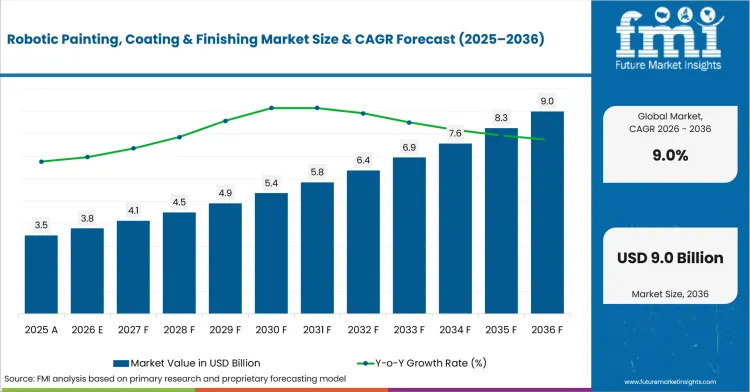
Key Takeaways of Robotic Painting, Coating & Finishing Market
- Demand for robotic painting, coating & finishing systems is driven by finish consistency mattering more than rated robot speed, with stable applicator distance reducing uneven bands and defects across curved panels and complex surfaces.
- By robot type, six-axis robots retain a central role, favored for their ability to reach pillars and recesses that need several approach angles.
- Exterior body painting remains the leading application, as visible defects carry immediate commercial cost across production runs.
- Hardware is estimated to hold high value, as arms and applicators must operate safely inside the booth during repeated production shifts, while software gains value through path creation and recipe control rather than replacing installed equipment.
- Unfilled finishing roles and measurable paint savings remain key demand drivers, particularly in plants with large coated areas and frequent color changes that increase flushing losses.
- China, the United States, European Union, Japan, and India are expected to follow distinct adoption paths, with China favoring full-line installation, the US/EU pursuing staged upgrades, Japan prioritizing repeatability, and India expanding through paint-savings-driven projects.
- Competition centers on integrated groups, robot makers, and adaptive specialists, with vendors differentiating through booth design and application engineering, flexible controllers and local service coverage, and path-teaching alternatives for fast-changing part geometry.
Analyst Perspective
"The robotic finishing cells market is evolving as manufacturers focus on coating consistency, material efficiency, and production repeatability instead of automation speed alone. Investment decisions are guided by the ability to achieve uniform film quality, minimize defects, and adapt to changing product mixes without disrupting throughput. Suppliers that combine process expertise with application engineering, commissioning support, and long-term service capabilities are likely to strengthen their presence across automotive, industrial, and high-value manufacturing operations."
- Nikhil Kaitwade Future Market Insights Industrial Automation Research Team
How is the Robotic Painting, Coating & Finishing Market segmented?
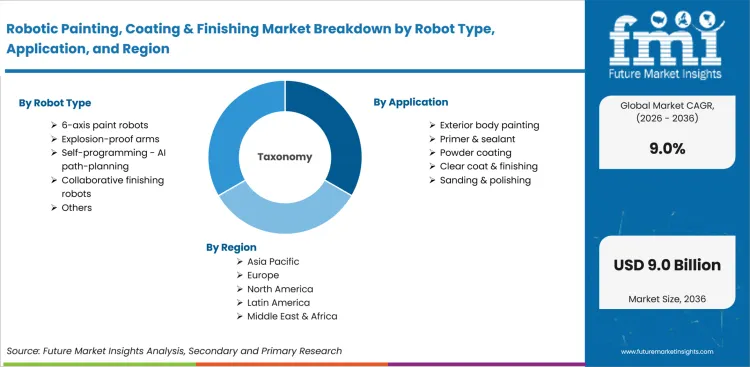
robot type, application, component, end-use industry, sales channel, and region
The market is segmented by robot type and application, showing how project value varies with physical reach and surface treatment needs. Component analysis separates robot hardware, control software, and supporting services used for installation and later production changes. End‑use coverage highlights differences in operating requirements across vehicle plants and other industrial sites with mixed product runs. Sales channels distinguish large projects delivered through direct factory programs from those executed via local system integrators. Regional analysis reflects variations in vehicle production volumes and the age of installed paint lines across major manufacturing bases.
What supports the 44.0% position of 6-axis paint robots in 2026?
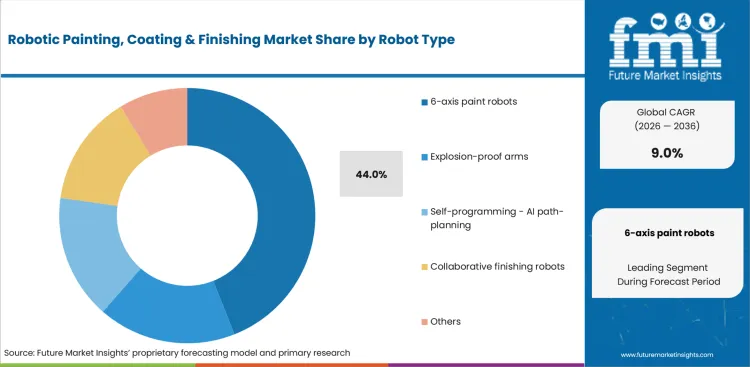
Curved vehicle bodies require spray-gun access from several directions during automated coating. A six-axis arm preserves that angle around pillars and wheel openings without moving the workpiece. Protected hose routing through the robot wrist keeps lines away from painted surfaces during long passes. The platform remains familiar to maintenance crews across long-established automotive production plants.
- With an estimated 44.0% of robot type revenue in 2026, 6-axis paint robots are anticipated to lead through reach and protected hose routing across established automotive booths during long production shifts.
- Six-axis paint robots attract interest from vehicle paint engineers because they can carry rotary atomizers through long passes. Controller and software choices support frequent recipe changes without delaying the wider paint line. Stable hose routing prevents unplanned contact with wet surfaces during long production shifts.
How is exterior body painting positioned within the application category?
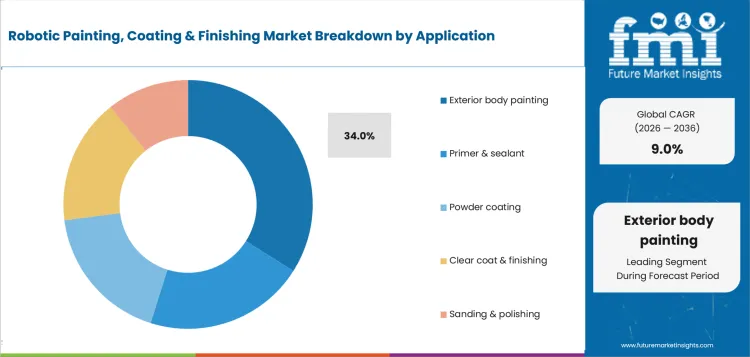
The visible finish on exterior panels shapes how customers judge vehicle quality under showroom lighting. Small changes in gun angle can leave uneven bands across roofs or doors during production. Robotic motion keeps each pass aligned through large visible areas and complex body curves. Exterior body painting retains spending because cured defects create costly repair work late in final assembly.
- By application, exterior body painting is expected to account for 34.0% in 2026 owing to large coated areas and visible quality risk during showroom inspection across premium vehicle programs.
- Vehicle paint shops purchase more exterior painting cells because stable gloss and repeatable film build remain hard requirements. Automotive robot programs benefit when the arm and atomizer are tuned as one process. That coordination reduces overspray while preserving edge coverage across roofs and recessed exterior surfaces.
Why is hardware expected to account for 64.0% of component value?
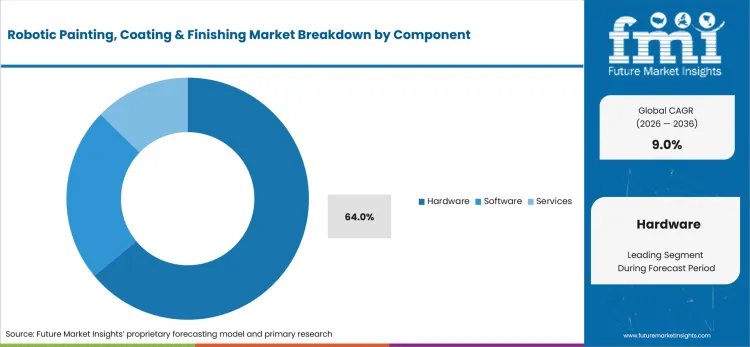
A working paint cell combines the robot arm and applicator with pumps and safety equipment suited to the spray area. Pumps and safety hardware must remain reliable through repeated color and recipe changes inside the spray area. Software improves flexibility through path creation and process settings across different product runs. Physical equipment retains most project value since it moves and meters the coating during every pass.
- Protected applicators and fluid equipment are projected to push hardware to a 64.0% share across components in 2026 since every cell needs physical motion and material control inside the spray booth.
- Hardware spending rises as hazardous-area designs and stable material flow receive greater weight during production. Coordinated automation systems gain value through better links between motion and fluid delivery. Service contracts follow the installed equipment through later color or recipe changes.
What supports automotive OEM demand within end-use industry?
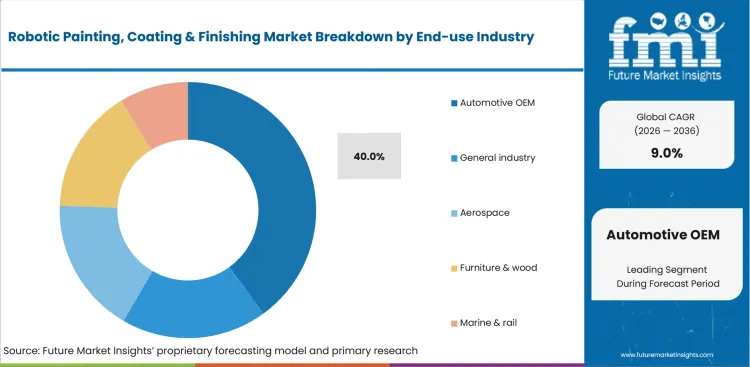
Vehicle bodies pass through repeatable coating stages at production rates that leave little room for unplanned stoppages. A paint-line interruption can affect the wider assembly schedule and delay connected production stages. Automotive plants value uptime and finish records during every model or color change. Large coated areas make paint savings visible enough for capital teams to measure during project review.
- Automotive OEM is estimated to account for 40.0% of end-use industry value in 2026 due to repeatable body coating stages and costly line stoppages across high-volume plants during model production.
- Sales of vision-guided finishing cells are forecast to expand in mixed-model paint shops through integrated booth and application planning. Vision-guided robot systems locate changing part shapes more reliably before each programmed pass. This capability reduces manual correction during model changes and short production runs.
Why are direct OEM lines expected to hold 52.0% across sales channels?
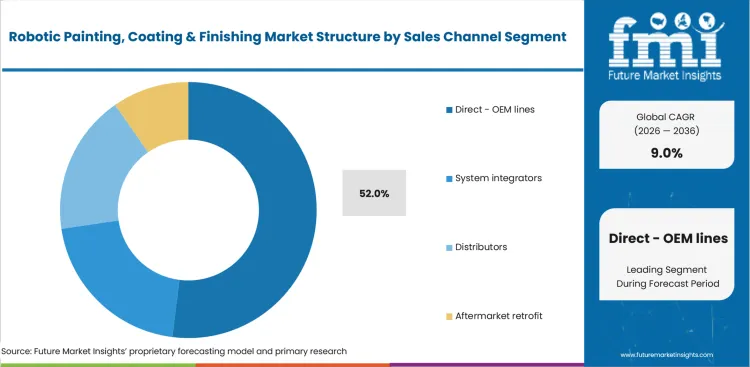
Large finishing projects are planned around booth airflow and line speed before equipment reaches the site. Direct programs keep application engineering close to the vehicle maker during design and commissioning. This direct contact shortens approval cycles for robot layout and paint delivery during project design. Local integrators remain relevant for smaller retrofits and later service work across established plants.
- A 52.0% share in sales channel value is anticipated for direct OEM lines in 2026 since large paint-shop projects need integrated design and accountable commissioning from one project team.
- Vehicle program teams favor direct OEM lines over alternatives due to coordinated responsibility across booths and robots. Compact robot formats support smaller tasks that fall outside fixed high-volume lines. Direct project control remains decisive for large body shops that need one accountable engineering partner.
What are the drivers, restraints, and opportunities in the Robotic Painting, Coating & Finishing Market?
Driver: repeatable finish control and lower worker exposure. Restraint: commissioning complexity across motion and coating behavior. Opportunity: adaptive path creation for variable parts.
- Driver: Stable robot motion is expected to reduce film variation and repeated work inside spray areas.
- Restraint: Integration cost is projected to rise when older booths need new controls and safety equipment.
- Opportunity: Scanning and process feedback are anticipated to extend automation across irregular parts and shorter batches.
Repeatable motion improves finish quality across long shifts and complex part shapes. The need to reduce worker exposure strengthens the case for automation inside spray areas with airborne material. The USA Occupational Safety and Health Administration revised its Hazard Communication Standard in May 2024. The final rule became effective on July 19, 2024 and changed chemical classification and label requirements. Robotic cells move repetitive spraying into a controlled process with defined booth procedures.
Integration remains difficult because robot accuracy cannot correct poor paint flow or unstable booth conditions. The International Organization for Standardization published ISO 10218-1:2025 and ISO 10218-2:2025 in February 2025. The standards cover industrial robots and complete cells with safety requirements for installation and system integration. Their release increases attention on risk assessment and system integration during project design. Smaller facilities face a greater burden as engineering costs carry more weight against limited production volume.
Adaptive path creation widens automated finishing beyond fixed vehicle lines and repeated part shapes. The European Commission reported in August 2024 that the revised Industrial Emissions Directive entered into force on August 4, 2024. The rule places greater pressure on industrial sites to manage emissions and resource use. Connected factory controls link path data with paint recipes and inspection results. Commercial value is clearest across work that remains too variable for fixed programming.
Which country CAGRs are profiled in the Robotic Painting, Coating & Finishing Market?
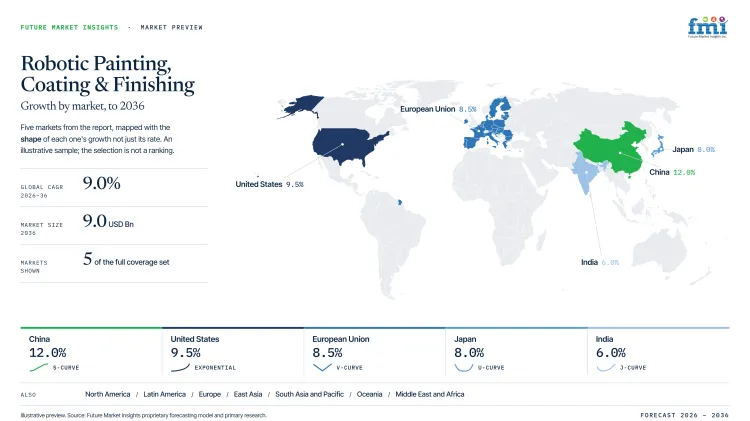
| Country | CAGR |
|---|---|
| China | 12.0% |
| United States | 9.5% |
| European Union | 8.5% |
| Japan | 8.0% |
| India | 6.0% |
Source: FMI's proprietary forecasting model and primary research
How do country-level CAGRs compare in the Robotic Painting, Coating & Finishing Market?
The country comparison spans 6.0 percentage points and reveals three distinct growth groups across the robotic painting, coating & finishing market. China forms the leading tier on its own, while the United States, the European Union and Japan create a closely aligned middle group with only 1.5 percentage points separating them. India sits 2.0 percentage points below Japan, marking a clear transition to the next growth tier. Adoption patterns reflect differences in manufacturing automation, quality requirements and investment in robotic finishing operations.
- China leads the comparison with a CAGR of 12.0%. Manufacturers are expanding the use of robotic painting and coating systems to achieve uniform finishes, reduce material waste and improve production efficiency across automotive, electronics and industrial manufacturing.
- The United States follows 2.5 percentage points behind China at 9.5%. Demand reflects increasing automation of surface finishing processes where robotic systems help deliver consistent coating quality, improve worker safety and handle repetitive finishing operations.
- At 8.5%, the European Union remains 1.0 percentage point below the United States. Investment is concentrated on precision manufacturing environments where robotic finishing equipment supports stringent quality standards, efficient paint application and reduced emissions. Adoption levels vary across member states according to industrial specialization and automation priorities.
- Japan records a CAGR of 8.0%, just 0.5 percentage points below the European Union. Established expertise in industrial robotics and advanced manufacturing continues to encourage the integration of automated painting and coating solutions into high-value production lines.
- India posts a CAGR of 6.0%, standing 2.0 percentage points below Japan. Market activity is associated with the gradual modernization of manufacturing facilities and increasing interest in robotic finishing technologies that improve consistency and productivity in automotive, metal fabrication and general industrial applications.
Comparable CAGRs can still produce different market entry conditions. Differences in factory automation maturity, manufacturing mix, quality requirements and investment in robotic production technologies influence deployment timelines and long-term commercial opportunities. The full report provides country-level CAGR analysis across North America, Latin America, Europe, East Asia, South Asia, Oceania and the Middle East and Africa.
Country-wise Analysis
Country growth depends on plant age and the pace of local industrial investment. China is projected to favor complete cells across new production capacity and modern paint-shop layouts. The United States and European Union support staged modernization inside established plants. Japan values stable motion and long equipment life across precision manufacturing and vehicle production. India broadens its installation base through vehicle output and wider industrial expansion programs. These differences shape demand for aerospace robot cells and automotive systems through distinct approval criteria.
- China is expected to retain a broad production base for industrial robots and vehicles through 2036. By 2036, China is projected to grow at 12.0% CAGR driven by new paint-shop capacity and local automation supply. The National Bureau of Statistics of China reported in September 2025 that industrial robot output rose 29.9% during the first eight months of 2025. This output growth is anticipated to improve access to locally supplied robot platforms and trained service teams. New factories are likely to integrate applicators and controls during line design rather than through later booth retrofits. The resulting advantage is expected to appear in faster commissioning and wider use beyond vehicle body painting.
- United States paint-shop managers are expected to examine uptime and service coverage before approving new finishing cells. Data published by the Federal Reserve in June 2025 showed that motor vehicle and parts output increased 4.9% during May 2025. The United States outlook is anticipated to advance at 9.5% CAGR supported by factory modernization and persistent staffing gaps in repetitive spray roles. Existing plants are likely to favor staged retrofits that protect production schedules during installation and commissioning.
- The European Union is projected to benefit from retrofit demand inside established automotive and industrial plants. Robotic painting demand is forecast to rise at 8.5% CAGR reflecting material efficiency targets and fixed booth footprints. Eurostat reported in June 2026 that sold production of motor vehicles and related transport equipment reached EUR 707 billion during 2024. That value represented 12% of European Union sold production across the industrial categories measured by Eurostat. The production base is expected to sustain demand for paint-line upgrades across older automotive and industrial facilities.
- Japan's production mix is anticipated to support smaller automated cells across precise finishing and coating work. Adoption of robotic finishing in Japan is estimated to expand at 8.0% CAGR linked to stable process control and long service expectations. The Statistics Bureau of Japan reported in September 2025 that transport equipment represented 23.4% of total export value during 2023. This export position is likely to support continued investment in coating quality across vehicle and machinery production. Vehicle plants are expected to sustain demand through repeatable coating stages and tightly controlled finish requirements.
- India's vehicle production base is expected to widen robotic finishing demand across automotive and related industrial plants. In India, robotic painting demand is predicted to advance at 6.0% CAGR on the back of vehicle output and industrial capacity additions. India's Press Information Bureau reported in April 2025 that vehicle production exceeded 28 million units during fiscal 2023-24. This production volume is projected to support a broader base for automated coating and related service work. Capital approval is likely to remain sensitive to sustained line use and local labor costs.
Who are the notable companies in the Robotic Painting, Coating & Finishing Market?
Dürr, ABB, FANUC, KUKA, GrayMatter Robotics and Omnirobotic represent integrated paint shops, flexible robot platforms and adaptive surface finishing.
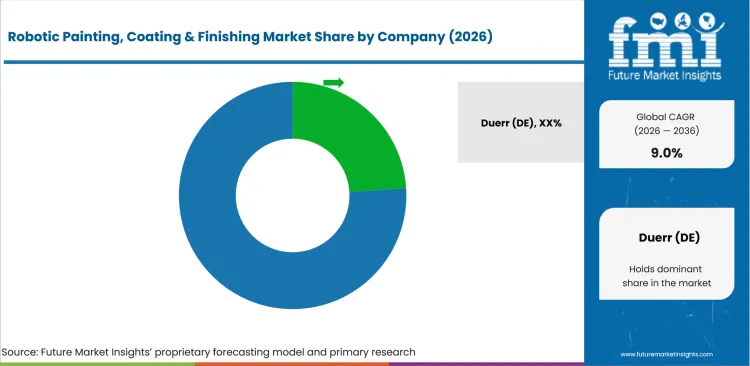
Competition splits between integrated paint-shop projects and flexible cells for mixed production. Large vehicle programs favor groups that coordinate booths and robots with application equipment. Smaller plants value scanning and automatic path creation that reduce engineering time. Robotic vision systems locate changing part shapes more reliably across mixed production batches. Service reach influences repeat orders because airflow or material settings can cause finish defects. No single portfolio fits both complete vehicle lines and compact high-mix cells.
- Integrated paint-shop groups: Dürr and ABB compete through robot integration and coating application expertise across vehicle programs. Dürr holds a 24.0% share in 2026 and adds turnkey paint-shop engineering across complete vehicle programs. ABB adds paint robots and precision application systems for complex exterior work across demanding vehicle production programs.
- Flexible robot platforms: FANUC and KUKA address protected painting tasks through controller options and paint-specific robot designs. Their relevance rises in general industry where cell layouts differ across plants. Local integration support shapes smaller projects that need faster commissioning and responsive service coverage.
- Adaptive finishing specialists: GrayMatter Robotics and Omnirobotic focus on variable parts that need scan-based path creation. Their commercial position depends on repeatable sanding or spraying results across short batches with changing geometry and limited setup time.
Competitive Benchmarking: Robotic Painting, Coating & Finishing Market
| Company | Integrated Paint-Shop Reach | Flexible Robot Portfolio | Adaptive Finishing Depth | Service Reach |
|---|---|---|---|---|
| Dürr | High | Medium | Medium | Global |
| ABB | High | High | Medium | Global |
| FANUC | Low | High | Medium | Global |
| KUKA | Medium | High | Medium | Global |
| GrayMatter Robotics | Low | Medium | High | North America |
| Omnirobotic | Low | Low | High | North America |
Scoring basis: High indicates direct capability across the named dimension and its related project work. A Medium rating indicates relevant coverage with narrower scope or partner dependence across the assessed dimension. A Low rating indicates limited documented coverage in the official company information used for this benchmark.
Source: Future Market Insights
Key Developments in the Robotic Painting, Coating & Finishing Market
- In September 2025, Dürr reported the completion of a turnkey paint shop for Volkswagen in Puebla with two identical painting lines. The project shows how one supplier can combine application technology with plant engineering for new vehicle capacity.
- In July 2025, ABB announced that Stellantis selected PixelPaint for the DS N°8 production program in Melfi. The selection shows commercial demand for precise two-tone application without masking across premium vehicle finishes.
- In June 2026, FANUC presented its P-55/15-21A paint robot with the R-50iA controller during Automate 2026. The demonstration shows how protected paint robots are expected to combine line tracking with simpler controller hardware across moving-part applications.
- In April 2025, KUKA launched iiQKA.OS2 with a complete virtual robot controller and a browser-based interface. The software release is expected to shorten engineering work across simulation and commissioning for flexible cells.
Key Players in the Robotic Painting, Coating & Finishing Market
Integrated paint-shop systems
- Dürr
- ABB
Flexible painting and coating robots
- FANUC
- KUKA
Adaptive surface finishing
- GrayMatter Robotics
- Omnirobotic
Robotic Painting, Coating & Finishing Market - Report Scope
| Report Attribute | Coverage |
|---|---|
| Market Breakdown | Robot Type, Application, Component, End-use Industry, Sales Channel and Region |
| Quantitative Units | USD billion for market value, percentage for segment share and CAGR |
| Market Definition | Robots and related cell equipment used for painting, coating and connected surface-finishing tasks |
| Regions Covered | North America, Latin America, Europe, East Asia, South Asia and Pacific, Oceania, Middle East and Africa |
| Countries Covered | United States, Canada, Brazil, Mexico, Germany, France, United Kingdom, Italy, Spain, China, Japan, South Korea, India, Australia, New Zealand, Gulf Cooperation Council Countries and South Africa |
| Key Companies Profiled | Dürr, ABB, FANUC, KUKA, GrayMatter Robotics and Omnirobotic |
| Approach | Bottom-up project value assessment with market totals, segment shares, country forecasts and primary research |
Source: Future Market Insights - analysis driven by proprietary forecasting models and primary research
Robotic Painting, Coating & Finishing Market - Research Methodology
| Method | Application |
|---|---|
| Primary Research | FMI analysts gathered input from manufacturers, service providers, technology developers, distributors, end users, procurement teams, and subject-matter experts. Interviews examined purchasing decisions, product or service evaluation, adoption barriers, approval requirements, pricing considerations, and expectations for technical or commercial support. Respondents were also asked what evidence is required before a trial, pilot, or initial order develops into regular purchasing. |
| Desk Research | Desk research covered government statistics, regulatory publications, trade data, industry associations, technical literature, standards, company filings, product information, and official corporate announcements. Sources were reviewed for relevance, publication date, geographic coverage, and consistency with the defined market scope. Claims relating to performance, applications, approvals, capacity, investment, and commercial activity were retained only when supported by credible public evidence. |
| Market Sizing and Forecasting | The market model combined the baseline value with historical performance, segment structure, pricing and volume indicators, adoption levels, company participation, and country-level demand conditions. Forecast assumptions considered economic activity, investment trends, regulatory developments, technology adoption, purchasing cycles, supply availability, and barriers to wider market use. Segment and regional estimates were reconciled before the final market total was calculated. |
| Data Validation | Estimates were checked against multiple independent indicators, including public data, company activity, trade patterns, industry developments, and findings from primary interviews. Validation also tested whether products, services, applications, and company revenues fell within the defined market boundaries. Adjacent categories, unsupported claims, overlapping revenues, and activities without direct market relevance were excluded to reduce double counting and maintain consistency across segments and countries. |
Robotic Painting, Coating & Finishing Market by Segments
Robotic Painting, Coating & Finishing Market segmented by Robot Type:
- 6-axis paint robots
- Explosion-proof arms
- Self-programming and AI path-planning systems
- Collaborative finishing robots
- Other robot types
Robotic Painting, Coating & Finishing Market segmented by Application:
- Exterior body painting
- Primer and sealant
- Powder coating
- Clear coat and finishing
- Sanding and polishing
Robotic Painting, Coating & Finishing Market segmented by Component:
- Hardware
- Software
- Services
Robotic Painting, Coating & Finishing Market segmented by End-use Industry:
- Automotive OEM
- General industry
- Aerospace
- Furniture and wood
- Marine and rail
Robotic Painting, Coating & Finishing Market segmented by Sales Channel:
- Direct OEM lines
- System integrators
- Distributors
- Aftermarket retrofit
Robotic Painting, Coating & Finishing Market by Region:
- North America
- United States
- Canada
- Latin America
- Brazil
- Mexico
- Other Latin American Countries
- Europe
- Germany
- France
- United Kingdom
- Italy
- Spain
- Other European Countries
- East Asia
- China
- Japan
- South Korea
- South Asia and Pacific
- India
- ASEAN Countries
- Other South Asian and Pacific Countries
- Oceania
- Australia
- New Zealand
- Middle East and Africa
- Gulf Cooperation Council Countries
- South Africa
- Other Middle Eastern and African Countries
Research Sources and Bibliography
- ABB. (2025, July 1). ABB PixelPaint selected by Stellantis for DS Automobiles all-electric flagship DS N°8. https://new.abb.com/news/detail/127327/prsrl-abb-pixelpaint-selected-by-stellantis-for-ds-automobiles-all-electric-flagship-ds-ndeg8
- Dürr. (2025, September 1). Dürr building a CO2-efficient paint shop as a turnkey project for Volkswagen. https://www.durr.com/en/media/news/news-detail/view/duerr-building-a-co2-efficient-paint-shop-as-a-turnkey-project-for-volkswagen-94466
- European Commission. (2024, August 2). Revised Industrial Emissions Directive comes into effect. https://environment.ec.europa.eu/news/revised-industrial-emissions-directive-comes-effect-2024-08-02_en
- Eurostat. (2026, June). Industrial production statistics. https://ec.europa.eu/eurostat/statistics-explained/index.php?title=Industrial_production_statistics
- FANUC America. (2026, May 21). FANUC America showcases physical AI and AI-enabled robotics demonstrations at Automate 2026. https://www.fanucamerica.com/press-releases/fanuc-america-showcases-physical-ai-and-ai-enabled-robotics-demos-at-automate-2026
- Federal Reserve Board. (2025, June 17). Industrial production and capacity utilization.
- GrayMatter Robotics. (2025, March 18). GrayMatter Robotics earns a place on Fast Company’s 2025 list. https://factory.graymatter-robotics.com/graymatter-robotics-fast-company-innovative-companies-2025/
- International Federation of Robotics. (2025, September 25). Global robot demand in factories doubles over ten years. https://ifr.org/ifr-press-releases/news/global-robot-demand-in-factories-doubles-over-10-years
- International Organization for Standardization. (2025, February). ISO 10218-1:2025 robotics safety requirements for industrial robots. https://www.iso.org/standard/73933.html
- International Organization for Standardization. (2025, February). ISO 10218-2:2025 robotics safety requirements for industrial robot applications and robot cells. https://www.iso.org/standard/73934.html
- KUKA. (2025, April 16). KUKA launches iiQKA.OS2. https://www.kuka.com/en-in/company/press/news/2025/03/iiqka_os2-launch
- National Bureau of Statistics of China. (2025, September 16). Industrial Production Operation in August 2025. https://www.stats.gov.cn/english/PressRelease/202509/t20250916_1961290.html
- Omnirobotic. (2026, June 17). Omnirobotic named finalist for the IWF 2026 Challengers Award. https://omnirobotic.com/news/omnirobotic-named-finalist-for-prestigious-iwf-2026-challengers-award/
- Press Information Bureau. (2025, April 15). Automobile and auto components industry in India. https://www.pib.gov.in/PressReleasePage.aspx?PRID=2121826
- Statistics Bureau of Japan. (2025, September). Statistical Handbook of Japan 2025. https://www.stat.go.jp/english/data/handbook/pdf/2025all.pdf
- USA Bureau of Labor Statistics. (2025, August 28). Painting and coating workers. https://www.bls.gov/ooh/production/painting-and-coating-workers.htm
- USA Occupational Safety and Health Administration. (2024, May 20). Hazard Communication Standard final rule. https://www.osha.gov/hazcom/rulemaking
This Report Answers
- How large is the robotic painting, coating and finishing market in 2026 and 2036?
- Which CAGR is projected for the market from 2026 to 2036?
- Which robot type and application hold the disclosed 2026 segment positions?
- Why do hardware and direct OEM lines account for the stated shares?
- Which forces support investment in automated surface finishing?
- How do country growth rates differ across the five profiled markets?
- Which competitive roles separate integrated paint-shop groups from adaptive specialists?
- Which dated company developments changed project or product capability after January 2025?
- What should plant teams examine before approving a robotic finishing cell?
Frequently Asked Questions
What is driving growth in the Robotic Painting, Coating & Finishing Market?
Repeatable finish control supports investment across complex parts and long production shifts. Labor replacement pressure strengthens automation inside ventilated spray areas with repetitive manual work.
Who are the key players in the Robotic Painting, Coating & Finishing Market?
Dürr and ABB provide integrated paint-shop and application capability across large automotive projects with strict finish requirements. FANUC and KUKA add flexible robot platforms with support from adaptive finishing specialists across mixed production settings.
What is a notable restraint in the Robotic Painting, Coating & Finishing Market?
Commissioning cost restrains adoption across low-volume facilities and older booths with limited control capacity. Finish quality depends on fluid behavior and airflow alongside robot accuracy during production.
Why should executives track the Robotic Painting, Coating & Finishing Market?
Finishing automation affects paint use and defect costs across several production stages. Executives should track whether adaptive cells improve mixed-batch returns without increasing integration risk across existing production lines.
What business problem does the Robotic Painting, Coating & Finishing Market address?
The market addresses uneven finish quality and repeated exposure inside industrial spray areas. Robotic cells keep applicator motion stable across difficult surfaces and repeated production shifts.
What should procurement leaders evaluate before selecting suppliers?
Procurement leaders should compare coating results and service response across representative parts from normal production. They should confirm hazardous-area suitability and controller support before approving the complete cell for routine use.
What limits return on investment for purchasers?
Low cell use weakens returns when fixed equipment serves irregular production runs. Poor commissioning reduces paint savings and extends defect correction across repeated production runs.
How do suppliers build long-term account confidence?
Repeatable finish results and responsive process support build long-term account confidence during planned line changes. Clear recipe records protect approved performance across later production changes and service events.
Preview the report firsthand - request a free sample
Get SampleGet the brochure for pricing and purchase details.
Get PDFTable of Content
- Key Takeaways
- Market Size and CAGR
- Top Growth Driver
- Fastest Growing Segment
- Leading Region
- Key Companies
- Emerging Opportunities
- Executive Summary
- Global Market Outlook
- Demand-side Trends
- Supply-side Trends
- Technology Roadmap Analysis
- Analysis and Recommendations
- Analyst Perspective (What is happening? Why now? What should investors know?)
- Key Questions Answered
- How large is the market?
- What is the CAGR?
- What are key trends?
- Which region dominates?
- Who are the leaders?
- Market Overview
- Market Coverage / Taxonomy
- Market Definition / Scope / Limitations
- Research Methodology
- Chapter Orientation
- Analytical Lens and Working Hypotheses
- Market Structure, Signals, and Trend Drivers
- Benchmarking and Cross-market Comparability
- Market Sizing, Forecasting, and Opportunity Mapping
- Research Design and Evidence Framework
- Desk Research Programme (Secondary Evidence)
- Expert Input and Fieldwork (Primary Evidence)
- Tooling, Models, and Reference Databases
- Data Engineering and Model Build
- Quality Assurance and Audit Trail
- Market Background
- Market Dynamics (Drivers, Restraints, Opportunity, Trends)
- Scenario Forecast (Optimistic, Likely, Conservative)
- Impact Analysis
- AI Impact
- Sustainability Impact
- Regulatory Impact
- Technology Impact
- Consumer / Buyer Analysis
- Purchase Drivers
- Adoption Barriers
- Buyer Journey
- Opportunity Map Analysis
- Product Life Cycle Analysis
- Supply Chain Analysis
- Investment Feasibility Matrix
- Value Chain Analysis
- PESTLE and Porter's Analysis
- Regulatory Landscape
- Regional Parent Market Outlook
- Production and Consumption Statistics
- Import and Export Statistics
- Global Market Analysis and Forecast, 2021 to 2036
- Historical Market Size Value (USD Bn) Analysis, 2021 to 2025
- Current and Future Market Size Value (USD Bn) Projections, 2026 to 2036
- Y-o-Y Growth Trend Analysis
- Absolute $ Opportunity Analysis
- Global Market Pricing Analysis, 2021 to 2036
- Global Market Analysis and Forecast, By Robot Type, 2021 to 2036
- Introduction / Key Findings
- Historical Market Size Value (USD Bn) Analysis By Robot Type, 2021 to 2025
- Current and Future Market Size Value (USD Bn) Analysis and Forecast By Robot Type, 2026 to 2036
- 6-axis paint robots
- Explosion-proof arms
- Self-programming - AI path-planning
- Collaborative finishing robots
- Others
- 6-axis paint robots
- Y-o-Y Growth Trend Analysis By Robot Type, 2021 to 2025
- Absolute $ Opportunity Analysis By Robot Type, 2026 to 2036
- Global Market Analysis and Forecast, By Application, 2021 to 2036
- Introduction / Key Findings
- Historical Market Size Value (USD Bn) Analysis By Application, 2021 to 2025
- Current and Future Market Size Value (USD Bn) Analysis and Forecast By Application, 2026 to 2036
- Exterior body painting
- Primer & sealant
- Powder coating
- Clear coat & finishing
- Sanding & polishing
- Exterior body painting
- Y-o-Y Growth Trend Analysis By Application, 2021 to 2025
- Absolute $ Opportunity Analysis By Application, 2026 to 2036
- Global Market Analysis and Forecast, By Component, 2021 to 2036
- Introduction / Key Findings
- Historical Market Size Value (USD Bn) Analysis By Component, 2021 to 2025
- Current and Future Market Size Value (USD Bn) Analysis and Forecast By Component, 2026 to 2036
- Hardware
- Software
- Services
- Hardware
- Y-o-Y Growth Trend Analysis By Component, 2021 to 2025
- Absolute $ Opportunity Analysis By Component, 2026 to 2036
- Global Market Analysis and Forecast, By End-use Industry, 2021 to 2036
- Introduction / Key Findings
- Historical Market Size Value (USD Bn) Analysis By End-use Industry, 2021 to 2025
- Current and Future Market Size Value (USD Bn) Analysis and Forecast By End-use Industry, 2026 to 2036
- Automotive OEM
- General industry
- Aerospace
- Furniture & wood
- Marine & rail
- Automotive OEM
- Y-o-Y Growth Trend Analysis By End-use Industry, 2021 to 2025
- Absolute $ Opportunity Analysis By End-use Industry, 2026 to 2036
- Global Market Analysis and Forecast, By Sales Channel, 2021 to 2036
- Introduction / Key Findings
- Historical Market Size Value (USD Bn) Analysis By Sales Channel, 2021 to 2025
- Current and Future Market Size Value (USD Bn) Analysis and Forecast By Sales Channel, 2026 to 2036
- Direct - OEM lines
- System integrators
- Distributors
- Aftermarket retrofit
- Direct - OEM lines
- Y-o-Y Growth Trend Analysis By Sales Channel, 2021 to 2025
- Absolute $ Opportunity Analysis By Sales Channel, 2026 to 2036
- Global Market Analysis and Forecast, By Region, 2021 to 2036
- Introduction
- Historical Market Size Value (USD Bn) Analysis By Region, 2021 to 2025
- Current Market Size Value (USD Bn) Analysis and Forecast By Region, 2026 to 2036
- North America
- Latin America
- Western Europe
- Eastern Europe
- East Asia
- South Asia and Pacific
- Middle East & Africa
- Market Attractiveness Analysis By Region
- North America Market Analysis and Forecast, By Country, 2021 to 2036
- Historical Market Size Value (USD Bn) Trend Analysis By Market Taxonomy, 2021 to 2025
- Market Size Value (USD Bn) Forecast By Market Taxonomy, 2026 to 2036
- By Country
- USA
- Canada
- By Robot Type
- By Application
- By Component
- By End-use Industry
- By Sales Channel
- By Country
- Market Attractiveness Analysis
- By Country
- By Robot Type
- By Application
- By Component
- By End-use Industry
- By Sales Channel
- Key Takeaways
- Latin America Market Analysis and Forecast, By Country
- Historical Market Size Value (USD Bn) Trend Analysis By Market Taxonomy, 2021 to 2025
- Market Size Value (USD Bn) Forecast By Market Taxonomy, 2026 to 2036
- By Country
- Brazil
- Mexico
- Chile
- Rest of Latin America
- By Robot Type
- By Application
- By Component
- By End-use Industry
- By Sales Channel
- By Country
- Market Attractiveness Analysis
- By Country
- By Robot Type
- By Application
- By Component
- By End-use Industry
- By Sales Channel
- Key Takeaways
- Western Europe Market Analysis and Forecast, By Country
- Historical Market Size Value (USD Bn) Trend Analysis By Market Taxonomy, 2021 to 2025
- Market Size Value (USD Bn) Forecast By Market Taxonomy, 2026 to 2036
- By Country
- Germany
- UK
- Italy
- Spain
- France
- Nordic
- BENELUX
- Rest of Western Europe
- By Robot Type
- By Application
- By Component
- By End-use Industry
- By Sales Channel
- By Country
- Market Attractiveness Analysis
- By Country
- By Robot Type
- By Application
- By Component
- By End-use Industry
- By Sales Channel
- Key Takeaways
- Eastern Europe Market Analysis and Forecast, By Country
- Historical Market Size Value (USD Bn) Trend Analysis By Market Taxonomy, 2021 to 2025
- Market Size Value (USD Bn) Forecast By Market Taxonomy, 2026 to 2036
- By Country
- Russia
- Poland
- Hungary
- Balkan & Baltic
- Rest of Eastern Europe
- By Robot Type
- By Application
- By Component
- By End-use Industry
- By Sales Channel
- By Country
- Market Attractiveness Analysis
- By Country
- By Robot Type
- By Application
- By Component
- By End-use Industry
- By Sales Channel
- Key Takeaways
- East Asia Market Analysis and Forecast, By Country
- Historical Market Size Value (USD Bn) Trend Analysis By Market Taxonomy, 2021 to 2025
- Market Size Value (USD Bn) Forecast By Market Taxonomy, 2026 to 2036
- By Country
- China
- Japan
- South Korea
- By Robot Type
- By Application
- By Component
- By End-use Industry
- By Sales Channel
- By Country
- Market Attractiveness Analysis
- By Country
- By Robot Type
- By Application
- By Component
- By End-use Industry
- By Sales Channel
- Key Takeaways
- South Asia and Pacific Market Analysis and Forecast, By Country
- Historical Market Size Value (USD Bn) Trend Analysis By Market Taxonomy, 2021 to 2025
- Market Size Value (USD Bn) Forecast By Market Taxonomy, 2026 to 2036
- By Country
- India
- ASEAN
- Australia & New Zealand
- Rest of South Asia and Pacific
- By Robot Type
- By Application
- By Component
- By End-use Industry
- By Sales Channel
- By Country
- Market Attractiveness Analysis
- By Country
- By Robot Type
- By Application
- By Component
- By End-use Industry
- By Sales Channel
- Key Takeaways
- Middle East & Africa Market Analysis and Forecast, By Country
- Historical Market Size Value (USD Bn) Trend Analysis By Market Taxonomy, 2021 to 2025
- Market Size Value (USD Bn) Forecast By Market Taxonomy, 2026 to 2036
- By Country
- Kingdom of Saudi Arabia
- Other GCC Countries
- Türkiye
- South Africa
- Other African Union
- Rest of Middle East & Africa
- By Robot Type
- By Application
- By Component
- By End-use Industry
- By Sales Channel
- By Country
- Market Attractiveness Analysis
- By Country
- By Robot Type
- By Application
- By Component
- By End-use Industry
- By Sales Channel
- Key Takeaways
- Key Countries Market Analysis
- USA
- Pricing Analysis
- Market Share Analysis, 2025
- By Robot Type
- By Application
- By Component
- By End-use Industry
- By Sales Channel
- Canada
- Pricing Analysis
- Market Share Analysis, 2025
- By Robot Type
- By Application
- By Component
- By End-use Industry
- By Sales Channel
- Mexico
- Pricing Analysis
- Market Share Analysis, 2025
- By Robot Type
- By Application
- By Component
- By End-use Industry
- By Sales Channel
- Brazil
- Pricing Analysis
- Market Share Analysis, 2025
- By Robot Type
- By Application
- By Component
- By End-use Industry
- By Sales Channel
- Chile
- Pricing Analysis
- Market Share Analysis, 2025
- By Robot Type
- By Application
- By Component
- By End-use Industry
- By Sales Channel
- Germany
- Pricing Analysis
- Market Share Analysis, 2025
- By Robot Type
- By Application
- By Component
- By End-use Industry
- By Sales Channel
- UK
- Pricing Analysis
- Market Share Analysis, 2025
- By Robot Type
- By Application
- By Component
- By End-use Industry
- By Sales Channel
- Italy
- Pricing Analysis
- Market Share Analysis, 2025
- By Robot Type
- By Application
- By Component
- By End-use Industry
- By Sales Channel
- Spain
- Pricing Analysis
- Market Share Analysis, 2025
- By Robot Type
- By Application
- By Component
- By End-use Industry
- By Sales Channel
- France
- Pricing Analysis
- Market Share Analysis, 2025
- By Robot Type
- By Application
- By Component
- By End-use Industry
- By Sales Channel
- India
- Pricing Analysis
- Market Share Analysis, 2025
- By Robot Type
- By Application
- By Component
- By End-use Industry
- By Sales Channel
- ASEAN
- Pricing Analysis
- Market Share Analysis, 2025
- By Robot Type
- By Application
- By Component
- By End-use Industry
- By Sales Channel
- Australia & New Zealand
- Pricing Analysis
- Market Share Analysis, 2025
- By Robot Type
- By Application
- By Component
- By End-use Industry
- By Sales Channel
- China
- Pricing Analysis
- Market Share Analysis, 2025
- By Robot Type
- By Application
- By Component
- By End-use Industry
- By Sales Channel
- Japan
- Pricing Analysis
- Market Share Analysis, 2025
- By Robot Type
- By Application
- By Component
- By End-use Industry
- By Sales Channel
- South Korea
- Pricing Analysis
- Market Share Analysis, 2025
- By Robot Type
- By Application
- By Component
- By End-use Industry
- By Sales Channel
- Russia
- Pricing Analysis
- Market Share Analysis, 2025
- By Robot Type
- By Application
- By Component
- By End-use Industry
- By Sales Channel
- Poland
- Pricing Analysis
- Market Share Analysis, 2025
- By Robot Type
- By Application
- By Component
- By End-use Industry
- By Sales Channel
- Hungary
- Pricing Analysis
- Market Share Analysis, 2025
- By Robot Type
- By Application
- By Component
- By End-use Industry
- By Sales Channel
- Kingdom of Saudi Arabia
- Pricing Analysis
- Market Share Analysis, 2025
- By Robot Type
- By Application
- By Component
- By End-use Industry
- By Sales Channel
- Türkiye
- Pricing Analysis
- Market Share Analysis, 2025
- By Robot Type
- By Application
- By Component
- By End-use Industry
- By Sales Channel
- South Africa
- Pricing Analysis
- Market Share Analysis, 2025
- By Robot Type
- By Application
- By Component
- By End-use Industry
- By Sales Channel
- USA
- Market Structure Analysis
- Competition Dashboard
- Competition Benchmarking
- Market Share Analysis of Top Players
- By Regional
- By Robot Type
- By Application
- By Component
- By End-use Industry
- By Sales Channel
- Emerging Startups
- Innovation Benchmarking
- Competition Analysis
- Competition Deep Dive
- Duerr (DE)
- Overview
- Product Portfolio
- Profitability by Market Segments
- Sales Footprint
- Strategy Overview
- Marketing Strategy
- Product Strategy
- Channel Strategy
- ABB (CH)
- GrayMatter Robotics (US)
- Omnirobotic (CA)
- Duerr (DE)
- Case Studies
- Success Stories
- Recent Developments
- Competition Deep Dive
- Assumptions & Acronyms Used


