

- Market Size (2026)
- USD 6500.0 Mn
- Forecast (2036)
- USD 15000.0 Mn
- CAGR (2026 to 2036)
- 8.7%
How big is the Robotic Welding Cells Market?
The Robotic Welding Cells Market is projected to grow from USD 6500.0 million in 2026 to USD 15000.0 million by 2036, at a CAGR of 8.7%.
The Robotic Welding Cells Market was valued at USD 5,979.76 million in 2025 and is expected to reach USD 6500.0 million in 2026. The market is projected to reach USD 15000.0 million by 2036 at a CAGR of 8.7% during 2026 to 2036. The 20-100 kg payload class is projected to hold a 52.0% share in 2026 as fabricators balance reach, weld-tool weight, and floor-space limits.
Global factories installed 542,000 industrial robots in 2024, and IFR reported 4,664,000 industrial robots in operational use during the same year.
Robotic welding cells are moving from large automotive body shops into metal fabrication, heavy machinery, and mid-size contract manufacturing.
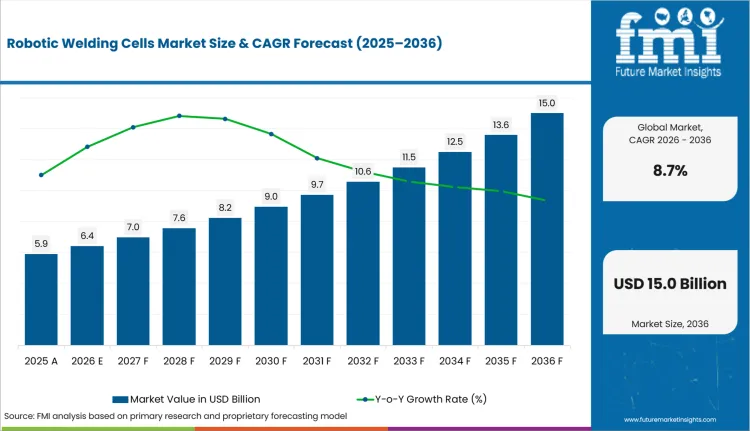
| Metric | Value |
|---|---|
| 2025 Market Size | USD 5,979.76 million |
| 2026 Market Size | USD 6500.0 million |
| 2036 Market Size | USD 15000.0 million |
| Forecast CAGR (2026-2036) | 8.7% |
| Leading Cell Type | Arc Welding Cells |
| Arc Welding Cells Share (2026) | 46.0% |
| Leading Payload Class | 20–100 kg |
| 20–100 kg Share (2026) | 52.0% |
| Fastest-growing Country | China |
| China CAGR by 2036 | 10.2% |
Summary of the Robotic Welding Cells Market
| Market Signal | Commercial Impact |
|---|---|
| Demand and Growth Drivers | Demand for robotic welding cells is increasing as manufacturers address skilled labor shortages, improve weld quality, and automate high-volume fabrication processes.
|
| Product and Segment View | Arc welding cells, mid-payload robots, and automotive applications continue to represent the leading commercial opportunities across the market.
|
| Geography and Growth Outlook | Asia continues to lead robotic welding adoption while North America expands through manufacturing reshoring and industrial automation investments.
|
| Competitive Landscape | Competition increasingly focuses on integrated robotic welding solutions, advanced software, and application engineering capabilities.
|
| Analyst Perspective | Robotic welding cells are evolving from standalone automation equipment into complete weld-process solutions where integration quality and production reliability determine long-term value.
- Nikhil Kaitwade, Principal Consultant at Future Market Insights |
Why is the Robotic Welding Cells Market growing?
Skilled welding labor gaps push factories toward cells that improve weld consistency and reduce rework exposure. EV platform programs need repeatable joining for battery trays, cooling plates, and lightweight vehicle structures.
- Skilled welding labor gaps push factories toward cells that improve weld consistency and reduce rework exposure.
- EV platform programs need repeatable joining for battery trays, cooling plates, and lightweight vehicle structures.
- Mid-size fabricators prefer modular cells as they need automation without rebuilding the entire production floor.
Automotive and heavy fabrication buyers are using robotic welding cells to control repeatability in parts that carry structural or sealing risk. KUKA said in June 2024 that it was supplying 23 friction stir welding cells with integrated robots for EV production, including battery-tray and cooling-plate joining. That order shows how welding-cell value now sits in process control and fixture engineering. Battery structures need repeatable seams and leak resistance, so suppliers with process ownership gain an advantage over robot-only vendors. Fabricators are adopting robotic welding cells when manual capacity becomes a delivery constraint.
How is the Robotic Welding Cells Market segmented?
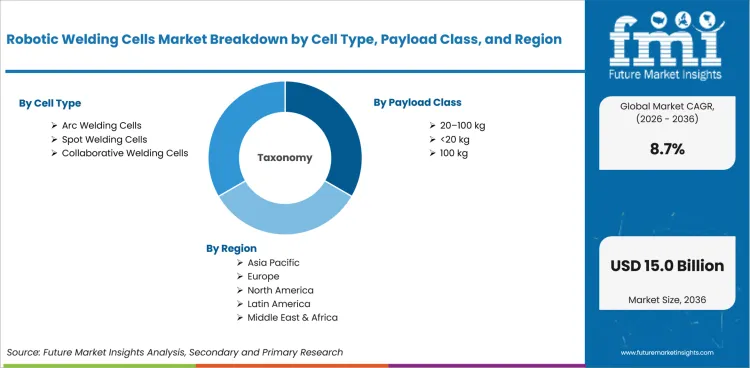
The Robotic Welding Cells Market is segmented by cell type, payload class, end use, configuration, sales channel, and region.
- With an estimated 46.0% share in 2026, Arc Welding Cells is expected to lead the cell type category because fabrication shops use MIG and MAG processes for varied metal parts.
- The 20-100 kg payload class is projected to account for a 52.0% share in 2026 since most weld torches and dress packs fit mid-payload robots.
- Automotive buyers are expected to direct 41.0% of End Use demand toward robotic welding cells in 2026 with EV and body-frame programs.
How does Arc Welding Cells contribute to the cell type category?
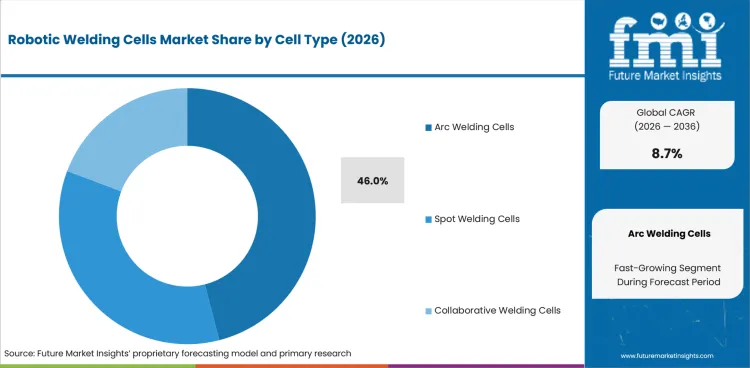
- Arc Welding Cells are projected to account for 46.0% of Cell Type demand in 2026 as MIG and MAG welding fit mixed metal fabrication and repairable process setups.
- Arc cells often require stronger torch-service planning than spot cells since contact tips, liners, and wire-feed settings influence downtime during long production runs.
What supports demand for 20-100 kg?
- The 20-100 kg class is estimated to hold a 52.0% share in 2026 as it supports welding guns, dress packs, and moderate part-handling loads.
- Mid-payload buyers often compare reach and wrist torque before price since awkward weld angles can create torch access issues on larger assemblies.
How do buyers evaluate Automotive within the end use category?
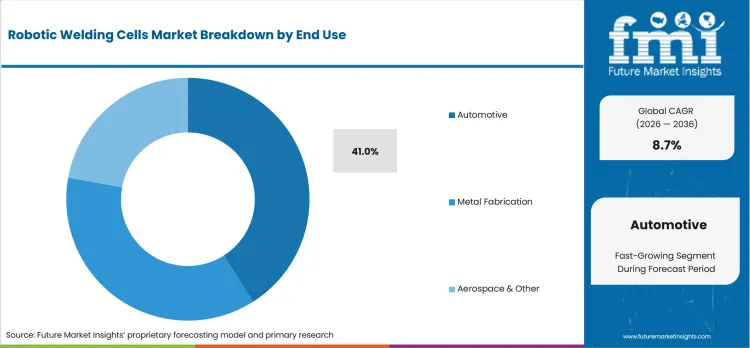
- Automotive is anticipated to represent 41.0% of End Use demand in 2026 as body structures and EV platforms need repeatable weld paths.
- Automotive welding cells face stricter uptime checks than general fabrication cells since one failed weld station can stop downstream body or battery assembly.
What market factors influence demand for Modular Cells?
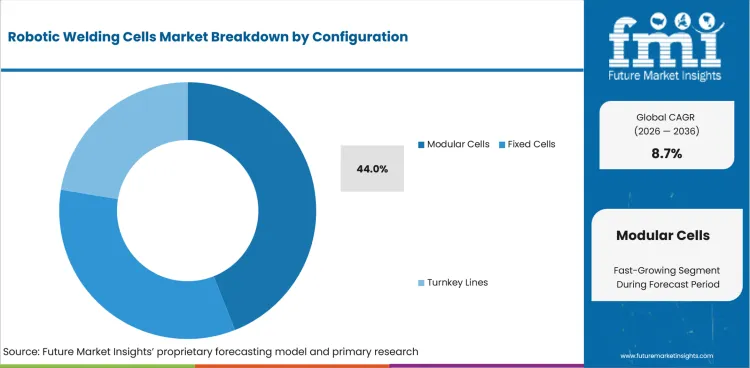
- Modular Cells are expected to account for 44.0% of Configuration demand in 2026 as plants seek weld automation that can shift across programs.
- Modular designs reduce layout risk for job shops since a cell can be moved or retooled without redesigning the full production line.
How does System Integrators affect the sales channel outlook?
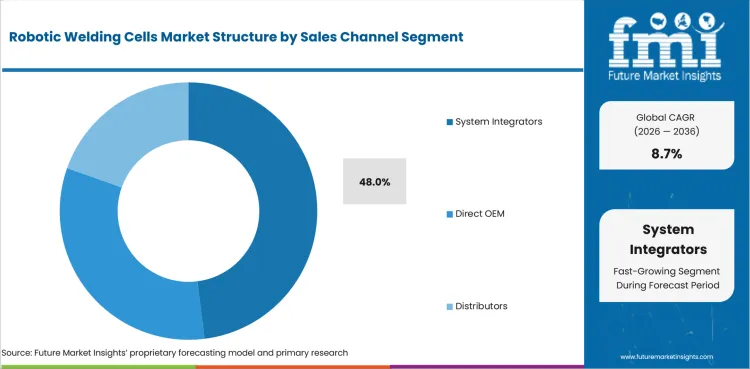
- System Integrators are projected to hold 48.0% of Sales Channel demand in 2026 as buyers need fixture, guarding, and weld-process support.
- Integrator-led projects often win when they include prove-out welding trials since buyer risk sits in seam quality and cycle time.
What drives and restrains the market?
Driver: EV battery welding creates new demand for cells that combine robot motion with fixture accuracy and heat control; restraint: High integration cost slows purchases when buyers underestimate fixtures, guarding, and programming work; opportunity: collaborative welding cells create a new entry point for smaller shops that lack robot engineering teams.
The market reflects a balance between the identified demand driver, adoption constraints, and the supplier opportunity outlined below.
- Driver: EV battery welding creates new demand for cells that combine robot motion with fixture accuracy and heat control.
- Restraint: High integration cost slows purchases when buyers underestimate fixtures, guarding, and programming work.
- Opportunity: collaborative welding cells create a new entry point for smaller shops that lack robot engineering teams.
EV Battery Weld Control: EV manufacturing is creating a specific welding-cell demand layer around trays, cooling plates, and lightweight structures. KUKA’s 2024 EV welding order showed how friction stir welding cells can join battery-related components with integrated robots and process ownership. This changes buyer selection from simple arm reach toward weld method, clamping stability, and real-time quality checks. Suppliers with battery welding references can defend pricing since the buyer risk is tied to leak-proof seams and pack safety.
Integration Cost Exposure: The main restraint is not robot availability but the hidden work inside fixtures, torch access, safety layouts, and weld qualification. FANUC’s ROBOGUIDE V10 launch in June 2025 focused on 3D workcell simulation without physical prototypes, which addresses this cost risk. Simulation lowers rework during cell design when CAD quality and process rules are strong. Buyers that skip this step often face longer commissioning and slower payback.
Which factors support expansion?
Commercial expansion is reinforced by the value, workflow, and recurring-demand factors below.
- The market value is rising as robotic welding cells replace manual weld stations where weld repeatability directly affects scrap cost and delivery reliability.
- Automotive buyers are spending on battery-tray and body-structure welding cells as EV platforms create new joining needs.
- Fabrication shops are adopting compact arc cells as skilled-welder availability limits output during peak order cycles.
Which country markets are included in the CAGR comparison?
The selected CAGR comparison covers China (10.2%), India (9.8%), United States (8.4%), Japan (8.2%), and Germany (7.8%) through 2036.
| Country | CAGR |
|---|---|
| China | 10.2% |
| India | 9.8% |
| United States | 8.4% |
| Japan | 8.2% |
| Germany | 7.8% |
Source: Future Market Insights analysis.
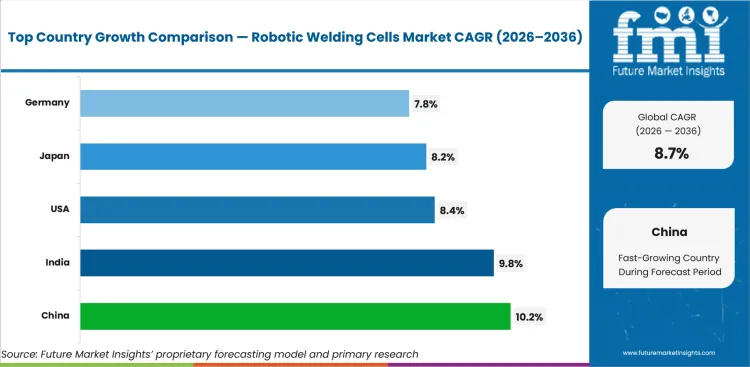
How do country-level CAGRs compare?
- China (CAGR: 10.2%): China installed 295,045 industrial robots in 2024 and accounted for 54% of global installations.
- India (CAGR: 9.8%): India is building from a smaller robot base but expanding in automotive and metal fabrication.
- United States (CAGR: 8.4%): Automotive remained the leading United States robot-adopting sector with 13,500 installations in 2025.
- Japan (CAGR: 8.2%): Japan recorded 44,453 industrial robot installations in 2024.
- Germany (CAGR: 7.8%): Germany recorded 26,982 industrial robot installations in 2024.
The global Robotic Welding Cells Market is forecast to record a CAGR of 8.7% from 2026 to 2036. The study covers 30+ countries across the report regions.
How is the Robotic Welding Cells Market developing in China?
China is projected to record a CAGR of 10.2% through 2036. The country outlook identifies this demand signal: China installed 295,045 industrial robots in 2024 and accounted for 54% of global installations.
Country Market Snapshot
| Country | China |
|---|---|
| Forecast CAGR | 10.2% |
| Demand anchor | China installed 295,045 industrial robots in 2024 and accounted for 54% of global installations. |
| Supply signal | Local Chinese suppliers held a larger share of domestic installations in recent IFR reporting. |
| Application mix | EVs, machinery, metal products, and electronics equipment drive welding-cell demand. |
| Restraint | Price pressure is high as local robotics competition expands. |
| Procurement route | Large manufacturers use direct OEM and integrator-led project purchasing. |
| Primary demand signal | China installed 295,045 industrial robots in 2024 and accounted for 54% of global installations. |
| Company context | Companies active in or serving this market include Estun Automation, EFORT, SIASUN, KUKA, and ABB Robotics. |
Market Outlook
China is forecast to grow at a CAGR of 10.2% through 2036 as a major global robot market keeps adding welding automation capacity. IFR reported 295,045 industrial robot installations in China during 2024 and a 54% global installation share. This scale gives robotic welding-cell suppliers a large addressable production footprint. Chinese buyers often compare cycle time, service speed, and local price more sharply than Western buyers.
Key Growth Drivers
- EV production supports welding cells for body structures and battery-related components.
- Local robot supplier depth shortens lead times for standard arc and spot cells.
- Provincial manufacturing upgrades support automation purchases in industrial clusters.
- China installed 295,045 industrial robots in 2024 and accounted for 54% of global installations.
Key Restraints
- Price competition can reduce margins for standard welding-cell packages.
- Local supplier variation can create quality gaps in fixtures and commissioning.
- Price pressure is high as local robotics competition expands.
Country Market FAQs
What should C-suite teams prioritize in China?
C-suite teams should prioritize qualification requirements, procurement routes, local service coverage, and implementation economics before committing capital or supplier volume.
How should suppliers approach the China market?
Suppliers should align technical evidence, local channel support, and account-specific commercial terms with the buying process used by major customers in China.
What can weaken the business case in China?
Price pressure is high as local robotics competition expands. Executives should test this exposure during supplier, investment, and rollout reviews.
How is the Robotic Welding Cells Market developing in India?
India is projected to record a CAGR of 9.8% through 2036. The country outlook identifies this demand signal: India is building from a smaller robot base but expanding in automotive and metal fabrication.
Country Market Snapshot
| Country | India |
|---|---|
| Forecast CAGR | 9.8% |
| Demand anchor | India is building from a smaller robot base but expanding in automotive and metal fabrication. |
| Application mix | Two-wheelers, passenger vehicles, construction equipment, and fabrication shops guide demand. |
| Procurement route | Buyers often select integrators that can prove ROI on a limited cell footprint. |
| Restraint | Price sensitivity can delay fully equipped cells with sensors and positioners. |
| Channel signal | FANUC India, KUKA India, ABB, Panasonic, and integrators support industrial automation projects. |
| Primary demand signal | India is building from a smaller robot base but expanding in automotive and metal fabrication. |
| Company context | Companies active in or serving this market include FANUC India, ABB Robotics, KUKA India, Yaskawa India, and Panasonic Smart Factory Solutions India. |
Market Outlook
India is expected to grow at a CAGR of 9.8% through 2036 as automotive and fabrication buyers automate more welding tasks. IFR’s 2025 global release listed India among the countries covered by detailed World Robotics reporting and noted wider long-term factory robot expansion. The market remains smaller than China or Japan, which makes education and ROI proof central. Indian buyers often start with arc welding cells for repetitive components.
Key Growth Drivers
- Automotive supplier expansion supports robotic welding for frames and structural components.
- Construction equipment and machinery makers need repeatable weld quality for exported assemblies.
- Local integrators reduce buyer risk through demonstrations and phased cell installation.
- India is building from a smaller robot base but expanding in automotive and metal fabrication.
Key Restraints
- High upfront cost limits sensor-rich welding cells in small fabrication shops.
- Service coverage outside major industrial clusters can slow repeat purchases.
- Price sensitivity can delay fully equipped cells with sensors and positioners.
Country Market FAQs
What should C-suite teams prioritize in India?
C-suite teams should prioritize qualification requirements, procurement routes, local service coverage, and implementation economics before committing capital or supplier volume.
How should suppliers approach the India market?
Suppliers should align technical evidence, local channel support, and account-specific commercial terms with the buying process used by major customers in India.
What can weaken the business case in India?
Price sensitivity can delay fully equipped cells with sensors and positioners. Executives should test this exposure during supplier, investment, and rollout reviews.
How is the Robotic Welding Cells Market developing in the United States?
The United States is projected to record a CAGR of 8.4% through 2036. The country outlook identifies this demand signal: Automotive remained the leading United States robot-adopting sector with 13,500 installations in 2025.
Country Market Snapshot
| Country | United States |
|---|---|
| Forecast CAGR | 8.4% |
| Demand anchor | Automotive remained the leading United States robot-adopting sector with 13,500 installations in 2025. |
| Channel signal | Domestic robot system integrators play a major role since the United States imports many robots. |
| Application mix | Welding-cell demand is notable in automotive, trailers, machinery, and contract fabrication. |
| Restraint | Skilled integrator availability can delay cell commissioning in regional fabrication clusters. |
| Competitive context | FANUC America, Lincoln Electric, Yaskawa Motoman, and ABB serve the market through direct and integrator routes. |
| Primary demand signal | Automotive remained the leading United States robot-adopting sector with 13,500 installations in 2025. |
| Company context | Companies active in or serving this market include Lincoln Electric, FANUC America, ABB Robotics, Yaskawa Motoman, and Miller Electric. |
Market Outlook
The United States is projected to record a CAGR of 8.4% through 2036 as fabrication buyers expand automation beyond automotive. IFR reported 38,000 industrial robot installations in 2025, which marked an 11% year-on-year rise. That rebound supports welding-cell demand where plants seek output stability during labor shortages. Buying behavior is split between large OEM programs and smaller fabricator cells. Large buyers value uptime proof and service response. Smaller buyers prefer pre-engineered cells, lease-style automation support, and local training through integrators.
Key Growth Drivers
- Automotive reshoring supports welding-cell projects across body, battery, and supplier plants.
- Fabrication shops adopt compact arc cells when welder hiring limits order intake.
- Local integrator networks reduce buyer risk by handling fixtures and safety layouts.
- Automotive remained the leading United States robot-adopting sector with 13,500 installations in 2025.
Key Restraints
- High fixture and safety-engineering costs can delay first-time automation projects.
- Imported robot dependence can expose buyers to support-time and currency pressure.
- Skilled integrator availability can delay cell commissioning in regional fabrication clusters.
Country Market FAQs
What should C-suite teams prioritize in the United States?
C-suite teams should prioritize qualification requirements, procurement routes, local service coverage, and implementation economics before committing capital or supplier volume.
How should suppliers approach the United States market?
Suppliers should align technical evidence, local channel support, and account-specific commercial terms with the buying process used by major customers in the United States.
What can weaken the business case in the United States?
Skilled integrator availability can delay cell commissioning in regional fabrication clusters. Executives should test this exposure during supplier, investment, and rollout reviews.
How is the Robotic Welding Cells Market developing in Japan?
Japan is projected to record a CAGR of 8.2% through 2036. The country outlook identifies this demand signal: Japan recorded 44,453 industrial robot installations in 2024.
Country Market Snapshot
| Country | Japan |
|---|---|
| Forecast CAGR | 8.2% |
| Demand anchor | Japan recorded 44,453 industrial robot installations in 2024. |
| Automotive signal | Japanese automotive plants installed about 13,000 industrial robots in 2024. |
| Supply base | FANUC, Yaskawa, Kawasaki Robotics, and Panasonic Connect are major local automation suppliers. |
| Application mix | Automotive, electronics equipment, machinery, and metal fabrication shape demand. |
| Restraint | Domestic installation levels declined 4% in 2024. |
| Primary demand signal | Japan recorded 44,453 industrial robot installations in 2024. |
| Company context | Companies active in or serving this market include FANUC, Yaskawa Electric, Kawasaki Robotics, Daihen, and Panasonic Connect. |
Market Outlook
Japan is projected to grow at a CAGR of 8.2% through 2036 as local robot suppliers support welding-cell modernization. IFR reported 44,453 industrial robot installations in Japan during 2024, with automotive robot installations around 13,000 units. This gives welding-cell suppliers a strong base of automation skill and customer familiarity. Japanese buyers value compact layouts and process reliability. Suppliers with robot, controller, and welding power-source integration have an advantage in plants with limited space and high uptime expectations.
Key Growth Drivers
- Automotive suppliers use robotic welding cells for repeatability in structural and frame parts.
- Local robot OEM depth supports faster engineering and service response.
- Compact factory layouts favor cell designs with small footprints and reliable cable routing.
- Japan recorded 44,453 industrial robot installations in 2024.
Key Restraints
- Slower domestic robot installation growth can limit short-term expansion.
- Aging factory equipment may need layout changes before new cells can be added.
- Domestic installation levels declined 4% in 2024.
Country Market FAQs
What should C-suite teams prioritize in Japan?
C-suite teams should prioritize qualification requirements, procurement routes, local service coverage, and implementation economics before committing capital or supplier volume.
How should suppliers approach the Japan market?
Suppliers should align technical evidence, local channel support, and account-specific commercial terms with the buying process used by major customers in Japan.
What can weaken the business case in Japan?
Domestic installation levels declined 4% in 2024. Executives should test this exposure during supplier, investment, and rollout reviews.
How is the Robotic Welding Cells Market developing in Germany?
Germany is projected to record a CAGR of 7.8% through 2036. The country outlook identifies this demand signal: Germany recorded 26,982 industrial robot installations in 2024.
Country Market Snapshot
| Country | Germany |
|---|---|
| Forecast CAGR | 7.8% |
| Demand anchor | Germany recorded 26,982 industrial robot installations in 2024. |
| Supply base | KUKA is headquartered in Augsburg and remains a major local automation supplier. |
| Application mix | Demand is concentrated in automotive, machinery, metalworking, and EV production equipment. |
| Restraint | EU cost pressure and weak order intake can delay large capital approvals. |
| Procurement route | German buyers use detailed engineering review before final cell selection. |
| Primary demand signal | Germany recorded 26,982 industrial robot installations in 2024. |
| Company context | Companies active in or serving this market include KUKA, CLOOS, ABB Robotics, Yaskawa Europe, and Fronius Deutschland. |
Market Outlook
Germany is forecast to grow at a CAGR of 7.8% through 2036 as high automation density supports repeat welding-cell upgrades. IFR reported Germany as Europe’s substantial robot market with 26,982 installations in 2024, equal to roughly 32% of European annual volume. That scale creates a large replacement and upgrade pool for robotic welding cells. German buyers are demanding on process proof and energy efficiency. Welding-cell suppliers need application references, safety validation, and service depth to enter automotive and machinery accounts.
Key Growth Drivers
- Automotive body and EV welding programs support robot-cell modernization.
- Machinery exporters use robotic welding cells to protect delivery quality.
- Local automation engineering depth improves access to complex turnkey lines.
- Germany recorded 26,982 industrial robot installations in 2024.
Key Restraints
- High labor and energy costs raise the hurdle for weakly justified automation projects.
- Capital spending caution in European manufacturing can slow large line conversions.
- EU cost pressure and weak order intake can delay large capital approvals.
Country Market FAQs
What should C-suite teams prioritize in Germany?
C-suite teams should prioritize qualification requirements, procurement routes, local service coverage, and implementation economics before committing capital or supplier volume.
How should suppliers approach the Germany market?
Suppliers should align technical evidence, local channel support, and account-specific commercial terms with the buying process used by major customers in Germany.
What can weaken the business case in Germany?
EU cost pressure and weak order intake can delay large capital approvals. Executives should test this exposure during supplier, investment, and rollout reviews.
Which companies are discussed in the Robotic Welding Cells Market?
The preview discusses FANUC, ABB, KUKA, Yaskawa Motoman, and Lincoln Electric among the companies active in this market.
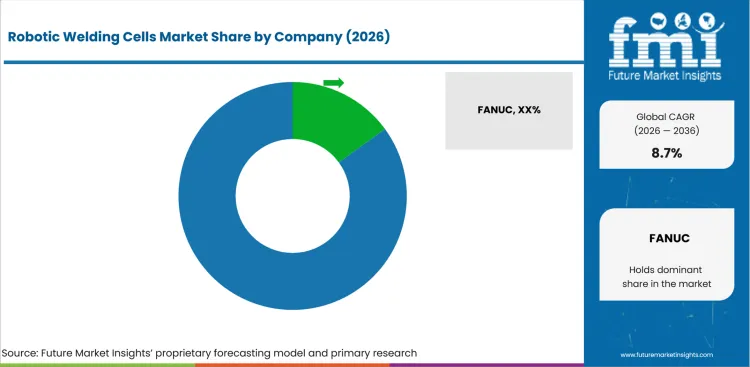
The market is moderately concentrated as global robot OEMs hold strong positions but integrators control many final cell decisions. established companies win by combining robot motion, welding process control, simulation, and service coverage. Smaller specialists compete in fixtures, retrofit cells, collaborative welding, and local commissioning support.
Entry barriers include weld-process knowledge, safety validation, software integration, and proof of uptime. Competition in robotic welding cells is less about selling an arm and more about proving the welded part. ABB’s June 2024 OmniCore controller supports precision areas such as arc welding and laser cutting, with path accuracy below 0.6 mm.
How is competition structured?
Competition reflects differences in specialization, portfolio scope, geographic reach, evidence, and customer access.
The competitive structure includes robot OEMs, welding process specialists, and integrators with cell-level engineering capability.
- Robot OEMs: FANUC, ABB, KUKA, Yaskawa Motoman, Kawasaki Robotics, and Nachi-Fujikoshi compete through robot arms, controllers, software, and service coverage. Their strengths are motion accuracy, payload range, safety features, and global installed support.
- Welding Process Specialists: Lincoln Electric, Fronius, Panasonic Connect, and DAIHEN compete through welding power sources, arc control, torches, and weld-process know-how. Their advantage is notable when the buyer needs stable arc behavior, weld qualification support, and proven power-source integration.
- System Integrators and Cell Specialists: Acieta, RedViking, Inrotech, and local automation houses compete through fixtures, guarding, programming, and commissioning. They win where buyers need a complete working cell and a local service team.
How do selected companies compare?
The selected companies differ in portfolio focus, geographic reach, evidence depth, and channel strength.
| Company | Competitive position |
|---|---|
| FANUC | FANUC is assessed for software or automation portfolio fit, integration capability, service coverage, and access to industrial buyers. |
| ABB Robotics | ABB Robotics is assessed for software or automation portfolio fit, integration capability, service coverage, and access to industrial buyers. |
| KUKA | KUKA is assessed for software or automation portfolio fit, integration capability, service coverage, and access to industrial buyers. |
| Yaskawa Motoman | Yaskawa Motoman is assessed for software or automation portfolio fit, integration capability, service coverage, and access to industrial buyers. |
| Lincoln Electric | Lincoln Electric is assessed for software or automation portfolio fit, integration capability, service coverage, and access to industrial buyers. |
What are the key developments in the Robotic Welding Cells Market?
- In June 2024, ABB launched OmniCore as its next-generation robotics control platform. The controller supports arc welding use cases through higher path accuracy and faster motion control.
- In June 2024, KUKA announced an order for 23 friction stir welding cells with integrated robots for EV production. The order highlights welding-cell demand in battery structures.
- In April 2024, Lincoln Electric acquired RedViking, an automation system integrator based in Michigan. The deal expanded Lincoln Electric’s automation integration capability.
Selected Companies in the Robotic Welding Cells Market
Companies referenced in this preview
- FANUC.
- ABB Robotics.
- KUKA.
- Yaskawa Motoman.
- Lincoln Electric.
- Kawasaki Robotics.
- CLOOS.
- Panasonic Connect.
Market Scope & Definition
| Metric | Value |
|---|---|
| Market definition | Robotic welding cells are integrated factory systems that combine a robot, welding process equipment, fixtures, safety guarding, controls, and cell software. |
| Functions covered | Arc Welding Cells, Spot Welding Cells, Laser Welding Cells, Collaborative Welding Cells |
| Applications covered | Automotive, Metal Fabrication, Heavy Machinery, Aerospace & Other |
| End-use industries | Automotive, Metal Fabrication, Heavy Machinery, Aerospace & Other |
| Inclusions | Market scope covers robotic welding systems by Cell Type, Payload Class, End Use, Configuration, and Sales Channel across the selected global countries. |
| Exclusions | The market excludes manual welding stations, portable welding machines, standalone welding consumables, pure cutting cells, additive manufacturing systems without welding-cell sale, and robots sold only for handling or palletizing. |
Research Methodology
| Metric | Value |
|---|---|
| Primary Research | FMI analysts reviewed buying behavior from automotive manufacturers, fabrication shops, robot integrators, welding equipment suppliers, and distributor networks. The review focused on cell specification, commissioning risks, fixture needs, and payback thresholds. |
| Desk Research | used robot installation data, company product evidence, standards references, and official industry releases. Product scope was cross-checked against welding-cell portfolios from robot OEMs and welding automation suppliers. |
| Market Sizing and Forecasting | The model combined equipment volume, average cell pricing, configuration mix, country automation maturity, and end-use adoption rates. The forecast used the provided values of USD 6500.0 million in 2026 and USD 15000.0 million by 2036. |
| Market Calibration | Forecasts reflect industrial robot installation trends, welding automation product launches, and system integrator activity. Segment positions reflect supplier portfolios and buyer use-case fit. |
What does the report cover?
The report covers cell type, payload class, end use, configuration, sales channel, and region across the 2026-2036 forecast period in 30+ countries.
| Metric | Value |
|---|---|
| Periods | Base year 2025; estimated year 2026; forecast period 2026-2036 |
| Quantitative units | USD 6500.0 million to USD 15000.0 million, at a CAGR of 8.7% |
| Segment axes | cell type, payload class, end use, configuration, sales channel, and region |
| Regions | North America, Latin America, Europe, East Asia, South Asia and Pacific, Middle East and Africa |
| Countries | United States, United Kingdom, Germany, France, Japan, China, South Korea, India and 30+ countries |
| Companies | FANUC, ABB Robotics, KUKA, Yaskawa Motoman, Lincoln Electric, Kawasaki Robotics, CLOOS, Panasonic Connect, and others |
| Approach | Hybrid bottom-up and top-down methodology using robot installation signals, supplier portfolios, country automation maturity, and welding-cell pricing. |
Market Segmentation Analysis
Segmented by Cell Type
- Arc Welding Cells.
- Spot Welding Cells.
- Laser Welding Cells.
- Collaborative Welding Cells.
Segmented by Payload Class
- <20 kg.
- 20-100 kg.
- 100 kg.
Segmented by End Use
- Automotive.
- Metal Fabrication.
- Heavy Machinery.
- Aerospace & Other.
Segmented by Configuration
- Fixed Cells.
- Modular Cells.
- Turnkey Lines.
Segmented by Sales Channel
- Direct OEM.
- System Integrators.
- Distributors.
By Region
- North America.
- United States.
- Canada.
- Mexico.
- Latin America.
- Brazil.
- Chile.
- Rest of Latin America.
- Western Europe.
- Germany.
- Italy.
- Spain.
- France.
- Nordic.
- BENELUX.
- Rest of Western Europe.
- Eastern Europe.
- Russia.
- Poland.
- Hungary.
- Balkan & Baltic.
- Rest of Eastern Europe.
- East Asia.
- China.
- Japan.
- South Korea.
- South Asia and Pacific.
- India.
- ASEAN.
- Australia & New Zealand.
- Rest of South Asia and Pacific.
- Middle East & Africa.
- Kingdom of Saudi Arabia.
- Other GCC Countries.
- Turkiye.
- South Africa.
- Other African Union.
- Rest of Middle East & Africa.
Research Sources and Bibliography
- 1. International Federation of Robotics. (2025, September 25). World Robotics 2025 report - Industrial Robots. International Federation of Robotics.
- 2. International Federation of Robotics. (2026, June 18). USA robot industry returns to double digit growth. International Federation of Robotics.
- 3. International Federation of Robotics. (2026, April 8). Robot density surges in Europe, Asia, and Americas. International Federation of Robotics.
- 4. International Federation of Robotics. (2025, July 15). Japan’s car industry has highest robot installations in five years. International Federation of Robotics.
- 5. ABB. (2024, June 4). ABB launches next-generation Robotics control platform OmniCore.
- 6. KUKA. (2024, June 12). State-of-the-art KUKA welding technologies for e-mobility: Major order in the double-digit million range.
- 7. Lincoln Electric. (2024, April 1). Lincoln Electric acquires RedViking.
- 8. Lincoln Electric. (2024, June 3). Lincoln Electric acquires Inrotech.
- 9. FANUC America. (2025, June 26). FANUC introduces enhanced, next-gen ROBOGUIDE robot simulation software.
- 10. Yaskawa Motoman. (2025, July). Yaskawa America announces new robotics manufacturing expansion in Franklin, Wisconsin.
- 11. ABB. (2025, September 23). ABB Robotics launches OmniCore EyeMotion.
- 12. Yaskawa Europe. (2025, August 5). Yaskawa at Welding & Cutting 2025.
The bibliography is provided for reader reference and uses primary non-commercial trade body sources or official company publications.
This Report Answers
- What is the projected value of the Robotic Welding Cells Market in 2026?
- What value is forecast for the Robotic Welding Cells Market by 2036?
- What CAGR is forecast for the Robotic Welding Cells Market from 2026 to 2036?
- What 2026 share is projected for Arc Welding Cells within the cell type category?
- What 2026 share is projected for 20-100 kg within the payload class category?
- Which demand factors support the Robotic Welding Cells Market outlook?
- Which restraints and opportunities affect adoption in the Robotic Welding Cells Market?
- How are country CAGR outlooks, including China at 10.2%, compared?
- Which companies and product developments are covered in the competitive analysis?
- What is included in the market scope, and how is the forecast validated?
Frequently Asked Questions
Why should executives track the Robotic Welding Cells Market?
Executives should track this market because it can affect capital allocation, supplier strategy, operating risk, and competitive positioning across commercial planning cycles.
What business problem does the Robotic Welding Cells Market address?
It helps executive teams judge where customer pain, supplier capability, compliance exposure, and implementation economics justify investment, procurement, or portfolio action.
What should procurement leaders evaluate before selecting suppliers?
Procurement leaders should assess evidence quality, integration fit, service coverage, compliance readiness, total cost of ownership, and supplier execution capability.
What can limit return on investment for buyers?
Return on investment can be limited by low utilization, integration delays, training gaps, unclear ownership, pricing pressure, or weak fit with existing workflows.
How can suppliers build executive confidence?
Suppliers can build confidence by proving implementation speed, risk reduction, support depth, reference use cases, and measurable outcomes for budget owners.
Preview the report firsthand - request a free sample
Get SampleGet the brochure for pricing and purchase details.
Get PDFTable of Content
- Key Takeaways
- Market Size and CAGR
- Top Growth Driver
- Fastest Growing Segment
- Leading Region
- Key Companies
- Emerging Opportunities
- Executive Summary
- Global Market Outlook
- Demand-side Trends
- Supply-side Trends
- Technology Roadmap Analysis
- Analysis and Recommendations
- Analyst Perspective (What is happening? Why now? What should investors know?)
- Key Questions Answered
- How large is the market?
- What is the CAGR?
- What are key trends?
- Which region dominates?
- Who are the leaders?
- Market Overview
- Market Coverage / Taxonomy
- Market Definition / Scope / Limitations
- Research Methodology
- Chapter Orientation
- Analytical Lens and Working Hypotheses
- Market Structure, Signals, and Trend Drivers
- Benchmarking and Cross-market Comparability
- Market Sizing, Forecasting, and Opportunity Mapping
- Research Design and Evidence Framework
- Desk Research Programme (Secondary Evidence)
- Expert Input and Fieldwork (Primary Evidence)
- Tooling, Models, and Reference Databases
- Data Engineering and Model Build
- Quality Assurance and Audit Trail
- Market Background
- Market Dynamics (Drivers, Restraints, Opportunity, Trends)
- Scenario Forecast (Optimistic, Likely, Conservative)
- Impact Analysis
- AI Impact
- Sustainability Impact
- Regulatory Impact
- Technology Impact
- Consumer / Buyer Analysis
- Purchase Drivers
- Adoption Barriers
- Buyer Journey
- Opportunity Map Analysis
- Product Life Cycle Analysis
- Supply Chain Analysis
- Investment Feasibility Matrix
- Value Chain Analysis
- PESTLE and Porter's Analysis
- Regulatory Landscape
- Regional Parent Market Outlook
- Production and Consumption Statistics
- Import and Export Statistics
- Global Market Analysis and Forecast, 2021 to 2036
- Historical Market Size Value (USD Billion) & Volume (Unit) Analysis, 2021 to 2025
- Current and Future Market Size Value (USD Billion) & Volume (Unit) Projections, 2026 to 2036
- Y-o-Y Growth Trend Analysis
- Absolute $ Opportunity Analysis
- Global Market Pricing Analysis, 2021 to 2036
- Global Market Analysis and Forecast, By Cell Type, 2021 to 2036
- Introduction / Key Findings
- Historical Market Size Value (USD Billion) & Volume (Unit) Analysis By Cell Type, 2021 to 2025
- Current and Future Market Size Value (USD Billion) & Volume (Unit) Analysis and Forecast By Cell Type, 2026 to 2036
- Arc Welding Cells
- Spot Welding Cells
- Collaborative Welding Cells
- Arc Welding Cells
- Y-o-Y Growth Trend Analysis By Cell Type, 2021 to 2025
- Absolute $ Opportunity Analysis By Cell Type, 2026 to 2036
- Global Market Analysis and Forecast, By Payload Class, 2021 to 2036
- Introduction / Key Findings
- Historical Market Size Value (USD Billion) & Volume (Unit) Analysis By Payload Class, 2021 to 2025
- Current and Future Market Size Value (USD Billion) & Volume (Unit) Analysis and Forecast By Payload Class, 2026 to 2036
- 20–100 kg
- <20 kg
- 100 kg
- 20–100 kg
- Y-o-Y Growth Trend Analysis By Payload Class, 2021 to 2025
- Absolute $ Opportunity Analysis By Payload Class, 2026 to 2036
- Global Market Analysis and Forecast, By End Use, 2021 to 2036
- Introduction / Key Findings
- Historical Market Size Value (USD Billion) & Volume (Unit) Analysis By End Use, 2021 to 2025
- Current and Future Market Size Value (USD Billion) & Volume (Unit) Analysis and Forecast By End Use, 2026 to 2036
- Automotive
- Metal Fabrication
- Aerospace & Other
- Automotive
- Y-o-Y Growth Trend Analysis By End Use, 2021 to 2025
- Absolute $ Opportunity Analysis By End Use, 2026 to 2036
- Global Market Analysis and Forecast, By Configuration, 2021 to 2036
- Introduction / Key Findings
- Historical Market Size Value (USD Billion) & Volume (Unit) Analysis By Configuration, 2021 to 2025
- Current and Future Market Size Value (USD Billion) & Volume (Unit) Analysis and Forecast By Configuration, 2026 to 2036
- Modular Cells
- Fixed Cells
- Turnkey Lines
- Modular Cells
- Y-o-Y Growth Trend Analysis By Configuration, 2021 to 2025
- Absolute $ Opportunity Analysis By Configuration, 2026 to 2036
- Global Market Analysis and Forecast, By Sales Channel, 2021 to 2036
- Introduction / Key Findings
- Historical Market Size Value (USD Billion) & Volume (Unit) Analysis By Sales Channel, 2021 to 2025
- Current and Future Market Size Value (USD Billion) & Volume (Unit) Analysis and Forecast By Sales Channel, 2026 to 2036
- System Integrators
- Direct OEM
- Distributors
- System Integrators
- Y-o-Y Growth Trend Analysis By Sales Channel, 2021 to 2025
- Absolute $ Opportunity Analysis By Sales Channel, 2026 to 2036
- Global Market Analysis and Forecast, By Region, 2021 to 2036
- Introduction
- Historical Market Size Value (USD Billion) & Volume (Unit) Analysis By Region, 2021 to 2025
- Current Market Size Value (USD Billion) & Volume (Unit) Analysis and Forecast By Region, 2026 to 2036
- North America
- Latin America
- Western Europe
- Eastern Europe
- East Asia
- South Asia and Pacific
- Middle East & Africa
- Market Attractiveness Analysis By Region
- North America Market Analysis and Forecast, By Country, 2021 to 2036
- Historical Market Size Value (USD Billion) & Volume (Unit) Trend Analysis By Market Taxonomy, 2021 to 2025
- Market Size Value (USD Billion) & Volume (Unit) Forecast By Market Taxonomy, 2026 to 2036
- By Country
- USA
- Canada
- Mexico
- By Cell Type
- By Payload Class
- By End Use
- By Configuration
- By Sales Channel
- By Country
- Market Attractiveness Analysis
- By Country
- By Cell Type
- By Payload Class
- By End Use
- By Configuration
- By Sales Channel
- Key Takeaways
- Latin America Market Analysis and Forecast, By Country
- Historical Market Size Value (USD Billion) & Volume (Unit) Trend Analysis By Market Taxonomy, 2021 to 2025
- Market Size Value (USD Billion) & Volume (Unit) Forecast By Market Taxonomy, 2026 to 2036
- By Country
- Brazil
- Chile
- Rest of Latin America
- By Cell Type
- By Payload Class
- By End Use
- By Configuration
- By Sales Channel
- By Country
- Market Attractiveness Analysis
- By Country
- By Cell Type
- By Payload Class
- By End Use
- By Configuration
- By Sales Channel
- Key Takeaways
- Western Europe Market Analysis and Forecast, By Country
- Historical Market Size Value (USD Billion) & Volume (Unit) Trend Analysis By Market Taxonomy, 2021 to 2025
- Market Size Value (USD Billion) & Volume (Unit) Forecast By Market Taxonomy, 2026 to 2036
- By Country
- Germany
- UK
- Italy
- Spain
- France
- Nordic
- BENELUX
- Rest of Western Europe
- By Cell Type
- By Payload Class
- By End Use
- By Configuration
- By Sales Channel
- By Country
- Market Attractiveness Analysis
- By Country
- By Cell Type
- By Payload Class
- By End Use
- By Configuration
- By Sales Channel
- Key Takeaways
- Eastern Europe Market Analysis and Forecast, By Country
- Historical Market Size Value (USD Billion) & Volume (Unit) Trend Analysis By Market Taxonomy, 2021 to 2025
- Market Size Value (USD Billion) & Volume (Unit) Forecast By Market Taxonomy, 2026 to 2036
- By Country
- Russia
- Poland
- Hungary
- Balkan & Baltic
- Rest of Eastern Europe
- By Cell Type
- By Payload Class
- By End Use
- By Configuration
- By Sales Channel
- By Country
- Market Attractiveness Analysis
- By Country
- By Cell Type
- By Payload Class
- By End Use
- By Configuration
- By Sales Channel
- Key Takeaways
- East Asia Market Analysis and Forecast, By Country
- Historical Market Size Value (USD Billion) & Volume (Unit) Trend Analysis By Market Taxonomy, 2021 to 2025
- Market Size Value (USD Billion) & Volume (Unit) Forecast By Market Taxonomy, 2026 to 2036
- By Country
- China
- Japan
- South Korea
- By Cell Type
- By Payload Class
- By End Use
- By Configuration
- By Sales Channel
- By Country
- Market Attractiveness Analysis
- By Country
- By Cell Type
- By Payload Class
- By End Use
- By Configuration
- By Sales Channel
- Key Takeaways
- South Asia and Pacific Market Analysis and Forecast, By Country
- Historical Market Size Value (USD Billion) & Volume (Unit) Trend Analysis By Market Taxonomy, 2021 to 2025
- Market Size Value (USD Billion) & Volume (Unit) Forecast By Market Taxonomy, 2026 to 2036
- By Country
- India
- ASEAN
- Australia & New Zealand
- Rest of South Asia and Pacific
- By Cell Type
- By Payload Class
- By End Use
- By Configuration
- By Sales Channel
- By Country
- Market Attractiveness Analysis
- By Country
- By Cell Type
- By Payload Class
- By End Use
- By Configuration
- By Sales Channel
- Key Takeaways
- Middle East & Africa Market Analysis and Forecast, By Country
- Historical Market Size Value (USD Billion) & Volume (Unit) Trend Analysis By Market Taxonomy, 2021 to 2025
- Market Size Value (USD Billion) & Volume (Unit) Forecast By Market Taxonomy, 2026 to 2036
- By Country
- Kingdom of Saudi Arabia
- Other GCC Countries
- Türkiye
- South Africa
- Other African Union
- Rest of Middle East & Africa
- By Cell Type
- By Payload Class
- By End Use
- By Configuration
- By Sales Channel
- By Country
- Market Attractiveness Analysis
- By Country
- By Cell Type
- By Payload Class
- By End Use
- By Configuration
- By Sales Channel
- Key Takeaways
- Key Countries Market Analysis
- USA
- Pricing Analysis
- Market Share Analysis, 2025
- By Cell Type
- By Payload Class
- By End Use
- By Configuration
- By Sales Channel
- Canada
- Pricing Analysis
- Market Share Analysis, 2025
- By Cell Type
- By Payload Class
- By End Use
- By Configuration
- By Sales Channel
- Mexico
- Pricing Analysis
- Market Share Analysis, 2025
- By Cell Type
- By Payload Class
- By End Use
- By Configuration
- By Sales Channel
- Brazil
- Pricing Analysis
- Market Share Analysis, 2025
- By Cell Type
- By Payload Class
- By End Use
- By Configuration
- By Sales Channel
- Chile
- Pricing Analysis
- Market Share Analysis, 2025
- By Cell Type
- By Payload Class
- By End Use
- By Configuration
- By Sales Channel
- Germany
- Pricing Analysis
- Market Share Analysis, 2025
- By Cell Type
- By Payload Class
- By End Use
- By Configuration
- By Sales Channel
- UK
- Pricing Analysis
- Market Share Analysis, 2025
- By Cell Type
- By Payload Class
- By End Use
- By Configuration
- By Sales Channel
- Italy
- Pricing Analysis
- Market Share Analysis, 2025
- By Cell Type
- By Payload Class
- By End Use
- By Configuration
- By Sales Channel
- Spain
- Pricing Analysis
- Market Share Analysis, 2025
- By Cell Type
- By Payload Class
- By End Use
- By Configuration
- By Sales Channel
- France
- Pricing Analysis
- Market Share Analysis, 2025
- By Cell Type
- By Payload Class
- By End Use
- By Configuration
- By Sales Channel
- India
- Pricing Analysis
- Market Share Analysis, 2025
- By Cell Type
- By Payload Class
- By End Use
- By Configuration
- By Sales Channel
- ASEAN
- Pricing Analysis
- Market Share Analysis, 2025
- By Cell Type
- By Payload Class
- By End Use
- By Configuration
- By Sales Channel
- Australia & New Zealand
- Pricing Analysis
- Market Share Analysis, 2025
- By Cell Type
- By Payload Class
- By End Use
- By Configuration
- By Sales Channel
- China
- Pricing Analysis
- Market Share Analysis, 2025
- By Cell Type
- By Payload Class
- By End Use
- By Configuration
- By Sales Channel
- Japan
- Pricing Analysis
- Market Share Analysis, 2025
- By Cell Type
- By Payload Class
- By End Use
- By Configuration
- By Sales Channel
- South Korea
- Pricing Analysis
- Market Share Analysis, 2025
- By Cell Type
- By Payload Class
- By End Use
- By Configuration
- By Sales Channel
- Russia
- Pricing Analysis
- Market Share Analysis, 2025
- By Cell Type
- By Payload Class
- By End Use
- By Configuration
- By Sales Channel
- Poland
- Pricing Analysis
- Market Share Analysis, 2025
- By Cell Type
- By Payload Class
- By End Use
- By Configuration
- By Sales Channel
- Hungary
- Pricing Analysis
- Market Share Analysis, 2025
- By Cell Type
- By Payload Class
- By End Use
- By Configuration
- By Sales Channel
- Kingdom of Saudi Arabia
- Pricing Analysis
- Market Share Analysis, 2025
- By Cell Type
- By Payload Class
- By End Use
- By Configuration
- By Sales Channel
- Türkiye
- Pricing Analysis
- Market Share Analysis, 2025
- By Cell Type
- By Payload Class
- By End Use
- By Configuration
- By Sales Channel
- South Africa
- Pricing Analysis
- Market Share Analysis, 2025
- By Cell Type
- By Payload Class
- By End Use
- By Configuration
- By Sales Channel
- USA
- Market Structure Analysis
- Competition Dashboard
- Competition Benchmarking
- Market Share Analysis of Top Players
- By Regional
- By Cell Type
- By Payload Class
- By End Use
- By Configuration
- By Sales Channel
- Emerging Startups
- Innovation Benchmarking
- Competition Analysis
- Competition Deep Dive
- FANUC
- Overview
- Product Portfolio
- Profitability by Market Segments (Product/Region/Sales Channel)
- Sales Footprint
- Strategy Overview
- Marketing Strategy
- Product Strategy
- Channel Strategy
- ABB Robotics
- KUKA
- Yaskawa Motoman
- Lincoln Electric
- Kawasaki Robotics
- FANUC
- Case Studies
- Success Stories
- Recent Developments
- Competition Deep Dive
- Assumptions & Acronyms Used


