

- Market Size (2026)
- USD 130.0 Mn
- Forecast (2036)
- USD 302.2 Mn
- CAGR (2026 to 2036)
- 8.8%
How big is the robot tool changer monitoring market in 2026?
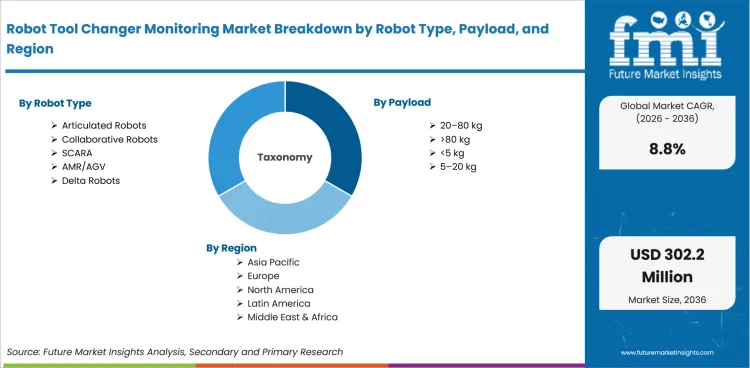
USD 130.0 million in 2026 and USD 302.2 million by 2036 at an 8.8% CAGR.
The robot tool changer monitoring industry value is forecast to grow from USD 119.5 million in 2025 to USD 302.2 million by 2036 at 8.8% CAGR as automated cells require verified coupling, tool identity, and signal continuity before robot motion resumes. Articulated robots are forecast to account for 42.0% share in 2026, led by multi-axis cells that expose tool interfaces to torque, cable strain, and repeated automatic changes. Lock status sensors are projected to hold 39.0% share in 2026 as buyers make safe coupling confirmation a standard acceptance point.
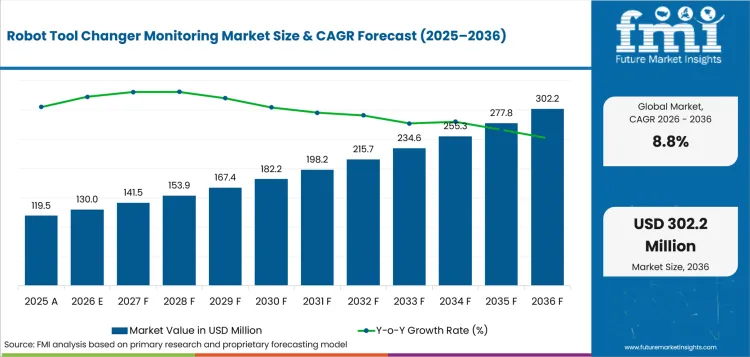
Robot Tool Changer Monitoring Market Overview: Size and Forecast
- 2025 Market Size: USD 119.5 million
- 2026 Market Size: USD 130.0 million
- 2036 Market Size: USD 302.2 million
- Forecast CAGR: 8.8% from 2026 to 2036
- Leading Robot Type: Articulated Robots
- Articulated Robots Share in 2026: 42.0%
- Leading Monitoring Component: Lock Status Sensors
- Lock Status Sensors Share in 2026: 39.0%
- Fastest-growing Country: China
- China CAGR: 10.2% by 2036
Summary of the Robot Tool Changer Monitoring Market
- Demand and Growth Drivers
- Automated cells are requiring cleaner lock confirmation before robots resume motion after a tool change.
- Integrators are adding tool identity checks to reduce wrong-tool cycles in mixed production lines.
- End users are giving more attention to monitored utility transfer across power, air, signal, and data channels.
- Product and Segment View
- Articulated robots are forecast to account for 42.0% share in 2026, influenced by high-motion tool-change cycles.
- Lock status sensors are projected to secure 39.0% share in 2026, led by demand for safe coupling verification.
- 20–80 kg payload systems are estimated to hold 36.0% share in 2026, supported by medium-duty welding and tending cells.
- Geography and Competitive Outlook
- China is projected to record 10.2% CAGR by 2036, supported by large robot deployment and domestic automation scale.
- India is expected to expand at 9.6% CAGR through 2036, backed by manufacturing automation and electronics capacity building.
- ATI Industrial Automation, Stäubli, SCHUNK, Zimmer Group, DESTACO, Robot System Products, and OnRobot compete through sensor-ready changer portfolios.
- Specialist suppliers win by pairing repeatable mechanical locking with tool-side diagnostics and common industrial communication support.
- Analyst Opinion
- Nikhil Kaitwade, Principal Consultant at Future Market Insights for the industrial domain, says, “Robot tool changer monitoring is becoming a practical uptime safeguard rather than an optional feature added after cell design. Buyers want proof that the tool is locked, identified, and ready before the robot moves at production speed. The strongest demand comes from cells that switch between grippers, welding guns, and inspection heads during one production cycle. Suppliers gain an edge when they combine repeatable mechanics with tool presence sensing and clean network data. The main watchpoint is integration effort. If monitoring data cannot enter the plant controller without custom work, the buyer loses part of the uptime value.”
Robot tool changer monitoring demand is also being shaped by broader robot deployment and industrial control scrutiny. The International Federation of Robotics reported 542,000 industrial robot installations in 2024, with operational stock reaching 4,663,773 units worldwide. CISA released four Industrial Control Systems advisories on June 10, 2025, showing why factories are reviewing connected robot-cell components more carefully. NIST’s 2024 digital twin guidance states that manufacturing digital twins help observe, diagnose, predict, and optimize systems in near real time. These signals make lock status, tool identity, and diagnostic data more valuable when plant teams connect end-of-arm tooling to controller dashboards.
The robot tool changer monitoring market is expected to witness steady expansion through 2036, driven by flexible robot cells that need verified tool changes before production restarts. Market adoption is further supported by rising demand for monitored coupling across automotive, electronics, logistics, and pharmaceutical automation.
Which factors support expansion in the robot tool changer monitoring market?
Finished monitored changer packages and retrofit-ready sensor modules support market value across automated production channels.
- Revenue is supported by monitored changer hardware before diagnostic software and communication modules add incremental value.
- Supplier pricing reflects locking repeatability, tool-side utility transfer, and signal reliability before payload class affects package cost.
- Value improves as factories move from single-tool robot stations toward multi-tool cells with verified exchange cycles.
- Buyer trust rises when lock status, tool presence, and tool identity are visible inside the plant controller.
Why is the robot tool changer monitoring market growing?
Flexible robot cells need verified tool status before production motion resumes after each change cycle.
Robot tool changer monitoring grows when factories expect one robot to complete several tasks in one cycle without manual checking. China’s National Bureau of Statistics reported industrial robot output of 773,074 units in 2025, up 28.0% from the previous year. This expanding automation base raises the number of tool interfaces that need lock confirmation, cable health visibility, and safe utility transfer. Monitoring demand is also increasing as buyers connect end-of-arm tooling data to plant diagnostics instead of relying on local indicator lights. The practical result is stronger demand for sensor-ready changer systems that help maintenance teams identify coupling problems before stoppages affect production schedules.
How is the robot tool changer monitoring market segmented?
The robot tool changer monitoring industry is segmented by robot type, payload, application, end-use industry, and monitoring component.
- Articulated robots are projected to secure 42.0% share in 2026, led by welding, handling, and tending cells that use frequent tool swaps under high motion loads.
- 20–80 kg payload systems are anticipated to hold 36.0% share in 2026 since medium-duty tools need reliable coupling across welding guns, grippers, and fixture-handling heads.
- Machine tending is expected to capture 28.0% share in 2026 due to unattended loading cells requiring lock and tool presence feedback before spindle cycles resume.
- Automotive is forecast to represent 31.0% share in 2026, guided by body shops and tier suppliers using monitored changers for welding, inspection, and handling tools.
- Lock status sensors are projected to account for 39.0% share in 2026, reflected by coupling verification becoming the first monitored signal buyers require.
Why do articulated robots dominate the robot tool changer monitoring market?
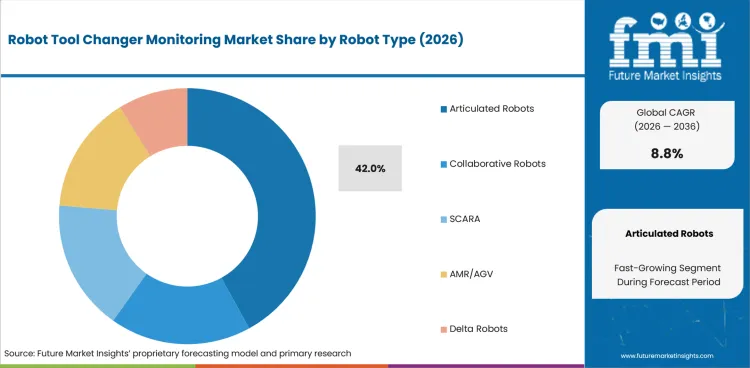
- Articulated robots are projected to account for 42.0% share in 2026, influenced by high-reach industrial cells where wrist torque and tool mass make coupling confirmation critical.
- Collaborative robots gain use in lighter workcells as compact changers help operators shift between grippers, screwdrivers, and inspection devices with lower integration effort.
Which payload range leads the robot tool changer monitoring market?
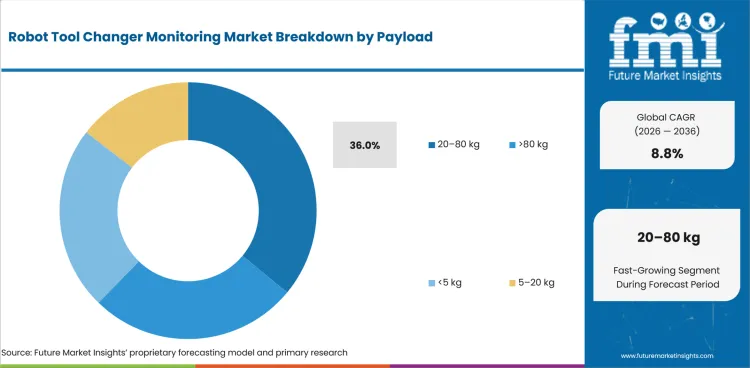
- 20–80 kg payload systems are estimated to represent 36.0% share in 2026, supported by medium-duty tooling that appears across welding, handling, and machine tending applications.
- 5–20 kg payload systems gain value in electronics and packaging cells where smaller tools still require lock status feedback and repeatable signal transfer.
Which application leads the robot tool changer monitoring market?
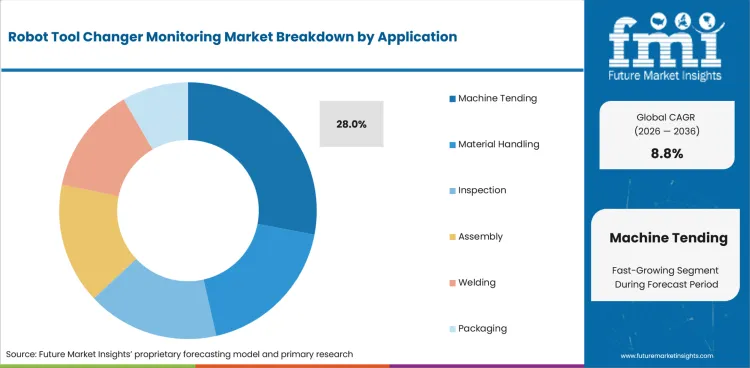
- Machine tending is projected to account for 28.0% share in 2026, led by unattended loading cells that need tool presence checks before spindle or fixture movement.
- Inspection applications are gaining importance as vision heads and metrology tools require cleaner high-speed data transfer through the changer interface.
Which end-use industry leads the robot tool changer monitoring market?
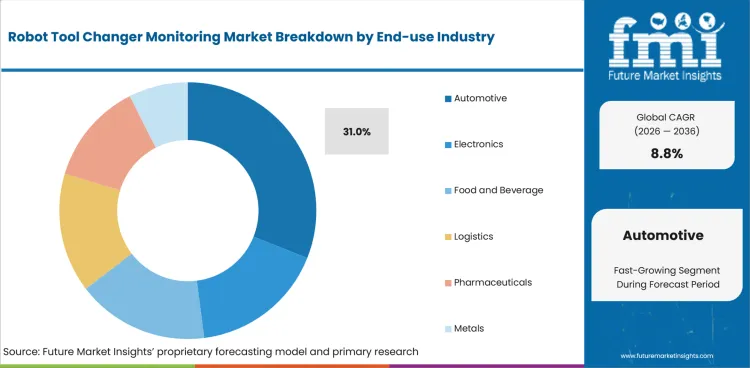
- Automotive is anticipated to account for 31.0% share in 2026, shaped by body-in-white, welding, handling, and parts-transfer cells that cannot tolerate wrong-tool cycles.
- Electronics manufacturers are increasing demand for compact monitored changers as short-cycle assembly lines shift between grippers, vacuum cups, and inspection heads.
Which monitoring component leads the robot tool changer monitoring market?
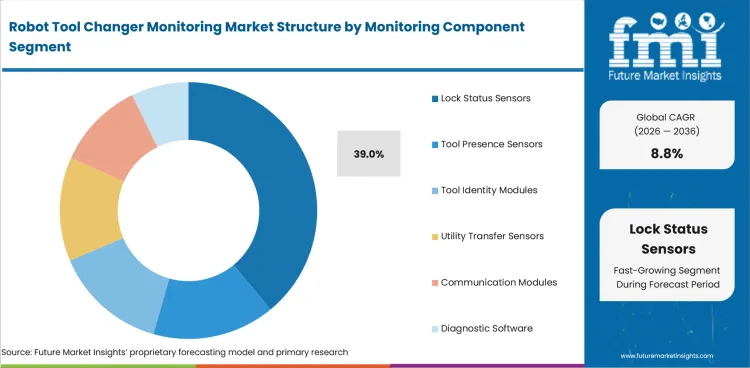
- Lock status sensors are forecast to secure 39.0% share in 2026, reflected by their role as the first safety and uptime confirmation point in automatic tool exchange.
- Tool identity modules gain stronger relevance as factories need the robot controller to confirm that the correct end effector is attached before motion begins.
What are the drivers, restraints, and opportunities in the robot tool changer monitoring market?
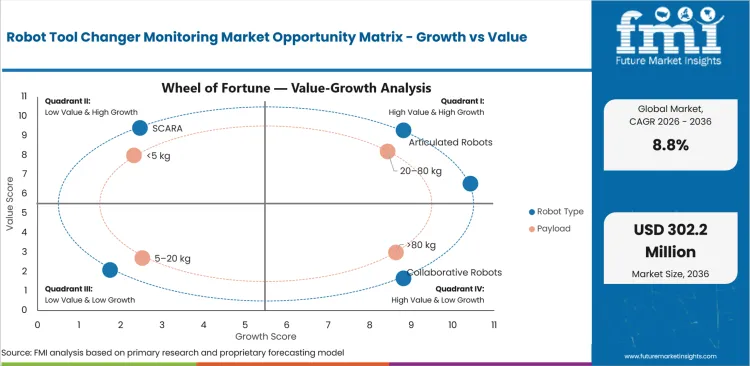
Flexible automation and sensor-ready tooling support adoption while retrofit complexity slows some upgrade programs.
- Tool identity checks reduce wrong-tool cycles in flexible production cells, helping plants avoid scrap, fixture damage, and unplanned stoppages during changeovers.
- Retrofit projects stall when older controllers lack spare input capacity, forcing engineers to add gateways or rework electrical architecture before monitoring can start.
- Standardized changer data can feed diagnostics and service programs, giving suppliers a recurring route to support uptime rather than only selling hardware.
Verified Coupling for Flexible Robot Cells
Tool changer monitoring gains budget priority when a missed lock signal can halt a high-value robot cell. NIST’s 2024 Manufacturing USA strategic plan identifies 17 current manufacturing institutes and nine federal partner agencies supporting advanced manufacturing priorities. This matters because automated production programs increasingly require measurable equipment status, repeatable change validation, and safer human-machine work practices. Tool changer monitoring supports these priorities by making the coupling interface a controlled data point rather than a hidden mechanical joint.
Legacy Controller Integration Burden
The main restraint is not sensor price alone. The harder barrier is connecting tool-side signals to older robot cells with limited inputs, mixed safety relays, and inconsistent network protocols. CISA released 3 Industrial Control Systems advisories on August 21, 2025, reflecting the continuing review burden around connected operational technology. Buyers may delay monitored changer retrofits when cyber review, safety validation, and controller mapping take longer than the hardware installation.
Network-Ready Diagnostics and Service Programs
Opportunity is rising as factories want tool changer data to support predictive maintenance and service contracts. NIST’s Manufacturing Extension Partnership network includes nearly 1,400 advisors and experts across more than 450 service locations, giving manufacturers a wider support base for modernization projects. This environment favors suppliers that provide clear signal models, common communication modules, and diagnostic outputs that integrators can connect without heavy custom engineering.
Which countries are growing fastest in the robot tool changer monitoring market?
China 10.2% CAGR, India 9.6% CAGR, South Korea 8.9% CAGR, Germany 8.4% CAGR, Japan 8.3% CAGR, United States 8.1% CAGR, France 7.6% CAGR, and United Kingdom 7.1% CAGR through 2036.
| Country | CAGR |
|---|---|
| United States | 8.1% |
| United Kingdom | 7.1% |
| Germany | 8.4% |
| France | 7.6% |
| Japan | 8.3% |
| China | 10.2% |
| South Korea | 8.9% |
| India | 9.6% |
Source: Future Market Insights, 2026.
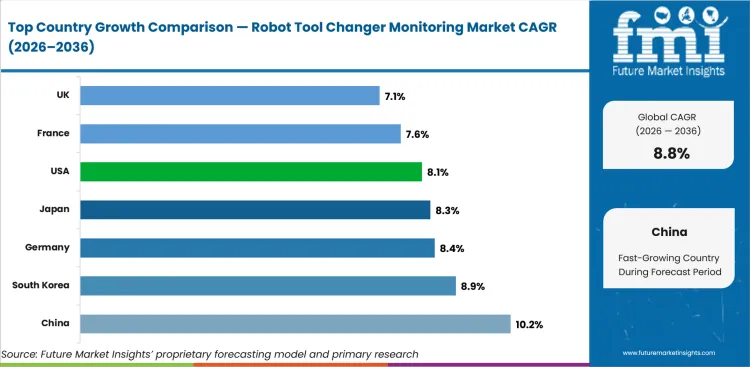
How do country-level CAGRs compare in the robot tool changer monitoring market?
China leads country expansion while the United Kingdom records the most cautious growth outlook among profiled markets.
- China is forecast to record 10.2% CAGR by 2036 as robot deployment scale supports faster monitored changer adoption.
- India is expected to expand at 9.6% CAGR through 2036 as manufacturing modernization supports new automation cells.
- South Korea is projected to grow at 8.9% CAGR by 2036 with electronics and automotive automation supporting sensor-ready tooling.
- Germany is estimated to advance at 8.4% CAGR through 2036 due to high-spec automotive and machinery automation demand.
- Japan is forecast to rise at 8.3% CAGR by 2036 as precision manufacturing supports monitored coupling systems.
- United States is projected to increase at 8.1% CAGR through 2036 as integrator-led retrofits improve existing robot cells.
- France is expected to post 7.6% CAGR by 2036 as aerospace, pharma, and automotive cells use documented tool-change validation.
- United Kingdom is forecast to grow at 7.1% CAGR by 2036 as selective automation spending supports modular monitoring upgrades.
What is driving robot tool changer monitoring demand in the United States?
A 8.1% CAGR through 2036 reflects integrator-led retrofit demand and strong installed automation use across automotive, aerospace, warehousing, and testing cells.
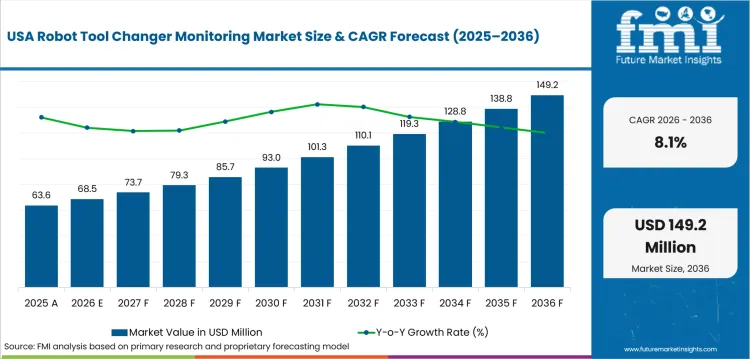
Country Market Snapshot Table
| Parameter | Value |
|---|---|
| Market Size in 2025 (Value) | USD 28.9 million |
| Market Size in 2026 (Value) | USD 31.2 million |
| Market Forecast in 2036 (Value) | USD 67.9 million |
| CAGR (2026 to 2036) | 8.1% |
| Years Considered | 2021 to 2036 |
| Base Year | 2025 |
| Forecast Period | 2026 to 2036 |
| Units Considered | Value (USD million) |
| Leading Sub-Region | Midwest and South Atlantic robot integration corridors |
United States Robot Tool Changer Monitoring Market Outlook
- United States demand is shaped by system integrator decisions and retrofit economics. Buyers often evaluate monitored changer packages by commissioning effort, service access, and compatibility with existing robot brands.
- Tool changer monitoring fits plants that want better uptime without replacing the full robot arm. Suppliers with local support, sensor-ready modules, and clear controller handoff should gain stronger acceptance.
Key Growth Drivers
- Automotive, aerospace, and testing cells require monitored utility transfer for high-value tools. The International Federation of Robotics reported 34,200 robot installations in the United States during 2024.
- Smart manufacturing support improves retrofit confidence for small and medium plants. NIST’s Manufacturing Extension Partnership includes more than 450 service locations across the United States and Puerto Rico.
- Integrator-led cell design helps monitored changers enter projects during gripper, welding, and inspection-tool upgrades.
- Domestic automation buyers value service proximity when production cells need fast replacement and troubleshooting support.
Key Restraints
- Industrial control review can lengthen approval cycles for connected tool-side diagnostics. CISA released 4 Industrial Control Systems advisories on June 10, 2025.
- Imported robot dependence can complicate cross-brand support for monitored changer interfaces.
- Older plants may lack spare input capacity for lock status, tool presence, and tool identity signals.
What makes the United States unique
The United States is unique because robot system integrators often control final changer monitoring architecture.
Key Companies
-
ATI Industrial Automation
- DESTACO
- SCHUNK
- Stäubli North America
- Zimmer Group USA
- OnRobot
- Robot System Products
Sales & Marketing Channels
- Direct enterprise sales to manufacturers
- Robot system integrators
- Automation distributors
- OEM tooling partnerships
- Aftermarket retrofit programs
- Technical support-led replacement channels
Country Segment Breakdown Table
| Segment | Sub-Segments |
|---|---|
| By Robot Type | Collaborative Robots · SCARA · Articulated Robots · AMR/AGV · Delta Robots |
| By Payload | <5 kg · 5–20 kg · 20–80 kg · >80 kg |
| By Application | Material Handling · Inspection · Assembly · Welding · Packaging · Machine Tending |
| By End-use Industry | Automotive · Electronics · Food and Beverage · Logistics · Pharmaceuticals · Metals |
| By Monitoring Component | Lock Status Sensors · Tool Presence Sensors · Tool Identity Modules · Utility Transfer Sensors · Communication Modules · Diagnostic Software |
| Key Sub-Regions Covered, Robot Integration Corridors | Midwest · South Atlantic · Texas · California · Pacific Northwest · Northeast |
Frequently Asked Questions
How fast is United States robot tool changer monitoring market growing?
Sales in the United States are expected to grow at 8.1% CAGR from 2026 to 2036, guided by integrator-led automation upgrades.
Who leads United States robot tool changer monitoring market?
ATI Industrial Automation, DESTACO, SCHUNK, Stäubli, Zimmer Group, and OnRobot compete through monitored changer systems and local support access.
What is driving adoption in United States robot tool changer monitoring market?
Integrator-led retrofit projects and high-value robot cells are moving buyers toward lock status and tool identity monitoring.
How is robot tool changer monitoring demand performing in the United Kingdom?
A 7.1% CAGR through 2036 reflects selective automation spending and modular retrofit demand across food, packaging, logistics, and automotive supplier cells.
Country Market Snapshot Table
| Parameter | Value |
|---|---|
| Market Size in 2025 (Value) | USD 5.3 million |
| Market Size in 2026 (Value) | USD 5.7 million |
| Market Forecast in 2036 (Value) | USD 11.3 million |
| CAGR (2026 to 2036) | 7.1% |
| Years Considered | 2021 to 2036 |
| Base Year | 2025 |
| Forecast Period | 2026 to 2036 |
| Units Considered | Value (USD million) |
| Leading Sub-Region | Midlands and national packaging automation corridors |
United Kingdom Robot Tool Changer Monitoring Market Outlook
- United Kingdom demand is smaller and more selective than larger automation markets. Buyers usually require clear downtime evidence before adding lock and tool presence monitoring to robot cells.
- Demand is expected to concentrate around packaging, food processing, logistics, and automotive supplier applications. Suppliers with simple sensor outputs and distributor support should gain preference in retrofit projects.
Key Growth Drivers
- Selective automation projects support monitored changer demand in food, packaging, and automotive supplier cells. The International Federation of Robotics recorded 2,500 industrial robot installations in the United Kingdom during 2024.
- Robotics adoption programs can lift buyer confidence in advanced automation. The UK government announced GBP 52 million for new robotics hubs in January 2026.
- Distributor-led support helps specialist tooling suppliers reach manufacturers with limited internal robotics teams.
- Packaging line integrators are adding tool checks as short production runs require faster end-effector changes.
Key Restraints
- Workplace safety review can lengthen approvals for moving robot-cell hardware. HSE recorded 59,219 employee non-fatal injuries reported under RIDDOR in 2024/25.
- Lower annual robot installation volume limits immediate replacement demand for monitored changers.
- Cost-sensitive buyers can delay upgrades when maintenance records do not clearly show downtime loss.
What makes the United Kingdom unique
The United Kingdom is unique because automation spending often depends on modular retrofit cases and distributor-led technical support.
Key Companies
- SCHUNK Intec UK
- Stäubli UK
- Zimmer Group UK
- OnRobot UK
- DESTACO UK
- BARA member integrators
- Local packaging automation suppliers
Sales & Marketing Channels
- Automation distributors
- Packaging line integrators
- OEM cell builders
- Maintenance retrofit contractors
- Direct sales to larger manufacturers
- Technical service partners
Country Segment Breakdown Table
| Segment | Sub-Segments |
|---|---|
| By Robot Type | Collaborative Robots · SCARA · Articulated Robots · AMR/AGV · Delta Robots |
| By Payload | <5 kg · 5–20 kg · 20–80 kg · >80 kg |
| By Application | Material Handling · Inspection · Assembly · Welding · Packaging · Machine Tending |
| By End-use Industry | Automotive · Electronics · Food and Beverage · Logistics · Pharmaceuticals · Metals |
| By Monitoring Component | Lock Status Sensors · Tool Presence Sensors · Tool Identity Modules · Utility Transfer Sensors · Communication Modules · Diagnostic Software |
| Key Sub-Regions Covered, Automation Clusters | Midlands · Greater Manchester · Yorkshire · London · South East · Scotland |
Frequently Asked Questions
How fast is United Kingdom robot tool changer monitoring market growing?
Industry in the United Kingdom is projected to increase at 7.1% CAGR from 2026 to 2036 through selective automation upgrades.
Who leads United Kingdom robot tool changer monitoring market?
SCHUNK, Stäubli, Zimmer Group, OnRobot, DESTACO, and specialist UK integrators compete through modular automation support.
What is driving adoption in United Kingdom robot tool changer monitoring market?
Packaging flexibility and retrofit-focused automation are moving UK buyers toward monitored robot tool changer systems.
What is supporting robot tool changer monitoring demand in Germany?
A 8.4% CAGR through 2036 reflects high-spec automotive, machinery, and precision manufacturing demand for repeatable tool-change validation.
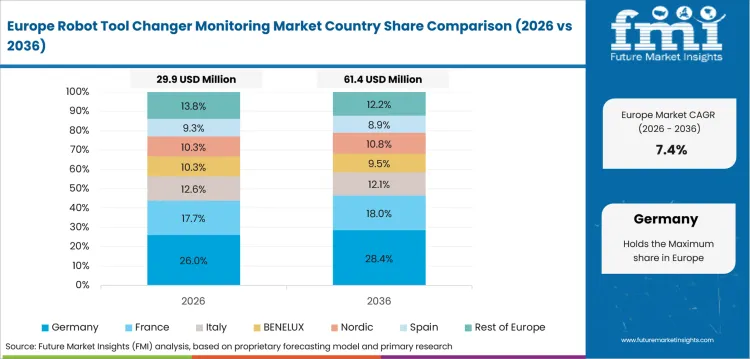
Country Market Snapshot Table
| Parameter | Value |
|---|---|
| Market Size in 2025 (Value) | USD 10.8 million |
| Market Size in 2026 (Value) | USD 11.7 million |
| Market Forecast in 2036 (Value) | USD 26.3 million |
| CAGR (2026 to 2036) | 8.4% |
| Years Considered | 2021 to 2036 |
| Base Year | 2025 |
| Forecast Period | 2026 to 2036 |
| Units Considered | Value (USD million) |
| Leading Sub-Region | Bavaria and Baden-Württemberg automation corridors |
Germany Robot Tool Changer Monitoring Market Outlook
- Germany combines high robot volume with demanding engineering standards. Buyers place strong weight on repeatability, safety feedback, controller compatibility, and documented performance.
- Demand is shaped by automotive body shops, machinery producers, and precision assembly cells. Local automation suppliers give Germany a strong role as both a demand center and a product reference market.
Key Growth Drivers
- Automotive and machinery factories create strong monitored changer demand. The International Federation of Robotics reported 26,982 robot installations in Germany during 2024, equal to 32.0% of European annual installations.
- Local robotics and automation capability supports technical adoption. Germany’s robotics and automation association counted more than 415 member companies as of Q2 2025.
- German machine builders use monitored changers in tending and loading cells that require repeatable lock confirmation.
- Automotive tier suppliers rely on validated tool exchange for welding guns, grippers, and inspection heads.
Key Restraints
- Automotive production softness can slow line-critical upgrades. Destatis reported German automotive industry output fell 18.5% month on month in August 2025.
- Long validation cycles can delay replacement of existing changer hardware in established plants.
- Engineering teams often reject products that lack proven compatibility with existing robot and safety systems.
What makes Germany unique
Germany is unique because it combines large European demand with local precision tooling and automation suppliers.
Key Companies
- SCHUNK
- Zimmer Group
- Stäubli Robotics
- DESTACO Europe
- OnRobot Germany
- Robot System Products
- ATI Industrial Automation Europe
Sales & Marketing Channels
- Direct OEM automation sales
- Machine builder partnerships
- Industrial distributor channels
- Automotive tier-one integrators
- Retrofit and maintenance programs
- Engineering consultant-led cell upgrades
Country Segment Breakdown Table
| Segment | Sub-Segments |
|---|---|
| By Robot Type | Collaborative Robots · SCARA · Articulated Robots · AMR/AGV · Delta Robots |
| By Payload | <5 kg · 5–20 kg · 20–80 kg · >80 kg |
| By Application | Material Handling · Inspection · Assembly · Welding · Packaging · Machine Tending |
| By End-use Industry | Automotive · Electronics · Food and Beverage · Logistics · Pharmaceuticals · Metals |
| By Monitoring Component | Lock Status Sensors · Tool Presence Sensors · Tool Identity Modules · Utility Transfer Sensors · Communication Modules · Diagnostic Software |
| Key Sub-Regions Covered, Precision Automation Hubs | Bavaria · Baden-Württemberg · North Rhine-Westphalia · Saxony · Lower Saxony · Hesse |
Frequently Asked Questions
How fast is Germany robot tool changer monitoring market growing?
Demand in Germany is expected to rise at 8.4% CAGR from 2026 to 2036, supported by high-spec automation.
Who leads Germany robot tool changer monitoring market?
SCHUNK, Zimmer Group, Stäubli, DESTACO, OnRobot, and Robot System Products compete through precision automation portfolios.
What is driving adoption in Germany robot tool changer monitoring market?
Automotive body shops and machinery producers are moving buyers toward repeatable monitored tool exchange.
How is robot tool changer monitoring demand developing in France?
A 7.6% CAGR through 2036 reflects selective adoption across aerospace, pharmaceuticals, automotive suppliers, and premium manufacturing cells.
Country Market Snapshot Table
| Parameter | Value |
|---|---|
| Market Size in 2025 (Value) | USD 5.8 million |
| Market Size in 2026 (Value) | USD 6.2 million |
| Market Forecast in 2036 (Value) | USD 12.9 million |
| CAGR (2026 to 2036) | 7.6% |
| Years Considered | 2021 to 2036 |
| Base Year | 2025 |
| Forecast Period | 2026 to 2036 |
| Units Considered | Value (USD million) |
| Leading Sub-Region | Île-de-France and Auvergne-Rhône-Alpes automation clusters |
France Robot Tool Changer Monitoring Market Outlook
- France shows a selective market profile with high technical expectations. Buyers in aerospace, pharmaceutical production, and automotive supply chains often require documented lock status and tool identification.
- Demand should concentrate around applications with high safety exposure and higher tool costs. Suppliers with strong documentation and local support should gain better acceptance.
Key Growth Drivers
- Higher-value robot cells keep monitored changer opportunities active. The International Federation of Robotics reported 4,900 industrial robot installations in France during 2024.
- European manufacturing supply chains support demand for flexible automation. Eurostat reported that machinery and transport equipment accounted for 39.0% of EU goods exports in 2024.
- Aerospace production uses precision handling and inspection workflows that benefit from documented tool identity.
- Pharmaceutical packaging and handling cells need clean status confirmation during format changes.
Key Restraints
- Manufacturing softness can slow near-term capital approvals. INSEE expected manufacturing industry emissions to fall 4.3% in 2025, reflecting reduced activity in affected industrial segments.
- Procurement teams often require detailed safety documentation before approving monitored changer retrofits.
- Smaller automation programs can struggle to justify tool-side diagnostics without clear downtime records.
What makes France unique
France is unique because high-value manufacturing creates selective demand for well-documented monitoring systems.
Key Companies
- Stäubli France
- SCHUNK France
- Zimmer Group France
- OnRobot France
- DESTACO Europe
- ATI Industrial Automation Europe
- French automation integrators
Sales & Marketing Channels
- Direct sales to large manufacturers
- Pan-European automation distributors
- Aerospace integrator channels
- Pharmaceutical equipment builders
- Automotive production cell integrators
- Maintenance service providers
Country Segment Breakdown Table
| Segment | Sub-Segments |
|---|---|
| By Robot Type | Collaborative Robots · SCARA · Articulated Robots · AMR/AGV · Delta Robots |
| By Payload | <5 kg · 5–20 kg · 20–80 kg · >80 kg |
| By Application | Material Handling · Inspection · Assembly · Welding · Packaging · Machine Tending |
| By End-use Industry | Automotive · Electronics · Food and Beverage · Logistics · Pharmaceuticals · Metals |
| By Monitoring Component | Lock Status Sensors · Tool Presence Sensors · Tool Identity Modules · Utility Transfer Sensors · Communication Modules · Diagnostic Software |
| Key Sub-Regions Covered, High-Value Manufacturing Areas | Île-de-France · Auvergne-Rhône-Alpes · Occitanie · Hauts-de-France · Grand Est · Nouvelle-Aquitaine |
Frequently Asked Questions
How fast is France robot tool changer monitoring market growing?
Sector in France is projected to expand at 7.6% CAGR from 2026 to 2036 through selective automation demand.
Who leads France robot tool changer monitoring market?
Stäubli, SCHUNK, Zimmer Group, OnRobot, DESTACO, and European automation integrators compete through monitored tooling systems.
What is driving adoption in France robot tool changer monitoring market?
Aerospace, pharmaceutical, and automotive supplier cells are moving buyers toward documented tool-change validation.
What is the robot tool changer monitoring market forecast for Japan?
A 8.3% CAGR through 2036 reflects precision manufacturing, electronics automation, and compact monitored changer demand.
Country Market Snapshot Table
| Parameter | Value |
|---|---|
| Market Size in 2025 (Value) | USD 15.9 million |
| Market Size in 2026 (Value) | USD 17.2 million |
| Market Forecast in 2036 (Value) | USD 38.2 million |
| CAGR (2026 to 2036) | 8.3% |
| Years Considered | 2021 to 2036 |
| Base Year | 2025 |
| Forecast Period | 2026 to 2036 |
| Units Considered | Value (USD million) |
| Leading Sub-Region | Tokai and Kanto precision manufacturing corridors |
Japan Robot Tool Changer Monitoring Market Outlook
- Japan is a high-volume automation market with deep robot manufacturing capability. Buyers reward precision, low downtime, compact integration, and reliable tool-side signal transfer.
- Electronics assembly creates demand for smaller payload systems with tool presence checks. Automotive lines support larger monitored changers with utility transfer for welding, handling, and inspection tools.
Key Growth Drivers
- Large robot use gives monitored changers a strong installed equipment base. The International Federation of Robotics reported 44,500 robot installations and 450,500 robots in operational stock in Japan during 2024.
- OT security preparation supports demand for clearer production-cell documentation. METI opened a 60-day public comment period for OT security guidelines for semiconductor device factories in 2025.
- Electronics factories need compact monitored changers for short-cycle assembly and inspection workflows.
- Robot OEM ecosystems make tool compatibility a central buying factor for end-of-arm monitoring.
Key Restraints
- Manufacturing output pressure can delay some automation refresh decisions. Japan’s production index stood at 101.2 in 2024, down 2.6% from the previous year.
- OEM-controlled automation designs can limit open supplier access for third-party monitoring packages.
- Buyers often require long proof cycles before tool-side monitoring changes are approved for production use.
What makes Japan unique
Japan is unique because robot manufacturing and robot use reinforce each other inside local supply chains.
Key Companies
- Fanuc ecosystem suppliers
- Yaskawa ecosystem suppliers
- Kawasaki Robotics partners
- Stäubli Japan
- SCHUNK Japan
- Zimmer Group Japan
- OnRobot Japan
Sales & Marketing Channels
- Robot OEM sales channels
- Factory automation integrators
- Electronics equipment builders
- Automotive line contractors
- Distributor-supported spare parts channels
- Direct support-led retrofit programs
Country Segment Breakdown Table
| Segment | Sub-Segments |
|---|---|
| By Robot Type | Collaborative Robots · SCARA · Articulated Robots · AMR/AGV · Delta Robots |
| By Payload | <5 kg · 5–20 kg · 20–80 kg · >80 kg |
| By Application | Material Handling · Inspection · Assembly · Welding · Packaging · Machine Tending |
| By End-use Industry | Automotive · Electronics · Food and Beverage · Logistics · Pharmaceuticals · Metals |
| By Monitoring Component | Lock Status Sensors · Tool Presence Sensors · Tool Identity Modules · Utility Transfer Sensors · Communication Modules · Diagnostic Software |
| Key Sub-Regions Covered, Precision Automation Areas | Kanto · Tokai · Kansai · Kyushu · Tohoku · Chugoku |
Frequently Asked Questions
How fast is Japan robot tool changer monitoring market growing?
Sector in Japan is projected at 8.3% CAGR from 2026 to 2036 as precision automation supports monitored coupling.
Who leads Japan robot tool changer monitoring market?
Japanese robot OEM ecosystems, Stäubli Japan, SCHUNK Japan, Zimmer Group Japan, and OnRobot Japan compete through automation partnerships.
What is driving adoption in Japan robot tool changer monitoring market?
Electronics assembly and automotive automation are moving Japanese buyers toward compact monitored changer systems.
Why is China the fastest-growing robot tool changer monitoring market?
A 10.2% CAGR through 2036 reflects large robot deployment, domestic automation capacity, and broad end-use demand across electronics, automotive, logistics, and metals.
Country Market Snapshot Table
| Parameter | Value |
|---|---|
| Market Size in 2025 (Value) | USD 35.1 million |
| Market Size in 2026 (Value) | USD 38.7 million |
| Market Forecast in 2036 (Value) | USD 102.2 million |
| CAGR (2026 to 2036) | 10.2% |
| Years Considered | 2021 to 2036 |
| Base Year | 2025 |
| Forecast Period | 2026 to 2036 |
| Units Considered | Value (USD million) |
| Leading Sub-Region | Yangtze River Delta and Pearl River Delta automation corridors |
China Robot Tool Changer Monitoring Market Outlook
- China is the strongest country opportunity because robot volume is unmatched. Dense automation use creates a large addressable pool for monitored tool changers in both new cells and upgrade programs.
- Domestic robot makers and global suppliers must align monitored changer designs with local platforms and price expectations. Demand should concentrate in electronics, automotive, logistics, and metals automation.
Key Growth Drivers
- China’s automation scale creates a large addressable base for monitored changer systems. The International Federation of Robotics reported 295,000 industrial robot installations in China during 2024.
- Domestic output supports faster tool-side monitoring adoption. China’s National Bureau of Statistics reported industrial robot production of 773,074 units in 2025.
- Electronics and new-energy vehicle factories need monitored utility transfer as throughput targets increase.
- Local robot platforms create opportunities for suppliers that can adapt lock status and tool identity modules to domestic standards.
Key Restraints
- Local performance benchmarks can raise buyer expectations for uptime and price. Shanghai targeted robot density of 500 units in key industries by 2025.
- Price competition can pressure margins for communication modules and diagnostic software.
- Supplier access can narrow when robot OEMs bundle end-of-arm tooling with preferred local partners.
What makes China unique
China is unique because unmatched robot deployment scale creates the widest monitored changer upgrade pool.
Key Companies
- AUBO Robotics ecosystem suppliers
- Estun Automation ecosystem suppliers
- Siasun ecosystem suppliers
- Stäubli China
- SCHUNK China
- Zimmer Group China
- OnRobot China
Sales & Marketing Channels
- Robot OEM partnerships
- Local automation integrators
- Electronics manufacturing contractors
- Automotive line builders
- Distributor-led retrofit channels
- Direct sales to large manufacturers
Country Segment Breakdown Table
| Segment | Sub-Segments |
|---|---|
| By Robot Type | Collaborative Robots · SCARA · Articulated Robots · AMR/AGV · Delta Robots |
| By Payload | <5 kg · 5–20 kg · 20–80 kg · >80 kg |
| By Application | Material Handling · Inspection · Assembly · Welding · Packaging · Machine Tending |
| By End-use Industry | Automotive · Electronics · Food and Beverage · Logistics · Pharmaceuticals · Metals |
| By Monitoring Component | Lock Status Sensors · Tool Presence Sensors · Tool Identity Modules · Utility Transfer Sensors · Communication Modules · Diagnostic Software |
| Key Sub-Regions Covered, Automation Corridors | Yangtze River Delta · Pearl River Delta · Beijing-Tianjin-Hebei · Chengdu-Chongqing · Shandong · Hubei |
Frequently Asked Questions
How fast is China robot tool changer monitoring market growing?
Demand in China is projected to grow at 10.2% CAGR from 2026 to 2036, supported by broad robot deployment.
Who leads China robot tool changer monitoring market?
Domestic robot ecosystems, Stäubli China, SCHUNK China, Zimmer Group China, and OnRobot China compete through local automation channels.
What is driving adoption in China robot tool changer monitoring market?
Large robot installations and electronics automation are moving Chinese factories toward monitored changer systems.
What is driving robot tool changer monitoring demand in South Korea?
A 8.9% CAGR through 2036 reflects dense automation use across electronics, automotive, battery, and precision manufacturing clusters.
Country Market Snapshot Table
| Parameter | Value |
|---|---|
| Market Size in 2025 (Value) | USD 12.4 million |
| Market Size in 2026 (Value) | USD 13.5 million |
| Market Forecast in 2036 (Value) | USD 31.7 million |
| CAGR (2026 to 2036) | 8.9% |
| Years Considered | 2021 to 2036 |
| Base Year | 2025 |
| Forecast Period | 2026 to 2036 |
| Units Considered | Value (USD million) |
| Leading Sub-Region | Gyeonggi and southeastern manufacturing corridors |
South Korea Robot Tool Changer Monitoring Market Outlook
- South Korea demand is supported by dense factory automation and high-value electronics production. Buyers often require compact monitored interfaces that fit fast-cycle production cells.
- Automotive and battery manufacturing support heavier monitored changer systems. Supplier success depends on compatibility with local robot programs and service access near production clusters.
Key Growth Drivers
- Dense robot deployment supports monitored tooling demand. The International Federation of Robotics reported 30,600 industrial robot installations in South Korea during 2024.
- National AI priorities support digital manufacturing adoption. South Korea’s national AI strategy targets 70.0% AI adoption across industry by 2030.
- Electronics and battery factories need compact monitored changers for high-frequency handling and inspection tasks.
- Automotive suppliers value lock status feedback when robots switch between gripping, welding, and handling tools.
Key Restraints
- Equipment investment softness can delay tool-side monitoring upgrades. The Ministry of Data and Statistics reported that South Korea’s equipment investment index decreased 3.6% month on month in December 2025.
- Local supplier preferences can limit access for imported changer monitoring packages.
- Fast-cycle electronics cells require compact modules that may increase design and validation effort.
What makes South Korea unique
South Korea is unique because high robot density and electronics manufacturing create strong demand for compact monitored interfaces.
Key Companies
- Doosan Robotics ecosystem suppliers
- Hyundai Robotics ecosystem suppliers
- Rainbow Robotics ecosystem suppliers
- Stäubli Korea
- SCHUNK Korea
- Zimmer Group Korea
- OnRobot Korea
Sales & Marketing Channels
- Robot OEM partnerships
- Electronics automation integrators
- Battery equipment suppliers
- Automotive line contractors
- Industrial distributors
- Direct enterprise automation sales
Country Segment Breakdown Table
| Segment | Sub-Segments |
|---|---|
| By Robot Type | Collaborative Robots · SCARA · Articulated Robots · AMR/AGV · Delta Robots |
| By Payload | <5 kg · 5–20 kg · 20–80 kg · >80 kg |
| By Application | Material Handling · Inspection · Assembly · Welding · Packaging · Machine Tending |
| By End-use Industry | Automotive · Electronics · Food and Beverage · Logistics · Pharmaceuticals · Metals |
| By Monitoring Component | Lock Status Sensors · Tool Presence Sensors · Tool Identity Modules · Utility Transfer Sensors · Communication Modules · Diagnostic Software |
| Key Sub-Regions Covered, Electronics and Mobility Clusters | Gyeonggi · Seoul · Incheon · Ulsan · Busan · Daegu |
Frequently Asked Questions
How fast is South Korea robot tool changer monitoring market growing?
Demand in South Korea is forecast to expand at 8.9% CAGR from 2026 to 2036 through electronics and automotive automation.
Who leads South Korea robot tool changer monitoring market?
Local robot ecosystems, Stäubli Korea, SCHUNK Korea, Zimmer Group Korea, and OnRobot Korea compete through automation channels.
What is driving adoption in South Korea robot tool changer monitoring market?
Electronics, battery, and automotive plants are moving buyers toward compact monitored changer systems.
How fast is robot tool changer monitoring demand growing in India?
A 9.6% CAGR through 2036 reflects manufacturing modernization, automotive automation, electronics investment, and integrator-led adoption.
Country Market Snapshot Table
| Parameter | Value |
|---|---|
| Market Size in 2025 (Value) | USD 3.6 million |
| Market Size in 2026 (Value) | USD 3.9 million |
| Market Forecast in 2036 (Value) | USD 9.9 million |
| CAGR (2026 to 2036) | 9.6% |
| Years Considered | 2021 to 2036 |
| Base Year | 2025 |
| Forecast Period | 2026 to 2036 |
| Units Considered | Value (USD million) |
| Leading Sub-Region | Western and southern manufacturing corridors |
India Robot Tool Changer Monitoring Market Outlook
- India starts from a smaller monitored changer base but shows faster adoption potential. Automotive, electronics, pharmaceuticals, and logistics automation are creating new opportunities for sensor-ready robot tooling.
- Buyers often depend on integrators for package selection and controller mapping. Suppliers with training support and modular retrofit designs should gain stronger early traction.
Key Growth Drivers
- India’s robot installation base is expanding as manufacturers automate higher-value cells. The International Federation of Robotics reported 9,120 robot installations in India during 2024.
- Industry modernization programs are building local adoption capacity. The Ministry of Heavy Industries sanctioned five Industry 4.0 centers under SAMARTH Udyog Bharat and assigned Phase II responsibility for 10 additional centers.
- Automotive and pharmaceutical plants are using monitored changers to reduce operator checks inside robot cells.
- Electronics assembly creates demand for smaller robot changers with tool presence and signal-readiness feedback.
Key Restraints
- Large industrial policy pipelines can stretch execution capacity across many sectors. India’s PLI program had 806 approved applications and about INR 1.76 lakh crore in realized investment by 2025.
- Smaller factories may delay monitored changer upgrades when payback evidence is not clearly documented.
- Imported specialist components can lengthen support and replacement timelines for some users.
What makes India unique
India is unique because fast automation adoption is guided by integrator capability and local manufacturing modernization programs.
Key Companies
- SCHUNK Intec India
- Stäubli India
- Zimmer Group India
- OnRobot India
- ATI Industrial Automation partners
- Indian robot system integrators
- Local automation distributors
Sales & Marketing Channels
- Robot system integrators
- Industrial automation distributors
- Automotive line builders
- Pharmaceutical equipment suppliers
- Direct enterprise automation sales
- Training-led retrofit programs
Country Segment Breakdown Table
| Segment | Sub-Segments |
|---|---|
| By Robot Type | Collaborative Robots · SCARA · Articulated Robots · AMR/AGV · Delta Robots |
| By Payload | <5 kg · 5–20 kg · 20–80 kg · >80 kg |
| By Application | Material Handling · Inspection · Assembly · Welding · Packaging · Machine Tending |
| By End-use Industry | Automotive · Electronics · Food and Beverage · Logistics · Pharmaceuticals · Metals |
| By Monitoring Component | Lock Status Sensors · Tool Presence Sensors · Tool Identity Modules · Utility Transfer Sensors · Communication Modules · Diagnostic Software |
| Key Sub-Regions Covered, Manufacturing Corridors | Maharashtra · Gujarat · Tamil Nadu · Karnataka · Haryana · Telangana |
Frequently Asked Questions
How fast is India robot tool changer monitoring market growing?
Demand in India is projected to grow at 9.6% CAGR from 2026 to 2036, supported by manufacturing modernization.
Who leads India robot tool changer monitoring market?
SCHUNK India, Stäubli India, Zimmer Group India, OnRobot India, ATI partners, and Indian automation integrators compete through local channels.
What is driving adoption in India robot tool changer monitoring market?
Automotive, pharmaceuticals, and electronics automation are moving Indian buyers toward monitored robot changer systems.
Who are the leading companies in the robot tool changer monitoring market?
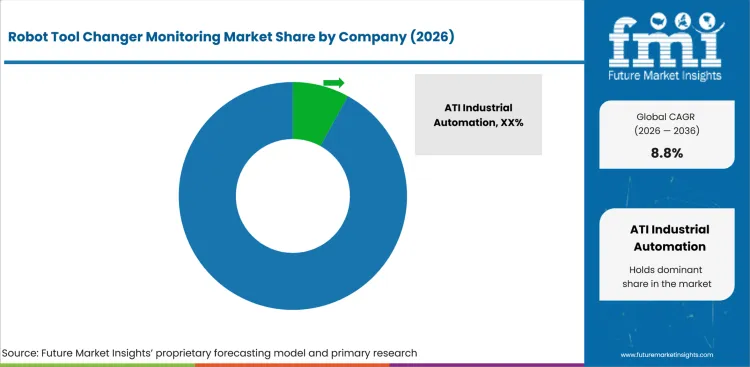
ATI Industrial Automation, Stäubli, SCHUNK, Zimmer Group and DESTACO.
- Established tool changer suppliers hold an advantage through mechanical repeatability and proven utility transfer modules.
- Robot end-of-arm specialists gain acceptance when they combine lock status signals with tool identity and communication options.
- Regional automation partners support adoption by helping factories map changer signals into robot controllers and safety systems.
- Retrofit-ready packages improve buyer confidence when plants need monitored coupling without replacing existing robot arms.
Tool changer monitoring suppliers compete by combining mechanical locking depth with reliable sensor feedback. ATI Industrial Automation, Stäubli, SCHUNK, Zimmer Group, and DESTACO hold stronger visibility through established tool changer portfolios. Buyers assess these suppliers by payload range, repeatability, available pass-through modules, and controller integration support. Tool status data becomes more valuable when it enters plant diagnostics without heavy custom engineering.
System integration depth has become a separator as factories add monitoring to older cells and new automation lines. Robot System Products and Applied Robotics compete through application-focused changer systems and tool-side utilities. OnRobot supports lightweight and collaborative robot tooling where simpler mounting and faster commissioning matter. Suppliers that reduce wiring complexity and provide clear status outputs can improve their chances in retrofit projects.
Regional adoption depends on local service coverage and documentation quality. Germany and Japan reward precision and proof of compatibility, while China and India require cost discipline and platform flexibility. The United States favors integrator-led packages that shorten commissioning time. Companies with clear lock-state evidence, utility transfer breadth, and service support should gain stronger listing decisions in automated production cells.
How do top robot tool changer monitoring companies compare?
ATI Industrial Automation and SCHUNK score strongest on monitoring depth while Stäubli and Zimmer Group lead high-spec utility transfer relevance.
| Company | Relevance to Market Title | Lock Status Monitoring Depth | Utility Transfer Module Breadth | Robot Brand Integration Support | Channel Reach | Geographic Footprint |
|---|---|---|---|---|---|---|
| ATI Industrial Automation | Very High | Very Strong | Very Strong | Very Strong | Very Strong | Global |
| Stäubli | Very High | Very Strong | Very Strong | Strong | Strong | Global |
| SCHUNK | Very High | Very Strong | Strong | Very Strong | Very Strong | Global |
| Zimmer Group | High | Strong | Strong | Strong | Strong | Global |
| DESTACO | High | Strong | Strong | Strong | Very Strong | Global |
| Robot System Products | High | Strong | Moderate to Strong | Moderate | Moderate | Europe and Global |
| Applied Robotics | Moderate to High | Moderate | Moderate | Moderate | Moderate | North America and Europe |
| OnRobot | Moderate to High | Moderate | Low to Moderate | Strong | Strong | Global |
Source: Future Market Insights competitive analysis, 2026.
Who are the key players in the robot tool changer monitoring market?
ATI Industrial Automation, Stäubli and SCHUNK are listed with Zimmer Group and DESTACO among other suppliers.
Key global companies leading the robot tool changer monitoring market include:
- ATI Industrial Automation
- Stäubli
- SCHUNK
- Zimmer Group
- DESTACO
- Robot System Products
- Applied Robotics
- OnRobot
Key Developments in Robot Tool Changer Monitoring Market
- In July 2024, ATI Industrial Automation launched GBX 10 Gigabit Ethernet modules for robotic tool changers to support high-speed data transmission in vision, inspection, metrology, motion control, and fieldbus applications.
- In November 2024, Zimmer Group introduced an aseptic tool changer concept for automated pharmaceutical processes where hygienic production requires flexible gripper exchange without manual intervention.
- In 2025, SCHUNK expanded attention around its Robot PLUS CPS and CPB tool changer systems with versatile media transfer and sensor-supported monitoring for automated end-effector changes.
Key Players in the Robot Tool Changer Monitoring Market
Global Tool Changer Specialists
- ATI Industrial Automation
- Stäubli
- SCHUNK
- Zimmer Group
- DESTACO
Application-Focused Automation Suppliers
- Robot System Products
- Applied Robotics
- OnRobot
- Effecto Group
- Gimatic
Integrator-Influenced Participants
- Robot cell integrators
- End-of-arm tooling distributors
- Automation service providers
- Automotive line builders
- Electronics equipment builders
Robot Tool Changer Monitoring Market - Scope & Definition
| Attribute | Detail |
|---|---|
| Market Definition | Hardware and software used to confirm robot tool changer coupling, lock status, tool presence, tool identity, utility transfer, and communication readiness between the robot flange and end-of-arm device. |
| Functions Covered | Lock confirmation, tool identification, utility monitoring, signal transfer, fieldbus communication, status output, diagnostics, and maintenance alerts. |
| Applications Covered | Material handling, inspection, assembly, welding, packaging, and machine tending applications using automatic or manual robot tool changers. |
| End-Use Industries | Automotive, electronics, food and beverage, logistics, pharmaceuticals, and metals manufacturing. |
| Grades Covered | Payload-linked changer systems covering <5 kg, 5–20 kg, 20–80 kg, and >80 kg monitored tool changer categories. |
| Inclusions | Sensors, valve modules, communication modules, status outputs, safety modules, and diagnostic software used with robot tool changer monitoring systems. |
| Exclusions | Standalone robot arms, grippers without changer monitoring, generic PLC modules, manual clamps without signal output, and plant-level software not connected to tool change validation. |
Robot Tool Changer Monitoring Market - Research Methodology
| Method | Description |
|---|---|
| Primary Research | FMI analyst interviews with robot cell integrators, end-of-arm tooling suppliers, automotive automation managers, electronics assemblers, and distributor channel specialists across key markets. |
| Desk Research | Review of official product literature, robotics association data, smart manufacturing references, safety guidance, industrial control advisories, and company portfolio disclosures. |
| Market Sizing & Forecasting | Hybrid bottom-up and top-down model using robot installation trends, payload mix, changer attachment rates, average monitored module pricing, and country-level automation maturity. |
| Data Validation | Cross-verification using robot installation data, end-use automation patterns, company product ranges, sensor-ready changer portfolios, and monitored utility transfer disclosures. |
Robot Tool Changer Monitoring Market - Report Scope
| Parameter | Details |
|---|---|
| Forecast period | 2026 to 2036 |
| Historical period | 2021 to 2025 |
| Quantitative unit | Revenue in USD million |
| By robot type | Collaborative robots, SCARA, articulated robots, AMR/AGV, delta robots |
| By payload | <5 kg, 5–20 kg, 20–80 kg, >80 kg |
| By application | Material handling, inspection, assembly, welding, packaging, machine tending |
| By end-use industry | Automotive, electronics, food and beverage, logistics, pharmaceuticals, metals |
| By monitoring component | Lock status sensors, tool presence sensors, tool identity modules, utility transfer sensors, communication modules, diagnostic software |
| Regions covered | North America, Latin America, Europe, East Asia, South Asia and Pacific, Middle East and Africa |
| Countries covered | United States, United Kingdom, Germany, France, Japan, China, South Korea, India |
| Key companies profiled | ATI Industrial Automation, Stäubli, SCHUNK, Zimmer Group, DESTACO, Robot System Products, Applied Robotics, OnRobot |
| Approach | Hybrid bottom-up and top-down methodology using robot installation data, supplier portfolios, payload mix, monitored changer attachment rates, and country-level automation maturity |
Source: Future Market Insights, 2026.
Robot Tool Changer Monitoring Market Breakdown by Robot Type, Payload, Application, End-use Industry, Monitoring Component, and Region
Robot Tool Changer Monitoring Market Segmented by Robot Type
- Collaborative Robots
- SCARA
- Articulated Robots
- AMR/AGV
- Delta Robots
Robot Tool Changer Monitoring Market Segmented by Payload
- <5 kg
- 5–20 kg
- 20–80 kg
- >80 kg
Robot Tool Changer Monitoring Market Segmented by Application
- Material Handling
- Inspection
- Assembly
- Welding
- Packaging
- Machine Tending
Robot Tool Changer Monitoring Market Segmented by End-use Industry
- Automotive
- Electronics
- Food and Beverage
- Logistics
- Pharmaceuticals
- Metals
Robot Tool Changer Monitoring Market Segmented by Monitoring Component
- Lock Status Sensors
- Tool Presence Sensors
- Tool Identity Modules
- Utility Transfer Sensors
- Communication Modules
- Diagnostic Software
Robot Tool Changer Monitoring Market by Region
- North America
- Latin America
- Europe
- East Asia
- South Asia and Pacific
- Middle East and Africa
Research Sources and Bibliography
- ATI Industrial Automation. (2024, July). GBX tool changer module unlocks hyperfast 10 Gigabit Ethernet.
- China State Council Information Office. (2024, November). China emerges as global frontrunner in industrial robot market.
- Cybersecurity and Infrastructure Security Agency. (2025, June 10). CISA releases four Industrial Control Systems advisories.
- Cybersecurity and Infrastructure Security Agency. (2025, August 21). CISA releases three Industrial Control Systems advisories.
- Eurostat. (2025). International trade in goods by type of good.
- Federal Statistical Office of Germany. (2025, October 8). Production in August 2025: -4.3% on the previous month.
- Health and Safety Executive. (2025, November). Health and safety at work: Summary statistics for Great Britain 2025.
- International Federation of Robotics. (2025, September 25). World Robotics 2025 report: Industrial robots.
- International Federation of Robotics. (2026, April). Robot density surges in Europe, Asia, and Americas.
- Ministry of Data and Statistics. (2026, January 30). Monthly industrial statistics, December 2025.
- Ministry of Economy, Trade and Industry. (2025, June). Draft OT security guidelines for semiconductor device factories.
- Ministry of Heavy Industries. (2025). SAMARTH Udyog Bharat 4.0.
- Ministry of Science and ICT. (2024). National AI strategy policy directions.
- National Bureau of Statistics of China. (2025, December). Industrial production operation in December 2025.
- National Institute of Standards and Technology. (2024, April). Digital twins for advanced manufacturing.
- National Institute of Standards and Technology. (2024, August). Strategic plan for the Manufacturing USA Program.
- National Institute of Standards and Technology. (2024, November). CESMII and NIST MEP partner to boost USA manufacturing with smart technologies.
- National Institute of Standards and Technology. (2026). Manufacturing Extension Partnership.
- Press Information Bureau. (2025, August). PLI Scheme: Boosting manufacturing and exports.
- SCHUNK. (2025). Discover Robot PLUS: Components and expertise aligned for automated production.
- Statistics Bureau of Japan. (2025, September). Statistical handbook of Japan 2025.
- UK Department for Science, Innovation and Technology. (2026, January). Red tape to be slashed for British robotics and defence innovators.
- Zimmer Group. (2024, November 19). Flexibility in pharmaceutical production.
This bibliography is provided for reader reference and is not exhaustive. The full report contains the complete reference list and detailed citations.
This Report Answers
- Market size estimates for 2026 and forecasts through 2036 for the robot tool changer monitoring market.
- Insights across more than 30 regional and country-level manufacturing automation markets.
- Analysis of demand drivers, robot cell retrofit patterns, tool-change validation needs, and monitored coupling trends.
- Evaluation of key robot types and payload categories, including articulated robots and medium-duty changer systems.
- Assessment of monitoring components, including lock status sensors, tool presence sensors, tool identity modules, and diagnostic software.
- Identification of opportunities across robot applications, utility transfer modules, controller integration, and service-led retrofits.
- Evaluation of supply chain dynamics, product innovation trends, and automation channel structures.
- Country-level growth analysis covering the United States, United Kingdom, Germany, France, Japan, China, South Korea, and India.
- Assessment of the competitive landscape, including leading tool changer manufacturers and other market participants.
- Analysis of buyer preferences, retrofit activity, and emerging growth opportunities across high-use robot cells.
- Regional outlooks across North America, Latin America, Europe, East Asia, South Asia and Pacific, and Middle East and Africa.
- Delivery of market data, forecasts, and supporting analysis in PDF and Excel formats.
Frequently Asked Questions
What is the growth prospect for robot tool changer monitoring?
Demand for robot tool changer monitoring is expected to rise at a considerable pace as factories add verified coupling and tool identity checks to automated cells.
Which companies are expected to shape the robot tool changer monitoring market?
ATI Industrial Automation, Stäubli, SCHUNK, Zimmer Group, DESTACO, Robot System Products, Applied Robotics, and OnRobot are expected to shape market competition through monitored changer portfolios and automation support.
Why are leading automation suppliers investing in robot tool changer monitoring?
Leading automation suppliers are investing in robot tool changer monitoring to help factories reduce wrong-tool cycles, improve safety signals, and connect end-of-arm tooling data to plant diagnostics.
Why are lock status sensors important in the robot tool changer monitoring market?
Lock status sensors are important because they confirm proper coupling before the robot resumes motion in welding, handling, inspection, and machine tending cells.
Which robot type is gaining attention in robot tool changer monitoring?
Articulated robots are gaining attention because high-motion cells require validated coupling, reliable utility transfer, and tool-ready signals before production movement.
How do retrofit projects influence robot tool changer monitoring demand?
Retrofit projects influence demand by allowing factories to add lock status, tool presence, and diagnostic outputs to existing robot cells without replacing robot arms.
Why is payload range important for robot tool changer monitoring?
Payload range is important because medium-duty and heavy-duty tools place different requirements on locking strength, signal transfer, utility routing, and monitoring depth.
What role do system integrators play in robot tool changer monitoring adoption?
System integrators support adoption by selecting changer packages, mapping signals into controllers, and validating monitored tool exchange during commissioning.
How do regulations and safety reviews influence robot tool changer monitoring projects?
Regulations and safety reviews influence projects by requiring documented equipment status, safe coupling confirmation, and reliable signal paths for connected robot-cell components.
Preview the report firsthand - request a free sample
Get SampleGet the brochure for pricing and purchase details.
Get PDFTable of Content
- Key Takeaways
- Market Size and CAGR
- Top Growth Driver
- Fastest Growing Segment
- Leading Region
- Key Companies
- Emerging Opportunities
- Executive Summary
- Global Market Outlook
- Demand-side Trends
- Supply-side Trends
- Technology Roadmap Analysis
- Analysis and Recommendations
- Analyst Perspective (What is happening? Why now? What should investors know?)
- Key Questions Answered
- How large is the market?
- What is the CAGR?
- What are key trends?
- Which region dominates?
- Who are the leaders?
- Market Overview
- Market Coverage / Taxonomy
- Market Definition / Scope / Limitations
- Research Methodology
- Chapter Orientation
- Analytical Lens and Working Hypotheses
- Market Structure, Signals, and Trend Drivers
- Benchmarking and Cross-market Comparability
- Market Sizing, Forecasting, and Opportunity Mapping
- Research Design and Evidence Framework
- Desk Research Programme (Secondary Evidence)
- Expert Input and Fieldwork (Primary Evidence)
- Tooling, Models, and Reference Databases
- Data Engineering and Model Build
- Quality Assurance and Audit Trail
- Market Background
- Market Dynamics (Drivers, Restraints, Opportunity, Trends)
- Scenario Forecast (Optimistic, Likely, Conservative)
- Impact Analysis
- AI Impact
- Sustainability Impact
- Regulatory Impact
- Technology Impact
- Consumer / Buyer Analysis
- Purchase Drivers
- Adoption Barriers
- Buyer Journey
- Opportunity Map Analysis
- Product Life Cycle Analysis
- Supply Chain Analysis
- Investment Feasibility Matrix
- Value Chain Analysis
- PESTLE and Porter's Analysis
- Regulatory Landscape
- Regional Parent Market Outlook
- Production and Consumption Statistics
- Import and Export Statistics
- Global Market Analysis and Forecast, 2021 to 2036
- Historical Market Size Value (USD Million) & Volume (Unit) Analysis, 2021 to 2025
- Current and Future Market Size Value (USD Million) & Volume (Unit) Projections, 2026 to 2036
- Y-o-Y Growth Trend Analysis
- Absolute $ Opportunity Analysis
- Global Market Pricing Analysis, 2021 to 2036
- Global Market Analysis and Forecast, By Robot Type, 2021 to 2036
- Introduction / Key Findings
- Historical Market Size Value (USD Million) & Volume (Unit) Analysis By Robot Type, 2021 to 2025
- Current and Future Market Size Value (USD Million) & Volume (Unit) Analysis and Forecast By Robot Type, 2026 to 2036
- Articulated Robots
- Collaborative Robots
- SCARA
- AMR/AGV
- Delta Robots
- Articulated Robots
- Y-o-Y Growth Trend Analysis By Robot Type, 2021 to 2025
- Absolute $ Opportunity Analysis By Robot Type, 2026 to 2036
- Global Market Analysis and Forecast, By Payload, 2021 to 2036
- Introduction / Key Findings
- Historical Market Size Value (USD Million) & Volume (Unit) Analysis By Payload, 2021 to 2025
- Current and Future Market Size Value (USD Million) & Volume (Unit) Analysis and Forecast By Payload, 2026 to 2036
- 20–80 kg
- <5 kg
- 5–20 kg
- >80 kg
- 20–80 kg
- Y-o-Y Growth Trend Analysis By Payload, 2021 to 2025
- Absolute $ Opportunity Analysis By Payload, 2026 to 2036
- Global Market Analysis and Forecast, By Application, 2021 to 2036
- Introduction / Key Findings
- Historical Market Size Value (USD Million) & Volume (Unit) Analysis By Application, 2021 to 2025
- Current and Future Market Size Value (USD Million) & Volume (Unit) Analysis and Forecast By Application, 2026 to 2036
- Machine Tending
- Material Handling
- Inspection
- Assembly
- Welding
- Packaging
- Machine Tending
- Y-o-Y Growth Trend Analysis By Application, 2021 to 2025
- Absolute $ Opportunity Analysis By Application, 2026 to 2036
- Global Market Analysis and Forecast, By End-use Industry, 2021 to 2036
- Introduction / Key Findings
- Historical Market Size Value (USD Million) & Volume (Unit) Analysis By End-use Industry, 2021 to 2025
- Current and Future Market Size Value (USD Million) & Volume (Unit) Analysis and Forecast By End-use Industry, 2026 to 2036
- Automotive
- Electronics
- Food and Beverage
- Logistics
- Pharmaceuticals
- Metals
- Automotive
- Y-o-Y Growth Trend Analysis By End-use Industry, 2021 to 2025
- Absolute $ Opportunity Analysis By End-use Industry, 2026 to 2036
- Global Market Analysis and Forecast, By Monitoring Component, 2021 to 2036
- Introduction / Key Findings
- Historical Market Size Value (USD Million) & Volume (Unit) Analysis By Monitoring Component, 2021 to 2025
- Current and Future Market Size Value (USD Million) & Volume (Unit) Analysis and Forecast By Monitoring Component, 2026 to 2036
- Lock Status Sensors
- Tool Presence Sensors
- Tool Identity Modules
- Utility Transfer Sensors
- Communication Modules
- Diagnostic Software
- Lock Status Sensors
- Y-o-Y Growth Trend Analysis By Monitoring Component, 2021 to 2025
- Absolute $ Opportunity Analysis By Monitoring Component, 2026 to 2036
- Global Market Analysis and Forecast, By Region, 2021 to 2036
- Introduction
- Historical Market Size Value (USD Million) & Volume (Unit) Analysis By Region, 2021 to 2025
- Current Market Size Value (USD Million) & Volume (Unit) Analysis and Forecast By Region, 2026 to 2036
- North America
- Latin America
- Western Europe
- Eastern Europe
- East Asia
- South Asia and Pacific
- Middle East & Africa
- Market Attractiveness Analysis By Region
- North America Market Analysis and Forecast, By Country, 2021 to 2036
- Historical Market Size Value (USD Million) & Volume (Unit) Trend Analysis By Market Taxonomy, 2021 to 2025
- Market Size Value (USD Million) & Volume (Unit) Forecast By Market Taxonomy, 2026 to 2036
- By Country
- USA
- Canada
- Mexico
- By Robot Type
- By Payload
- By Application
- By End-use Industry
- By Monitoring Component
- By Country
- Market Attractiveness Analysis
- By Country
- By Robot Type
- By Payload
- By Application
- By End-use Industry
- By Monitoring Component
- Key Takeaways
- Latin America Market Analysis and Forecast, By Country
- Historical Market Size Value (USD Million) & Volume (Unit) Trend Analysis By Market Taxonomy, 2021 to 2025
- Market Size Value (USD Million) & Volume (Unit) Forecast By Market Taxonomy, 2026 to 2036
- By Country
- Brazil
- Chile
- Rest of Latin America
- By Robot Type
- By Payload
- By Application
- By End-use Industry
- By Monitoring Component
- By Country
- Market Attractiveness Analysis
- By Country
- By Robot Type
- By Payload
- By Application
- By End-use Industry
- By Monitoring Component
- Key Takeaways
- Western Europe Market Analysis and Forecast, By Country
- Historical Market Size Value (USD Million) & Volume (Unit) Trend Analysis By Market Taxonomy, 2021 to 2025
- Market Size Value (USD Million) & Volume (Unit) Forecast By Market Taxonomy, 2026 to 2036
- By Country
- Germany
- UK
- Italy
- Spain
- France
- Nordic
- BENELUX
- Rest of Western Europe
- By Robot Type
- By Payload
- By Application
- By End-use Industry
- By Monitoring Component
- By Country
- Market Attractiveness Analysis
- By Country
- By Robot Type
- By Payload
- By Application
- By End-use Industry
- By Monitoring Component
- Key Takeaways
- Eastern Europe Market Analysis and Forecast, By Country
- Historical Market Size Value (USD Million) & Volume (Unit) Trend Analysis By Market Taxonomy, 2021 to 2025
- Market Size Value (USD Million) & Volume (Unit) Forecast By Market Taxonomy, 2026 to 2036
- By Country
- Russia
- Poland
- Hungary
- Balkan & Baltic
- Rest of Eastern Europe
- By Robot Type
- By Payload
- By Application
- By End-use Industry
- By Monitoring Component
- By Country
- Market Attractiveness Analysis
- By Country
- By Robot Type
- By Payload
- By Application
- By End-use Industry
- By Monitoring Component
- Key Takeaways
- East Asia Market Analysis and Forecast, By Country
- Historical Market Size Value (USD Million) & Volume (Unit) Trend Analysis By Market Taxonomy, 2021 to 2025
- Market Size Value (USD Million) & Volume (Unit) Forecast By Market Taxonomy, 2026 to 2036
- By Country
- China
- Japan
- South Korea
- By Robot Type
- By Payload
- By Application
- By End-use Industry
- By Monitoring Component
- By Country
- Market Attractiveness Analysis
- By Country
- By Robot Type
- By Payload
- By Application
- By End-use Industry
- By Monitoring Component
- Key Takeaways
- South Asia and Pacific Market Analysis and Forecast, By Country
- Historical Market Size Value (USD Million) & Volume (Unit) Trend Analysis By Market Taxonomy, 2021 to 2025
- Market Size Value (USD Million) & Volume (Unit) Forecast By Market Taxonomy, 2026 to 2036
- By Country
- India
- ASEAN
- Australia & New Zealand
- Rest of South Asia and Pacific
- By Robot Type
- By Payload
- By Application
- By End-use Industry
- By Monitoring Component
- By Country
- Market Attractiveness Analysis
- By Country
- By Robot Type
- By Payload
- By Application
- By End-use Industry
- By Monitoring Component
- Key Takeaways
- Middle East & Africa Market Analysis and Forecast, By Country
- Historical Market Size Value (USD Million) & Volume (Unit) Trend Analysis By Market Taxonomy, 2021 to 2025
- Market Size Value (USD Million) & Volume (Unit) Forecast By Market Taxonomy, 2026 to 2036
- By Country
- Kingdom of Saudi Arabia
- Other GCC Countries
- Türkiye
- South Africa
- Other African Union
- Rest of Middle East & Africa
- By Robot Type
- By Payload
- By Application
- By End-use Industry
- By Monitoring Component
- By Country
- Market Attractiveness Analysis
- By Country
- By Robot Type
- By Payload
- By Application
- By End-use Industry
- By Monitoring Component
- Key Takeaways
- Key Countries Market Analysis
- USA
- Pricing Analysis
- Market Share Analysis, 2025
- By Robot Type
- By Payload
- By Application
- By End-use Industry
- By Monitoring Component
- Canada
- Pricing Analysis
- Market Share Analysis, 2025
- By Robot Type
- By Payload
- By Application
- By End-use Industry
- By Monitoring Component
- Mexico
- Pricing Analysis
- Market Share Analysis, 2025
- By Robot Type
- By Payload
- By Application
- By End-use Industry
- By Monitoring Component
- Brazil
- Pricing Analysis
- Market Share Analysis, 2025
- By Robot Type
- By Payload
- By Application
- By End-use Industry
- By Monitoring Component
- Chile
- Pricing Analysis
- Market Share Analysis, 2025
- By Robot Type
- By Payload
- By Application
- By End-use Industry
- By Monitoring Component
- Germany
- Pricing Analysis
- Market Share Analysis, 2025
- By Robot Type
- By Payload
- By Application
- By End-use Industry
- By Monitoring Component
- UK
- Pricing Analysis
- Market Share Analysis, 2025
- By Robot Type
- By Payload
- By Application
- By End-use Industry
- By Monitoring Component
- Italy
- Pricing Analysis
- Market Share Analysis, 2025
- By Robot Type
- By Payload
- By Application
- By End-use Industry
- By Monitoring Component
- Spain
- Pricing Analysis
- Market Share Analysis, 2025
- By Robot Type
- By Payload
- By Application
- By End-use Industry
- By Monitoring Component
- France
- Pricing Analysis
- Market Share Analysis, 2025
- By Robot Type
- By Payload
- By Application
- By End-use Industry
- By Monitoring Component
- India
- Pricing Analysis
- Market Share Analysis, 2025
- By Robot Type
- By Payload
- By Application
- By End-use Industry
- By Monitoring Component
- ASEAN
- Pricing Analysis
- Market Share Analysis, 2025
- By Robot Type
- By Payload
- By Application
- By End-use Industry
- By Monitoring Component
- Australia & New Zealand
- Pricing Analysis
- Market Share Analysis, 2025
- By Robot Type
- By Payload
- By Application
- By End-use Industry
- By Monitoring Component
- China
- Pricing Analysis
- Market Share Analysis, 2025
- By Robot Type
- By Payload
- By Application
- By End-use Industry
- By Monitoring Component
- Japan
- Pricing Analysis
- Market Share Analysis, 2025
- By Robot Type
- By Payload
- By Application
- By End-use Industry
- By Monitoring Component
- South Korea
- Pricing Analysis
- Market Share Analysis, 2025
- By Robot Type
- By Payload
- By Application
- By End-use Industry
- By Monitoring Component
- Russia
- Pricing Analysis
- Market Share Analysis, 2025
- By Robot Type
- By Payload
- By Application
- By End-use Industry
- By Monitoring Component
- Poland
- Pricing Analysis
- Market Share Analysis, 2025
- By Robot Type
- By Payload
- By Application
- By End-use Industry
- By Monitoring Component
- Hungary
- Pricing Analysis
- Market Share Analysis, 2025
- By Robot Type
- By Payload
- By Application
- By End-use Industry
- By Monitoring Component
- Kingdom of Saudi Arabia
- Pricing Analysis
- Market Share Analysis, 2025
- By Robot Type
- By Payload
- By Application
- By End-use Industry
- By Monitoring Component
- Türkiye
- Pricing Analysis
- Market Share Analysis, 2025
- By Robot Type
- By Payload
- By Application
- By End-use Industry
- By Monitoring Component
- South Africa
- Pricing Analysis
- Market Share Analysis, 2025
- By Robot Type
- By Payload
- By Application
- By End-use Industry
- By Monitoring Component
- USA
- Market Structure Analysis
- Competition Dashboard
- Competition Benchmarking
- Market Share Analysis of Top Players
- By Regional
- By Robot Type
- By Payload
- By Application
- By End-use Industry
- By Monitoring Component
- Emerging Startups
- Innovation Benchmarking
- Competition Analysis
- Competition Deep Dive
- ATI Industrial Automation
- Overview
- Product Portfolio
- Profitability by Market Segments (Product/Region/Sales Channel)
- Sales Footprint
- Strategy Overview
- Marketing Strategy
- Product Strategy
- Channel Strategy
- Stäubli
- SCHUNK
- Zimmer Group
- DESTACO
- Robot cell integrators
- End-of-arm tooling distributors
- Automation service providers
- Automotive line builders
- Electronics equipment builders
- ATI Industrial Automation
- Case Studies
- Success Stories
- Recent Developments
- Competition Deep Dive
- Assumptions & Acronyms Used


