

- Market Size (2026)
- USD 202.6 Mn
- Forecast (2036)
- USD 365.4 Mn
- CAGR (2026 to 2036)
- 6.1%
How big is Robot TCP Calibration Systems Market in 2026?
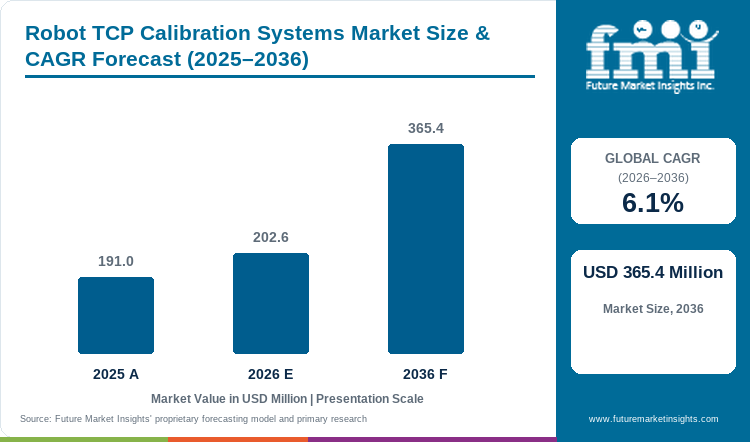
USD 202.6 million in 2026 and USD 365.4 million by 2036 at a 6.1% CAGR.
The market was valued at USD 191.0 million in 2025. Demand is estimated at USD 202.6 million in 2026 and is projected to reach USD 365.4 million by 2036 at 6.1% CAGR. The estimate covers dedicated hardware and software used to identify or restore a robot tool center point, including contact devices, optical systems, controller routines and major service packages. General robot mastering, full-cell metrology and standalone laser trackers are excluded unless sold for TCP calibration.
TCP calibration demand grows with the industrial robotics market, because a robot can repeat its joint positions while a bent or changed tool shifts the process point. Revenue follows installed robots, tool-change frequency and the cost of process drift.
Key Takeaways
- The market is valued at USD 202.6 million in 2026 and is projected to create USD 162.8 million in additional value by 2036.
- Physical contact systems is projected to hold 58.0% of Calibration Method demand in 2026 because they provide durable shop-floor references at practical cost.
- Automated in-cycle calibration is projected to hold 46.0% of Operating Mode demand in 2026 because high-utilization cells need frequent checks with limited downtime.
- Six-axis industrial robots is projected to hold 83.0% of Robot Type demand in 2026 owing to broad use in path-critical manufacturing processes.
- A calibration device cannot correct mechanical backlash, robot mastering errors or fixture movement unless the diagnostic routine separates those causes from TCP shift.
- Some of the key players in this market include ABB, LEONI, FANUC, Yaskawa Motoman, KUKA, Wiest AG, Creaform, Hexagon Manufacturing Intelligence, Fronius, Cognex.
Analyst Perspective
"TCP calibration is valuable because it distinguishes tool drift from robot repeatability. The system must check often enough to prevent scrap and clearly enough to direct maintenance to the right cause."
- Nikhil Kaitwade, Principal Consultant, Future Market Insights
How is the robot TCP calibration systems market segmented?
The robot TCP calibration systems market is segmented by calibration method, operating mode, robot type, application, offering and region.
The robot TCP calibration systems market is segmented by calibration method, operating mode, robot type, application, offering and region. Calibration method distinguishes contact, optical, laser and manual approaches. Operating mode separates in-cycle automation from scheduled maintenance and portable service. Robot type identifies the platform being calibrated, while application reflects where TCP accuracy matters most. Offering captures whether buyers purchase integrated systems, software, portable hardware or replacement components
Why do physical contact systems lead method demand?
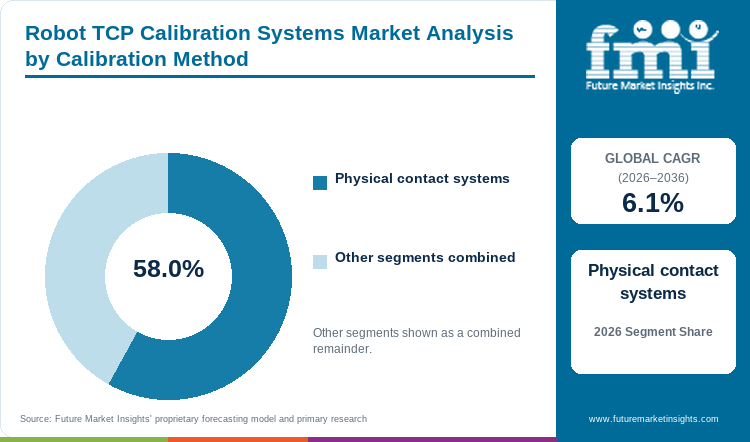
Physical contact systems remain practical in production cells because the robot measures against a known mechanical reference rather than depending on lighting, surface reflectivity or camera visibility. A pin, wire, switch or reference feature can be built directly into a welding or handling cell and revisited whenever the tool is changed or suspected of moving. ABB's Torch Service Center uses an automated gauging routine that lets the robot return to a reference point during production, check the TCP and apply corrections before resuming work.
- Physical contact systems are estimated to account for 58.0% of calibration-method demand in 2026 because durable mechanical references fit harsh shop-floor cells and can be incorporated into repeat calibration routines.
- ABB's TSC 2013 automatically defines the TCP during setup and can recheck it at programmed intervals during production, while its wire-cutting function maintains a consistent wire stick-out for the measurement.
Why does automated in-cycle calibration lead value?
The commercial advantage of in-cycle calibration is that the check happens before TCP drift becomes a batch-quality problem. In welding cells, a robot can leave the production sequence briefly, run a quick reference check and return to work without waiting for a maintenance intervention. ABB states that BullsEye can perform a programmed quick check in about ten seconds and automatically recalculate the TCP and torch angle when misalignment is detected. That shifts calibration from an occasional maintenance task toward a production-control function.
- Automated in-cycle calibration is estimated to account for 46.0% of operating-mode value in 2026 because high-utilization cells benefit from detecting tool movement without taking the robot out of service for a lengthy manual calibration.
- ABB documents predefined BullsEye routines for automatic TCP calibration during production and reports that the process can reduce calibration-related downtime to almost zero.
Why do six-axis robots lead demand?
Six-axis robots expose TCP errors more directly because their programmed path depends on the geometric relationship between the robot flange and the working point of the attached tool. A bent welding torch, replaced contact tip or remounted gripper can therefore shift the process point even when the robot itself continues to repeat its joint positions correctly. ABB recommends regular tool calibration for robot accuracy and provides separate routines for moving-tool TCP, stationary-tool TCP and tool rotation, illustrating how closely calibration is tied to articulated robot operation.
- Six-axis industrial robots are estimated to account for 83.0% of robot-type demand in 2026 because articulated robots dominate path-sensitive welding, dispensing, cutting and handling processes where the programmed tool point has to match the physical tool.
- ISO 9283 remains the applicable standard for performance criteria and test methods for manipulating industrial robots, covering the pose and path behavior against which robot accuracy is assessed.
Why does arc welding lead application demand?
Arc welding creates repeated reasons for the tool point to move. Contact tips are replaced, wire stick-out changes and torch assemblies can be knocked during production. Because the programmed robot path follows the TCP at the end of the welding wire, even a small shift can move the weld relative to the joint. ABB describes the TCP explicitly as the reference point where the wire should touch the workpiece and integrates calibration into its welding support equipment alongside torch cleaning and wire cutting.
- Arc welding is estimated to account for 41.0% of application demand in 2026 because weld placement depends directly on keeping the wire-tip reference aligned with the programmed path over repeated production cycles.
- ABB's BullsEye automatically updates both TCP and torch angle, while its Torch Service Center combines TCP gauging with wire cutting so the calibration is performed against a consistent wire length.
Why do integrated systems lead offering demand?
A TCP calibration system has to do more than measure a point. The reference device must communicate with a robot routine, the controller has to interpret the result and corrected tool data must be written back into the motion program. ABB's BullsEye illustrates this integration: the software defines QuickCheck procedures and full scans, tracks deviation over time and can automatically update tool data. That reduces the engineering burden compared with combining an independent measuring device with separately developed correction logic.
- Integrated hardware and software are estimated to account for 64.0% of offering demand in 2026 because measurement has little production value unless the robot controller can convert the result into a usable TCP correction.
- ABB's system combines dedicated calibration hardware with controller software and programmed scan routines, while its current OmniCore documentation also supports geometry-based and RAPID tool-calibration procedures inside the controller environment.
What are the drivers, restraints and opportunities in the Robot TCP Calibration Systems Market?
Path-quality requirements drive adoption, diagnostic ambiguity restrains simple deployment, and automatic calibration creates opportunity in high-utilization multi-tool cells.
- Driver: Welding, dispensing and processing cells require a stable tool center point after collisions, wear and tool changes.
- Restraint: TCP error can be confused with mastering, fixture or robot mechanical problems, requiring skilled diagnosis.
- Opportunity: Automated optical and contact systems can support frequent checks across mixed robot fleets and tool changers.
The precision metrology robots market expands the installed base of path-programmed robots. Calibration demand is strongest where a small tool shift creates scrap, rework or unsafe process clearance.
A successful calibration routine needs a stable reference artifact and known robot condition. If the cell base, fixture or wrist is damaged, changing the TCP may hide the underlying fault. Buyers therefore value diagnostic logs and integration with maintenance workflows.
The motion control software in robotics market supports higher-accuracy robot processes and creates demand for traceable calibration records. Cameras, reference spheres and automatic routines can reduce manual four-point teaching.
Which country CAGRs are profiled in the Robot TCP Calibration Systems Market?
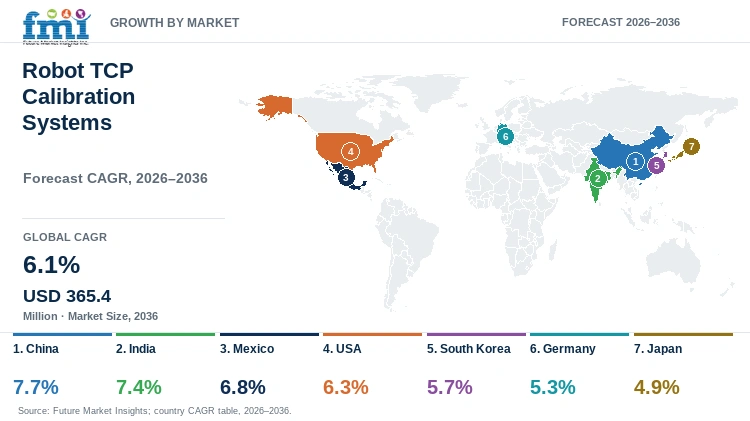
| Country | CAGR |
|---|---|
| China | 7.7% |
| India | 7.4% |
| Mexico | 6.8% |
| USA | 6.3% |
| South Korea | 5.7% |
| Germany | 5.3% |
| Japan | 4.9% |
How do country-level CAGRs compare in the Robot TCP Calibration Systems Market?
The country pattern follows the installed robot base, the share of path-critical applications and the extent to which plants automate maintenance tasks. China combines a very large robot fleet with continuing additions of new cells. India is earlier in the automation cycle and is adding robots rapidly, particularly in automotive manufacturing. Mexico remains closely tied to vehicle production. The USA has a broad mixed-industry fleet, while South Korea, Germany and Japan derive more of their opportunity from maintaining accuracy across dense, mature robot installations. IFR reported 542,000 industrial robot installations globally in 2024, with Asia accounting for 74% of deployments.
- China: More than 295,000 industrial robots were installed in 2024, equal to 54% of global deployments, and the operational stock exceeded 2 million units. That creates a large base of welding, handling and processing cells in which TCP checks can be incorporated into routine maintenance or production cycles.
- India: Industrial robot installations reached a record 9,120 units in 2024, up 7%, with automotive accounting for 45% of installations. Calibration demand therefore develops alongside new welding and assembly cells, where integrators can introduce TCP checking during commissioning rather than retrofit it later.
- Mexico: Automotive manufacturing dominates the robotics mix. The sector represented 63% of Mexican robot installations in 2024, creating a concentrated base of welding and component-production cells where torch position and tool repeatability directly affect process quality.
- USA: Robot installations rebounded to 38,000 units in 2025, up 11%, with automotive still accounting for 13,500 units. Growth in food manufacturing and other applications is broadening the installed base beyond traditional vehicle plants, which increases the relevance of calibration systems that can work across different robot brands and tool types.
- South Korea: The country has the highest manufacturing robot density at 1,220 robots per 10,000 employees. Electronics and automotive production underpin that concentration, making calibration less about first-time robot adoption and more about preserving repeatability in already highly automated factories.
- Germany: Germany remains Europe's main robot market, with 26,982 new installations in 2024 and 449 robots per 10,000 manufacturing employees. A dense brownfield automation base creates demand for calibration records and maintenance routines that can be integrated into existing quality systems.
- Japan: Japan combines a mature robot fleet with domestic robot-manufacturing capability. About 44,453 industrial robots were installed in 2024, while the operational stock reached roughly 450,500 units. TCP calibration demand is therefore weighted toward replacement, tool changes and accuracy maintenance across an established fleet.
Across the key countries in this market, these rates measure revenue within the defined product boundary and do not represent growth of the wider industrial robotics market.
Country-wise Analysis
- China, at 7.7% CAGR through 2036, has the deepest potential calibration base in the country set. Its robot stock passed 2 million units in 2024, while another 295,000 robots were installed during the year. The commercial opportunity therefore extends beyond selling calibration hardware into new cells. Automated TCP checking can also be attached to a vast installed fleet where welding torches, grippers or process tools are replaced repeatedly over the machine life.
- India is projected at 7.4% CAGR through 2036. The important factor is the age of the automation cycle. With robot installations reaching a record 9,120 units in 2024 and automotive generating 45% of demand, calibration can be designed into cells during commissioning rather than added after recurring tool-position problems appear. That gives robot integrators an important role in market development.
- Mexico follows at 6.8% CAGR through 2036. Its calibration opportunity is unusually concentrated in automotive manufacturing, which accounted for 63% of robot installations in 2024. This favors systems compatible with global robot brands and welding equipment already standardized across multinational plants. Regional service matters because a calibration fault can interrupt a dedicated production cell rather than a standalone measurement process.
- The USA records a 6.3% CAGR through 2036. A return to 38,000 installations in 2025 expanded the future maintenance base, while demand is becoming less dependent on automotive alone. Food-industry robot adoption rose 30% in 2025, and metal, machinery and electronics each represented roughly 3,000 installations. That wider application mix supports portable and automated calibration systems able to work across different tooling environments.
- South Korea reaches 5.7% CAGR through 2036. With 1,220 robots per 10,000 manufacturing employees, factories already operate at exceptionally high automation density. The value proposition therefore shifts from adding robots to keeping existing cells accurate. Electronics applications, frequent tool changes and short production cycles increase the cost of undetected TCP drift, giving automated checks a role beyond conventional welding calibration.
- Germany, at 5.3% CAGR through 2036, develops from a mature industrial base rather than rapid robot-fleet expansion. Installations declined 5% in 2024 but still reached 26,982 units, the country's second-highest annual total on record. Calibration suppliers therefore have more scope in brownfield integration, where measurement histories can support quality documentation and maintenance decisions across long-lived automated cells.
- Japan, at 4.9% CAGR through 2036, combines high robot density with an established domestic automation ecosystem. Robot installations fell to about 44,500 units in 2024, but the operational fleet continued to expand to roughly 450,500 units. That makes replacement, recalibration after tool changes and controller-integrated routines more important commercial drivers than rapid greenfield adoption.
Who are the notable companies in the Robot TCP Calibration Systems Market?
ABB, LEONI, FANUC, Yaskawa Motoman, KUKA, Wiest AG, Creaform, Hexagon Manufacturing Intelligence, Fronius, Cognex are the notable companies profiled in this market.
Robot OEMs compete through controller-native routines, while calibration specialists provide cross-brand hardware and measurement depth. Metrology and vision suppliers remain Unscored where public evidence does not establish a dedicated TCP-calibration system.
- Robot OEM Calibration Platforms: ABB, FANUC, Yaskawa Motoman, KUKA.
- Dedicated TCP Calibration Specialists: LEONI, Wiest AG.
- Adjacent Metrology and Process Platforms: Creaform, Hexagon Manufacturing Intelligence, Fronius, Cognex.
Competitive Benchmarking: Robot TCP Calibration Systems Market
| Company | Direct TCP Evidence | Automation Level | Fleet Coverage | Geographic Reach |
|---|---|---|---|---|
| ABB | High | High | High | Global |
| LEONI | High | High | High | Global |
| FANUC | High | High | High | Global |
| Yaskawa Motoman | High | High | High | Global |
| KUKA | Medium | High | High | Global |
| Wiest AG | High | High | Medium | Europe, export |
| Creaform | Unscored | High | High | Global |
| Hexagon Manufacturing Intelligence | Unscored | High | High | Global |
| Fronius | Unscored | High | High | Global |
| Cognex | Unscored | High | High | Global |
High direct evidence requires a named TCP-calibration system or automated routine. Medium reflects controller calibration functions. Unscored identifies adjacent metrology, vision or welding capability without a dedicated TCP product.
Key Developments in the Robot TCP Calibration Systems Market
- In 2026, IFR reported that US industrial-robot installations increased to 38,000 units in 2025, adding to the fleet requiring calibration and maintenance.
- In September 2025, IFR reported 542,000 global industrial-robot installations in 2024, with automotive, electronics and metal industries forming major application groups.
- In 2025, ABB continued to publish BullsEye as a fully automated TCP calibration system that can operate during production.
Key Players in the Robot TCP Calibration Systems Market
Robot OEM Calibration Platforms
- ABB
- FANUC
- Yaskawa Motoman
- KUKA
Dedicated TCP Calibration Specialists
- LEONI
- Wiest AG
Adjacent Metrology and Process Platforms
- Creaform
- Hexagon Manufacturing Intelligence
- Fronius
- Cognex
Robot TCP Calibration Systems Market - Report Scope
| Coverage field | Report scope |
|---|---|
| Market Size | USD 202.6 million in 2026 and USD 365.4 million by 2036 at 6.1% CAGR. |
| Market Definition | Hardware, software and services used to measure, verify or restore an industrial robot tool center point, including contact, optical and controller-integrated systems. |
| Segmentation | Calibration method, operating mode, robot type, application, offering and region. |
| Regional Coverage | North America, Latin America, Western Europe, Eastern Europe, East Asia, South Asia and Pacific, and Middle East and Africa. |
| Countries Covered | China, India, Mexico, USA, South Korea, Germany, Japan and more than 20 countries included in the full report. |
| Key Companies Profiled | ABB, LEONI, FANUC, Yaskawa Motoman, KUKA, Wiest AG, Creaform, Hexagon Manufacturing Intelligence, Fronius, Cognex. |
| Forecast Period | 2026 to 2036. |
| Approach | Bottom-up model using installed robots, path-critical application share, calibration-system attachment, service frequency, offering mix and replacement cycles. |
Robot TCP Calibration Systems Market - Research Methodology
| Method | Approach |
|---|---|
| Primary Research | FMI analysts gathered input from manufacturers, system integrators, distributors, plant engineers, procurement teams and application specialists. Interviews tested purchasing criteria, replacement cycles, qualification work and technical-service requirements. |
| Desk Research | Desk research covered government statistics, standards, industry associations, technical literature, patents, official product information and corporate announcements. Evidence was screened for scope, date and direct relevance. |
| Market Sizing and Forecasting | Bottom-up model using installed robots, path-critical application share, calibration-system attachment, service frequency, offering mix and replacement cycles. |
| Data Validation | Estimates were checked against parent-market activity, installed-base indicators, product specifications and supplier participation. Adjacent products without the defined function were excluded. |
Robot TCP Calibration Systems Market by Segments
Robot TCP Calibration Systems Market segmented by Calibration Method:
- Physical contact systems
- Optical and camera-based systems
- Laser and metrology-based systems
- Software-only and manual methods
Robot TCP Calibration Systems Market segmented by Operating Mode:
- Automated in-cycle calibration
- Automated maintenance-shift calibration
- Manual and portable calibration services
Robot TCP Calibration Systems Market segmented by Robot Type:
- Six-axis industrial robots
- Collaborative robots
- SCARA robots
- Other industrial robots
Robot TCP Calibration Systems Market segmented by Application:
- Arc welding
- Dispensing and sealing
- Material handling and assembly
- Cutting and processing
- Inspection and other applications
Robot TCP Calibration Systems Market segmented by Offering:
- Integrated hardware and software
- Calibration software
- Portable hardware and services
- Replacement components
Robot TCP Calibration Systems Market by Region:
- North America
- United States
- Canada
- Latin America
- Brazil
- Mexico
- Argentina
- Chile
- Western Europe
- Germany
- France
- United Kingdom
- Italy
- Spain
- Benelux
- Nordics
- Eastern Europe
- Poland
- Czech Republic
- Romania
- Hungary
- East Asia
- China
- Japan
- South Korea
- South Asia and Pacific
- India
- ASEAN
- Australia and New Zealand
- Middle East and Africa
- GCC Countries
- South Africa
- Türkiye
- Israel
Research Sources and Bibliography
- International Federation of Robotics. (2025, September 25). World Robotics 2025 industrial robot statistics.
- International Federation of Robotics. (2026). United States robot installation update for 2025.
- International Organization for Standardization. (1998). ISO 9283 industrial robot performance criteria and test methods.
- ABB. (n.d.; accessed September 23, 2026). BullsEye robotic tool calibration.
- LEONI. (n.d.; accessed September 23, 2026). advintec TCP 3D and 6D systems.
- National Institute of Standards and Technology. (2025). Robot performance measurement resources.
- KUKA. (n.d.; accessed September 23, 2026). Robot tool calibration resources.
- Future Market Insights. (2026). Precision Metrology Robots Market.
This bibliography is provided for reader reference and is not exhaustive. The full report contains the complete reference list and detailed citations.
This Report Answers
- How large is the robot TCP calibration systems market in 2026 and 2036?
- Which product specification leads demand in 2026?
- What operating condition converts technical need into a purchase?
- Which constraint can delay qualification or replacement?
- How do country growth rates compare across the profiled markets?
- Which companies provide direct or adjacent market capability?
Frequently Asked Questions
How big is the robot TCP calibration systems market in 2026?
The robot TCP calibration systems market is valued at USD 202.6 million in 2026 and is projected to reach USD 365.4 million by 2036. The estimate covers revenue within the stated market definition and excludes adjacent equipment or chemicals sold without the required function.
What is the CAGR of the robot TCP calibration systems market from 2026 to 2036?
The market is projected to grow at 6.1% CAGR between 2026 and 2036. Expansion depends on end-market output together with the rate at which plants adopt higher-specification products.
Which calibration method leads the robot TCP calibration systems market?
Physical contact systems is expected to hold 58.0% share in 2026 because they provide durable shop-floor references at practical cost. Optical methods grow where non-contact measurement or several tool features are required.
Which countries are projected to record higher growth?
China is projected at 7.7% CAGR, followed by India at 7.4% and Mexico at 6.8% through 2036. The comparison reflects local production investment and the timing of replacement or qualification cycles.
Which companies are active in the robot TCP calibration systems market?
The profiled group includes ABB, LEONI, FANUC, Yaskawa Motoman, KUKA, Wiest AG, Creaform, Hexagon Manufacturing Intelligence, Fronius, Cognex. Capability differs by product range and application evidence.
Preview the report firsthand - request a free sample
Get SampleGet the brochure for pricing and purchase details.
Get PDFTable of Content
- Key Takeaways
- Market Size and CAGR
- Top Growth Driver
- Fastest Growing Segment
- Leading Region
- Key Companies
- Emerging Opportunities
- Executive Summary
- Global Market Outlook
- Demand-side Trends
- Supply-side Trends
- Technology Roadmap Analysis
- Analysis and Recommendations
- Analyst Perspective (What is happening? Why now? What should investors know?)
- Key Questions Answered
- How large is the market?
- What is the CAGR?
- What are key trends?
- Which region dominates?
- Who are the leaders?
- Market Overview
- Market Coverage / Taxonomy
- Market Definition / Scope / Limitations
- Research Methodology
- Chapter Orientation
- Analytical Lens and Working Hypotheses
- Market Structure, Signals, and Trend Drivers
- Benchmarking and Cross-market Comparability
- Market Sizing, Forecasting, and Opportunity Mapping
- Research Design and Evidence Framework
- Desk Research Programme (Secondary Evidence)
- Expert Input and Fieldwork (Primary Evidence)
- Tooling, Models, and Reference Databases
- Data Engineering and Model Build
- Quality Assurance and Audit Trail
- Market Background
- Market Dynamics (Drivers, Restraints, Opportunity, Trends)
- Scenario Forecast (Optimistic, Likely, Conservative)
- Impact Analysis
- AI Impact
- Sustainability Impact
- Regulatory Impact
- Technology Impact
- Consumer / Buyer Analysis
- Purchase Drivers
- Adoption Barriers
- Buyer Journey
- Opportunity Map Analysis
- Product Life Cycle Analysis
- Supply Chain Analysis
- Investment Feasibility Matrix
- Value Chain Analysis
- PESTLE and Porter's Analysis
- Regulatory Landscape
- Regional Parent Market Outlook
- Production and Consumption Statistics
- Import and Export Statistics
- Global Market Analysis and Forecast, 2021 to 2036
- Historical Market Size Value (USD Million) Analysis, 2021 to 2025
- Current and Future Market Size Value (USD Million) Projections, 2026 to 2036
- Y-o-Y Growth Trend Analysis
- Absolute $ Opportunity Analysis
- Global Market Pricing Analysis, 2021 to 2036
- Global Market Analysis and Forecast, By Calibration Method, 2021 to 2036
- Introduction / Key Findings
- Historical Market Size Value (USD Million) Analysis By Calibration Method, 2021 to 2025
- Current and Future Market Size Value (USD Million) Analysis and Forecast By Calibration Method, 2026 to 2036
- Physical contact systems
- Optical and camera-based systems
- Laser and metrology-based systems
- Software-only and manual methods
- Y-o-Y Growth Trend Analysis By Calibration Method, 2021 to 2025
- Absolute $ Opportunity Analysis By Calibration Method, 2026 to 2036
- Global Market Analysis and Forecast, By Operating Mode, 2021 to 2036
- Introduction / Key Findings
- Historical Market Size Value (USD Million) Analysis By Operating Mode, 2021 to 2025
- Current and Future Market Size Value (USD Million) Analysis and Forecast By Operating Mode, 2026 to 2036
- Automated in-cycle calibration
- Automated maintenance-shift calibration
- Manual and portable calibration services
- Y-o-Y Growth Trend Analysis By Operating Mode, 2021 to 2025
- Absolute $ Opportunity Analysis By Operating Mode, 2026 to 2036
- Global Market Analysis and Forecast, By Robot Type, 2021 to 2036
- Introduction / Key Findings
- Historical Market Size Value (USD Million) Analysis By Robot Type, 2021 to 2025
- Current and Future Market Size Value (USD Million) Analysis and Forecast By Robot Type, 2026 to 2036
- Six-axis industrial robots
- Collaborative robots
- SCARA robots
- Other industrial robots
- Y-o-Y Growth Trend Analysis By Robot Type, 2021 to 2025
- Absolute $ Opportunity Analysis By Robot Type, 2026 to 2036
- Global Market Analysis and Forecast, By Application, 2021 to 2036
- Introduction / Key Findings
- Historical Market Size Value (USD Million) Analysis By Application, 2021 to 2025
- Current and Future Market Size Value (USD Million) Analysis and Forecast By Application, 2026 to 2036
- Arc welding
- Dispensing and sealing
- Material handling and assembly
- Cutting and processing
- Inspection and other applications
- Y-o-Y Growth Trend Analysis By Application, 2021 to 2025
- Absolute $ Opportunity Analysis By Application, 2026 to 2036
- Global Market Analysis and Forecast, By Offering, 2021 to 2036
- Introduction / Key Findings
- Historical Market Size Value (USD Million) Analysis By Offering, 2021 to 2025
- Current and Future Market Size Value (USD Million) Analysis and Forecast By Offering, 2026 to 2036
- Integrated hardware and software
- Calibration software
- Portable hardware and services
- Replacement components
- Y-o-Y Growth Trend Analysis By Offering, 2021 to 2025
- Absolute $ Opportunity Analysis By Offering, 2026 to 2036
- Global Market Analysis and Forecast, By Region, 2021 to 2036
- Introduction
- Historical Market Size Value (USD Million) Analysis By Region, 2021 to 2025
- Current Market Size Value (USD Million) Analysis and Forecast By Region, 2026 to 2036
- North America
- Latin America
- Western Europe
- Eastern Europe
- East Asia
- South Asia and Pacific
- Middle East and Africa
- Market Attractiveness Analysis By Region
- North America Market Analysis and Forecast, By Country, 2021 to 2036
- Historical Market Size Value (USD Million) Trend Analysis By Market Taxonomy, 2021 to 2025
- Market Size Value (USD Million) Forecast By Market Taxonomy, 2026 to 2036
- By Country
- United States
- Canada
- By Calibration Method
- By Operating Mode
- By Robot Type
- By Application
- By Offering
- By Country
- Market Attractiveness Analysis
- By Country
- By Calibration Method
- By Operating Mode
- By Robot Type
- By Application
- By Offering
- Key Takeaways
- Latin America Market Analysis and Forecast, By Country
- Historical Market Size Value (USD Million) Trend Analysis By Market Taxonomy, 2021 to 2025
- Market Size Value (USD Million) Forecast By Market Taxonomy, 2026 to 2036
- By Country
- Brazil
- Mexico
- Argentina
- Chile
- By Calibration Method
- By Operating Mode
- By Robot Type
- By Application
- By Offering
- By Country
- Market Attractiveness Analysis
- By Country
- By Calibration Method
- By Operating Mode
- By Robot Type
- By Application
- By Offering
- Key Takeaways
- Western Europe Market Analysis and Forecast, By Country
- Historical Market Size Value (USD Million) Trend Analysis By Market Taxonomy, 2021 to 2025
- Market Size Value (USD Million) Forecast By Market Taxonomy, 2026 to 2036
- By Country
- Germany
- France
- United Kingdom
- Italy
- Spain
- Benelux
- Nordics
- By Calibration Method
- By Operating Mode
- By Robot Type
- By Application
- By Offering
- By Country
- Market Attractiveness Analysis
- By Country
- By Calibration Method
- By Operating Mode
- By Robot Type
- By Application
- By Offering
- Key Takeaways
- Eastern Europe Market Analysis and Forecast, By Country
- Historical Market Size Value (USD Million) Trend Analysis By Market Taxonomy, 2021 to 2025
- Market Size Value (USD Million) Forecast By Market Taxonomy, 2026 to 2036
- By Country
- Poland
- Czech Republic
- Romania
- Hungary
- By Calibration Method
- By Operating Mode
- By Robot Type
- By Application
- By Offering
- By Country
- Market Attractiveness Analysis
- By Country
- By Calibration Method
- By Operating Mode
- By Robot Type
- By Application
- By Offering
- Key Takeaways
- East Asia Market Analysis and Forecast, By Country
- Historical Market Size Value (USD Million) Trend Analysis By Market Taxonomy, 2021 to 2025
- Market Size Value (USD Million) Forecast By Market Taxonomy, 2026 to 2036
- By Country
- China
- Japan
- South Korea
- By Calibration Method
- By Operating Mode
- By Robot Type
- By Application
- By Offering
- By Country
- Market Attractiveness Analysis
- By Country
- By Calibration Method
- By Operating Mode
- By Robot Type
- By Application
- By Offering
- Key Takeaways
- South Asia and Pacific Market Analysis and Forecast, By Country
- Historical Market Size Value (USD Million) Trend Analysis By Market Taxonomy, 2021 to 2025
- Market Size Value (USD Million) Forecast By Market Taxonomy, 2026 to 2036
- By Country
- India
- ASEAN
- Australia and New Zealand
- By Calibration Method
- By Operating Mode
- By Robot Type
- By Application
- By Offering
- By Country
- Market Attractiveness Analysis
- By Country
- By Calibration Method
- By Operating Mode
- By Robot Type
- By Application
- By Offering
- Key Takeaways
- Middle East and Africa Market Analysis and Forecast, By Country
- Historical Market Size Value (USD Million) Trend Analysis By Market Taxonomy, 2021 to 2025
- Market Size Value (USD Million) Forecast By Market Taxonomy, 2026 to 2036
- By Country
- GCC Countries
- South Africa
- Türkiye
- Israel
- By Calibration Method
- By Operating Mode
- By Robot Type
- By Application
- By Offering
- By Country
- Market Attractiveness Analysis
- By Country
- By Calibration Method
- By Operating Mode
- By Robot Type
- By Application
- By Offering
- Key Takeaways
- Key Countries Market Analysis
- United States
- Pricing Analysis
- Market Share Analysis, 2025
- By Calibration Method
- By Operating Mode
- By Robot Type
- By Application
- By Offering
- Canada
- Pricing Analysis
- Market Share Analysis, 2025
- By Calibration Method
- By Operating Mode
- By Robot Type
- By Application
- By Offering
- Mexico
- Pricing Analysis
- Market Share Analysis, 2025
- By Calibration Method
- By Operating Mode
- By Robot Type
- By Application
- By Offering
- Brazil
- Pricing Analysis
- Market Share Analysis, 2025
- By Calibration Method
- By Operating Mode
- By Robot Type
- By Application
- By Offering
- Chile
- Pricing Analysis
- Market Share Analysis, 2025
- By Calibration Method
- By Operating Mode
- By Robot Type
- By Application
- By Offering
- Germany
- Pricing Analysis
- Market Share Analysis, 2025
- By Calibration Method
- By Operating Mode
- By Robot Type
- By Application
- By Offering
- United Kingdom
- Pricing Analysis
- Market Share Analysis, 2025
- By Calibration Method
- By Operating Mode
- By Robot Type
- By Application
- By Offering
- Italy
- Pricing Analysis
- Market Share Analysis, 2025
- By Calibration Method
- By Operating Mode
- By Robot Type
- By Application
- By Offering
- Spain
- Pricing Analysis
- Market Share Analysis, 2025
- By Calibration Method
- By Operating Mode
- By Robot Type
- By Application
- By Offering
- France
- Pricing Analysis
- Market Share Analysis, 2025
- By Calibration Method
- By Operating Mode
- By Robot Type
- By Application
- By Offering
- India
- Pricing Analysis
- Market Share Analysis, 2025
- By Calibration Method
- By Operating Mode
- By Robot Type
- By Application
- By Offering
- ASEAN
- Pricing Analysis
- Market Share Analysis, 2025
- By Calibration Method
- By Operating Mode
- By Robot Type
- By Application
- By Offering
- Australia and New Zealand
- Pricing Analysis
- Market Share Analysis, 2025
- By Calibration Method
- By Operating Mode
- By Robot Type
- By Application
- By Offering
- China
- Pricing Analysis
- Market Share Analysis, 2025
- By Calibration Method
- By Operating Mode
- By Robot Type
- By Application
- By Offering
- Japan
- Pricing Analysis
- Market Share Analysis, 2025
- By Calibration Method
- By Operating Mode
- By Robot Type
- By Application
- By Offering
- South Korea
- Pricing Analysis
- Market Share Analysis, 2025
- By Calibration Method
- By Operating Mode
- By Robot Type
- By Application
- By Offering
- Poland
- Pricing Analysis
- Market Share Analysis, 2025
- By Calibration Method
- By Operating Mode
- By Robot Type
- By Application
- By Offering
- Hungary
- Pricing Analysis
- Market Share Analysis, 2025
- By Calibration Method
- By Operating Mode
- By Robot Type
- By Application
- By Offering
- Türkiye
- Pricing Analysis
- Market Share Analysis, 2025
- By Calibration Method
- By Operating Mode
- By Robot Type
- By Application
- By Offering
- South Africa
- Pricing Analysis
- Market Share Analysis, 2025
- By Calibration Method
- By Operating Mode
- By Robot Type
- By Application
- By Offering
- United States
- Market Structure Analysis
- Competition Dashboard
- Competition Benchmarking
- Market Share Analysis of Top Players
- By Regional
- By Calibration Method
- By Operating Mode
- By Robot Type
- By Application
- By Offering
- Emerging Startups
- Innovation Benchmarking
- Competition Analysis
- Competition Deep Dive
- ABB
- Overview
- Product Portfolio
- Profitability by Market Segments
- Sales Footprint
- Strategy Overview
- Marketing Strategy
- Product Strategy
- Channel Strategy
- LEONI
- FANUC
- Yaskawa Motoman
- KUKA
- Wiest AG
- Creaform
- Hexagon Manufacturing Intelligence
- Fronius
- Cognex
- ABB
- Case Studies
- Success Stories
- Recent Developments
- Competition Deep Dive
- Assumptions & Acronyms Used


