

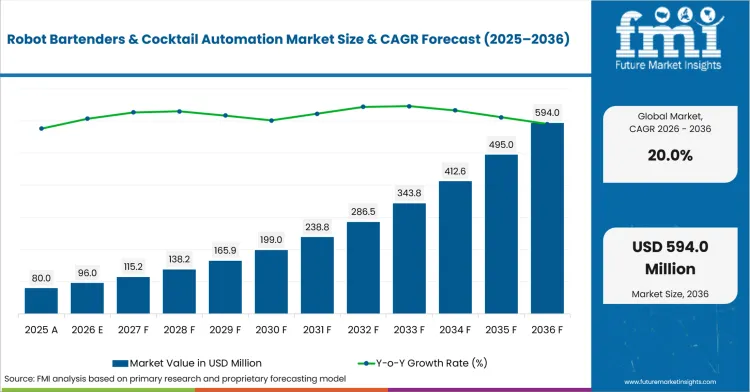
- Market Size (2026)
- USD 96.0 Mn
- Forecast (2036)
- USD 594.0 Mn
- CAGR (2026 to 2036)
- 20.0%
How big is the Robot Bartenders & Cocktail Automation Market in 2026?
USD 96.0 million in 2026 and USD 594.0 million by 2036 at a 20.0% CAGR.
Demand for Robot Bartenders is projected to expand at 20.0% CAGR between 2026 and 2036, increasing valuation from USD 96.0 million in 2026 to USD 594.0 million by 2036. Hospitality businesses continue adopting automated beverage preparation systems as labour shortages and rising service expectations reshape food and beverage operations. Automated bartending platforms improve drink consistency and support continuous service during peak operating hours. During January 2025, Makr Shakr expanded deployment of its robotic bartending technology across hospitality venues, reflecting continued commercial interest in beverage automation and interactive customer experiences.
Hospitality operators across the United States continue concentrating on high-throughput beverage automation for entertainment venues and large commercial establishments. European businesses increasingly emphasize standardized drink preparation together with operational efficiency across hotels and premium hospitality locations. Cruise operators and integrated resorts continue evaluating robotic beverage systems as part of broader guest experience enhancement strategies.
Commercial investment increasingly favours robotic platforms capable of combining beverage dispensing accuracy with software-driven recipe management and seamless payment integration. Purchasing decisions therefore reflect equipment reliability and operational flexibility instead of automated dispensing capability alone.
Key Takeaways of Robot Bartenders & Cocktail Automation Market
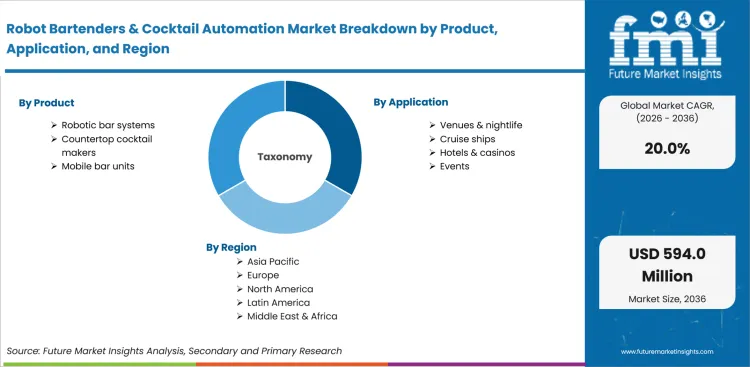
- The market is segmented by Product, Application, Component, End User, Business Model, and Region: product covers robotic bar systems, robotic cocktail stations, and robotic beverage kiosks; application spans hospitality venues, cruise ships & resorts, airports & entertainment venues, and corporate events; components include hardware, software, and services.
- By product, robotic bar systems are expected to lead with 52.0% share in 2026, as integrated platforms combine dispensing, ingredient storage, recipe management, and payment connectivity in a single automated workstation.
- Hospitality venues are the dominant application segment, projected to hold 46.0% share in 2026, driven by pressure to improve operational efficiency and maintain consistent customer experiences during peak periods.
- Hardware is estimated to lead the component category with 58.0% share in 2026, reflecting the mechanical dispensing systems, robotic arms, ingredient delivery units, and sensor technologies that form the foundation of installations.
- Software and service capabilities remain important differentiators, with software supporting recipe customization, operational monitoring, and predictive maintenance, while services strengthen reliability through installation support and calibration.
- Integration with point-of-sale platforms, inventory management software, and customer ordering applications continues to strengthen operational performance across hospitality businesses.
- End users span restaurants & bars, hotels, cruise operators, event organizers, and commercial entertainment venues, with regional coverage across North America, Latin America, Europe, East Asia, South Asia, Oceania, and the Middle East & Africa.
Analyst Perspective
"The robot bartenders & cocktail automation market is moving beyond novelty as hospitality operators seek consistent drink quality, faster service, and efficient bar operations. Long-term growth will favor suppliers that combine reliable automation with easy workflow integration, dependable maintenance, and practical support for high-volume hospitality environments."
- Nandini Roy Choudhury, Principal Analyst at Future Market Insights
How is the Robot Bartenders & Cocktail Automation Market segmented?
The robot bartender market is segmented by Product, Application, Component, End User, and Business Model, and Region.
Product classification includes robotic bar systems, robotic cocktail stations, and robotic beverage kiosks. Application analysis comprises hospitality venues, cruise ships & resorts, airports & entertainment venues, and corporate events. Component evaluation covers hardware, software, and services. Deployment assessment includes fixed installations and portable systems. End-user segmentation consists of restaurants & bars, hotels, cruise operators, event organizers, and commercial entertainment venues. Regional assessment covers North America, Latin America, Europe, East Asia, South Asia, Oceania, and the Middle East & Africa.
Why do robotic bar systems lead product demand?
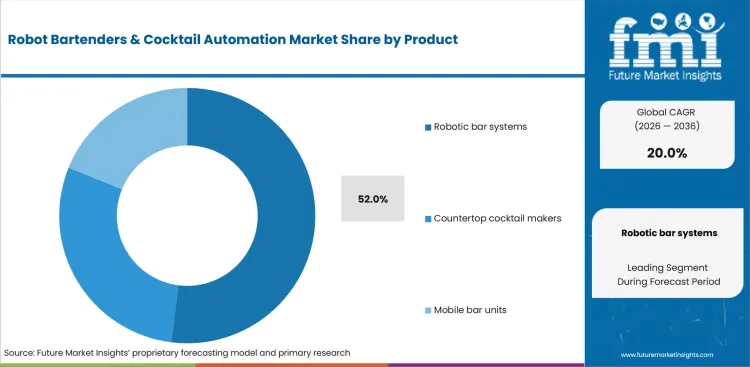
Integrated robotic bar platforms simplify beverage preparation by combining dispensing, ingredient storage, recipe management, and payment connectivity within a single automated workstation. Hospitality operators increasingly prefer complete systems that improve service consistency while reducing manual intervention.
- Robotic bar systems secure the leading product position, contributing 52.0% of overall demand during 2026. Integrated automation continues supporting high-volume beverage preparation across hotels, restaurants, airports, and entertainment venues.
- Manufacturers continue improving dispensing precision, touchscreen ordering, and cloud-based recipe management, enabling operators to maintain standardized beverage quality throughout daily operations.
Why do hospitality venues represent the primary application?
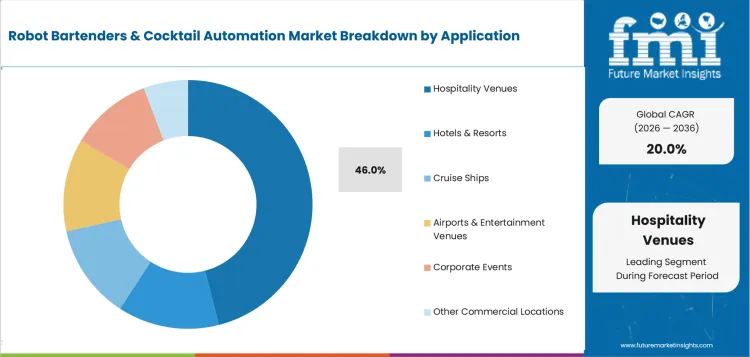
Restaurants, hotels, lounges, and bars continue facing growing pressure to improve operational efficiency while maintaining consistent customer experiences. Robotic bartenders support faster service, minimize preparation errors, and enhance guest engagement across busy hospitality environments.
- Hospitality venues remain the principal application segment with a 46.0% market share in 2026. Commercial establishments continue investing in beverage automation to improve workflow efficiency and reduce dependence on manual preparation during peak operating periods.
- Integration with point-of-sale platforms, inventory management software, and customer ordering applications continues strengthening operational performance across hospitality businesses.
Why does hardware account for the largest component share?
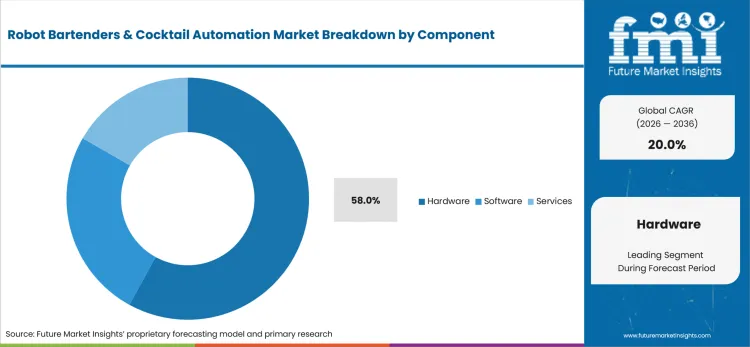
Mechanical dispensing systems, robotic arms, ingredient delivery units, refrigeration modules, and sensor technologies collectively represent the foundation of robotic bartender installations. Hardware therefore continues accounting for the largest proportion of overall system investment.
- Hardware occupies the leading component position, representing 58.0% of market demand in 2026. Growing installation of robotic dispensing equipment and automated beverage preparation modules continues supporting investment across commercial hospitality locations.
- Software improves recipe customization, operational monitoring, and predictive maintenance, whereas service offerings strengthen equipment reliability through installation support, calibration, and lifecycle maintenance.
What are the drivers, restraints, and opportunities in the Robot Bartenders & Cocktail Automation Market?
Automation across hospitality operations continues encouraging investment in robotic beverage preparation systems that improve efficiency and service consistency. Initial installation costs remain an important commercial consideration, whereas advances in artificial intelligence and connected hospitality technologies continue expanding long-term growth opportunities.
- Driver: Hospitality operators continue investing in beverage automation to improve service efficiency and reduce dependence on manual preparation.
- Restraint: Higher installation expenditure together with integration requirements continues influencing purchasing decisions among small and medium hospitality businesses.
- Opportunity: Progress in artificial intelligence, cloud-based recipe management, and connected hospitality platforms continues creating new commercial opportunities for robotic bartending solutions.
Restaurants and entertainment venues continue searching for technologies that improve beverage preparation without compromising quality or customer experience. Robotic bartenders deliver consistent drink preparation and uninterrupted service during periods of high customer demand.
Deployment programmes frequently involve integration with payment systems and existing hospitality infrastructure before commercial operation begins. Venue operators evaluate equipment reliability, software compatibility, maintenance requirements, ingredient handling capability, and operational safety before approving installation. Comprehensive technical assessment therefore remains an important stage throughout purchasing decisions.
Artificial intelligence continues improving recipe personalization, customer interaction, inventory optimization, and predictive maintenance across robotic beverage systems. Cloud connectivity and remote operational monitoring continue enhancing equipment performance while supporting hospitality operators in managing multiple installations efficiently. Manufacturers delivering dependable robotic performance together with intelligent software capability are anticipated to strengthen future commercial opportunities across hospitality automation.
Which country CAGRs are profiled in the Robot Bartenders & Cocktail Automation Market?
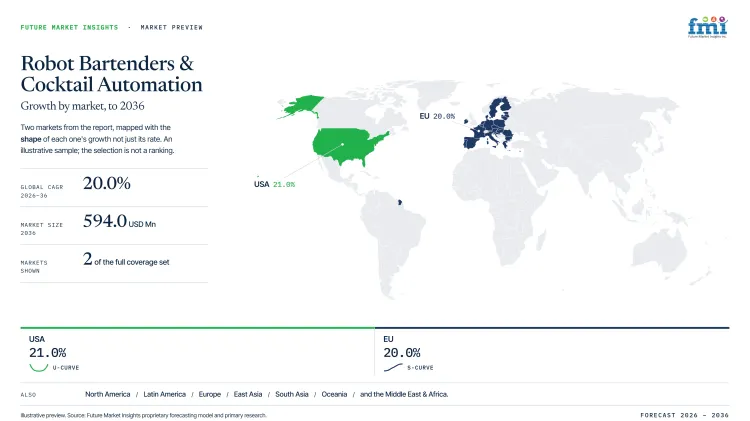
| Country | CAGR |
|---|---|
| Germany | 19.2% |
| USA | 21.0% |
| EU | 20.0% |
Source: FMI proprietary forecasting model and primary research.
How do country-level CAGRs compare in the Robot Bartender Market?
Commercial hospitality investment and automation strategies continue shaping country-level adoption of robotic bartending systems. Deployment priorities differ according to venue modernization programmes, customer engagement initiatives, and foodservice automation investment.
- Germany is projected to expand at a CAGR of 19.2% through 2036, reflecting continued adoption of hospitality automation across hotels, restaurants, and entertainment venues. During March 2025, Messe Düsseldorf showcased expanding foodservice automation technologies at ProWein 2025, highlighting increasing commercial interest in automated beverage preparation across European hospitality businesses.
- Supported by rising adoption of automated beverage systems across commercial hospitality environments, the United States is expected to record a CAGR of 21% between 2026 and 2036. Investment continues increasing across restaurants, airports, hotels, and entertainment destinations to improve service consistency and labour productivity.
Who are the notable companies in the Robot Bartenders & Cocktail Automation Market?
Companies active in this market include Makr Shakr (IT), Cecilia.ai (IL), Barsys (US).
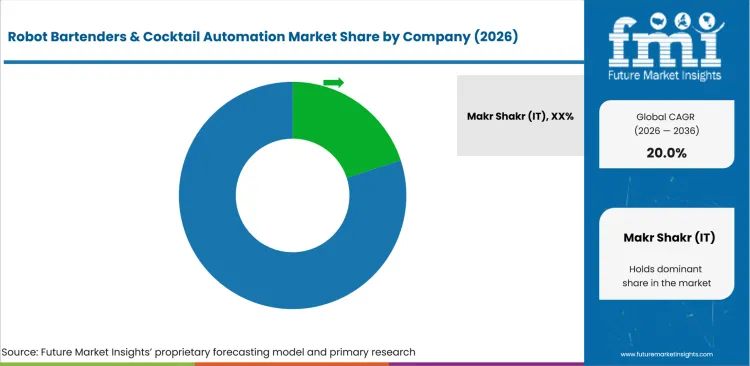
Competition is assessed around product relevance, deployment fit, service capability, and ability to support procurement or integration requirements within this market.
Makr Shakr (IT), Cecilia.ai (IL), Barsys (US) represent the principal company group profiled in this report.
Competitive Benchmarking: Robot Bartenders & Cocktail Automation Market
| Company | Automation Capability | Software Integration | Product Innovation | Geographic Presence |
|---|---|---|---|---|
| Makr Shakr (IT) | High | High | High | Global |
| Cecilia.ai (IL) | High | High | High | North America & Asia |
| Barsys (US) | High | High | Medium | Global |
| Richtech Robotics (US) | High | High | High | North America |
| Keenon Robotics (CN) | High | Medium | High | Europe & Global |
| Pudu Robotics (CN) | High | Medium | High | Global |
| LG Electronics (KR) | High | High | High | Global |
| Doosan Robotics (KR) | High | Medium | High | Global |
Assessment reflects beverage automation capability, software functionality, commercial deployment, and international business presence.
Source: FMI proprietary competitive assessment based on company portfolios and primary research.
Key Players
- Makr Shakr (IT)
- Cecilia.ai (IL)
- Barsys (US)
Robot Bartenders & Cocktail Automation Market Report Scope
| Coverage Field | Report Scope |
|---|---|
| Market Breakdown | Product type, application, component, deployment model, end user, country, and regional assessment. |
| Quantitative Units | Revenue in USD Million and CAGR (%). |
| Market Definition | Robot bartenders are automated beverage preparation systems that combine robotics, dispensing technologies, software, and intelligent control to prepare and serve alcoholic and non-alcoholic beverages across commercial hospitality environments. |
| Regions Covered | North America, Latin America, Europe, East Asia, South Asia, Oceania, and the Middle East & Africa. |
| Countries Covered | United States, Germany, United Kingdom, France, China, Japan, South Korea, Australia, and additional countries. |
| Key Companies Profiled | Makr Shakr (IT), Cecilia.ai (IL), Barsys (US). |
| Forecast Period | 2026 to 2036. |
| Base Year | 2025. |
| Approach | Market estimates were established through primary interviews, hospitality automation assessment, company benchmarking, product portfolio evaluation, technology analysis, and regional demand validation. |
Source: FMI proprietary research and primary interviews.
Robot Bartenders & Cocktail Automation Market Research Methodology
| Method | Approach |
|---|---|
| Primary Research | FMI analysts gathered input from manufacturers, service providers, technology developers, distributors, end users, procurement teams, and subject-matter experts. Interviews examined purchasing decisions, product or service evaluation, adoption barriers, approval requirements, pricing considerations, and expectations for technical or commercial support. Respondents were also asked what evidence is required before a trial, pilot, or initial order develops into regular purchasing. |
| Desk Research | Desk research covered government statistics, regulatory publications, trade data, industry associations, technical literature, standards, company filings, product information, and official corporate announcements. Sources were reviewed for relevance, publication date, geographic coverage, and consistency with the defined market scope. Claims relating to performance, applications, approvals, capacity, investment, and commercial activity were retained only when supported by credible public evidence. |
| Market Sizing and Forecasting | The market model combined the baseline value with historical performance, segment structure, pricing and volume indicators, adoption levels, company participation, and country-level demand conditions. Forecast assumptions considered economic activity, investment trends, regulatory developments, technology adoption, purchasing cycles, supply availability, and barriers to wider market use. Segment and regional estimates were reconciled before the final market total was calculated. |
| Data Validation | Estimates were checked against multiple independent indicators, including public data, company activity, trade patterns, industry developments, and findings from primary interviews. Validation also tested whether products, services, applications, and company revenues fell within the defined market boundaries. Adjacent categories, unsupported claims, overlapping revenues, and activities without direct market relevance were excluded to reduce double counting and maintain consistency across segments and countries. |
Robot Bartenders & Cocktail Automation Market Segmentation
By Product Type
- Robotic Bar Systems
- Robotic Cocktail Stations
- Robotic Beverage Kiosks
By Application
- Hospitality Venues
- Hotels & Resorts
- Cruise Ships
- Airports & Entertainment Venues
- Corporate Events
- Other Commercial Locations
By Component
- Hardware
- Software
- Services
By Deployment Model
- Fixed Installations
- Portable Systems
By End User
- Restaurants & Bars
- Hotels
- Cruise Operators
- Event Organizers
- Entertainment Venues
By Region
- North America
- United States
- Canada
- Latin America
- Brazil
- Mexico
- Argentina
- Europe
- Germany
- United Kingdom
- France
- Italy
- Spain
- Rest of Europe
- East Asia
- China
- Japan
- South Korea
- South Asia
- India
- ASEAN
- Rest of South Asia
- Oceania
- Australia
- New Zealand
- Middle East & Africa
- GCC Countries
- South Africa
- Rest of Middle East & Africa
Research Sources and Bibliography
- Future Market Insights analysis and primary research.
- Company public materials reviewed for market relevance: Makr Shakr (IT), Cecilia.ai (IL), Barsys (US).
- Public robotics, automation, defence, hospitality, maritime, and industrial sources reviewed for market context where applicable.
This Report Answers
- What is the projected valuation of the robot bartenders & cocktail automation market by 2036?
- Which CAGR is anticipated for the robot bartender market between 2026 and 2036?
- Which product type contributes the leading market share?
- Why do hospitality venues remain the principal application?
- Which component records the largest share across robot bartender systems?
- How do country growth prospects compare throughout the forecast period?
- Which companies continue influencing competition in the robot bartender market?
- Companies active in this market include Makr Shakr (IT), Cecilia.ai (IL), Barsys (US).
- Which operational considerations influence purchasing decisions among hospitality operators?
- How does Future Market Insights estimate and validate market forecasts?
Frequently Asked Questions
What is encouraging demand for robot bartenders?
Growing investment in hospitality automation, labour optimization, and consistent beverage preparation continues supporting commercial adoption of robotic bartender systems.
Which product type records the leading market share?
Robotic bar systems remain the leading product segment owing to integrated beverage preparation, dispensing automation, and software-driven recipe management.
Why do hospitality venues represent the principal application?
Restaurants, bars, hotels, and entertainment venues continue adopting robotic bartenders to improve service speed, beverage consistency, and operational efficiency.
Which component accounts for the highest share?
Hardware contributes the largest share as robotic arms, dispensing systems, sensors, refrigeration units, and automation equipment form the foundation of every installation.
Who are the major companies operating in the robot bartender market?
Companies active in this market include Makr Shakr (IT), Cecilia.ai (IL), Barsys (US).
What remains the principal challenge for industry participants?
Installation costs, software integration, maintenance requirements, and compatibility with existing hospitality infrastructure continue influencing purchasing decisions.
Which regions continue presenting attractive growth opportunities?
North America, Europe, and East Asia continue generating attractive opportunities through hospitality modernization, automation investment, and expanding commercial foodservice infrastructure.
Preview the report firsthand - request a free sample
Get SampleGet the brochure for pricing and purchase details.
Get PDFTable of Content
- Key Takeaways
- Market Size and CAGR
- Top Growth Driver
- Fastest Growing Segment
- Leading Region
- Key Companies
- Emerging Opportunities
- Executive Summary
- Global Market Outlook
- Demand-side Trends
- Supply-side Trends
- Technology Roadmap Analysis
- Analysis and Recommendations
- Analyst Perspective (What is happening? Why now? What should investors know?)
- Key Questions Answered
- How large is the market?
- What is the CAGR?
- What are key trends?
- Which region dominates?
- Who are the leaders?
- Market Overview
- Market Coverage / Taxonomy
- Market Definition / Scope / Limitations
- Research Methodology
- Chapter Orientation
- Analytical Lens and Working Hypotheses
- Market Structure, Signals, and Trend Drivers
- Benchmarking and Cross-market Comparability
- Market Sizing, Forecasting, and Opportunity Mapping
- Research Design and Evidence Framework
- Desk Research Programme (Secondary Evidence)
- Expert Input and Fieldwork (Primary Evidence)
- Tooling, Models, and Reference Databases
- Data Engineering and Model Build
- Quality Assurance and Audit Trail
- Market Background
- Market Dynamics (Drivers, Restraints, Opportunity, Trends)
- Scenario Forecast (Optimistic, Likely, Conservative)
- Impact Analysis
- AI Impact
- Sustainability Impact
- Regulatory Impact
- Technology Impact
- Consumer / Buyer Analysis
- Purchase Drivers
- Adoption Barriers
- Buyer Journey
- Opportunity Map Analysis
- Product Life Cycle Analysis
- Supply Chain Analysis
- Investment Feasibility Matrix
- Value Chain Analysis
- PESTLE and Porter's Analysis
- Regulatory Landscape
- Regional Parent Market Outlook
- Production and Consumption Statistics
- Import and Export Statistics
- Global Market Analysis and Forecast, 2021 to 2036
- Historical Market Size Value (USD Million) Analysis, 2021 to 2025
- Current and Future Market Size Value (USD Million) Projections, 2026 to 2036
- Y-o-Y Growth Trend Analysis
- Absolute $ Opportunity Analysis
- Global Market Pricing Analysis, 2021 to 2036
- Global Market Analysis and Forecast, By Product Type, 2021 to 2036
- Introduction / Key Findings
- Historical Market Size Value (USD Million) Analysis By Product Type, 2021 to 2025
- Current and Future Market Size Value (USD Million) Analysis and Forecast By Product Type, 2026 to 2036
- Robotic Bar Systems
- Robotic Cocktail Stations
- Robotic Beverage Kiosks
- Robotic Bar Systems
- Y-o-Y Growth Trend Analysis By Product Type, 2021 to 2025
- Absolute $ Opportunity Analysis By Product Type, 2026 to 2036
- Global Market Analysis and Forecast, By Application, 2021 to 2036
- Introduction / Key Findings
- Historical Market Size Value (USD Million) Analysis By Application, 2021 to 2025
- Current and Future Market Size Value (USD Million) Analysis and Forecast By Application, 2026 to 2036
- Hospitality Venues
- Hotels & Resorts
- Cruise Ships
- Airports & Entertainment Venues
- Corporate Events
- Other Commercial Locations
- Hospitality Venues
- Y-o-Y Growth Trend Analysis By Application, 2021 to 2025
- Absolute $ Opportunity Analysis By Application, 2026 to 2036
- Global Market Analysis and Forecast, By Component, 2021 to 2036
- Introduction / Key Findings
- Historical Market Size Value (USD Million) Analysis By Component, 2021 to 2025
- Current and Future Market Size Value (USD Million) Analysis and Forecast By Component, 2026 to 2036
- Hardware
- Software
- Services
- Hardware
- Y-o-Y Growth Trend Analysis By Component, 2021 to 2025
- Absolute $ Opportunity Analysis By Component, 2026 to 2036
- Global Market Analysis and Forecast, By Deployment Model, 2021 to 2036
- Introduction / Key Findings
- Historical Market Size Value (USD Million) Analysis By Deployment Model, 2021 to 2025
- Current and Future Market Size Value (USD Million) Analysis and Forecast By Deployment Model, 2026 to 2036
- Fixed Installations
- Portable Systems
- Fixed Installations
- Y-o-Y Growth Trend Analysis By Deployment Model, 2021 to 2025
- Absolute $ Opportunity Analysis By Deployment Model, 2026 to 2036
- Global Market Analysis and Forecast, By End User, 2021 to 2036
- Introduction / Key Findings
- Historical Market Size Value (USD Million) Analysis By End User, 2021 to 2025
- Current and Future Market Size Value (USD Million) Analysis and Forecast By End User, 2026 to 2036
- Restaurants & Bars
- Hotels
- Cruise Operators
- Event Organizers
- Entertainment Venues
- Restaurants & Bars
- Y-o-Y Growth Trend Analysis By End User, 2021 to 2025
- Absolute $ Opportunity Analysis By End User, 2026 to 2036
- Global Market Analysis and Forecast, By Region, 2021 to 2036
- Introduction
- Historical Market Size Value (USD Million) Analysis By Region, 2021 to 2025
- Current Market Size Value (USD Million) Analysis and Forecast By Region, 2026 to 2036
- North America
- Latin America
- Western Europe
- Eastern Europe
- East Asia
- South Asia and Pacific
- Middle East & Africa
- Market Attractiveness Analysis By Region
- North America Market Analysis and Forecast, By Country, 2021 to 2036
- Historical Market Size Value (USD Million) Trend Analysis By Market Taxonomy, 2021 to 2025
- Market Size Value (USD Million) Forecast By Market Taxonomy, 2026 to 2036
- By Country
- USA
- Canada
- By Product Type
- By Application
- By Component
- By Deployment Model
- By End User
- By Country
- Market Attractiveness Analysis
- By Country
- By Product Type
- By Application
- By Component
- By Deployment Model
- By End User
- Key Takeaways
- Latin America Market Analysis and Forecast, By Country
- Historical Market Size Value (USD Million) Trend Analysis By Market Taxonomy, 2021 to 2025
- Market Size Value (USD Million) Forecast By Market Taxonomy, 2026 to 2036
- By Country
- Brazil
- Mexico
- Chile
- Rest of Latin America
- By Product Type
- By Application
- By Component
- By Deployment Model
- By End User
- By Country
- Market Attractiveness Analysis
- By Country
- By Product Type
- By Application
- By Component
- By Deployment Model
- By End User
- Key Takeaways
- Western Europe Market Analysis and Forecast, By Country
- Historical Market Size Value (USD Million) Trend Analysis By Market Taxonomy, 2021 to 2025
- Market Size Value (USD Million) Forecast By Market Taxonomy, 2026 to 2036
- By Country
- Germany
- UK
- Italy
- Spain
- France
- Nordic
- BENELUX
- Rest of Western Europe
- By Product Type
- By Application
- By Component
- By Deployment Model
- By End User
- By Country
- Market Attractiveness Analysis
- By Country
- By Product Type
- By Application
- By Component
- By Deployment Model
- By End User
- Key Takeaways
- Eastern Europe Market Analysis and Forecast, By Country
- Historical Market Size Value (USD Million) Trend Analysis By Market Taxonomy, 2021 to 2025
- Market Size Value (USD Million) Forecast By Market Taxonomy, 2026 to 2036
- By Country
- Russia
- Poland
- Hungary
- Balkan & Baltic
- Rest of Eastern Europe
- By Product Type
- By Application
- By Component
- By Deployment Model
- By End User
- By Country
- Market Attractiveness Analysis
- By Country
- By Product Type
- By Application
- By Component
- By Deployment Model
- By End User
- Key Takeaways
- East Asia Market Analysis and Forecast, By Country
- Historical Market Size Value (USD Million) Trend Analysis By Market Taxonomy, 2021 to 2025
- Market Size Value (USD Million) Forecast By Market Taxonomy, 2026 to 2036
- By Country
- China
- Japan
- South Korea
- By Product Type
- By Application
- By Component
- By Deployment Model
- By End User
- By Country
- Market Attractiveness Analysis
- By Country
- By Product Type
- By Application
- By Component
- By Deployment Model
- By End User
- Key Takeaways
- South Asia and Pacific Market Analysis and Forecast, By Country
- Historical Market Size Value (USD Million) Trend Analysis By Market Taxonomy, 2021 to 2025
- Market Size Value (USD Million) Forecast By Market Taxonomy, 2026 to 2036
- By Country
- India
- ASEAN
- Australia & New Zealand
- Rest of South Asia and Pacific
- By Product Type
- By Application
- By Component
- By Deployment Model
- By End User
- By Country
- Market Attractiveness Analysis
- By Country
- By Product Type
- By Application
- By Component
- By Deployment Model
- By End User
- Key Takeaways
- Middle East & Africa Market Analysis and Forecast, By Country
- Historical Market Size Value (USD Million) Trend Analysis By Market Taxonomy, 2021 to 2025
- Market Size Value (USD Million) Forecast By Market Taxonomy, 2026 to 2036
- By Country
- Kingdom of Saudi Arabia
- Other GCC Countries
- Türkiye
- South Africa
- Other African Union
- Rest of Middle East & Africa
- By Product Type
- By Application
- By Component
- By Deployment Model
- By End User
- By Country
- Market Attractiveness Analysis
- By Country
- By Product Type
- By Application
- By Component
- By Deployment Model
- By End User
- Key Takeaways
- Key Countries Market Analysis
- USA
- Pricing Analysis
- Market Share Analysis, 2025
- By Product Type
- By Application
- By Component
- By Deployment Model
- By End User
- Canada
- Pricing Analysis
- Market Share Analysis, 2025
- By Product Type
- By Application
- By Component
- By Deployment Model
- By End User
- Mexico
- Pricing Analysis
- Market Share Analysis, 2025
- By Product Type
- By Application
- By Component
- By Deployment Model
- By End User
- Brazil
- Pricing Analysis
- Market Share Analysis, 2025
- By Product Type
- By Application
- By Component
- By Deployment Model
- By End User
- Chile
- Pricing Analysis
- Market Share Analysis, 2025
- By Product Type
- By Application
- By Component
- By Deployment Model
- By End User
- Germany
- Pricing Analysis
- Market Share Analysis, 2025
- By Product Type
- By Application
- By Component
- By Deployment Model
- By End User
- UK
- Pricing Analysis
- Market Share Analysis, 2025
- By Product Type
- By Application
- By Component
- By Deployment Model
- By End User
- Italy
- Pricing Analysis
- Market Share Analysis, 2025
- By Product Type
- By Application
- By Component
- By Deployment Model
- By End User
- Spain
- Pricing Analysis
- Market Share Analysis, 2025
- By Product Type
- By Application
- By Component
- By Deployment Model
- By End User
- France
- Pricing Analysis
- Market Share Analysis, 2025
- By Product Type
- By Application
- By Component
- By Deployment Model
- By End User
- India
- Pricing Analysis
- Market Share Analysis, 2025
- By Product Type
- By Application
- By Component
- By Deployment Model
- By End User
- ASEAN
- Pricing Analysis
- Market Share Analysis, 2025
- By Product Type
- By Application
- By Component
- By Deployment Model
- By End User
- Australia & New Zealand
- Pricing Analysis
- Market Share Analysis, 2025
- By Product Type
- By Application
- By Component
- By Deployment Model
- By End User
- China
- Pricing Analysis
- Market Share Analysis, 2025
- By Product Type
- By Application
- By Component
- By Deployment Model
- By End User
- Japan
- Pricing Analysis
- Market Share Analysis, 2025
- By Product Type
- By Application
- By Component
- By Deployment Model
- By End User
- South Korea
- Pricing Analysis
- Market Share Analysis, 2025
- By Product Type
- By Application
- By Component
- By Deployment Model
- By End User
- Russia
- Pricing Analysis
- Market Share Analysis, 2025
- By Product Type
- By Application
- By Component
- By Deployment Model
- By End User
- Poland
- Pricing Analysis
- Market Share Analysis, 2025
- By Product Type
- By Application
- By Component
- By Deployment Model
- By End User
- Hungary
- Pricing Analysis
- Market Share Analysis, 2025
- By Product Type
- By Application
- By Component
- By Deployment Model
- By End User
- Kingdom of Saudi Arabia
- Pricing Analysis
- Market Share Analysis, 2025
- By Product Type
- By Application
- By Component
- By Deployment Model
- By End User
- Türkiye
- Pricing Analysis
- Market Share Analysis, 2025
- By Product Type
- By Application
- By Component
- By Deployment Model
- By End User
- South Africa
- Pricing Analysis
- Market Share Analysis, 2025
- By Product Type
- By Application
- By Component
- By Deployment Model
- By End User
- USA
- Market Structure Analysis
- Competition Dashboard
- Competition Benchmarking
- Market Share Analysis of Top Players
- By Regional
- By Product Type
- By Application
- By Component
- By Deployment Model
- By End User
- Emerging Startups
- Innovation Benchmarking
- Competition Analysis
- Competition Deep Dive
- Makr Shakr (IT)
- Overview
- Product Portfolio
- Profitability by Market Segments
- Sales Footprint
- Strategy Overview
- Marketing Strategy
- Product Strategy
- Channel Strategy
- Cecilia.ai (IL)
- Barsys (US)
- Makr Shakr (IT)
- Case Studies
- Success Stories
- Recent Developments
- Competition Deep Dive
- Assumptions & Acronyms Used


