

- Industry Size (2026)
- USD 4699.00 Mn
- Forecast (2036)
- USD 8494.89 Mn
- CAGR (2026 to 2036)
- 6.1%
Premixed Cocktail Shots Market Size, Market Forecast and Outlook By FMI
The premixed cocktail shots market was valued at USD 4,428.83 million in 2025, projected to reach USD 4,699.00 million in 2026, and is forecast to expand to USD 8,494.89 million by 2036 at a 6.1% CAGR. Convenience-driven consumption occasions and single-serve packaging formats are repositioning premixed cocktail shots from a novelty party product to a regular at-home and on-the-go alcoholic beverage choice. Retail channel expansion into grocery, convenience, and online platforms is normalizing premixed shot procurement as part of routine alcohol purchasing behaviour. As per FMI, the category benefits from a structural shift in drinking occasions away from bar-poured cocktails toward packaged, portion-controlled formats that eliminate preparation complexity and ingredient inventory requirements for consumers. Spirit-based premixed shots hold 53.0% share because spirit-based formulations deliver the flavour intensity and perceived quality that consumers associate with traditional cocktail experiences. Hypermarket and supermarket distribution at 38.0% share reflects the category's transition from specialty liquor stores into mainstream grocery alcohol aisles where impulse and planned purchase occasions converge.
Summary of Premixed Cocktail Shots Market
- Premixed Cocktail Shots Market Definition
- Premixed cocktail shots are single-serve, ready-to-drink alcoholic beverages packaged in portion-controlled formats typically ranging from 30ml to 100ml. These products combine spirits, wine, or malt bases with flavouring agents, sweeteners, and sometimes non-alcoholic mixers, designed for direct consumption without additional preparation or bartending equipment.
- Demand Drivers in the Market
- Convenience consumption format preference: Consumers are gravitating toward portion-controlled, no-preparation alcohol formats that fit into home entertaining, outdoor events, and travel occasions. FMI analysts observe that premixed cocktail shots eliminate the ingredient sourcing, measuring, and mixing steps that deter casual consumers from cocktail preparation, converting these non-consumption occasions into purchase events.
- Retail channel normalization: Based on FMI's report, premixed cocktail shots are migrating from specialty liquor store niche sections into mainstream supermarket alcohol aisles, convenience store impulse zones, and online grocery delivery platforms. This distribution broadening exposes the category to the full grocery-shopping population rather than the narrower liquor-store customer base.
- Festival and event economy expansion: Outdoor music festivals, sporting events, and social gatherings create demand spikes for portable, single-serve alcohol formats that can be consumed without glassware or bar infrastructure. As per FMI, event organizers are partnering with premixed shot brands for exclusive pouring rights, creating branded consumption experiences that drive post-event retail trial.
- Key Segments Analyzed in the FMI Report
- Spirit-based formulation preference: Spirit-based holds 53.0% share in 2026. Consumers perceive spirit-based premixed shots as delivering authentic cocktail quality compared to malt or wine-based alternatives, and spirit bases provide the flavour intensity required to mask sweetness and create complex taste profiles in small-format packaging.
- Alcoholic additive dominance: Alcoholic commands 78.0% share in 2026. The core value proposition of premixed cocktail shots centres on delivering a complete alcoholic cocktail experience in a single-serve format, and the alcoholic segment captures consumers seeking convenience without sacrificing alcohol content expectations.
- Supermarket distribution anchor: Hypermarket/Supermarket holds 38.0% share in 2026. Grocery channel distribution captures both planned party procurement shoppers and impulse weekend shoppers, with chilled shelf placement near beer and wine creating cross-category browsing exposure for premixed cocktail shot brands.
- Analyst Opinion at FMI
- Nandini Roy Choudhury, Principal Consultant for Food & Beverage analysts observe that the premixed cocktail shots market benefits from convergence between two consumption trends: the convenience economy that drives ready-to-drink alcohol growth, and the cocktail culture that elevates consumer flavour expectations beyond basic beer and wine. Brands that deliver craft cocktail credibility in a convenience format, through quality spirit bases, recognizable flavour profiles, and premium packaging, will outperform commodity-positioned competitors selling on price alone. The category is at an inflection point where retail distribution breadth and brand recognition will determine which producers capture the volume growth ahead.
- Strategic Implications / Executive Takeaways
- Spirits companies should develop premixed shot product lines as a portfolio extension leveraging existing brand equity and spirit bases to enter the single-serve convenience alcohol segment.
- Retail buyers should allocate dedicated premixed cocktail shot fixture space within alcohol aisles to capture the growing impulse and planned purchase demand without cannibalizing existing RTD cocktail sales.
- Packaging suppliers should develop tamper-evident, recyclable single-serve formats that meet both consumer convenience expectations and tightening single-use packaging regulations across European and Australian markets.
- Methodology
- Primary Research: FMI conducted detailed technical interviews with procurement specialists, production engineers, and operations directors across 40 countries to validate adoption timelines.
- Desk Research: Analysts aggregated public regulatory documentation, industry standards publications, and corporate disclosure filings.
- Market-Sizing and Forecasting: Forecasting models apply a hybrid methodology starting with global production and trade metrics and projecting adoption conversion rates.
- Data Validation and Update Cycle: Segment forecasts undergo cross-validation against quarterly and annual industry production and trade volumes.
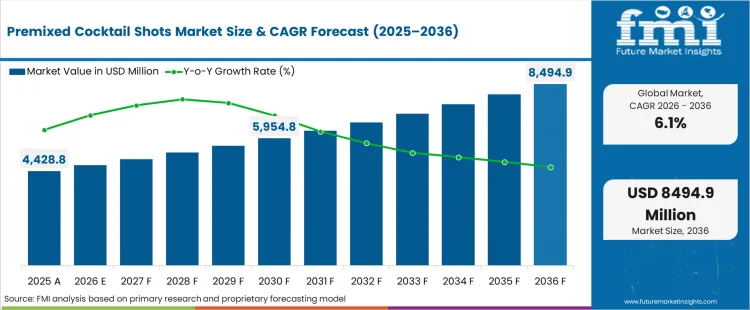
Premixed Cocktail Shots Market Key Takeaways
| Metric | Details |
|---|---|
| Industry Size (2026) | USD 4,699.00 Million |
| Industry Value (2036) | USD 8,494.89 Million |
| CAGR (2026-2036) | 6.1% |
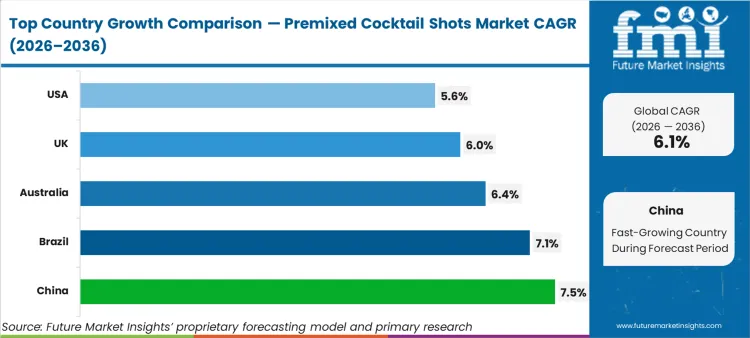
Source: Future Market Insights, 2026 China leads with a 7.5% CAGR, driven by the expansion of convenience retail alcohol formats in urban centres and the cultural adoption of Western cocktail consumption patterns among younger demographics. Brazil follows at 7.1% as Carnival and festival culture creates peak seasonal demand for portable, premixed alcoholic formats. Australia registers a 6.4% pace anchored by the ready-to-drink beverage culture and regulatory frameworks that facilitate packaged cocktail distribution through off-premise retail. UK operations advance at 6.0%, supported by supermarket private-label premixed ranges and the expansion of online alcohol delivery services. USA markets grow at 5.6% driven by ready-to-drink category growth that positions premixed shots as a convenience alternative to hard seltzers and canned cocktails.
Premixed Cocktail Shots Market Definition
Premixed cocktail shots are single-serve, ready-to-drink alcoholic beverages packaged in portion-controlled formats typically ranging from 30ml to 100ml. These products combine spirits, wine, or malt bases with flavouring agents, sweeteners, and sometimes non-alcoholic mixers, designed for direct consumption without additional preparation or bartending equipment.
Premixed Cocktail Shots Market Inclusions
Market scope includes spirit-based, wine-based, and malt-based premixed cocktail shots in both alcoholic and non-alcoholic formulations. The report covers global and regional market sizes from 2026 to 2036, segmented by primary ingredient, additive ingredient, sales channel, and geography.
Premixed Cocktail Shots Market Exclusions
Full-size ready-to-drink cocktails in cans or bottles exceeding 200ml are excluded. Standalone spirit miniatures without premixed cocktail flavouring are outside scope. Non-alcoholic mocktail shots without any alcohol-derived base ingredient are excluded from the valuation.
Premixed Cocktail Shots Market Research Methodology
- Primary Research: Analysts engaged with procurement specialists, production managers, and supply chain directors to map the decision gates triggering purchasing cycles and supplier qualification requirements.
- Desk Research: Data collection phases aggregated regulatory filings, industry standards documentation, trade association publications, and public company disclosures.
- Market-Sizing and Forecasting: Baseline values derive from a hybrid top-down and bottom-up methodology, applying region-specific adoption curves to project growth velocity through 2036.
- Data Validation and Update Cycle: Projections are tested against publicly reported production volumes, trade data, and industry benchmarks with annual model recalibration.
Key Industry Highlights
Increased focus on craft-quality production by companies
The artisanal movement has taken over Premixed Cocktail Shots, where people prefer small batches of handcrafted cocktails served in shot form for convenience purposes. Moreover, one craves luxurious cocktail experiences tailored especially for them.
Distillers use premium ingredients that are organic or locally sourced in order to create taste profiles that are intricately designed rather than those of traditional cocktails. The selling point here is authenticity tied closely to the craftsmanship narrative since customers would rather test new brands linked to artistic heritage and quality.
Biodegradable packaging and ethical sourcing a priority for consumers
Environmental sustainability underpins the Premixed Cocktail Shots landscape. Modern-day consumers are increasingly more eco-friendly and select products that have minimal impact on nature. Some brands have made significant strides in sourcing using sustainable practices and packaging their products in biodegradable materials.
In addition to reducing carbon footprints, these initiatives also enhance brand equity by promoting customer loyalty among environmentally conscious consumers. With time, such a trend will drive consumer expectations about industry standards.
Increasing demand for low-additives and low-sugar premixed cocktail shots
The health and wellness movement has greatly influenced the Premixed Cocktail Shots landscape primarily because there is an emerging group of consumers who are becoming health-conscious as far as alcoholic drinks are concerned. Some people want cocktails that include premixed shots with no artificial flavourings or colourings and are sugar-free as well as have fewer calories.
The balance between healthy ingredients and enjoyable features of all other cocktails makes it difficult for marketers to choose healthiness at the expense of taste. This space has been filled with innovations that have led to shots that are both enjoyable as well as aligned with a healthy diet; thus targeting a niche but rapidly growing segment of consumers.
2021 to 2025 Global Premixed Cocktail Shots Sales Analysis Compared to Demand Forecasts for 2026 to 2036
Global Premixed Cocktail Shots sales increased at a CAGR of 4.9% from 2021 to 2025. For the next ten years (2026 to 2036), projections are that the Premixed Cocktail Shots market will rise at a forecasted CAGR of 6.1%.
The Global Premixed Cocktail Shots market has had a historical performance that has witnessed a steady rise in popularity, driven by consumer demand for convenience and variety. Initially, the industry was involved in serving niche segments but as time went by, there have been major expansions due to lifestyle changes that have led to increased social gatherings and preference for ready-to-drink options.
Additionally, the craft cocktail movement has also favoured the industry with consumers looking to at-home artisanal and premium experiences.
Looking forward, the prospects of the industry are quite promising. The growth of premiumization is an ongoing trend where consumers are willing to pay more for higher quality and unique offerings, which should keep pushing up sales.
Furthermore, advancements in production technologies and packaging are expected to benefit this industry through enhanced shelf life as well as other features that enhance product effectiveness.
Sustainability and health consciousness are also emerging factors. In all likelihood, organic, low-calorie and non-alcoholic alternatives of premixed cocktail shots will become highly sought after in this landscape. This move coincides with broader trends towards mindful consumption thereby providing an opportunity for reaching new buyers.
Moreover, globalization and the spread of Western drinking culture to developing regions present huge expansion opportunities. As international tourism resumes post-pandemic, exposure to global flavours and styles is anticipated to influence taste preferences that is expected to lead to a more diverse product offering.
Market Concentration
The Premixed Cocktail Shots market depicts a fragmented landscape characterized by various players comprising both multinational corporations (MNCs) plus local companies across countries/regions. This is indicative of fragmentation within a marketplace having several products available along with competitive strategies and hence, no single company controls major shares in such industries, unlike consolidated ones.
In some concentrated sectors, industries are dominated by just a few big players; however, it is not so when we comes to Premixed Cocktail shots' case. There is a blend of MNCs such as Diageo or Bacardi that operate globally and offer diverse ranges that compete with smaller regional firms who mainly focus on local tastes and preferences.
These regional players can respond quickly and flexibly to their domestic market environments, thereby having an upper hand in this fast-changing industry.
Value share and industry dominance are some of the concepts that can be used in explaining the degree of concentration. In a situation where there are only a few firms in the industry, the industry is said to be concentrated as it implies that a few companies have captured most of the shares; hence dominating it completely.
Conversely, Premixed Cocktail Shots' fragmented nature makes competition more intense due to the many players involved who each hold small shares, thus denying any particular business immense power over others.
This diversity leads to innovation and variety because these entities aspire to differentiate themselves by developing unique flavours, and branding materials including marketing strategies for promotional purposes.
Thus, consumers have access to a vibrant competitive marketplace offering a wide range of alternatives. The current balance between multinational corporations (MNCs) and regional or local companies ensures that both global trends as well as local aspirations are met making it a dynamic yet diverse market.
Country-wise Insights
The following table shows the estimated growth rates of the top industries. The USA and Germany are set to exhibit high Premixed Cocktail Shots consumption, recording CAGRs of 3.5% and 2.8%, respectively, through 2036.
.webp "Top Country Growth Comparison Premixed Cocktail Shots Market Cagr (2026 2036)")
| Countries | CAGR |
|---|---|
| USA | 5.6% |
| Brazil | 7.1% |
| UK | 6.0% |
| China | 7.5% |
| Australia | 6.4% |
Source: FMI analysis based on primary research and proprietary forecasting model
United States maintaining its prominence in premixed Cocktail Shots sales
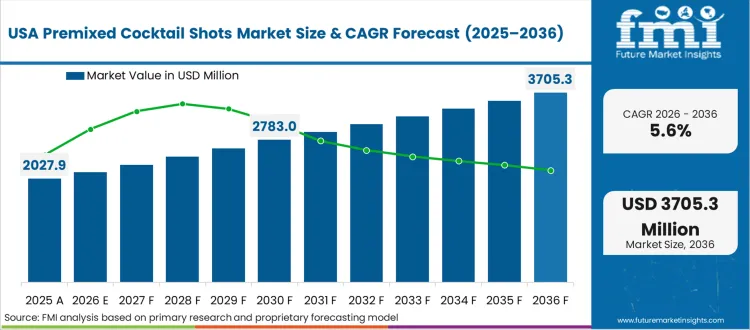
Premixed cocktail shots are popular in the USA thanks to the extensive drinking culture and openness to innovative alcoholic drinks by Americans. There is a strong distribution network supporting this landscape that ensures wide availability through various retail formats. Premixed cocktail shots suit USA customers' need for on-the-go options since they can be consumed quickly whenever needed.
Moreover, there are numerous innovative brands headquartered here that never cease pushing boundaries through outstanding marketing techniques and product development; thus maintaining its dominance in the sector. The USA landscape is projected to grow at a CAGR of 5.6% from 2026 to 2036 and reach a value of USD 2,573.2 million or a value of 34.1% in 2036.
Premixed Cocktail Shots gaining popularity in Brazil
Premixed cocktail shots have gained ground based on Brazil's vibrant culture and festive spirit. In addition, local buying practices reveal an increasing preference for such convenient instant services when locals gather together socially during celebrations. The chilled refreshing tropical climate also provides suitable conditions for the consumption of chilled bottles in summer.
Manufacturers are tailor-making beverages infused with local flavourings alongside other Brazilian ingredients so as to appeal to Brazilian taste buds, which has resulted in premixed cocktail shots’ growth within the alcohol market of the country. The industry is projected to have a world value share of 8.4% in 2036 with a value of USD 633.9 million owing to growth at a forecast CAGR of 7.1% from 2026 to 2036.
Premixed Cocktail Shots Companies penetrating the Chinese market
Premixed cocktail shots companies are increasingly targeting China due to its growing middle class and increased disposable incomes. These businesses have a chance now with the shift in social norms that has seen a wider acceptance of Western drinking cultures. They customize their products to local tastes and preferences by bringing forth flavours that resonate well with Chinese consumers.
In China, where technology is very advanced, e-commerce applications as well as social media advertising have also greatly helped in introducing as well as increasing demand for premixed cocktail shots. The Chinese landscape is projected to advance with a forecast CAGR of 7.5% from 2026 to 2036 to reach a value of USD 769.7 million in 2036.
Category-Wise Insights
Spirit-based premixed cocktail shots are currently the popular choice for consumers
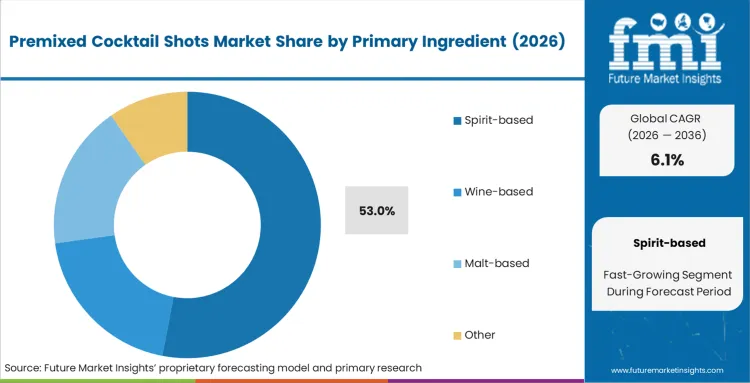
| Segment | Spirit-based |
|---|---|
| Main segment | Primary Ingredient |
| Value Share (2026) | 53.0% |
Their convenience and quality make spirit-based premixed cocktail shots attractive propositions for consumers. Such ready-to-drink offers give customers a taste of high-class cocktails minus any mixing or additional ingredients. The main reasons why customers buy them are variety, availability of premium spirits at their disposal and ease of use.
Consequently, market players are making more innovative mixtures from classics to exotic choices that cater for different tastes. Moreover, this segment’s popularity has been boosted further by the rise in home entertainment where hosts can serve consistent professional drinks throughout the gathering. These reasons have led to spirit-based premixed cocktail shots gaining a projected value share of 53.0% in 2036 with a value of USD 3,999.4 million owing to a forecast CAGR of 5.8%.
Consumers prefer purchasing premixed cocktail shots at Hypermarkets& Supermarkets
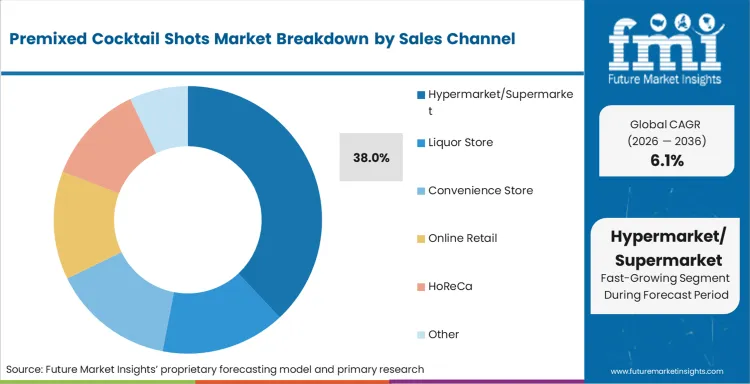
| Segment | Hypermarket/Supermarket |
|---|---|
| Main segment | Sales Channel |
| Value Share (2026) | 38.0% |
When it comes to premixed cocktail shots, two places shoppers are most likely to find them are Hypermarkets and Supermarkets. In addition, these shopping centres, which equate one-stop stores with innumerable products, have a range of goods for customers to choose from that can either be bought as per requirement.
Furthermore, shelves that are spaced out and arranged in an orderly manner make it simpler for buyers to recognize new stocks and weigh alternatives against each other.
On top of that, premixed cocktail shots are placed on the shelves near the entrance where everybody passes through; thus there is a temptation in such transactions. Finally, the security of knowing what to expect combined with instant gratification as opposed to waiting for shipments makes these places ideal places for shopping.
Hypermarkets/ Supermarkets channel is projected to grow with a forecast CAGR of 6.6% from 2026 to 2036, which will help it to reach a value of USD 2,867.5 million or a value share of 38.0% in 2036.
Competition Outlook
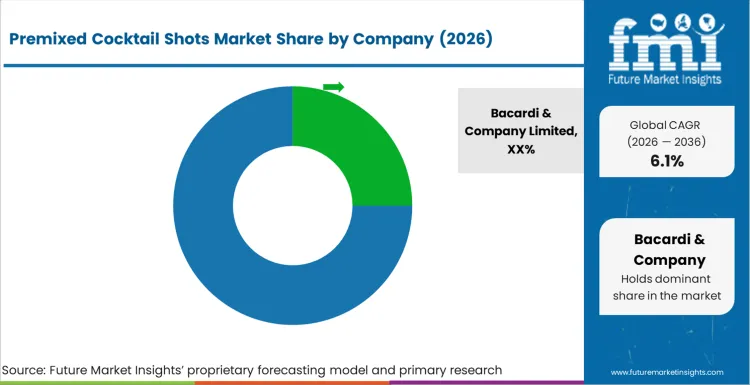
The companies operating in the Global Premixed Cocktail Shots market are faced with a highly dynamic business environment and hence, they must adopt new strategies if they want to remain relevant players in this industry; especially given that there is also substandard quality being sold by certain retailers who just want to make quick money from unsuspecting consumers.
Mergers and acquisitions have been used as strategic tools by businesses when they seek to expand their industries or diversify their products. Brands amass niche entities within the industry so that they can exploit new technologies and ridership which will advance their competitiveness in the industry.
Product launches play an important role in maintaining relevance and capturing consumer attention within this fast-paced market. In fact, innovative flavour presentation and packaging design strongly influence the popularity of products; thereby leading to increasing final revenue sales.
In order to maintain growth in the marketplace, organizations are tending towards strategic partnerships among themselves. Such arrangements lead to co-marketing activities, sharing of resources and accessing new distribution channels.
Corporate strategies now include such practices for the sake of corporate sustainability that would help to attract environment-friendly customers and build loyalty to particular brands.
Agility, innovation and strategic collaborations are shaping the future of premixed cocktail shots globally. Companies that react quickly to current consumer preferences will eventually become market leaders in this vibrant industry.
- By December 2023, Coca-Cola had made a move into India’s ready-to-drink alcoholic beverage category.
- In October 2023, Ketel One launched three new premixed cocktails including Ketel One vodka espresso martini, Ketel One vodka cosmopolitan, and Tanqueray gin negroni.
Leading Premixed Cocktail Shots Brands
- Bacardi & Company Limited
- Diageo Plc
- Heineken NV
- Altia Oyj
- Carlsberg A/S
- Belvedere SA
- Ball Corporation
- The Whisky Exchange
- Suntory Holdings
- Mark Anthony Brands LIQS
- Twisted Shotz
- Others
Scope of the Report
| Metric | Value |
|---|---|
| Quantitative Units | USD Million 4,699.00 to USD Million 8,494.89, at a CAGR of 6.1% |
| Market Definition | Premixed cocktail shots are single-serve, ready-to-drink alcoholic beverages packaged in portion-controlled formats typically ranging from 30ml to 100ml. These products combine spirits, wine, or malt bases with flavouring agents, sweeteners, and sometimes non-alcoholic mixers, designed for direct consumption without additional preparation or bartending equipment. |
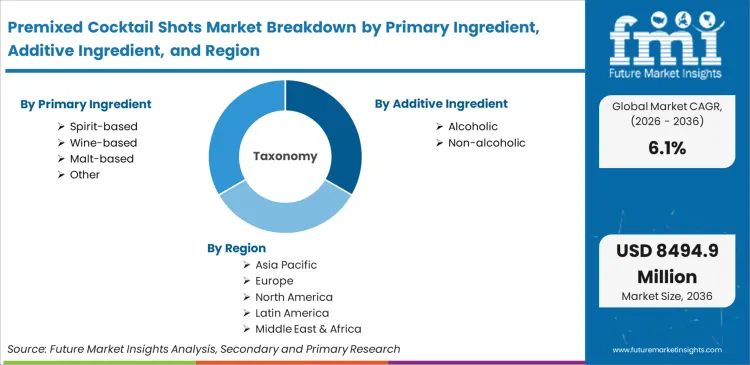
| Primary Ingredient Segmentation | Spirit-based, Wine-based, Malt-based, Other |
| Additive Ingredient Segmentation | Alcoholic, Non-alcoholic |
| Sales Channel Segmentation | Hypermarket/Supermarket, Liquor Store, Convenience Store, Online Retail, HoReCa, Other |
| Regions Covered | North America, Latin America, Europe, East Asia, South Asia, Oceania, Middle East & Africa |
| Countries Covered | China, Brazil, Australia, UK, USA, and 40 plus countries |
| Key Companies Profiled | Bacardi & Company Limited, Diageo Plc, Heineken NV, Altia Oyj, Carlsberg A/S, Belvedere SA, Ball Corporation, The Whisky Exchange, Suntory Holdings, Mark Anthony Brands LIQS, Twisted Shotz |
| Forecast Period | 2026 to 2036 |
| Approach | Hybrid top-down and bottom-up modelling anchored by primary interviews and public data benchmarking |
Key Segments of Market Report
By Primary Ingredient:
As per Primary Ingredient, the industry is categorized into Malt-based, Wine-based, Spirit-based, and Other Ingredients.
By Additive Ingredient:
As per Additive Ingredient, the industry is categorized into Alcoholic and Non-alcoholic.
By Sales Channel:
As per Sales Channel, the industry is categorized into Liquor Store, Hypermarket/Supermarket, Convenience Store, Online Retail, HoReCa, and Other Channels.
By Region:
Industry analysis has been carried out in key countries of North America, Latin America, Europe, East Asia, South Asia, Oceania, and the Middle East & Africa.
Bibliography
- International Wines and Spirits Record. (2024). IWSR Drinks Market Analysis: Ready-to-Drink Category Report. IWSR.
- Organisation for Economic Co-operation and Development. (2024). Alcohol Consumption and Policy Indicators. OECD Health Statistics.
- European Spirits Organisation. (2024). Facts and Figures: European Spirit Drinks Sector Report 2024. spiritsEUROPE.
- World Health Organization. (2024). Global Alcohol Action Plan 2022-2030: Progress Report. WHO.
- Australian Government Department of Health. (2024). National Alcohol Strategy 2019-2028: Implementation Progress Report. Commonwealth of Australia.
This bibliography is provided for reader reference. The full FMI report contains the complete reference list with primary research documentation.
Frequently Asked Questions
How large is the demand for Premixed Cocktail Shots in the global market in 2026?
Demand for Premixed Cocktail Shots in the global market is estimated to be valued at USD Million 4,699.00 in 2026.
What will be the market size of Premixed Cocktail Shots in the global market by 2036?
Market size for Premixed Cocktail Shots is projected to reach USD Million 8,494.89 by 2036.
What is the expected demand growth for Premixed Cocktail Shots in the global market between 2026 and 2036?
Demand for Premixed Cocktail Shots is expected to grow at a CAGR of 6.1% between 2026 and 2036.
Which Primary Ingredient is poised to lead global sales by 2026?
Spirit-based accounts for 53.0% share in 2026.
How significant is the role of Alcoholic in Additive Ingredient?
Alcoholic commands 78.0% of the additive ingredient segment in 2026.
What is the growth outlook for China?
China is projected to grow at a CAGR of 7.5% during 2026 to 2036.
What is the growth rate for Brazil in this market?
Brazil is projected to expand at a CAGR of 7.1% during 2026 to 2036.
What is Premixed Cocktail Shots and what is it mainly used for?
Premixed cocktail shots are single-serve, ready-to-drink alcoholic beverages packaged in portion-controlled formats typically ranging from 30ml to 100ml. These products combine spirits, wine, or malt bases with flavouring agents, sweeteners, and sometimes non-alcoholic mixers, designed for direct consumption without additional preparation or bartending equipment.
What is included in the scope of this Premixed Cocktail Shots report?
Market scope includes spirit-based, wine-based, and malt-based premixed cocktail shots in both alcoholic and non-alcoholic formulations. The report covers global and regional market sizes from 2026 to 2036, segmented by primary ingredient, additive ingredient, sales channel, and geography.
What is excluded from the scope of this report?
Full-size ready-to-drink cocktails in cans or bottles exceeding 200ml are excluded. Standalone spirit miniatures without premixed cocktail flavouring are outside scope.
What does market forecast mean on this page?
The market forecast represents a model-based projection built on defined industry and supply chain assumptions for strategic planning purposes.
How does FMI build and validate the Premixed Cocktail Shots forecast?
Forecasting models apply a hybrid top-down and bottom-up methodology and cross-validate projections against publicly available industry data and primary research inputs.
What does zero reliance on speculative third-party market research mean here?
Primary interviews, verified public regulatory documentation, and official industry standards registries are used instead of unverified syndicated estimates.
Preview the report firsthand - request a free sample
Get SampleGet the brochure for pricing and purchase details.
Get PDFTable of Content
- Executive Summary
- Global Market Outlook
- Demand-side Trends
- Supply-side Trends
- Technology Roadmap Analysis
- Analysis and Recommendations
- Market Overview
- Market Coverage / Taxonomy
- Market Definition / Scope / Limitations
- Research Methodology
- Chapter Orientation
- Analytical Lens and Working Hypotheses
- Market Structure, Signals, and Trend Drivers
- Benchmarking and Cross-market Comparability
- Market Sizing, Forecasting, and Opportunity Mapping
- Research Design and Evidence Framework
- Desk Research Programme (Secondary Evidence)
- Company Annual and Sustainability Reports
- Peer-reviewed Journals and Academic Literature
- Corporate Websites, Product Literature, and Technical Notes
- Earnings Decks and Investor Briefings
- Statutory Filings and Regulatory Disclosures
- Technical White Papers and Standards Notes
- Trade Journals, Industry Magazines, and Analyst Briefs
- Conference Proceedings, Webinars, and Seminar Materials
- Government Statistics Portals and Public Data Releases
- Press Releases and Reputable Media Coverage
- Specialist Newsletters and Curated Briefings
- Sector Databases and Reference Repositories
- FMI Internal Proprietary Databases and Historical Market Datasets
- Subscription Datasets and Paid Sources
- Social Channels, Communities, and Digital Listening Inputs
- Additional Desk Sources
- Expert Input and Fieldwork (Primary Evidence)
- Primary Modes
- Qualitative Interviews and Expert Elicitation
- Quantitative Surveys and Structured Data Capture
- Blended Approach
- Why Primary Evidence is Used
- Field Techniques
- Interviews
- Surveys
- Focus Groups
- Observational and In-context Research
- Social and Community Interactions
- Stakeholder Universe Engaged
- C-suite Leaders
- Board Members
- Presidents and Vice Presidents
- R&D and Innovation Heads
- Technical Specialists
- Domain Subject-matter Experts
- Scientists
- Physicians and Other Healthcare Professionals
- Governance, Ethics, and Data Stewardship
- Research Ethics
- Data Integrity and Handling
- Primary Modes
- Tooling, Models, and Reference Databases
- Desk Research Programme (Secondary Evidence)
- Data Engineering and Model Build
- Data Acquisition and Ingestion
- Cleaning, Normalisation, and Verification
- Synthesis, Triangulation, and Analysis
- Quality Assurance and Audit Trail
- Market Background
- Market Dynamics
- Drivers
- Restraints
- Opportunity
- Trends
- Scenario Forecast
- Demand in Optimistic Scenario
- Demand in Likely Scenario
- Demand in Conservative Scenario
- Opportunity Map Analysis
- Product Life Cycle Analysis
- Supply Chain Analysis
- Investment Feasibility Matrix
- Value Chain Analysis
- PESTLE and Porter’s Analysis
- Regulatory Landscape
- Regional Parent Market Outlook
- Production and Consumption Statistics
- Import and Export Statistics
- Market Dynamics
- Global Market Analysis 2021 to 2025 and Forecast, 2026 to 2036
- Historical Market Size Value (USD Million) Analysis, 2021 to 2025
- Current and Future Market Size Value (USD Million) Projections, 2026 to 2036
- Y-o-Y Growth Trend Analysis
- Absolute $ Opportunity Analysis
- Global Market Pricing Analysis 2021 to 2025 and Forecast 2026 to 2036
- Global Market Analysis 2021 to 2025 and Forecast 2026 to 2036, By Primary Ingredient
- Introduction / Key Findings
- Historical Market Size Value (USD Million) Analysis By Primary Ingredient , 2021 to 2025
- Current and Future Market Size Value (USD Million) Analysis and Forecast By Primary Ingredient , 2026 to 2036
- Spirit-based
- Wine-based
- Malt-based
- Other
- Spirit-based
- Y-o-Y Growth Trend Analysis By Primary Ingredient , 2021 to 2025
- Absolute $ Opportunity Analysis By Primary Ingredient , 2026 to 2036
- Global Market Analysis 2021 to 2025 and Forecast 2026 to 2036, By Additive Ingredient
- Introduction / Key Findings
- Historical Market Size Value (USD Million) Analysis By Additive Ingredient, 2021 to 2025
- Current and Future Market Size Value (USD Million) Analysis and Forecast By Additive Ingredient, 2026 to 2036
- Alcoholic
- Non-alcoholic
- Alcoholic
- Y-o-Y Growth Trend Analysis By Additive Ingredient, 2021 to 2025
- Absolute $ Opportunity Analysis By Additive Ingredient, 2026 to 2036
- Global Market Analysis 2021 to 2025 and Forecast 2026 to 2036, By Sales Channel
- Introduction / Key Findings
- Historical Market Size Value (USD Million) Analysis By Sales Channel, 2021 to 2025
- Current and Future Market Size Value (USD Million) Analysis and Forecast By Sales Channel, 2026 to 2036
- Hypermarket/Supermarket
- Liquor Store
- Convenience Store
- Online Retail
- HoReCa
- Other
- Hypermarket/Supermarket
- Y-o-Y Growth Trend Analysis By Sales Channel, 2021 to 2025
- Absolute $ Opportunity Analysis By Sales Channel, 2026 to 2036
- Global Market Analysis 2021 to 2025 and Forecast 2026 to 2036, By Region
- Introduction
- Historical Market Size Value (USD Million) Analysis By Region, 2021 to 2025
- Current Market Size Value (USD Million) Analysis and Forecast By Region, 2026 to 2036
- North America
- Latin America
- Western Europe
- Eastern Europe
- East Asia
- South Asia and Pacific
- Middle East & Africa
- Market Attractiveness Analysis By Region
- North America Market Analysis 2021 to 2025 and Forecast 2026 to 2036, By Country
- Historical Market Size Value (USD Million) Trend Analysis By Market Taxonomy, 2021 to 2025
- Market Size Value (USD Million) Forecast By Market Taxonomy, 2026 to 2036
- By Country
- USA
- Canada
- Mexico
- By Primary Ingredient
- By Additive Ingredient
- By Sales Channel
- By Country
- Market Attractiveness Analysis
- By Country
- By Primary Ingredient
- By Additive Ingredient
- By Sales Channel
- Key Takeaways
- Latin America Market Analysis 2021 to 2025 and Forecast 2026 to 2036, By Country
- Historical Market Size Value (USD Million) Trend Analysis By Market Taxonomy, 2021 to 2025
- Market Size Value (USD Million) Forecast By Market Taxonomy, 2026 to 2036
- By Country
- Brazil
- Chile
- Rest of Latin America
- By Primary Ingredient
- By Additive Ingredient
- By Sales Channel
- By Country
- Market Attractiveness Analysis
- By Country
- By Primary Ingredient
- By Additive Ingredient
- By Sales Channel
- Key Takeaways
- Western Europe Market Analysis 2021 to 2025 and Forecast 2026 to 2036, By Country
- Historical Market Size Value (USD Million) Trend Analysis By Market Taxonomy, 2021 to 2025
- Market Size Value (USD Million) Forecast By Market Taxonomy, 2026 to 2036
- By Country
- Germany
- UK
- Italy
- Spain
- France
- Nordic
- BENELUX
- Rest of Western Europe
- By Primary Ingredient
- By Additive Ingredient
- By Sales Channel
- By Country
- Market Attractiveness Analysis
- By Country
- By Primary Ingredient
- By Additive Ingredient
- By Sales Channel
- Key Takeaways
- Eastern Europe Market Analysis 2021 to 2025 and Forecast 2026 to 2036, By Country
- Historical Market Size Value (USD Million) Trend Analysis By Market Taxonomy, 2021 to 2025
- Market Size Value (USD Million) Forecast By Market Taxonomy, 2026 to 2036
- By Country
- Russia
- Poland
- Hungary
- Balkan & Baltic
- Rest of Eastern Europe
- By Primary Ingredient
- By Additive Ingredient
- By Sales Channel
- By Country
- Market Attractiveness Analysis
- By Country
- By Primary Ingredient
- By Additive Ingredient
- By Sales Channel
- Key Takeaways
- East Asia Market Analysis 2021 to 2025 and Forecast 2026 to 2036, By Country
- Historical Market Size Value (USD Million) Trend Analysis By Market Taxonomy, 2021 to 2025
- Market Size Value (USD Million) Forecast By Market Taxonomy, 2026 to 2036
- By Country
- China
- Japan
- South Korea
- By Primary Ingredient
- By Additive Ingredient
- By Sales Channel
- By Country
- Market Attractiveness Analysis
- By Country
- By Primary Ingredient
- By Additive Ingredient
- By Sales Channel
- Key Takeaways
- South Asia and Pacific Market Analysis 2021 to 2025 and Forecast 2026 to 2036, By Country
- Historical Market Size Value (USD Million) Trend Analysis By Market Taxonomy, 2021 to 2025
- Market Size Value (USD Million) Forecast By Market Taxonomy, 2026 to 2036
- By Country
- India
- ASEAN
- Australia & New Zealand
- Rest of South Asia and Pacific
- By Primary Ingredient
- By Additive Ingredient
- By Sales Channel
- By Country
- Market Attractiveness Analysis
- By Country
- By Primary Ingredient
- By Additive Ingredient
- By Sales Channel
- Key Takeaways
- Middle East & Africa Market Analysis 2021 to 2025 and Forecast 2026 to 2036, By Country
- Historical Market Size Value (USD Million) Trend Analysis By Market Taxonomy, 2021 to 2025
- Market Size Value (USD Million) Forecast By Market Taxonomy, 2026 to 2036
- By Country
- Kingdom of Saudi Arabia
- Other GCC Countries
- Turkiye
- South Africa
- Other African Union
- Rest of Middle East & Africa
- By Primary Ingredient
- By Additive Ingredient
- By Sales Channel
- By Country
- Market Attractiveness Analysis
- By Country
- By Primary Ingredient
- By Additive Ingredient
- By Sales Channel
- Key Takeaways
- Key Countries Market Analysis
- USA
- Pricing Analysis
- Market Share Analysis, 2025
- By Primary Ingredient
- By Additive Ingredient
- By Sales Channel
- Canada
- Pricing Analysis
- Market Share Analysis, 2025
- By Primary Ingredient
- By Additive Ingredient
- By Sales Channel
- Mexico
- Pricing Analysis
- Market Share Analysis, 2025
- By Primary Ingredient
- By Additive Ingredient
- By Sales Channel
- Brazil
- Pricing Analysis
- Market Share Analysis, 2025
- By Primary Ingredient
- By Additive Ingredient
- By Sales Channel
- Chile
- Pricing Analysis
- Market Share Analysis, 2025
- By Primary Ingredient
- By Additive Ingredient
- By Sales Channel
- Germany
- Pricing Analysis
- Market Share Analysis, 2025
- By Primary Ingredient
- By Additive Ingredient
- By Sales Channel
- UK
- Pricing Analysis
- Market Share Analysis, 2025
- By Primary Ingredient
- By Additive Ingredient
- By Sales Channel
- Italy
- Pricing Analysis
- Market Share Analysis, 2025
- By Primary Ingredient
- By Additive Ingredient
- By Sales Channel
- Spain
- Pricing Analysis
- Market Share Analysis, 2025
- By Primary Ingredient
- By Additive Ingredient
- By Sales Channel
- France
- Pricing Analysis
- Market Share Analysis, 2025
- By Primary Ingredient
- By Additive Ingredient
- By Sales Channel
- India
- Pricing Analysis
- Market Share Analysis, 2025
- By Primary Ingredient
- By Additive Ingredient
- By Sales Channel
- ASEAN
- Pricing Analysis
- Market Share Analysis, 2025
- By Primary Ingredient
- By Additive Ingredient
- By Sales Channel
- Australia & New Zealand
- Pricing Analysis
- Market Share Analysis, 2025
- By Primary Ingredient
- By Additive Ingredient
- By Sales Channel
- China
- Pricing Analysis
- Market Share Analysis, 2025
- By Primary Ingredient
- By Additive Ingredient
- By Sales Channel
- Japan
- Pricing Analysis
- Market Share Analysis, 2025
- By Primary Ingredient
- By Additive Ingredient
- By Sales Channel
- South Korea
- Pricing Analysis
- Market Share Analysis, 2025
- By Primary Ingredient
- By Additive Ingredient
- By Sales Channel
- Russia
- Pricing Analysis
- Market Share Analysis, 2025
- By Primary Ingredient
- By Additive Ingredient
- By Sales Channel
- Poland
- Pricing Analysis
- Market Share Analysis, 2025
- By Primary Ingredient
- By Additive Ingredient
- By Sales Channel
- Hungary
- Pricing Analysis
- Market Share Analysis, 2025
- By Primary Ingredient
- By Additive Ingredient
- By Sales Channel
- Kingdom of Saudi Arabia
- Pricing Analysis
- Market Share Analysis, 2025
- By Primary Ingredient
- By Additive Ingredient
- By Sales Channel
- Turkiye
- Pricing Analysis
- Market Share Analysis, 2025
- By Primary Ingredient
- By Additive Ingredient
- By Sales Channel
- South Africa
- Pricing Analysis
- Market Share Analysis, 2025
- By Primary Ingredient
- By Additive Ingredient
- By Sales Channel
- USA
- Market Structure Analysis
- Competition Dashboard
- Competition Benchmarking
- Market Share Analysis of Top Players
- By Regional
- By Primary Ingredient
- By Additive Ingredient
- By Sales Channel
- Competition Analysis
- Competition Deep Dive
- Bacardi & Company Limited
- Overview
- Product Portfolio
- Profitability by Market Segments (Product/Age /Sales Channel/Region)
- Sales Footprint
- Strategy Overview
- Marketing Strategy
- Product Strategy
- Channel Strategy
- Diageo Plc
- Heineken NV
- Altia Oyj
- Carlsberg A/S
- Belvedere SA
- Ball Corporation
- The Whisky Exchange
- Suntory Holdings
- Mark Anthony Brands LIQS
- Twisted Shotz
- Others
- Bacardi & Company Limited
- Competition Deep Dive
- Assumptions & Acronyms Used


