

- Market Size (2026)
- USD 562.4 Mn
- Forecast (2036)
- USD 966.0 Mn
- CAGR (2026 to 2036)
- 5.6%
How big is Robotic Workpiece Positioners Market in 2026?
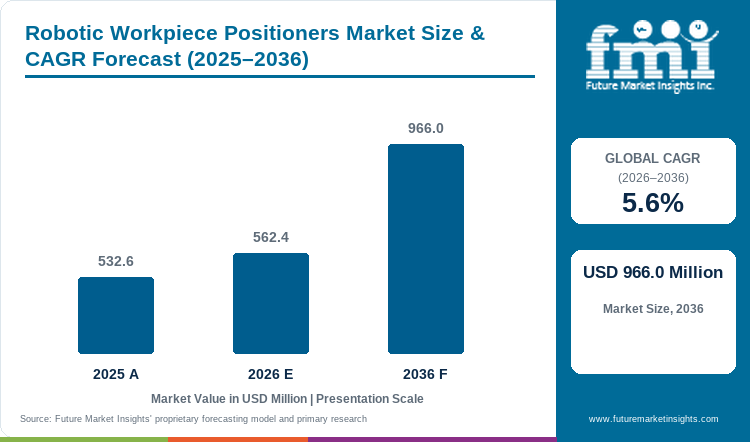
USD 562.4 million in 2026 and USD 966.0 million by 2036 at a 5.6% CAGR.
The market was valued at USD 532.6 million in 2025. Demand is estimated at USD 562.4 million in 2026 and is projected to reach USD 966.0 million by 2036 at 5.6% CAGR. The estimate covers servo or robot-controlled devices that rotate, tilt or index a workpiece in coordinated robotic cells, including new units and major rebuilds. Manual welding turntables and general machine-tool rotary tables without robotic coordination are excluded.
Demand is anchored in the robotic welding market, where a positioner brings seams into a stable robot posture and can reduce out-of-position welding. Equipment value changes with axes, payload, fixture size and coordinated control.
Key Takeaways
- The market is valued at USD 562.4 million in 2026 and is projected to create USD 403.6 million in additional value by 2036.
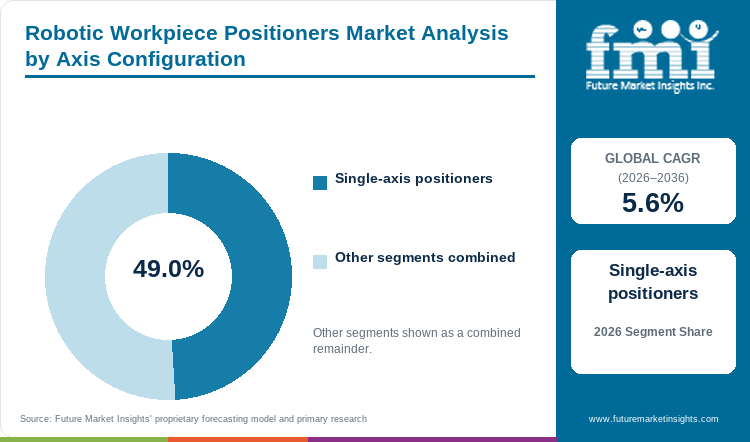
- Single-axis positioners is projected to hold 49.0% of Axis Configuration demand in 2026 because one controlled rotation solves a broad range of welding tasks.
- Up to 1,000 kg is projected to hold 56.0% of Load Capacity demand in 2026 because medium weldments form the broadest repeatable automation base.
- Robotic arc welding is projected to hold 63.0% of Application demand in 2026 owing to the direct link between part orientation and weld quality.
- A positioner specified by static payload alone can underperform when fixture mass, center of gravity and rotational inertia are not included.
- Some of the key players in this market include ABB, KUKA, Yaskawa Motoman, FANUC, CLOOS, Pemamek, Lincoln Electric, Güdel, Comau, Kawasaki Robotics.
Analyst Perspective
"The positioner is part of the robot motion system, not just a rotating fixture. Selection must begin with inertia, weld access and safe load exchange before nominal payload or axis count."
- Nikhil Kaitwade, Principal Consultant, Future Market Insights
How is the robotic workpiece positioners market segmented?
The robotic workpiece positioners market is segmented by axis configuration, load capacity, application, station layout, integration model and region.
Axis configuration covers single, dual and custom motion. Load capacity includes the fixture and workpiece. Application and station layout define the production case, while integration model separates packaged cells from independent equipment.
Why do single-axis positioners lead configuration demand?
One controlled rotary movement covers a large share of welding jobs without adding unnecessary axes to the cell. Cylindrical parts, frames and fabricated assemblies can be turned to expose successive seams while the robot follows a simpler path. The mechanical layout is easier to fixture and commission than a multi-axis system, especially when the workpiece mainly needs rotation rather than compound tilting.
- Single-axis positioners are estimated to account for 49.0% of configuration demand in 2026.
- Major robot and welding-system suppliers offer single-axis rotary positioners across several payload classes, reflecting their use in standard coordinated welding cells.
Why does the up-to-1,000 kg class lead value demand?
A large portion of robotic welding sits between lightweight component work and heavy fabrication. Vehicle structures, tanks, frames and machined assemblies often fall within a range that can still use conventional floor-mounted positioners and standard robotic cells. ABB's IRP K and comparable industrial models extend through the 1,000 kg class, while heavier systems move into more specialized handling, foundations and cell engineering.
- Up to 1,000 kg is estimated to account for 56.0% of payload-class demand in 2026.
- Commercial positioner portfolios commonly include several steps below and around 1,000 kg, giving integrators room to match fixture weight and workpiece mass without moving into heavy-duty equipment.
Why does robotic arc welding lead application demand?
The value of a positioner becomes especially clear when seam orientation changes during welding. Turning the workpiece can maintain access to joints that would otherwise push the robot toward awkward wrist positions or longer travel. It can also place more of the weld in a favorable orientation, giving the robot a more consistent torch path across complex fabricated parts.
- Robotic arc welding is estimated to account for 63.0% of application demand in 2026.
- Robot manufacturers and welding-system specialists integrate external positioner axes directly into coordinated arc-welding programs so robot and workpiece motion can be planned together.
Why do twin-station layouts lead value demand?
The second station changes the economics of the cell more than the welding process itself. While the robot works on one fixture, the next part can be loaded, clamped and prepared outside the active welding zone. The benefit becomes substantial when handling time would otherwise leave the robot idle between cycles. Two-station layouts are therefore common where repeat production and fixture changeover determine cell utilization.
- Twin-station systems are estimated to account for 44.0% of layout demand in 2026.
- Commercial welding cells use alternating stations specifically to separate robot welding time from operator loading and unloading time.
Why do integrated packages lead?
A positioner is only one moving element inside the welding cell. Its axis has to remain synchronized with robot motion, welding parameters, interlocks and guarding throughout the cycle. Problems usually appear at the interfaces, such as timing mismatches, controller communication or safety sequencing. This gives integrated supply an advantage during commissioning, particularly when the positioner is treated as an external robot axis rather than an independent rotary table.
- Robot-OEM and system-integrator packages are estimated to account for 53.0% of offering demand in 2026.
- Welding-system suppliers commonly combine robot control, external axes, process equipment and safety hardware within one engineered cell rather than leaving positioner integration to the end user.
What are the drivers, restraints and opportunities in the Robotic Workpiece Positioners Market?
Robotic welding drives demand, fixture and inertia engineering restrain standardization, and coordinated multi-station cells create an opportunity for higher robot utilization.
- Driver: Positioners improve robot access and keep welding or processing paths in favorable orientations.
- Restraint: Custom fixtures, high inertia and safety guarding raise engineering cost and lead time.
- Opportunity: Twin-station and heavy-payload systems can increase robot utilization in fabricated-metal production.
Expansion in the industrial robotics market increases the need for coordinated workpiece motion. Positioners are adopted where rotating the part produces a more stable process than extending robot reach or adding another robot.
The rated payload does not describe center of gravity, inertia or fixture overhang. Integrators must model acceleration, braking and bearing load for each workpiece family. Custom engineering limits rapid price comparison and can extend commissioning.
Growth in the robotic welding cells market supports complete cells where robot, power source, positioner and safety controls are engineered together. Modular fixtures and offline programming can make high-mix welding more economical.
Which country CAGRs are profiled in the Robotic Workpiece Positioners Market?
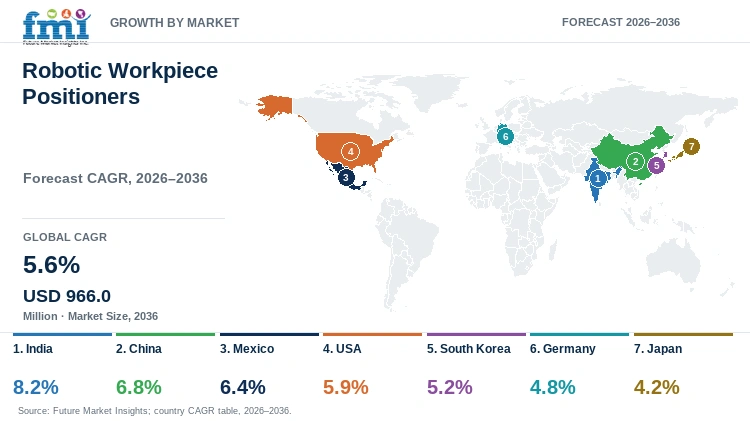
| Country | CAGR |
|---|---|
| India | 8.2% |
| China | 6.8% |
| Mexico | 6.4% |
| USA | 5.9% |
| South Korea | 5.2% |
| Germany | 4.8% |
| Japan | 4.2% |
How do country-level CAGRs compare in the Robotic Workpiece Positioners Market?
Country demand reflects the type of fabrication being automated rather than robot installations alone. India and China are adding welding capacity across automotive, machinery and fabricated-metal production. Mexico is more closely tied to vehicle and appliance manufacturing, while the USA combines automotive demand with general fabrication and labor-saving automation. South Korea has a stronger requirement for heavier and more specialized positioning equipment in shipbuilding and industrial manufacturing. Germany and Japan are mature automation markets, where purchases are more often linked to cell upgrades, replacement equipment and tighter motion-control requirements.
- India: Growth in fabricated components, automotive production and welded assemblies is widening the use of positioners in new robotic cells. Medium-payload systems are especially relevant where manufacturers are moving from manual part handling to repeatable coordinated welding.
- China: The opportunity spans automotive, machinery and metal fabrication. A large installed robot base creates demand for rotary tables, headstock-tailstock units and coordinated external axes that can be added to both new and existing welding lines.
- Mexico: Positioner demand is concentrated around automotive components, vehicle structures and appliance manufacturing. Twin-station and medium-payload layouts fit plants where cycle time, fixture changeover and operator loading have a direct effect on output.
- USA: Welding automation is increasingly used where skilled labor is difficult to secure or where repetitive fabrication limits throughput. Positioners help manufacturers automate larger or awkward weldments without forcing the robot to reach every seam from a fixed part orientation.
- South Korea: Shipbuilding, transport equipment and advanced manufacturing create a broader requirement for higher-payload and application-specific positioning systems. The buying case can involve workpiece stability, synchronized motion and access to long or complex weld paths rather than simple part rotation.
- Germany: Much of the opportunity sits inside established automated factories. Positioners are often introduced during cell modernization, where the requirement is to improve weld access or increase utilization without replacing the complete robot installation.
- Japan: Mature robot adoption shifts demand toward carefully engineered cells and replacement of older external-axis equipment. Accuracy, compact layouts and compatibility with existing robot controls have greater influence on purchasing than basic automation adoption.
Across the key countries in this market, these rates measure revenue within the defined product boundary and do not represent growth of the wider parent industry.
Country-wise Analysis
- India: 8.2% CAGR through 2036. Local integrators increasingly pair imported servo positioners with fixtures, guarding and cell engineering sourced closer to the customer. This lowers the integration barrier for automotive components, fabricated assemblies and other repeat welding jobs where manual repositioning limits cycle consistency.
- China: 6.8% CAGR through 2036. Domestic positioner suppliers cover a wide range of payloads and cell configurations. At the same time, automotive, machinery and export-oriented fabrication require consistent weld geometry across repeated production runs, supporting coordinated positioner use alongside welding robots.
- Mexico: 6.4% CAGR through 2036. Automotive and component plants create a practical case for twin-station systems. Loading and fixture changeover can take place on one side while welding continues on the other, helping suppliers serving North American production networks reduce non-welding time.
- USA: 5.9% CAGR through 2036. Heavy equipment, vehicle production and general fabrication create demand where similar weldments recur often enough to justify dedicated fixtures. Positioners are particularly useful for large or awkward parts that would otherwise require extensive robot reach or manual repositioning between seams.
- South Korea: 5.2% CAGR through 2036. Shipbuilding and advanced fabrication create requirements that extend beyond standard rotary tables. Higher payloads, coordinated external axes and stable handling of complex structures become more important when weld access changes substantially around the workpiece.
- Germany: 4.8% CAGR through 2036. Positioner purchases are closely tied to modernization of established welding cells. Safety integration, offline programming and fixture flexibility matter where manufacturers want to improve utilization without rebuilding the entire automation line.
- Japan: 4.2% CAGR through 2036. Domestic robot platforms and established automation suppliers shape a market centered on carefully engineered cells. Replacement equipment, controller compatibility and precise coordinated motion carry more weight than basic adoption of robotic welding.
Who are the notable companies in the Robotic Workpiece Positioners Market?
ABB, KUKA, Yaskawa Motoman, FANUC, CLOOS, Pemamek, Lincoln Electric, Güdel, Comau, Kawasaki Robotics are the notable companies profiled in this market.
Robot OEMs offer controller-native positioners, while welding specialists compete through fixtures, process knowledge and heavy-payload engineering. Scores distinguish named positioner products from broader cell-integration capability.
- Robot OEM Positioner Platforms: ABB, KUKA, Yaskawa Motoman, FANUC, Kawasaki Robotics.
- Welding Automation Specialists: CLOOS, Pemamek, Lincoln Electric.
- Integrated Motion and Cell Engineering: Güdel, Comau.
Competitive Benchmarking: Robotic Workpiece Positioners Market
| Company | Direct Positioner Evidence | Coordinated Control | Fixture Engineering | Geographic Reach |
|---|---|---|---|---|
| ABB | High | High | High | Global |
| KUKA | High | High | High | Global |
| Yaskawa Motoman | High | High | High | Global |
| FANUC | High | High | High | Global |
| CLOOS | High | High | High | Global |
| Pemamek | High | High | High | Global |
| Lincoln Electric | Medium | High | High | Global |
| Güdel | Medium | High | High | Global |
| Comau | Medium | High | High | Global |
| Kawasaki Robotics | Medium | High | High | Global |
High direct evidence requires a named robotic workpiece positioner. Medium reflects integrated welding cells or external-axis engineering with less public product detail.
Key Developments in the Robotic Workpiece Positioners Market
- In 2026, IFR reported 38,000 US industrial-robot installations in 2025, supporting continued cell-equipment demand beyond the robot arm.
- In September 2025, IFR reported that automotive installed 126,088 industrial robots worldwide in 2024, sustaining demand for coordinated welding positioners.
- In 2025, ABB continued to document the IRP K family for coordinated payload handling up to 1,000 kg.
Key Players in the Robotic Workpiece Positioners Market
Robot OEM Positioner Platforms
- ABB
- KUKA
- Yaskawa Motoman
- FANUC
- Kawasaki Robotics
Welding Automation Specialists
- CLOOS
- Pemamek
- Lincoln Electric
Integrated Motion and Cell Engineering
- Güdel
- Comau
Robotic Workpiece Positioners Market - Report Scope
| Coverage field | Report scope |
|---|---|
| Market Size | USD 562.4 million in 2026 and USD 966.0 million by 2036 at 5.6% CAGR. |
| Market Definition | Servo or robot-controlled equipment that rotates, tilts or indexes a workpiece within a coordinated robotic process cell, including new systems and major rebuilds. |
| Segmentation | Axis configuration, load capacity, application, station layout, integration model and region. |
| Regional Coverage | North America, Latin America, Western Europe, Eastern Europe, East Asia, South Asia and Pacific, and Middle East and Africa. |
| Countries Covered | India, China, Mexico, USA, South Korea, Germany, Japan and more than 20 countries included in the full report. |
| Key Companies Profiled | ABB, KUKA, Yaskawa Motoman, FANUC, CLOOS, Pemamek, Lincoln Electric, Güdel, Comau, Kawasaki Robotics. |
| Forecast Period | 2026 to 2036. |
| Approach | Bottom-up model using robotic welding cells, positioner attachment rates, payload and axis mix, fixture content, replacement cycles and regional integrator activity. |
Robotic Workpiece Positioners Market - Research Methodology
| Method | Approach |
|---|---|
| Primary Research | FMI analysts gathered input from manufacturers, system integrators, distributors, plant engineers, procurement teams and application specialists. Interviews tested purchasing criteria, replacement cycles, qualification work and technical-service requirements. |
| Desk Research | Desk research covered government statistics, standards, industry associations, technical literature, patents, official product information and corporate announcements. Evidence was screened for scope, date and direct relevance. |
| Market Sizing and Forecasting | Bottom-up model using robotic welding cells, positioner attachment rates, payload and axis mix, fixture content, replacement cycles and regional integrator activity. |
| Data Validation | Estimates were checked against parent-market activity, installed-base indicators, product specifications and supplier participation. Adjacent products without the defined function were excluded. |
Robotic Workpiece Positioners Market by Segments
Robotic Workpiece Positioners Market segmented by Axis Configuration:
- Single-axis positioners
- Two-axis tilt-rotate positioners
- Multi-axis and custom systems
Robotic Workpiece Positioners Market segmented by Load Capacity:
- Up to 250 kg
- Above 250 to 1,000 kg
- Above 1,000 to 5,000 kg
- Above 5,000 kg
Robotic Workpiece Positioners Market segmented by Application:
- Robotic arc welding
- Assembly and fastening
- Painting and coating
- Inspection and processing
Robotic Workpiece Positioners Market segmented by Station Layout:
- Single-station systems
- Twin-station systems
- Ferris-wheel and multi-station systems
- Custom transfer layouts
Robotic Workpiece Positioners Market segmented by Integration Model:
- Robot-OEM and system-integrator packages
- Independent positioner purchases
- Rebuild and retrofit packages
Robotic Workpiece Positioners Market by Region:
- North America
- United States
- Canada
- Latin America
- Brazil
- Mexico
- Argentina
- Chile
- Western Europe
- Germany
- France
- United Kingdom
- Italy
- Spain
- Benelux
- Nordics
- Eastern Europe
- Poland
- Czech Republic
- Romania
- Hungary
- East Asia
- China
- Japan
- South Korea
- South Asia and Pacific
- India
- ASEAN
- Australia and New Zealand
- Middle East and Africa
- GCC Countries
- South Africa
- Türkiye
- Israel
Research Sources and Bibliography
- International Federation of Robotics. (2025, September 25). World Robotics 2025 industrial robot statistics.
- International Federation of Robotics. (2026). United States robot installation update for 2025.
- International Organization for Standardization. (2011). ISO 10218-1 industrial robot safety requirements.
- ABB. (n.d.; accessed September 23, 2026). IRP K industrial robot positioner.
- KUKA. (n.d.; accessed September 23, 2026). Positioners for robotic applications.
- Yaskawa Motoman. (n.d.; accessed September 23, 2026). Welding positioners and systems.
- National Institute of Standards and Technology. (2025). Robotic systems performance resources.
- Future Market Insights. (2026). Robotic Welding Market.
This bibliography is provided for reader reference and is not exhaustive. The full report contains the complete reference list and detailed citations.
This Report Answers
- How large is the robotic workpiece positioners market in 2026 and 2036?
- Which product specification leads demand in 2026?
- What operating condition converts technical need into a purchase?
- Which constraint can delay qualification or replacement?
- How do country growth rates compare across the profiled markets?
- Which companies provide direct or adjacent market capability?
Frequently Asked Questions
How big is the robotic workpiece positioners market in 2026?
The robotic workpiece positioners market is valued at USD 562.4 million in 2026 and is projected to reach USD 966.0 million by 2036. The estimate covers revenue within the stated market definition and excludes adjacent equipment or chemicals sold without the required function.
What is the CAGR of the robotic workpiece positioners market from 2026 to 2036?
The market is projected to grow at 5.6% CAGR between 2026 and 2036. Expansion depends on end-market output together with the rate at which plants adopt higher-specification products.
Which axis configuration leads the robotic workpiece positioners market?
Single-axis positioners is expected to hold 49.0% share in 2026 because one controlled rotation solves a broad range of welding tasks. Single-axis systems balance capability and installed cost.
Which countries are projected to record higher growth?
India is projected at 8.2% CAGR, followed by China at 6.8% and Mexico at 6.4% through 2036. The comparison reflects local production investment and the timing of replacement or qualification cycles.
Which companies are active in the robotic workpiece positioners market?
The profiled group includes ABB, KUKA, Yaskawa Motoman, FANUC, CLOOS, Pemamek, Lincoln Electric, Güdel, Comau, Kawasaki Robotics. Capability differs by product range and application evidence.
Preview the report firsthand - request a free sample
Get SampleGet the brochure for pricing and purchase details.
Get PDFTable of Content
- Key Takeaways
- Market Size and CAGR
- Top Growth Driver
- Fastest Growing Segment
- Leading Region
- Key Companies
- Emerging Opportunities
- Executive Summary
- Global Market Outlook
- Demand-side Trends
- Supply-side Trends
- Technology Roadmap Analysis
- Analysis and Recommendations
- Analyst Perspective (What is happening? Why now? What should investors know?)
- Key Questions Answered
- How large is the market?
- What is the CAGR?
- What are key trends?
- Which region dominates?
- Who are the leaders?
- Market Overview
- Market Coverage / Taxonomy
- Market Definition / Scope / Limitations
- Research Methodology
- Chapter Orientation
- Analytical Lens and Working Hypotheses
- Market Structure, Signals, and Trend Drivers
- Benchmarking and Cross-market Comparability
- Market Sizing, Forecasting, and Opportunity Mapping
- Research Design and Evidence Framework
- Desk Research Programme (Secondary Evidence)
- Expert Input and Fieldwork (Primary Evidence)
- Tooling, Models, and Reference Databases
- Data Engineering and Model Build
- Quality Assurance and Audit Trail
- Market Background
- Market Dynamics (Drivers, Restraints, Opportunity, Trends)
- Scenario Forecast (Optimistic, Likely, Conservative)
- Impact Analysis
- AI Impact
- Sustainability Impact
- Regulatory Impact
- Technology Impact
- Consumer / Buyer Analysis
- Purchase Drivers
- Adoption Barriers
- Buyer Journey
- Opportunity Map Analysis
- Product Life Cycle Analysis
- Supply Chain Analysis
- Investment Feasibility Matrix
- Value Chain Analysis
- PESTLE and Porter's Analysis
- Regulatory Landscape
- Regional Parent Market Outlook
- Production and Consumption Statistics
- Import and Export Statistics
- Global Market Analysis and Forecast, 2021 to 2036
- Historical Market Size Value (USD Million) Analysis, 2021 to 2025
- Current and Future Market Size Value (USD Million) Projections, 2026 to 2036
- Y-o-Y Growth Trend Analysis
- Absolute $ Opportunity Analysis
- Global Market Pricing Analysis, 2021 to 2036
- Global Market Analysis and Forecast, By Axis Configuration, 2021 to 2036
- Introduction / Key Findings
- Historical Market Size Value (USD Million) Analysis By Axis Configuration, 2021 to 2025
- Current and Future Market Size Value (USD Million) Analysis and Forecast By Axis Configuration, 2026 to 2036
- Single-axis positioners
- Two-axis tilt-rotate positioners
- Multi-axis and custom systems
- Y-o-Y Growth Trend Analysis By Axis Configuration, 2021 to 2025
- Absolute $ Opportunity Analysis By Axis Configuration, 2026 to 2036
- Global Market Analysis and Forecast, By Load Capacity, 2021 to 2036
- Introduction / Key Findings
- Historical Market Size Value (USD Million) Analysis By Load Capacity, 2021 to 2025
- Current and Future Market Size Value (USD Million) Analysis and Forecast By Load Capacity, 2026 to 2036
- Up to 250 kg
- Above 250 to 1,000 kg
- Above 1,000 to 5,000 kg
- Above 5,000 kg
- Y-o-Y Growth Trend Analysis By Load Capacity, 2021 to 2025
- Absolute $ Opportunity Analysis By Load Capacity, 2026 to 2036
- Global Market Analysis and Forecast, By Application, 2021 to 2036
- Introduction / Key Findings
- Historical Market Size Value (USD Million) Analysis By Application, 2021 to 2025
- Current and Future Market Size Value (USD Million) Analysis and Forecast By Application, 2026 to 2036
- Robotic arc welding
- Assembly and fastening
- Painting and coating
- Inspection and processing
- Y-o-Y Growth Trend Analysis By Application, 2021 to 2025
- Absolute $ Opportunity Analysis By Application, 2026 to 2036
- Global Market Analysis and Forecast, By Station Layout, 2021 to 2036
- Introduction / Key Findings
- Historical Market Size Value (USD Million) Analysis By Station Layout, 2021 to 2025
- Current and Future Market Size Value (USD Million) Analysis and Forecast By Station Layout, 2026 to 2036
- Single-station systems
- Twin-station systems
- Ferris-wheel and multi-station systems
- Custom transfer layouts
- Y-o-Y Growth Trend Analysis By Station Layout, 2021 to 2025
- Absolute $ Opportunity Analysis By Station Layout, 2026 to 2036
- Global Market Analysis and Forecast, By Integration Model, 2021 to 2036
- Introduction / Key Findings
- Historical Market Size Value (USD Million) Analysis By Integration Model, 2021 to 2025
- Current and Future Market Size Value (USD Million) Analysis and Forecast By Integration Model, 2026 to 2036
- Robot-OEM and system-integrator packages
- Independent positioner purchases
- Rebuild and retrofit packages
- Y-o-Y Growth Trend Analysis By Integration Model, 2021 to 2025
- Absolute $ Opportunity Analysis By Integration Model, 2026 to 2036
- Global Market Analysis and Forecast, By Region, 2021 to 2036
- Introduction
- Historical Market Size Value (USD Million) Analysis By Region, 2021 to 2025
- Current Market Size Value (USD Million) Analysis and Forecast By Region, 2026 to 2036
- North America
- Latin America
- Western Europe
- Eastern Europe
- East Asia
- South Asia and Pacific
- Middle East and Africa
- Market Attractiveness Analysis By Region
- North America Market Analysis and Forecast, By Country, 2021 to 2036
- Historical Market Size Value (USD Million) Trend Analysis By Market Taxonomy, 2021 to 2025
- Market Size Value (USD Million) Forecast By Market Taxonomy, 2026 to 2036
- By Country
- United States
- Canada
- By Axis Configuration
- By Load Capacity
- By Application
- By Station Layout
- By Integration Model
- By Country
- Market Attractiveness Analysis
- By Country
- By Axis Configuration
- By Load Capacity
- By Application
- By Station Layout
- By Integration Model
- Key Takeaways
- Latin America Market Analysis and Forecast, By Country
- Historical Market Size Value (USD Million) Trend Analysis By Market Taxonomy, 2021 to 2025
- Market Size Value (USD Million) Forecast By Market Taxonomy, 2026 to 2036
- By Country
- Brazil
- Mexico
- Argentina
- Chile
- By Axis Configuration
- By Load Capacity
- By Application
- By Station Layout
- By Integration Model
- By Country
- Market Attractiveness Analysis
- By Country
- By Axis Configuration
- By Load Capacity
- By Application
- By Station Layout
- By Integration Model
- Key Takeaways
- Western Europe Market Analysis and Forecast, By Country
- Historical Market Size Value (USD Million) Trend Analysis By Market Taxonomy, 2021 to 2025
- Market Size Value (USD Million) Forecast By Market Taxonomy, 2026 to 2036
- By Country
- Germany
- France
- United Kingdom
- Italy
- Spain
- Benelux
- Nordics
- By Axis Configuration
- By Load Capacity
- By Application
- By Station Layout
- By Integration Model
- By Country
- Market Attractiveness Analysis
- By Country
- By Axis Configuration
- By Load Capacity
- By Application
- By Station Layout
- By Integration Model
- Key Takeaways
- Eastern Europe Market Analysis and Forecast, By Country
- Historical Market Size Value (USD Million) Trend Analysis By Market Taxonomy, 2021 to 2025
- Market Size Value (USD Million) Forecast By Market Taxonomy, 2026 to 2036
- By Country
- Poland
- Czech Republic
- Romania
- Hungary
- By Axis Configuration
- By Load Capacity
- By Application
- By Station Layout
- By Integration Model
- By Country
- Market Attractiveness Analysis
- By Country
- By Axis Configuration
- By Load Capacity
- By Application
- By Station Layout
- By Integration Model
- Key Takeaways
- East Asia Market Analysis and Forecast, By Country
- Historical Market Size Value (USD Million) Trend Analysis By Market Taxonomy, 2021 to 2025
- Market Size Value (USD Million) Forecast By Market Taxonomy, 2026 to 2036
- By Country
- China
- Japan
- South Korea
- By Axis Configuration
- By Load Capacity
- By Application
- By Station Layout
- By Integration Model
- By Country
- Market Attractiveness Analysis
- By Country
- By Axis Configuration
- By Load Capacity
- By Application
- By Station Layout
- By Integration Model
- Key Takeaways
- South Asia and Pacific Market Analysis and Forecast, By Country
- Historical Market Size Value (USD Million) Trend Analysis By Market Taxonomy, 2021 to 2025
- Market Size Value (USD Million) Forecast By Market Taxonomy, 2026 to 2036
- By Country
- India
- ASEAN
- Australia and New Zealand
- By Axis Configuration
- By Load Capacity
- By Application
- By Station Layout
- By Integration Model
- By Country
- Market Attractiveness Analysis
- By Country
- By Axis Configuration
- By Load Capacity
- By Application
- By Station Layout
- By Integration Model
- Key Takeaways
- Middle East and Africa Market Analysis and Forecast, By Country
- Historical Market Size Value (USD Million) Trend Analysis By Market Taxonomy, 2021 to 2025
- Market Size Value (USD Million) Forecast By Market Taxonomy, 2026 to 2036
- By Country
- GCC Countries
- South Africa
- Türkiye
- Israel
- By Axis Configuration
- By Load Capacity
- By Application
- By Station Layout
- By Integration Model
- By Country
- Market Attractiveness Analysis
- By Country
- By Axis Configuration
- By Load Capacity
- By Application
- By Station Layout
- By Integration Model
- Key Takeaways
- Key Countries Market Analysis
- United States
- Pricing Analysis
- Market Share Analysis, 2025
- By Axis Configuration
- By Load Capacity
- By Application
- By Station Layout
- By Integration Model
- Canada
- Pricing Analysis
- Market Share Analysis, 2025
- By Axis Configuration
- By Load Capacity
- By Application
- By Station Layout
- By Integration Model
- Mexico
- Pricing Analysis
- Market Share Analysis, 2025
- By Axis Configuration
- By Load Capacity
- By Application
- By Station Layout
- By Integration Model
- Brazil
- Pricing Analysis
- Market Share Analysis, 2025
- By Axis Configuration
- By Load Capacity
- By Application
- By Station Layout
- By Integration Model
- Chile
- Pricing Analysis
- Market Share Analysis, 2025
- By Axis Configuration
- By Load Capacity
- By Application
- By Station Layout
- By Integration Model
- Germany
- Pricing Analysis
- Market Share Analysis, 2025
- By Axis Configuration
- By Load Capacity
- By Application
- By Station Layout
- By Integration Model
- United Kingdom
- Pricing Analysis
- Market Share Analysis, 2025
- By Axis Configuration
- By Load Capacity
- By Application
- By Station Layout
- By Integration Model
- Italy
- Pricing Analysis
- Market Share Analysis, 2025
- By Axis Configuration
- By Load Capacity
- By Application
- By Station Layout
- By Integration Model
- Spain
- Pricing Analysis
- Market Share Analysis, 2025
- By Axis Configuration
- By Load Capacity
- By Application
- By Station Layout
- By Integration Model
- France
- Pricing Analysis
- Market Share Analysis, 2025
- By Axis Configuration
- By Load Capacity
- By Application
- By Station Layout
- By Integration Model
- India
- Pricing Analysis
- Market Share Analysis, 2025
- By Axis Configuration
- By Load Capacity
- By Application
- By Station Layout
- By Integration Model
- ASEAN
- Pricing Analysis
- Market Share Analysis, 2025
- By Axis Configuration
- By Load Capacity
- By Application
- By Station Layout
- By Integration Model
- Australia and New Zealand
- Pricing Analysis
- Market Share Analysis, 2025
- By Axis Configuration
- By Load Capacity
- By Application
- By Station Layout
- By Integration Model
- China
- Pricing Analysis
- Market Share Analysis, 2025
- By Axis Configuration
- By Load Capacity
- By Application
- By Station Layout
- By Integration Model
- Japan
- Pricing Analysis
- Market Share Analysis, 2025
- By Axis Configuration
- By Load Capacity
- By Application
- By Station Layout
- By Integration Model
- South Korea
- Pricing Analysis
- Market Share Analysis, 2025
- By Axis Configuration
- By Load Capacity
- By Application
- By Station Layout
- By Integration Model
- Poland
- Pricing Analysis
- Market Share Analysis, 2025
- By Axis Configuration
- By Load Capacity
- By Application
- By Station Layout
- By Integration Model
- Hungary
- Pricing Analysis
- Market Share Analysis, 2025
- By Axis Configuration
- By Load Capacity
- By Application
- By Station Layout
- By Integration Model
- Türkiye
- Pricing Analysis
- Market Share Analysis, 2025
- By Axis Configuration
- By Load Capacity
- By Application
- By Station Layout
- By Integration Model
- South Africa
- Pricing Analysis
- Market Share Analysis, 2025
- By Axis Configuration
- By Load Capacity
- By Application
- By Station Layout
- By Integration Model
- United States
- Market Structure Analysis
- Competition Dashboard
- Competition Benchmarking
- Market Share Analysis of Top Players
- By Regional
- By Axis Configuration
- By Load Capacity
- By Application
- By Station Layout
- By Integration Model
- Emerging Startups
- Innovation Benchmarking
- Competition Analysis
- Competition Deep Dive
- ABB
- Overview
- Product Portfolio
- Profitability by Market Segments
- Sales Footprint
- Strategy Overview
- Marketing Strategy
- Product Strategy
- Channel Strategy
- KUKA
- Yaskawa Motoman
- FANUC
- CLOOS
- Pemamek
- Lincoln Electric
- Güdel
- Comau
- Kawasaki Robotics
- ABB
- Case Studies
- Success Stories
- Recent Developments
- Competition Deep Dive
- Assumptions & Acronyms Used


