

- Market Size (2026)
- USD 891.4 Mn
- Forecast (2036)
- USD 1411.0 Mn
- CAGR (2026 to 2036)
- 4.7%
How big is Industrial Cam Positioners Market in 2026?
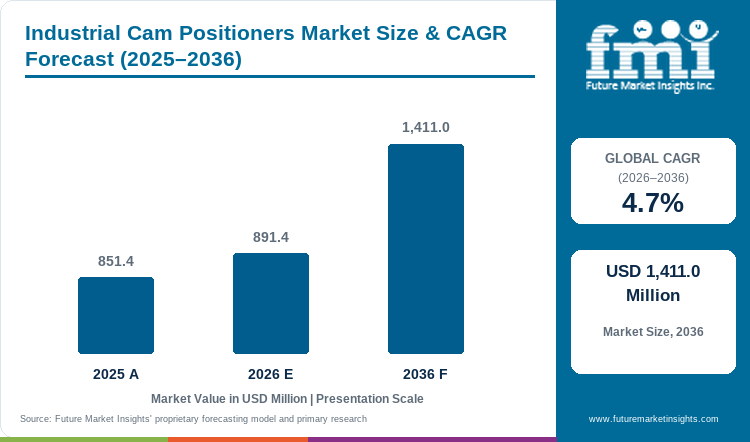
USD 891.4 million in 2026 and USD 1411.0 million by 2036 at a 4.7% CAGR.
The market was valued at USD 851.4 million in 2025. Demand is estimated at USD 891.4 million in 2026 and is projected to reach USD 1411.0 million by 2036 at 4.7% CAGR. The estimate covers mechanical cam-driven rotary and linear positioners, index drives and complete indexing tables used in industrial automation, including new units and major replacements. Servo rotary tables without a cam mechanism and robot workpiece positioners are excluded.
Cam positioners overlap with the industrial rotary table market, but this scope is limited to equipment whose indexed motion and dwell are generated by a mechanical cam profile. Revenue follows automation-machine builds, load class and indexing complexity.
Key Takeaways
- The market is valued at USD 891.4 million in 2026 and is projected to create USD 519.6 million in additional value by 2036.
- Rotary cam indexers is projected to hold 66.0% of Product Type demand in 2026 because circular multi-station machines are widely used in production automation.
- Globoidal cam drives is projected to hold 57.0% of Drive Architecture demand in 2026 because globoidal mechanisms combine precise indexing with robust mechanical dwell.
- 50 kg to 500 kg is projected to hold 45.0% of Load Class demand in 2026 because medium fixtures dominate repeat-index production equipment.
- A cam indexer is efficient for a fixed motion law, but late changes to station count, dwell or cycle timing can require mechanical redesign.
- Some of the key players in this market include DESTACO, Sankyo Seisakusho, WEISS, CDS Cam Driven Systems, Colombo Filippetti, TÜNKERS, Motion Index Drives, Hannz Motrol, SPINEA, Nabtesco.
Analyst Perspective
"Cam positioning converts a desired production rhythm into a mechanical motion law. Its advantage is repeatable dwell and shock control; its tradeoff is lower flexibility after the machine is built."
- Nikhil Kaitwade, Principal Consultant, Future Market Insights
How is the industrial cam positioners market segmented?
The industrial cam positioners market is segmented by product type, drive architecture, load class, application, end-use industry and region.
Product type separates rotary, oscillating and linear motion. Drive architecture defines the cam mechanism. Load class, application and end-use industry describe the machine duty and purchasing sector.
Why do rotary cam indexers lead product demand?
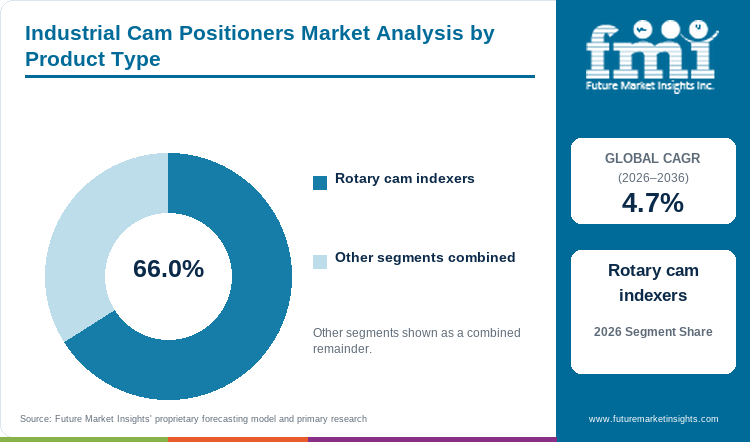
Rotary cam indexers fit machines that repeatedly move a workpiece from one fixed station to the next. The cam mechanism converts continuous input rotation into a defined sequence of acceleration, deceleration and dwell, so the machine designer can synchronize assembly or inspection operations mechanically. Sankyo describes indexing drives as alternating between dwell and index phases and notes their use in rotary automated machinery, while DESTACO highlights repeatable positioning and quick settling at the dwell point.
- Rotary cam indexers are estimated to account for 66.0% of product demand in 2026 because multi-station rotary machines use intermittent positioning across assembly, processing, packaging and inspection operations.
- Sankyo lists assembly machines, food filling and wrapping equipment, and inspection machinery among SANDEX applications. DESTACO's CAMCO range covers rotary dial machines from small electronics applications to heavy automotive indexing.
Why do globoidal cam drives lead architecture value?
The advantage of the globoidal or roller-gear architecture lies in how torque is transmitted. A globoidal cam remains in rolling contact with cam followers, producing high rigidity and eliminating the clearance that would otherwise reduce positioning accuracy under repeated loading. Sankyo states that SANDEX indexers combine a globoidal cam with cam followers and cites high speed, rigidity, output torque and zero backlash as operating advantages. This makes the architecture useful when the machine must arrive at a fixed station accurately and withstand process forces during dwell.
- Globoidal cam drives are estimated to account for 57.0% of architecture value in 2026 as machine builders use the mechanism where fixed-position indexing must combine mechanical rigidity with repeatable motion.
- Sankyo's SANDEX D Series uses a roller gear cam and cam followers, with selectable stop counts and several cam curves. That allows motion characteristics to be matched to station spacing, cycle time and load rather than relying on a single generic movement profile.
Why does the medium load class lead value demand?
The 50 kg to 500 kg range sits between lightweight component indexing and the specialized systems needed to rotate very large tooling or vehicle structures. Many rotary machines carry a table, fixtures and several workpieces at once, so indexer sizing is driven by the combined rotating inertia rather than part weight alone. Sankyo's own sizing process asks machine builders for table weight, tool weight, workpiece weight and pitch-circle dimensions before selecting a drive, showing why a broad middle load class captures many assembly and processing machines.
- The 50 kg to 500 kg class is estimated to account for 45.0% of load-class demand in 2026 because it covers a wide band of rotary dial machines carrying multiple fixtures and workpieces without moving into specialized heavy-transfer equipment.
- Supplier portfolios span compact indexing drives through units capable of moving several tons. DESTACO explicitly separates small pharmaceutical and electronics applications from large E-Series units used for automotive body parts, leaving a substantial middle range for mainstream production machinery.
Why does assembly and production automation lead?
Cam indexing becomes particularly useful when several operations have to occur in a fixed sequence around one machine. During dwell, a station can fasten, press, inspect or load a component while other workpieces remain locked at their respective stations. Sankyo's DA Series was developed specifically for rotary assembly chassis and provides synchronized shafts for processing units, allowing multiple operations to remain mechanically coordinated. DESTACO likewise lists assembly, part positioning, inspection and quality control among its automation applications.
- Assembly and production automation are estimated to account for 37.0% of application demand in 2026 because fixed-station machines can use the index-and-dwell cycle to coordinate several operations from one repeatable motion system.
- Sankyo cites electronic-component assembly, precision-component processing and medical-equipment assembly among SANDEX applications, while DESTACO positions rotary indexers directly within assembly automation.
Why do automotive and components lead end-use demand?
Automotive component production gives cam indexing systems a demanding combination of cycle repetition and tooling load. Dedicated machines may need to position fixtures for assembly, welding or inspection thousands of times with little accumulated positioning error. DESTACO states that its rotary indexers are used from small-component applications through automotive factories, and its larger systems can rotate several tons of automotive body parts. The same supplier also identifies automotive as a core market for rotary positioning equipment.
- Automotive and components are estimated to account for 32.0% of end-use demand in 2026 as dedicated component and body-production equipment combines high cycle counts with substantial fixture loads and repeat-position requirements.
- DESTACO lists automotive among the industries served by its automation portfolio, while Sankyo's published customer references include Toyota, Nissan and Honda, alongside manufacturers in electronics and other automated industries.
What are the drivers, restraints and opportunities in the Industrial Cam Positioners Market?
High-cycle automation drives demand, fixed motion profiles restrain late reconfiguration, and hybrid cam-servo machines create opportunity for controlled flexibility.
- Driver: Machine builders use cam indexers for repeatable high-cycle motion and stable dwell at process stations.
- Restraint: A fixed cam profile is less adaptable than direct servo motion when product timing or station layout changes.
- Opportunity: Servo-controlled input drives and condition monitoring can add flexibility without removing the cam's mechanical motion law.
Growth in the industrial automation market supports indexed assembly, packaging and processing machines. Cam positioners are selected where repeat cycles and dwell stability justify a dedicated motion mechanism.
Cam motion is engineered around a defined load, index angle, dwell and cycle rate. A product redesign can change inertia or station timing enough to require a different indexer. Machine builders therefore compare life-cycle volume against the flexibility of servo alternatives.
The factory automation and industrial controls market creates demand for connected drives, sensors and controls around mechanical positioners. Monitoring vibration, lubrication and cycle count can improve maintenance planning without changing the core cam mechanism.
Which country CAGRs are profiled in the Industrial Cam Positioners Market?
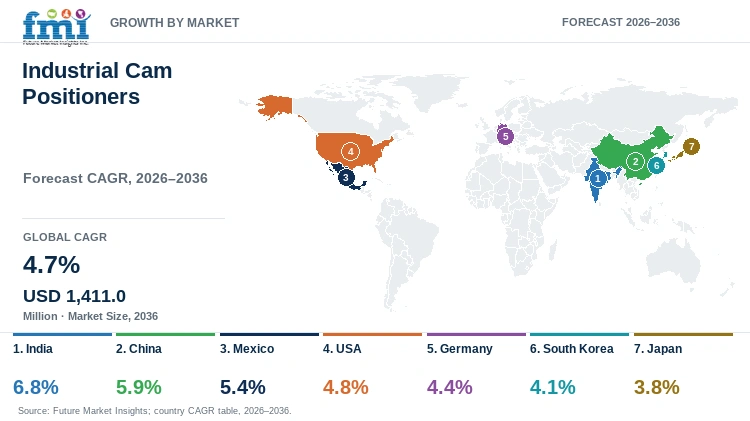
| Country | CAGR |
|---|---|
| India | 6.8% |
| China | 5.9% |
| Mexico | 5.4% |
| USA | 4.8% |
| Germany | 4.4% |
| South Korea | 4.1% |
| Japan | 3.8% |
How do country-level CAGRs compare in the Industrial Cam Positioners Market?
The country pattern follows where repetitive production machinery is being added and where mechanical indexing still offers a practical alternative to fully servo-driven motion. India and China have broader greenfield manufacturing exposure, while Mexico benefits from its vehicle-production base. The USA and Germany are more replacement- and machine-builder-led. South Korea and Japan lean toward compact systems where positioning accuracy and cycle repeatability matter more than sheer table size.
- India: Electronics and automotive investment is increasing the number of assembly lines that require repetitive positioning. Electronics production reached about ₹12 lakh crore in 2024-25, while automobile and auto-component PLI projects continue to add manufacturing capacity. Cam positioners can enter through locally built assembly fixtures, inspection stations and component machines even when the indexing drive itself is imported.
- China: The demand base extends across machine tools, automated assembly and high-volume component production. Equipment-manufacturing value added increased 9.2% in 2025, while industrial robot output rose 28.0%. Cam indexers therefore compete inside a rapidly expanding automation ecosystem where mechanical indexing remains useful for fixed-cycle machines even as servo and robotic alternatives become more common.
- Mexico: Automotive production provides a direct route into dedicated assembly and inspection machinery. Mexico produced about 4.0 million light vehicles in 2025, keeping a substantial installed base of component plants and production tooling in operation. For indexer vendors, local servicing and spare-part availability can be decisive because downtime on a dedicated transfer machine can stop an entire production cell.
- USA: The market is less dependent on new factory creation than on modernization of established production systems. U.S. Census Bureau data now separately track industrial robots and related capital expenditure in manufacturing plants, reflecting the depth of factory automation already in place. Cam positioners retain a role where fixed motion sequences and long production runs make mechanical indexing economical.
- Germany: Demand comes from machine builders that compete on engineered motion rather than low equipment cost. Industrial cam systems are relevant where machinery requires defined acceleration profiles and mechanically repeatable dwell positions. The commercial opportunity is therefore concentrated in higher-specification custom equipment rather than broad installation across every automation task.
- South Korea: Electronics and battery-related machinery create a different requirement profile from heavy transfer lines. Compact rotary systems can be used where fixtures move through rapid assembly or inspection sequences and floor space is constrained. Here, low backlash and fast settling are more commercially important than maximum load capacity.
- Japan: The country combines an established machinery industry with domestic expertise in cam indexing. METI continues to track machinery production and productive capacity through its Current Survey of Production. With suppliers such as Sankyo already serving this technology base, demand is shaped heavily by replacement, machine redesign and applications that continue to favor mechanical motion over servo substitution.
Across the key countries in this market, these rates measure revenue within the defined product boundary and do not represent growth of the wider parent industry.
Country-wise Analysis
- India, at 6.8% CAGR through 2036, has the strongest expansion profile in the country set. Manufacturing investment is widening the addressable base for indexed assembly equipment, particularly in electronics and automotive components. The commercial opening is often split between imported precision drives and locally fabricated tables, fixtures and machine structures, creating room for international indexer suppliers without requiring the entire automation system to be imported.
- China is projected at 5.9% CAGR through 2036. Its advantage comes from the density of domestic machinery production rather than one end-use sector. Equipment-manufacturing value added grew 9.2% in 2025, and industrial robot production increased 28.0%. Cam-positioner suppliers therefore compete inside a market with strong local automation capability, where documented accuracy and operating life become more important when Chinese-built machines are supplied to demanding export customers.
- Mexico follows at 5.4% CAGR through 2036. Nearly 4.0 million light vehicles were produced in the country during 2025, supporting a wide supplier network for components and production equipment. Indexer selection in this environment is influenced by serviceability because dedicated assembly machinery may remain in use for years after installation. A supplier that can support replacement parts and troubleshooting locally has an advantage beyond the initial equipment price.
- The USA records a 4.8% CAGR through 2036. The opportunity is centered on an already automated manufacturing base rather than first-time adoption. Cam-driven systems are most defensible in machines with stable products and repeated cycles, where mechanical motion can provide years of consistent indexing without requiring the flexibility of a programmable axis. Census tracking of robotic equipment also illustrates how extensively manufacturers already invest in automated production assets.
- Germany, at 4.4% CAGR, is a higher-specification market. Machine builders are more likely to evaluate the complete motion profile, including indexing time and dwell stability, before choosing an architecture. Cam positioners therefore compete less on simple table diameter or load rating and more on whether the motion law can be engineered into a reliable production machine with a predictable service life.
- South Korea reaches 4.1% CAGR through 2036. Electronics and advanced component machinery favor compact indexing systems capable of moving relatively small fixtures at high cycle rates. Suppliers serving this market need to control backlash and settling behavior because positioning error can become significant when automated inspection or precision assembly follows immediately after each index.
- Japan, at 3.8% CAGR through 2036, has a mature installed base and established domestic indexing technology. Growth therefore comes more from replacement and new machine generations than from first-time adoption. Suppliers differentiate through accuracy retention and mechanical rigidity as well as long operating life, particularly where an existing production process already relies on cam-based indexing.
Who are the notable companies in the Industrial Cam Positioners Market?
DESTACO, Sankyo Seisakusho, WEISS, CDS Cam Driven Systems, Colombo Filippetti, TÜNKERS, Motion Index Drives, Hannz Motrol, SPINEA, Nabtesco are the notable companies profiled in this market.
Direct competition is led by indexer manufacturers with documented cam mechanisms and machine-builder channels. Precision-gear suppliers are adjacent alternatives and remain Unscored because their products do not define a complete cam positioner.
- Direct Cam Indexer Specialists: DESTACO, Sankyo Seisakusho, CDS Cam Driven Systems, Colombo Filippetti, Motion Index Drives, Hannz Motrol.
- Automation Table and Transfer Platforms: WEISS, TÜNKERS.
- Adjacent Precision Positioning: SPINEA, Nabtesco.
Competitive Benchmarking: Industrial Cam Positioners Market
| Company | Direct Cam Evidence | Motion-Law Engineering | Global Support | Geographic Reach |
|---|---|---|---|---|
| DESTACO | High | High | High | Global |
| Sankyo Seisakusho | High | High | High | Global |
| WEISS | High | High | High | Global |
| CDS Cam Driven Systems | High | High | Medium | Europe, global |
| Colombo Filippetti | High | High | Medium | Europe, global |
| TÜNKERS | Medium | High | High | Global |
| Motion Index Drives | High | Medium | Medium | North America, export |
| Hannz Motrol | High | Medium | Medium | Asia, export |
| SPINEA | Unscored | High | High | Global |
| Nabtesco | Unscored | High | High | Global |
High direct evidence requires a named cam-driven indexer or positioner. Medium reflects rotary automation systems with narrower public cam detail. Unscored identifies precision positioning alternatives without a complete cam indexer.
Key Developments in the Industrial Cam Positioners Market
- In 2026, industrial automation investment continued to emphasize machine availability and connected maintenance, increasing demand for sensor-ready indexing platforms.
- In 2025, Sankyo continued to document SANDEX cam indexers across compact and production-machine configurations.
- In 2025, DESTACO continued to publish CAMCO rotary indexers for high-cycle automated assembly and manufacturing equipment.
Key Players in the Industrial Cam Positioners Market
Direct Cam Indexer Specialists
- DESTACO
- Sankyo Seisakusho
- CDS Cam Driven Systems
- Colombo Filippetti
- Motion Index Drives
- Hannz Motrol
Automation Table and Transfer Platforms
- WEISS
- TÜNKERS
Adjacent Precision Positioning
- SPINEA
- Nabtesco
Industrial Cam Positioners Market - Report Scope
| Coverage field | Report scope |
|---|---|
| Market Size | USD 891.4 million in 2026 and USD 1411.0 million by 2036 at 4.7% CAGR. |
| Market Definition | Mechanical cam-driven rotary, oscillating or linear equipment that moves a fixture or load through a defined index-and-dwell cycle in industrial machinery. |
| Segmentation | Product type, drive architecture, load class, application, end-use industry and region. |
| Regional Coverage | North America, Latin America, Western Europe, Eastern Europe, East Asia, South Asia and Pacific, and Middle East and Africa. |
| Countries Covered | India, China, Mexico, USA, Germany, South Korea, Japan and more than 20 countries included in the full report. |
| Key Companies Profiled | DESTACO, Sankyo Seisakusho, WEISS, CDS Cam Driven Systems, Colombo Filippetti, TÜNKERS, Motion Index Drives, Hannz Motrol, SPINEA, Nabtesco. |
| Forecast Period | 2026 to 2036. |
| Approach | Bottom-up model using automation-machine production, cam-indexer attachment rates, load and architecture mix, replacement cycles and regional machine-builder activity. |
Industrial Cam Positioners Market - Research Methodology
| Method | Approach |
|---|---|
| Primary Research | FMI analysts gathered input from manufacturers, system integrators, distributors, plant engineers, procurement teams and application specialists. Interviews tested purchasing criteria, replacement cycles, qualification work and technical-service requirements. |
| Desk Research | Desk research covered government statistics, standards, industry associations, technical literature, patents, official product information and corporate announcements. Evidence was screened for scope, date and direct relevance. |
| Market Sizing and Forecasting | Bottom-up model using automation-machine production, cam-indexer attachment rates, load and architecture mix, replacement cycles and regional machine-builder activity. |
| Data Validation | Estimates were checked against parent-market activity, installed-base indicators, product specifications and supplier participation. Adjacent products without the defined function were excluded. |
Industrial Cam Positioners Market by Segments
Industrial Cam Positioners Market segmented by Product Type:
- Rotary cam indexers
- Oscillating cam positioners
- Linear indexing drives
- Custom cam handling systems
Industrial Cam Positioners Market segmented by Drive Architecture:
- Globoidal cam drives
- Parallel and barrel cam drives
- Roller gear cam drives
- Custom conjugate cam systems
Industrial Cam Positioners Market segmented by Load Class:
- Below 50 kg
- 50 kg to 500 kg
- Above 500 kg to 2,000 kg
- Above 2,000 kg
Industrial Cam Positioners Market segmented by Application:
- Assembly and production automation
- Packaging and filling
- Machining and metalworking
- Inspection and testing
- Other material handling
Industrial Cam Positioners Market segmented by End-use Industry:
- Automotive and components
- Packaging and consumer goods
- Electronics and electrical
- Medical devices
- General industrial machinery
Industrial Cam Positioners Market by Region:
- North America
- United States
- Canada
- Latin America
- Brazil
- Mexico
- Argentina
- Chile
- Western Europe
- Germany
- France
- United Kingdom
- Italy
- Spain
- Benelux
- Nordics
- Eastern Europe
- Poland
- Czech Republic
- Romania
- Hungary
- East Asia
- China
- Japan
- South Korea
- South Asia and Pacific
- India
- ASEAN
- Australia and New Zealand
- Middle East and Africa
- GCC Countries
- South Africa
- Türkiye
- Israel
Research Sources and Bibliography
- United Nations Industrial Development Organization. (2025). World manufacturing production statistics.
- United States Census Bureau. (2025). Manufacturing machinery shipment resources.
- DESTACO. (n.d.; accessed September 23, 2026). CAMCO rotary indexers.
- Sankyo Seisakusho. (n.d.; accessed September 23, 2026). SANDEX cam indexers.
- WEISS. (n.d.; accessed September 23, 2026). Rotary indexing tables.
- CDS Cam Driven Systems. (n.d.; accessed September 23, 2026). Cam-driven motion products.
- International Organization for Standardization. (2010). ISO 12100 machinery safety principles.
- Future Market Insights. (2026). Industrial Rotary Table Market.
This bibliography is provided for reader reference and is not exhaustive. The full report contains the complete reference list and detailed citations.
This Report Answers
- How large is the industrial cam positioners market in 2026 and 2036?
- Which product specification leads demand in 2026?
- What operating condition converts technical need into a purchase?
- Which constraint can delay qualification or replacement?
- How do country growth rates compare across the profiled markets?
- Which companies provide direct or adjacent market capability?
Frequently Asked Questions
How big is the industrial cam positioners market in 2026?
The industrial cam positioners market is valued at USD 891.4 million in 2026 and is projected to reach USD 1411.0 million by 2036. The estimate covers revenue within the stated market definition and excludes adjacent equipment or chemicals sold without the required function.
What is the CAGR of the industrial cam positioners market from 2026 to 2036?
The market is projected to grow at 4.7% CAGR between 2026 and 2036. Expansion depends on end-market output together with the rate at which plants adopt higher-specification products.
Which product type leads the industrial cam positioners market?
Rotary cam indexers is expected to hold 66.0% share in 2026 because circular multi-station machines are widely used in production automation. Rotary architectures provide compact station-to-station transfer.
Which countries are projected to record higher growth?
India is projected at 6.8% CAGR, followed by China at 5.9% and Mexico at 5.4% through 2036. The comparison reflects local production investment and the timing of replacement or qualification cycles.
Which companies are active in the industrial cam positioners market?
The profiled group includes DESTACO, Sankyo Seisakusho, WEISS, CDS Cam Driven Systems, Colombo Filippetti, TÜNKERS, Motion Index Drives, Hannz Motrol, SPINEA, Nabtesco. Capability differs by product range and application evidence.
Preview the report firsthand - request a free sample
Get SampleGet the brochure for pricing and purchase details.
Get PDFTable of Content
- Key Takeaways
- Market Size and CAGR
- Top Growth Driver
- Fastest Growing Segment
- Leading Region
- Key Companies
- Emerging Opportunities
- Executive Summary
- Global Market Outlook
- Demand-side Trends
- Supply-side Trends
- Technology Roadmap Analysis
- Analysis and Recommendations
- Analyst Perspective (What is happening? Why now? What should investors know?)
- Key Questions Answered
- How large is the market?
- What is the CAGR?
- What are key trends?
- Which region dominates?
- Who are the leaders?
- Market Overview
- Market Coverage / Taxonomy
- Market Definition / Scope / Limitations
- Research Methodology
- Chapter Orientation
- Analytical Lens and Working Hypotheses
- Market Structure, Signals, and Trend Drivers
- Benchmarking and Cross-market Comparability
- Market Sizing, Forecasting, and Opportunity Mapping
- Research Design and Evidence Framework
- Desk Research Programme (Secondary Evidence)
- Expert Input and Fieldwork (Primary Evidence)
- Tooling, Models, and Reference Databases
- Data Engineering and Model Build
- Quality Assurance and Audit Trail
- Market Background
- Market Dynamics (Drivers, Restraints, Opportunity, Trends)
- Scenario Forecast (Optimistic, Likely, Conservative)
- Impact Analysis
- AI Impact
- Sustainability Impact
- Regulatory Impact
- Technology Impact
- Consumer / Buyer Analysis
- Purchase Drivers
- Adoption Barriers
- Buyer Journey
- Opportunity Map Analysis
- Product Life Cycle Analysis
- Supply Chain Analysis
- Investment Feasibility Matrix
- Value Chain Analysis
- PESTLE and Porter's Analysis
- Regulatory Landscape
- Regional Parent Market Outlook
- Production and Consumption Statistics
- Import and Export Statistics
- Global Market Analysis and Forecast, 2021 to 2036
- Historical Market Size Value (USD Million) Analysis, 2021 to 2025
- Current and Future Market Size Value (USD Million) Projections, 2026 to 2036
- Y-o-Y Growth Trend Analysis
- Absolute $ Opportunity Analysis
- Global Market Pricing Analysis, 2021 to 2036
- Global Market Analysis and Forecast, By Product Type, 2021 to 2036
- Introduction / Key Findings
- Historical Market Size Value (USD Million) Analysis By Product Type, 2021 to 2025
- Current and Future Market Size Value (USD Million) Analysis and Forecast By Product Type, 2026 to 2036
- Rotary cam indexers
- Oscillating cam positioners
- Linear indexing drives
- Custom cam handling systems
- Y-o-Y Growth Trend Analysis By Product Type, 2021 to 2025
- Absolute $ Opportunity Analysis By Product Type, 2026 to 2036
- Global Market Analysis and Forecast, By Drive Architecture, 2021 to 2036
- Introduction / Key Findings
- Historical Market Size Value (USD Million) Analysis By Drive Architecture, 2021 to 2025
- Current and Future Market Size Value (USD Million) Analysis and Forecast By Drive Architecture, 2026 to 2036
- Globoidal cam drives
- Parallel and barrel cam drives
- Roller gear cam drives
- Custom conjugate cam systems
- Y-o-Y Growth Trend Analysis By Drive Architecture, 2021 to 2025
- Absolute $ Opportunity Analysis By Drive Architecture, 2026 to 2036
- Global Market Analysis and Forecast, By Load Class, 2021 to 2036
- Introduction / Key Findings
- Historical Market Size Value (USD Million) Analysis By Load Class, 2021 to 2025
- Current and Future Market Size Value (USD Million) Analysis and Forecast By Load Class, 2026 to 2036
- Below 50 kg
- 50 kg to 500 kg
- Above 500 kg to 2,000 kg
- Above 2,000 kg
- Y-o-Y Growth Trend Analysis By Load Class, 2021 to 2025
- Absolute $ Opportunity Analysis By Load Class, 2026 to 2036
- Global Market Analysis and Forecast, By Application, 2021 to 2036
- Introduction / Key Findings
- Historical Market Size Value (USD Million) Analysis By Application, 2021 to 2025
- Current and Future Market Size Value (USD Million) Analysis and Forecast By Application, 2026 to 2036
- Assembly and production automation
- Packaging and filling
- Machining and metalworking
- Inspection and testing
- Other material handling
- Y-o-Y Growth Trend Analysis By Application, 2021 to 2025
- Absolute $ Opportunity Analysis By Application, 2026 to 2036
- Global Market Analysis and Forecast, By End-use Industry, 2021 to 2036
- Introduction / Key Findings
- Historical Market Size Value (USD Million) Analysis By End-use Industry, 2021 to 2025
- Current and Future Market Size Value (USD Million) Analysis and Forecast By End-use Industry, 2026 to 2036
- Automotive and components
- Packaging and consumer goods
- Electronics and electrical
- Medical devices
- General industrial machinery
- Y-o-Y Growth Trend Analysis By End-use Industry, 2021 to 2025
- Absolute $ Opportunity Analysis By End-use Industry, 2026 to 2036
- Global Market Analysis and Forecast, By Region, 2021 to 2036
- Introduction
- Historical Market Size Value (USD Million) Analysis By Region, 2021 to 2025
- Current Market Size Value (USD Million) Analysis and Forecast By Region, 2026 to 2036
- North America
- Latin America
- Western Europe
- Eastern Europe
- East Asia
- South Asia and Pacific
- Middle East and Africa
- Market Attractiveness Analysis By Region
- North America Market Analysis and Forecast, By Country, 2021 to 2036
- Historical Market Size Value (USD Million) Trend Analysis By Market Taxonomy, 2021 to 2025
- Market Size Value (USD Million) Forecast By Market Taxonomy, 2026 to 2036
- By Country
- United States
- Canada
- By Product Type
- By Drive Architecture
- By Load Class
- By Application
- By End-use Industry
- By Country
- Market Attractiveness Analysis
- By Country
- By Product Type
- By Drive Architecture
- By Load Class
- By Application
- By End-use Industry
- Key Takeaways
- Latin America Market Analysis and Forecast, By Country
- Historical Market Size Value (USD Million) Trend Analysis By Market Taxonomy, 2021 to 2025
- Market Size Value (USD Million) Forecast By Market Taxonomy, 2026 to 2036
- By Country
- Brazil
- Mexico
- Argentina
- Chile
- By Product Type
- By Drive Architecture
- By Load Class
- By Application
- By End-use Industry
- By Country
- Market Attractiveness Analysis
- By Country
- By Product Type
- By Drive Architecture
- By Load Class
- By Application
- By End-use Industry
- Key Takeaways
- Western Europe Market Analysis and Forecast, By Country
- Historical Market Size Value (USD Million) Trend Analysis By Market Taxonomy, 2021 to 2025
- Market Size Value (USD Million) Forecast By Market Taxonomy, 2026 to 2036
- By Country
- Germany
- France
- United Kingdom
- Italy
- Spain
- Benelux
- Nordics
- By Product Type
- By Drive Architecture
- By Load Class
- By Application
- By End-use Industry
- By Country
- Market Attractiveness Analysis
- By Country
- By Product Type
- By Drive Architecture
- By Load Class
- By Application
- By End-use Industry
- Key Takeaways
- Eastern Europe Market Analysis and Forecast, By Country
- Historical Market Size Value (USD Million) Trend Analysis By Market Taxonomy, 2021 to 2025
- Market Size Value (USD Million) Forecast By Market Taxonomy, 2026 to 2036
- By Country
- Poland
- Czech Republic
- Romania
- Hungary
- By Product Type
- By Drive Architecture
- By Load Class
- By Application
- By End-use Industry
- By Country
- Market Attractiveness Analysis
- By Country
- By Product Type
- By Drive Architecture
- By Load Class
- By Application
- By End-use Industry
- Key Takeaways
- East Asia Market Analysis and Forecast, By Country
- Historical Market Size Value (USD Million) Trend Analysis By Market Taxonomy, 2021 to 2025
- Market Size Value (USD Million) Forecast By Market Taxonomy, 2026 to 2036
- By Country
- China
- Japan
- South Korea
- By Product Type
- By Drive Architecture
- By Load Class
- By Application
- By End-use Industry
- By Country
- Market Attractiveness Analysis
- By Country
- By Product Type
- By Drive Architecture
- By Load Class
- By Application
- By End-use Industry
- Key Takeaways
- South Asia and Pacific Market Analysis and Forecast, By Country
- Historical Market Size Value (USD Million) Trend Analysis By Market Taxonomy, 2021 to 2025
- Market Size Value (USD Million) Forecast By Market Taxonomy, 2026 to 2036
- By Country
- India
- ASEAN
- Australia and New Zealand
- By Product Type
- By Drive Architecture
- By Load Class
- By Application
- By End-use Industry
- By Country
- Market Attractiveness Analysis
- By Country
- By Product Type
- By Drive Architecture
- By Load Class
- By Application
- By End-use Industry
- Key Takeaways
- Middle East and Africa Market Analysis and Forecast, By Country
- Historical Market Size Value (USD Million) Trend Analysis By Market Taxonomy, 2021 to 2025
- Market Size Value (USD Million) Forecast By Market Taxonomy, 2026 to 2036
- By Country
- GCC Countries
- South Africa
- Türkiye
- Israel
- By Product Type
- By Drive Architecture
- By Load Class
- By Application
- By End-use Industry
- By Country
- Market Attractiveness Analysis
- By Country
- By Product Type
- By Drive Architecture
- By Load Class
- By Application
- By End-use Industry
- Key Takeaways
- Key Countries Market Analysis
- United States
- Pricing Analysis
- Market Share Analysis, 2025
- By Product Type
- By Drive Architecture
- By Load Class
- By Application
- By End-use Industry
- Canada
- Pricing Analysis
- Market Share Analysis, 2025
- By Product Type
- By Drive Architecture
- By Load Class
- By Application
- By End-use Industry
- Mexico
- Pricing Analysis
- Market Share Analysis, 2025
- By Product Type
- By Drive Architecture
- By Load Class
- By Application
- By End-use Industry
- Brazil
- Pricing Analysis
- Market Share Analysis, 2025
- By Product Type
- By Drive Architecture
- By Load Class
- By Application
- By End-use Industry
- Chile
- Pricing Analysis
- Market Share Analysis, 2025
- By Product Type
- By Drive Architecture
- By Load Class
- By Application
- By End-use Industry
- Germany
- Pricing Analysis
- Market Share Analysis, 2025
- By Product Type
- By Drive Architecture
- By Load Class
- By Application
- By End-use Industry
- United Kingdom
- Pricing Analysis
- Market Share Analysis, 2025
- By Product Type
- By Drive Architecture
- By Load Class
- By Application
- By End-use Industry
- Italy
- Pricing Analysis
- Market Share Analysis, 2025
- By Product Type
- By Drive Architecture
- By Load Class
- By Application
- By End-use Industry
- Spain
- Pricing Analysis
- Market Share Analysis, 2025
- By Product Type
- By Drive Architecture
- By Load Class
- By Application
- By End-use Industry
- France
- Pricing Analysis
- Market Share Analysis, 2025
- By Product Type
- By Drive Architecture
- By Load Class
- By Application
- By End-use Industry
- India
- Pricing Analysis
- Market Share Analysis, 2025
- By Product Type
- By Drive Architecture
- By Load Class
- By Application
- By End-use Industry
- ASEAN
- Pricing Analysis
- Market Share Analysis, 2025
- By Product Type
- By Drive Architecture
- By Load Class
- By Application
- By End-use Industry
- Australia and New Zealand
- Pricing Analysis
- Market Share Analysis, 2025
- By Product Type
- By Drive Architecture
- By Load Class
- By Application
- By End-use Industry
- China
- Pricing Analysis
- Market Share Analysis, 2025
- By Product Type
- By Drive Architecture
- By Load Class
- By Application
- By End-use Industry
- Japan
- Pricing Analysis
- Market Share Analysis, 2025
- By Product Type
- By Drive Architecture
- By Load Class
- By Application
- By End-use Industry
- South Korea
- Pricing Analysis
- Market Share Analysis, 2025
- By Product Type
- By Drive Architecture
- By Load Class
- By Application
- By End-use Industry
- Poland
- Pricing Analysis
- Market Share Analysis, 2025
- By Product Type
- By Drive Architecture
- By Load Class
- By Application
- By End-use Industry
- Hungary
- Pricing Analysis
- Market Share Analysis, 2025
- By Product Type
- By Drive Architecture
- By Load Class
- By Application
- By End-use Industry
- Türkiye
- Pricing Analysis
- Market Share Analysis, 2025
- By Product Type
- By Drive Architecture
- By Load Class
- By Application
- By End-use Industry
- South Africa
- Pricing Analysis
- Market Share Analysis, 2025
- By Product Type
- By Drive Architecture
- By Load Class
- By Application
- By End-use Industry
- United States
- Market Structure Analysis
- Competition Dashboard
- Competition Benchmarking
- Market Share Analysis of Top Players
- By Regional
- By Product Type
- By Drive Architecture
- By Load Class
- By Application
- By End-use Industry
- Emerging Startups
- Innovation Benchmarking
- Competition Analysis
- Competition Deep Dive
- DESTACO
- Overview
- Product Portfolio
- Profitability by Market Segments
- Sales Footprint
- Strategy Overview
- Marketing Strategy
- Product Strategy
- Channel Strategy
- Sankyo Seisakusho
- WEISS
- CDS Cam Driven Systems
- Colombo Filippetti
- TÜNKERS
- Motion Index Drives
- Hannz Motrol
- SPINEA
- Nabtesco
- DESTACO
- Case Studies
- Success Stories
- Recent Developments
- Competition Deep Dive
- Assumptions & Acronyms Used


