

- Market Size (2026)
- USD 96.0 Mn
- Forecast (2036)
- USD 594.0 Mn
- CAGR (2026 to 2036)
- 20.0%
How big is the Robotic Live-Fire Training Targets Market size?
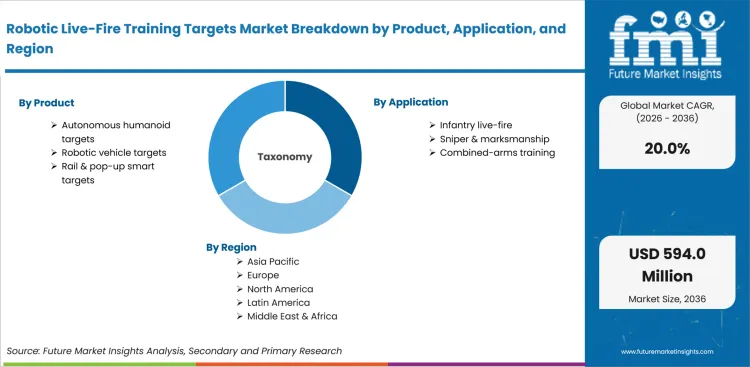
USD 96.0 million in 2026 and USD 594.0 million by 2036 at a 20.0% CAGR.
Sales of robotic live-fire training targets are estimated to rise at 20.0% CAGR through 2036, increasing valuation from USD 96.0 million in 2026 to USD 594.0 million between 2026 and 2036. Military ranges require continuous updates so soldiers can practice against moving threats safely and also since creating realistic field scenarios remains difficult. Autonomous target platforms help solve challenges by mimicking real combat behavior. Department of the Army reported in March 2024 noting 22 Combat Training Center rotations funded in FY 2025 requests. Frequent training rotations helps readiness programs require repeatable target setups and clear range control.
Training upgrades take different shapes depending on regional military priorities. United States and Australia programs focus heavily on range modernization and steady target movement. European nations weigh allied exercise intensity and interoperability records before expanding target services. Spending on vehicle and aircraft simulations also helps combine live-fire training with virtual environments. NATO reported in May 2024 stating Steadfast Defender 24 involved more than 50 ships, more than 80 aircraft, and 1,100 combat vehicles from all 32 Allies. Prominent multinational exercises highlight how crucial interoperable target systems remain for complex live-fire preparation worldwide.
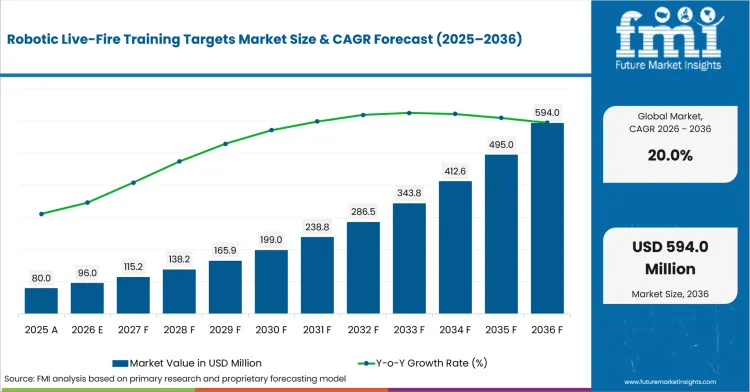
Key Takeaways of Robotic Live-Fire Training Targets Market
- Demand for robotic live-fire training targets is driven by defence and public safety trainers seeking realistic moving targets without placing personnel downrange, with account decisions reflecting range safety proof and service response.
- By component, hardware is expected to lead with 58.0% share in 2026, led by physical target units and movement mechanisms.
- Autonomous humanoid targets are the dominant product segment, projected to hold 56.0% share in 2026, driven by realistic human-form movement and hit reaction needs.
- Infantry live-fire is estimated to lead the application category with 52.0% share in 2026, reflecting basic combat training needs for moving threat scenarios.
- Hit detection accuracy and maintenance responsiveness remain critical to supplier evaluation, as range service teams seek providers that reduce downtime during target replacement.
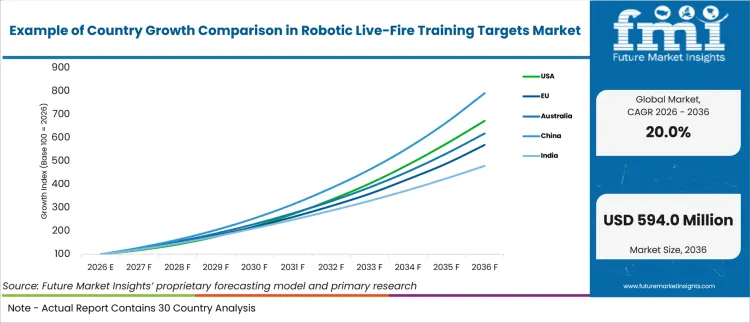
- The United States, Australia, and the European Union are expected to form the higher-growth country tier, advancing at 21.0%, 20.0%, and 19.0% CAGR respectively through 2036, supported by training-range scale, combined exercises, and allied readiness activity.
- Competition centers on Marathon Targets, MVP Robotics, InVeris Training Solutions, Caswell Live Fire, QinetiQ Target Systems, and Theissen Training Systems, with vendors differentiating through autonomous humanoid target depth, live-fire range systems, and service coverage.
Analyst Perspective
"Growth in the robotic live-fire training targets market will be influenced by how well vendors support long-term training readiness rather than one-time equipment sales. Reliable target movement, straightforward maintenance, software upgrades, and instructor enablement all contribute to sustained program success. Organizations increasingly value partners that remain engaged throughout the equipment lifecycle."
- Nikhil Kaitwade, Principal Consultant for Industrial Automation at Future Market Insights
Source: Future Market Insights analysis, 2026.
How is Robotic Live-Fire Training Targets Market segmented?
The robotic live-fire training targets industry is segmented by product, application, component, end user, business model and region.
The robotic live-fire training targets sector covers six parent segments. Product coverage includes autonomous humanoid targets alongside robotic vehicle targets and rail or pop-up smart targets. Application coverage includes infantry live-fire, sniper and marksmanship, and combined-arms training. Component coverage includes hardware, scenario software and services. End-user coverage includes armies, special forces, and police or training centers. Business model coverage includes training-as-a-service, direct sale and rental. Regional coverage includes North America and Latin America. Coverage also includes Europe, East Asia, South Asia, Oceania and Middle East and Africa.
How does hardware guide component demand?
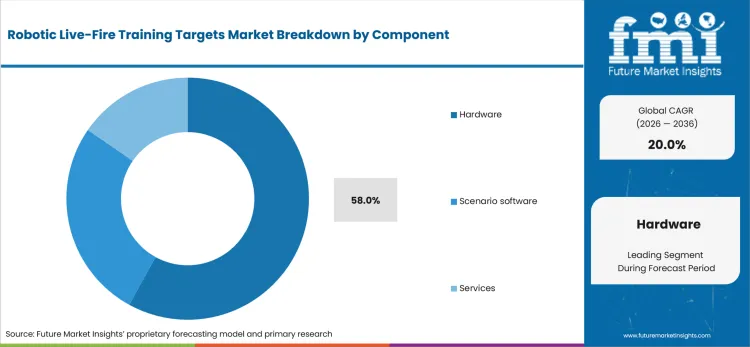
Hardware is anticipated to lead component adoption as live-fire target programs require armored bodies and range-control interfaces. Training teams value units influencing repeated strikes and predictable maintenance routines after field use. Doodle Labs reported on May 16, 2024 stating HEKTR could exceed 20 mph, reflecting mobile-target designs requiring human-like motion and real-time training assessment.
- In 2026, hardware is projected to account for 58.0% share due to target bodies and movement mechanisms. Range teams prefer hardware-backed systems after sensor response and replacement timing are documented.
- Scenario software and services support training scoring and after-action review. Hardware retains selection strength after field teams need physical target performance before adding software-driven training layers.
How do autonomous humanoid targets shape product purchasing?
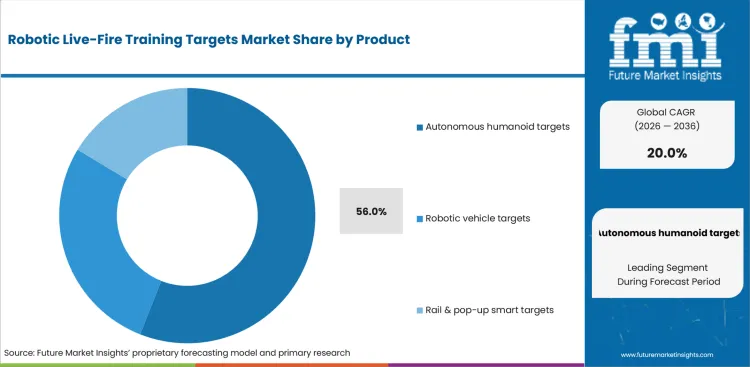
United States Secret Service reported in August 2025 noting autonomous robotic targets could reach up to 11 mph, promoting realistic target movement for trainees using live ammunition. Autonomous humanoid targets are estimated to guide product purchasing as infantry and public safety training need moving human-form targets. Buyers value platforms able to create movement uncertainty and safer live-fire exposure.
- Autonomous humanoid targets are forecast to hold 56.0% share in 2026, helped by realistic movement and human-form threat presentation. Buyers prefer humanoid platforms after reaction behavior and field-service evidence are documented.
- Robotic vehicle targets and rail or pop-up smart targets support vehicle-threat training and conventional range upgrades. Humanoid formats retain selection strength after instructors need target behavior closer to live opponent movement.
Why does infantry live-fire influence application demand?
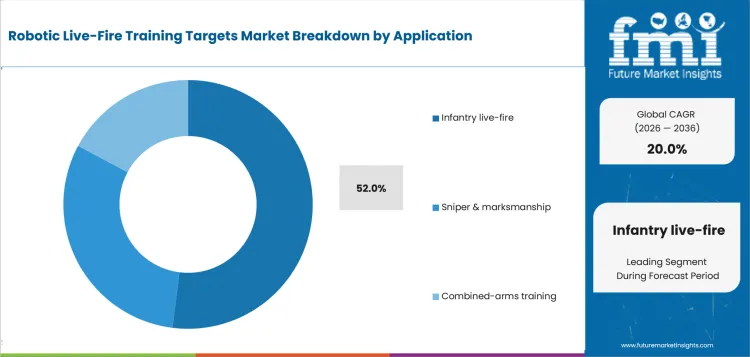
Infantry live-fire is expected to support application demand as squads require moving target exposure during close-range and open-range drills. Trainers assess target movement and scenario reset time before repeated deployment. USA Army reported in September 2025 stating Fort McCoy had over 30 live-fire ranges, highlighting range scale connected with stationary and moving target training needs.
- Infantry live-fire is estimated to secure 52.0% share of application in 2026, backed by recurring soldier qualification and squad training needs. Providers gain review strength after target systems show repeatable movement during range exercises.
- Sniper and marksmanship training and combined-arms training generate sustained demand for advanced moving target systems. Application review is expected to improve after buyers compare hit detection and scenario realism.
How do armies support end-user demand?
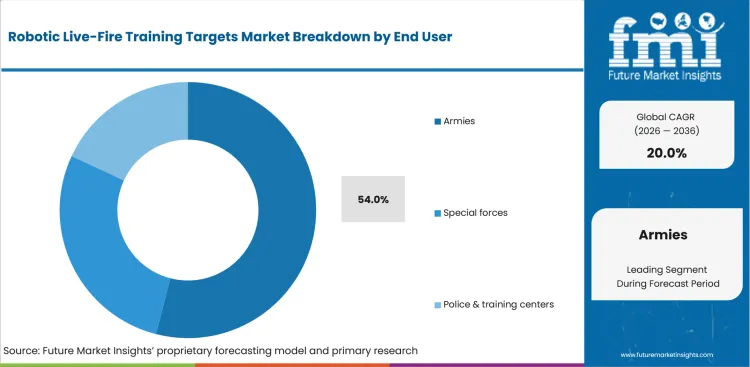
Department of the Army reported on March 11, 2024 stating the FY 2025 request supported a Regular Army end strength of 442,300 soldiers, indicating a large training population needing qualification and readiness activity. Armies are anticipated to support end-user requirement as active force readiness depends on repeated live-fire training under controlled safety rules. Program teams prefer systems connecting realistic threat movement with range-command oversight.
- Based on end-user, armies are projected to account for 54.0% share in 2026 owing to recurring qualification and combat readiness programs. Military buyers prefer providers able to support range uptime and training records.
- Special forces and police training centers require advanced scenarios for close-quarter drills and tactical response. Army accounts retain selection strength after live-fire training connects platform reliability with instructor control.
How does training-as-a-service support business model demand?
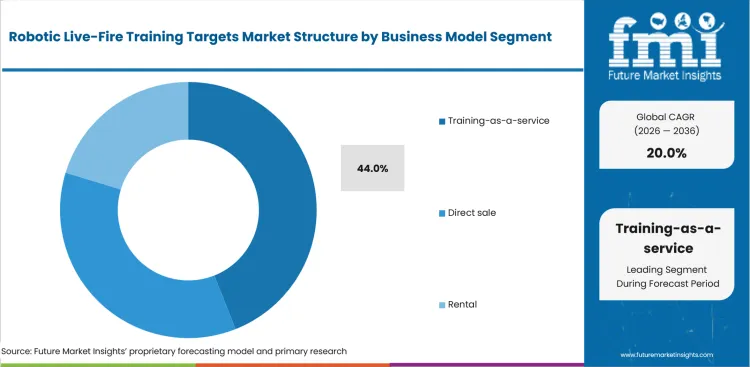
Training-as-a-service is expected to support business model demand as buyers seek operated systems without full ownership burden. Range teams value short deployment windows and predictable service support for temporary events. Marathon Targets released Training as a Service in 2025 noting its training-as-a-service workforce consisted of over 95% veterans, indicating service-led operating support for scenario execution.
- By business model, training-as-a-service is anticipated to capture 44.0% share in 2026 since short-term training influences demand and operator-led execution. Buyers prefer service models after scenario quality and equipment uptime are proven.
- Direct sale and rental models remain useful for permanent ranges and event-specific exercises. Training-as-a-service gains preference after buyers need live-fire realism without taking full maintenance responsibility.
What are drivers, restraints, and opportunities in robotic live-fire training targets market?
Buyer decisions reflect safer live-fire training needs as range integration and service readiness gaps slow approval.
- Driver: Range operators are replacing static target arrangements with robotic systems designed to improve movement realism and reduce staff exposure during live-fire training.
- Restraint: Adoption slows if target protection and scenario control remain unclear during equipment approval. Maintenance access and service files also affect review timing.
- Opportunity: Companies offering operated target services and instructor support improve approval chances across law enforcement and training-center accounts.
Modern live-fire ranges create a continuous need for moving targets used across convoy and squad scenarios. training teams prefer target systems recreating route exposure and squad reaction pressure without placing staff inside firing lanes. Army SBIR reported in May 2025 stating Trackless Moving Targets were available in 2 representations, influencing infantry and vehicle training needs connected with marksmanship modernization.
Securing new programs remains difficult after moving-target designs fail to match range geometry and safety requirements. Range planners need early layout proof before target tracks and safety zones move into approval review. USA Army Engineering and Support Center reported in January 2025 stating Moving Infantry Target emplacements use track lengths of 15 m and 40 m, highlighting design constraints affecting installation approval and service planning.
Expansion avenues are expected to improve as older range assets are upgraded with automated targetry and scenario control. Modernization projects strengthen adoption prospects after automated targets shorten reset cycles and improve instructor control. USA Army reported in June 2025 claiming a USD 5.6 million Multipurpose Range Complex modernization included a fully automated targetry system, attracting buyer attention around realistic and customizable training scenarios.
What country CAGRs are profiled in Robotic Live-Fire Training Targets Market?
| Country | CAGR |
|---|---|
| United States | 21.0% |
| Australia | 20.0% |
| European Union | 19.0% |
Source: Future Market Insights analysis, 2026.
How do country-level CAGRs compare in the Robotic Live-Fire Training Targets Market?
The country comparison spans 2.0 percentage points and reflects a closely grouped growth outlook across the robotic live-fire training targets market. The United States, Australia and the European Union all fall within a narrow 2.0-point range, indicating broadly similar momentum in adopting advanced training technologies. Growth is shaped by military modernization, improvements in combat readiness and greater use of realistic, technology-enabled live-fire exercises.
-
The United States leads the comparison with a CAGR of 21.0%. Defense organizations are expanding the use of robotic live-fire targets that simulate moving threats, improve training realism and provide repeatable performance during firearms qualification and tactical exercises.
-
Australia follows 1.0 percentage point behind the United States at 20.0%. Investment reflects continued modernization of military training ranges and increasing interest in automated target systems that enhance force preparedness while reducing manual range operations.
-
The European Union records a CAGR of 19.0%, remaining 1.0 percentage point below Australia. Demand is associated with defense training modernization and the adoption of programmable target systems that support more realistic battlefield scenarios across member states. Implementation levels vary because military procurement priorities and training requirements differ among individual countries.
Comparable CAGRs can still produce different market entry conditions. Differences in defense training doctrine, military modernization programs, range infrastructure and investment priorities influence deployment timelines and long-term commercial opportunities. The full report provides country-level CAGR analysis across North America, Latin America, Europe, East Asia, South Asia, Oceania and the Middle East and Africa.
Country-wise Analysis
Robotic live-fire training targets demand is expected to be guided by force readiness priorities and live-fire range modernization. Service access also shapes company selection. European accounts are expected to connect adoption with allied interoperability and training standardization. Australia and United States buyers are anticipated to influence sales with large exercises and operator-led training support.
- Local fielding depth supports buyer confidence as mobile targets move from testing into repeat training use. Industry in the United States is projected to rise at 21.0% CAGR by 2036, guided by range uptime and target service continuity across recurring readiness programs. Army SBIR reported in May 2025 stating Trackless Moving Targets initial fielding support covered 9 installations, strengthening local adoption through planned Army and National Guard deployment.
- Sector in Australia is expected to record 20.0% CAGR between 2026 and 2036, backed by combined training activity and range-service requirements. Large joint exercises create practical need for movable targets able to support repeated scenario resets across field training events. Australian Defence reported in August 2025 stating Exercise Talisman Sabre 2025 involved more than 40,000 military personnel, influencing large exercise settings needing advanced range scenarios.
- NATO reported in April 2025 stating Steadfast Defender 2024 deployed over 90,000 troops, strengthening demand signals for interoperable target services and live-fire readiness systems. Allied exercise scale raises the need for target services supporting shared training procedures across partner forces. Sales in the European Union are set to rise at 19.0% CAGR during the study period, driven by allied readiness programs and multi-country training requirements.
Who are notable companies in Robotic Live-Fire Training Targets Market?
Marathon Targets and MVP Robotics Inc. are expected to shape autonomous humanoid target competition. InVeris Training Solutions and Caswell Live Fire add live-fire range system depth. QinetiQ Target Systems and Theissen Training Systems support target services and range equipment coverage. General Dynamics Mission Systems and Pratt Miller Defense add USA targetry program support through Army training-system exposure.
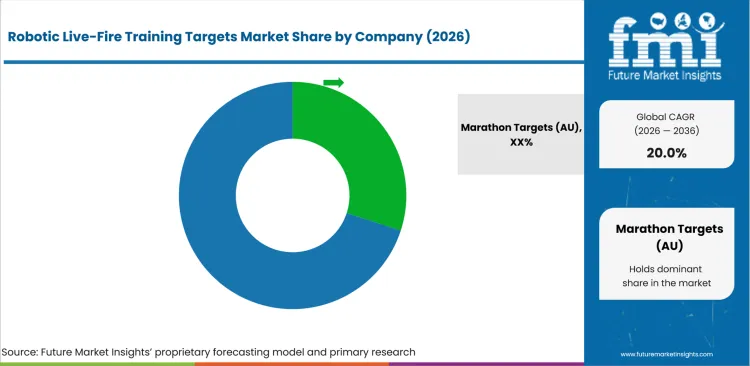
Competition in robotic live-fire training targets is anticipated to center on sensor accuracy and range safety. Scenario control and field service response guide final provider review. Account teams are likely to compare companies based on proof files and support for repeated training programs after first approval. Marathon Targets is expected to receive review attention due to autonomous robotic target depth. MVP Robotics Inc. is anticipated to add humanoid target mobility. InVeris Training Solutions and Caswell Live Fire are projected to compete driven by live-fire range systems. QinetiQ Target Systems is estimated to compete based on uncrewed target services. Theissen Training Systems is forecast to promote account demand due to infantry targets and range equipment. General Dynamics Mission Systems and Pratt Miller Defense are likely to add program-linked targetry experience.
- Marathon Targets and MVP Robotics Inc. gain account attention based on humanoid robotic target capabilities. Live-fire movement experience promotes programs needing realistic target behavior and rapid scenario reset.
- InVeris Training Solutions and Caswell Live Fire compete through live-fire range equipment and targetry portfolios. Service depth improves account review as buyers assess system continuity and safety records.
- QinetiQ Target Systems and Theissen Training Systems support demand due to target services and range systems. Training teams compare operator support and range integration before provider approval.
- General Dynamics Mission Systems and Pratt Miller Defense gain review strength depending on USA Army targetry program exposure. Provider attention improves as live-fire ranges need tested target-control arrangements.
Competitive Benchmarking: Robotic Live-Fire Training Targets Market
| Company | Portfolio Depth | Target Format Match | Application Support | Service Reach |
|---|---|---|---|---|
| Marathon Targets | High | High | High | Global |
| MVP Robotics Inc. | High | High | Medium | Regional/Global |
| InVeris Training Solutions | High | Medium | High | Global |
| Caswell Live Fire | High | Medium | High | Global |
| QinetiQ Target Systems | High | Medium | High | Global |
| Theissen Training Systems | Medium | High | Medium | Global |
| General Dynamics Mission Systems | Medium | Medium | High | Global |
| Pratt Miller Defense | Medium | Medium | Medium | Regional/Global |
| Saab Training and Simulation | Medium | Medium | High | Global |
| Cubic Defense | Medium | Medium | High | Global |
Source: Future Market Insights competitive analysis, 2026.
Key Developments in Robotic Live-Fire Training Targets Market
- In January 2025, InVeris Training Solutions announced the launch of FATS LIVE as a hybrid system combining virtual training with live-fire shooting. InVeris stated on January 20, 2025 the system used a self-healing rubber screen and dual-camera hit detection, supporting buyer review of blended live-fire and scenario-training systems.
- In June 2025, QinetiQ Target Systems Canada supported Formidable Shield 2025 using Snyper Mk II and Hammerhead Mk II target systems. QinetiQ stated on June 26, 2025 the exercise brought together 11 NATO nations, strengthening demand evidence for target services used in live-fire and mission rehearsal activity.
- In January 2026, InVeris Training Solutions announced the spin-off of Caswell Live Fire from InVeris. InVeris stated on January 12, 2026 Caswell would focus on shooting range design and service, improving focus across live-fire technology and range-support programs.
Key Players in Robotic Live-Fire Training Targets Market
Autonomous robotic target providers
- Marathon Targets
- MVP Robotics Inc.
Live-fire range and targetry system companies
- InVeris Training Solutions
- Caswell Live Fire
- Theissen Training Systems
Target services and defence training system providers
- QinetiQ Target Systems
- Saab Training and Simulation
- Cubic Defense
Program-linked range targetry partners
- General Dynamics Mission Systems
- Pratt Miller Defense
Robotic Live-Fire Training Targets Market - Report Scope
| Coverage field | Report scope |
|---|---|
| Market breakdown | Robotic Live-Fire Training Targets Market breakdown by product alongside application, component, end user, business model and region |
| Quantitative Units | USD million in 2026 to USD million by 2036 at a CAGR |
| Market Definition | Robotic live-fire training targets are mobile or automated training systems used to present realistic threat movement, hit response, scenario control and safer live-fire exposure across defence, public safety and commercial training ranges. |
| Regions Covered | North America and Latin America alongside Europe, East Asia, South Asia, Oceania and Middle East and Africa |
| Countries Covered | United States and European Union alongside Australia, Canada, Brazil, Mexico, Argentina, Germany, United Kingdom, France, Italy, Spain, China, Japan, South Korea, India, Thailand, Indonesia, New Zealand, GCC countries, South Africa and Türkiye |
| Key Companies Profiled | Marathon Targets and MVP Robotics Inc. alongside InVeris Training Solutions, Caswell Live Fire, QinetiQ Target Systems, Theissen Training Systems, General Dynamics Mission Systems, Pratt Miller Defense, Saab Training and Simulation and Cubic Defense |
| Forecast Period | 2026 to 2036 |
| Approach | Hybrid bottom-up and top-down methodology using segment share, country CAGR, defence training activity, range modernization, target mobility, provider portfolio depth and service exposure |
Source: Future Market Insights analysis, 2026.
Robotic Live-Fire Training Targets Market - Research Methodology
| Method | Approach |
|---|---|
| Primary Research | FMI analysts gathered input from manufacturers, service providers, technology developers, distributors, end users, procurement teams, and subject-matter experts. Interviews examined purchasing decisions, product or service evaluation, adoption barriers, approval requirements, pricing considerations, and expectations for technical or commercial support. Respondents were also asked what evidence is required before a trial, pilot, or initial order develops into regular purchasing. |
| Desk Research | Desk research covered government statistics, regulatory publications, trade data, industry associations, technical literature, standards, company filings, product information, and official corporate announcements. Sources were reviewed for relevance, publication date, geographic coverage, and consistency with the defined market scope. Claims relating to performance, applications, approvals, capacity, investment, and commercial activity were retained only when supported by credible public evidence. |
| Market Sizing and Forecasting | The market model combined the baseline value with historical performance, segment structure, pricing and volume indicators, adoption levels, company participation, and country-level demand conditions. Forecast assumptions considered economic activity, investment trends, regulatory developments, technology adoption, purchasing cycles, supply availability, and barriers to wider market use. Segment and regional estimates were reconciled before the final market total was calculated. |
| Data Validation | Estimates were checked against multiple independent indicators, including public data, company activity, trade patterns, industry developments, and findings from primary interviews. Validation also tested whether products, services, applications, and company revenues fell within the defined market boundaries. Adjacent categories, unsupported claims, overlapping revenues, and activities without direct market relevance were excluded to reduce double counting and maintain consistency across segments and countries. |
Source: Future Market Insights analysis, 2026.
Robotic Live-Fire Training Targets Market by Segments
Robotic Live-Fire Training Targets Market segmented by Product:
- Autonomous humanoid targets
- Robotic vehicle targets
- Rail and pop-up smart targets
Robotic Live-Fire Training Targets Market segmented by Application:
- Infantry live-fire
- Sniper and marksmanship
- Combined-arms training
Robotic Live-Fire Training Targets Market segmented by Component:
- Hardware
- Scenario software
- Services
Robotic Live-Fire Training Targets Market segmented by End User:
- Armies
- Special forces
- Police and training centers
Robotic Live-Fire Training Targets Market segmented by Business Model:
- Training-as-a-service
- Direct sale
- Rental
Robotic Live-Fire Training Targets Market by Region:
- North America
- United States
- Canada
- Latin America
- Brazil
- Mexico
- Argentina
- Europe
- Germany
- United Kingdom
- France
- Italy
- Spain
- East Asia
- China
- Japan
- South Korea
- South Asia
- India
- Thailand
- Indonesia
- Oceania
- Australia
- New Zealand
- Middle East and Africa
- GCC countries
- South Africa
- Türkiye
Research Sources and Bibliography
- Army SBIR. (2025, May 2). Army innovation funding hits the target for small business technology.
- Australian Department of Defence. (2025, August 4). Exercise Talisman Sabre 2025 concludes.
- Department of the Army. (2024, March 11). FY 2025 President's Budget Highlights.
- Doodle Labs. (2024, May 16). MVP Robotics' latest robotic shooting targets leverage Doodle Labs Mesh Rider radios.
- InVeris Training Solutions. (2025, January 20). InVeris debuts FATS LIVE: Virtual + live fire trainer.
- InVeris Training Solutions. (2026, January 12). Caswell Live Fire announces spin-off from InVeris.
- Marathon Targets. (2025). Marathon Targets: Training as a Service.
- NATO. (2025, April). Secretary General annual report 2024.
- QinetiQ. (2025, June 26). QinetiQ's Canadian-made targets demonstrate swarm capability at Formidable Shield 2025.
- United States Secret Service. (2025, August 20). Autonomous robotic targets are a bullseye for live-fire training.
- USA Army. (2025, June 9). USD 5.6 million Multipurpose Range Complex modernization complete.
- USA Army. (2025, September 17). Huntsville Center improves targets for range at Fort McCoy.
- USA Army Engineering and Support Center, Huntsville. (2025, January). Moving Infantry Target emplacement: RTLP-MCX Range Design Guide.
- Supreme Headquarters Allied Powers Europe. (2024, May 31). NATO wraps up Steadfast Defender 24.
This bibliography is provided for reader reference and is not exhaustive. The full report contains the complete reference list and detailed citations.
This Report Answers
- What segments shape demand across product, application, component, end user and business model?
- How do training teams evaluate robotic live-fire targets before replacing static target systems?
- How do country CAGRs differ across profiled markets?
- What companies compete through autonomous target depth and live-fire service coverage?
- How does FMI validate forecasts using a hybrid bottom-up and top-down approach?
- What factors do account teams address before larger range-equipment expansion?
- How do hit detection records and movement realism affect provider selection?
- What limits return on investment for teams adding robotic live-fire targets?
- How do range safety files and operator support influence account approval?
- What provider capabilities improve long-term account confidence?
Frequently Asked Questions
What supports demand in robotic live-fire training targets market?
Demand is likely to be supported by training teams needing moving targets protecting range safety and realism during live-fire drills. Accounts are expected to prefer providers combining target proof and service response.
Who are key players in robotic live-fire training targets market?
Key companies are anticipated to include Marathon Targets and InVeris Training Solutions among others supporting competition. Competition is likely to be based on target realism and regional service coverage.
What restraint affects robotic live-fire training targets market?
A major restraint is the proof burden created during range layout review and target-protection assessment across approval teams. Accounts slow adoption if platforms lack service evidence or safety files needed for range approval.
Why do executives track robotic live-fire training targets market?
Executives are expected to track robotic live-fire training target demand as training-equipment choices affect readiness and range utilization. Factors such as target movement and service support shape buyer reviews.
What business problem does robotic live-fire training targets market address?
Robotic live-fire training targets market addresses the practical training gap created by teams needing realistic moving threats without placing staff downrange. Military and law enforcement trainers need target systems supporting safe repetition and field-ready service evidence.
What do account teams evaluate before selecting providers?
Account teams are likely to evaluate target mobility and service reliability before provider approval. Hit detection and operating support are expected to guide final review.
What limits return on investment for purchasing teams?
Return on investment weakens if target operation or account acceptance is not proven before range deployment. Rework, maintenance delays and low scenario use reduce expected training gains.
How do companies build long-term account confidence?
Companies build account confidence by providing consistent target quality and evidence specific to robotic live-fire training targets. Installation records and responsive troubleshooting support are expected to influence repeat-order trust.
Preview the report firsthand - request a free sample
Get SampleGet the brochure for pricing and purchase details.
Get PDFTable of Content
- Key Takeaways
- Market Size and CAGR
- Top Growth Driver
- Fastest Growing Segment
- Leading Region
- Key Companies
- Emerging Opportunities
- Executive Summary
- Global Market Outlook
- Demand-side Trends
- Supply-side Trends
- Technology Roadmap Analysis
- Analysis and Recommendations
- Analyst Perspective (What is happening? Why now? What should investors know?)
- Key Questions Answered
- How large is the market?
- What is the CAGR?
- What are key trends?
- Which region dominates?
- Who are the leaders?
- Market Overview
- Market Coverage / Taxonomy
- Market Definition / Scope / Limitations
- Research Methodology
- Chapter Orientation
- Analytical Lens and Working Hypotheses
- Market Structure, Signals, and Trend Drivers
- Benchmarking and Cross-market Comparability
- Market Sizing, Forecasting, and Opportunity Mapping
- Research Design and Evidence Framework
- Desk Research Programme (Secondary Evidence)
- Expert Input and Fieldwork (Primary Evidence)
- Tooling, Models, and Reference Databases
- Data Engineering and Model Build
- Quality Assurance and Audit Trail
- Market Background
- Market Dynamics (Drivers, Restraints, Opportunity, Trends)
- Scenario Forecast (Optimistic, Likely, Conservative)
- Impact Analysis
- AI Impact
- Sustainability Impact
- Regulatory Impact
- Technology Impact
- Consumer / Buyer Analysis
- Purchase Drivers
- Adoption Barriers
- Buyer Journey
- Opportunity Map Analysis
- Product Life Cycle Analysis
- Supply Chain Analysis
- Investment Feasibility Matrix
- Value Chain Analysis
- PESTLE and Porter's Analysis
- Regulatory Landscape
- Regional Parent Market Outlook
- Production and Consumption Statistics
- Import and Export Statistics
- Global Market Analysis and Forecast, 2021 to 2036
- Historical Market Size Value (USD Million) Analysis, 2021 to 2025
- Current and Future Market Size Value (USD Million) Projections, 2026 to 2036
- Y-o-Y Growth Trend Analysis
- Absolute $ Opportunity Analysis
- Global Market Pricing Analysis, 2021 to 2036
- Global Market Analysis and Forecast, By Product, 2021 to 2036
- Introduction / Key Findings
- Historical Market Size Value (USD Million) Analysis By Product, 2021 to 2025
- Current and Future Market Size Value (USD Million) Analysis and Forecast By Product, 2026 to 2036
- Autonomous humanoid targets
- Robotic vehicle targets
- Rail & pop-up smart targets
- Autonomous humanoid targets
- Y-o-Y Growth Trend Analysis By Product, 2021 to 2025
- Absolute $ Opportunity Analysis By Product, 2026 to 2036
- Global Market Analysis and Forecast, By Application, 2021 to 2036
- Introduction / Key Findings
- Historical Market Size Value (USD Million) Analysis By Application, 2021 to 2025
- Current and Future Market Size Value (USD Million) Analysis and Forecast By Application, 2026 to 2036
- Infantry live-fire
- Sniper & marksmanship
- Combined-arms training
- Infantry live-fire
- Y-o-Y Growth Trend Analysis By Application, 2021 to 2025
- Absolute $ Opportunity Analysis By Application, 2026 to 2036
- Global Market Analysis and Forecast, By Component, 2021 to 2036
- Introduction / Key Findings
- Historical Market Size Value (USD Million) Analysis By Component, 2021 to 2025
- Current and Future Market Size Value (USD Million) Analysis and Forecast By Component, 2026 to 2036
- Hardware
- Scenario software
- Services
- Hardware
- Y-o-Y Growth Trend Analysis By Component, 2021 to 2025
- Absolute $ Opportunity Analysis By Component, 2026 to 2036
- Global Market Analysis and Forecast, By End User, 2021 to 2036
- Introduction / Key Findings
- Historical Market Size Value (USD Million) Analysis By End User, 2021 to 2025
- Current and Future Market Size Value (USD Million) Analysis and Forecast By End User, 2026 to 2036
- Armies
- Special forces
- Police & training centers
- Armies
- Y-o-Y Growth Trend Analysis By End User, 2021 to 2025
- Absolute $ Opportunity Analysis By End User, 2026 to 2036
- Global Market Analysis and Forecast, By Business Model, 2021 to 2036
- Introduction / Key Findings
- Historical Market Size Value (USD Million) Analysis By Business Model, 2021 to 2025
- Current and Future Market Size Value (USD Million) Analysis and Forecast By Business Model, 2026 to 2036
- Training-as-a-service
- Direct sale
- Rental
- Training-as-a-service
- Y-o-Y Growth Trend Analysis By Business Model, 2021 to 2025
- Absolute $ Opportunity Analysis By Business Model, 2026 to 2036
- Global Market Analysis and Forecast, By Region, 2021 to 2036
- Introduction
- Historical Market Size Value (USD Million) Analysis By Region, 2021 to 2025
- Current Market Size Value (USD Million) Analysis and Forecast By Region, 2026 to 2036
- North America
- Latin America
- Western Europe
- Eastern Europe
- East Asia
- South Asia and Pacific
- Middle East & Africa
- Market Attractiveness Analysis By Region
- North America Market Analysis and Forecast, By Country, 2021 to 2036
- Historical Market Size Value (USD Million) Trend Analysis By Market Taxonomy, 2021 to 2025
- Market Size Value (USD Million) Forecast By Market Taxonomy, 2026 to 2036
- By Country
- USA
- Canada
- By Product
- By Application
- By Component
- By End User
- By Business Model
- By Country
- Market Attractiveness Analysis
- By Country
- By Product
- By Application
- By Component
- By End User
- By Business Model
- Key Takeaways
- Latin America Market Analysis and Forecast, By Country
- Historical Market Size Value (USD Million) Trend Analysis By Market Taxonomy, 2021 to 2025
- Market Size Value (USD Million) Forecast By Market Taxonomy, 2026 to 2036
- By Country
- Brazil
- Mexico
- Chile
- Rest of Latin America
- By Product
- By Application
- By Component
- By End User
- By Business Model
- By Country
- Market Attractiveness Analysis
- By Country
- By Product
- By Application
- By Component
- By End User
- By Business Model
- Key Takeaways
- Western Europe Market Analysis and Forecast, By Country
- Historical Market Size Value (USD Million) Trend Analysis By Market Taxonomy, 2021 to 2025
- Market Size Value (USD Million) Forecast By Market Taxonomy, 2026 to 2036
- By Country
- Germany
- UK
- Italy
- Spain
- France
- Nordic
- BENELUX
- Rest of Western Europe
- By Product
- By Application
- By Component
- By End User
- By Business Model
- By Country
- Market Attractiveness Analysis
- By Country
- By Product
- By Application
- By Component
- By End User
- By Business Model
- Key Takeaways
- Eastern Europe Market Analysis and Forecast, By Country
- Historical Market Size Value (USD Million) Trend Analysis By Market Taxonomy, 2021 to 2025
- Market Size Value (USD Million) Forecast By Market Taxonomy, 2026 to 2036
- By Country
- Russia
- Poland
- Hungary
- Balkan & Baltic
- Rest of Eastern Europe
- By Product
- By Application
- By Component
- By End User
- By Business Model
- By Country
- Market Attractiveness Analysis
- By Country
- By Product
- By Application
- By Component
- By End User
- By Business Model
- Key Takeaways
- East Asia Market Analysis and Forecast, By Country
- Historical Market Size Value (USD Million) Trend Analysis By Market Taxonomy, 2021 to 2025
- Market Size Value (USD Million) Forecast By Market Taxonomy, 2026 to 2036
- By Country
- China
- Japan
- South Korea
- By Product
- By Application
- By Component
- By End User
- By Business Model
- By Country
- Market Attractiveness Analysis
- By Country
- By Product
- By Application
- By Component
- By End User
- By Business Model
- Key Takeaways
- South Asia and Pacific Market Analysis and Forecast, By Country
- Historical Market Size Value (USD Million) Trend Analysis By Market Taxonomy, 2021 to 2025
- Market Size Value (USD Million) Forecast By Market Taxonomy, 2026 to 2036
- By Country
- India
- ASEAN
- Australia & New Zealand
- Rest of South Asia and Pacific
- By Product
- By Application
- By Component
- By End User
- By Business Model
- By Country
- Market Attractiveness Analysis
- By Country
- By Product
- By Application
- By Component
- By End User
- By Business Model
- Key Takeaways
- Middle East & Africa Market Analysis and Forecast, By Country
- Historical Market Size Value (USD Million) Trend Analysis By Market Taxonomy, 2021 to 2025
- Market Size Value (USD Million) Forecast By Market Taxonomy, 2026 to 2036
- By Country
- Kingdom of Saudi Arabia
- Other GCC Countries
- Türkiye
- South Africa
- Other African Union
- Rest of Middle East & Africa
- By Product
- By Application
- By Component
- By End User
- By Business Model
- By Country
- Market Attractiveness Analysis
- By Country
- By Product
- By Application
- By Component
- By End User
- By Business Model
- Key Takeaways
- Key Countries Market Analysis
- USA
- Pricing Analysis
- Market Share Analysis, 2025
- By Product
- By Application
- By Component
- By End User
- By Business Model
- Canada
- Pricing Analysis
- Market Share Analysis, 2025
- By Product
- By Application
- By Component
- By End User
- By Business Model
- Mexico
- Pricing Analysis
- Market Share Analysis, 2025
- By Product
- By Application
- By Component
- By End User
- By Business Model
- Brazil
- Pricing Analysis
- Market Share Analysis, 2025
- By Product
- By Application
- By Component
- By End User
- By Business Model
- Chile
- Pricing Analysis
- Market Share Analysis, 2025
- By Product
- By Application
- By Component
- By End User
- By Business Model
- Germany
- Pricing Analysis
- Market Share Analysis, 2025
- By Product
- By Application
- By Component
- By End User
- By Business Model
- UK
- Pricing Analysis
- Market Share Analysis, 2025
- By Product
- By Application
- By Component
- By End User
- By Business Model
- Italy
- Pricing Analysis
- Market Share Analysis, 2025
- By Product
- By Application
- By Component
- By End User
- By Business Model
- Spain
- Pricing Analysis
- Market Share Analysis, 2025
- By Product
- By Application
- By Component
- By End User
- By Business Model
- France
- Pricing Analysis
- Market Share Analysis, 2025
- By Product
- By Application
- By Component
- By End User
- By Business Model
- India
- Pricing Analysis
- Market Share Analysis, 2025
- By Product
- By Application
- By Component
- By End User
- By Business Model
- ASEAN
- Pricing Analysis
- Market Share Analysis, 2025
- By Product
- By Application
- By Component
- By End User
- By Business Model
- Australia & New Zealand
- Pricing Analysis
- Market Share Analysis, 2025
- By Product
- By Application
- By Component
- By End User
- By Business Model
- China
- Pricing Analysis
- Market Share Analysis, 2025
- By Product
- By Application
- By Component
- By End User
- By Business Model
- Japan
- Pricing Analysis
- Market Share Analysis, 2025
- By Product
- By Application
- By Component
- By End User
- By Business Model
- South Korea
- Pricing Analysis
- Market Share Analysis, 2025
- By Product
- By Application
- By Component
- By End User
- By Business Model
- Russia
- Pricing Analysis
- Market Share Analysis, 2025
- By Product
- By Application
- By Component
- By End User
- By Business Model
- Poland
- Pricing Analysis
- Market Share Analysis, 2025
- By Product
- By Application
- By Component
- By End User
- By Business Model
- Hungary
- Pricing Analysis
- Market Share Analysis, 2025
- By Product
- By Application
- By Component
- By End User
- By Business Model
- Kingdom of Saudi Arabia
- Pricing Analysis
- Market Share Analysis, 2025
- By Product
- By Application
- By Component
- By End User
- By Business Model
- Türkiye
- Pricing Analysis
- Market Share Analysis, 2025
- By Product
- By Application
- By Component
- By End User
- By Business Model
- South Africa
- Pricing Analysis
- Market Share Analysis, 2025
- By Product
- By Application
- By Component
- By End User
- By Business Model
- USA
- Market Structure Analysis
- Competition Dashboard
- Competition Benchmarking
- Market Share Analysis of Top Players
- By Regional
- By Product
- By Application
- By Component
- By End User
- By Business Model
- Emerging Startups
- Innovation Benchmarking
- Competition Analysis
- Competition Deep Dive
- Marathon Targets (AU)
- Overview
- Product Portfolio
- Profitability by Market Segments
- Sales Footprint
- Strategy Overview
- Marketing Strategy
- Product Strategy
- Channel Strategy
- QinetiQ (UK)
- InVeris (US)
- Marathon Targets (AU)
- Case Studies
- Success Stories
- Recent Developments
- Competition Deep Dive
- Assumptions & Acronyms Used


