

- Market Size (2026)
- USD 1.8 Bn
- Forecast (2036)
- USD 9.0 Bn
- CAGR (2026 to 2036)
- 17.5%
How big is Parcel Sortation Robots Market in 2026?
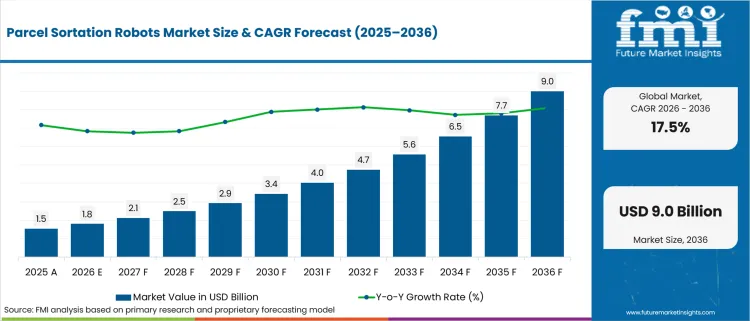
USD 1.8 billion in 2026 and USD 9.0 billion by 2036 at a 17.5% CAGR.
Parcel sortation robot sales are projected to drive industry valuation from USD 1.8 billion in 2026 to USD 9.0 billion by 2036, with a 17.5% CAGR during the forecast period. Expansion reflects demand for warehouse robotics that can add destinations without rebuilding an entire conveyor route. China's State Council reported in January 2026 that courier operators handled 199 billion parcels during 2025, an increase of 13.7% from 2024. That volume supports larger robot fields at hubs that need frequent destination changes and limited construction downtime.
China and the United States present different investment cases, with Chinese courier hubs able to justify larger robot fields through dense parcel volume. United States networks often favor phased retrofits that share software and service routines across several facilities. TheUSA Postal Service reported in June 2025 that Shipping and Packages revenue reached USD 32.260 billion during fiscal 2024. That revenue base gives national parcel networks room to plan equipment renewal across several hubs. Parcel operators must test barcode capture, induction timing, and destination space before setting fleet size. These conditions make e-commerce logistics projects more dependent on fit with existing scanners and dispatch plans than on robot count alone.
Key Takeaways of Parcel Sortation Robots Market
- Demand for parcel sortation robots is driven by the need for flexible sorting capacity that follows changing destinations without permanent construction inside active hubs.
- AMR-based sorters are the leading system type for sites needing phased growth and route changes across a shared floor rather than a permanent carrier loop.
- Parcel hubs gain value from robotic fields that can redirect capacity toward changing destinations within fixed dispatch windows and limited floorspace.
- Hardware absorbs much of the early budget, as robots, induction stations, cameras, and safety equipment create the physical processing capacity.
- Reliable identification and balanced parcel entry remain critical to output, giving every robot task a readable destination record at induction and a confirmed handoff at discharge.
- China, the United States, the European Union, Japan, and India are expected to follow distinct adoption paths, shaped by dense courier flows, modular multi-facility systems, fixed-sorter retrofit constraints, and volume-driven investment at high-pressure facilities.
- Competition centers on Prime Vision, Berkshire Grey, Ambi Robotics, Tompkins Robotics, and BEUMER Group, with vendors differentiating through mobile fleet identification, vision-guided handling cells, modular floor-based sort fields, and integrated hub control systems.
Analyst Perspective
"The robotic parcel sorting market is increasingly measured by end-to-end throughput rather than fleet size alone. Sorting efficiency depends on balanced parcel induction, accurate destination handling, and effective management of operational exceptions during peak volumes. Market adoption will favor solutions that sustain reliable performance across seasonal demand while scaling without creating bottlenecks elsewhere in the sorting process."
- Nikhil Kaitwade, Principal Analyst at Future Market Insights
Source: FMI's proprietary forecasting model and primary research
How is the Parcel Sortation Robots Market segmented?
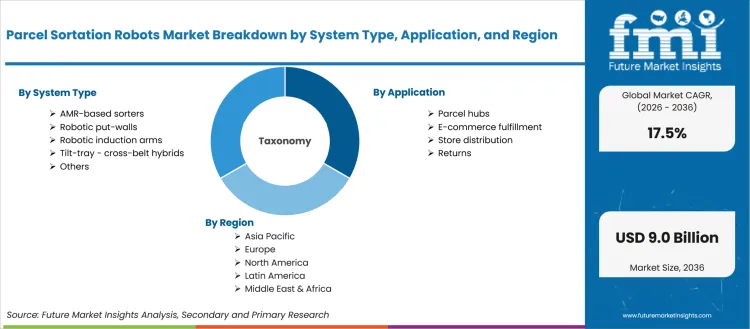
The parcel sortation robots industry is segmented by system type, application, component, end-use industry, sales channel, and region.
The report compares six dimensions that shape equipment design and operating responsibility across parcel sortation projects. System type separates mobile robot platforms from induction arms and hybrid designs that handle different stages of the parcel route. Application analysis compares parcel hubs with fulfillment centers facing different destination counts and dispatch deadlines. Component analysis separates equipment spending from software and service costs across the full installation life. Robotic put-walls consolidate orders as goods-to-person robots deliver items to assigned work positions, connecting parcel mix with floor limits and operating responsibility.
How do AMR-based sorters shape demand within the system type category?
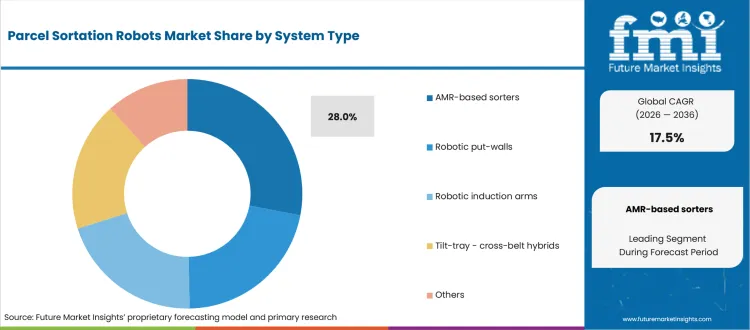
AMR-based sorters carry parcels across a shared floor, and fleet software revises route maps as parcel patterns change. Prime Vision reported in April 2025 that more than 1,000 sorting robots operated across 53 United States sites. Prime Vision's April 2025 release placed typical fleet throughput between 3,000 and 4,000 parcels per hour. Those figures show why autonomous mobile robots suit hubs with changing route counts and tight floorspace. Flexible capacity then avoids committing valuable floor space to an untested route before parcel demand is proven.
- By system type, AMR-based sorters are forecast to represent 28.0% of demand in 2026 due to phased installation and flexible destination mapping. A hub can begin with a limited field and add robots as parcel volume proves the need. This approach reduces the risk of fixing an untested route pattern into the building too early.
- Parcel operators are expected to favor AMR-based sorters for seasonal routes and customer programs with changing destination counts. Charging plans and traffic controls must be tested under peak flow so extra robots do not create floor congestion. The useful fleet size is set by induction capacity and destination space rather than the number of units available.
What supports demand for parcel hubs within the application category?
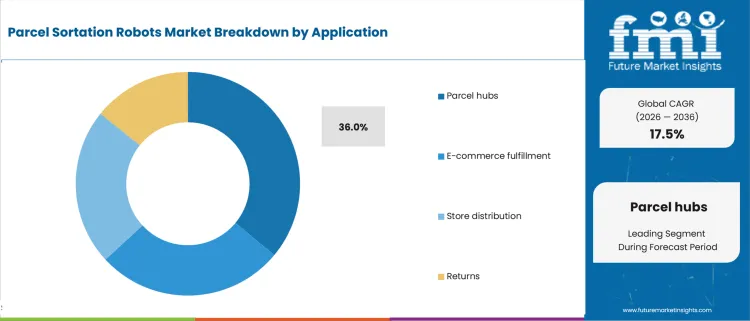
Parcel hubs make repeated destination decisions inside dispatch windows that leave little time for correction. One miss can send an item toward the wrong depot and create another handling cycle. Robotic sortation therefore connects with automated material handling systems that control each handoff across dense logistics sites. BEUMER Group reported in March 2025 that its Dynamic Bulk Pick system could feed sorters at about 1,600 picks per hour. The figure shows why hub projects must match robotic induction with the capacity of the sorter receiving each parcel.
- In 2026, parcel hubs are expected to account for 36.0% of application demand due to dense route counts and fixed dispatch deadlines. Their value comes from coordinating many destination changes within one operating wave during peak operations. A robotic field can redirect capacity toward a busy dispatch area without extending the permanent sorter through every changing lane.
- Hub managers are anticipated to combine robots with existing high-speed sorters so each technology handles the flow it suits. Permanent equipment can serve stable routes with repeated volume, while mobile systems absorb seasonal destinations and customer-specific lanes.
How is hardware positioned within the component category?
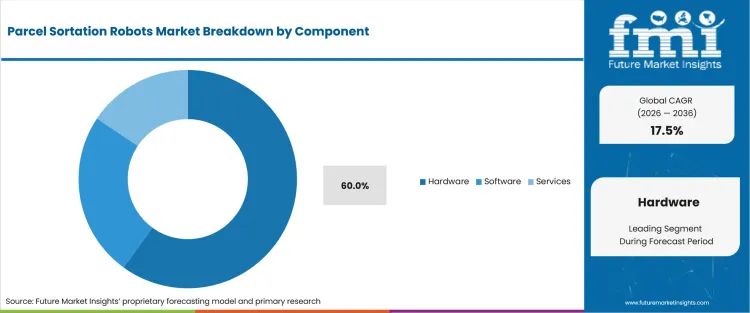
Hardware creates the physical capacity that picks and places parcels into assigned destination flows inside active hubs. Robotic arms need vision and grippers that can handle cartons and flexible mailers without slowing the line. Ambi Robotics reported in April 2025 that its AmbiSort fleet had sorted more than 100 million packages with 99.6% accuracy across United States operations. The result shows why hardware spending covers the robot and vision system as one working unit. A poor match between those parts reduces usable output across the cell during a shift.
- By component, hardware is estimated to represent 60.0% of demand in 2026 due to the cost of robots, induction stations, cameras, and safety equipment. Each additional processing lane needs enough machines to carry or place incoming parcels during the shift. The physical assets therefore absorb much of the early project budget before recurring software and service spending expands.
- Demand for hardware is expected to rise among parcel hubs that need reliable identification at each robotic handoff. Fixed industrial barcode scanners and vision systems confirm parcel identity so fleet software can assign a destination from a verified record. Equipment selection must reflect label quality and parcel surfaces because poor capture can create manual recovery work across the shift.
What are the drivers, restraints, and opportunities in the Parcel Sortation Robots Market?
Changing parcel waves support modular systems. Identification and handoff errors limit usable output. Service contracts reduce the entry cost of a first robotic sorting installation.
- Driver: Parcel peaks support modular robot fleets that add temporary capacity without committing the building to a permanent conveyor extension.
- Restraint: Unreadable labels and incomplete manifest data create recovery work that reduces the throughput delivered by the installed fleet.
- Opportunity: Service contracts align fleet size with parcel volume and lower the capital commitment required for an initial installation.
Parcel peaks can create a capacity problem that persists through several weeks of concentrated demand. A sorter can leave unused capacity during quieter periods and occupy space needed for other work. Prime Vision reported in April 2026 that a temporary DHL installation used up to 75 robots across 80 destinations and processed up to 13,000 parcels per shift. Prime Vision's April 2026 announcement said the temporary system reached full operating readiness within two weeks. The result supports modular fleets at hubs that need peak capacity without permanent building work.
Identification quality sets a direct limit on robotic sortation because each routing task depends on a unique parcel record. The USA Postal Service stated in February 2025 that commercial parcels entered through USPS Ship must carry a tracking number unique for 120 days. Those rules compare captured package attributes with manifest data, which mirrors the control robotic fleets need at induction and discharge. An unreadable or duplicated identity can divert a parcel into manual recovery, reducing the output produced by the installed fleet throughout an active shift.
Service contracts reduce the upfront commitment required to test robotic sorting inside an operating parcel hub. The robotics-as-a-service model shifts equipment ownership and routine maintenance toward the provider under a recurring fee. Prime Vision announced its sorting service in February 2025 and stated that customers would pay for the capacity used. Prime Vision's February 2025 release said fleets could range from a few robots to more than 70 units. This structure lets operators expand after throughput and recovery results support a larger operating plan.
Which country CAGRs are profiled in the Parcel Sortation Robots Market?
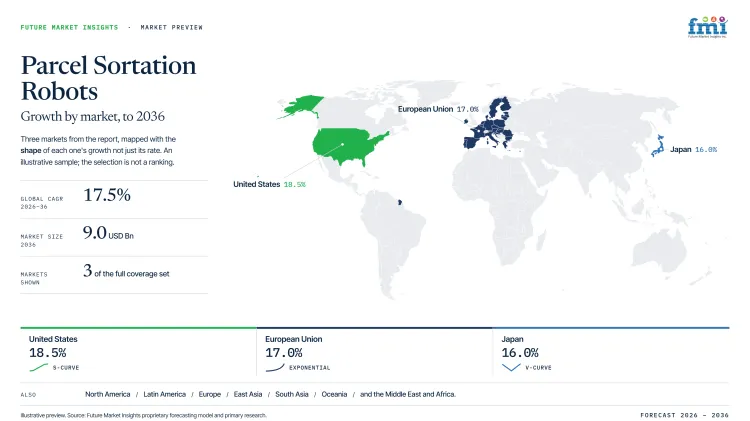
| Country | CAGR |
|---|---|
| United States | 18.5% |
| European Union | 17.0% |
| Japan | 16.0% |
Source: FMI's proprietary forecasting model and primary research
How do country-level CAGRs compare in the Parcel Sortation Robots Market?
Country growth differs according to parcel density and facility age, with labor availability and capital budgets shaping the pace of hub upgrades. United States networks place more value on repeatable systems that can share software and service routines across several facilities. European Union projects must fit older buildings and established fixed sorters, while Japan concentrates spending at hubs with clear volume and service pressure.
- United States parcel networks often require automation that can be repeated across several hubs without changing every operating procedure. Demand is forecast to rise at 18.5% CAGR during the forecast period as national carriers invest in phased equipment renewal. Data from the USA Postal Service showed Shipping and Packages volume at 7.252 billion pieces in June 2025 for fiscal 2024. That scale supports modular projects that share fleet software and service routines across locations throughout the network. Network engineering teams need acceptance tests covering label capture, destination accuracy, and peak traffic before a wider rollout.
- European Union parcel hubs often need flexible capacity inside brownfield facilities that already depend on fixed sorters and narrow operating windows. The regional outlook is projected to advance at 17.0% CAGR from 2026 to 2036 as operators seek to add destinations without replacing installed equipment. In October 2025, the European Regulators Group for Postal Services published findings from 28 national regulators and reported that robotics remained limited to a small number of postal pilot projects. That gap shows that many operators need phased installations with clear integration tests.
- Japan's parcel operators face stable shipment demand alongside pressure to maintain service with a smaller available workforce. Japan's transport ministry reported in August 2025 that fiscal 2024 parcel volume reached 5.031 billion items, an increase of 24.14 million items or 0.5%. Adoption is estimated to expand at 16.0% CAGR by 2036 with investment concentrated at sites that can support dedicated robotic capacity. This steady base favors compact systems that improve repeatability without requiring rapid network expansion inside existing facilities.
Who are the notable companies in the Parcel Sortation Robots Market?
Prime Vision, Berkshire Grey, Tompkins Robotics, Ambi Robotics, and BEUMER Group are the notable companies shaping the Parcel Sortation Robots Market.
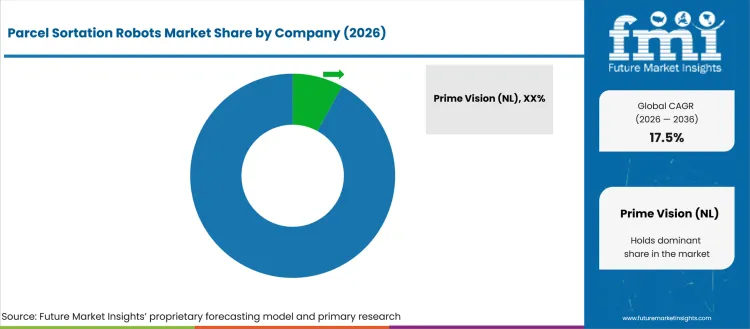
Competition divides between mobile robot fields and integrated systems that control induction, identification, and discharge. Prime Vision and Tompkins Robotics focus on modular routes that can add destination points within existing floorspace. Berkshire Grey and Ambi Robotics use vision-guided handling systems for mixed parcels and assigned sort destinations. BEUMER Group connects robotic induction with wider hub controls that coordinate the next stage of parcel movement. These approaches overlap with retail logistics operations that need accurate item movement during daily fulfillment work.
- Prime Vision focus on mobile robot fleets linked with computer vision and parcel identification inside active hubs. Its approach gives postal and courier sites one control layer for route mapping and destination checks. The model suits facilities that need temporary destinations or phased capacity without extending a fixed carrier loop through the building.
- Berkshire Grey and Ambi Robotics use vision-guided arms for parcel or item handling inside automated cells. Berkshire Grey connects robotic picking with sortation workflows, while Ambi Robotics focuses on mixed-package recognition and placement. Their value depends on item coverage and recovery logic across the actual parcel mix handled at each site.
- Tompkins Robotics supplies modular robot fields that carry parcels toward assigned sort points across a mapped floor. That capacity gives parcel operators a measurable basis for testing a limited layout before expanding the field.
- BEUMER Group combines robotic induction with parcel hub sorters and system controls that govern the wider flow. This position matters at sites where feeding speed can limit downstream equipment during active sorting waves. Integration work must align the robot cell with scanner data and sorter capacity so the handoff does not create a new bottleneck.
Competitive Benchmarking: Parcel Sortation Robots Market
| Company | Robotic Sortation Scope | Parcel Identification Integration | Installation and Service Support | Geographic Reach |
|---|---|---|---|---|
| Prime Vision | High | High | High | Medium |
| Berkshire Grey | High | Medium | Medium | Medium |
| Tompkins Robotics | High | Medium | High | Medium |
| Ambi Robotics | High | High | Medium | Medium |
| BEUMER Group | Medium | High | High | High |
Source: Future Market Insights competitive analysis, 2026. Ratings reflect relative portfolio relevance and workflow fit.
Key Developments in the Parcel Sortation Robots Market
- In May 2025, Prime Vision announced a partnership with Dell Technologies to develop edge-computing systems for parcel sorting and fulfillment centers. The official announcement said local processing would reduce latency for large vision datasets inside sorting facilities. Faster local decisions can improve destination checks during live sorting operations across several active parcel hubs.
- In January 2025, Ambi Robotics, launched the PRIME-1 foundation model for robotic sorting systems used in commercial warehouses. Ambi Robotics stated that the model used more than 20 million images from 150,000 operating hours.
- In March 2026, BEUMER Group announced a three-year enterprise lab with Fraunhofer IML to develop mobile robotics. Release assigned five full-time research positions to the program and included sortation robots for parcel centers. The partnership connects laboratory testing with BEUMER Group parcel-handling systems used inside active parcel hubs.
- In June 2026, Berkshire Grey announced a Customer Innovation Center near Amsterdam to support parcel and logistics providers across Europe. The release said the facility would provide system demonstrations, testing, and regional service for robotic picking and sortation. Local evaluation reduces the risk of fitting a robotic cell into an existing operating hub.
Key Players in the Parcel Sortation Robots Market
Mobile robotic sortation and vision platforms
- Prime Vision
- Tompkins Robotics
Robotic parcel handling and induction platforms
- Berkshire Grey
- Ambi Robotics
Integrated parcel hub systems
- BEUMER Group
Parcel Sortation Robots Market - Report Scope
| Coverage field | Report scope |
|---|---|
| Market breakdown | System type, application, component, end-use industry, sales channel, and region. |
| Market Definition | The market includes robotic systems that identify and carry parcels before placing them into assigned destination flows. |
| Regions Covered | North America, Latin America, Europe, East Asia, South Asia, Oceania, and the Middle East and Africa. |
| Countries Covered | United States, Canada, Brazil, Mexico, Germany, United Kingdom, France, China, Japan, India, and other covered countries. |
| Key Companies Profiled | Prime Vision, Berkshire Grey, Tompkins Robotics, Ambi Robotics, and BEUMER Group. |
| Forecast Period | The forecast runs from 2026 to 2036, with 2025 used as the base-year reference for market sizing. |
| Approach | Facility estimates are reconciled with country demand through primary interviews and official research on parcel flows. |
Source: Future Market Insights analysis driven by proprietary forecasting models and primary research
Parcel Sortation Robots Market - Research Methodology
| Method | Approach |
|---|---|
| Primary Research | FMI analysts gathered input from manufacturers, service providers, technology developers, distributors, end users, procurement teams, and subject-matter experts. Interviews examined purchasing decisions, product or service evaluation, adoption barriers, approval requirements, pricing considerations, and expectations for technical or commercial support. Respondents were also asked what evidence is required before a trial, pilot, or initial order develops into regular purchasing. |
| Desk Research | Desk research covered government statistics, regulatory publications, trade data, industry associations, technical literature, standards, company filings, product information, and official corporate announcements. Sources were reviewed for relevance, publication date, geographic coverage, and consistency with the defined market scope. Claims relating to performance, applications, approvals, capacity, investment, and commercial activity were retained only when supported by credible public evidence. |
| Market Sizing and Forecasting | The market model combined the baseline value with historical performance, segment structure, pricing and volume indicators, adoption levels, company participation, and country-level demand conditions. Forecast assumptions considered economic activity, investment trends, regulatory developments, technology adoption, purchasing cycles, supply availability, and barriers to wider market use. Segment and regional estimates were reconciled before the final market total was calculated. |
| Data Validation | Estimates were checked against multiple independent indicators, including public data, company activity, trade patterns, industry developments, and findings from primary interviews. Validation also tested whether products, services, applications, and company revenues fell within the defined market boundaries. Adjacent categories, unsupported claims, overlapping revenues, and activities without direct market relevance were excluded to reduce double counting and maintain consistency across segments and countries. |
Source: Future Market Insights analysis based on proprietary forecasting model and primary research
Parcel Sortation Robots Market by Segments
Parcel Sortation Robots Market segmented by System Type:
- AMR-based Sorters
- Robotic Induction Arms
- Robotic Put-walls
- Hybrid Systems
Parcel Sortation Robots Market segmented by Application:
- Parcel Hubs
- Fulfillment Centers
- Postal Facilities
- Retail Distribution Centers
Parcel Sortation Robots Market segmented by Component:
- Hardware
- Software
- Services
Parcel Sortation Robots Market segmented by End-use Industry:
- Post and Parcel
- E-commerce and Retail
- Third-party Logistics
- Air Cargo and Courier
Parcel Sortation Robots Market segmented by Sales Channel:
- Direct Sales
- System Integrators
- Distributor and Partner Sales
- Robotics-as-a-Service Contracts
Parcel Sortation Robots Market by Region:
- North America
- United States
- Canada
- Latin America
- Brazil
- Mexico
- Argentina
- Europe
- Germany
- United Kingdom
- France
- Italy
- Spain
- East Asia
- China
- Japan
- South Korea
- South Asia
- India
- Thailand
- Indonesia
- Oceania
- Australia
- New Zealand
- Middle East and Africa
- GCC Countries
- South Africa
- Türkiye
Research Sources and Bibliography
- The State Council of the People's Republic of China. (2026, January). China's postal delivery volume hits 216.5 billion items in 2025.
- The State Council of the People's Republic of China. (2025, January). China's express delivery sector posts fast growth in 2024.
- Berkshire Grey. (2026, June). Berkshire Grey expands European operations as demand for physical AI accelerates.
- United States Postal Service. (2025, June). Fiscal Year 2024 Annual Report to Congress.
- European Regulators Group for Postal Services. (2025, October). ERGP report on technological changes and environmentally sustainable solutions in the postal sector.
- Japan Ministry of Land, Infrastructure, Transport and Tourism. (2025, August). Fiscal 2024 parcel delivery and mail service handling results.
- Press Information Bureau. (2026, May). India Post revenue surges to INR 15,373 crore in FY 2025-26; MoS Communications outlines a comprehensive transformation agenda.
- Prime Vision. (2025, February). Robots as a service simplifies the automation of sorting operations.
- United States Postal Service. (2025, February). DMM revision: Migration from Electronic Verification System to USPS Ship.
- Prime Vision. (2025, April). Robotic sorting provides logistics with a flexible solution to an uncertain tomorrow.
- Prime Vision. (2026, April). Robotic Sorting Solution enables flexible peak operations for DHL.
- Prime Vision. (2025, May). Prime Vision partners with Dell Technologies to develop hybrid AI for logistics sorting centers.
- Ambi Robotics. (2025, January). Ambi Robotics launches PRIME-1 foundation model for warehouse robots.
- Ambi Robotics. (2025, April). Ambi Robotics wins IEEE award for product innovation.
- BEUMER Group. (2025, March). BEUMER Group sets new standards in fully automated logistics.
- BEUMER Group. (2026, March). BEUMER Group and Fraunhofer Institute for Material Flow and Logistics IML launch joint Enterprise Lab for mobile robotics.
- Tompkins Robotics. (2025, December). The warehouse sortation systems you need to know.
This bibliography is provided for reader reference and uses primary government, standards-body, official trade body, and company sources.
This Report Answers
- What market value is estimated for 2026 and 2036?
- What CAGR is projected from 2026 to 2036?
- How do system type and application choices change parcel sortation demand?
- Which operating pressures support robotic sorting inside parcel hubs?
- How do country CAGRs differ across the three profiled locations?
- Which companies compete through robot platforms or integrated sorter systems?
- How are market estimates and country forecasts developed?
- How do identification and exception handling affect system selection?
- Which dated company actions show direct investment in robotic parcel sorting systems?
Frequently Asked Questions
What is driving growth in the Parcel Sortation Robots Market?
Parcel networks need sorting capacity that follows changing destinations without requiring a long conveyor project. Mobile fleets support phased expansion during short demand peaks and can be reduced after volumes normalize.
Who are the key players in the Parcel Sortation Robots Market?
Prime Vision and Tompkins Robotics supply modular robot fields designed for changing parcel destinations inside active hubs. Berkshire Grey and Ambi Robotics handle mixed packages while BEUMER Group integrates wider parcel hub systems.
What is a notable restraint in the Parcel Sortation Robots Market?
Unreadable labels and poorly timed handoffs reduce usable throughput even if robot navigation remains accurate. Controlled exception routes prevent uncertain parcels from circulating through the main robotic sorting flow during peak periods.
Why should executives track the Parcel Sortation Robots Market?
Robotic sortation lets parcel networks add capacity around fixed equipment during seasonal peaks and frequent route changes. Executives should track whether installations raise throughput without requiring more floorspace or permanent conveyor construction.
What business problem does the Parcel Sortation Robots Market address?
Parcel sortation robots address flows that change faster than fixed equipment can be reconfigured inside active hubs. Mobile units absorb variable destinations around permanent lanes that continue carrying stable parcel volume through each dispatch wave.
What should procurement teams evaluate in the Parcel Sortation Robots Market?
Procurement teams should test item coverage and recovery procedures with the parcel mix expected during peak operations. Contracts must assign software control and maintenance responsibility throughout periods of heavy parcel volume and frequent exceptions.
What limits return on investment in the Parcel Sortation Robots Market?
Weak induction control can leave robots idle or create floor congestion during heavy parcel waves. Returns decline if scanner capacity and destination points cannot support the installed fleet throughout the shift.
What supports long-term commercial confidence in the Parcel Sortation Robots Market?
Documented performance across normal parcel mixes and seasonal peaks supports confidence in repeatable robotic sorting operations. Clear maintenance response and complete exception records give networks a sound basis for expanding across additional hubs.
Preview the report firsthand - request a free sample
Get SampleGet the brochure for pricing and purchase details.
Get PDFTable of Content
- Key Takeaways
- Market Size and CAGR
- Top Growth Driver
- Fastest Growing Segment
- Leading Region
- Key Companies
- Emerging Opportunities
- Executive Summary
- Global Market Outlook
- Demand-side Trends
- Supply-side Trends
- Technology Roadmap Analysis
- Analysis and Recommendations
- Analyst Perspective (What is happening? Why now? What should investors know?)
- Key Questions Answered
- How large is the market?
- What is the CAGR?
- What are key trends?
- Which region dominates?
- Who are the leaders?
- Market Overview
- Market Coverage / Taxonomy
- Market Definition / Scope / Limitations
- Research Methodology
- Chapter Orientation
- Analytical Lens and Working Hypotheses
- Market Structure, Signals, and Trend Drivers
- Benchmarking and Cross-market Comparability
- Market Sizing, Forecasting, and Opportunity Mapping
- Research Design and Evidence Framework
- Desk Research Programme (Secondary Evidence)
- Expert Input and Fieldwork (Primary Evidence)
- Tooling, Models, and Reference Databases
- Data Engineering and Model Build
- Quality Assurance and Audit Trail
- Market Background
- Market Dynamics (Drivers, Restraints, Opportunity, Trends)
- Scenario Forecast (Optimistic, Likely, Conservative)
- Impact Analysis
- AI Impact
- Sustainability Impact
- Regulatory Impact
- Technology Impact
- Consumer / Buyer Analysis
- Purchase Drivers
- Adoption Barriers
- Buyer Journey
- Opportunity Map Analysis
- Product Life Cycle Analysis
- Supply Chain Analysis
- Investment Feasibility Matrix
- Value Chain Analysis
- PESTLE and Porter's Analysis
- Regulatory Landscape
- Regional Parent Market Outlook
- Production and Consumption Statistics
- Import and Export Statistics
- Global Market Analysis and Forecast, 2021 to 2036
- Historical Market Size Value (USD Billion) Analysis, 2021 to 2025
- Current and Future Market Size Value (USD Billion) Projections, 2026 to 2036
- Y-o-Y Growth Trend Analysis
- Absolute $ Opportunity Analysis
- Global Market Pricing Analysis, 2021 to 2036
- Global Market Analysis and Forecast, By System Type, 2021 to 2036
- Introduction / Key Findings
- Historical Market Size Value (USD Billion) Analysis By System Type, 2021 to 2025
- Current and Future Market Size Value (USD Billion) Analysis and Forecast By System Type, 2026 to 2036
- AMR-based sorters
- Robotic put-walls
- Robotic induction arms
- Tilt-tray - cross-belt hybrids
- Others
- AMR-based sorters
- Y-o-Y Growth Trend Analysis By System Type, 2021 to 2025
- Absolute $ Opportunity Analysis By System Type, 2026 to 2036
- Global Market Analysis and Forecast, By Application, 2021 to 2036
- Introduction / Key Findings
- Historical Market Size Value (USD Billion) Analysis By Application, 2021 to 2025
- Current and Future Market Size Value (USD Billion) Analysis and Forecast By Application, 2026 to 2036
- Parcel hubs
- E-commerce fulfillment
- Store distribution
- Returns
- Parcel hubs
- Y-o-Y Growth Trend Analysis By Application, 2021 to 2025
- Absolute $ Opportunity Analysis By Application, 2026 to 2036
- Global Market Analysis and Forecast, By Component, 2021 to 2036
- Introduction / Key Findings
- Historical Market Size Value (USD Billion) Analysis By Component, 2021 to 2025
- Current and Future Market Size Value (USD Billion) Analysis and Forecast By Component, 2026 to 2036
- Hardware
- Software
- Services
- Hardware
- Y-o-Y Growth Trend Analysis By Component, 2021 to 2025
- Absolute $ Opportunity Analysis By Component, 2026 to 2036
- Global Market Analysis and Forecast, By End-use Industry, 2021 to 2036
- Introduction / Key Findings
- Historical Market Size Value (USD Billion) Analysis By End-use Industry, 2021 to 2025
- Current and Future Market Size Value (USD Billion) Analysis and Forecast By End-use Industry, 2026 to 2036
- Post & parcel
- 3PL
- E-commerce
- Retail
- Post & parcel
- Y-o-Y Growth Trend Analysis By End-use Industry, 2021 to 2025
- Absolute $ Opportunity Analysis By End-use Industry, 2026 to 2036
- Global Market Analysis and Forecast, By Sales Channel, 2021 to 2036
- Introduction / Key Findings
- Historical Market Size Value (USD Billion) Analysis By Sales Channel, 2021 to 2025
- Current and Future Market Size Value (USD Billion) Analysis and Forecast By Sales Channel, 2026 to 2036
- Direct Sales
- System integrators
- Distributors
- Aftermarket
- Direct Sales
- Y-o-Y Growth Trend Analysis By Sales Channel, 2021 to 2025
- Absolute $ Opportunity Analysis By Sales Channel, 2026 to 2036
- Global Market Analysis and Forecast, By Region, 2021 to 2036
- Introduction
- Historical Market Size Value (USD Billion) Analysis By Region, 2021 to 2025
- Current Market Size Value (USD Billion) Analysis and Forecast By Region, 2026 to 2036
- North America
- Latin America
- Western Europe
- Eastern Europe
- East Asia
- South Asia and Pacific
- Middle East & Africa
- Market Attractiveness Analysis By Region
- North America Market Analysis and Forecast, By Country, 2021 to 2036
- Historical Market Size Value (USD Billion) Trend Analysis By Market Taxonomy, 2021 to 2025
- Market Size Value (USD Billion) Forecast By Market Taxonomy, 2026 to 2036
- By Country
- USA
- Canada
- By System Type
- By Application
- By Component
- By End-use Industry
- By Sales Channel
- By Country
- Market Attractiveness Analysis
- By Country
- By System Type
- By Application
- By Component
- By End-use Industry
- By Sales Channel
- Key Takeaways
- Latin America Market Analysis and Forecast, By Country
- Historical Market Size Value (USD Billion) Trend Analysis By Market Taxonomy, 2021 to 2025
- Market Size Value (USD Billion) Forecast By Market Taxonomy, 2026 to 2036
- By Country
- Brazil
- Mexico
- Chile
- Rest of Latin America
- By System Type
- By Application
- By Component
- By End-use Industry
- By Sales Channel
- By Country
- Market Attractiveness Analysis
- By Country
- By System Type
- By Application
- By Component
- By End-use Industry
- By Sales Channel
- Key Takeaways
- Western Europe Market Analysis and Forecast, By Country
- Historical Market Size Value (USD Billion) Trend Analysis By Market Taxonomy, 2021 to 2025
- Market Size Value (USD Billion) Forecast By Market Taxonomy, 2026 to 2036
- By Country
- Germany
- UK
- Italy
- Spain
- France
- Nordic
- BENELUX
- Rest of Western Europe
- By System Type
- By Application
- By Component
- By End-use Industry
- By Sales Channel
- By Country
- Market Attractiveness Analysis
- By Country
- By System Type
- By Application
- By Component
- By End-use Industry
- By Sales Channel
- Key Takeaways
- Eastern Europe Market Analysis and Forecast, By Country
- Historical Market Size Value (USD Billion) Trend Analysis By Market Taxonomy, 2021 to 2025
- Market Size Value (USD Billion) Forecast By Market Taxonomy, 2026 to 2036
- By Country
- Russia
- Poland
- Hungary
- Balkan & Baltic
- Rest of Eastern Europe
- By System Type
- By Application
- By Component
- By End-use Industry
- By Sales Channel
- By Country
- Market Attractiveness Analysis
- By Country
- By System Type
- By Application
- By Component
- By End-use Industry
- By Sales Channel
- Key Takeaways
- East Asia Market Analysis and Forecast, By Country
- Historical Market Size Value (USD Billion) Trend Analysis By Market Taxonomy, 2021 to 2025
- Market Size Value (USD Billion) Forecast By Market Taxonomy, 2026 to 2036
- By Country
- China
- Japan
- South Korea
- By System Type
- By Application
- By Component
- By End-use Industry
- By Sales Channel
- By Country
- Market Attractiveness Analysis
- By Country
- By System Type
- By Application
- By Component
- By End-use Industry
- By Sales Channel
- Key Takeaways
- South Asia and Pacific Market Analysis and Forecast, By Country
- Historical Market Size Value (USD Billion) Trend Analysis By Market Taxonomy, 2021 to 2025
- Market Size Value (USD Billion) Forecast By Market Taxonomy, 2026 to 2036
- By Country
- India
- ASEAN
- Australia & New Zealand
- Rest of South Asia and Pacific
- By System Type
- By Application
- By Component
- By End-use Industry
- By Sales Channel
- By Country
- Market Attractiveness Analysis
- By Country
- By System Type
- By Application
- By Component
- By End-use Industry
- By Sales Channel
- Key Takeaways
- Middle East & Africa Market Analysis and Forecast, By Country
- Historical Market Size Value (USD Billion) Trend Analysis By Market Taxonomy, 2021 to 2025
- Market Size Value (USD Billion) Forecast By Market Taxonomy, 2026 to 2036
- By Country
- Kingdom of Saudi Arabia
- Other GCC Countries
- Türkiye
- South Africa
- Other African Union
- Rest of Middle East & Africa
- By System Type
- By Application
- By Component
- By End-use Industry
- By Sales Channel
- By Country
- Market Attractiveness Analysis
- By Country
- By System Type
- By Application
- By Component
- By End-use Industry
- By Sales Channel
- Key Takeaways
- Key Countries Market Analysis
- USA
- Pricing Analysis
- Market Share Analysis, 2025
- By System Type
- By Application
- By Component
- By End-use Industry
- By Sales Channel
- Canada
- Pricing Analysis
- Market Share Analysis, 2025
- By System Type
- By Application
- By Component
- By End-use Industry
- By Sales Channel
- Mexico
- Pricing Analysis
- Market Share Analysis, 2025
- By System Type
- By Application
- By Component
- By End-use Industry
- By Sales Channel
- Brazil
- Pricing Analysis
- Market Share Analysis, 2025
- By System Type
- By Application
- By Component
- By End-use Industry
- By Sales Channel
- Chile
- Pricing Analysis
- Market Share Analysis, 2025
- By System Type
- By Application
- By Component
- By End-use Industry
- By Sales Channel
- Germany
- Pricing Analysis
- Market Share Analysis, 2025
- By System Type
- By Application
- By Component
- By End-use Industry
- By Sales Channel
- UK
- Pricing Analysis
- Market Share Analysis, 2025
- By System Type
- By Application
- By Component
- By End-use Industry
- By Sales Channel
- Italy
- Pricing Analysis
- Market Share Analysis, 2025
- By System Type
- By Application
- By Component
- By End-use Industry
- By Sales Channel
- Spain
- Pricing Analysis
- Market Share Analysis, 2025
- By System Type
- By Application
- By Component
- By End-use Industry
- By Sales Channel
- France
- Pricing Analysis
- Market Share Analysis, 2025
- By System Type
- By Application
- By Component
- By End-use Industry
- By Sales Channel
- India
- Pricing Analysis
- Market Share Analysis, 2025
- By System Type
- By Application
- By Component
- By End-use Industry
- By Sales Channel
- ASEAN
- Pricing Analysis
- Market Share Analysis, 2025
- By System Type
- By Application
- By Component
- By End-use Industry
- By Sales Channel
- Australia & New Zealand
- Pricing Analysis
- Market Share Analysis, 2025
- By System Type
- By Application
- By Component
- By End-use Industry
- By Sales Channel
- China
- Pricing Analysis
- Market Share Analysis, 2025
- By System Type
- By Application
- By Component
- By End-use Industry
- By Sales Channel
- Japan
- Pricing Analysis
- Market Share Analysis, 2025
- By System Type
- By Application
- By Component
- By End-use Industry
- By Sales Channel
- South Korea
- Pricing Analysis
- Market Share Analysis, 2025
- By System Type
- By Application
- By Component
- By End-use Industry
- By Sales Channel
- Russia
- Pricing Analysis
- Market Share Analysis, 2025
- By System Type
- By Application
- By Component
- By End-use Industry
- By Sales Channel
- Poland
- Pricing Analysis
- Market Share Analysis, 2025
- By System Type
- By Application
- By Component
- By End-use Industry
- By Sales Channel
- Hungary
- Pricing Analysis
- Market Share Analysis, 2025
- By System Type
- By Application
- By Component
- By End-use Industry
- By Sales Channel
- Kingdom of Saudi Arabia
- Pricing Analysis
- Market Share Analysis, 2025
- By System Type
- By Application
- By Component
- By End-use Industry
- By Sales Channel
- Türkiye
- Pricing Analysis
- Market Share Analysis, 2025
- By System Type
- By Application
- By Component
- By End-use Industry
- By Sales Channel
- South Africa
- Pricing Analysis
- Market Share Analysis, 2025
- By System Type
- By Application
- By Component
- By End-use Industry
- By Sales Channel
- USA
- Market Structure Analysis
- Competition Dashboard
- Competition Benchmarking
- Market Share Analysis of Top Players
- By Regional
- By System Type
- By Application
- By Component
- By End-use Industry
- By Sales Channel
- Emerging Startups
- Innovation Benchmarking
- Competition Analysis
- Competition Deep Dive
- Prime Vision (NL)
- Overview
- Product Portfolio
- Profitability by Market Segments
- Sales Footprint
- Strategy Overview
- Marketing Strategy
- Product Strategy
- Channel Strategy
- Berkshire Grey - SoftBank (US-JP)
- Interroll (CH)
- BEUMER (DE)
- Prime Vision (NL)
- Case Studies
- Success Stories
- Recent Developments
- Competition Deep Dive
- Assumptions & Acronyms Used


