

- Industry Size (2026):
- USD 540.0 Mn
- Forecast (2036):
- USD 1387.9 Mn
- CAGR (2026 to 2036)
- 9.9%
Automatic Parcel Singulator Market Forecast and Outlook 2026 to 2036
In 2026, revenue from automatic parcel singulators stands at USD 540.0 million and is expected to rise to USD 1,387.9 million by 2036, implying a 9.9% CAGR. Value formation is driven by throughput stabilization requirements within automated parcel handling facilities rather than discretionary automation adoption. Singulators function as conditioning systems that regulate parcel flow into downstream scanning and sortation equipment. Capital allocation is linked to the need to reduce induction variability, prevent sorter congestion, and maintain consistent line utilization under mixed parcel streams. Investment decisions prioritize systems that support continuous operation during peak volume periods while limiting manual intervention at induction points.
Demand persistence reflects structural pressure on logistics operators to manage increasing parcel mix complexity, including variability in size, weight, and packaging integrity. Manual singulation introduces inconsistency that constrains sorter accuracy and increases jam incidence, creating operational risk during high-load cycles. Automated singulators mitigate these constraints by aligning parcels into controlled, single-file feeds compatible with high-speed sorters and dimensioning systems. Replacement and expansion cycles align with facility throughput upgrades, network capacity expansion, and reconfiguration of existing sortation layouts rather than routine equipment wear. Value growth remains anchored to expansion of automated parcel processing capacity and rising performance expectations for induction accuracy across large-scale distribution networks.
Quick Stats for Automatic Parcel Singulator Market
- Automatic Parcel Singulator Market Value (2026): USD 540.0 million
- Automatic Parcel Singulator Market Forecast Value (2036): USD 1,387.9 million
- Automatic Parcel Singulator Market Forecast CAGR 2026 to 2036: 9.9%
- Leading Technology Type by Demand Share: Belt-Based Singulators
- Fastest-Growing Countries: China, India, USA, Germany, UK
- Top Players in Global Demand: Dematic, Vanderlande, Interroll, Beumer Group, Murata Machinery
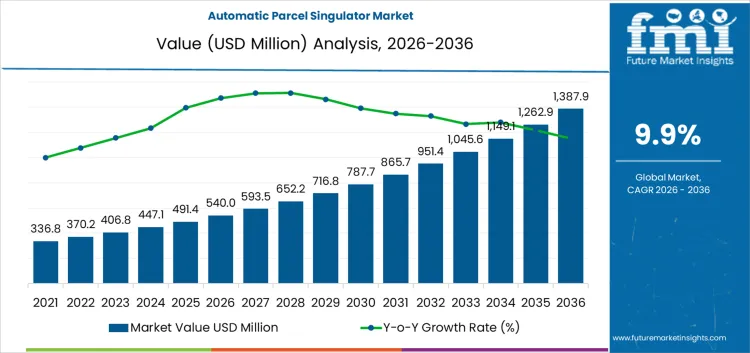
Automatic Parcel Singulator Market Key Takeaways
| Metric | Value |
|---|---|
| Market Value (2026) | USD 540.0 million |
| Market Forecast Value (2036) | USD 1,387.9 million |
| Forecast CAGR 2026 to 2036 | 9.9% |
Why is the Demand for Automatic Parcel Singulator Market Growing?
Demand for automatic parcel singulators is increasing as logistics and fulfillment operators address throughput imbalance between unloading, induction, and sortation stages. Mixed parcel streams entering facilities introduce variability that limits scanning accuracy, reduces sorter efficiency, and increases manual correction requirements. Singulators separate overlapping and randomly oriented parcels into controlled, single-file flows that enable downstream systems to operate within designed performance thresholds. Operators specify singulators to stabilize induction rates, reduce congestion, and maintain predictable processing speeds during volume surges. System performance is evaluated based on separation accuracy, compatibility with parcel size variation, and ability to sustain continuous operation without operator intervention.
Labor availability constraints and ergonomic exposure further reinforce adoption of automated singulation systems. Manual singulation tasks are repetitive and physically demanding, contributing to productivity variability and safety risk. Automated solutions reduce dependence on manual induction while improving consistency of parcel presentation for scanning, weighing, and sorting processes. Advances in sensor feedback, control logic, and modular design allow singulators to adapt to diverse facility layouts and throughput requirements. Integration with existing conveyor system and sortation infrastructure supports phased automation without full system replacement. These operational efficiency and reliability requirements are sustaining demand for automatic parcel singulators across parcel hubs, fulfillment centers, and distribution facilities.
How Are the Segments Classified in the Automatic Parcel Singulator Market?
Demand for automatic parcel singulators is shaped by parcel flow variability, induction rate stability requirements, and compatibility with downstream scanning and sortation systems. Facilities deploy singulators to condition parcel streams before dimensioning, weighing, and sorting stages where alignment and spacing tolerances are critical. Adoption aligns with automated handling environments that process mixed parcel profiles under fixed footprint and throughput constraints. System selection prioritizes separation accuracy, mechanical reliability, and integration compatibility rather than feature breadth. Segment classification reflects differentiation by singulation mechanism, parcel geometry tolerance, and operational end use influencing throughput ceilings, layout flexibility, and system complexity.
Which Technology Type Represents the Largest Share of Demand?
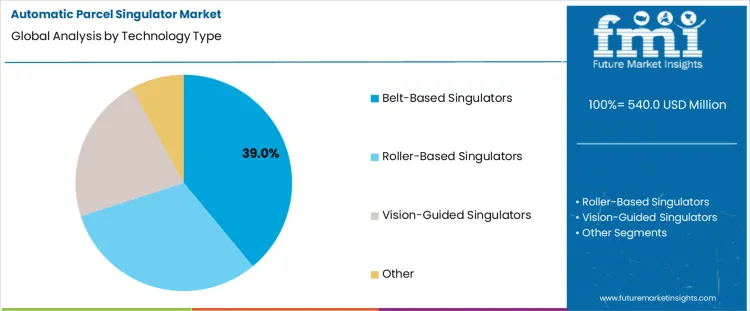
Belt-based singulators hold 39.0%, representing the largest share due to mechanical simplicity and stable performance across variable parcel loads. Continuous belt motion supports controlled acceleration and spacing of parcels with minimal control complexity. These systems tolerate moderate variation in parcel size and surface friction while maintaining predictable flow into scanners and sorters. Lower mechanical wear and straightforward maintenance support sustained operation during peak processing cycles. Roller-based and vision-guided systems address higher variability environments but introduce additional control and integration requirements. Technology segmentation reflects preference for mechanically stable solutions that balance throughput consistency with operational reliability.
Key Points
- Belt systems provide stable spacing with limited control complexity
- Continuous motion supports predictable downstream sorter performance
- Other technologies address higher parcel variability with added system overhead
Which Parcel Size Category Accounts for the Highest Share of Demand?
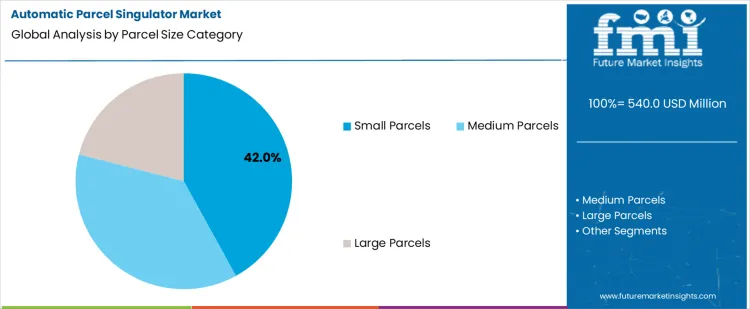
Small parcels account for 42.0%, representing the largest share due to higher handling density and tighter spacing tolerance requirements. Smaller parcels increase induction complexity because overlap and misalignment directly affect scan accuracy and sorter diversion rates. Singulators configured for small parcel handling emphasize precise spacing control and surface friction management. Consistent separation improves barcode readability and reduces recirculation. Medium and large parcels require lower induction density and exhibit greater tolerance for spacing variance. Parcel size segmentation reflects concentration where flow density and misalignment risk impose the greatest operational penalties.
Key Points
- High parcel density increases separation precision requirements
- Small parcels amplify scan and sorter sensitivity to overlap
- Other sizes impose lower spacing control intensity
Which End Use Accounts for the Highest Share of Demand?
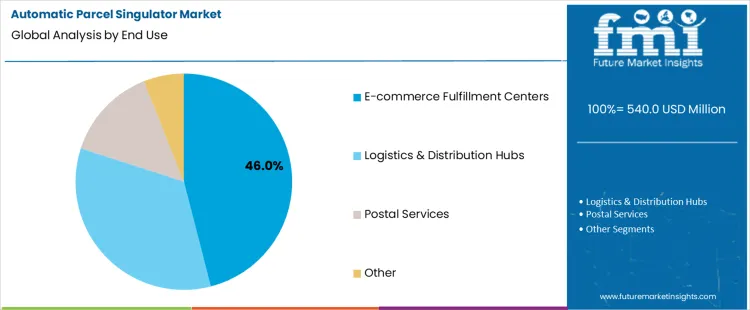
Fulfillment centers account for 46.0%, representing the largest share due to continuous, high-density parcel induction requirements. These facilities process mixed parcel profiles under fixed time windows and limited buffer capacity. Singulators stabilize feed rates into automated sorters, enabling sustained throughput without manual correction. Layout constraints and peak load variability increase reliance on conditioning equipment at induction points. Postal and regional distribution hubs deploy singulators under different flow patterns with lower parcel heterogeneity. End-use segmentation reflects concentration where induction stability directly determines overall system performance.
Key Points
- High-density induction requires consistent parcel conditioning
- Throughput stability limits manual intervention capacity
- Other end uses operate under lower variability conditions
What Are the Key Dynamics in the Automatic Parcel Singulator Market?
Demand dynamics reflect the need to maintain stable throughput across unloading, induction, and sortation stages within automated parcel handling facilities. Singulators address operational imbalance created by random parcel orientation, overlap, and spacing inconsistency. Value formation depends on achievable induction rate, separation accuracy, and compatibility with sorter operating limits. Purchasing decisions align with facility throughput targets, parcel mix characteristics, and available footprint for conditioning equipment.
How Do Induction Stability and Sortation Performance Shape Adoption?
Automated sorters operate within defined spacing, orientation, and speed tolerances. Demand increases where manual induction introduces variability that reduces scan accuracy and diversion reliability. Singulators regulate parcel presentation by separating, aligning, and spacing items before downstream processing. Stable induction reduces jam frequency, recirculation rates, and manual exception handling. Facilities with high parcel diversity rely on singulation to preserve sorter efficiency during sustained peak operation. Adoption reflects the need to protect downstream system performance rather than increase nominal conveyor speed.
How Do System Complexity and Integration Cost Influence Scalability?
Scalability is constrained by integration complexity, layout dependency, and capital cost. Singulators must align mechanically and digitally with upstream unloading and downstream sortation systems. Customization for parcel size range, surface friction, and footprint increases engineering effort and installation time. Maintenance requirements and operator training add to lifecycle cost. Smaller facilities face justification challenges where throughput gains do not offset integration expense. Variability in parcel geometry further limits standardized deployment. These constraints moderate adoption outside high-throughput environments.
How Is Demand for the Automatic Parcel Singulator Market Evolving Globally?
Global demand for automatic parcel singulators is increasing as e-commerce growth drives the need for efficient and automated sorting and handling systems in distribution centers. Expansion reflects logistics sector modernization, increased parcel volumes, and the adoption of Industry 4.0 technologies. Demand growth aligns with the need to optimize operational efficiency, reduce manual labor costs, and improve throughput. China records 12.1% CAGR, India records 11.4% CAGR, the USA records 9.3% CAGR, Germany records 8.6% CAGR, and the UK records 8.1% CAGR. Adoption is driven by the continued rise of e-commerce, supply chain complexity, and technological advancement in parcel handling systems.
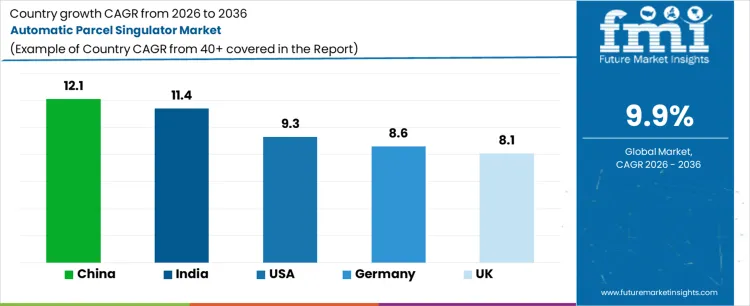
| Country | CAGR (%) |
|---|---|
| China | 12.1% |
| India | 11.4% |
| USA | 9.3% |
| Germany | 8.6% |
| UK | 8.1% |
What is driving growth of automatic parcel singulator demand in China?
Demand for automatic parcel singulators in China is accelerating as e-commerce volume soars and logistics networks modernize. Growth at 12.1% CAGR reflects the rapid expansion of distribution centers, especially in urban areas, to meet the demand for fast, reliable parcel delivery. Automation adoption in logistics is being fueled by labor shortages and the desire to increase sorting speed and accuracy. Government policies supporting the digital economy and infrastructure investment further boost logistics efficiency. China's extensive online retail sector and global export activities are propelling demand for automated parcel handling solutions to streamline operations.
- Soaring e-commerce volume and online retail growth
- Government support for digital infrastructure
- Increased demand for faster parcel processing
- Automation adoption due to labor constraints
Why is India seeing expansion in automatic parcel singulator adoption?
Automatic parcel singulator demand in India is rising as e-commerce penetration grows and logistics infrastructure evolves to handle higher parcel volumes. Growth of 11.4% CAGR reflects the rapid expansion of e-commerce giants and local players, driving the need for automated sorting systems. Retailers and logistics operators are increasingly investing in technology to streamline operations, reduce manual labor, and increase throughput. India’s growing urbanization, expanding middle class, and digital economy contribute to demand. Automation also supports cost reduction in last-mile delivery operations, improving overall efficiency in the supply chain.
- Rapid growth of e-commerce and retail
- Increasing demand for cost-effective logistics solutions
- Infrastructure upgrades in urban areas
- Need for operational efficiency in last-mile delivery
How is the USA supporting growth of automatic parcel singulator demand?
Sales of automatic parcel singulators in the USA are increasing as e-commerce and omnichannel fulfillment continue to reshape distribution networks. Growth of 9.3% CAGR reflects the need for greater automation in sorting systems to keep up with higher parcel volumes, particularly during peak seasons. The USA’s investment in smart warehouses, AI-driven logistics, and robotics is driving the demand for automated parcel handling solutions. Additionally, labor shortages, especially in warehousing and distribution, have further accelerated the adoption of automation. Retailers and 3PL providers are increasingly focused on operational optimization to meet delivery speed expectations.
- Rapid e-commerce and omnichannel expansion
- Investments in AI and robotics for logistics
- Labor shortages pushing for automation adoption
- Focus on improving operational efficiency and throughput
What factors are shaping automatic parcel singulator sales in Germany?
Automatic parcel singulator market demand in Germany is shaped by the need for efficiency and accuracy in parcel sorting systems due to the country’s central role in European logistics. Growth at 8.6% CAGR reflects the adoption of automation across industries such as retail, logistics, and manufacturing. As European e-commerce continues to grow, logistics providers in Germany are investing in advanced technologies to optimize parcel handling processes. Germany’s focus on sustainability and carbon footprint reduction further drives investments in energy-efficient, automated systems. The country's robust infrastructure and advanced manufacturing capabilities support demand for cutting-edge logistics solutions.
- Growth of European e-commerce and cross-border trade
- Focus on sustainability and energy-efficient systems
- Investment in advanced logistics and automation technology
- Germany’s central role in European logistics networks
How is the UK supporting growth of automatic parcel singulator demand?
Demand for automatic parcel singulators in the UK is rising as the need for automation in parcel handling systems increases due to e-commerce growth and fulfillment complexity. Growth of 8.1% CAGR reflects the continuous rise in parcel volumes and the UK's role as a key logistics hub in Europe. Retailers are investing in automated solutions to enhance sorting speed, improve operational efficiency, and meet customer delivery expectations. The growing trend of omnichannel retail, coupled with labor challenges in the logistics sector, is driving the shift toward automation. UK retailers and third-party logistics providers seek scalable systems to handle the increasing volume of online orders.
- Rapid growth in e-commerce and omnichannel retail
- Increased focus on improving delivery speed and efficiency
- Labor shortages in logistics fueling automation adoption
- Investment in scalable and efficient sorting systems
What is the competitive landscape of demand for the automatic parcel singulator market globally?
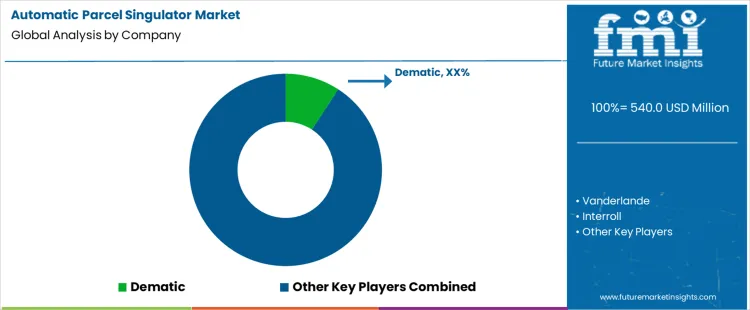
Demand for automatic parcel singulators is driven by increasing parcel flow variability, automation of induction processes, and the need to maintain stable sorter performance within high-throughput parcel handling facilities. Buyers evaluate system throughput, speed, accuracy, flexibility in handling different parcel sizes, integration with existing sorting systems, and space optimization. Procurement behavior emphasizes reliability, scalability, serviceability, and supplier experience in large-scale logistics projects. Purchasing decisions prioritize cost efficiency, system maintenance support, and ability to handle peak demand. Trend in the market reflects the rise of omni-channel distribution, the need for automation in last-mile fulfillment, and growing interest in AI-driven sorting solutions.
Dematic leads competitive positioning through comprehensive automation portfolios, extensive global service infrastructure, and integration capabilities across complex sorting systems. Vanderlande supports demand with high-speed singulation technology, extensive experience in large-scale distribution centers, and global service networks. Interroll competes with modular, flexible solutions catering to both large and small logistics operators, focusing on high throughput and durability. Beumer Group maintains relevance by providing customized singulation systems tailored to specific parcel handling needs in high-performance environments. Murata Machinery participates by offering automation solutions optimized for precision and integration with broader logistics systems. Competitive differentiation depends on throughput efficiency, system integration, reliability under varying parcel volumes, and service support.
Key Players in the Automatic Parcel Singulator Market
- Dematic
- Vanderlande
- Interroll
- Beumer Group
- Murata Machinery
Scope of the Report
| Items | Values |
|---|---|
| Quantitative Units | USD million |
| Technology Type | Belt-Based Singulators; Roller-Based Singulators; Vision-Guided Singulators; Other |
| Parcel Size Category | Small Parcels; Medium Parcels; Large Parcels |
| End Use | E-commerce Fulfillment Centers; Logistics & Distribution Hubs; Postal Services; Other |
| Regions Covered | Asia Pacific, Europe, North America, Latin America, Middle East & Africa |
| Countries Covered | China, India, USA, Germany, UK, and 40+ countries |
| Key Companies Profiled | Dematic; Vanderlande; Interroll; Beumer Group; Murata Machinery |
| Additional Attributes | Dollar sales by technology type, parcel size category, end use, and sales channel; singulation accuracy and throughput efficiency across belt-based, roller-based, and vision-guided systems; scalability and modularity for integration with automated sorting and handling systems; durability under high-volume operational conditions; channel mix influenced by e-commerce growth, logistics network optimization, and postal service modernization projects. |
Automatic Parcel Singulator Market by Segment
Technology Type:
- Belt-Based Singulators
- Roller-Based Singulators
- Vision-Guided Singulators
- Other
Parcel Size Category:
- Small Parcels
- Medium Parcels
- Large Parcels
End Use:
- E-commerce Fulfillment Centers
- Logistics & Distribution Hubs
- Postal Services
- Other
Region:
- Asia Pacific
- China
- Japan
- South Korea
- India
- Australia & New Zealand
- ASEAN
- Rest of Asia Pacific
- Europe
- Germany
- United Kingdom
- France
- Italy
- Spain
- Nordic
- BENELUX
- Rest of Europe
- North America
- United States
- Canada
- Mexico
- Latin America
- Brazil
- Chile
- Rest of Latin America
- Middle East & Africa
- Kingdom of Saudi Arabia
- Other GCC Countries
- Turkey
- South Africa
- Other African Union
- Rest of Middle East & Africa
Bibliography
- International Organization for Standardization. (2023). Safety of machinery—Safety-related parts of control systems—Part 1: General principles for design (ISO Standard No. 13849-1:2023). International Organization for Standardization.
- PMMI, The Association for Packaging and Processing Technologies. (2023). Safety requirements for packaging and processing machinery (ANSI/PMMI Standard No. B155.1-2023). PMMI.
- International Transport Forum. (2023). Adapting (to) automation: Transport workforce in transition. OECD Publishing.
Frequently Asked Questions
How big is the automatic parcel singulator market in 2026?
The global automatic parcel singulator market is estimated to be valued at USD 540.0 million in 2026.
What will be the size of automatic parcel singulator market in 2036?
The market size for the automatic parcel singulator market is projected to reach USD 1,387.9 million by 2036.
How much will be the automatic parcel singulator market growth between 2026 and 2036?
The automatic parcel singulator market is expected to grow at a 9.9% CAGR between 2026 and 2036.
What are the key product types in the automatic parcel singulator market?
The key product types in automatic parcel singulator market are belt-based singulators, roller-based singulators, vision-guided singulators and other.
Which parcel size category segment to contribute significant share in the automatic parcel singulator market in 2026?
In terms of parcel size category, small parcels segment to command 42.0% share in the automatic parcel singulator market in 2026.
Preview the report firsthand - request a free sample
Get SampleGet the brochure for pricing and purchase details.
Get PDFTable of Content
- Executive Summary
- Global Market Outlook
- Demand-side Trends
- Supply-side Trends
- Technology Roadmap Analysis
- Analysis and Recommendations
- Market Overview
- Market Coverage / Taxonomy
- Market Definition / Scope / Limitations
- Market Background
- Market Dynamics
- Drivers
- Restraints
- Opportunity
- Trends
- Scenario Forecast
- Demand in Optimistic Scenario
- Demand in Likely Scenario
- Demand in Conservative Scenario
- Opportunity Map Analysis
- Product Life Cycle Analysis
- Supply Chain Analysis
- Investment Feasibility Matrix
- Value Chain Analysis
- PESTLE and Porter’s Analysis
- Regulatory Landscape
- Regional Parent Market Outlook
- Production and Consumption Statistics
- Import and Export Statistics
- Market Dynamics
- Global Market Analysis 2021 to 2025 and Forecast, 2026 to 2036
- Historical Market Size Value (USD Million) Analysis, 2021 to 2025
- Current and Future Market Size Value (USD Million) Projections, 2026 to 2036
- Y-o-Y Growth Trend Analysis
- Absolute $ Opportunity Analysis
- Global Market Pricing Analysis 2021 to 2025 and Forecast 2026 to 2036
- Global Market Analysis 2021 to 2025 and Forecast 2026 to 2036, By Technology Type
- Introduction / Key Findings
- Historical Market Size Value (USD Million) Analysis By Technology Type, 2021 to 2025
- Current and Future Market Size Value (USD Million) Analysis and Forecast By Technology Type, 2026 to 2036
- Belt-Based Singulators
- Roller-Based Singulators
- Vision-Guided Singulators
- Other
- Belt-Based Singulators
- Y-o-Y Growth Trend Analysis By Technology Type, 2021 to 2025
- Absolute $ Opportunity Analysis By Technology Type, 2026 to 2036
- Global Market Analysis 2021 to 2025 and Forecast 2026 to 2036, By Parcel Size Category
- Introduction / Key Findings
- Historical Market Size Value (USD Million) Analysis By Parcel Size Category, 2021 to 2025
- Current and Future Market Size Value (USD Million) Analysis and Forecast By Parcel Size Category, 2026 to 2036
- Small Parcels
- Medium Parcels
- Large Parcels
- Small Parcels
- Y-o-Y Growth Trend Analysis By Parcel Size Category, 2021 to 2025
- Absolute $ Opportunity Analysis By Parcel Size Category, 2026 to 2036
- Global Market Analysis 2021 to 2025 and Forecast 2026 to 2036, By End Use
- Introduction / Key Findings
- Historical Market Size Value (USD Million) Analysis By End Use, 2021 to 2025
- Current and Future Market Size Value (USD Million) Analysis and Forecast By End Use, 2026 to 2036
- E-commerce Fulfillment Centers
- Logistics & Distribution Hubs
- Postal Services
- Other
- E-commerce Fulfillment Centers
- Y-o-Y Growth Trend Analysis By End Use, 2021 to 2025
- Absolute $ Opportunity Analysis By End Use, 2026 to 2036
- Global Market Analysis 2021 to 2025 and Forecast 2026 to 2036, By Region
- Introduction
- Historical Market Size Value (USD Million) Analysis By Region, 2021 to 2025
- Current Market Size Value (USD Million) Analysis and Forecast By Region, 2026 to 2036
- North America
- Latin America
- Western Europe
- Eastern Europe
- East Asia
- South Asia and Pacific
- Middle East & Africa
- Market Attractiveness Analysis By Region
- North America Market Analysis 2021 to 2025 and Forecast 2026 to 2036, By Country
- Historical Market Size Value (USD Million) Trend Analysis By Market Taxonomy, 2021 to 2025
- Market Size Value (USD Million) Forecast By Market Taxonomy, 2026 to 2036
- By Country
- USA
- Canada
- Mexico
- By Technology Type
- By Parcel Size Category
- By End Use
- By Country
- Market Attractiveness Analysis
- By Country
- By Technology Type
- By Parcel Size Category
- By End Use
- Key Takeaways
- Latin America Market Analysis 2021 to 2025 and Forecast 2026 to 2036, By Country
- Historical Market Size Value (USD Million) Trend Analysis By Market Taxonomy, 2021 to 2025
- Market Size Value (USD Million) Forecast By Market Taxonomy, 2026 to 2036
- By Country
- Brazil
- Chile
- Rest of Latin America
- By Technology Type
- By Parcel Size Category
- By End Use
- By Country
- Market Attractiveness Analysis
- By Country
- By Technology Type
- By Parcel Size Category
- By End Use
- Key Takeaways
- Western Europe Market Analysis 2021 to 2025 and Forecast 2026 to 2036, By Country
- Historical Market Size Value (USD Million) Trend Analysis By Market Taxonomy, 2021 to 2025
- Market Size Value (USD Million) Forecast By Market Taxonomy, 2026 to 2036
- By Country
- Germany
- UK
- Italy
- Spain
- France
- Nordic
- BENELUX
- Rest of Western Europe
- By Technology Type
- By Parcel Size Category
- By End Use
- By Country
- Market Attractiveness Analysis
- By Country
- By Technology Type
- By Parcel Size Category
- By End Use
- Key Takeaways
- Eastern Europe Market Analysis 2021 to 2025 and Forecast 2026 to 2036, By Country
- Historical Market Size Value (USD Million) Trend Analysis By Market Taxonomy, 2021 to 2025
- Market Size Value (USD Million) Forecast By Market Taxonomy, 2026 to 2036
- By Country
- Russia
- Poland
- Hungary
- Balkan & Baltic
- Rest of Eastern Europe
- By Technology Type
- By Parcel Size Category
- By End Use
- By Country
- Market Attractiveness Analysis
- By Country
- By Technology Type
- By Parcel Size Category
- By End Use
- Key Takeaways
- East Asia Market Analysis 2021 to 2025 and Forecast 2026 to 2036, By Country
- Historical Market Size Value (USD Million) Trend Analysis By Market Taxonomy, 2021 to 2025
- Market Size Value (USD Million) Forecast By Market Taxonomy, 2026 to 2036
- By Country
- China
- Japan
- South Korea
- By Technology Type
- By Parcel Size Category
- By End Use
- By Country
- Market Attractiveness Analysis
- By Country
- By Technology Type
- By Parcel Size Category
- By End Use
- Key Takeaways
- South Asia and Pacific Market Analysis 2021 to 2025 and Forecast 2026 to 2036, By Country
- Historical Market Size Value (USD Million) Trend Analysis By Market Taxonomy, 2021 to 2025
- Market Size Value (USD Million) Forecast By Market Taxonomy, 2026 to 2036
- By Country
- India
- ASEAN
- Australia & New Zealand
- Rest of South Asia and Pacific
- By Technology Type
- By Parcel Size Category
- By End Use
- By Country
- Market Attractiveness Analysis
- By Country
- By Technology Type
- By Parcel Size Category
- By End Use
- Key Takeaways
- Middle East & Africa Market Analysis 2021 to 2025 and Forecast 2026 to 2036, By Country
- Historical Market Size Value (USD Million) Trend Analysis By Market Taxonomy, 2021 to 2025
- Market Size Value (USD Million) Forecast By Market Taxonomy, 2026 to 2036
- By Country
- Kingdom of Saudi Arabia
- Other GCC Countries
- Turkiye
- South Africa
- Other African Union
- Rest of Middle East & Africa
- By Technology Type
- By Parcel Size Category
- By End Use
- By Country
- Market Attractiveness Analysis
- By Country
- By Technology Type
- By Parcel Size Category
- By End Use
- Key Takeaways
- Key Countries Market Analysis
- USA
- Pricing Analysis
- Market Share Analysis, 2025
- By Technology Type
- By Parcel Size Category
- By End Use
- Canada
- Pricing Analysis
- Market Share Analysis, 2025
- By Technology Type
- By Parcel Size Category
- By End Use
- Mexico
- Pricing Analysis
- Market Share Analysis, 2025
- By Technology Type
- By Parcel Size Category
- By End Use
- Brazil
- Pricing Analysis
- Market Share Analysis, 2025
- By Technology Type
- By Parcel Size Category
- By End Use
- Chile
- Pricing Analysis
- Market Share Analysis, 2025
- By Technology Type
- By Parcel Size Category
- By End Use
- Germany
- Pricing Analysis
- Market Share Analysis, 2025
- By Technology Type
- By Parcel Size Category
- By End Use
- UK
- Pricing Analysis
- Market Share Analysis, 2025
- By Technology Type
- By Parcel Size Category
- By End Use
- Italy
- Pricing Analysis
- Market Share Analysis, 2025
- By Technology Type
- By Parcel Size Category
- By End Use
- Spain
- Pricing Analysis
- Market Share Analysis, 2025
- By Technology Type
- By Parcel Size Category
- By End Use
- France
- Pricing Analysis
- Market Share Analysis, 2025
- By Technology Type
- By Parcel Size Category
- By End Use
- India
- Pricing Analysis
- Market Share Analysis, 2025
- By Technology Type
- By Parcel Size Category
- By End Use
- ASEAN
- Pricing Analysis
- Market Share Analysis, 2025
- By Technology Type
- By Parcel Size Category
- By End Use
- Australia & New Zealand
- Pricing Analysis
- Market Share Analysis, 2025
- By Technology Type
- By Parcel Size Category
- By End Use
- China
- Pricing Analysis
- Market Share Analysis, 2025
- By Technology Type
- By Parcel Size Category
- By End Use
- Japan
- Pricing Analysis
- Market Share Analysis, 2025
- By Technology Type
- By Parcel Size Category
- By End Use
- South Korea
- Pricing Analysis
- Market Share Analysis, 2025
- By Technology Type
- By Parcel Size Category
- By End Use
- Russia
- Pricing Analysis
- Market Share Analysis, 2025
- By Technology Type
- By Parcel Size Category
- By End Use
- Poland
- Pricing Analysis
- Market Share Analysis, 2025
- By Technology Type
- By Parcel Size Category
- By End Use
- Hungary
- Pricing Analysis
- Market Share Analysis, 2025
- By Technology Type
- By Parcel Size Category
- By End Use
- Kingdom of Saudi Arabia
- Pricing Analysis
- Market Share Analysis, 2025
- By Technology Type
- By Parcel Size Category
- By End Use
- Turkiye
- Pricing Analysis
- Market Share Analysis, 2025
- By Technology Type
- By Parcel Size Category
- By End Use
- South Africa
- Pricing Analysis
- Market Share Analysis, 2025
- By Technology Type
- By Parcel Size Category
- By End Use
- USA
- Market Structure Analysis
- Competition Dashboard
- Competition Benchmarking
- Market Share Analysis of Top Players
- By Regional
- By Technology Type
- By Parcel Size Category
- By End Use
- Competition Analysis
- Competition Deep Dive
- Dematic
- Overview
- Product Portfolio
- Profitability by Market Segments (Product/Age /Sales Channel/Region)
- Sales Footprint
- Strategy Overview
- Marketing Strategy
- Product Strategy
- Channel Strategy
- Vanderlande
- Interroll
- Beumer Group
- Murata Machinery
- Dematic
- Competition Deep Dive
- Assumptions & Acronyms Used
- Research Methodology


