

- Industry Size (2026)
- USD 2.3 Bn
- Forecast (2036)
- USD 4.0 Bn
- CAGR (2026 to 2036)
- 5.70%
Automatic Reversing Mill Market Forecast and Outlook 2026 to 2036
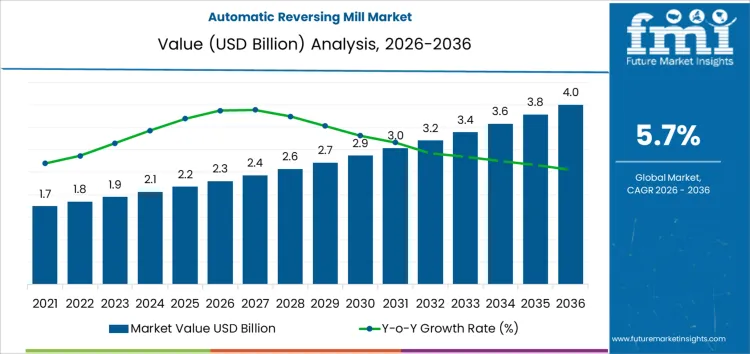
The automatic reversing mill market is forecast to reach USD 4.0 billion by 2036 from USD 2.3 billion in 2026, expanding at a CAGR of 5.70%.Between 2026 and 2036, performance within the automatic reversing mill market is shaped less by shipment volumes and more by how costs, pricing authority, and service intensity are managed across the value chain. Capital expenditure remains heavily front-loaded, with mill stands, drive systems, and automation accounting for the largest cost blocks. Value capture increasingly concentrates among suppliers that bundle proprietary automation, control software, and long-term modernization packages, allowing tighter pricing discipline and recurring margins.
Hardware-only suppliers face margin compression due to customization costs and competitive bidding. Profit pools also shift toward lifecycle services, upgrades, and digital optimization tools, where switching costs are higher and buyer dependency increases over time. As steel producers prioritize yield stability and energy efficiency, suppliers controlling intellectual property, system integration, and post-installation optimization retain stronger pricing leverage and capture a disproportionate share of market value over the forecast period.
Quick Stats for Automatic Reversing Mill Market
- Automatic Reversing Mill Market Value (2026): USD 2.3 Billion
- Automatic Reversing Mill Market Forecast Value (2036): USD 4.0 Billion
- Automatic Reversing Mill Market Forecast CAGR 2026 to 2036: 5.70%
- Leading Type of Automatic Reversing Mill: Two-Stand Reversing Mills (48% share)
- Key Growth Regions in Automatic Reversing Mill Market: Asia Pacific, Europe, North America, Latin America, Middle East & Africa
- Top Key Players in Automatic Reversing Mill Market: ANDRITZ AG, SMS group GmbH, Primetals Technologies Ltd., Danieli & C. Officine Meccaniche S.p.A., Tenova S.p.A., John Cockerill Group, Fagor Arrasate S.Coop., MINO S.p.A., IHI Corporation
Automatic Reversing Mill Market Key Takeaways
| Metric | Value |
|---|---|
| Automatic Reversing Mill Market Value (2026) | USD 2.3 Billion |
| Automatic Reversing Mill Market Forecast Value (2036) | USD 4.0 Billion |
| Automatic Reversing Mill Market Forecast CAGR 2026 to 2036 | 5.70% |
Why Is the Automatic Reversing Mill Market Growing?
The automatic reversing mill market is growing due to rising demand for high-precision rolling equipment across steel, aluminum, and specialty metal processing industries. Increasing consumption of flat and long metal products in construction, automotive, shipbuilding, and heavy machinery manufacturing is driving investments in advanced rolling mills. Automatic reversing mills enable flexible thickness control, improved surface finish, and efficient processing of slabs and plates, making them suitable for both primary and secondary metal production facilities. This versatility supports their adoption across a wide range of production capacities.
Growth is further supported by modernization and capacity expansion initiatives in existing rolling plants. Manufacturers are upgrading conventional mills to automatic reversing systems to improve productivity, reduce manual intervention, and enhance operational consistency. Integration of automation, digital controls, and real-time monitoring systems allows operators to optimize rolling parameters, minimize material wastage, and improve yield rates. These operational advantages are encouraging replacement demand, particularly in mature industrial regions with aging infrastructure.
Emerging economies are also contributing to market expansion through increased capital expenditure in steel and non-ferrous metal manufacturing. Infrastructure development, urbanization, and industrialization are driving new rolling mill installations in Asia Pacific, the Middle East, and Latin America. Stricter quality standards and energy efficiency requirements are pushing manufacturers toward technologically advanced equipment. Together, sustained end-use demand, plant upgrades, and regional capacity additions are supporting steady growth of the Automatic Reversing Mill Market over the forecast period.
What Is The Segment Overview Of The Automatic Reversing Mill Market?
The automatic reversing mill market is segmented by type and application, with clear dominance of specific categories. By type, two-stand reversing mills account for 48% share, reflecting widespread adoption in flexible rolling operations and medium-capacity steel plants, while four-stand reversing mills and six-stand reversing mills support higher rolling loads and precision-driven production requirements. By application, automotive steel processing leads with approximately 41% share, driven by demand for flat steel and high-strength grades, alongside appliances and white goods, construction and infrastructure, electrical and packaging steel, and other industrial applications that collectively sustain diversified demand.
Why Do Two-Stand Reversing Mills Lead The Automatic Reversing Mill Market By Type?
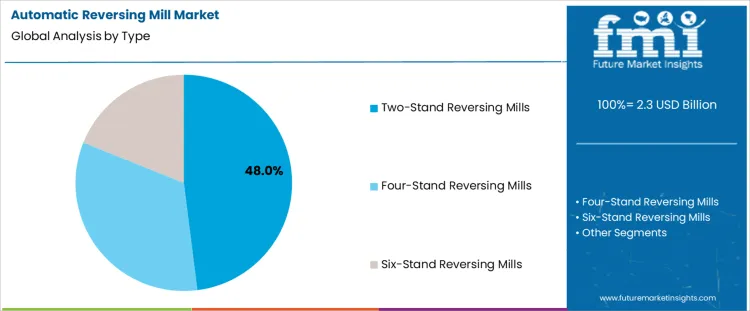
Two-stand reversing mills lead the automatic reversing mill market with 48% share because they offer a practical balance between flexibility and investment efficiency. These mills accommodate frequent changes in slab dimensions and steel grades, which supports diversified production schedules. Steel producers use two-stand reversing mills to roll carbon steel and standard alloy grades for construction, automotive supply chains, and industrial equipment. Automation enables precise pass control, stable rolling speed, and consistent thickness accuracy. Lower installation complexity and reduced maintenance requirements improve operational reliability. These factors explain why two-stand reversing mills remain the most widely adopted configuration across global rolling facilities.
How Does Automotive Steel Processing Dominate The Application Segment?
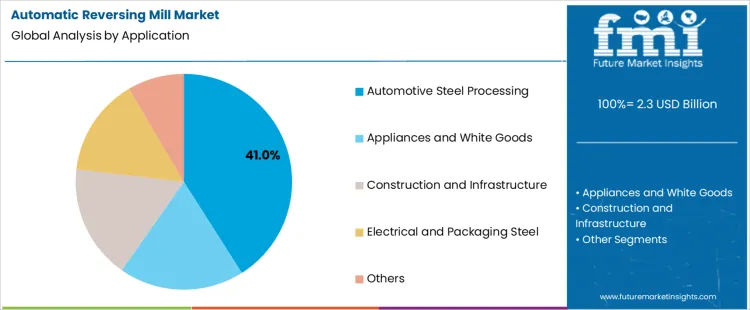
Automotive steel processing dominates the automatic reversing mill market with 41% share through sustained demand for flat steel products requiring strict dimensional tolerances. Automatic reversing mills convert slabs into sheets and plates used in vehicle body panels, chassis components, and structural reinforcements. Controlled rolling processes support production of high-strength and formable steel grades essential for modern vehicle design. Automation improves surface quality and consistency, which supports efficient downstream stamping and forming operations. Expansion of electric vehicle manufacturing increases demand for specialized steel used in battery housings and safety structures. These production requirements reinforce automotive steel processing leadership.
What Are The Key Dynamics Of The Automatic Reversing Mill Market?
The automatic reversing mill market is shaped by demand for flexible rolling operations, precision thickness control, and cost-efficient production of plates, sheets, and strips. Steel producers prefer automatic reversing mill systems for their ability to process varied slab sizes and alloy grades using a single mill configuration. Capital investment cycles in the primary metals industry, modernization of aging rolling lines, and automation intensity directly influence demand patterns. Regional steel capacity expansion and replacement of manual rolling systems continue to determine competitive positioning within the automatic reversing mill market.
How Are Technology Advancements Influencing The Automatic Reversing Mill Market?
Technology advancements are reshaping the automatic reversing mill market through wider adoption of advanced automation, closed-loop thickness control, and real-time shape correction systems. Steel producers are integrating PLC-based control platforms with AI-driven setup models to improve rolling accuracy, stabilize product quality, and reduce scrap generation. Digital twin applications are increasingly used to simulate rolling passes, predict roll force behavior, and optimize mill parameters before production. Energy-efficient main drives, regenerative braking systems, and optimized hydraulic controls are being deployed to lower power consumption. These developments collectively enhance throughput, reduce operating costs, and improve production consistency across automatic reversing mill installations.
Why Do Capital And Operational Constraints Challenge The Automatic Reversing Mill Market?
Capital and operational constraints continue to challenge growth in the automatic reversing mill market, particularly among small and mid-sized steel producers. High upfront investment requirements for mill stands, automation systems, and auxiliary equipment restrict faster adoption. Installation complexity and long commissioning timelines disrupt production schedules and impact cash flow planning. Skilled manpower requirements for automation calibration, software integration, and ongoing maintenance increase operating expenditure. Cyclical fluctuations in steel demand result in deferred capital spending decisions. Integration of automatic reversing mill systems into legacy rolling lines often faces space limitations, electrical incompatibility, and downtime risks, slowing retrofit activity.
What is the Country-Wise Outlook of the Automatic Reversing Mill Market?
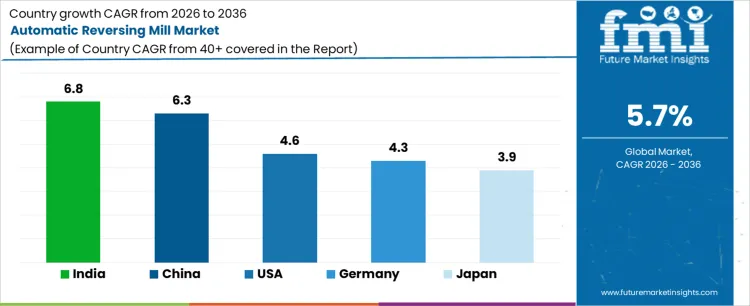
Demand for automatic reversing mill market equipment varies across countries based on steel production capacity, modernization cycles, and capital investment intensity. Asia Pacific remains the primary growth region, led by China and India, while North America and Europe exhibit steady replacement-driven demand. China is projected to expand at a CAGR of 6.3% between 2026 and 2036, supported by large-scale industrial output and mill upgrades. India follows with a CAGR of 6.8% due to new steel capacity additions. The United States, Germany, and Japan are expected to grow at 4.6%, 4.3%, and 3.9%, respectively, reflecting mature but stable industrial environments.
| Country | CAGR (%) |
|---|---|
| China | 6.3% |
| India | 6.8% |
| USA | 4.6% |
| Germany | 4.3% |
| Japan | 3.9% |
How Is Demand for Automatic Reversing Mill Equipment Shaping Growth in China?
Demand for automatic reversing mill equipment in China, expanding at a CAGR of 6.3% during 2026 to 2036, is driven by continuous modernization of large-scale steel and metal processing facilities. The automatic reversing mill market in China benefits from replacement of legacy rolling mills alongside selective capacity upgrades in flat and long product manufacturing. Steel producers are focusing on improving throughput, thickness control, and operational efficiency to sustain high-volume output. Industrial consolidation and efficiency-oriented policies are encouraging adoption of advanced reversing mill configurations. Export-focused manufacturers also contribute to steady equipment demand, as dimensional accuracy and process consistency remain critical for global competitiveness. Localized engineering capabilities and domestic manufacturing reduce procurement lead times and cost pressures. These factors collectively support strong volume contribution and sustained investment momentum in the automatic reversing mill market in China over the forecast period.
Why Are Sales of Automatic Reversing Mill Solutions Increasing in India?
Sales of automatic reversing mill solutions in India, growing at a CAGR of 6.8% from 2026 to 2036, are supported by rapid expansion of domestic steel production capacity. The automatic reversing mill market in India is driven by new plant installations and brownfield expansions across primary and secondary steel producers. Infrastructure development, urban construction activity, and industrial manufacturing growth are increasing steel consumption, strengthening upstream equipment demand. Manufacturers favor flexible mill configurations capable of processing varied product grades and batch sizes. Policy support for domestic manufacturing and capital goods investment improves procurement confidence among producers. The rising presence of regional equipment suppliers is also improving accessibility. These factors position India as the fastest-growing country within the automatic reversing mill market during the forecast period.
What Is Driving Demand for Automatic Reversing Mill Equipment in the USA?
Demand for automatic reversing mill equipment in the USA, registering a CAGR of 4.6% between 2026 and 2036, is primarily linked to modernization of existing steel manufacturing infrastructure. The automatic reversing mill market in the USA is characterized by replacement-driven procurement as producers upgrade aging mills. Investments focus on automation compatibility, precision control, and energy efficiency improvements. Capital expenditure decisions emphasize long-term reliability and compliance with operational standards. Reshoring initiatives and supply chain resilience strategies are contributing to incremental upgrades across specialty steel facilities. Limited greenfield capacity additions keep volume growth moderate. As a result, the automatic reversing mill market in the USA reflects steady, value-oriented expansion supported by modernization cycles rather than large-scale capacity growth.
How Does Germany Sustain Stable Sales of Automatic Reversing Mill Equipment?
Sales of automatic reversing mill equipment in Germany, expanding at a CAGR of 4.3% over the forecast period, are sustained through disciplined replacement cycles across mature steel and metal processing industries. The automatic reversing mill market in Germany is influenced by strong emphasis on engineering precision and production consistency. Manufacturers prioritize efficiency enhancement, dimensional accuracy, and process optimization rather than capacity expansion. Investments are incremental and focused on upgrading existing mills to meet quality and energy efficiency standards. Export-oriented steel production supports continued demand, as high-specification output is essential for international competitiveness. Long equipment lifecycles and structured capital planning limit rapid growth. Consequently, Germany maintains stable but moderate expansion in the automatic reversing mill market.
Why Is Demand for Automatic Reversing Mill Equipment Moderate in Japan?
Demand for automatic reversing mill equipment in Japan, expanding at a CAGR of 3.9% during 2026 to 2036, reflects a mature industrial base and conservative capital investment behavior. The automatic reversing mill market in Japan is driven mainly by refurbishment and selective technology upgrades in existing steel facilities. Manufacturers emphasize operational stability, reliability, and precision, leading to extended replacement cycles. Limited new capacity additions and ongoing industry consolidation restrict volume expansion. Sustained focus on high-quality steel grades ensures recurring baseline equipment demand. Investments are directed toward performance enhancement rather than scale expansion. These factors result in steady but slower growth, positioning Japan as a stable market within the automatic reversing mill market landscape.
How Are Leading OEMs Competing in the Automatic Reversing Mill Market?
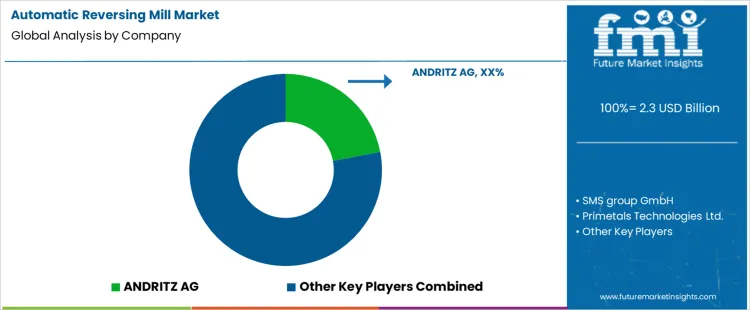
Competition in the automatic reversing mill market is shaped by product-led differentiation anchored in official rolling mill portfolios. ANDRITZ AG positions itself through heavy-plate and Steckel mill reversing solutions designed for wide thickness ranges and high-load operation. Emphasis is placed on modular mill stands, robust drive systems, and automation packages aligned with plate, stainless steel, and special steel rolling. SMS group GmbH competes through advanced reversing cold and hot mill configurations integrated with Level 1 and Level 2 automation. Product brochures highlight gauge control, rolling force optimization, and digital mill models aimed at yield consistency. Primetals Technologies Ltd. differentiates via compact reversing mill designs supported by intelligent drives, process visualization tools, and condition-based maintenance modules.
Strategic competition is reinforced through application-specific customization. Danieli & C. Officine Meccaniche S.p.A. focuses on energy-efficient reversing mills for carbon and alloy steel producers, with brochures stressing reduced passes and optimized roll changing systems. Tenova S.p.A. advances through integrated furnace-to-mill solutions where reversing mills are paired with reheating and automation platforms. John Cockerill Group emphasizes long-life mechanical design and modernization kits, positioning reversing mills as upgrade-friendly assets for legacy plants.
Niche specialization defines the competitive edge of mid-sized suppliers. Fagor Arrasate S.Coop. targets flexible reversing mills for medium-capacity strip and plate rolling, promoted through compact layouts and rapid setup capabilities. MINO S.p.A. competes on precision reversing mills for stainless steel and non-ferrous applications, with brochures highlighting surface quality control. IHI Corporation leverages heavy-duty engineering expertise, positioning reversing mills for high-force industrial environments. Across players, competition is driven by brochure-backed performance metrics, automation depth, and lifecycle efficiency rather than price-led positioning.
Key Players in Automatic Reversing Mill Market
- ANDRITZ AG
- SMS group GmbH
- Primetals Technologies Ltd.
- Danieli & C. Officine Meccaniche S.p.A.
- Tenova S.p.A.
- John Cockerill Group
- Fagor Arrasate S.Coop.
- MINO S.p.A.
- IHI Corporation
Scope of Report
| Attribute | Description |
|---|---|
| Quantitative Unit | USD Billion |
| Type | Two-Stand Reversing Mills, Four-Stand Reversing Mills, Six-Stand Reversing Mills |
| Application | Automotive Steel Processing, Appliances and White Goods, Construction and Infrastructure, Electrical and Packaging Steel, Others |
| Countries Covered | China, Japan, South Korea, India, Australia & New Zealand, ASEAN, Rest of Asia Pacific, Germany, United Kingdom, France, Italy, Spain, Nordic, BENELUX, Rest of Europe, United States, Canada, Mexico, Brazil, Chile, Rest of Latin America, Kingdom of Saudi Arabia, Other GCC Countries, Turkey, South Africa, Other African Union, Rest of Middle East & Africa |
| Regions Covered | Asia Pacific, Europe, North America, Latin America, Middle East & Africa |
| Key Companies Profiled | ANDRITZ AG, SMS group GmbH, Primetals Technologies Ltd., Danieli & C. Officine Meccaniche S.p.A., Tenova S.p.A., John Cockerill Group, Fagor Arrasate S.Coop., MINO S.p.A., IHI Corporation |
| Additional Attributes | Dollar sales by type and application are evaluated across key steel processing end uses, supported by country-level demand analysis. The report includes growth projections, assessment of automation and control technology adoption, competitive benchmarking of major suppliers, pricing influence of system integration, and analysis of lifecycle services contributing to long-term revenue generation. |
Automatic Reversing Mill Market by Key Segments
Type
- Two-Stand Reversing Mills
- Four-Stand Reversing Mills
- Six-Stand Reversing Mills
Application
- Automotive Steel Processing
- Appliances and White Goods
- Construction and Infrastructure
- Electrical and Packaging Steel
- Others
Region:
- Asia Pacific
- China
- Japan
- South Korea
- India
- Australia & New Zealand
- ASEAN
- Rest of Asia Pacific
- Europe
- Germany
- United Kingdom
- France
- Italy
- Spain
- Nordic
- BENELUX
- Rest of Europe
- North America
- United States
- Canada
- Mexico
- Latin America
- Brazil
- Chile
- Rest of Latin America
- Middle East & Africa
- Kingdom of Saudi Arabia
- Other GCC Countries
- Turkey
- South Africa
- Other African Union
- Rest of Middle East & Africa
Bibliography
- Organisation for Economic Co-operation and Development. (2024). Latest developments in steelmaking capacity and outlook until 2026. OECD.
- Organisation for Economic Co-operation and Development. (2025). OECD steel outlook 2025: Trends, capacity and overcapacity dynamics. OECD Publishing.
- International Energy Agency. (2025). Breakthrough agenda report 2025: Steel sector analysis. IEA.
Frequently Asked Questions
How big is the automatic reversing mill market in 2026?
The global automatic reversing mill market is estimated to be valued at USD 2.3 billion in 2026.
What will be the size of automatic reversing mill market in 2036?
The market size for the automatic reversing mill market is projected to reach USD 4.0 billion by 2036.
How much will be the automatic reversing mill market growth between 2026 and 2036?
The automatic reversing mill market is expected to grow at a 5.7% CAGR between 2026 and 2036.
What are the key product types in the automatic reversing mill market?
The key product types in automatic reversing mill market are two-stand reversing mills, four-stand reversing mills and six-stand reversing mills.
Which application segment to contribute significant share in the automatic reversing mill market in 2026?
In terms of application, automotive steel processing segment to command 41.0% share in the automatic reversing mill market in 2026.
Preview the report firsthand - request a free sample
Get SampleGet the brochure for pricing and purchase details.
Get PDFTable of Content
- Executive Summary
- Global Market Outlook
- Demand-side Trends
- Supply-side Trends
- Technology Roadmap Analysis
- Analysis and Recommendations
- Market Overview
- Market Coverage / Taxonomy
- Market Definition / Scope / Limitations
- Market Background
- Market Dynamics
- Drivers
- Restraints
- Opportunity
- Trends
- Scenario Forecast
- Demand in Optimistic Scenario
- Demand in Likely Scenario
- Demand in Conservative Scenario
- Opportunity Map Analysis
- Product Life Cycle Analysis
- Supply Chain Analysis
- Investment Feasibility Matrix
- Value Chain Analysis
- PESTLE and Porter’s Analysis
- Regulatory Landscape
- Regional Parent Market Outlook
- Production and Consumption Statistics
- Import and Export Statistics
- Market Dynamics
- Global Market Analysis 2021 to 2025 and Forecast, 2026 to 2036
- Historical Market Size Value (USD Million) Analysis, 2021 to 2025
- Current and Future Market Size Value (USD Million) Projections, 2026 to 2036
- Y-o-Y Growth Trend Analysis
- Absolute $ Opportunity Analysis
- Global Market Pricing Analysis 2021 to 2025 and Forecast 2026 to 2036
- Global Market Analysis 2021 to 2025 and Forecast 2026 to 2036, By Type
- Introduction / Key Findings
- Historical Market Size Value (USD Million) Analysis By Type , 2021 to 2025
- Current and Future Market Size Value (USD Million) Analysis and Forecast By Type , 2026 to 2036
- Two-Stand Reversing Mills
- Four-Stand Reversing Mills
- Six-Stand Reversing Mills
- Two-Stand Reversing Mills
- Y-o-Y Growth Trend Analysis By Type , 2021 to 2025
- Absolute $ Opportunity Analysis By Type , 2026 to 2036
- Global Market Analysis 2021 to 2025 and Forecast 2026 to 2036, By Application
- Introduction / Key Findings
- Historical Market Size Value (USD Million) Analysis By Application, 2021 to 2025
- Current and Future Market Size Value (USD Million) Analysis and Forecast By Application, 2026 to 2036
- Automotive Steel Processing
- Appliances and White Goods
- Construction and Infrastructure
- Electrical and Packaging Steel
- Others
- Automotive Steel Processing
- Y-o-Y Growth Trend Analysis By Application, 2021 to 2025
- Absolute $ Opportunity Analysis By Application, 2026 to 2036
- Global Market Analysis 2021 to 2025 and Forecast 2026 to 2036, By Region
- Introduction
- Historical Market Size Value (USD Million) Analysis By Region, 2021 to 2025
- Current Market Size Value (USD Million) Analysis and Forecast By Region, 2026 to 2036
- North America
- Latin America
- Western Europe
- Eastern Europe
- East Asia
- South Asia and Pacific
- Middle East & Africa
- Market Attractiveness Analysis By Region
- North America Market Analysis 2021 to 2025 and Forecast 2026 to 2036, By Country
- Historical Market Size Value (USD Million) Trend Analysis By Market Taxonomy, 2021 to 2025
- Market Size Value (USD Million) Forecast By Market Taxonomy, 2026 to 2036
- By Country
- USA
- Canada
- Mexico
- By Type
- By Application
- By Country
- Market Attractiveness Analysis
- By Country
- By Type
- By Application
- Key Takeaways
- Latin America Market Analysis 2021 to 2025 and Forecast 2026 to 2036, By Country
- Historical Market Size Value (USD Million) Trend Analysis By Market Taxonomy, 2021 to 2025
- Market Size Value (USD Million) Forecast By Market Taxonomy, 2026 to 2036
- By Country
- Brazil
- Chile
- Rest of Latin America
- By Type
- By Application
- By Country
- Market Attractiveness Analysis
- By Country
- By Type
- By Application
- Key Takeaways
- Western Europe Market Analysis 2021 to 2025 and Forecast 2026 to 2036, By Country
- Historical Market Size Value (USD Million) Trend Analysis By Market Taxonomy, 2021 to 2025
- Market Size Value (USD Million) Forecast By Market Taxonomy, 2026 to 2036
- By Country
- Germany
- UK
- Italy
- Spain
- France
- Nordic
- BENELUX
- Rest of Western Europe
- By Type
- By Application
- By Country
- Market Attractiveness Analysis
- By Country
- By Type
- By Application
- Key Takeaways
- Eastern Europe Market Analysis 2021 to 2025 and Forecast 2026 to 2036, By Country
- Historical Market Size Value (USD Million) Trend Analysis By Market Taxonomy, 2021 to 2025
- Market Size Value (USD Million) Forecast By Market Taxonomy, 2026 to 2036
- By Country
- Russia
- Poland
- Hungary
- Balkan & Baltic
- Rest of Eastern Europe
- By Type
- By Application
- By Country
- Market Attractiveness Analysis
- By Country
- By Type
- By Application
- Key Takeaways
- East Asia Market Analysis 2021 to 2025 and Forecast 2026 to 2036, By Country
- Historical Market Size Value (USD Million) Trend Analysis By Market Taxonomy, 2021 to 2025
- Market Size Value (USD Million) Forecast By Market Taxonomy, 2026 to 2036
- By Country
- China
- Japan
- South Korea
- By Type
- By Application
- By Country
- Market Attractiveness Analysis
- By Country
- By Type
- By Application
- Key Takeaways
- South Asia and Pacific Market Analysis 2021 to 2025 and Forecast 2026 to 2036, By Country
- Historical Market Size Value (USD Million) Trend Analysis By Market Taxonomy, 2021 to 2025
- Market Size Value (USD Million) Forecast By Market Taxonomy, 2026 to 2036
- By Country
- India
- ASEAN
- Australia & New Zealand
- Rest of South Asia and Pacific
- By Type
- By Application
- By Country
- Market Attractiveness Analysis
- By Country
- By Type
- By Application
- Key Takeaways
- Middle East & Africa Market Analysis 2021 to 2025 and Forecast 2026 to 2036, By Country
- Historical Market Size Value (USD Million) Trend Analysis By Market Taxonomy, 2021 to 2025
- Market Size Value (USD Million) Forecast By Market Taxonomy, 2026 to 2036
- By Country
- Kingdom of Saudi Arabia
- Other GCC Countries
- Turkiye
- South Africa
- Other African Union
- Rest of Middle East & Africa
- By Type
- By Application
- By Country
- Market Attractiveness Analysis
- By Country
- By Type
- By Application
- Key Takeaways
- Key Countries Market Analysis
- USA
- Pricing Analysis
- Market Share Analysis, 2025
- By Type
- By Application
- Canada
- Pricing Analysis
- Market Share Analysis, 2025
- By Type
- By Application
- Mexico
- Pricing Analysis
- Market Share Analysis, 2025
- By Type
- By Application
- Brazil
- Pricing Analysis
- Market Share Analysis, 2025
- By Type
- By Application
- Chile
- Pricing Analysis
- Market Share Analysis, 2025
- By Type
- By Application
- Germany
- Pricing Analysis
- Market Share Analysis, 2025
- By Type
- By Application
- UK
- Pricing Analysis
- Market Share Analysis, 2025
- By Type
- By Application
- Italy
- Pricing Analysis
- Market Share Analysis, 2025
- By Type
- By Application
- Spain
- Pricing Analysis
- Market Share Analysis, 2025
- By Type
- By Application
- France
- Pricing Analysis
- Market Share Analysis, 2025
- By Type
- By Application
- India
- Pricing Analysis
- Market Share Analysis, 2025
- By Type
- By Application
- ASEAN
- Pricing Analysis
- Market Share Analysis, 2025
- By Type
- By Application
- Australia & New Zealand
- Pricing Analysis
- Market Share Analysis, 2025
- By Type
- By Application
- China
- Pricing Analysis
- Market Share Analysis, 2025
- By Type
- By Application
- Japan
- Pricing Analysis
- Market Share Analysis, 2025
- By Type
- By Application
- South Korea
- Pricing Analysis
- Market Share Analysis, 2025
- By Type
- By Application
- Russia
- Pricing Analysis
- Market Share Analysis, 2025
- By Type
- By Application
- Poland
- Pricing Analysis
- Market Share Analysis, 2025
- By Type
- By Application
- Hungary
- Pricing Analysis
- Market Share Analysis, 2025
- By Type
- By Application
- Kingdom of Saudi Arabia
- Pricing Analysis
- Market Share Analysis, 2025
- By Type
- By Application
- Turkiye
- Pricing Analysis
- Market Share Analysis, 2025
- By Type
- By Application
- South Africa
- Pricing Analysis
- Market Share Analysis, 2025
- By Type
- By Application
- USA
- Market Structure Analysis
- Competition Dashboard
- Competition Benchmarking
- Market Share Analysis of Top Players
- By Regional
- By Type
- By Application
- Competition Analysis
- Competition Deep Dive
- ANDRITZ AG
- Overview
- Product Portfolio
- Profitability by Market Segments (Product/Age /Sales Channel/Region)
- Sales Footprint
- Strategy Overview
- Marketing Strategy
- Product Strategy
- Channel Strategy
- SMS group GmbH
- Primetals Technologies Ltd.
- Danieli & C. Officine Meccaniche S.p.A.
- Tenova S.p.A.
- John Cockerill Group
- Fagor Arrasate S.Coop.
- MINO S.p.A.
- IHI Corporation
- ANDRITZ AG
- Competition Deep Dive
- Assumptions & Acronyms Used
- Research Methodology


